







Abstract

A number of Fellowship or studentship opportunities for general practice trainees exist either during training or in the early years following qualification. They allow post-holders the opportunity to increase their experience in a certain area, discover a different way of working and gain additional skills.
The majority are Academic Fellowships, which have been discussed in depth previously in InnovAiT (Taylor and Irving, 2010) and are briefly mentioned for information. However, Table 1 demonstrates that there are a variety of well-established opportunities and novel Fellowships that have emerged from changes in health care delivery.
Non-academic General Practice Fellowships

Some Fellowships are only available to trainees in a particular deanery and due to both funding and organizational changes, these can vary from year to year. But, if there is something that is of particular interest and it is not available in your area, there is no harm in talking to your specific deanery about the possibility of setting up an innovative post.
The majority of posts are advertised in the late winter or spring before the August in which they commence. For further information about the posts, the most important contacts are the deaneries themselves and the person currently undertaking the role.
Academic Fellowships
A substantial number of academic opportunities exist throughout the country for trainees at all levels from speciality trainee 1 (ST1) (Table 2) to ST3 and post-certificate of completion of training (CCT) (Table 3). The organizational structure varies between deaneries, but the trainee will be attached to an academic department of primary care and have the opportunity to undertake some research training.
Academic Clinical Fellowships for entry at ST1

Academic Clinical Fellowships for entry at ST3/ST4/post-CCT
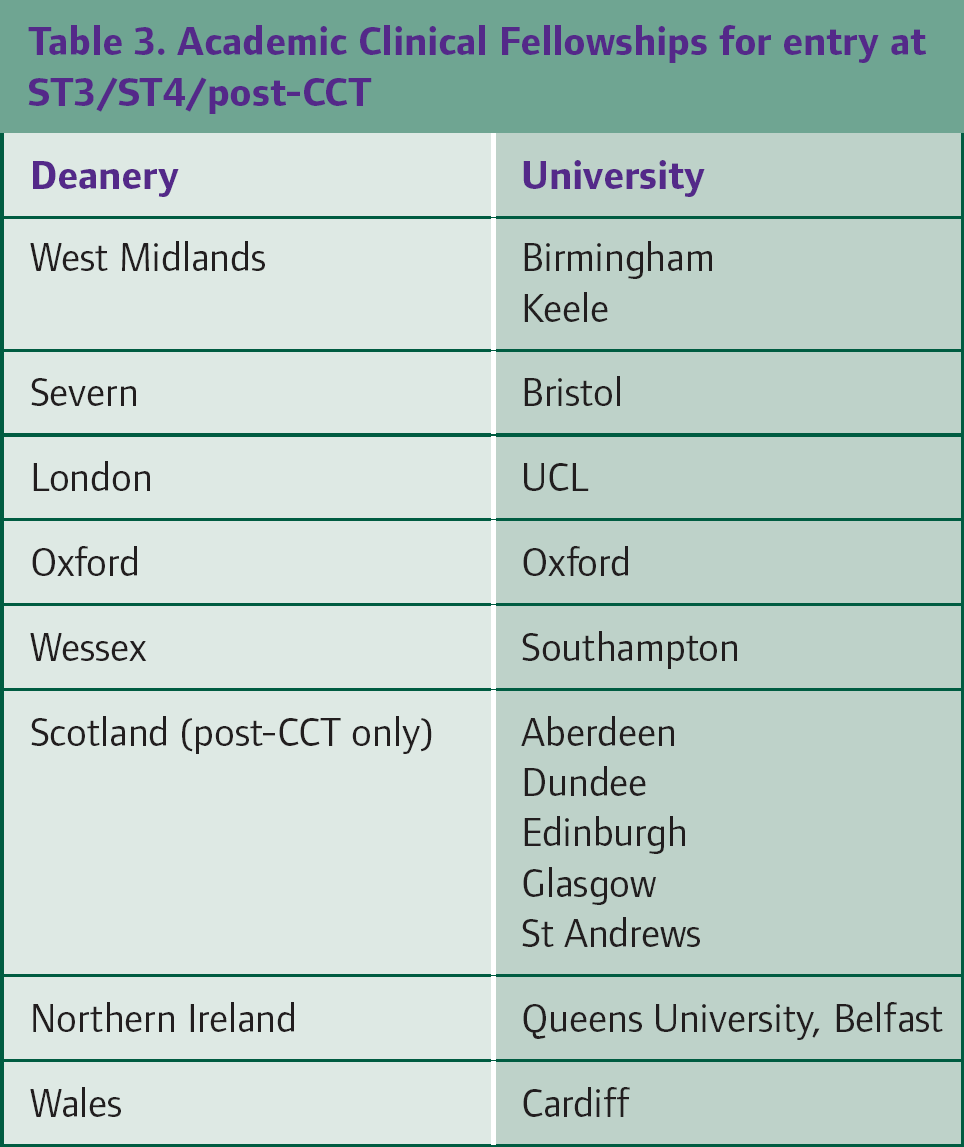
Trainees usually carry out small projects, which should lead to posters and presentations at local, national and international conferences as well as opportunities for journal publications. Projects are generally related to the department's interests, but some deaneries also allow educational research. If this career path is to be pursued for longer, the Fellowship can act as a springboard for applying for further research funding.
There are currently two nationally funded ST3 academic posts, which can only be in certain deaneries. More information about these can be found on the GP recruitment website. Other research training posts are available but tend to be locally funded and therefore more subject to change.
Clinical Commissioning and Leadership Fellowships
As changes to the delivery of health care are occurring, a number of 1 year training extensions are available to allow trainees to undertake further training in leadership and commissioning roles. These Fellowships allow trainees to gain the competencies set down by the Royal College of General Practitioners (RCGP) to become commissioning leaders. Trainees will be involved in a commissioning project throughout the year, which is combined with a four-session clinical component. Fellowships also allow the development of leadership skills in organizational and system issues. The focus is on service and transformational change with patient safety and quality of health care at its core. This might be a good opportunity for trainees who wish to become future health care leaders.
Service Improvement Fellowship
In common with the Commissioning Fellowships, Service Improvement Fellowships allow the trainee to be attached to senior clinical staff and work on projects in health improvement and service redesign, especially around areas that have been prioritized by local health policy and relate to the Quality and Outcomes Framework. This is combined with an academic component focusing on service and quality improvement measures, project management and leadership development.
Rural Fellowship
Currently, 11 post-CCT Rural Fellowships exist in Scotland. As Scotland has large areas of sparsely populated countryside and islands, GPs require enhanced skills in acute medicine and remote working, including evacuation procedures, to be able to work safely in these areas. The scheme allows newly qualified GPs the opportunity to experience rural medicine while retaining a mentorship. This fellowship includes BASICS training in pre-hospital emergency care and regular meetings with other rural fellows. Rural Fellowships are full-time 1 year posts that can be applied for once CCT is achieved.
Occupational Health Fellowship
Occupational Health Fellowships are offered in Scotland to introduce newly qualified GPs to occupational medicine. Those undertaking the Fellowship enter into training with occupational medicine trainees and work in a National Health Service (NHS) -based department of occupational health. Fellowships are 50% full-time equivalent (FTE) posts, with the other 50% used to maintain clinical competencies. There is an expectation that the Diploma of the Faculty of Occupation Health will be gained by the end of the Fellowship.
Health Inequality Fellowship
Due to the diverse nature of the Scottish population and the disparities between socio-economic groups, Fellowships have been set up to train GPs in health inequalities. The Fellow works clinically in an area of high deprivation while retaining protected time for an academic component that involves completing health inequalities modules on specified Masters (MSc) courses and undertaking a suitable, small research project.
Medical Education Fellowship
These Fellowships are designed for newly qualified GPs or, in some cases, GP trainees to gain experience of teaching and an understanding of quality assurance of medical education at both undergraduate and postgraduate level. The Fellowships are usually 50% full-time and registering for a qualification in medical education is encouraged. In addition, there may be scope in some of the Academic Fellowships for medical education and research.
Sustainable Health Care Scholarship
Health care institutions and providers are being strongly encouraged to decrease their carbon footprint and are subject to the government's Carbon Reduction Commitment, aiming to reduce emissions by 80% over the next few decades. This Fellowship helps the trainee to develop skills in sustainable medicine via a combination of academic input, such as support from the Campaign for Greener Healthcare and the RCGP's Climate Change and Sustainable Healthcare Lead, while undertaking a research project in sustainability to gain skills in problem analysis, business planning, project management and report preparation.
Substance Misuse Fellowship
The Substance Misuse Fellowship is designed to allow the trainee to gain additional skills in substance misuse management in the context of NHS contractual services. This will vary from the assessment and pharmacological and non-pharmacological interventions for misuse to the effects of addiction on society as a whole. This Fellowship would be ideal for those who have a special interest in the area of substance misuse. The Fellowship involves undertaking two sessions/week in the substance misuse service, extending the ST3 year by 3 months.
Others
This is not an exhaustive list of opportunities. There are other Fellowships that are available to trainees in all specialties, and these require permission for out-of-programme experience. Such Fellowships include the post of clinical adviser to the Chief Medical Officer or many Medical Education Fellowships, such as a clinical teaching fellow, which requires time to be taken out of GP training.
In conclusion
The various Fellowships are an ideal way for trainees or newly qualified GPs to gain some experience in a new area. There is often good mentoring and structure, which can lead to further interesting opportunities. One drawback might be the potential for a lower salary than GPs who are locuming or undertaking partnerships; however, trade off is better job security for the duration. If you are interested in applying for a Fellowship, early contact with the relevant deanery is advised as some posts can be quite competitive and evidence of interest from an early stage is useful. Discuss the role with its current incumbent and, if required, improve your curriculum vitae to give you the best possible chance of getting the job.