







Abstract
The UK has one of the widest ranges of contraception available; yet, one-third of pregnancies remain unplanned. In response to the Department of Health's National Strategy for Sexual Health and HIV, the National Institute for Health and Clinical Excellence (NICE) produced guidelines on long-acting reversible contraception (LARC). LARC is promoted as an effective way to reduce unintended pregnancies. The National Strategy specifically emphasized the need for primary care teams to support women in making informed choices about their contraceptive options. This article discusses one form, the contraceptive implant.
The GP curriculum and the contraceptive implant
Effectiveness rates, risks, benefits and appropriate selection of patients for all methods, including methods of emergency contraception Knowledge and availability of intrauterine methods of contraception and subdermal implants Health education and prevention advice—safe sex and risk reduction Use risk assessment to tailor advice and care accordingly, including advice on safer sexual practice Be aware of legal aspects of providing contraception and sexual health in under 16s (including child protection) Ensure that the doctor's own beliefs, moral or religious reservations about any contraceptive methods or abortion and about sexual behaviour and practices do not adversely affect the management of a patient's sexual health
The National Health Service (NHS) Information Centre reports that 9% of women attending community contraception clinics in 2009–10 were using the contraceptive implant and that 30 000 more implants were prescribed compared to the year before. The increased uptake may be due to wider availability of trained fitters, greater public knowledge, increasing acceptability and national targets to increase LARC use.
The contraceptive implant, also known as the subdermal implant or progestogen-only implant, is a progesterone-only LARC. The progesterone is embedded in a slow release carrier matrix that is covered by a rate-limiting membrane. It works principally by inhibiting ovulation. It also increases the viscosity of cervical mucus and causes endometrial thinning.
There are currently two types of implant used in the UK: Implanon and Nexplanon. They are bioequivalent, contain the same amount of etonogestrel and therefore have the same risk–benefit profile. The basic price for both implants is £79.46 on the NHS tariff.
Implanon was launched in the UK in 1999. It consists of a single 40 mm flexible rod measuring 2mm in diameter, about the size of a matchstick as shown in Figure 1. It contains 68 mg etonogestrel in an ethylene vinyl acetate matrix. In the first few weeks after insertion, Implanon releases 60–70 mcg etonogestrel. Thereafter, it provides constant low daily levels of 30–40 mcg etonogestrel. This is sufficient to suppress ovulation in most cycles for 3 years.
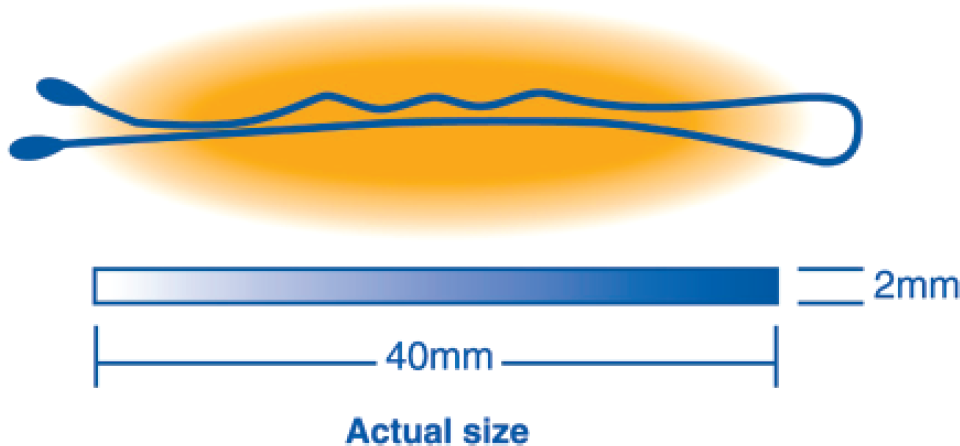
Contraceptive implant.
In October 2010, Nexplanon replaced Implanon in the UK. It contains a preloaded applicator designed to reduce deep insertions, and contains barium, allowing radio-opacity.
Implanon can no longer be ordered but existing stocks can be used. The Medicines and Healthcare products Regulatory Agency (MHRA) confirms that patients who have existing Implanon can be reassured and there are no new safety issues.
Practitioners may see patients from countries outside the UK with other contraceptive implants. These include the levonorgestrel implant Norplant that has six rods and the two-rod Norplant II (Jadelle). Both these are licensed for 5 years use.
Who is the contraceptive implant suitable for?
When discussing suitability for the contraceptive implant, practitioners should refer to the UK Medical Eligibility Criteria for Contraceptive Use (UKMEC) consensus guidelines relating to the safe use of contraception. Women whose medical histories place them in UKMEC 1 category may use this type of contraception without restriction. Of note, age, obesity and smoking status do not preclude contraceptive implant use.
UKMEC 2 suggests the benefits of contraceptive type generally outweigh the risks, but more careful follow-up may be needed. UKMEC 2 situations for contraceptive implants include hypertension, diabetes, history of thromboembolism, major surgery with prolonged immobilization and women with an undiagnosed breast mass.
UKMEC 3 indicates that the method is not usually recommended unless other methods are not available or not acceptable to the woman. In this situation, the method can be used with expert clinical judgement, usually via referral to a specialist. Situations classified as UKMEC 3 for the contraceptive implant include:
Active thromboembolism Migraine with aura, stroke (including transient ischaemic attack) or myocardial infarction while using implant History of breast cancer but no evidence of recurrence for 5 years Unexplained genital tract bleeding Active liver disease, e.g. hepatitis, severe cirrhosis, liver tumours including benign types Drugs that induce liver enzymes (e.g. rifampicin, antiretroviral drugs, St John's wort, certain anticonvulsants), which reduce contraceptive implant efficacy
Women using liver enzyme-inducing drugs for less than 3 weeks may continue with the contraceptive implant but additional barrier contraception should be used until 4 weeks after the liver enzyme inducer is stopped. Patients using long-term liver enzyme-inducing drugs such as antieplileptics and antiretrovirals should be advised to use a different contraceptive method.
UKMEC 4 describes an unacceptable health risk, that is, an absolute contraindication. Situations classified as UKMEC 4 are
current breast cancer having multiple UKMEC 3 conditions
In the unlikely event that a woman becomes pregnant while using a contraceptive implant, she should not be advised to terminate the pregnancy on this basis alone. There is no consistent evidence of risk to the developing foetus, although most data are from small observational studies of women using the combined oral contraceptive pill.
Animal studies have shown that very high doses of progestogens may cause masculinization of female foetuses. A very small number of cases of clitoral enlargement have been reported in humans but there have been no reports of serious abnormalities.
If the woman opts to abort the pregnancy, the implant can be left in place for ongoing contraception. If the woman opts to continue the pregnancy, the implant should be removed due to the theoretical risk of foetal virilization. There is also a theoretical risk that progestogen from the implant may interact with the progesterone receptor antagonist, mifepristone, used in medical termination.
Acceptability
An individualized approach to assisting women in choosing a contraceptive method is particularly important. Clear factual information should be given to the women as there are many myths about contraception, often gained from family and friends. Taking a relevant sexual and social history helps to identify motivation and likely contraceptive adherence, contraceptive preferences and prior contraceptive experiences.
Wider context
LARCs are particularly useful for women at risk of user failure or where an inadvertent pregnancy is likely to have a major psychosocial impact, such as unplanned pregnancies in young people. Like all progestogen-only methods, the implant may be particularly useful for women who are ineligible for or unwilling to use oestrogen-based contraceptive methods. It is also a convenient method to use following termination of pregnancy as it can be inserted immediately at the time of the procedure. Other contraceptive methods may be more appropriate if a woman has other medical symptoms, which could be addressed by using contraception for dual purposes, such as using the oral contraceptive to treat acne or dysmenorrhoea when other causes have been excluded.
How is the implant inserted?
Pre-insertion counselling is vital and all GPs should be competent to discuss this (see Box 1 for a summary of important points to cover). The procedure requires the administration of subcutaneous local anaesthetic to the site of contraceptive implant insertion and is carried out under aseptic conditions. The implant is inserted subdermally into the inner side of the non-dominant arm 8–10 cm above the medial epicondyle of the humerus.
Pre-insertion counselling.
The primary mode of action is prevention of ovulation The implant lasts 3 years Most women experience a change in their bleeding pattern. One-fifth of users will have no bleeding and almost half will have infrequent, frequent or prolonged bleeding. Bleeding is likely to remain irregular over time No causal association with weight change, mood change, loss of libido or headache Acne may improve, occur or worsen Little or no increase in risk of venous thromboembolism Ectopic pregnancy risk is reduced compared to using no contraception No evidence of a clinically significant effect on bone mineral density No evidence of delay in fertility following removal Additional contraception needed when timing of insertion outside of days 1–5 Opportunistic health promotion and testing for sexually transmitted infections
In order to insert and remove contraceptive implants, clinicians should undergo approved training. The Faculty of Sexual and Reproductive Health (FSRH) awards the Letter of Competence (LoC) for subdermal implants to those who have undergone suitable training and have a valid certificate from them, such as the Diploma (DFSRH). Eligibility criteria and details of how to proceed are available on the Faculty website (www.fsrh.org). Practitioners who hold a current training certificate or LoC for subdermal implants must update their skills to use Nexplanon, which was introduced in October 2010. Training can be accessed through the manufacturer's website at www.nexplanontraining.co.uk/HCPTraining.aspx. Nurses are also eligible for this training (see Royal College of Nursing training requirements).
Timing of insertion
Ideally, an implant should be inserted during days 1–5 of a menstrual cycle, or following a miscarriage, or a first trimester termination of pregnancy. If inserted beyond day 5, an additional contraception is needed for 7 days. An implant can also be inserted outside the terms of the product license on day 21 postpartum or following second trimester abortion; beyond this, 7 days additional protection is required. If prescribing off-licence, the professional must be reasonably sure that the woman is not pregnant or at risk of pregnancy.
Changing to a contraceptive implant from a combined hormonal method is possible during the first 5 days of the pill-free interval or at any time if the method was being used reliably. Implants can be fitted immediately following use of the progesterone-only pill or a previous implant and up to 14 weeks following depot medroxyprogesterone acetate (DMPA) injection.
Following insertion, the woman should be shown how to check the position of the contraceptive implant. If the implant is not palpable, it should be localized by either ultrasound scan or magnetic resonance imaging; Nexplanon can be visualized on x-ray. Routine follow-up is not necessary but some services review women between 6 weeks and 3 months after to assess side effects. A woman should be advised to return if she cannot feel the implant, if there is any change in the skin around the site of the implant, has pain, becomes pregnant or if she develops any medical condition that would contraindicate its use.
Implant removal
The implant can be removed at any time upon a woman's request. Following removal, etonogestrel levels decay rapidly over 1–2 weeks. Compared to the contraceptive injection, there is no delay in the return of fertility, with 94% of women ovulating within 3 weeks of removal.
Women who return on schedule for implant removal or replacement do not need to:
abstain from sexual intercourse prior to removal use additional contraceptive protection or use emergency contraception if sexual intercourse has occurred
However, immediately after the implant has been removed, clinicians should assume that fertility has been restored and the woman will need effective contraception if pregnancy is not desired.
Removal using a ‘pop-out’ technique is facilitated by the rigidity of the capsule and takes about 3 minutes to perform. It is important to discuss future contraception or any other relevant issues at this time. If removal proves difficult, specialist referral is appropriate.
Efficacy and controversies
According to the NICE, the pregnancy rate is less than 1 in 1000 women using the contraceptive implant over 3 years. However, the MHRA collected data over 11 years showing 584 women using Implanon became pregnant. This suggests a ‘failure rate’ of 0.014% per year.
In the last year, the Medical Defence Union, which represents around half of all GPs, paid out £100 000 in compensation for implant related issues. Pregnancies in implant users are usually due to incorrect timing of insertion, unrecognized non-insertion or drug interactions rather than true method failures. Therefore, the MHRA have reiterated the need for professionals to undergo thorough training before fitting the device. The MHRA will continue monitoring problems.
A study by Newton and Newton (2003) showed no pregnancies at 1 year among 78 implant users weighing over 70 kg. In women with a body mass index over 35 kg/m2, the manufacturer advises earlier replacement of the implant, but UKMEC recommends unrestricted use.
Benefits and problems with the implant
In addition to its high efficacy and 3 year lifespan, the implant is a useful contraceptive because it does not interrupt sexual spontaneity, can be used by women of any weight and also can be used during breastfeeding. Fertility returns to normal as soon as the implant is removed. Like other ovulation suppressants, the implant may improve dysmenorrhoea and the symptoms of endometriosis. However, it is not licensed for use as treatment for these conditions. Some women perceive the possible amenorrhoea as a benefit.
The main disadvantage is the changed bleeding pattern; 20% of women have no bleeding (more likely in older women), and 50% develop infrequent, frequent or prolonged bleeding, which does not improve over time. Other side effects reported in an integrated safety analysis of Implanon (Blumenthal et al. 2008) include:
headaches (15.3%) weight gain (11.8%) acne (11.4%) breast tenderness (10.2%) mood changes (5.7%) abdominal pain (5.2%)
Advise women that these should stop within a few months. Although some women develop acne, Blumenthal et al. (2008) reported in their study that acne improved for the same number of women.
The implant is not suitable for women using liver enzyme-inducing drugs for more than 4 weeks. It is important to emphasize that the implant does not protect against sexually transmitted infections, so safer sex with condoms is recommended in women at high risk of infection.
How to manage irregular bleeding
Irregular bleeding is the most common reason for premature discontinuation of the contraceptive implant. It is important to inform women before insertion that bleeding is likely to become erratic and to remain so during implant use.
Since the progesterone, etonogestrel, is the same as the metabolite of the oral progesterone-only contraceptive, Cerazette, some practitioners offer a trial of Cerazette before using an implant. This allows the woman to experience the likely bleeding pattern change without undergoing the insertion procedure.
When a woman using an implant presents with irregular bleeding, other causes such as sexually transmitted infections, pregnancy and cervical cancer must be excluded. Irregular bleeding can be managed with short-term mefenamic acid or ethinylestradiol (either alone or as the combined oral contraceptive pill).
Financial incentives for contraceptive services in primary care
Long-term use of the progestogen-only implant is more cost-effective than combined oral contraception and progestogen-only injectables. The implant is more cost-effective than the levonorgestrel-releasing intrauterine system (LNG-IUS) up to 3 years of use, but after that time, the LNG-IUS becomes more cost-effective. Although the intrauterine device is more cost-effective than the implant, the incremental cost-effectiveness ratio decreases with duration of use.
Under the Quality and Outcomes Framework (QOF) indicator Sexual Health 2 (SH2), practices can gain three points if women prescribed oral or patch contraceptives within the last 15 months had a discussion about LARC. Practices that have opted to provide a Local Enhanced Service (LES) for LARCs can also claim fees for insertion and removal of contraceptive implants.
Key points
Progesterone-only implants are highly efficient with a true method failure rate of 1 in 1000 and can be used by a wider range of women compared to other forms of contraception Nexplanon has replaced Implanon as the only implant marketed in the UK as it is easier to insert and locate, while the pharmacology and cost remain the same; however, existing Implanon users do not need to have their implants removed Clinical assessment for suitability should include a medical and sexual history, with consideration of the UKMEC guidance The timing and technique of subdermal insertion are essential in preventing adverse events