






Abstract
Background
Design
Methods and results
Conclusion
Introduction
The Incremental Decrease in End Points through Aggressive Lipid Lowering (IDEAL) [1] showed that in patients with coronary heart disease (CHD) high-dose atorvastatin as compared with 20-40 mg simvastatin reduced the incidence of first major coronary events [fatal and nonfatal myocardial infarction or resuscitated cardiac arrests, major coronary events (MCE)] by 11% [95% confidence interval (CI): −1.22], major cardiovascular disease (CVD) by 13% (95% CI: 2.22), any CHD by 16% (95% CI: 9.24), and any CVD by 16% (95% CI: 9.22). These results were associated with an average net difference in low-density cholesterol (LDL-C) of 23 mg/dl (0.6 mmol/l) between the treatment groups during the 5-year trial period.
The trial used a so-called prospective randomized open label blinded endpoint (PROBE) classification design where both patient and investigator knew the treatment assignments [2]. IDEAL showed that adherence was high in both treatment groups but there was a systematic higher adherence in the simvastatin group (95%) on average throughout the trial period as compared with the atorvastatin group (89%). In double-blind placebo-controlled trials, a differential in adherence is usually a rare observation [3, 4], but the PROBE design makes this more probable. More patients (50%) had been on simvastatin and for a longer time than on atorvastatin (12%) before randomization. Adaptations to simvastatin could therefore have been more prevalent. As IDEAL was a prescription trial without tablet counts we used adherence as a measure of compliance. We wanted to reanalyze some of the endpoint data in the IDEAL trial by adjusting for the differential in adherence between the treatment groups.
Methods
The IDEAL study was a multicenter, randomized trial in 8888 patients with a history of confirmed acute myocardial infarction. Its design and the principal findings on mortality, morbidity, and safety have been published earlier [1, 5]. In short, the patients were aged 80 years or below for both sexes who qualified for statin therapy according to the national guidelines in the six northern European countries recruiting for the trial. The main exclusion criteria were any known contraindications to statin therapy, previous intolerance to statins in low or high doses, liver enzymes greater than two times the upper limit of normal, and using other lipid-lowering drugs. Patients who were already treated with statins were included, except if they were already receiving a dose higher than the equivalent of simvastatin 20 mg daily. Randomization was done through a central interactive voice response system with equal allocation to either atorvastatin 80 mg or simvastatin 20 mg daily within each center and done by prescriptions. No run-in or wash-out period was observed. Patients were followed up by study coordinators and investigators at the clinical centers at 12 and 24 weeks and every 6 months thereafter. Patients on simvastatin could be titrated to 40 mg daily when their plasma total cholesterol at the 24-week visit was at least 5.0 mmol/l (190 mg/dl). Except for such cases lipid levels were not revealed to study personnel during the study. The reason why the PROBE design was chosen was because of nonavailability of a simvastatin placebo from its producer and too high costs of producing them for the purpose of this study only. When the design of a prescription study was used, the costs of simvastatin could be covered by the federal governments in each country (except Finland).
Lipids and lipoproteins were measured in the fasting state at baseline, 12 and 24 weeks, and half yearly thereafter. All measurements were done at a central laboratory in Sweden and no results were revealed to patients or investigators except in the need of titration.
All events were classified by an independent endpoint classification committee who had no information on study medication. The primary endpoint was a major coronary event — a composite of coronary death, hospitalization for nonfatal acute myocardial infarction, or resuscitated cardiac arrest. A secondary endpoint analyzed in this paper was any coronary event (MCE, revascularization, or unstable angina).
Statistical analysis
Overall adherence for each participant was defined as total study medication exposure (interval of time between dates of first and last dose, without regard to how many doses were taken in the interval) as a percentage of total follow-up time for all-cause death. Two groups of adherers were defined, those who had an adherence of at least 80% (adherers) and those who had less (nonadherers). Differences between adherers and nonadherers on baseline characteristics were tested by t-tests for continuous variables and by χ2 tests for categorical variables. Odds ratios comparing adherers and nonadherers were estimated with Wald 95% confidence limits. In such analyses adjustments for age, sex, smoking, history of diabetes, and statin use at randomization were done. Cox regression analysis with stratification by adherence status was used to calculate hazard ratios (HRs) and Wald 95% CIs. As interventions other than study medication may have taken place at hospitalizations for cardiovascular (CV) events, the analyses were repeated with follow-up time truncated at the first CV event. An additional analysis was performed where adherence/nonadherence was used as a time-varying covariate, assuming that the adherence differences throughout the trial was not because of postrandom treatment per se but rather because of reasons occurring before randomization or reasons unrelated to treatment after randomization. The PROBE design combined with greater selection of simvastatin-tolerant study participants than atorvastatin-tolerant study participants and extension to use high-dose statins at older age made such an assumption likely. The value of the time-varying covariate for each participant remained constant and reflected adherence until the date of last dose, at which time the value of the covariate reflected nonadherence. Different lag times, that is, intervals of times from last change in adherence status and event time or end of follow-up for an event was used to study the robustness of results. For example, for the 7-day lag analysis, a participant was considered adherent as long as the date of last dose was less than 7 days before an event time or the end of follow-up. Various lag times were used as changes in randomized treatment may take place as a consequence of signs and symptoms of disease deterioration close to the event and thus influence results. Instead of using adherence as a categorical variable, analyses were also performed with percent adherence as a continuous exposure variable. Results were, however, same for all practical purposes and thus are not given. A test of interaction between treatment group and previous statin use on outcome adjusting for adherence was performed by Cox regression analysis.
Statistical analysis was performed using SAS Version 8.2 (SAS Institute Inc., Cary, North Carolina, USA). All analyses were based on the intention-to-treat principle including all patients. Two-sided P values of less than 0.05 were considered as statistically significant; corrections for multiple comparisons were not done.
Ethics and approvals
The study was approved by the regional ethics committees in the participating countries and all included patients provided a written informed consent. The authors had full access to the data and took responsibility for its integrity. All authors have read and agreed to the manuscript as written.
Results
During the study, there were 979 patients with less than 80% adherence, 651 (14.7%) in the atorvastatin and 328 (7.4%) in the simvastatin group (P < 0.0001). Adherers and nonadherers differed in some of the risk factors as shown in Table 1. Adherers were somewhat younger and comprised more males. Adherers were more frequently on simvastatin and somewhat less on atorvastatin at baseline than nonadherers, also the use of β-blockers and aspirin were more frequent in adherers at baseline. Furthermore, although the distribution of smoking history was significantly different between the adherent and nonadherent participants (P = 0.005), among the non-adherent participants, a greater proportion of those randomized to simvastatin were current smokers (28.4%) than those randomized to atorvastatin (17.7%).
Table 2 shows that LDL-C and apolipoprotein B (apoB) levels differed between treatment groups among adherers. Average LDL-C was 25% and apoB was 22% lower in atorvastatin-treated patients than those on simvastatin. However, nonadherers on atorvastatin had about the same achieved LDL-C or apoB level as adherers on simvastatin therapy. Only in adherent atorvastatin-treated patients were HDL-C and apoA-1 slightly lower than in the other three groups.
Baseline participant characteristics by adherence
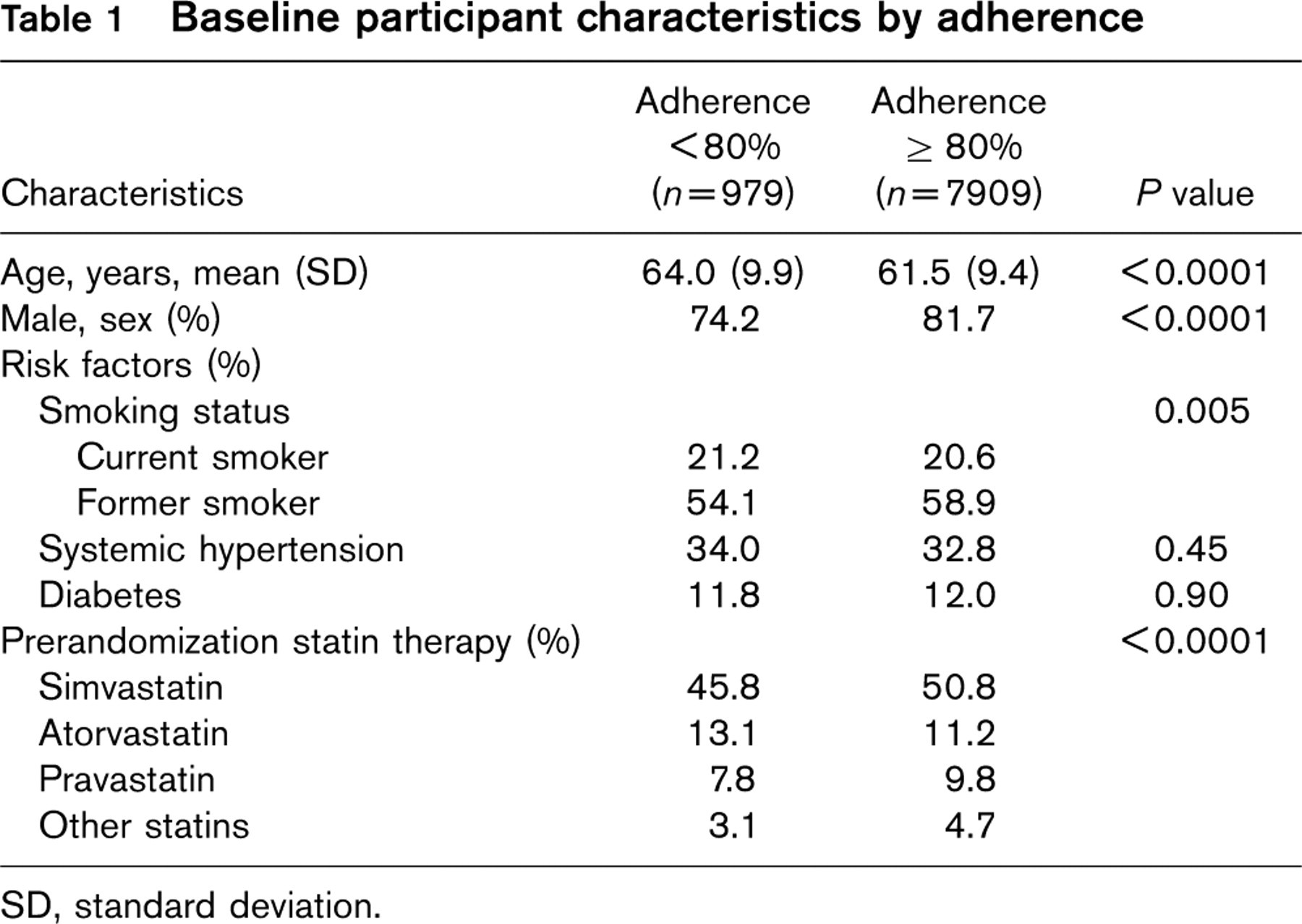
SD, standard deviation.
Average (SE) on-treatment lipoprotein components by categorical adherence and treatment group
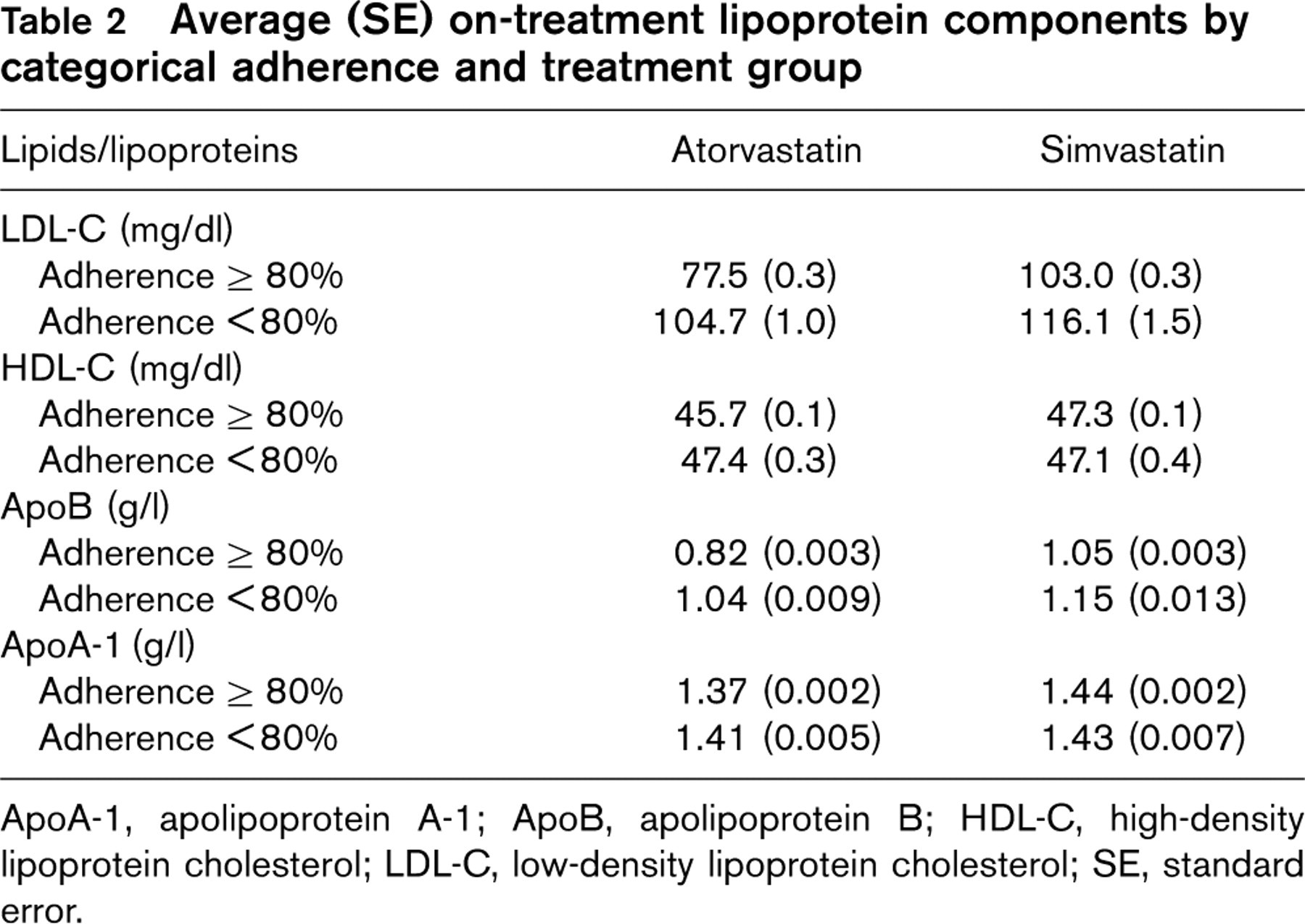
ApoA-1, apolipoprotein A-1; ApoB, apolipoprotein B; HDL-C, high-density lipoprotein cholesterol; LDL-C, low-density lipoprotein cholesterol; SE, standard error.
Figure 1 shows that the general level of CHD risk was higher in nonadherers as compared with adherers. This was as evident for MCE as for any CHD, but the most marked difference was seen for all-cause mortality, irrespective of treatment. Thus, nonadherers seemed to be a high-risk group not fully accounted for by their excess coronary risk. It seems that categorical adherence is a potential confounder for MCE, any CHD, and all-cause mortality risk. In the adherers relative risk reduction was 13% and in nonadherers 22% for MCE. For any CHD the risk reductions were 15.0% and 24.9%, and for all-cause mortality similar figures were 5.3% and 25.9%. When censoring was made at the first occurrence of any CVD, effect sizes improved slightly but 199 patients with a major coronary event were censored and the statistical power correspondingly reduced.

Incidence of events by categorical adherence status. CHD, coronary heart disease; MCE, major coronary event. ∗Censored at first cardiovascular event. Adherent/nonadherent hazard ratio unadjusted P value < 0.001 for all events in figure except any CHD event (P value for this event = 0.03); results were similar after adjustment for sex and baseline age.
A stratified analysis according to categorical adherence revealed an adjusted HR of 0.85 for MCE (P =0.019), which was slightly improved to 0.83 with censoring at the first CV event. This type of censoring diminished the HRs somewhat between adherers and nonadherers, but for any CHD only slight changes occurred as compared with the nonadjusted analyses. All-cause mortality outcome was improved from 0.98 to 0.90 with stratification (P = 0.14) and again slightly improved to 0.86 (P = 0.12) when censored at the first CV event. It is noteworthy that the estimate of HR for non-CV mortality was 0.79 (P = 0.042) in this stratified analysis. The results were similar after further adjustment by baseline smoking status (HR: 0.81; P = 0.07), suggesting that although there was an imbalance between the treatment groups for the adherent participants and thus a potential confounder, it does not fully explain this treatment difference.
The categorization of adherence is based on information partly obtained after events have occurred. Thus, these simple analyses could be misleading. A time-varying Cox regression analysis was performed with categorical adherence as a time-varying covariate that could be changed at each visit. For MCE endpoint results using different lag times, that is, times from last change in adherence status to occurrence of MCE, when a half-year lag time was used, the relative risk reduction was 14% (P = 0.024), whereas shorter lag times towards MCE slightly improved effect sizes to 15-16%. Censoring at the first CV event further improved estimates by about 2%. In all models adherers had almost 50% less MCE risk than nonadherers. Thus, the results were similar to those found using the simpler method of Cox regression with time-fixed categorical adherence.
The test of interaction between treatment group and previous statin use on outcome adjusting for adherence did not show significant interaction on the primary endpoint, possibly because of low power.
Discussion
This study showed that the original estimate of effect size for the primary endpoint in IDEAL might have been underestimated. The estimate increased from 11 to 15% when adjustments were made for differences in adherence between treatment groups. Both a simplistic stratified and a time-varying adherence-adjusted regression analysis found this increase. In addition, all-cause mortality tended towards a beneficial effect of atorvastatin when such adjustments were made. A high risk of all-cause mortality was noted in nonadherers and especially so in non-CV mortality. That endpoint result was more pronounced in the simvastatin as compared with the atorvastatin group, but was not apparent in the adherers. Adherers and nonadherers did not differ much in level of risk factors, medical history, or use of concomitant drugs and thus could not explain the high relative risk between nonadherers and adherers. Additional calculations of Cox regression parameter estimates for categorical adherence after adjustment for several risk factors measured on all randomized participants with MCE or non-CV death as the events were done. The maximum attenuation in the parameter estimates was 21% for MCE as the outcome and 15% for non-CV death as the outcome, and both still remained statistically significant (data not shown). Therefore, adherence remained a strong predictor of risk even after statistical adjustment for important risk factors. From earlier trials [6, 7] it is known that nonadherers to placebo may have higher mortality as compared with placebo adherers. It is also known that adherers and nonadherers to treatment regimens differ in psychological traits, educational level, and marital status etc. and that all are known to be associated with longevity. Such information was, however, not available in IDEAL.
Selection to nonadherence
Another point of consideration concerns the degree of selection to nonadherence in the two treatment groups. It may be that as nonadherence to simvastatin occurred less frequently than in the atorvastatin group, the simvastatin nonadherers were sharper selected including more patients with alcoholic, nutritional, and other psychosocial problems, which could be associated with high mortality in the simvastatin nonadherers. This is somewhat substantiated by the difference in smoking prevalences among nonadherers between treatment groups known to be associated with such disorders. Although 17.7% of the nonadherent atorvastatin patients smoked at baseline this was 28.4% (P < 0.001) in the simvastatin group. However, by adjusting for these differences the estimate of non-CV mortality risk reduction by atorvastatin changed only slightly, HR: 0.81 (95% CI: 0.64, 1.01; P = 0.067). No differences in smoking habits were observed in adherers (both groups 21%). The clinical importance of this finding is that clinical trialists should be particularly alerted to a potentially high morbidity and mortality in nonadherers and should follow them closely.
One hundred and ninety-nine patients got a CV event before the primary endpoint. At such hospitalizations, interventional cardiologists may have carried out procedures or changes in concomitant medications that could lower subsequent CV risk. As more first CV events occurred in the simvastatin as compared with the atorvastatin group this could equalize the HR of the primary event. An additional analysis was therefore performed where censorships took place at death or first CV event and it showed an improved relative risk reduction of atorvastatin as compared with simvastatin by about 2%.
The prospective randomized open label endpoint evaluation design
The first introduction of the PROBE design was presented by Hansson et al. [2]. Later, several trials have used this design, especially in the hypertension field. Such earlier trials with PROBE design have not reported on problems with differential adherence. These trials, however, have been comparative titration hypertension trials comparing two basic treatment principles and then adding more antihypertensive drugs when goals for blood pressure were not reached. Though, in the Nordic Diltiazem trial [8] as well as the hypertension part of the Anglo-Scandinavian Cardiac Outcomes trial [9] more additional drugs were needed in one group as compared with the other, but both differential adherence, often because of intolerance, and efficacy at the doses given could be the explanation.
As familiarization to simvastatin was greater than to atorvastatin and as we recruited patients up to 80 years of age, investigators may have been especially alerted to adverse events or laboratory abnormalities in the elderly treated with a high-dose statin as they were open to treatment allocation. We found permanent treatment discontinuations because of adverse events or laboratory abnormalities clearly higher on atorvastatin than on simvastatin. There were 427 (9.6%) who ended the trial because of adverse events in the atorvastatin group and 186 (4.2%) in the simvastatin group. Likewise, 38 (0.9%) and 8 (0.2%) ended the trial because of laboratory abnormalities in the two groups, respectively. By definition, adherers had far less adverse events resulting in permanent discontinuations of study drug than non-adherers. For myalgia proportions were 13.6 versus 0.2%, for diarrhea 4.6 versus 0.03%, for abdominal pain 4.7 versus 0.01%, and for nausea 2.9 versus 0%. Thus, the major reason may be a combined effect of these factors jointly limiting high adherence to atorvastatin somewhat.
The use of a PROBE design therefore has to be carefully considered. It has clearly weaknesses in its openness to treatment allocation that could result in different patient care by investigators leading to uncontrollable biases, especially in patient groups with less experience in the use of one of the treatments. Its strengths are the objective and independent assessments of endpoints, practice-oriented treatment on the part of the investigators, and the possibility of having patients entered as part of a routine treatment.
Strengths and weaknesses
The statistical methods used were, first a simplistic method with a time-fixed categorical adherence covariate, which may have yielded invalid results as adherence is a postrandomization time-varying variable. We also simplified the time-varying adherence analysis by classifying participants as adherent until their date of last dose. This was partly because of less reliable adherence data between first and last dose. MCE risk reduction was also fairly constant independent of reasonably chosen lag times. However, an underlying assumption for a valid interpretation of time-dependent Cox regression analyses is that treatment is not the cause of adherence status. In the IDEAL trial, change in adherence was in all likelihood associated with previous treatment experiences as 75% of patients were already on statins at baseline and clearly more and for a longer time familiarized to simvastatin as compared with atorvastatin. In addition, the relative inexperience of many investigators to use high-dose statin in the elderly could have limited the adherence. Furthermore, the withdrawal of cerivastatin from the market during the first part of the IDEAL study could have made both doctors and patients concerned about a high dose of a new statin (atorvastatin at that time), especially in the elderly. Thus, we believe that reasons for change in adherence status were less associated with effects of a treatment differential after randomization although such effects cannot be fully excluded, especially among the elderly.
Footnotes
Acknowledgements
This trial was fully sponsored by Pfizer Inc., New York, USA.
Conflicts of interest: Ingar Holme has received honoraria from Pfizer and Merck Sharp and Dohme for participation in Steering Committee meetings. Nilo Cater is an employee of Pfizer Inc., and Michael Szarek and Christina Lindahl were employed by Pfizer at the time of the study and preparation of the paper. Ole Faergeman has received consulting fees and/or honoraria from Pfizer, Merck Sharp and Dohme, AstraZeneca, Novartis, and Roche. John Kastelein has received honoraria, consulting fees, and/or research support from Pfizer, AstraZeneca, Merck, Schering-Plough, Bristol-Myers Squibb, Roche, Novartis, ISIS, Genzyme, Kowa, and sanofi-aventis. Anders Olsson has received honoraria and consulting fees from Pfizer. Matti Tikkanen has received honoraria from Pfizer and consulting fees from Pfizer, Merck Finland, and Orion Finland. Mogens Lytken Larsen has received honoraria from Pfizer, Merck Sharp and Dohme, and AstraZeneca, consulting fees from Genzyme and Merck Sharp and Dohme, and research grant support from Merck Sharp and Dohme. Terje Pedersen has received honoraria from Pfizer and Merck, consulting fees from Pfizer and Merck Schering-Plough, and research grant support from Merck Sharp and Dohme.