






Abstract
Background
Design
Methods
Results
Conclusion
Keywords
Introduction
Heart failure is common, costly, and deadly, and development of prediction tools for early initiation of treatment is of the essence. Left ventricular (LV) hypertrophy and dilation are markers of LV remodeling, which precedes heart failure. LV remodeling invariably involves a disturbed extracellular matrix turnover; therefore, the means of identifying this process is crucial. Extracellular matrix turnover is governed by an equilibrium between the degrading matrix metalloproteinases (MMPs) and their tissue inhibitors (TIMPs).
The concept of monitoring cardiac extracellular matrix remodeling by means of levels of circulating matrix biomarkers is attractive and promising [1], but needs more research on the population level. In the only other population-based study of correlates of matrix biomarkers to date, the Framingham Heart Study, MMP-9 and TIMP-1 (two of the markers most consistently associated with cardiovascular disease [1]) were related to a number of cardiovascular disease risk factors [2, 3]; and TIMP-1 was related to LV wall thickness and inversely to systolic function [2]. The N-terminal peptide of procollagen type III, a collagen turnover marker, was of limited value in that cohort [4]. In that project, a limited MMP-9 assay was used, and no diastolic function indices were included. No studies in European population samples have been conducted.
In smaller studies in samples of hypertensive patients, higher circulating TIMP-1 levels have repeatedly [5–7], albeit not uniformly [8], been observed in persons with LV hypertrophy [5–7] and diastolic impairment [6] or diastolic heart failure [7, 9]. In other small samples of systolic heart failure patients, increased circulating levels of MMP-9 [10–14] have been observed.
We hypothesized that the cardiac extracellular matrix remodeling intrinsic to heart failure progression is active already in the earliest, asymptomatic, stages of LV remodeling; and that cardiac extracellular matrix remodeling is reflected in altered levels of certain circulating matrix biomarkers. We accordingly investigated relations of serum MMP-9 and TIMP-1 levels to echocardiographic LV geometry and systolic and diastolic function, as well as to clinical cardiovascular disease risk factors, in a large community-based sample without history of heart failure or myocardial infarction or echocardiographic valvular disease.
Methods
Study sample
The Prospective Investigation of the Vasculature in Uppsala Seniors is a community-based sample of 1016 70-year-old residents of Uppsala, Sweden. For this study, we excluded participants with a self-reported history of myocardial infarction (n = 69) or congestive heart failure (n = 18), echocardiographic findings of valvular disease (n = 28), and those lacking serum matrix marker measurements (n = 10); rendering a sample of 891 persons eligible for further analysis, of which 468 (53%) were women. The study complies with the Declaration of Helsinki; Uppsala University Ethics Committee approved the research protocol, and informed consent was obtained from the participants.
Clinical and laboratory investigations
All participants were investigated in the morning after an overnight fast, as described in detail previously [15]. Briefly, a questionnaire was collected, anthropometric measures were recorded, blood samples were drawn, and laboratory analyses were performed [15]. Intra-arterial blood pressure recordings were obtained in the supine position using a catheter (20 G/1.10 × 45 mm) in the brachial artery connected to a pressure tube (150 mm) and a transducer (DTX Plus Transducer DT-XX, Franklin Lakes, New Jersey, USA); mean blood pressures during 5 min, at least 30 min after the arterial catheterization, were used.
The key laboratory variables of this study, serum MMP-9 and TIMP-1, were analyzed using commercial enzyme-linked immunosorbent assays provided by R&D Systems Europe Ltd (Abingdon, United Kingdom). Glass test tubes without any additives were used; 1 h after sampling, they were centrifuged and after that frozen at −70°C awaiting final analysis. When thawed, the samples had been frozen for a mean of 776 days (range 456-1124). When analyzing 20 participants twice on the same plate, MMP-9 and TIMP-1 had coefficients of variation of 5.4 and 4.8%, respectively.
Echocardiographic methods
A comprehensive two-dimensional and Doppler echocardiography was performed by one examiner (L.L.) as described previously [15]. LV ejection fraction was calculated from volumes obtained using the Teichholz formula [7 × D3/(2.4 + D)]. LV dimensions were measured with M-mode online from parasternal projections, using a leading-edge to leading-edge convention. Measurements included left atrial diameter, interventricular septal thickness (IVS), LV posterior wall thickness (PW), LV diameter in end-diastole and end-systole (LVEDD). LV wall thickness was calculated as IVS + PW relative wall thickness as (IVS + PW)/LVEDD, and LV mass = 0.8 × [1.04 × (IVS + LVEDD + PW)3-LVEDD3]+ 0.6g [16]. LV mass index was obtained by indexing LV mass to height2.7. As measurement of LV diastolic function, the LV diastolic filling pattern was used. This was obtained from the apical transducer position with the sample volume between the tips of the mitral leaflets during diastole. The peak velocity of the early rapid filling wave (E wave) and the atrial filling wave (A wave) were recorded and thus the E/A ratio was calculated. LV isovolumic relaxation time was measured as the time between aortic valve closure and the start of mitral flow using the Doppler signal from the area between the LV outflow tract and mitral flow.
Statistical analysis
Initially, distributional properties were examined and natural logarithmic transformation was used for non-normally distributed variables (i.e. serum MMP-9, TIMP-1, insulin, triglycerides, plasma glucose, and heavy exercise) in all calculations.
Linear relations of matrix biomarkers to echocardiographic measures were examined using Pearson's correlation coefficients. To examine nonlinear relations, we investigated levels of echocardiographic variables by quartiles of matrix biomarkers, using analyses of covariance. All these models, linear as well as nonlinear, were adjusted for sex, height, use of antihypertensive drugs, intra-arterial systolic and diastolic blood pressures, and freezer time, with the single exception of LV mass index, which was adjusted for all these covariates except for height.
Relations of clinical variables to the matrix biomarkers (MMP-9 and TIMP-1) were investigated in separate models using Pearson's correlation coefficients, adjusting for freezer time. Clinical variables that were significantly related to a matrix marker in these models were entered into backward stepwise multiple regression models (one model each for MMP-9 and TIMP-1) with a P value of less than 0.05 as condition for retaining the variable. Freezer time was forced to stay in these models. Interaction terms between sex and the matrix biomarkers were investigated in all models. Two-sided significance tests were used. The STATA 10 program (Stata Corp LP, College Station, Texas, USA) was used for all calculations.
Results
Clinical characteristics of the study sample are shown in Table 1. As there is uncertainty to how frozen storage affects serum levels of MMP-9 and TIMP-1 over time, we initially examined the correlation between these and the number of days the samples had been frozen. TIMP-1 levels were significantly related to freezer time (r = 0.10, P = 0.02) but MMP-9 levels were not (r = −0.04, P = 0.23). Therefore, all statistical models were adjusted for freezer time (days). In likelihood ratio tests comparing TIMP-1 models with and without the variable for freezer time, models with the freezer time variable had a better fit but TIMP-1 estimates in the two sets of models were nearly identical. None of the interaction terms tested was significant.
Clinical characteristics of the study sample
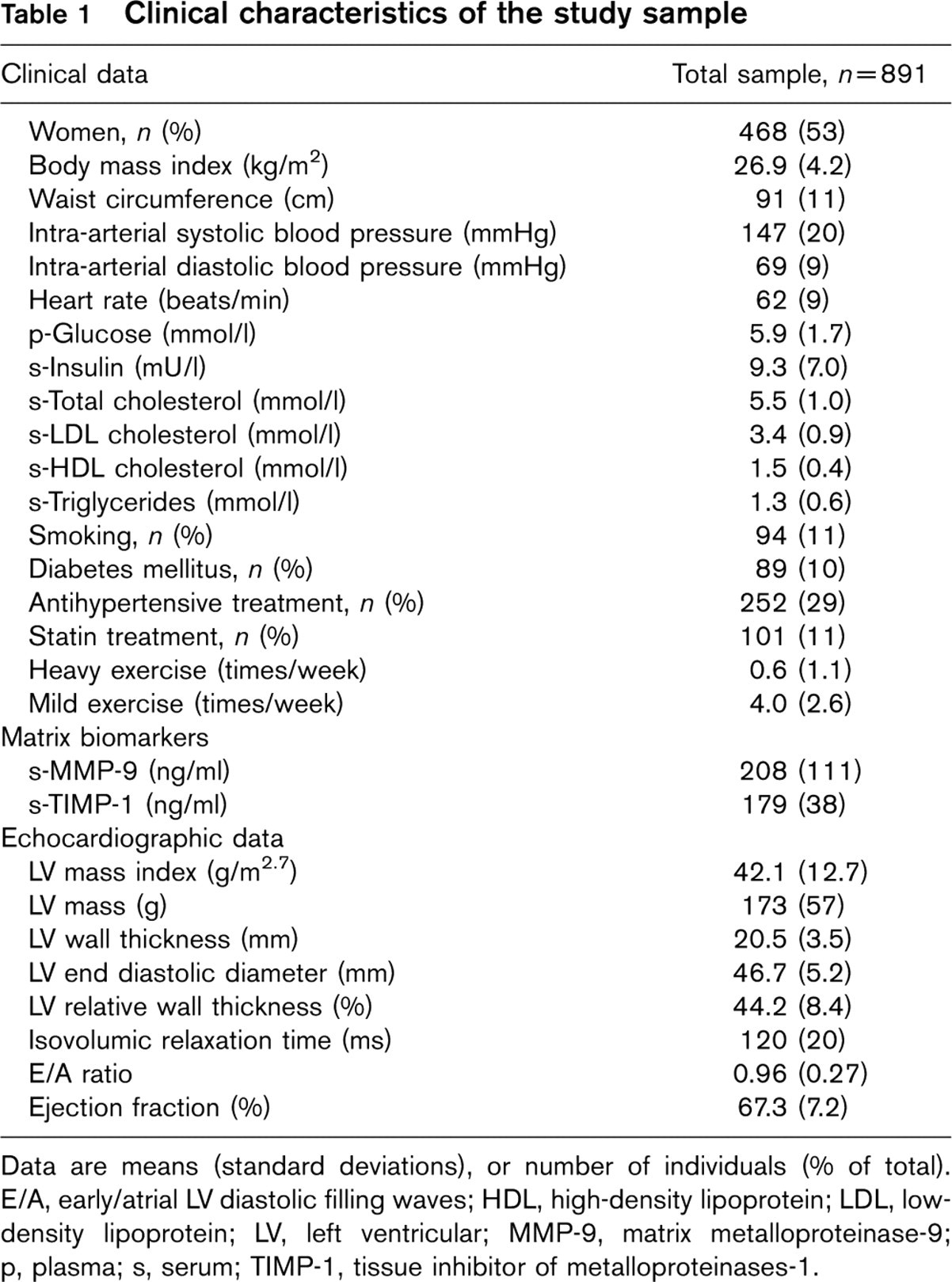
Data are means (standard deviations), or number of individuals (% of total). E/A, early/atrial LV diastolic filling waves; HDL, high-density lipoprotein; LDL, low-density lipoprotein; LV, left ventricular; MMP-9, matrix metalloproteinase-9; p, plasma; s, serum; TIMP-1, tissue inhibitor of metalloproteinases-1.
Echocardiographic correlates of serum matrix metalloproteinase-9 and tissue inhibitor of metalloproteinases-1
In models adjusted for sex, height, use of antihypertensive drugs, intra-arterial systolic and diastolic blood pressures, and freezer time, we observed a moderate direct relation of serum MMP-9 level to LV wall thickness and an inverse relation to isovolumic relaxation time, but no relations of MMP-9 to other echocardiographic measures, as shown in Table 2.
Adjusting for the same covariates, serum TIMP-1 was directly related to LV mass, mass index, wall thickness, and relative wall thickness, and inversely related to LV ejection fraction; but neither to the diastolic dysfunction indices nor to LV dimension (Table 3). In absolute terms, 32 g higher LV mass and 2.2 mm thicker walls were observed in the fourth compared with the first quartile of serum TIMP-1. The inverse relation of TIMP-1 to LV ejection fraction seemed slightly nonlinear, ejection fraction being clearly lower only in the highest TIMP-1 quartile (Table 3). Other relations did not noticeably deviate from linearity.
Cardiovascular disease risk factors and serum matrix metalloproteinase-9 and tissue inhibitor of metalloproteinases-1
The relations of a number of cardiovascular disease risk factors to serum MMP-9 and TIMP-1 levels were investigated through univariate and backward stepwise models, Table 4. Correlation coefficients were generally moderate. In backward stepwise models, serum MMP-9 was directly related to smoking, waist circumference, and heart rate, and inversely to total cholesterol. In univariate analyses, body mass index, glucose, and insulin were also positively related, and low-density lipoprotein cholesterol and high-density lipoprotein (HDL) cholesterol and frequency of mild exercise negatively related to serum MMP-9.
In backward stepwise models, serum TIMP-1 was higher in persons using antihypertensive treatment and in smokers, and was positively related to body mass index and negatively to HDL cholesterol. In univariate but not in backward stepwise models, serum TIMP-1 was directly related to waist circumference, intra-arterial diastolic blood pressure, heart rate, insulin, and triglyceride levels, and inversely to statin treatment.
Discussion
Primary observations
In this large community-based sample without history of heart failure or myocardial infarction or echocardiographic valvular disease, our main observation was that serum TIMP-1 levels were related to LV hypertrophy (mainly caused by thick LV walls) and inversely to systolic function, whereas serum MMP-9 levels were not consistently related to LV measures. This lends support to our hypothesis that cardiovascular extracellular matrix remodeling is active already in the earliest stages of LV remodeling; and that this process may be reflected in altered circulating matrix marker levels, mainly those of TIMP-1.
Relations of serum MMP-9 to echocardiography measures

Data are Pearson's correlation coefficients (r) and corresponding P values in the left part of the table (linear models); and levels of echocardiography variables by quartiles of MMP-9, and analyses of covariance P values for difference between the quartiles, in the right part of the table (nonlinear models). All models were adjusted for sex, height, use of antihypertensive drugs, intra-arterial systolic and diastolic blood pressures, and freezer time; except LV mass index, which was not adjusted for height. E/A, early/atrial LV diastolic filling waves; LV, left ventricular; MMP-9, matrix metalloproteinase-9.
Relations of serum TIMP-1 to echocardiography measures

Data are Pearson's correlation coefficients (r) and corresponding P values in the left part of the table (linear models); and levels of echocardiographic variables by quartiles of TIMP-1, and analyses of covariance P values for difference between the quartiles, in the right part of the table (nonlinear models). All models were adjusted for sex, height, use of antihypertensive drugs, intra-arterial systolic and diastolic blood pressures, and freezer time; except LV mass index, which was not adjusted for height. E/A, early/atrial LV diastolic filling waves; LV, left ventricular; TIMP-1, tissue inhibitor of metalloproteinases-1.
Cardiovascular disease risk factors and serum MMP-9 and TIMP-1
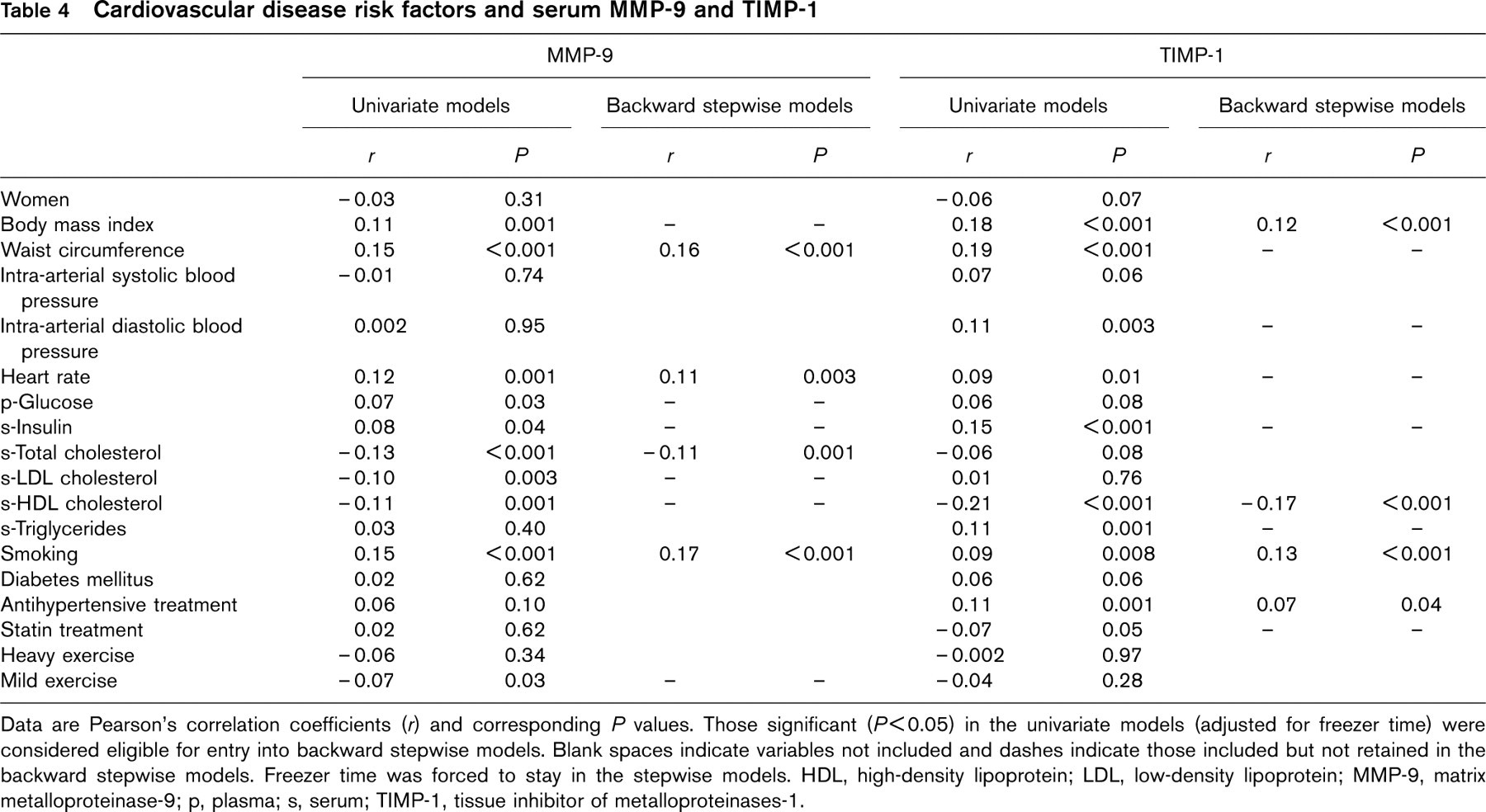
Data are Pearson's correlation coefficients (r) and corresponding P values. Those significant (P < 0.05) in the univariate models (adjusted for freezer time) were considered eligible for entry into backward stepwise models. Blank spaces indicate variables not included and dashes indicate those included but not retained in the backward stepwise models. Freezer time was forced to stay in the stepwise models. HDL, high-density lipoprotein; LDL, low-density lipoprotein; MMP-9, matrix metalloproteinase-9; p, plasma; s, serum; TIMP-1, tissue inhibitor of metalloproteinases-1.
Both MMP-9 and TIMP-1 levels were higher in smokers and were related to indices of obesity; MMP-9 was related to heart rate and inversely to total cholesterol; and TIMP-1 was related to antihypertensive treatment use and inversely to HDL cholesterol.
Echocardiographic correlates of serum matrix metalloproteinase-9 and tissue inhibitor of metalloproteinases-1
Comparisons with previous studies
The only previous population-based study of correlates of matrix biomarkers yielded almost identical results regarding the relation of TIMP-1 levels to LV measures [2]. Similar relations of TIMP-1 levels to LV hypertrophy have also been observed in smaller hypertensive samples [5–7]. In our population-based sample, we could not confirm the relations of TIMP-1 levels to diastolic dysfunction previously observed in small patient samples [6, 7, 9].
In the previous population-based study [3], MMP-9 levels were more strongly related to LV wall thickness than to LV dimension (albeit only in men) [3], which is confirmed in this study by the observed weak relation of MMP-9 levels to LV wall thickness, expanding that observation to the whole range of MMP-9 levels in the population. MMP-9 levels were not related to systolic function in this study. Hence, in this sample of relatively healthy persons, we could not confirm the relations of MMP-9 to systolic dysfunction or heart failure previously observed in small patient samples [10–14, 17].
Potential mechanisms
In animal models of heart failure on the basis of hypertension [18], myocardial infarction [19], volume overload [20], or rapid pacing [21, 22], pharmacological MMP inhibition reduces LV dilatation and preserves cardiac systolic function to some extent, but may also increase myocardial collagen content and cardiac stiffness [21, 22]. Thus, the balance is delicate between the collagen-degrading effects of the MMPs and the collagen-accumulating effects of the TIMPs. Transgenic animal models also support the notion of detrimental effects of MMP-9 and beneficial effects of TIMP-1 after myocardial infarction [23–25], showing the direct involvement of MMP-9 and TIMP-1 in LV remodeling. The timing of events is also important, as the transition from compensated hypertrophy to congestive heart failure has repeatedly been shown to coincide with increasing myocardial MMP activity [26, 27].
A possible interpretation of our observations is that circulating TIMP-1 levels start to increase in the earliest phases of LV remodeling, characterized by thick LV walls and an accumulation of collagen, which may decrease systolic function. TIMP-1 may play a direct role in this process. Diastolic function is likely also offset in this phase, but the E/A ratio may be too crude to capture this in a relatively healthy population-based sample. It is possible that circulating MMP-9 levels start to increase only with the development of more advanced systolic dysfunction, that is, when the LV starts to dilate. The temporal sequence of these events remains to be elucidated.
Cardiovascular disease risk factors and serum matrix metalloproteinase-9 and tissue inhibitor of metalloproteinases-1
We also noted a striking similarity in the clinical correlates of circulating TIMP-1 levels in this study and the earlier study of the Framingham Heart Study sample [2]. In both studies, TIMP-1 was related to smoking, body mass index, lipid profile, and antihypertensive medication use (considered a marker for hypertension), in multi-variable models [2].
In the earlier [3] as well as in this study, MMP-9 was related to heart rate in multivariable models. MMP-9 was also related to smoking in the earlier study in unadjusted models, and in this study in multivariable models. MMP-9 was inversely related to total cholesterol in this study.
Relations of MMP-9 and TIMP-1 levels to diabetes observed in the previous population-based sample [2, 3] were not apparent in this study.
Strengths and limitations
The large study sample and the absence of selection bias are beneficial. All participants being the same age discards a crucial confounding factor, but in contrast makes the results somewhat less generalizable. A downside of the ethnically homogenous population is an unknown generalizability to non-Caucasians.
The relative imprecision in the E/A ratio for measuring diastolic function may partly account for the lack of correlations to this variable. More recent methods such as tissue Doppler imaging or color M-mode should be encouraged in further studies of the topic.
There is an ongoing debate regarding potential preanalytical errors of MMPs and TIMPs. The release of these from leukocytes or platelets during sample handling has been suggested as a source of artificially elevated serum levels. The relations of serum TIMP-1 to cardiovascular disease risk factors and LV measures in this study was remarkably similar to the relations observed in the previous population-based study, which used plasma samples [2]. The decision of which is the best compartment for measuring matrix biomarkers (the level of MMP-9 release during the serum preparation process, that is, the ease by which MMP-9 is released as a response to a clotting stimulus, may be a physiologically important entity per se), as well as the question of which one to choose from the abundance of matrix biomarkers, should be answered in large prospective studies investigating prognostic importance. Another concern is indications that MMP-9 in plasma may degrade over time despite storage at −80°C, whereas TIMP-1 seems to remain stable [28]. The pattern and cause of this is not fully known and studies have, as far as we know, not been conducted on serum. In contrast, we found in our sample signs of a small but yet statistically significant increase of TIMP-1 but no certain change in MMP-9 over time.
Conclusion
Our observations support our hypothesis that cardiovascular extracellular matrix remodeling is active already in the earliest stages of LV remodeling; and that this process may be reflected in altered circulating matrix biomarker levels, mainly those of TIMP-1. It is possible that MMP-9 and other matrix biomarkers are more important later in the process, with the transition to overt heart failure. Circulating TIMP-1 levels may be a good summary measure of cardiovascular risk, as they are well related to the established risk factors for atherosclerotic disease as well as to thick LV walls, and inversely to systolic function.
To evaluate the clinical use of matrix biomarker measurements, a series of further studies is needed. First, large prospective studies are needed investigating the prognostic role of matrix biomarkers for development of cardiovascular events in population-based studies, including studies with serial echocardiograms. Second, studies investigating the role of matrix biomarkers in aiding the decision of and for monitoring effects of cardiovascular pharmacotherapy (e.g. with the synthetic MMP inhibitors currently under development) are warranted.
Footnotes
Acknowledgements
Sources of support: the Swedish Heart-Lung Foundation, the Swedish Research Council, and Uppsala University. None of the work presented in the article has been presented before. No perceived conflicts of interest exist for any of the authors.