







Abstract
Scholarship in urban sociology has pointed to the reliance of city governments on ever–more market mechanisms for organizing social and economic policy. This form of governance involves prioritizing cities’ cultural and social assets for their value in a global competition of urban “brands,” each competing for new infusions of human and investment capital. At the same time, however, cities have been at the center of seemingly progressive policy efforts aimed at promoting innovation, sustainability, and creativity. These themes represent a newly dominant planning discourse in cities across the globe. While researchers have thoroughly examined how “creative classes” and “creative cities” may exclude everyday, working–class, or poor residents, new urban imaginaries focused on sustainability potentially imply less stratified urban outcomes. Analyzing two high–profile interventions in Buenos Aires, Argentina—a sustainable urban regeneration plan for the historic downtown, and the creation of an arts cluster in the impoverished south of the city—this paper argues that despite divergent narratives, creative and sustainable urban projects suggest similar policy agendas, planning assumptions, and relationships to market mechanisms. Increasingly, global policies, whose design and objectives may appear to contradict market logics, may have outcomes that further them.
Introduction
At the 2013 ribbon cutting for Buenos Aires’ newly pedestrian downtown, Mayor Mauricio Macri hailed the creation of Latin America's “first green center,” redeveloped for people rather than automobile traffic (La Razón 2013). The project reflected the administration's promotional activity, which had plastered public spaces with a new slogan: “Buenos Aires: A Green City.” A few miles away, in the impoverished south of Buenos Aires, sustainability and creativity came together in the city government's establishment of “creative districts,” said to overcome unequal urban development by subsidizing nonpolluting industries such as the arts, design, and technology. Consistent with the inclusive rhetoric of the mayor, the city's Director of Creative Industries insisted that a creative city is an integrated, sustainable, and socially equitable city, in which residents from the south's many shantytowns must be included.
These were not the pronouncements of utopian–minded politicians or progressive urban planners, but the official policy of a center–right administration. 1 This rhetoric makes it hard to perceive the persistent accusations of critics of the local government for its cozy ties with developers and promoting cutbacks to public housing (see Rodríguez et al. 2011 for an overview). Local governments, of course, are prone to packaging public policy in language that departs from its most controversial objectives. But these policies are not purely marketing. Across many contemporary planning discourses, what might be considered a new normative policy script is being put into practice. It is hardly uniform or concrete, but on balance it suggests cities should be participatory, diverse, and sustainable. They should harbor creativity and innovation. And, they should have spaces of diversion and collective encounter. This programmatic discourse gives expression to the goal of competitive urban policies (McCann 2011). It is the topic of international conferences for city managers and the subject of intervention for transnational policy consultants (Prince 2012).
This vision of the “good city” is a real guide to action across a number of institutional settings in Buenos Aires, where practitioners take the importance and impact of these goals seriously. As a repertoire of institutionally imbedded values, it constitutes a travelling set of urban best practices adapted to the exigencies of local circumstance. Everyday planners and city officials are, of course, aware of the high levels of acceptance these discourses have achieved in local policy circles. Yet, place–based specificities mean that they are more likely to be modified as a set of guiding orientations (González and Healey 2005), rather than a strict suite of policies.
But what does creativity have to do with sustainability and why have both of these policy goals generated seemingly universal attention from planners and policy makers in recent years? If postindustrial competitive city priorities indeed involve a “deregulatory race to the bottom” (Jessop 1998, p. 79), would this not suggest that ecological variables and human needs would be increasingly neglected by urban states, rather than assume a privileged role in urban policy agendas?
This paper examines two state–led urban interventions in Buenos Aires. Since a constitutional reform in 1994, Buenos Aires holds direct elections for mayor (jefe de gobierno) and city council (legislatura), and is administered through ministries such as Culture, Urban Development, Public Space, etc., staffed by and reporting to the mayor. 2 The city government (conceived here as the mayor, his appointed heads of city ministries, and the urban planners and officials within them) has framed these two interventions around sustainability and creativity. The first is a restructuring of the historic downtown banking district, said to be a sustainable regeneration project. The second involves the creation of creative clusters, in this case, an arts district (Distrito de las Artes) in the downtrodden south of the city. 3 The administration of Mayor Mauricio Macri developed and implemented both projects. Elected in 2007, Macri's business–friendly administration has reduced spending on housing and social programs, cracked down on informal vendors, and engaged in protracted conflicts with squatters and social movements tied to housing (Guevara 2014; Rodríguez et al. 2011; Videla 2011).
In analyzing these projects, I argue that there is a gap between public policy, planning narratives, and outcomes that is similar in both cases, despite their divergent language. This article thus brings together questions that have often been treated separately, such as the uses of public space in creative city policy (Sager 2011) and the role of “green urbanism” initiatives in environmental gentrification (Curran and Hamilton 2012; Rosol 2010). In doing so, creativity and sustainability are analyzed as interrelated planning idioms, each serving to open up undercapitalized areas of Buenos Aires for investment. These policies seek to impose an image of Buenos Aires as clean, open, and culturally exciting, thus making the city more attractive for middle–class residents, investors, and visitors.
Urban scholars have long pointed out that, despite the language of human expression, cultural citizenship, and diversity, using creativity and culture as instruments of urban redevelopment may result in displacement (see Miles and Paddison 2005 for an overview). Though city officials typically cast cultural projects as efforts at strengthening interest in tradition and history, they often embed powerful economic growth agendas (Gotham 2005). Similar to creativity discourses, Greenberg (2013) notes how sustainability initiatives often appeal to nonmarket values such as ecological preservation and community resilience, though city governments may mobilize these narratives in service to market–oriented goals.
The aim of this paper, then, is not to identify the well–documented inequalities embedded in creative city policies (see Peck 2005). Rather, it seeks to untangle the aims and outcomes of new urban policy narratives that share a “win–win” vision of urban development in which competing interests and priorities are absent. 4 Put concretely, both creative and sustainable urban policy frameworks tout potentially nonmarket values to address competitive market pressures. In this sense, the creative city is but one iteration in what has come to encompass a broader range of policy agendas that include issues of sustainability, traditionally thought of as representing a constraint on urban growth (Campbell 1996; Greenberg forthcoming). 5 Ostensibly seeking to rectify problems characteristic of Latin American cities—segregation (Portes and Roberts 2005), exclusion (Auyero 2000; Caldeira and Holston 1999), and territorial imbalances (Centner 2009; Ciccolella 1999; Libertun de Duran 2006)—these projects stress progressive goals such as cultural expression, ecological integrity, and socioterritorial integration, even as scholars note the hardening of social and class boundaries in Buenos Aires (Grimson 2008) and cities around the world.
New Urban Planning Narratives
As Richard Florida was publishing his now canonic text on the Creative Class (2002), Buenos Aires could not have seemed further away from this triumphalist vision of the urban good life. The quickly spreading millennial discourse on creativity, culture, tolerance, and diversity would have seemed odd to municipal officials caught up in an economic crisis that enveloped Argentina in late 2001 and sent the country into a spiral of devaluation, inflation, and street protest for much of 2002.
Fortunately, the administration of then Mayor Aníbal Ibarra (2000–2006) would soon find itself with an asset that potentially transcended Buenos Aires’ structural deficits. The country's sharp currency devaluation in 2002 transformed Buenos Aires from one of the most expensive cities in the world to one of the cheapest, producing a dramatic increase in international tourism, a development the city government was eager to exploit economically (Centner 2007, p. 20). Moreover, the city's history of artistic production, legacy of cultural syncretism, and disinvested yet sophisticated urban amenities fit neatly within an emerging esthetic of hipster cool, which in the parlance of international guidebooks now almost universally cast Buenos Aires as a delightful example of urban shabby chic (Dávila 2012, p. 137; Luongo 2003).
In some respects, it was unsurprising that Buenos Aires should become “the culture capital of Latin America” as the city government would have it following the crisis (Bayardo 2013, p. 105). In fact, Buenos Aires had, since the early 20th century, been a pioneering player in the regional culture industries. Its voracious reading public was well known to the publishing industry, its cinema penetrated the Latin American market since the mid–20th century (King 2000, ch. 3), and its colossal opera house was ranked among the world's best for its acoustics, notwithstanding its monumental scale (Benzecry 2011).
Yet, historically, the place of culture in government involved professionals largely cut off from the exigencies of the market (Getino 2003, p. 77; Yúdice 2003, ch. 1), though not necessarily the electoral strategies of local politicians (Landi 1984; Sarlo and Altamirano 2001; Sigal 2002). However, as the city government sought to squeeze more economic development out of cultural industries, cultural promotion found a place on the radar of city ministries like Economic and Urban Development. As the mayor put it in the aftermath of crisis, Buenos Aires was not going to compete with “slave labor,” though the city “did have creativity” (Centner 2007, p. 22).
The city's Ministry of Culture increasingly infused economic and urban policy with cultural cachet through the organizing of international festivals, the redevelopment of museums in particular districts, and tourism promotion (Kanai and Ortega–Alcázar 2009; Lacarrieu 2008; Luker 2010). This cultural branding of economic and urban policies hardly represented a dramatic institutional shift, and indeed the central work and responsibilities of each ministry remained largely the same. What creative city discourses had produced institutionally is what Peck (2012, p. 467) refers to as a “weak center,” a process of institutional learning in which a fragile consensus on the desirability of creative city policy sits at the nexus of culture, the economy, and urban development. In practice, rather than representing a wholehearted embrace of “mobile” urban policies adopted from models abroad, the city government's embrace of creativity represented a soft institutional orientation and set of organizing skills cultivated by outward–looking city leaders and inculcated within the ranks of various city ministries. Thinly held together by a shared vision of the economically competitive creative city, this loose set of policies and discourses represented a subtle but important shift for the institutional imaginings of the city government.
For example, the city's Ministry of Culture created an institute for studying the cultural industries in the early 2000s. It organized international festivals for tango, film, and jazz that energized the cultural theming of the city and increased economic activity. Meanwhile, Buenos Aires secured UNESCO status for tango, hosted international conferences on the creative industries, and managed to be designated UNESCO's first City of Design.
But then something peculiar took place. With the election of Mayor Macri in 2007, the city government's discourse on creativity and its long arm into urban design grafted easily onto increasingly global planning discourses intended to make the city more sustainable with green urban development. The creative city was also a more pedestrian–centric city; a city of bicycle lanes, LED lighting, and more and better quality public spaces. As While et al. (2004, p. 550) note, negative environmental issues such as pollution, traffic, or waste have to be eliminated in the production of positive city images meant to foster new investment. Representing a “sustainability fix” (While et al. 2004) or “sustainability edge” (Greenberg forthcoming), so–called entrepreneurial urban governance (Harvey 1989) indicates that cities are adopting a more active role in pursuing and developing investment opportunities such that environmental concerns are “problems to be banished from the city undergoing redevelopment and integration into the new economy” (Jones and While 2004, p. 144). In cities across the globe, then, there is a blurring of the boundaries between postindustrial restructuring rooted in creative urban agendas and the rise of socioenvironmental initiatives, such as the “greening” of public space (Checker 2011), the growth of urban gardening in formerly abandoned areas (Rosol 2010), and the installation of bike lanes and other forms of sustainable transport.
The Smart–Innovative–Sustainable–Creative City
Plan Microcentro, redesigning downtown, a smart urban planning project that focuses on using innovative and inclusive technology for the renewal of public spaces in downtown Buenos Aires, creating a more sustainable, innovative, creative, and livable city.
– Government Description of Plan Microcentro at the Smart City Expo, Barcelona 2013
Cities’ important role in the production of cultural industries is not new. The literature on the creative economy is multidisciplinary, spanning sociology (Lloyd 2006; Zukin 1995), cultural geography (Peck 2005; Scott 2006), urban planning (Landry 2008), and economics (Markusen et al. 2008), among other fields. Defining the creative economy and its constitutive sectors has been the subject of significant debate (Markusen et al. 2008).
Culture too is a famously difficult concept to pin down. Because of this malleability, creative city discourses may represent more of a loose orientation than an economic program per se. Urban spaces and practices that have little to do with creative employment sectors, such as graffiti or street art (Banet–Weiser 2011), local markets (Bubinas 2011; Gonzalez and Waley 2013), or new public spaces such as New York City's High Line (Loughran 2014), may be attractive to local governments because they project an image of creativity and leisure at the center of these agendas without in fact being readily translated into new cultural industries.
On the other hand, much research on contemporary urban politics suggests that there is a move away from public control of public goods. Some label the trend of city governments adopting ever–more market–led policies as neoliberal urbanism (Hackworth 2007; Wilson 2004), while others have noted that urban governance increasingly requires that authorities willingly abdicate state responsibilities to the market in the context of a global competition for investment (Peck 2005). Formerly public goods such as education or housing may be privatized. In fact, here is an erosion of the meaning of the public when state–managed spaces increasingly serve private interests in the form of business improvement districts (Ward 2006) or park conservancies (Low et al. 2005).
Neoliberal policy agendas, however, go beyond the extension of market mechanisms to urban amenities. As Dávila (2012, p. 5) notes in a study of three sites in the United States and Latin America, culture as an object of urban policy innovation brings together multiple dimensions of economic reorganization. Culture's increased importance responds to free–trade principles prioritizing competitive local industries such as tourism services, while at the urban level entrepreneurial governance is evident in the upgrading of specific districts through cultural meanings conducive to investment. Indeed, tourism has become a significant policy concern for municipal governments around the world (Hoffman et al. 2003; Judd and Fainstein 1999). In turn, city officials have paid increased attention to the cultural or “symbolic” dimensions of urban economies, which facilitate place marketing strategies tied to consumption and entertainment (Urry and Larsen 2011; Zukin 1995).
Sustainability policies can express similar logics, particularly when they signal new opportunities for growth in undercapitalized districts. Much like creativity, sustainability can easily mean any number of things including antisprawl, so–called smart growth (Barnett 2007; Glaeser 2012), green urbanism based on energy–efficient architecture and innovative design (Lehmann 2011), as well as diverse policies aimed at making cities less automobile–dependent. As a planning policy, sustainability dovetails with many New Urbanism discourses (Ellis 2002; Katz et al. 1994), which suggest that it can offer the “tripartite” benefits of economic growth, social equality, and ecological responsibility (Gibbs et al. 2013, p. 2051). Though community activists and some multilateral institutions have included social justice priorities as part of creating sustainable places (Agyeman et al. 2003, ch. 1), more often the term covers any number of urban agendas that can reasonably claim to make the city more accessible, verdant, or clean.
And not all sites are worthy of environmental concern. As has been pointed out in cities such as New York (Checker 2011), bike lanes and particular public spaces are a priority, though less so lead paint or similar environmental conditions of high–poverty neighborhoods. While the south of Buenos Aires and its metropolitan region contain one of the most polluted and dangerous bodies of water in the world (Auyero and Swistun 2009; Berros 2012), the city center and its surroundings have been the locus of local greening efforts. This selectivity of environmental concerns provides insight into institutional priorities.
In what follows, I use a case study approach to examine two prominent local interventions in Buenos Aires framed around creativity and sustainability: Plan Microcentro, a state–led effort to redevelop and design the city's downtown business district, and the Macri administration's creation of an arts district (Distrito de las Artes) in the distressed south of Buenos Aires (Figure 1). I develop two themes embedded in creative and sustainable interventions: competitive city legitimation strategies, and the role of nonmarket values in producing consensual, “win–win” narratives for redevelopment. Sustainability and creativity are thus used as interrelated strategies with similar results. The outcome of each project includes higher land values, the displacement of the urban poor, and the remaking of these districts for tourism.
Methods and Case Overviews
This research employs a multimethod approach consisting of semistructured interviews with residents, stakeholders, and officials within the city government's ministries of Culture, Economic Development, Urban Development, and Public Space, along with an analysis of government plans, media reports, and official statements of local actors. Among “expert” interviews (n = 8), informants consisted of officials and ex–officials in the above ministries as well as two legal advisors to two different members of the city council. Of the interviews with city government officials and ex–officials (not including legislative aides), three represented “top” officials, the definition of which here is either the ministerial level (e.g., the city's Minister of Culture) or those reporting directly to the ministerial level. The others represented middle–range city officials, with others reporting to them, however, without direct organizational contact with the ministers of their respective areas. I also conducted fieldwork consisting of dozens of semistructured and informal interviews with neighborhood residents and stakeholders, while conducting participant observation at various local institutional events such as community boards, political protests, and neighborhood fairs between July 2012 and September 2013. 6
Plan Microcentro
Appeals to public space have special resonance in Argentina, as a venue that came to represent pluralism and encounter during the country's transition to democracy in the 1980s (Gorelik 2008). When the center–right local government came to office in 2007, its urban development plans centered upon the idea of producing a more “humane” city—a city that was less congested, with more green space—in short, a city in which it was pleasurable to be. The Plan Microcentro fits within this vision: The new downtown would open up more public space for residents. It would have “green” transportation alternatives such as bike lanes and pedestrian corridors, and novel forms of waste collection like subterranean trash receptacles.
Although the plan Microcentro did not break ground until late 2012, planning for the project began several years earlier. The Microcentro is the city's historic business district, known for its concentration of financial institutions. The symbolic center of the district is the calle Florida, a 10–block pedestrian shopping zone with some of the highest commercial leasing prices in Argentina. The street attracts thousands of strolling office workers and international tourists attracted to its leather and tango memorabilia stores, as well as a number of international chain stores such as Zara.
Despite the area's rich architectural heritage, it had in recent years suffered from neglect. Scavengers picked through the copious amount of public refuse, and informal vendors competed with formal merchants, showcasing their goods over blankets on calle Florida's pedestrian corridor. Urban projects elsewhere in the city impinged upon business ties to the historic downtown. The building of skyscraper offices nearby, and later the redevelopment of nearby docklands into shiny office space (Jajamovich 2012) created a strong attraction for businesses looking to move out of the outdated Microcentro. In the midst of these changes, storeowners began their own campaign against informal vendors, organizing under the auspices of the powerful Confederation of Argentine Medium–Sized Firms. The protests registered strong reactions in the media, which devoted significant attention to the purported decay of the city's most prestigious pedestrian shopping street.
Responding to these concerns, the Plan Microcentro's goals included the following items:
Leveling of streets and sidewalks to make them pedestrian–friendly. Upgrading of streets and avenues with new lighting, trees, and signs. The ordering of public space to do away with illegal advertising, public telephones, and wires. Repair and illumination of historic facades. Organizing of transit with increased bicycle lanes. New trash and recycling containers stored underground. More culture and tourism offerings. Increased security cameras and police presence.
The Distrito De Las Artes: Building An Arts Cluster
In a marathon session in the final meetings of the city council's 2012 legislative year, the mayor's ruling bloc and the opposition agreed upon a battery of urban projects requiring votes that neither of the parties could muster on their own. The mayor's party agreed to rezone city–owned land for a housing program, while the opposition agreed to approve the new Distrito de las Artes, an arts district mostly confined to the poor but touristic neighborhood of La Boca.
La Boca's few blocks of multicolor tenements (conventillos) represent a prominent touristic theme for the city and a must–see landmark for international tourists. Though the tenements are meant to portray the late–19th and early–20th century conditions of Italian immigrants in the neighborhood, their surroundings tell of a much longer trajectory of poverty. La Boca is a socially divided neighborhood with ramshackle zinc–roofed dwellings along its polluted border with the Riachuelo inlet, abandoned factories testifying to its mid–20th century industrial production, and a sizable number of lower middle–class residents who remained despite an exodus in the latter half of the century (Herzer 2008). The neighborhood has a long tradition of artistic production, most famously, the “birthplace of tango,” and produced a number of Italian–Argentine painters who came to express the processes of modernization and immigrant nostalgia for which the district is known.
For the neighborhood to be consolidated as a major space of tourism, the city reshaped the unevenness of its social and cultural infrastructure. Currently, tourists are mostly bussed to the picturesque multicolored street of Caminito. They cannot stray far from the bright restored tenements, tango–themed bars, and souvenir stands, since the neighborhood is otherwise dominated by “real” tenements, informal housing (asentamientos) (Rodríguez et al. 2007, p. 62–64), and high rates of petty crime (Guano 2003). The city's Minister of Economic Development, in charge of the creative cluster policy, sees the arts district as one way of consolidating the neighborhood for international tourism. With the development of the district, “…tourists could stay one more day in Buenos Aires, with all that would imply economically” (Fernández Fronza 2012).
The city's Director of Creative Industries frames creative district policy as having progressive goals, premised on lessening the erstwhile divide that separates the wealthy north of Buenos Aires from the south. The district's promotional material suggests that by spurring investment in these neighborhoods the divide can be closed, a process of real estate price convergence the city government refers to as “integration” of the city. 7 On the one hand, the creative districts are intended to create clusters of like–minded individuals and firms, while on the other, they would promote investment by those businesses that might otherwise locate in the already saturated north. The mechanism for incentivizing this movement is essentially fiscal. For those who meet the guidelines of the city government, the Arts District offers a 10–year exemption from local taxes. More importantly, perhaps, the law creates the new category of the “developer of artistic infrastructure.” With an additional tax incentive of up to 35 percent of the investment in the district, these credits are meant for any real estate developer whose project sets aside at least 30 percent of the development for cultural–artistic production, including market–rate projects such as studio rentals or gallery space. One of the first projects in the new district was a $150 million conversion of an abandoned meat–packing plant, set to be redeveloped into condos, a hotel, and—unsurprisingly—studio and gallery space. La Boca also, however, has a strong history of local activism and mutual aid (Herzer et al. 2005). Ironically, when the city proposed the Distrito de las Artes, many local artists and activists opposed the local government's plans, arguing that the law did little for artists in the area and was instead a real estate project.
Legitimation Strategies for Competitive Cities
Green Culture in the Microcentro
In public pronouncements and official plans, the city government strongly appealed to the importance of everyday use values in the Microcentro. The administration emphasized pedestrians over cars as making the city more sustainable and green. The mayor framed the plan as a user–centric model, “[w]ith less noise, less contamination, and all of this space transformed so that people can enjoy it every day” (La Razón 2013).
Nestor, a coordinator for the plan Microcentro, provided me with a walking tour on a Friday afternoon in March 2013. When he shows up he seems harried, even at 5 pm on a Friday, with the intention of returning to work after our meeting. He explains the reason for his job's stressfulness: The work of the Plan Microcentro goes beyond just planning and design, and has to do with regulating activities that have been historically difficult to control in Buenos Aires. The project is as much about reshaping the social relations of the Microcentro through its visual presentation—the restoration of historic facades, the regulation of outdoor advertising, an increase in lighting and security, and the removal of ambulant vendors—as it is about its physically pedestrianized streets. Much like creativity, city officials may mobilize sustainability narratives and their progressive connotations to signal a district's suitability for new growth and investment.
In order to create a new atmosphere on Florida Street, Nestor asserted that a few preliminary measures were necessary. Security in the capital had historically been controlled by the federal government, which proved unwilling to evict street vendors. But the city eventually secured a compromise allowing it to create a parallel force, the Metropolitan Police. With the advent of the Metropolitan Police under the control of the city government, the Plan Microcentro could be put into action. The police swiftly impeded vendors from setting up their blankets and goods in the public sphere. Soon after, the government broke ground on the pedestrianization of the Microcentro's streets.
The Plan Microcentro called for—in its internal planning, rather than its public–facing campaigns—the promotion of the area as a node for tourism, particularly as a space for hotels, and the “revalorization” of property in the area. In addition to tourists, the plan aimed to catalyze the “residentialization” of the area, a goal of the city's broader urban development policy, passed into law in 2008. 8 The law stipulated that central areas of the city should move away from their mostly commercial character and aspire to “mixed use,” such that these spaces could be turned into more inviting areas of social and cultural encounter. In this sense, a fairly superficial “green” framing of the Plan Microcentro easily aligned with broader goals of urban policy, specifically the government's plan to reshape the residential and commercial character of the district.
Yet, the action of the Metropolitan Police was not going to be enough to lure middle–class residents into a part of the city that had become synonymous with rush–hour congestion, urban chaos, and insecurity (fear of crime). A major aspect of the plan was to bring more people to enjoy the Microcentro, rather than seeing it as a place to escape. Consequently, the iron fist of policing was to be combined with the velvet glove of cultural programming. For this reason, Nestor's team is working with the Ministry of Culture to produce events in the area that will attract residents from other neighborhoods. These are meant to be free and open activities that will help reframe the city's public spaces as spaces of collective diversion and encounter. As Juan Carlos Poli, a former Director of Public Space Usage and a member of the team working on the Microcentro, suggested in a public talk,
We wanted to bring back nighttime [activities], to extend the usage of the Microcentro. Now people go home and all the stores close at 6. From [the perspective of] culture we want to bring in events, theater, expositions, gastronomy, to stretch the hours of use in the beginning of the evening so that [public space] is not occupied by the homeless or those who sort through trash. (Poli 2012)
Poli's conception of the kind of events capable of attracting other residents indicates a tension around the normative boundaries of the public. It was not merely culture that city managers sought to encourage, but particular forms of culture that would attract middle–class patrons and consumers from more affluent areas of the city. These attractions aimed at reinforcing new conceptions of urban lifestyles, tied to uses of the city based on leisure.
Free and open cultural events would seem to represent a new public amenity. Yet, culture itself in this case had a strong class component. As Nestor put it, “We have to get people from other parts of the city to come to the Microcentro. That's why we are including cultural events as part of the plan. But we cannot just say ‘come here and go to such and such event’. There first must be infrastructure, there must be places where people can use the restroom, there must be places to eat and drink. First we must address this, and then plan events.” In describing the kinds of infrastructure necessary, such as restaurants, Nestor is clearly referring to the city's more privileged residents whose presence will revitalize the neighborhood and frame its dominant image as one of entertainment.
An Artistic Mode of Neighborhood Production
On a gray April evening in 2013, around 15 neighborhood residents gathered in a school in the southern neighborhood of Parque Patricios as part of the district's advisory council (concejo consultivo). The Consejo Consultivos act as a consultative voice for the comunas, districts composed of a geographic cluster of neighborhoods. This particular comuna's (comuna 4) leadership was aligned with the conservative city government. The advisory council, however, mostly comprised working–and middle–class residents of the district who voluntarily attend these meetings and are opposed to the policies of the mayor. According to the attendees, the local state ignored their ideas, problems, and complaints, as the institutional mechanisms comprising the advisory council were weak and their comuna run by the mayor's party.
Comuna 4 represents a strategic space for the local state. Though it comprises neighborhoods in the impoverished south of the city, it is located just south of the center. For this reason, it is under market pressures of rising rents, but also receives government tax incentives that subsidize developers who allot space for “creative” job creation. Of the four creative districts in the south of the city, three of them are in Comuna 4 (the arts, technology, and design districts).
The city government estimates that the new arts district will produce 10 new hotels in the area and some 200 new restaurants. At the same time, tax benefits are only extended to those whose businesses employ at least five individuals, leaving out artists who work on their own. When I asked a senior member of the government agency working on the Distrito de las Artes about rising rents, she acknowledged the problem, yet suggested that renters could “associate” with one another to come up with a project allowing them to purchase a property while it is still cheap. While this could represent an attractive option to some residents, it is unlikely for those residents living in informal settlements and tenement housing, let alone those lacking a potential cultural project.
Rising land prices had clear implications in terms of who could afford to stay in the neighborhood versus who would likely have to leave. Table 1 demonstrates the impact the district's passage in late 2012 had on the local real estate market. While the city as a whole experienced little change in average land prices, the neighborhood of La Boca increased by over 61 percent.
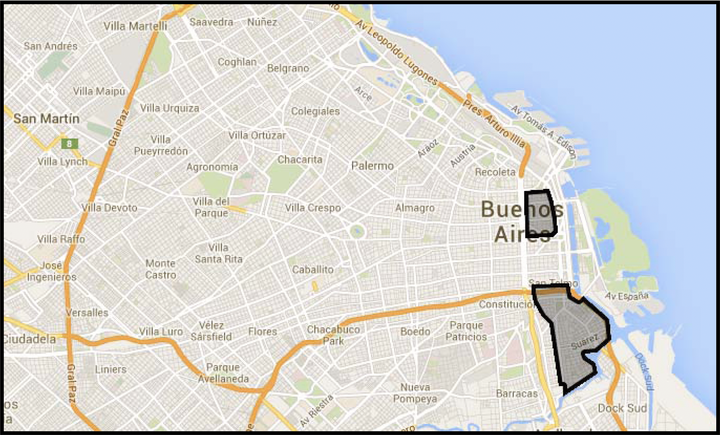
Two areas of intervention. Plan Microcentro (north) and the Distrito de las Artes (south).
Lucas, a member of a local social movement (agrupación), Los Pibes, comprising working–class and poor residents at odds with the local state over housing and social policy, summed up this unevenness of benefits during the Consultative Council meeting:
We have the misfortune that our comuna is in the eye of the storm.…It has to do with a politics of the government of the city to transform the south.…That it should be included, it should be part of the city, not with numbers of Belgium in the north and India in the south, [but] it [really] has to do with making money, with obtaining the most benefit possible in the buying and selling of land, in real estate speculation for the benefit of a the few. We are an expression of the undesirable in the city. We are those who should move 45 kilometers from the city.
Lucas claimed to speak for all of the comuna's “neighbors,” but in reality his movement and its members are mostly renters or inhabitants of the precarious and/or informal housing that puncture the colorful tourist landscape of La Boca. He invoked the symbols of India and Belgium to refer to the city's well–publicized concern with the endemic poverty of the south and its fragmentation with the relative prosperity of the north. His speech identifies an element of the plan that the government is reluctant to acknowledge. Rather than a “win–win” for all neighbors, the plan has distinctly different outcomes for different social groups. The city's territorial integration is not necessarily a consensual policy, but one that raises objections from groups who believe that they will be displaced.
Soon after Lucas spoke, Estela, a resident in her 50s, stood up, clearly exasperated, and began to shout. She denounced the hours of lost time spent complaining about the government's policies. What the area needs is progress, she said. “I want my neighborhood to blossom (florecer), that it becomes a neighborhood where there is housing, that the people who live renting have housing.…One has to see the good things and say when there are bad things. But if everyone wants to boycott everything.…For two hours [we've been here] and we've only talked about one [bad] thing.” Estela identified herself as an owner, though expressed solidarity with those who rent in the neighborhood. Her outrage illustrates the tensions around the government's attempt to frame these policies as “win–win” opportunities. Though Estela wanted to focus on the “good” aspects of neighborhood change, including more security, renovated parks, and new subway stops, she appeared to believe that this progress would also include housing for local residents. In reality, though, Lucas’ appraisal of the situation is likely accurate in that the upgrade of the neighborhood would seem to do more harm than good for those who fear displacement.
Yet, it is not only working–class and poor renters who oppose the plan. In the case of the Distrito de las Artes, the dominant definition of culture came under increased scrutiny since the project itself claimed to embody the communal value of cultural and artistic expression. Many of the attendees of different social classes distrusted the project on the grounds that it only provides benefits to developers and real estate actors and not everyday artists and cultural producers. In this sense, a project that is said to benefit culture and the arts was denounced as a threat to local cultural producers. As Teresa Stambazzi, the director of a sustainable tourism organization in the district, put it, “The arts district is a business that affects not just artists.…The entire neighborhood of La Boca, that should be culturally protected, is the one that will lose, it's going to lose its identity, its history, we're going to lose the tenements (conventillos) that are already being evicted” (Radio Gráfica FM 89.3 2012).
The presence of an existing community of cultural producers in the neighborhood, who rejected the city government's creative district plans, thus contested the state's framing of the project. The conflicts around the neighborhood's true identity demonstrated one of the paradoxes of promoting communal values tied to culture and creativity. The arts district was connected to the city's branding strategy by offering an identifiably unique community for cultural tourism. Yet, residents feared that the project would convert the area into a space for outsiders. To this end, an official in the city's Ministry of Economic Development working on the project complained in an interview about the neighborhood's locally minded residents who opposed the project. They were, in her words, overly invested in their own “Boquense” (from La Boca) culture and constantly worried that the neighborhood might be turned into a global space, inundated with artists from other parts of the city, including the fashionable northern neighborhood of Palermo. Yet, this transformation, particularly its implications for tourism and investment, was precisely what the plan intended to do.
Nonmarket Values, Market–Oriented Objectives
The local state's “humanized” vision of the city draws attention to the importance of distinguishing between nonmarket values and market–based outcomes. As the Minister of Economic Development recently put it,
The base of success of a city is its unique and distinct positioning. Cities in the last decade have stopped differentiating themselves in infrastructure to do so through values[….] A city brand is able to materialize intangibles—creativity, human capital—it captures values, local enchantment, and concentrates its competitive advantages under an overarching concept that permits it to compete with other cities.…The [creative] districts are a successful formula that work from the values of the brand of Buenos Aires, not only because they attract investments, rather because they convert Buenos Aires into an attractive city to develop oneself and live, and seduce that “creative class” for which the world is competing. (Cabrera 2012)
As a form of aestheticizing the city in service to new forms of place marketing, sustainability and creativity discourses imply similar urban outcomes. The attractive city in which a creative class is able to develop itself requires more than transportation infrastructure and public amenities. It requires affixing certain values to the city itself, such as cultural expression, ecological integrity, and place–based character. The leveraging of touristic production in service to economic development emphasizes the distinctiveness of local history and culture as a resource for competitive urban policy.
One important strategy for reshaping the cultural meaning of disinvested districts is the use of public art and entertainment. When Nestor from the Plan Microcentro provided me with a walking tour of Florida Street, it gave me another sense of how the city government's sustainability discourse may conceal efforts to promote higher–end development. The plan must get the new aesthetics of the street right if it is to attract the right kind of public. When walking by a store with a neon cell–phone sign outside, Nestor paused for a moment before entering the building to chide them for their outdoor sign, which does not meet the new standards for advertising. He tells me that since this particular store is housed in a structure whose renovation the city paid for, he has more leverage with its owners. According to the Plan Microcentro's leadership, advertising infractions are understood as “visual contamination,” blights that affect the quality of life of everyday residents. These, then, are private infringements on the meaning and use values of public space, suggesting that nonmarket values such as the collective enjoyment of the Microcentro must trump narrow private uses such as car traffic or street vendors.
The city's Director of Creative Industries, Enrique Avogadro, similarly suggested in public remarks that creative cities required differentiating place–based cultural offerings by allowing for less standardized production processes based on individual creativity. As he suggested to one reporter,
If in the old globalization we all wanted to have the same McDonalds or the same Starbucks, in the new globalization we all want to come to the world with our [own] product or service, but that has to be original, unique, and a product that clearly has a good story. (El País 2014)
Further emphasizing storytelling, the city installed public art on pedestrian corridors, while collective creativity was promoted in projects like the public decorating of street tiles with stickers emblazoned with “less cars,” “more security,” and “more space.” Storytelling and public art came together in the “Microhistorias” campaign in which the city government sponsored the placement of life–size photos of storeowners and office workers accompanied by their history in the Microcentro. The photos were playful and showed a diversity of users: from executives and white–collar professionals, to waitresses and kiosk owners. The brochure for the photo collection began with the quote: “Every street and every person is a brush–stroke of this mural [the Microcentro] that we walk each day.” The city's public spaces were thus framed as pluralistic spaces of diversion, expression, and social encounter. In this sense, the Plan Microcentro, touted as a sustainability project, had incorporated the broader creative city policy template in which place marketing became a valuable asset for the city's brand.
The new street would thus frame certain publics as the rightful users of this space by providing an image of the Microcentro as clean and orderly, yet also open and diverse. During my walking tour with Nestor, he told me that some stores may be pressured to leave or change their appearances, particularly those whose goods are visibly stored in display areas of the store itself, reminiscent of wholesalers, rather than kept in a back room. Those whose goods are held in the back room convey a more upscale image, and Nestor was insistent on the importance of aesthetics in the restructuring of the street.
The mayor called the new Microcentro the “first green center in Latin America” (La Razón 2013), rooted in the idea of “putting people as the focus [of the plan] and public space as a place of encounter.” By claiming that as a green center the space was now meant for everyday social encounter rather than traffic or commerce, the mayor aimed to claim the mantle of values such as human uses over business uses and environmental responsibility over private transport (e.g., car traffic). While the plan did eliminate much of the area's grit in terms of car exhaust and trash, it also catalyzed a number of new social dynamics. Subterranean trash receptacles discouraged scavenging. Pedestrian only streets made the area potentially more alluring for “residentialization” and touristic investment. Beyond the cultural values to which the local government appealed, market mechanisms and goals were very much a part of the project's outcomes.
At a 2012 TEDx talk, Avogadro (2012) emphasized the importance of individuals in place–based differentiation as a tool for competing in the global economy: “The truth is that within the concept of the creative city, you don't have just the creative class, but every person has the possibility to be creative.… Everybody has knowledge that can contribute to the creative city.… Not just governments, but organizations, people… there is hardware and software for the city. The hardware is the spaces, the equipment. The software is…the capacity we all have to love the city and to tell our story.” Avogadro was careful to point out that these projects should include and benefit residents of nearby shantytowns: Creativity, he suggested, is “a bridge” to overcome social divides. Leaders tied this new approach to inequality to a broader emphasis on the collective construction of public space. In public pronouncements, the local government encouraged the community to participate by responsibly making use of urban amenities such as parks and subways. Avogadro noted that “the government doesn't have a monopoly on public space” and it is thus socially “owned” by the community. The responsible uses outlined, however, tended to fit within the real–estate–centric focus of the themed districts. Forms of expression, such as graffiti, were welcome if they could be domesticated in the form of publicly or privately sanctioned murals or public art, thus providing an image of place–based pluralism.
Avogadro's description also emphasized international concepts such as the creative city and creative class, making clear the role of local government as a provider of the physical infrastructure fostering individual forms of expression. But what is most unexpected, coming from a government said to ignore the needs of the poor, is its explicit focus on urban inequality. The government's positioning of creative districts in the impoverished south of the city is explicitly framed as an effort to reduce the north–south divide and stoke the creative juices of local artists. Promotional videos for the Arts District show local artists in their studios demonstrating the benefits of clustering and the government's support for artistic expression. These videos clearly appeal to the values of cultural expression and community. Yet, the branding of the district as a site of these nonmarket values may still be read as an example of market–oriented goals when the broader framework of this project is taken into account. As one member of the opposition in the city council, Susana Rinaldi, put it (amid applause from the gallery where residents had gathered),
As I understand, the developers of artistic infrastructure are not exactly artists. Precisely this has a correlate in its [the project's] origin, that wasn't as it should be, from the Ministry of Culture.…In effect, we are accustomed to everything passing through the economy, and nothing but the economic…from the mercantilist [vision of the city government] that reduces the state to following private investment… (Legislatura de la Ciudad de Buenos Aires 2012)
The legislator in the above example is drawing attention to the benefits the district provides to real estate through the category of “developer of artistic infrastructure.” The Arts District appeals to nonmarket values, but these are easily put into the service of broader urban policy goals, which are very much guided by market mechanisms. In defining the creative city, Enrique Avogadro claims that it must be sustainable, equitable, integrated, and productive. According to the government's thin conception of urban inequality, however, with its omission of social conditions, integrating the city is understood as an effort to attract fresh investment to these devalued districts through improving their public spaces and amenities. Conceiving of territorial inequality through the lens of lifestyle, urban policy is especially concerned with the public spaces, amenities, and leisure activities that make a neighborhood more attractive to potential residents and businesses. As a recent promotional video for the creative districts put it,
…In the north 70% of the city's inhabitants live. And this creates inequality.…A [creative] district is to think of the city as a themed space that grows around an industry. This way, a neighborhood that was relegated is converted into a better place with more opportunities, where people can work, but also where people want to live. (Ministerio de Desarrollo Económico de la Ciudad de Buenos Aires 2014)
This real–estate–friendly concept of creativity shows preference for property developers, owners, and tourists. In this sense, the outcome of these policies represents the opposite of the collective inclusion that Avogadro attributed to city policy. For neighborhoods with major housing shortages, and generally poor services, schools, and hospitals, appeals to providing a place “where people want to live” provide insight into the government's aims in the creative districts. The local state's policy toward the south is one of consumer residential choice, resolving territorial inequality through greater social inequality, bringing higher income residents and business to the area. Importantly, however, this policy is framed around collective values that are difficult to contest.
Conclusion
This research analyzes the urban fads and consensual fictions embedded in the discourses of sustainable and creative policy agendas in Buenos Aires, showing that they are both features of competitive city frameworks. Much like creative city discourses, sustainability can mean different things to different actors. Given these ambiguities, social scientists have evaluated the validity of these policies’ environmental or social justice claims. This paper departs somewhat from this perspective, in casting sustainability and creativity as legitimizing scripts for neoliberal urbanism. These ideas respond to internal and external pressures and priorities of urban governance. As cities increasingly compete for mobile investment, selected areas represent opportunities for redevelopment and growth. Although there is broad consensus among urban researchers that cities increasingly harness public revenues for entrepreneurial aims, especially those steeped in visions of the creative city, novel sustainability discourses suggest that progressive environmental, social, and ecological concerns may be gaining priority over market goals. This paper, however, argues that sustainability as a malleable objective potentially dovetails with creative city policies, widely understood by urban scholars as representing a policy of revalorization cloaked in the language of cultural participation.
Much urban sociological research suggests that increased urban exclusion is the result, in part, of the privatization of public space and amenities, a logic extended to public goods such as housing and education. In Buenos Aires, however, a rhetoric of access and inclusion to urban amenities is really heard in much contemporary planning. Emphasizing the centrality of inclusion and the role of public space in producing civic engagement has become a defining feature of government–sponsored urban projects in Buenos Aires, especially those framed as creative or sustainable interventions.
Yet, a gap separates the nonmarket values that have become the hallmark of such projects, and the market–led outcomes that accompany them. Objectives such as sustainability may sound like a normative ideal, yet the policies meant to achieve it may enhance private interests over the public's richer citizens over the poor. Competitive city policies are responses to new economic pressures, both external and local. Their local manifestations are complex, tied to particular regulatory regimes and public pressures. Yet, the rise of sustainability as a legitimizing discourse in cities across the globe suggests that competitive policies underlie local governments efforts to attract new investment and growth, while selling these policies to local publics.
Price of Land per Meter Squared in US Dollars in 2012 and 2013 (Average of Four Quarters of Assessment per Year)
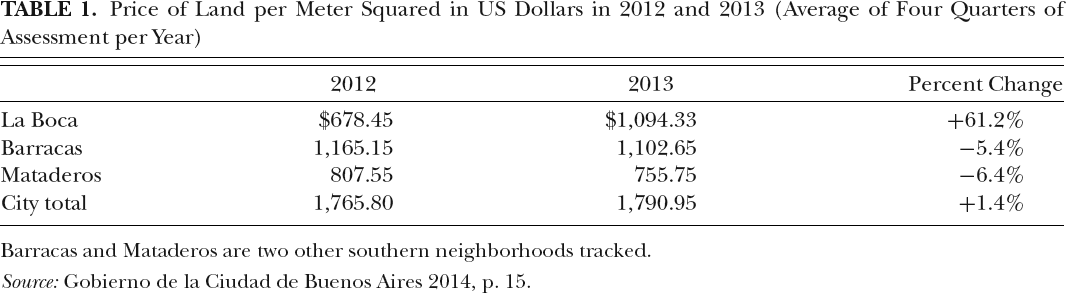
Barracas and Mataderos are two other southern neighborhoods tracked.
Source: Gobierno de la Ciudad de Buenos Aires 2014, p. 15.
Footnotes
Acknowledgment
I am grateful to Sharon Zukin, Miriam Greenberg, Hillary Angelo, Daniel Aldana Cohen, and the members of the Center for Place, Culture, and Politics 2013–2014 seminar for helpful feedback and advice.