







Abstract
Gentrification literature focuses mostly on growth machines pursuing profits or residents pursuing taste preferences, to the exclusion of cultural intermediaries that connect these processes, particularly businesses. Recent research addresses this gap, but even those focusing on commercial gentrification tell a partial story, neglecting the subjectivities of merchants and ignoring the diversity of businesses involved. This paper contributes to this growing literature by exploring merchants’ attitudes, and moving beyond boutiques and independent businesses. Examining Chicago's Wicker Park, it asks “Under what circumstances do merchants come to embrace or repudiate gentrification in their neighborhood?” Merchants support gentrification when they understand it primarily as an alternative to financial instability and repudiate gentrification when they understand it primarily as a disruptor of aesthetic stability. This paper identifies two specific neighborhood mechanisms that determine how merchants might arrive at such understandings: geographical location and perceived customer base. Additionally, while there is heterogeneity in terms of these two characteristics, there is remarkable homogeneity in terms of understanding of neighborhood reputation. Specifically, there is a common understanding of the neighborhood's reputational hipness across respondents. Those who support gentrification value this reputation instrumentally while those who oppose it value it intrinsically, but either way, everyone orients themselves to this reputation in forming attitudes and making consequential decisions.
Introduction
“You used to walk down the street here and see this crazy bohemian nature of this neighborhood, you know what I mean?” says Ben, of Wicker Park, the neighborhood his community–based ad agency inhabits. “[T]here was more independent shit, there were skate shops, there were people hanging out smoking, there were people who were trying to do shit.” Wicker Park is a neighborhood that has been designated as hip. Ben himself says “it's an artistic bohemian neighborhood, it always has been.” It is also a neighborhood where people fiercely dispute its hipness.
While Wicker Park's emergence as a “Neo–Bohemia” in the 1980s and 1990s (Lloyd 2005) is well–documented, the neighborhood's character has continued to shift in the intervening decades. Nowhere is this more evident than in the storefronts along Milwaukee Avenue, its main commercial corridor. A vibrating commercial stretch about a mile long between Division Street and North Avenue, the main stretch of commercial real estate in Wicker Park has come to represent a certain sort of hip neighborhood, in Chicago and nationally, but a closer look reveals divisions. The upper end is far more developed than the lower end, and storefronts that gained prominence as Wicker Park garnered its reputation for hipness compete for space with moneyed chains that moved in afterward to take advantage of this reputation. There are also newer stores that serve a different sort of customer base, one that might have more money but is not as interested in the neighborhood's “edgy” past that earned it the reputation in the first place. Wicker Park keeps changing, and an important way to index those changes, and to understand what they mean for the social construction of the neighborhood as a place is to hear what the people in these storefronts have to say.
How do merchants respond to gentrification in their neighborhood? As neither developers who stand to make a great deal of money from development nor the residents who might be pushed out, what goes into the calculus of what a business–owner or –manager thinks of a changing neighborhood? When do economic considerations matter, and when do cultural considerations matter? Using interview data with local merchants and neighborhood stakeholders, this paper uses the case of the Wicker Park neighborhood of Chicago to get at the circumstances that lead merchants to either embrace or repudiate gentrification in their neighborhood. Merchants support gentrification when they understand it primarily as an alternative to financial instability and repudiate gentrification when they understand it primarily as a disruptor of aesthetic stability. This paper identifies two specific neighborhood mechanisms that determine how merchants might arrive at such understandings: geographical location and perceived customer base. Additionally, while there is heterogeneity in terms of these two characteristics, there is remarkable homogeneity in terms of understanding of the neighborhood's place reputation. By place reputation, I specifically mean “a collective understanding about a place based on stories people out in the world tell about it” (Brown–Saracino and Parker 2017:841). In Wicker Park, there is a common understanding of the neighborhood's reputational hipness across respondents. Those who support gentrification value this reputation instrumentally while those who oppose it value it intrinsically, but either way, everyone orients themselves to this reputation in forming attitudes and making consequential decisions.
Literature: Gentrification and Neighborhood Change
Sociological study of the processes behind neighborhood change has been a primary preoccupation of American sociologists since the early Chicago school—Robert Park notes in The City that “there spring up fashionable residence quarters from which the poorer classes are excluded because of the increased value of land” (1925:6). Though there are variations on theories of gentrification, analysts typically center on concentration of capital, subsequent displacement, and transformation of local space (Brown–Saracino 2010:12). That said, much gentrification literature has focused on either “growth machines” (Logan and Molotch 1987) pursuing profits or residents pursuing taste preferences, and discussion has typically revolved around processes related to residential issues, not commercial ones—notice that the Park quote above is about “fashionable residence quarters,” not “fashionable shopping quarters.”
Considering the increasing importance of consumption and amenities for the shaping of urban neighborhoods (Clark 2004; Lloyd 2005), an empirical understanding of the role of businesses in gentrifying neighborhoods is necessary. Yet, Logan and Molotch (1987) alert us to the fact that “in contrast to our extensive information about residents (based on hundreds of ethnographies and mountains of survey research), we know little about corporations’ attachment to place” (p. 21). If developers are likely to be on the side of the growth machine and residents are likely to oppose it, businesses are stuck in the middle, trying to negotiate neighborhood growth in a way that helps them maximize profits while maintaining their customer base. Indeed, Logan and Molotch make an argument that businesses rely not just on customers, but on specific customers, which means that “merchants have an ongoing stake in a particular social makeup of place” (p. 21). Merchants are especially interesting cases, as they balance not only their own economic interests and ideological commitments, but also those of their customers, when considering issues of gentrification. While all merchants value profit to one degree or another, as this paper will demonstrate, even the idea of profit is a complicated one. What is profitable is determined by a number of complicated social factors, such as who one's customers are and the changing demographics of a neighborhood. What is profitable to one merchant based on customer base, economic model, or neighborhood reputation might be manifestly unprofitable to another.
Scholars have recently worked to address the relative historical dearth of work done on commercial gentrification in comparison to work done on residential gentrification (Zukin et al. 2009:49). That said, while important work has been done to address this disparity (Deener 2012; Ley 2003; Zukin 2011, 2012; Zukin and Kosta 2004), there are still gaps in our knowledge about what role businesses play in gentrification, especially in terms of their role as entities acting within a neighborhood, not just on a neighborhood. While they are often agents of neighborhood change, businesses exist, like residents, within neighborhoods. Also like residents, they come in many forms. If it is true that commercial gentrification has been understudied, it is also true that important work that has touched on it has mostly failed to account for different types of businesses, instead focusing on the boutiques and independent stores that help create the commercial aesthetic of many gentrifying neighborhoods.
Debates about roots of gentrification (Smith 1979), specifically whether they are to be found in economic or cultural explanations, have remained persistent, even as recent work has attempted to demonstrate the ways that both economics and culture matter for how gentrification plays out (Lloyd 2005, Brown–Saracino 2009, Deener 2012). Looking at businesses in gentrifying neighborhoods is potentially enlightening on this front, as they are locations that mediate economic interests and consumer choices. In the same way gentrification processes can be explained using economic and cultural explanations simultaneously, merchant attitudes toward gentrification are informed by both economic incentives and cultural commitments.
Crucially, these preferences do not always line up with presumed economic interests. Using Wicker Park as a case allows us to look at why. Zukin et al.'s (2009) research on commercial gentrification in Harlem and Williamsburg demonstrates a connection between commercial gentrification in these neighborhoods and “strong growth in ‘new entrepreneurial’ retail capital (boutiques); a notable increase in ‘corporate’ retail capital (chain stores), especially in Harlem; and deep decline in old, ‘local’ retail stores” (Zukin et al. 2009:58). This is the same story told in Wicker Park, but attitudes among business–owners and –managers about gentrification in the neighborhood do not necessarily line up with their economic lots in the neighborhood. Whereas one might expect supporters of continued gentrification to come primarily from groups who have benefited from it in the past and opponents to come primarily from those under the most imminent threat, the opposite has happened: Many of the most adamant supporters of gentrification in Wicker Park own and manage businesses that Zukin et al. would classify as “local,” whereas many of the harshest critics of gentrification in the neighborhood own and manage businesses Zukin et al. would call “new entrepreneurial” or even “corporate.” Why is this?
I argue that the circumstances in which business–owners and –managers come to either embrace or repudiate gentrification emerge as a combination of key characteristics which can differ significantly among businesses, and common understandings of a neighborhood which can be shared. In order to understand how businesses respond to neighborhood change, it is crucial to consider both heterogeneity within the business community and common cultural contexts in which that heterogeneity may exist. Specifically, business–owners and –managers support gentrification when they understand it primarily as an alternative to financial instability and repudiate gentrification when they understand it primarily as a disruptor of aesthetic stability. There are businesses that do not fit this model perfectly—witness owners of newer “mainstream” businesses who support gentrification. Yet, even these businesses fit into a general model in which security in a more developed part of the neighborhood allows people to frame their perceptions of gentrification in terms of aesthetics and not economic survival. There is a common understanding of the neighborhood's reputational hipness across respondents, but those who support gentrification tend to value this reputational hipness instrumentally, as something that could conceivably attract people to the neighborhood to shop, while those opposed to it tend to value it intrinsically, as something that makes the neighborhood worth being in.
Methods and Case
Data for this paper come primarily from 29 in–depth interviews of merchants and knowledgeable stakeholders I conducted in 2012 and 2013. 1 Based on previous ethnographic work and a series of pilot interviews, I created a prospective interview guide that I used in these in–depth interviews, which I conducted myself, in–person. Interviews focused on my respondents’ attitudes and reactions to past, present, and potential gentrification and development in the neighborhood, in particular with regard to their business and the larger business climate. In the process of gaining consent to interview them, I offered research respondents the option of being identified by actual name or pseudonym. There was variation in requests among my respondents, which I have honored in this paper. I supplemented these interviews with field observations at focused gatherings like neighborhood festivals and organizational meetings, and with a study of historical accounts of Wicker Park.
While I agree with the utility of using different methods to get at different information (Trow 1957; Khan and Jerolmack 2013), the majority of my data for this paper comes from interviews, and this is because I hold with Weiss (1994) that interviews are useful for “developing detailed descriptions” about things we ourselves were not there to see, “integrating multiple perspectives” on the same topic, “describing process[es]” that might not be visible on the surface, and perhaps most crucially, developing a “holistic description,” since
by putting together process reports from people whose behaviors interrelate—putting together the reports of retailers and customers or of institutional psychiatrists and institutionalized patients—we can learn about systems. Qualitative interview study may well be the method of choice if our aim is to describe how a system works or fails to work. (9–10)
I am looking at a neighborhood with multiple actors and trying to understand how a process that includes all of them—commercial gentrification—operates and operated in the past.
Nestled northwest of the central business district of the Loop, Wicker Park is a neighborhood with a reputation for being a sort of bohemia, as documented by Lloyd (2005). Though much of this reputation is built on the history of the neighborhood in previous decades, it does persist, specifically in the idea that Wicker Park is a “hip” neighborhood. Recently, Forbes called it “the Midwest Mecca of Hipsterdom,” ranking it as the fourth best hipster neighborhood in America, based on a quantitative formula along with a startup's “Hipness Index” (“4. Wicker Park, Chicago, IL, Morgan Brennan Closing Table, Forbes,” Brennan 2012). While these inputs might seem totally arbitrary, they do affect how people come to understand reputation, and Wicker Park over the previous decades has developed both a reputation for being hip and a history of being gentrified. Although it has a reputation as a hip, gentrified neighborhood, Wicker Park, and Milwaukee Avenue in particular, is a site of uneven development, with one end of the commercial corridor the site of much more commercial development—and much more commercial development associated with a hip, bohemian aesthetic—than the other. While the upper end is populated primarily by restaurants, bars, cafes, and boutiques, the lower end, to the extent that it is commercially developed at all, is dominated by furniture stores and shoe stores, as well as a large grocery store surrounded by an enormous parking lot. While there are some commercial outposts that are more like those on the upper end of the street, one is much more likely to see an empty storefront than a haven for hipsters. As such, while at the upper end you might see people stop by a record store, a high end taco joint, or an artisanal doughnut shop before heading to a trendy dive bar or a famous music venue for a show, at the lower end you mostly see either people purchasing basic needs—shoes, furniture, groceries—or, often, walking past shuttered stores on their way to the more active end of the street. In other words, Wicker Park is a neighborhood that can rightly be called both gentrified and gentrifying, as the process is both longstanding and ongoing in the neighborhood.
I selected respondents initially based on their status as business–owners and –managers 2 on Milwaukee Avenue. Commercial streets are particularly interesting locations. Zukin and Kosta (2004) highlight the importance of shopping districts for the understanding of gentrifying neighborhoods, saying that “looking only at either local housing markets or labor markets neglects one of a district's key functions in urban redevelopment: to create the consumption spaces on which both cultural producers and new middle classes rely” (102). Deener (2007) argues that these spaces have symbolic value, that “because commercial streets take such a central role in building local neighborhood identity, they are fundamental to understanding the process of inclusion and exclusion at the neighborhood level” (294). Commercial gentrification is a potentially controversial process—Ocejo (2011) defines it as “new establishments with particular goods and services—such as clothing boutiques, art galleries, cafes, restaurants, and bars—that open to satisfy the needs of middle–class gentrifiers” (p. 285). A neighborhood where there has been controversy over these concerns provides a useful case for studying how different issues—strictly financial, strictly aesthetic, or a combination of the two—might impact merchants’ considerations of gentrification.
I also targeted owners and managers because it seems that these figures would be the ones with the most financial stake in the commercial development of the surrounding neighborhood. In other words, they are visible figures with potentially conflicting interests in the neighborhood. Residents do have financial stakes in the development of neighborhood, as either renters or homeowners, but it is business–owners and –managers who offer the most visible manifestation of commercial gentrification in the neighborhood, and it is business–owners and –managers who have been missing in much of the literature about gentrification that has focused either on residents or developers. The identity category of business–owner or –manager is complicated by the fact that some business–owners and –managers are also residents of the neighborhood, and these dual identities do indeed play a role for some of my respondents. When I went beyond owners and managers, I did so to talk to knowledgeable neighborhood stakeholders who either were former merchants in the neighborhood or worked with them in some capacity, as when I spoke to a real estate developer and an urban planner.
Following Weiss (1994), I sampled for range within the population, specifically along dimensions of business type (independent vs. chain or franchise) and tenure in the neighborhood (those who have moved into the neighborhood in the previous ten years vs. those who have been there longer). Just because businesses are relatively geographically proximate does not guarantee that their owners or managers will have identical interests, so I sought to sample for range along dimensions I suspected were relevant in order to guarantee variation in my sample. I used a limited “snowball” method (Weiss 1994) to add to my list of potential respondents. I was conscious of the fact that this method has the potential to cause oversampling certain groups because of homophily, as perhaps people who run similar types of businesses associate with each other. Because of this, I made an effort to seek out different kinds of business–owners and –managers myself.
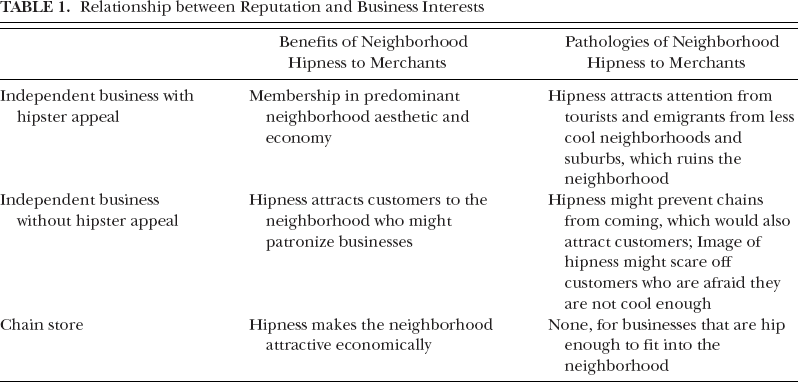
Relationship between Reputation and Business Interests
Analysis
Differences in attitudes toward gentrification and development among merchants emerged based on two distinct, though related, dimensions: (a) their position in the neighborhood in terms of geographic location of their business and (b) who they perceived to be their customers. Crucially, both dimensions are construed not in a vacuum, but in relation to the reputation of the neighborhood. Merchants develop distinct understandings of gentrification based on their relationship to this neighborhood context, to their customers, and to each other.
How Geographic Location Constrains Cultural Comittments
A business's geographic position in the neighborhood can have important effects on how a merchant thinks about gentrification and development. The result of this uneven development is that merchants on opposite ends of the corridor see gentrification and development in different ways that are often informed by their geographic location. The importance of geographic location for informing attitudes toward gentrification becomes especially evident when merchants offer their opinions on chain stores’ place in the neighborhood.
Ken is the manager of an independent shoe store. He says his store has a wide variety of customers, as opposed to some stores up the street, which are for “yuppies.” He thinks of development as positive, as it creates more customers and makes the area more valuable, which is also important to him because he owns property in the area. Although he lives elsewhere, he does own property in the neighborhood. When asked about what kind of new stores he would like to see open in the neighborhood, he says “well–known, big corporate–owned stores.” In contrast, Eric is the owner of an independent boutique, and has lived and worked in Wicker Park for close to fifteen years. During this time, he has seen the neighborhood, and his customer base, get older and less bohemian. When asked whether chain stores are good for him as a resident or a business–owner, he says these are two different questions. “Personally as a resident, I wouldn't want to see chains, but as a business–owner, it actually would be a good thing,” he says.
Ken and Eric both work at independent stores on Milwaukee Avenue, and they are aware of the potentially beneficial effects of chains on their stores’ financial outcomes. That said, they have come to radically different conclusions about whether chain stores are superior. What is at issue here? Personal ideological commitments do play a role. Ken does not express a preference for one type of aesthetic or another. Eric, on the other hand, talks somewhat wistfully about how the neighborhood used to be. A resident of the neighborhood, Eric also has a personal investment in the neighborhood beyond just his store—he and his family live here, and experience it from that perspective as well. Yet, there is another important dimension on which Ken and Eric differ. Ken's shoe store is located on the lower end of the commercial stretch of Milwaukee Avenue, closer to Division Street, and Eric's boutique is located on the upper end, closer to North Avenue. The stores are less than half a mile apart from each other, but this is significant social space in Wicker Park.
The stretch of Milwaukee Avenue I focus on is less than a mile long, but there is a bifurcation in terms of types of businesses and level of development. The northern end of the stretch, marked by the “six corners” made by Milwaukee Avenue, Damen Avenue, and North Avenue, is considered the hub of the neighborhood from which commerce emanates. The part of Milwaukee Avenue closer to Division Street has a different reputation. It is more sparsely populated, with more empty storefronts, and is dominated by furniture stores and shoe stores. Ben, who owns a business on the lower end, focused negatively on these types of stores, saying “if you don't need shoes or furniture, there is almost no reason to come here.” Mayra, who manages a boutique closer to the six corners, talks about this part of the neighborhood as “sketchy.” Others talk about this stretch of Milwaukee Avenue being even less developed in the past—JC, who used to own a business in the neighborhood, described the area in the past as “bombed out”— but there remains a sense among merchants, especially those at the lower end of Milwaukee Avenue, that this stretch is divided into a more developed and a less developed section.
This stratification of development on Milwaukee Avenue has ramifications for those looking to operate businesses in the area. For those backed with significant financial capital, locating as close to the six corners as possible is viewed as an obvious move for Wicker Park businesses. My conversation with Anna, the manager of a chain restaurant, demonstrates this point:
I mean, it's a fantastic neighborhood. It really is, and we have primo real estate here. When you are right on the corner of Milwaukee and Damen, we are on one of the busiest intersections in Wicker Park. You've got a million things around you, in terms of bars, in terms of galleries, in terms of, you know, like I said, the little small businesses. You know, we've got all the clothing shops, we've got the shoe stores we've got… there is just so much going on in this neighborhood, it's kind of like why wouldn't you try and jump on board, why wouldn't you try and become part of that?
Anna outlines all the benefits of the location of her business and wonders why anyone would not want to locate in this area. Locating close to the six corners is more of a problem for others who do not have corporate backing. Nancy, who owns a boutique in the neighborhood that has been housed at multiple locations over the years, talks about relocating to her current location near the six corners even though it is more expensive because she thought it was “worth it.”
Not everyone has the resources to make this cost–benefit analysis. For example, Ben, who runs a “community–based ad agency,” talks about a spot near the six corners as simply beyond his company's financial grasp, saying “Now if you are in the six corners, you're looking at $7000 and $9000 to rent the space that five years ago was $2000, which is making it so small places like myself cannot get down there because the rent is just too high.” While not everyone who located their business on the bottom end of the stretch of Milwaukee Avenue framed the decision as explicitly as Ben, presumably concern over rental costs plays some role in decision–making about where to locate for any business.
For many, the prospect of Milwaukee Avenue “filling in” is an exciting one. Sebastian, who owns a shoe store, says
Between us, like it goes to probably 1400, 1300 block and then it's kind of not such good stores, but all stores, and then after you pass Walgreens, it starts again for a better area. I wish we would connect it, and I hope it's going to happen, because a lot of people, they stop shopping on the North, they won't go down here, they stop probably around like Walgreens, because they think, they start seeing like shitty stores, so then they think there's nothing behind.
Chris, who runs an art gallery space in the middle of the stretch of Milwaukee Avenue, also talks about the benefits of “filling in Milwaukee.” However, there is apprehension, as he describes new development as “great for the neighborhood” but wonders about the prospect of bigger chains coming in. Earlier in the interview, he had even discussed the slowdown of development as a result of the housing bubble as saving the neighborhood:
It really has gentrified, and in essence it gentrified, it started doing a little bit fast, and then we had a big housing bubble that really stopped everything, and I think that almost saved the neighborhood, because you can go too far with gentrification, where all of a sudden big corporations take over some of the small business storefronts, and they make it so that small businesses can't operate, you can't compete with, you know, a big corporation that has deep pockets.
Chris's gallery is an interesting case, because it operates roughly at the area of division between the two parts of Milwaukee Avenue, which also happens to be the area that has seen more development extended to it in recent years. As such, he has experience with both old concerns about not being connected to the main commercial stretch of the street and new concerns with the area becoming too developed.
So how does this relate to how merchants understand development and gentrification? Those located closer to the commercial hub of the six corners expressed a variety of opinions about development and gentrification. Those located far away from the six corners were more likely to talk about development and gentrification in positive terms related to their geographic position in the neighborhood. Specifically, they talked about how further development would benefit them by “filling” in Milwaukee Avenue. Geographic location in the more financially secure—and more developed—section of Milwaukee Avenue gives business–owners more latitude to use aesthetic and identity preferences when they form attitudes toward gentrification and development, whereas those farther away from the economic center of the neighborhood were more likely to think about development as something related mostly to economic interests as opposed to identity and aesthetics. Of course, it is likely that much of this attitude toward gentrification has to do with the types of stores that locate at this end of Milwaukee Avenue. As the next section covers, different stores in the neighborhood serve different customer bases, and it is reasonable to suggest that the stores that dominate the lower end of Milwaukee Avenue tend to serve a customer base less hostile to gentrification, particularly to chain stores. That said, it is a fact that the lower end of Milwaukee Avenue is less dense than the upper end, and the lower foot traffic that accompanies lower density is a problem for a store regardless of who their customers are. Bringing it back to Ken and Eric, this difference emerges most clearly when respondents talked about national chains. A chain store means something radically different to someone close to the six corners than it does to someone far away.
Respondents who repudiated chain stores did so for one of two reasons: (a) a belief that they negatively impact the neighborhood or (b) a belief that they do not fit in with the predominant identity and aesthetics of the neighborhood. While the first set of objections can be connected directly to financial interest, the second set is more complicated. Respondents who embraced chains tended to do so for one reason: They would bring more business to their own stores. Interestingly, respondents who extolled the virtues of chains were owners of independent stores, whereas respondents associated with chains sometimes expressed a desire to keep chain stores out of the neighborhood.
Ulysses, the manager of a café that used to be located close to the six corners and relocated at the less developed end of Milwaukee Avenue after it was displaced by a bank, talks about how chains do nothing for the neighborhood, saying “I wouldn't want to see McDonald's be built down the street. That would just kill it, kill it, you know.” When I ask why, he responds:
Ulysses: Because I've noticed Wicker Park's like its own little community, like, everybody knows everybody. Like, the other day I saw a couple of customers coming together, and they bought coffee for one another, and I'm just like, “You know each other? When did this happen?” So again, you know everybody that lives around here, and, I don't know, to me, it seems more commercial, to like bring more people in. Interviewer: A chain seems more commercial? Ulysses: Yeah… Like a chain. And it's nice just to support your neighborhood, you know, rather than supporting a worldwide chain that really does nothing for you.
Jonathan, who owns a tattoo studio, expresses similar thoughts about what giving money to a local business as opposed to a chain store means:
Well, mom and pop corporations, if you support those stores you are going to send your daughter to college maybe or help their grandmother out or help you know it's a family run business that helps family. Corporations on the other hand, I don't trust large corporations—I'm a corporation—but large corporations, I don't trust period. There's a lot of corruption, mismanagement of money, and I would just rather get my money to a local business or the local economy. I don't want to support somebody who's living in Virginia. Well, I do of course but I would rather support local people.
For many people, supporting a local business instead of a chain means keeping money and support inside the neighborhood. It is not simply about a business being a corporation, but about what kind of corporation the business is, and how it relates to the community.
Frank, the manager at a boutique clothing store, frames chain stores in terms of “cashing in” on the authentically productive work of people in the neighborhood:
It's just, I don't know, they're just cashing in on everything that's good. So I definitely don't want to see one of those, or like, hmm, I don't know, places like that that are just big corporations cashing in on other things that people in this neighborhood are doing well already, you know? Like a McDonald's, I wouldn't want to see a McDonald's right there. I'd rather see, like, some guy that makes fresh burgers with integrity with what kind of meats he's using and vegetables and stuff. Because then, I mean, yeah you'll pay a couple dollars more, but you're going to stay in business because people want to find that kind of stuff.
For Frank, what is good in the neighborhood is found among its people, and corporations who move in are often trying to co–opt their hard work. It is worth noting, though, that Frank ultimately talks about the positive aspects of gentrification. While he has held this job, he has seen chain stores come in that have directly impacted his business, offering the same products at lower prices, forcing him to abandon some of the merchandise he used to sell. He frames this as giving him the opportunity to find new brands, and concludes “it's just, I don't know, nothing, nothing gold can stay.”
For others, it is not so much a matter of the morality of chains, but rather about perceived neighborhood fit. Supporting a local business instead of a chain can be a matter of identity and aesthetics—of maintaining the idea of what belongs in the neighborhood. Anna, the manager of a restaurant near the six corners, mentions one particular national chain when discussing what does not belong in the neighborhood:
As much as I love Target, as much as I love that stuff, and I do. You know, having it North Elston is close enough for me. I wouldn't want to see anything like that move over here. I think that because that part of what makes this neighborhood great is all the small businesses, all of those kind of little fun, kitschy shops. And I mean don't get me wrong, and you still have BCBG up the street, you still have those, but they are more boutique–y, still, so even though they are well known, they are still boutiques, so they still kind of have that sense of individuality.
Particularly interesting about this exchange is that Anna, who is the manager of a chain restaurant, talks about the importance of keeping small businesses in the neighborhood as opposed to chains. It is worth noting, though, that she also emphasized her business's local connections, despite being a chain, earlier in the interview. She also draws distinctions between Target and the more “boutique–y” chain BCBG on Damen Avenue. Throughout these interviews, it became apparent that for many people, there are different levels of being a chain, and identity depends not just on economic model, but also on aesthetics and feel.
Annette owns an independent eyeglass shop, and she similarly expresses a preference that chains not develop in the neighborhood, saying “Well I you know I have a real problem with the WalMartization of America so I hate to see corporate stores that you find in shopping malls, in neighborhoods like this only because it's taking away from the independent business people that are really making their living.” It's important to note, though, that Annette makes an exception when discussing her opposition to corporate stores, saying she prefers them to empty storefronts. Of course, Annette is in a part of the neighborhood that is not full of empty storefronts, which perhaps lets her distinguish between good development and bad development, with national chains representing bad development. Those farther away from the six corners do not get to make that distinction, and conceive of chains in a radically different way.
Sebastian, the manager of a shoe store on the lower end of Milwaukee Avenue, talks about the existence of a chain near his store in positive terms when discussing what the neighborhood was like when his store opened:
It wasn't as busy as it is right now. There was no H&R Block, there was no stores next to me, there was no Aldo. Which Aldo also helped, because Aldo brings customers. Because everything is like a shopping mall: If you see 2 stores, you're going to come in, if there is one, you're not going to come in because there's a chance you're not going to find something. People go to Aldo, they won't find nothing from me, go to Aldo; if they see something, they won't find in Aldo, they come back to me.
For Sebastian, a chain store helped attract customers to his local business. Ken, from the beginning of the section, is similarly positive in his attitudes toward chains, saying “I think those types of businesses will attract a lot more customers.”
Asked about what sorts of stores they would like to see move to the area near him, Ken and Sebastian explicitly talk about chains. For them, a chain is not something that would be out of place with the neighborhood, or a threat to business. A chain, rather, represents potential for more customers. Contrast this with Chris's sentiment:
I would be excited by more, more small businesses. I think that's what keeps our, if I wanted to brand our neighborhood, I would brand it like, let's have more of what we've got kind of thing. I think it really adds to the allure of the neighborhood. I don't need a national chain to come in to drive people here. I think there's plenty of that out there, and if I had my say, I would encourage a lot more small businesses to come in.
Chris explicitly says he does not need a national chain to drive business to his art gallery. A number of things could be at work here. First of all, he is not on the least developed part of Milwaukee Avenue, which means he is probably already getting more foot traffic than those at the lower end of the street. Second, he runs an art gallery space, which fits in well with the idea of the neighborhood as an artistic space—he refers to where he is as “the Wicker Park arts district.” For him, a chain does not add to this allure, and might detract from it. Sebastian and Ken, on the other hand, run shoe stores, which do not fit into any sort of artistic schema. Therefore, a chain would not interrupt any aesthetic of the neighborhood that is particularly beneficial to them, and would potentially drive more foot traffic to their less–developed section of Milwaukee Avenue.
Whose Wicker Park? Businesses’ Perceived Customer Bases
Geographic position connects to a related, but distinct dimension of difference among merchants that influence formation of attitudes on gentrification: the fact that there are very different sets of customers in Wicker Park. Among my respondents, stores on the lower end of Milwaukee were more likely to serve pregentrification residents, while those closer to the six corners were more associated with residents doing the gentrification. However, it is not enough to just look at geographic location, as there is variation past this division. Specifically, among the gentrifiers, there are the artists and hipsters Lloyd discussed, but increasingly there are also new young professionals and families, with their own set of distinct interests. In a neighborhood like Wicker Park, which has a history of residential opposition to certain types of commercial gentrification as well as a reputation for being a bohemian neighborhood, customer expectations can lead merchants to take sides on the issue of gentrification, sometimes in surprising ways. While repudiation might seem to contravene financial interests and speak to primarily aesthetic issues—especially when respondents outright say that gentrification would benefit them—an argument can be made that the maintenance of Wicker Park as a certain type of neighborhood is actually a very real, if more abstract, financial incentive. On the other hand, when customer base is conceived of as being oppositional to Wicker Park's bohemian reputation, some merchants have reason to support gentrification.
Rachel is the manager of the Chicago branch of a small chain of boutique stores. Most of the locations of her store are in New York, and the Chicago store is one of a few outside that city. Even though she works for a chain store, she talks negatively about chains, expressing a desire to see more independent stores in the neighborhood. Why does the manager of a chain store decry the proliferation of chain stores in the neighborhood? Part of this can of course be attributed to personal preference or ideology—Rachel likes smaller businesses, and even identifies with them despite the corporate backing her own store has. Rachel is not alone here—Anna, the manager of a chain restaurant, similarly extolled the virtues of small businesses as opposed to chains.
More importantly, though, Rachel manages a store whose customers value independent businesses. Rachel talks about a camera store opening in the neighborhood as being positive because it fits with a certain aesthetic she identifies as “hipster”:
Yeah, because we're getting that camera store up over here, and there's kind of a lot of hipsters that are really into that. I think this is kind of a more and more of a hipster neighborhood. And I think that's a good thing, that businesses are opening around here that will really try to gear toward the aesthetic of the neighborhood.
She also discusses the “bohemian feel” of the neighborhood:
Just kind of more of a sort of bohemian kind of feel, not really too upscale. Like, we didn't want to move our business to like the Magnificent Mile, because we've just kind of get swallowed up there. And we're kind of a neighborhood business, so we wanted to be somewhere kind of more neighborhood–centric and not really just another shopping spot in kind of a big lost area.
This idea of Wicker Park as being “neighborhood–y” is important to a lot of the people I talked to, because the idea of Wicker Park as a bohemian neighborhood is important not only for the people who live there but for tourists who have made the neighborhood a destination. Chris talks about how he has a relationship with hotel concierges in the Loop who direct out–of–town visitors to the neighborhood, partly so they can see “where the locals go.” Boutique–manager Mayra also talks about tourists coming to the neighborhood, when asked about how the neighborhood has changed:
We have like so many tourist groups visit now, because they hear like the neighborhood is such a cool place to visit, and I think that has become more of a thing since I started working here. Now we have people who stay downtown, and when people ask “What neighborhoods should I check out?,” Wicker Park is always on the top of the list.
Boutique–owner Eric tells a similar story about tourists:
A tourist comes to downtown, you walk around Michigan Avenue for a couple of days and you're like, okay now what, I want to see a real neighborhood: This is the neighborhood they come to. The train is right here, it's a big part of it. They can catch a train; it's easy to get a train. So they come, they see our independent shops, oh this is cool, this is actually cooler than Michigan Avenue. So then they go back and tell their friends, come to Wicker Park. So then now it's busier, stores are more vibrant, now you get another bar pops up, another bar pops up, another retails space, a hair salon.
He also talks about a dark side, though. For both local customers and outside tourists, the idea of Wicker Park as a bohemian neighborhood is an important part of its draw. This can be frustrating for business–owners at times, though. Eric, who discussed the draw of the neighborhood for tourists, discusses this phenomenon in partly negative terms:
Because I feel like this is like a zoo, because people come to the neighborhood to see it being something, it's like outsiders coming to see this cool neighborhood and I feel like it's not really as cool as it actually could be. Then one is coming as an outsider to see what's happening and only a few people actually create stuff, you know. But before, I feel like more people who were actually involved in the creative process, not looking, not looking outward in, more just doing it, who were part of it. There were more people who were starting businesses and doing their own thing, now it's like, you get a lot of tourists in the neighborhood, too, now. Before that, you had no tourists coming to the neighborhood, like none.
Eric feels frustration because he feels like Wicker Park's reputation for being cool gets in the way of its ability to actually be cool. Stories of gentrification often focus on a triad of developers, business–owners, and people who live in a neighborhood, but important to the story of Wicker Park is a group of people who do not live in the neighborhood, but rather visit it because of its attraction as a “cool” neighborhood.
Going back to Rachel's affinity for independent businesses, national chains might seem out of place to a customer looking for a “cool” neighborhood, which explains why even the manager of a chain might prefer other national chains not move in, assuming her own chain appeals to a sufficiently bohemian image. Ian, a developer, talks about how even the chain stores in the neighborhood fall within this tradition.
It's a pretty wide variety, but I have noticed it being clothing that leans towards that funkier, hipper, younger generation, you know, for example Joe's Jeans, the Marc Jacobs…but it's because their lower–end line, it is also expensive. The Urban Outfitters, the Levis, the Carhartt, Chrome Bags, St. Alfred, which is a shoe, like an urban shoe store you know for gym shoes and stuff. With that whole urban skater kind of trend, so you know, whereas you go to places like Lincoln Park and you are going to find more Banana Republic and Lululemon and things like that.
Ben, who runs a small local business that serves creative freelancers, talks about specifically targeting Wicker Park because of its bohemian tradition, saying “It's an artistic bohemian neighborhood, it always has been.”
Other business–owners react negatively to the idea of the neighborhood as cool because they feel like their businesses do not fit or that the whole idea is stifling. As a result, they come to appreciate a certain kind of development and gentrification that might be dangerous to merchants who rely on the image of Wicker Park as a cool bohemian enclave to attract customers.
Kevin is the manager of a bar and restaurant that he says caters to everyone—“someone who just kind of lives in the neighborhood or like next to the artist types to you know the young professionals that live in Lincoln Park to downtown to like my parents.” He talks about feeling like his business does not belong during a summer street festival in the neighborhood organized around underground music, and says that there was an initial struggle to find a place in the milieu of Wicker Park as a hip neighborhood.
Kevin:I think that what we had, I think what we struggled with a little bit before was trying to kind of like fit in with some of the like the, kind of like the hip neighborhood kids and that's not really like…Those people would go like to go to a different like Nick's, or Flat Iron or Crocodile and some bars just down the street from us and maybe wouldn't want to come in here. Interviewer: Why is …? Kevin: I don't know I think just because we are a little bit more, we are a little bit cleaner. We are a little bit more upscale like those places are kind of like; they are little dingier, they are bit more divey. They are a little more like grimy and edgy and this is just kind of like the, that's kind of like what I think a lot of people would think of when they take a look at your bar.
He's seen a change in the neighborhood, though, that he views as positive:
But over the years like I feel like it's nice because what you have got, there is different places to going out. It's a little bit different like there is, there are corporate kind of retail place like an Urban Outfitters and you've got your Starbucks and stuff like that but it's still… You notice it when you see like the street festival or when you…Like on certain nights during the week when it is mainly just kind of local people bouncing around in the summer time like from bar to bar. It's still got that kind hip kind of vibe to it where… I think it's always going to have that; I think Wicker Park is always going to be cool.
He claims Wicker Park still has a “hip kind of vibe to it,” but likes the increasing number of corporate spaces in the neighborhood. He views this change as good for his bar and for the neighborhood in general, as he thinks it opens up the neighborhood to new people.
Similarly, Aubrey, the manager of a clothing resale shop, strives for her store's customer–base to be wide–ranging, including more professional people. She suggests that a reputation for coolness or hipsters might work against this:
As far as in terms of the customer service that, I mean people see a store like mine and they think immediately like ‘Oh, I'm going to bring my stuff in there and they are going to treat me like crap and they are going to tell me I'm not cool enough and blah, blah, blah,’ it's kind of that whole like ‘Have you heard of this band?,’ of course not, only I know about it thing, or like… To me it's like the opposite of the customer service that I want presented here, it's I want to be accepting and open, obviously trying to get money from everybody, not just hipsters, frankly they don't have that much. An operational definition of hipster would be that too cool for school, not really in it for the right reasons, here for themselves, not here for the company and not here for the customer.
Perhaps not coincidentally, when asked what kinds of businesses she would like to see open up in the neighborhood, she rattles off a list of chain stores:
That's a really good question, I mean, I have a couple of things, I would love to see, like, you know, an Anthropologie, like a J. Crew, something that sort of fights the like hipster Wicker Park–ness, something just to kind of break up the, it's so impossibly cool here. Something a little more mainstream might be nice, like you know we've got an Aldo and an Urban Outfitters, but like even that is a little too cool for school. I think it would be interesting to see that happen. I mean I'd love to see some other local businesses like local boutiques and things like that would be awesome to get a really specific kind of retail flavor in there.
She still talks about local businesses in a positive light, but the first places she mentions are retail chains to fight the “hipster Wicker Park–ness” of the area.
Similarly, Rachel says that part of her store's customer population consists of professionals, even if they targeted the neighborhood because of its “bohemian feel.” Specifically, she mentions a “yuppie crowd,” and explains what she means:
[Laughs] Probably the young families in their late 20s, early 30s. People who are starting a family but still want to, you know, keep up with trends and look fashionable and cool, but have clothes that function well for their particular lifestyle. Which is, you know, people who stay at home but do still work from home, and so need to kind of look professional–ish.
Even among businesses who target customers with an idea of bohemia, there is an understanding that some customers will be professional people. Eric even brings up the possibility of the same people who used to dress more bohemian needing to dress more conservatively when they get better jobs.
Finally, many merchants emphasize that the neighborhood serves not just young people, but also families. While Kevin talks about the clientele at his bar as diverse as a way to show that it has appeal beyond bohemia, Timothy, the owner of an independent boutique, talks about diversity in terms of appeal beyond single people and young people:
Timothy: We are making a strong effort through some of the organizations that I belong to or belong to reformulate the neighborhood's identity and not to change it necessarily but get the message out there that it's a really diverse neighborhood. Interviewer: Can you talk about that a little bit, like what would you say the neighborhood's identity is now or … Timothy: It's a hip party neighborhood is what I think if you just ask population at large that is what they'd say. Interviewer: And what are you trying to…? Timothy: I don't think they would talk about as much as it is a neighborhood friendly, family friendly during the day. It kind of has two faces a day face and a night face. I think a really strong example of that is several years ago there was a neighborhood group that developed a large children's area in our local park and that area exploded and actually now is too small because families with children have adopted that park and are going to that park regularly but unfortunately, you don't see as many of those strollers on the street shopping in neighborhood stores.
Similarly, Anna talks about how her restaurant has a great deal of diversity in terms of who they serve, including lots of families, saying “Our running [joke] is especially in the weekends we call it our daily parking section for strollers back here in the back.” Strollers are actually a powerful image for describing neighborhood change in Wicker Park. In addition to bar–owner Dan talking about having to dodge them and Anna talking about a stroller parking section, boutique–owner Nancy used them to illustrate neighborhood change by talking about when she first moved into the neighborhood, saying “Like you never [used to] see strollers, you barely [used to] see joggers.” Similarly, for Eric, seeing young white couples with babies was a totally new phenomenon. One respondent anticipated that strollers would be brought up a lot in my interviews:
The strollers, I'm sure that gets brought up a bunch. I still think that's kind of bullshit to complain about. It's like, look, eventually you're gonna have kids or even if you don't, you're basically saying you're anti–children. I mean so what if there are strollers? It's not like they're gas guzzling Hummers or something like that. They're strollers.
There is other evidence of children in Wicker Park, from the toy store that has opened on Milwaukee Avenue to the nearby schools. It should be noted, however, that there is evidence that the image of Wicker Park as a place for bohemians and the image of Wicker Park as a place for families need not always clash: At summer festivals in the neighborhood, there were often areas designated for family activities, ranging from concerts aimed at toddlers to a booth that offered punk rock haircuts for children.
A third set of businesses do not concern themselves with whether or not the perceived hipness of Wicker Park draws in customers or scares them away, because their customers are not here to make the scene—they are here because they used to live here, or live nearby. Some respondents, mostly those located at the lower end of Milwaukee, talked about serving ethnic minorities who don't live in the neighborhood anymore. Sebastian says he concentrates “on ethnic groups that live a bit further down here,” not the residents who he describes as “average 35, 40 years old American people, white people, and they are not as much right target as they are, like, Wicker Park people.” For Sebastian, Wicker Park is a convenient area not because of the artists and hipsters who gentrified the neighborhood, or because of the new mostly white young professionals and families who are moving in now, but because of ethnic minorities whose presence around the neighborhood predates any of the neighborhood change. While he does not specify whether his customers used to live in Wicker Park, others do. Anthony talks about how some of his furniture store customers come from the Hispanic families that were displaced from the neighborhood to the South Side or the suburbs, although it should be noted that he also talks about how his clientele has become whiter and younger. Ken, the manager of a shoe store, explicitly draws distinctions between his store, which draws customers who he describes as diverse—specifically “a lot of ethnic and urban customers”—and shops in other parts of the neighborhood that cater to customers who are young and white, who he describes as “gentrification people.” When discussing his customers, Ken identifies them as people who used to live in the neighborhood, saying “I think they used to live here, but they're kind of pushed out, maybe, I would have to say, West, North, Northwest. And that a lot of my, our urban customers, they pushed out to either west or south.” Sebastian, Anthony, and Ken all talk about gentrification in positive terms, and do not express concern one way or another about the relative hipness of the kind of development that goes on. Their customers do not live in the neighborhood and are attracted to the area for reasons that have nothing to do with Wicker Park as a bohemian enclave, so while development and gentrification may have economic impacts on them, it does not threaten to diminish or improve the subcultural aesthetics of the neighborhood for them, as the subcultural aesthetics of the neighborhood are not at the root of their business.
Reputation as Object of Coordination
Notice that in discussing gentrification in the neighborhood, respondents return again and again to fairly similar issues. Beyond focusing on their position in the neighborhood and who they perceive their customers to be, respondents generally tend to talk about Wicker Park, and their place in it, with reference to it being a certain kind of neighborhood, in this instance one with a certain level of reputational hipness. The idea of Wicker Park as a hip neighborhood matters in totally different ways for different respondents, but ultimately, they tell stories about the same process from different perspectives. If Lloyd and others documented how Wicker Park and neighborhoods like it became cool, part of the story here is how Wicker Park has become, for some people, uncool, which has ramifications for everyone I spoke to.
Hipness helped build the economic viability of Wicker Park—Jamie, an urban planner who helped develop the neighborhood's Master Plan, discussed how even those who were development–minded on the neighborhood's Special Service Area (SSA) 3 board “would try to care about the art scene and the music scene because they did recognize that it did bring a unique flavor to the neighborhood and it did draw people in”—so what happens if the neighborhood is in danger of losing it? Regardless of their personal ideological commitments or even the type of store they run, merchants make sense of development and gentrification in terms of the neighborhood's reputational hipness—what Deener (2007) calls “the structure and symbol of neighborhood life.” Wicker Park is conceived of as a hip neighborhood, and that matters for how these businesses operate whether or not they themselves are conceived of as hip. A look at the Wicker Park Bucktown SSA Master Plan (Wicker Park–Bucktown Chamber of Commerce), with its emphasis on what kind of neighborhood it is—namely that “drawn by unique spaces, convenient location, affordable prices and a gritty urban feel, the influx of artists still defines the image and perception of the community” (p. 68)—is enough to realize that the merchants of Wicker Park know how they are getting paid. The reputed hipness of Wicker Park was a salient issue in some way for most of my respondents. That said, for everyone I talked to, this reputation has benefits and drawbacks.
For the independent business–owner whose customers are identified as artists, bohemians, or hipsters, the identity of Wicker Park as a hip neighborhood tied in with their businesses image as hip stores, benefiting them socially and financially. The downside of neighborhood hipness, from this perspective, is that it has the potential to attract attention from tourists and less cool neighborhoods and suburbs, which “ruins” the neighborhood by diluting the coolness or sanitizing the grittiness. For independent businesses without bohemian appeal, the benefit of Wicker Park's reputational hipness is that it attracts potential customers for everyone's business. The downside is that the reputational hipness might constrain the type of development that can occur in the neighborhood, as only certain kinds of chains are in a good position to locate in the area, and that a reputational hipness might scare off some potential customers who are afraid of being deemed not cool enough. Finally, for the chain stores in the neighborhood, the benefit of Wicker Park's reputational hipness is that it provides a neighborhood built largely on consumption that is attractive from an economic and aesthetic perspective assuming your chain can fit in with the neighborhood. The downside for a chain is that it seems that only certain kinds of chains are believed to fit in the neighborhood.
The corporate development that has occurred in Wicker Park has been by and large by chains that have a sort of subcultural feel, if not a subcultural business model. Just as Ian described the corporate stores in Wicker Park as being stores with clothing that “leans towards that funkier, hipper, younger generation,” as Jamie distinguishes between the higher–priced chains in Bucktown and those found in Wicker Park, saying “Wicker Park is where—when I think about it, it's like Wicker Park is like Bucktown's younger kind of rebellious sibling.” Based on the way my respondents discuss development and gentrification in Wicker Park, the image of Wicker Park as a hip, edgy place is what attracts many customers to it in the first place, which means that the continued viability of independent businesses in the neighborhood is in the best interests not only of the independent stores themselves, but also of the corporate stores whose customer–base in the neighborhood is largely ensured by the attraction of a neighborhood people perceive as hip.
The ways my respondents make sense of development and gentrification in their neighborhood are both animated by and constrained by the concept of hipness, and what it means to reach an appropriate level of it in Wicker Park. Respondents might disagree about the accuracy of this reputation—boutique owner Eric laments that “this is not an avant–garde neighborhood, this is not SoHo,” while hair salon owner Masa believes that the neighborhood is still “hip enough.” Place reputations can emerge and persist for a number of reasons. They do not simply come into existence, but are rather socially constructed. Suttles (1972) makes the important point that these reputations are social objects, as “residential identities … are embedded in a contrastive structure in which each neighborhood is known primarily as a counterpart to some of the others, and relative differences are probably more important than any single and widely shared social characteristic” (p. 51). Specifically, place reputations, once established, become durable as a result of any number of factors, including, relevant to Wicker Park, belief that certain places belong to certain place categories (Brown–Saracino and Parker 2017). In this case, that place category is “hipster neighborhood,” and it is encouraged by media coverage and creation of such categories. Neighborhood reputation can also be affected by those seeking to “brand” a place (Greenberg 2008), although it should be noted that brand and reputation are distinct categories, as branding is what is done by insiders and reputation is what is understood by outsiders. Specifically,
while insiders—from residents to branders—certainly influence place reputation, reputation rests on the understandings of outsiders, as well. Place branding can inform place reputations, as well, but reputation and branding are not synonymous. In fact, place branding is often done in response to an existing negative place reputation (Brown–Saracino and Parker 2017:844).
Regardless of why reputations emerge and persist, they play a crucial role in the social processes that define a neighborhood, including gentrification. What this means, ultimately, is that reputation must be reckoned with, along with a number of other factors, by the merchants of Wicker Park. How reputation matters for each merchant depends on a number of factors on which they might differ, but the fact that it does matter is undeniable.
Conclusion
This paper has argued that commercial gentrification has been understudied in the broader literature. While there have been important moves toward correcting this in recent years, studies of commercial gentrification have suffered from not considering the attitudes and decision–making of business–owners and not taking a holistic view of neighborhood business environments, instead choosing to focus on certain types of stores that are associated, largely for aesthetic reasons, with gentrification. Using the commercial corridor of Milwaukee Avenue in the Chicago neighborhood of Wicker Park as a case, this paper has attempted to demonstrate that (a) in order to understand commercial gentrification we need a better understanding of its relevance to multiple types of businesses in gentrifying neighborhoods, (b) its relevance is mediated through dimensions like position in the neighborhood and perceived customer base, and (c) regardless of where businesses fall on these dimensions, reputation affects the extent to which merchants either embrace or repudiate gentrification in their neighborhood.
First, Wicker Park, as a neighborhood that has undergone and continues to undergo processes of commercial gentrification, possesses a great deal of diversity in its business climate. Despite the image—in the literature and in the popular imagination—of the typical gentrifying neighborhood, particularly one associated with hipsters, as being dominated by boutiques and small businesses, Wicker Park has many different types of businesses. In the same way there is heterogeneity in the range of business types in Wicker Park, there is heterogeneity in responses to gentrification among merchants. The neighborhood includes stores owned or managed by individuals who seem like Brown–Saracino's self–conscious “social preservationists,” repudiating gentrification's effects on the neighborhood even as they themselves contribute to it. There are also managers of chain stores who declare their opposition to chain stores in the neighborhood, and owners of independent stores who welcome the prospect of national chains.
Second, there is significant disparity in the level of development in Wicker Park, which contributes to the importance of key dimensions of difference in how respondents understand gentrification. Wicker Park is thought of as a gentrified neighborhood—indeed, I had respondents tell me that I should have studied the neighborhood fifteen years earlier, because it was already gentrified. The fact of the matter is, though, that there is a great deal of heterogeneity in the extent of development in the neighborhood, even on the relatively bounded commercial corridor of Milwaukee Avenue. Position and perceived customer base will always matter for how individuals respond to gentrification, but it matters more because gentrification is uneven, even in highly local contexts.
More to the point, this discussion of whether Wicker Park is “gentrifying” or “gentrified” brings to light an important tension in debates about gentrification. Simply put, in both academic and popular discussions of gentrification, people often talk about gentrification as if it is an event, as opposed to a process. Signposts of gentrification are pointed to—the local café closing, the condos going up, the Starbucks moving in—and while these are indeed important events, they have the potential to obscure the fact that gentrification is a process of constantly becoming, not an event with a set end point. Wicker Park is gentrified and gentrifying, just like a lot of neighborhoods.
This paper is also fruitful for exploring how economic interests and cultural interests—in this case, financial stability and aesthetic stability—interact in neighborhood contexts. In the case of Wicker Park, we find that financial stability provides a sort of security that allows for a commitment to aesthetic stability. In other words, commitment to aesthetics is contingent on a baseline level of financial security. Without such financial security, aesthetics take a backseat. Further research is needed to explore other ways these spheres might interact, however, as one can easily imagine other outcomes. For example, we might expect a financially stable merchant to use that stability to challenge the aesthetic stability of a neighborhood, if that neighborhood's aesthetic was anathema to business in general, as in the case of a neighborhood perceived as dangerous. In general, this paper suggests that business stability engenders support for aesthetic stability when aesthetic stability is desirable for some reason. If aesthetic stability is manifestly undesirable for all parties, there is no reason to think commitment to it would differ along the dimension of financial stability as it does in Wicker Park, where aesthetic stability is good for some and bad or inconsequential for others.
Finally, despite their diversity along these multiple dimensions, these businesses deal with issues within a common reputational context, in this case Wicker Park's reputed hipness. Merchants might respond in different ways to this reputational context—in general, merchants support gentrification when they understand it primarily as an alternative to financial instability and repudiate gentrification when they understand it primarily as a disruptor of aesthetic stability—but regardless, they all orient their attitudes and decision–making in light of an understanding of their neighborhood as reputationally hip. As this paper demonstrates, neighborhood business communities can be incredibly diverse in terms of any number of dimensions—experience, economic structure, customer base, and financial needs, among them—but the common context of neighborhood reputation unites them and orients them toward at least one common goal and encourages coordination in that endeavor: the maintenance of that neighborhood reputation. 4
A shared understanding of reputation is the object around which these merchants coordinate. This does not mean that they agree on every action and neighborhood change—discussion with the urban planner reveals that there is disagreement. No, the fact that merchants coordinate around their conception of Wicker Park's reputation means that this is what dictates a shared understanding of what Wicker Park is and what the stakes of change are. It creates what Goffman (1959) calls “the definition of the situation.” While capitalism is often associated with competition, this coordination of understandings toward a common object reveals the extent to which cooperation is a necessary component for the successful operation of a commercial district in a neighborhood, even at the level of a single street. Given a set of circumstances, sometimes merchants will cooperate to achieve common goals, as with the construction of a neighborhood master plan. Sometimes they will compete with each other over what priorities ought to win out, which can be seen in the debates during the creation of the master plan. What is important is that they are oriented to the same “definition of the situation” because they share a common understanding of the importance of the neighborhood's reputation.
Previous scholarship that focuses on boutiques and independent stores in gentrifying neighborhoods is useful insofar as it recognizes that it is these stores that often create the predominate aesthetic for a neighborhood. This is certainly the case in Wicker Park. It is also true, however, that this aesthetic matters for stores that do not fit it, and exploration of all types of businesses in gentrifying neighborhoods—new boutique, old local staple, or national chain—is crucial to understanding how commercial gentrification in changing neighborhoods works. It is too simplistic to look at one type of store, even if that store is representative of the most visible sort of gentrification. As stakeholders in a neighborhood, merchants of all types have influence in the way their neighborhood develops, whether informally by contributing to a certain sort of consumption environment, or explicitly by helping to formalize guidelines in neighborhood master plans or advocating certain zoning regulations. Moreover, it is also overly simplistic to assume that just because people have distinct economic interests means they will always be at loggerheads over neighborhood issues. This paper has demonstrated the way neighborhood reputation serves as a coordinating mechanism that merchants who differ on a number of dimensions can all orient themselves toward.
Of course, one cannot totally separate the economic from the aesthetic, as they are intimately connected, as Wherry (2008) suggests when he points out that “artisans and their objects do not generate economic value independently of the circuit of other individuals, objects, and histories in which they are embedded” (p. x). Quite often, aesthetic preferences emerge from economic interests, and economic interests delimit the space available for aesthetic preferences to be influential. That said, even if economics and culture are related, it is still useful to draw distinctions between when merchants frame their attitudes in terms of economics and when they frame their attitudes in terms of aesthetics, as it can have ramifications for how key figures in the story of neighborhood change understand that change, and consequently help to make or prevent that change.
Footnotes
Acknowledgements
This paper has improved through feedback received from participants at the University of Chicago Urban Workshop, the University of Chicago Urban Doctoral Fellows program, Kristen Schilt's writing workshop, the Northwestern University Urban Workshop, the Chicago Ethnography Conference, annual meetings of the American Sociological Association, and the 2016 Research Symposium on Gentrification and Neighborhood Change hosted by the Federal Reserve Banks of Philadelphia and Minneapolis, U.S. Department of Housing and Urban Development, and the NYU Furman Center for Real Estate and Urban Policy. Mario Small provided excellent feedback on this project from its inception. Additional thanks for feedback at various stages of development of my larger project go to Andrew Abbott, Japonica Brown–Saracino, Gordon Douglas, Ingrid Gould Ellen, Joshua Garoon, Forest Gregg, Derek Hyra, Amy Khare, Richard Lloyd, Ben Merriman, Kristen Schilt, Forrest Stuart, and Richard Taub. Finally, the author would like to thank the editors of City & Community and two anonymous reviewers for providing helpful advice to improve the paper, as well as the merchants in this paper who shared their time and thoughts during the research process.