







Abstract
The sociological literature, although rich on the topic of racial/ethnic hierarchy, often overlooks its spatially varying nature relative to group tensions and inequality. In this article, we address this gap by drawing on and analyzing four historically important U.S. urban cases (i.e., Atlanta, Chicago, Los Angeles, and New York City) that reflect both compositional diversity and significant variation in racial/ethnic group sizes. Our analyses, which draw on U.S. Census microdata and content–coded newspaper reports (1910–1930), demonstrate considerable consistency in racial/ethnic labor market hierarchies, yet divergences in levels of labor market inequality. Specifically, our aggregate analyses and cross–city comparisons of sectoral representations and occupational returns reveal the importance of place–specific processes—processes consistent with what spatially sensitive queuing perspectives suggest about the bolstering of minority prospects in contexts where subordinated groups come to numerically dominate. As suggested by competition/threat perspectives, however, such gains from queuing are undermined at least to some extent by city–specific racial/ethnic antagonisms, industry–level segregation, and group closure. We conclude by discussing the implications of our findings for various streams of research on group inequality, labor market hierarchies, and spatial understandings of how they unfold across urban spaces.
Industrial relations and urban labor markets in the United States have historically been characterized by racial and ethnic competition and hostility—competition and hostility that persist for some groups into the modern era and that offer a compelling sociological context for understanding the dynamics of group hierarchy and inequality. Historically, old– and new–stock European ethnic groups flooded the nation's urban industrial centers in the North, concentrating heavily in cities like Chicago, Detroit, New York, and Philadelphia (Lieberson 1980). During roughly the same period, a steady stream of African Americans fled the Jim Crow South for expanding opportunities in the Northeast and Midwest (Alexander 1998; Ward 1971). The West, in contrast, was marked by a sizeable Asian and Mexican presence along with smaller pockets of European ethnics (Daniels 1997; Jiobu 1988).
Prior analyses of racial/ethnic labor market inequalities, while certainly useful, tend to center on localized, often singular cases or broad, national patterns. Case studies offer rich and useful narratives, to be sure, but at the cost of generalizability, while aggregate national analyses tend to miss local and spatial variations and arguably the core sociological processes underlying them. One important consequence is that the spatial and urban character of group locational and labor market queuing (i.e., that can confer mobility depending on group composition) and competition processes (i.e., wherein perceptions of threat, the intensity of group rivalries, and exclusion frequently manifest) are often overlooked (Blalock 1967; Tomaskovic–Devey and Roscigno 1996).
Case–centered comparative designs can provide a worthwhile corrective in the aforementioned regards by helping distill relevant general versus spatially specific processes—processes that encourage economic mobility for some while undergirding if not reinforcing inequality and subordination for others (Byrne 2009; Mahoney and Terrie 2009; Rueschemeyer 2004). Building on insights from competition (e.g., Bonacich 1976; Olzak 1992), closure (e.g., Roscigno 2007; Weeden 2002), and queuing perspectives (e.g., Kornrich 2009; Tolnay 2001), we undertake such analyses in this article. Doing so provides analytic leverage regarding the importance of place for racial/ethnic labor market inequalities. Moreover, it offers a necessary extension to general accounts of hierarchical processes by embedding insights in the specifics of history and place.
Our analyses, which draw on both U.S. Census microdata (1910–1930) for multiple racial/ethnic groups (i.e., native–stock whites, English, Irish, Germans, Swedes, Austro–Hungarians, Czechs, Italians, Poles, Russian Jews, Mexicans, Japanese, and African Americans) and systematic, content–coded archived newspaper reports of group tension, conflict, and prejudice during the very same time period (1910–1930), offer case–comparative insights of racial/ethnic inequality in several important, early twentieth century U.S. labor markets. We focus specifically on Atlanta, Chicago, Los Angeles, and New York City. These cities, along with the time period in which we examine them, reflect important and dynamic urban contexts with varying levels of diversity, racial/ethnic tension, and social–structural constraint.
Our comparative approach and systematic use of quantitative and qualitative data offer complementary leverage for sorting out important though often neglected spatial dynamics implied but not directly assessed in the literature (in this regard, see Kornrich 2009; Restifo et al. 2013; see also Fox and Guglielmo 2012). Moreover, by analyzing how prevailing hierarchies manifest and/or vary by place, we contribute to the more general sociological understanding of racial/ethnic group experiences—experiences commensurate with positive mobility and inclusion for some, yet heightened vulnerability and closure for others. Finally, we conclude by drawing attention to the broader relevance of our findings for the sociological understanding of contemporary racial/ethnic labor market inequalities across multigroup urban settings.
Racial/Ethnic Hierarchy, Competition, and Labor Market Inequality
Prior work, to be sure, has drawn attention to socially and culturally embedded notions of race/ethnicity and racial similarity/dissimilarity (Daniels 1997; Fox and Guglielmo 2012; Restifo et al. 2013) as well as implicit and overt preferences and antiminority sentiment (Kornrich 2009; Tolnay 2001; Wilson and McBrier 2005; see also Dixon and Rosenbaum 2004). Scholarship in this vein points to a status order in which native whites are found at the top, followed by white ethnics, then nonwhite groups. To the extent that such hierarchy is a more general cultural phenomenon, it is plausible to expect that historical labor market inequalities followed a similar pattern across place.
During the late nineteenth and early twentieth centuries, foreign–born and domestic minority populations shared important similarities in their labor market experiences. 1 Frequently joining the workforce with few skills and limited resources, survival often demanded racial/ethnic minorities accept low wage employment, long hours, and harsh working conditions (Bonacich 1976; Boswell 1986; Jamieson [1946] 1975; Lieberson 1980; Marks 1981). Such relations were fundamentally hierarchical; something clearly observed during periods of labor unrest when racial/ethnic “others” were recruited as strikebreakers. This was the case in 1907, for example, when an estimated 1,000 Italian strikebreakers were recruited during a longshoreman's strike in New York (New York Times 1907) and again in 1912 when several thousand Southern blacks were brought in to replace both native– and foreign–born striking hotel workers (New York Times 1912a, 1912b). 2 Recognizing the multigroup and hierarchical character that marks a city is, we believe, pivotal for sociological understandings of racial/ethnic labor market hierarchies and their consequences for divergent experiences and inequalities.
While general predictions regarding racial/ethnic hierarchy and labor market stratification are useful, racial/ethnic competition/threat theory and related scholarship has long argued that demographic concentrations will generate variations in levels of exclusion and ultimately, in the case of our focus, disparate labor market rewards (Blalock 1967; Bonacich 1972; Marks 1981). Indeed, consistent with this point, prior work connects competitive threat and local urban context to racial violence and conflict. Some work in this vein, for instance, highlights linkages between legislation, minority political involvement, economic conditions (e.g., unemployment rates and economic narrowing), and the degree to which they may promote or intensify the likelihood of riots and lynching that target immigrant and domestic minorities (Myers 1997; Olzak 1992; Olzak and Shanahan 2003; see also Jacobs et al. 2005; King et al. 2012). Perceptions of threat, contentious racial/ethnic contact, and competitive outcomes, in such accounts, are deeply embedded in the local political–economic and compositional contexts of place (Cunningham 2012).
Such strands of work point to group size and especially its consequences for tensions, conflict, and exclusion between native– and foreign–born populations, whites and nonwhites, and various cross–sections of immigrant and minority group populations. Intersecting and conflicting interests can indeed alter the terms of both employee–employee and employee–employer labor relations, including the extent of racial/ethnic–based discrimination, social closure, and political–legal repression (Kornrich 2009). Dominant group labor, for instance, can and often has pressured employers against the hiring of outside labor, taking action against both real and perceived threats to wage stability, job security, and working conditions (Bonacich 1972; Boswell 1986; Boswell et al. 2006; Tomaskovic–Devey and Roscigno 1996). In addition, minorities in high composition and competitive contexts have historically been excluded from trade and craft union membership and restricted from training required for semiskilled and skilled employment (Higham 1988; Lieberson 1980; Olzak 1989). 3 Such group closure reinforces dominant group privilege and hierarchy (see also Roscigno 2007; Weeden 2002). Especially central relative to our analyses is the suggestion that exclusion and resulting racial/ethnic inequalities, including those regarding the labor market, will tend to vary across urban contexts as a function of group size, the relative mix of potentially competing groups, and the dominant group's abilities to enforce exclusion (see, e.g., Beggs et al. 1997; Blalock 1967; Cohen 1998).
Queuing theory, like competition/threat perspectives, is equally pertinent but offers an alternate account of racial/ethnic inequality and labor–related dynamics and processes. Here, the racial/ethnic composition of the labor market (irrespective of potential hostilities and more explicit labor rivalries) and size of racial/ethnic groups (as a proportion of the total available workforce) are germane and may, over time, reduce (as opposed to intensifying) disparities by creating an upward push (Thurow 1975). To be sure, favored groups will be overrepresented in desirable jobs relative to group size. Yet, some prior research suggests a racial/ethnic or immigrant presence might be tied to growing representation in higher status, better–paying jobs (Lieberson 1980; Tolnay 2001) and gains associated with ethnic occupational niche development and potential political power (Waldinger 1996; see also Jenkins and Perrow 1977).
In an urban labor market queuing scenario, greater racial/ethnic minority composition may offset, in the aggregate, labor market disadvantages and competitive tendencies experienced by those at the bottom of the labor queue by creating an upward push (Kornrich 2009; Lieberson 1980). In areas where African Americans comprise a large share of the workforce, for instance, black labor may “overflow” into good jobs given demand for labor and too few favored workers to fill desirable positions (Glenn 1964). Relatedly, a sizeable group presence can, on occasion, also encourage the establishment of industrial and occupational niches that mitigate closure from higher status jobs and industries. Here, it is argued, minority group members may very well develop a foothold in a particular industrial sector and, once established, make use of coethnic networks and recruitment to expand employment opportunities and push for additional training (Waldinger 1996; Wilson 2003).
Consistent with queuing arguments, some scholarship suggests occupational niches are contingent upon the supply and demand of jobs, the local economic structure, and the racial/ethnic composition of labor markets (Lieberson 1980; Wilson 2003). Such was arguably the case, for example, among Jews in clothing and retail trades in New York (Waldinger 1996) and Japanese in agricultural production and distribution in California (Jiobu 1988). Queuing processes and potentially associated economic niche development, in contrast to what competition and threat perspectives might predict, can lead to a positive relationship between minority group size and overall labor market returns (Glenn 1964; Kornrich 2009; Lieberson 1980; Tolnay 2001; see also Huffman and Cohen 2004; McBrier and Wilson 2004).
Competition/threat and queuing frameworks, although offering countervailing predictions, provide an important potential addendum or even corrective to more general and universalistic conceptions of group hierarchy and inequality by highlighting the salience of urban histories and context, the character of urban labor markets and group compositions, and the consequences for hierarchical relations. Indeed, variation in urban racial/ethnic compositions, competition, and dominant group action can produce distinct minority employment experiences and result in varying degrees of job segregation, exclusion, and labor market inequality (Kornrich 2009; Restifo et al. 2013; Tolnay 2001). This point and the perspectives discussed thus far undergird our expectations (outlined below) as well as our analytic design and focus.
Multigroup Settings, Case Comparison, and Expectations
Prior work has offered valuable theoretical insights on the hierarchical nature of group relations and inequality. More general discussions of socially and culturally embedded notions of race/ethnicity and racial similarity/dissimilarity (Daniels 1997; Fox and Guglielmo 2012; Restifo et al. 2013), as well as recognition of implicit/overt preferences and antiminority sentiment (Kornrich 2009; Tolnay 2001; see also Dixon and Rosenbaum 2004), suggest more or less uniformity of inequality across place. This leads to the most general prediction regarding labor market inequality and race/ethnicity:
The general character of racial/ethnic hierarchy and labor market inequality will be largely parallel across U.S. urban contexts. Native–stock whites and old–stock white European ethnics will disproportionately occupy the most highly rewarded and high–status labor market positions and, consequently, receive the highest returns. They will be followed by more recently arrived white European ethnics, with non–white racial minorities positioned at the bottom (i.e., in the lowest status labor market sectors and reaping the lowest occupational returns).
Such a general prediction is, in our interpretation of the literature, amended by competition/threat and queuing perspectives—perspectives that recognize the salience of a broader national racial/ethnic status order but that also draw attention to how the degree and character of inequality will be shaped by local compositional dynamics in urban, multigroup contexts and the queuing and competitive group dynamics that may result. An important consequence of not addressing this possibility is likely an oversimplification of otherwise diverse labor market contexts, where native whites, diverse foreign–born groups, and domestic minorities are often simultaneously seeking access to or experiencing competition for work (for some exceptions, see Adelman and Tolnay 2003; Bohon 2001; Boswell and Jorjani 1988; Boswell et al. 2006; Lieberson 1980; Logan et al. 2002; McCall 2001).
Building on competition and queuing perspectives—perspectives that offer opposing predictions to some degree—we consider multiple racial/ethnic groups (i.e., native–stock whites, English, Irish, Germans, Swedes, Austro–Hungarians, Czechs, Italians, Poles, Russian Jews, Mexicans, Japanese, and African Americans) across four distinct contexts (i.e., Atlanta, Chicago, Los Angeles, and New York City) and examine how local variability and more general expressions of prejudice (and privilege) intersect to shape labor market inequalities. The benefit of this approach lies in blending situational and case specificity with empirical generality (Byrne 2009; Mahoney and Terrie 2009; Rueschemeyer 2004).
Atlanta, at the turn of the twentieth century, represented an emerging Southern industrial economy and underscored the region's fundamentally black–white racial divide and limited immigrant presence. Chicago and New York City, in contrast, embodied the North's burgeoning industrial centers with their complex mix of native–stock whites, older and newer white ethnics, and African Americans. Los Angeles, on the other hand, reflected the developing economies of the West, particularly California, with its diverse Asian, European, and Mexican populations. Importantly, each city for the period is characterized by heavy employment in manufacturing, substantial demand for low– and semiskilled workers, and explicit examples of institutionalized racism.
Based on the literatures already discussed and locations selected, two unique and countervailing expectations emerge. Competition and related group threat frameworks suggest that a larger minority group presence in an area promotes increased prejudice and discriminatory action and, thus, constrained labor market access and returns. Specifically:
There will be a negative relationship between minority group size, minority representation in higher return labor market sectors and, correspondingly, minority employment returns. Such inequalities in labor market sectoral representation and returns, as well as the hierarchical relations they reflect, will be at least partially a product of local competition, antagonism, and exclusion.
Given the large concentration of Italian ethnics in the Northeast, for instance, Italian labor in New York should fare worse compared to coethnics in Los Angeles (where Italians were less numerous, and social and cultural hostilities typically targeted the region's more visible Asian and Mexican populations). Similarly, one might expect black labor in Atlanta to fare poorly compared to its counterparts in Los Angeles and New York (where blacks represented a smaller share of labor force participants and, presumably, posed less of a threat to dominant labor). Our comparison across cities and qualitative material we draw from (which highlights group antagonisms and exclusions) allow us to delineate the extent to which local competition/threat is consequential for group concentration in particular labor market sectors and inequalities in returns.
Queuing theory provides an alternative possibility—a possibility wherein a larger minority group presence will result in spillover into higher status jobs and industrial sectors and, thus, higher occupational returns. The prediction here is that:
There will be a positive association between minority group size and employment returns. Such an effect will reflect a compositional spillover into higher reward labor market sectors and, thus, higher relative occupational returns (i.e., lower levels of inequality in labor market returns).
Following such logic, and returning to the Italian case, one might expect Italian labor in New York to fare well compared to coethnics in Chicago and Los Angeles owing to large population size and numerical domination in certain industrial–sectoral spheres (e.g., unionized manufacturing and construction). Black labor might similarly fare better in a relative sense in Atlanta (where blacks represented a larger segment of the population) compared to other cities outside the South. Our analyses, which center on examining multigroup hierarchical dynamics within as well as across cities, allow us to assess the predictions above and especially the utility of context specific analyses compared to more general (and national) notions of group inequality.
Data and Methods
Our analyses center on the period 1910–1930—a period that entailed the peak of European migration to the United States as well as extensive black outmigration from the South (Lieberson 1980; Tolnay 2001). Our analyses employ both quantitative and systematic qualitative methods. Quantitative data are drawn from the Integrated Public Use Microdata Series (IPUMS) for decennial U.S. Censuses spanning 1910–1930 (Ruggles et al. 2015). 4 These data are a 1–in–100 sampling of persons located in household units in Atlanta, Chicago, Los Angeles, and New York City. We restrict the sample to males, age 20–50, given that labor related data on women for the era are, as many others have noted, largely deficient. 5 We focus on individuals age 20–50 because this age range represents the peak years of labor force participation.
We consider the labor market experiences and related returns/inequalities of multiple racial/ethnic groups within and across each city. Specifically, we include and distinguish between native–stock whites, English, Irish, Germans, Swedes, Austro–Hungarians, Czechs, Italians, Poles, Russian Jews, Mexicans, Japanese, and African Americans in our analyses. Native–stock whites are U.S.–born persons of native–white parentage. European ethnic groups represent an array of both old–stock (i.e., English, Irish, German, and Swedish) and new–stock ethnics (i.e., Austro–Hungarian, Czech, Italian, Polish, and Russian–Jewish). 6 Each national origin group includes foreign–born individuals and those born in the U.S. to foreign–born parents. The three remaining groups considered are persons of African American, Mexican, and Japanese ancestry. Each group included in our respective analyses of each urban context comprises at least 2 percent of a given city's total male population age 20–50. 7
We first draw from IPUMS data to investigate compositional representation across cities and its potential impact on racial/ethnic group hierarchy in labor market returns. The second portion of our analyses combines our quantitative modeling of group sectoral representation and inequalities in occupational returns within cities with systematic, content–coded newspaper coverage during the era—newspaper coverage that, when systematically analyzed, reveals aspects of group closure, conflict, and discrimination that quantitative analyses and data are simply incapable of capturing. Indeed, the content–coded data we offer provide insight relative to our key quantitative findings and bolster confidence regarding pertinent labor market and era–specific dynamics of group tension and exclusion. 8
Measurement and Quantitative Data
Occupational Returns
Our primary outcome of interest is racial/ethnic inequalities in occupational returns within and across cities. Occupational returns is a composite measure of both occupational standing and earnings developed by IPUMS (and referred to by IPUMS as occupational earnings score). It is based on the standardized median earnings levels associated with detailed occupation categories (within and across economic sectors) and captures specifically the percentage of persons employed in occupations earning less. 9 This measure is especially effective for our purposes as it gauges labor market inequality by simultaneously taking into account the occupational position individuals land in and the returns to the position (Ruggles et al. 2015). Thus, tapping into occupational attainment and rewards, it readily lends itself to interpretation regarding labor market and occupational inequalities and assessment of earlier predictions regarding competition and queuing.
Independent Variables
Racial/ethnic identifications are central to our analyses and serve as key predictors for modeling occupational returns. For white European ethnics and Mexican ethnics of mixed ancestry, paternal ancestry is used. Prior scholarship in these regards suggests that surnames (typically obtained from the father) commonly act as ethnic markers—markers used to distinguish and target persons for discrimination (Jiménez 2004; Swidler 1986; Vasquez 2010; Waters 1990).
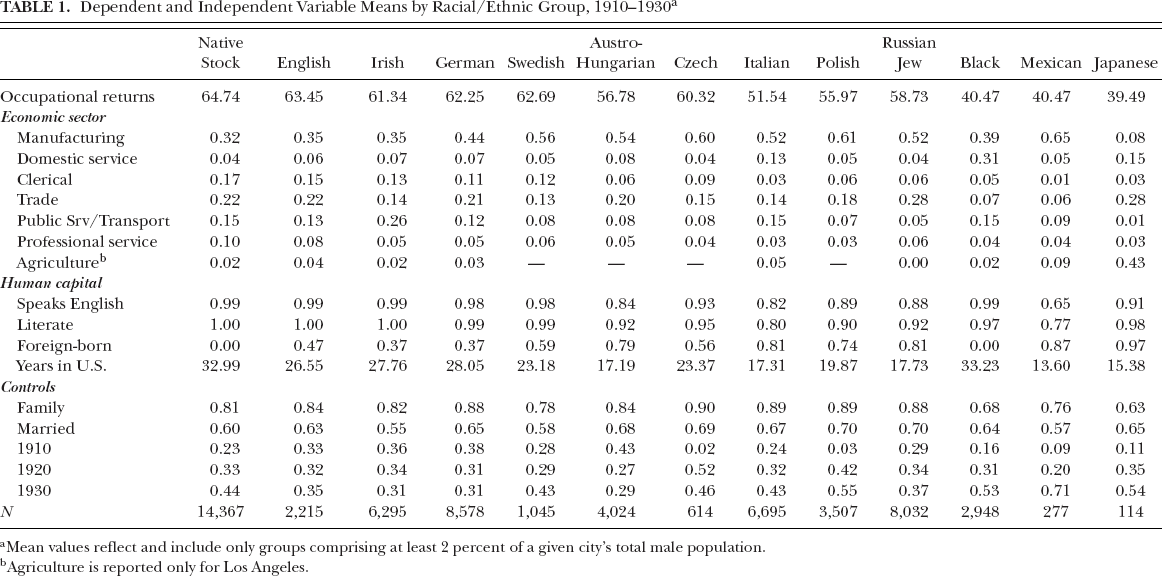
Economic sectoral concentration and segregation, which likely serve as a mechanism underlying the racial/ethnic inequality we are analyzing and may vary across the four locales of interest, are captured through group– and city–specific employment in manufacturing, domestic service, clerical service, trade, transportation and public service, professional occupations, and, in the case of Los Angeles, agriculture. These measures are dichotomous, coded 1 if a respondent is employed in a given industry and 0 otherwise. Means and standard deviations for these and other variables are reported in Table 1 by racial/ethnic group.
Dependent and Independent Variable Means by Racial/Ethnic Group, 1910–1930 a
Mean values reflect and include only groups comprising at least 2 percent of a given city's total male population.
Agriculture is reported only for Los Angeles.
Importantly, and in addition to race/ethnicity and industrial sectors, our full modeling accounts for several measures of human and cultural capital associated with differential employment returns: literacy, English language proficiency, nativity, and years in the United States (Lieberson 1980; Tolnay 2001). 10 Literacy and English language proficiency are dichotomous variables, coded 1 in the presence of the corresponding characteristic and 0 otherwise. Nativity is also dichotomous, coded 1 if an individual is foreign–born and 0 if U.S.–born. Years in the United States is a continuous measure that taps into cultural capital accumulated as a result of time spent in the United States. 11
Finally, our models include important statistical controls for household family membership (immediate or extended) and marital status. Both measures are strongly associated with social capital and economic status—factors commonly connected to employment opportunities and rewards (Sanders and Nee 1996; Tolnay 2004). Household family membership is dichotomous, coded 1 if an individual lives in a household unit with family and 0 otherwise; marital status is coded 1 if a respondent is married and 0 otherwise (i.e., single, divorced, widowed). As a final precaution, we include dichotomous measures for each census year (1910–1930) to control for period effects.
Content–Coded Qualitative Data
Our analyses also uniquely draw on systematic content–coding and qualitative immersion into several hundred articles from the Atlanta Constitution, Chicago Daily Tribune, Los Angeles Times, and New York Times for the years paralleling our quantitative data (i.e., 1910–1930). A significant benefit of such data lie in its rich content, its ability to capture concrete events and group biases, and its corresponding use for clarifying patterns of inequality revealed by the quantitative findings.
Each newspaper provided extensive coverage of local events and issues for the period and was circulated widely throughout its home state. That is, each maintained a broad readership and had an influential public presence during the time frame being considered. Accessed through Proquest Historical Newspapers [Full Text], a publicly accessible digital newspaper archive, we developed and employed a series of broad search term combinations to generate a preliminary set of articles to examine. Our search cast a wide net, extracting all articles identifying racial/ethnic groups (e.g., Irish, Italian, Japanese, and Mexican) and the foreign–born more generally. We also pulled all articles that referenced labor markets, schools, housing, and other common settings where racial/ethnic antagonisms might flare up and discrimination often takes place. 12 Our initial search generated over 3,400 article hits. Several coders then filtered articles to eliminate those not directly dealing with groups, issues, or events in California, Georgia, Illinois, or New York. Article inclusion was restricted to content centering on racial/ethnic conflict and discrimination in the particular state in which the given newspaper was based. 13 Most of these articles reflected events, tensions, etc., in the particular city of interest, although some reported on group dynamics and antagonisms throughout the state. We chose to include state coverage as well since readership tended to be highly concentrated within the target city. Moreover, state–wide issues and events frequently echoed more localized attitudes and concerns.
Next, using a predesigned coding device and following the restrictions noted above, the remaining articles for each of the four newspapers were coded by at least two coders. 14 Articles were coded for publication date, article placement/type, racial/ethnic group focus, and multiple dimensions of racial/ethnic antagonism, bias, and exclusionary practices. Coders recorded all first–hand accounts and commentary pertaining to labor market conflict, violence, discrimination, and segregation. Content concerning racial/ethnic–based discrimination and segregation in nonlabor market settings (e.g., schooling, housing, community organizations, and politics) was also coded. Article content was then arranged into three clusters: (1) employment/union discrimination; (2) labor conflict/violence; and (3) nonlabor discrimination. An intercoder reliability of approximately 0.87 was achieved, and coders regularly consulted with one another when article content was somewhat ambiguous (see Hodson 1999). Elimination of extraneous articles that did not fully match our coding criteria resulted in 446 relevant articles. In roughly one–half of these articles, two or more groups were discussed. Each instance in which a particular racial/ethnic group was discussed was treated as a separate case. This produced 724 data points (i.e., cases) reflecting some dimension of racial/ethnic antagonism, bias, or exclusion.
Analytic Strategy
Our analyses proceed in two steps. First, we employ conventional regression techniques and undertake aggregate analyses of compositional dynamics and differences across each of the four cities examined (Table 2) and the extent to which inequalities in occupational returns (Table 3) are exacerbated (i.e., competition/threat) or mitigated (i.e., queuing) for each group depending on overall representation. These analyses highlight which of the two arguably most pertinent spatially sensitive expectations receive the bulk of support.
Racial/Ethnic Group Composition, 1910–1930 a
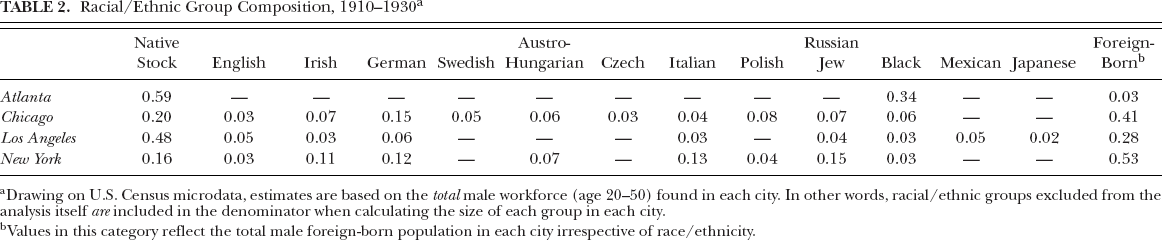
Drawing on U.S. Census microdata, estimates are based on the total male workforce (age 20–50) found in each city. In other words, racial/ethnic groups excluded from the analysis itself are included in the denominator when calculating the size of each group in each city.
Values in this category reflect the total male foreign–born population in each city irrespective of race/ethnicity.
Predicted Occupational Returns Ratios by Race/Ethnicity, 1910–1930 a

Predicted occupational returns estimates are based on Table 4, Model 1, and hold human/cultural capital and control variables constant at their mean. Ratios are calculated as a proportion of predicted native–stock white scores. This conversion allows for direct comparison both within and across groups and cities.
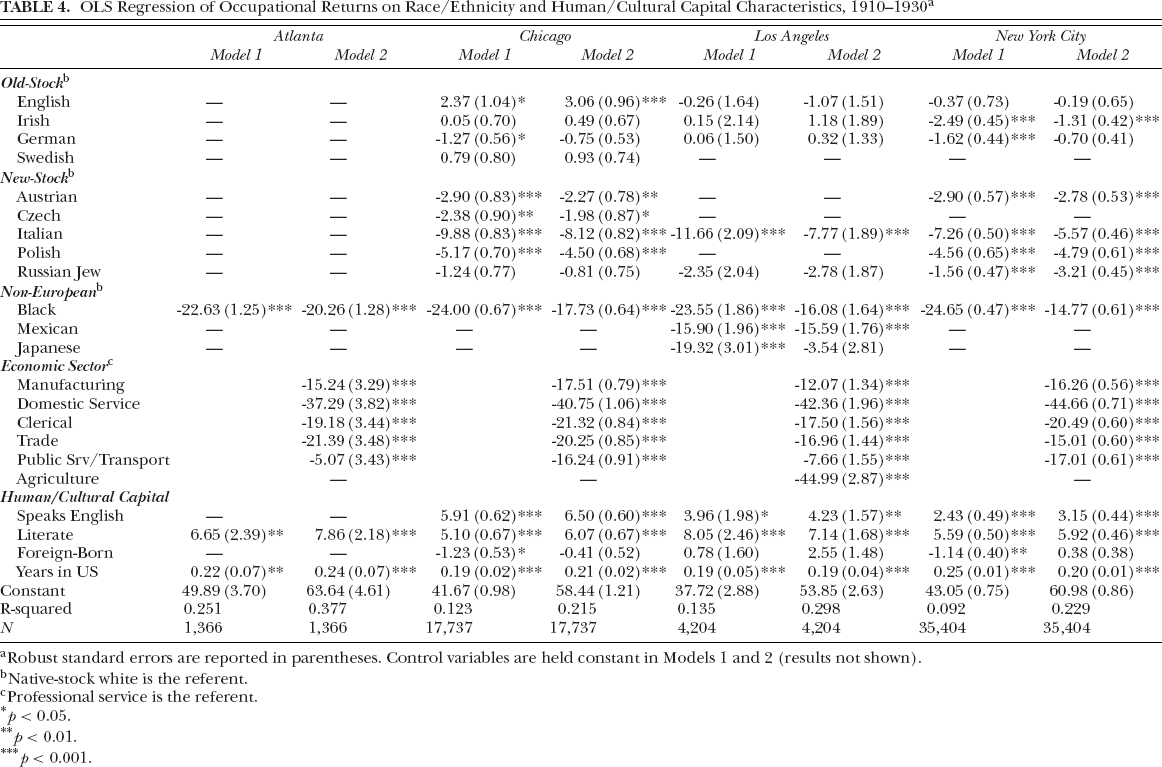
The second portion of our analyses digs even deeper, examining the extent to which the racial/ethnic inequalities uncovered are explained by dynamics of industrial segregation and concentration and exclusionary and local discriminatory processes. The coupling of quantitative analyses of group inequalities in occupational returns and internal labor market concentrations (Table 4) with systematic content coding of qualitative materials pertaining to exclusion, bias, and discrimination (Table 5) are important relative to: (1) the question of mechanisms; but also (2) the extent to which competition plays out differentially within and across urban locales—a point we return to in our conclusion and that helps rectify, to some extent, the countervailing patterns our analyses reveal.
OLS Regression of Occupational Returns on Race/Ethnicity and Human/Cultural Capital Characteristics, 1910–1930 a
Robust standard errors are reported in parentheses. Control variables are held constant in Models 1 and 2 (results not shown).
Native–stock white is the referent.
Professional service is the referent.
p < 0.05.
p < 0.01.
p < 0.001.
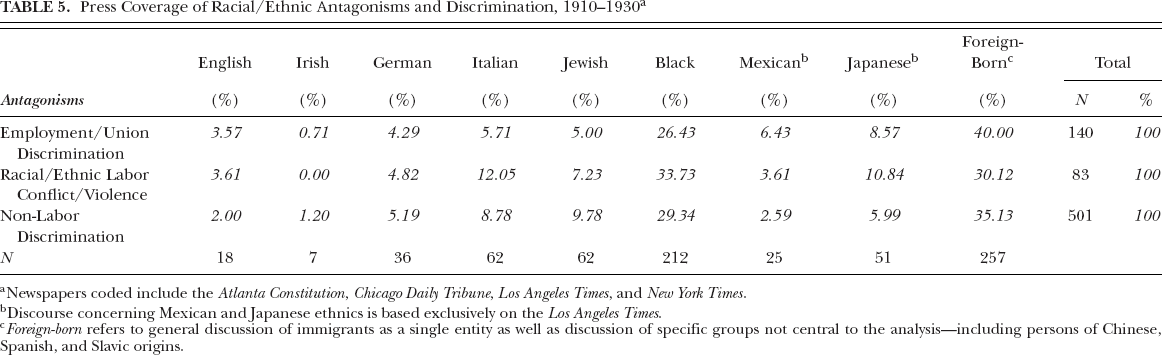
Press Coverage of Racial/Ethnic Antagonisms and Discrimination, 1910–1930 a
Newspapers coded include the Atlanta Constitution, Chicago Daily Tribune, Los Angeles Times, and New York Times.
Discourse concerning Mexican and Japanese ethnics is based exclusively on the Los Angeles Times.
Foreign–born refers to general discussion of immigrants as a single entity as well as discussion of specific groups not central to the analysis—including persons of Chinese, Spanish, and Slavic origins.
Hierarchy, Group Composition, and Labor Market Inequalities
Table 2 reports group concentrations across each of the four contexts and their variations. The heavy flow of white European ethnic labor to New York City and Chicago, where nearly half of the respective populations were foreign born, is evident. New York, of course, was a key port of entry, while both New York and Chicago were long–term destinations for many European ethnics. This contrasts in notable ways with Los Angeles, where white ethnics represented a much smaller share of the workforce and, instead, many foreign–born laborers were of Asian and Mexican descent; and Atlanta, where African Americans comprised the preponderance of the low wage minority labor supply, and European ethnics, Asians, and Hispanics were largely absent.
The patterns of group concentration reported above speak directly to expectations regarding spatial variations. To the extent competition and threat mattered relative to generating greater inequality, one should expect to observe a higher degree of white ethnic economic subordination in New York and Chicago, especially pronounced African American inequality in Atlanta, and Asian and Mexican economic subordination in Los Angeles. Conversely, and to the extent there are queuing and niche advantages associated with group concentration, it is plausible to expect the opposite. To address these possibilities, we turn to Table 3, which reports predicted occupational returns ratios (i.e., inequalities) by racial/ethnic group, controlling for core background and human capital attributes.
Table 3 shows that average English, Irish, German, and Swedish returns generally parallel those of native–stock whites—particularly in Chicago and Los Angeles. This implies not only the successful incorporation of old–stock European groups into the economic mainstream by the time period under consideration, but also commensurate treatment relative to native–stock whites. This is much less true for new–stock European ethnics, African Americans, Mexicans, and Japanese, who clearly witnessed and experienced racial/ethnic hierarchy and inequalities in occupational returns.
Italians, African Americans, Mexicans, and Japanese fare quite poorly in each of the four cities under investigation, albeit to varying degrees. Italian returns, for instance, fall significantly below all other European ethnic groups. In Los Angeles, in particular, and despite a favorable and open context for white ethnic labor, Italian returns trailed the nearest European ethnic group by about 15 percent—falling midway between predicted white and black scores. In New York, in contrast, where they were most highly represented, Italians actually fare somewhat better overall. This intercity comparison and pattern is more consistent with the possibility of queuing and ethnic niche benefits rather than competitive losses. A similar case can be made for African Americans in Atlanta given high levels of representation and the fact that black–white inequalities in relative returns, while pronounced in general, are smaller than those found in Chicago, Los Angeles, and New York.
Although city–level comparisons are not possible for Mexicans and Japanese, owing to their negligible representation in three of the four contexts considered, it is clear that both groups experienced significant closure and disadvantage during the period in question. Indeed, Mexican and Japanese occupational returns in Los Angeles were 25–30 percent lower than native–stock whites and European ethnics with similar human capital. Although considered white in principle by various California State laws (as well as the U.S. Census Bureau), early twentieth–century Mexican and Mexican American labor was, in practice, often viewed and treated distinctly. Comparisons regarding the mental and physical attributes of Mexicans also frequently alluded and drew parallels to African Americans—replicating disparaging stereotypes of innate inferiority (Fox and Guglielmo 2012; Garcia 2001; see also Myrdal 1944). Asians and Asian Americans likewise faced significant barriers to economic and political incorporation, outright exclusion at various points, and relegation to the lowest rungs of service sector work and agriculture (Boswell 1986; Jiobu 1988).
When taken in concert, Table 2 and 3 denote clear racial/ethnic labor market inequality and hierarchy across the four cities being considered, with more evidence overall for a queuing advantage (compared to a competitive/threat disadvantage). Comparison of Italian and African American labor market inequalities and local compositions are especially informative in this regard. One possible explanation is that, given prevailing racial/ethnic hierarchies, closure, and a low starting point, the heavy concentration of Italians in New York and African Americans in Atlanta allowed these groups to fill labor needs, push into better jobs, and thus experience better occupational returns relative to their peers elsewhere.
A positive relation between local minority group size and opportunities/rewards even for lower–status, less favored groups in the labor market strata is not to suggest that competitive pressures and exclusionary processes were not occurring. Indeed, Table 3 reveals significant economic inequalities and group hierarchy within each urban context considered—economic inequalities and group hierarchy that might be triggered by and related to internal (intracity) processes of competition, segregation, and even discrimination. This possibility—that is, that competition may be relevant more so within city contexts—is addressed next as we consider the extent to which processes of industrial segregation, group antagonism, and exclusion contribute to the inequalities and group hierarchies thus far highlighted.
Within–City Competition, Segregation, and Antagonism
To the extent that inequalities and group hierarchies exist, it is essential that scholars probe the mechanisms and processes that might be implicated (Gross 2009; Reskin 2003; Tilly 1999). In the case of our analyses, this entails deeper examination of the degree to which observed group–level inequalities in labor market returns might be at least partially a product of competitive pressures, industrial segregation, and discriminatory tendencies within multigroup urban settings.
We begin with Figure 1, which reports group economic sector representation across all four urban contexts. 15 Values are reported for groups with adequate population representation per city, and reflect a given group's share within a particular sector of the labor market. The reader will note a few dominant trends. New–stock European ethnics, African Americans, Mexicans, and Japanese are significantly underrepresented in higher return professional service work and, to a lesser extent, manufacturing and clerical positions. Instead, they tend to be overrepresented in low reward sectors such as domestic service work (Italians and especially African Americans) and agriculture (Japanese). Such under– and overrepresentation in higher and lower reward sectors may help explain the economic gaps highlighted earlier and may, in fact, reflect competitive and exclusionary mechanisms through which the racial/ethnic hierarchy already reported was reified. To get at this possibility, we regress group–specific occupational returns on sectoral segregation and representation along with individual background controls (reported in Table 4). We also draw on our systematically coded qualitative newspaper content to get at underlying processes of group closure (reported in Table 5).
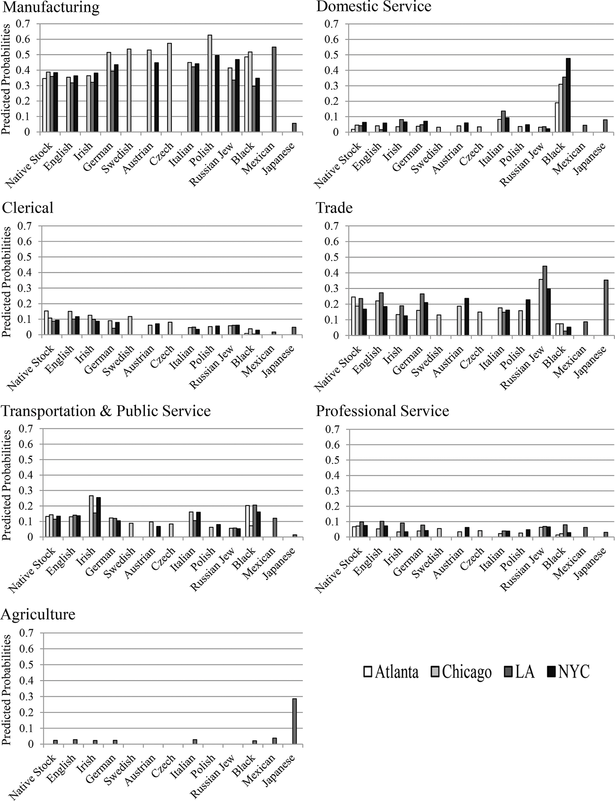
Predicted probability of working in a given economic sector by race/ethnicity, 1910–1930.
Model 1 provides a baseline for examining disparities by both group and location. Here, average old–stock European returns are comparable to or trail native–stock whites by just a few points. Among new–stock groups, however, estimates are quite variable, falling anywhere from 2–12 points below native whites. Average black, Mexican, and Japanese returns trail those of native–stock whites by 16–25 points. This model reveals a clear status hierarchy in which native–stock whites are located at the top, followed closely by old–stock European ethnics, then new–stock groups, and finally non–European minorities.
Notable, especially when undertaking this modeling with and without controls (available upon request), human and cultural capital have very little bearing when it comes to black–white differentials—particularly in Atlanta. Atlanta, in this regard, represents a case in which socially and institutionally entrenched Jim Crow and racial hierarchy for the period constrained African American labor market opportunities and rewards.
In Chicago, human and cultural capital was more meaningful for labor market returns—at least for those of European ancestry. Among old–stock ethnics, the inclusion of individual background attributes eliminates most statistically significant inequalities. And among new–stock white ethnic groups in Chicago, disparities drop sharply for Austro–Hungarians and Russian Jews, and are cut by a third or more for Italians, Poles, and Czechs. Italian and Polish returns, nonetheless, continue to trail native–stock whites by 5–10 points. Thus, although human and cultural capital attributes broadly benefit white ethnics, gains are hardly even across the board. The persistence of such disadvantage among Italians and Poles suggests they were precluded from full social and economic participation—a trend fundamentally echoed in New York.
In Los Angeles, average returns for old–stock European ethnics did not differ significantly from native–stock whites prior to or once we include controls in Model 1. Among new–stock white ethnics, however, human and cultural capital reduces group–specific inequalities more markedly—though at varying levels. While estimates for Russian Jews edge closer to parity with native–stock whites, the gap for Italians remains sizable and statistically significant. A similar pattern of persistent disadvantage is replicated among non–European minorities in Los Angeles as well. Mexican and Japanese coefficients are attenuated to some extent when individual human and cultural capital are included as they are in Model 1, yet remain 16–19 points lower than native whites. Average African American returns are more or less stagnant. Black estimates in this instance trail native–stock whites by about 24 points—a deficit comparable to that found in Chicago and New York.
We introduce in Model 2 indicators of industrial sector representation. The reader will note sizeable declines in disparities in relative returns between Models 1 and 2 once these measures are included. This is especially true for the Japanese in Los Angeles and both Italians and African Americans in Chicago, Los Angeles, and New York. Such reductions in inequality gaps once we account for economic sector suggest at least one important mechanism contributing to racial/ethnic inequality, namely, sectoral segregation and disparate representation in low return labor markets. Although our quantitative analyses cannot speak directly to the question of how or why sectoral representation varies by group, historical work (e.g., Lieberson 1980) and our own analyses of content–coded newspaper accounts suggest that competitive, exclusionary, and discriminatory pressures within each urban context played a role. Indeed, as reported in Table 5, newspaper reports of group exclusion via job discrimination across labor market settings as well as industrial conflict and other forms of exclusion are most pronounced for those of Italian, Jewish, African American, Mexican, and Japanese descent.
These groups, noted above, tended to be discouraged or excluded from more lucrative economic sectors or embraced as needed in lower return industrial sectors, depending on the compositional mix. Take these two accounts from California, for instance, that denote hierarchical preferences for low wage race/ethnic labor:
In the Middle West all south–of–Europe immigrants are looked upon as undesirables. But to California, they will be a godsend. In the words of Secretary Horatio F. Stoll of the Grape Growers Association of California, “With the coming of the teeming thousands from France, Italy, Portugal, and the southern countries of Europe, the agricultural industry of the state will be in safe hands” (Los Angeles Times 1913a: II1).
There is no agricultural district in the state wholly free from the Japanese…The yellow peril evoked by this Japanese industrial invasion is not an imaginary one. If the percentage of increase of Japanese population in the last ten years were to be continued for the next fifty years California would be, to all social and economic intents and purposes, a Japanese colony (Los Angeles Times 1920a: 20).
Such reports reflect the advantaged position of newer white European ethnics in Los Angeles as well as the perceived and enduring threat of Asian labor and nativist opposition at state and local levels (Bennett 1988; Chan 1990; see also Los Angeles Times 1913b, 1913c, 1914, 1920b, 1920, 1924).
Findings for New York similarly suggest a potential link between white ethnic and immigrant concentrations, competitive dynamics, and labor market returns—a point corroborated by our qualitative analyses. Take, for instance, the following comments made by New York residents in letters to the editor of the Times:
The flow of new immigration has within recent years come from parts of Europe where the customs and people are entirely different from our own. The chances of our assimilation of them are very small. They retain their lower standard and in ever–increasing numbers portend an ever–increasing danger of national degeneration and economic rupture. But the problem is not alone an ethnic one… When we have numerous unemployed of our own, it is folly to invite others to our shores (New York Times 1922a:118).
No part of the population of the United States suffers more from unrestricted immigration than does labor…Immigrants come from countries with a lower standard of living. If immigration is unrestricted or a great number of aliens is allowed to come to this country, the American laborer is placed in an unfavorable position. If he tries to compete with the immigrant, he must be content with the wages which the alien asks, and this means his standard of living must fall (New York Times 1928: 61).
Such statements clearly denote some sense of threat surrounding local European ethnic and immigrant encroachment and concentration—concentration that resulted in some restrictions to new–stock white ethnic employment but that also likely dampened old–stock opportunities and returns, especially among Irish and German labor. The apparent negative association between overall white ethnic population size and employment outcomes among those closer to the top of the racial/ethnic hierarchy (e.g., Irish and German ethnics in New York) speaks to the salience of perceived competition and local racial/ethnic composition.
Our findings are also consistent with historical accounts and media portrayals depicting southern and eastern European ethnics as racially inferior and ill–suited for many jobs (Higham 1988; Yans–McLaughlin 1982), as well as discourses describing them as swarthy, criminal, and more simply, an unwanted minority population (see, e.g., Bennett 1988; Restifo et al. 2013; see also Chicago Daily Tribune 1910a, 1910, 1910c, 1915; New York Times 1911a, 1913, 1921, 1923, 1924, 1930). This was certainly the case with Italians, whose tenuous position is evident in the following account offering veiled praise:
The laboring Italian, a lower product of civilization than that of the negro…has gladly sought labor that the other rejects.…Ignorant of our language and customs, and with some prejudice against him on these and other grounds, the Italian has bravely entered the field, and serves generally in such work as shoe blackening, window and store cleaning, [and] street sweeping, requiring no skill or capital, or as barbers, coal, wood, and ice dealers, peddlers, fruiterers, etc., where fair intelligence and very small capital suffice (New York Times 1911b: 10).
Characteristic of the era, the following account by social scientist George E. Haynes (at the time Executive Secretary of the National League on Urban Conditions Among Negroes) sheds similar light on the ongoing vulnerability and sectoral and occupational closure confronting African Americans:
[I]t cannot be denied that heretofore [in the North the negro] has been practically shut out of most of the highly paid employments. He has also been crowded into very limited fields and mostly into occupations where white men in large numbers did not care to compete. This has been mainly in domestic and personal service (New York Times 1916: X12).
To be sure, conditions for African Americans in the Northeast and Midwest often mirrored those of the South. Black labor was the frequent target of abuse and exclusion, and numerous race riots erupted as a result of perceived penetration into white institutions (Foner 1974; Spero and Harris 1931; see also Chicago Daily Tribune 1917a, 1917b, 1919a, 1919b; New York Times 1917, 1919, 1922b, 1926). Clearly, for the period, African Americans were located at the bottom of the nation's racial order and constrained primarily to low–status occupations.
Although our general analyses of labor market returns suggest some queueing advantages associated with group concentration, our more in–depth quantitative analyses of sectoral representation and systematic consideration of media accounts reveal that competitive pressure, discrimination, and social closure were certainly at play within these four urban contexts during the time period considered. When we compare cities, however, it appears that competition/threat and the exclusions it entailed were not enough to undercut the aggregate queueing advantages that minority population sizes conferred, at least with regard to labor market returns.
Discussion
Deep–seated prejudice and prevailing racial/ethnic hierarchies constrain labor market opportunities and rewards for many minority groups. Such dynamics were certainly witnessed in the cities and time periods that have been highlighted in this article. Yet, our analyses, which included comparison across four significant U.S. urban areas with diverse racial/ethnic groups and varying compositions, also revealed some important queueing advantages associated with heightened minority representation. Such findings, taken together, highlight the general importance of local context, multigroup compositions, hierarchical labor arrangements, and their implications particularly for labor market inequalities and returns.
Old–stock European groups, according to our analyses, were largely integrated and consequently experienced rather comparable treatment to that of native–stock whites both within and across labor markets that we examined. For groups ranked lower in the racial/ethnic status order and labor queue, a larger local presence corresponded, on average, to greater relative economic returns. This was certainly the case in our analyses for Italians and African Americans in particular. Italians in New York and African Americans in Atlanta appear to have gained a better foothold in higher status, higher return occupations even in the face of persistent barriers, labor or sectoral exclusions, and intergroup tensions. Growing representation, demand for labor, and niche development likely converged to afford these groups at least some degree of better access to higher return jobs despite competitive pressures.
Our analyses lend some albeit limited support to competition/threat perspectives and more compelling evidence consistent with what queuing frameworks would suggest, at least when it comes to labor market returns and inequality. This is not to suggest there were not processes of group threat and discrimination that were triggered by growing levels of minority presence. There certainly were, as demonstrated especially within quantitative findings on sectoral segregation and impact and our qualitative materials, which highlighted clear group hierarchies and avenues of tension and discrimination within and across multigroup urban settings. Yet, occupational returns for less favored minorities were, in the aggregate, bolstered with group size. Our findings in these regards help clarify the diverse pathways by which historical labor market inequality unfolds relative to racial/ethnic hierarchy, sometimes simultaneously conferring advantage (i.e., in labor market returns) but also disadvantage (i.e., stigma, group tension, and exclusion) relative to group representation.
Conclusions
We offered in this article a systematic account of complex patterns and pathways associated with U.S. labor market inequality and hierarchical processes. Building upon labor market stratification literatures and case–based comparative methods, we considered how compositional forces conditioned the labor market experiences of diverse racial/ethnic groups in early twentieth–century urban America. Our strategy and findings underscore, to some degree, the importance of place in conjunction with more widespread racial/ethnic antagonisms.
Admittedly, our analyses focus only on male labor market participants. As such, potential gender–based variations remain untouched. We suspect that examining the nexus of race/ethnicity and gender, to the extent that comparable historical data become available, may reveal important patterns and mechanisms that inform our understanding of historical as well as contemporary labor market inequalities. Additionally, census data do not directly account for labor market discrimination or closure. Context–specific consideration of time and place, along with systematic analyses of local, archived data, can nevertheless offer some leverage for understanding and interpreting patterns of disadvantage by both group and locale.
Future research could also benefit from continued in–depth consideration of how labor market processes and status hierarchies converge. Case–centered comparative designs exploring multiple settings and spanning multiple eras would be useful and offer leverage for disentangling stratifying mechanisms and identifying moments wherein race/ethnicity trumps individual effort and ability. Sensitivity to the cultural and structural specifics of place, which can set the terms of competitive and even exclusionary battles, is therefore key. In addition, greater theoretical and empirical attention should be devoted to the role economic status plays in shaping even broader racial and ethnic boundaries (see Saperstein and Penner 2012; Vargas 2015) as they may play out across other domains of social life. Such work is particularly crucial given potential linkages between historical labor market disadvantage, shifting racial boundaries over the course of the twentieth century, and current racial/ethnic inequalities and immigrant flows into the U.S. Without investing in such scholarship, our understanding of racial/ethnic stratification and labor markets will remain incomplete.
The findings we have presented, even with the aforementioned caveats, offer interesting sociological insights on racial/ethnic inequality and labor markets by highlighting: (1) the ways in which racial/ethnic labor market hierarchies impact the sorting and occupational placement of minority group labor; (2) how the economic position of minorities at or near the top of the U.S. racial/ethnic order might stagnate where minority concentration is particularly high; and (3) how queuing can bolster the prospects of minorities at or near the bottom. Such results challenge and sit at a crossroads of conventional competition and queuing predictions, while also offering clues toward developing a deeper understanding of not just historical but also contemporary racial/ethnic labor market stratification and dominant group response.
Race/ethnicity played a decisive role in determining early twentieth–century employment opportunities and economic experiences—a role that has left a lasting legacy and that continues to shape the experiences of many contemporary groups. Local sociocultural context and group composition were (and remain) instrumental. Indeed, there are compelling reasons to expect that the perceived threat surrounding current immigration flows and today's racial/ethnic demographic trends will generate pressures toward closure. Just how that plays out relative to racial/ethnic inequality and hierarchy, and whether queueing advantages will outweigh competitive disadvantages, will certainly vary depending on prevailing national discourses, stereotypes, and the specifics of locality, including histories of race/ethnic relations and the extent of group representation.
Footnotes
Acknowledgements
An earlier version of this article was presented at the 2014 Meetings of the American Sociological Association, San Francisco, CA. We thank Natalie Kendall and Jennifer Spaulding for valuable newspaper collection and coding assistance in the early stages of this project. We also thank the City & Community editor and anonymous reviewers for their thoughtful feedback and key suggestions. This project and article was partially supported by the National Science Foundation Graduate Research Fellowship Program under Grant No. DGE–0822215.