







Abstract
The acquisition of language has long stood as a challenge to general learning accounts, leading many theorists to propose domain-specific knowledge and processes to explain language acquisition. Here we review evidence that analogical comparison is instrumental in language learning, suggesting a larger role for general learning processes in the acquisition of language.
Language acquisition is one of humankind's most impressive cognitive feats. A 6-month-old can do little more than babble, but by 2 or 3 years of age, children show generative knowledge of the patterns of their language—that is, they can extend the words they hear to new situations, and they can use grammatical constructions in new contexts. This accomplishment—a hallmark of human cognition—has seemed to defy explanation via general learning processes. In this paper we review findings suggesting that human language learning may be explained in part by another hallmark ability in human cognition—namely, analogical processing, a domain-general process of unusual power and generativity.
We first highlight some challenges in early language learning. Then we describe analogical processing in humans and present evidence that analogical-comparison processes are instrumental in language learning. We begin with the acquisition of word meaning, including object names, part names, adjectives, and verbs. Then we turn to the role of analogy in grammar learning.
THE PROBLEM OF LANGUAGE LEARNING
Consider a young child who hears “This is a bicycle.” She has to realize that an object is being discussed, determine which object it is, and (if she is to successfully use the word herself in new contexts) ascertain which aspects of the object are important in making it a “bicycle.” She must also comprehend the grammatical construction “This is a —.” How do children learn these patterns? We suggest that comparison across utterances plays a major role in this achievement.
STRUCTURE-MAPPING THEORY AND STRUCTURAL ALIGNMENT
The proposal that comparison processes can promote language learning is based on research in analogy and similarity. New findings have revealed patterns that go beyond ordinary intuitions. We all know that comparing two things can highlight commonalities, such as “both are red” or “both can fly.” But this is only part of the story. Our research has shown that humans' comparison processes preferentially highlight relational commonalities (Gentner & Markman, 1997). For example, when adults were given the two pictures in Figure 1 and asked what the car in Figure 1A “goes with” in Figure 1B, they chose the similar car. But when another group of adults was induced to first compare the pictures and rate their similarity, before being asked what the car goes with, they instead chose the boat. Instead of focusing on the object match, the comparison group focused on the common relational structure (aligning “trucka TOWS car a ” with “carb TOWS boat b ” (Markman & Gentner, 1993). According to structure-mapping theory, this relational focus arises because when people compare two things, they implicitly seek to find correspondences between their conceptual representations, a process referred to as structural alignment (Gentner, 2003). In the above study, the correspondence between the two towing relations led the comparison group to choose the initially unintuitive correspondence between the car in Figure 1A and the boat in Figure 1B over the more obvious match between the two cars. This illustrates an important point: The alignment process favors commonalities between relations among objects over commonalities between objects per se.
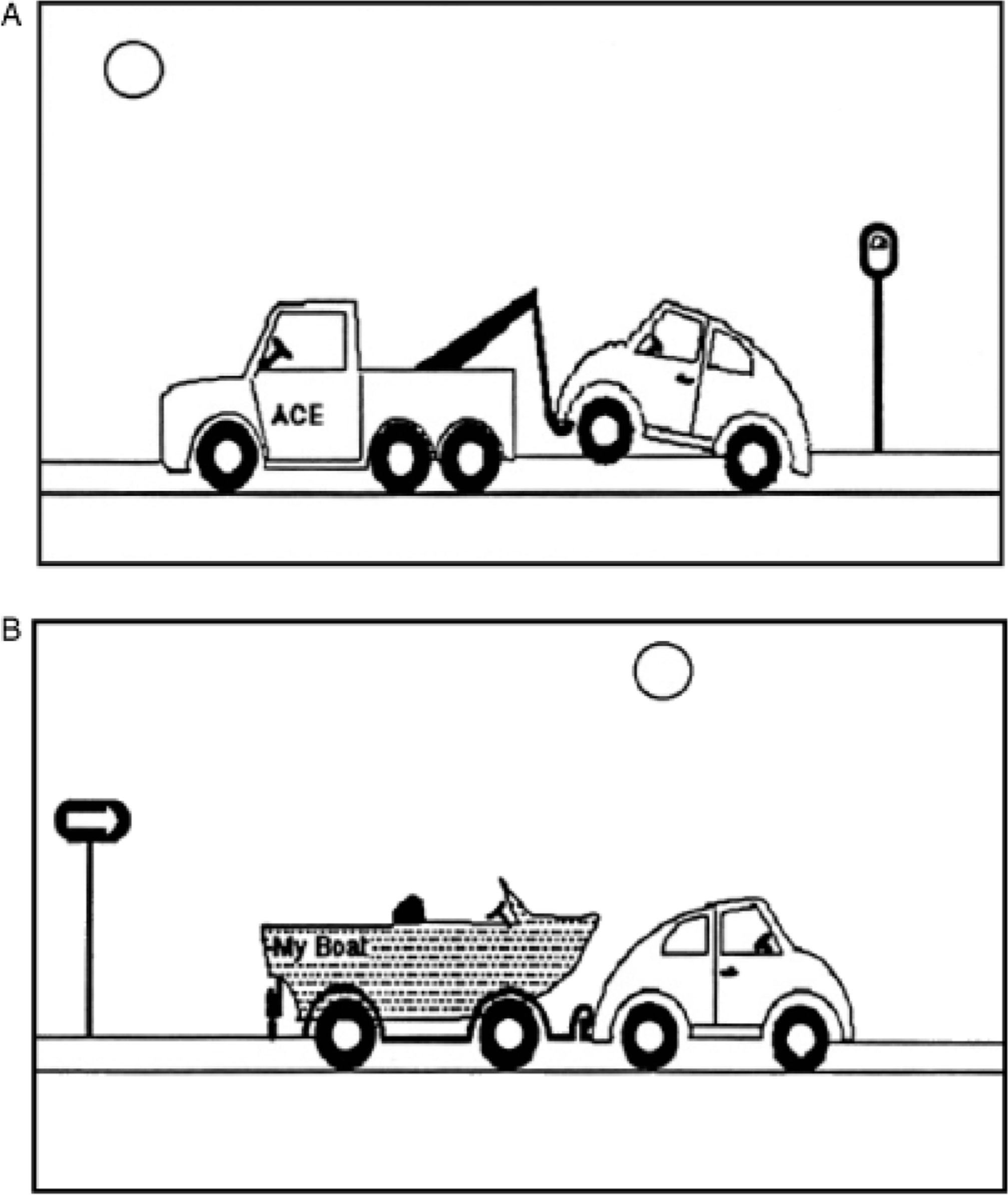
Sample item from the Markman and Gentner (1993) study. Carrying out a prior comparison increases the likelihood that adults will match the car in A with the boat in B based on their common relational role (as thing being towed), rather than simply matching the two cars.
This study also demonstrates that, even among adults, object matches are highly salient (as evidenced by the control group's propensity to choose the car-to-car match). This initial focus on objects rather than relations is even more pronounced in children, whose knowledge of the relevant relations is often fragile. Thus, even more than adults, children stand to benefit greatly from comparison processes. When children actively compare two things, as opposed to perceiving them in isolation, their attention often shifts toward common relational information—information that might have been shadowy and implicit prior to the comparison.
Alignment can also strengthen children's ability to generalize these insights about common relations to other objects and situations. We have found that comparing two highly similar items (that have both surface and relational commonalities) often paves the way for children to subsequently notice more abstract relational commonalities. A central claim in our work is that this process of progressive alignment from concrete similarity to abstract relational similarity is an important bootstrapping process in children's learning. We turn now to evidence that structural-alignment processes are at work in language acquisition.
LEARNING OBJECT NAMES
From early in development, children believe that if two things have the same name, they share some common properties. But in order to use the name themselves and apply it to new exemplars, children must work out which common properties matter. Early in development, children often focus on perceptual similarity—particularly shape similarity. For example, they make naive but systematic mistakes such as calling horses and cats “doggies.” This focus on perceptual similarity may be a reasonable early heuristic, given that many of children's initial words are names for basic-level object categories (whose members share perceptual as well as conceptual similarity). But children clearly move beyond salient perceptual properties and come to appreciate the deeper commonalities that underlie word meanings. We suggest that comparison processes are fundamental to this ability.
A key tenet of our work is that words are invitations to compare. Children spontaneously compare things that have the same name. For the reasons just described, this simple act of comparing two things can lead to an enriched understanding of the word's meaning, by elevating the salience of relational commonalities among its referents that might otherwise not be noticed. This process enables children to override compelling perceptual commonalities in favor of deeper conceptual ones.
In our studies, we invited children to compare objects from a given category (such as fruit or things you ride on) and then tested their word extension (Gentner & Namy, 1999). For example, we taught 4-year-olds a new “puppet word” (e.g., “blicket” for a bicycle) and asked them to choose another blicket from a set of possibilities that included a perceptually similar object from a different category (eyeglasses) and a perceptually dissimilar object from the same conceptual category (a skateboard; see Fig. 2). A second group of children performed the same task with a tricycle (perceptually and conceptually highly similar to the bicycle) as the standard. Both these groups chose the perceptual match (the eyeglasses) over the conceptual match. A third group (the comparison group) was shown both the bicycle and the tricycle, told that they were both blickets, and asked “Can you see why these are both blickets?” These children differed strikingly from the other two groups when asked to choose a matching object. Despite the fact that they had twice as much evidence for the matching perceptual features, they chose the conceptual match (the skateboard). Comparing the two standards led children to attend to their common conceptual relations, highlighting their common causal and functional structure over their perceptual commonalities. Thus, comparison can act to reveal important conceptual properties.
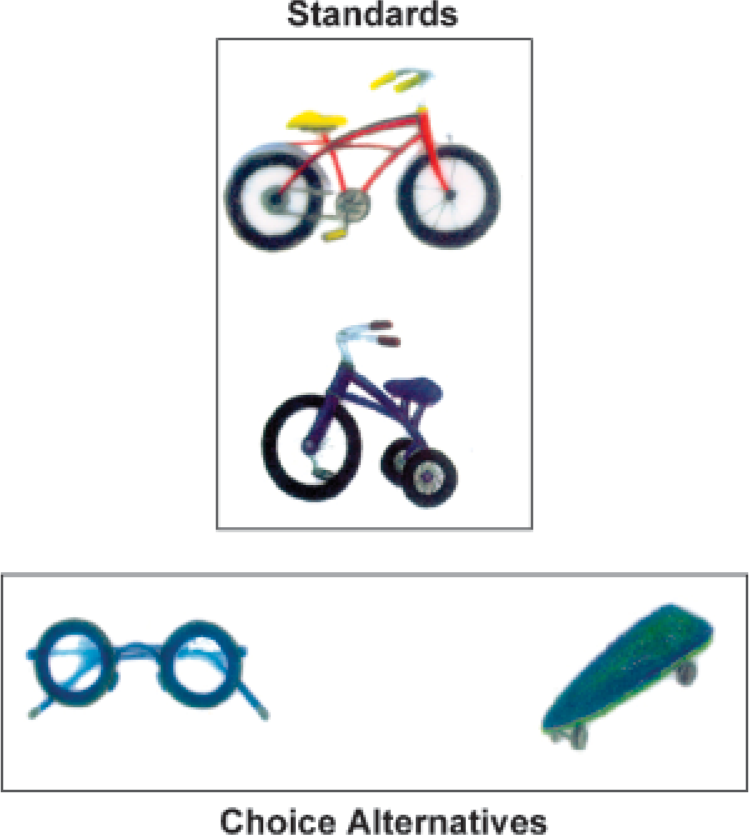
Sample item from the Gentner and Namy (1999) study. Children who learned a novel word (e.g., “blicket”) for either of the two standards (bicycle or tricycle) extended the word to the perceptual match, the eyeglasses. Those who heard a common label for the two standards extended the word to the category match, the skateboard.
A further study revealed more direct evidence that words can serve as invitations to compare. Namy and Gentner (2002) showed 4-year-olds pairs of similar objects (e.g., bicycle and tricycle) with either the same label or different labels. When asked to “find another one,” those who had heard the same label (e.g., “blicket”) for both objects chose a category match, whereas those who had heard different labels for the two objects (e.g., “blicket” and “riffel”) chose a perceptual match.
Although in our studies we pitted perceptual matching against conceptual matching, in real life the two are often mutually supporting. Perceptual commonalities are often correlated with deep relational commonalities: For example, fins and gills are associated with a different kind of breathing process than legs and fur are. A striking aspect of the current findings is that comparing two things that were highly perceptually similar led children to notice common conceptual structure. This suggests that even comparisons that are initially based on perceptual commonalities can bootstrap insight into conceptual commonalities. Early in learning, children may rely on salient perceptual commonalities in comparing exemplars and in extending new words. But comparison among perceptually similar exemplars can lead them to discover the underlying conceptual relations.
WORDS FOR PARTS AND PROPERTIES
So far we have considered names for object categories. Recent studies have also investigated the role of alignment in children's learning of names for parts and for properties. For example, Gentner, Loewenstein, and Hung (in press) found that alignment processing can facilitate the acquisition of part names in 3- to 5-year-old children. Children were shown a novel “Martian creature” and told (for example) “See, this one has a dibble. Can you tell me which one of these has a dibble?” They had to choose between two alternatives that were identical to each other except that only one of them shared a key part (e.g., a navel or a wing) with the standard (see Fig. 3). To simulate incidental word learning, in this task children received very little guidance; for example, the experimenter did not point to the part in the standard. Yet children were highly successful, again suggesting that spontaneous comparison may aid children's everyday word learning.
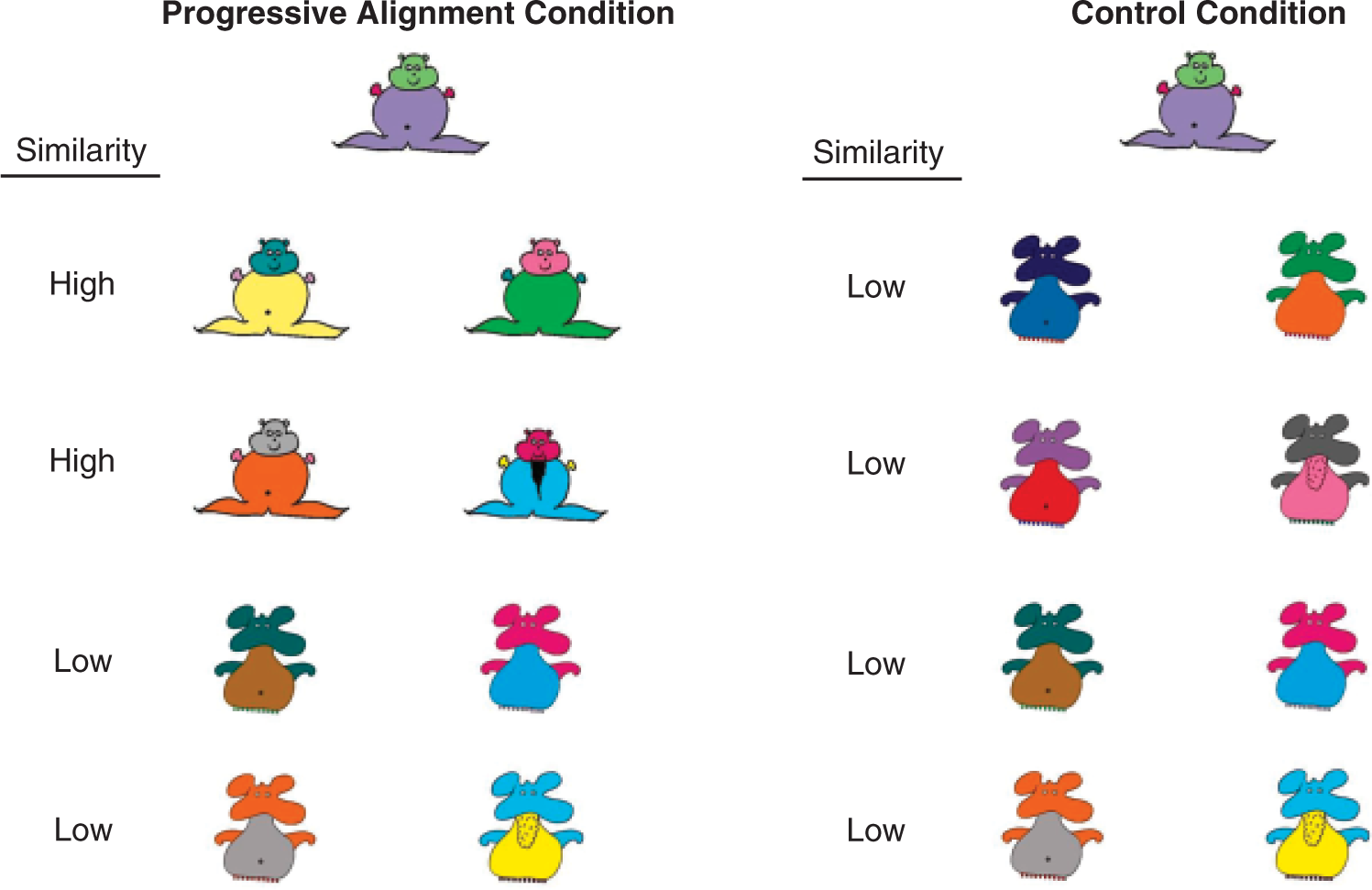
Sample item from the Gentner, Loewenstein, and Hung (in press) paper in which children were asked to extend novel body-part labels (e.g., a “dibble” in the animal's abdomen) to different creatures. Three-year-olds who first received alternatives that were highly similar to the standard creature were subsequently better able to apply the body-part label to a low-similarity creature with the same body part (progressive alignment condition, left) than were children who received low-similarity trials throughout (control condition, right).
These studies also demonstrated the role of progressive alignment in word learning. Whereas 4- to 5-year-olds succeeded even when the alternatives were perceptually dissimilar from the standard, 3-year-olds initially succeeded only when the two alternatives were both highly similar to the standard and were therefore easily aligned with it. They performed at chance on dissimilar triads. However, if 3-year-olds were first given high-similarity triads, they went on to succeed at the dissimilar triads. Aligning the high-similarity, “easy” items helped them discern the common structure needed to align the low-similarity, “difficult” items—evidence for the role of alignment in learning.
Alignment processes have also been demonstrated in the learning of adjectives. Waxman and Klibanoff (2000) taught 3-year-olds a novel adjective for a particular property (such as having stripes). Children heard a novel adjective applied to a standard (e.g., a spotted frog) and then had to say which of two alternatives shared that property. Children's accuracy depended strongly on whether the alternatives were perceptually similar to the standard. There was also evidence for progressive alignment: Children performed better on dissimilar alternatives if they had first received highly similar alternatives.
A longitudinal observational study by Sandhofer (2001) suggests a role for comparison in learning the meanings of dimensional terms. She found, first, that parents varied in their use of comparative statements across different conceptual domains. Comments about size were predominantly comparative (e.g., “This one is bigger than that one”) whereas those regarding color and number were predominantly categorical (e.g., “Here are two bears”). Second, she found that children attained conceptual mastery earlier in domains (such as size) for which parents used mostly comparative statements than in domains (such as color) for which parents used mostly categorical statements.
LEARNING RELATIONAL TERMS
Inferring the meanings of verbs poses a particular challenge to young children because these word classes are inherently relational—only the relation is held constant across instances, with the objects free to vary. Thus alignment across utterances may be particularly important for learning verbs and other relational terms. Childers (2006) taught 2 1/2-year-olds novel result verbs—verbs like open, which express the result of an action regardless of how it is achieved. She found that 2 1/2-year-olds were able to learn the meaning of a novel result verb by comparing multiple instances in which different objects performed different specific actions that each accomplished the same result but varied in the specific actions and objects. Further, children's success at enacting the verb with new objects and actions improved as a function of the number of instances of the verb they had seen. Finally, consistent with findings reported above, the comparison effect was increased by the use of a common label across presentations.
ALIGNMENT AND THE ACQUISITION OF GRAMMAR
One of the great mysteries of human cognition is how young children acquire the grammatical structure of their language. The reigning view has been that general learning processes are insufficient to account for this achievement, given the abstractness and complexity of human grammar. Recently, however, researchers have begun to explore the role of learning processes, and evidence is emerging that structural-alignment processes may facilitate the learning of grammar. Tomasello (2000) has suggested that structural alignment provides a mechanism by which children come to generalize constructions from one verb to another and acquire a generalized understanding of linguistic constructions. Fisher (1996) has proposed that structural analogies between form and meaning—for example, the parallel between the transitive sentence form (e.g., “X pushes Y”) and a causal event (such as person X pushing object Y)—help children learn about verb meanings. Evidence from studies of how people learn artificial grammars suggests that comparison across instances of the same grammatical construction can facilitate discovery of regular patterns across sentences. For example, 7-month-old infants who hear multiple utterances with parallel structures can abstract the relational pattern and apply it to new utterances (Gomez & Gerken, 1999; Marcus, Vijayan, Bandi, & Vishton, 1999). This learning has been successfully modeled in a computational simulation that uses progressive alignment (Kuehne, Gentner, & Forbus, 2000).
Casenhiser and Goldberg (2005) found evidence for structural alignment processes in learning a new grammatical construction. They showed 6-year-old children videotaped events accompanied by sentences with novel verbs. The events all shared the general meaning of something appearing in a location, and the sentences all had the same novel grammatical form—for example, “The rabbit the hat moopoed” for a rabbit appearing on a hat, or “The sun the sky fegoed” for the sun rising into the sky. Children (and adults) were able to learn the novel construction and generalize it correctly to a new verb. Further, as predicted by structural-alignment theory, children learned better when given many instances of the same novel verb rather than a small number of instances of several different verbs. Sentences that have the same verb are highly likely to be aligned, providing a structure that forms a frame for the other sentences.
Childers and Tomasello (2001) conducted research showing that comparison can help children discover syntactic patterns in their native language. They found that intensive comparison across instances of a particular grammatical construction increased 2 1/2-year-old children's likelihood of producing that construction. After experiencing a series of events, each described with a transitive sentence (e.g., “The cow is swinging the bottle!”), children were far more likely to use a transitive sentence to answer questions about a novel event than were children who did not receive this experience. These findings add to the evidence that comparison across utterances may aid in learning grammatical patterns.
CONCLUSIONS
There is compelling evidence that analogical comparison contributes to language acquisition. Alignment processes help children gain insight into word meanings, and there is mounting evidence that alignment also contributes to the learning of grammatical constructions. This evidence raises the possibility that domain-general learning mechanisms, rather than a specialized language acquisition device, may account at least in part for the human capacity to acquire language. Of course, it remains an open question whether humans also have specialized capacities that underpin language learning. Further research on alignment processes in language acquisition may help us discover just which aspects of language are especially available to young human learners.
Our ongoing work on this topic includes an exploration of which kinds of comparisons are optimal for learning (e.g., is it always best to begin with close comparisons, and if so, how quickly should one progress to far comparisons?), of what factors prompt children to engage in alignment spontaneously (e.g., spatial/temporal proximity of instances; high similarity among instances), and of how alignment might facilitate children's discovery of functionally important features when learning novel categories.
The research reviewed here bears on the question of whether and how general learning processes enter into language acquisition. Structural alignment is a domain-general cognitive process that operates across a wide range of cognitive domains, yet there is abundant evidence that it contributes to the learning of language. We suggest that the exploration of analogical processes can help in replacing the mystery of language acquisition with a learning account.