







Abstract
Substantial U.S. population growth in relatively rural areas adjacent to large urban areas is sparking renewed interest in the rural–urban fringe. This research identifies some of the roots of the rural–urban fringe concept and reviews recent scholarly interest in the related exurban concept. Analysis of primary and secondary data is conducted to examine the fringe in relation to both urban/suburban areas and rural areas of Ohio, seeking to determine the extent to which the fringe is similar to or dissimilar from the suburbs or more rural areas. Comparisons are made across a number of ecological, occupational, and sociocultural attributes. Differences between incorporated (cities and villages) and unincorporated (township) areas are also considered. Findings support the notion of the fringe being distinct from the suburbs, with more modest differences compared to more rural places. Practical implications of this research are discussed as are future research needs for further understanding an increasingly important settlement area of the United States.
Introduction
Despite demographers reporting dynamic U.S. population change at the interface between large urban and relatively rural areas (Fuguitt, 1985; Heimlich and Brooks, 1989; Johnson, 2003; Johnson, Nucci, and Long, 2005), study of the rural–urban fringe has received modest attention from urban and community sociologists. While some scholars have systematically examined matters of land–use policy and growth management at the rural–urban fringe (Daniels, 1999; Davis, 1993; Davis, Nelson, and Dueker, 1994; Healy, 1981; Nelson, 1992; Nelson and Sanchez, 1997), this dynamic region of change has arguably received less attention than more purely urban or rural areas. As our research team has examined land–use and agricultural change at the rural–urban interface in Ohio, we have been startled by the sheer size of the population residing just beyond the edge of many of Ohio's large urbanized areas. While county–level demographic analysis provides glimpses of the change occurring in the rural–urban fringe, it masks much of the change and provides little knowledge of fringe residents and communities.
In this study, we seek to rediscover the rural–urban fringe as a concept of interest to community sociologists and present a variety of data from Ohio to illustrate some of its contemporary characteristics. We begin by briefly reviewing historic and contemporary scholarship, concluding with a series of questions to consider to better understand this settlement area. To answer these questions, we conduct descriptive and bivariate analysis of primary and secondary data. We conclude by outlining some of the implications of this research and identify next steps for increasing our understanding of the fringe. An overarching goal of this endeavor is to stimulate more scholarly interest in the rural–urban fringe, which is needed to guide development of effective policy and planning to manage fringe growth and change.
Understanding the Rural–Urban Fringe
One factor limiting study of the rural–urban fringe may be that it “is too urban to attract traditional rural researchers and too rural to incite urban scholarly inquiry” (Audirac, 1999, p. 7). A further complicating factor is that data compiled at an appropriate level of geography for delineating the rural–urban fringe have not been readily available (Hart, 1991). Despite disciplinary and data–related limitations, the rural–urban fringe has received attention on and off since at least the 1950s, with persistent interest in simply defining the fringe and occasional examinations of its social aspects.
Pryor (1968) credits first use of the term “fringe” to T. Lynn Smith in 1937 (although Shyrock and Siegal, 1980, note that Smith's usage is akin to Galpin's even earlier term “rurban”). in 1958, Kurtz and Eicher (1958) arrived at the following definition of the rural–urban fringe as a:
location beyond the limits of the legal city, in the ‘agricultural hinterland,’ exhibiting characteristics of mixed land use, with no consistent pattern of farm and nonfarm dwellings. The residents are involved in rural and urban occupations. The area is unincorporated, relatively lax zoning regulations exist, and few, if any, municipal services are provided. The area shows potentialities for population growth and increasing density ratios. Present density ratios are intermediate between urban and rural. (p. 36, 37)
Ten years later, Pryor (1968) continued the task of defining the rural–urban fringe, with particular attention to contextualizing it into existing theories of urban invasion. While there are a number of similarities between Kurtz and Eicher's (1958) definition and Pryor's (1968) definition, an important element of the latter's work is a focus on the fringe's transitional nature. This leads Pryor to anticipate an urban fringe, contiguous to the central city with more land being used for nonfarm purposes, and a rural fringe, contiguous to the urban fringe with less land in nonfarm uses and lowers rates of farmland conversion and commuting (p. 206). of course, Pryor acknowledges that the fringe's character will evolve and its exact geographic pattern will vary between locales.
In the 1990s, the rural–urban fringe began to receive attention from a small group of academic planners and geographers (Daniels, 1999; Davis, 1993; Davis, Nelson, and Dueker, 1994; Nelson, 1992; Nelson and Sanchez, 1997) who generally referred to this region of interest as exurbia, a term also appearing more widely in the popular press, particularly since 2004 when exurbanites were purported to have played an important role in determining the outcome of that year's U.S. presidential election (Brooks, 2004; Lyman, 2005; Mahler, 2005). 1 Among exurban researchers, a leading question has been whether exurbia is simply an early manifestation of the suburbs or a distinct settlement form. Research findings related to this thesis are mixed, though. Focusing on characterizing exurban residents in relation to suburban residents, some researchers have found substantial similarities between exurbanites and suburbanites, suggesting that the exurbs are simply suburbs of the suburbs, while other researchers have identified distinctive characteristics of exurbanites relative to suburbanites (Davis, 1993; Davis, Nelson, and Dueker, 1994; Nelson and Sanchez, 1999; Patel, 1980).
Nelson and Sanchez (1997) uncover many similarities as they examine household characteristics, worker occupations, employment accessibility, and residential characteristics of suburbanites and exurbanites. The statistically significant differences between the two groups, they note, are more a function of location than of systematic differences in household demographics or occupation. For example, exurbanites commute further, live on larger lots, and reside in larger houses, differences anticipated by traditional location theory. Others, though, have found exurbanites to be distinct. For instance, Lessinger (1986) argues that exurbanites are more concerned about quality of life issues than suburbanites. Davis, Nelson, and Dueker (1994) conclude a Portland area case study by stating that “significant attitudinal and lifestyle differences separate exurbanites from suburbanites” (p. 54). Their findings reveal that “exurban rural” (unincorporated) areas have the highest rate of dual–income households and the lowest rate of households out of the workforce as compared to the suburban and exurban village households. Exurban rural area dwellers are also twice as likely as suburban workers to have blue–collar jobs.
While urban–oriented researchers have sought to differentiate exurbanites from suburban and urban residents, rural–oriented scholars have also attempted to identify how fringe residents and communities differ from more traditional rural residents or communities. These largely qualitative analyses have sought to understand the evolving meaning of community, nature, and agriculture at the rural–urban fringe (Bell, 1994; Friedland, 2002; Salamon, 2003). Both Bell (1992) and Friedland (2002) examine the social meanings associated with rural landscapes and living by newcomers and long–time residents. Friedland identifies how conflict can arise among increasingly diverse fringe residents regarding what is agriculture and what are preferred uses of the landscape. Salamon (2003), on the other hand, examines the evolving social organization and community disruption that can occur as a result of the invasion and possible succession of long–time residents by newcomers in rural–urban fringe areas. An end result is the emergence of a number of different types of communities within the commutershed of nearby urban areas, including agrarian hamlets, affluent residential communities, shabby residential communities, and communities with mixed economic attributes.
In many ways the various efforts of planners, geographers, and sociologists to assess the extent to which rural–urban fringe or exurban residents are different from or similar to more “rural” or “urban/suburban” residents is largely a renewed examination of the question of whether places and people might be classified as distinctive along a rural–urban continuum (e.g., Bell, 1992; Friedland, 2002; Pahl, 1966; Willits and Bealer, 1967). This research has generally sought to characterize communities and citizens according to their ruralness or urbanness, primarily focusing on occupational, sociocultural, and ecological characteristics of the community or its residents (Bell, 1992; Friedland, 2002; Hummon, 1990; Willits and Bealer, 1967). in the case of occupation, the assumption is that more rural places, due to proximity to natural resources, will have greater employment in farming, fishing, or mining than urban places (Freudenburg, 1991; Jones et al., 2003; Sharp and Tucker, 2005). Sociocultural differences are expected based on interpretations of classic traditions in community sociology (e.g., Tönnies, 1988; Wirth, 1938) that anticipate qualitative changes in social relationships due to urbanization, resulting in reduced personal kinship or friendship–based linkages among urban residents and lower place attachment among urbanites as well. Finally, ecological measures of local populations, such as population size, density, and level of service provision (with urban places having a more complete array of services relative to rural) have also been used to distinguish rural from urban. Similar to the mixture of findings related to the existence of differences at the rural–urban fringe, results have been mixed regarding the existence of differences between rural and urban places, particularly in terms of sociocultural differences (Goudy, 1990; Theodori and Luloff, 2000; Wellman, 1979; White and Guest, 2003).
Based on this review, we offer two critical observations regarding further systematic analysis of the rural–urban fringe (or exurbia, depending on one's preference). First, while fringe scholarship is fragmented by such factors as era (pre–1970s, late 1970s to early 1980s, mid 1990s to present), discipline (planning, geography, sociology), and research orientation (rural vs. urban), a more holistic and integrated approach is needed. in particular, analysis of the fringe often occurs in reference to either urban or rural; rarely is the fringe examined in relation to both urban/suburban and rural settlements in the same analysis. A second limitation of contemporary rural–urban fringe scholarship, particularly that focusing on the people and places at the fringe, is the lack of well–developed framework for interpreting findings and building an integrated body of knowledge about the fringe and its people. A first step may be to examine the fringe in relation to the historic characterizations of communities along a rural–urban continuum.
Analytical Approach
We propose to examine select occupational, sociocultural, and ecological characteristics of fringe, urban/suburban, and rural places to assess characteristics of the fringe and its distinctiveness. We classify Ohio places according to a spatial model that distinguishes between urbanized areas, the fringe, and rural areas using a simple distance model organized around Ohio's largest urbanized areas. in addition, we intend to distinguish between the inner and outer portions of the rural–urban fringe, acknowledging what some previous analysts have noted as a rural–urban fringe and an urban–rural fringe. We will then conduct a series of bivariate comparisons to characterize the fringe in relation to both suburban/urban and rural places.
An additional issue we are compelled to introduce into our analysis is a distinction between places according to whether they are incorporated or unincorporated, a distinction generally ignored by community researchers. in Ohio, the state we are most familiar with, community governance is complicated by the existence of a large number of subcounty, unincorporated governmental units labeled as townships. Like other states, predominantly in the Midwest, 2 Ohio's 88 counties are parsed into over 1,300 unincorporated townships and almost 1,000 incorporated cities and villages. Generally, township governments were originally authorized to assist in the conveyance of land and are commonly thought of as a rural form of government with limited power. However, as a result of substantial migration into fringe townships, this type of government increasingly has to respond to serious challenges associated with local governance and service provision (Bender and Zolty, 1986), challenges they have historically not dealt with and, in some states, are not adequately empowered to manage. in some instances, unincorporated townships have grown so large that they are functional equivalents of cities, providing a broad range of services beyond their original “rural” responsibilities.
A number of factors may help explain why townships have been overlooked, despite their growing significance at the rural–urban fringe. One issue is the difficulty of compiling useful secondary data to describe unincorporated township areas. U.S. Census geography and the organization of the data for public use do not allow easy access to this level of data aggregation. Further, the tradition among rural community sociologists, the most likely to confront this matter, is generally to associate unincorporated areas with the most proximate incorporated areas (a tradition dating back as far as Galpin, 1915). Planners and geographers have shown similar levels of disinterest in unincorporated areas as a unit of analysis. in one of the only studies comparing incorporated and unincorporated areas, Davis, Nelson, and Dueker (1994) did find that exurban small town (incorporated places) residents are markedly different from residents of exurban “rural” areas (unincorporated) in the Portland, Oregon, region.
In light of the existence of different community governance structures at the rural–urban interface, we will examine whether differences exist between incorporated and unincorporated places of the rural–urban fringe. A priori, we expect there to be differences, particularly in ecological and occupational matters, with lower densities and greater natural resource linkages in the township/unincorporated areas. The Davis, Nelson, and Dueker (1994) findings also suggest that sociocultural differences may exist.
To summarize our analytical approach, we propose to conduct three sets of contrasts. These contrasts include: comparison of urban, suburban fringe, and rural places; comparison of fringe incorporated and unincorporated places; and finally a comparison of the inner and outer fringe areas with more suburban and rural areas. Based on our understanding of the literature, we anticipate that the rural–urban fringe will have some characteristics similar to suburban areas and other characteristics akin to rural areas, thus occupying a middle location along the rural–urban continuum in ecological, occupational, and select sociocultural features. We do expect differences will exist within the fringe between incorporated and unincorporated places, as noted in the previous paragraph. Finally, we are not strongly inclined to anticipate substantial differences between residents and settlements of the inner fringe versus the outer fringe or expect to find the inner fringe more similar to the suburbs and the outer fringe more similar to rural, although previous land–use–oriented research has revealed differences in the level of development in the outer versus inner regions (Audirac, 1999).
Data and Methods
Ohio is an excellent laboratory for studying the fringe. There are 20 urbanized areas in or adjacent to the state and substantial amounts of relatively rural farm and forest land within the sphere of influence of these urbanized areas (Clark et al., 2003). in fact, one recent study estimated that over 60 percent of Ohio's land area can be characterized as exurban (Irwin and Reece, 2002). For this study, we analyze data from the 1980, 1990, and 2000 U.S. Censuses and from the 2002 version of the Ohio Survey of Food, Agricultural, and Environmental Issues. The survey is an ongoing, biennial mail survey of a stratified sample of Ohio households. The survey response rate was 55.6 percent in 2002 (4,013 completed questionnaires from nearly 7,200 deliverable surveys). The mail survey was conducted using the tailored design method (Dillman, 2000), with five mail contacts during the course of data collection. Statistical analysis was conducted using SPSS 13.0.1 and spatial analysis utilizes ESRI's ArcView 3.2.
Identifying the Rural–urban Fringe
To identify Ohio's rural–urban fringe, a simple distance model was created, structured according to what were determined as reasonable commuting distances to the state's largest urbanized areas (urbanized areas with 50,000 residents). This approach has drawbacks, but is consistent with that of other rural–urban fringe researchers (Audirac, 1999). 3 in practice, then, the rural–urban fringe is located just beyond the boundary of each of the state's urbanized areas 4 and those urbanized areas in neighboring states. The outer limit of the fringe is what might be considered a reasonable commuting distance back to the urbanized area. The commuting distance was determined by analyzing commuting data from the 2000 U.S. Census. First, the average commute time was calculated for all areas of Ohio. Given the great range in sizes of the state's urbanized areas, commuting times were anticipated to vary according to the population of the urbanized area. Analysis of commuting data verified this expectation, with average commutes longer around the largest urbanized areas and shorter around the smallest. To account for this variation, the commuting field was defined as 35 miles from the edge of the largest urbanized areas (one million or more residents); 25 miles from the edge of urbanized areas with a population between 500,000 and one million people; and 15 miles from the edge of urbanized areas of less than 500,000 residents. To distinguish the inner and outer zones of the rural–urban fringe, a break was created at half the distance from the urban edge and the outer portion of the rural–urban fringe (this break was at 17.5 miles for urbanized areas of over one million people; 12.5 miles for urbanized areas of between 500,000 and one million people; and 7.5 miles for all other urbanized areas). While there is no “right” way to demarcate the fringe, we believe our approach is both intuitive and practical. We do note that alternative buffer distances are possible and we expect to be able to partially evaluate this matter during the course of our analysis, particularly when examining the inner and outer fringe zones.
Once the inner and outer portions of the rural–urban fringe were determined, the 931 cities or villages (incorporated places) and 1,309 townships (unincorporated places) 5 were classified as urban, suburban, inner fringe, outer fringe, or rural. Ohio's 17 central cities of urbanized areas were classified as urban. Cities other than core cities, villages, and townships with at least 25 percent of their land area within the urbanized area were defined as suburban. Inner fringe cities, villages, and townships were those places not defined as suburban with at least 25 percent of their land base in the inner fringe. Outer exurban cities, villages, and townships were those places not assigned to the inner fringe and with at least 50 percent of their land base within the outer fringe. Finally, rural cities, villages, and townships were those places with less than 50 percent of their land base in the outer fringe.
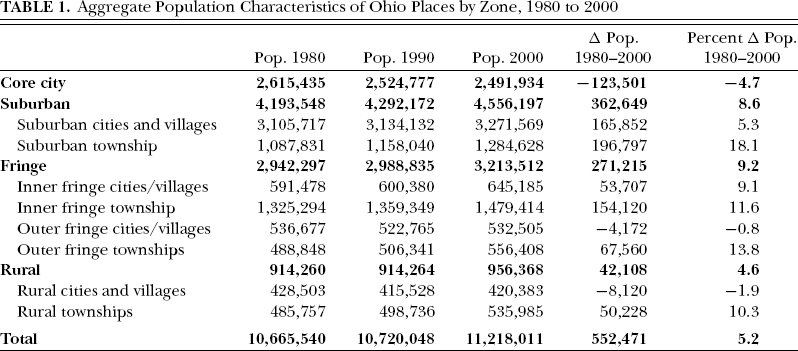
The result is that 17 core cities were defined as urban, 268 cities and villages and 82 townships were classified as suburban, 235 cities and villages and 482 townships were classified as inner fringe, 206 cities and villages and 340 townships were classified as outer fringe, and 205 cities and villages and 404 townships were classified as rural. Figure 1 reveals the spatial organization of Ohio's cities, villages, and townships into these categories and table 1 reports basic population data for the urban, suburban, fringe, and rural zones as well as subgroupings of interest within these zones (namely inner and outer fringe and incorporated and unincorporated places). The majority of Ohio's population is concentrated in the core cities or suburbs (more than seven million residents). The aggregate population of Ohio's core cities has declined between 1980 and 2000, while both suburban cities and villages and townships have grown. Aggregate and relative population growth has been greatest in the suburban townships from 1980 to 2000, despite the loss of suburban township area and population across these 20 years to annexation by adjoining suburban and urban incorporated areas. The fringe is home to over 3.2 million residents, up by over a quarter of million since 1980. Nearly half of fringe residents (1.5 million) reside in the inner fringe townships, which have gained over 150,000 residents since 1980. Aggregate population growth in the inner fringe cities and villages has been much more modest since 1980. Outer fringe cities and villages collectively lost population between 1980 and 2000, while outer fringe townships grew nearly 14 percent. Just under a million Ohioans reside in the rural areas of the state, with a majority of those rural residents residing in rural townships. Further, what growth there has been in rural Ohio occurred in the township areas (grew 10 percent while cities and villages collectively declined nearly 2 percent). 6
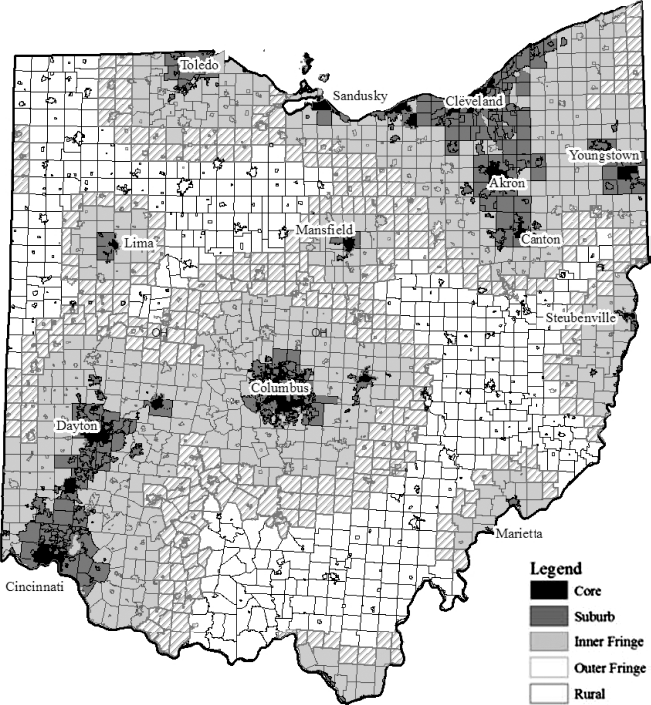
Ohio by fields (core urban, suburb, inner and outer fringe, rural) with major cities identified.
Aggregate Population Characteristics of Ohio Places by Zone, 1980 to 2000
Operationalization of Demographic, Occupational, and Agricultural Indicators
Select ecological and demographic data of Ohio cities, villages, and townships were compiled from the 2000 U.S. Census. The specific measures include population, density, population change, housing value, age of population, poverty, education, and income attributes. Occupational data from the 2000 Census to be examined include commuting data and data pertaining to employment in industries such as construction, agriculture, or professions.
A variety of social or cultural characteristics of the fringe are of possible interest to examine. While several recent studies of the exurbs have focused on locational and amenity–related preferences (Crump, 2003; Davis, Nelson, and Dueker, 1994), we focus on questions of social connections to farming and attitudes about farming. This focus is practically relevant, as Ohio's fringe is largely a farmed landscape and understanding residents’ views of farming can be important to land–use policy development and efforts to balance nonfarm development and traditional agriculture. Data related to residents’ social connections to and views of farming are from the 2002 Ohio Survey of Food, Agricultural, and Environmental Issues. Social connections to farming were measured through a series of questions asking respondents whether they were raised on a farm, whether their parents ever owned or operated a farm, whether any close friends operated a farm, the number of farmers known by the respondents, the average number of days per month a respondent visited with a farmer or a member of a farm family, and a series of questions concerning the frequency with which respondents visited rural areas for social or recreational purposes. These latter questions were aggregated into a rural recreation/visitation scale. 7
Attitudes about farming were measured in several ways. One series of questions asked respondents how important it was to preserve Ohio farmland in general, to preserve farmland for food production, and to preserve farmland to preserve the rural character (response categories for these items ranged from 1 = not important to 7 = very important). Respondents were also asked about the importance of research efforts aimed at preserving family farms. Two scales were constructed from responses to questions pertaining to attitudes about Ohio farmers and farming. These two scales are identified as a proagriculture support scale and a trust of farmers scale. 8
To conduct the comparisons of interest, mean demographic and occupational characteristics of the cities, villages, or townships within the urban, suburban, fringe, and rural zones are generated. Because the data from the 2002 Ohio Survey of Food, Agriculture, and Environmental Issues are insufficient to generate statistics for individual cities, villages, and townships, the mean agricultural linkages and attitudes reflect the mean of all respondents residing in each of the zones of interest (see Figure 1). One–way ANOVA was conducted to identify statistically significant differences among the settlement areas (F–test significant at 0.05 level results in rejection of the null hypothesis that means of all groups are equal). Where the F–test indicates the existence of differences among the groups, pairwise comparisons using the least significant difference (LSD) test are conducted to identify differences among particular pairs of settlement types. Because efficiently reporting the results of all pairwise comparisons is difficult, results of only those pairwise comparisons of interest are reported.
Fringe versus Urban/Suburban and Rural
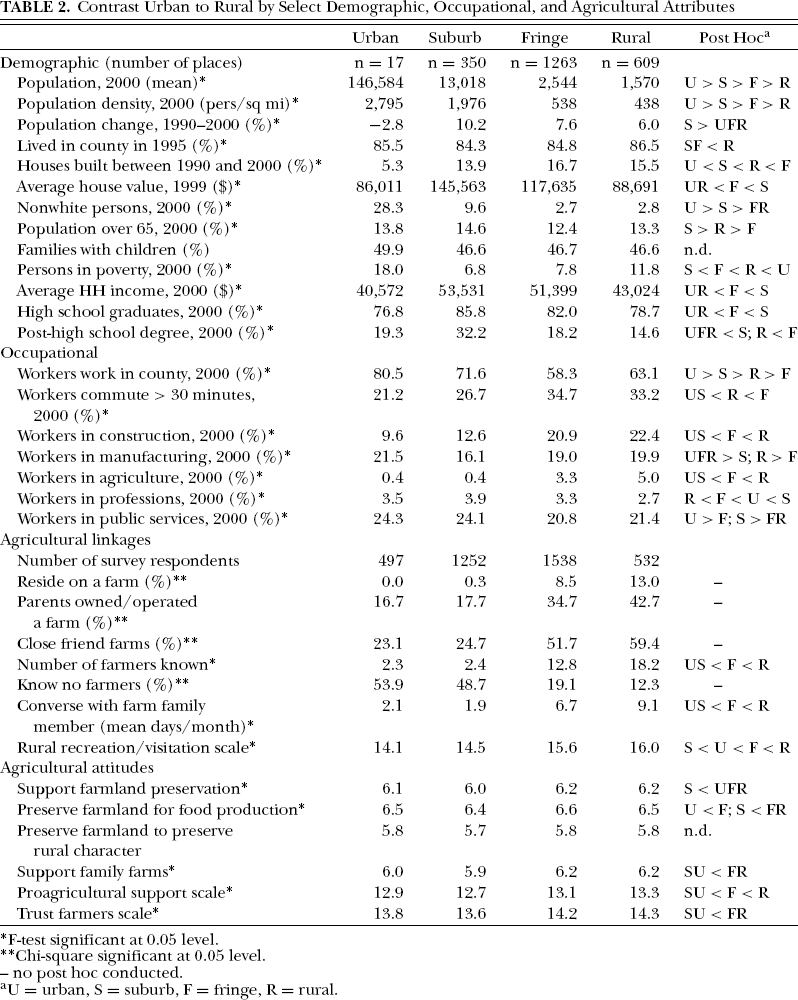
The first contrast of interest is the extent to which the fringe (both inner and outer regions combined) compares with the suburban/urban regions as well as the most rural parts of the state. table 2 contains the mean demographic and occupational–related data for places in each of the four settlement areas. in many cases the fringe occupies a middle position between urban/suburban and rural. Demographically, the average fringe place is substantially smaller in size than suburban places, but more populated than rural places. A similar pattern exists in terms of population density as well as agricultural linkages and agricultural attitudes. For example, fringe residents were much more likely to reside on a farm compared to urban/suburban residents but less likely than rural residents. Similarly, fringe residents knew a larger number of farmers on average and were much more likely to converse with a farm family member than urban/suburban residents but less likely compared to rural residents. in some instances the fringe did not occupy a middle position along the urban to rural continuum. in terms of housing, a larger proportion of houses were built between 1990 and 2000 in the fringe than in any of the other regions. in terms of jobs, a smaller proportion of fringe residents reported working in their county of residence and a larger proportion of fringe residents commute more than 30 minutes compared to residents of other regions.
Contrast Urban to Rural by Select Demographic, Occupational, and Agricultural Attributes
F–test significant at 0.05 level.
Chi–square significant at 0.05 level.
no post hoc conducted.
U = urban, S = suburb, F = fringe, R = rural.
These findings are generally consistent with our initial expectations, with the fringe occupying a middle position between the suburbs and rural in many attributes. Interpreting these results more qualitatively, even though the statistical comparisons generally confirm our expectations, the fringe appears more similar to rural in a number of instances (primarily ecologically and agriculturally) and more similar to suburban in one noteworthy instance (socioeconomic status). Clearly, the fringe on the whole is relatively sparsely populated compared to the suburbs and more similar to rural. Fringe residents also are much more likely to have personal, social, or familial linkages to agriculture compared to suburbanites, and are more similar to rural residents in this regard as well. The most noteworthy example of the fringe being more similar to the suburbs is in the case of average household income, as the average income of residents of both regions is in excess of $50,000, compared to $43,024 in rural settings. A “cost” to many fringe residents of achieving this higher income may be the greater likelihood of working outside their county of residence and incurring longer commutes.
Fringe Incorporated versus Fringe Unincorporated Places
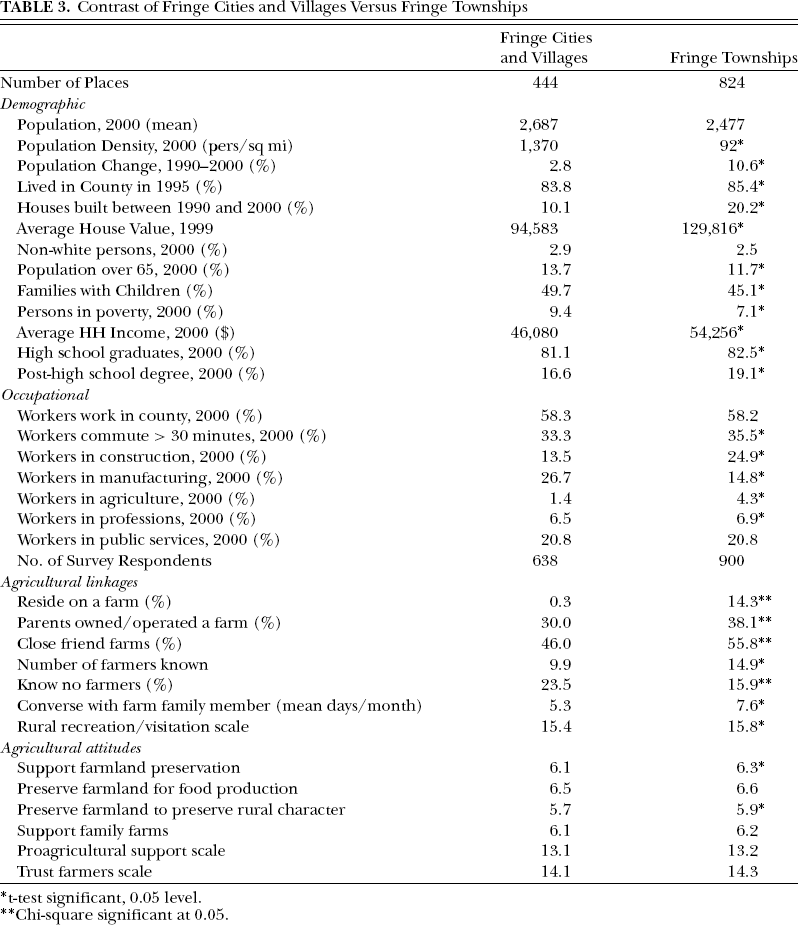
The comparisons among the four regions in the previous section can mask substantial diversity within a particular region. As previously noted, a potentially important distinction relevant to the study of fringe areas is the existence of both incorporated (cities and villages) and unincorporated (townships) places. To assess the extent to which these types of fringe places differ, analysis comparing fringe cities and villages with fringe townships is conducted. The results of these comparisons are reported in table 3, with the group means and t–test results identified. While the average population of fringe cities and villages and townships are similar, there are substantial differences in other demographic, occupational, and agricultural characteristics. As would be expected, the density of township areas is substantially less than those of fringe cities and villages (92 persons per square mile versus 1,370). Population growth, proportion of houses built between 1990 and 2000, average housing value, household income, proportion of workers employed in agriculture, proportion of residents residing on a farm, average number of farmers known by residents, and support of farmland preservation are all greater in fringe township areas compared to fringe cities and villages.
Contrast of Fringe Cities and Villages Versus Fringe Townships
t–test significant, 0.05 level.
Chi–square significant at 0.05.
These findings clearly support our expectation of differences between incorporated and unincorporated places of the fringe. We anticipated demographic differences and occupational and cultural differences consistent with the presence of substantial farmland in township areas. and the stronger support for farmland preservation, particularly to preserve rural character, is consistent with the thesis that amenities may be an important attraction for residing in townships. Qualitatively, though, it must be observed that while some of the attitudinal differences may be statistically significant, they are substantively modest. in fact, the most noteworthy aspect of these attitudinal contrasts (and those reported in other tables) is the quite strong, positive attitudes toward farmers, farming, and farmland of residents of all settlement type. 9 in terms of social connections to agriculture, residents of township areas are much more closely linked with farmers (although fringe city and village residents still have relatively strong connections to farming when compared to suburbanites, see table 3). The most substantial difference between fringe cities and villages and townships is in the rate of growth, housing starts and value, and socioeconomic status (both income and education). Townships are faster growing, have had more new housing, have higher value housing, and residents have higher income and more education on average. Interestingly, a large proportion of residents of both types of fringe places worked outside the county of residence, but the pattern of occupations differed, with fringe townships having a higher proportion of employment in construction, agriculture, and the professions compared to fringe cities and villages. on the other hand, manufacturing employment was greater in fringe cities and villages compared to townships. Thus, not only does this analysis clearly reveal distinctive characteristics of cities and villages versus townships of the fringe, it also suggests the existence of economic stratification between the two adjoining types of fringe places. The impact of these differences on intercommunity relations, local school governance (which often encompass both incorporated and unincorporated fringe areas), and land–use planning all warrant further consideration.
Inner and Outer Fringe versus Suburbs and Rural Areas
The final matter to be reviewed is the extent to which the fringe might be meaningfully split into an inner fringe, most proximate to the urban edge, and outer fringe, more proximate to rural. Based on our finding of substantial differences between cities and villages and townships, this final analysis focuses on only townships in the suburban, inner fringe, outer fringe, and rural regions of Ohio. This focus is justified for two reasons: it allows for comparisons among similar political jurisdictions and it also focuses on the fastest growing areas of the state (table 1).
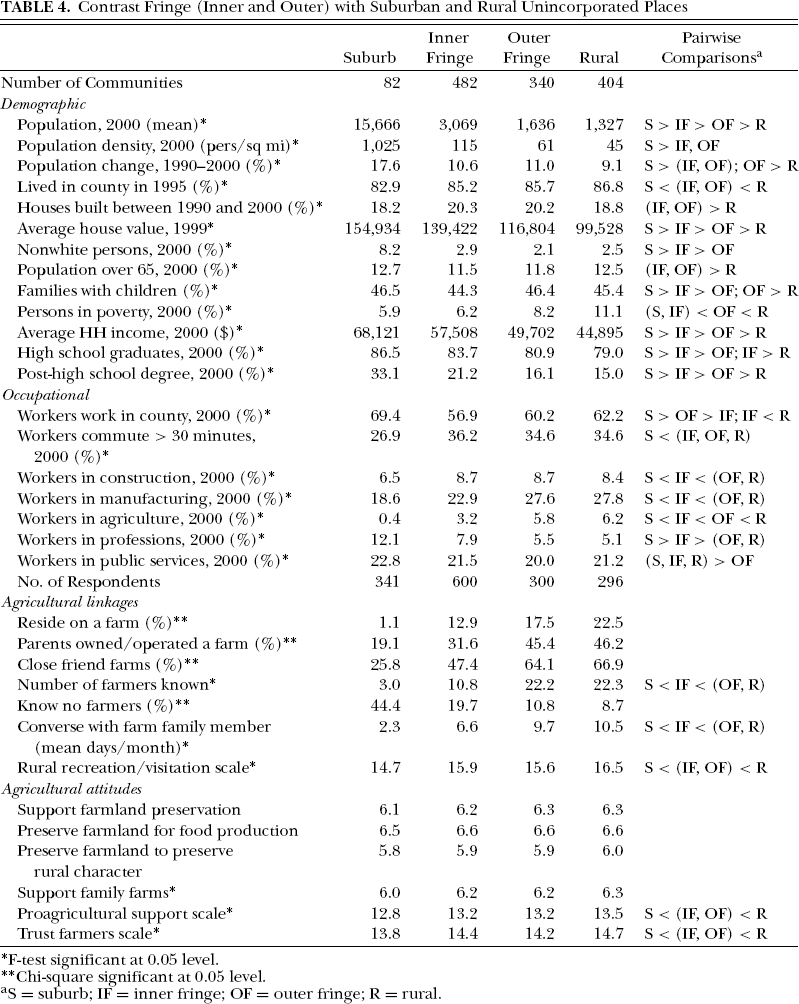
Mean characteristics of townships in each of the four areas and results of pairwise comparisons are reported in table 4. Only the results of pairwise comparisons involving the inner fringe and the outer fringe are reported (thus some comparisons of rural vs. urban are not reported to allow more manageable reporting of the results of greatest interest). For the most part, the demographic, occupational, and agricultural linkage attributes of the four regions align in a pattern consistent with an urban to rural continuum. Pairwise comparisons confirm this pattern in terms of average household income, proportion of residents with a post–high school degree, and proportion of workers employed in agriculture. The pattern is also found in other cases, while both fringe regions are consistently different from the suburbs, there are a number of instances where the inner and outer fringe are not statistically different (such as population density and proportion of workers commuting more than 30 minutes). There are also several instances of the fringe regions being similar to rural, or only the inner fringe being statistically different from rural. This is particularly true in the case of agricultural linkages, with much similarity between the outer fringe and rural areas, with residents of both areas having greater connections to agriculture than residents of the inner fringe.
Contrast Fringe (Inner and Outer) with Suburban and Rural Unincorporated Places
F–test significant at 0.05 level.
Chi–square significant at 0.05 level.
S = suburb; IF = inner fringe; OF = outer fringe; R = rural.
While no initial hypotheses were proposed regarding the expected pattern to be found in this step of the analysis, the mixed results prompt a number of noteworthy observations. Qualitatively, the inner and outer fringe aligns with urban and rural consistent with a continuum. Generally, suburban townships are quite distinct from both fringe regions demographically, occupationally, and in terms of agricultural linkages. There are some demographic and occupational similarities between inner fringe and outer fringe, but also a number of instances of the outer fringe and rural areas being similar to one another but different from the inner fringe, particularly in terms of occupational attributes and agricultural connections. The existence of relatively sharp differences between the outer and inner fringe, particularly in terms of population density, housing value, and post–high school education, suggests our fringe buffers may be too liberal and encompass areas more accurately characterized as rural. on the other hand, the fact that population growth and new houses built is relatively high in both inner and outer fringe suggests that the classification of an urban–rural fringe and a rural–urban fringe may be appropriate. Our preference, based on this analysis, is to utilize buffer distances as we have and distinguish between the inner and outer fringe but future research should explore this matter further, either adjusting buffer distances or by parsing the landscape to more closely match actual settlement and new development.
Conclusions
This analysis examined a series of sequentially related contrasts that illuminate characteristics of the rural–urban fringe. Among the selected ecological, occupational, and social attributes we examine, we conclude that the rural–urban fringe differs from urban and suburban places in a number of ways and is also distinctive from more rural places in several ways. in terms of the rural–urban continuum, our research reveals fringe communities and residents have many attributes that place them in a middle position between suburban and rural places and residents. The fringe does deviate from the continuum, though, particularly in terms of where residents work and the distance they drive to their place of employment. This particular deviation is consistent with the fact that much contemporary fringe settlement is possible due to proximity to urban/suburban agglomerations of jobs and services.
We also conclude that it is important to distinguish between types of governmental areas at the rural–urban fringe, cities, and villages versus townships in the case of Ohio. Finally, our analysis of the inner and outer portions of the fringe suggests it is evolving in accordance to urban proximity, with the inner portion of the fringe less like rural than the outer portion. This analysis, though, lacks an adequate examination of change across time to conclude that the inner fringe is destined to become increasingly more suburban–like. Realistically, some fringe areas are likely to be integrated into the suburbs, but for many inner fringe townships to achieve the average characteristics of the suburban townships would require a tenfold increase in density and a fivefold increase in population. Such an increase is likely for only a very small number of the 482 townships located in Ohio's inner fringe.
An important question not fully addressed by our analysis is the diversity that may exist among fringe places. We conclude that distinguishing cities and villages and townships is important, but there are likely important differences within those categories as well. The work of Salamon (2003) begins to identify some of these differences, and future fringe research should further explore this matter. Such differences may emerge as newcomer choice of settlement is stratified by class and it is apparent that some amount of stratification already exists between fringe incorporated and unincorporated places. There may also be substantial differences between fringe newcomers and long–time residents that are not explored in this analysis. Our data are limited in this matter, but ad hoc analysis of our survey data suggests that fringe newcomers (which do not number many in our final survey sample) have agricultural ties and affinities more akin to rural and long–time fringe residents than suburban residents, but this matter needs to be systematically explored further.
The relevance of this analysis to settings outside of Ohio might also be noted as a concern regarding the applicability of this work. We believe Ohio is an excellent laboratory for studying the fringe with several large metropolitan areas spread uniformly around the state and over 3.2 million people living in the fringe. While the state's metro areas have distinct histories and characteristics, the pattern of growth in unincorporated fringe areas has been quite uniform across the state's different metro areas regardless of their size or character (Clark et al., 2003) and our applied work in these different metro areas has also revealed many similarities. One of the biggest differences we have observed, though, is the level of policy development, which actually varies more within a region than between regions of the state. Based on our analysis and experience, we do anticipate that characteristics of the fringe will vary as it is more broadly examined in the United States. in particular, we would expect the fringe's character to vary according to state and local policies, metro area economics, and the geophysical character of the metro area. For example, we would expect differences between Oregon's fringe, where there is strong state–level land–use and development policies, compared to Ohio's fringe, where land–use policies are less developed and responsibility resides with county and subcounty governments. Comparative research that explores the fringe across states and metro areas is an important next step.
Despite the limitations of our research, we offer three concluding observations relevant to future rural–urban fringe research. First, elements of this analysis provide important support for identifying the fringe as a distinct form of settlement along the rural–urban continuum, not simply the suburbs of the suburbs. While we identify some of the unique characteristics of the fringe relative to urban, suburban, and rural places, this alone may not be enough to pique additional interest among rural and urban social scientists. But couple these findings with the fact that a substantial and growing proportion of U.S. residents reside in the fringe, and it should attract additional attention. in Ohio's inner fringe alone, there are over 2.1 million residents, up from 1.9 million in 1980. This is more than double the number of residents residing in rural areas of Ohio and is approaching the size of the state's population residing in core cities (nearly 2.5 million).
A second research implication of this analysis is the importance of distinguishing between incorporated and unincorporated areas in the study of fringe and rural areas. Not only are there systematic differences in terms of demographics, occupation, and agricultural linkages between incorporated and unincorporated areas, substantial growth has occurred in all types of unincorporated (township) areas of Ohio in recent decades. Greater attention is needed to the processes of growth, community capacity, and the sociological/planning questions about how “community” develops where the arrangement of housing, subdivisions, shopping, or social institutions do not conform to traditional patterns found in cities, villages, and suburbs.
Third, this research has a variety of policy and planning implications. It is clear that the fringe is emerging as a significant settlement area that does not conform to traditional notions of rural and urban. There is a growing need for better–quality information about these fringe places and a need to develop appropriate government tools and capacity for managing local change and delivering necessary services. in terms of farming, some have noted the possibility for a culture clash (Berry, 1978) at the rural–urban fringe. We find surprisingly strong social ties between fringe resident and farmers and high levels of support for farming and farmland preservation among these residents as well. Agriculture as an employer also remains relatively important in the fringe, despite nonfarm growth and development. These findings suggest that farming remains relevant in the urban shadows, perhaps even an amenity attracting some of the population growth in these regions. Local government officials and planners may want to explore ways of further building relationships between farmers and nonfarmers, and the generally positive sentiments of nonfarmers toward farming may have social capital like resource potential for developing local food systems (Lyson, 2004) or managing conflicts that arise where farm and nonfarm interests clash.
In conclusion, this research has sought to take a holistic approach to understanding the fringe, reviewing and integrating insights from sociologists, planners, and geographers to understand an increasingly important settlement form in the United States. Future research in this area is warranted and the increasing availability of diverse data at quite refined levels of geography coupled with the analytical tools (GIS) to study this data should create fruitful new avenues of inquiry to answer the many lingering questions about the rural–urban fringe.