







Abstract
Research on urban growth and vitality suggests that gay men concentrate in high quality of life cities, indicated by high–tech development, diversity, and city amenities. The goal of this paper is to evaluate the degree to which theories of urban renewal and economic development—including Florida's creative class—can explain the neighborhood–level distribution of lesbians and gays within a city. Using 2000 U.S. Census data, tax parcel data, and other data sources, we conduct multivariate spatial regression to investigate the distribution of lesbians and gays in Columbus, Ohio, and their relationship to diversity, openness, and amenities. While the neighborhood distribution of gay men is associated with many of these characteristics, lesbian housing patterns are not. We do, however, find both lesbians and gays concentrate in tracts with other gay and lesbian households and that gay residential patterns are influenced by gay concentration in neighboring tracts suggesting that geographic clustering may also be a protective mechanism.
Resumen
Los estudios sobre crecimiento y vitalidad urbana indican que los hombres gay tienden a concentrarse en ciudades con altos niveles de calidad de vida. Las mismas cuentan con altos niveles de desarrollo tecnológico, diversidad y servicios urbanos. El objetivo de este artículo es evaluar hasta qué punto las teorías sobre renovación urbana y desarrollo económico–incluyendo la teoría de Florida sobre la clase creativa–pueden explicar la distribución de los gays y lesbianas a nivel barrial dentro de una ciudad. Usando los datos del censo de Estados Unidos del 2000, datos fiscales sobre la propiedad inmobiliaria y otras fuentes, llevamos a cabo una regresión espacial multivariada para analizar la distribución de lesbianas y gays en Columbus, Ohio y la forma en que dicha distribución se relaciona con los niveles de diversidad, apertura y servicios urbanos. Aunque la distribución de los hogares gay está relacionada con estos factores, no sucede lo mismo con los patrones de distribución de las viviendas de parejas lesbianas. Sin embargo, sí encontramos que tanto los hogares de lesbianas como los de gays se concentran en secciones donde ya hay hogares de gays y lesbianas y que los patrones residenciales gays son influenciados por la concentración de hogares gays en secciones adyacentes; lo cual sugiere que la concentración geográfica también puede constituir un mecanismo de protección.
Introduction
Scholars across a range of disciplines are paying increasing attention to gay and lesbian space, including research in economics, geography, urban studies, and sociology (Binnie and Valentine, 1999; Kirkey and Forsyth, 2001). 1 Most of these studies investigate neighborhoods with high concentrations of lesbian and gay residents and/or commercial development, using qualitative methods to explore topics such as the historical development of the space, variations between gay defined and lesbian defined space, and the role of gays and lesbians in gentrification (e.g., Bouthillette, 1997; Levine, 1998; Podmore, 2001; Sibalis, 2004). While gays and lesbians may concentrate in particular neighborhoods, they can be found throughout a city (Brekhus, 2003) and studies of gay and lesbian enclaves only examine a small, unique subset of neighborhoods. Nonenclave neighborhoods should vary dramatically in their desirability and openness to lesbian and gay residents and little is known about the residential patterning of gays and lesbians across a city's neighborhoods (Forsyth, 2001). The few existing quantitative studies of within–city variations largely document bivariate relationships through correlations (Bailey, 1999), t–tests (Castells, 1983), or weighted estimates (Gates and Ost, 2004), leaving an incomplete understanding of gay and lesbian residential patterns (for an important exception see Anacker and Morrow–Jones (2005)). 2
Though few studies quantitatively investigate the distribution of gays and lesbians within a city, recent studies by Florida (2002, 2005) and others (Black et al., 2002; Cooke and Rapino, 2007; Florida and Gates, 2001) have examined cross–city variations in gay and lesbian concentration. Florida (2002, 2005), in his research on the creative class, argues that the relative presence of gay households can be used as an indicator of the degree to which cities embrace diversity. Acceptance of diversity, what he calls tolerance, is argued to be critical to a city's growth and vitality since today's most desired workers prefer to live in diverse cities. Gay concentration, therefore, is theorized to be positively associated with both the size of the city's creative class and the quality of life characteristics members of the class desire. Additional cross–city research provides support for Florida's argument, finding high concentrations of gay men to be associated with positive city characteristics such as diversity, increased levels of high–tech development, good weather, and higher numbers of “adult–related” amenities (Black et al., 2002; Cooke and Rapino, 2007; Florida and Gates, 2001). 3 What has not been addressed is whether neighborhood–level variations in gay and lesbian housing patterns are also associated with the prevalence of creative class members and their desired quality of life characteristics.
Our paper, therefore, has two goals. First, we contribute to the research on urban growth by investigating the degree to which the neighborhood–level distribution of gay and lesbian households within a specific city reflects the same factors associated with variations in their city–level concentration. While Florida (2002; 2005) and others (Black et al., 2002; Cooke and Rapino, 2007; Florida and Gates, 2001) have documented regional variations in the distribution of gay households, it is less clear whether these findings apply to the relative presence of gays and lesbians across neighborhoods. We address this substantive gap by examining the degree to which the neighborhood–level concentration of gays and lesbians is associated with the amenities, diversity, and openness predicted by Florida's (2002; 2005) and other cultural explanations for urban growth (Clark et al., 2002; Lloyd and Clark, 2001). While understanding the sources of city–level growth is important, so too is documenting the factors associated with neighborhood vitality. Urban renewal requires residents to settle in particular neighborhoods, not just the city generally (Storper and Manville, 2006). Research on inner city revitalization suggests that lesbians and gays, as well as other nontraditional households, can be used to redevelop inner–city neighborhoods (Forsyth, 2001; Lauria and Knopp, 1985). By investigating the neighborhood–level distribution of gay and lesbian households within a city, our paper both evaluates the ability of Florida (2002; 2005) and other theories of urban growth to explain the within–city distribution of lesbians and gays and provides evidence of the characteristics that might contribute to neighborhood revitalization.
In addition, the positive characteristics associated with the city–level distribution of gay men, and to some degree lesbians, can be perceived to imply that their living conditions are “better” than average. There is significant debate—both academic and political—over the degree to which lesbians and gays are socially disadvantaged (Badgett, 1995; Feldblum, 2000). Opponents of lesbian and gay rights often depict gays and lesbians as economically advantaged and use this portrayal to argue against new legal protections, like antidiscrimination protection, deeming them unnecessary (Feldblum, 2000). The degree to which the living conditions of gays and lesbians are “advantaged” depends not only on the cities in which gays and lesbians live, but in the neighborhoods in which they reside. By studying within–city variations in the distribution of lesbian and gay households, we also contribute to the general research on gay and lesbian space by providing a more nuanced picture of gay and lesbian residential patterns and the associated neighborhood characteristics.
Explaining Variations in Gay and Lesbian Residential Concentration
Recent research on urban growth and vitality argues that a city's well–being is determined by its ability to draw highly educated workers—called various names including high–tech workers, the creative class, or knowledge workers (Clark et al., 2002; Florida, 2002; Lloyd, 2002). Firms and jobs then follow in an attempt to capitalize on the talent base within the city. The question then becomes, what draws these educated workers to specific cities? Rather than emphasizing the availability of jobs, these scholars argue that desired workers select cities based on the quality of life available, including opportunities for outdoor activity, city amenities, and diversity (Clark et al., 2002; Florida, 2002; Lloyd and Clark, 2001).
One of the best predictors of regional variations in the presence of these desired workers is the concentration of gay households (Florida, 2002; 2005; Florida and Gates, 2001). Essentially, educated workers prefer to live in cities that embrace diversity and have few barriers to entry—what Florida (2005) calls openness. The presence of lesbians and gays is argued to be a particularly strong indicator of tolerance since discrimination and prejudice against gays and lesbians is acceptable in ways that other forms of inequality are not (Florida, 2002; 2005). So, rather than arguing that gays and lesbians are disproportionally represented among educated workers, gays and lesbians are seen as precursors of the creative class, signally the quality of life desired by educated workers (Florida, 2005; Lloyd and Clark, 2001).
There are important limitations, however, in the ability of these studies to explain gay and lesbian concentration. Urban scholars’ primary interest in gay housing patterns is in their ability to explain urban growth and the regional distribution of educated workers (Florida, 2002; 2005; Lloyd and Clark, 2001). They are less interested in explaining why gays and lesbians concentrate in the cities that they do beyond a preference for “tolerance.” In other words, they use gay residential concentration as an explanatory variable rather than a phenomenon to be explained. However, research on lesbian and gay space that specifically focuses on explaining the distribution of gays and lesbians across cities finds that tolerance, operationalized as supportive public attitudes and/or legal climate, is not an important predictor of their spatial concentration (Black et al., 2002; Cooke and Rapino, 2007). Instead, this research argues that lesbians and gays make conscious decisions to pay more in order to live in desirable, high quality of life cities, which they are able to do because of their higher average earnings (Black et al., 2002). 4 While there is debate over whether gays and lesbians actually earn more than heterosexuals (Badgett, 1995; Black et al., 2003), they are assumed to have more discretionary income because lesbians and gays are less likely to have children, and the corresponding expenses, than are heterosexuals (Black et al., 2000; Lloyd and Clark, 2001). 5 Essentially, these scholars argue that gays and lesbians make housing choices similar to other economically well off households without children (Black et al., 2002). Therefore, the overlap between the residential patterns of gays and lesbians and educated workers is due to a shared desire to live in high quality of life cities and the economic means to do so.
Neighborhood–level analyses of gay and lesbian space, in contrast, paint a more pessimistic picture, finding their concentration to be associated with more negative or neutral characteristics (Bailey, 1999; Castells, 1983). For example, both gay and lesbian neighborhoods have been found to have fewer households with children, fewer owner–occupied dwellings, and lower median rents (Adler and Brenner, 1992; Bailey, 1999; Castells, 1983). Why might this be? Historical analyses of gay enclaves (Abrahamson, 1996; Castells, 1983; Knopp, 1997) suggest that gay men migrate into neighborhoods based on the availability of inexpensive housing, questioning the assumption of cross–city analyses that lesbians and gay are using economic flexibility to live in highly desirable areas.
In addition, while there is debate over whether sexual orientation is linked to economic disadvantage, gays and lesbians do suffer from other forms of inequality, which may influence their housing options. By the end of 2009, only 21 states had state–level antidiscrimination laws that included sexual orientation. 6 While the public has become more supportive of employment and housing protections for lesbians and gays, a majority of Americans (51.5 percent) still believe that same–sex sexual relations are always wrong and almost half oppose same sex marriage (47.6 percent) (National Opinion Research Center, 2008). Even with relative support for housing and employment protection, 16 percent of lesbians and 17 percent of gays report experiencing these forms of discrimination (Herek, 2009). Lesbians and gays also live under the threat of violence. Hate crimes based on sexual orientation, ranging from verbal threats to murder, occur frequently in the United States. In 2008, over 16 percent of hate crimes reported to the FBI were committed against gays and lesbians (Federal Bureau of Investigation, 2009), which is very high considering only 2.8 percent of men and 1.4 percent of women identify themselves as homosexual (Laumann et al., 1994). Taken together, the legal disadvantages, negative public opinion, and threats to safety mean that lesbians and gays face challenges and disadvantages that heterosexuals do not.
These disadvantages could have implications for the residential distribution of lesbians and gays. First, discrimination may limit access to certain housing options, particularly for renters whose access is dependent on landlords. In addition, the overall societal hostility experienced by lesbians and gays may encourage them to reside together in order to be in safer and more accepting environments (Abrahamson, 1996; Bouthillette, 1997; Lauria and Knopp, 1985). According to Fischer's (1984 [1976]) subcultural theory, one advantage of cities is that their size enables the development of distinct subcultures that smaller communities cannot support. In these subcultures, people with some shared characteristic, like sexual orientation, can carve out niches for themselves. The inequality faced by lesbians and gay men may encourage them to develop communities, including physical space, where the commercial establishments of the subculture are located and where members of the community reside, even at the expense of other amenities.
There is surprisingly little academic scholarship on housing discrimination against gays and lesbians. Recent research in Sweden on internet rental listings compares the response of landlords to same–sex couples’ requests for information about their properties to heterosexual couples’ inquiries. Landlords responded less favorably to gay couples than heterosexual couples, though there was no statistically significant difference in their responses to lesbian couples (Ahmed and Hammarstedt, 2007; Ahmed, Andersson, and Hammarstedt, 2008). In addition, Lambda Legal, a U.S. gay and lesbian activist organization, has been active in housing–related cases throughout its 35–year history including cases involving discrimination by co–opt boards, mortgage companies, landlords, and nursing homes; access to public housing; and the ability of partners to inherit apartments from their partners (Lambda Legal various years, 1983–2000).
While we are not able to measure discrimination directly, if gays and lesbians concentrate in areas of the city where other gays and lesbians reside, especially at the expense of other neighborhood characteristics, it could suggest attempts to carve out “safe” space or the existence of potential barriers to gay and lesbian residents in certain areas of the city. If this is the case, Florida (2002) and other urban renewal theories may overestimate the ability of gays and lesbians to cluster in high amenity neighborhoods. Therefore, we use research on gay and lesbian space, both qualitative and quantitative, to supplement theories of urban renewal to better theorize the factors that influence gay and lesbian neighborhood concentration and evaluate the degree to which gay and lesbian housing patterns reflect choice and economic strength.
A second limitation of urban renewal research is that it largely ignores lesbian residential patterns, operationalizing the gay index as the concentration of gay male households (Florida, 2002; 2005; Florida and Gates, 2001). Yet, existing geography research has documented significant differences between gay and lesbian residential patterns, finding that lesbians are less spatially concentrated than gay men and, when concentrated, tend to live in different types of neighborhoods (Adler and Brenner, 1992; Bailey, 1999; Bouthillette, 1997; Gates and Ost, 2004) and different areas of the city than their gay counterparts (Forsyth, 1997; Podmore, 2006). Though there are examples of geographically defined lesbian spaces (Forsyth, 1997; Podmore, 2006), many scholars find that lesbians reside within other alternative communities like those of feminists, artists, and students rather than lesbian–specific spaces (Adler and Brenner, 1992; Bouthillette, 1997; Podmore, 2006). Scholars argue that gay men and lesbians have different relationships to space for several reasons. First, lesbians experience the same economic disadvantages in the labor market that other women face so they may have less economic flexibility than gay men (Adler and Brenner, 1992; Bouthillette, 1997). In addition, while lesbians are less likely to have children than heterosexual women, they are more likely to have children than gay men are, so that family friendly housing may be more important for lesbians than gay men (Black et al., 2000; Bouthillette, 1997). Therefore, we analyze lesbian and gay residential patterns separately to evaluate the degree to which their residential patterns vary and the relevance of urban growth explanations for their neighborhood–level distributions (Anacker and Morrow–Jones, 2005; Forsyth, 1997).
Specific Hypotheses
Florida (2002; 2005) makes three key assumptions about the city characteristics associated with gay concentration. He predicts that gay men reside in diverse, tolerant cities with few barriers to entry and significant amenities. We examine the importance of all three in the neighborhood–level distribution of gay and lesbian households in one city—Columbus, Ohio.
Diversity
First, Florida (2002; 2005) argues that the concentration of gay households is an indicator of a city's level of diversity and tolerance. This tolerance then draws highly educated workers (Lloyd and Clark, 2001). If these relationships hold at the neighborhood level, we should expect to find an association between the distribution of educated workers and gay and lesbian residential patterns. The concentration of gay and lesbian households will be positively associated with the proportion of college graduates in the neighborhood (H1).
If gay and lesbian concentration reflects an affiliation with diversity, then they should cluster in racially and ethnically diverse neighborhoods. In particular, recent history in Columbus suggests that gay and lesbian concentration will be positively associated with the proportion of black residents in a neighborhood. As documented by the film Flag Wars (Bryant and Poitras, 2003; Gabreyna, 2003), gays and lesbians have been moving into and renovating housing in Columbus's working class, black neighborhoods. Gay and lesbian concentration will be higher in neighborhoods with a larger proportion of black residents (H2).
The association with diversity would also suggest that gay and lesbian concentration will be higher in tracts with sizeable foreign–born populations (Florida, 2002; 2005). This is particularly true in the case of lesbians. Existing research suggests that lesbians often reside within other alternative communities (Adler and Brenner, 1992; Bouthillette, 1997). Since the percent foreign born can be related to the physical presence of various “alternative” shops or restaurants (Podmore, 2001), lesbian and gay concentration may be higher in these areas. Gay and lesbian concentration will be higher in neighborhoods with a significant foreign–born population (H3).
Openness
Diversity is higher when cities have low barriers for entry, what Florida (2005) terms openness. In Florida's (2005, p. 31) analysis, “… exclusive, tightly connected communities …” are theorized to create barriers by making it difficult for diverse populations to enter the community. Analyses of gay and lesbian neighborhoods have documented specific barriers to the spread of gay and lesbian space including owner–occupied dwellings and the presence of “traditional” families (Adler and Brenner, 1992; Bailey, 1999; Castells, 1983). In general, we expect the presence of these barriers to decrease the concentration of gay and lesbian households in Columbus neighborhoods as well. While gay space has been correlated with fewer traditional, family households (Adler and Brenner, 1992; Anacker and Morrow–Jones, 2005; Bailey, 1999; Castells, 1983), the relationship between lesbians and family households is more complicated (Anacker and Morrow–Jones, 2005; Bailey, 1999). Family households have acted as a barrier to the spread of lesbian space, but lesbians’ higher likelihood of family responsibilities may increase their motivation to overcome those barriers. The concentration of gay men will be lower in neighborhoods with high proportions of families with children (H4a). The concentration of lesbians may be negatively or positively associated with the percentage of families in the neighborhood (H4b). Both gay and lesbian concentration will be positively associated with the percentage of renters in the neighborhood (H5).
Neighborhood openness is also indicated by the presence of lesbians and gays themselves and we expect gay and lesbian households to be spatially clustered even after controlling for other factors. First, we expect gay men to live near other gay men and lesbians to reside near other lesbians. We also believe that the neighborhood–level distribution of gay households will be affected by lesbian housing patterns and vice versa. Existing research suggests that lesbians and gays cluster in different cities (Black et al., 2002; Gates and Ost, 2004) and in different neighborhoods within cities (Forsyth, 1997). However, other scholars find lesbian and gay concentration overlap (Anacker and Morrow–Jones, 2005; Bailey, 1999). We predict gay (lesbian) concentration will be positively associated with the concentration of gay (lesbian) households in neighboring tracts (H6a). In addition, lesbian concentration will be positively influenced by gay concentration and vice versa (H6b).
Finally, scholars have found the distribution of gay and lesbian households to be positively associated with traditional college age populations, particularly in cities with large student populations (Bailey, 1999; Podmore, 2001). This would make sense since student populations are transient and have the loose, informal networks theorized by Florida (2005) to create openness. Since Columbus is the home of The Ohio State University, which had almost 48,000 students in 2000 (Caldwell, 2000), we include the percentage of residents between the ages of 18 and 24 in our analyses. Gay and lesbian concentration will be positively associated with the size of the college age population (H7).
Amenities and other Neighborhood Characteristics
Both research on urban growth and cross–city analyses of gay and lesbian space argue that the concentration of gay and lesbian couples will be higher in amenity–rich cities (Black et al., 2002; Clark et al., 2002; Florida, 2002) and neighborhoods (Lloyd, 2002; Lloyd and Clark, 2001). Much of this research focuses on very specific amenities, called “cultural amenities” (Lloyd and Clark, 2001) or “street culture” (Florida, 2002; Lloyd, 2002). Essentially, city residents, especially those without children, are hypothesized to be looking for vibrant street life and neighborhood entertainment options in addition to, or instead of, traditional amenities (Adler and Brenner, 1992; Clark et al., 2002; Florida, 2002; Lloyd, 2002; Lloyd and Clark, 2001). In these cases, residents are less concerned with property values and school quality and more interested in neighborhood access to art galleries, local restaurants, and a lively local music scene (Lloyd, 2002). Lesbian and gay concentration will be higher in Columbus neighborhoods with cultural amenities (H8).
This emphasis on vibrant street life and entertainment options also suggests that lesbians and gays will concentrate in neighborhoods near gay and lesbian bars (Lloyd and Clark, 2001). Qualitative research on gay and lesbian space has found significant overlap between gay and lesbian residential concentration and commercial space (Adler and Brenner, 1992; Bouthillette, 1997; Castells, 1983; Levine, 1998; Podmore, 2006), which is not surprising. Histories of the gay and lesbian community stress the importance of gay and lesbian institutions, particularly bars, in creating gay and lesbian identities (Abrahamson, 1996; D'Emilio, 1983). We expect a similar pattern. Neighborhoods near gay and lesbian bars will have higher concentrations of lesbian and gay residents than other areas of Columbus (H9).
Recent research on urban growth argues that workers choose to reside in cities with entertainment based amenities at the expense of “mainstream” amenities. Rather than entering a neighborhood with the hope that their economic investment will “improve” the neighborhood, some residents enter urban neighborhoods with the goal of maintaining the character and culture of the space (Brown–Saracino, 2004; Lloyd, 2002). These residents value urban neighborhoods for the lifestyle they provide, whether it is historical architecture or the presence of an ethnic population and its institutions, and are not interested in recreating the middle–class lifestyle of the suburbs (Brown–Saracino, 2004; Lloyd, 2004). For example, Lloyd (2002) found in his study of Chicago's Wicker Park neighborhood that residents considered crime and homelessness to be an expected, even desired, characteristic of city neighborhoods; part of “… the authentic urban experience” (p. 528). However, few studies have explicitly investigated the relationship between lesbian and gay housing patterns and the more “mainstream” characteristics associated with desirable neighborhoods. Therefore, we examine the relationship between several traditional measures of neighborhood quality and the distribution of gay and lesbian households in addition to the cultural amenities discussed above.
First, we investigate the effect of “mainstream” amenities on the distribution of gay and lesbian households. While entertainment and vibrant street culture may be important to city residents, access to amenities like shopping centers and schools is also evidence of neighborhood quality (Peterson, Krivo, and Harris, 2000). Research on urban growth and authenticity suggests these amenities will be either unrelated to or negatively associated with gay and lesbian housing patterns (Brown–Saracino, 2004; Florida, 2002; Lloyd, 2002). However, research on lesbian and gay space suggests the relationship with schools may be more complicated for lesbians due to their higher likelihood of family responsibilities. Gay concentration will be either negatively associated with or unrelated to traditional amenities both malls and schools (H10a). Lesbian concentration will be negatively associated with or unrelated to the number of malls, but positively related to the number of schools due to their increased likelihood of family responsibility relative to gay men (H10b).7,8
Existing scholarship also suggests that lesbian and gay residential patterns will be associated with the age of housing stock. More specifically, researchers find the concentration of lesbian and gay households is higher in neighborhoods with older homes. While newer neighborhoods are often considered desirable (Ellen et al., 2001), scholars have documented numerous cases of gays and lesbians moving into and gentrifying older, inner–city neighborhoods (Abrahamson, 1996; Forsyth, 2001; Lauria and Knopp, 1985; Podmore, 2001). Gay and lesbian residential concentration will be higher in older neighborhoods (H11).
We also expect residential concentration to be associated with the value of housing in the neighborhood. Research on neighborhood gentrification provides several examples of gays, and lesbians to a lesser extent, purchasing and renovating homes in deteriorating, but attractive, neighborhoods, increasing the desirability and value of the area (Castells, 1983; Lauria and Knopp, 1985; Sibalis, 2004). The pattern often starts with a few gay men moving into a neighborhood to access the inexpensive housing created by an exodus of the existing, usually working class, residents (Abrahamson, 1996; Forsyth, 2001; Knopp, 1990; Lauria and Knopp, 1985; Sibalis, 2004). Gay men's willingness to move into these “risky” neighborhoods and to make economic investments is attributed to a need for safe, community defined space (Abrahamson, 1996; Forsyth, 2001; Lauria and Knopp, 1985) and/or their lack of interest in family–oriented neighborhoods (Knopp, 1990). After initial investments are made, more affluent gay men follow, making additional improvements to the neighborhood, eventually leading to other middle–class residents defining the neighborhood as desirable (Abrahamson, 1996; Forsyth, 2001; Knopp, 1990). In most cases, this economic “conversion” of the neighborhood is unintentional (Knopp, 1990) though there are cases where government officials, realtors, and other business people work consciously to transform the space (Sibalis, 2004). 9 This differs slightly from Florida (2002), who provides examples of people using the presence of gays to “signal” high–quality neighborhoods. Instead, gentrification research sees gay men as important because they contribute to the original economic transformation of the neighborhood.
Gentrification has been documented in Columbus as well. The film Flag Wars records the tensions created by gays and lesbians moving into historically black neighborhoods (Bryant and Poitras, 2003; Gabreyna, 2003). The increased property values and subsequent taxes created by gentrification, as well as the enforcement of zoning laws, made the neighborhoods less affordable for the existing, primarily working–class black residents (Gabrenya, 2003; Thomason, 2000). Research on cross–city patterns suggests a similar relationship between gay and lesbian housing patterns and home values, finding that gays and lesbians tend to reside in cities with higher housing costs (Black et al., 2002). Therefore, we expect a positive link between lesbian and gay concentration and housing values, either as a result of gentrification or the use of discretionary income to select high–quality neighborhoods. Gay and lesbian concentration should be higher in neighborhoods with higher home values (H12).
Finally, existing gay and lesbian space research also suggests that the distribution of gay and lesbian households will be associated with land use. Specifically, gay and lesbian concentration has been found to be higher in areas with more multifamily housing (Bailey, 1999). Though multifamily housing is traditionally defined as less desirable (Novak and Seiler, 2001), cultural theories of urban growth suggest that city residents, including gays and lesbians, are looking for a style of life lacking in city neighborhoods with single family housing. Gay and lesbian concentration will be higher in neighborhoods with more multifamily land use and less single family land use (H13).
Methodology and Variables
Residential Distribution of Gay and Lesbian Households
The distribution of lesbian and gay households is calculated using data from the 2000 U.S. Census. While sexual orientation is not asked directly, gay and lesbian couples can be identified indirectly. We operationalize lesbian and gay couple households as the unmarried partner households in the U.S. Census where the householder and the unmarried partner are the same sex (source: 2000 U.S. Census, Summary File 3 PCT1 “Unmarried Partner Households by Sex of Partners”). Clearly, the U.S. Census significantly underestimates the size of the gay and lesbian population by leaving out gays and lesbians without partners, those that do not live with their partners, and, as in the case of all surveys, those unwilling to identify themselves. It is also possible that some of the households that identified themselves as unmarried partners did so incorrectly. The question then becomes, how likely is it that the households with same–sex unmarried partners are actually gay and/or lesbian households?Black et al. (2000), through an analysis of the 1990 U.S. Census, estimates the potential for error in the identification of same–sex households. Using households that identify more than one “marriage–like” relationship, a clear error, Black et al. (2000) argues most people appear to understand what unmarried partner means. Instead, most errors reflect a misunderstanding of the respondent's relationship to the householder. For example, if an unmarried couple resides in a household where the householder is one of their parents, the couple might identify themselves as unmarried partners, which they are, but not to the householder. Overall, Black et al. (2000, p. 147) estimate that no more than “… 0.4 percent of nonmarried householders mistake the meaning of unmarried partner …” in the 1990 Census. While the 2000 Census is not ideal, it is far and away the best existing measure of the spatial distribution of gays and lesbians. We feel comfortable identifying same–sex couple households as gay and lesbian, following the precedent of scholars in political science, geography, economics, and other fields (Black et al., 2001; Bradford, Barrett, and Honnold; Cooke and Rapino, 2007; Florida and Gates, 2001; Forsyth, 1997; Gates and Ost, 2004; Haider–Markel, 2001). 10
We analyze the 226 census tracts within the city of Columbus, which report 1,585 gay couples and 1,348 lesbian couples (U.S. Census, 2000). Same–sex couples are distributed throughout the city; there are only nine tracts without any gay couples and only eight tracts without any lesbian couples. The number of gay couples per tract ranges between zero and 62, while the number of lesbian couples ranges between zero and 29. Lesbian and gay representation is relatively low, however, relative to other households in the tract—with same–sex couples making up no more than 4.9 percent of all households in a given tract.
People often ask us, “Why study Columbus,” but the better question is, “Why not study Columbus?” While most research on gay and lesbian neighborhoods in the United States has been done on cities like New York (Green et al., 2001), Los Angeles (Retter, 1997), and San Francisco (Castells, 1983), which have unusually large proportions of the gay and lesbian population (Levine, 1998), gays and lesbians live in cities throughout the United States (Cooke and Rapino, 2005). In fact, only 15 percent of gay and lesbian households are located in the cities with the five largest gay and lesbian populations—Chicago, New York City, Los Angeles, San Francisco, and Washington, D.C. (U.S. Census Bureau, 2000). Clearly, the vast majority of gays and lesbians live elsewhere, making it important to understand their distribution outside of gay and lesbian strongholds (Brekhus, 2003). In fact (Cooke and Rapino, 2005), research on gay and lesbian couples concludes that same–sex couples “… are found in regions with large populations and that their regional distribution may not be as unique as is frequently assumed” (p. 291).
While an analysis of Columbus, Ohio, will not represent the housing patterns in every U.S. city, we argue Columbus is a good city to use in a preliminary examination of lesbian and gay residential patterns because it has an average sized gay and lesbian population. In the 2000 U.S. Census, 8.86 percent of all same–sex couples households lived in the New York City metropolitan area, 6.60 percent lived in the Los Angeles MSA, and 4.86 percent lived in the greater San Francisco MSA (Bradford, Barrett, and Honnold, 2002). In contrast, the Columbus MSA has.67 percent of all same–sex couple households; a proportion much closer to the overall representation in the United States (.51 percent) (U.S. Census Bureau, 2000). In addition, when compared to the 50 largest U.S. cities, the size of both Columbus's lesbian and gay populations falls in the middle (Black et al., 2001; Gates and Ost, 2004). That said, while Columbus has fewer lesbian and gay residents than cities like New York, it has a strong community with identifiable lesbian and gay neighborhoods and annual events (Thomason, 2000). These strengths contributed to its recent identification as one of the best “off–beat” places for lesbians and gays to live by The Advocate (Caldwell, 2007). There is clearly a well developed enough lesbian and gay presence to make Columbus worth studying. Therefore, while Columbus may not represent every city, it is fairly typical and allows us to diversify the type of cities analyzed in the gay and lesbian space literature.
Once the lesbian and gay couple households in Columbus were identified, we used Black et al. (2002) and Florida and Gates (2001) as models to create neighborhood–level (i.e., tract) measures of both gay and lesbian spatial concentration by taking the percentage of gay (or lesbian) couple households (i.e., households with same–sex unmarried partners) in a given census tract and dividing it by the percentage of gay (or lesbian) couples within Columbus as a whole, providing a continuous measure of gay (or lesbian) concentration that is required for spatial regression (Anselin, 1992). This variable measures the degree to which gay and lesbian couples are over– (or under–) represented in a tract, compared to their representation in the city as a whole, rather than labeling particular tracts as gay or lesbian. Our goal is not to identify and analyze “gay” or “lesbian” tracts, but to explain variations in concentrations through the city. Tracts with an index of 1.0 have concentrations of lesbian or gay couples equivalent to the city as a whole, tracts measuring above 1.0 have higher concentrations than the city as a whole, and those with an index below 1.0 have an underrepresentation of gay or lesbian couples.11,12,13
Figure 1 shows a clustering of neighborhoods with high concentrations of gay couple households (tracts with values of 2.0 and above, depicted in black) in and near the downtown region of Columbus. Additionally, many neighborhoods with moderately high gay couple concentration (tracts with values between 1.0 and 1.99, depicted in grey) surround the highly concentrated gay couple neighborhoods. Generally, Figure 1 seems to demonstrate a pattern of concentration with a focal point in the downtown areas of Columbus. However, the pattern is different for lesbian couple households (see Figure 2). Figure 2 illustrates a clustering in the North central portion of the city (tracts with values of 2.0 and above). Neighborhoods with concentrations of lesbian couple households with values between 1.0 and 1.99 appear to be more scattered throughout the city. While there is overlap, these figures suggest that gay and lesbian couple households cluster in different areas of the city.
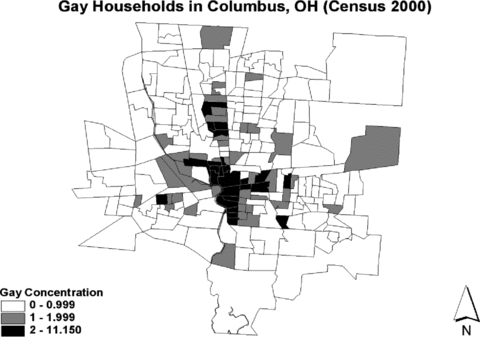
The concentration of gay couple households (N= 226 Census Tracts, Columbus, OH, 2000 Census).
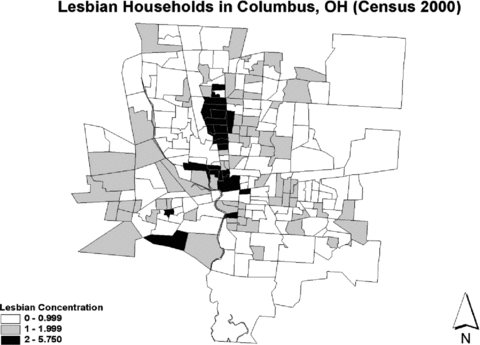
The concentration of lesbian couple households (N= 226 Census Tracts, Columbus, OH, 2000 Census).
While we can only measure couples, our residential concentration variable does capture several of the recognized gay and lesbian neighborhoods in Columbus. Old Towne East, the neighborhood featured in Flag Wars (Gabrenya, 2003), is east of downtown and shows as an area with a high concentration of gay couples. German Village, a neighborhood known for gay driven gentrification (Thomason, 2000), is immediately southeast of downtown and also shows as an area with a high concentration of gay couples. In contrast, Clintonville, a north central neighborhood recognized for its high lesbian population (Thomason, 2000), shows as an area with a high proportion of lesbian couples. This suggests that the Census's measure of same–sex couples is capturing gay and lesbian households and that our index documents the reality of gay and lesbian space in Columbus even with its significant undercount.
Independent Variables
We use five data sources to compile our independent variables including the 2000 Franklin County Tax Parcel Data, the National Center of Education Statistics, the 2000 U.S. Census, the 1999 edition of the Gayellow Pages, and the Columbus phone book. All of the diversity and openness measures are drawn from the 2000 U.S. Census. Percent college educated is the percentage of residents in the tract with a Bachelors degree. Percent black is the percentage of tract residents that identify as black. Percent foreign–born measures the percentage of tract residents born outside of the United States. Our measure of spatial autocorrelation (see description below) captures the degree to which gay (and lesbian) concentration is associated with the concentration of gay (and lesbian) households in the contiguous tracts. We also include lesbian concentration as a predictor of gay concentration and gay concentration as a predictor of lesbian concentration. Percent children measures the percentage of households in the tract with children under eighteen. Percent renters refers to the percentage of households that are renter (rather than owner) occupied. Percent 18 to 24 is the percentage of residents in the tract between the ages of 18 and 24 years.
Our measures of amenities and other neighborhood characteristics are drawn from a variety of sources. Cultural amenities is an additive measure of the presence or absence of three amenities in the tract—nonchain bookstores, nonchain coffee shops, and art galleries—and has the potential to range from 0 to 3. It is constructed from the Columbus Telephone Book (Yellow Pages, 2000).
Gay/lesbian bar is a dichotomous variable indicating whether the midpoint of the tract is within one mile of a gay or lesbian bar. The addresses of all gay and lesbians bars were drawn from the 1999 edition of the Gayellow Pages (Green, 1999)—a national directory of the gay and lesbian community. All listings in the Columbus, Ohio, section of the volume are included.
The number of public schools is from the Common Core of Data (CCD), a comprehensive, annual database containing information about the locations of public elementary and secondary schools across the United States (National Center for Education Statistics, 2000). Public schools were identified, counts were aggregated to the tract, and then coded as “0–5” (truncating values at five to reduce skew).
The five remaining neighborhood variables—malls, median year built, average value per square foot, and single and multifamily land use—are drawn from the Franklin County Tax Parcel Data (Franklin County Tax Auditor, 2001). As these databases are constantly being edited when zoning changes are made (e.g., when a lot is changed from residential to commercial, etc.), these land–use measures are more accurate than data from other sources, including the Census. As zoning and other updates are made, the Franklin County Appraiser's Office takes the tax parcel information on each individual taxable unit (e.g., residences, businesses, empty lots) and links it back to regularly updated and maintained geospatial records of every individual parcel in Franklin County. Malls is a count of all malls and shopping centers in the tract, coded as “0–5” (truncating values at five to reduce skew). Median year built measures the median age of housing in the tract. Average value per square foot is calculated by dividing each home's value by its square footage and then aggregating the results to the tract level. Single family land use is the percentage of tax parcels in the tract that are single family homes while multifamily land use is the percentage of tax parcels in the tract identified as multifamily dwelling such as apartments, condominiums, or duplexes. 14
Methodology
Because our study utilizes spatial data, Geospatial Information Systems (GIS) is used, in the context of address–matching and exploratory analyses, to examine the effects of spatial clustering, through the development of spatial lag and spatial error regression models (Longley, 2000). The geographic correlation of neighborhood events and social characteristics, while theoretically interesting, often causes problems for traditional statistical techniques like Ordinary Least Squares regression (OLS) because OLS assumes independence (Anselin and Kelejian, 1997; McClendon, 1994). But geographic data, including Census data, by their very nature, imply the possibility that proximate neighborhoods will have similar values of social and physical characteristics. Thus, the assumption of independence is often violated by this type of data, resulting in a condition known as spatial autocorrelation (Anselin, 1992, 1998; Robinson, 1998). In addition, autocorrelated data may result in the standard error estimates being biased, creating inaccurate results (Robinson, 1998).
Spatial autocorrelation can be checked through the Moran's I statistic (Moran, 1950), which is a univariate statistic designed to test the null hypothesis of the absence of spatial clustering (Baller et al., 2001; Cliff and Ord, 1973). In simple terms, Moran's I measures the deviation from spatial randomness, or the concentration of an attribute over space. Moran's I is similar to a Pearson correlation coefficient and is scaled to be less than one in absolute value. If locations are close together and tend to be similar in attributes, then this will be reflected with a positive spatial autocorrelation score (contagion, spillover, externalities), with underestimated regression coefficients (Robinson, 1998). Conversely, if locations are proximate but instead have very dissimilar values, then this is reflected as a negative spatial autocorrelation score (competition, revulsion), with overestimated regression coefficients (Robinson, 1998). Larger absolute values indicate higher levels of spatial autocorrelation in the data. When values are independent of their location, then zero autocorrelation is present (Baller et al., 2001). (See Anselin et al., 2000, for the mathematical calculation of Moran's I.)
We employ the SpaceStat (Anselin, 1988) program, and use the “queen” join count statistic (edge–to–edge and vertex–to–vertex) to calculate Moran's I (Robinson, 1998). Moran's I values greater than 0.10 that are statistically significant are evidence of spatial autocorrelation (Anselin, 1992; 1998). In this study, the concentration of gay households is 0.49 (p <.001) and the concentration of lesbian households is 0.35 (p <.001) indicating the presence of spatial autocorrelation.
The data were first analyzed using OLS regression. The variables were entered progressively across three models. The first model examined the measures of diversity and openness while the second model incorporated the amenities variables and other neighborhood characteristics. The final model included only the significant variables from the first two models.
Diagnostic tests from these OLS models indicated whether the analyses required the use of spatial error models or spatial lag models. The diagnostic tests determined the nature of the problem caused by the spatial dependence—was it a nuisance, meaning that one needed to increase sample size or incorporate the spatial autocorrelation in a regression error term, or was it substantive, meaning that the structure of the spatial dependence needed to be incorporated as an explanatory variable in the model (Anselin, 1992, 1998).
We utilized the LaGrange Multiplier tests for spatial dependency (p <.001 for both gays and lesbians). These diagnostic tests showed that the spatial clustering of the concentrations of gays and lesbians required different modeling techniques. In the models examining the concentration of lesbians, spatial dependence in the form of a “nuisance” was indicative of omitted covariates that were spatially correlated. Thus, this condition, if left uncorrected, would have influenced our ability to make accurate inferences from our results (Baller et al., 2001). To correct for this problem, spatial error models were used. 15 However, in the models examining the concentration of gays, the spatial dependence existed in the form of spatial “effects,” suggesting a possible diffusion process—events in one place predict and increase the likelihood of similar events in neighboring places, net of the effect of structural covariates (Baller et al., 2001). The spatial lag term captures the average concentration of gay couples in neighboring census tracts and can be interpreted as the extent the concentration of gay couples in a tract can be explained by the average of its neighboring tracts’ concentrations (Anselin et al., 2000).
Results
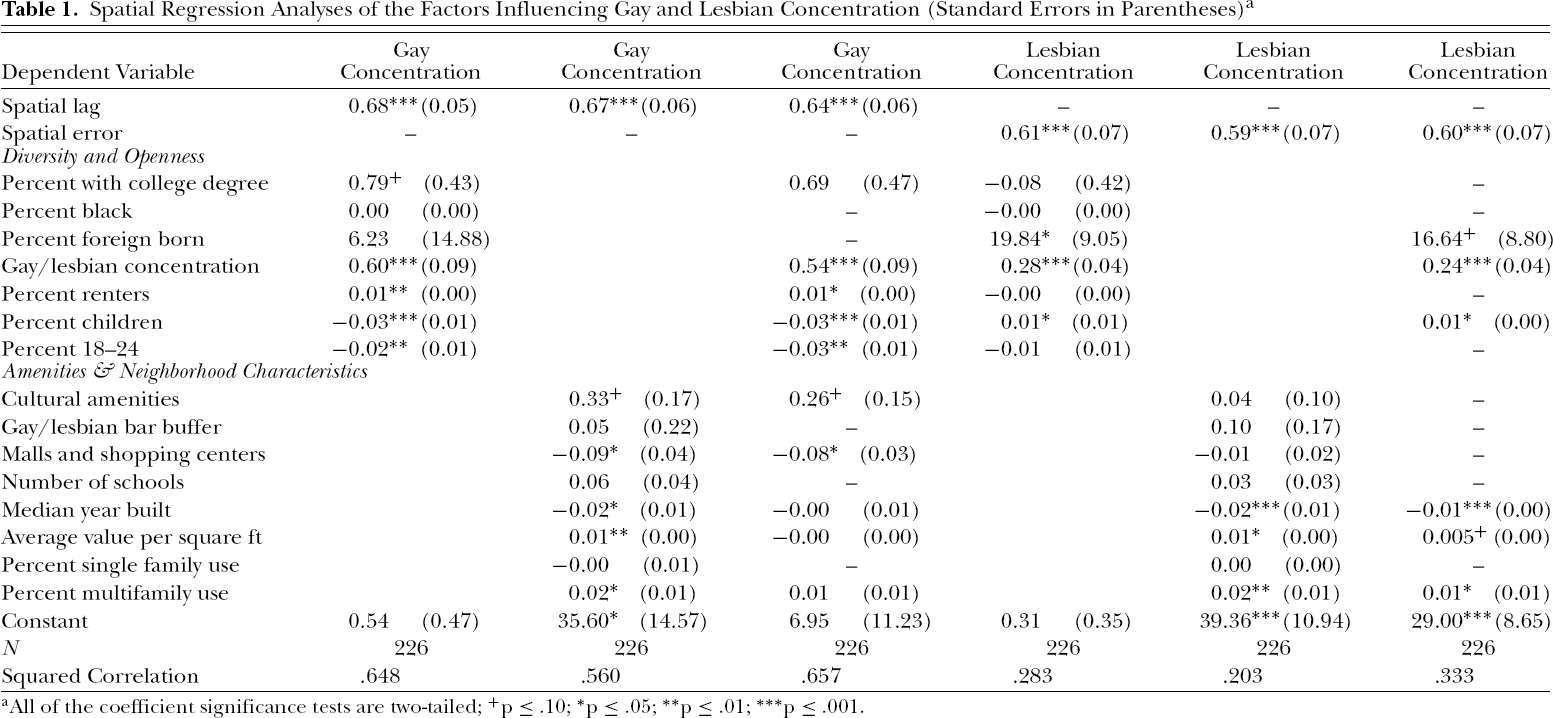
Table 1 provides the spatial regression results on the factors influencing the residential concentration of gay and lesbian couples in Columbus. The first three columns present the results for gay couples while columns four through six present the results for lesbian couples. The first model for each (columns 1&4) examines the influence of diversity and openness. The second model for each (columns 2&5) investigates the importance of amenities and other neighborhood features. The last model for each (columns 3&6) includes all of the factors that were significant in the previous models.
Spatial Regression Analyses of the Factors Influencing Gay and Lesbian Concentration (Standard Errors in Parentheses) a
All of the coefficient significance tests are two–tailed;
p ≤.10;
p ≤.05;
p ≤.01;
p ≤.001.
Gay Concentration
We find that the distribution of gay couples is significantly influenced by the level of concentration in contiguous tracts, indicating that the cluster effect we saw in Figure 1 is not by chance (Table 1, columns 1–3). The significance of our spatial lag coefficient identifies the existence of spatial contagion where high concentrations of gay couple households spread to surrounding tracts and lower concentrations act as a barrier. Essentially, the likelihood of gay couples residing in a particular tract is heavily influenced by the concentration of gay couples in the surrounding tracts, even after controlling for diversity, openness, and neighborhood amenities (Table 1, columns 1–3). While gay men may live in high quality of life areas, they also appear to be seeking out neighborhoods surrounded by peers. While we do not measure housing barriers or other forms of discrimination in the analyses, the presence of spatial clustering suggests that gay men may reside together as a protective measure as well.
Only one of the three diversity variables is significant. The concentration of gay couples is higher in neighborhoods with higher proportions of college–educated residents in the first model (Table 1, column 1); however, the measure loses significance in the combined model (Table 1, column 3). Florida's (2002, 2005) prediction that the housing patterns of gay men and the creative class overlap is only partially supported. At the neighborhood level, the overlap appears to be the result of the neighborhood characteristics rather than a relationship between the two populations per se.
In contrast, neither of the racial and ethnic diversity measures is significant. Gay concentration is not shaped by the percentage of black or foreign–born residents in the tract (Table 1, column 1). Florida (2002; 2005) uses gay men as a general indicator of a city's openness to diversity, but we do not find the same association at the neighborhood level even with qualitative evidence of gays and lesbians gentrifying black, working–class neighborhoods in Columbus (Gabrenya, 2003). It could be that gay concentration only reflects some forms of diversity. While high–tech employment and educated workers are positively associated with several forms of diversity—immigrants, gays, and artists—Florida (2002) actually finds a negative association between high–tech jobs and the proportion of the population that is African American, concluding that, “… the Creative Economy does little to ameliorate the traditional divide between the white and nonwhite segments of the population” (Florida, 2002, p. 263). Further research needs to be done on the connection (or lack thereof) between African Americans, the creative class, and gay residential patterns.
All four measures of openness significantly influence the distribution of gay couples across Columbus (Table 1, column 1). Tracts with high concentrations of gay men tend to have more renters, supporting prior research that identified ownership as a barrier to gay space (e.g., Adler and Brenner, 1992; Anacker and Morrow–Jones, 2005; Bailey, 1999; Castells, 1983). Tracts with a higher percentage of family households (i.e., households with children) have lower levels of gay couple concentration. This relationship is evidence of both families acting as barriers to entry and the relative unimportance of child–related amenities in gay housing patterns. In addition, while gay and lesbian residential patterns differ (see Figures 1 & 2), gay concentration is associated with higher concentrations of lesbian households, providing further evidence of the importance of openness.
Gay households are also negatively associated with the young adult population, indicating that gay couples do not reside with traditional aged college students. This is somewhat surprising. Previous research found a positive association between gay residential patterns and large student populations (Bailey, 1999). We expected to find a similar relationship since the transitory nature of the student population creates the loose ties that Florida (2002; 2005) argues facilitates diversity. Our results could be attributed to the fact that we examine the housing patterns of gay couples rather than gays generally. Coupled households could make different housing decisions than single households.
Five of the eight amenities and neighborhood variables are also significant, though only two of them remain so in the combined model (Table 1, columns 2 and 3). As hypothesized, gay couple residential patterns are significantly related to tract–level amenities. Our indicator of cultural amenities is significant and positive. The more varied the types of cultural amenities available in a tract (i.e., coffee shops, art galleries, and bookstores), the higher the concentration of gay couples (though it is only significant at.10). This relationship suggests that gay concentration is associated with amenities indicative of vibrant street life and neighborhood entertainment options predicted by cultural theories of urban growth (Clark et al., 2002; Florida, 2002; Lloyd and Clark, 2001). In contrast, tracts with more malls and shopping centers have smaller concentrations of gay couples, suggesting that “mainstream” amenities are less important.
The age and value of housing is also associated with the distribution of gay couples. Gay concentration increases as the median age of houses gets older and as the average value per square foot of housing increases (Table 1, column 2). Similar to qualitative research on gay residential patterns (Abrahamson, 1996; Forsyth, 2001; Lauria and Knopp, 1985), gay men appear to be moving into and gentrifying Columbus's neighborhoods, thereby raising housing values. However, once resident characteristics are taken into account, both median year built and average value per square foot lose significance (Table 1, column 3). While there is a clear history of gentrification in particular Columbus neighborhoods (Bryant and Poitras, 2003), the overall concentration of gay couples throughout the city is not associated with housing age or values once diversity and openness are considered. 16
The distribution of gay couples is also positively associated with the proportion of multifamily land use, such as apartments and condominiums, in the tract, probably as a result of gay men clustering in downtown neighborhoods. However, the relationship with multifamily land use disappears when diversity and openness measures are included (Table 1, column 3).
The three remaining neighborhood characteristics are not significant. Single family land use, the number of schools in the tract, and being within a mile of a gay or lesbian bar are not related to gay concentration. The lack of a relationship between bars and gay concentration is surprising. In fact, gay/lesbian bars are a significant predictor in the initial OLS model without spatial controls (not shown). However, once the influence of gay male concentration in the surrounding tracts was included in the model, being within a mile of a gay bar loses significance. Gay housing patterns appear to be driven more by the concentration of other gay couple households than by the presence of gay institutions. The lack of significance of schools and single family land use is less surprising. Cultural theories of urban renewal suggest that ‘mainstream’ amenities are less important than cultural ones. In addition, if gay men are less likely to have children (Black et al., 2003), then we would expect child–related amenities to be relatively unimportant in explaining gay residential concentration.
Lesbian Concentration
The factors predicting lesbian concentration differ dramatically from the factors predicting the geographic distribution of gay couples (Table 1, columns 4–6). First, the exploratory OLS analyses for lesbians found that the spatial dependence called for the use of a spatial error model rather than a spatial lag model. In other words, lesbian concentration in a given tract is not predicted by the level of concentration in surrounding tracts. The significant error term also indicates that there are clustering effects of some variable(s) that we have not been able to control for in our current study. Our methodology, while unable to tell us what variable(s) we did not have, is able to detect and control for omitted events that are clustered and relevant to lesbian concentration. Even after controlling for omitted events, however, we do not explain as much of the variation in lesbian concentration (squared correlation =.333) as we do in the variation in gay concentration (squared correlation =.657).
The only significant diversity measure is the percentage of residents that are foreign born (Table 1, columns 4 and 6). Lesbian couples have higher concentrations in tracts with large foreign–born populations (though only at the.10 level in the combined model). This lends support for other research that finds lesbian residential patterns to be associated with alternative communities (Adler and Brenner, 1992; Bouthillette, 1997; Podmore, 2006).
Neither the percentage of college–educated residents nor the percent black is significant. Unlike gay men, there is not even a weak relationship between the residential patterns of the creative class and lesbians. While our results cannot tell us why, research on gay and lesbian space suggests that lesbians’ increased family responsibilities and lower economic flexibility, relative to gay men, might constrain their ability to pursue the same quality of life characteristics. In fact, increased family responsibilities may make these characteristics less desirable. The lack of a relationship between lesbian concentration and percent black is less surprising. Neither Florida's (2002; 2005) work nor research on lesbian space has found a consistent association between racial diversity and lesbian housing patterns.
Two openness measures significantly influence lesbian concentration, but only one is in the expected direction (Table 1, column 4). Lesbian couple concentration is positively associated with gay couple concentration, again demonstrating that while lesbian and gay housing patterns differ, gays and lesbians are likely to live in tracts with other same–sex couple households. In contrast, rather than providing a barrier to lesbian space, the proportion of family households is positively associated with lesbian concentration. Finally, both the percentage of renters and 18–24 residents are unrelated to the residential patterns of lesbian couples. These findings imply that neighborhood openness may not play the same role in lesbian housing patterns as it does for gay men.
In addition, none of the amenity variables are significant. The distribution of lesbian households in Columbus is unrelated to the availability of cultural amenities, the proximity to gay or lesbian bars, access to malls and shopping centers, and the number of schools. While similar to gay men, traditional amenities like schools and shopping centers do not influence lesbian housing patterns. However, unlike gay men, there is also little evidence that the quality of life characteristics theorized to be important by cultural theories of urban growth matter either.
Three neighborhood characteristics, however, are significantly associated with the spatial distribution of lesbian couples: median year built, average value per square foot, and multifamily land use (Table 1, columns 5 and 6). Similar to gay couples, the concentration of lesbian couples is higher in tracts with older homes and higher average values per square foot (though home value is only significant at the.10 level in the combined model). In contrast to gay men, though, this relationship remains even in the combined model. This finding is unique. Existing research either finds that both gay and lesbian patterns are associated with housing age and value (Anacker and Morrow–Jones, 2005; Bailey, 1999) or the relationship is found only for gay men (Bouthillette, 1997). Our results can be interpreted in a couple of ways. First, instead of lesbians’ increased likelihood of family responsibilities creating a need for inexpensive housing, it may make the quality of housing a higher priority, above other amenities. Second, as discussed above, we lack some of the explanatory factors predicting lesbian concentration. Inclusion of those variables might remove the relationship between lesbian concentration and the age and value of housing in the tract.
Finally, lesbian concentration is also associated with a higher proportion of multifamily land use in the tract and, unlike gay men, this relationship holds even in the combined model (Table 1, columns 5 and 6). Since this relationship exists even after taking into account the proportion of renters and housing values, this probably reflects lesbians’ concentration in central city neighborhoods and type of housing available (i.e., condominiums, townhomes).
Conclusions
The primary goal of the paper is to determine whether Florida's (2002; 2005) and other cultural explanations of urban growth can be used to understand the neighborhood–level residential patterns of lesbians and gays. These theories have largely been used to analyze city or regional–level concentrations of gay men, ignoring lesbians and within–city distributions. We find cultural explanations for urban growth have some relevance for explaining the distribution of gay men within Columbus, but are less useful for understanding lesbians’ housing patterns.
In his analysis of the creative class, Florida (2002; 2005) hypothesizes that the relative presence of gay households will be associated with three city characteristics—diversity, openness, and amenities. We find similar connections between these three characteristics and the neighborhood–level distribution of gay men in Columbus, Ohio. As Florida (2002) predicts, there is an initial positive association between gay concentration and the proportion of college–educated residents, demonstrating an overlap between the housing patterns of gay couples and the creative class. However, this relationship loses significance once neighborhood amenities are considered. We also find that neighborhood openness matters. Gay concentration is negatively associated with the proportion of family households and positively associated with renters, providing additional evidence that families and ownership provide obstacles to the spread of gay space (Castells, 1983). Unexpectedly, large college age populations also appear to be a barrier, decreasing the concentration of gay couples. Finally, gay couples also cluster in neighborhoods with cultural amenities while traditional indicators of neighborhood quality like access to mall shopping and schools either have no influence or decrease their concentration. Gay men may give up more “mainstream” measures of neighborhood quality to reside in areas rich in culture amenities and openness.
We do not, however, find the same, consistent associations with lesbian housing patterns. While there is a positive association between lesbian concentration and the proportion of foreign–born residents (an indicator of diversity), lesbian housing patterns do not overlap with members of the creative class. In addition, lesbian residential patterns are unrelated to neighborhood amenities—cultural or mainstream—and most indicators of openness. Instead, lesbian concentration is actually higher in tracts with families, which previous research on gay and lesbian space defines as a barrier to neighborhood entry.
While Florida (2005; Florida and Gates, 2001) limits his predictions to gay concentration, his rationale for the association between the creative class and the relative presence of gay households should apply to lesbians as well. Gay concentration “… simply represents a leading indicator of a place that is open and tolerant” (Florida, 2002, p. 258) and members of the creative class often consciously use the presence of gay men as evidence of tolerance and high–quality living (Florida, 2002; 2005). Why don't lesbians provide the same signal? Our results indicate that the distribution of lesbians may reflect their greater childrearing responsibilities—with concentrations higher in older neighborhoods with more valuable housing and in tracts with larger proportions of family households. Is the overlap, then, between gay households and the creative class due to gays “signally” the openness desired by the creative class or is it a more coincidental linking caused by the timing (or lack) of childrearing and access to economic resources? Future research needs to clarify the causal mechanisms behind the association between gay couples, high tech development, and educated workers.
We also find that the housing patterns of gay and lesbian couples reflect a desire to live in gay/lesbian–defined space. Lesbian concentration is higher in tracts with a higher relative proportion of gay households and vice versa even after neighborhood amenities, openness, and other indicators of diversity are considered. While lesbian and gay couples have different residential patterns, there is significant overlap and their concentrations are, at least in part, a reflection of one another's. In addition, gay residential patterns are influenced by the gay concentration in neighboring tracts. In spatial terms, there is a contagion effect; gay concentration is higher when surrounded by tracts with significant gay presence and lower when surrounded by tracts without similar concentrations.
This clustering of gay households, in combination with the importance of openness, suggests that gay residential patterns may also be a response to societal hostility, a factor that cross–city analyses, including Florida, largely ignore. Our results demonstrate a clear connection between the distribution of gay households and neighborhood–level barriers to entry, finding negative associations with family households, home ownership, and student populations. Therefore, rather than interpreting clustering as evidence solely of economic discretion and choice, the combination of geographic concentration and neighborhood barriers suggests that gay men may either face explicit barriers to specific neighborhoods or that the generalized hostility in the U.S. culture encourages clustering as a protective mechanism. In fact, we find little evidence that gay couples are concentrated in economically affluent neighborhoods as their housing patterns are unrelated to housing age and value once other factors are considered.
In contrast, there is less evidence of barriers and hostility influencing lesbian housing patterns. While lesbian concentration is associated with gay housing patterns, there is no evidence that lesbian concentration is influenced by their relative presence in contiguous tracts. In addition, only one other measure of neighborhood openness is significant, but in the opposite direction. Lesbian concentration is positively, not negatively, associated with the presence of family households. Other scholars have interpreted this lack of clustering among lesbian households as a consequence of lesbians’ lower–economic resources (Adler and Brenner, 1992; Bouthillette, 1997). It may be. However, there is also the possibility that lesbians face fewer housing barriers. Research on Swedish landlords (Ahmed, Andersson, and Hammarstedt, 2008) found discrimination against gay couples, relative to heterosexual couples, but not against lesbian couples. In addition, general public opinion is more positive toward lesbians than gay men (Herek, 2002). This raises questions about the causes of the variations between gay and lesbian housing patterns. May the differences be partially driven by gay men's increased experience of discrimination? If lesbians face fewer barriers and are less likely to experience discrimination, they may have less need for a separate, lesbian defined space.
At this point, we can only hypothesize why gay and lesbian households are clustered the way that they are. Qualitative research, particularly interviews with lesbians and gays on their housing decisions, is needed to better understand why they live where they do. Do they consciously choose to live in areas near other lesbian and gay households? If so, why? Is it a matter of specific amenities, economic factors, or living in a “safe” space?
In addition, our analyses are limited to one city—Columbus, Ohio. While we believe Columbus is an appropriate case, research on other cities would help determine how generalizable these patterns are. It would also be helpful to compare gay and lesbian residential patterns to the distribution of other nontraditional households (i.e., singles, other nonmarried couples, both with and without children) to determine whether the relationships we, and other scholars, have found are specific to same–sex couples.
Footnotes
Acknowledgments
Authorship is shared equally; author names are listed alphabetically. We would like to thank the members of UTD's Social Science Workshop, Brian J. L. Berry, Rachel A. Woldoff, the anonymous City & Community reviewers, and the City & Community editors—Anthony M. Orum and Hilary Silver—for their thoughtful comments on previous drafts. Earlier versions of this paper were presented at the annual meetings of the Southern Sociological Society, in Atlanta, Georgia, April 2004 and the American Sociological Association in San Francisco, California, August 2004.