






Abstract
We analyze a supply chain consisting of a supplier and a retailer. The supplier's unit production cost, which characterizes his type, is only privately known to him. When trading with the retailer, the supplier demands a reservation profit that depends on his unit production cost. We model this problem as a game of adverse selection. In this model, the retailer offers a menu of contracts, each of which consists of two parameters: the ordering quantity and the supplier's share of the channel profit. We show that the optimal contract depends critically on a surrogate measure—the ratio of the types’ reservation profit differential to their production cost differential. An important implication from our analysis is that information asymmetry alone does not necessarily induce loss in channel efficiency. The optimal contract can coordinate the supply chain as long as the low‐cost supplier's cost efficiency is neither much overvalued nor much undervalued in the outside market. We further discuss the retailer's preference of the supplier's type under different market conditions, as well as evaluate the effects of the supplier's reservation profit, the retail price, and the demand uncertainty on the optimal contract.
Keywords
Introduction
A supply chain typically consists of independent firms acting on their own interests, and inefficiency occurs when their interests are not aligned. Quite a few contracts have been designed to improve efficiency in supply chains. These include buy‐back contracts (Pasternack 1985), quantity discount contracts (Jeuland and Shugan 1983), quantity flexibility contracts (Tsay 1999), sales rebate contracts (Krishnan et al. 2004, Taylor 2002), revenue‐sharing contracts (Cachon and Lariviere 2001), and risk‐sharing contracts (Gan et al. 2005). All these contracts assume that the supplier's production cost per unit is fully observed by all the firms in the supply chain. However, this is not often the case in practice as observed by Arrow (1963): “… by definition the agent [supplier] has been selected for his specialized knowledge and the principal [retailer] can never hope to completely check the agent's performance.”
We study a supply chain consisting of a single risk‐neutral supplier [he] and a single risk‐neutral retailer [she] facing a newsvendor problem. The retailer may not know the exact cost components of the supplier such as raw material costs, labor costs, and yield of production. Therefore, the supplier's marginal production cost or his type is only privately known. To maximize her expected profit, the retailer designs a menu of contracts, each of which specifies her ordering quantity and her proportion of the channel profit. Among the menu of contracts, the supplier chooses one to ensure his reservation profit and to maximize his expected profit.
This naturally leads to an adverse selection model. The retailer proposes a menu of contracts to the supplier, who then chooses one to execute. In the supply chain management literature, papers using adverse selection models (e.g., Corbett and Tang 1999, Ha 2001, Lutze and Özer 2008) typically assume a bilateral monopoly setting, and thus assume the agent's reservation profit to be independent of his type. An important feature of our model, which leads to a major departure from the aforementioned studies, is the consideration of the dependence between the supplier's reservation profit and his marginal cost.
A supplier's reservation profit is often interpreted as his outside opportunity, that is, the best profit he can obtain if not trading with the retailer. Such opportunity depends on the supplier's type in many practical situations (e.g., Jullien 2000, Maggi and Rodríguez‐Clare 1995). We discuss two such scenarios in the supply chain context.
When the retailer trades with the supplier for the first time, she may not fully understand the supplier's cost structure, technology, and workforce profile. Thus, she may not know the supplier's production cost. Moreover, the supplier's production cost may be related to his negotiating power and consumer base, which are key determinants of the minimum profit he demands to make the deal. For example, the retailer may not know the kind of resources the supplier possesses. A supplier with highly flexible resources (e.g., general‐purpose equipment and cross‐trained workers) may have a different marginal production cost as well as outside opportunities from one with highly dedicated resources (e.g., specialized equipment and workers).
Our model can also be applied to a situation where the supplier incurs a fixed investment in fulfilling the contract. All one needs to do is to treat the fixed investment as the supplier's reservation profit. An interesting example of this is the original design manufacturing (ODM) practice in the consumer electronics industry. A buyer (e.g., Sony) may specify the requirement of a product to a supplier (e.g., Flextronics), who then develops and produces the product. In a typical contract, the supplier gets a fixed compensation for his development cost and a variable compensation for each unit produced. At the time of signing the agreement, the buyer does not know the development cost and the marginal production cost, which are often correlated. Hence, she must offer a menu of contracts that allows the supplier to choose a contract based on his cost realization. Upon completing the design, the supplier observes his development cost and has an assessment of his marginal production cost. He may then choose the appropriate contract to execute.
Several important insights are derived from our model. First, while the supplier's profit is always decreasing in his marginal production cost, the retailer may not necessarily prefer the supplier to have a low marginal production cost. The retailer's preference depends also on the profit that the supplier may earn if not trading with her. To connect the supplier's outside opportunity with his type, we compute the ratio of the types’ reservation profit differential to their cost differential. It turns out that the form of the optimal contract can be fully determined by this ratio. When this ratio is very small, a low‐cost supplier's gain in reservation profit from his cost efficiency is small, and thus his cost advantage is undervalued in the outside market. This makes the low‐cost supplier attractive to the retailer, who obtains a larger profit by trading with a low‐cost supplier than with a high‐cost one. In this case, the low‐cost supplier produces at the channel‐optimal quantity and the high‐cost supplier produces less than the channel‐optimal quantity under the optimal contract. When the ratio of reservation profit differential to the cost differential is very large, however, a low‐cost supplier is overvalued in the outside market and thus a high‐cost supplier becomes attractive to the retailer. Consequently, the retailer makes a higher profit from the high‐cost supplier than from a low‐cost one. In this case, the optimal contract quantity for the high‐cost supplier equals the channel‐optimal quantity and that for the low‐cost supplier is larger than the channel optimal quantity.
Second, we show that channel coordination may be achieved when the ratio of reservation profit differential to the cost differential is in an intermediate range. This provides an interesting contrast to the earlier belief that information asymmetry between supply chain members always induces suboptimal channel performance. Our result suggests a different explanation for the loss of system efficiency in adverse selection settings. In particular, supply chain coordination cannot be achieved when the outside market overvalues or undervalues the supplier's cost efficiency. In either case, the supplier may have an incentive to misreport his marginal production cost, which leads to distortion of his production quantity. Only in the intermediate case, the profit allocation between the supplier and the retailer can be appropriately contracted to achieve channel efficiency. When this happens, information asymmetry becomes unimportant because the supplier will voluntarily reveal his marginal production cost.
Third, we quantify the value of private information to the retailer by comparing her profits under symmetric information and asymmetric information. Our analysis reveals some interesting insights. The retailer incurs a big loss as a result of information asymmetry when the outside market overvalues or undervalues the supplier's cost efficiency. Another observation is that learning the supplier's type is beneficial only when the demand uncertainty is low. This is because the retailer is facing both demand uncertainty and supply uncertainty, which interact in her planning problem. The value of learning the supplier's type is much reduced if the major uncertainty driver comes from the demand.
This article is organized as follows. In section 2, we review the literature. In section 3, we set up our model, and solve the retailer's profit maximization problem when both the supplier and the retailer have the same information on the supplier's marginal production cost. In section 4, we deal with the retailer's profit maximization problem when the supplier holds private information. Section 5 discusses operational implications of our model. The article is concluded in section 6. The proofs of all the formal results are relegated to an appendix.
Literature Review
Coordinating supply chains has been a major focus in the research community over the last 10 years. There is considerable literature devoted to contract design under the assumption that the parties in the supply chain possess the same information when making their decisions. This literature has been surveyed by Tayur et al. (1999) and Cachon (2005). We limit ourselves to reviewing papers that deal with information sharing and asymmetric information.
The value of sharing demand information in supply chains has been quantified and reported by many studies (see, e.g., Aviv 2002, Cachon and Fisher 2000, Chen 1998, Gavirneni 2002, Gavirneni et al. 1999, Lee et al. 2000). In addition, several papers examine incentives for truthful information sharing via contract design. Examples include Corbett and de Groote (2000), Corbett (2001), Özer and Wei (2006), and Cachon and Lariviere (2001). Besides demand information, information asymmetry on stock levels (Cachon and Fisher 2000, Lutze and Özer 2008) or cost structures (Cachon and Fisher 2007, Corbett et al. 2004) has also been analyzed.
Corbett and Tang (1999), Ha (2001), and Özer and Raz (2011) are closely related to our model. They study a supply chain consisting of one supplier and one retailer facing price‐sensitive demand. Each of these papers uses an adverse selection model to determine the supplier's optimal contracts when the retailer has private information about her marginal cost. Corbett and Tang (1999) consider optimal contracts in six scenarios. They compare the profits in these different scenarios, and examine the value to the supplier of getting better information about the retailer's cost. Ha (2001) considers the issues of incentive and asymmetric cost information when demand is stochastic and price sensitive. He shows that the first‐best solution is impossible under asymmetric information, and that a cutoff‐level policy is optimal when the distribution of the retailer's type is continuous. Moreover, he characterizes the optimal cutoff level. Özer and Raz (2011) study a big supplier and a small supplier competing over a component supply contract to a downstream manufacturer. They analyze how the optimal two‐part tariff offered by the big supplier and the resulting supply chain performance depend on his information about the other players’ cost structure.
Our adverse selection model is different from those in Corbett and Tang (1999), Ha (2001), and Özer and Raz (2011) in a fundamental way. We assume that the supplier's reservation profit depends on his unit production cost, while they assume a common reservation profit. This difference is important. Their models describe bilateral monopoly settings, which are special cases of ours when the low‐cost supplier's cost efficiency is undervalued in the outside market. Moreover, their results suggest that information asymmetry always leads to a loss of supply chain efficiency. In contrast, we show that this is not always true.
The issue of type‐dependent reservation profit has indeed not been much explored in the operations management literature. Recently, Chakravarty and Zhang (2007) consider this issue when the agent's type follows a continuous distribution, and they demonstrate that no first‐best solution can be achieved. But in our article, we show that the first‐best solution can be achieved and provide an intuitive explanation for such a phenomenon.
The adverse selection models with type‐dependent reservation profits have been studied in the economics literature; see, for example, Maggi and Rodríguez‐Clare (1995), Jullien (2000), and Laffont and Martimort (2002). These studies focus on deriving the form of the optimal contract based on the curvature of the agent's reservation profit. While we use a similar solution approach as the one developed by Laffont and Martimort (2002), we provide new interpretations and develop insights into the supplier–retailer interactions in the context of supply chain management. Moreover, we extend their analysis by considering the cutoff issue (i.e., allowing the retailer to exclude a certain type of supplier from the trade). We show that the retailer may exclude either a low‐cost or a high‐cost supplier to achieve profit improvement even if she can obtain a positive profit from that supplier.
Model Setup
We consider a supply chain with a risk‐neutral supplier and a risk‐neutral retailer. The retailer faces a newsvendor problem and makes a single purchase of a product from the supplier. The supplier's unit production cost is privately known. The retailer only knows that there are two supplier types: low cost (L) or high cost (H). This is the information asymmetry considered in this article.
Specifically, a supplier of type θ ∈ {L,H} has a unit production cost of c
θ
and a reservation profit of


We study a profit‐sharing contract that specifies the retailer's ordering quantity q and the supplier's share of the expected channel profit ϕ. The main insights derived from this article continue to hold when other types of contracts are considered (see section 3).
Without knowing the supplier's cost, the retailer needs to design a menu of contracts {(ϕ
L
,q
L
), (ϕ
H
,q
H
)} that must meet several requirements. The first requirement is that the menu must include at least one acceptable contract


The acceptability and appropriateness of the menu are termed, respectively, as individual rationality (or participation) and incentive compatibility constraints (see Fudenberg and Tirole 1991, Laffont and Martimort 2002, Myerson 1979, Rasmussen 1994). We will use this terminology in the sequel.
The sequence of events is as follows:
The retailer offers a menu of contracts {(ϕ
L
,q
L
),(ϕ
H
,q
H
)} without knowing the type of the supplier. The supplier observes his type θ ∈ {L,H} and chooses one of the contract The supplier delivers


In this article, we write “expected profit” simply as “profit” when no confusion arises. Let p be the product price per unit. Let f(·) and F(·) be the density and cumulative distribution functions of the demand faced by the retailer, respectively. We assume that the demand has no mass so that F(·) is continuous. Without loss of generality, we let the salvage value as well as the goodwill cost be zero.
Symmetric Information Scenario
As a benchmark, we study the situation when both the retailer and the supplier observe the value of θ before entering the contract. Knowing the supplier's type θ ∈ {L,H} and thus his unit production cost c θ , the retailer offers the supplier a contract, under which she specifies her ordering quantity q θ and the supplier's share ϕ θ of the expected channel profit.
Let π
θ
(q) denote the supply chain's expected profit when the supplier type is θ and the retailer's order quantity is q. Then,

It is in the retailer's interest to maximize π
θ
(q) and leave the supplier just his reservation profit to induce his participation. Therefore, her profit is maximized by the contract


It is obvious that the quantities

Contract under Asymmetric Information
In this section, we study the problem when the retailer does not observe the supplier's type. She only knows that the supplier is of type L with probability ν and H with probability (1 − ν). Consequently, she would offer two contracts: (ϕ L ,q L ) and (ϕ H ,q H ), where (ϕ θ ,q θ ) is intended for the supplier of type θ ∈ {L,H}.
If the supplier chooses the contract



Based on the revelation principle (see Fudenberg and Tirole 1991, Myerson 1979), there is an optimal contract menu from which the supplier will choose the contract that is intended for his type. The retailer solves the following problem that maximizes her expected profit.






Constraints (3) and (4) are called individual rationality constraints. They guarantee that each type of supplier earns at least his reservation profit when he chooses the contract designed for his type. Constraints (5) and (6) are called incentive compatibility constraints. These constraints state that each supplier type prefers the contract that is designed for him.
Denote




Proposition 2 suggests that the supplier may obtain a bigger share of the channel profit with private information than without. This is because the supplier earns the lowest profit (i.e., his reservation profit) and the channel profit is maximized under symmetric information.
To separate low‐cost type from high‐cost type so that the supplier will self‐select the appropriate contract, the difference


Another important observation from Proposition 2 is that

A supplier possessing private information may obtain a profit higher than his reservation profit. The gap is termed information rent in the literature. It is easy to see that the retailer need not offer information rent to both types. Thus, at least one of the individual rationality constraints (3) and (4) is binding.
The optimal contract menu depends on the characteristics associated with the suppliers’ types. In particular, we define

The quantity


If If If the optimal contract menu










When


The situation is reversed for a large


When


If


Part of Figure 1 summarizes the results in Theorem 1. The top part of the figure demonstrates the production quantity distortion. The bottom part of the figure illustrates the allocation of information rent. We should note that the boundaries for the rent allocation do not coincide with those for production efficiency. In other words, zero rent and production distortion can coexist under the optimal contract. This happens when one of the types produces at

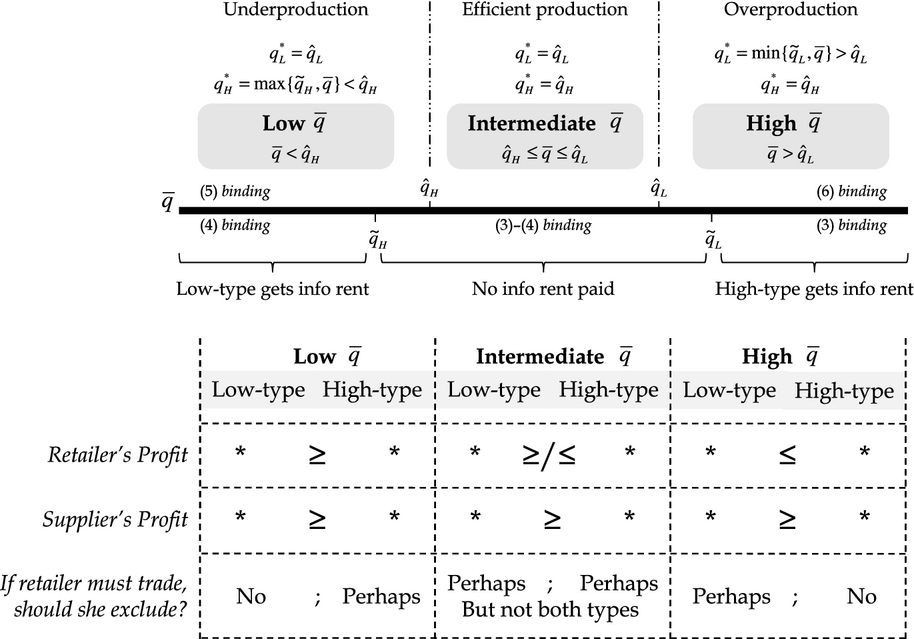
Summary of the Results in Section 4
In formulating Problem

Alternatively, we may allow the flexibility of not trading with a certain type of supplier. This is done by offering a contract that does not honor the reservation profit of that type, that is, by relaxing the individual rationality constraints (3) and (4). Apparently, the retailer may make a higher profit with such an option. In our discussion that follows, we are only interested in deriving the condition under which the optimal contract excludes only one supplier type, because the problem becomes trivial if the retailer does not trade with any supplier.
An Intermediate

In this case, the retailer can extract the most profit from the supplier by paying him his reservation profit and production cost. It is clear that the retailer should not trade with the type θ supplier if and only if she earns a negative profit from that type, θ ∈ {L,H}. This happens when






We can formulate and analyze Problem


A Small

According to Corollary 1, the retailer earns a larger profit from the low‐cost supplier than from the high‐cost one. This implies that the retailer always chooses the low‐cost supplier if she can only trade with one type. We shall assume that

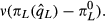
If, however, she trades with both types, her profit can be derived according to Theorem 1 as:

The retailer should compare the two profits to determine whether or not to include the high‐cost supplier. The exact condition is characterized in the next proposition.
Suppose
When When






The case







The analysis for this case is very similar to that for the previous one. We summarize the results in the next proposition for the sake of completeness.
Suppose
When When



The second part of Figure 1 summarizes the results in this subsection. The retailer earns a higher (lower) profit from the low‐cost supplier than from the high‐cost one for a small (large)


Our discussion has focused on a profit‐sharing contract (q,ϕ). The qualitative insights derived here apply to other types of practical contracts. Moreover, the quantitative results may continue to hold for some contract forms in our newsvendor setting as suggested by Cachon (2005).
Consider the revenue‐sharing contract (λ θ ,w θ ,q θ ) analyzed by Cachon and Lariviere (2005), where λ θ is the retailer's share of revenue generated from each unit and the w θ is the wholesale price. It can be shown that for a given pair (ϕ θ ,q θ ), there exists an equivalent revenue‐sharing contract defined by λ θ = 1 − ϕ θ and w θ = ϕ θ c θ .
As another example, consider a buy‐back contract (w θ ,b θ ,q θ ), where w θ is the wholesale price and b θ is the buy‐back price. When b θ = ϕ θ p and w θ = ϕ θ p + (1 − ϕ θ )c, the buy‐back contract leads to the same profit allocation as the profit‐sharing contract (ϕ θ ,q θ ). We can see that w θ and b θ are increasing in ϕ θ . An interesting observation is that the wholesale price for the low‐cost supplier might be higher than the one for the high‐cost supplier when ϕ L < ϕ H .
Comparative Statics
To offer further insights, we analyze the impacts of key model inputs on the optimal contract menu derived in the previous section. In particular, we discuss the effects of the supplier's reservation profit, the retail price, and the demand uncertainty.
Reservation Profit
Our previous analysis suggests that the supplier's reservation profits determine the form of the optimal contract. The next proposition characterizes its impact on the optimal contract parameters.
The following results hold.
The low‐cost (high‐cost) supplier's profit and information rent are weakly increasing in The low‐cost (high‐cost) supplier's profit is weakly increasing in The low‐cost (high‐cost) supplier's share of profit is weakly increasing in


According to the optimal contract, the payment to a supplier consists of three parts: compensation for his variable production cost, reservation profit, and information rent. The last two consist of the supplier's profit. Proposition 5 (i–ii) suggests that the low‐cost supplier may make a larger profit not only when his own reservation profit increases, but also when that of the high‐cost supplier increases. This is because in the latter case, the low‐cost supplier has a stronger incentive to mimic the high‐cost supplier. To discourage this, the retailer must provide a higher information rent to the low‐cost supplier. It is also interesting to note that the information rent paid to the low‐cost supplier is weakly decreasing in his own reservation profit, because his misreporting incentive is much reduced. These results are illustrated in Figure 2.

The Supplier's Profit and Information Rent with Respect to

We further compute the optimal contract parameters in Figure 3 to illustrate the results in Proposition 5 (iii). It is intuitive that the low‐cost supplier's share of profit


The Contract Parameters with Respect to

When the contract quantity deviates from the first‐best level, the supply chain is not operating efficiently. Such an inefficiency is because of the retailer's inability to infer the supplier's unit production cost. This hurts the retailer as the supplier benefits from a possibly positive information rent. To quantify the retailer's loss as a result of information asymmetry, we analyze the value of information to the retailer; that is, the difference of her profits under symmetric and asymmetric information.
When the low‐cost (high‐cost) supplier's reservation profit increases, the value of information to the retailer weakly decreases to zero and then weakly increases.
It turns out that the retailer's loss from information asymmetry depends on the difference between the reservation profits of the high‐ and low‐cost suppliers. In other words, the retailer cares more about the supplier's type when his reservation profit is highly correlated to his type. This is illustrated in the left panel of Figure 4.

The Impacts of Information Asymmetry with Respect to

It is also interesting that the impact of information asymmetry on the retailer's profit is very different from that on the channel's efficiency. The latter is measured by the percentage gap of the channel profit under the optimal contract compared with that under the first‐best contract. It is easily seen that the channel efficiency suffers as the deviation of the contract quantity from the first‐best quantity becomes larger (comparing the right panel of Figure 4 and the left panel of Figure 3). The channel efficiency may decrease when


Intuitively, when the retail price increases, the overall profit of the supply chain also increases as the product becomes more profitable. The next proposition characterizes the changes in the optimal contract parameters as well as the split of channel profit.
When the retail price p increases, the following results hold:
The contract quantity weakly increases. The retailer's profit increases, the low‐cost supplier's profit weakly increases, and the high‐cost supplier's profit weakly decreases.
The contract order quantity increases in the retail price because the underage cost (i.e., the loss of marginal profit due to understocking) increases. The retailer's profit increases as the margin of the product increases. The low‐cost supplier also enjoys an increased profit because of his capability of efficient high‐volume production. It is interesting that the high‐cost supplier's profit may decrease despite an increased p. Note that the high‐cost supplier earns a positive net profit only for a large


In general, the effect of information asymmetry is not monotone with respect to the retail price as shown in Figure 5. For a small


The Impacts of Information Asymmetry with Respect to pNote. Parameters: cL
= 5, cH
= 10, v = 0.5,
In general, the contract parameters may reveal subtle changes with respect to the demand uncertainty. This is because the order quantity is not monotone with respect to the demand uncertainty in standard newsvendor models.
When the demand increases stochastically in the convex order, the following results hold.
The retailer's profit is weakly decreasing. For If the demand distribution can be fully characterized by its mean and standard deviation σ, then the value of information to the retailer is weakly decreasing in σ.






The results in Proposition 8(i)–(ii) are consistent with our intuition. An increased demand uncertainty leads to reduced channel profit due to the added risk in the supply chain. Both the retailer and the supplier are hurt by the increased risk.
However, it is interesting to observe from Proposition 8 (iii) and Figure 6 that the private information becomes less useful to the retailer as the demand uncertainty increases. To see the intuition, we note that the demand uncertainty has a direct impact on the retailer's profit because she is exposed to the risks of underage and overage. The supplier, however, is indirectly affected by the demand uncertainty via the contract parameters, which are deterministic. Thus, the retailer's profit is significantly reduced when the demand is more uncertain. In this case, the information asymmetry has less impact on the retailer's profit.

The Impacts of Information Asymmetry with Respect to Demand Uncertainty Note. Parameters: cL
= 5, cH
= 10, p = 18, v = 0.5,
We treat the issue of contracting in a supply chain with asymmetric information. As an important departure from the literature, we consider type‐dependent outside opportunities for the supplier. Such a consideration leads to new understanding of the relationship between information asymmetry and channel efficiency. In particular, we show that the information asymmetry itself does not necessarily lead to an inefficient supply chain as the earlier studies in the supply chain literature indicated. We introduce a measure, which evaluates the low‐cost supplier's gain in reservation profit relative to his cost efficiency. This measure allows us to compare how the outside market values a given type of supplier with how the retailer values him. In other words, it quantifies the impact of outside opportunities on the retailer–supplier relationship considered in our model.
We also evaluate the value of the private information to the retailer by comparing her profit improvement via learning the supplier's type. Our analysis suggests that the information asymmetry can lead to significant profit loss to a small or a big retailer. Only when the difference of suppliers’ reservation profits is moderate compared with their cost differential, the retailer can overcome her information disadvantage. Moreover, the information asymmetry also has less of an impact on the retailer's profit when she is facing a highly volatile retail demand.
Our discussion also uncovers several interesting behaviors. In particular, we show that the supplier of a given type benefits not only from an increase of his own reservation profit, but also from an increase of the other type's reservation profit. Moreover, not every player can benefit from an increased retail price in our model.
This article assumes that the retailer and the supplier are risk neutral. If the supplier is risk averse and has a Von Neumann–Morgentstern utility function u(·), the supplier's payoff function will be expected utility instead of simply expected profit. In this case, we expect that the retailer's profit will be less than that in the risk neutral case, as the retailer needs to give more incentive to the risk‐averse supplier to participate.
A limitation of our model is the assumption that the supplier's production cost has two types. A natural next step is to incorporate n ≥ 3 types or even continuous types. As Fudenberg and Tirole (1991) point out, the problem involving multiple (more than two) types and type‐dependent reservation utility is analytically difficult and does not yield general results, and remains an important issue for future research.
Footnotes
Proofs
Acknowledgments
Xianghua Gan's research was supported in part by RGC (Hong Kong) PolyU 5170/08E.
1
In our base model, we assume that the retailer must trade with the supplier regardless of his type. Thus, we must allow the possibility that the retailer may earn a negative profit from a certain type of supplier, that is, ϕ
θ
> 1, θ ∈ {L,H}. In reality, such a solution will be ruled out; see the discussion in section  .
.
2
We use the convention that F −1(a) = 0 for a < 0 and F −1(a) = ∞ for a > 1.
3
There is an alternative way to obtain the solution proposed. We can replace the strict inequality constraint (11) by the weak inequality constraint
4
5
A random variable X
1 is said to be stochastically larger than a random variable X
2 in the convex order when