






Abstract
In consulting, finance, and other service industries, customers represent a revenue stream, and must be acquired and retained over time. In this paper, we study the resource allocation problem of a profit maximizing service firm that dynamically allocates its resources toward acquiring new clients and retaining unsatisfied existing ones. The interaction between acquisition and retention in our model is reflected in the cash constraint on total expected spending on acquisition and retention in each period. We formulate this problem as a dynamic program in which the firm makes decisions in both acquisition and retention after observing the current size of its customer base and receiving information about customers in danger of attrition, and we characterize the structure of the optimal acquisition and retention strategy. We show that when the firm's customer base size is relatively low, the firm should spend heavily on acquisition and try to retain every unhappy customer. However, as its customer base grows, the firm should gradually shift its emphasis from acquisition to retention, and it should also aim to strike a balance between acquisition and retention while spending its available resources. Finally, when the customer base is large enough, it may be optimal for the firm to begin spending less in both acquisition and retention. We also extend our analysis to situations where acquisition or retention success rate, as a function of resources allocation, is uncertain and show that the optimal acquisition and retention policy can be surprisingly complex. However, we develop an effective heuristic for that case. This paper aims to provide service managers some analytical principles and effective guidelines on resource allocation between these two significant activities based on their firm's customer base size.
Introduction
Customer retention is a growing concern for firms in many industries. From consulting, to finance, to cable service, customer retention is the key to long‐term profitability for many companies. Also critical is a firm's ability to acquire new customers in order to build its customer base. These two considerations in parallel naturally lead to the question of how a service firm should manage the trade‐off between customer acquisition and retention. Customer acquisition and retention are costly activities for a firm, and the firm may be prone to fail at this process due to a lack of guidance or actionable strategies. For example, during the dot‐com boom of the late 1990s and early 2000s many companies spent millions on customer acquisition without proper processes in place for retention.
This study is derived from industry experience of the first author, who faced this problem while working at a small third‐party‐financing company. The firm lent money to patients for medical procedures through a network of doctors. Thus, these doctors were considered as the firm's customers because their satisfaction and service usage drove profitability for the firm. A sales force located throughout the United States was tasked with acquiring new customers as well as visiting existing ones to keep them satisfied with the service being provided. The trade‐off between acquisition and retention was widely discussed at the company, and its impact on profitability was significant. During this period, the firm heavily emphasized acquisition while experiencing rapid growth. Analysis supported this practice, concluding that time and money were better spent in acquisition. However, as the firm matured, two things happened. First, the efforts in acquisition became futile, because incremental prospects were harder to acquire and less profitable. Second, attrition became a problem because the firm had neglected some of the existing users. Naturally the focus started to shift toward retention, though subsequent analyses indicated that the shift occurred too late. A primary motivating factor for this research is to build a model that helps companies better allocate resources toward acquisition and retention over time.
We consider the acquisition and retention trade‐off from the perspective of a service manager. The key research questions relate to the timing and quantity of spend in each of these two areas: How many customers should be targeted and how can the manager appropriately determine the effort that should be spent on acquisition of new accounts versus development of existing accounts? Does the strategy change as the customer base of the firm grows over time? Is there an efficient number of customers for the firm to maintain over time?
Acquisition and retention management is an issue of alignment between marketing and operations, and thus deserves consideration in the operations management and service operations literature. While the specific acquisition and retention tactics themselves may be marketing (or sales) activities, they need to be balanced against operations and service capabilities. The service capabilities affect the ability of the firm to allocate resources toward acquisition and retention. Therefore, acquisition and retention activities should be carefully coordinated between marketing and operations. Furthermore, we make the distinction between specific acquisition and retention strategies and the higher level resource allocation decision about how much capital or effort to spend in these areas. The latter is often an operational decision of a firm.
We study how a service operations manager should dynamically allocate his resources toward acquisition/retention when faced with limited resources (e.g., a limited budget to spend on these activities). We characterize how the acquisition/retention policy dynamically depends on the number of customers of the firm, the number of “unhappy” customers in danger of canceling service, and the firm's total budget (cash constraint) for acquisition and retention. Our results indicate that early on when the firm has few customers, the firm should spend heavily on acquisition and try to retain every “unhappy” customer. However, as the customer base of the firm grows, the firm may reach a point where it is not optimal to retain all unhappy customers due to resource constraint on acquisition and retention activities. In this situation the firm needs to carefully strike a balance between acquisition and retention while using up the entire available budget. Finally, when the customer base is large enough, it may be optimal for the firm to begin spending less in both acquisition and retention. This result, that is, the firm may reach a point in the number of customers it wants to have and curtails its acquisition and retention activities beyond this critical size, may seem unintuitive at first. However, it is driven by the fact that the marginal acquisition and retention costs are increasing in the number of customers acquired and retained, while the marginal increase in revenues is decreasing in the number of customers the firm serves. These are reasonable assumptions since sales forces acquire and retain the easiest prospects in a market first and acquiring and retaining customers gets more costly as the number of customers of the firm increases. An example of this from practice occurred a few years ago when telecommunication companies such as Sprint decided to “hang up” their high‐maintenance customers, which corresponds to refusing to retain customers beyond a certain point in our model. 1 Another implication of our results is that if the firm can become more efficient in acquisition and retention (by reducing acquisition or retention costs, or finding ways to make its service more valuable to customers so that customers are willing to pay more for service), it will enable the firm to increase its efficient size, which then leads to an increased overall customer base.
As the economy has become more service oriented, the importance of maintaining customer relationships is more critical today than ever before. The goal of this work is to provide structural insights and analysis of the essential trade‐offs that occur in managing service industries, through the use of a dynamic decision making model. We begin with a literature review in section 2, present the model and results in section 3, and discuss a model extension with heuristic in section 4, before we conclude in section 5. Throughout the paper, we use the terms increasing and decreasing to mean non‐decreasing and non‐increasing, respectively. Finally, all mathematical proofs are given in Appendix S1.
Literature Review
The trade‐off between acquisition and retention has been primarily studied in the marketing literature. The novel approach of our work is that we analyze this problem as a dynamic one, which captures the dynamic nature of resource allocation over time. The vast majority of other work is not dynamic. As a result, our approach has system dynamics in the form of state transitions. We also use the machinery of stochastic optimization, in contrast to most papers which use regression, empirical, or deterministic techniques.
In a well known article in Harvard Business Review, Blattberg and Deighton (1996) establish the “customer equity test” for determining the allocation of resources between acquisition and retention of customers. Using a deterministic model, the main contribution of this work is a simple calculation used to compare acquisition and retention costs with potential benefits.
The marketing literature contains numerous sources analyzing the acquisition and retention trade‐off. Reinartz et al. (2005) discuss the problem from a strict profitability perspective using industry data. They find that under‐investment in either area can be detrimental to success while over‐investment is less costly, and that firms often under‐invest in retention. Thomas (2001) discusses a statistical methodology for linking acquisition and retention. Homburg et al. (2009) use a portfolio management approach to maintaining a customer base.
Fruchter and Zhang (2004) is most closely related to our work in that it takes a dynamic approach to analyze the trade‐off between acquisition and retention. However, there are fundamental differences between our approach and theirs. In Fruchter and Zhang (2004), there are two firms and a fixed market in which customers use one firm or the other. Acquisition represents converting customers from the other firm while retention is preventing existing customers from switching to a competitor. Furthermore, their model is a differential game in which they make very specific assumptions on how effective acquisition and retention are at generating sales, namely that effectiveness is proportional to the square root of the expenditure. With this special model structure, Fruchter and Zhang (2004) show that equilibrium retention increases in a firm's market share while equilibrium acquisition decreases. Our work does not assume a fixed market, or specific functions that determine the relationship between expenditure and impact, and our work also captures randomness (Fruchter and Zhang (2004) is deterministic). Due to the fact that we do not assume a fixed market where the only way to obtain more customers is to convert them from another company, our insights are also different than Fruchter and Zhang (2004).
A recent paper on customer acquisition and retention from the operations management literature is Dong et al. (2011), and the reader is referred to their introduction for additional references on the problem studied. Dong et al. (2011) consider joint acquisition and retention, and use an incentive mechanism design approach to solve their problem. Additionally, they consider the question of direct versus indirect selling, in which the firm decides whether to use a sales force (for which an incentive is designed) or not. Their problem is static, where decisions are made only once.
Sales force management is a topic well‐studied from the incentive‐design perspective by others in addition to Dong et al. (2011). It often represents a traditional adverse selection problem, where designing a proper incentive structure can be difficult and costly due to the economics concept of information rent that must be paid to the sales agent to induce them to truthfully reveal their hidden information. Papers that discuss sales incentives in this context come from both the economics and operations management literature. From the economics literature, important works include Gonik (1978), Grossman and Hart (1983), Holmstrom (1979), and Shavell (1979). These papers set the stage for how moral hazard applies in the sales context and propose potential incentive mechanisms. In the operations literature, sales force incentives have been discussed primarily in the context of inventory‐control, and manufacturing. Important references include Chen (2005), Porteus and Whang (1991), and Raju and Srinivasan (1996). These papers do not discuss the trade‐off between acquisition and retention.
There also exists a body of literature on customer management from a service and capacity perspective. Hall and Porteus (2000) study a dynamic game model of capacity investment where maintaining sufficient capacity relative to market share drives retention, and excess capacity leads to acquisition. With a special structure for costs and benefits of capacity, they are able to solve explicitly for the subgame perfect equilibrium. Related dynamic game inventory‐based competition research includes Ahn and Olsen (2011) and Olsen and Parker (2008). In these papers, retention and acquisition are driven by fill rates, and are not explicit decisions, as in our study.
There is a broad literature on service failure recovery, which generally finds that it is beneficial to recover dissatisfied customers after a service failure (see e.g., Spreng et al. 1995). This literature also discusses the “service recovery paradox,” which says that previously dissatisfied customers respond most strongly to recovery efforts (see Matos et al. 2007). Our concept of “retention” is more pro‐active, and we do not explicitly model service failures, but instead assume that some customers are “unhappy,” and we have the option to work on retaining them once we find out their unhappiness. (Our model is especially relevant in many settings such as cable or telecommunications where a set of customers express unhappiness with the service absent a specific explicit service failure which caused the unhappiness). Another related area of literature is organizational learning, where acquisition and retention are framed as exploration and exploitation (as it pertains to new innovations/technologies). A seminal paper in this area is March (1991) and a more recent update is Gupta et al. (2006). The general finding in these papers is that exploitation is beneficial in the short term but can have negative consequences in the long term unless accompanied by exploration. Thus the key to success for a firm is to be ambidextrous across both capabilities of exploration and exploitation.
The main contribution of this paper is to study the acquisition and retention management problem using a dynamic optimization approach. With this approach, we are able to incorporate the dynamic nature of this important resource allocation problem, and derive managerial insights on optimal acquisition and retention related to the system dynamics, for example, how does a firm's current level of satisfied and dissatisfied customers impact its allocation decisions in acquisition and retention?
We believe it is important to study dynamic acquisition and retention for a firm due to the following reasons. First of all, we argue that a dynamic model cannot be reduced to a single period model as one needs at least two periods for the investment in acquisition and retention to later pay‐off. Second, it is the dynamic nature of our model that makes it more representative of reality and more general, and enables us to obtain a richer characterization of optimal acquisition and retention policies’ dependence on the size of the customer base, the size of the “unhappy” customers, as well as the available budget for acquisition/retention.
Model and Main Results
We model the acquisition and retention resource allocation problem as an N period finite‐horizon dynamic program. The decision period is indexed by n, n = 1, …, N. At the beginning of period n, the firm knows its number of customers,


In this section, we consider the situation in which a firm decides how many of its “unhappy” customers to retain and how many new customers to acquire, and the firm will spend the necessary resources to implement the decision in the period. Therefore, the outcomes for these decisions are deterministic,




Because customers represent a revenue stream for the firm, the expected revenue generated during period n, given that the number of customers at the beginning of period n is


It is also possible for some “happy” customers to discontinue service even though the firm has no prior indication of their dissatisfaction with the service. We denote the random percentage of “happy” customers that continue service in period n as





Suppose the decision maker uses a discount factor, α ∈ (0,1), in computing its profit. The objective of the firm is to balance acquisition and retention in each period to maximize its total expected discounted profits. Let


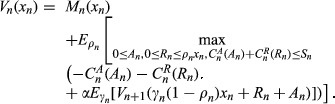

The optimality equation is described as follows. Suppose


The cost functions for the retention of existing customers and acquisition of new customers given by


More acquisition or retention is always more costly to the firm, thus


The expected revenue function


The expected revenue is clearly increasing in the number of customers using the firm's service. Here we also assume that it is concave in the number of customers. Larger and higher margin customers are likely to be targeted first in acquisition, so incremental customers will generate less revenue. In the third‐party‐financing industry, incremental customers tend to be less profitable because they are likely to be smaller and more skeptical of the benefit associated with the service being provided. In addition, as the prospects valuing the service most are acquired, it takes more effort and better terms to successfully acquire more skeptical customers.
Our model complements the landmark work of Blattberg and Deighton (1996) that establishes the “customer equity test.” In their model, as in ours, acquisition and retention success is a concave function of total spending, customers generate a per‐period revenue, and a firm makes acquisition and retention decisions. However, the primary difference is that they assume that acquisition and retention decisions are made only once, and then maintained over the lifetime of a customer. In our model, the firm can dynamically adjust its strategy over time, which enables us to characterize these dynamic decisions as a function of the size of the firm's customer base and the number of its “unhappy” customers. Also, we allow costs and revenues to have a more general form, while Blattberg and Deighton (1996) assume linear revenues and an exponential spending/outcome relationship. Finally, we have a cash constraint on total expected acquisition and retention activities, as discussed.
Before proceeding to the main result, we present here a preliminary modularity result which will be useful in our characterization of the firm's optimal strategy.
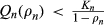
Given continuous and strictly concave functions f(·), g(·) and h(·), a non‐negative constant K, and a non‐negative random variable ε, the optimal solution to the optimization problem



The result above states that as K varies, the optimal


With our technical result in Lemma 1, we are ready to present the main result of this paper. The following theorem states that there exists a


Suppose The optimal strategy for period n is determined by a critical number There exist increasing functions There exists a critical threshold function











The optimal strategy stated in Theorem 1 takes an intuitive form. For a relatively small base of customers, the firm should retain each and every “unhappy” customer. In this region, acquisition is also critical. After this point, there may exist a second region where the firm spends

From the results of this section, we learn that a firm should shift resources from acquisition to retention as its customer base grows. However, this is only true up to some critical point. After that point, there may first exist a region in which acquisition and retention are constant due to the firm's cash constraint; and when the customer base grows large enough, the optimal strategy for the firm will be to invest less in both acquisition and retention. Note that our result indicates that retention effort is a function of a firm's customer size, an insight that is consistent with much of the marketing literature. However, compared with the marketing literature (e.g. Fruchter and Zhang 2004), our results are consistent only in the first region, where the firm increases retention as its customer base grows and decreases acquisition. However, when the firm is large enough, our results predict less spending in both acquisition and retention. With our explicit cash constraint on total expected acquisition and retention spending, we also characterize a region in which the constraint is tight so the total acquisition and retention are constant.
We also want to point out that the threshold function


In the first example, suppose that the costs of acquisition and retention decrease over time due to experience gained by sales individuals performing these tasks. Even with constant customer revenue rate, we will see that







The second example assumes instead that costs are constant but customers become more profitable over time because the firm finds ways to extract additional value through cost efficiencies or cross selling. In this example let





Thus, our results indicate that if a firm wants to keep growing its customer base, it needs to find ways to reduce its acquisition and retention costs over time or find ways to make customers more valuable over time (by potentially selling them additional services that the customers may be willing to buy). To the extent that the firm is able to do that, in Theorem 1, the expected number of customers that the firm will have in each period will be higher in expectation than in the previous period.
The optimal strategy is demonstrated in Figures 1 and 2, in which we can observe the strategy and how it changes as a function of the customer base,




Optimal Acquisition and Retention Strategies in Terms of Number of Customers







Optimal Acquisition and Retention Strategies in Terms of Number of Customers

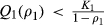




To further characterize the optimal strategy, we need the following result. In this result, we use


If









The implication of Lemma 2 is that the monotone switching curves







In the first case, that is,



Case I—Optimal Acquisition and Retention Strategies in Terms of Number of Customers


The second case, that is, when



Case II—Optimal Acquisition and Retention Strategies in Terms of Number of Customers


Lemma 2 allows us to develop detailed guidelines to firms on how to allocate their valuable resources toward acquisition and retention in different ranges of the size of their customer base and the fraction of dissatisfied customers (see Figures 3 and 4), and these results are much more detailed and intricate than provided in the previous literature. Indeed, as shown in Figures 3 and 4, the results indicate that there may be as many as 6 different regions in which the firm adapts different strategies based on these parameters.
In practice, one may think that the firm would always dedicate some resource toward retention. However, this is not true in general. In the following, we present a sufficient condition under which this is indeed true.
If there exists a positive number κ > 0 such that




Essentially, the firm will always retain some customers as long as the discounted marginal benefit from an additional customer is always higher than the cost to retain one customer. This is a reasonable and intuitive finding. Similarly, the following corollary establishes a sufficient condition under which the firm always does some acquisition.
If there exists a positive number κ > 0 such that



We highlight that our results are critically dependent upon the fact that we have a dynamic model. Suppose that the firm's revenue function is linear in the number of customers it has at the end of a single period (static) problem and assume for simplicity that the firm faces no cash constraint. Then with linear payouts and convex acquisition and retention costs, the optimal strategy would be determined by a simple order‐up‐to policy, in which the optimal acquisition is


We note that our results can be extended to a scenario in which the cost of acquisition depends on both the number acquired



Model Extension
The formulation in section 3 fits in environments where retaining or acquiring customers requires a lot of personal interactions. For example, in the health care finance industry one of the authors worked in, sales people paid visits to customers who intended to discontinue service and sales staff knew whether retention or acquisition had been successful. Thus sales staff would be given targets on how many customers to retain and could keep working until their targets were met. However, in many applications, it is common that both costs and outcomes are random for acquisition and/or retention. Such situations occur when the results of acquisition or retention efforts are realized after certain time. For example, in the magazine subscription industry, acquisition and retention are done through mails, and success would not be realized immediately.
In this section, we consider this generalization of our model in which outcomes in acquisition or retention may be stochastic, meaning that a confirmed success in acquisition or retention is not always possible at the time the effort is made.
Stochastic Retention and Acquisition
Let



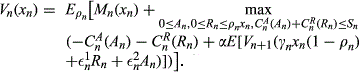
With the same boundary condition as before (

The optimal strategy is defined by three state‐dependent switching curves,
if otherwise, the firm sets
The switching curves








The lack of monotonicity in the switching curves indicates that the optimal policy for acquisition and retention no longer has a nice or intuitive structure.
The following example illustrates some of these phenomena; the optimal acquisition and retention strategies are given in Figure 5, which is in contrast to the optimal policy structures from Theorem 1 displayed in Figure 1 and 2.

Optimal Acquisition and Retention Strategy for Variable

This example is generated by modifying data from (Chen et al. 2013). Again we consider a problem with two periods, N = 2, hence



The three random variables are assumed to be discrete:


The optimal strategies are presented in Figure 5. One can see that acquisition is no longer decreasing in


A Heuristic
For the model presented in section 3, the optimal acquisition and retention strategies had monotone properties (in the number of customers


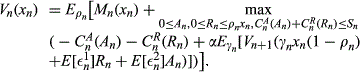

To understand the performance of this heuristic approach, we conducted a numerical study on a number of different scenarios, and computed the performance of the heuristic as compared to an optimal strategy. The parameters that we used in our numerical study are summarized in Table 1. For all scenarios, we consider a five‐period problem (N = 5), and assume, for all n, that





Testing Scenario Overview (N = 5 and for all n, 





By varying the different parameters, we tested 162 different scenarios. We summarize the results of the numerical study in Table 2. For each scenario, we determined the average error (across a number of different possible starting states), and the worst error.
Testing Summary
In each of the scenarios we tested, the average error was well under one tenth of a percent with a maximum error under 1%. This indicates that our heuristic performs very well with reasonable functions for acquisition/retention costs and benefits.
Although our numerical study indicates that the heuristic generally performs well, it is possible to also find examples where it does not. Consider once again our numerical example in subsection 4.1. We compared the optimal strategy for this problem to the heuristic across scenarios in which the number of starting customers 
We note however that this is a highly contrived example where the firm's revenue function has a severe discontinuity: the firm makes 14 dollars per customer up to 500 customers but only 0.5 thereafter. Furthermore, while acquisition is less costly in expectation, retention outcomes are less random. Therefore when we replace the random outcomes by their expectations, the heuristic only uses acquisition. This is to its detriment because the sharp discontinuity in the revenue function rewards a strategy in which retention is used so long as the number of customers is below 500. However, we were only able to generate examples where the heuristic performed so poorly when our parameters had such drastic changes and we believe that such situations are less likely in practice. In fact, with a similar example and a more smooth revenue function, we see that the heuristic performs well, a finding consistent with the results from our more comprehensive computational testing. Suppose instead of making $14 up to 500 customers and then $0.50 thereafter, the firm's revenue function is piece‐wise linear with decreasing marginal customer values of 14, 12, 11, 10, 9, 8, 7.5, 7, 6.5, 6, 5.5, 5, 4.5, 4, 3.5, 3, 2.5, 2, 1.5, 1 (all in $) for the twenty 25‐customer increments from 0 to 500 (i.e. the firm makes $14 for each of the first 25 customers, then $12 for each of the next 25, then $11 for the next 25, etc.). Above 500, we assume the marginal customer value is $0.50 as before. In this case the heuristic performs well, with the average profit across all cases equal to 0.75% and the worst error observed across all cases equal to 3.42%. Again because firms’ revenue functions are likely smooth in practice, we think this example is more realistic than the one where the firm's marginal revenue from customers went from $14 to $0.5 at a single sharp point. More generally, our numerical tests found that it is possible to find cases where the suggested heuristic does not work well, but to generate these cases, one needed very sharp jumps in the revenue, acquisition cost and retention cost functions. As seen in the above example, more gradual jumps in these functions resulted in a pretty good performance for the heuristic.
Conclusion
Maintaining and growing a base of profitable customers is critical to the success of many companies across different industries. To succeed, companies need to appropriately allocate resources to the retention of existing customers and to acquisition of new ones. In this study, we develop a model to analyze this problem which captures the practical interactive dynamic decision‐making process. Existing literature has focused on the acquisition and retention trade‐off using regression, empirical analysis, or static optimization. This work is unique in that it provides a dynamic optimization perspective on the resource allocation trade‐off between customers acquisition and retention. Because customer relationships evolve over time, we believe the paper makes a meaningful contribution to the literature.
With some plausible assumptions on the costs of acquisition and retention and the revenue generated from customers, we obtain some interesting structural properties for the optimal strategy, which then provide important insights to the firm's optimal solution. For a small firm undergoing initial growth in its customer base, our results emphasize the critical importance of customer retention; the firm should spend heavily on both channels, while shifting resources from acquisition to retention during this initial growth. In practice, we believe that many firms undervalue retention during initial growth of its customer base and overemphasize acquisition. If this were to occur, acquisition can be undermined by the loss of existing customers, stalling growth. When a firm gets larger, there may exist a region in which the spending in acquisition and retention is flat because the firm is spending at the maximal amount dictated by the cash constraint. Finally, when its customer base is large enough the firm begins to invest less in both acquisition and retention. The reason for this is that when retention efforts become prohibitively expensive, the firm accepts that it might lose some customers, rather than spending a lot of resource to try and keep every customer. This important result is consistent with some observations in the telecommunication industries. In practice, some customers may be so expensive to keep satisfied that it no longer makes sense for the firm to continue retaining every one of them, if the customer base is large enough. However, we also did find conditions that enable the firm to continue growing: namely, if the firm can reduce acquisition and retention costs over time, or if the firm can increase the value of its customers by convincing the customers to buy more services, then it is optimal for the firm to continue growing its customer base over time. We also discussed an extension to our model where acquisition and retention outcomes (as well as their costs) are random. This case results in a much more complex optimal policy structure and we developed an effective heuristic policy for that.
There is significant opportunity for additional research from the operations management community on the topic of customer acquisition and retention management. For example, it is often the case in practice that multiple firms target the same pool of prospective customers, and one would need to apply game theory to study the dynamic decision making and competition of the firms. There is also the possibility of incorporating other sales management decisions into the framework of the acquisition and retention trade‐off. For example, one may consider joint decisions on acquisition, retention, and sales compensation design, or joint decisions on acquisition, retention, and hiring or laying‐off employees. Such models would extend our work to consider other strategic aspects of the dynamic acquisition and retention management problem.
Acknowledgment
The authors are grateful to the Senior Editor and two referees and their constructive comments and suggestions, which have helped to significantly improve both the content and exposition of this study. The research of Xiuli Chao is supported in part by the NSF under grant CMMI‐1362619.
Footnotes
1