







Abstract
Uncertainty before purchase often gives rise to postpurchase emotions that consumers might anticipate when making purchase decisions. Our study investigates how consumers' anticipated postpurchase regret affects their optimal search behavior and how this affects firms' price and assortment competition. The key tension considered in this study is that consumers balance between saving the cost of product evaluation by searching less and alleviating the potential postpurchase regret on their purchase by searching more. We use a classical sequential search framework to examine this key tension. Our results show that anticipated regret encourages more intense search across competitive alternatives, leading to an intensified price competition when search depth is exogenous (searching a fixed number of attributes) or when search depth is endogenous but full‐depth search (inspecting all attributes) emerges (with high regret intensity). However, when search depth is endogenous but partial‐depth search (inspecting a subset of attributes) emerges (with low regret intensity), the blessing effect of anticipated regret on softening firms' price competition begins to emerge. In addition, anticipated regret can achieve a “win‐win‐win” situation for consumers, firms, and the social planner. Moreover, multiproduct firms use different competitive devices with different levels of regret intensity: When regret intensity is low (high), firms focus on assortment (price) competition to retain consumers. The relevant managerial implications are discussed.
INTRODUCTION
In many shopping situations, consumers face uncertainty on product information before purchase. Thus, products' values realized after purchase, either good or bad, often give rise to postpurchase emotions (e.g., elation or regret) to consumers. If they can anticipate those emotions (as they do in many cases) before making the purchase decision, consumers might alter their strategies in product evaluation, which helps them resolve product uncertainty. Consider a typical situation in which a consumer is shopping for a skirt, hoping to find the one best in line with current trends. The key tension that she faces is as follows.
On the one hand, collecting more information—on more skirts and/or along more attributes—increases the chance that the consumer finds a closer substitute to the trendsetting design, which reduces her regret on the purchase. However, doing so might be too costly to the consumer. On the other hand, the consumer might consider just a few alternatives to save the cost of skirt evaluation. However, selecting from a small set of skirts likely provides her a substitute that is distant from the trendsetting design, making her feel more regret about the purchase. That is, considering more alternatives reduces regret but is more costly, whereas searching fewer alternatives saves evaluation cost but might trigger more regret on the purchase. Thus, it is not a straightforward matter how the consumer optimally balances the trade‐off when she can anticipate the postpurchase regret before making the purchase decision.
Although a rich strand of literature shows that consumers can anticipate regret and incorporate it in their decision‐making process (Inman et al., 1997; Zeelenberg et al., 1996), little research has been conducted to analyze how anticipated regret affects consumers' search behavior before they make purchase decisions, let alone its influence on firms' price and assortment competition. To the best of our knowledge, this work is the first analytical study that focuses on these important issues.
Particularly, the key dimension in search that is considered in our model is search depth (i.e., how many attributes the consumer searches), which is a novel construct that has drawn attention in the recent literature on consumer search (Branco et al., 2012; Dukes & Liu, 2016; Ke et al., 2016). Thus, when considering how much to invest in search, the consumer makes a trade‐off between how many attributes to evaluate (search depth) and how many products to search (referred to as search breadth). Back to the example of searching for the trendsetting skirt design. The consumer decides how many skirt attributes (e.g., color, size, and style) to search and how many skirts to evaluate, knowing that more search (either along the depth or the breadth dimension) not only alleviates potential postpurchase regret but also incurs a higher search cost, whereas less search intensifies the anticipated regret but is less costly to her.
We will explore these interactions under a classic sequential search framework in which the consumer is under the guidance of an optimal stopping rule, and she sequentially evaluates products at some search depth until a purchase is made. Using this framework, we will explore how anticipated regret affects consumer search, which, in turn, influences firms' competition in pricing and assortment, consumer surplus, and social welfare.
In summary, this study attempts to address the following research questions. How do consumers' anticipated regret and their search behaviors interact under the sequential search framework? How do the interactions between anticipated regret and search affect firms' price competition, consumer surplus, and social welfare? Is it possible that anticipated regret can benefit all agents? How do the levels of regret intensity affect multiproduct firms' competition in assortment and prices? Specifically, which competitive device should multiproduct firms focus on, pricing or assortment, with different levels of regret intensity?
Our paper attempts to address these important research questions. In addition, we also explore other relevant research issues, for example, are the main results obtained under the sequential search framework consistent with those obtained under an alternative parallel search framework (in which consumers first decide a sampling plan, including how many firms to evaluate and how many attributes to inspect, and then make a search effort and the purchase decision)? And, how does the structure of search costs affect the main results? Our analysis yields several interesting results.
First, intuitively, when searching less can trigger more postpurchase regret that can be anticipated by consumers before purchase, they will search more extensively to alleviate regret, which will intensify firms' price competition. This intuition is confirmed in our model when search depth is exogenous or when search depth is endogenous but full‐depth search (i.e., inspecting all attributes) prevails: Under these situations, a higher regret intensity encourages consumers to search more competitive alternatives, thereby trigging price competition (referred to as the breadth effect).
Second, when search depth is endogenous, our results show that consumers use partial‐depth search (i.e., inspecting a subset of attributes) with low levels of regret intensity, whereas, they use full‐depth search (i.e., inspecting all attributes) with high levels of regret intensity. Interestingly, when the partial‐depth search prevails, as regret intensity increases, consumers use a greater search depth (inspecting more attributes), which lets them better differentiate products and thus increases their willingness to pay (referred to as the depth effect). Meanwhile, consumers search (on average) more competitive alternatives, implying that the (negative) breadth effect is strengthened. The former softens firms' price competition whereas the latter intensifies it. Thus, the overall effect of anticipated regret on firms' prices depends on which effect dominates.
Specifically, when regret intensity is low (under partial‐depth search), consumers search (on average) a small number of competitive products, and thus, the competition is low. A higher regret intensity will induce consumers to search more firms, bringing more competition among firms. Thus, the breadth effect dominates, implying that equilibrium prices decrease in regret intensity. However, in contrast, when regret intensity is higher (but still under partial‐depth search), as consumers search (on average) many competitive firms, searching an additional firm (due to a higher regret intensity) does not bring much additional competition. This implies that the breadth effect no longer dominates, and thus, the depth effect ensures that firms' equilibrium prices increase in regret intensity.
Combining the first two sets of results, the blessing effect brought by anticipated regret on softening firms' price competition emerges when regret intensity is neither too large nor too small. Thus, anticipated regret acts as a double‐edged sword to firms' price competition: The blessing effect of anticipated regret on price competition emerges with intermediate levels of regret intensity, which ensures that partial‐depth search prevails when search depth is a choice by consumers. We believe that these conditions for this blessing effect are widely applied in many shopping situations in which consumers can choose search depth.
The third result is also intriguing. Intuitively, anticipated regret acts as a disutility to consumers, implying a reduced consumer surplus and social welfare. However, our results show that anticipated regret can bring a “win‐win‐win” situation, in which consumers, firms, and the social planner all benefit, because the lower prices (caused by the intensified competition due to the breadth effect) dominate the utility loss to consumers. In addition, the expanded market due to the lower prices brings firms higher profits. As a result, social welfare increases in regret intensity.
Fourth, our results show that firms focus on assortment competition when regret intensity is low, whereas they focus on price competition when regret intensity is high. Specifically, when the regret intensity is low, as the depth effect dominates, firms charge higher prices as regret intensity increases, encouraging firms to carry a higher level of assortment. This intensifies firms' assortment competition. However, as regret intensity increases and the consumer uses full‐depth search, the depth effect vanishes and thus the breadth effect intensifies price competition, leading to lower prices. This intensifies firms' price competition. These results illustrate that multiproduct firms should keep the magnitude of consumers' regret intensity in check: In particular, if regret intensity is low, consumers have some (but not high) incentive to search more to avoid anticipated regret. Thus, firms should compete more aggressively in assortment by providing a potential better fitting value to retain consumers; however, if regret intensity is high, consumers have a high incentive to avoid anticipated regret by searching intensively. Under this situation, firms need a more direct device—competing more aggressively in prices—to retain consumers.
In addition, our paper also explores two important extensions. The first extension examines the situation under a parallel search framework and shows that the main results still hold. The second extension focuses on the role of a more general search cost function and shows that our main results hold if the concavity of the search cost function is sufficiently high; otherwise, the blessing effect of anticipated regret on softening firms' price competition never emerges as partial‐depth search never prevails in equilibrium.
LITERATURE REVIEW
Our study closely connects to the literature on anticipated regret. Several studies have explored its effect in various shopping contexts, for example, between a standard product and a custom order (Syam et al., 2008), in advanced selling (Nasiry & Popescu, 2012), in innovation investment (Jiang et al., 2017), in pricing and inventory management (Özer & Zheng, 2016), in product line design (Zou et al., 2020), and in AI automation effectiveness evaluation (Li & Li, 2022). Our contributions are as follows. First, to the best of our knowledge, this study is the first to explore how anticipated regret interacts with consumer search: Consumers balance between saving the cost of product evaluation by searching less and alleviating their potential postpurchase regret on purchase by searching more. All other key results—on firms' competition in price and assortment, as well as welfare analysis—are built on this key interaction. Second, the literature on anticipated regret largely assumes that consumers choose between a surer alternative and a riskier one, and if the latter turns out to be undesirable, they will regret not buying the surer one. By contrast, our study explores the situation in which consumers have imperfect information on all products (all alternatives are risky), but can conduct more search to alleviate regret.
Our study is also related to the literature on consumer search. Most of the studies in the literature have focused on two mainstream frameworks, parallel search and sequential search. Specifically, under the parallel search, consumers decide a sampling plan before evaluation and then inspect all products in the sampling plan before making the purchase decision (Cachon et al., 2005, 2008; De los Santos et al., 2012; Dukes & Liu, 2016; Hauser & Wernerfelt, 1990; Honka & Chintagunta, 2017; Honka et al., 2017; Liu & Dukes, 2013, 2016; Morgan & Manning, 1985; Ratchford, 1982; Wang & Sahin, 2018). While others assume that consumers' search behavior is guided under an optimal stopping rule, and they search product sequentially until a purchase decision is made (Anderson & Renault, 1999; Armstrong et al., 2009; Chen, 2021; Ke et al., 2016; Kuksov, 2004; Perdikaki & Swaminathan, 2013; Sankaranarayanan & Sundararajan, 2010; Weitzman, 1979; Wolinsky, 1986; Zhou, 2014). Especially, our study is closely built on the recent booming literature on partial‐depth search (Bar‐Isaac et al., 2012; Branco et al., 2012; Dukes & Liu, 2016; Jin et al., 2020; Ke et al., 2016), which assumes that consumers can optimally choose how many attributes to evaluate. Our study provides an equilibrium analysis on how anticipated regret affects consumers' search behavior, which, in turn, influences firms' competition in price and assortment. Our analysis yields many interesting results new to the literature. For example, our results show that when search depth is exogenous or when search depth is endogenous but full‐depth search emerges (with high levels of regret intensity), anticipated regret always intensifies firms' price competition. In contrast, when depth is endogenous and partial‐depth search prevails (with low levels of regret intensity), as regret intensity increases, the equilibrium prices first decrease and then increase in regret intensity due to the trade‐off between the depth effect and the breadth effect, which, respectively, plays a positive and a negative role on the equilibrium prices. As a result, due to partial‐depth search, the blessing effect of anticipated regret on softening firms' price competition emerges when regret intensity is neither too large nor too small. Thus, anticipated regret acts as a double‐edged sword to firms' price competition through consumers' optimal search behavior.
Our work is relevant to the literature on assortment management (refer to Caro et al., 2020; Kök et al., 2015, for a detailed review). Many studies explore the optimal assortment level for a single retailer with various consumer choice models (Chen et al., 2021; Davis et al., 2014; Pan & Honhon, 2012; Rusmevichientong et al., 2010; Şen et al., 2018; Talluri & van Ryzin, 2004; Wang & Wang, 2017). Some recent studies incorporate a consideration set into assortment management, such as Aouad et al. (2021) for several structured consideration sets, Feldman and Topaloglu (2018) for nested consideration sets, Jagabathula and Vulcano (2018) for a partial‐order–based choice model, and Feldman et al. (2019) for a small consideration set. They assume that the consideration sets are known in advance. However, in our study, we consider the formation of the consideration set. There are also studies focusing on firms' assortment competition with/without search behavior (Besbes & Sauré, 2016; Cachon et al., 2005, 2008; Federgruen & Hu, 2015; Gallego & Wang, 2014; Heese & Martínez‐de‐Albéniz, 2018). Our study shows some interesting results on assortment that are affected by the interaction between anticipated regret and search: Firms focus on assortment competition when regret intensity is low, whereas they focus on price competition when regret intensity is high. These results imply that multiproduct firms should keep the magnitude of consumers' regret intensity in check: When consumers have some (but not high) incentive to avoid anticipated regret (due to low regret intensity) by searching more, firms should provide a higher level of assortment to offer a higher potential fitting value to retain consumers; however, when consumers have a high incentive to avoid anticipated regret (due to high regret intensity) by searching intensively, firms should use a more direct device to retain consumers—competing more aggressively in prices.
MODEL DESCRIPTION
There are N firms competing in a market. Each firm offers a single product and determines its selling price. 1 Without loss of generality, we normalize the unit production cost to zero. In addition, we assume that all products are within the same category and horizontally differentiated without systematic quality differences.
There is a unit mass of consumers with idiosyncratic taste who at most buys one unit product. We assume that consumers have imperfect information about the fit of products before search, but they can costly collect information to become knowledgable about the value of products. Specifically, in the main analysis, we consider a sequential search model in which consumers visit firms sequentially and continue searching until they either buy a desirable product or leave the market without purchase. 2
We assume that the consumer can optimally decide how much information to acquire about a product, which is referred to as search depth, and denoted by





To search at depth d, the consumer needs to incur a search cost, and we assume that the search cost is quadratic in search depth d (i.e.,


The new behavioral feature that we capture in our search model is that the consumer can anticipate potential postpurchase regret when collecting product information. Before search, the consumer normally has a vision of the ideal product and has an expectation for its utility, denoted by






Each firm i needs to determine its selling price

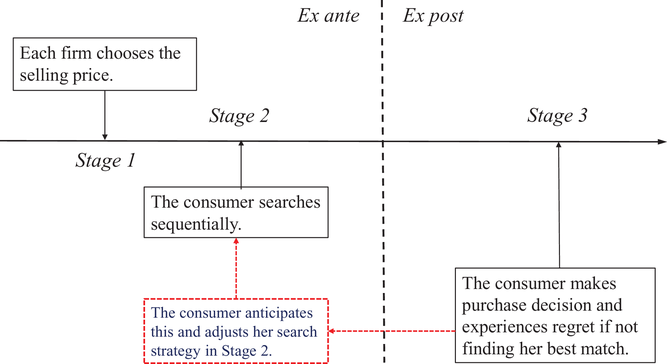
Sequence of events
MAIN ANALYSIS
In this section, we explore how anticipated regret affects consumer search and firms' price competition. At first, the consumer observes the no‐purchase utility and decides whether to enter the market (i.e., visit a firm) or not; once the consumer enters the market, upon visiting each firm, she decides between buying its product and searching the next firm.
Particularly, to illustrate these interactions, we first consider a benchmark model in which the search depth is fixed, 5 and then focus on the situation in which the depth is a choice. Through the comparisons, we attempt to show that the consumer's search depth decision is critical in the effect of anticipated regret on firms' competition. That is, anticipated regret is always a curse to firms when depth is fixed but may become a blessing when it is endogenous. In addition, we will discuss several interesting results brought by anticipated regret that are new to the search literature and their relevant managerial implications.
Benchmark: Exogenous search depth
Assume that the search depth is fixed at d. Suppose that the consumer has already evaluated a set of products (denoted by







Now, the consumer has to decide whether to search for next product j. With the belief on firms' symmetric equilibrium




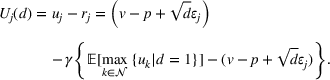
Therefore, the expected benefit from searching another product j at depth d is given by
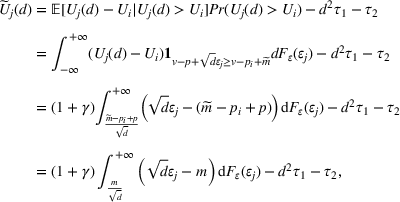


One can easily verify that the consumer's search strategy follows a threshold policy with the threshold point




One immediate observation is that anticipated regret increases the search benefit (i.e., left‐hand side of Equation (6) increases in γ), because an additional search reduces the consumer's anticipated regret.
We now turn to firms' decision. Suppose product i sells at price There exists a unique optimal stopping rule such that the consumer buys when



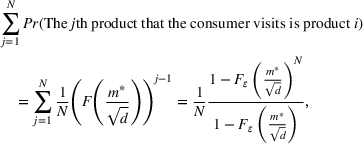


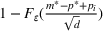
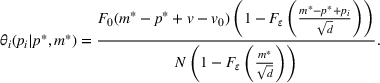




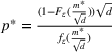
This lemma illustrates that, with a fixed search depth, the consumer searches (on average) more products to alleviate regret, because the reservation utility

Interestingly, our results in the following text will show that anticipated regret might soften firms' competition when the search depth is endogenous.
Endogenous search depth
In this subsection, the consumer chooses an optimal search depth in each step of the sequential search process. We assume that the consumer uses a stationary search depth, There exists a unique optimal stopping rule such that the consumer buys when when when





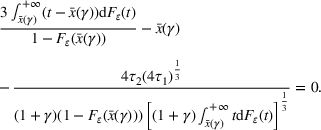
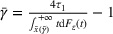


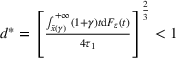
This proposition illustrates how anticipated regret affects the consumers' search behavior. The key message is delivered in Part (ii) of this proposition: Partial‐depth search prevails when regret intensity is low (


Part (i) shows that when the regret intensity is high (

Next, we explore how regret intensity affects firms' equilibrium prices. The following lemma gives out firms' equilibrium prices. Firms' equilibrium price

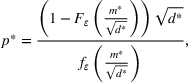


This lemma illustrates that the equilibrium price is a function of the optimal search depth (


As in Proposition 1, the optimal search depth (
When When


This proposition illustrates how regret intensity affects firms' equilibrium prices. The key result in this proposition is in Part (ii): When partial‐depth search emerges (


Specifically, when the partial‐depth search prevails with


In particular, when γ is large (


Equilibrium price versus search depth with


However, with an intermediate level of γ (

In summary, for any positive transportation cost (

Next, we explore two extreme cases of our main model:


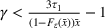
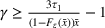
Part (i) of this corollary illustrates results that are consistent with those in Lemma 1. Specifically, when

The results in Part (ii) are consistent with those in Propositions 1 and 2. The key difference is that, with


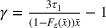
Next, we explore how anticipated regret intensity affects consumer surplus and social welfare. Intuitively, anticipated regret should reduce consumer surplus and social welfare. However, the following proposition challenges this intuition. When v0 is small and γ is large, consumer surplus and social welfare increase in γ. There may exist some


This proposition illustrates an interesting result: Anticipated regret can create a “win‐win‐win” situation in which all agents (the consumer, firms, and social planner) benefit from it. When v0 is small, social welfare increases in γ when it is sufficiently high, because a larger γ leads to a reduced price (due to the breadth effect), which expands the market. 10 This reduced price not only increases consumer surplus but also improves firms' profit because the expanded market dominates the reduced price. Thus, social welfare also improves, and there is a “win‐win‐win” situation.
Figure 3
11
shows the “win‐win‐win” situation (which is highlighted in the yellow shaded region [i.e.,


The case with


Multiproduct firms
In this subsection, we explore the situation with multiproduct firms and focus on how firms' assortment and anticipated regret interact. In the following, we will show that our main results in the main text with single‐product firms are still robust, and then illustrate a new result: firms use different competitive devices (assortment or pricing) with different magnitude of regret intensity.
We use a to denote the assortment level, and all products are assumed to be a priori identical before search. When the consumer decides whether to continue search or not, she anticipates that all firms will choose the same assortment (a) and price (p) in equilibrium. We do not consider the outside option because of the complexity of the problem. Thus, the expected utility from searching another firm j at depth d is given by









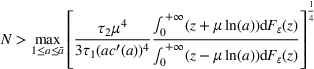
Then, we turn to firms' decisions. Firm i incurs an operational cost


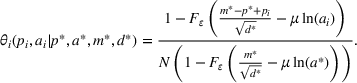
Firm i needs to determine its selling price



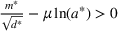
There exists a solution There exists a unique optimal stopping rule,




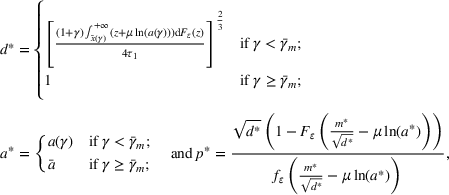



The main results illustrated in this lemma are consistent with those in the main text: Partial‐depth search emerges with low regret intensity (


Next, we will explore which competitive device, assortment, or pricing, firms focus on with different levels of regret intensity. The following proposition summarizes the results. Firms compete more aggressively in assortment when partial‐depth search emerges (


The proposition shows an interesting result: Firms focus more on assortment competition when the regret intensity is low and on price competition when it is high. This result implies that competitive firms choose different competitive devices, either price or assortment, in the presence of consumers' regret.
Particularly, when the regret intensity is low (


The results of this proposition bring interesting managerial implications. Specifically, multiproduct firms should keep the magnitude of consumers' regret intensity in check. If regret intensity increases from a low level, consumers have some (but not high) incentive to search more to avoid anticipated regret. Under this situation, firms should compete more aggressively by investing in a higher level of assortment as doing so can benefit consumers through a potential better fitting value; in contrast, if regret intensity increases from a high level, consumers have a strong incentive to avoid anticipated regret by searching intensively. As a result, firms should compete more aggressively in prices, which is a more direct device to retain consumers.
These results are summarized in the following figures in which the red‐solid line, the dashed‐blue line, and the horizontal axis, respectively, represent the equilibrium price, the equilibrium assortment level, and consumers' regret intensity (γ). From Figure 4, we can see that the equilibrium assortment increases in regret intensity when partial‐depth search emerges (


The case with


EXTENSION
In this section, we explore two important extensions: (1) We first discuss the situation with another important search model—parallel search: Consumers simultaneously evaluate a fixed number of firms that are randomly sampled before search and then select the most preferred product or leave the market without buying any product; and 2) we then relax the quadratic assumption on search cost function by considering a more general cost function. The goal of this section is to check the robustness of our main results and derive additional managerial insights.
Parallel search
In this section, we consider the parallel search process in which the consumer determines her sampling plan, including how many products to evaluate (i.e., search breadth


When choosing her sampling plan, the consumer anticipates regret and thus forms expectation of



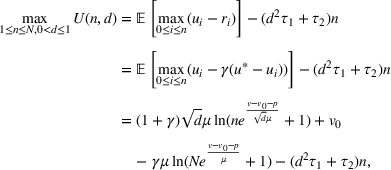




A firm can correctly anticipate that all other firms follow a symmetric equilibrium, denoted by



Thus, firm i's expected profit can be expressed as



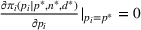

To characterize the equilibrium, we let The optimal sampling plan is given by (

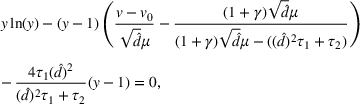



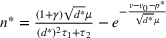
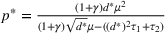


This lemma illustrates that, when full‐depth search prevails under parallel search, the results are consistent with those obtained under sequential search: A higher level of regret intensity encourages the consumer to include more products into her sampling plan (


Because deriving analytical results with partial‐depth search is not mathematically tractable under parallel search pattern, we use simulation to illustrate the results. Specifically, one can easily see from Figure 5 12 that the main results obtained under sequential search still hold. First, anticipated regret decreases the equilibrium prices when full‐depth search emerges (because the breadth effect dominates). Second, when partial‐depth search emerges, anticipated regret can increase the equilibrium prices (because the depth effect dominates). Third, anticipated regret can bring a “win‐win‐win” situation in which the social planner, the consumer, and firms all benefit (see the highlighted areas).

The case with


Search cost function:

The base model assumes that the search cost is a quadratic function of search depth, that is,










Given firms' selling prices p, the probability that the consumer purchases from firm i is If
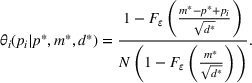




This lemma delivers one key message: It challenges our main results that anticipated regret can benefit firms when search depth is endogenous by showing that regret always intensifies firms' price competition and reduces their profits with low levels of q (

When For partial‐depth search emerges with low regret intensity ( the equilibrium price


The results of this proposition are consistent with those in the main text (see Propositions 1 and 2). As the intuition is similar, we omit the discussion to avoid repetition. Combining the results in this subsection, we want to make the following key points: Whether the blessing effect of anticipated regret on firms' price competition emerges in equilibrium depends on the functional form of search cost; with

CONCLUSION
This paper examines how consumers' anticipated regret affects consumers' optimal search behavior, and how this affects strategic firms' pricing and assortment competition. To the best of our knowledge, this study is the first to jointly examine two important concepts in business literature—consumer search and anticipated regret. Our paper shows several new findings. First, anticipated regret always intensifies firms' price competition when search depth is exogenous or when search depth is endogenous but full‐depth search emerges (with low regret intensity), because of the breadth effect. Second, when the search depth is endogenous, anticipated regret can benefit firms when partial‐depth search prevails (with low regret intensity) because of the depth effect. This happens when regret intensity is neither too large nor too small. That is, regret acts as a double‐edged sword to firms' competition. Third, anticipated regret can bring a “win‐win‐win” situation in which the social planner, the consumer, and firms all benefit. Fourth, multiproduct firms focus on assortment competition when the regret intensity is low but focus on price competition when it is high. In addition, our extensions show the robustness of our main results, and bring additional new findings: Our main results still hold under parallel search or under a sufficiently concave search cost function; however, under search cost function with low concavity, the blessing effect of anticipated regret on softening firms' price competition never emerges because partial‐depth search does not prevail in equilibrium.
The results of our paper shed light on many shopping situations that involve consumers' anticipated regret. To illustrate the relevant managerial implications, we focus on the time leniency of returns policies by brand manufacturers or digital platforms 14 : A longer returns window lets consumers return the purchase for refund and thus alleviates anticipated regret more than the shorter returns window with which consumers might figure that they want to return their purchase after the window is closed for refund and thus feel and anticipate more regret. For example, the results of Proposition 2 show that the blessing effect of regret—that softens firms' price competition—emerges when the regret intensity is relatively low. This finding might explain why many digital platforms extend the time window for product returns during holidays and encourage brand manufacturers to offer more generous return policies in time and monetary leniency than those provided by platforms: High lenience levels of returns policy might keep consumers' aversion to regret on their purchase at low levels, and this softens firms' price competition, thereby benefiting platforms that charge commission fees (a percentage of listing prices) from firms that they host. In addition, the results of Proposition 3 show that anticipated regret might lead to a “win‐win‐win” situation that benefits the social planner, consumers, and firms, implying that the social planner has an incentive to keep in check the level of regret intensity. This might be relevant to the laws or regulations addressing the leniency level of consumers' product returns, which might affect the degree of consumers' regret about their purchase. Interestingly, various leniency levels are observed in many states. For example, in California and New York, the law requires firms to accept returns within 30 days of purchase, whereas the time window is shorter—20 days in Virginia, Florida, and New Jersey, 15 implying that state governors might judiciously consider the impact of the leniency of returns policy on consumers, firms, and state society. Moreover, our Proposition 4 shows that firms focus on assortment competition when regret intensity is low and on price competition when it is high. This finding might shed light on the observations that firms normally compete aggressively in prices on digital platforms in China or India, which provide low leniency of returns policies that trigger consumers' potential postpurchase regret.
There are several potential avenues for future research. First, our model assumes that products are different and symmetric. However, in many shopping situations, consumers search among asymmetric products (e.g., with different qualities), implying that some products are more prominent than others in consumers' search process, and thus, search becomes ordered. It is interesting to explore how this will reshape the interaction with anticipated regret and the subsequent implications in firms' strategic reactions. Second, it is interesting to explore whether the key results of anticipated regret and search in this paper still hold with a more general function of search cost. Our analysis in the extension section already shows that a different search cost function can provide a boundary of the key results. We believe that additional analysis can shed more light on this key issue. Third, our paper focuses on a specific construct of emotional loss—anticipated regret. Future studies can explore how other constructs such as disappointment affect the main results.
Footnotes
ACKNOWLEDGMENTS
The authors gratefully thank the department editor Dan Zhang, the anonymous senior editor, and the anonymous referees for their constructive comments, which helped greatly improve this study. The authors also thank Axel Stock for his insightful suggestions. Authors are listed in random alphabetical order and contributed equally to this work. Lin Liu is the corresponding author. Jin's work is supported in part by National Natural Science Foundation of China (72010107002, 71671163, 72171212). Yang's work is supported in part by National Natural Science Foundation of China (72125004, 71871198). Zhu's work is supported in part by National Natural Science Foundation of China (71931009, 71821002, 72171212). Liu's work is supported in part by the Start Funding from Beihang University.
1
Our extension section considers the situation in which each firm offers an assortment of products, and simultaneously chooses the selling price and assortment level.
2
We will consider an alternative parallel search model in the extension section. Specifically, under the parallel search, consumers simultaneously evaluate a fixed number of firms that are randomly sampled before search and then select the most preferred product or leave the market without buying any product.
3
The Gumbel distribution possesses the self‐decomposable property and infinite divisibility, which can be used to capture consumers' utility under partial‐depth search (e.g., see Dukes & Liu, 2016; Steutel & Van Harn,  ). Our CE.2 in the Supporting Information shows that the continuous depth can be approximated by searching a discrete bundle of product attributes.
4
Our extension section will consider a more general functional form of search cost.
5
This corresponds to the situation in which the consumer's search depth is dictated by search environment, such as Internet shopping.
6
7
Other works on sequential search also make the same assumption (e.g., Anderson & Renault, 1999; Cachon et al., ).
8
This assumption is plausible when the number of firms is sufficiently large.
9
10
The market size is given by
11
The left part of the vertical dotted line corresponds to partial‐depth search, and the right part corresponds to full‐depth search.
12
The left (right) part of the vertical dotted line corresponds to partial (full)‐depth search.
13
The base model becomes a special case by setting
14
We believe that the relevant implications and applications are beyond returns policies.
15
See