







Abstract
This study analyzes whether individual skills and personality traits facilitate labor market mobility of disadvantaged groups and rural migrants. We use a panel dataset of individuals in rural South India to explore the relationship between individual cognitive skills, personality traits, and income mobility. We take advantage of intragroup heterogeneity in terms of cognitive skills and personality traits to examine whether these personal characteristics enable individuals to overcome rigid social structures, exploring the role of these skills and traits in migrants’ income mobility. We show that despite strong rigidity in the area’s labor market structure, personality traits are important determinants of labor mobility, enabling individuals to overcome caste and gender discrimination, but that these personality traits do not contribute to increases in migrants’ income mobility.
Over the past four decades, India has experienced rapid changes that have reshaped the labor structure throughout the country. Tamil Nadu, one of the most developed, urbanized, and industrialized Indian states, is no exception. The exodus of higher castes from rural areas to the cities has initiated substantial transformations of land distribution and labor organization (Djurfeldt et al. 2008), leading to a decline of agriculture in the last 20 years. Despite this significant drop, agriculture continues to provide a large share of employment, especially in remote areas. Conversely, development of connections between rural and urban areas has led to a significant rise in rural nonfarm employment, which has provided new job opportunities (Guérin, Venkatasubramanian, and Michiels 2015). The dynamism of nearby cities has influenced the local labor market, especially for the educated youth desiring to leave villages of origin where employment opportunities outside of agriculture remain scarce.
At the same time, political changes have created a fertile ground for social policies targeted at the poor, improving access to employment for disadvantaged groups, namely, women and lower castes (Vijayabaskar 2010). Yet these vulnerable groups remain disadvantaged in both absolute and relative terms (Papola and Kannan 2017). In this changing economic, social, and political landscape, studying the dynamics of the labor market is essential to understanding social mobility.
Traditionally in India, the caste system means that jobs are determined at birth (Deshpande 2000), making hereditary occupational specialization one of its inherent characteristics. Yet despite a persistent congruence between caste and occupation, this trend has been mitigated by the modernization of the Indian economy since the 1980s, which does not only weaken barriers of entry into specific occupations, but also creates new forms of employment. The rapid and substantial development of the service sector in urban and peri-urban areas has created new types of occupations out of the traditional caste-based job assignment system. However, facing modernization, the caste system has adapted and rearranged (Harriss-White 2003) to create new forms of employment segregation. For instance, low-quality employment in the informal service sector is no longer associated with specific jatis, 1 but it remains disproportionately occupied by lower castes.
Various studies, focusing on the evolution of the employment structure of specific groups with an intergenerational perspective, have shown a large occupational path dependency across generations (Motiram and Singh 2012). Individual (intragenerational) labor mobility, on the other hand, is scarcely analyzed, and studies that use longitudinal individual-level data (i.e., panel data) are particularly rare. Studying intragenerational income mobility by analyzing both absolute and relative measures, Azam (2016) shows that individuals belonging to the disadvantaged groups (scheduled castes and other backward castes) are less likely to experience upward mobility and more likely to experience downward mobility compared to individuals belonging to the upper castes.
The Indian labor market is also strongly segmented on the lines of gender, which limits women’s occupational and income mobility. Women are more likely to be present in temporary and casual occupations than in more stable ones because of barriers to entry (e.g., not meeting educational requirements, lack of experience, insufficient social network, or discrimination), and they are also likely to remain in those occupations (Sundari 2020; Guérin et al. 2020). Moreover, self-selection of women into specific jobs linked to beliefs regarding “male” and “female” jobs (Goldin 2014) strengthens labor market segregation and leads to reduced mobility across occupations and income brackets.
One important means to social mobility in India is through migration. Indeed, benefiting from new employment opportunities, often related to the structural change India has undergone, a large share of rural Indians migrate seasonally or permanently for labor reasons. Research has shown that migration in itself is a way to transcend caste and gender barriers in terms of occupational and income mobility (Michiels 2016), but only a few studies focus on the underlying processes. Migration and access to new forms of employment are likely to challenge the intragenerational path dependency inherent to the caste system. Moreover, women’s migration is also a potential vector of social mobility, with temporary migration driven by labor market opportunities targeting women in the manufacturing sector (Banerjee and Raju 2009).
If sociocultural structures, such as caste and gender, play an important role in limiting mobility across occupations and income brackets, individual skills can allow workers to overcome these barriers by providing them with resources to seize labor market opportunities, namely, through migration. In Western countries, individual endowments, such as cognitive and personality traits, have received significant attention as determinants of labor performance in the past two decades (Heckman, Stixrud, and Urzua 2006; Almlund et al. 2011). In fact, personality traits, referring to qualities such as motivation or social skills, have in some cases been shown to be at least as important as cognitive skills for earnings and employment prospects. Theoretically, personality traits can have both direct and indirect effects on labor market integration and success. They can directly affect employability and productivity by being considered as part of an individual’s set of endowments or serve as incentive-enhancing preferences (Acosta, Muller, and Sarzosa 2015). Additionally, they can indirectly affect individuals’ social inclusion, for instance, through effects on aspirations, occupational choice, and educational attainment. They can also influence the propensity to migrate, allowing individuals to access new labor market opportunities (Jokela 2009). Labor market mobility is likely to be shaped by these individual differences. Studies in psychology show that individuals with higher cognitive skills and those with certain personality traits (openness to experience, extraversion, and emotional stability) have access to broader and more diverse social networks (Pollet, Roberts, and Dunbar 2011), which in turn influence labor market transitions (Granovetter 1985; Bramoullé and Saint-Paul 2010).
In India, social structure, institutions, and norms affect individual labor, mobility, trajectories, and other individual choices, oftentimes by constraining them. Up to now, in economics, the role of cognitive and personality traits has been evaluated in isolation from the external environment, by purely focusing on their effects on individual choices and preferences, thereby neglecting the social structures in which individuals evolve. Hence, the extent to which the effects of skills and traits on labor mobility are intertwined with these social structures, namely, gender roles and the caste system, is rather unexplored. Anthropological studies in India show that the interaction between skills and social structures matters for job access (Carswell and De Neve 2018). But empirical knowledge on this is meager in economics, especially in the context of developing countries. Moreover, we know little about the role of cognition on migrants’ labor market outcomes. Studying these issues appears fundamental in the case of India, where two-third of the population still live in rural areas, and labor migration out of villages remains the exception rather than the rule (Michiels 2016).
Labor market mobility across time in India is usually studied through the prism of social groups, mainly due to the cross-sectional nature of available data. Individual data can nevertheless provide a more precise understanding of the determinants of labor market mobility by providing insights into both group and individual characteristics. This article follows this approach by analyzing income mobility using firsthand panel data from rural Tamil Nadu in 2010 and 2016. We aim to observe whether income mobility is restricted for vulnerable groups (i.e., low caste groups and women) and if individual endowments in terms of personality traits and cognitive skills play a role in labor market mobility.
Our research questions include the following: Are personality traits and cognitive skills determinants of income mobility? How do gender and caste interact with those individual differences in this process? Are certain cognitive traits and processes of income mobility specific to labor migrants? In what follows, we implement Heckman estimations of determinants of income mobility to control for selection bias. We conduct our analyses on gender, caste, and migrant subsamples allowing us to (1) understand the role of cognition in income mobility, (2) discuss the relevance of a Five Factor Model (FFM) of personality traits in comparison to alternative gender-specific factors when studying rural women’s labor market mobility, and (3) provide insights into the links between migration and mobility. A final section discusses the implications of our findings.
Data and Methodology
Data
To study the dynamics of labor market transitions, we use a panel database built on two original surveys: RUral Microfinance & Employment (RUME) and Networks, dEbt, Employment, Mobilities and Skills in India Survey (NEEMSIS), respectively carried out in 2010 and 2016–2017. The first wave (RUME) has been conducted among 405 households in ten villages located in coastal/central Tamil Nadu in the Cuddalore and Villupuram districts (see online Appendix 1). The second wave of the survey (NEEMSIS) was collected by the authors in the same ten villages plus nine additional localities where migrant households had settled since 2010. 2 Using a tracking procedure for migrant households, the attrition rate between both waves is limited to 4.8 percent. The balanced panel dataset (i.e., individuals observed in both waves) contains 1,581 adults (15+ years old), with 52 percent men and 48 percent women. Jatis affiliation has been clubbed in three categories: the Dalits community, which is at the bottom of the caste system, represents around 48 percent of the sample; the middle caste group represents 37 % and the upper caste constitutes the last 15 percent of the sample. Seven hundred forty-nine adults had an occupation in both waves.
In this analysis, we are also interested in the income mobility of migrants. The 2016–2017 wave of the NEEMSIS data already tracked fifty migrant households, which contributed to reducing panel attrition. An additional dedicated wave was carried out in 2018, allowing us to recover eighty-three individual migrants. We do not include individuals from this wave in our caste and gender analysis to ensure better homogeneity of the second wave of data, but we provide a separate analysis focusing on migration, which includes the tracked individual migrants.
Methodology
The detection of labor market mobility
We measure income mobility in absolute and relative terms. Absolute income mobility is measured by the logged value of the difference of income between 2010 and 2016 (after controlling for inflation). Relative income mobility is detected by a variable measuring the number of percentiles of mobility (percentile rank change) that a worker experienced across the distribution of annual wages between the 2010 and 2016–2017 waves. The variable can take the values [–100; 100].
Cognitive skills and personality traits
Individual endowments, such as educational background, are known to be important determinants of labor opportunities. However, the effects of other individual differences on the labor market are much more complex to assess. Our study identifies cognitive skills using three dimensions: literacy tests (reading and writing basic sentences); numeracy tests (four basic calculation tests); and the Raven Colored Progressive Matrices (CPM), meant to capture “fluid intelligence.” 3 The Raven CPM consists of three sets of twelve questions of increasing difficulty, which are cognitive, visual, nonverbal tests that do not require any level of formal education. It captures the ability to think and make sense of complex data and logical reasoning. The Raven CPM has been previously used in economics for cognitive skills assessment in low-literacy populations in developing countries (e.g., Serneels 2008). The score of the respondent to each dimension provides a refined measure of individual cognitive abilities.
In addition to these usual dimensions of individual endowments, we use the Long Big Five Inventory, which is a taxonomy that refers to five dimensions commonly used to describe human personality traits: openness to experience, conscientiousness, extraversion, agreeableness, and emotional stability. Practically, a set of forty-two questions (seven for each dimension) has been asked to the respondent to capture the five personality traits. 4 We implement an alternative and gender-specific personality traits factor analysis. The universality of the Big Five Factor Model (FFM) has indeed been questioned in several economic and anthropological studies. Laajaj et al. (2019) show that their validity outside of Western, educated, industrialized, rich, and democratic (WEIRD) populations is limited because of a risk of misinterpreting the Big Five survey. Moreover, by testing the FFM among forager-farmers in the Bolivian Amazon, Gurven et al. (2012) show that the FFM is not universal. They do not find strong support for the FFM but consistency among factors relating to prosociality and industriousness. They argue that further research is needed on how lower-rank personality traits assemble into higher-order personality traits. Following the intuition of these studies, we implement our own factor analysis of the forty-two questions on male and female subsamples separately. We extract the first five factors, then proceed to a promax rotation and analyze the content of each factor (see online Appendix 8). We implement checks of internal factor validity using the Cronbach’s alpha measure and compare the results of the two approaches: (i) and (ii).
Estimating the determinants of income mobility
To analyze income mobility in an econometric setup, we use the two aforementioned income mobility variables (i.e., absolute income mobility and relative income mobility) as dependent variables. The independent variables of interest are the cognitive skills

The estimation of equation (1) by ordinary least squares (OLS) is likely to yield biased estimates because our variables of interest were only collected in the second wave of the dataset and because of sample selection issues pertaining to the nature of our research questions, which included only active occupied individuals. To deal with these issues, we restrict our sample to individuals older than 30 years old, 5 ensuring the stability of cognitive skills and personality traits across the two waves (Cobb-Clark, Deborah, and Schurer 2012), and we implement a Heckman selection correction method, which is commonly used in labor market analyses. Further information on these issues and the methods used are available in online Appendix 2.
Descriptive Evidence of Labor Market Mobility
The labor market structure in our study area has experienced multiple changes between 2010 and 2016–2017. As online Appendix 3 shows, as elsewhere in Tamil Nadu and more generally in India, agricultural employment has declined drastically, especially for agricultural casual laborers. Moreover, employment outside of agriculture has simultaneously risen sharply for regular, nonqualified workers; and declined for casual workers. These evolutions suggest a trend of regularization of nonagricultural employment explained by the rapid development of the service sector in rural Tamil areas over the last decade. We also note that the Mahatma Gandhi National Rural Employment Guarantee Act (hereafter NREGA) scheme, which is a national employment program aimed at alleviating rural poverty, has become the main occupation for 11 percent of the occupied active population in 2016–2017.
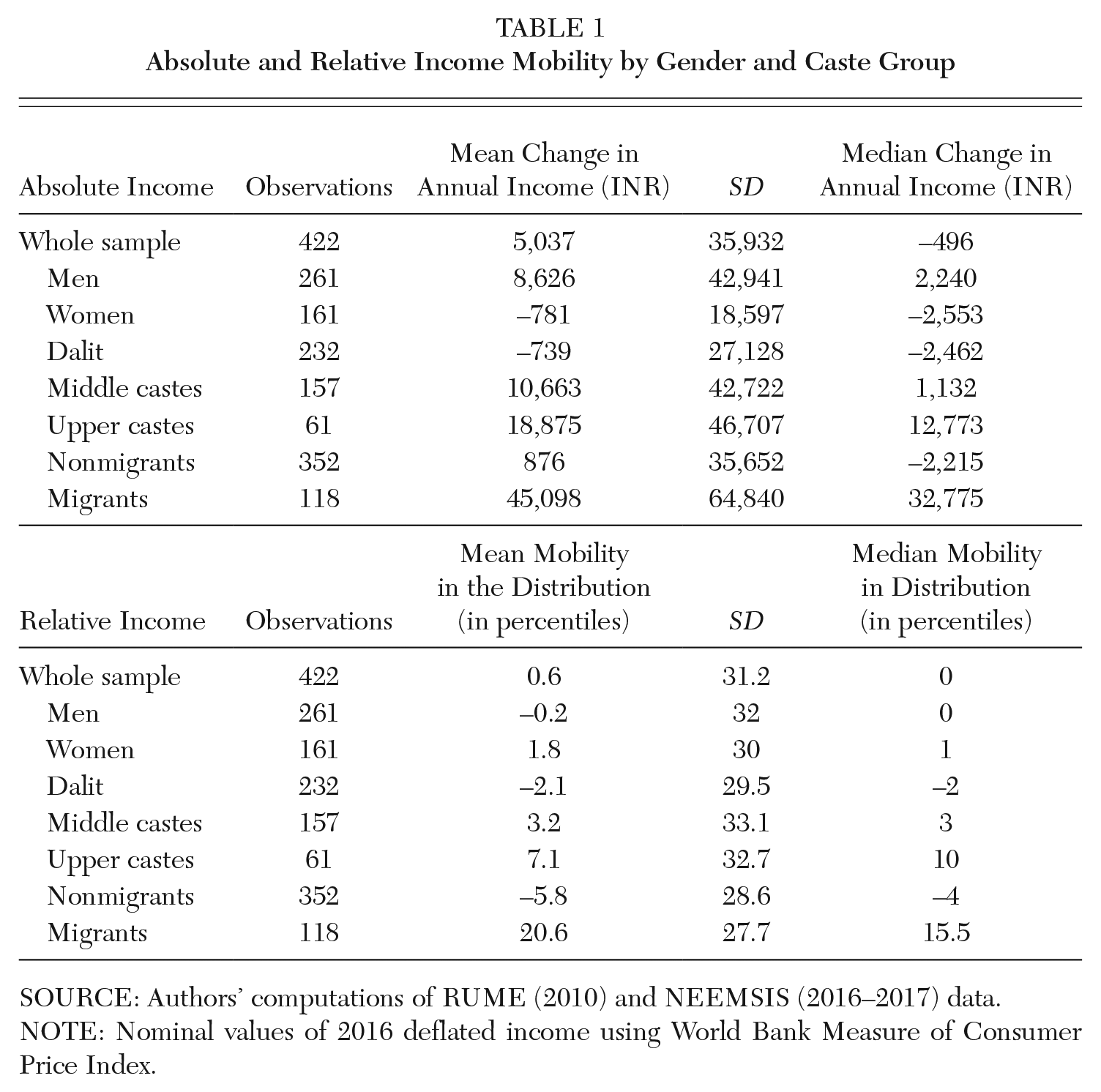
Looking at income mobility reveals additional information on how the labor market evolution has reinforced caste and gender inequalities in terms of income. Table 1 shows that, overall, average annual incomes rose by 5,000 rupees (around USD [U.S. dollars] 75 in 2016) over the six-year period, but this amount masks strong heterogeneity. The first striking feature is that disadvantaged groups (i.e., women and Dalits) have, on average, lost around 700 rupees (USD 10.50) between 2010 and 2016–2017. Conversely, men and non-Dalits seem to have benefited from the labor market evolution, and we observe a significant rise in annual incomes for these social groups (up to USD 247 for upper castes).
Absolute and Relative Income Mobility by Gender and Caste Group
SOURCE: Authors’ computations of RUME (2010) and NEEMSIS (2016–2017) data.
NOTE: Nominal values of 2016 deflated income using World Bank Measure of Consumer Price Index.
In terms of relative income mobility, overall, we observe little variation, indicating that despite important occupational mobility, the earnings gap is not dramatically changing over time. Upper castes, and to a lesser extent middle castes, have not only experienced a significant increase in their earnings but also an upward mobility in the income distribution. 6 In brief, we do not observe significant changes at the bottom of the distribution, where Dalits and women are overrepresented, but the earnings gap is increasing between the middle and the upper tail of the distribution.
Last, we observe that migration enables important income gains in both absolute and relative terms. Half of the migrants have seen their incomes rise by more than 32,000 rupees between the two periods, translating to an upward mobility of 13 percentiles on average in the income distribution. The migrants’ employment structure explains, in part, this higher income mobility. Sixty percent of migrants have regular employment, compared to only 20 percent for nonmigrants. However, these figures need to be tempered. Only a small share of migrants’ occupations are urban qualified jobs (around 10 percent). But in a context of high uncertainty and precariousness, having access to regular incomes throughout the year is an important asset in comparison to casual and seasonal activities available in the villages.
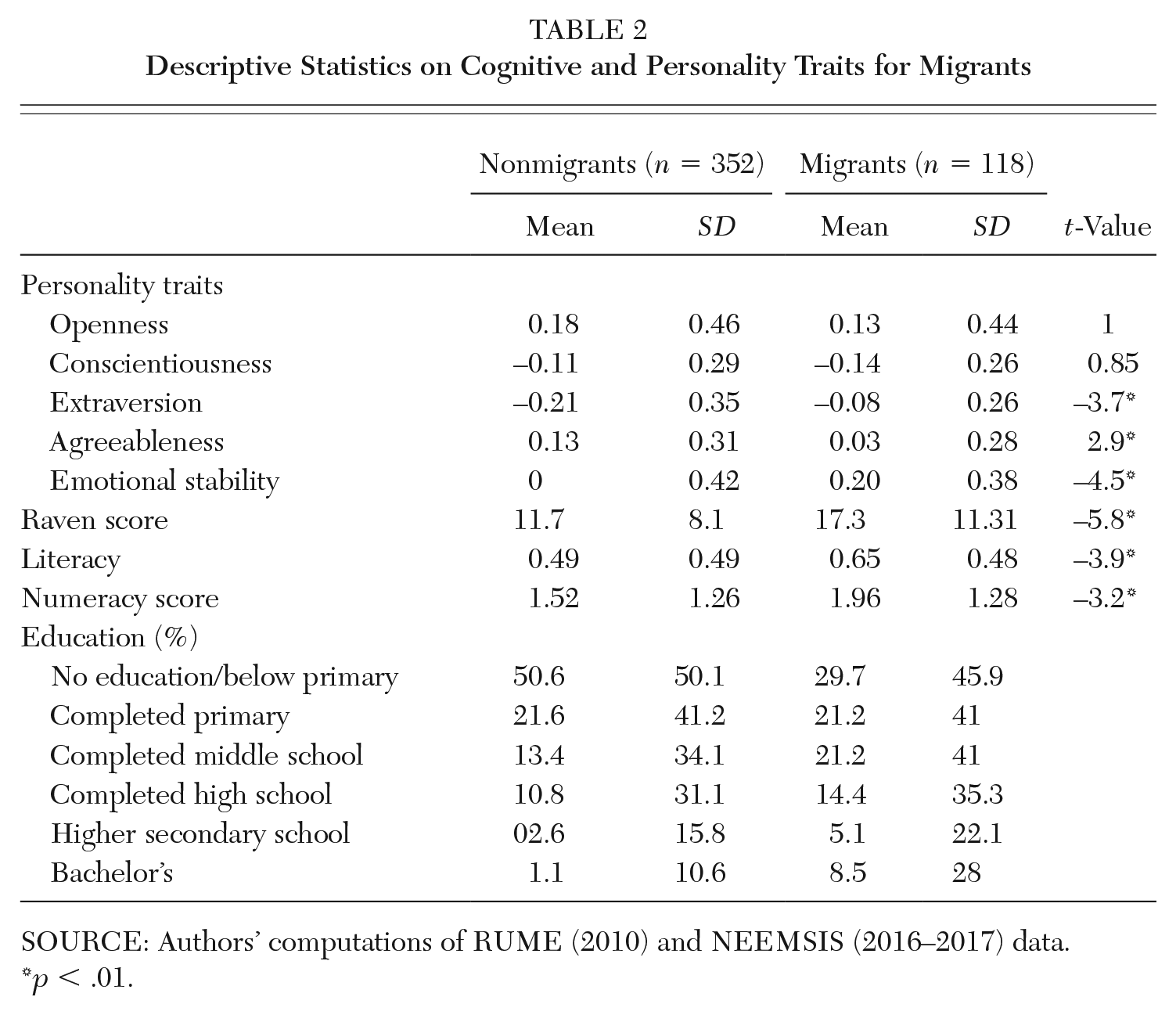
Overall, migrants are better educated and skilled than nonmigrants (Table 2), namely, regarding all the cognitive skills (Raven, numeracy, and literacy) and some personality traits, such as emotional stability and extraversion (the differences being significant at the 1 percent level). Migrants are also more likely to have completed higher education than nonmigrants. These specific individual characteristics of our migrants’ subsample could explain why migrants have experienced better income mobility between the two periods.
Descriptive Statistics on Cognitive and Personality Traits for Migrants
SOURCE: Authors’ computations of RUME (2010) and NEEMSIS (2016–2017) data.
p < .01.
The Determinants of Labor Market Mobility
Income mobility: General and caste-wise results
This section presents the results stemming from the Heckman estimations that we reported in regression tables in online Appendices 5 and 6. The dependent variables are absolute income mobility (difference in log incomes between both waves) and relative income mobility (rank change in percentiles between both waves). The variables of interest are the Big Five personality traits and cognitive skills variables: numeracy score, literacy dummy, and Raven CPM score. The general results (online Appendix 5) show that cognitive skills are not determinants of income gain in absolute or relative terms. However, three of the Big Five personality traits have positive and significant coefficients. Openness to experience, extraversion, and emotional stability are determinants of positive income change (i.e., income increase) in both absolute and relative terms, meaning that they are associated with increases in absolute income and increases in the relative income rank of individuals between both waves.
The fact that the cognitive skills variables are not significant imply that when other variables are held constant, a higher Raven score, and literacy or numeracy levels are not associated with income mobility.
The results of the Heckman estimations by caste group (online Appendix 6) 7 show that openness to experience is a determinant of relative income change (the coefficient is positive and significant) for all caste groups. Emotional stability is positively related to absolute and relative income mobility for all caste groups. Two personality traits allow income mobility for Dalits, but in both cases the result is only significant at the 10 percent level. First, openness to experience is positively and significantly related to absolute income change for Dalits. Second, agreeableness is positively and significantly related to relative income change for the same group. Interactions show that upper castes have a smaller chance of income mobility (both absolute and relative) for the same level of emotional stability compared to middle castes, suggesting that this trait contributes to the reshuffling of the socioeconomic hierarchy among the non-Dalits.
Income mobility: Gender results
In this subsection we present the results of our estimations by male and female subsamples. To further explore the determinants of income mobility, we use our own factor analysis of the forty-two personality questions by sex subsamples (online Appendix 8) and the results of Heckman estimations with gendered factors are presented in online Appendix 7. Note that the internal validity of the gendered factors were measured using the Cronbach’s alpha and show higher internal validity of the gender-specific factors than the FFM factors. 8
The results using the FFM factors show that, for men, openness to experience, conscientiousness, extraversion, and emotional stability are determinants of absolute income mobility and relative income mobility. For women, emotional stability is the only determinant of absolute income mobility and relative income mobility. The cognitive skills are never significant for men. For women, literacy is positively related to absolute income mobility.
Looking at gendered personality traits provides a more in-depth understanding of the determinants of women’s income mobility. Indeed, factors 1, 2, and 3 are significant for both absolute and relative income mobility. These factors respectively refer to (1) traits that indicate emotional stability (i.e., not changing moods easily, not being nervous, and not being easily upset), combined with conscientiousness traits, also indicating some form of stability (e.g., not easily distracted, working hard) and one extraversion trait (i.e., talkative); (2) traits of openness to experience (i.e., like to talk, new ideas, curious, inventive) and emotional stability (does not feel depressed and does not worry a lot); and (3) a combination of traits from all five factors (see online Appendix 8). If we look at the gendered subsamples for men, only the first factor is significant. This factor combines conscientiousness and emotional stability items, which is consistent with FFM results. These observations illustrate the ongoing debate on the universality of the Big Five Inventory and, in our case study, it appears to be male-oriented as it hardly captures women’s personality traits.
Migration and income mobility
The results provided in online Appendix 9 report regressions in which we interact a migration dummy with our different variables of interest. We use three migration dummies: general migration, household migration, and individual migration. The results confirm that, even when we control for other factors, migration is positively and significantly related to both absolute and relative income changes. However, the only significant interaction between migration and cognitive skills or personality traits is with the variable numeracy. Interestingly, the interaction term is negative and exhibits an overall negative effect. Hence, the effect of numeracy on income mobility for migrants is negative compared to nonmigrants. Note that this effect is small and significant at the 5 percent level. As Table 2 shows, migrants generally have higher personality trait scores than nonmigrants, which may explain their collective (at the household level) and individual decisions to move out of their origin villages for better job prospects. However, the regression results (online Appendix 9) show that none of the interaction terms between migration and personality traits is significant. 9
Discussion
Using a unique panel dataset allowing us to study the role of cognitive skills and personality traits on labor market outcomes in rural India, we have identified the extent to which individual differences overcome social inequalities in the labor market. Our analysis of intragenerational mobility uses measures of cognitive and psychological differences that are scarcely used in the case of developing countries, especially India, and deepen the understanding of the dynamics of income mobility in the rural area of Tamil Nadu. This analysis highlights the existence of a plurality of mechanisms that reinforce caste and gender inequalities, which we discuss in what follows.
Importantly, this analysis has joined together disciplinary approaches. Behavioral economics, which includes recent and fruitful advances in psychology economics, has provided new evidence that cognitive and socioemotional skills are likely to have direct and indirect impacts on individual choices and outcomes in the labor markets, but it is too often disconnected from the analysis of social structures in which individuals are embedded. By contrast, structuralist approaches recognize that individuals cannot be considered outside of the social relations that make up the collective structure (Polanyi 1944). Labor markets, therefore, appear as a place of negotiation and social interaction, where complex forms of power and domination are encompassed in relations of rivalry, exclusion, and cooperation. While both approaches are often presented as incompatible, they appear to have numerous points of convergence. Most behaviorists pay attention to the role of social norms and interactions but overlook their inherent nature, while many structuralists emphasize the structural origin of cognition and emotion but disregard the extent to which they shape individual preferences and choices. We recognize here that both views are meaningful and need to be articulated, and our findings illustrate the complementarity of both approaches.
Bearing on migration, men in rural Tamil Nadu have experienced a regularization of labor and an exit out of agriculture toward construction, education, or the growing service sector, whereas women have experienced opposite trends (Djurfeldt et al. 2008). Women’s culturally mandated seclusion limits access to employment and education; therefore, women depend on employment within the village, where opportunities are scarce, mostly agriculture oriented, low paid, and available only on a daily basis. We similarly observe a reinforcement of inequalities among castes.
Individual cognitive and psychological predispositions might appear as determinants of labor market mobility. All things being equal, however, cognitive skills play a limited role in income mobility, while personality traits seem to be significantly associated with it. We do observe a significant effect of literacy for women in absolute income mobility (see, for instance, Nordman, Sarr, and Sharma [2019] for similar findings in Bangladesh). This is especially true for Dalit women, since upper caste women are more likely to be involved in self-employed occupations, requiring a certain level of economic and social capital that lower castes rarely meet.
Our results also emphasize the crucial role of emotional stability for income mobility of Dalits and non-Dalits. We also observe that agreeableness is significantly correlated to relative income mobility for Dalits, but not to absolute income mobility. Dalits are more likely to be involved in casual occupations where relationships with the employer (oftentimes from higher castes) are crucial for job continuity. Also, for men, openness to experience, emotional stability, conscientiousness, and extraversion are significantly correlated with relative and absolute income mobility. In other words, in a highly competitive and narrow labor market, those being proactive, enthusiastic, and curious are more likely to be integrated into networks facilitating better job accessibility, enabling them to move up in the income distribution. Openness to experience, extraversion, and emotional stability are also known to increase access to broader and more diverse social networks (Pollet, Roberts, and Dunbar 2011). Here, we assume and partly verify (with our network data) that social ties may constitute a transmission channel in the relationship between some dimensions of cognition and labor mobility (see online Appendix 11 and previous findings for Bangladesh in Hilger, Nordman, and Sarr 2018).
Similarly, emotional stability is one of the main determinants of mobility into better-quality jobs. For women, openness to experience is an important determinant of exiting agricultural jobs, suggesting that this type of mobility requires being able to take risks and to challenge highly constraining social norms such as seclusion. None of the cognitive skills variables allow individuals to enter better-quality jobs, which points toward the value of soft skills in enabling access to better jobs.
Migrants do not reap the benefits of their advantageous cognitive and personality traits to improve their absolute and relative incomes. Indeed, although they appear to benefit from higher income mobility, cognitive skills of migrants, namely, numeracy, are not rewarded after migration. This result suggests that the jobs found by migrants in their new location do not require such skills, as these jobs may be of poor quality. Hence, while greater cognitive attributes might constitute a trigger for deciding to move out of their origin villages (Table 2), these skills may not be properly rewarded in the type of jobs they find in the new destination (mostly brick kiln industries). One potential limitation of this migration analysis, which is shared by most migration studies in general, is that some migrants are difficult to track. This is especially true for migrants who move to cities to access specific and qualified jobs. As a consequence, the migrants of our sample are certainly not representative, which may lead to underestimating the effect of cognitive and personality traits on income mobility.
Finally, our study provides suggestive evidence that in an effort to be universal, the FFM may blur the complexity of psychological traits of specific groups, leading to unclear evidence concerning their effects on labor mobility. Indeed, the universality of the Big Five may not be appropriate in the context of a rigid society where the role of men and women are strongly compartmentalized and socially constructed. We attempt to provide an alternative personality taxonomy suited to the rural Indian context by identifying new gender-specific factors. These factors provide interesting results for women and have a higher internal validity than the FFM (as suggested by higher Cronbach’s alphas presented in online Appendix 8.3). In line with previous studies (for instance, Laajaj et al. 2019), our results suggest that more research is needed on the relevance of FFM factors for analyzing the personality of non-WEIRD populations, especially with a gender dimension.
Conclusion
Our rural India case study shows that personality traits are important determinants of labor market mobility but also emphasizes a strong rigidity of the socioeconomic structure of the Indian labor market in terms of gender and caste, and its relative stillness over time. While for women, literacy, emotional stability, and openness to new experience appear to allow income gains, these benefits are limited by the labor market structure, maintaining them in low-skilled and casual occupations. This result also holds for individual rural migrants who have moved out of their origin villages for better job prospects, but mostly then access poor-quality jobs, with no clear reward for their specific skills. For Dalits, emotional stability and agreeableness seem to play an important role in relative income mobility. These interesting findings highlight the segmented nature of the Indian labor market, which is still strongly organized by diverse forms of domination. As shown in previous research, the caste system adapts and rearranges (Harriss-White 2003), mitigating the impact of any type of structural change to equalize livelihoods of individuals. Our article calls for further research to understand how personality traits are acquired and shaped and how they can be leveraged to allow disadvantaged groups to access better jobs and higher incomes. Our results also call for further exploration of the nature and the variety of socioeconomic barriers facing disadvantaged groups in rural India. Indeed, even if individuals have the required personality traits that enable an upward mobility pattern, having these traits might not be sufficient to transcend caste and gender labor segregation because of other factors, such as wage discrimination and nepotism.
Supplemental Material
sj-docx-1-ann-10.1177_00027162211055990 – Supplemental material for Many Rivers to Cross: Social Identity, Cognition, and Labor Mobility in Rural India
Supplemental material, sj-docx-1-ann-10.1177_00027162211055990 for Many Rivers to Cross: Social Identity, Cognition, and Labor Mobility in Rural India by Sébastien Michiels, Christophe Jalil Nordman and Suneha Seetahul in The ANNALS of the American Academy of Political and Social Science
Footnotes
NOTE:
The authors are grateful to Anne Hilger for fruitful discussions and to the participants of the Paris Cognition and Migration Workshop 2020 for their comments and suggestions on presentations of this study. We especially thank our discussants, Flore Gubert, and Ilka Vari-Lavoisier for their constructive comments.
Notes
Sébastien Michiels is a postdoctoral research fellow at CNRS (CREST, ENSAE, Paris). His work aims to explore labor market dynamics in South Asia, focusing on social inequalities and migration.
Christophe Jalil Nordman is a senior research fellow at the French Research Institute for Sustainable Development (IRD), is currently assigned to the research team DIAL (IRD, PSL University, CNRS), and is a research associate with the French Institute of Pondicherry (India). His research focuses on the various dimensions of labor in developing countries, including the formation of earnings, skills and social networks, gender and ethnic/caste discriminations, household vulnerabilities, and the labor consequences of migrations.
Suneha Seetahul is a development economist working at the World Bank as an Africa Fellow 2021. She is also an affiliated researcher at the University of Sydney. Her research mainly focuses on gender and labor in developing countries.
References
Supplementary Material
Please find the following supplemental material available below.
For Open Access articles published under a Creative Commons License, all supplemental material carries the same license as the article it is associated with.
For non-Open Access articles published, all supplemental material carries a non-exclusive license, and permission requests for re-use of supplemental material or any part of supplemental material shall be sent directly to the copyright owner as specified in the copyright notice associated with the article.
