






Abstract
After the 2020 presidential election, some state-level officials endorsed antidemocratic rhetoric, and a smaller faction took action against the election results. To fortify American democracy, safeguarding election certification from politically motivated interference is imperative. We explore the potential of nonpartisan certification of elections for mitigating antidemocratic actions, arguing that such a practice would shield the certification process from political pressures that might compel politicians to attempt election overturns. Through an original survey experiment on a nationally representative sample of Americans, we analyze how nonpartisan certification impacts elected officials’ public approval. The results indicate that our proposed reform is an incentive-compatible solution by which elites in government can maintain support without acting against the electoral process. Furthermore, we demonstrate that there is broad support among all segments of the public for empowering nonpartisan commissions to certify elections.
Democracy depends on politicians playing by the rules and accepting the results of free and fair elections. Not surprisingly, electoral winners readily fulfill this requirement. However, in well-functioning democracies, losing candidates also comply. Following the 2020 presidential election in the U.S., a vocal group of politicians from the Republican Party claimed, with no credible evidence, that the election had been stolen. Prominent among this group were current and former members of American state legislatures, some of whom protested the election result on social media and attempted to subvert certification of the election in their states. A small number even appeared at the U.S. Capitol on January 6, 2021. These legislators’ positions as elites in government amplified their voices and provided a blueprint for casting doubt on the electoral process for losing parties in the future. This dynamic of election denial by public officials creating skepticism of election integrity among voters is bad for American democracy. Thus, strengthening democratic norms depends on inducing broad acceptance of election results among lawmakers, who hold power to influence the public with their rhetoric, and/or reducing the consequences of that rhetoric for the administration of elections. In this article, we ask, What reform efforts could alter public officials’ incentives to deny the results of free and fair elections and, therefore, promote seamless election certifications?
We discuss two reasons that politicians might try to subvert the results of a free and fair election. First, lawmakers may truly believe that an election was marred by corruption, and their sincere preferences might motivate them to engage in election-denial activities. Second, lawmakers from the losing party may have strong electoral incentives to publicly deny the election. Importantly, neither case depends on evidence. Politicians’ sincere viewpoints need not be supported by actual electoral fraud, and the electoral incentive to deny the results requires only that a sufficient share of constituents hold that view. Thus, our recommendation for strengthening democratic practice does not center on correcting misinformation or detailing the empirical case for a fair process. Instead, we consider an institutional reform that disrupts the latter mechanism: the clear separation of the electoral process from partisan elected officials’ control.
In what follows we discuss these mechanisms and the prospects for reforms that could mitigate their influence in American state governments. Revising the incentive structure could, in theory, alter both the elite-level mechanism of sincerely held beliefs and the election-induced mechanism of motivated public denial among officials from the losing political party. However, we believe that taking steps to insulate the election-certification process from the election-induced mechanism is the most promising option for protecting American democracy in the short term. We argue that insulating the certification process by granting election-certification power to a nonpartisan commission works because it is incentive-compatible with politicians’ reelection goals. Politicians need to appeal to voters to win. So, if the voters in a politician’s party believe that an election has been stolen, the politician has incentives to challenge the election results. While nonpartisan commissions insulate the certification process from those pressures, they may also insulate the politician who can verbally take the position their constituents hold without acting to overturn the election result. We conduct an original survey experiment on voters who thought the 2020 election was not free and fair. The experiment shows that when politicians side with the voters in saying the election was stolen, they are punished if they then certify the election relative to the condition when an independent commission certifies the election. Granting independent commissions authority to certify elections insulates both the process and the politicians from voter pressures, making it an incentive-compatible solution.
Pathways to Election Subversion
Why did hundreds of state legislators in the U.S. suggest via social media that Donald Trump won the 2020 presidential election and/or attempt to overturn the results? 1 We consider explanations based on legislators’ sincere and strategic preferences. These pathways broadly align with the selection and sanctions models of democratic representation (Fearon 1999; Mansbridge 2009). In the former, legislators represent their districts because their own preferences already reflect those of their constituents. The latter involves constituent control over representatives’ behavior via the provision or withdrawal of electoral support. While both mechanisms suggest solutions to the problem of antidemocratic behavior by lawmakers, we focus more on the latter in our analysis and proposal for action because it holds the most promise for making an immediate change.
Elite-level mechanism
The legislators who run and win elections in recent times are more likely than ever before to hold extreme preferences, including those on issues such as democratic practices (Druckman et al. 2023). Some of these lawmakers may truly believe that the voting process in 2020 in some states was unfair. In such a case, acting against the election is a sincere choice that reflects their beliefs about reality. In our view, creating change through the elite-level mechanism means changing the type of people who run for state legislative office. Taking steps to make office-holding more attractive to politicians who play by the rules could increase the likelihood that state governments are not populated with members willing to announce and/or publicly act on antidemocratic attitudes.
However, this charge is quite challenging in practice. Legislative politics has, over time, sorted out the type of candidates most likely to demonstrate forbearance. Thomsen (2017) argues that, as liberal Republicans and conservative Democrats have found the U.S. Congress to be a less and less hospitable place in recent decades, moderate candidates have largely disappeared. This “party fit” perspective suggests that potential lawmakers whose views run counter to those of their parties cannot gain traction to steer their colleagues in a new direction. Indeed, parties can use their resources to shape legislators’ policy positions. Recruitment and support efforts reflect partisan influence over the candidate pool (Moncrief, Squire, and Jewell 2001; Roscoe and Jenkins 2014; Sanbonmatsu 2010) and their policy positions (Broockman 2014; Broockman et al. 2021).
Hall (2019) extends this logic by arguing that the enormous costs of running for office also dissuade many candidates. The extensive media scrutiny, unending need to communicate to voters, and relentless necessity of financial support exert a heavy toll on those who run. Moreover, the benefits are generally low. The modern American legislature is dominated by party leadership at the expense of individual lawmakers, and even the financial compensation of serving is a barrier to entry for all but the wealthy (see also Carnes 2013, 2018). It may be that candidates willing to play by the rules are disproportionately dissuaded from seeking office by this combination of high costs and low benefits (Hall 2019). Thus, the campaign process selects only those candidates who are most committed to a principle, issue, or ideological perspective. In the current era of partisan politics, that outcome may lead to more candidates with antidemocratic behaviors.
In short, this elite-driven pathway to election subversion is animated by selection into a polarized political climate where those who seek to bridge divides face constant difficulty. People who are, on average, more likely to sincerely hold antidemocratic beliefs choose to enter electoral contests, and the political system has evolved to support their success. Mitigating this mechanism could be possible (e.g., Carnes 2018). But it would be a difficult, long-term solution; moreover, fully removing members with extreme views from America’s state governments is not realistic (or democratic). Thus, we next consider a mechanism based on the electoral sanctions that citizens can impose on politicians that may be more feasible to implement, especially in the short term.
Election-induced mechanism
This second mechanism follows from a long-established claim about democratic governance: politicians are motivated to win reelection (e.g., Mayhew 1974). This logic is the foundation for a sanctions model of representation (Mansbridge 2009), in which voters reward or punish elites in government by retaining them or voting them out of office (e.g., Birkhead 2015; Canes-Wrone, Brady, and Cogan 2002; Hogan 2008). Simply put, public officials must make decisions with the understanding that they are regularly accountable to voters. While general elections are often not competitive at the state legislative level, these lawmakers still operate under the threat of a primary challenger (S. E. Anderson, Butler, and Harbridge-Yong 2020). With partisanship held constant in a primary, competing factions inside the party could determine a legislator’s fate. We posit that this case describes a likely scenario in which a politician may decide to speak out and/or take action against an election even if she does not sincerely believe it was corrupt.
In other words, elected officials may form the belief that taking an antidemocratic position such as election denial is rational given their interest in reelection and perceptions of their constituents’ preferences. They may believe that their constituents want them to take a stand against a process perceived as unfair. 2 Or, at the very least, they likely expect not to pay a significant cost for taking a position against an election among their own reelection constituency (Graham and Svolik 2020). This observation is, of course, ironic in the sense that it involves elected officials believing that they must act against an election in order to win a future election. It reflects the risk of gradual backsliding in the U.S., where even antidemocratic actors seek the legitimacy of democratic institutions and processes (Gallo and Prato 2023).
There are two ways to address this potential source of antidemocratic behavior among state lawmakers. The first involves persuasion. Efforts to convince voters (and politicians) that the 2020 election was free and fair and/or that forbearance is critical for the long-term health of American democracy could mitigate the electoral benefits of speaking against future elections. While simple in theory, this approach is potentially quite difficult in practice; research finds that correcting misinformation about politics yields limited success and may even cause voters to become more entrenched in their original beliefs (Nyhan and Reifler 2010). However, Druckman et al. (2023) report results of successful corrections to misperceptions among state legislators. Specifically, lawmakers hold inaccurate “meta-perceptions” about the other party’s antidemocratic views; however, legislators reduce their own support for antidemocratic practices after receiving accurate information about where all voters stand on these practices.
The second solution to the election-induced mechanism is insulation. Rather than changing officials’ views toward an election, the certification process can be separated from partisan control. Insulation mitigates the threat to democracy by ensuring that, even if elected officials have electoral incentives to publicly speak or attempt action against election results, the process of certifying the election is independent and able to move forward. This approach is appealing in that it does not infringe on lawmakers’ right to hold the opinion that an election was corrupt or speak about that view.
One means of insulating the certification process would be to appoint an independent, nonpartisan commission to certify the results. The commission’s specific charge would be to move the crucial process of finalizing elections forward without partisan interference. The current practice in many states, in which the secretary of state or lieutenant governor is responsible for certification, exposes election results to manipulation by actors with partisan objectives. 3 Indeed, following the 2020 election, many Republican-controlled state legislatures sought to expand their own power over elections and even diminished the role of secretaries of state. States should move in the opposite direction and place the process under the direction of a neutral body.
We argue that giving independent, nonpartisan commissions authority over elections can be an incentive-compatible solution because it also insulates the legislator from the electoral pressure to attack the election result. The clarity-of-responsibility literature suggests that voters hold politicians more accountable for their actions when they are in charge of determining policy (C. Anderson 2000; Powell and Whitten 1993). When politicians have the power to do something but do not follow through, voters punish them regardless of what those politicians may say. However, if the politicians do not have the power to take action, they can receive the benefits of taking a position that aligns with their constituents’ views without having to take action on that position. Giving authority to an independent commission means that the politician may be able to get the benefits of siding with constituents in their public statements without having to actually overturn the election.
A potential model for these commissions is independent redistricting commissions, which are also designed to take a process that affects the parties out of partisan control. Evidence suggests that independent redistricting commissions draw less biased and more efficient maps (Rakich 2022). However, they are not complete solutions to partisan gerrymandering. Independent commissions have not produced maps with many competitive districts, and, depending on how their memberships are decided, they can quickly slip into partisan influence and dysfunction (Imamura 2022; Rakich 2022). This latter point emphasizes the need for true independence in our proposed election-certification commissions. When legislators have been given the power to appoint or serve as redistricting-commission members—even with representation from both major parties—the commission’s work has suffered (Rakich 2022). Thus, election-certification commissions must be chosen by neutral parties and given specific instructions for procedures, accountability, and transparency.
These two solutions—persuasion and insulation—are distinct, and both can be pursued at the same time or on their own. We do not address the question of persuasion in detail here because other articles in this volume consider what can be done to increase the likelihood that voters accept the legitimacy of free and fair elections. Instead, we evaluate some empirical evidence on insulation. Using an experiment embedded in a nationally representative survey of Americans, we assess whether granting certification responsibilities to a nonpartisan election commission affects how voters respond to politicians’ words and actions in relation to certifying election results.
A Survey Experiment about the Election-Certification Process
We argue that putting the election-certification process into the hands of a nonpartisan commission would decrease the electoral punishment that politicians face from voters who believe the election may have been stolen. We are particularly interested in how these voters respond when the election is certified. Do voters who believe the election was not free and fair punish the politician more if the politician has the power to certify the results versus not holding that power?
To test voters’ evaluations of politicians, we conducted a survey experiment that describes how a hypothetical secretary of state—Secretary Whitaker—acted around the certification of the 2020 election. We used a secretary of state in the vignette, because that office is the chief elections administrator in the majority of states. However, we designed the vignettes to be sufficiently general that the experiment could apply to any elected official who could speak or act out against election results. Indeed, with several state legislatures attempting to take more control over elections after 2020, the experiment is relevant to legislators as well.
The vignette was presented as text that could have appeared in a news story, quoting Secretary Whitaker and describing the certification of the election. 4 While the election was always certified in the vignette, we varied who had the power to certify the election: Secretary Whitaker or a nonpartisan commission. We also varied whether Secretary Whitaker said the election was free and fair or whether Secretary Whitaker said the election was stolen. The full vignette of the survey experiment is given below, with the randomized portions displayed in brackets. 5
State officials deal with many important issues each year. Please read the following text, which discusses an issue you might have read about in the news 2 years ago.
Elections in our state are certified by [a nonpartisan election commission composed of appointed members/the Secretary of State]. At the capital last week, the Secretary of State was asked about whether the state’s election results from 2020 should be certified. Secretary Whitaker, who has been serving since 2014, said, “This is the most passion I’ve seen regarding any election during in my time in office. I think the election was [free and fair and the results should be certified/stolen and the results should not be certified].” The [nonpartisan commission/Secretary of State] officially certified the elections. If you lived in this state, how much would you approve of the job Secretary Whitaker was doing? • Strongly Approve • Approve • Slightly Approve • Slightly Disapprove • Disapprove • Strongly Disapprove
We included this survey experiment on a survey conducted by the National Opinion Research Center (NORC) at the University of Chicago on behalf of the Weidenbaum Center at Washington University in St. Louis. The survey was administered to respondents, 18 years and older, who are part of NORC’s AmeriSpeak panel and was fielded between January 31, 2023, and February 21, 2023. 6
In the survey, we also asked respondents how they felt regarding the 2020 election result. We are most interested in studying the reaction of voters who do not think the election was free and fair. If the overwhelming majority of voters in primary and general elections think it was a free and fair process, there would be no electoral incentive to actively dispute the election. The election-induced mechanism motivating our study only comes into play if there are enough voters who think the election was not free and fair. Insulating the certification process depends on how those voters respond to politicians’ words and actions. We included the following question in the survey
7
to identify voters who did not think the 2020 presidential election was free and fair. For our analysis, we limit the sample to the 314 respondents who indicated that “the 2020 election was stolen from Trump” and those who indicated that “we do not yet know who truly won the election; more investigations are needed.”
Which statement better describes how you feel about the 2020 presidential election?
The 2020 election was free and fair and Biden won.
We do not yet know who truly won the election; more investigations are needed.
The 2020 election was stolen from Trump.
Commissions Insulate Certification from Politics
For the analysis, we regress the respondent’s approval of Secretary Whitaker on indicators for the different combinations created by the randomized treatments. The dependent variable, respondent approval of Secretary Whitaker, is coded on a six-point scale from strongly disapprove (1) to strongly approve (6). Because this variable is ordered, we use an ordered probit model to estimate the treatment effects. In estimating the regression model, the baseline treatment condition is that Secretary Whitaker says the election was stolen and then Secretary Whitaker certifies the election. The regression coefficients from the estimated model are displayed in Figure 1 and show that the interaction between the politician’s statement and the institution used to certify the election has an effect. The treatment combination that leads to the highest level of approval is Secretary Whitaker says the election was stolen and an independent commission certifies the election. In fact, this combination of treatment conditions is statistically different from the other conditions at the 95 percent level, while the other three conditions are statistically indistinguishable from each other. These voters do not believe that Biden won the 2020 presidential election free and fair. They approve of Secretary Whitaker less if he shows by word or deed that he supports certifying the election.
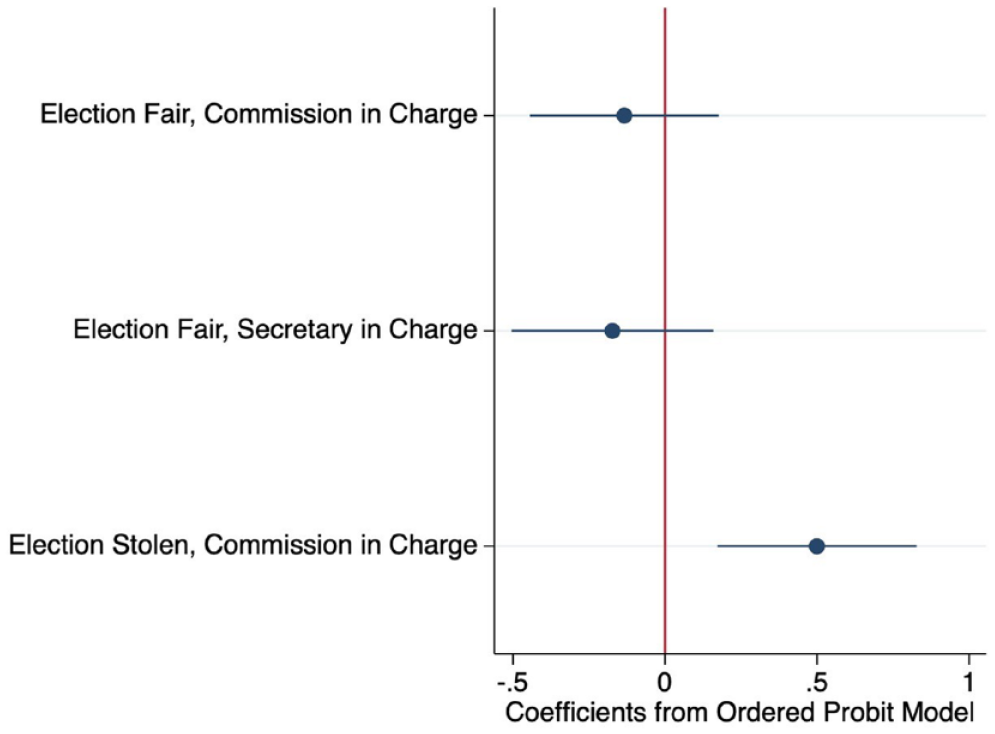
Coefficient Plot
Given that voters want politicians who share their positions (Mayhew 1974), it is not surprising that respondents approved of Whitaker less for saying the election was free and fair. It is telling, however, that saying the election was stolen does not benefit Secretary Whitaker if he has the authority over certifying the election and he still certifies the election. Giving independent, nonpartisan commissions authority over elections insulates the process and the politicians. The potential downside to giving a nonpartisan commission certification authority is that it may lead more politicians to say that an election was stolen because they are able to blame the independent commission without having to actually overturn the election themselves. While normatively undesirable, this latter outcome would at least protect the certification process from direct harm.
Overall, we contend that the benefits of using an independent commission outweigh the potential cost because when politicians have incentives to attack free and fair election results, they will also have incentives to take action to overturn the election. In cases where voters do not want to overturn an election, politicians will not have electoral incentives to pursue that goal. We are less worried about politicians taking detrimental positions in those situations because they have few incentives to do so. However, if the primary voters in a politician’s party believe that a free and fair election was stolen, insulating the process from those politicians is important because they would have incentives to attack the election results in word and deed. In that scenario, we especially want to insulate the process.
As this discussion highlights, insulating the process is not a cure-all for the protection of free and fair elections. In addition to exploring the institution of nonpartisan elections commissions, scholars should continue to research ways to build voter support for democratic elections. These actions should be done in tandem.
The Broad Voter Consensus for Nonpartisan Commissions
We have argued that there are benefits to having independent commissions certify election results. A few states empower bipartisan commissions to administer elections, but bipartisan appointees are still partisan, and the relative balance can become partisan in nature. Getting more states to adopt truly independent commissions would require broad support among voters (and politicians). In addition to the experiment, we asked the 1,013 respondents in our survey who they would prefer to oversee elections. This question provides insight into the baseline level at which independent commissions have a chance at becoming a political reality.
In America, state governments oversee running elections. In some states, this duty is done by elected officials who are members of political parties. In other states, it is done by a nonpartisan commission with members who are appointed to the role of overseeing elections. Which would you prefer to oversee elections in your state?
Elected, partisan officials
A nonpartisan, appointed commission
Table 1 gives the results broken down by both party and respondents’ attitudes toward the 2020 presidential election. The results show there is a broad consensus among the public. More than 70 percent of both Democrats and Republicans support the use of nonpartisan commissions in the certification process. Among voters who lean toward a party, the level of support is more than 80 percent. Further, the level of support for nonpartisan commissions is more than 70 percent among voters who thought the 2020 election was free and fair and among those who thought the election was stolen from Trump. The majority of voters of all types overwhelmingly prefer to have a nonpartisan, appointed commission oversee elections.
Percentage of Respondents Who Prefer Nonpartisan Election Commissions
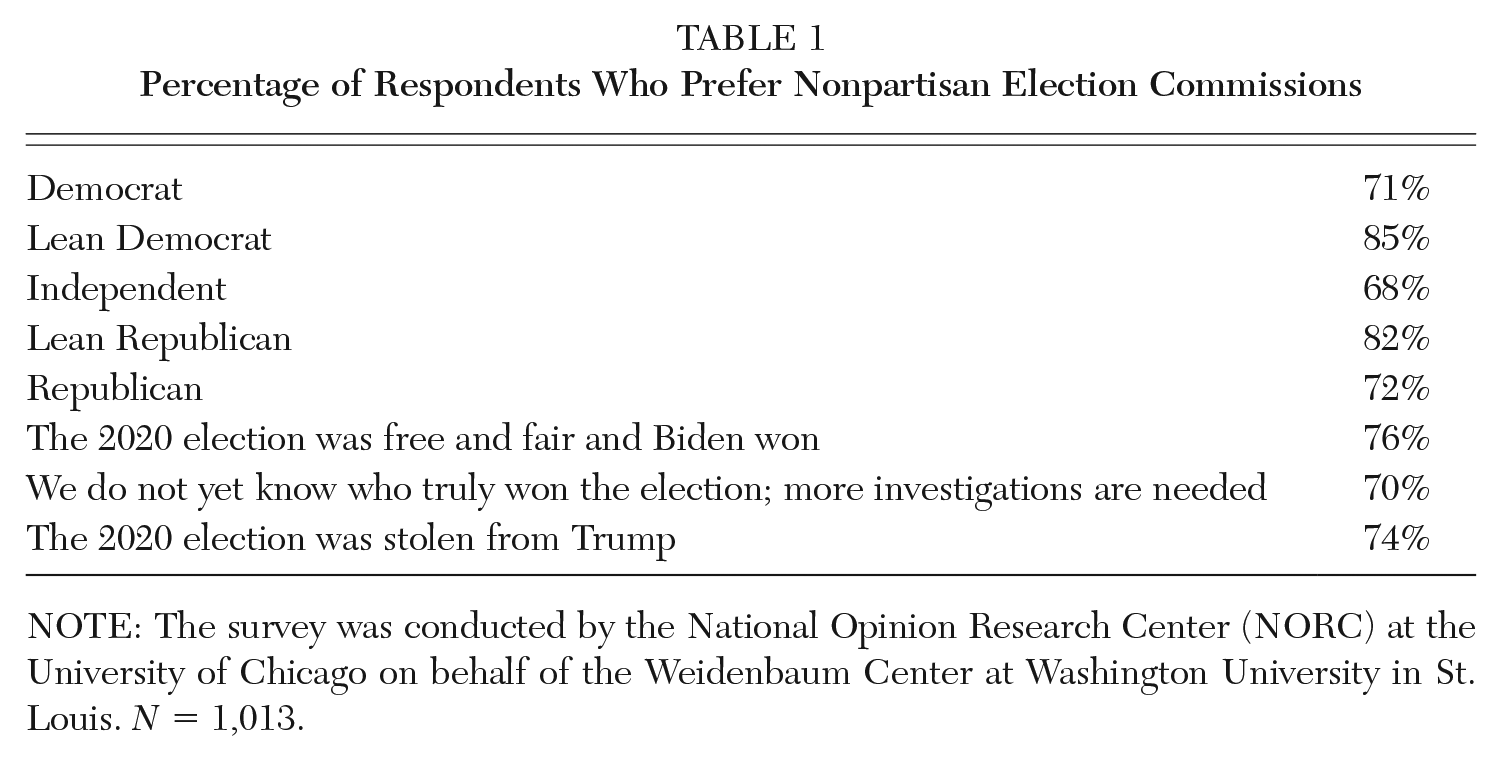
NOTE: The survey was conducted by the National Opinion Research Center (NORC) at the University of Chicago on behalf of the Weidenbaum Center at Washington University in St. Louis. N = 1,013.
Because there is broad support for this action, reformers interested in taking this step might consider starting in states with ballot initiatives or those for which “seeding” new policies and reforms is effective (Boehmke et al. 2017; Desmarais, Harden, and Boehmke 2015). Through the ballot initiative process, the number of states where the election process is more insulated from partisan politics could steadily increase, leading to a “snowball effect” in which other states adopt the reform (Shipan and Volden 2006).
Conclusions
Election certification has become an increasingly partisan issue since the 2020 election. This trend threatens the health of democracy by blurring the lines between policy priorities and the administration of a foundational process in democratic governance. We consider two means by which this partisan influence could be mitigated. First, changing the composition of the candidate pool for elected offices could ameliorate the tension. If all candidates over which voters are choosing in an election are interested in playing by the rules, despite the outcome, democracy in America would be stronger. However, such a goal may be quite difficult to achieve. The high costs of running for office, the need to gain party support to win, and the generally high levels of polarization between elites in the two major parties could make less room for those who would not be tempted to break democratic norms in fulfillment of party goals. While this mechanism may be a more long-lasting solution, just starting it would be formidable.
Second, a more feasible option would be the creation of nonpartisan election-certification commissions. We contend that removing partisan influence from the certification of elections as much as possible would protect the process while still allowing candidates and sitting officials the freedom to voice their criticisms without endangering the process. We draw parallels to nonpartisan redistricting commissions, which have helped in another area in which partisan politics can quickly deteriorate a cornerstone of democracy: fair representation of all citizens. To be sure, our proposed solution still permits elites to spread false contentions about an election. This behavior is not ideal, but any reform should not curb the freedom of expression. Insulating the electoral process from partisan control is a feasible solution that moves things in the right direction.
Our survey results demonstrate that nonpartisan electoral commissions are an incentive-compatible solution, because they insulate the politician when voters believe the election was not free and fair. When comparing the experimental conditions where our hypothetical Secretary of State Whitaker said the election was stolen, he was punished if he certified the election relative to the condition where an independent commission certified the election. Independent, nonpartisan election commissions insulate the process and the politicians. In another survey question, we also found broad support across party lines and attitudes toward the 2020 election for nonpartisan administration of elections in the U.S.
A well-functioning democracy requires that politicians accept the results of free and fair elections, regardless of the outcome. After the 2020 presidential election in the U.S., elites in government across the country publicly stated doubts about the election process and/or attempted to delay the certification of their states’ results. That their actions hold the capacity to seriously threaten democracy in America motivates the search for possible reforms. One such reform that appears to be effective and feasible is removing the certification process for state elections from the hands of partisan political officials. Doing so permits them to voice protests to an election without taking tangible actions against it. Ironically, it leverages these politicians’ own desire to stay in office. Protecting election administration in the U.S. may require institutional reform that allows elected officials the opportunity to maintain support among their partisan supporters without actually backing up their words with antidemocratic deeds.
Footnotes
Note:
We thank Abigail Hemmen for assistance with coding state legislators’ antidemocratic actions and Jamie Druckman, Jake Grumbach, and Charlotte Hill for helpful comments.
Notes
Daniel M. Butler is a professor of political science at Washington University in St. Louis. He studies representation with a focus on the primary elections and the behavior of elites. His latest book is Rejecting Compromise: Legislators’ Fear of Primary Voters (Cambridge University Press), coauthored with Sarah Anderson and Laurel Harbridge-Yong.
Jeffrey J. Harden is Andrew J. McKenna Family Associate Professor of Political Science at the University of Notre Dame. His research interests include political representation and public policy diffusion in the American states, with a focus on state legislatures.