






Abstract
How does partisanship shape the ways Americans interpret major political events? We examine public evaluations of the Black Lives Matter protests and the January 6th insurrection using an original nationally representative YouGov survey alongside cross-sectional and panel data from the 2016–2024 American National Election Studies. We find that responses to both events are strongly structured by partisanship, but that this influence extends beyond party identification alone. Substantial differences exist within the two parties: MAGA Republicans and progressive Democrats diverge markedly from their co-partisans in their assessments of these episodes. Additionally, colder feelings toward the opposing party are associated with more polarized evaluations, with these relationships unfolding in opposite directions for Democrats and Republicans. Lastly, both Democrats and Republicans who perceive democracy as being under greater levels of threat also have more polarized evaluations of these key events. Although our evidence is observational, the consistency of these patterns across data sources and over time demonstrates the central role of partisanship in structuring how Americans interpret politically consequential events. The findings highlight how partisanship acts through various means, such as affective polarization, perceptions of threats to democracy, and factional identities within parties, to shape public evaluations of political conflict.
Introduction
On May 25, 2020, George Floyd was murdered by a police officer in Minneapolis. The next day, nationwide protests began, some of which turned violent. On May 28, Minneapolis protestors burned down a police station. Early in the next morning, President Donald Trump tweeted “These THUGS are dishonoring the memory of George Floyd, and I won’t let that happen. Just spoke to Governor Tim Walz and told him that the Military is with him all the way. Any difficulty and we will assume control but, when the looting starts, the shooting starts. Thank you!” In that November’s election, Trump won nearly 90% of the vote of those who had an unfavorable view of the Black Lives Matter Protests (CNN 2020).
On January 6, 2021, following months of false claims by Trump that the 2020 election had been stolen, Trump held a rally in which he stated to a crowd of supporters “If you don’t fight like hell, you’re not going to have a country anymore.” Shortly thereafter, his supporters marched on the Capitol, violently breaching the perimeter, erecting gallows, and temporarily halting the certification of the 2020 election. In the coming weeks, every Democratic member of Congress would vote to either impeach or remove Trump from office.
It is well understood that responses to these two events differed significantly by partisanship (Drakulich and Denver 2022). In this paper, we seek to understand why. How and why did individuals process Black Lives Matter Protests and January 6 differently across the partisan spectrum? Partisanship (Drakulich and Denver 2022), ideology and racial attitudes (Reny and Newman, 2021) are associated with individuals’ responses to the 2020 BLM protests. Racial attitudes and feelings toward Black Lives Matter Protests appear to have been instrumental in shaping attitudes toward January 6 (Barreto et al. 2024). In this paper, we examine the factors that condition how partisans evaluate these key events, including attachment to partisan factions (namely, MAGA Republicans and Progressive Democrats), perceptions of democracy as threatened and affective polarization—the increasing dislikes and animosity between Democrats and Republicans (Iyengar et al. 2019; Iyengar et al. 2012).
It is worth noting that we are not suggesting that these events were qualitatively similar. Where the January 6th insurrection represents a legitimate threat to democracy as a violent attempt to overturn the outcome of the 2020 election, the BLM protests, though violent at times, were an attempt to gain rights and recognition for a long-marginalized group. However, we argue that to different partisans across the spectrum, both events are seen as threatening. To be clear, we are comparing responses to these events rather than the events themselves.
Through understanding how and why partisans differed so starkly in the way in which they processed these two major events, we hope to better understand how partisanship may shape the way in which we experience the political world. Since The American Voter (Campbell et al. 1960), partisanship has been understood as the key driver of American political behavior, but in the current era of polarization, partisanship seems to have taken on an even larger role. Are Democrats and Republicans, particularly those in the more extreme camps of their party, inhabiting different worlds? Our findings suggest that they are. They suggest that the partisan public views the legitimacy, legality, impact, and threat posed by these key events very differently depending on their partisanship, as well as their positioning within their own party (i.e., MAGA vs. non-MAGA, Progressive vs. non-Progressive), their perceptions of whether democracy is under threat (presumably from the other party), and their disaffection for the other party. This indicates that partisanship, and with it affective polarization, party factionalism, and polarized perceptions of democracy, are extremely powerful lenses that may alter our fundamental understandings of the political world around us.
In this paper, we examine several ways in which partisan attitudes are linked to the ways Americans interpret two defining political events: the Black Lives Matter protests and the January 6th insurrection. Relying on an original 2023 YouGov survey as well as cross-sectional and panel data from the 2016–2024 ANES, we provide a comprehensive portrait of how partisan identities and affective attachments shape citizens’ judgments about the legitimacy, consequences, and democratic implications of these events. While our analyses are observational, they reveal three consistent patterns. First, out-party affect is strongly associated with evaluations of both events beyond partisan identification and racial resentment alone, and additionally changes in out-party affect over time track corresponding changes in views of Black Lives Matter. Second, substantial heterogeneity exists within parties: MAGA Republicans and progressive Democrats diverge markedly from their co-partisans. Third, evaluations of BLM and January 6 are associated with perceptions that American democracy is under threat. Both Democrats and Republicans who perceive democracy as under greater levels of threat have more polarized views of these events compared to co-partisans. Together, these findings demonstrate that while partisanship strongly structures evaluations of major political events, its effects vary systematically by affective attachments, perceptions of democratic threat, and intra-party factional identities.
Partisanship, Affective Polarization, and Processing Political Information
Partisanship has long been understood to be an identity that one develops during political socialization (Campbell et al. 1960). Significant literature has established that partisanship is a deeply held social identity (Achen and Bartels 2016; Campbell et al. 1960; Carsey and Layman 2006; Green et al. 2002; Mason 2015). Tajfel and Turner (1979) argue that social identities stem from a process in which individuals first distinguish between groups, then self-categorize into a group and lastly make comparisons between groups. This process may lead to stereotyping as group membership may be a source of psychological esteem and individuals feel a need to view their group as superior to others. It may also lead to a process of otherization in which those adhering to one social identity ostracize, criticize, and even dehumanize members of other groups (Finkel et al. 2020).
Though partisan politics are often framed in ideological terms, the general public largely does not hold ideological belief systems (Converse 1964; Kinder and Kalmoe 2017). Rather, they conceive of politics in terms of group membership and group benefits (Achen and Bartels 2016; Berelson et al. 1954; Converse 1964; Kinder and Kalmoe 2017). This identity-driven polarization is known as affective polarization which describes the phenomenon that Democrats and Republicans increasingly dislike and distrust each other (Iyengar et al. 2019; Iyengar et al. 2012). Affective polarization has deleterious consequences in both social and political settings. In social settings, for example, affective polarization has impacts on whom individuals decide to make friends with or date (Huber and Malhotra 2017; Nicholson et al. 2016), whom the employers decide to hire (Gift and Gift 2015) and whether people offer help and connect with each other (Webster et al. 2021). In political settings, affective polarization may determine whether individuals place trust in the government (Hetherington and Rudolph 2015) and whether they support political violence (Kalmoe and Mason 2022) and democratic norms (Graham and Svolik 2020; Kingzette et al. 2021).
The association between affective polarization and issue positions are closely associated. Although some works suggest that affective polarization has an ideological foundation (Orr and Huber 2020; Orr et al. 2023; Rogowski and Sutherland 2016), others argue that affective polarization may also shape political belief and attitude formation. For example, Druckman et al. (2021a, 2021b) reported a strong association between partisan animosity and subsequent attitudes towards the COVID-19 (also see Druckman et al. 2024). Relatedly, affective polarization is also strongly associated with selective attribution of blame on specific policies (Jin et al. 2023).
Social identity appears to be instrumental in shaping out-party affect. The decline of cross-cutting cleavages (Jin et al. 2025; Jin and Jones 2026), combined with greater emotional investment in partisanship as a social identity (Mason 2016) and increasingly bitter rhetoric from political and media elites (Lelkes 2018; Mason 2018) are primary drivers of affective polarization. Similarly, Westwood and Peterson (2022) find linkages between partisan and racial attitudes. They find that parallel updating occurs in experimental settings, meaning that racial primes move attitudes towards the out-party in addition to those towards the racial outgroup and vice-versa.
Individuals most often process political information not through a detailed study of policy or news events, but rather through the use of heuristics (Lupia 1994; Petty and Cacioppo 1986; Petty et al. 1981; Zaller 1992). Additionally, we know that feelings towards outgroups commonly shape political attitudes. Racial attitudes, for instance, have regularly been found to have a significant role in shaping attitudes towards various policy domains not directly related to race, such as welfare (Gilens 2009), healthcare policy (Tesler 2012), disaster relief (Gilens et al. 2024), the death penalty (Peffley and Hurwitz 2007), and tax policy (Holbrook and Heideman 2022). We argue that the preexisting affective dispositions associated with affective polarization may shape what heuristics those who are more affectively polarized are susceptible to. In other words, affective polarization may condition the informational shortcuts one uses to form political opinions. For instance, those with greater out-party disaffection may hold more extreme elites as opinion leaders, or may be more likely to see out-party members as a threat leading them to take more adversarial positions on partisan issues. In this way, affective polarization shapes not only the direction of political attitudes, but the informational pathways through which those attitudes are formed. These informational pathways, in turn, structure how individuals interpret political events, shaping judgments about blame, threat, legitimacy, and deservingness in ways that align with their partisan attachments.
Affective polarization may also, similarly, drive certain voters to engage in motivated reasoning. Motivated reasoning refers to the tendency for individuals to process information in ways that align with their prior beliefs and desired conclusions rather than objective accuracy (Kunda 1990; Lodge and Taber 2013; Taber and Lodge 2006). In political contexts, these prior beliefs are often rooted in partisan identity and reinforced by affective attachments to political groups (Green et al. 2002; Mason 2018). A large body of research demonstrates that individuals engage in directional motivated reasoning, selectively crediting information that is congruent with their prior attitudes while dismissing or counterarguing incongruent information (Bolsen et al. 2014; Taber and Lodge 2006).
We argue that affective polarization functions as a key prior that conditions how individuals engage in this process. Rather than serving as a heuristic itself, affective polarization shapes how individuals respond to political cues, including partisan labels, elite messaging, and the framing of political events (Druckman et al. 2021a, 2021b; Zaller 1992). In The American Voter, Campbell et al. (1960) describe partisanship as an “unmoved mover” that structures how individuals understand the political world. We build on this insight by arguing that affective polarization operates as a central mechanism through which this structuring occurs. Specifically, hostility toward the out-party functions as a predisposition that conditions both the types of political cues individuals are receptive to and the elites they recognize as credible opinion leaders. This perspective aligns with the Receive-Accept-Sample model (Kuklinski and Hurley 1994; Zaller 1992), in which prior dispositions shape the acceptance of elite messages. In highly polarized environments, elite communications are rarely neutral; instead, they provide partisan frames that signal how events should be interpreted. Affective polarization intensifies these dynamics: individuals with stronger negative affect toward the out-party are more likely to accept congenial elite messages and dismiss or counter-argue opposing frames, amplifying both confirmation and disconfirmation biases in political information processing and leading them to interpret political events in ways that are consistent with their underlying group attachments (Strickland et al. 2011; Taber and Lodge 2006). In this way, affective polarization intensifies directional motivated reasoning, leading individuals to evaluate the same political events, such as Black Lives Matter protests or the events of January 6th, in sharply divergent ways and in accordance with various heuristics that may themselves be shaped by motivated reasoning. Thus, we present the following hypotheses:
Partisan Differences Hypothesis—Democrats have more positive evaluation on BLM than Republicans; Republicans have more positive evaluation on January 6
th
than Democrats.
Affective Polarization Hypothesis—As affective polarization increases, individuals are more likely to evaluate political events in ways that are consistent with their partisan identities. Accordingly, Democrats are expected to evaluate BLM more positively and January 6 more negatively, whereas Republicans are expected to show the opposite pattern.
It is notable that we do not anticipate that lower levels of affective polarization will necessarily lead to generalized tolerance toward outgroups or more accepting attitudes more broadly. Rather, we recognize that lower levels of affective polarization likely signal the occupation of a differing space on the partisan spectrum in terms of identity, ideology and affective attachments, including potential shifts toward more moderate or cross-pressured positions. This may function not to foster generalized tolerance towards outgroups, but rather to shape susceptibility to out-party elite messaging, to incentivize directional motivated reasoning toward more moderate or bipartisan positions and to act as a cross pressure generally pulling people towards the out-party’s positions. This dynamic is especially relevant for highly polarized issues that are strongly associated with one party’s coalition, where increased openness to cross-cutting cues may lead co-partisans to adopt less favorable evaluations.
Notable cleavages have emerged in recent years within the two parties. Parker and Barreto (2015), for instance, found significant differences in the racial attitudes of tea-party and non-tea-party identifying Republicans. Similarly, Melcher and Lindsay (2024) find differences in the attitudes of self-identified socialists and non-socialist-identifying liberals that extend beyond redistributive attitudes. We argue that each party effectively has two sub-brands—MAGA and non-MAGA Republicans and Progressive and non-Progressive Democrats. We conceive of each of these groups as, at least in ways relevant to the present study, to be separate, albeit sometimes overlapping, identities. We expect that these wings of each party will process politics and political events in heterogeneous patterns reflecting their ideological positioning. Because these factions differ in their affective attachments to political groups, as well as in their ideological orientations and exposure to elite cues, we expect them to process political events in systematically different ways.
Party Faction Hypothesis—Democrats who identify more strongly as progressive are expected to evaluate BLM more positively and January 6 more negatively relative to other Democrats, whereas Republicans who identify more strongly with MAGA are expected to evaluate BLM more negatively and January 6 more positively compared to other Republicans.
We acknowledge that partisan sub-brands are not perfectly symmetrical across the two parties. On the Republican side, distinctions such as “MAGA” versus “establishment” Republican are relatively well established in elite discourse, media coverage, and public understanding, and the MAGA brand has been closely associated with a successful presidential candidate. By contrast, the boundaries of Democratic sub-brands are more contested: labels such as “progressive,” “liberal,” “moderate,” “establishment,” and “mainstream” are used inconsistently across scholarly work, political commentary, and voter perceptions. Moreover, unlike the Republican case, no clearly identifiable progressive Democratic elite has been elected president, which limits the extent to which a “progressive Democrat” sub-brand has been nationally institutionalized around presidential leadership. Thus, our distinction between “progressive” and “establishment” Democrats should be understood as a heuristic for capturing meaningful intra-party variation, not as a definitive or universally accepted typology. This asymmetry is substantively important and should inform the interpretation of cross-party comparisons: Republican sub-brands may map onto clearer and more widely recognized factional identities, whereas Democratic sub-brands are more fluid, overlapping, and debated.
Partisanship and Perceptions of American Democracy Under Threat
Perceptions of threat to American democracy are widespread in American politics. Many scholars of politics have argued that American Democracy is vulnerable in the current era (Carey et al. 2019; Graham and Svolik 2020; Kingzette et al. 2021; Levitsky and Ziblatt 2018). The mass public also largely sees American democracy as threatened. In the 2024 Presidential election, democracy was the most important issue to voters, and Harris won the voters who named democracy as the top issue by 62 points (National Exit Poll 2024). This may lead some to believe that the perception of democratic threat is primarily a phenomenon concentrated among Democrats. However, this is not the case. According to those same exit polls, 73% of voters said that democracy was threatened and Trump actually won voters who said Democracy was under threat by a slim, two-point, margin. This indicates that both Democrats and Republicans widely believe democracy is under threat. We contend, however, that the nature of the perceived threat to democracy likely varies significantly by party. Where Democrats are likely to believe that democracy is threatened by Trump and Trumpism, Republicans almost certainly believe the source of the threat is different. Perhaps they believe that marginalized groups’ push for rights threatens the social order and therefore poses a threat to democracy. This would be consistent with theory regarding the authoritarian personality and its nature as a polarizing force in American politics (Hetherington and Weiler 2009). Perceptions of status threat may lead some Republicans in dominant groups to perceive that “their” country is being taken away from them (see Parker and Barreto 2015). In the European context, belief in the Great Replacement Theory is associated with decreased democratic satisfaction and political trust (Herold 2025). Additionally, conservatives may view the progressive agenda as a threat to traditional American values. Each of these theoretical orientations suggests that segments of the political right may be more likely to interpret shifts in the distribution of political and social power as a threat to the existing political order. As demographic change and evolving social norms alter patterns of representation and influence, some individuals may perceive these developments as a departure from established understandings of how the political system functions. From this perspective, changes that expand political voice and inclusion for historically marginalized groups may be experienced not simply as policy disagreement, but as a transformation of the underlying rules and balance of the system itself. As a result, what is often understood as democratizing may be understood by some on the political right as a weakening of the political order they associate with democracy. In short, each party may see some members of the other party as a threat to democracy.
We conceptualize “saving democracy” as a justificatory frame through which individuals evaluate political actions in terms of their perceived consequences for democratic institutions and norms. Prior research suggests that citizens are willing to tolerate or even support violations of democratic norms when such actions are perceived as necessary to protect their preferred political group or the democratic system more broadly (e.g., Graham and Svolik 2020; Svolik 2019). Importantly, these perceptions of threat are not likely neutral but, rather, often filtered through partisan and affective lenses. Recent work shows that in highly polarized political environments, partisans frequently perceive the out-party as a threat, which can erode support for democratic norms (Mason 2018; McCoy et al. 2018). In this sense, appeals to “saving democracy” can operate as a form of motivated reasoning, allowing individuals to align their evaluations of political events with their underlying affective attachments to political groups. As a result, the same event may be interpreted as either a defense of democracy or a threat to it, depending on the observer’s partisan and affective predispositions. Accordingly, we present the following hypothesis:
Saving American Democracy Hypothesis—Among Democrats, perceiving American democracy as under threat is associated with more positive evaluations of BLM and more negative evaluations of January 6, whereas among Republicans the opposite pattern is expected.
It is worth discussing why partisans would perceive the BLM Protests and the January 6th insurrection as either supporting or threatening democracy. Democrats are likely to perceive the January 6th insurrection as an attempt to overturn the results a democratic election, thereby being inherently undemocratic. However, Republicans, particularly MAGA Republicans, are more likely to see the results of the 2020 election as illegitimate and thereby to believe that the January 6th insurrection aimed not to overturn a legitimate election, but rather to instate that election’s rightful winner.
Why attitudes toward the BLM protests may implicate perceptions of democracy is less straightforward, but nonetheless clear. Republicans may be likely to view BLM protests as undemocratic because rather than using the traditional, “normal” democratic channels to implement social change, such as elections and legislation, protests are taking to the streets and, in some cases, using violence. Therefore, a group they may already see as more threatening are seen as circumventing the democratic process through means of intimidation. For Democrats, on the other hand, the BLM protesters are advocating for democracy as a long-marginalized group demands proper rights and recognition. Rather than circumventing the democratic process, protesters are advocating for greater inclusion in the rights and privileges of citizenship. While Republicans, who tend to be higher in the authoritarian personality, value conformity and order and see threats to that order when social dissidents challenge it, Democrats, who tend to be lower in the authoritarian personality, place greater emphasis on individual rights and inclusion (see Hetherington and Weiler 2009). This likely leads partisans to place different values on their conception of democracy. Republicans tend to value order and conformity; thus, they may see the primary function of democracy as to provide order and calibrate social values. Where Democrats, on the other hand, tend to value rights and inclusion; thus they see democracy’s primary function as to protect individual rights and grant inclusion to long-marginalized groups.
BLM and January 6th
We are not the first to research public opinion on the 2020 BLM Protests, nor January 6. Many have found that racial attitudes impact support for the January 6th insurrection. White racial antipathy (Rush et al. 2025), status threat among white republicans (Hernandez et al. 2025), aspirational status among Latinos (Ocampo et al. 2025), and changes in local racial demographics (Sanchez et al. 2025) are all linked to attitudes towards January 6th. Barreto et al. (2024) find that immigration attitudes, belief in the great replacement theory, and support for the BLM protests are predictive of attitudes towards the January 6th insurrection. Those with more negative racial attitudes are more likely to support January 6th.
Others have found partisan and ideological influences in perceptions of January 6th. Silver and Shi (2023) found that partisan bias shapes support for repressive and punitive action in response to protests; those who were more ideologically conservative were more supportive of repressive and punitive responses towards BLM protests than MAGA protests relative to their liberal counterparts. Drakulich and Denver (2022) find that “Although those who identify as Democrat or Republican have starkly different views of the movement, what they share is that these views appear relatively fixed: partisan respondents did not meaningfully change their views when we explained the broader goals of the movement, highlighted police violence toward the protestors, or described the protests negatively as violent riots.” However, they also find that framing effects have a significant impact on independents’ views of the protests. Reny and Newman (2021) find that the BLM protest negatively impacted attitudes towards police and positively impacted perceptions of discrimination among liberals, but that these effects were smaller and less durable among conservatives. Notably, Kalmoe and Mason (2022) find that support for political violence is driven by partisan identity and extremity. Barreto et al. (2024) find that favorability toward Trump is associated with support for January 6th. For reasons discussed above, we also believe that affective polarization, partisan subgroupings and perceptions of democratic threat are associated with perceptions of both the BLM protests and January 6.
The Black Lives Matter Protests and January 6 are not equivalent by any means. We are not the first political scientists to point this out (Barreto et al. 2024), but in many ways, this point should be obvious. One was a violent attempt to overthrow the government by a faction supporting a candidate who had recently lost their reelection bid, the other was a decentralized series of protests intended to bring recognition and equality to a long-marginalized group. On this level of analysis, these events are not equivalent and cannot be made equivalent. However, both likely presented a threat to those who were not sympathetic to their cause and challenged the worldview of those who opposed them. We compare these events not based on their qualitative merits, but rather based on the mechanism through which the American public cognitively processed them.
It is also important to note that both of these events occurred during the COVID-19 pandemic and therefore may be impacted by the unique social undercurrents of that time. While this is certainly a possibility we see it as unlikely that the pandemic impacted the mechanism through which these events were processed, even if it may have made these issues or partisan differences more salient. Nonetheless, we cannot entirely rule out Covid having a unique impact on the way individuals processed political information in that time, and this may be a “best case” test of our theory due to the plausibly increased salience of partisanship and political events broadly.
We distinguish our work from extant research on attitudes of BLM and January 6th (particularly Barreto et al. 2024) in several important ways. First, we contend that partisan affective attachments structure public opinion on key political events, so we argue that focusing on the role of affective polarization, party factionalism, and perceptions of democratic threat adds additional explanatory leverage beyond standard measures of partisanship and ideology. Second, we agree that views on these two key events reflect more generic racial attitudes, but racial attitudes alone cannot explain divergent views on these two events. As our later analysis shows, even when controlling for racial resentment, affective polarization is significantly associated with evaluations of BLM and January 6th. More importantly, we believe that opinions on contentious issues derive from entrenched partisan divides. Third, as partisan politics increasingly erodes democratic norms (Graham and Svolik 2020; Kingzette et al. 2021), we theorize that perceptions of threats to American democracy function as a key motivator in shaping support for both BLM protests and the January 6th insurrection. Individuals’ stance on these two events may hint at underlying beliefs about democratic politics.
We also believe that this research has implications beyond these two events by identifying specific mechanisms, affective polarization, intra-party factionalism, and perceptions of democratic threat, through which partisanship shapes how political events are interpreted. While the BLM protests and January 6th insurrections were of course unique events that drew significant attention from journalists and scholars alike, the lessons drawn from how partisans understand and process these events are likely to have implications for how they do so for other major events. We seek not just to understand attitudes shaping perceptions of these two key events, but rather how partisans process the world around them.
Data and Method
We launched a survey with a nationally representative sample of 1,000 adults (aged 18 years or older) recruited from YouGov which is an online survey platform that recruits large and diverse samples of adults to participate in opt-in online surveys. The survey was fielded during November 8th–13th, 2023. See Section C, Online Appendix for additional survey details.
Affective Polarization
We measure affective polarization using four approaches. First, feeling thermometer to the two parties. Respondents are asked to rate their feeling towards the two parties on a 101-point scale from 0 to 100 with 0 indicating the coldest feeling and 100 the warmest feeling. Then, affective polarization is measured by subtracting out-party feeling from in-party feeling (mean = 47.84; SE = 1.30) and out-party feeling 1 (mean = 21.48; SE = 0.91). Second, feeling thermometer to the presidential candidates. Respondents are asked to rate Joe Biden and Donald Trump on a 101-point scale. Then it is measured by subtracting out-party candidate feeling from in-party (mean = 52.29; SE = 1.50) and feeling to the out-party candidate (mean = 15.72; SE = 0.92). Third, a three-item social distance scale. Respondents are asked to rate how comfortable they are having a close personal friend, having a neighbor, and having their children marrying an out-party voter on a scale from 1 (not at all comfortable) to 4 (extremely comfortable). Then affective polarization is measured by the average across the three items (alpha = 0.77; mean = 2.90; SE = 0.04). Fourth, traits rating. 2 Respondents are asked to evaluate how eight adjectives describe out-party voters including: American, intelligent, honest, open-minded, generous, hypocritical, mean and selfish on a scale from 1 (not at all well) to 5 (extremely well). Then, affective polarization is measured by the average across these eight items (alpha = 0.86; mean = 2.59; SE = 0.04). We primarily present the results on the most classical and commonly used measure—feeling thermometer to the parties and findings of the other three measures can be found in the Online Appendix.
Partisan Sub-Brands
Respondents are first asked to place themselves on the traditional 7-point partisan identity scale, ranging from strong Democrat to strong Republican. Those who identify with the Democratic Party, including Democratic leaners, are then asked to indicate where they fall on a 7-point scale from “Establishment Democrat” (1) to “Progressive Democrat” (7). Similarly, those who identify with the Republican Party, including Republican leaners, are asked to indicate where they fall on a 7-point scale from “Establishment Republican” (1) to “MAGA Republican” (7). Pure independents are excluded from this analysis.
Perception of American Democracy Under Threat
We ask respondents to evaluate whether American democracy is under threat or secure on a scale from 1—completely secure to 5—completely under threat (mean = 3.8; SE = 0.04).
Evaluation of Black Lives Matter (BLM) Movement and the January 6th Incident
Respondents are asked to evaluate BLM and the January 6th on five items: whether it is an illegal riot or legal protest, whether it has a positive impact on American democracy, and how well empowering, divisive, and dangerous describes the two events on a 5-point scale. All items are recoded to make higher value indicate more positive impact. The overall evaluation of BLM (alpha = 0.86; mean = 2.87; SE = 0.04) and the January 6th (alpha = 0.80; mean = 2.29; SE = 0.03) is measured by the average of the five items. The correlation of evaluation on these two events is −0.47 (p < 0.001).
Racial Resentment
We used the 6-item scale (alpha = 0.82; mean = 3.04; SE = 0.03) of racial resentment (Huddy et al. 2005) which is an expanded version of the original scale by Kinder and Sanders (1996).
Control Variables
We control the demographics of age, race (white = 1; nonwhite = 0), gender (male = 1; female = 0), and education (below high school = 1; postgraduate = 6). We also control the political variables of partisan identity (1 = Republican, 0 = Democrat), partisan strength (folding the 7-point partisanship scale into a 4-point scale with higher values indicating stronger partisan identity), and political ideology (a 5-point scale from very liberal to very conservative).
The specific survey question wording can be found in the Section B, Online Appendix.
Results
H1: Partisan Differences Hypothesis
We first test whether there is a partisan difference in the evaluation of the BLM movement and the January 6th incident. In the analysis, we categorize Independent Leaners as partisans. The left panel in Figure 1 shows how individuals evaluate the BLM movement by partisanship, estimated from a weighted OLS regression model controlling for demographics. Democrats (mean = 3.42; SE = 0.05) have significantly more positive evaluation (t = −6.92, p < 0.001 for the comparison with pure Independents; t = −14.05, p < 0.001 for the comparison with Republicans) on the BLM movement than pure Independents (mean = 2.83; SE = 0.07) and Republicans (mean = 2.36; SE = 0.05). The right panel in Figure 1 demonstrates people’s evaluation on the January 6th incident by partisanship. Democrats (mean = 1.99; SE = 0.05) have significantly more negative evaluation (t = 10.54, p < 0.001 for the comparison with Republicans; t = 2.13, p < 0.05 for the comparison with Independents) on the January 6th than pure Independents (mean = 2.17; SE = 0.06) and Republicans (mean = 2.74; SE = 0.05). Full regression results are reported in Table 10 in Section A of the Online Appendix. Partisan difference in the evaluation of Black Lives Matter movement and the January 6th incident. Note. Estimates are derived from weighted OLS regression models controlling for demographics; the error bars indicate 95% confidence intervals.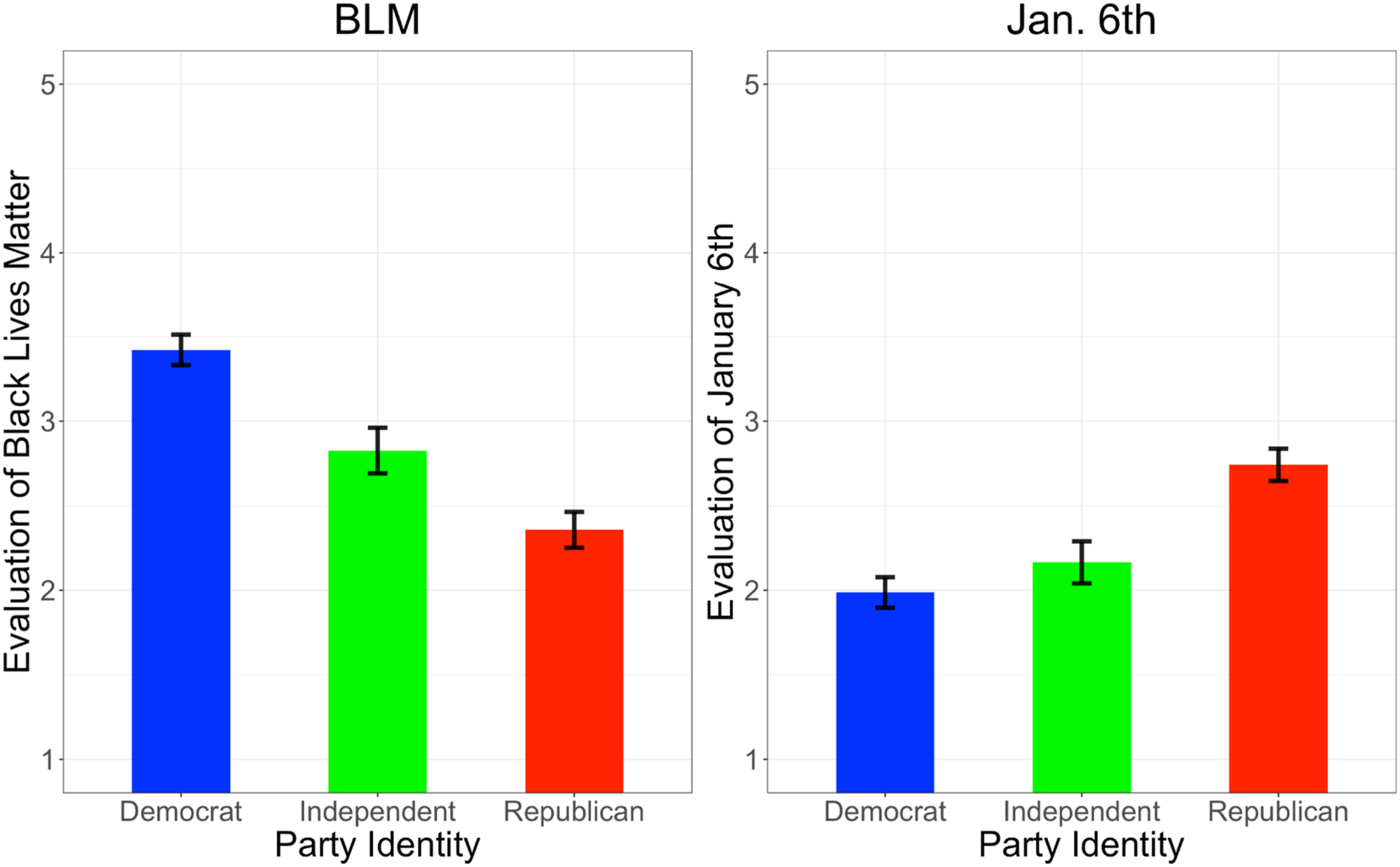
The results are consistent when we compare each individual item in the evaluation of BLM and January 6th by partisanship. As Figure 1, Section A in the Online Appendix shows, Democrats perceive BLM as significantly more legal, having more positive impact, and more empowering than Independents and Republicans, but they think BLM is significantly less divisive and dangerous than Independents and Republicans. In the same vein, as Figure 2, Section A, in the Online Appendix demonstrates, Republicans perceive January 6th as significantly more legal, having more positive impact, and more empowering than Independents and Democrats, while they perceive it is significantly less divisive and dangerous than Democrats and Independents.
If our Hypothesis 1 holds, pure Independents—who lack a clear party partisan identification—should nonetheless display the same affective pattern: those who feel warmer toward Democrats will view the BLM protests more favorably and the January 6th insurrection less favorably, while those who feel warmer toward Republicans will show the opposite inclination. Indeed, as shown in Figure 2, which is estimated using a weighted OLS regression model controlling for demographics, Independents who feel warmer toward Democratic party (mean = 3.08; SE = 0.09) has significantly more positive (t = −4.03; p < 0.001) evaluation on BLM than those who feel warmer to the Republican party (mean = 2.42; SE = 0.13). Similarly, Independents who feel warmer toward the Republican party (mean = 2.52; SE = 0.10) have significantly more positive (t = 2.90; p < 0.01) evaluation on January 6th than those who feel warmer toward the Democratic party (mean = 2.13; SE = 0.09). Full regression results are reported in Table 11 in Section A of the Online Appendix. The comparison among pure Independents adds more clarity and robustness to H1. The evaluation of Black Lives Matter movement and the January 6th incident among Independents. Note. Estimates are derived from weighted OLS regression models controlling for demographics; the error bars indicate 95% confidence intervals.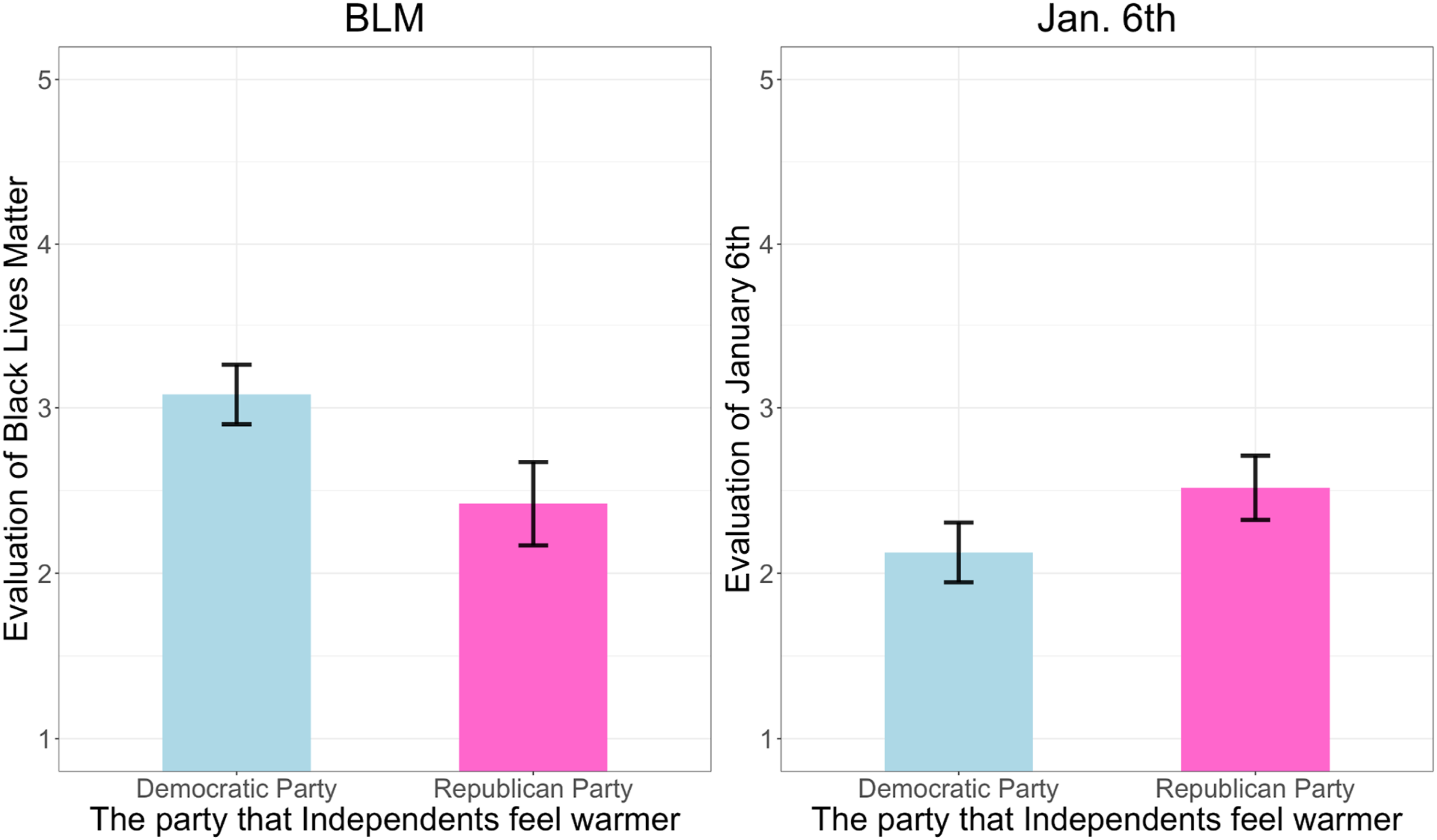
H2: Affective Polarization Hypothesis
We next investigate the association between affective polarization and the evaluation of the BLM and the January 6th. We run a weighted OLS interaction model between partisanship and affective polarization to predict the evaluation of these two events controlling for demographics and perception of democracy under threat.
3
As the top two panels in the Figure 3 demonstrate, warmer out-party feeling (lower affective polarization) among Republicans predicts more positive evaluation of the BLM, while colder out-party feeling (higher affective polarization) among Democrats predicts more positive evaluation of the BLM. This means that among Democrats, increased warmth toward the Republican Party is associated with less favorable attitudes toward the Black Lives Matter movement. While this pattern may initially appear counterintuitive to some, it is consistent with our theoretical expectations. We return to this relationship in the Discussion. The bottom two panels in the Figure 3 suggest that warmer out-party feeling (lower affective polarization) among Democrats predicts more positive evaluation of the January 6th insurrection, while colder out-party feeling (higher affective polarization) among Republicans predicts more positive evaluation of the January 6th insurrection. The full regression results can be found in Table 1 in the Online Appendix. We also test whether the results hold when we use other measures of affective polarization. As Tables 3 and 4, Section A Online Appendix demonstrate, our findings are consistent when affective polarization is measured by out-party feeling to presidential candidates, the difference between in-party and out-party candidates, and out-party traits rating. However, we find that social distance to the out-party is not significantly associated with evaluation of these two events and there is no significant interaction with partisanship. This finding is consistent with the existing works on the discussions of the measure of affective polarization. As Druckman and Levendusky (2019) point out social distance measure is less correlated with measures of affective polarization such as feeling thermometer and traits rating. Social distance is more likely to capture the consequences of affective polarization in social dimension than political dimension. In addition, because affective polarization is measured contemporaneously with respondents’ retrospective evaluations of these events, these results should not be interpreted as establishing temporal or causal precedence. Rather, they document systematic relationships between partisan affect and the interpretation of politicized events. Evaluation on BLM and the January 6th predicted by Affective Polarization. Note. Estimates are derived from weighted OLS regression models controlling for demographics and perception of American democracy under threat; the error bars indicate 95% confidence intervals.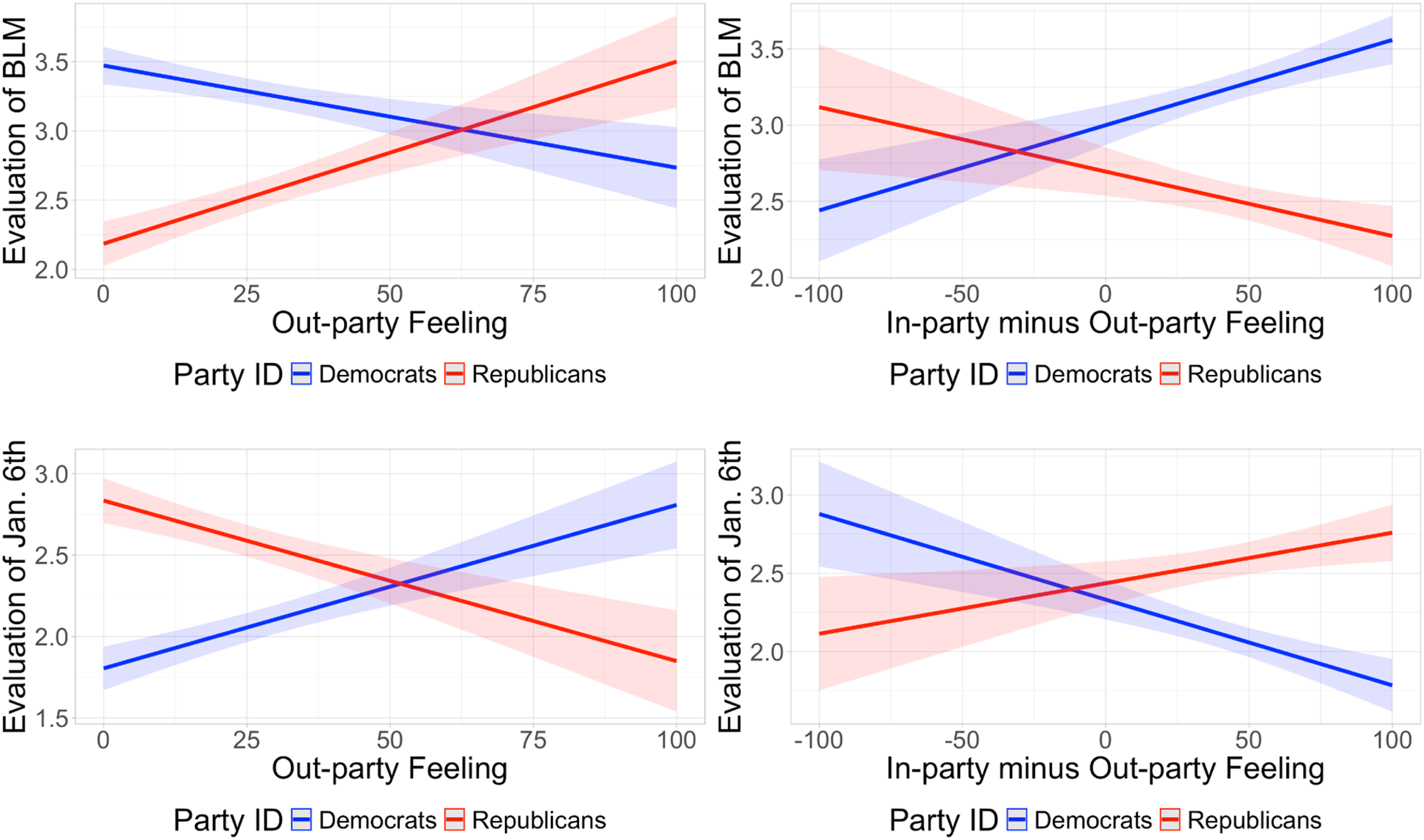
Additionally, we analyze American National Election Studies (ANES 2016, 2020, and 2024) cross-sectional surveys as robustness checks. In this analysis, we use the feeling thermometer of the Black Lives Matter movement (on a scale from 0 to 100) as the major dependent variable. We run weighted OLS regression models controlling for demographics, political variables and racial resentment. As we hypothesize, out-party feeling is positively associated with feeling to the BLM movement among Republicans, and negative among Democrats, though the variation of feeling to BLM is much smaller among Democrats, as Figure 7 and Table 6, Section A, in the Online Appendix suggest.
To provide additional leverage on the temporal relationship between affective polarization and attitudes toward the Black Lives Matter movement, we draw on ANES panel data from 2016, 2020, and 2024. While panel data cannot fully establish causality, this approach allows us to examine whether changes in out-party affect are associated with subsequent changes in attitudes toward BLM over time. At the same time, these estimates should be interpreted with caution, as changes in affect and attitudes may be jointly determined by broader political developments over this period. We first construct a dependent variable capturing changes in feelings toward Black Lives Matter (BLM) by subtracting respondents’ 2016 scores from their 2020 scores. Similarly, we construct an independent variable capturing changes in warmth toward the out-party, measured as the difference between 2020 and 2016 scores. We repeat this process with regards to the 2024 iteration of the ANES by measuring the differences between the 2024 and 2020 scores on these variables. We then estimate a weighted ordinary least squares (OLS) regression model controlling for demographics, political variables, and racial resentment in 2020. As shown in the left panel of Figure 4, an increase in warmth toward the out-party from 2016 to 2020 is associated with warmer feelings toward BLM among Republicans, whereas among Democrats, increased warmth toward the out-party corresponds to colder feelings toward BLM. Although the overall pattern from 2020 to 2024 resembles that of 2016–2020, the interaction term between change in out-party warmth and partisanship is not statistically significant (95% confidence interval) for predicting change in feelings toward BLM in this period. We anticipate that the insignificance arises primarily from limited variation in out-party warmth changes between 2020 and 2024.
4
Results remain consistent after controlling for changes in racial resentment in our weighted OLS regression models (full results are presented in Tables 7–8, Section A, Online Appendix). As a robustness check, we also examine changes in feelings toward BLM and out-party warmth across the entire period from 2016 to 2024. Consistent with expectations, increased out-party warmth is positively associated with improved feelings toward BLM among Republicans but negatively associated among Democrats (see Table 9, Section A, in the Online Appendix). Change on feeling to Black Lives Matter predicted by the interaction between partisanship and change on out-party feeling (ANES 2016–2024 panel data). Note. Estimates are derived from weighted OLS regression models controlling for demographics; the error bars indicate 95% confidence intervals.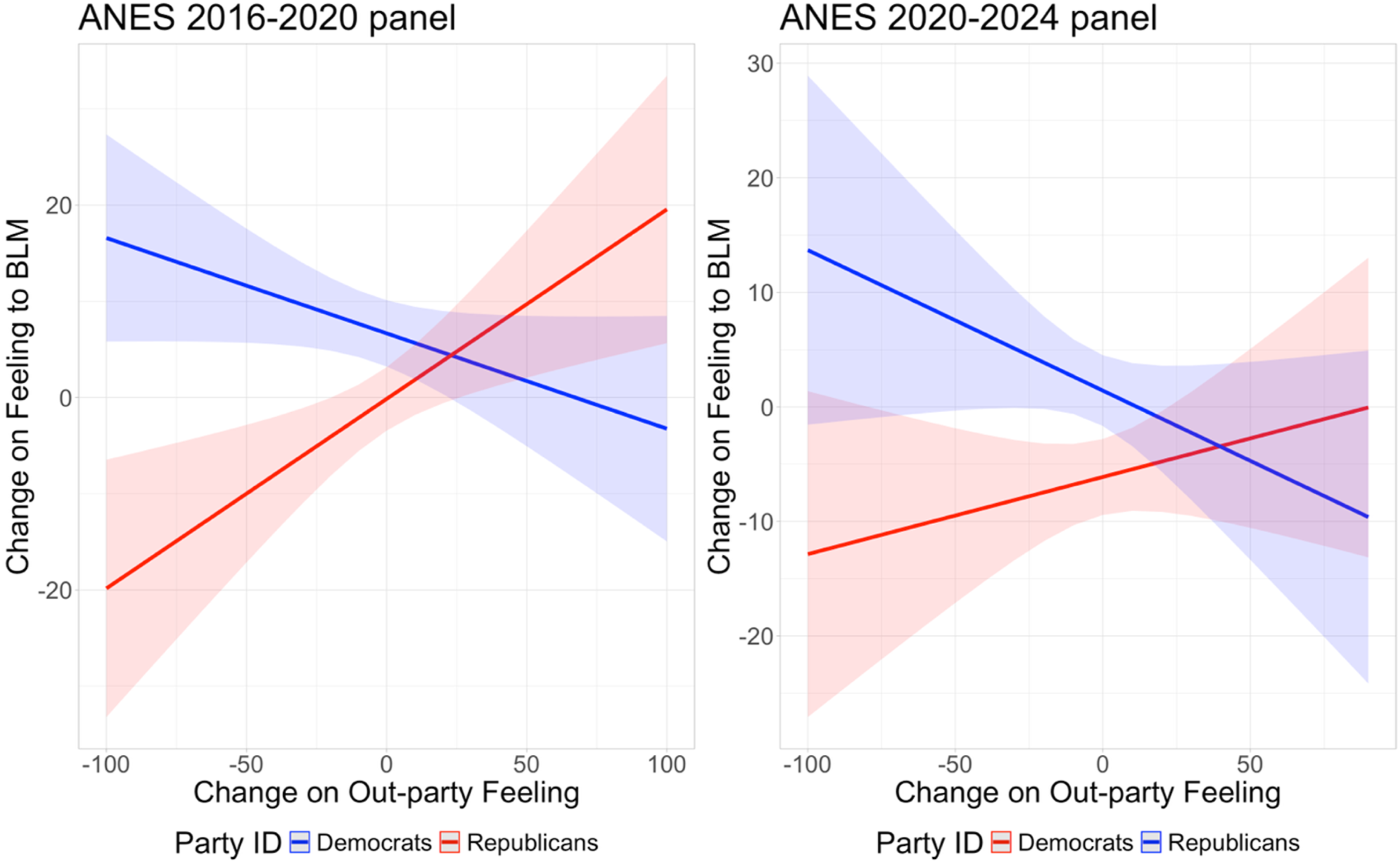
Overall, our analyses using both cross-sectional and panel survey data provide support for our affective polarization hypothesis. Although the absence of survey questions regarding January 6th in the ANES prevents us from performing identical analyses, we anticipate that the underlying motivational processes related to the perceptions of January 6th events are consistent with those we observed for attitudes toward BLM.
H3: Party Faction Hypothesis
We next examine whether evaluation of these two events vary across sub-brands within the two parties to test H3. To do so, we first collapse partisan subgroups into binary indicators—Progressive Democrats versus non-Progressive Democrats, and MAGA Republicans versus non-MAGA Republicans—and report the raw average evaluations of the two events for each subgroup. The two plots on the top in Figure 10, Section A, Online Appendix exhibit how Progressive Democrats and Non-Progressive Democrats evaluate these two events. Progressive Democrats (mean = 3.67; SE = 0.05) evaluate the BLM significantly (t = 6.62; p < 0.001) more positive than Non-Progressive Democrats (mean = 3.16; SE = 0.06). Additionally, Progressive Democrats (mean = 1.81; SE = 0.05) view the January 6th significantly (t = −2.38; p < 0.05) less positive than Non-Progressive Democrats (mean = 2.00; SE = 0.06). In the same vein, MAGA Republicans (mean = 3.12; SE = 0.07) have significantly (t = 7.95; p < 0.001) more positive evaluation of the January 6th than Non-MAGA Republicans (mean = 2.47; SE = 0.05), while the former (mean = 1.99; SE = 0.08) view the BLM significantly (t = −5.05; p < 0.001) more negative than the latter (mean = 2.50; SE = 0.06).
The findings are mostly consistent when we compare each item in the evaluation of BLM and January 6th by partisan sub-brands. As Figure 3, Section A, in the Online Appendix shows, Progressive Democrats and Non-Progressive Democrats are insignificantly different in evaluating the January 6th insurrection in most of the five items. But Progressive Democrats perceive BLM more legal, having more positive impact, and more empowering than Non-Progressive Democrats, while they perceive it is significantly less divisive and less dangerous than Non-Progressive Democrats as Figure 4, Section A, in the Online Appendix shows. Figure 5, Section A, in the Online Appendix shows that MAGA Republicans perceive January 6th significantly more legal, having more positive impact, and more empowering than Non-MAGA Republicans, while they perceive it is significantly less divisive and dangerous than Non-MAGA Republicans. As we expect, Non-MAGA Republicans perceive BLM significantly more legal, more empowering and having positive impact, while significantly less divisive and dangerous than MAGA Republicans in Figure 6, Section A, in the Online Appendix.
We then treat partisan sub-brand identities as continuous variables. As shown in Figure 5, we estimate the association between partisan sub-brand identification and evaluations of the two events using weighted OLS regression models that control for demographic characteristics, racial resentment, and affective polarization. Among Democrats, stronger identification with Progressive Democrats is associated with significantly more positive evaluations of the BLM movement. However, after controlling for demographic characteristics, racial resentment, and affective polarization, identification with Progressive Democrats is not significantly associated with evaluations of January 6th. Among Republicans, stronger identification with MAGA Republicans is associated with significantly more negative evaluations of the BLM movement and significantly more positive evaluations of January 6th. Full regression results are reported in Table 5, Section A Online Appendix. The consistent evidence on within party variation offers stronger evidence for H3. Intra-party variation in the evaluation of Black Lives Matter movement and the January 6th incident. Note. Estimates are derived from weighted OLS regression models controlling for demographics, racial resentment and affective polarization; the error bars indicate 95% confidence intervals; all the associations are significant except the upper right panel; the dotted horizontal lines indicate the average evaluations.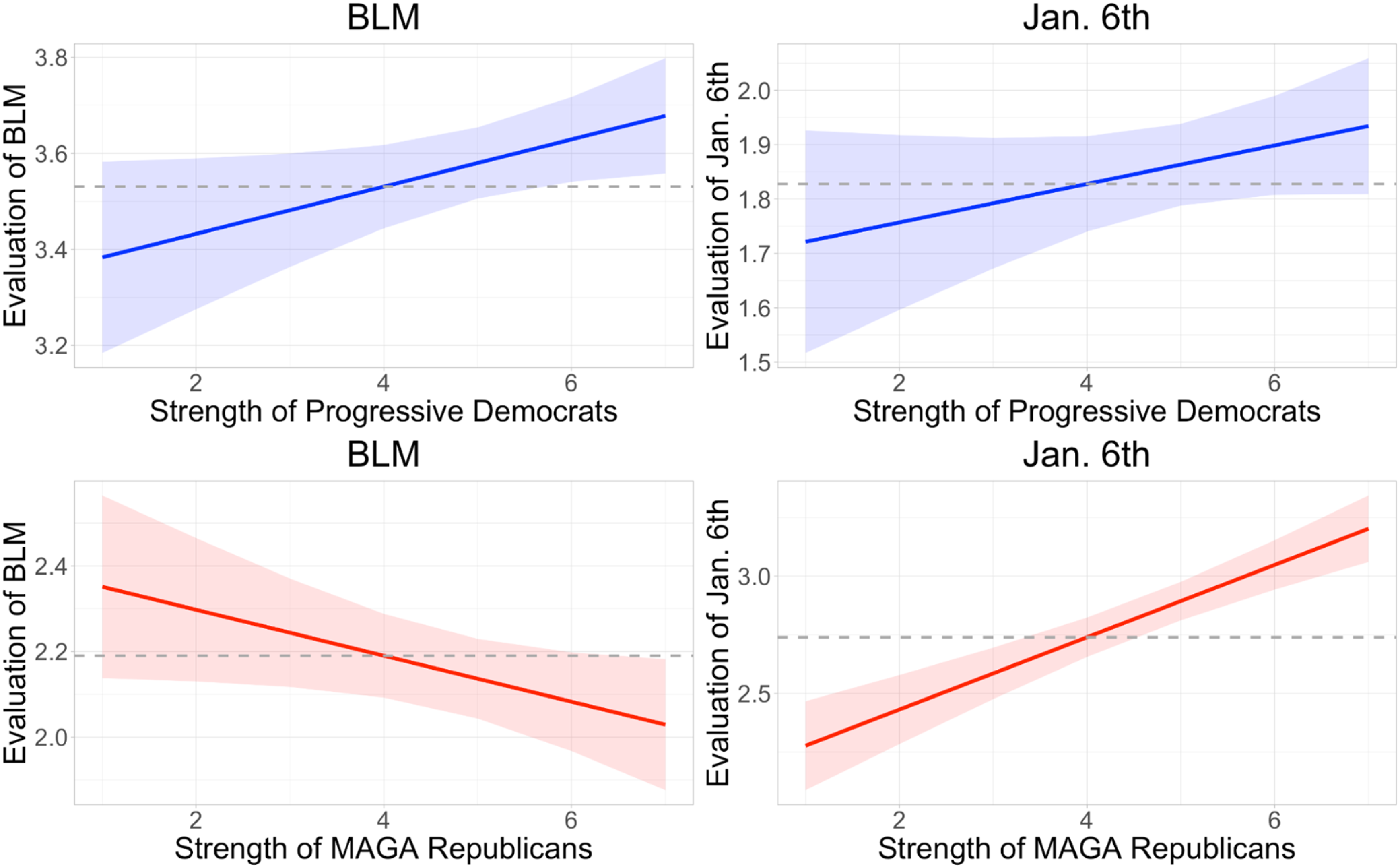
H4: Saving American Democracy Hypothesis
We last examine the association between perception of American democracy under threat and the evaluation of the BLM and January 6th. We run a weighted interaction model between partisanship and perception of American democracy under threat to predict the evaluation of these two incidents controlling for demographics, affective polarization and racial resentment. As the left panel in Figure 6 shows, as Republicans are more concerned about American democracy under threat, they have more negative evaluation of the BLM, while this association is positive among Democrats. On the contrary, the right panel in Figure 6 demonstrates, as Democrats are more concerned about American democracy under threat, they perceive January 6th more negatively, while this association is positive among Republicans. The full regression results can be found in Table 2, Section A in the Online Appendix. Evaluation on BLM and the January 6th predicted by the perception of whether American Democracy is under threat. Note. Estimated from weighted OLS regression models controlling for demographics and affective polarization.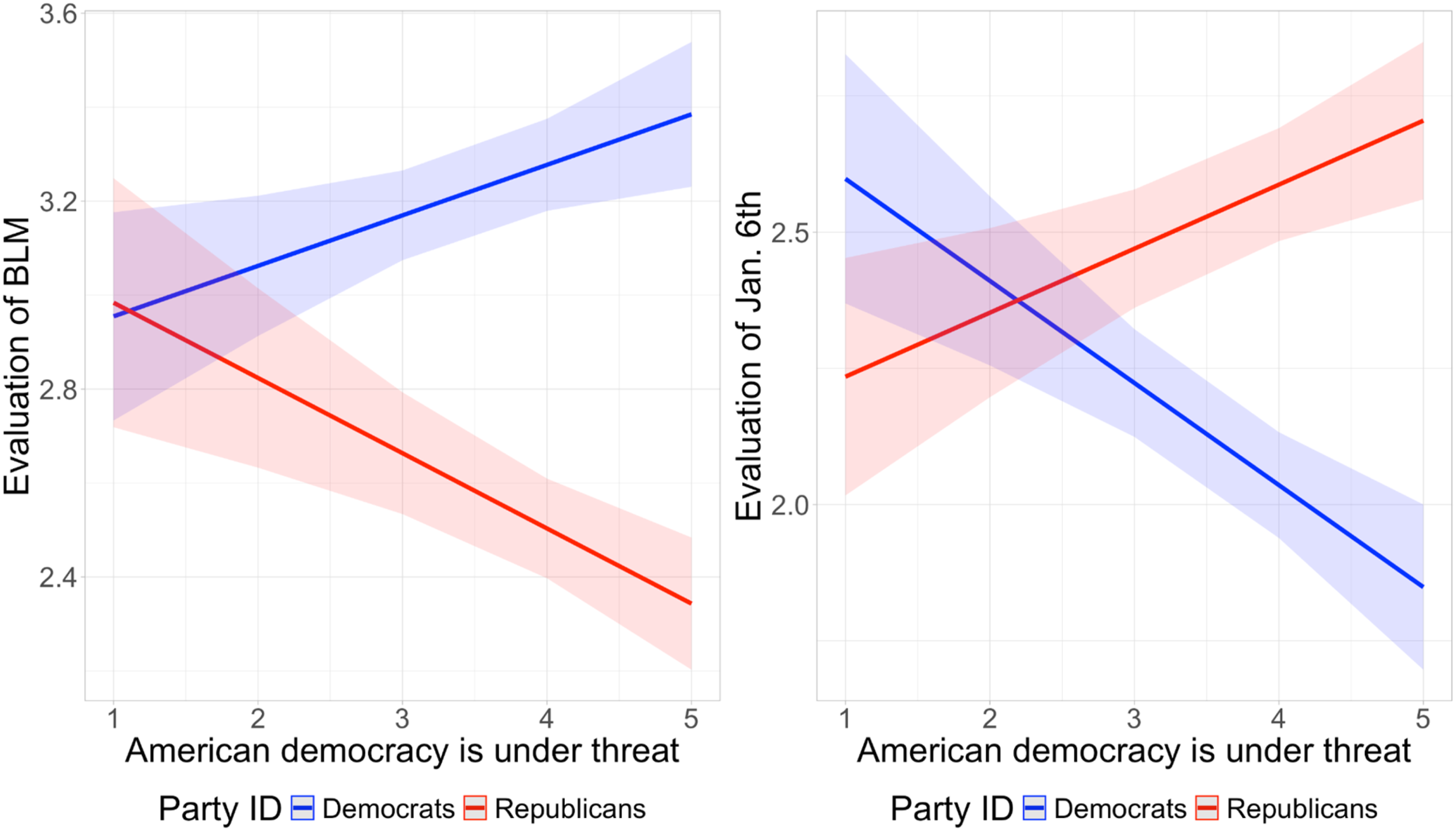
Discussion
Taken together, our findings contribute to ongoing debates not simply by reaffirming that partisanship structures political evaluations, but by demonstrating how this relationship is conditioned by multiple, interacting dimensions of partisan identity. In particular, we show that affective polarization, factional identities within parties, and perceptions of democratic threat each independently and jointly shape how citizens interpret major political events. Relying on an original YouGov survey with a nationally representative sample and ANES 2016–2024 cross-sectional and panel surveys, we examined the association between a variety of partisan attitudes and evaluation of two controversial political incidents—the Black Lives Matter movement and the January 6th insurrection. Our findings complement prior works that focused on racial attitudes or ideological alignments in explaining response to these two events. We first affirm preexisting findings that attitudes on these two events are sorted along partisan lines—Democrats have more positive evaluation on the BLM but more negative views on January 6th, while Republicans have more positive views on January 6th but more negative opinion on the BLM. More importantly, we find that partisanship seems to shape evaluations of these major events through a variety of different mechanisms. First, we find that affective polarization is associated with polarized perceptions of the two key events we analyzed. Affective polarization is associated with attitudes on these two incidents; those who are higher on affective polarization have more extreme views on BLM and January 6th. This highlights the ways in affective dispositions toward the out-party may be a powerful force in shaping one’s worldview. At first glance, the finding that Democrats who become warmer toward Republicans also become less favorable toward the Black Lives Matter movement may appear counterintuitive. However, this pattern is consistent with our theoretical framework. We do not interpret increased warmth toward the out-party as a general reduction in political conflict or a uniform increase in tolerance. Instead, such changes may reflect movement within a broader partisan and ideological space. In this context, Democrats who grow warmer toward Republicans may also be shifting toward more moderate or cross-pressured positions, which are associated with less favorable evaluations of movements that are widely perceived as aligned with the political left. More broadly, this pattern is consistent with accounts in which affect, and the partisan identities with which it is closely intertwined, shape the interpretation of political issues, rather than simply reflecting them. From this perspective, individuals adjust their issue attitudes to maintain coherence with evolving affective and identity-based orientations toward political groups. While our data do not allow us to definitively establish this direction of causality, the observed relationship is consistent with this interpretation.
Second, we find substantial heterogeneity within parties in how individuals evaluate these two political events depending on which faction individuals identify with. In particular, MAGA Republicans and progressive Democrats hold significantly more polarized views than their co-partisans, suggesting that partisan identity alone masks important internal divisions. This pattern highlights the importance of intra-party factionalism as a structuring force in public opinion: individuals are not simply Democrats or Republicans, but are differently positioned within those coalitions in ways that meaningfully shape their interpretations of political events. These findings contribute to a growing recognition that contemporary polarization is not only between parties, but also reflects the influence of distinct ideological and identity-based subgroups within them. As such, the more extreme wings of each party may play an outsized role in anchoring and potentially shifting party-level attitudes toward more polarized positions, with implications for elite rhetoric, coalition dynamics, and the boundaries of acceptable political discourse.
Third, we find that perceptions of democratic threat are strongly associated with how partisans interpret both the Black Lives Matter protests and the January 6th insurrection. Individuals who perceive American democracy to be under greater threat tend to hold more extreme evaluations of both events, suggesting that these perceptions intensify rather than moderate partisan responses. Importantly, this relationship appears across party lines, indicating that concerns about democratic backsliding do not operate as a neutral constraint on polarization, but instead become filtered through partisan lenses. In this way, perceptions of threat may reinforce divergent political realities, as citizens interpret the same events as either defending or undermining democracy depending on their prior commitments. This dynamic underscores the difficulty of building shared understandings of democratic norms in a polarized environment, and suggests that subjective perceptions of threat are themselves a key component of how political conflict is experienced and sustained.
Before we turn to the limitations and broader implications of our paper, it is important to clarify what our comparison does and does not imply. We do not treat the Black Lives Matter protests and the January 6th insurrection as normatively or morally equivalent events. They differed profoundly in their goals, organization, and relationship to democratic institutions. Our objective instead has been analytic: to understand how partisan attitudes are associated with the ways citizens interpret events that many perceive as consequential for American democracy. The contrast thus helps reveal how polarization is linked to divergent political realities rather than suggesting parity between the events.
An important limitation of our study concerns temporal ordering and causal identification. Our primary analyses rely on survey data collected in 2023, in which respondents evaluate events that occurred in 2020 and 2021. As a result, our measure of affective polarization may not function purely as a prior disposition; it may also reflect, in part, how individuals have already processed and incorporated these highly salient political events into their political worldviews. This raises the possibility of endogeneity, as the observed relationships may capture reciprocal reinforcement between partisan affect and evaluations of political events rather than a unidirectional causal effect. To partially address this concern, we draw on ANES panel data (2016–2024) to examine whether changes in out-party affect are associated with subsequent changes in attitudes toward the Black Lives Matter movement. These analyses provide additional leverage on temporal ordering and yield patterns that are consistent with our theoretical expectations. However, even with panel data, we cannot fully rule out reciprocal causation or the influence of unobserved factors that jointly shape both affective polarization and event evaluations over time. Accordingly, our findings should be interpreted as documenting robust and consistent relationships between partisan identity, affective polarization, and the interpretation of major political events, rather than as definitive evidence of causal direction. At the same time, the persistence of these relationships across both cross-sectional and longitudinal analyses suggests that the linkage between partisan affect and political evaluations is a stable feature of contemporary American public opinion. Future research using experimental or high-frequency panel designs would be better positioned to more cleanly identify the causal mechanisms underlying these relationships.
Our study has several important implications for understanding how partisanship influences political attitudes in a highly polarized environment. First, we contribute to ongoing debates about the relationship between affective polarization and political beliefs. While existing work often treats affective polarization as rooted in ideological disagreement (Abramowitz and Webster, 2018; Orr and Huber, 2020), a growing body of research suggests that partisan affect may also play an independent role in structuring political attitudes (Druckman et al. 2021a, 2021b, 2024). Our findings are consistent with this latter perspective: across multiple datasets, we show that out-party affect is strongly associated with how individuals evaluate salient political events, even when accounting for partisanship and related predispositions. At the same time, we expand on this literature by demonstrating that the relationship between partisanship and political evaluations is not uniform, but is systematically conditioned by additional dimensions of partisan identity.
Additionally, our results highlight the importance of intra-party factionalism and perceptions of democratic threat as underappreciated factors shaping political judgment. Taken together, these findings suggest that contemporary partisanship and polarization operates through multiple, reinforcing mechanisms—affective attachments, factional identities, and threat perceptions—that jointly influence how citizens understand the political world. Future research should build on these insights using experimental and longitudinal designs to more precisely identify the causal pathways linking partisan identity, affect, and political interpretation.
Second, aligning with works on racial sorting (Jardina and Ollerenshaw 2022; Westwood and Peterson 2022), we find additional evidence that racial attitudes actually are also sorting along the partisan lines. Evaluations of January 6th are not necessarily driven by racial attitudes, but some scholars characterize it as anti-BLM and white status anxiety (Barreto et al. 2024). Furthermore, political scientists are increasingly concerned about polarization and its deleterious consequences on American democracy, particularly after January 6th. To our best knowledge, we are the first to demonstrate that Americans’ perception of the status of democracy not only motivates their political views on hot-button issues, but also that this association is conditional on partisan identity.
Third, our study contributes to ongoing debates over how affective polarization should be measured and what different measures capture. Scholars have long debated whether feeling thermometers reflect a general affective orientation toward partisan groups or whether they capture more specific evaluations of party elites and politically salient partisan symbols. Druckman and Levendusky (2019), for example, argue that feeling thermometers are especially closely tied to evaluations of political elites, while social distance is only weakly correlated with other common measures of affective polarization (also see Kingzette et al. 2021). Our findings reinforce this distinction. The results are broadly consistent when affective polarization is measured using party feeling thermometers, candidate feeling thermometers, in-party versus out-party candidate differences, and out-party trait ratings. By contrast, social distance is less consistently associated with evaluations of the Black Lives Matter protests and January 6th. This pattern suggests that measures capturing generalized evaluative negativity, moralized perceptions of partisan opponents, or affect toward partisan elites are more closely connected to how citizens interpret major politicized events than measures capturing interpersonal avoidance in everyday social life. This distinction matters because the political consequences of affective polarization may depend on which dimension of partisan affect scholars are studying. Feeling thermometers and trait ratings may be especially relevant when the outcome concerns judgments of blame, threat, legitimacy, or democratic meaning in political settings. Social distance, by contrast, may be better suited for studying the social and interpersonal consequences of affective polarization, such as friendship, dating, neighborhood preferences, or willingness to interact across party lines. Our results therefore caution against treating all measures of affective polarization as interchangeable and suggest that scholars should select measures that correspond to the specific political or social consequences they seek to explain.
Lastly, our findings expose a vexing paradox for efforts to reverse democratic backsliding in the United States: partisans cannot even agree on what threatens democracy, let alone how to improve it. Although the survey did not ask respondents to name the source of danger, the interaction between partisanship and perceived democratic threat indicates that Democrats and Republicans locate the menace squarely in the opposing camp—essentially inhabiting divergent political realities. When citizens disagree about the very meaning of democracy and who endangers it, forging bipartisan consensus on institutional reforms becomes exceptionally difficult. Future research should therefore map these competing threat narratives in greater detail and identify any residual areas of agreement on core democratic norms.
Supplemental Material
Supplemental Material - Inhabiting Different Worlds: How Partisan Attitudes Shape Americans’ Evaluation of the Black Lives Matter Protests and the January 6th Insurrection
Supplemental Material for Inhabiting Different Worlds: How Partisan Attitudes Shape Americans’ Evaluation of the Black Lives Matter Protests and the January 6th Insurrection by Rongbo Jin and Spencer Lindsay in Political Research Quarterly.
Footnotes

Ethical Considerations
This study has been approved by IRB at The University of Arizona (STUDY00001849).
Funding
The authors received no financial support for the research, authorship, and/or publication of this article.
Declaration of Conflicting Interests
The authors declared no potential conflicts of interest with respect to the research, authorship, and/or publication of this article.
Supplemental Material
Supplemental material for this article is available online.
Notes
References
Supplementary Material
Please find the following supplemental material available below.
For Open Access articles published under a Creative Commons License, all supplemental material carries the same license as the article it is associated with.
For non-Open Access articles published, all supplemental material carries a non-exclusive license, and permission requests for re-use of supplemental material or any part of supplemental material shall be sent directly to the copyright owner as specified in the copyright notice associated with the article.
