






Abstract
Idiopathic pulmonary fibrosis (IPF) and gastroesophageal reflux disease (GERD) are undoubtedly related. Even though it is not clear yet which one is the primary disease, they certainly interact increasing each other’s severity. Symptoms are unreliable to diagnose GERD in patients with IPF, and objective evaluation with pH monitoring and/or bronchoalveolar lavage analysis is mandatory. Pharmacological treatment with proton pump inhibitors (PPIs) may bring control of IPF in few patients, but PPIs do not control reflux but just change the pH of the gastric refluxate. Surgical therapy based on a fundoplication is safe and effective as it controls any type of reflux, independently from the pH of the gastric refluxate. In patients waiting for lung transplantation (if they can tolerate a laparoscopic operation under general anesthesia), a fundoplication before the operation might block the progression of IPF, while after transplantation it might prevent rejection by preventing the bronchiolitis obliterans syndrome.
Keywords
Introduction
Gastroesophageal reflux disease (GERD) is a very prevalent condition and the most common gastrointestinal disorder in the United States. 1 While it is easily recognized when presents with classic esophageal symptoms (heartburn, regurgitation, and dysphagia), the diagnosis is more challenging when it causes extraesophageal symptoms. 2 The lung may be affected by direct contact with refluxed gastroduodenal contents or by bronchial contraction due to acid stimulation of the vagus nerves. 3 Many pulmonary diseases have been linked to GERD, from asthma to chronic obstructive pulmonary disease (COPD).4,5 There is evidence that idiopathic pulmonary fibrosis (IPF) may also be linked to GERD. 6
This review focuses on the association of IPF and GERD, with stress on pathophysiology, diagnosis, and treatment.
Pathophysiology of GERD
The pathophysiology of GERD is certainly multifactorial.
7
Gastric contents are naturally prone to be refluxed upward into the esophagus due to a thoracoabdominal gradient secondary to a concomitant positive intra-abdominal pressure and a negative intrathoracic pressure. Even though many factors can play a role such as tissue resistance, salivary, and motor esophageal clearance
8
(Figure 1), in most patients, a failure of the valvular mechanism at the level of the gastroesophageal junction is the main cause that leads to GERD.
8
In certain circumstances, GERD may occur in the setting of a normal valvular mechanism due to an altered transdiaphragmatic pressure gradient.
9
Abdominal pressure may be abnormally increased surpassing the retention pressure of the esophagogastric valve in obese patients.
10
On the other side, thoracic pressure may be decreased in patients with restrictive pulmonary diseases
11
: this may be the case in patients with IPF. Gastroesophageal reflux disease pathophysiology. Reproduced from Menezes MA, Herbella FAM. Pathophysiology of gastroesophageal reflux disease. World J Surg. 2017;41(7):1666-1671. Source. Reproduced by permission from Springer.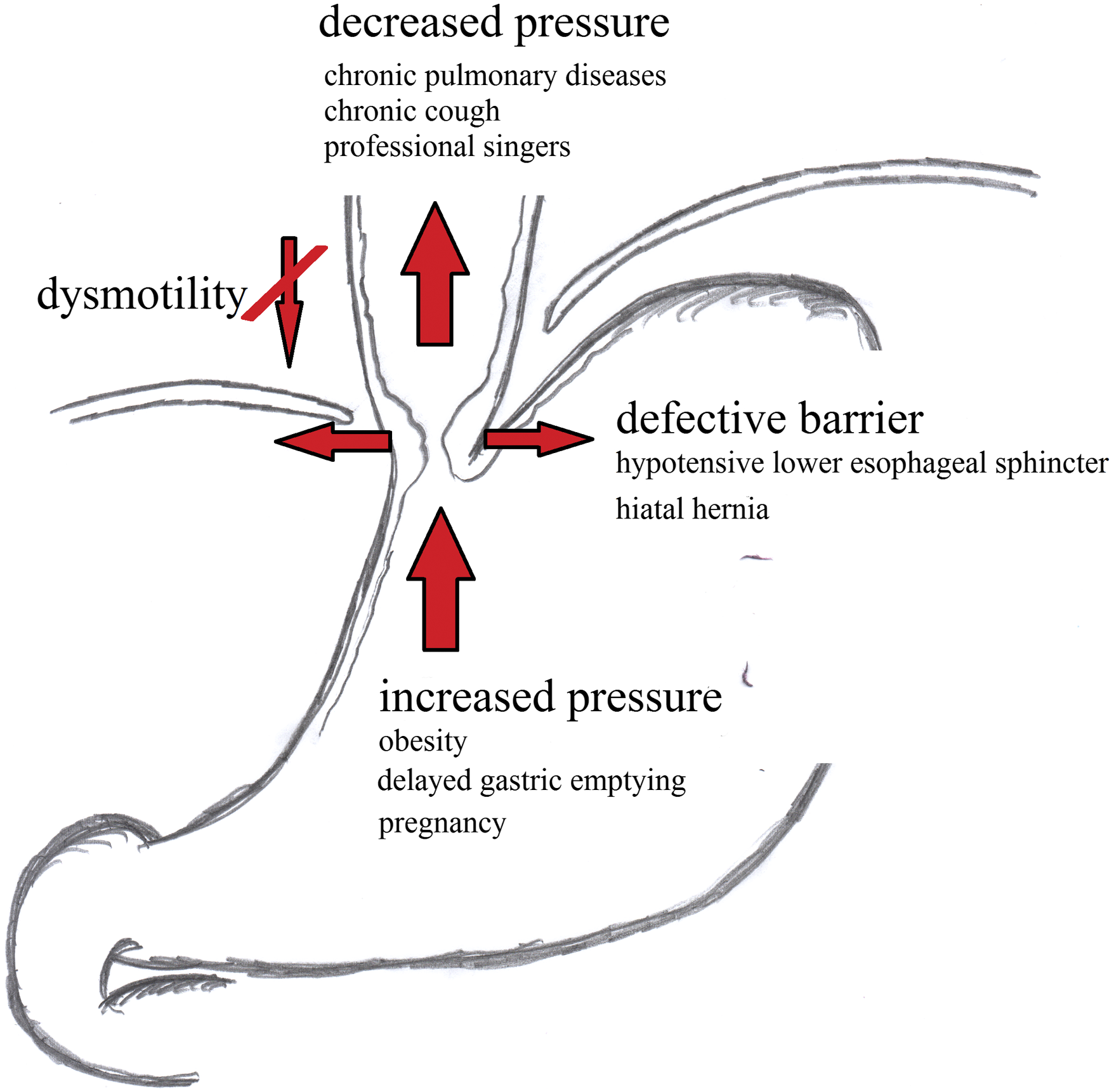
Gastroesophageal reflux disease may be detrimental due to direct chemical injury to the esophagus or adjacent organs or indirectly through vagal stimulation with consequent bronchial spasm. 3
It is been shown that the gastric refluxate may reach the upper portion of the esophagus. Patti et al 12 in a classical work using a dual probe pH monitoring, showed that reflux may reach the proximal esophagus in a significant number of patients, with possible aspiration. Aspiration of gastric contents has been confirmed by recent studies showing pepsin and bile salts in the bronchoalveolar lavage. 13 The amount of reflux that may injure the lungs is elusive though, since individual tissue resistance and visceral sensitivity may play roles. 14
Gastroesophageal reflux disease may also stimulate vagal receptors in the esophagus and lead to bronchospasm 15 and coronary spasm 16 with deleterious consequences over these organs.
Pathophysiology of GERD in Idiopathic Lung Fibrosis
We have mentioned that the lung may be damaged by the gastric refluxate. Pulmonary diseases may promote an altered transdiaphragmatic pressure gradient and cause GERD. Moreover, commonly used medications such as bronchodilators may act by decreasing the tone of the lower esophageal sphincter, thus favoring reflux.
17
Smoking may also be a causative factor for both diseases.
18
This egg/hen conundrum is linked to most pulmonary diseases putatively associated to GERD (Figure 2). Pathophysiologic interaction between gastroesophageal reflux disease and pulmonary diseases.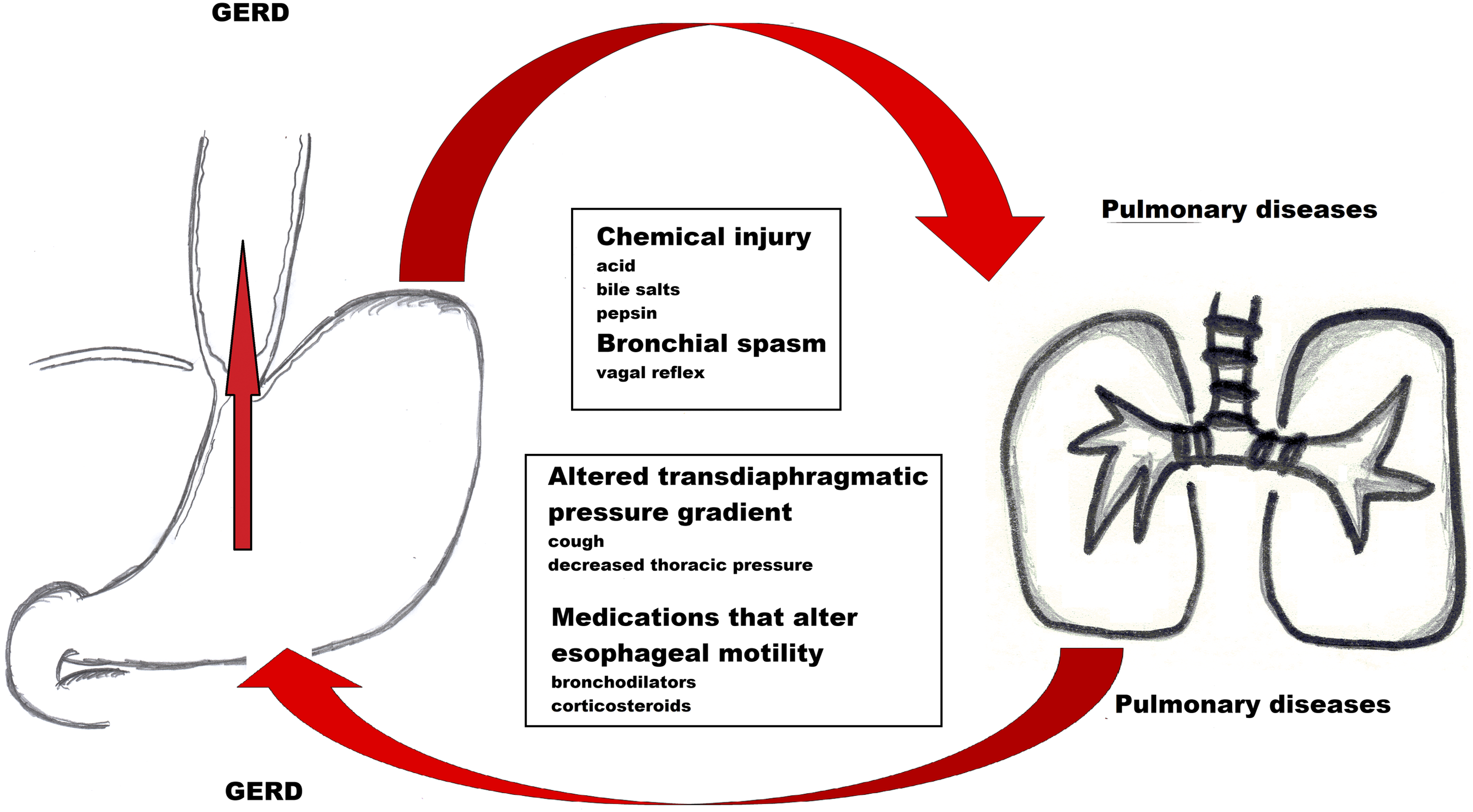
Gastroesophageal reflux disease is certainly associated to IPF. Gastroesophageal reflux disease is more prevalent in IPF than controls, 18 and it may be present in up to 76% of patients with IPF. 19 Some studies tried to evaluate the physiologic relationship between these 2 diseases. Allaix et al 6 showed that patients with IPF and GERD had normal lower esophageal sphincter pressures but lower pressure of the upper esophageal sphincter, decreased esophageal clearance, and higher prevalence of proximal acid exposure than patients with GERD but not IPF. Similar results were found by others. 19 A similar pattern is found in patients with COPD and GERD. 10 This may suggest that GERD may be secondary to the pulmonary disease but once established may contribute to its progression. Other studies, however, showed opposite results with a defective esophagogastric barrier associated to esophageal dysmotility.20,21 These studies suggested that GERD is the primary disease.
Diagnosis of GERD in Idiopathic Lung Fibrosis
Even typical symptoms are unreliable to diagnose GERD.22,23 The same is true in patients with pulmonary diseases.6,10,24 Specifically, in IPF patients, reflux was often silent as heartburn was absent in more than 40% of patients. 6 Thus, GERD may be silent or be manifested by extraesophageal symptoms that may be pulmonary in origin and be confused with the lung illness. 26 Objective evaluation of GERD in these patients by pH monitoring is thus mandatory. Dual probe pH monitoring is desirable since proximal reflux is present in the majority of cases. 19
Other methods to detect GERD in IPF patients are direct detection of gastroduodenal contents in the bronchoalveolar lavage fluid. Both pepsin and bile acids may be detected.25,26
Treatment of GERD in Idiopathic Lung Fibrosis
Following the treatment of GERD in patients without IPF, both pharmacological and surgical therapies have been proposed to treat GERD in the IPF setting.
Results for Pharmacological (Proton Pump Inhibitors) Treatment of IPF.
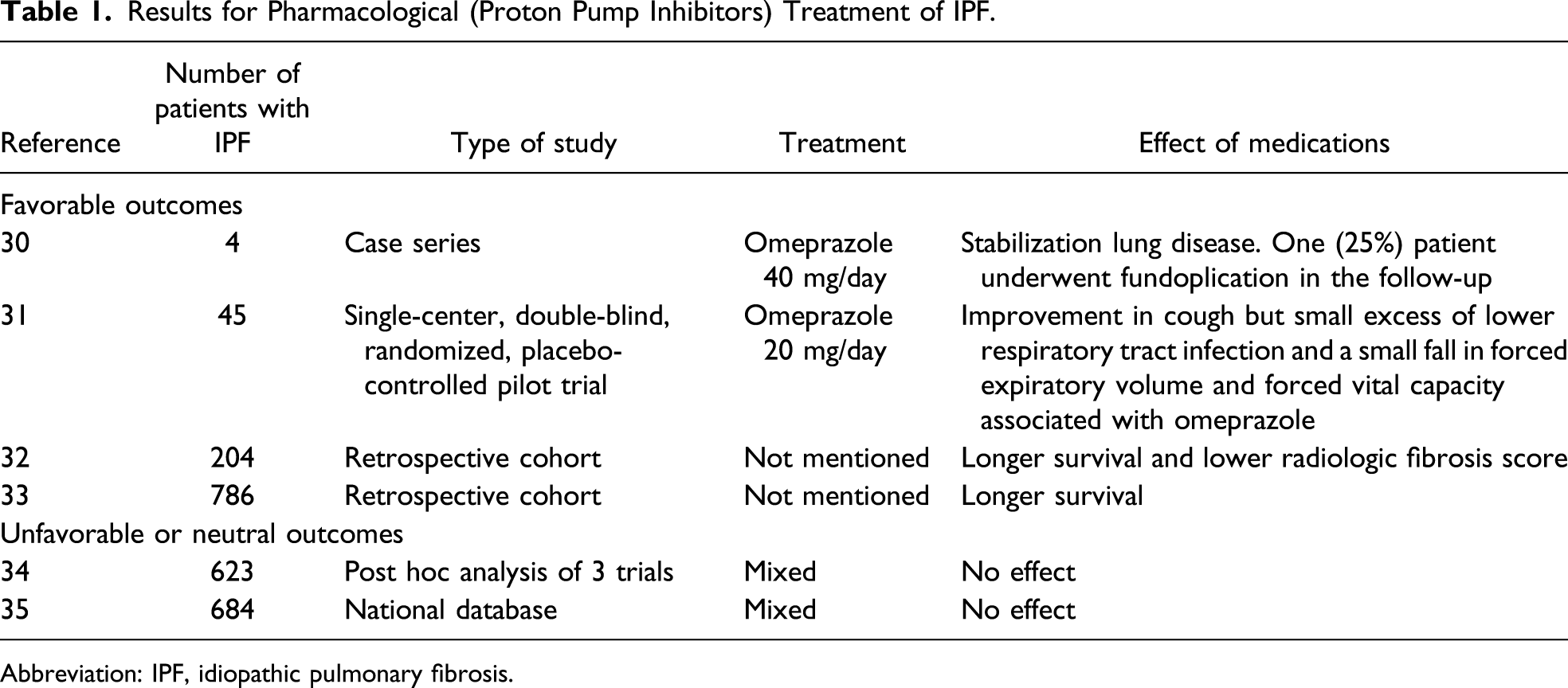
Abbreviation: IPF, idiopathic pulmonary fibrosis.
Results for Surgical (Fundoplication) Treatment of IPF.
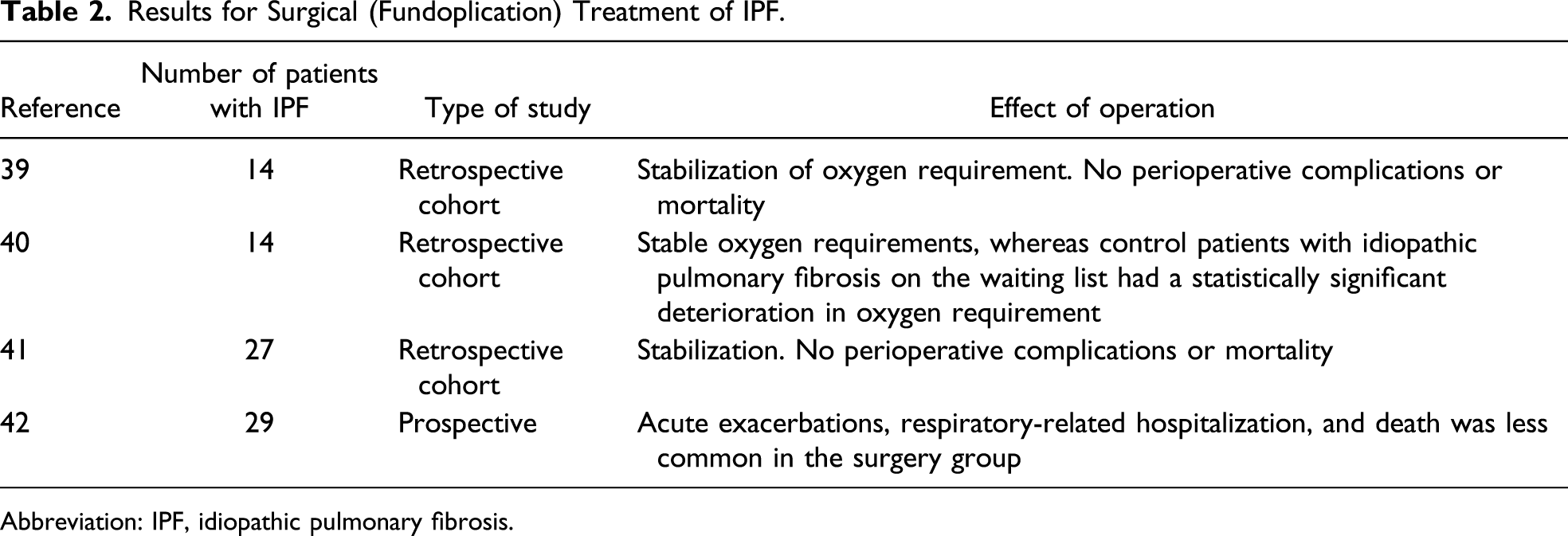
Abbreviation: IPF, idiopathic pulmonary fibrosis.
GERD and Lung Transplant in Idiopathic Lung Fibrosis
Idiopathic pulmonary fibrosis is a common cause of end-stage pulmonary disease leading to the need for transplantation. In 1 series, IPF accounted for almost a quarter of the cases in the transplant waiting list, with GERD detected in almost 80% of patients. 24 Gastroesophageal reflux disease is, however, not only a cause for lung deterioration before lung transplantation but it may also cause rejection and failure. There is plenty of current evidence showing that GERD leads to obliterative bronchiolitis, a process of fibrosis that starts in the small bronchioles of the transplanted lung culminating with the bronchiolitis obliterans syndrome (BOS), characterized by a progressive deterioration of lung function after transplantation. 43
The available literature is scarce regarding IPF and BOS. One study showed that IPF, among other causes for end-stage lung disease, had the higher rate of acute rejection that correlates with the higher amount of pepsin in bronchiolar lavage fluid. 26 Not surprisingly, IPF ranks as the pulmonary disease with higher rates of GERD in most series.24,39,44 Gastroesophageal reflux disease treatment seems to prevent BOS. A recent metanalysis encompassing 6 studies showed pulmonary function improvement in transplant recipients who underwent anti-reflux surgery. 45 Early surgical treatment of GERD (before lung transplantation) brings superior outcomes than after the transplant. 46 Davis et al 47 showed that lung transplant candidates with GERD who undergo a fundoplication may have improved 5-year survival after transplantation, from 48% to 71% in 5 years. This figure equates lung transplant survival to other solid organs what is uncommon in other series.
Not all patients, however, may be fit for a fundoplication before the transplant. Patients with severe pulmonary hypertension, exercise tolerance of less than 1 block, or the requirement of supplemental oxygen are usually referred for a fundoplication after lung transplant. 48 The performance of both operations at the same moment is frequently not indicated. Of note is the fact that GERD may occur de novo after lung transplantation and it is frequently associated to poor gastric emptying probably secondary to vagal damage.48,49 Interestingly, PPIs seem to be protective of the graft as well. 50
Conclusions
Idiopathic pulmonary fibrosis and GERD are undoubtedly related. It is still unclear, however, which one is the primary disease, but they certainly interact increasing each other’s severity. Symptoms are unreliable for GERD diagnosis in this population, and objective evaluation with pH monitoring and/or brochoalveolar lavage analysis is mandatory. Pharmacological treatment with PPI brings some control of IPF in most studies. There is, however, an increase chance of infection. Surgical therapy with a fundoplication is safe and effective. In patients waiting for lung transplantation, a fundoplication before the operation may prevent acute rejection, while after the transplant, it may prevent BOS.
Footnotes
Author Contributions
All authors: Protocol/project development; Data collection and management; Data analysis; Manuscript writing/editing.
Declaration of Conflicting Interests
The author(s) declared no potential conflicts of interest with respect to the research, authorship, and/or publication of this article.
Funding
The author(s) received no financial support for the research, authorship, and/or publication of this article.