






Abstract
Objectives:
Trial vocal fold injection (TVFI) may be used prior to permanent medialization when voice outcome is uncertain. We aimed to determine whether voice outcomes of TVFI are predictive of, or correlate with outcomes after type I Gore-Tex medialization thyroplasty (GMT) in patients with nonparalytic glottic incompetence (GI).
Methods:
Thirty-five patients with nonparalytic GI who underwent TVFI followed by GMT were retrospectively reviewed. Change in voice-related quality of life (VRQOL) after TVFI was compared to change in VRQOL 3 to 9 months after GMT. Similar comparisons were made for change in glottal function index (GFI) and change in grade, roughness, breathiness, asthenia, and strain (GRBAS). Sample correlation coefficients were calculated.
Results:
Change in VRQOL after TVFI showed good correlation with change in VRQOL after GMT, r = 0.55. Change in GFI after TVFI showed strong correlation with change in GFI after GMT, r = 0.74. Change in GRBAS after TVFI showed excellent correlation with change in GRBAS after GMT, r = 0.90.
Conclusion:
The TVFI is a useful tool in nonparalytic GI when outcomes from glottic closure procedures are not clear. Voice outcome measures after TVFI strongly correlate with outcomes from GMT. These data may be used to more confidently counsel patients regarding their predicted outcomes of permanent medialization.
Keywords
Introduction
Glottic incompetence (GI) is defined by incomplete or insufficient closure of the vocal folds during phonation. Patients suffering from GI can experience a wide range of symptoms, including breathy dysphonia, vocal fatigue, dysphagia, decreased loudness, and vocal projection. 1 A variety of nonparalytic laryngeal disorders, including vocal fold hypomobility/paresis, vocal fold atrophy, and vocal fold scar, can result in GI. 2 In comparison to vocal fold paralysis, the ideal treatment for nonparalytic GI is more difficult to determine given the complexity and diversity of these disorders. Treatment options typically include voice therapy, vocal fold injection augmentation, and type I medialization thyroplasty.1-5 In these cases, the outcome of surgical intervention is often unpredictable. Specifically, it is questionable whether isolated medialization will improve the voice in the absence of addressing the altered muscular tone and/or mucosal pliability that may additionally contribute to dysphonia. It is in this setting that a trial vocal fold injection (TVFI) may be appropriate. As described by Carroll and Rosen, 6 TVFI allows a patient to “test drive” an augmentation procedure to determine the degree of vocal improvement.
At our institution, during the “test drive” of TVFI for nonparalytic GI, patients underwent complete voice evaluation to assess the outcome of their trial augmentation. If the outcome was deemed positive by the patient and the voice center team, patients often went on to undergo type I Gore-Tex medialization thyroplasty (GMT). Prior work has demonstrated that GMT provides reliable improvement in both perceptual and subjective voice parameters in patients with both glottic incompetence and mobile vocal folds.1,2,4
The objective of this study was to determine whether the magnitude of improvement in multidimensional vocal outcomes following TVFI correlates with those following GMT in patients with nonparalytic GI.
Materials and Methods
The Institutional Review Board of the University of North Carolina (UNC) approved this study.
Patients
We identified all patients who underwent type I Gore-Tex thyroplasty for nonparalytic GI treated at the University of North Carolina Voice Center from 2005 to 2015 via the UNC Voice Center’s clinical database. For inclusion in this study, patients must have undergone both TVFI and GMT and have sufficient recorded vocal outcome data following both procedures for comparison and analysis.
All patients diagnosed with nonparalytic GI were classified by their primary diagnosis: vocal fold hypomobility, vocal fold paresis, vocal fold atrophy, and vocal fold scar. A team that includes a fellowship-trained laryngologist and voice-specialized speech-language pathologist (SLP) determined patients’ diagnoses following a complete voice evaluation and videostrobolaryngoscopy. Vocal fold paresis was distinguished from vocal fold hypomobility by diagnostic laryngeal electomyographic (LEMG) findings of neuropathic changes. Retrospective chart review was undertaken for demographic information and multidimensional voice measures. These measures included voice-related quality of life (VRQOL), glottal function index (GFI), and evaluation of grade, roughness, breathiness, asthenia, and strain (GRBAS). Scores were obtained at the patient’s initial visit. Outcome measures obtained 3 to 8 weeks post-injection were deemed to be representative of post-injection results. Outcome measures obtained 3 to 9 months after GMT were used as a representative post-surgical outcome. The magnitude of change of voice parameters from the initial visit to those obtained following operative intervention were calculated, compared, and analyzed.
The VRQOL questionnaire is a validated, patient-completed survey of 10 items that are rated on a 5-point scale (0-4) measuring the physical, social, and emotional impact of dysphonia. The overall score is a summation of the 10-item survey and calculated (0-100) where higher scores indicate better voice-related quality of life. 7 The GFI is a validated, subjective, patient-completed four-item survey of glottal function. Items are graded by the patient on a 6-point scale (0-5) and summed up to a total score (0-20), where a higher score indicates worse perceived glottal function. 8 The GRBAS is an anchored perceptual analysis of vocal function performed by a trained listener (a voice specialized SLP in our practice), assessing voice quality on a 4-point scale (rating 0-3) each for grade, roughness, breathiness, asthenia, and strain. A lower overall score on the summed scale of 0 to 15 indicates better vocal quality.
The change in each vocal outcome measure (VRQOL, GFI, and GRBAS) from initial visit to post-TVFI was compared to the change in each vocal outcome measure from initial visit to post-GMT. Using SAS software 9.4 (SAS Institute Inc., Cary, North Carolina, USA), a biostatistician performed statistical analysis on the collected data. Pearson sample correlation coefficients were used to determine if the change in each vocal outcome measure after TVFI correlated with change in each vocal outcome measure after GMT.
Procedures
The TVFI was performed either in the office or the operating room (OR). Materials used for injection augmentation include carboxymethylcellulose (Radiesse Voice Gel; Merz North America Inc., San Mateo, California, USA), absorbable gelatin powder (Gelfoam; Pfizer Inc, New York, New York, USA), and micronized dermis (Cymetra; Lifecell Corporation, Bridgewater, New Jersey, USA). 9 The injectable material used was determined based on patient and surgeon preference, access to material, location of procedure (OR vs. office), and duration of effect desired. Unilateral versus bilateral injection was determined at the surgeon’s discretion, based on patient factors, including diagnosis.
Long-term surgical intervention was performed by Gore-Tex medialization thyroplasty in all cases. This technique and its advantages has been previously described.10,11 A fellowship-trained laryngologist performed all procedures. Gore-Tex medialization thyroplasty sidedness (unilateral right, left vs bilateral) was a real-time intraoperative determination driven by “optimal voicing” at the time of surgery rather than being predetermined by diagnosis or the previous TVFI side alone. Intraoperatively, bilateral thyroid cartilage windows were opened. A trial of manual medialization during vocalization was briefly performed on both sides serially to identify the side that yielded the greater voice change. Following this determination, Gore-Tex medialization was carried out on the “more impactful” side until the best achievable voice was obtained. Thereafter, the contralateral side was implanted only in the event that further voice improvement was recognized with the addition of contralateral augmentation.
Results
Patients
Seventy-eight patients underwent GMT for nonparalytic GI between 2005 and 2015 by the senior authors at the University of North Carolina. Six of these patients did not undergo TVFI. Thirty-seven patients had insufficient recorded vocal outcome data to be included in the analysis. Thirty-five patients met the inclusionary criteria for this study.
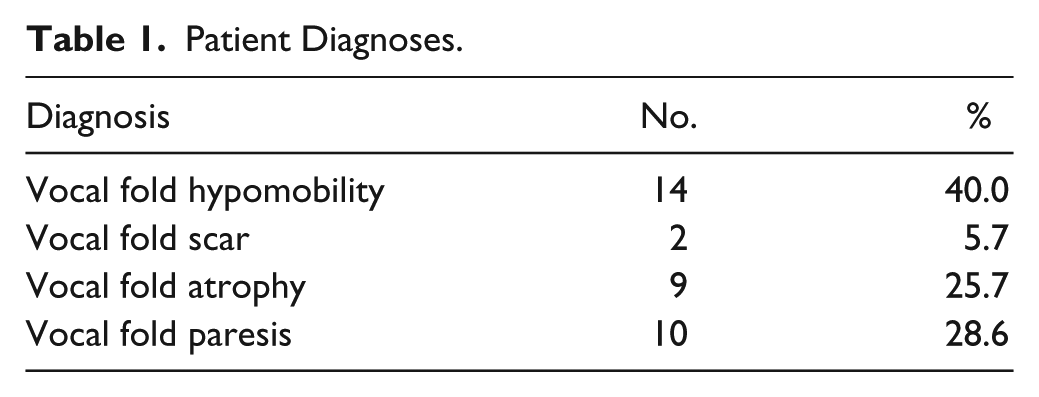
The average age of patients in the study was 54 years; 18 patients were female (51%), and 17 were male (49%). The distribution of specific diagnosis for the nonparalytic GI breaks down as follows: vocal fold hypomobility, n = 14; vocal fold paresis, n = 10; vocal fold atrophy, n = 9; vocal fold scar, n = 2 (Table 1). Twenty-four patients underwent voice therapy prior to TVFI. Seven patients never underwent voice therapy. Any additional voice therapy given along the clinical course was recommended and performed to correct individual vocal behaviors.
Patient Diagnoses.
Procedures
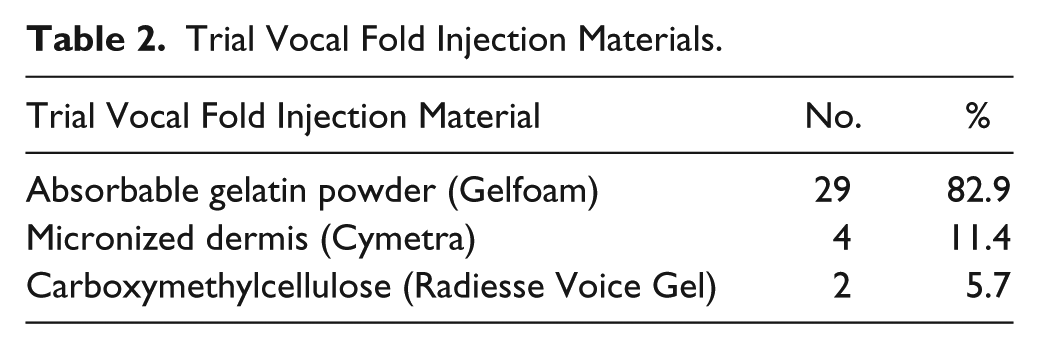
Thirteen of the 35 patients (37%) had unilateral TVFI, while 22 of 35 (63%) had bilateral injections using the following temporary materials: carboxymethylcellulose (Radiesse Voice Gel; Merz North America Inc), absorbable gelatin powder (Gelfoam; Pfizer Inc), and micronized dermis (Cymetra; Lifecell Corporation) (Table 2). Thirty TVFI procedures (86%) were done in the operating room, while 5 (14%) were done in the office.
Trial Vocal Fold Injection Materials.
Fourteen patients (40%) had unilateral GMT, and 21 patients (60%) had bilateral GMT procedure. The majority of patients had the same vocal fold(s) implanted as they had injected (n = 20; 57%). Based on intraoperative voicing feedback during GMT, 15 patients (43%) had a change from the previous TVFI treatment strategy.
Pearson’s sample correlations were calculated. Change in VRQOL from initial visit to post-TVFI had a moderate correlation with change in VRQOL from initial visit to post-GMT, r = .55, n = 35 (Figure 1). Change in GFI from initial visit to post-TVFI had a strong correlation with change in GFI from initial visit to post-GMT, r = .74, n = 19 (Figure 2). Change in GRBAS from initial visit to post-TVFI had an excellent correlation with change in GRBAS from initial visit to post-GMT, r = .90, n = 13 (Figure 3).
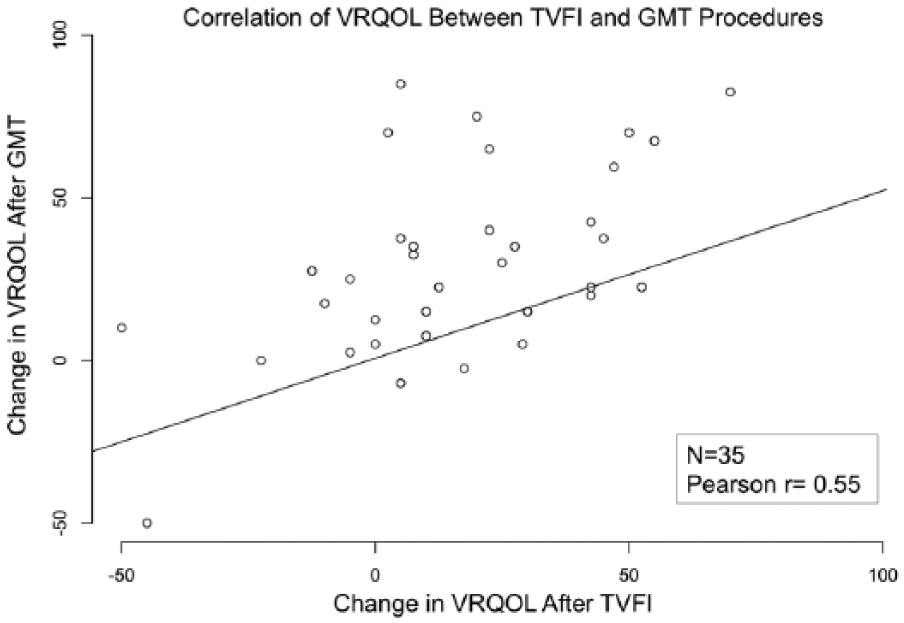
Correlation of change in voice-related quality of life (VRQOL) after trial vocal fold injection (TVFI) with change in VRQOL after Gore-Tex medialization thyroplasty (GMT).
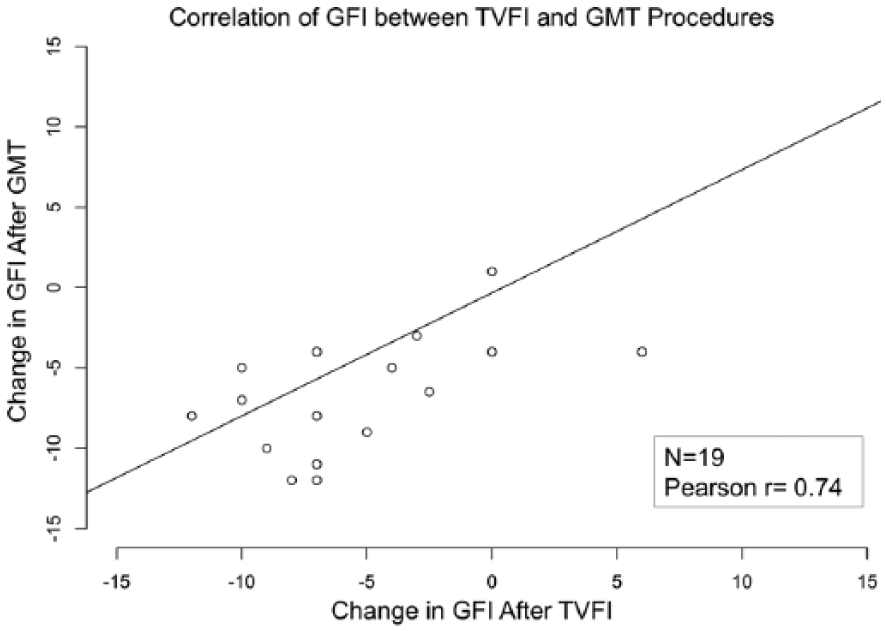
Correlation of change in glottal function index (GFI) after trial vocal fold injection (TVFI) with change in GFI after Gore-Tex medialization thyroplasty (GMT).
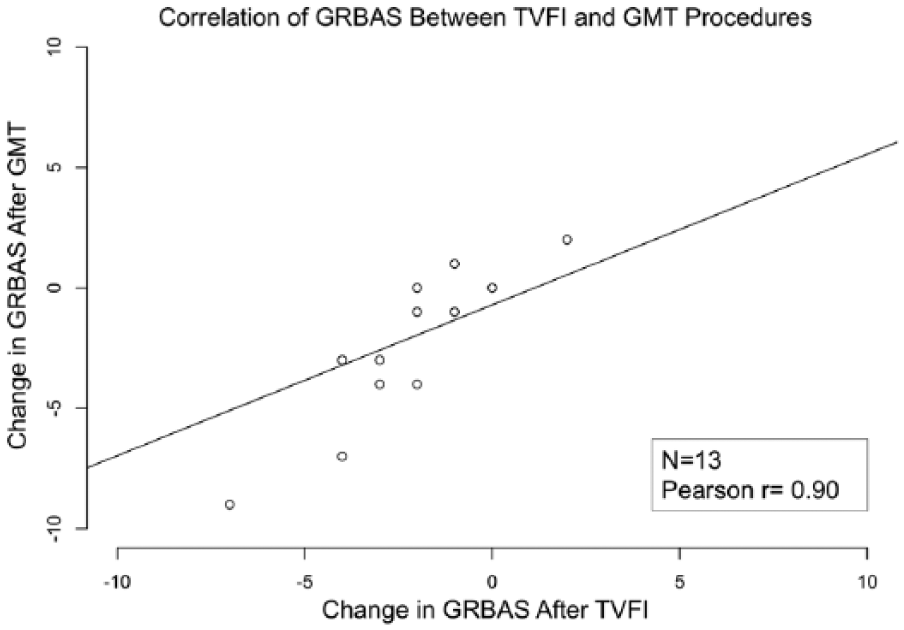
Correlation of change in GRBAS (grade, roughness, breathiness, asthenia, strain) after trial vocal fold injection (TVFI) with change in voice-related quality of life (VRQOL) after Gore-Tex medialization thyroplasty (GMT).
Discussion
Vocal fold injection augmentation has gained popularity as a treatment for GI due to its technical ease, low cost, and wide availability. 9 A study by Carroll and Rosen 6 defined the concept of TVFI as the use of temporary injection laryngoplasty when the benefit of augmentation is unclear. Their study showed a trend toward a good response to permanent augmentation in patients who had positive responses to TVFI. Young et al 5 found similar results reporting that 75% of vocal atrophy patients demonstrated voice improvement with long-term augmentation after having a good response to trial TVFI. While these prior studies have suggested TVFI results may predict favorable permanent results, we endeavored to determine how well the magnitude of change after TVFI, measured by multidimensional voice outcomes, correlated with outcomes following GMT.
In cases of nonparalytic glottic incompetence (vocal fold hypomobility/paresis, vocal fold atrophy, and vocal fold scar), patients often have additional deficits of tone or vibratory anatomy that remain unaltered by augmentation, making their optimal surgical intervention less clear. It is in these cases that we find TVFI most useful. Of the 78 patients identified who underwent GMT for nonparalytic GI in the past 10 years at the University of North Carolina, nearly all, 72 of 78 (92%), first underwent injection laryngoplasty of some description.
Our voice outcome measures included self-reported patient surveys, VRQOL and GFI, as well as perceptual voice rating (GRBAS) by a skilled listener (SLP). We chose an available voice measure time point at 3 to 8 weeks post-TVFI to represent the clinical effect of the temporary injectable materials. The most commonly used temporary injectable material was absorbable gelatin powder (Gelfoam; Pfizer Inc), 82.9%. We chose a representative set of voice measures in the 3- to 9-month post-GMT timeframe to represent medium-term voice outcomes after surgery.
Our study used multidimensional outcome measures for analysis as there is no consensus regarding a single optimal or an ideal combination of measures. The GFI and VRQOL are non–disease specific, self-reported instruments regarding a patient’s voice performance. While the VRQOL queries physical/functional and social/emotional impacts of voice dysfunction, the GFI specifically assesses the physical symptoms associated with voice dysfunction (pain, perception of effort, and fatigue). The GRBAS measures a skilled listener’s perceptual assessment of voice quality. While these measures are associated with each other and have been shown to correlate with each other, no one measure is perfect. 1 For this reason, we believe multidimensional analysis is critical. Our data show a good correlation (r = .55) between change in VRQOL after TVFI with change in VRQOL after GMT, a strong correlation (r = .74) between respective GFI change, and an excellent correlation (r = .90) between change in GRBAS following TVFI subsequent GMT. The strong correlation of our results suggests that it is reasonable to use voice improvements following TVFI to predict those following permanent surgical intervention with GMT in patients with nonparalytic GI.
In this setting (TVFI), we consider the trial of vocal fold injection to be a generalized intervention to determine the potential for functional improvement with improved glottic closure. The specific side of trial injection (right left or bilateral) may be less important, however. It has been our experience that although the location of our TVFI is based on laryngoscopic findings and to some extent diagnosis, final augmentation strategy was sometimes altered at the time of GMT based on real-time intraoperative voice feedback. The strong correlation of outcomes between TVFI and GMT, we believe, suggests that the specific location of injection augmentation trial is less critical than providing an adequate trial of glottal closure in general.
Limitations of our study include its retrospective nature and the limited sample size. While 37 additional patients had TVFI, they did not follow up in the period of time representative of the impact of the augmentation for vocal outcome analysis and thus are not included in our data set. Future studies should be aimed at prospective collection of data of all patients undergoing TVFI. Further, this study does not address patients with poor results following TVFI. Patients who did not have improvement in vocal outcomes with regards to VRQOL, GFI, and GRBAS were not recommended to undergo GMT and were therefore not included in the study. Lastly, the small sample size limits the ability to do a meaningful subgroup analysis. Future studies should be aimed at a larger sample size and a diagnostic subgroup analysis of TVFI correlation with GMT.
Conclusions
In summary, in patients with nonparalytic GI, multidimensional voice outcomes of TVFI are very well correlated with the individual’s outcome following GMT. Given its predictive value, TVFI is a useful predictive tool in this population of patients when the optimal rehabilitative operative strategy is uncertain. These data should assist voice clinicians to more confidently counsel patients regarding their likely outcomes following permanent medialization.
Footnotes
Acknowledgements
Angela Liu Mazul, PhD, MPH.
Authors’ Note
Presented at American Laryngological Association 2106 meeting at Combined Otolaryngology Spring Meetings, Chicago, Illinois, USA, May 18-19, 2016. The Institutional Review Board of the University of North Carolina approved this study: 15-0670
Declaration of Conflicting Interests
The author(s) declared no potential conflicts of interest with respect to the research, authorship, and/or publication of this article.
Funding
The author(s) disclosed receipt of the following financial support for the research, authorship, and/or publication of this article: Clinical and Translational Research Center grant support (1UL1TR001111 from the Clinical and Translational Science Award Program of the Division of Research Resources, National Institutes of Health). REDCap project used for data collection. Funding from the University of North Carolina: Carolina Medical Student Research Program.