







Abstract
Public cooperation with police is essential for the control of crime and disorder. Hence, understanding factors that shape public cooperation with the police is important. However, Australian and international studies show that police find it difficult to elicit cooperation from ethnic communities, this made difficult by the fact that ethnic groups display low levels of trust and confidence in the police. This study examines the role that procedural justice plays in fostering minority group perceptions of police legitimacy and their willingness to cooperate with police. Using survey data collected from 1204 Australian citizens, this study tests whether procedurally fair policing can enhance perceptions of police legitimacy and nurture cooperation among ethnic minorities in Australia. Findings reveal that procedural justice predicts views of police legitimacy more so than instrumental factors for both minority and majority group members. The results also suggest that ethnicity moderates the effect of procedural justice on cooperation; specifically, procedural justice is shown to be less effective for nurturing cooperation among ethnic minorities than majority group members. A group identity perspective is used to explain these findings. The findings also have implications for how the police can foster better relationships with ethnically diverse communities.
Introduction
Australian research indicates that in order for the police to effectively control crime and secure cooperation from the general population, there needs to exist high levels of support for the police as an appropriate, proper and just institution (Murphy et al., 2008; Pickering et al., 2008). Hence, to effectively engage communities, public police agencies need to understand the intrinsic and internal motivations shaping people’s desire to voluntarily cooperate with police (Tyler and Huo, 2002). Australian, US and UK research supports the conclusion that such motivations are largely linked to perceptions of legitimacy (Jackson and Sunshine, 2007; Tyler and Fagan, 2006). Research has demonstrated that if people view an authority as legitimate they will be more likely to cooperate with that authority (Hinds and Murphy, 2007; Murphy, 2005; Sunshine and Tyler, 2003).
Public police agencies in Australia and abroad have faced significant challenges in generating voluntary cooperation from ethnic minority groups and have found it difficult to engage ethnic groups in collaborative crime control (Cherney and Chui, 2008). This has been complicated by the fact that ethnic minority groups tend to hold less favourable assessments of the police compared to the general population (Engel, 2005; Gallagher et al., 2001; Pickering et al., 2008; Reisig and Parks, 2000; Sampson and Bartusch, 1998; Sivasubramaniam and Goodman-Delahunty, 2008). Such assessments lead these groups to question the legitimacy of institutional authorities and can undermine police/community engagement and cooperation (Sherman, 2001). Using data collected from a sample of Australian citizens, the present study examines factors that affect the willingness of people to cooperate with police efforts to control crime and disorder effectively. Of particular interest will be how these factors may influence ethnic minority groups in Australia.
The importance of legitimacy and procedural justice in fostering cooperation with police
Legitimacy has often been defined as ‘a property of an authority or institution that leads people to feel that that authority or institution is entitled to be deferred to and obeyed’ (Sunshine and Tyler, 2003: 514). Where authorities are judged to be legitimate, people feel that they ought to cooperate with authorities, defer to their decisions and rules, and follow them voluntarily out of obligation rather than out of fear of punishment or anticipation of reward. This view of legitimacy is derived from Max Weber’s early observation that compliance with authorities cannot be guaranteed through coercive power relations alone (Roth and Wittich, 1978; see also Black, 2008; Jackson and Sunshine, 2007; Turner, 2005). This argument suggests that if police build greater levels of legitimacy, they are more likely to encourage intrinsically motivated cooperation – that is, people will want to cooperate and comply with police because they believe it is the right thing to do (Tyler, 2006a). This can occur despite any negative outcomes that may result from complying with police decision-making. Empirical evidence supports this view. For example, using a sample of 1656 residents of Los Angeles and Oakland in the United States, Tyler and Huo (2002) found that the two main factors shaping people’s willingness to accept police decisions were the degree to which the decisions were regarded as favourable and fair, and whether the police were generally regarded as legitimate.
Police legitimacy has been found to comprise both instrumental and relational aspects. According to the instrumental perspective, police legitimacy is linked to instrumental evaluations of three elements: police performance, risk of detection, and judgments about distributive justice (Sunshine and Tyler, 2003). This instrumental view suggests that police can increase support from the public when they (a) effectively control crime and criminal behaviour (performance), (b) create a credible risk of detection and sanction for those who break the law (deterrence), and (c) fairly distribute police services across people and communities (distributive justice). In other words, the instrumental perspective of legitimacy suggests that police develop and maintain legitimacy through their effectiveness in controlling crime and disorder in the community.
Legitimacy can also comprise relational aspects. This refers to the influence of relational factors such as procedural justice in shaping institutional legitimacy and voluntary cooperation (Paternoster et al., 1997; Sunshine and Tyler, 2003; Tyler, 2006b). Procedural justice concerns the perceived fairness of the procedures involved in decision making and the perceived treatment one receives from the decision maker. In fact, people’s willingness to defer to the authority of the police and engage with the police in a cooperative manner has been found to be less reliant on instrumental reasons, but more on the perceived fairness and quality of treatment they receive. For example, in a US study of high crime areas, Tyler and Huo (2002) found that how police treated people accounted for more of the variance in police evaluations of legitimacy than did variations in the quality of police performance (see also Sunshine and Tyler, 2003).
The group-value model explains why people may care more about relational issues when evaluating authorities (Lind and Tyler, 1988; Tyler and Lind, 1992). The group value model suggests that people derive a sense of self-worth from group membership. Individuals will assess their status within groups by evaluating the extent to which important group representatives (such as authorities) treat them fairly. When people feel they are treated with procedural fairness, their sense of self-worth is bolstered and their attachment to the group is reaffirmed. Unfair treatment, in contrast, signals marginality and exclusion. Hence, assessments that an individual is, and will be, treated justly and with respect in their interactions with police is critical to fostering levels of support for the police as a legitimate and trustworthy institution. At the same time, however, the group-value model also predicts that procedural justice will matter more to people if they identify strongly with the dominant group and that group’s representatives. In contrast, relational considerations should be less relevant in interactions with an authority that represents a group one does not care about (for empirical support for this see DeCremer, 2002; Huo, 2003; Huo et al.,1996; Huo and Tyler, 2001; Tyler and DeGoey, 1995).
Policing ethnic minorities
As in the United States, studies reveal that ethnic minority groups living in Australia have particularly problematic and poor relationships with police (e.g. Chan, 1997; Dixon and Maher, 2002; NSWPLC, 2001; Pickering et al., 2008; Sivasubramaniam and Goodman-Delahunty, 2008). This in particular can be exacerbated for immigrants who come from vastly different cultural backgrounds and legal traditions, and who may be apprehensive about police contact as a result of past experience with police in their country of origin (Cherney and Chui, 2008; Pickering et al., 2008). In addition, perceptions of racial profiling and the over-policing of ethnic communities further undermines relations (Dixon and Maher, 2002; NSWPLC, 2001; Pickering et al., 2008). There is a strong argument to be made that given the history of police and ethnic group relations in Australia, enhancing legitimacy in the eyes of ethnic groups should be a priority of Australian police agencies.
While Pickering et al. (2008) recognize that in the context of addressing terrorism, improving police legitimacy is linked to effective methods of policing within culturally diverse communities, the relationship between procedural fairness, legitimacy and ethnicity has so far been ignored in the Australian context. This is despite recent work on legitimacy and policing in Australia highlighting the need to examine this relationship (see Hinds and Murphy, 2007). This gap in the Australian literature is unfortunate given the number of procedural justice studies coming out of the United States.US-based research has revealed that the underlying dynamics of the fair process effect are similar across ethnic groups (for a review see MacCoun, 2005). While some ethnic groups have been found to differ in their judgments of the quality of the way they are treated by authorities – for example, African Americans are more critical than Whites (e.g. MacCoun, 2005; Tyler and Huo, 2002) – most studies have found striking similarities across cultural and ethnic groups in both the antecedents and consequences of procedural justice (Tyler et al., 1997). These studies have also consistently revealed that procedural justice is more important than instrumental factors across all ethnic groups. Recently, Tyler et al. (2010) have found that procedural justice is the primary factor shaping American-Muslims’ perceptions of police legitimacy and their subsequent willingness to cooperate with police in anti-terror policing. Empirical evidence such as this is important because it suggests that if police adhere to principles of procedural justice in their dealings with ethnic minority group members, then they may be able to successfully engage these people and shape their willingness to cooperate with police in a range of different matters.
An important empirical question arising from this prior work is whether these US-based research findings can be translated to other western jurisdictions such as Australia. The present study aims to test the relationship between procedural justice, legitimacy and cooperation among ethnic minorities in Australia. US-based research suggests that there should be little difference across ethnic groups in the fair process effect, and that procedural justice will matter more to people than instrumental factors. However, as already noted above, the group value model predicts that procedural justice may matter less to people when they do not identify with group representatives of a majority group. This suggests that ethnic minorities may place less weight on procedural justice than majority group members if they identify less strongly with Australia and being an Australian. Given the strong focus on multiculturalism in Australia, and the general desire of ethnic minorities to maintain links to their own cultural identity and practices, of interest will be if this has an impact on whether procedural justice-based policing fosters their cooperation.
Method
Participants and Procedure
In 2009, a total of 2088 surveys were posted to a stratified national random sample of Australian citizens (stratified by state and territory jurisdiction). The 22-page survey examined a range of issues, including views about crime and safety, attitudes and beliefs about police and the law, and experiences with legal authorities. Participants were chosen from the publicly available Electoral Roll. 1 Three reminder letters were posted to non-responders during the survey fielding period, and a total of 1204 completed surveys were returned (58% response rate). When adjusted for respondents who did not live at the address listed in the electoral roll, or who were incapable of completing the survey (N = 232), an adjusted response rate of 65% was obtained.
Respondents in the final sample were between 14 and 93 years of age (M = 56.13; SD = 15.00), 2 46% were male, 75% were married or in a de-facto relationship, 32% had attained a university qualification, 25% were born overseas, and the average household income was reported to be AUS$82,344 (SD = $55,239). Using 2006 Australian census data, the sample was found to be broadly representative of the overall Australian population. However, like many mail surveys, those who are older and more educated tend to be over-represented. Men were also slightly underrepresented in the survey.
Unlike in the United States, where there are three predominant racial/ethnic groups represented in the population (Whites, African Americans, Latino/Hispanics), ethnicity in Australia is much more heterogeneous in nature. As a result, it is much more difficult to cluster respondents into discrete ethnic and racial groups from a general population survey. For the purposes of the present study, therefore, only one ethnic minority group was formed. 3 Ethnic/racial minority group membership was determined via self-report using five separate survey questions: country of birth, country of father’s birth, country of mother’s birth, ancestry (up to two ancestries could be listed), and language spoken at home. Among the 1204 respondents were 223 people who identified themselves as belonging to an ethnic/racial minority group. Minority status was determined if the respondent was from a non-Anglo-Saxon background. In other words, if their country of birth or ancestry was identified as being of an Anglo-Saxon nature (i.e. outside of Australia, but from countries such as the United Kingdom, the Netherlands, Sweden, New Zealand, etc.), respondents were not included in the minority group. Instead, they were categorized as a majority group member. At the same time, however, if respondents indicated that they were born in Australia, but that their ancestry or parents’ country of birth was from a non-Anglo-Saxon background (e.g. China, India, Maori) they were included in the minority group. This process produced two distinct groups based on ethnic/racial background: what we refer to as (a) the ethnic minority group (coded as 1; N = 223 or 19% of the sample) and (b) the majority group (coded as 0; N = 981 or 81% of the sample).
With 2006 Australian census data revealing that approximately 27% of people residing in Australia on census night were from a non-Anglo-Saxon background, the results from the present study suggest that ethnic minorities may have been slightly under-represented in this study. However, given survey respondents were sampled from the electoral roll, it can reasonably be assumed that minorities might be less represented on the electoral roll than in the census. This is due to the fact that not all people residing in Australia who completed the census on census night were Australian citizens.
Measures
Factor analysis differentiating variables used in this study
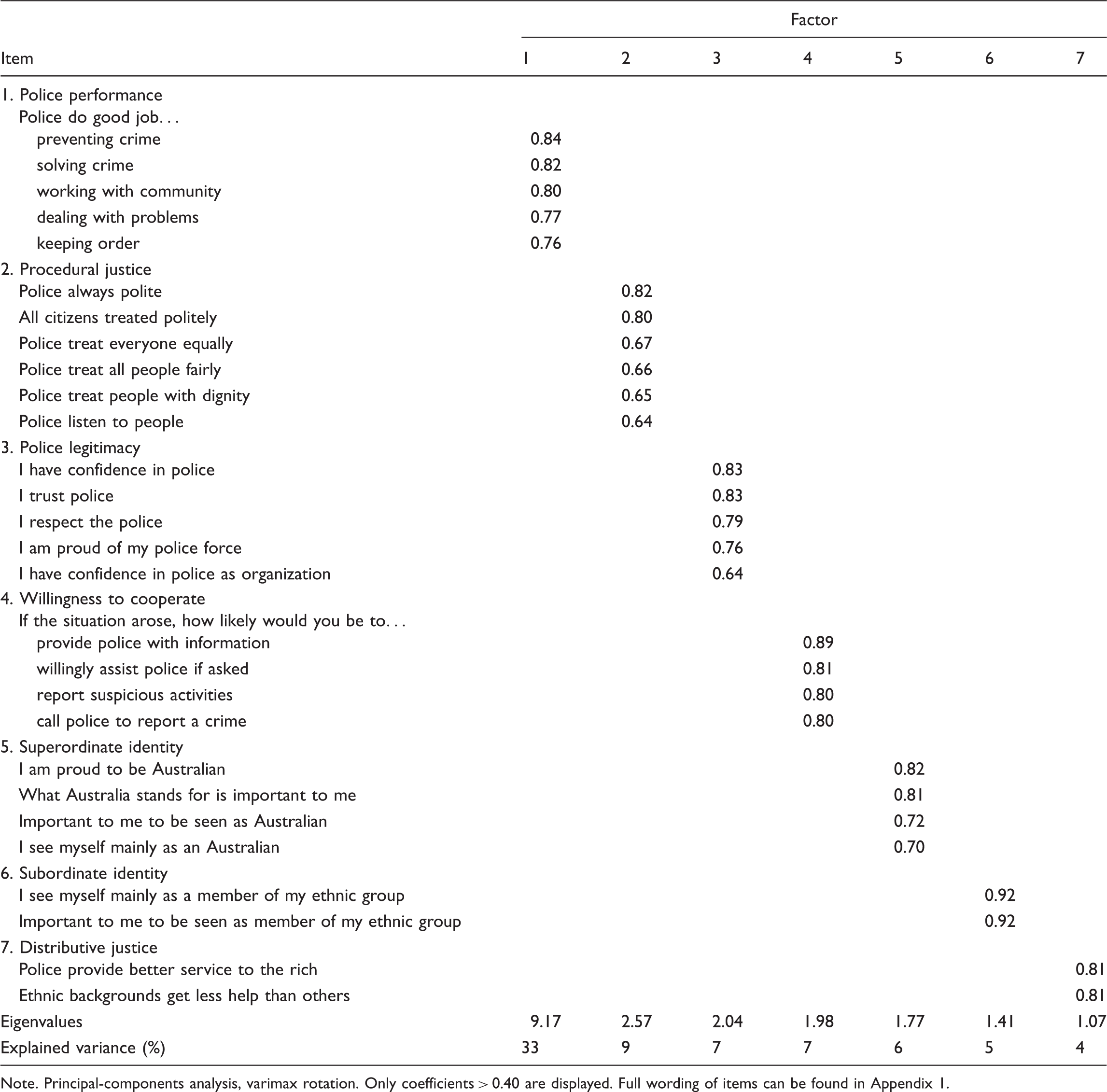
Note. Principal-components analysis, varimax rotation. Only coefficients > 0.40 are displayed. Full wording of items can be found in Appendix 1.
Means, standard deviations, Cronbach alpha reliability coefficients, and bivariate correlations for all measures (standard deviations are in brackets)
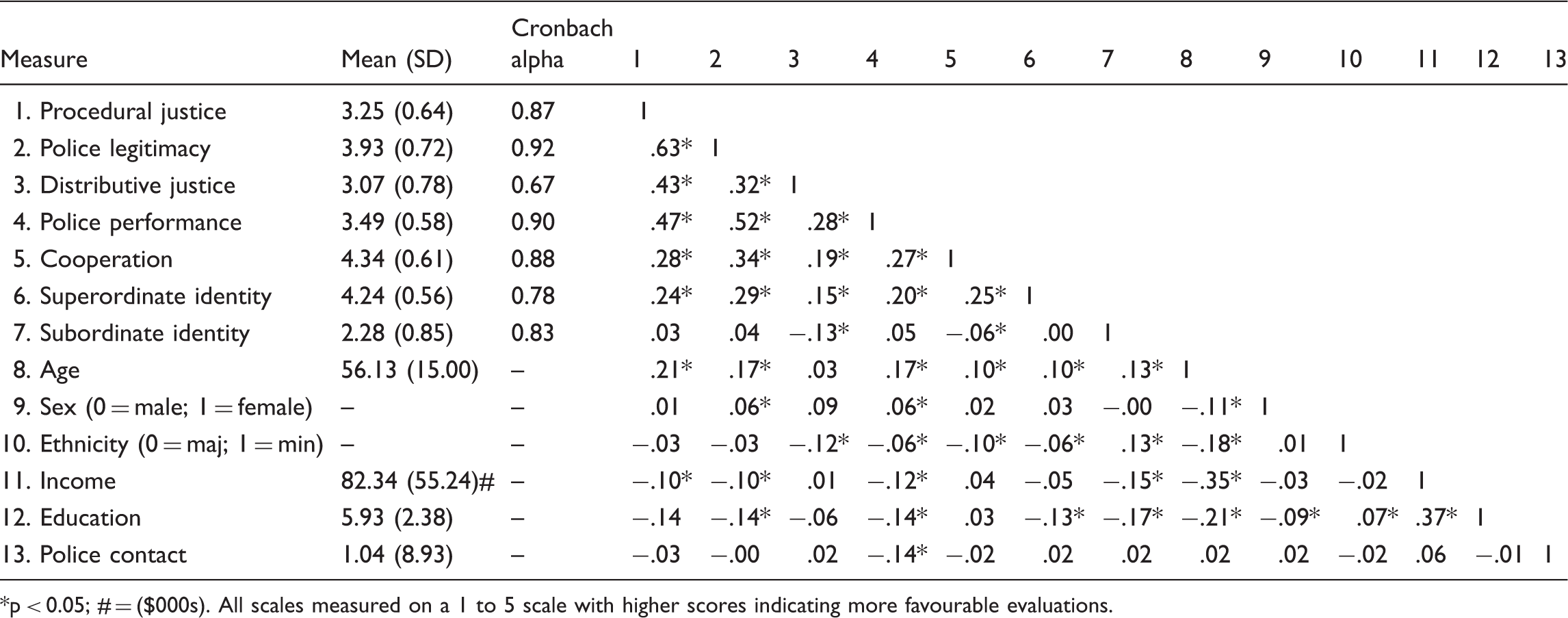
p < 0.05; # = ($000s). All scales measured on a 1 to 5 scale with higher scores indicating more favourable evaluations.
Procedural justice
Procedural justice is typically conceived as a two-dimensional concept consisting of the quality of treatment people receive from authorities and the quality of decision-making people receive from authorities (Reisig et al., 2007). However, the results from the factor analysis in this study revealed a uni-dimensional concept (see Table 1). The six-item procedural justice scale used here referred to both the quality of treatment and the quality of decision making (e.g. ‘Police treat all people fairly’).
Distributive justice
Distributive justice in the policing context refers to the fair distribution of police services across people and communities. Distributive justice was measured using two questions (e.g., ‘Police sometimes give people from specific ethnic backgrounds less help than they give others’; reverse scored). These questions were designed to assess whether citizens thought police give preferential treatment to different groups of people.
Police performance
Police performance was assessed via five questions that asked citizens whether they thought police do a good job in controlling crime (e.g. ‘On the whole, how good a job are police doing in your neighbourhood at solving crime?’). Respondents scoring high on this scale view police as performing their job well.
Police legitimacy
The police legitimacy scale was constructed via five items. The measure was designed to assess feelings of respect and confidence in the police. In other words, the legitimacy scale was designed to measure the extent to which police are seen to have legitimate authority (e.g. ‘I have confidence in the police’).
Cooperation with police
Responses to four items were combined to form a cooperation scale. Respondents were asked about their willingness to help or cooperate with police to prevent crime (e.g., ‘How likely would you be to willingly assist police if asked?’). A higher score on the cooperation scale indicates respondents were more willing to cooperate with police.
Identification
To ascertain whether ethnic minority group respondents in the present study identify with Australia as the superordinate group to the same degree as majority group members, four questions were used to construct the superordinate identity scale (e.g. ‘Do you see yourself first and mainly as a member of the Australian community?’). An additional two item scale assessed the level of identification respondents made with their respective ethnic subgroup (e.g. ‘Do you see yourself first and mainly as a member of your racial/ethnic group?’); higher scores indicate greater levels of identification.
Control variables
Additional variables were also included in all analyses to control for demographic differences that have been shown in past research to influence people’s attitudes toward police (see Skogan, 2006). These variables were the sex (0 = male; 1 = female), age, income level, and educational attainment of participants (1 = no formal schooling to 10 = postgraduate degree), as well as the number of contacts they have had with police in the preceding 12 months (excluding any social or work contact). Also used as a control variable was the ethnic group membership of the respondent (0 = majority; 1 = minority).
Results
Identity with the super-ordinate and sub-ordinate group
As noted earlier, the group value model predicts that for people who identify more strongly with the superordinate group (i.e. Australian society) and hence the authorities who represent that group, procedural justice should take on greater importance. In contrast, for those who identify weakly with the mainstream group but identify strongly with a subordinate group (i.e. their own ethnic group), procedural justice is expected to take on less significance. T-tests revealed that when compared to majority group members, minority respondents were significantly less likely to identify with the superordinate group (minority: M = 4.17; SD = 0.59 vs. majority: M = 4.25; SD = 0.55; t(1185) = 1.95, p < 0.05) and were significantly more likely to identify with their subgroup (minority: M = 2.52; SD = 0.91 vs. majority: M = 2.23; SD = 0.83; t(1180) = 4.55, p < 0.01). The correlation coefficients in Table 2 also suggest that ethnic minorities are less likely to identify strongly with the superordinate group (r = −0.06, p<0.05) and are more likely to identify strongly with their sub-group (r = 0.13, p<0.001). This may have implications for the findings obtained below.
Regression analyses
Regression analysis showing predictors of police legitimacy for the full sample
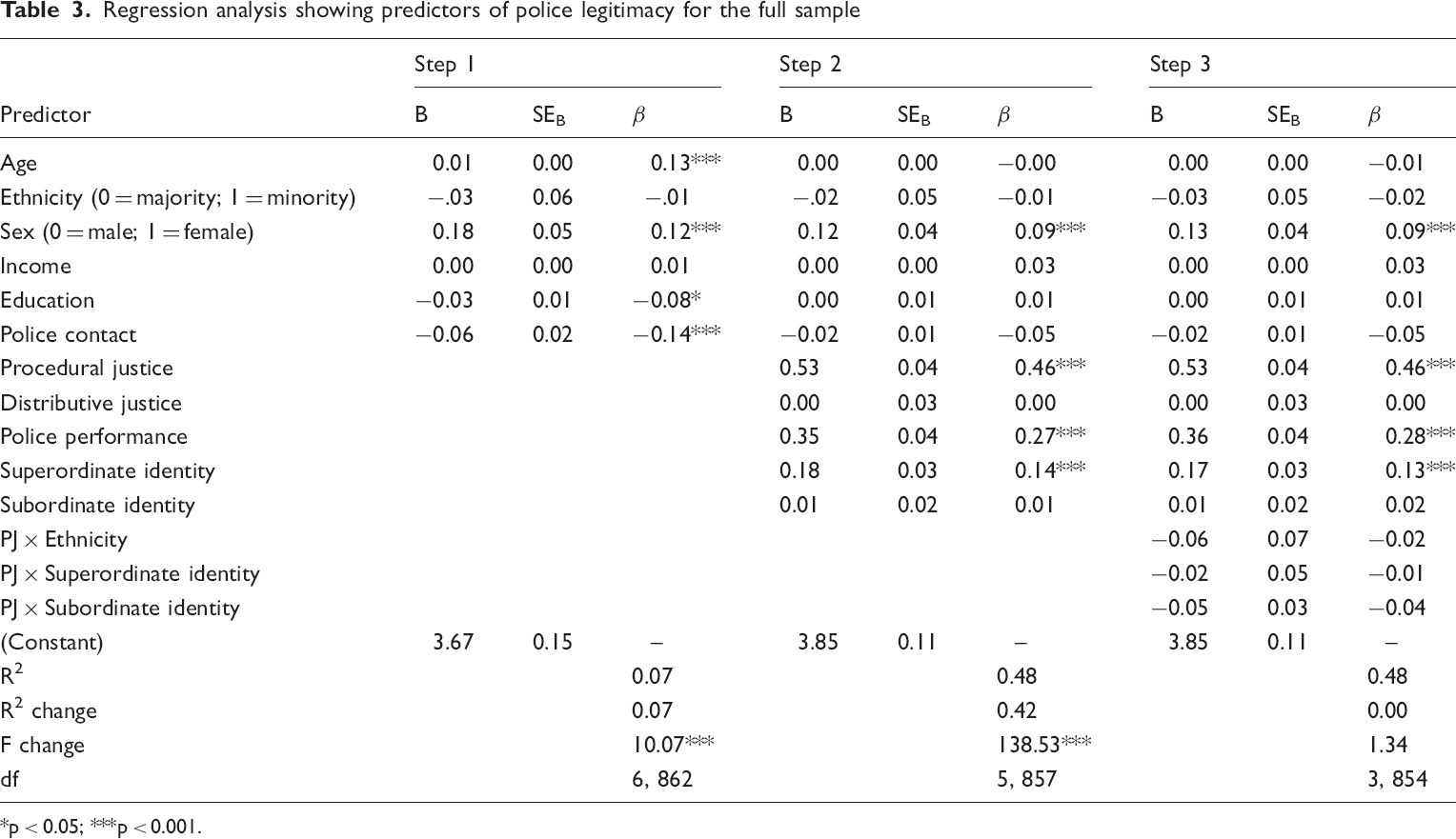
p < 0.05; ***p < 0.001.
Regression analysis showing predictors of willingness to cooperate with police for the full sample
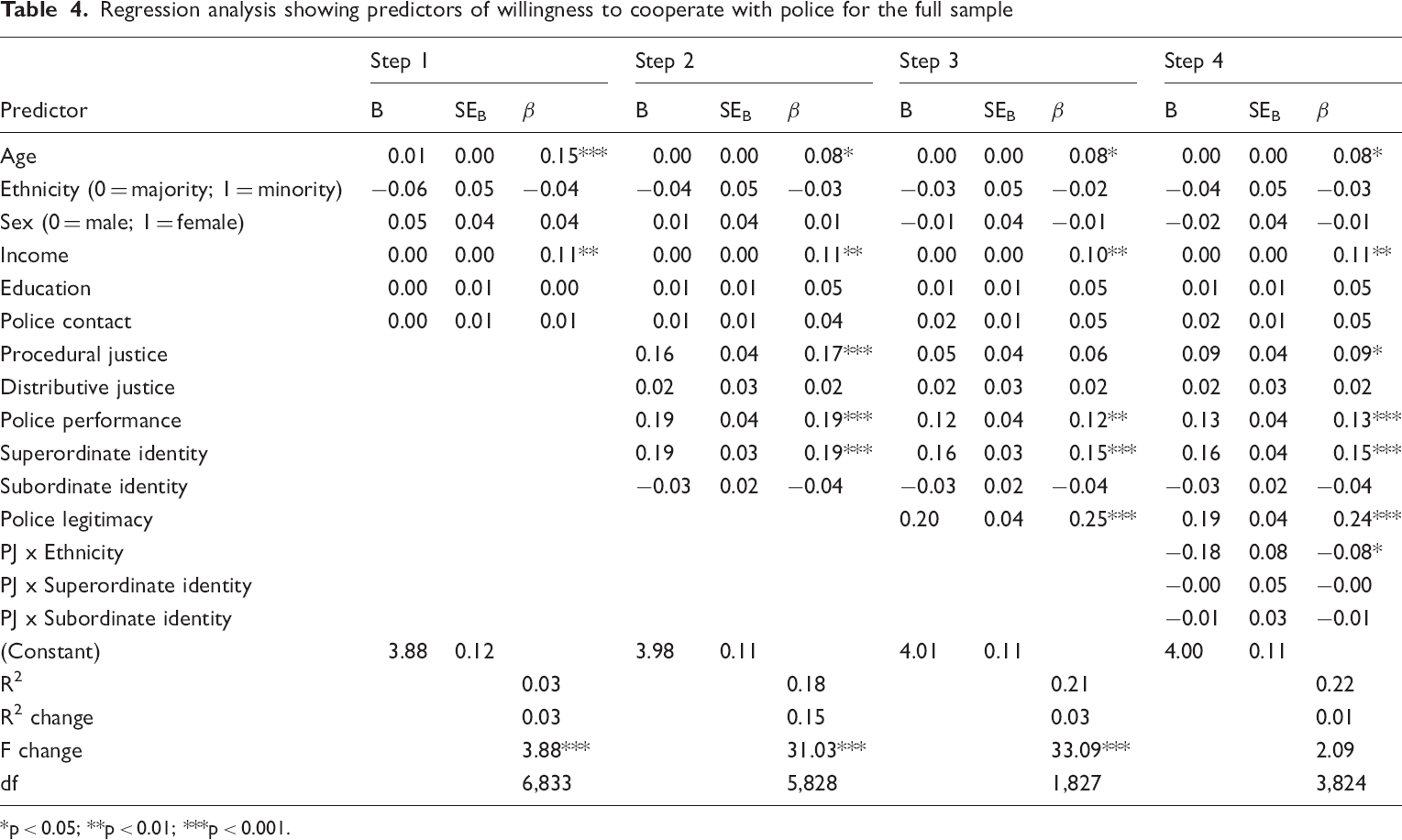
p < 0.05; **p < 0.01; ***p < 0.001.
On entry of the police legitimacy variable at Step 3, the age, income, police performance, and superordinate identity variables continued to predict cooperation. Legitimacy itself was also found to predict cooperation, with those perceiving police to be more legitimate being more willing to cooperate with them. In fact, legitimacy became the biggest predictor of cooperation at Step 3. It can also be seen from Table 4 that perceptions of police legitimacy appeared to fully mediate the effect of procedural justice on cooperative behaviour. When the legitimacy measure was entered into the model at Step 3, procedural justice no longer remained a significant predictor of willingness to cooperate. This finding supports those of previous procedural justice studies in both Australia and the US which show that perceptions of police legitimacy can mediate the effect of procedural justice on cooperation with police (see Murphy et al., 2008; Sunshine and Tyler, 2003). A significant Sobel test confirmed this mediation effect (z = 5.16, p< 0.001). More importantly, at Step 4 there was the significant interaction between procedural justice and ethnicity on cooperation. Ethnicity itself was not found to be a significant predictor of cooperation with police, however the interaction between procedural justice and ethnicity reveals that the impact of procedural justice on willingness to cooperate with police is moderated by ethnicity. The direction of the interaction suggests that procedural justice might be less effective in shaping cooperation among minority group members than for majority group respondents. No interaction was observed between procedural justice and superordinate or subordinate identity.
To illustrate the meaning of the significant interaction effect further, simple slope effects were calculated (Aiken and West, 1991). The simple slope effects revealed that for the majority group procedural justice was effective at increasing cooperation levels (β = 0.17, p<0.01). For the minority group, in contrast, procedural justice had no effect on cooperation levels (β = 0.02, ns). This particular finding is important because it differs from those obtained in the US, where findings have consistently revealed few differences in procedural justice effects across ethnic groups.
Discussion
The main aim of the present study was to examine the effect that procedural justice has in predicting perceptions of police legitimacy and willingness to cooperate with police in both minority and majority group citizens in Australia. This is the first time that such a study has been undertaken in Australia.
To summarize the findings it was found that procedural justice and perceptions of police performance predicted perceptions of police legitimacy for both ethnic minority and majority group members. Importantly, as in the US, relational factors mattered more to people when forming an opinion of the police. The present study also confirmed that procedural justice and perceptions of police performance predicted willingness to cooperate with police. However, the ethnicity of respondents was found to moderate the effect of procedural justice on willingness to cooperate with police. Procedural justice had no effect in shaping willingness to cooperate with police among ethnic minority group respondents. In contrast, for the majority group, procedural justice significantly enhanced their willingness to cooperate with police. This contradicts US-based research which tends to find that procedural justice effects vary little across ethnic groups.
Before proceeding to discuss why procedural justice may matter less to ethnic minority respondents in Australia, the methodological limitations of the present study should be highlighted. First, this study utilizes cross-sectional survey data. Cross-sectional data pose significant challenges if one wishes to make conclusions about the causal relationships that may exist between variables of interest. A longitudinal dataset following up the same people over time to examine how their views and behaviours on certain issues may change would go some way to addressing this issue. Likewise qualitative research would also assist in uncovering the processes and experiences (i.e. contextual conditions) that influence assessments of police legitimacy. These could be particularly important in the case of ethnic minority groups because of the unique social, political, and economic conditions that shape their experiences and influence police contact (Brunson and Miller, 2006).Second, the measure of cooperation used in the present study assessed survey respondents’ willingness to cooperate with police in a variety of circumstances. Self-reported willingness to cooperate in response to survey questions could in fact differ from how these people might actually respond in a real life request for assistance. Hence, the issue of context once again is relevant to an understanding of how people might cooperate with the police. Related to this is the impact that prior contact with police might have in influencing assessments of police legitimacy and willingness to cooperate (see Hinds, 2009; Murphy, 2009). This is an issue of particular importance to ethnic minority groups, because they may have two distinct reference points when making judgments about whether or not to assist police: (a) experience with police in their country of origin; and (b) experience with police in Australia. For instance, research has shown that for Arab, Sudanese, and Vietnamese communities in Australia both these factors impact on levels of cooperation with the police (Cherney and Chui 2010; Dixon and Maher, 2002; Meredyth et al., 2010; Pickering et al., 2008). Finally, we also acknowledge that the sample of respondents who identified as belonging to an ethnic minority group in the present study was relatively small and represented a diverse array of ethnic/racial backgrounds. Whether the group in the present study and their responses are representative of all ethnic minority groups that exist in Australia is therefore unclear. Related to this issue is the fact that the sample was drawn from the Australian electoral roll. Only Australian citizens were therefore included in the sample. New migrants from ethnic minority groups who may not yet have been eligible to take up citizenship, or those who may have chosen not to take up citizenship, are therefore excluded from the analysis. Even with these limitations, however, the present study has yielded some interesting findings. For example, why is it the case that procedural justice might be ineffective in nurturing cooperation among minorities living in Australia when it has proved so effective in the US? The following section uses a group identity perspective to provide a theoretical explanation for this finding.
Why might procedural justice matter little to minority respondents?
The group value model can be used to explain why ethnicity may have moderated the effect of procedural justice on people’s willingness to cooperate with police. Lind and Tyler (1988) argue that the interpersonal treatment people receive from authorities is a particularly important source of information about how much they are perceived as valued members of society. The group value model assumes that people are concerned about their long-term social relationship with authorities or institutions. The model also suggests that people value membership in social groups (Tyler, 1989). People want to belong to social groups and to establish and maintain the social bonds that exist within groups. As noted in the Introduction, the model asserts that individuals will assess their status within groups by evaluating the extent to which important group representatives (such as authorities) treat them fairly. When people feel they are treated with procedural fairness by these authorities, their sense of self-worth is bolstered and their attachment to the group is reaffirmed. Hence, if police act in procedurally unfair ways, it can influence the extent to which people feel socially connected because it provides a ‘yardstick’ by which people measure their overall status as valued and respected members of society (Tyler et al., 1997). In other words, fair procedures communicate respect and value, while unfair procedures communicate disrespect, marginality or even exclusion from a valued group. If people are treated disrespectfully, they are likely to suspect that the authority they are dealing with regards them as having low status.
The group value model allows for the finding that procedural justice may be less effective under certain circumstances. Procedural justice research has shown that identity-related factors can determine when procedural justice will affect views and behaviours toward group representatives and when it will not (e.g. Braithwaite et al., 2007; DeCremer 2002; Huo et al., 1996). The central finding of this research is that identification with an authority and the social group it represents matters, with procedural justice being potentially less effective for those who have a weak identification with mainstream groups and institutions. This points to a possible explanation for why procedural justice may have been ineffective for the minority respondents in the present study. While no significant procedural justice by identity interaction was revealed in the present study, minority respondents were less likely to identify with the superordinate group of Australians and were more likely to identify with their own subordinate ethnic or cultural group. Given that the police represent a group they are less likely to identify with, the group value model would predict procedural justice to matter less to them. However, this explanation causes us to pose two additional questions: (1) why would minorities in Australia as an overall group be less likely to identify with the dominant Anglo-Saxon Australian culture as the superordinate group than minorities in America? and (2) why might it be the case that ethnicity interacts with procedural justice in Australia when it does not in the United States? We suggest that minorities as a group in Australia may be less likely to identify with mainstream Australian culture and values and may be more likely to identify with their own ethnic subgroups than in the United States, given the strong emphasis on multiculturalism in Australia. Australia’s multicultural society asserts that cultural differences within society are valuable and should be preserved. Our multicultural philosophy proposes that different cultures mix, but should remain distinct in their own right. As observers on multiculturalism have commentated, the valorization of ‘otherness’ via the discourse of diversity has encouraged minorities to identify strongly with their own sub-group (Verkuyten, 2010). This is because multiculturalism focuses on the recognition and active support for group differences (Hage, 1998; Modood, 2007; Verkuyten, 2010). In contrast, in the United States, the ‘melting pot’ metaphor has long been used to describe the assimilation of immigrants and ethnic minority groups into mainstream cultures and values of the United States. Under a melting pot philosophy, minority groups are strongly encouraged to take on the identity of being American above all else (Gleason, 1979; Hirschman, 1983). While many do, some do not, perhaps leading to greater variability in identification levels within ethnic minority groups in the US (Hirschman, 1983). This could explain the importance of identity-related variables, as opposed to ethnicity per se, in moderating the effect of procedural justice in US-based studies. It should also be noted that in much of the previous procedural justice research from the United States, African-American respondents have often been used to examine ethnic or racial differences in procedural justice effects. These studies tend not to find a relationship between ethnicity and procedural justice. It could be argued that given that African-American culture has been of such importance to American culture as a whole, it is unlikely that people from this racial group would not see themselves primarily as Americans. So we might not expect to see differences in procedural justice outcomes for such a group overall when compared to the White Anglo-Saxon majority.Does this then mean that multiculturalism in Australia is a bad policy from a policing perspective? We would suggest no. Clearly the results of the present study suggest that police have to work harder to engage ethnic minority groups than majority group members. However, while procedural justice played no role in predicting minority cooperation with police in the present study, this does not suggest that procedural justice should not be utilized by police when they encounter ethnic minorities. After all, police legitimacy was found to be the predominant factor predicting willingness to cooperate with police, with procedural justice being a major and significant predictor of police legitimacy for both minority and majority groups. This particular finding is promising and suggests that police relations with minority groups can still be improved significantly through the adoption of a procedural justice-based policing approach. This begs an important question: what would a procedurally fair model of policing look like?
Conclusion: Policing ethnic groups with procedural justice
One implication of the findings reported here is that they seem to suggest that procedurally just encounters are not sufficient to alter general views of police and cooperation for ethnic minorities. 4 This may be the result of poor relations between the police and ethnic communities that taint ethnic group opinions of the police, coupled with the experiences of migrants with police in their country of origin. Any contact with the police would be processed in accordance with these pre-existing beliefs or attitudes (Brandl et al., 1994; Hamilton, 1981). Hence any police effort to engage minorities through processes that emphasize procedural fairness have to overcome more global views that the police cannot be trusted, no matter what they do or say (Brandl et al., 1994; Hawdon, 2008). These pre-existing attitudes may bias the processing of information relating to a police encounter or practice, in such a way as to only reinforce the existing belief system. This conclusion accords with research on cognitive processes associated with stereotyping that influence the formation of people’s attitudes (Greenwald and Banaji, 1995; Hamilton, 1981). Brandl et al. (1994) found that global attitudes about the police have a strong influence on the assessment of specific police practices. The relevance of this for the overall efficacy of procedurally fair policing has been under-analysed (Hawdon, 2008).
While this and other studies in Australia and abroad indicate that procedural justice is central to shaping perceptions of police legitimacy, a less understood issue is what a procedurally fair model of policing might look like? 5 Also if, as indicated in this study, identity related issues impact on assessments of procedurally just policing practices, what does this mean for how they are implemented?
Insight into both these issues can be provided by reference to the concept of voice, which has also been a focus of procedural justice research (Folger, 1977; Platow et al., 2008). Voice refers to the opportunity for groups to comment on or inform an authority’s decisions, and allows them to have some level of input into processes that affect them (Folger, 1977). Voice provides for some level of local control and is premised on notions of accountability and participation. In short, attention to the idea of voice builds trust both within and across social groups (e.g. between the police and ethnic communities) and is an important predicator of whether people perceive a process to be just (Folger, 1977).This finding is particularly relevant to police efforts to engage ethnic communities and generate increased participation in police/community partnerships. It needs to be recognized by police that consultation and collaboration with community groups has to be a two-way process. That is, police organizations cannot simply aim to engage ethnic groups as a way of improving responses to what the police themselves define as the key policing issues for that community. Within the context of counter-terrorism policing this issue has been identified as particularly problematic because of its undemocratic underpinnings and potential to further erode police/community relations (Innes, 2006; Pickering et al., 2008). It also has relevance more broadly because when police determine the security agenda it denies community members voice: the right to potentially influence processes that affect them (i.e. how their communities are policed).Complicating this process further is the distinction that can be made between instrumental and non-instrumental voice. Instrumental voice occurs when participation is invited before a decision is made. By informing the authority’s decision, it is possible that stakeholders can influence the outcome in such a way that brings instrumental rewards. Non-instrumental voice occurs when authorities invite people to comment on or speak out about a decision that has already been made. This kind of voice is called non-instrumental because by definition it can have no ultimate effect on the outcomes of the decision. The literature shows that instrumental voice is vital in promoting a sense of procedural justice and that non-instrumental voice tends to be very ineffective in promoting perceptions of legitimacy (Platow et al., 2008). This draws attention to the fact that procedurally fair practices operate across a spectrum from those that aim to be more polite, informative and unbiased but do not allow any direct citizen input into a decision or outcome (i.e. they promote non-instrumental voice), to those that provide an opportunity to directly influence decision making (i.e. they promote instrumental voice). If police adopt procedurally fair models that only promote non-instrumental voice, it is possible they will be looked upon as an insincere attempt to elicit cooperation. This may reinforce the perception that a particular group one belongs to (e.g. ethnic group) is of low status because no opportunity is actually being provided for them to have direct influence over decision making. Therefore, the types of procedurally fair practices used might matter a great deal in influencing cooperation with the police among ethnic groups. While this conclusion requires further empirical research, it points to the need to unpack models of police/community collaboration and highlights the need for police agencies to recognize that the type or method of engagement has the potential to influence levels of community cooperation.The practical relevance of this is that police agencies must be open and receptive to input about how community groups want their communities to be policed and there must be a demonstrable effect of that consultation – instrumental voice must be promoted, which enhances police legitimacy. If police are not amenable to suggestions made by community members, such as cultural and religious issues or practices that need to be kept in mind when police encounter or require cooperation from members of that ethnic or cultural group, then voice is denied and engagement is a superficial undertaking. If decisions have already been made about how police might address a community problem, then any attempt to engage the community will be perceived as tokenistic and insincere. The outcome will be that cooperation is likely to be non-existent and any level of collaboration fleeting. The reality is that procedurally fair models may differ between ethnic communities given cultural differences and the fact that experiences of policing can be very different across various ethnic groups (Brunson and Miller, 2006). The results of this study lend further weight to the idea of tailored models for ethnic minority groups. Future research in the area of policing and procedural justice would benefit from additional attention to both how the experiences of minorities shape their understanding of procedural justice and what these groups believe procedurally just policing in their communities should look like (Brunson and Miller 2006).
Funding
The present research was supported by the Australian Research Council (Discovery Grants DP0987792 and DP1093960.)
Footnotes
Notes
Appendix 1
Contained in Appendix 1 is a complete list of the measures used in the analyses of this paper. It also details the original scale formats and the recoding of data if applicable (reverse scoring indicated with the letter r).
Procedural Justice. Items measured on a 1 = strongly disagree to 5 = strongly agree scale.
Police treat all people fairly. Police treat everyone equally. Police treat people with dignity and respect. Police listen to people before making decisions. Police are always polite when dealing with people. All citizens are treated politely by police.
Distributive Justice. Items measured on a 1 = strongly disagree to 5 = strongly agree scale.
Police sometimes give people from specific ethnic backgrounds less help than they give others (r). Police provide a better service to the rich than to the average citizen (r).
Police Performance. Items measured on a 1 = very poor job to 5 = very good job scale.
On the whole, how good a job are police doing in your neighbourhood at…
preventing crime solving crime working with people in your community to solve local problems keeping order dealing with problems that concern you?
Police Legitimacy. Items measured on a 1 = strongly disagree to 5 = strongly agree scale.
I respect police. I trust police. I have confidence in police. I am proud of my police force. I have a great deal of confidence in the police as an organization.
Cooperation with Police. Items measured on a 1 = very unlikely to 5 = very likely scale.
If the situation arose, how likely would you be to…
help police to find someone suspected of committing a crime by providing them with information report dangerous or suspicious activities to police call police to report a crime willingly assist police if asked?
Superordinate identity. Items measured on a 1 = strongly disagree to 5 = strongly agree scale.
Do you see yourself first and mainly as a member of the Australian community? Is it important for you to be seen by others as a member of the Australian community? I am proud to be an Australian. What Australia stands for is important to me.
Subordinate identity. Items measured on a 1 = strongly disagree to 5 = strongly agree scale.
Do you see yourself first and mainly as a member of your racial/ethnic group? Is it important for you to be seen by others as a member of your racial/ethnic group