







Abstract
Recent studies have found evidence of a racial bias in sentencing in Australia despite previous work showing the opposite. However, in some cases, these studies fail to adjust properly for differences in offence seriousness and in others fail to control for important covariates. Our aim in this study was to investigate the relationship between Indigenous status and likelihood of imprisonment for serious assault offences, matching on offence seriousness and controlling for additional covariates. Multivariate logistic regression with generalized estimating equations was used to explore the effect of Indigenous status on the likelihood of a prison sentence while controlling for the other sentence-relevant factors. Interaction effects were examined by fitting a logistic regression model with all covariates separately for Indigenous and non-Indigenous offenders and comparing the coefficient of each covariate for differences. The results show that the marginal increase in the risk of a prison sentence for Indigenous offenders is less than one percentage point (3.40% for Indigenous offenders compared with 2.45% for non-Indigenous). Significant interaction effects between Indigenous status and whether or not the offence was domestic violence related (p = .024), whether or not the offence was committed after 2011 (p = .020) and whether or not the offender had previously been issue a community service order for a serious assault offence (p = .025) were found, each of which altered the probability of imprisonment. Despite this, no interaction effect was found that resulted in a difference in marginal probability of imprisonment greater than 1.2 percentage points between Indigenous and non-Indigenous offenders. We conclude that while there is a significant effect of Indigenous status on sentencing, the effect is vastly reduced when controlling for additional covariates.
Keywords
Introduction
One of the main problems currently faced by the criminal justice systems in Australia is the gross over-representation of Indigenous offenders in the prison population. In September 2016, nearly 25% of all adult prisoners in New South Wales (NSW) identified as either Aboriginal or Torres Strait Islander status (NSW Bureau of Crime Statistics and Research [BOCSAR], 2016), despite only comprising 2.9% of the general population (June 2011 estimate, Australian Bureau of Statistics, 2013).
One possible explanation for this discrepancy is systemic bias in the response of the criminal justice system to Indigenous defendants and offenders, as claimed by Anthony (2013); Blagg, Morgan, Cunneen, and Ferrante (2005); and Cunneen, Allison, and Schwartz (2014). However, research seems to be mixed regarding whether or not a systemic bias exists at sentencing. While there is qualitative research to suggest that a bias may exist in sentencing (Anthony, 2013; Anthony, Bartels, & Hopkins, 2015; Baldry & Cunneen, 2014; Cunneen, 1992), empirical results on the matter have been mixed.
In Australia, studies by Bond and Jeffries (2010); Bond and Jeffries (2011a); Bond and Jeffries (2011b); Jeffries and Bond (2009); Snowball and Weatherburn (2006); Snowball and Weatherburn (2007) found little or no evidence of a bias between Indigenous and non-Indigenous offenders at sentencing. In fact, in their review of the quantitative literature, Jeffries and Bond (2012) concluded: Once crucial sentencing factors are held constant (especially, current and past offending), sentencing outcomes for Indigenous and non-Indigenous offenders either achieve parity or the gap [in sentencing outcomes] is considerably reduced … In circumstances where disparity remains, there is evidence to suggest that, Indigenous defendants are at times treated leniently in comparison with their non-Indigenous counterparts. (p. 23)
Lockwood, Hart, and Stewart (2015) also report mixed results in sentencing disparities between Indigenous and non-Indigenous offenders in Queensland courts, using conjunctive analysis of case configurations (CACC) to match appropriate observations. CACC is a technique which matches observations on all observable covariates except for the variable of interest (Indigenous status, in this case). The technique was used in a criminological context by Miethe, Hart, and Regoeczi (2008) who used it to examine factors influencing the sentencing of federal drug offenders in the United States. Lockwood et al. (2015) used it to compare sentencing outcomes between Indigenous and non-Indigenous offenders who only differed only in terms of Indigenous status. They found that the difference in imprisonment rate between the two types of offenders ranged between −35 percentage points and 44 percentage points in the lower court and between −30 percentage points and 56 percentage points in the higher court. A negative difference means that Indigenous offenders were sentenced less harshly, whereas a positive difference means they were sentenced more harshly.
One likely explanation for the inconsistent results found in quantitative studies of racial bias in sentencing is that different studies employ different controls. Studies of racial bias in sentencing need to take particular care to include variables that have been identified by the appeal courts or the legislature as relevant to sentencing. Drug and alcohol abuse, for example, has been identified by appeal courts as a relevant and sometimes aggravating consideration in the sentencing for violent offences (see NSW Sentencing Council, 2009, p. 46), yet neither Donnelly and Poynton (2015) nor Jeffries and Bond (2015) included controls for this factor. Again, past studies have found that prior penalties exert an effect on penalty selection over and above the effect of prior convictions (see, for example, Snowball, 2008). Courts also seem more likely to impose prison sentences where an offender has previously breached an apprehended violence order (Donnelly and Poynton, 2015). Jeffries and Bond (2015) included no controls for prior penalties or prior breaches of orders. Some or all of the effects of Indigenous status on the risk of imprisonment might be due to failure to control for these factors. For example, when Bond and Jeffries (2009) and Snowball and Weatherburn (2007) included controls covering (among other things) prior criminal history (and in the case of Bond and Jeffries, substance abuse), they showed that as more controls were added to the model, the odds ratio for the effect of Indigenous status on imprisonment decreased.
Another important procedural requirement in studies examining the effect of racial bias in sentencing is to avoid grouping offences with very different statutory maxima. The statutory maximum penalty is an important marker of the seriousness with which the legislature views a particular offence. Offenders convicted of offences with very different statutory maxima are likely to receive very different sentences. Failure to control for this could bias estimates of the effect of Indigenous status on the risk of imprisonment. Two offenders convicted of assault who differ only in their Indigenous status may receive different penalties because one has committed a more serious form of assault (e.g. assault occasioning grievous bodily harm) than the other (e.g. common assault). Jeffries and Bond (2015) endeavoured to mitigate this risk by including a measure of offence seriousness using the National Offence Index (Australian Bureau of Statistics, 2009), but it is doubtful that this strategy succeeded. For one thing, their sample consisted of all adult offenders convicted of a ‘personal’ offence. This would have included offenders convicted of offences as diverse (in terms of seriousness) as assault, sexual assault and robbery. For another, the National Offence Index also conflates offences of widely varying seriousness. The index, for example, makes no distinction between assault occasioning actual bodily harm (assault ABH) and assault occasioning grievous bodily harm (assault GBH) although assault ABH has a maximum penalty of 5 years imprisonment and assault GBH has a maximum penalty of 25 years imprisonment.
The purpose of this study is to revisit the questions addressed by Donnelly and Poynton (2015) and Jeffries and Bond (2015) using (a) a more extensive set of controls and (b) assault offences matched in terms of seriousness. More specifically, in addition to the usual demographic and prior record controls, we include controls for drug and alcohol abuse, prior penalties (prior suspended sentence, prior prison sentence) and prior breach of an apprehended violence order. We also include specific controls for the seriousness of the assault, as indicated by the exact nature of the charge (conviction for assault occasioning ABH vs. conviction for assault occasioning GBH).
Method
Data sources
Data were taken from BOCSAR’s Re-Offending Database. The sample we considered covered offenders who were found guilty of a serious assault offence (ANZSOC code 0211) as their principal offence in a NSW Local Court between January 2009 and December 2014 and who received a prison sentence, suspended sentence or suspended supervised sentence only. The sample was limited to those offenders whose principal offence was an assault involving ABH or GBH (the law part codes for these offences can be found in Table 6 of Appendix 1). The law part codes used only took effect from 31 March 2008, so offenders were restricted to those whose principal offence had occurred after this date.
Explanatory covariates
The majority of covariates included as explanatory variables were those used by Donnelly and Poynton (2015). These variables were as follows:
Age: The age of the offender at the time of index finalisation. This was classified into categories of 18–24 years; 25–34 years; 35–44 years; 45+ years Gender: The gender of the offender Indigenous status: The Indigenous status of the offender as recorded at the index contact, classified as non-Indigenous/unknown; Indigenous Year of Finalisation: The year the index matter was finalised, classified into categories of 2009–2011; 2012–2014 Plea: How the offender pleaded to the index offence, classified as not guilty; guilty/other Concurrent offences: Number of proven concurrent offences other than the principal offence at the index contact, classified as none; one; two; three or more Severity: The severity of assault, classified as ABH; GBH (classified using law part codes) DV Related: Whether or not the principal offence was a domestic violence related offence, classified as DV related; non-DV related (classified using law part codes) Prior proven court appearances: Number of finalised court appearances with proven offences in the five years prior to the index appearance, classified as none; one; two; three or more Prior proven serious assaults: Same as prior proven court appearances, restricted to serious assault offences (ANZSOC codes 211 and 212), classified as none; one or more Prior prison sentences: Same as prior proven court appearances, restricted to appearances where the offender received a prison sentence for the principal offence, classified as none; one; two or more Prior prison sentences for serious assault: Same as prior prison sentences, restricted to appearances where the prison sentence was for serious assault offences (ANZSOC codes 211 and 212) Prior suspended prison sentences: Same as prior prison sentences, but for court appearances where the offender received a suspended sentence rather than a prison sentence, classified as none; one or more Prior proven breaches of violence/non-violence orders: Number of finalised court appearances with proven breaches of violence/non-violence orders in the five years prior to the index appearance, classified as none; one or more
In addition, the Level of Service Inventory-Revised (LSI-R) domain 8 score was included as an indicator for previous alcohol/drug abuse. The LSI-R score was treated as a categorical variable, with an additional category for offenders who had no LSI-R score present. Because the decision on what sentence to impose depends partly on how the defendant has responded to previous penalties, a number of variables looking at the prior penalties received for serious assault offences were also included. These were as follows:
Prior suspended prison sentences for serious assault offences: Same as prior suspended sentences, but for court appearances where the suspended sentence was for a serious assault offence (ANZSOC codes 211 and 212), classified as none; one or more Prior supervised suspended prison sentences for serious assault offences: Same as prior suspended sentences for serious assault, but for court appearances where the suspended sentence was supervised, classified as none; one or more Prior community service orders for serious assault offences: Same as prior suspended sentences for serious assault, but for court appearances where a community service order was imposed rather than a suspended sentence, classified as none; one or more Prior good behaviour bonds issued for serious assault offences: Same as prior suspended sentences for serious assault, but for court appearances where a good behaviour bond was issued rather than a suspended sentence, classified as none; one or more Prior supervised good behaviour bonds issued for serious assault offences: Same as prior suspended sentences for serious assault, but for court appearances where a supervised good behaviour bond was issued rather than a suspended sentence, classified as none; one or more
Statistical analysis
Descriptions of the different models used in this analysis.
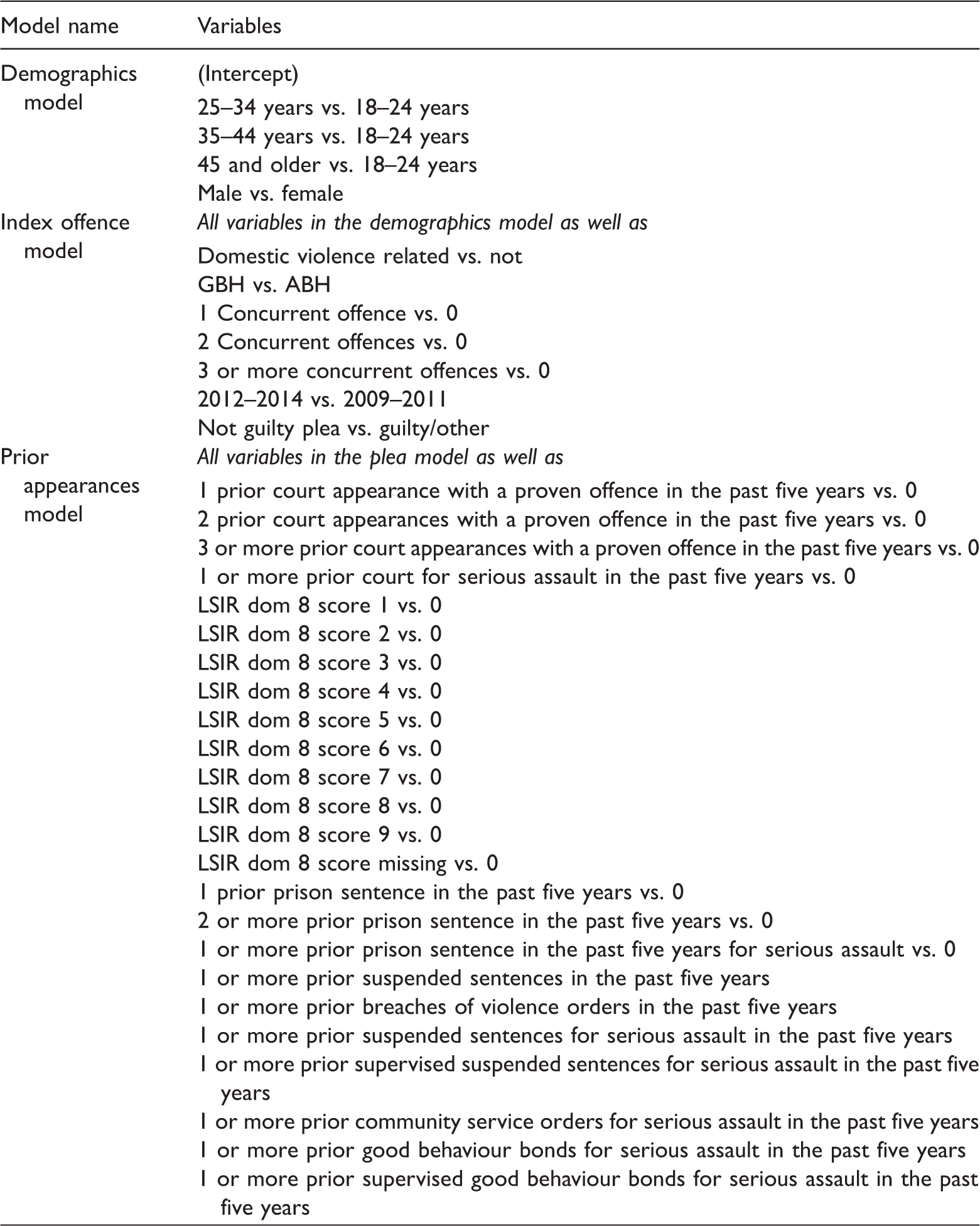
Due to the large number of variables, interaction effects were not included in the binomial GEE regression. Possible interaction effects were examined by fitting the model separately for Indigenous and non-Indigenous offenders, then comparing the coefficient estimates for each parameter for the two models. Standard multivariate logistic regression was used rather than GEE regression at this stage, as it tests for significance between the coefficients of the two models. The coefficients were tested for difference using the procedure outlined by Paternoster, Brame, Mazerolle, and Piquero (1998).
Results
Offender characteristics
Demographic characteristics of serious assault offenders.
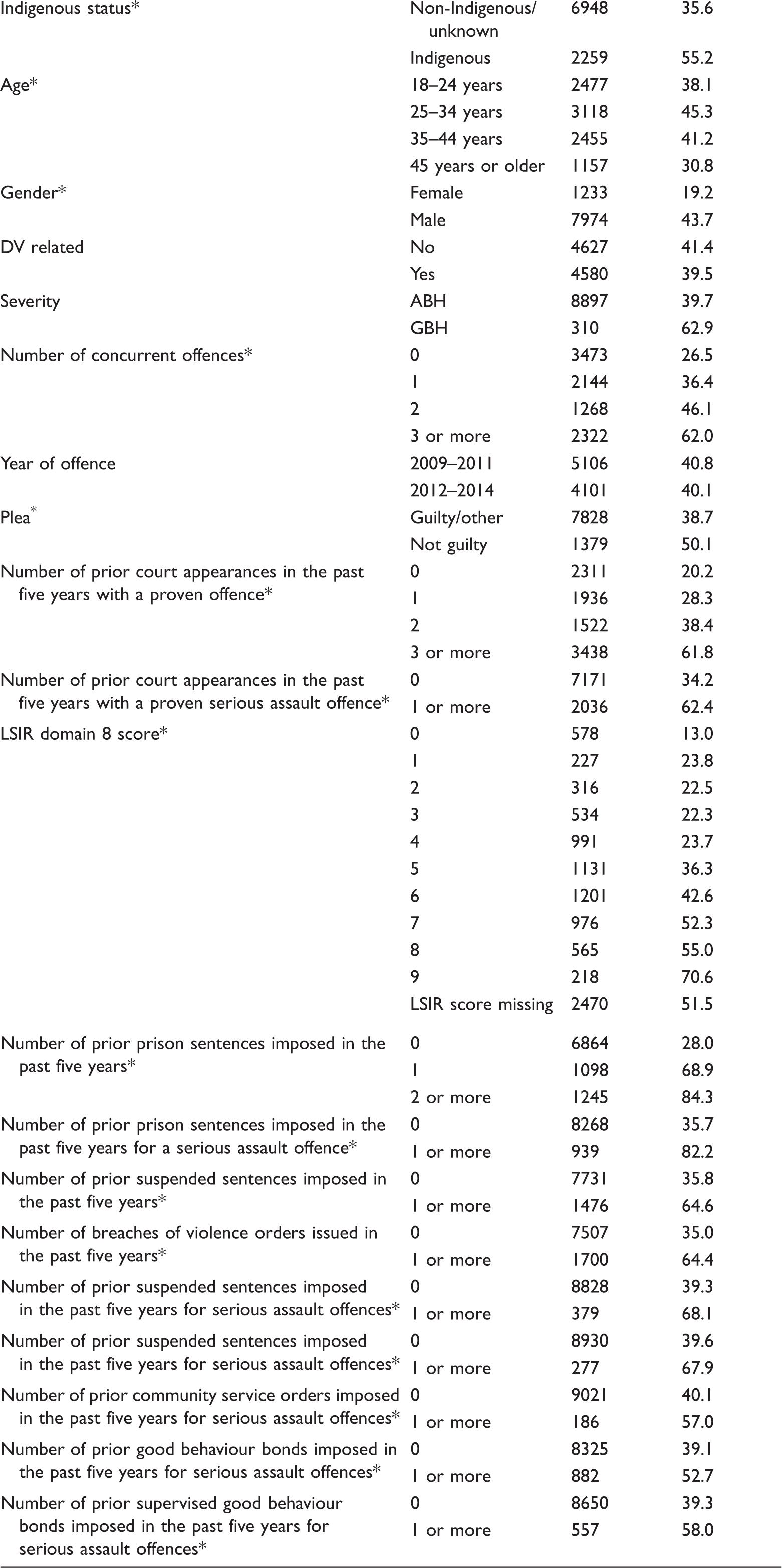
Significant association between the variable and probability of imprisonment.
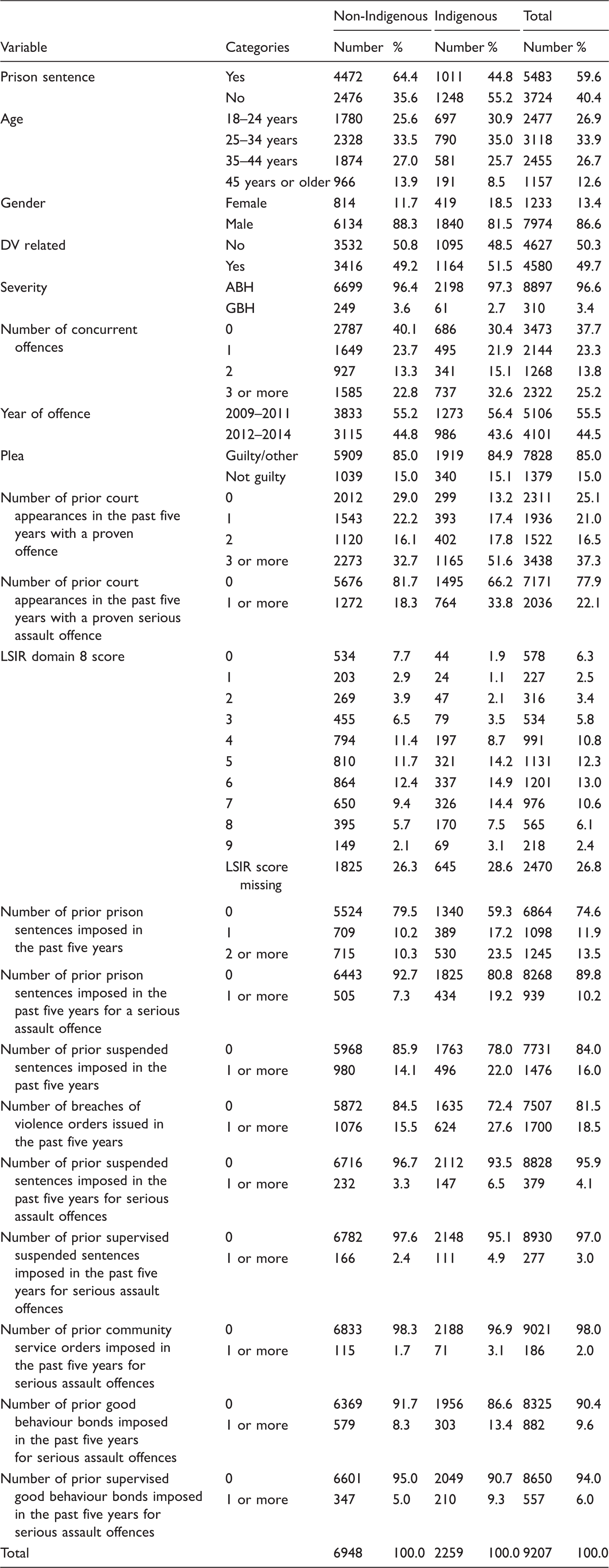
Demographic characteristics of offenders by Indigenous status.
Multivariate models
Coefficient estimates and standard errors for variables in each model.
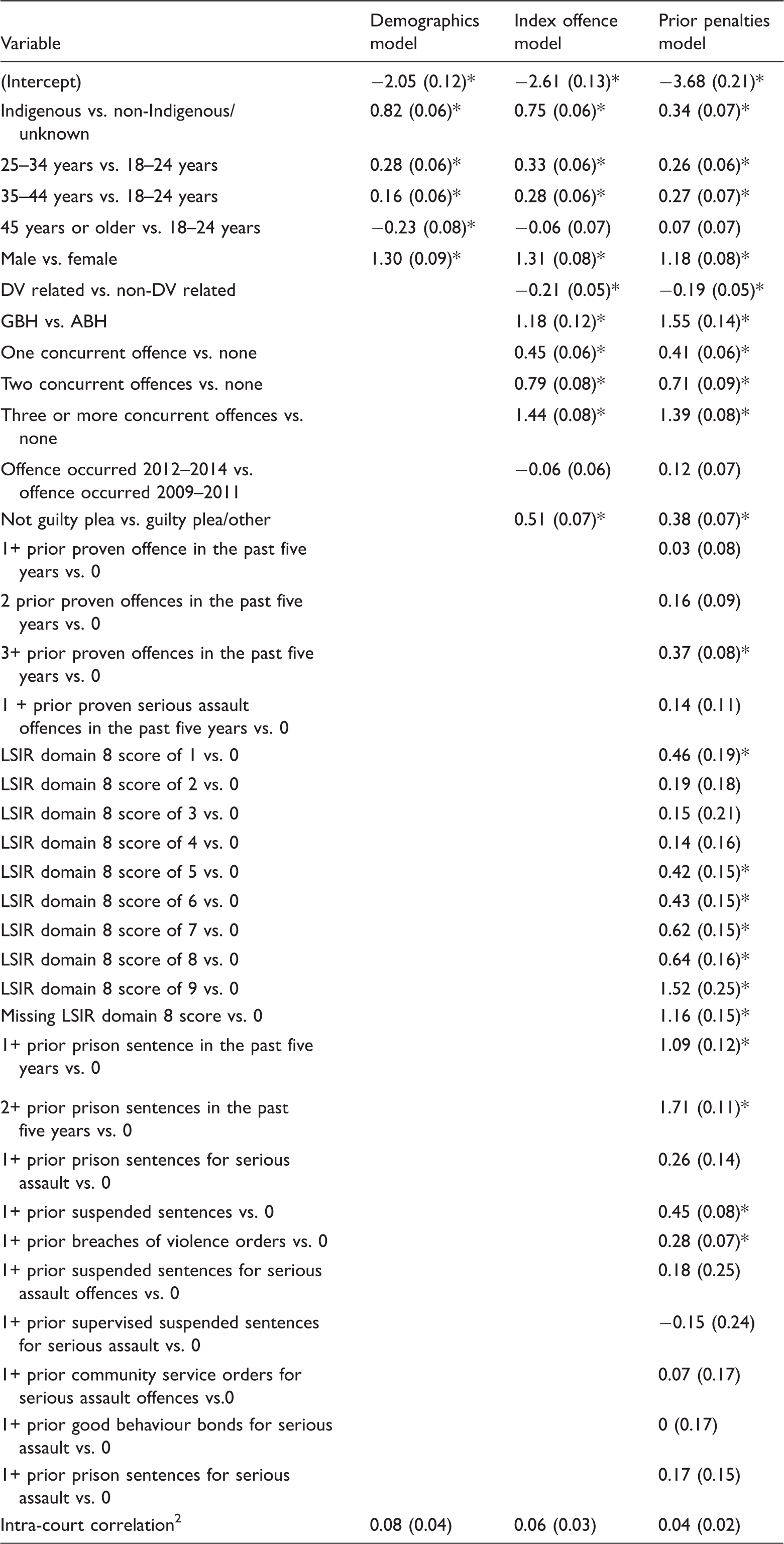
Significant at the 5% level.
The coefficient for Indigenous status is both positive and significant in all three models, showing that no matter what variables are controlled for, Indigenous offenders (all else being equal) have an increased likelihood of receiving a prison sentence. However, the size of the coefficient decreases as more variables are added to the model. This shows that the difference in the likelihood of an Indigenous and a non-Indigenous offender receiving a prison sentence decreases as more variables are controlled for. To illustrate this, we calculated the marginal probabilities of receiving a prison sentence for the referent-level offenders for each model for both Indigenous and non-Indigenous offenders, shown in Figure 1.
Marginal probabilities of offenders by Indigenous status.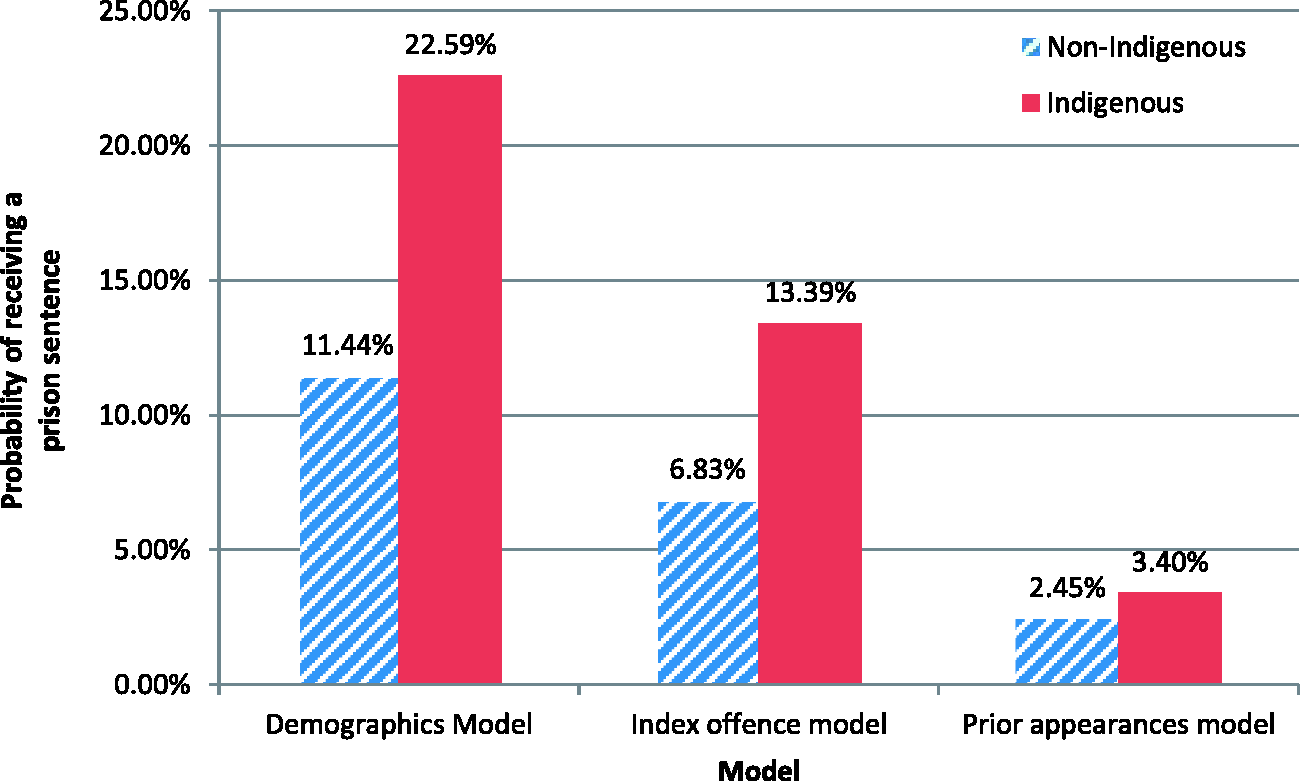
Figure 1 shows the marginal probability of receiving a prison sentence for an Indigenous and non-Indigenous offender of the referent level for all other covariate variables (a female offender, aged 18–24 years, found guilty of an ABH, non-DV offence with no concurrent or prior offences of any kind, and an LSI-R score of 0). The probabilities shown in Figure 1 support the conclusion drawn from the coefficient estimates in Table 4 – the more covariates that can be controlled for, the smaller the difference in probability of imprisonment. Once all covariates have been controlled for, the difference in probability is less than one percentage point (as opposed to approximately 11 percentage points for the demographics only model).
Comparison of coefficients for Indigenous and non-Indigenous models.
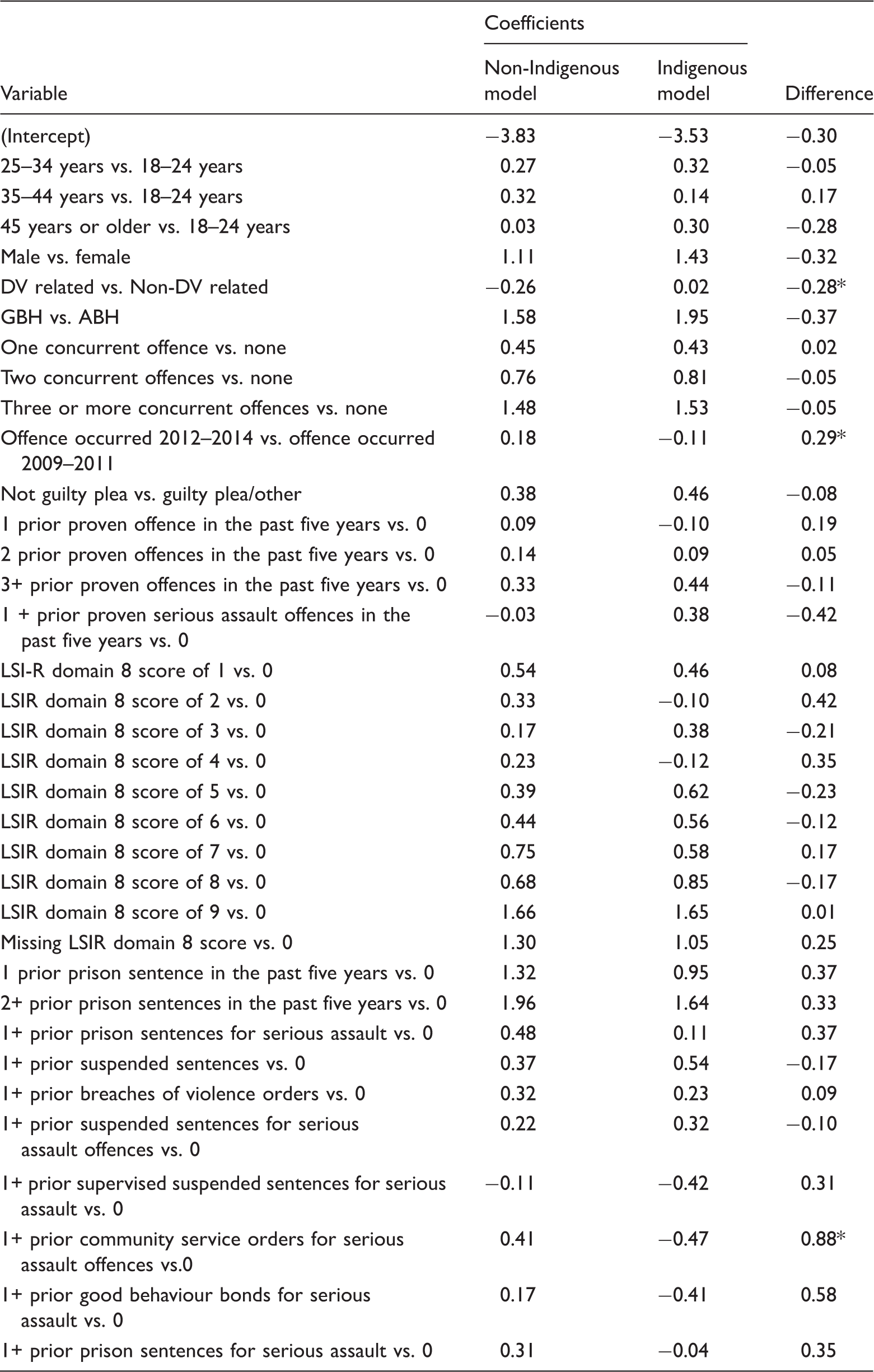
Difference between the coefficients is significant at the 5% level.
Table 5 shows the difference in coefficients between the Indigenous and non-Indigenous models. Three variables show a significant interaction effect: whether or not the offence was domestic violence related (Indigenous offenders were more likely than non-Indigenous offenders to receive a prison sentence), whether or not the offence occurred after 2011 (non-Indigenous offenders were more likely to receive a prison sentence after 2011) and whether or not the offender had received a community service order for a serious assault offence in the previous five years (non-Indigenous offenders who received a community service order were more likely to receive a prison sentence than Indigenous offenders). Given this, the marginal probabilities for different offenders were recalculated using these two models to show the effect of the significant interaction effects, shown in Figure 2.
Marginal probabilities of offenders by Indigenous status accounting for interaction effects.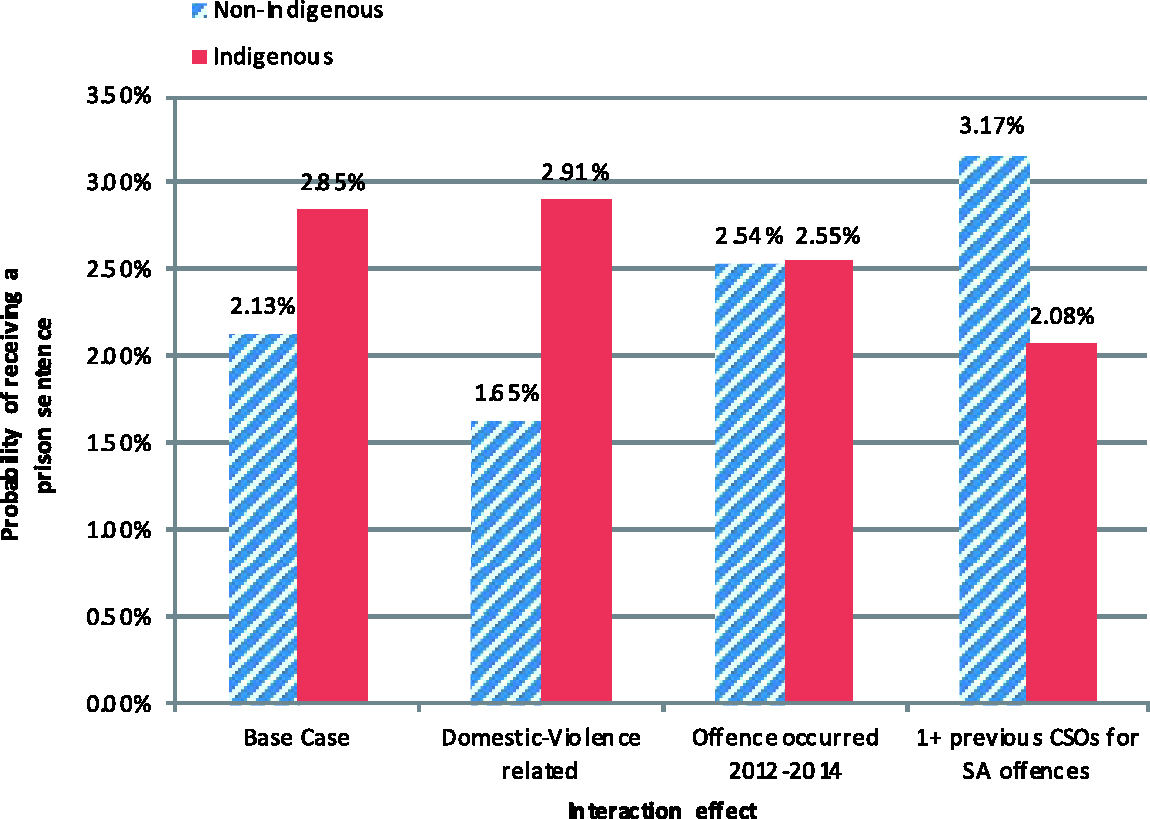
Figure 2 shows that the significant interaction effects have only a small impact on the difference in likelihood of imprisonment. The largest difference found was for offenders committing a domestic violence offence, in which Indigenous offenders were roughly 1.25 percentage points more likely to receive a prison sentence than non-Indigenous offenders (compared to the base-case for offenders, in which Indigenous offenders were less than one percentage point more likely). The interaction effects for year-group of offence and the presence of previous community service orders for serious assault offences both increased the likelihood of non-Indigenous offenders receiving prison sentences relative to Indigenous offenders. When the offence occurred after 2012, the difference in the likelihood of imprisonment was negligible across Indigenous status, whereas the presence of a previous community service order for a serious assault offence actually made a non-Indigenous offender more likely to be imprisoned than an Indigenous offender.
Discussion
Given the substantial difference in incarceration rates between Indigenous and non-Indigenous offenders in NSW, it is vital to look at factors which could be influencing this, including sentencing bias. This is especially important given the inconsistency in previous research between Snowball and Weatherburn (2006, 2007), on the one hand, and Jeffries and Bond (2015) and Donnelly and Poynton (2015), on the other.
Our binomial GEE regression models showed that Indigenous status of the offender had a significant effect on the probability of receiving a prison sentence over a suspended sentence or supervised bond. This effect persisted as more covariates were added to the model, supporting the findings of Donnelly and Poynton (2015). Furthermore, separate modelling of both Indigenous and non-Indigenous offenders showed an interaction effect between Indigenous status and whether or not the offence was domestic violence related, again supporting Donnelly and Poynton (2015).
Unlike Donnelly and Poynton (2015), however, the effects of Indigenous status in the current study are comparatively small. Once all covariates have been controlled for, the difference in the probability of imprisonment between Indigenous and non-Indigenous assault offender is less than one percentage point (as opposed to approximately 11 percentage points for the demographics only model). This highlights the importance of including comprehensive, sentence relevant controls in any analysis of the effect of race (or Indigenous status) on sentencing. The larger effect of Indigenous status on imprisonment risk found in the Donnelly and Poynton (2015) and Jeffries and Bond (2015) studies would appear to be due to their more limited controls. This said, it must be emphasised that the current study still finds a significant interaction between Indigenous status, offence type and penalty choice. The effect may be small but Indigenous offenders convicted of assault are more likely to receive a prison sentence than non-Indigenous offenders if the assault is domestic. To that extent our results support the interpretation given by Jeffries and Bond (2015, p. 476) of their results: namely that Australian courts in recent times have been treating domestic violence in Indigenous communities as a fundamental cause of Indigenous community dysfunction and, as a result, imposing tougher penalties on Indigenous offenders convicted of domestic violence offences. We agree, moreover, that imprisoning a higher proportion of Indigenous domestic violence offenders is not likely to do much to improve the safety of Indigenous victims of assault. It is bleak consolation to note that our results seem to show that after 2011 courts seem to have become more willing to impose a prison sentence on non-Indigenous offenders.
The interaction of Indigenous status with past receipt of a community service order is interesting and admits of at least two explanations. Snowball and Weatherburn (2007) in their analysis of the effect of racial bias in sentencing found that courts placed less weight on the prior criminal record of the offender in the case of Indigenous offenders than non-Indigenous offenders. Snowball and Weatherburn (2007) suggested that this may reflect the courts’ sensitivity to the economic and social disadvantage experienced by Indigenous Australians (echoing the findings by Jeffries and Bond, 2012, p. 23). It is possible that the current finding (that courts place less weight on the fact that an Indigenous offender has had a community service order than if a non-Indigenous offender has had such an order) reflects a similar tendency. An alternative possibility is that the effect is an artefact of sample size. The number of Indigenous offenders who had previously received a community service order (71) was comparatively small. In the circumstances, it would be unwise to place too much weight on the finding.
Taken as a whole, the current findings give little reason to believe that the gross disparity between Indigenous and non-Indigenous rates of imprisonment is explicable in terms of racial bias in sentencing. The overwhelming weight of evidence suggests that Indigenous/non-Indigenous differences in rates of offending (and re-offending) account for most, if not all of the difference in imprisonment rates (Weatherburn, 2014). Of course, this does not mean that the criminal justice system as a whole is free from racial bias. Police, for example, may be biased in the way they exercise their discretion to refuse or grant bail or in the decision about how to proceed in relation to a suspected offender. These are possibilities that deserve further research. The key question for policy makers is where best to apply their efforts to reduce Indigenous over-representation in prison. Indigenous Australians are known to fare far worse on most of the factors associated with higher rates of offending, including drug and alcohol abuse, child neglect and abuse, poor school performance and unemployment (Weatherburn, 2014). Reducing the influence of these factors would certainly reduce Indigenous over-representation in prison. Whether heightened judicial awareness of the possibility of racial bias in sentencing would have a similar effect is far less clear.
Footnotes
Declaration of conflicting interests
The author(s) declared no potential conflicts of interest with respect to the research, authorship, and/or publication of this article.
Funding
The author(s) received no financial support for the research, authorship, and/or publication of this article.