






Abstract
The concepts of crisis and contestation have become ubiquitous in International Relations (IR) and beyond. Indeed, crisis and contestation are theoretical terms that crystallize the current challenges to global governance and international orders. At the same time, not only the definition of each term individually but also especially of their relationship remains opaque and has not yet encouraged cross-disciplinary debates within and beyond IR. This is not only unfortunate but also potentially clouds researchers’ understanding of these challenges as well as policy-makers’ efforts to manage the present crisis, upsetting global governance, as this forum illustrates. By discussing the relationship, but also the boundaries of these two concepts, across a wide variety of empirical situations, the contributions to this forum illustrate how approaching a situation as a crisis or a contestation influences its understanding. Moreover, the forum highlights four dimensions that structure the relationship and influence scholarly understanding of these challenges in a future yet to come.
Introduction
Johanna Speyer and Nils Stockmann
Whoever says crisis means the world, says famine, says third world.
These lyrics by Belgian singer Stromae seem to suggest that crisis and the international simply belong together. And indeed, these days, crisis seems to be all around. However, while Stromae links crises to famine and developing countries, the present crises extend far beyond specific countries or regions and destroy certainties on a global and local level. Consider only the ongoing Russian attack on Ukraine, which is first and foremost a crisis to the Ukrainian state and society in the sense of an existential and immediate threat. But this crisis not only marks the return of interstate war to Europe, but it has also been a catalyst for other lingering crises, such as crises of the transatlantic security partnership and European energy security. Situations like this convey imminent and complex uncertainty and, by many, are perceived as a fundamental disruption of, if not an existential threat to, society and life. And while Stromae’s advice to “go out and forget about the problems” seems to recall the proverbial ostrich that buries its head in the sand, academics remain split over crises and the analysis of their effects, while international organizations (IOs) and states, it seems, can hardly keep pace in designing effective countermeasures and precautionary strategies. A wide array of crisis typologies has been proposed, each aiming to characterize crises and to make accessible the specific challenges they pose. Moreover, the cooccurrence of different crises has stipulated a vivid engagement with concepts such as “multiple” or “poly” crises (e.g. Boin et al., 2020; Brosig, 2025). Meanwhile, Peoples (2024: 5) suggests that the diagnosis of a “Crisis of the Liberal International Order” has become “a minimally shared reference point for its critics and defenders alike” and degenerated into a “technology of crisis management in itself,” rather than maintaining a critical perspective on its “object.”
In a parallel, though seemingly little-connected development, interest in contestation has surged. The concept of contestation in International Relations (IR) has been discussed particularly in relation to norms (Lucenti et al., 2025; Orchard and Wiener, 2024; Zimmermann et al., 2023). International norms, those formerly considered “stable,” are found to be “in motion” (Zwingel, 2017) and subject to change in almost every issue area. A prominent example of timely relevance includes the international norm framework on nuclear non-proliferation, which is in constant flux and challenged by both norm entrepreneurs and antipreneurs (Tannenwald, 2024; Wunderlich, 2020). At the same time, recent contributions have, explicitly or implicitly, broadened the concept to refer to institutions, IOs, the international order, policies, or global governance (e.g. Goddard et al., 2024; Lake et al., 2021; Speyer, 2025; Zürn, 2018). However, whether contestation has a strengthening or weakening effect on the robustness of the contested entities remains disputed – just as the effect of crises on international (institutional) orders (Deitelhoff et al., 2026; Deitelhoff and Zimmermann, 2019, 2020; Wiener et al., 2026).
While the concepts “Crisis” and “Contestation” are well established as focal reference points in IR scholarship and have become the nucleus of scholarly debates up to the formation of (norm) contestation and crisis (management) research communities, the two debates remain largely separate. And indeed, there may be instances where such separation is justified, especially when research comes close to policy or activism. Researchers interested in the emancipatory effects of norm contestation may avoid the crisis language due to its colloquial association with urgency and authoritative action. Conversely, scholar-activists urging for definite action upon global challenges such as climate change may prefer to mobilize the crisis term and shy away from using “contestation” as it might suggest a “normal” global governance procedure (Dreyer and Holm, 2025). Nevertheless, certain situations in contemporary global politics are simultaneously described as a contestation and a crisis, and it is this “fuzzy” territory that we want to explore in this forum. 2 Specifically, we argue that this conceptual choice has a profound impact on how the event in question is assessed. But how does it matter if we speak of a crisis or contestation? We argue that viewing both concepts together may be key to understanding and effectively governing episodes of crisis or contestation. Indeed, theoretically informed clarity about the crisis and contestation concepts, their boundaries and relations provides researchers of IR and beyond with more analytical and reflexive precision as they assess and explain global dynamics and normative change in the world.
This is highly necessary in times when crises are increasingly assessed as multiple, “fast-burning” and mutually constitutive (Rhinard, 2019; Seabrooke and Tsingou, 2019). Can a contestation perspective shed light on the uncertainty surrounding crises and thus contribute to overcoming the sense of fatality that they seem to project upon the future? Indeed, crises may be understood as condensation points in which norm(ative) contestation becomes particularly visible, politically pertinent, and, therefore, scholarly accessible (Gholiagha et al., 2020). Conversely, crises and contestation may be opposites of each other, as crises require swift action and emergency measures, which are explicitly deemed not to be debated and contested. Moreover, confronting the two concepts with each other may offer innovative perspectives on third concepts such as (European) (dis)integration (Speyer and Stockmann, 2024).
This intriguing interrelation suggests that shedding light on the relationship between and the boundaries of crisis and contestation is paramount for accessing the two phenomena and their implications for global politics. Such boundary work 3 has the potential to develop a much-needed holistic perspective on the many facets of the crises of and within international orders and thereby to provide a constructive and problem-oriented reflection of their study, understanding and management. That being said, different endeavours have already been undertaken in order to relate the crisis and contestation concepts. For example, critical appraisal of the securitization literature early on has demonstrated the tension between the “procedural ‘normalcy’ of democracy” and the “‘exceptionalism’ of securitization” (Aradau, 2004: 392) or, in other words, between the accessibility of contestation and authoritative action in crises (for a more recent discussion with regard to “current crises,” see Dreyer and Holm, 2025). More recently, the omnipresence of global crisis phenomena and the (missing) reaction of the international community have also stipulated a similarly lively debate about resilience and contestation in the IO literature (Hirschmann and Kreuder-Sonnen, 2025).
While the abovementioned debates are more or less firmly grounded in conceptual camps of IR scholarship, namely, securitization theory and IO research, this forum brings together different reflections on how the interrelation between crises and contestation manifests in various areas of IR and how these specific insights illuminate the concepts of crisis and contestation (broadly understood). Building on the authors’ rich empirical and conceptual repertoires, the contributions impress that crisis and contestation, individually, but also their relationship, are imagined differently by researchers and portrayed in varying ways in specific situations.
Esra Dilek’s contribution provides insights into Turkey’s contestation of liberal peacemaking practices. Specifically, she shows how the often-anticipated crisis of the Liberal International Order (LIO) serves as an emancipatory opportunity for rising powers to gain voice and contest. Similarly, Özge Onursal-Beşgül, using the example of de-Europeanization, illustrates how understanding a situation as a crisis always involves political judgement or even strategy that can serve different normative aims. Nils Stockmann and Lucrecia García Iommi understand crises as discursive constructions that actors engage to contest dominant norms and normative orders. Illustrating this with the norm of climate protection, their essay demonstrates how past and future crises can be used to broaden norms in an emancipatory manner. The climate governance area is also focused on by Hayley Walker and Hai Yang. Their contribution presents insights into the contestation of practices of the international climate governance regime, namely, the inclusion of the fossil fuel lobby into UN climate negotiations. They argue that this contestation may in fact be directed against the “wrong” practices and thereby risk precipitating the “real” crisis at hand – climate change.
Although it might seem desirable at first glance for this forum to establish clear definitions for crisis and contestation and to settle the questions surrounding their relationship, already the above summary of the contributions shows that such an exercise would potentially foreclose empirical and methodological diversity and thereby gloss over fruitful debates. In fact, we explicitly decided against establishing a unitary definition of crisis and contestation for the contributions. 4 Consequently, this collection does not rally a like-minded group of scholars trying to settle conceptual debates. The forum does not advocate for specific conceptualizations. Quite the contrary: it calls upon scientists to consciously reflect upon the crisis-contestation relationship as well as the implications of assessing a situation as a crisis or contestation and, thus, to engage in boundary work. For instance, crisis and contestation can be analytically related in different ways: either one could be part of the other, they could be completely different, or they could intersect in certain situations up to the point where crisis and contestation are just two terms to describe the same situation from different perspectives. Such differing conceptualizations, this forum reveals, shape researchers’ perceptions as well as the tools used in the analysis of contemporary challenges that can be described as either crises or contestations.
Indeed, the forum reveals these subtle but far-reaching differences by mobilizing four dimensions of the crisis-contestation-relationship, namely, a temporal, a substantive, a normative, and an actor dimension. As an analytical framework, these dimensions undergird the contributions and guide their analyses (see Figure 1). 5 They outline an interdisciplinary uncharted territory that unfolds in different conceptual vocabularies, methodological approaches, and empirical contexts, many of which are represented in this forum’s contributions. As an analytical framework for this forum, the four dimensions have a double benefit. On the one hand, they structure the conceptualization of crisis and contestation in the contributions across a broad range of empirical cases and issue areas. As such, they highlight how understandings differ and converge, which are not immediately apparent and underline the consequential nature of these, at times very subtle, differences. On the other hand, the dimensions help us to derive and cluster questions concerning the boundary work between crisis and contestation.
To reiterate, this forum explicitly refrained from authoritatively establishing a definition of crisis and contestation to be followed by the authors to underline the relevance and merit of the dimensions and to reflect on conceptual choices and relations. Hence, understandings of crisis vary from objective descriptions of a challenging situation to purposeful discursive construction, whereas contestation is understood as related to norms (Özge Onursal-Beşgül and Nils Stockmann and Lucrecia García-Iommi) or more broadly to include institutions and procedures (Esra Dilek, Hayley Walker, and Hai Yang). Rather, the authors locate their use of the concepts along the analytical framework’s dimensions, thus highlighting crucial questions that characterize these dimensions and arise from analysing their specific empirical case through a lens that favours crisis or contestation. Figure 1 summarizes the central questions for each dimension that structure the contributions, which engage with the dimensions selectively. The dimensions will be discussed in turn in the following. The differing answers that the forum contributions give to these questions will be drawn together in a conclusion to this forum.
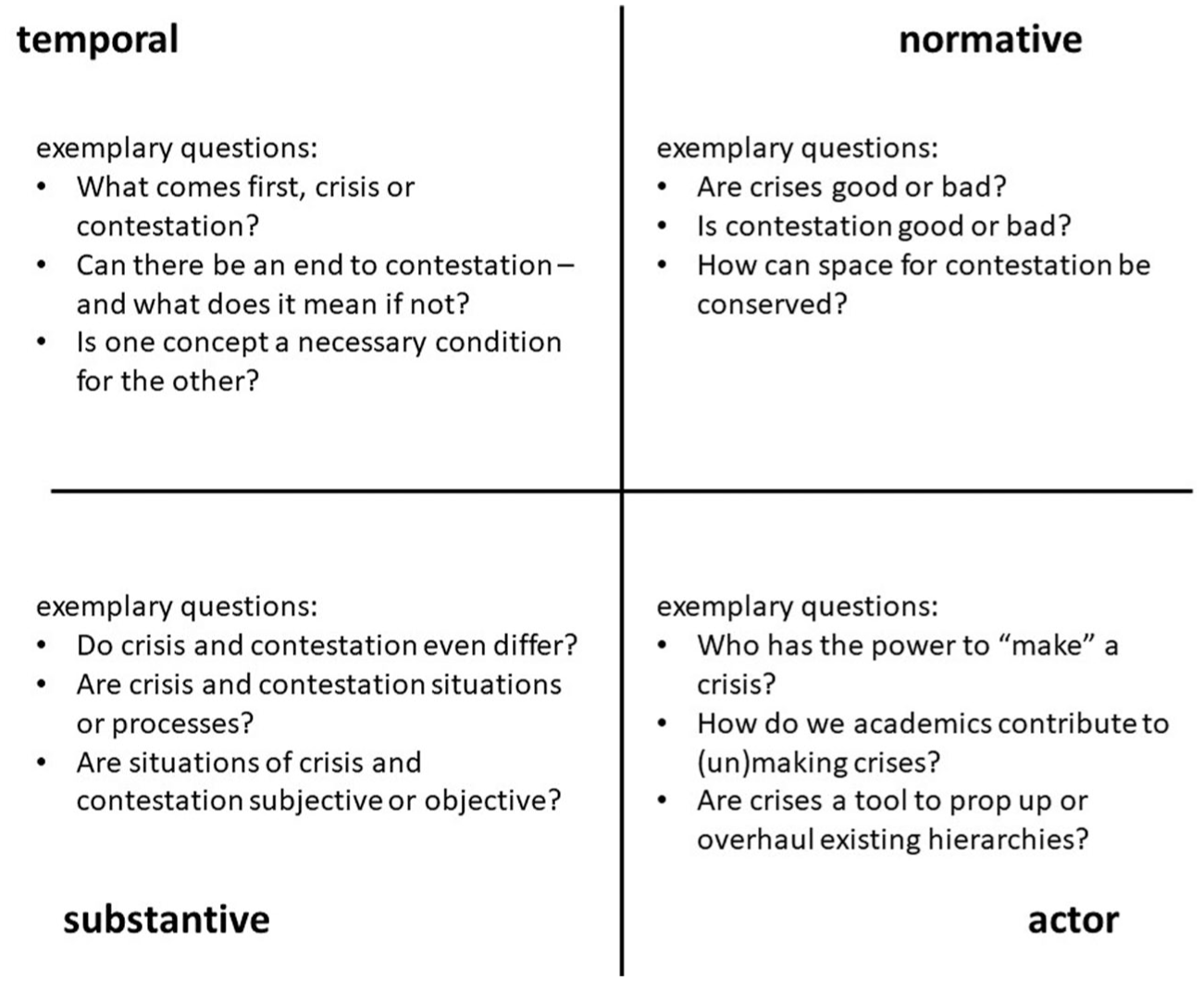
Analytical framework: Dimensions of the relationship between the concepts of crisis and contestation and respective questions addressed by the contributions.
The temporal dimension: What comes first?
If we look at the relationship between the concepts of crisis and contestation from a temporal perspective, the first question is which of the concepts precedes the other. This also includes the question of whether one of the concepts is a necessary condition for the other and whether crisis and contestation are mutually dependent. Yet, what difference does the order make? Are crises strategic ways of opening up spaces for contestation? With regards to contestation, this puts the robustness or resilience of norms and institutions under scrutiny (Deitelhoff and Zimmermann, 2020).
Indeed, the reader will notice that the contributions to this forum differ widely in their understanding of the temporal dimension of the crisis-contestation relationship. In many areas of global governance, including those covered in this forum, more or less precise normative and institutional frameworks that have grown over time are already established. But what if orientation for a particular situation seems to be completely missing, that is, a “norm gap” exists (Rosert, 2019)? Is it rather these gaps that bring about crises, which then, in turn, enable the formation of a corresponding norm? Likewise, we may ask whether either contestation or crises are moments or processes. From a perspective that embraces contestation as an essential part of global governance, can there even be an end to contestation, or should it rather be treated as a general baseline that enables global governance in the first place? Conversely, if the state of polycrisis is the “new normal,” what do we gain by using either the crisis or the contestation label to characterize a certain situation?
The substantive dimension: Do crisis and contestation even differ?
This leads us to a substantive dimension of the crisis-contestation relationship. Such a perspective inevitably problematizes the analytical tangibility and the ontological content of the two concepts. There is a need to distinguish between an understanding of crisis and contestation as a situational description or a practice. Furthermore, are situations of crises and contestation subjective or objective ontological phenomena? Is it not rather the entity that is subject to crisis or contestation, rather than the concepts of crisis and contestation as such, which is decisive? If crisis and (norm) contestation actually describe the same situation, the choice of one of the two concepts would possibly only be a result of the research tradition and discipline in which academics locate themselves (Sil and Katzenstein, 2010). But the choice could also be a function of the contested entity, urgency, or geographic location of a situation. As highlighted with reference to contestation above, the entity subject to contestation, be it norms, institutions, or an order as a whole, makes a crucial difference for the way contestation unfolds and its potential effects (Speyer, 2022, 2025; Speyer and Stockmann, 2024).
This forum takes the readers deeper into this debate. Crises, regardless of whether they are objective or subjective, the contributions to this forum concur, invariably conjure up a feeling of existential threat that requires quick, uncompromising, and decisive action (also Kreuder-Sonnen, 2019). Yet, what is perceived as a politically desirable contestation (and even seen as an opportunity structure) in one place may present itself as a threatening crisis elsewhere or to other actors (Holzscheiter et al., 2023). These observations question whether the use of different concepts for the same situation does not rather stand in the way of an understanding dialogue and academic progress, or even whether the terms “crisis” and “contestation” carry invisible normative baggage (see below).
Conversely, centring the “how” of crises and contestation presupposes understanding both concepts as processes rather than as situations. Certain practices are legitimized by actors as necessary responses to crises, sometimes with the effect of undermining existing norms in practice. However, to the extent that this is perceived as a necessity in a crisis, it is (at least initially) not perceived as a contestation.
The normative dimension: Good contestation, bad crisis?
These reflections imply a normative dimension of navigating between the concepts of crisis and contestation. The cases presented in this forum reiterate that both terms carry an ambiguity that requires a reflexive assessment. Moreover, while contestation is generally thought of as a dialogical process, crisis seems to carry a hierarchical connotation (Deitelhoff and Zimmermann, 2019: 3; Kreuder-Sonnen, 2019).
In norms research, it is controversial whether contestation is positive or negative: does a norm’s contestation lead to “norm death” (Panke and Petersohn, 2016) or generate inclusivity and ensure global governance’s legitimacy by giving a voice to marginalized actors (Wiener, 2004, 2018; Wolff and Zimmermann, 2016; Zimmermann et al., 2023)?
In contrast, “crisis” is often used colloquially as a “catch-all” term with little qualitative differentiation. In this everyday understanding, it usually carries with it a negative connotation. However, academically, the concept of crisis is controversial (Jordheim and Wigen, 2018). With a view to European integration, scholars distinguish between good and bad crises depending on whether they further or unravel integrational successes (Lefkofridi and Schmitter, 2015; Speyer and Stockmann, 2024). A central fault line in deciding on a positive or negative characterization is whether the crisis is understood as an objective phenomenon or as a social construction (and thus, in turn, as constructed in practice). Even in an understanding of crisis as an intersubjective construction, it carries a negative understanding: if not contained, a crisis can become a potentially existential threat.
The actor dimension: Who “does,” crisis, and contestation?
Assuming that crises are social constructions, the actors who (can) construct crises come to the fore. Consequently, crises could be a strategic construction to enable or prevent (norm) contestation, or at least offer possibilities of empowerment for certain actors. But do crises thus essentially represent an instrument through which already hegemonic actors strengthen their dominance? Would it not then be the task of critical scholarship to deconstruct crises and name the actors involved? Conversely, how are scholars focused on crisis and contestation themselves contributing to (un)making crises?
In constructing crises, actors also assign responsibility for and affectedness by a crisis (Gholiagha et al., 2020). While certain actors are thereby denied the ability to act in a crisis, other (often collective) actors are confronted with the expectation of contributing to a solution. In normative terms, this can be understood as a call for contestation by some and a desire for omission of the same by others. The lyrics of Stromae’s song, quoted at the beginning of this forum, illustrate this well, as he associates crisis invariably with the developing world. By discursively mobilizing attributes such as guilt, vulnerability, or leadership in crises, actor roles and the associated marginalization (“othering”) can be reproduced (Epstein, 2012; Zwingel, 2017).
These questions take us back to those asked with reference to the temporal dimension of how crisis and contestation interact. If crisis is a strategic tool to enable or foreclose contestation, does that not suggest a sequential process whereby contestation may result from crisis?
Building on the rich empirical and conceptual repertoire of the authors, this forum showcases different understandings of the highly topical concepts of crisis and contestation as well as their relationship. Beyond that, this forum also epitomizes the hope that IR research, by grappling with these questions, can deconstruct crisis narratives and uncover new prospects for crisis management obscured by the encompassing uncertainty spread by the current wave of crises and contestation. We will evaluate these impulses and the practical implications of the different perspectives that result from the dimensions in a concluding piece to this forum.
Order crisis, rising powers, and the contestation of liberal peacemaking
Esra Dilek
Introduction
Rising middle-power states such as BRICS+ countries (particularly Russia and China), Gulf countries, and Turkey are assessed as central actors in the contestation of the LIO, which is going through a multidimensional crisis (Newman and Zala, 2018). Crises constitute serious threats to the basic structures or the fundamental values and norms of a social system and necessitate making critical decisions under time pressure and uncertainty (Rosenthal et al., 1989). Order crises, challenges to the structure of the international system, provide the opportunity structures for weaker actors to contest hierarchies. This contribution focuses on the agency of rising middle-power states as actors who adopt contestation strategies to overcome power imbalances, to enhance their status, and to construct new identities. It focuses on liberal peacemaking as an area where the crisis of the LIO crystalizes, opening room for contestation by rising powers. As observed in the case of Turkey, rising powers situate themselves in a liminal position, engaging in both liberal and illiberal modes of peacemaking, which is reflected in their practices as well as in their discursive articulations.
Crises, actors, and contestation
A crisis is defined here as a period of tension or disruption in the international system when existing institutions, norms, or power structures are unable to ensure stability, leading to uncertainty. As noted in the introduction to the forum, crises may be understood as condensation points in which norm(ative) contestation becomes particularly visible and politically pertinent (Goliagha et al., 2020). With its origins in the “thin” Western order established in the post-Second World War era (Mearsheimer, 2019), the LIO provided a dominant framework for accepted state behaviour in the post-Cold War era. Currently, the LIO is going through such a condensation phase (Ikenberry, 2018), where contestation, defined here as discursive and behavioural disapproval of structures and norms, has become a defining feature. Cracks in the LIO became increasingly apparent since the mid-2000s. The effects of the US interventions in Afghanistan and Iraq, the 2008 financial crisis, the 2014 war in Ukraine, and the 2016 Brexit are seen as indicators of an ever-growing decline (Mearsheimer, 2019) that has been accompanied by increasing questioning of the power and normative structure of LIO.
Currently, the LIO is challenged both internally and externally. Contestation from within the West is observed in the rise of populist governments, associated with the rise of resentment among majoritarian national groups who feel increasingly threatened by immigration, the domestic extension of civil rights, and their relative loss of economic power to “out groups” (Adler-Nissen and Zarakol, 2021). Externally, actors outside of the core liberal West, including rising powers (Newman and Zala, 2018), challenge the existing order by contesting the norms and power structures that constitute it. Such actors criticize the post-Cold War international order for using double standards and institutionalizing inequality (Börzel and Zürn, 2021). The challenge to the LIO is louder and more systematic outside this core, voiced most notably by rising powers, including BRICS+ countries (particularly Russia and China), Gulf countries, and Turkey. Rising powers present variation in terms of their position, interests, and needs within the existing international order.
As part of the LIO, the liberal peace model, broadly understood as the peacemaking approach that relies on inclusive negotiations, democratization, and mediation adopted during most of the (post-)Cold War periods, is likewise facing increased contestation. Liberal peacebuilding has been subject to criticism for its top-down character, leading to problems of local ownership and unintended consequences such as conflict recurrence (Chandler, 2015). Liberal peacebuilding is also criticized due to its inability to solve complex internationalized civil wars. Syria, Libya, and Yemen constitute a few examples of protracted internationalized conflicts that have attracted multiple peacebuilding actors besides the United Nations, leading to parallel peace mediation initiatives (Hellmüller and Salaymeh, 2023). Two major rising powers, Russia and China, are assessed as leading actors in the contestation of the liberal peace model (Jütersonke et al., 2021; Lewis, 2022). For example, Russia’s emerging model of conflict management (such as in Syria) points to the use of military force to cement a peace deal (Lewis, 2022). China’s peacemaking approach, on the other hand, emphasizes sovereignty and non-intervention and rejects externally induced democratization processes (Yuan, 2022). Other rising powers, such as Brazil, South Africa, India, Mexico, Turkey, and the Gulf states, are also regarded as shifting the nature of liberal peacebuilding. Rather than being necessarily revisionist, this reshaping of peacebuilding represents the states’ and status-seeking aspirations (Richmond and Tellidis, 2014).
Indeed, crises and contestation processes may be co-constitutive for actors who seek to enhance their position in an international order. Crises provide an opportunity structure, especially for peripheral actors who are not satisfied with their position and influence within the system. For such actors, peacemaking constitutes a niche area that allows for engagement in conflict and post-conflict contexts. When contesting liberal peacemaking, rising states act from within the existing system into which they have been socialized. Therefore, these actors engage in “competitive socialization”: they do not seek to revise the existing order and normative structure as a whole but rather to equalize existing power relations by expressing agency (Kobayashi et al., 2022).
Rising middle powers and liberal peacemaking in a world of crises: Turkey as an emerging peacemaking actor
Rising middle powers operate both within and outside the liberal framework that they have been socialized into (Peter and Rice, 2022). They acquire a liminal position and develop an ambivalent, multidimensional stance towards the institutional and normative fabric that constitutes the LIO. This ambivalence is related to the fact that they generally seek reformist rather than fundamental or radical change (Jordaan, 2017). Furthermore, the contestation of the LIO covers both normative and representational aspects; that is, it is directed both towards the principles (e.g. non-intervention and democracy) and the institutions (e.g. the control of institutions such as the United Nations Security Council (UNSC)) of the LIO (Newman and Zala, 2018). Rising powers seek increased representation within the system and, at the same time, contest organizing principles such as multilateralism, proportionality, and accountability.
As a rising middle-power country, Turkey frequently appears in discussions on the growing international contestation of the liberal order (Öniş and Kutlay, 2020). Turkey was socialized into the liberal order through the active state policy of Westernization that was pursued throughout the 20th century. This process has stagnated since 2007, and Turkey’s competitive authoritarian system has been reflected in the country’s foreign policy in the form of increasing criticism of the West and the liberal order (Kutlay and Öniş, 2021). During the last two decades, Turkey has used a branding approach based on liminality, combining representations of Turkey as both Western and Eastern (Rumelili and Suleymanoglu-Kurum, 2017). With this aim, Turkey has remained committed to multilateral solutions to international peace and security problems through its activities at the United Nations, NATO, and the European Union (EU) while at the same time strengthening its relations with Eastern regions by actively participating in regional organizations including the Gulf Cooperation Council, the Arab League, and the Organization of Islamic Cooperation (Rumelili and Suleymanoglu-Kurum, 2017).
Turkey has adopted a multidimensional contestation strategy in its foreign policy, presenting both representational and normative aspects (Newman and Zala, 2018). Criticisms that the existing world order is going through a crisis of representation due to the UNSC and the veto power of permanent members reveal Turkey’s representational contestation of the LIO (Aral, 2019). Furthermore, it emphasizes that the current structure is not only unrepresentative but also unfair (Erdoğan, 2018). At the same time, Turkey criticizes Western powers for being hypocritical about their commitment to the liberal order and its normative framework. Turkey thus has adopted “liberal performance” as a contestation strategy (Bettiza and Lewis, 2020) in order to enhance its position as a regional power: on the one hand, it criticizes Western non-compliance with liberal principles, especially concerning the protection of civilians in war and the lack of action against human rights violations in conflict areas. On the other hand, Turkey has sought to undertake mediation and humanitarian peacebuilding activities that are not in line with the liberal peacebuilding model.
As a mediator, Turkey has been engaged in peacebuilding both inside and outside of the UN framework. The Astana process regarding Syria is an example of a mediation process “parallel” to the UN framework (Hellmüller and Salaymeh, 2023). Turkey criticized the UNSC’s inaction against Syria in the early phase of the civil conflict due to the vetoes implemented by Russia and China as permanent members. At an international conference organized in Istanbul in 2012, Turkey expressed criticism of the UNSC as an unfair system that failed to reflect the will of most countries (The Guardian, 2012). The crisis of the liberal peace model, observed in the protraction of the Syrian conflict and the inability of the UN-led Geneva Peace Talks to bring a negotiated solution during 2012–2016, provided an opportunity structure for the emergence of parallel processes. The Astana process was initiated in 2017 by Russia, Turkey, and Iran as a mediation initiative. Reflecting the approach and interests of these rising actors, the Astana process differed from the UN process in that it took the form of a military elite pact-making process focusing on a ceasefire. Through the Astana process, Turkey sought to express agency as a regional power, seeking to protect its interests and address insecurities arising from armed group activities on its border with Syria. Overall, the process fitted well with Turkey’s status-seeking aspirations as a regional power.
Turkey’s humanitarian peacebuilding towards African countries and the Middle East also presents alternatives to the liberal model and centres on normative contestation. Turkey’s peacebuilding approach in Africa diverges from the liberal peace model in that it rejects conditionality and does not focus on democratization processes as part of peacebuilding (Aras and Akpınar, 2015). In Africa, Turkey has adopted a civilizational contestation strategy as a means for building agency and identity as a peacemaking actor. “Civilizationism,” the universalization of a liberal standard of civilization, has undergirded the deepening of the LIO in the aftermath of the Cold War as an ideology. This liberal civilizational standard has been experienced by non-Western actors as ideologically entrapping them through socialization and stigmatization (Bettiza et al., 2023). In the Middle East and Africa, Turkey links humanitarian diplomacy to Muslim identity and the Ottoman past (Benli Altunışık, 2023). This contestation strategy rests on the idea of the “failure of the West” and, therefore, the crisis of the liberal model in dealing with humanitarian crises, especially in the context of Syria and Somalia (Benli Altunışık, 2023). Turkey’s strategy embodies a civilizational synthesis between East and West: it presents continuity with the Ottoman past while at the same time embodying a concern with human rights, equality, and justice. Accordingly, contestation on a civilizational basis has enabled Turkey to build an identity as an actor unburdened by “colonial baggage” and who adopts a flexible peacemaking approach that rejects top-down reconstruction of liberal democracy and economy.
Conclusion
This contribution focused on the role and agency of rising middle-power countries as actors contesting the normative power/representation structure of the LIO. The persistence of recent conflicts can be seen as crises that expose the limits of the LIO and liberal peacemaking as part of it. Accordingly, crises precede contestation temporarily, opening a window of opportunity for actors who seek to overcome power hierarchies. At the same time, contestation enhances crises as internal and external criticisms weaken legitimacy. Moreover, contestation has been directed towards both the power structures and the normative dimension of the LIO. Rising powers contest the legitimacy basis of the LIO and criticize the current system as being unfair towards countries outside of the core West. Finally, regarding the actor dimension, crises offer a strategic opportunity for contestation by rising powers to criticize the power and norms of dominant actors while at the same time carving out a new role for themselves. This perspective is substantiated by the analysis of Turkey’s contestation of the liberal order and liberal peacemaking. Turkey, along with other rising powers, has contested the power structure of the liberal order with a focus on the lack of representativeness of the UNSC. Turkey’s contestation has become increasingly prominent since the 2010s, when the broader weakening of the LIO was already underway. Turkey has also used contestation to criticize Western non-compliance with norms such as justice, equality, and rights in peacemaking in the Middle East and Africa. This has allowed Turkey to develop an identity as a peacemaking actor who uses flexible strategies and does not link peacemaking to political conditionalities such as democratization and institution-building. In this way, Turkey has joined other rising powers such as China and Russia in developing a peacebuilding model that does not align with the normative prescriptions of liberal peacebuilding. Overall, crises have supported Turkey’s contestation of the LIO as a rising actor who seeks status and power in its region and beyond.
De-Europeanization as crisis and contestation
Özge Onursal-Beşgül
De-Europeanization does not necessarily signal a crisis of integration; it can instead be understood as a reconfiguration of the EU’s normative influence, both internally and externally, often catalysed by economic, political, or geopolitical disruptions. What appears as a crisis from the EU’s perspective may constitute a legitimate policy adjustment from national or regional viewpoints. Although de-Europeanization has been associated with democratic backsliding, the erosion of the rule of law and the rise of nationalism, it should not be equated with disintegration; it may also reflect a response to a crisis or a process triggered by one.
This contribution distinguishes between crisis, contestation and de-Europeanization, viewing these processes not as synonymous or sequential, but as coconstitutive. A crisis is not an objective rupture that precedes contestation; rather, it is a socially constructed and contested moment of uncertainty, framed by political actors through competing claims about legitimacy and meaning. Contestation, in turn, is the ongoing struggle over the interpretation and validity of norms, events, and institutions – including the question of whether a given situation constitutes a crisis. While analytically distinct, the two are mutually shaping: crises gain political significance through contestation, and contestatory practices simultaneously define what counts as a crisis. This distinction enables conceptual clarity without denying their empirical entanglement.
De-Europeanization emerges from this interplay. Political actors exploit crisis narratives to challenge, reinterpret, or withdraw from EU norms and institutions. This does not necessarily imply decline; depending on the perspective adopted, it can reflect adaptation, resistance, or redefinition. The concept of “polycrisis,” for example, emphasizes how interconnected economic, geopolitical, and democratic issues are testing the resilience of European integration (Juncker, 2016) and the LIO (Adler-Nissen and Zarakol, 2021). However, crises can also foster innovation and recalibration. Norms persist not only through institutional inertia but also through their embeddedness within clusters of mutually reinforcing principles (Cost et al., 2026).
Although these distinctions may seem obvious, they are important for analysis. Public, policy, and scholarly debates often conflate de-Europeanization with crisis or disintegration. In the Turkish context, periods of tension, such as stalled accession negotiations, constitutional reforms, and disputes over fundamental rights, have repeatedly been interpreted as signs of a wider crisis in EU–Turkey relations. Such developments are often equated with an imminent rupture or breakdown in ties with Europe (see, for example, the Türkiye Report, European Commission 2025). Similarly, scholarly literature uses episodes of democratic backsliding, contestation, or slowed reform as evidence of de-Europeanization, even when these reflect domestic political restructuring rather than a linear withdrawal from European norms. Yılmaz (2016) highlights that fluctuations in alignment stem from shifting elite preferences and domestic political priorities, and Aydın-Düzgit and Kaliber (2016) demonstrate that classifying all forms of politicization or turbulence as de-Europeanization obscures the complexity of Turkey–EU interactions. Clarifying the conceptual relationship between de-Europeanization and crisis narratives reveals how the latter are strategically used to justify the former and how the meaning of crisis itself becomes contested.
This article demonstrates that the relationship between crisis and contestation is co-constitutive: crises do not merely precede contestation but are shaped and defined through contestatory practices, just as contestation gains political force through crisis framings. Situations are framed as crises through acts of contestation, which simultaneously heighten their visibility and political urgency. In this context, de-Europeanization transcends simple policy reversal or institutional withdrawal; it functions as a strategic form of norm contestation that challenges EU authority and produces alternative visions of order, sovereignty, and legitimacy. Thus, the argument bridges the literatures on crisis, contestation, and de-Europeanization. It contributes to the forum’s “boundary work” by demonstrating how crises and contestations are socially constructed, actor-driven, and constitutive of the politics of Europeanization.
Connecting Europeanization with the norms literature
Understanding the relationship between international institutions and domestic actors requires close attention to crisis-driven disruptions and the contestation that might redefine normative frameworks. Conceptualizing Europeanization as a dynamic and contested process of norm diffusion enables a more nuanced analysis of de-Europeanization, not as a mere reversal but as a strategic reconfiguration of EU-derived norms in response to shifting domestic and international conditions.
Norms are understood as “dynamic entities” that evolve through interaction (Speyer and Stockmann, 2024), with a dual quality of stability and adaptability (Wiener, 2004, 2007). Rather than being universally accepted or linearly implemented, norms are frequently challenged, reinterpreted, or resisted by actors at various levels. Thus, contestation is not simply a by-product of norm diffusion but a fundamental force shaping its direction and outcomes. A. Wiener (2004: 219) argues, contestation arises when the meaning of a norm is disputed, and such conflicts can reshape or destabilize the normative foundations of political order. Even after norms have been formally institutionalized, they remain subject to ongoing debate and negotiation.
This focus on the dynamism of norms is also evident in the literature on Europeanization as a form of norm diffusion (Börzel and Risse, 2003). Radaelli (2003: 30) defines Europeanization as the “construction,” “diffusion,” and “institutionalization” of rules, norms, and practices that are consolidated in the EU and subsequently incorporated into domestic contexts (see also Bulmer and Radaelli, 2004; for a summary, see Flockhart, 2010; Vink and Graziona, 2007). Crucially, this process is not unidirectional (see Börzel and Risse, 2012): it includes top-down downloading, bottom-up uploading, and horizontal cross-loading between states (Bache et al., 2020). These multi-level dynamics highlight the complexity of norm diffusion and the active role of domestic actors in shaping the process (see Tabak, 2021). As norms move across levels, they may provoke backlash, crises, or processes such as de-Europeanization, whereby actors deliberately resist, reinterpret, or dismantle previously accepted norms.
(De)Europeanization as contestation and resistance
De-Europeanization refers to the “loss or weakening of the EU/Europe as a normative/political context and reference point in domestic settings and national public debates,” which is often accompanied by the deliberate avoidance of EU-related language and frameworks (Aydın-Düzgit and Kaliber, 2016). Crucially, however, de-Europeanization is not simply the abandonment of EU norms, such as those related to democracy, judicial independence, media freedom, or minority rights. Instead, it often involves strategically reconfiguring these norms to align with changing domestic agendas and ideologies.
Domestic actors play a central role in this process. Rather than rejecting EU norms outright, they contest and reinterpret them selectively, often embedding them in sovereignty-focused or nationalist discourses. Where the EU’s legitimacy is perceived to be declining, local actors have more opportunity to reframe EU-derived norms to align with their own political objectives. This can lead to significant departures from the original liberal-democratic context in which those norms were formulated. Therefore, the trajectory of de-Europeanization is contingent and multidirectional. While some EU norms persist, others are marginalized, resulting in a fragmented landscape of partial adoption and resistance. This selective engagement, often referred to as “cherry-picking” and conceptualized as “accommodation,” illustrates how compliance with EU norms becomes conditional and is driven by interests and strategic calculation (see Börzel and Risse, 2003).
De-Europeanization thus involves both political and symbolic struggles over the meaning, ownership, and application of EU norms. Understanding this dynamic requires moving beyond top-down models of norm transfer to focus on how norms are continuously redefined through conflict, reinterpretation, and local agency. Crucially, moments of crisis create conditions that make such contestation more visible, intense, and consequential. They act as catalysts, exposing the fragility and contestability of norms.
Substantive dimension: What are the implications of contestation?
A clear distinction must be made between a crisis, defined as a rupture in the normative order, and contestation, understood as an ongoing political struggle over meaning and legitimacy. While coconstitutive, they remain analytically distinct: the former refers to the structural condition of uncertainty where existing norms no longer provide a stable guide for action, whereas the latter refers to the agentic process of debating and reconfiguring those norms. Recognizing this distinction is essential for analysing the shifting legitimacy of European integration and the evolving relationship between EU-level and domestic normative frameworks.
A crucial question in the study of norm dynamics is the effect of contestation on the norm itself. On the one hand, contestation can strengthen norms by reinforcing their legitimacy through debate and engagement. A. Wiener (2004: 218) argues, “contestation is central for establishing the legitimacy of compliance processes; indeed, it is constitutive towards social legitimacy.” In the absence of formal political legitimacy, contestation can generate social legitimacy, thereby enhancing the conditions for long-term, sustainable normative stability. However, contestation can also expose underlying disagreements and fault lines, potentially weakening a norm rather than reinforcing it.
This raises a central question: why and when does contestation strengthen or weaken a norm? As Deitelhoff and Zimmermann (2020) observe, the robustness of norms hinges not only on whether they are challenged but also on how they are challenged. Specifically, challenges to the application of norms can reinforce their legitimacy, whereas challenges to their validity may erode it. Therefore, norm robustness is determined by the interplay between structural context and the specific types of contestation enacted by norm challengers, rather than by the challengers’ power alone.
These insights provide valuable analytical tools for understanding de-Europeanization. In contrast to approaches that focus primarily on institutional trajectories of integration and disintegration (Delanty, 2021; Zielonka, 2014), this article conceptualizes de-Europeanization as a dynamic process of norm contestation. Importantly, de-Europeanization is not a predetermined outcome of crisis but rather the result of contestation triggered or intensified during periods of perceived disruption. Once underway, however, de-Europeanization can reshape the normative landscape, prompting further challenges to the applicability and legitimacy of EU norms. In this way, de-Europeanization reflects an active process of negotiating, resisting, or repurposing norms that originated within the European integration framework, rather than simply withdrawal or absolute rejection of norms. It often reflects a strategic and deliberate reconfiguration of EU norms in line with domestic priorities. While the EU may interpret this as an “integration crisis,” domestic actors may regard it as a legitimate realignment or reinterpretation of normative commitments. De-Europeanization is both a form of contestation – especially against norms perceived as externally imposed – and a facilitator of further contestation, as it opens up space for questioning and renegotiating the meaning, legitimacy, and applicability of EU norms.
Actor dimension: Who are the contesters?
Ultimately, whether de-Europeanization constitutes a “crisis” depends on who is observing, contesting, and affected by it. An actor-centred perspective reminds us that contestation is not simply about rejecting norms; it is also about negotiating power, identity, and legitimacy in both domestic and international arenas. In order to analyse norm dynamics, it is crucial to understand who engages in contestation and what makes contestation possible. Shifting the analytical focus from the norms themselves to the actors who contest them emphasizes the importance of political agency and discursive strategies (Cost et al., 2026). As Börzel and Zürn (2021: 22) argue, “it is not enough to account for non-liberal deviations in terms of structural causes”; rather, “we also need to study the normativity underlying the contestations by exploring the narratives and claims of the contestants.”
In the field of IR, normative contestation frequently transcends disagreements over norms, encompassing broader critiques of the legitimacy of those responsible for setting norms. In this sense, contestation may target the authority and credibility of institutions promoting specific normative frameworks (see, for example, Aydın-Düzgit, 2018; Aydın-Düzgit and Noutcheva, 2022). Contestation is not merely reactive; it is often rooted in competing normative visions and represents deliberate attempts to undermine the norms’ legitimacy. For EU institutions and pro-European actors in member or candidate states, de-Europeanization may be seen as a crisis involving a loss of influence, credibility, or collective identity. Conversely, nationalist elites and sovereignty-focused governments may frame de-Europeanization as a corrective measure aimed at reclaiming autonomy and redefining normative boundaries.
In this way, the meaning and implications of de-Europeanization vary across actors. What appears as a crisis to one group may be a strategic opportunity for another. For instance, in cases of external de-Europeanization, the EU’s normative order may remain largely intact because the process is not necessarily perceived as a crisis by the EU. By contrast, internal de-Europeanization is more likely to generate domestic political tensions, particularly when there is contestation over the direction and meaning of Europeanization within the de-Europeanizing state.
From contestation to crisis: Reframing de-Europeanization
In summary, the concepts of “crisis” and “contestation” inherently involve political judgement and interpretation in the social sciences. They serve as analytical tools to understand how norms form and transform in society and global politics. Their application often reflects subjective assessments: what some view as a sign of danger or weakness, others see as a necessary process of testing and strengthening norms. It is crucial to recognize that “norm contestation becomes particularly visible and politically pertinent in perceived crises,” while conversely, situations may be framed as crises precisely because dominant norms are challenged (Speyer and Stockmann, 2024: 2). The relationship between contestation and crisis is co-constitutive: crises heighten the visibility and political significance of norm contestation, while contestatory practices simultaneously shape and define what counts as a crisis.
Viewing de-Europeanization as a form of contestation emphasizes that it is a deliberate process of disengagement from EU influence, rather than merely rhetorical or policy disagreement. Contestation here extends beyond mere resistance within the integration framework to encompass active withdrawal from, redefinition of, or replacement of that framework. In this context, de-Europeanization could be seen as a more institutionalized or strategic phase of contestation – one that starts within discourse but could lead to structural change.
Framing de-Europeanization as a challenge to the status quo shifts the focus away from viewing it as a mere technical or institutional rollback. Instead, it reveals a deliberate challenge to the legitimacy and authority of EU norms, emphasizing the political and ideological stakes involved. De-Europeanization encompasses more than policy divergence or institutional decoupling; it is also a contest over the values, priorities, and identity associated with European integration. It therefore forms part of a broader struggle over meaning and authority, in which actors reject EU influence while promoting alternative visions of sovereignty, order, and legitimacy. This invites us to study de-Europeanization not solely in terms of compliance or alignment but as a continuous political contestation over which norms should prevail and why.
This contribution fulfils a valuable role in the forum by defining crisis as a perceived rupture and contestation as an ongoing, substantive struggle. It neither reduces de-Europeanization to a crisis nor contests the idea that contestation is merely a symptom. Instead, it shows that different outcomes result from actor-specific framings and strategic interpretations. This conceptualization challenges the common association of de-Europeanization with failure to integrate, showing that contestation driven by actors can produce normative reconfiguration rather than collapse. By tracing these dynamics, the analysis links the forum’s substantive and actor-related dimensions, shedding light on the contingent politics of de-Europeanization. Ultimately, it reveals that crises and contestations are socially constructed and strategically mobilized processes, shaped by the framing power of actors, and that political and scholarly interpretations jointly produce the meaning of crisis in Europeanization.
Understanding crises and norm contestation through time: Introducing the normalization of possible futures
Nils Stockmann and Lucrecia García Iommi
I want you to panic. I want you to feel the fear I feel every day. And then I want you to act. I want you to act as you would in a crisis. I want you to act as if the house is on fire. Because it is.
This statement by climate activist Greta Thunberg at the World Economic Forum in 2019 illustrates the idea that facts only become crises when they are represented as such (Nabers, 2019). Even more significantly in the context of the forum, norms and norm contestation can help construct such meaningful representations of crises and define what counts as a crisis in the first place. Indeed, Winston (2018: 640) notes that the creation of norms entails that “a fact becomes problematized if it is interpreted in such a way that its existence negatively impacts the attainment or continued practice of something that is valued, thus necessitating some form of corrective behavior.” Building on this observation, this essay explores how norms and their contestation interact with crises in both a constitutive and a regulative manner – shaping norms themselves as well as the responses they demand. We trace the dynamic interplay between norm dynamics and crisis over time (temporal dimension), underscoring the emancipatory potential of critically engaging with norms, that is, norm contestation, by focusing on one of the most pressing crises of our time: climate change.
Specifically, we advance an understanding of climate change as a current crisis, likely to worsen in the future if not addressed today. We also rethink the nature of this crisis and identify responses beyond the ones accepted as appropriate today. While most would already agree that climate change is indeed a crisis, so there is no need to construct it as such, we argue that actors can redefine the parameters of this crisis and the appropriate responses to it. Creating imaginations of responses in the future or retrieving them from the past could broaden acceptable responses and even expand or alter the hierarchy of meaning that guides us today on the issue of climate. In this way, we demonstrate how the interaction of norm contestation and crises carries significant normative power and how contestation and crisis are mutually constitutive, engaging with the normative and temporal dimensions of the contestation-crises relationship outlined in the introduction.
Beyond the present: The temporal politics of norm contestation
Norms are inherently indeterminate and polysemic (Linsenmaier et al., 2021). This makes norm contestation inevitable. Contestation refers to discursive and behavioural practices that critically engage with and modify norms, this way either strengthening or weakening their robustness (Deitelhoff and Zimmermann, 2020). In that sense, norm contestation and crisis must not be conflated, as the former does not necessarily lead to the latter or vice versa. We align with this understanding and we emphasize the mutually constituted nature of crisis and contestation, focusing on how the pervasiveness of norm contestation creates opportunities to construct issues as crises and thus bring them to the forefront of political debates and influence what is deemed an appropriate response to these crises. This interplay between norm contestation and crisis is what interests us. While this understanding of the relation between contestation and crisis might suggest that the former precedes the latter, that is not always the case. Indeed, exploring the temporal dimension of norms elucidates the mutually constitutive relation between contestation and crises in the past, present, and future. To this end, we present the framework of Normalization of Possible Futures (NPF) as a heuristic device to grasp the norms-time relationship and mobilize it with an emancipatory purpose.
The NPF entails broadening the boundaries of norm meaning along a temporal dimension in order to imagine and advance a more inclusive and fair society (García Iommi and Stockmann, 2024). Specifically, we argue that what constitutes acceptable meanings-in-use can be contested and broadened not only to accommodate cultural differences but also to include historically marginalized and not yet formulated meanings. The NPF is relevant to our understanding of the relationship between norm contestation and crises because it expands what we consider possible in terms of identifying and responding to a crisis. Indeed, broadening meaning across a temporal dimension can lead to the interpretation of facts as crises, and we can have access to new corrective behaviours to advance a world that reflects those values. Furthermore, existing crises, while not necessary to NPF, can facilitate it by creating a sense of urgency for normative change. While the opposite is also true and crises could foster reactionary responses invested in preserving the status quo, we are particularly interested in the aforementioned possibilities for contestation that crises might create. Moreover, while normalization and the expansion of what constitutes acceptable norms and meanings-in-use could be used for domination instead of emancipation, NPF refers specifically to their use with the latter goal in mind.
Why is it necessary to consider a temporal dimension of norms and norm contestation? The reason is that norm contestation cannot reach its full emancipatory potential without it. Indeed, the absence of historically marginalized and not yet formulated meanings creates an inherent bias in our study of norms and limits political agency. There are two sides to this problem. First, when we explore the trajectory of norms, it becomes evident that particular interpretations prevail while others become marginalized in an obvious exercise of power. The process of fixing norm meaning (Linsenmaier et al., 2021) and “forgetting” that alternative understandings of norms ever existed is critical to naturalizing the prevailing understanding today and delegitimize contestation outside contemporary boundaries. Accordingly, we should conceptualize norms dynamics in a manner that allows us to look back, encouraging us to create genealogies of norms to identify marginalized perspectives and potentially reincorporate them in the discourse. Second, because norms constitute a critical component of aspirational politics, embodying lofty goals for the future as well as the transformative potential of imagination in a manner that facilitates their advancement (Finnemore and Jurkovich, 2020), we need tools that allow us to think about norms with a prospective orientation. In other words, acknowledging national/regional and cultural diversity is not enough to understand norm dynamics and empower political actors to imagine and, through critical engagement (contestation), create better futures. We need to consider contestation over time as a factor.
While the NPF entails an explicit emancipatory purpose, we recognize that norm contestation along a temporal dimension can be mobilized to create or respond to crises in a manner that closes discursive spaces, as the crisis literature has already demonstrated (Kreuder-Sonnen, 2019). Moreover, exclusively focusing on crises as apocalyptic imaginaries may lead to an entrenchment that we know well from the securitization literature (Albert, 2022; Allan, 2017). In other words, the normative impact of contestation and crises is immanent. The inclusion of meanings relating to positive, alternate imaginaries of the future and the retrieval of “good practice” from the past is essential to fulfil their emancipatory potential (Cassegard and Thörn, 2018).
The NPF – Crisis as creation and crisis as opportunity
Through NPF, actors can expand what they consider acceptable norms’ meanings. Specifically, actors look forward (identifying meanings not yet articulated) and backwards (identifying historically marginalized meanings) in time, which empowers them to construe an issue as a crisis – that is, identifying problems no longer or not yet considered urgent as such and possible solutions beyond what is available today. A variety of actors, including scholars, activists, policy-makers, and other stakeholders, may engage in NPF to interpret particular situations as crises and to expand what are deemed appropriate behaviours in response to them. A pre-existing sense of crisis can enhance their ability to do so, and, paradoxically, such a crisis might be the product of extended contestation. Furthermore, a pre-existing crisis can help us implement changes in a norm’s meaning-in-use in a manner that fosters inclusion and a fairer society.
The climate change crisis provides an illustrative case. With regard to the forward-looking anticipatory dimension, climate change’s anticipated effects have been perceived as being (more or less) far away in the future. The famous dictum of “caring for the next generation” exemplifies this felt distance between today’s actions and tomorrow’s crises. As others have argued, such distancing has made it difficult to transform rather vague aspirations into action-guiding norms (Finnemore and Jurkovich, 2020). It just seemed too easy to evade conflicts about “limits to growth” and related fundamental changes to economic and social practices by trusting a techno-optimistic vision of the future, hoping that technological fixes to ecological problems would finally arrive (White, 2024). More recently, however, this path has been substantively questioned, as arguably the “next” generation became “this” or even the “last,” and the devastating effects of climate change could be felt all around the globe and were no longer marginal, though existential, problems for small Indian Ocean islands (Beauregard et al., 2021). The apocalyptic scenarios that had been around in activist and popular culture imaginaries have become much less distant to many – posing the question of what could happen if actors do not follow climate action norms and consider the diverse ways of affectedness climate change brings about.
In turn, we observe that strong regulatory interventions to mitigate climate change are currently marginalized as are holistic perceptions of prosperity that extend a quantified economic growth logic. Indeed, a “green growth” paradigm that postulates a symbiotic relationship between economic growth and more ambitious ecological policymaking dominates the way we think about climate protection. This dictates that actors should achieve the necessary decoupling of economic and social activities from harmful effects, such as greenhouse gas emissions, through technological progress. The NPF can be used to look back in time to retrieve normative meanings-in-use and their constitutive elements, lost to contingency, struggles, and power dynamics, to provide a better response to climate change. Interestingly, some of these lost meanings emerged in the first place in the context of past crises, which speaks to their generative potential.
For instance, in current climate policy debates, strict regulatory measures such as “driving bans” or phase-out policies (i.e. fossil fuel or nuclear power) are regularly framed as “last resort” measures and interventions into the personal freedom of consumers. However, in past crisis situations, limits to individual consumption have been legitimated: during the Second World War, the US government advocated for fuel savings and car-sharing, manifesting “If you ride alone, you ride with Hitler” (National Archives, 1943). Furthermore, during the 1970s oil crisis, Germany implemented temporary driving bans (economically friendly on Sundays only). These examples demonstrate that, in a historical perspective, strong regulatory interventions into consumption behaviour have not been unthinkable but have rapidly been marginalized again by the growth-oriented economic model, narrating fossil fuel-based practices as the “normal” and creating contingent “carbon lock-ins” (Marquardt and Nasirtousi, 2022). Nevertheless, invoking the magnitude of past shocks, such as wars or economic struggles, actors may be able to again manifest the legitimacy and social feasibility of such interventions.
Furthermore, religious and Indigenous knowledge about sufficiency-oriented lifestyles and the intrinsic value of nature has played an important role in societies and their dealing with crises over centuries (Merino and Gustafsson, 2021). (Re)introducing this repertoire to (global) policy debates could substantively broaden what is considered part of climate action norms. For example, through a genealogical analysis, Lindroth (2011) shows how Indigenous actors were able to counter their objectification as victims in the global climate discourse and to position themselves as actors providing value-bound solutions to climate challenges in the UN Permanent Forum.
Contested crises, contestation in crisis
Introducing a temporal dimension to norm contestation, the NPF expands the boundaries of what is considered acceptable norm meanings for the purpose of advancing fairer global governance of and for the future. From an analytical perspective, the NPF significantly expands the scope of contestation. From a normatively progressive standpoint, past and yet not articulated norm meanings can be engaged to widen the realm of acceptable norm meanings in an inclusive manner. This speaks directly to the organizing questions of this forum because the NPF engages with the interplay between contestation and crises.
Specifically, our discussion engaged primarily with the normative and temporal dimensions of the contestation-crises relationship. We understood crises and contestation as distinct phenomena and characterized them as mutually constitutive, problematizing linear narratives that give precedence to one or the other. More specifically, we argued that crises are both constructed through contestation and used to contest norms in the form of opportunities for contestation and sources of inspiration to expand what constitutes acceptable meanings.
Accordingly, in our application of the NPF to climate change, we focused on contestation over the climate change crisis and how it is understood and dealt with and the crisis itself as an opportunity to contest prevailing responses, emphasizing the agency of actors as they transform the boundaries of the norms that constitute this crisis and regulate our response to it. In doing so, we underscored the temporal dimension of both contestation and crises. Indeed, contestation is not limited to present available meanings across diverse cultures and regional contexts; it can encompass lost and not yet formulated meanings. In turn, crises as imaginaries that can facilitate contestation or emerge from it reside simultaneously in the past, present, and future. Indeed, the NPF applied to the current climate change crisis illustrates the possibility and power of mobilizing past and future crises for today’s governance.
As the discussion of climate change illustrated, the dynamics between crisis and contestation are not limited to the present but, to fully understand the emancipatory potential of contestation, require looking into the past and the future and, thus, considering the temporal dimension of this relationship. Understanding crises and contestation through time allows one to understand affectedness and agency in a more inclusive way, shedding light on the question of “whose” crises count in IR practice and scholarship. What do we describe as crises and as appropriate responses to them? What values inform this judgement? Accordingly, the relationship we established between the NPF, as a form of contestation that engages with norms across a temporal dimension, and crisis highlighted the normative potential of both. On the one hand, the NPF concept and its application to the normative structure through which we approach climate change underscore the normative potential of contestation. On the other hand, the fact that a crisis can facilitate and inform the NPF speaks to the normative potential of crisis as well. It is this latter observation that might prove more controversial. Indeed, while the literature on contestation has established that access to contestation is a precondition for norm legitimacy (Wiener, 2014) and a virtue for compliance (Magnusson et al., 2020: 4), in a context of crisis, some might fear that contestation has gone too far. For some, the readjustment of norms and normative order entails a loss of certainty.
This perception is represented in major discourses, such as around the evolvement of a “risk society” (Beck, 1992; implying a “risk” to an established status quo), but also in the contestation of the so-called liberal order (Börzel and Zürn, 2021). Yet, for others, moments of normative uncertainty may imply emancipation, that is, chances to become visible. Precisely, while crisis and contestation might undermine someone’s sense of security and well-being, they can embody the potential for emancipation for another. In this way, our contribution helps elucidate both the temporal and normative dimensions of the contestation-crisis relationship outlined in the introduction in a manner that both validates and challenges prevailing views and adds complexity to the way in which we understand these concepts.
Crisis and (mis)contestation: Fossil fuel lobbying at the United Nations Framework Convention on Climate Change
Hayley Walker and Hai Yang
Global governance institutions (GGIs) are increasingly focal points for public contestation that can precipitate crises of legitimacy (Zürn, 2018). This contestation-crisis dynamic is evident across IOs and issue domains. The World Health Organization faced a crisis of legitimacy following waves of contestation over its (mis)management of global public health emergencies (Yang, 2021). The United Nations Framework Convention on Climate Change (UNFCCC) has been under constant pressure for its failure to accommodate the growing demand of non-state actors for participation in global climate policymaking, contributing to widespread perceptions of procedural illegitimacy (Yang and Walker, 2025). Typically, contestation targets a GGI’s perceived failure to meet the institutional standards of procedure and performance (Bexell et al., 2022; Tallberg and Zürn, 2019). Sustained contestation can generate salient normative demands that push a GGI to reform and better align its governance with the established standards (Lenz and Söderbaum, 2023; Yang, 2025). In the field of intergovernmental cooperation, civil society discourse is vital in shaping what is politically possible (Walker et al., 2021). Yet, such contestation can also erode public trust and tip an institution into a full-blown crisis of legitimacy (Reus-Smit, 2007), particularly when the institution lacks the corrective capacity to address concerns.
Our essay engages primarily with the normative dimension of the crisis-contestation relationship outlined in the forum’s introduction, specifically, whether contestation is good or bad. We argue that for contestation to be most productive, it should be cognizant of institutional realities and target those actors with the capacity for remedial action. In a geopolitical moment when multilateral cooperation is facing unprecedented challenges, contestation that overlooks how GGIs function risks inadvertently feeding into the agenda of actors with an interest in stoking the crisis of multilateralism. Given our focus on GGIs, we understand contestation as the practice of challenging the appropriateness of a GGI’s specific practices or underlying principles 6 and crisis as a state of severe threat, whether objective or socially constructed.
To advance our argument, we examine the case of fossil fuel lobbying at the UNFCCC. Civil society has protested against the large presence of lobbyists at climate negotiations, arguing this has resulted in the corporate capture of the Conferences of the Parties (COPs) (Kick Big Polluters Out, 2023, 2024). This contestation has been a force for good, as it resulted in the UNFCCC secretariat introducing new rules enhancing transparency of participation. However, when it comes to demands for excluding actors from the process, the UNFCCC lacks the corrective capacity, on account of procedural constraints and a lack of political authority. When directed at the UNFCCC, continued contestation is unlikely to achieve its objectives and risks undermining the organization’s legitimacy. To be most effective, contestation of fossil fuel lobbying should instead be directed at the national level, because this is where the most important decisions on climate policy are taken today and because only governments possess the capacity to address the issue.
The footprint of the fossil fuel industry on the UNFCCC
In 2024, global average temperatures for the first time breached the safe threshold of 1.5 C above pre-industrial levels (Tollefson, 2025). As the global response to climate change repeatedly fails to deliver action commensurate with what the science tells us is required, and as the window of opportunity for averting the worst impacts closes, there is growing discontent and disillusionment with the UNFCCC, the focal institution in global climate governance (Green, 2025; Nasiritousi et al., 2024; Rockström et al., 2023).
In particular, media coverage of the recent COPs, the UNFCCC’s supreme decision-making body and platform for global climate negotiations, has been dominated by headlines on the number of fossil fuel lobbyists in attendance, with some claiming fossil fuel interests have “seized control” of climate negotiations (Al Jazeera, 2024). Fears over the capture of the process by the fossil fuel industry have been further stoked by the fact that COPs 27–29 were all hosted by petrostates. Most recently, more than 200 civil society groups have urged Brazil – COP30 host – to commit to preventing “fossil fuel capture” (Kick Big Polluters Out, 2025).
There is some truth in the claim that fossil fuel lobbyists have “seized control” – not in the sense of shady back-room deals, but rather in contributing to procedural rules that hand power to the least ambitious countries and ensure that fossil fuel producers will always be able to protect their interests. At COP1 in 1995, governments were poised to adopt the Rules of Procedure, which contained a provision for taking decisions by a two-thirds majority vote as a last resort when consensus proved impossible. The US-based fossil fuel lobbyists were highly active under the guise of innocuous-sounding names like the “Global Climate Coalition” or the “Climate Council.” Led by the infamous lawyer and oil industry lobbyist Don Pearlman, they openly advised the Saudi Arabian and Kuwaiti delegations (Depledge, 2024), who subsequently blocked the adoption of the Rules of Procedure.
While fossil fuel lobbying was not the only obstacle to adopting the voting rule, the result – that decisions can only be taken by consensus – serves their interests, since it often results in lowest-common-denominator outcomes. Whereas ambitious countries must convince all to accept their proposals, the least ambitious need only say “no” to block anything they disagree with. This stringent decision-making rule stymies climate ambition and often results in lowest-common-denominator outcomes. It has immeasurably slowed down the pace and strength of global climate action and is a major reason for the woefully inadequate progress we see today (Stoddard et al., 2021). Resulting procedural path-dependencies also make the repeated calls to “kick out” the fossil fuel industry from the COPs impossible to implement.
Non-state actors, including the fossil fuel industry, can gain access to COPs in two ways: as an admitted “observer” organization or through inclusion in a government (“Party”) delegation. Observers, as the name implies, have limited participation rights; decision-making is reserved for parties. A recent study found that 68% of fossil fuel lobbyists at COP29 attended as part of a party delegation, while less than 20% participated as observers (Transparency International, 2025: 11). However, as there are no rules or limits on who parties may choose to represent them in international negotiations, efforts to restrict the access of fossil fuel lobbying to the UNFCCC have so far focused on changing the admission rules for observers. As per the requirement for decisions to be made by consensus, any formal changes to these rules would require approval by consensus among all 197 Parties to the UNFCCC.
Yet there is little appetite from parties for opening this issue. Even if it were on the table, proposals for limiting access to certain groups of non-state actors would face opposition from many governments, any one of which could block their adoption. Also, attempts to block or restrict the admission of fossil fuel representatives as observers would likely backfire, driving them to join Party delegations in even larger numbers – with greater access to the negotiations and influence over decision-making. Moreover, this entire debate overlooks a more fundamental point: the most important decisions on climate policy are today taken elsewhere.
Interest groups and modern-day climate policymaking
In the intervening decades since COP1, climate change has grown from a relatively little-known subset of global environmental governance to a juggernaut of the policy world. It now bridges environmental, socio-economic, and geopolitical concerns and necessitates entire government departments, sophisticated policymaking apparatus, and a well-established policy cycle where government positions are negotiated months ahead of the annual COPs. Furthermore, the primary policy instruments on which the Paris Agreement is based – Nationally Determined Contributions (NDCs) – are, as the name suggests, not negotiated at the COPs but are determined by national governments. As a result, the Don Pearlmans of today are actively operating in capitals all around the world. We need only consider the US Supreme Court’s Citizens United versus Federal Election Commission ruling to see the insidious impact of domestic-level corporate lobbying. The 2010 ruling effectively allows corporations to provide unlimited amounts of undisclosed political funding and has transformed climate change from a once bipartisan issue in the United States to one of deep polarization and legislative gridlock (Jones, 2015).
This highlights a critical point – the crux of the problem is not lobbying per se but money in politics. Lobbying is a core feature of a pluralistic democracy. Civil society and environmental groups also lobby. The problems arise when rule-making fails to account for resource asymmetries that distort policy away from the public interest, for example, by imposing limits on political spending and/or by ensuring sufficient transparency around lobbying. Whereas the fossil fuel industry has seemingly limitless resources to invest in lobbying in myriad different locations, advocates for ambitious climate policy, and against the influence of vested interests operate with finite resources. On the face of it, lobbying intensively against fossil fuel influence at the COPs seems like a sensible strategy – why expend valuable resources replicating efforts dozens of times over at the national level when targets converge at a single international gathering? The problem, we argue, is twofold. First, the national level is the primary arena for policymaking, and so to most effectively counter fossil fuel influence, contestation should target national capitals, where negotiating positions are formed.
Second, lobbying the UNFCCC secretariat has now reached the limits of what is institutionally possible for an international bureaucracy that lacks the political authority to exclude non-state actors or impose any restrictions on the composition of government delegations. The secretariat operates under the authority of member states and has limited capacity for autonomous action. Where the secretariat has been able to take action – with governments’ cautious consent – is to enhance transparency, introducing new procedures requiring all COP participants, from party and observer delegations alike, to disclose their identity, affiliation, and financial relationship with their nominating government or organization. The responses, including those that decline to respond, are now made public (Berwyn, 2023). These changes were introduced following a review of its engagement with non-state actors, in which the participation of fossil fuel lobbyists at the COPs was heavily contested (Bertipaglia and Walker, 2025: 75; Yang and Walker, 2025: 452), demonstrating the positive power of contestation when corrective capacity exists. The only actors with the power to curtail the participation of the fossil fuel industry at COPs are national governments.
Contestation, crisis, and the legitimacy of the UNFCCC
For contestation to deliver meaningful change, it needs to target actors with corrective capacity. This dynamic is central to the UNFCCC’s current legitimacy crisis. Intense contestation over the pervasive presence and influence of fossil fuel lobbyists at the COPs has exacerbated challenges to the institution’s legitimacy, on both the procedural and performance fronts (Yang and Walker, 2025). Such challenges are further compounded by significant political headwinds, not least from the current US administration that has made no secret of its close ties to the fossil fuel industry and has consistently worked to weaken global climate action, including through its second withdrawal from the Paris Agreement, defunding of United Nations agencies and use of coercive tactics to prevent countries from adopting a negotiated agreement to decarbonize the global shipping industry (Foster et al., 2025). In our view, sustained criticism of fossil fuel lobbying at the UNFCCC undermines the GGI’s legitimacy, at a fragile moment when it is most needed, not only to coordinate multilateral cooperation on climate change but also to send a clear signal to business and the real-world economy on the future direction of travel.
Contestation is a necessary catalyst for change, but only when effectively channelled. To borrow from an old adage on democracy, the UNFCCC is far from perfect, but it is the least flawed and most inclusive system of global climate governance we have. If it ceased to exist or to be relevant, global climate governance would shift to more exclusive venues like the G20, which exclude the poorest and most vulnerable countries and civil society. A narrow focus on contesting fossil fuel lobbying at the UNFCCC, without simultaneously demanding more stringent regulation of fossil fuel lobbying at the national level, is unlikely to revamp global climate policy. Such an approach offers little prospect for meaningful reform and deepens the UNFCCC’s legitimacy crisis. After the failed 2009 climate summit in Copenhagen, the UNFCCC’s legitimacy hit an all-time low, leading politicians and academics alike to seriously consider shifting venues (Betts, 2025; Orr, 2011). The loss of the most transparent, inclusive, and wide-reaching climate GGI would allow obstructionist forces to operate with even less scrutiny and set back climate action at the very moment it requires urgent acceleration. In this case, (mis)contestation may ultimately benefit the very industry it seeks to oppose and exacerbate the very crisis it seeks to address.
Conclusion: Moving forward the contestation–crisis relationship
Johanna Speyer and Nils Stockmann
The contributions to this forum make a strong case for the reflection on crisis-contestation dynamics through boundary work, in which the forum authors engaged individually as well as in a collaborative manner. When viewed through the lens of the four dimensions that make up this forum’s analytical framework, the diversity of the essays’ empirical, and theoretical approaches demonstrates that the conceptual relationship materializes “on the ground,” that is, in empirical analyses, and can be made visible if researchers explore and eventually “test” their concepts’ boundaries. Rather than developing overarching contestation and crisis definitions, the contributors engage in reflexive boundary work, that is, reflect on conceptual choices and differentiations.
Notably, the contributions to this forum all address pertinent debates of current IR scholarship and practice. They tackle the issues of climate change, security, and regional (dis)integration. Of course, this list is not exhaustive, and readers of this forum may miss certain topics. Yet, while the issue areas addressed in the contributions may not be the most visible and may not have drawn most attention lately, they impress the encompassing nature and increasing occurrence of crises of global governance that have precipitated researchers and pundits alike to diagnose a crisis of the LIO (Peoples, 2024). As such, they embody the sense of excessive demands that the popping up of crises in many different settings incurs for those trying to keep track. Besides, the cases covered in the contributions nicely illustrate the breadth of issue areas affected by the crises, as they discuss climate change (Walker and Yang, this forum), the fate of international norms and procedures of liberal peace in the face of global power shifts (Dilek, this forum), regional governance and the lasting attractiveness of regional international organizations (Onursal-Beşgül, this forum), or the emancipatory potential of crises in shaping the future (Stockmann and García Iommi, this forum).
These differing empirical foci notwithstanding, the dissection into four analytical dimensions sheds light on differing conceptualizations of and relationships between crisis and contestation represented in this forum alone. The contributions reveal the common conclusion that whether we assess a situation as a crisis or contestation is not trivial. Moreover, a retreat into the specific vocabularies and logics of research communities, such as those formed around contestation and crisis as boundary objects, risks missing important explanations provided by the respective others. However, such cross-fertilizations, we argue, are necessary as IR is poised to make a practical impact in times of global uncertainty and change, reflected in the situations that are taken up in this forum but also in other timely developments.
Concerning the temporal dimension, Esra Dilek subscribes to a view of crises preceding contestation. Likewise, Nils Stockmann and Lucrecia García Iommi show how past and future crises are used as vehicles for contestation. Hayley Walker and Hai Yang add complexity to the temporal dimension of the conceptual relationship by distinguishing between real-world crises and crises of institutional legitimacy, whereby one is the framework condition for contestation while the other is caused by contestation. Özge Onursal-Beşgül even argues that “[t]he relationship between contestation and crisis is [. . .] co-constitutive”: crises increase the visibility of contestation, while norm contestation, in turn, precipitates and defines the crisis (also see Speyer and Stockmann, 2024: 908).
Focusing on the substantive dimension of the conceptual relationship, the contributions concur that crises, regardless of whether they are objective or subjective, conjure up a feeling of existential threat that requires quick, uncompromising, and decisive action – and not (misplaced) contestation (also Kreuder-Sonnen, 2019). In this regard, Hayley Walker and Hai Yang are interested in the effectiveness of an institution in solving a crisis, mobilizing, in particular, the distinction between real-world crises and crises of institutional legitimacy created through contestation. Conversely, Esra Dilek and Özge Onursal-Beşgül highlight the legitimacy-generating, but also crisis-inducing, character of order contestation. Nils Stockmann and Lucrecia García-Iommi emphasize how the perception and invocation of crises as means of norm contestation influence the normative configuration of the future. Thus, while they differentiate between crisis and contestation in substance, it is not that they identify one situation as a crisis and one as norm contestation. Rather than that, the two concepts coincide.
The normative dimension of the relationship between crises and contestation, which mainly varies among the extremes that one is invariably good and the other bad and that no definite normative judgement is possible. Indeed, the contributions to this forum generally subscribe to the understanding of crises as objectively bad. Yet, crises, or rather their anticipation and imagination, could make the emergence of norms possible in the first place (Prem, 2022). But if it is thanks to a crisis in particular that norms can emerge or be contested (Stockmann and García Iommi, this forum), or thanks to a crisis that an actor can shed a stigma (Dilek, this forum), is that crisis not a good thing after all? Indeed, Esra Dilek describes crises as “‘opportunity structures for weaker actors to contest hierarchies” and thus diverges from the idea that crises are always bad. However, Nils Stockmann and Lucrecia García Iommi caution that this understanding implies a power-laden dimension of the crises and contestation relationship, which is at best ambivalent: “In a context of crisis some might fear contestation has gone too far as the readjustment of norms and normative order entails a loss of certainty.” Hayley Walker’s and Hai Yang’s contributions add yet another perspective to this puzzle: What if normatively well-based contestation in the light of a looming crisis, here, climate change, is exercised poorly or misdirected? Does contestation then risk shattering the legitimacy of institutions and practices that would be needed to address the crisis in the first place? Crises may be used to scare actors away from contestation and norms. Sometimes such considerations may be sound. But at the same time, such reasoning can lead to authoritative action being viewed as the only effective “emergency” measure against crises (Kreuder-Sonnen, 2019).
The actor dimension remains implicit in the contributions of Hayley Walker and Hai Yang as well as Nils Stockmann and Lucrecia García Iommi; it takes centre stage in the contributions by Esra Dilek and Özge Onursal-Beşgül. Crises and contestation, as the latter two authors present the concepts, “inherently involve political judgment and interpretation” (Onursal-Beşgül, this forum) and constitute opportunities to “overcome power imbalances.” However, whereas Özge Onursal-Beşgül emphasizes that de-Europeanization is not necessarily a crisis of European integration, the contestation of the LIO by rising powers that Esra Dilek describes seems to be decidedly directed against the West and an order perceived as unfair. As such, they seem to suggest that contestation may yet be a way to achieve a more equal global governance system. Conversely, for Nils Stockmann and Lucrecia García Iommi, the sense of what crises have been or could be becomes an emancipatory resource that is used to reconfigure normative order today.
All in all, the analytical framework undergirding this forum has thus helped us to discover these important differences in the contributions’ concepts of crisis and contestation. Although subtle, these differences have important and consequential effects, for example, on whether and how crises and contestations are desirable or to be foreclosed by any means, whether and for whom they carry opportunities for emancipation and what dynamics and which actors they render invisible. It is easily apparent that all these aspects are consequential for the way in which crises and contestation are academically analysed and politically managed.
It remains important to note that these dimensions of the crisis-contestation relationship are not necessarily exhaustive. In this way of ordering the boundary work between those concepts, this forum rather offers a starting point for further engagement in which we hope this heuristic can be employed and, if necessary, refined and expanded. In addition, we acknowledge that this forum and all its contributions are firmly grounded in IR research, such as the fields of norm, IO or EU research. Eventually, the boundary work on the crisis-contestation relationship should go even further as a truly interdisciplinary endeavour.
Charting the ground for such further investigations, this forum has underlined that the relationship between and choice of the two concepts is not trivial but shapes our perceptions as well as the tools for analysis that we as researchers use when approaching past or current challenges and conundrums. More than just an academic virtue, analytical precision and reflection should be cornerstones in a discourse that is threatening to get more and more detached from the responsible use of words and actions. As contestation and crisis are used as frames serving political ends, as contributions to this forum also illustrate, researchers should carefully assess their positionality and potential complicity as they engage these concepts. Consider that what a researcher finds analytically exciting as a contestation will likely be experienced by another actor as an existential crisis. Or when a researcher publicly diagnoses a crisis, this may have real-world implications, such as financial crashes or political turmoil, whether or not intended. Concludingly, as IR is poised to make a practical impact in times of global uncertainty and change, a better grasp of the conceptual boundaries of crisis and contestation is crucial to the understanding of these two very topical concepts.
Footnotes
Acknowledgements
The forum unites contributions of scholars who gathered at a workshop organized by Johanna Speyer (Peace Research Institute Frankfurt, Germany) and Nils Stockmann (University of Osnabrück, Germany) and facilitated at the European International Studies Association’s (EISA) European Workshops in International Studies (EWIS) in July 2024. The authors extend their gratitude to the EISA for providing the opportunity to conduct this workshop and to all workshop participants for their thought-provoking input that was foundational for developing this forum.
ORCID iDs

Funding
The authors received no financial support for the research, authorship, and/or publication of this article.
Declaration of conflicting interests
The authors declared no potential conflicts of interest with respect to the research, authorship, and/or publication of this article.
1.
The original French lyrics are “Qui dit crise, te dit monde. Dit famine, et dit tiers monde.”
2.
The forum unites contributions of scholars who gathered at a workshop organized by Johanna Speyer (Peace Research Institute Frankfurt, Germany) and Nils Stockmann (University of Osnabrück, Germany) and facilitated at the European International Studies Association’s (EISA) European Workshops in International Studies (EWIS) in July 2024.
4.
We do acknowledge, however, that our own perspectives as forum editors are necessarily partial and situated (see Kropp et al., 2023). For example, this means that our selection of the contributions to the workshop this forum has emerged from may have been biased by our particular understanding of contestation, which is grounded in critical-constructivist norm scholarship. Nevertheless, we have been cautious to avoid such partiality by also inviting perspectives that represent regional and conceptual diversity to make this forum a space for identifying and debating (the wider effect of) commonalities and differences.
5.
While these four dimensions have primarily been developed against the backdrop of a norm contestation perspective (Stockmann and Speyer, 2023), this forum shows that they equally apply to a broader notion of contestation.
6.
We focus specifically on normative challenges within institutional frameworks, emphasizing the questioning of legitimacy and appropriateness. As such, contestation is a practice that can both challenge and potentially strengthen institutional legitimacy.