







Abstract
The relationship between educational attainment and involvement in the criminal justice system is one of the most consistent findings in the criminological literature. Contributing to this relationship is the increased and disproportionate use of exclusionary discipline, particularly among ethno-racial minorities. Exclusionary discipline is correlated with negative life outcomes however; scholars have yet to examine the impact of school discipline on behavioral outcomes across race and ethnicity. Using data from the National Longitudinal Study of Adolescent and Adult Health, this study addresses this gap by modeling the pathways from school exclusion to future dropout, delinquency, and criminal offending for White, Black, and Hispanic youth. Results suggest significant differences in the effect of school exclusion on future outcomes across ethno-racial groups.
Introduction
The relationship between educational attainment and involvement in the criminal justice system is one of the strongest and most consistent findings in the criminological literature (Lochner & Moretti, 2004; Machin, Marie, & Vujic, 2011). According to the most recent report on the educational attainment of incarcerated persons, 56% of federal, 67% of state, and 69% of jail inmates did not complete high school (U.S. Bureau of Justice Statistics, 2003). As such, school failure and dropout are strong risk factors for future involvement with the criminal justice system. Contributing to the relationship between school failure and criminal justice involvement is the use of exclusionary discipline; that is, out-of-school suspension and expulsion (Wald & Losen, 2003). Since 1974, the number of students suspended annually has doubled from 1.7 to 3.45 million (U.S. Department of Education, 2014).
The increase in the use of exclusionary discipline has not been equally distributed across the student population. Nationally, Black students are three times as likely to be suspended as White students (U.S. Department of Education, 2014). Between 1972 and 2011, the percentage of White students suspended annually for more than 1 day rose from 3.1% to 5.0%. During that same period, the percentage for Black students increased from 6% to 17% (Losen & Gillespie, 2012). Thus, as the number of suspensions has increased over time, so have racial disparities. In addition to differential rates of suspension, Black students are far more likely to receive severe disciplinary consequences than White students for similar behaviors (Losen, 2011; Skiba et al., 2011). Scholars document racial disproportionality in office disciplinary referrals, expulsion, school arrests, and corporal punishment, revealing that White students are much less likely to receive severe disciplinary action compared with their Black peers (McFadden, Marsh, Price, & Hwang, 1992; Payne & Welch, 2010; Rocque, 2010; Theriot, 2009).
Although research consistently documents that Black students are much more likely to receive formal disciplinary action than Whites, the disparity between Hispanics and Whites is less dramatic (Gordon, Piana, & Keleher, 2000; Skiba et al., 2011). In one of the few investigations of Hispanic suspension rates, Raffaele-Mendez and Knoff (2003) discovered that Hispanic students were more likely than Whites to be suspended yet less likely than Black students. A national study of ethno-racial disproportionality in suspension and expulsion rates reported that the highest rates were among Black (35%) and Native American (38%) students followed by Hispanics (20%) and Whites (15%) (Hoffman & Llagas, 2003). A more recent study suggests Hispanics fall between Blacks and Whites in which they experience rates of suspension and expulsion that are higher than White students but lower than Black students (Wallace, Goodkind, Wallace, & Bachman, 2008).
Similar to school discipline trends, people of color are also overrepresented at all stages in the juvenile and criminal justice systems (National Council on Crime and Delinquency, 2007). In the juvenile justice system, Black youth overwhelmingly receive harsher treatment than White youth at almost every stage of the process (Campaign for Youth Justice, 2012). Similar disparities are found between Hispanic and White youth in which Hispanics are more likely to be petitioned, adjudicated delinquent, incarcerated, and referred to out-of-home placement than White youth (Arya, Villarruel, Viallanueva, & Augarten, 2009). These disparities continue into the adult justice system in which 32% of Black males and 17% of Hispanic males are incarcerated during their lifetime, compared with just 6% of White males (The Sentencing Project, 2015). At all legal processing stages, people of color are more likely to receive less favorable outcomes than their White counterparts (Hartney & Vuong, 2009).
The relationship between the educational and criminal justice system has been aptly named the “school-to-prison pipeline” (STPP). Although the STPP is a valuable construct that highlights the relationship between school exclusion and subsequent involvement with the juvenile and criminal justice system, it is unlikely that suspension or expulsion alone is directly linked to criminal offending (McGrew, 2016; Skiba, Arrendondo, & Williams, 2014). Rather, it is more probable that the effect of school exclusion is mediated by negative short-term outcomes, such as dropping out of school and delinquent behavior, that funnel students toward the criminal justice system (Cameron & Sheppard, 2006; Vanderhaar, Munoz, & Petrosko, 2014). To my knowledge, no study has yet considered how delinquency and dropout act as mediators between exclusionary discipline and criminal offending across race and ethnicity. This article addresses this gap by modeling the pathways from school to prison while also identifying how these pathways vary across race and ethnicity.
Race, Ethnicity, and the STPP
The finding of racial disproportionality in the use of exclusionary discipline is one of the most consistent findings in the STPP literature. Since 1975, scholars and activists have documented the overrepresentation of Black students, particularly males, in exclusionary discipline (Fenning & Rose, 2007; Nicholson-Crotty, Birchmeier, & Valentine, 2009; Shollenberger, 2015). This overrepresentation of Black youth in school disciplinary action cannot be explained away by socioeconomic status of the student or school or the severity of the offense (Losen, 2011; Skiba et al., 2011). As such, much of research conducted on race and the STPP focuses on the disparate use of exclusionary discipline, in which Black youth are disproportionately suspended and expelled compared with their White and Hispanic counterparts (Goran & Gage, 2011; Raffaele-Mendez & Knoff, 2003; Wallace et al., 2008). Understandably so, a large proportion of studies focus solely on identifying the risk factors of exclusionary discipline among the Black student population.
Consequently, there is significantly less literature documenting how the STPP operates for other ethno-racial groups. Not only are there few studies examining other ethno-racial groups, but the results of these studies are inconsistent (Skiba et al., 2014). While Peguero and Shekarkhar (2011) found disparities in discipline for first- and third-generation Hispanic students, others have reported the rates of suspension for Hispanic students do not differ significantly from Whites (Horner, Fireman, & Wang, 2010; McFadden et al., 1992; Skiba, Peterson, & Williams, 1997). Although it is evident that Black students are by far the most negatively affected by school disciplinary practices, a more comprehensive understanding of the STPP can be gained by examining the outcomes for Black students in relation to students of other ethno-racial groups.
Although we know that racial disproportionality in exclusionary discipline exists, there is less knowledge on how this translates to future life outcomes across race and ethnicity (Ramey, 2016). For example, studies find students who have been suspended or expelled are more likely to drop out of school (Balfanz, Byrnes, & Fox, 2015; Marchbanks et al., 2015) and engage in subsequent delinquency (Hirschfield & Gasper, 2011; Monahan, VanDerhei, Bechtold, & Cauffman, 2014); however, what remains unknown is whether the effect of exclusionary discipline on delinquency, dropout, and criminal offending differs across race and ethnicity. In other words, are all students regardless of race, who are suspended or expelled, just as likely to engage in these future behaviors?
The Differential Impact of School Discipline Across Race and Ethnicity
There is a theoretical basis for proposing that differences exist in the impact of school discipline on subsequent pipeline benchmarks across race and ethnicity. At its core, the STPP construct purports that exclusionary discipline enacts a series of events that stigmatizes and pushes students out of school and into justice system. This fundamental assertion lends itself to the labeling perspective. Research suggests that being labeled a “troublemaker” in school has detrimental effects on future educational achievement and opportunities (Bernburg & Krohn, 2003; Bowditch, 1993). Furthermore, being negatively labeled in school can severely diminish the school bond and increase the likelihood of engaging in delinquent behavior (Bowditch, 1993; Cernkovich & Giordano, 1992). Particularly relevant to this study is the debate among scholars on whether the application and consequences of the label are equal across populations (Becker, 1963; Bernburg & Krohn, 2003; Kavish, Mullins, & Soto, 2016; Link & Phelan, 2001).
On one hand, Sampson and Laub (1997) argued that disadvantaged structural locations, including racial minority status, intensify labeling effects as “deficits and disadvantages pile up faster” among the disadvantaged (p. 153). Due to labeling, ethno-racial minorities face even greater exclusion from conventional activities than do Whites. For instance, racial and ethnic minorities are more likely to be stereotyped as deviant or dangerous by the community (Chiricos & Escholz, 2002; Ferguson, 2000), face discrimination during the employment process (Pager, 2003), and experience suspension/expulsion or juvenile justice referrals for school misconduct (Brooks, Schiraldi, & Ziedenberg, 1999). Scholars also note that not only do ethno-racial minorities face more exclusionary reactions to delinquent labels but they may also have fewer resources to cope with such responses (Hirschfield, 2008). For example, previous research discovered that Whites and other affluent youth are protected from the effects of the delinquent label due to more financial resources, connections within the justice system, and more lenient and private treatment from police and other officials (Clayton & Voss, 1981; Sullivan, 1989). This suggests that “whites may be better able than blacks [and Hispanics] to flirt with deviant behavior in adolescence without suffering long-term deleterious effects” (Cernkovich & Giordano, 1992, p. 263).
However, other scholars argue that those of higher social status may be more vulnerable to the labeling process as they have more stakes in conformity and thus more to lose than those of lower social standing (Ageton & Elliot, 1974; Jensen, 1972). Hirschfield (2008) suggested that delinquent labels may be less likely to result in self- or social rejection for ethno-racial minorities because youth of color are more likely to have deviant identities prior to arrest (e.g., at school), because deviant behavior is the norm in many social contexts, or because the sanctions and the official themselves are viewed as illegitimate and unjust (Brunson & Miller, 2006; Hagan, Shedd, & Payne, 2005; Sherman, 1993).
The Current Study
Although racial disproportionality is a primary focus within the school discipline discourse, ethno-racial differences are rarely explored after the initial experience with school discipline. As such, we know who is being suspended and expelled at disproportionate rates but we know less about what happens after school exclusion that structures the pathways toward criminal offending. Moreover, little is known regarding the variation in these pathways across ethno-racial groups. Informed by labeling perspective, this article examines the short- and long-term effects of exclusionary discipline on negative life outcomes. The current study contributes to the STPP research by identifying the pathways between exclusionary discipline and criminal offending while also considering how these pathways vary by race and ethnicity. Based on the current literature, I propose the following hypotheses:
Method
Data and Sample
Data are drawn from the National Longitudinal Study of Adolescent to Adult Health (Add Health). Add Health contains nationally representative longitudinal survey data on respondents’ social, economic, psychological, and physical well-being. This provides a unique opportunity to study how experiences in early adolescence are linked to behavioral outcomes in late adolescence and early adulthood (Bruce, 2004; Harris et al., 2009).
The study sample is drawn from the public use in-home questionnaire from Waves I to III. The public use data set includes 6,504 initial respondents. However, only those who participated in each wave and had the appropriate survey weight were included in the analysis, resulting in a sample size of 4,882. Respondents were eliminated from the sample if they were not enrolled in school during Wave I (n = 81), if they had missing values on the school exclusion variable (n = 177), and if they marked “other” for their race or ethnicity (n = 303). After applying these filters, the final sample is N = 4,321. Descriptive statistics by race and ethnicity are presented in Table 1.
Descriptive Statistics for All Analysis Variables by Race/Ethnicity (N = 4,321).
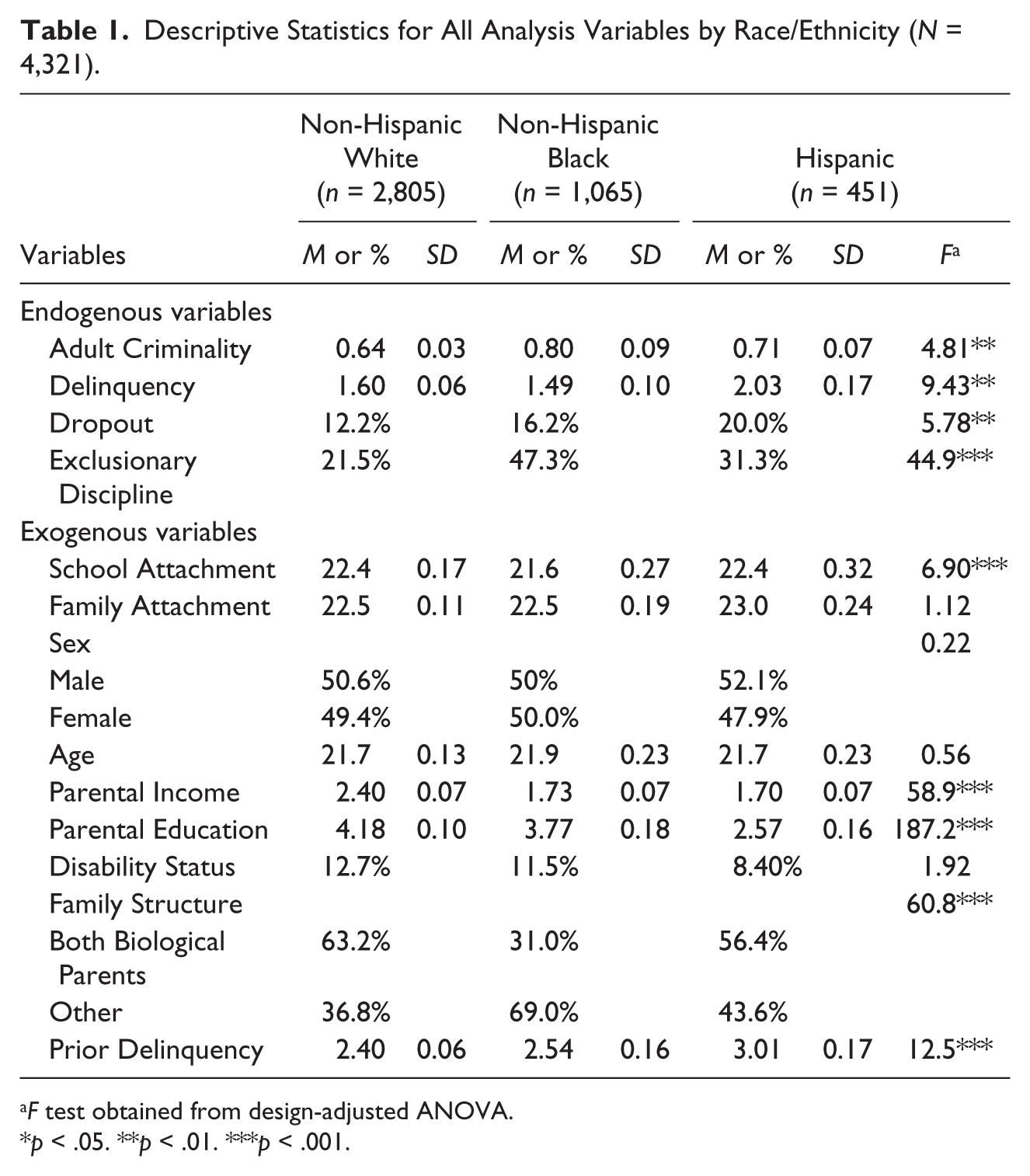
F test obtained from design-adjusted ANOVA.
p < .05. **p < .01. ***p < .001.
Endogenous Variables
The primary outcome variable is criminal offending measured at Wave III. Criminal offending is an index variable constructed using the responses from the following: “In the past 12 months, how often did you” (1) deliberately damaged someone’s property; (2) steal something worth more than US$50; (3) gone into a house or building to steal something; (4) threaten to use or used a weapon to get something from someone; (5) sold marijuana or other drugs; (6) steal something worth less than US$50; (7) taken part in a physical group fight; (8) buy, sell, or hold stolen property; (9) use someone else’s credit card, bank card, or ATM card without permission; (10) purposely write a bad check; (11) use a weapon in a fight; and (12) belong to a gang. Due to limited variability, responses were collapsed into two categories with 0 representing no engagement in the criminal act and 1 indicating criminal engagement at least once. Criminal offending ranges from 0 to 12.
Self-reported delinquency was measured at Wave II and consists of 14 items derived from responses to the following question: “In the past 12 months, how often did you” (1) paint graffiti on someone else’s property, (2) deliberately damage something that didn’t belong to you, (3) lie to your parent or guardian about where you were or who you were with, (4) take something from a store without paying for it, (5) get into a serious physical fight, (6) hurt someone badly enough to need bandages or care from a doctor or nurse, (7) run away from home, (8) drive a car without the owner’s permission, (9) steal something worth more than US$50, (10) go into a house or building to steal something, (11) use or threaten to use a weapon to get something from someone, (12) sell marijuana or other drugs, (13) steal something worth less than US$50, and (14) take part in a fight where a group of your friends was against another group. Responses were collapsed into two categories with 0 representing no engagement in the delinquent act and 1 indicating delinquent involvement at least once. Delinquency ranges from 0 to 14, with higher values indicating more engagement in a variety of delinquent acts.
Dropout, measured at Wave III, is comprised of the following question: “What was the highest grade or year of school you completed?” Responses range from sixth grade to fifth year of graduate school. Dropout is a dummy variable in which 1 represents those who did not graduate high school.
Exclusionary discipline acts solely as a mediator between background factors and the other endogenous variables. This is necessary as being suspended or expelled is heavily influenced by student characteristics including socioeconomic status, disability status, race or ethnicity, and parental education (Skiba, Michael, Nardo, & Peterson, 2002; Wald & Losen, 2003). Exclusionary discipline is measured at Wave I and combines instances of out-of-school suspension and expulsion. The variable is comprised of the responses to the following questions: (1) Have you ever received an out-of-school suspension? (2) Have you ever been expelled? The combination of these two types of exclusionary discipline is often necessary as expulsion seldom occurs (Cuellar & Markowitz, 2015; Shollenberger, 2015). Exclusionary discipline was dummy coded with 1 indicating an experience with suspension or expulsion.
Exogenous Variables
Several sociodemographic and control variables were obtained from Waves I to III. These include prior delinquency, parental education, parental income, disability status, family structure, sex, and age. Considering that prior delinquent behavior is one of the strongest predictors of future delinquency, dropout, and eventual involvement with the criminal justice system, prior delinquency is controlled for (Gottfredson & Hirschi, 1990; Kavish et al., 2016; Sampson & Laub, 1993). Prior self-reported delinquency is measured at Wave I, which used the same measures as Wave II. Prior delinquency ranges from 0 to 14.
Because socioeconomic status is strongly correlated with delinquency, dropout, and criminal behavior, it is imperative to control for the socioeconomic status of the students’ parents or guardians, both obtained from the In-Home Parent Questionnaire (Cohen, 1955; Kavish et al., 2016; Miller, 1958). This study uses two indicators of parental socioeconomic status: parental education and parental income at Wave I. Parental education consists of the education level of the respondents’ residential parents using responses from the following question: “How far in school did your mother go?” and “How far in school did your father go?” Mother and father education were combined and averaged into a scale ranging from 0 to 7, with 0 indicating “eighth grade or less” and 7 representing “beyond college.” Parental income was obtained at Wave I using the following question: “About how much total income, before taxes did your family receive in 1994? Include your own income, the income of everyone else in your household, and income from welfare benefits, dividends, and all other sources.” Parental income is divided into seven categories: 0 = less than US$10,000; 1 = US$10,000 to US$24,999; 2 = US$25,000 to US$49,999; 3 = US$50,000 to US$74,999; 4 = US$75,000 to US$99,999; 5 = US$100,000 to US$149,000; and 6 = US$150,000 and up.
The disability status of the student was obtained from the In-Home parent questionnaire at Wave I. Evidence suggests that having a disability significantly increases the likelihood of being suspended or expelled, particularly among minorities (U.S. Department of Education, 2014). Disability status is a dummy variable comprised from the responses to the following questions: (1) “Is your child mentally retarded?” and (2) “Does he or she have a specific learning disability, such as difficulties with attention, dyslexia, or some other reading, spelling, writing, or math disability?” If the parent responded yes to either of these questions, the student was considered to have a disability.
Family structure is a categorical variable derived from the household roster obtained at Wave I. Respondents were asked questions about who lives in their household including biological parents, siblings, and nonbiological family members. Family structure has long been shown to influence adolescent delinquency, drug use, and school performance in which living with biological parents is shown to have a protective effect (Dornbusch, Erickson, Laird, & Wong, 2001; Gottfredson & Hirschi, 1990; Sokol-Katz, Dunham, & Zimmerman, 1997). As such, family structure was collapsed into a dummy variable in which 1 represents living with both biological parents and 0 indicates other family compositions.
The age-crime curve is one of the most well-established findings in criminology; as such, age is included as a control variable at Wave III (Gottfredson & Hirschi, 1990; Sampson & Laub, 1993). Age, a continuous variable, was calculated by subtracting the respondent’s date of birth from the date of the in-home interview. Sex, a dummy variable, was coded 0 for female and 1 for male. Race/ethnicity was constructed from the response to the following question: “What is your race?” To keep mutually exclusive categories, if a respondent indicated that they were of Hispanic origin, they were categorized as Hispanic.
Analytic Strategy
To examine the relationship between school disciplinary experiences and later life outcomes, several analyses were conducted. First, descriptive statistics for each ethno-racial group are reported for all of the study variables. Second, because the main purpose of this project is to determine whether ethno-racial differences exist in the pathways from school discipline to criminal offending, it is necessary to establish that group differences exist. To determine the statistical significance of group differences, I rely on F test. For the main analysis, generalized path analytic techniques were used to model the pathways from school exclusion to criminal offending for each race group. Equality-of-coefficients tests (Z test) were conducted to compare the unstandardized path coefficients across race and ethnicity to determine whether group differences were statistically significant (Paternoster, Brame, Mazerolle, & Piquero, 1998).
Results
Descriptive Analyses by Ethno-Racial Group
Table 1 displays the means/proportions and standard deviations separately for non-Hispanic Whites (referred to as White), non-Hispanic Blacks (referred to as Black), and Hispanics. Results from the F tests suggest significant differences across ethno-racial groups for several of the study variables. Blacks report the highest level of criminal activity in adulthood (
There is also variation in reported levels of delinquency and dropout across ethno-racial group. Hispanics report the highest level of delinquency (
Generalized Path Analysis Results
White Sample
Final results for the White sample are illustrated in Figure 1. First, the paths from exclusionary discipline to the three outcome variables suggest some interesting relationships. For Whites, being suspended or expelled increases the odds of dropping out by 3.16 (p < .001). There is a negative relationship between exclusionary discipline and criminal offending; however, this relationship is not significant. For Whites, being suspended or expelled appears to have a deterrent effect on delinquency. Experiencing exclusionary discipline is associated with 19% decrease in the odds of engaging in delinquency, exp(B) = 0.81, p < .001. In terms of the paths from the mediating variables to adult crime, only one relationship is significant. For Whites, engaging in delinquency is related to a 7% increase in the odds of criminal offending in adulthood, exp(B) = 1.07, p < .001. Dropping out is positively associated with adult offending; however, the relationship is not significant.
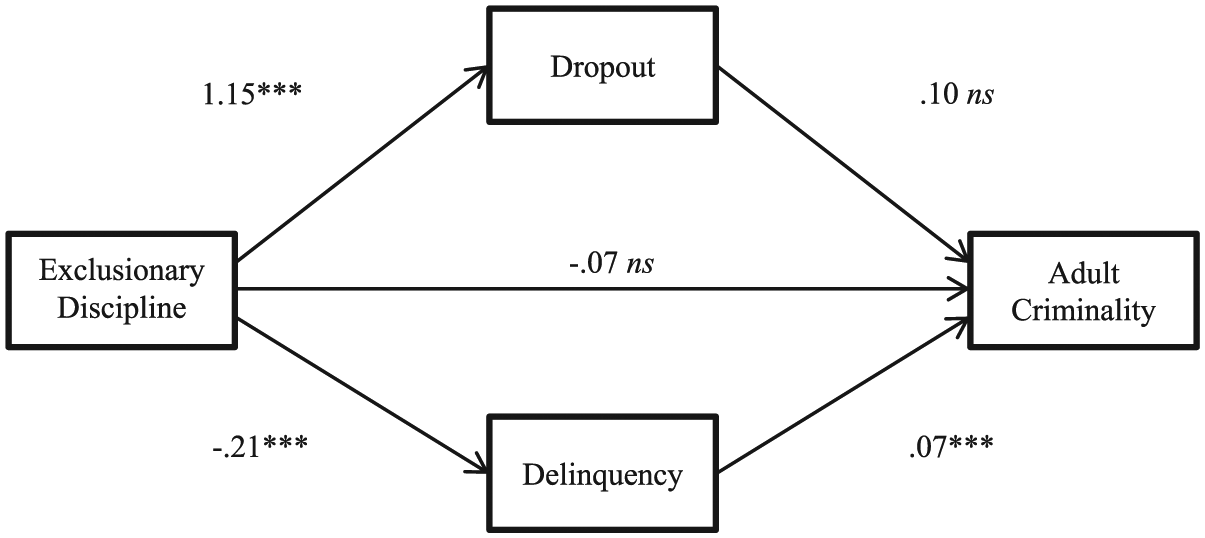
Final model White sample, unstandardized path coefficients (n = 2,805).
There were several significant relationships between the sociodemographic factors and the outcome variables. First, regarding student characteristics, being male is related to a 3.56 (p < .001) and 2.27 (p < .001) increase in the odds of being suspended or expelled and criminal offending in adulthood, respectively. For Whites, having a disability decreased the odds of being suspended or expelled by 52%, exp(B) = 0.48, p < .001, as well as decreased the odds of engaging in criminal behavior by 25%, exp(B) = 0.75, p < .05. However, having a disability increased the odds of dropping out by 2.16 (p < .001) and engaging in delinquency by 10%, exp(B) = 1.10, p < .01. Age was negatively associated with criminal offending, decreasing the odds of adult crime by 18%, exp(B) = 0.82, p < .001, for each additional year. Engaging in prior delinquency was positively related to each of the outcome variables. Prior delinquency increased the odds of being suspended or expelled by 31%, exp(B) = 1.31, p < .001; dropping out of school by 8%, exp(B) = 1.08, p < .01; engaging in delinquency by 21%, exp(B) = 1.21, p < .001; and criminal offending by 7%, exp(B) = 1.07, p < .001.
Regarding parental and family characteristics, parental education is negatively related to exclusionary discipline and school dropout. For each additional year of parental education, the odds of suspension or expulsion and dropping out of school decrease by 21%, exp(B) = 0.79, p < .001, and 27%, exp(B) = 0.73, p < .001, respectively. However, for each additional year of parental education, the odds of criminal offending increase by 4%, exp(B) = 1.04, p < .05. Parental income is associated with a 14% and 25% decrease in the odds of being suspended or expelled and dropping out of school, respectively. Again, parental income is positively associated with criminal behavior, so that for each unit increase in parental income, the odds of engaging in criminal behavior increase by 11%. For Whites, family structure has significant protective effects. Living with both biological parents decreases the odds of suspension or expulsion by 48%, dropping out of school by 41%, and engaging in adult crime by 24%.
Black Sample
Final results for the Black sample are presented in Figure 2. Results suggest that exclusionary discipline is positively related to dropping out of school and criminal offending. For Blacks, being suspended or expelled increases the odds of dropping out by 3.16 (p < .001) and increases the odds of engaging in criminal behavior by 28%, exp(B) = 1.38, p < .01. Exclusionary discipline is negatively associated with delinquency; however, this relationship is not significant. Regarding the pathways from the mediating variables to adult criminality, dropping out increases the odds of engaging in criminal offending by 40%, exp(B) = 1.40, p < .01. Delinquency is negatively related to criminal offending; however, this relationship is not significant.
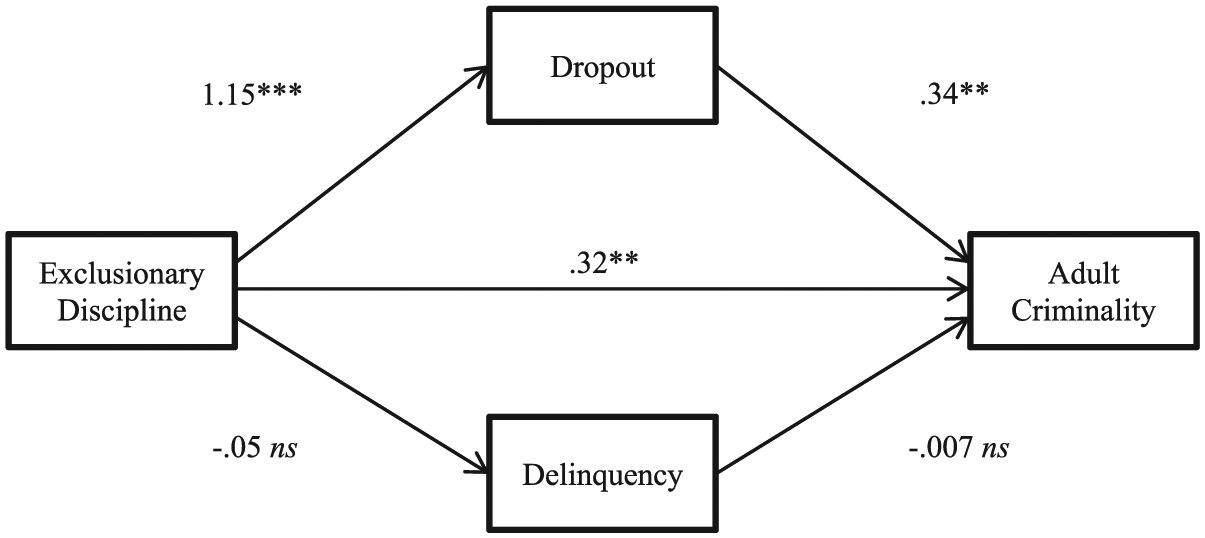
Final model Black sample, unstandardized path coefficients (n = 1,065).
There are several significant relationships between the sociodemographic and control variables and the main outcome variables. Being male increases the odds of being suspended or expelled by 99%, exp(B) = 1.99, p < .001. Similarly, being male increases the odds of criminal offending by 2.09 (p < .001). For Blacks, having a disability decreases the odds of engaging in delinquency by 22%, exp(B) = 0.78, p < .05. For each additional year in age, there is an 8% decrease in the odds of engaging in adult crime, exp(B) = 0.92, p < .01. Prior delinquency related to a 27% increase in the odds of being suspended or expelled, a 22% increase in the odds of engaging in delinquency, and an 11% increase in the odds of criminal offending.
Regarding parental and family characteristics, for each additional year of parental education, there is a 14%, exp(B) = 0.86, p < .001, decrease in the odds of exclusionary discipline as well as a 22%, exp(B) = 0.78, p < .001, decrease in the odds of dropping out. However, for each additional year of parental education, there is a 5% increase in the odds of delinquency, exp(B) = 1.05, p < .01. Higher parental income decreases the odds of exclusionary discipline by 17%, exp(B) = 0.83, p < .05, and decreases the odds of dropping out by 24%, exp(B) = 0.76, p < .05. Living with both biological parents decreases the odds of exclusionary discipline by 40%.
Hispanic Sample
Results for the final model are shown in Figure 3. Exclusionary discipline is associated with an 82%, exp(B) = 1.82, p < .05, increase in the odds of dropping out of school. Although suspension/expulsion is positively related to both delinquency and criminal offending, neither of those relationships is significant. Dropping out of school is marginally significant (p < .055) in increasing the odds of criminal offending by 39%. Delinquency is positively related to criminal offending; however, this relationship does not reach statistical significance.
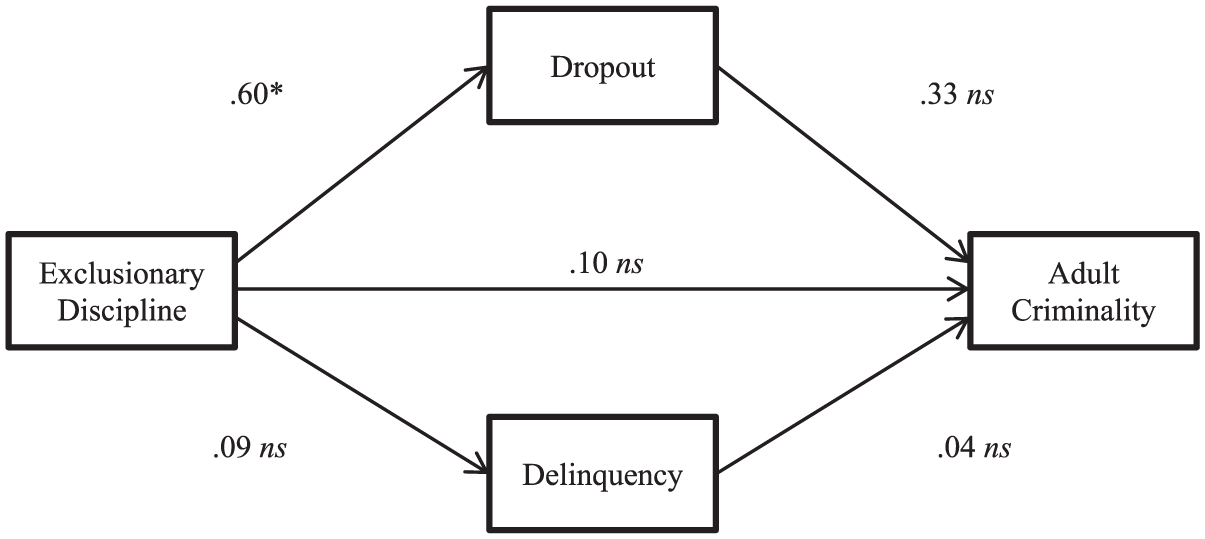
Final model Hispanic sample, unstandardized path coefficients (n = 451).
Regarding student characteristics, being male increases the odds of exclusionary discipline and criminal offending by 3.16 (p < .001) and 2.38 (p < .001), respectively. For each additional year in age, the odds of engaging in criminal offending decreases by 10%, exp(B) = 0.90, p < .05. Prior delinquency is positively associated with each outcome variable. Engaging in prior delinquency increases the odds of exclusionary discipline by 24%, dropping out by 15%, delinquency by 16%, and criminal offending by 6%. There is no significant relationship between having a disability and any of the outcome variables.
In terms of parental and family factors, for each additional year of parental education, the odds of being suspended or expelled decrease by 11%, exp(B) = 0.89, p < .05. Likewise, higher parental education decreases the odds of dropping out by 13%, exp(B) = 0.87, p < .05. Higher parental income is related to a 44% decrease in the odds of dropping out, exp(B) = 0.66, p < .05. Last, living with both biological parents decreases the odds of being suspended or expelled by 52%, exp(B) = 0.48, p < .01.
Comparison of Coefficients Across Ethno-Racial Path Models
Table 2 displays the results of the equality of coefficients test for the main study variables across ethno-racial group. As expected, Whites and Blacks differ significantly in all but one relationship, that being the relationship between exclusionary discipline and dropout. The largest statistically significant difference between Whites and Blacks is in the impact of exclusionary discipline on criminal offending in which Blacks experience increased odds of offending in adulthood after being suspended or expelled (Z = −4.03, p < .001). Blacks and Whites also differed with respect to the impact of exclusionary discipline on delinquency and the effects of delinquency and dropout on offending in early adulthood.
Tests for Equality of Path Coefficients Across Ethno-Racial Group.
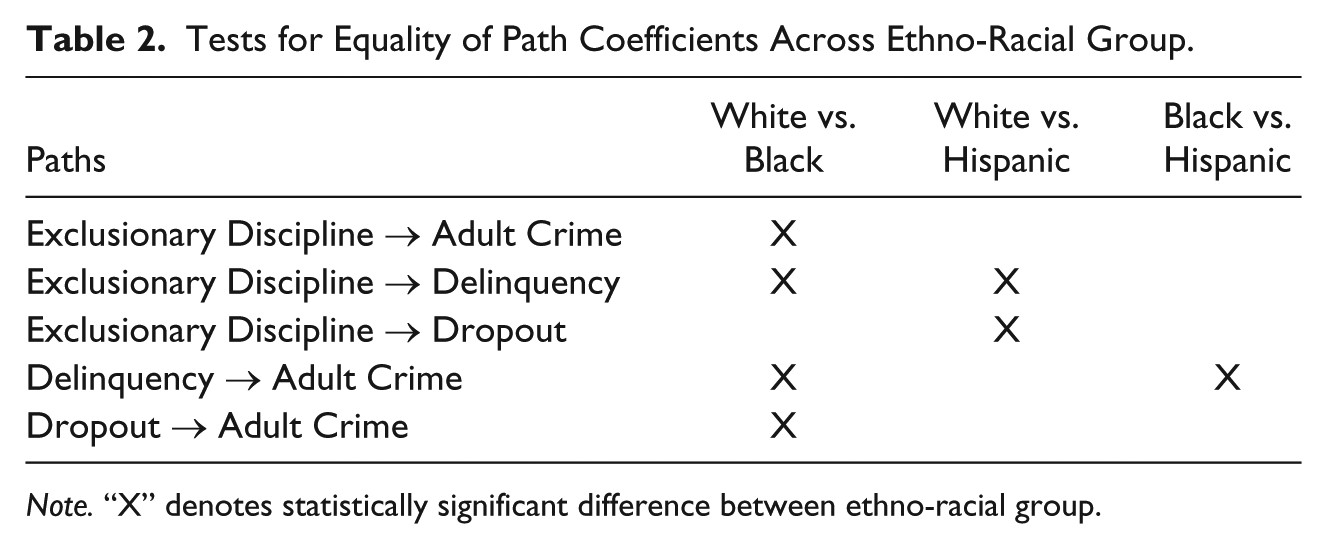
Note. “X” denotes statistically significant difference between ethno-racial group.
The results of the equality of coefficients test indicate that Whites and Hispanics differ in the effect of exclusionary discipline on delinquency and dropout. The largest statistical difference between Whites and Hispanics is the influence of exclusionary discipline on delinquency in which Whites experience decreased odds of delinquency after being suspended or expelled (Z = −2.48, p < .01).
Discussion
The aim of this study was to explicate the pathways from exclusionary discipline to criminal offending in adulthood via delinquency and dropout and to ascertain whether those pathways varied across race and ethnicity. One purpose of this study was to challenge the notion of the STPP as singular pathway that takes students from suspension and/or expulsion directly to involvement with the criminal justice system. Rather, this study posited that it is more probable that the effects of school exclusion are mediated by more immediate short-term outcomes that funnel students toward involvement with the criminal justice system (Skiba et al., 2014).
First, as anticipated, Black and Hispanic students experienced a disproportionate amount of exclusionary discipline compared with their White counterparts. Black and Hispanic students were suspended or expelled at a rate two and three times their sample population, respectively. In addition, results from the regression analyses suggest that Black students are 2.58 times more likely to be suspended or expelled controlling for other relevant factors such as socioeconomic status and family structure. Given this disparity in exclusionary discipline, racial and ethnic minorities are at an elevated risk of entering the pipeline as compared with White students.
As expected, there were several significant differences across race and ethnicity. In terms of pathways from school exclusion to adult criminality, Black students have two significant paths toward criminal offending, including a direct link from exclusion to criminal offending and the other via dropout. This direct effect suggests that for Blacks, the effect of being labeled in adolescence may have a strong influence on outcomes in adulthood.
Next, although both Black and White students have similar odds of dropping out of school after being suspended or expelled, only Black students experience an increased risk of engaging in criminal offending after dropping out of school. For both White and Hispanic students, suspension and expulsion are related to an increased risk of dropout, yet for both of these groups, dropout does not lead to criminal offending in adulthood. It is possible that dropping out of school does not lead to crime in adulthood because Whites and Hispanics may have better employment options in spite of their failure to graduate. Exemplified in the work of Pager (2003), the stigma associated with the label of “felon” was stronger for Blacks than Whites. Pager’s seminal work found that Black applicants with a criminal record were the least likely to receive a callback for an interview when compared with stigmatized Whites.
Another noteworthy difference is the path from exclusionary discipline to delinquency. For Whites, being suspended or expelled actually deterred delinquency in Wave II, whereas for Black and Hispanic students, exclusionary discipline had no significant impact on delinquency. This finding suggests that the deterrent effect of school punishment operates differently across race and ethnicity. This finding, while unexpected, corresponds to some of the theoretical propositions in the deterrence literature. Empirical research on the deterrent effect of punishment in general has been inconsistent, with studies concluding that punishment decreases, increases, or has no effect on future criminal offending (Nagin & Pogarski, 2001; Pratt, Cullen, Blevins, Daigle, & Madensen, 2006). Although not addressing race specifically, Sherman (1993) posited that the deterrent effect of punishment differed across various social conditions including offender characteristics, type of offense, and the perceptions of fairness. He suggests that sanctions will provoke defiance if the offender sees the punishment as illegitimate, has weakened bonds to the agent or community, and feels shame over their behavior triggering isolation from the community. On the contrary, an offender will be deterred from future offending if the offender sees the punishment as legitimate, maintains strong bonds to the agent or community, and accepts the shame of their behavior but remains in solidarity with the community (1993).
In light of Sherman’s (1993) theory, the deterrent effect of school punishment for Whites makes sense. First, school discipline literature suggests that Black students, and to a lesser extent Hispanic students, tend to view punishments as unfair and thus illegitimate (Tyler, 1990; Verdungo, 2002). Studies document that minority students observe the arbitrary and disproportionate use of out-of-school suspension, therefore reducing the legitimacy of authority (Costenbader & Markson, 1998; Verdungo, 2002). Because exclusionary discipline is not disproportionately applied to White students, when White youth are suspended or expelled, they may be more likely to accept punishment as fair and just, thus reaffirming the legitimacy of authority figures and increasing compliance among Whites (Tyler, 1990). In addition, Sherman noted that previous studies on deterrence suggest that sanctions are more likely to fail to deter crime among out-groups, such as ethno-racial minorities, even while they deter in-groups.
Although these findings contribute to the understanding of the STPP, limitations must be noted. First, it was not possible to include school-level characteristics due to data accessibility restrictions. This is an important limitation as there are differences in disciplinary practices across schools in which those with a majority of poor, racial minority students have the most punitive policies (Skiba et al., 2014; Theriot, 2009). However, the primary purpose of this study was not to predict the use of exclusionary discipline but rather the effects associated with it. Next, because the fundamental purpose of Add Health was to collect information on health-risk behaviors, many crime-relevant variables were not collected. Pertinent to this project is the lack of deviant or delinquent peer measures. This is a significant limitation given the empirical research documenting the influence of deviant peers on delinquent and criminal offending (Matsueda & Anderson, 1998; Sampson & Laub, 1993).
In terms of theoretical limitations, while labeling theory is central to the development of this study, “labeling” is not directly tested. Extending the work of Mowen and Brent (2016), this study proposed that being suspended or expelled is an event that labels an individual and brings about a series of reinforcing conditions that puts students on a path toward prison. However, this does require an assumption that others have in fact labeled the student as a “troublemaker” or “bad kid” and that these labels have been successfully applied subsequently preventing conventional opportunities. Although this is a substantial assumption, other studies lend support to this notion finding that being labeled in school has significant consequences for future success (Alexander, 2010; Bowditch, 1993). Finally, the goal of this study was to provide a better understanding of the STPP. Unfortunately, there were not enough cases to have incarceration as an outcome variable (n = 75). Rather, self-reported criminal behavior in adulthood was used as a proxy.
Policy Implications
Even with these limitations, this study provides significant insight into the nuanced relationship between school discipline, negative life outcomes, and race and ethnicity. There are several important policies that could be implemented based on the results of this research. Consistent with previous research, this study found evidence of severe racial disparities in the use of exclusionary discipline while controlling for socioeconomic factors such as parental income and education. This is an important finding as some scholars discount the race effect in school punishment by claiming its effect as solely due to socioeconomic factors. As a consequence of this disparity in use, racial minorities are likely to view the punishment and school officials as illegitimate and unjust. Thus, rather than deterring negative behaviors, school punishment can intensify future problem behaviors. As such, this project suggests that educational policy needs to foremost address and correct unfair and inconsistent zero-tolerance disciplinary policies. To achieve this, policymakers should consider implementing a system to regularly check and analyze disciplinary referrals to improve consistency, discretionary bias, and fairness in the application of school discipline (Morrison, Peterson, O’Farrell, & Redding, 2004; Toldson, 2011).
Wald and Losen (2003) noted that one of the detrimental consequences of exclusionary discipline is that once students are removed from school for extended periods of times, they often experience difficulty in reentering. Similar to the reintegration problems plaguing the prison system, reintegrating students back into the school environment can be a difficult experience. This study supports this claim in that, following suspension or expulsion, students experienced an increased risk for dropping out of school. This may signal to the challenges felt by students who have been labeled, stigmatized, and missed out on valuable instruction. Braithwaite’s (1989) work on reintegrative shaming can help to address this problem. Criminal sanctions, in this case school punishment, can be delivered in either “reintegrative” or “stigmatizing” ways; the former induces social shame on the act, whereas the latter places shame on the actor (Braithwaite, 1989). In other words, rather than doing a bad thing, you are a bad kid. Reintegrative shaming can work to reduce criminal behavior, whereas stigmatizing shame increases it. As such, utilizing reintegrative shaming techniques may help to successfully integrate rather than isolate students from school environment.
Footnotes
Author’s Note
Racheal Pesta is currently affiliated with Eastern Connecticut State University, CT, USA.
Declaration of Conflicting Interests
The author(s) declared no potential conflicts of interest with respect to the research, authorship, and/or publication of this article.
Funding
The author(s) received no financial support for the research, authorship, and/or publication of this article.