







Abstract
Suicidal behaviors are of critical public health concern. These behaviors are even more pervasive in the justice system, in particular in the correctional sector. Yet, the field of criminology has historically shown limited interest in furthering the scientific inquiry behind these behaviors. Interdisciplinary work has routinely been used as a buzz word in academia. This study argues that the intersection of criminology, psychology, and sociology are a beginning step to challenge normal science and progress into a new paradigm of scholarship, in relation to suicidology. The current study details the importance of knowledge building, exchange of theories, measurement, variables, and collaboration. Using real data to illustrate how this approach could work, a test of lifetime suicidal ideations and in-jail suicidal ideation is conducted to demonstrate the interdisciplinary nature of suicide within justice involved populations.
Background
Kuhn (1962) argued in his seminal work “The Structure of Scientific Revolutions,” that scientific understanding is not a process that happens through gradual change and small works of new understanding. Science, according to Kuhn, thrives off of revolutions. Everything else is “normal.” And yet normal science is a prerequisite of the revolutionary science. This begs the question, though, in the six decades since Kuhn posited his theory, at a time when it took 50-years for the amount of say, medical knowledge, to double, to today when it takes only 73 days for the medical field to double the amount of information available to researchers (Densen, 2011)—Why are scientific revolutions still so rare?
One possible explanation is that information is siloed; confined to its field of regard, while other related scientific fields keep their research in their own silos (Root-Bernstein, 1989). This is how academia produces experts, the PhDs who are at the height of their knowledge (Hambrick et al., 2014). But perhaps delving deeper and deeper into a subject, into an ever-expanding chasm of knowledge is not the only way to create Kuhn’s scientific revolutions. Perhaps, instead, one should be destroying silos to find what one’s neighbors know.
Take criminology. Since the first Homo Sapiens roamed out of the savanna and into the wider world, crime has existed. Yet crime was never its only field of study. Rather, philosophy, and later, sociology were the overarching fields of inquiry. Their theories could be adapted to account for an understanding of crime but, once criminology evolved from these two fields, it began developing its own theories and began retreating from its scientific predecessors. But in a field where the target population is notoriously hard to study, this paper argues that the next revolution of criminology will come from a applying a multi-disciplinary approach to criminology, instead of refining a criminology unique theory to the nth degree. Synthesis of relevant related information, rather than delving deeper into an expanding abyss in one field of study, is the key to rapidly expanding knowledge of the problem.
That is to say, this paper serves as an example of what this could look like. This study looks at one problem, suicide in an incarcerated population, from three lenses: criminology, psychology, and sociology. Acknowledging that the criminology research is limited, the current study draws from criminology’s predecessors, whose knowledge on suicidology is more established, to demonstrate how each field contributes to illuminating a devastating but understudied problem. While this multidisciplinary approach is not all inclusive in its literature review, it actually strives not to be, rather pulling out the most relevant threads of information from these former silos of knowledge. Finally, after analyzing the problem through three distinct lenses, this study closes with a singular discussion, the problem now illuminated in a new light.
Introduction
Criminology, and criminologists, are missing out on a huge area of human behavior that occurs within, and throughout, the criminal justice system [CJS]. Self-injurious thoughts and behaviors are extremely prevalent in all four sectors of the CJS: juveniles, policing, courts, and corrections. In fact, justice workers are some of the most at risk populations for self-injurious thoughts and behaviors (Stanley et al., 2016). In particular, criminologists are missing out on the study of suicide, and suicide related behaviors, within the correctional system. Suicide is the leading cause of death in jails in the United States (Carson & Cowhig, 2020). However, even with this knowledge, the study of self-injurious thoughts and behaviors is lacking in criminological research. Often times the evaluation of suicide falls to criminological theories, without diving back into the roots of criminology, which most would argue stem from psychology and sociology, to use the well-developed tools from across a range of fields. Instead, as a total institution, criminological work on suicide tends to occur only within the criminal justice worldview and lacks the integration with related disciplines. Often this leads to testing and analyzing CJS related samples using strict criminological and criminal justice theories, while forgetting to include the valuable insight from the empirical, clinical, and practical suicidology world.
As a means of illustrating how the individual can accomplish hastened advances in scientific understanding, this paper uses the topic of suicide of a jail-based population. Suicidal ideation is a critical concern for people incarcerated in jail, and yet there is no official data collected on suicidal ideation in the United States. Suicidal ideation is the most common self-injurious thought and behavior and is known to increase the risk for both suicide attempts and death by suicide (Jobes & Joiner, 2019). Death by suicide accounted for 29.9% of deaths in jails in the United States in 2018 (Carson & Cowhig, 2020). As a result, suicide was the leading cause of death and had a rate of mortality more than three times that of the general population’s suicide mortality rate (45 per 100,000 compared to 14 per 100,000) (Carson, 2021). Given that Jobes and Joiner (2019) found that suicidal ideation is the most common predictor of death by suicide, it should be no surprise that He et al. (2001) suggested in their work that 72% of the deaths by suicide in their prison-based study had reported suicidal ideation prior to death.
As Goffman (1968) would argue that the correctional system is a total institution, or rather, a closed system, there should be no need to open one’s aperture to study seemingly unrelated fields and theories. But human beings excel at recognizing patterns in nature. This is true, then, when analyzing two systems that, at surface value, are unrelated. So, in order to demonstrate how an individual can apply a multidisciplinary approach to bridge the gap between Kuhn’s “normal” and revolutionary science, this paper demonstrates how measures, and ultimately theories, from different fields can be overlaid on top of existing jail-based knowledge to rapidly expand the understanding about suicide in jail population. 1 An interdisciplinary approach is not simply an integration of theories, where one would combine knowledge from within the same field into a general theory, interdisciplinary is intentionally finding the best, most relevant theory from one field and deliberately changing it to fit your world view, then shifting and finding the best theory from that vantage point and adjusting accordingly. While similar to an integration of theories approach, this interdisciplinary approach uses framework from multiple fields to leverage a holistic approach to a problem. In the current study, three fields are used to further the understanding of how lifetime and in-jail suicidal ideations function. Finally, this study discusses how expanding the aperture to a multidisciplinary approach can accelerate relevant policy changes which, in this case, can buy down the risk to vulnerable and difficult to study populations that exist in the CJS. A discussion of future implications for more suicide research throughout the CJS is detailed with suggestions for integration with other fields, not presented in the empirical part of this study. This should be viewed as a suggestion and push for innovation in suicide research throughout the CJS.
Suicidology Approach
Suicidology exists in a wide variety of times and places, sometimes occurring for individuals not as an isolated instance, but across their life span. Within the field of criminology, there are studies that explore suicidal behaviors among individuals incarcerated (Blaauw et al., 2002; Chapman et al., 2005; Dye, 2010*; He et al., 2001; Konrad et al., 2007; Simlot et al., 2013; Smith et al., 2014*; Stoliker, 2018*; Wortzel et al., 2009), correctional officers (Cramer et al., 2017; Frost & Monteiro, 2020*; Kamerman, 1995; Stack & Tsoudis, 1997; Violanti, 2017 ), and police officers (Aamodt & Stalnaker, 2001; Baker & Baker, 1996; Barron, 2010*; Grassi et al., 2019; Stack & Kelley, 1994*; Janik & Kravitz, 1994; Josephson & Reiser, 1990*; Marzuk et al., 2002; Violanti, 1995, 2010, 2018). 2 For correctional research, typically, the samples are prison-based, and looks at identifying in-prison suicide risk, or death by suicide. Recently, scholarship has begun to expand on this small area of suicidality research within criminal justice, by looking at jail-based samples, probationers, and other justice-system actors (Stoliker & Abderhalden, 2021; Antunes et al., 2021; Holliday et al., 2021; Phillips et al., 2018; Simlot et al., 2013; Stoliker, 2018). However, because of the wide spanning self-injurious thoughts and behaviors, suicidological research exists within many fields of research, including nursing, public health, psychiatry, psychology, sociology, and criminology. Suicidal behaviors, meaning the encompassing behaviors that preempt death by suicide, are phenomenon that have a substantial amount of research, typically related to risk factors and prevention, or treatment, approaches. Yet, it is all too common for each of these fields to stovepipe their knowledge which results in an incomplete picture of the problem. In order to demonstrate the validity of taking an interdisciplinary approach to research, the current study looks at the intersection of criminological, psychological, and sociological research on suicidal ideations with a sample of individuals from jail incarceration. What follows is a brief review of the relevant suicide literature available from each of these fields.
Criminological Suicide Overview
Criminology is the study of crime and deviant behavior. In criminological research, the focus of suicidal behaviors is to examine the relationship with criminal behavior. Most studies within the field of criminology and criminal justice that look at suicidal behaviors, explore self-injurious thoughts and behaviors in association with criminal offense (Killias et al., 2001; Webb et al., 2011, 2012). Criminal justice theories have been used to explain suicide with justice involved populations. One of the most used theoretical frameworks used is the importations and deprivation models, which suggest that individuals bring in factors to facilities that effect their behavior (importations) or have factors due to the incarcerated environment itself that lead to behaviors (deprivations) (Abderhalden, 2021; Dye, 2010; Frottier et al., 2001; Stoliker, 2018). Other theoretical approaches within the criminal justice framework of suicidal behaviors often focus on strain theory, the idea that individuals have stressful events that lead them to suicidal behaviors (Forster et al., 2019; Stack & Wasserman, 2007). While neither of these theoretical approaches should be viewed as incorrect, there is a large gap in the understanding of suicidal behaviors among justice involved individuals by not looking, adapting, and integrating from fields with a long history of focus specifically on suicidal behaviors, like psychology and sociology. By looking only through criminological theory, and thus criminological vantage points, there is a neglect of factors that related to suicide that may be outside of these theoretical frameworks.
In addition, in criminological research, investigations have a tendency to look at justice system involved populations, most commonly prison, and use that population origin as the base for why a study is a criminological study. While this is not a bad approach, as the sample is a criminal justice-based sample, and thus by definition fits into the criminological world, this base alone can be expanded to look at criminological based constructs in relation to the suicidality outcomes as well. Constructs like time served, sentence, offense type, perceptions within incarceration, are examples of variables that have a base in criminology research that can be used in conjunction with the suicidality outcomes of death by suicide, self-harm, and suicidal ideation that are frequently used in criminological scholarship.
The problem is that by transposing prison data onto jailed individuals can lead to missing the nuances of what make jails, jails. Prisons and jails are not analogous. They operate in unique manners and have very different structures, populations, policies, and programing. Historically, jails are extremely difficult to research (Foudray et al., 2021). Prison based research is more common due in part to the stability within the facility, the policies that overarch Department of Corrections in each state, and federal oversight, all which make prisons more accessible than jails. Jails on the other hand are more difficult to gain access to, in part due to the instability (a result of regular turnover of the incarcerated population), the lack of structured oversight, and the chaotic, and thus dangerous, nature of jail incarceration (May et al., 2014). By assuming an interdisciplinary approach to studying suicide within jails, there is an ability to utilize multiple lenses to learn about an understudied, vulnerable population that is plagued by limited access for researchers. Therefore, scholars should want to view self-injurious thoughts and behaviors through as many disciplines are possible to understand as many aspects of these behaviors as possible.
Psychological Suicide Overview
Psychology is the study of the mind and behavior. Psychology scholars tend to focus their research on what is behind someone’s mentality for self-injurious thoughts and behaviors, what is driving someone to suicidal behaviors and ideations. Psychological studies often examine mental health factors, burdensomeness, belonging, family history, and drinking and drug abuse (Joiner, 2005; Levi-Belz et al., 2019; Van Orden et al., 2010). Suicidal ideation is one of the most common suicidal behaviors studied in psychology, as well as one of the most likely to increase the risk for suicide attempts and death by suicide (Jobes & Joiner, 2019). One of the most prevalent approaches to suicidality research in psychology, is the framework of Beck’s Hopelessness theory. This approach centers hopelessness as the core causal mechanism for suicidal behaviors, and refers to negative and fatal views about one’s future (Beck et al., 1988).
Other research within psychology has looked at other risks to suicidality, including prior suicide attempts, family history of suicide, and substance disorders (Currier et al., 2020; Harlow et al., 1986; Klonsky & May, 2015; Schneider, 2009). Prior scholarship has long looked at the linkage between substance use disorders and suicidal ideation (Poorolajal et al., 2016). Psychologists are most commonly concerned with the mental pain and suffering that leads someone to self-injurious thoughts and behaviors. Studies that focus on the psyche that facilitates suicidal ideation and behaviors usually examine emotional characteristics, like hopelessness, loneliness, depression, and anxiety (Orbach, 2003; Shneidman, 1993; Verrocchio et al., 2016). The underlying approach to suicide through the psychology perspective is to identify psychosomatic factors that predispose or precipitate suicidal behaviors.
Psychological research is frequently conducted in the clinical and general populations and commonly with youth samples. The access that psychological research has is often more available and widespread than the access to protected populations. However, psychological research that explores sensitive topics, like suicide, often faces some of the same struggles as gaining access to jail facilities. As a result, while criminology has been lacking the depth and breadth of research on suicide and suicide related behaviors, psychology seems to be able to capture the breadth of the population and some degree of the depth. By leveraging these strengths of psychological scholarship, criminology can begin to build toward a richer understanding of self-injurious thoughts and behaviors within the CJS.
Sociological Suicide Overview
Sociology is the study of how humans develop and function within the structure of society. In sociological research, the focus of research on suicidality focuses on the external context of why someone may have suicidal behaviors and ideations. One of the predominate theoretical approaches to suicide within the sociological world, is Durkheim’s (1897) theory of suicide. In this theory, Durkheim (1897) argues that there are two domains that result in suicidality, these two domains are social integration and moral regulation. Social integration refers to the social ties that an individual has with others and society, while moral regulation refers to how the individual is impacted by the norms and regulations of society.
While there have been more recent sociology developments surrounding the study of suicide, since Durkheim, the touchstone theme has continued to be concerned with social integration and social ties (Berkman et al., 2000; Kawachi & Kennedy, 1997; Wray et al., 2011). Gibbs and Martin (1964) suggested the idea of integration between social roles and demographic characteristics having a joint role in suicide. Abrutyn and Mueller (2014) examine the socioemotional structure of suicide by expanding on Durkheim’s theory and building on the dimensions though expanded theoretical and methodological approach. They push sociology to consider how to reformulate the principles that Durkheim presented, and to develop more robust and general suicidology theories (see Abrutyn & Mueller, 2014 for the full discussion). In part, the current study builds on this by expanding out of the sociological lens that Abrutyn and Mueller (2014) present, and pushes the conversation forward to interdisciplinary approaches to continue this work. However, even with more recent shifts to racial disparities and bullying, the underlying role within sociology research on suicide stays squarely in the importance and role of social integrations, which include a variety of relationship functions (Gibbs, 2000; Kposowa et al., 1995; Maimon & Kuhl, 2008; Stockard & O’Brien, 2002; van Tubergen et al., 2005).
Similar to how criminology can learn to grow through interweaving a psychological approach to expand on depth and breadth of knowledge related to suicidal behaviors, the same can be said for including sociological insights. In particular, sociology approaches the context surrounding human behavior and the social context. Given that the CJS is a large system, a total institution, that in and of itself provides a unique experience and social structure, sociological views can help to frame how individual behavior acts within this system. Sociological factors are helpful to get a better snapshot of the social environment that could affect suicide within the CJS, but even more specifically within the jail environment. Given the difficulty to access individuals incarcerated in jail, having the tools and methods borrowed from sociology to add to the toolbox of analysis in conjunction with the psychological and criminological tools, the picture can begin to gain clarity that has been lacking from assessing justice involved individuals’ suicidal behaviors.
Lifetime Compared to Specific Time Period Suicidal Ideation
Suicidal ideations within incarcerated settings is a major public health concern (Fazel et al., 2011). The World Health Organization (2007) has highlighted the international importance of looking at incarceration among this high risk population, citing that suicide for incarcerated people happens at a rate of 3 to 8 times that of the general public. However, the majority of studies on suicidality for incarcerated populations only reflects a small part of the overall suicidality problem. Most of the literature focuses on prison-based incarceration and death by suicide (Sveticic & De Leo, 2012). With much less empirical support for other suicidal behaviors and outcomes, and other incarcerated populations, like jails.
Furthermore, recent developments in suicidology research supports the framework of a gradual suicidal process, where individuals may transition from suicidal ideation to eventual suicidal active behaviors, including suicide attempts (Fazel et al., 2008; Klonsky & May, 2015; Shaw et al., 2004). This ideation-to-action foundation suggests that individuals may have lifetime history of suicidal behavior that may be amplified within the carceral setting (Abderhalden, 2021; Stoliker & Abderhalden, 2021; Jenkins et al., 2005). Research by Larney et al. (2012) found that 33.7% of incarcerated individuals in their study reported having a lifetime of suicidal behaviors, prior to their incarceration. In a similar study, Sarchiapone et al. (2009) found that about 15% of their sample had a lifetime history of attempting suicide, while over 43% of the sample had a history of suicidal ideation. These high rates of lifetime suicidality are concerning for incarcerated populations, due to the known hardships and pains of incarceration which can lead to emotional, physical, and mental distress, which may amplify any lifetime suicidality while in-jail (Abderhalden, 2021; May et al., 2014).
Current Study
This study uses mediation analysis to test the relationship between lifetime suicidal ideation and in-jail suicidal ideation, to frame how suicidal ideation may function for justice-involved individuals in the United States. In particular, the current study explores the characteristics from the three proposed fields, criminology, psychology, and sociology with suicidal ideation. Specifically, the research question being asked is:
What factors from the criminology, psychology, and sociology fields are related to suicidal ideation across the lifetime?
Does suicidal ideation across the lifetime mediate the factors from criminology, psychology, and sociology fields when exploring suicidal ideation in jail?
The current study uses this test to demonstrate how this integration of fields and perspectives could work to advance scientific knowledge. A discussion of future implications for collaborative work and interdisciplinary practices is detailed.
Methods
Procedures
Data for this study come from a larger study investigating the adjustment and concerns of jail incarcerated individuals from two jails. The current investigation is based on information obtained in the self-report surveys. Data collection was conducted on two independent days (one at each facility) in the spring of 2018 and 2019. A full description of the data collection procedures can be found in (Stoliker & Abderhalden, 2021).
Respondents ranges in age from 19 to 73. with a mean age of 35. Participation in the study was voluntary and anonymous. Participants filled out their own survey and then placed the survey into a collection box, they were specifically informed, both verbally and written, to not include their name, or inmate number, on their survey. Sampling was criterion in nature, as there were two requirements to be eligible for participation; first, the respondent had to be over 18 on the day of data collection, and second, the respondents had to be English readers.
Both facilities that participated in this research are run by the sheriff. Prior to the collection of surveys, the survey was reviewed by the Chief of the facility, as well as by the on-staff psychiatrist. Having this reviewed by the psychiatrist was done as a debriefing precaution, to ensure that any participant could seek out the psychiatrist after the survey, should they feel it necessary.
Participants
All participants needed to meet the criterion of the study, as well as not be currently housed in administrative segregation or the mental health unit on the day of collection at both facilities. 3 From the facility in Florida, 857 people were currently being housed on the day of collection, of this, four of the individuals were under the age of 18 and therefore excluded from participation in the survey. A total of 353 respondents submitted a completed or partially completed the survey resulting in a final response rate of 41.4% from all of the eligible individuals at the facility on the day of data collection. At the facility in Texas, 633 people were housed at the facility on the day of collection; it is unknown how many were excluded for being under 18- but juveniles were housed in a separate unit so it was not possible to have accidentally surveyed anyone who did not meet the age requirement; 196 completed or partially completed surveys were collected (RR = 31%). Overall, the response rate for this study is 36.9%.
Dependent Variables
Self-reported lifetime suicidal ideation and jailed suicidal ideation
There are two dependent variables for this study. Lifetime suicidal ideations and in jail suicidal ideations both from the Self-Injurious Thoughts and Behaviors Index, Jail (SITBI-J) (Abderhalden, 2021; Stoliker & Abderhalden, 2021). “I have had thoughts about killing myself in the past,” is used as a lifetime measure of suicidal ideation, and “I have had thoughts about killing myself since being in jail” is used as a measure of in-jail suicidal ideation. The SITBI-J has strong psychometric properties (Abderhalden, 2021). These two outcome variables have single-item reliability of .96 and .99, respectively (Abderhalden, 2021).
Independent Variables
The independent variables used to model lifetime suicidal ideation and in-jail suicidal ideation are based on the three fields of study mentioned above.
Criminology Based Factors
Time Served is a continuous measure of days, using a self-report question asking, “how long have you been at this facility?” Segregation is measured with the question, “Have you ever spent time in segregation while incarcerated?” This measure is dichotomous with yes = 1, and no = 0. Offense type (violent/sex) is measured asking “Please select the offense you are currently being held for.” This measure was then recoded into violent and sex offenses as the reference category compared to non-violent, property, traffic, drug, and violation of parole offenses. Perception of Safety questions were adapted from Gordon et al. (2003) and was measured with the following items, “Being attacked by other inmates,” “Being taken advantage of by other inmates,” “Having a heated argument with guards,” “Having your property stolen by another inmate,” and “Having a heated argument with inmates.” All questions were proposed in a single-matrix with a Likert scale of Not at all Afraid (1), Somewhat Afraid (2), Afraid (3), and Very Afraid (4). The final alpha for this construct is a .896.
Psychology Based Factors
Hopelessness is a measure adapted from the Beck et al.’s (1988) Hopelessness scale. Using eight items, participants were asked on a Likert scale of Strongly Disagree (1), Disagree (2), Agree (3), Strongly Agree (4), “I look forward to the future with hope and enthusiasm,” “I never get what I want, so it’s foolish to want anything,” “The future seems vague and uncertain,” “I might as well give up because there’s nothing I can do to make things better,” “When I look ahead to the future I expect I will be happier than I am now,” “There’s no use in trying to get something I want because I probably won’t get it,” “All I can see ahead of me is unpleasantness rather than pleasantness,” and “When things are going badly, it helps to know that they can’t stay that way for ever.” The alpha for hopelessness is .831. Loneliness is a single-item measure which asked respondents to reply based on the agreement Likert scale, to the following statement, “I feel lonely.” This item has been validated in prior literature as a good measure for self-reported feelings of loneliness (Russell, 1996; Rutter et al., 2008). Prior suicide attempt is a single-item measure asking, “Have you ever attempted suicide?” and coded dichotomously with yes = 1 and no = 0. Family suicide history is measured by asking “Has anyone in your family ever committed suicide?” with yes = 1 and no = 0.
Drug Abuse is an aggregate measure adapted from the Drug Abuse Screening Tool (Evren et al., 2014) about drug use with yes = 1 and no = 0. The question asks a variety of drug related questions about the prior 12 months to incarceration. The two items used in this study are, “Have you used drugs other than those required for medical reasons,” and “Have you used prescription drugs other than what they are prescribed for.” Drinking Abuse is adapted from the CAGE Substance Abuse Screening Tool (Evren et al., 2014). This four-item measure asks respondents the following questions, “I feel I should cut down on my drinking,” “People are often annoyed with me for drinking,” “I feel guilty about my drinking,” and “I drink in the morning to steady my nerves.” This measure was then transformed into a dichotomous measure, with two more positive responses indicative of alcohol dependency.
Sociology Based Factors
Autonomy is measured asking participants. “When there’s a problem officers give the chance to tell your side of the story?” This was measured on the agreement Likert scale. Support is adapted from the Fragile Families and Child Wellbeing Study (Waldfogel et al., 2010). This aggregate measure asks, “I receive a great deal of emotional support from my friends and family,” “I am very satisfied with my level of support from my friends and family.” This measure is dichotomous with yes = 1 and no = 0. Parental Status is measured asking, “Do you have any children?” with Yes = 1 and No = 0. Relationship Status is a measure that asked, “Which of the following best describes your current relationship status?” Response categories included, single never married (0), single previously married (1), in a relationship but not married (2), married (3), widowed (4), other (5). Relationship status was dichotomized as single/widowed versus other, with being in a relationship as the reference category.
Demographics
Age is a continuous measure of self-reported measure asking “In what year were you born?” Sex (male) is measured by asking, “Which gender do you identify with?” Male, Female, Transgendered, and other were the response categories, this question was dichotomized with Male being the reference category. Race (white) is a self-reported measure asking, “What race or ethnicity do you consider yourself?” Response categories were Black, White, Hispanic, Latino, Mexican American (of any race), and Other. Race was dichotomized with White as the reference category.
Analytic Technique
To test the significance of the multidisciplinary factors and their relationship to suicidal ideation, first a test of the univariate descriptive statistics are reported (see Table 1). Then, after checking for normalcy of the data using the Shapiro-Wilk test, which demonstrated that the data is reasonably normally distributed (Razali & Wah, 2011), a test of the multivariate mediation regression models was conducted. The standardized (β) coefficients of the analysis are reported in Table 2. Model 1 shows the effects predicting lifetime suicidal ideation and Model 2 measured the effects of predicting in-jail suicidal ideation.
Descriptive Statistics of Independent Variables (n = 548).
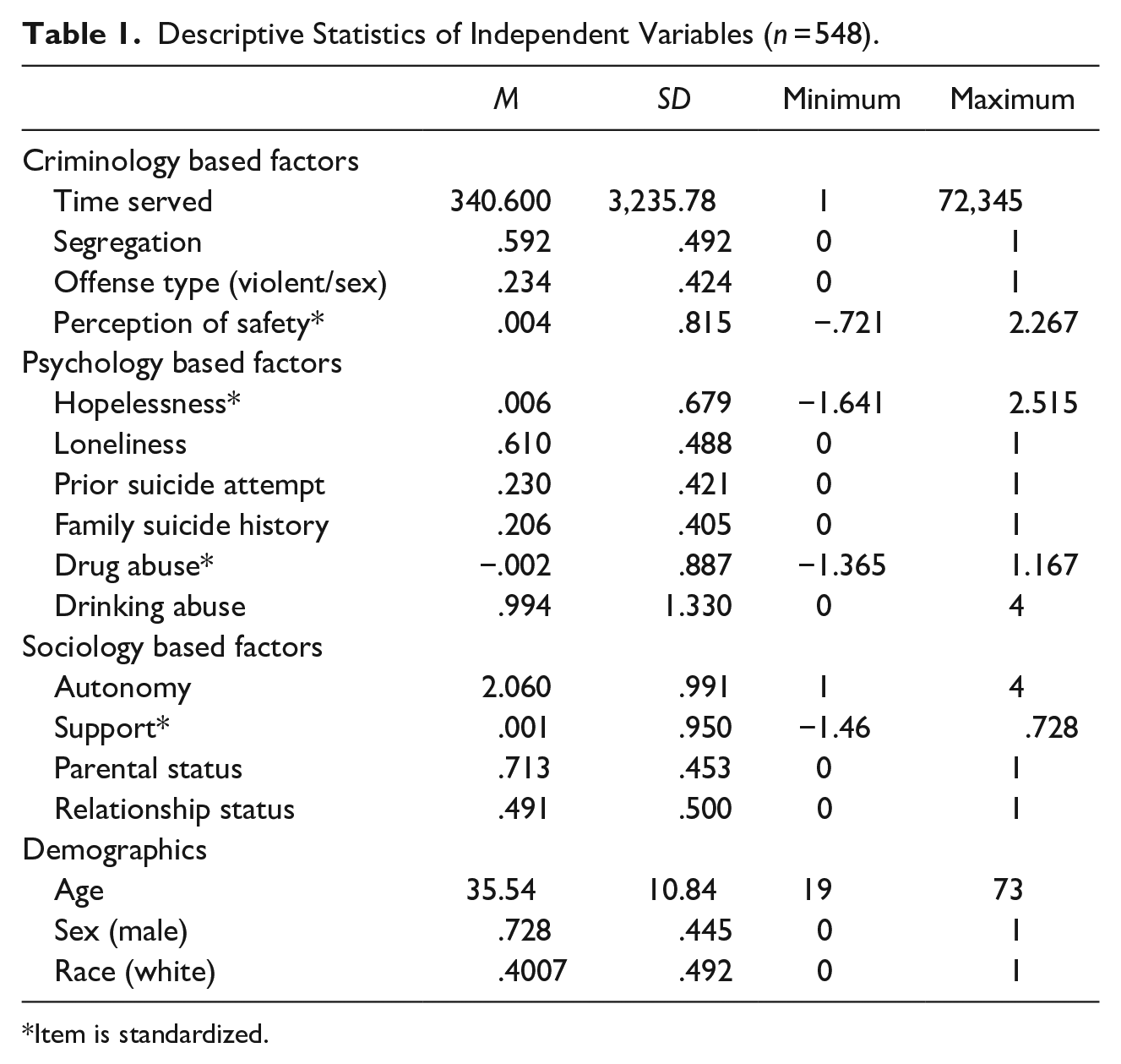
Item is standardized.
Models Assessing the Mediation Effect of Lifetime Suicidal Ideation on in-Jail Suicidal Ideation.
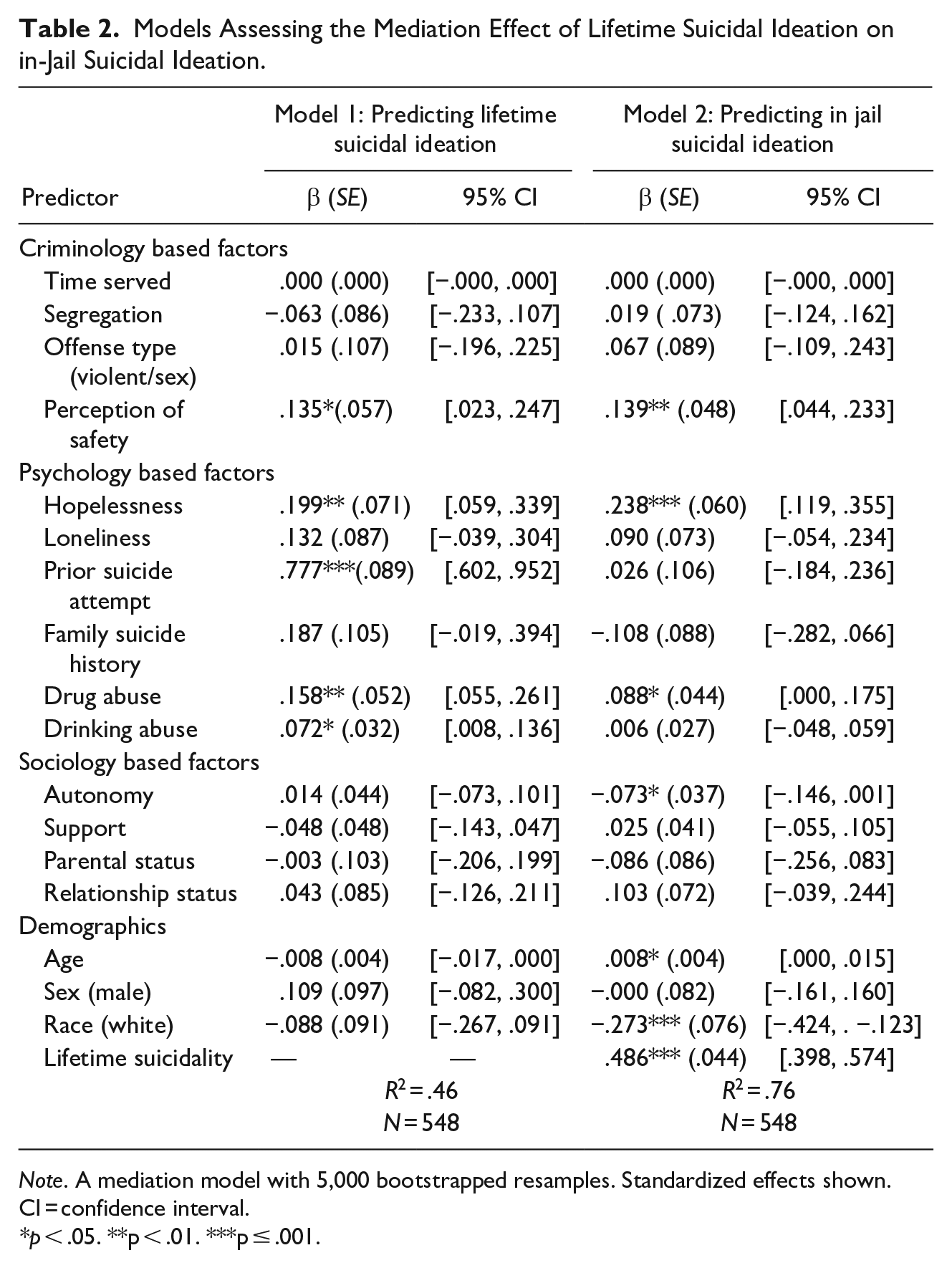
Note. A mediation model with 5,000 bootstrapped resamples. Standardized effects shown. CI = confidence interval.
p < .05. **p < .01. ***p ≤ .001.
Additionally, given the expansive variable list and the intersection of three fields of study, a pressentaiton of the theoretical model for what could be evaluated with the integration of these fields is provided. 4 The full theoretical model with the proposed disciplinary differences is presented in Figure 1.
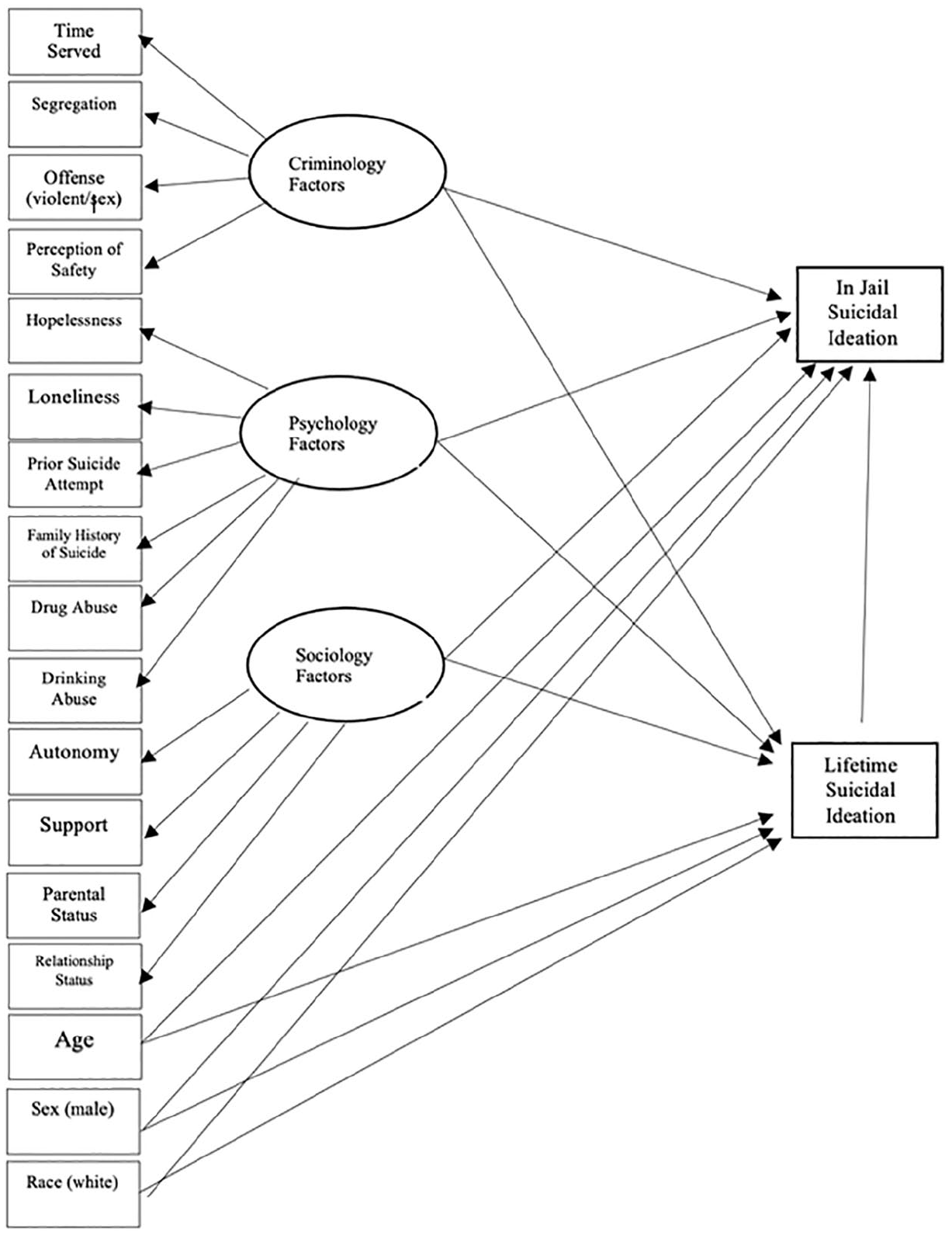
Theoretical structural model of the latent measures and their proposed relationship between self-reported lifetime suicidal ideation and in-jail suicidal ideation among people currently incarcerated in jail.
Results
To begin with an overview of the sample characteristics, which can be found in full in Table 1. The sample is 73% male. The racial distribution of the sample is 40% white, and 60% nonwhite. The average age is 35 years old. Table 2 presents the two models assessing lifetime suicidal ideation and in-jail ideation. Result from the first model predicting lifetime suicidal ideation shows that prior suicide attempt(s) by an individual has the strongest association with lifetime suicidal ideation (p < .001, β = .777). This model also demonstrates the significant association of hopelessness with lifetime suicidal ideation (p < .001, β = .199). Hopelessness has the second strongest association with lifetime suicidal ideations, coming after prior suicide attempt(s). The third strongest predictor of lifetime suicidal ideation is an increase in perception of safety concerns (p < .001, β = .135). Drug abuse is significantly related to lifetime suicidal ideation (p < .01, β = .158). And finally, for lifetime suicidal ideation, drinking abuse is significantly related, but the weakest predictor of the significant findings (p < .05, β = .072). In model for lifetime suicidal ideation 46% of the variance is explained.
Mediation
Next a test for the mediation of effect of lifetime suicidal ideation on in-jail suicidal ideation was conducted. Using a bootstrapping technique, which uses nonparametric resampling of the data set to generate a sampling distribution for the results (Hayes & Preacher, 2010). The confidence interval (CI) for indirect effect obtained from this sampling method of bootstrap draws generates a corrected 95% CI for each estimate. Any CI that does not pass through zero, suggests evidence of an indirect significant effect (Hayes, 2009). Effect sizes and 95% confidence intervals are presented in Table 2. Results of the coefficients approach and estimation of a percentile-based bootstrap (k = 5,000) confidence interval indicate significant mediation of lifetime suicidal ideation on in-jail suicidal ideation by prior suicide attempts. This indicates that lifetime suicidal ideation is actually a mediator for in-jail suicidal ideation.
The results support a mediational effect of lifetime suicidal ideation on the association between prior suicide attempts and in-jail suicidal ideation (p < .001, β = .486). This is a very strong effect between lifetime suicidal ideation and in-jail suicidal ideation, the strongest power of all the variables on each other. This shows that people may have a range of field specific risk factors that may lead to greater experience of lifetime suicidal ideation, which in turn may raise their in-jail suicidal ideation. Specifically, hopelessness remains significant, and increases in strength, even when mediation of lifetime suicidal ideation occurs (p < .001, β = .238), suggesting that hopelessness is more significantly related to in-jail suicidal ideation compared to lifetime ideation. Next, individuals’ who identify as non-White are significantly more likely to report suicidal ideation in-jail, compared to their White identifying counterparts (p < .001, β = −.273). The fourth strongest predictor of in-jail suicidal ideation is, an increase in perception of safety concerns (p < .01, β = .139). Perception of autonomy, which was not significant for lifetime suicidal ideation, but is significant for in-jail suicidal ideation, even when mediation is happening (p < .05, β = −.073). This suggests that greater negative feelings about autonomy lead to an increase in-jail suicidal ideation. In addition, drug abuse remains significant (p < .05, β = .088), and age becomes significant in Model 2 (p < .05, β = .008). From both models, the variance is well explained, with an R-square of .46 and .76 respectively, with the second model indicating extremely good explanation in the variance. There is a large, in-direct effect between prior suicide attempts, lifetime suicidal ideation and in-jail suicidal ideation, which is consistent with prior research that says that lifetime suicidal ideation is related to continued increase risk for suicidal behaviors (Franklin et al., 2017; Hubers et al., 2018; Larney et al., 2012; Sarchiapone et al., 2009). The model for the mediation is reported in Table 3.
In-Direct Effects of Prior Suicide Attempt(s) mediated by Lifetime Suicidal Ideation on in-Jail Suicidal Ideation (n = 548).
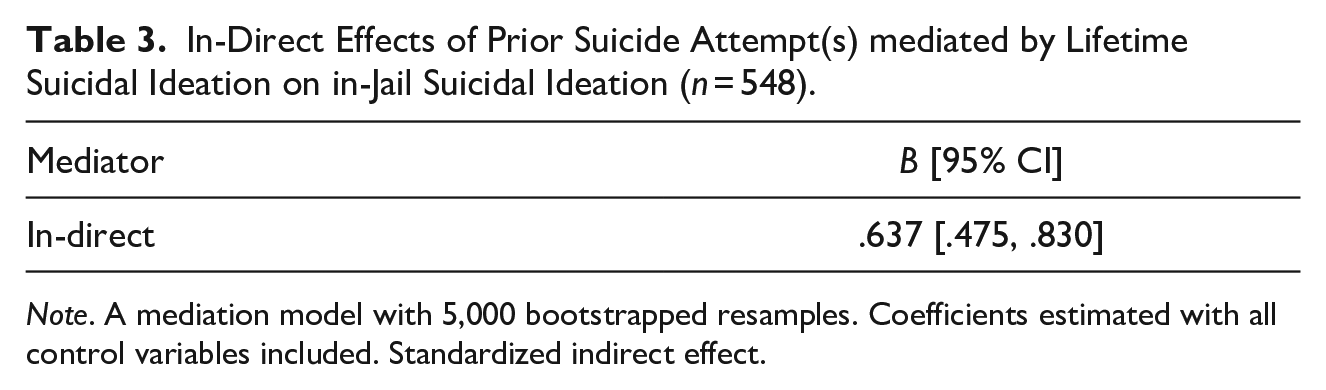
Note. A mediation model with 5,000 bootstrapped resamples. Coefficients estimated with all control variables included. Standardized indirect effect.
Study Findings
This study was an effort to further the understanding and knowledge surrounding the intersection of three fields that study suicidal behaviors and to advance the understanding of lifetime suicidal ideation to in-jail specific suicidal ideation. While all three areas of study did have significant effects on suicidal ideation, the differences between fields and lifetime compared to in-jail suicidal ideation are apparent. The findings suggest that all three fields, and their different concerns with suicidal ideation, have an impact on people who are incarcerated in jail. Next, these findings are broken down by subfield to suggest and offer suggestions for future research.
Criminology
Within the criminology based factors, perception of safety was the only measure that was significantly related to suicidal ideation, in either model. For every unit increase in perception of safety, meaning an increase in concerns about safety, there is an increase in lifetime suicidal ideation, while holding all other variables constant. This finding is consistent with prior literature by Liebling et al. (2013) In the second model, perception of safety increases slightly in power and significance for in-jail suicidal ideation, which suggests that current in-jail suicidal ideation is slightly more influenced by perception of safety, compared to the overall lifetime suicidal ideations, which makes sense given the jail environment.
Psychology
In strong support of prior literature in psychology, prior suicide attempts is the strongest predictor of lifetime suicidal ideation (β = .777). This is a consistent finding, that prior suicide attempts significantly increases the risk for suicidality in the future (Klonsky et al., 2015). In addition to prior suicide attempts, three other psychology based factors were found to be significant in the first model, hopelessness, drug abuse, and drinking abuse. Feelings of hopelessness increase individual’s suicidal ideation, for both lifetime and in-jail suicidal ideation. Given the expansive literature on hopelessness and the relation to mental health and distress of individuals who exhibit suicidal behaviors (see Abramson et al., 1998; Hirsch et al., 2009; Joiner & Rudd, 1995; Priester & Clum, 1993) this finding is not surprising and remains consistent with prior literature.
Prior work has found mixed findings in relation to history of substance abuse being a predictor of suicidal behavior. The current study found drug abuse and drinking abuse are associated with lifetime suicidal ideation, which seems to hold up with work by Blaaw et al. (2005), Daniel and Fleming (2006), Kovasznay et al. (2004), Power et al. (2013) and Way et al. (2005), who all found support for substance abuse prior to incarceration being prevalent for suicidality. This seems to hold especially true since drinking abuse falls out of significance for in-jail suicidal ideation, seeming to offer more support for the lifetime aspect- as well as accessibility.
Sociology
No sociology based factors were significant predictors of lifetime suicidal ideation. However, interestingly, in the second model looking at in-jail suicidal ideation as the outcome, autonomy becomes significant. This finding demonstrates that a decrease in perception of autonomy leads to an increase in-jail suicidal ideation. This measure was tested using a perception of voice, the ability to speak up and have personal choice. Prior literature on self-determination theory supports this finding, suggesting that suicidal ideation increases when individuals lose their sense of self and ability to self-regulate (Deci & Ryan, 2000; Sheldon et al., 2003). This has been further discussed in literature on suicide in the military, by looking at how individuals who are in total institutional states, like incarceration or military, may lose their autonomy due to having their entire life be regimented and structured around a higher authority’s decisions (Bodner et al., 2006). For individuals who are in-jail, their ability to make even small decisions about showering, eating, going outside, are removed, which could be why this concern appears in the model for in-jail suicidal ideation, perhaps in their lifetime history, individuals do feel like they have autonomy but when it is removed due to social isolation (a sociological approach), they are suddenly confronted with suicidal behaviors.
Demographics
Due to demographic variables being used across the board in all fields of research, these are presented for comment holistically. Demographic variables were significantly related to in-jail suicidal ideation only. Race was strongly and significantly related to in-jail suicidal ideation. Perhaps this could be contextualized under the framework of viewing a race variable as a measure of racism. In jail, it is possible that the safety, security, and overall racial tone of the facility is one which benefits and protects White individuals over minorities. Under this understanding, it could be viewed that non-White individuals are at more risk for in-jail suicidal ideation, due to the systematic oppression and outward racism that minorities face on a daily basis. Perhaps, this finding is not found in the lifetime suicidal ideation model because lifetime experiences allow for socialization on a more homogenous basis, perhaps a safer environment to protect against the racist structure of the facility. Age was found to be significant for in-jail suicidal ideation, suggesting that slightly older individuals are more at risk for suicidal ideation. Given the range of ages in the facilities and the knowledge that suicide occurs most often for jailed individuals between 25 and 34, this seems to support that understanding (Carson, 2021).
Discussion
The findings from this study suggest that taking an interdisciplinary approach to self-injurious thoughts and behaviors may offer a unique opportunity to find areas where harm reduction can be done. Scholars have done extensive work in all three fields of study explored on suicidal ideation; however, seeing how factors from all of these fields are important, can lend a hand to now begin to push forward for integration of these disciplines and build a new vantage point to address suicide research throughout the criminal justice system. Learning from and integrating these approaches, which view the social phenomenon of suicide from their own perspectives, can help to better understand how different suicidal behaviors function for different populations of people. From this integrative approach, the study supports all three fields bringing in factors that matter for suicidal ideation of individuals incarcerated in jail. Had this study only used a criminological approach, there would have been potentially for missing some of the more nuanced characteristics of suicidal ideation for this population, including autonomy which only became a significant concern when analyzed through a sociology lens.
With specific regard to suicidology, future research should focus on the intersection of disciplines that work with suicidal outcomes. There is a wide range of fields that deal with suicidality in some form, well beyond the three used in this study. One suggestion is for future work not only do conceptual integration, like proposed in this current study, but also work with collaborators from other disciplines to reshape how suicidal behaviors are measured and functions within different population samples. To focus on criminology, the study of suicide is often classified as a function of the system. Future criminology work on suicide should be encouraged to consider the other implications of suicidal behaviors throughout the justice system (e.g., vicarious exposure), taking an integrated approach to evaluate self-injurious thoughts and behaviors within the field of criminal justice but with an additional lens of another perspective.
One possible way to do this is to create groups of multidisciplinary experts on suicidology from different fields and nations. As an intersectional phenomena of study, like suicide, exists, the need to take an interdisciplinary and international approach becomes apparent. The international community of suicidologists need to begin to define and accept what common standards exist, if any, for incarcerated self-injurious thoughts and behaviors research in order to increase the quality and universality of the data, finds, and ultimately policy developments in relation to treatment and prevention. Of course, this approach can be applied to other areas of interest- like policing and the code of silence surrounding suicide, perceptions of the dangerousness and criminalization of suicidal behaviors, juvenile’s trauma exposure and detention centers, stigma attachment to suicide throughout justice actors, and so much more.
Policy Implications
The bottom line goal of any policy implication surrounding suicidal ideation is to save lives. Ultimately, if researchers can reduce fatalities, that is a win for the CJS. However, to reform the CJS and the many flaws in it, it is going to take a collective of individuals who are influential to the CJS. If those involved can begin to acknowledge that there are extreme levels of mental trauma that run rampant through all levels of the CJS, perhaps then those involved with the CJS can better take care of the people who are justice involved and justice workers. In part, this is going to require impactful reforms that institute active change, not just lip service and ineffective band aid policies. Through the integration of a multidisciplinary approach, actionable changes becomes a more feasible expectation. When assessing the information surrounding suicide and suicidal behaviors through the perspective of multidisciplinary approaches, researchers will be able to better showcase to those who are influential in the CJS holistic approaches to prevention, intervention, and treatment. This will allow policy makers and administrators to be confident in the validity and fidelity of implementing approaches, knowing that they are not narrowly focused on only one aspect of suicide prevention, but rather looking at a more complete picture. In doing so, future policies can better target and utilize resources to help reduce these behaviors and get to the bottom line of saving lives.
Limitations
This study is not without its limitations. First, this survey was conducted as part of a larger research project and the intention of this work was not primarily to take an interdisciplinary approach. Future survey construction should work to pre-identify and incorporate multiple perspectives into the study intentionally, to better test measures from different fields. Second, the survey data was cross-sectional data, therefore, results may not reflect generalized findings to all individuals in United States jails. In addition, future research should continue to evaluate the differences and similarities between lifetime suicidal ideation and in-jail, or incarcerated, suicidal ideation through a multidisciplinary approach. Utilizing only a criminal justice lens to the issues surrounding suicide and suicidal ideation is not enough to create impactful prevention and treatment options. One of the limitations of the current work is the cross-sectional nature of the data, future work would be benefited by longitudinal data to further understand the dynamic nature of suicidal ideation and if there are different time points during incarceration that change the behaviors, compared to pre- or post- incarceration. To date, there are few longitudinal studies within incarcerated populations, and even fewer that focus on suicidal ideation. Using the hypothetical aforementioned standards offers a way for micro-revolutionary development to be done by individual, or small groups of scholars, in order to make large pushes for new methods of suicide research within justice involved settings. Finally, while there is no reason to assume that the jails in this sample are unique to other jails, it is unlikely that all jails in the United States have the same mechanics and structure. The place (suburban jails), the time of data collection, the locations (Florida and Texas), may all contribute to the findings and future research should try to reach more widespread data to try to reach more generalizable conclusions.
Conclusion
Interdisciplinary work should not just use measures that fit into other disciplines work, but should more deeply integrate other approaches to research, through testing theories from outside fields, redesigning instrumentation and measurement, expanding on the knowledge from other populations, and continue to integrate knowledge. This type of expansion and integration is the goal of the current study to present. The field of criminology is still rather infantile (especially when contrasted to its ancestors, psychology, and sociology), which allows for room to grown and decide how scholarship can advance even further. But growing and expanding criminal justice specific theories, while necessary to build a solid foundation of knowledge, is a temptation that some researchers must resist. The other researchers must intentionally be broad in their scope and knock down silos of knowledge. For in doing so, they will be the ones to help expand beyond the traditionally accepted theories, especially in relation to suicidology and the criminal justice system. This was a first step to begin to tackle the suicidology perspective in a criminology population through a variety of interdisciplinary fields, something future work can grow and expand on through more interdisciplinary integration.
Footnotes
Declaration of Conflicting Interests
The author declared no potential conflicts of interest with respect to the research, authorship, and/or publication of this article.
Funding
The author received no financial support for the research, authorship, and/or publication of this article.
