






Abstract
Purpose
This study aims to investigate the mechanisms through which instructional leadership influences student academic performance, with a specific focus on the mediating variables of teacher trust, teacher collaboration, and teacher feedback.
Research Design
This study utilizes data from the Programme for International Student Assessment (PISA) 2022, focused on teachers and students in Hong Kong. The dataset exhibits a nested structure, with student-level data nested within teacher-level data. To analyze the complex interplay among instructional leadership, teacher trust, teacher collaboration, teacher feedback, and student academic performance, Bayesian estimation is employed to estimate the multilevel mediation model.
Findings
Contrary to expectations, instructional leadership was found to have no direct effect on student academic performance. However, teacher trust emerged as an independent mediator in the relationship between instructional leadership and student academic performance. Furthermore, a chain mediation effect was observed, with teacher trust, teacher collaboration, and teacher feedback mediating the relationship between instructional leadership and student academic performance.
Conclusions
These findings highlight the nuanced pathways through which instructional leadership impacts student outcomes. The study contributes to the existing literature by shedding light on the complex interplay between instructional leadership, teacher trust, teacher collaboration, teacher feedback, and student academic performance. Implications for educational leadership practice and directions for future research are discussed.
Keywords
Introduction
Instructional leadership, with its focus on guiding teaching and learning practices, has emerged as a focal point in educational research aimed at enhancing school effectiveness and supporting educator growth (Bellibas et al., 2021; Marks & Printy, 2003). In this study, instructional leadership is defined as the practices and behaviors of school leaders focused on improving teaching and learning processes within schools (Liu & Hallinger, 2018). Studies have underscored the significance of instructional leadership in fostering a collaborative school culture conducive to professional development and organizational improvement (Blase & Blase, 1999; Kim & Lee, 2020; Neumerski, 2013). This leadership approach is believed to bolster teacher efficacy and job satisfaction (Liu & Hallinger, 2018; Liu et al., 2021), thereby nurturing a supportive ecosystem for teaching and learning. Furthermore, instructional leadership is associated with heightened school capacity for effective instructional practices and student engagement (Bellibas et al., 2021; Ozdemir & Yalcin, 2019).
However, the literature reveals divergent findings regarding its direct impact on student achievement. Some studies suggest a positive relationship between instructional leadership and student academic performance (Gao et al., 2024), while others indicate variations in its effects across different student populations (Tan, 2018; Tan et al., 2020).
Instructional leadership plays a pivotal role in shaping the educational environment and influencing student academic performance (Gao et al., 2024). It encompasses a range of practices aimed at guiding and supporting teachers in their instructional endeavors (Bellibas et al., 2021). These practices create an environment where educators receive guidance and actively engage in professional growth and development (Marks & Printy, 2003). Key elements of instructional leadership include setting clear instructional goals, providing effective feedback, and fostering a culture of continuous improvement (Alanoglu, 2022). Additionally, it promotes collaboration among educators and encourages the use of evidence-based teaching strategies (Liu et al., 2021). Therefore, it is plausible to hypothesize that instructional leadership enhances student academic performance by supporting and guiding teachers. Nonetheless, empirical research elucidating the specific mechanisms through which instructional leadership affects student outcomes remains limited, warranting further investigation.
Previous research indicates that leadership practices promote student academic performance through various pathways (Liu et al., 2022). One such pathway involves enhancing school capacity, which includes elements like teamwork, professional community, and collaboration, ultimately leading to school improvement (Liu & Hallinger, 2024; Liu et al., 2021). Instructional leadership facilitates opportunities for educators to interact, share ideas, and discuss teaching and learning (Marks & Printy, 2003). It fosters environments where teachers feel trusted, engage in exchange and coordination for teaching, and receive feedback on their instructional practices (Bellibas et al., 2021).
Empowered by instructional leadership, educators are more likely to cultivate a culture of trust among colleagues, fostering an environment where teachers feel supported and valued in their professional endeavors (Ma & Marion, 2021). Teachers who perceive a high level of trust from instructional leaders are likely to experience increased job satisfaction and a sense of efficacy (Edinger & Edinger, 2018). This sense of trust is crucial as it lays the foundation for effective collaboration and professional growth (Alazmi & Hammad, 2023). As teachers exchange ideas and coordinate their teaching efforts, they create a supportive environment conducive to student learning. Additionally, effective exchange and coordination among educators, facilitated by instructional leadership, can enhance instructional alignment and coherence, thereby optimizing teaching effectiveness (Bellibas et al., 2021). In this collaborative atmosphere, feedback provided by teachers plays a pivotal role in shaping student learning outcomes (Núñez et al., 2015). Timely and constructive feedback guides students towards academic growth and achievement by addressing areas for improvement and reinforcing positive learning behaviors (Wang & Zhang, 2020).
Given the established link between instructional leadership, teacher trust, collaboration, and feedback, it is crucial to explore how these elements collectively influence student academic performance. While previous research has highlighted the potential of instructional leadership in fostering teacher development and improving student outcomes (Liu et al., 2022), the specific mechanisms through which instructional leadership influences student academic performance remain underexplored. Existing studies have primarily focused on the direct effects of instructional leadership, but fewer have examined the mediating roles of teacher trust, teacher collaboration, and teacher feedback in this relationship. To address this gap, this study aims to provide quantitative evidence and construct a framework through a comprehensive review of the literature. By elucidating how instructional leadership shapes teachers’ perceptions of trust, collaboration, and feedback provision and how these, in turn, affect student academic performance, we can gain deeper insights into its potential to enhance student outcomes. Specifically, we aim to investigate the relationships among instructional leadership, teacher trust, teacher collaboration, teacher feedback, and ultimately, student academic performance.
Through this exploration, we aim to contribute to the development of strategies and interventions that leverage instructional leadership to optimize teaching practices and improve student outcomes in diverse educational settings. Our research questions guiding this inquiry include: (1) To what extent are instructional leadership, teacher trust, teacher collaboration, teacher feedback, and student academic performance related? (2) If such relationships exist, how does teacher trust, teacher collaboration, and teacher feedback mediate the relationship between instructional leadership and student academic performance?
To investigate the mechanisms linking instructional leadership and student academic performance, this study employs a multilevel mediation analysis using Bayesian estimation, based on data from the Programme for International Student Assessment (PISA) 2022 conducted in Hong Kong. PISA 2022 provides detailed information on instructional leadership, teachers’ perceptions, and student performance, making it well-suited for this analysis (OECD, 2023a). Multilevel mediation analysis effectively captures the complex relationships among instructional leadership, teacher trust, teacher collaboration, teacher feedback, and student academic performance. Bayesian estimation enhances the robustness and precision of the analysis, offering deeper insights into these underlying mechanisms (Moeyaert et al., 2017).
Literature Review
Theoretical Framework: the Ripple Effect of Principal Leadership
The present study is grounded in The Ripple Effect Model (Clifford et al., 2012), which conceptualizes principal influence as an indirect yet powerful force that shapes school conditions, instructional practices, and ultimately student achievement. This model posits that principals do not impact student learning in isolation but rather through a series of interconnected mechanisms—most notably by fostering a collaborative professional culture, supporting high-quality teacher feedback, and cultivating trust among educators. These elements, in turn, enhance instructional effectiveness and create the conditions necessary for sustained student success.
Instructional Leadership as the Central Driver
At the core of the ripple effect is instructional leadership, which sets the direction for teaching and learning within a school (Hallinger, 2011). Effective instructional leaders establish a shared vision, provide meaningful professional development, and implement data-informed instructional practices (Clifford et al., 2012). By prioritizing teacher growth and collaboration, principals create an environment where educators are encouraged to engage in continuous learning and reflective practice (Robinson et al., 2008).
Extending the Ripple Effect Through Social Exchange Theory
To further elucidate the internal mechanisms of the ripple effect, this study incorporates Social Exchange Theory as a complementary lens. Social Exchange Theory posits that relationships within organizations are governed by norms of reciprocity and mutual benefit (Blau, 1964; Homans, 1958). When individuals perceive trust and fairness in their professional interactions, they are more likely to engage in cooperative and helping behaviors that sustain the social system. Within school contexts, trust among teachers serves as a catalyst for reciprocal exchanges—teachers share materials, offer support, and engage in joint problem-solving. These collaborative exchanges, in turn, promote the flow of pedagogical knowledge and foster a culture in which feedback, both among teachers and from teachers to students, becomes a natural and valued component of professional practice. Thus, the sequential process of teacher trust → teacher collaboration → teacher feedback can be understood as an expression of reciprocal social exchange that links leadership actions to classroom outcomes.
The Mediating Role of Teacher Trust, Collaboration, and Feedback
Building on both the Ripple Effect Model and Social Exchange Theory, this study emphasizes the mediating roles of teacher trust, collaboration, and feedback in the relationship between instructional leadership and student achievement.
Teacher Trust – Trust is an essential precondition for effective collaboration and professional learning communities (Bryk & Schneider, 2002). Principals who cultivate trust among teachers encourage open dialogue, shared decision-making, and a collective sense of responsibility for student success (Tschannen-Moran, 2004).
Teacher Collaboration – Research indicates that strong instructional leadership fosters a culture of collaborative teaching, where educators engage in co-planning, peer observation, and joint problem-solving (Goddard et al., 2007). Such collaboration enhances instructional consistency and promotes the diffusion of effective pedagogical strategies across classrooms (Ronfeldt et al., 2015).
Teacher Feedback – High-quality feedback from teachers to students is a critical mechanism for improving instructional effectiveness. Principals who emphasize instructional leadership create conditions that enable teachers to provide timely, specific, and actionable feedback. Such feedback helps students track their learning progress, address misconceptions, and improve academic performance. By fostering a school culture that values meaningful feedback, instructional leaders support student engagement, motivation, and self-regulated learning (Wang & Zhang, 2020).
Instructional Leadership
Instructional leadership has become a prominent concept in educational research and practice, gaining significant attention in recent decades (Bellibas et al., 2021; Kim & Lee, 2020). Although its conceptual roots trace back to earlier theories of effective school leadership, instructional leadership gained prominence in the late twentieth century as researchers sought to identify specific behaviors and practices of school leaders that impact teaching and learning outcomes (Blase & Blase, 1999). Since then, a substantial body of literature has explored various dimensions and effects of instructional leadership (Liu & Hallinger, 2018; Liu et al., 2021; Neumerski, 2013).
At its core, instructional leadership emphasizes the role of school leaders in promoting effective teaching and learning practices (Bellibas et al., 2021). This involves setting a clear instructional vision, establishing high academic expectations, and providing support and resources to facilitate effective teaching (Neumerski, 2013). Instructional leadership encompasses a range of behaviors and practices aimed at improving instructional quality, supporting teacher professional growth, and enhancing student academic performance (Kim & Lee, 2020).
Numerous studies have empirically supported the positive relationship between instructional leadership and student academic achievement across various educational contexts (Gao et al., 2024; Liu et al., 2022). For instance, Ozdemir and Yalcin (2019) found that principals’ instructional leadership indirectly influences student academic achievement through its impact on instructional climate and school safety, which in turn enhance student engagement and performance. Additionally, research has shown that instructional leadership influences student academic performance by shaping the quality of teaching practices and fostering a supportive learning environment (Robinson et al., 2008). Moreover, related research on broader leadership practices supports this positive association. Shen et al. (2020) found that teacher leadership is positively related to student achievement (r = 0.19), with improvements in curriculum, instruction, and assessment showing the strongest effects. Similarly, Wu and Shen (2022) reported a significant positive relationship between principal leadership and student achievement (Cohen's d = 0.34), highlighting that the impact of leadership may vary depending on the educational context.
However, not all studies have confirmed a direct positive effect of instructional leadership on student academic achievement. For instance, a study on high school students in China found that school-level instructional leadership did not significantly affect student achievement (Hou et al., 2019). This discrepancy suggests that the relationship between instructional leadership and student performance may depend on contextual factors such as school culture, teacher autonomy, and variations in leadership implementation. These mixed findings underscore the complexity of the instructional leadership–student achievement relationship and highlight the need for further research to identify potential mediating factors.
Nevertheless, most studies have reported a positive association between instructional leadership and student achievement, indicating that the relationship may be nuanced and shaped by contextual or mediating influences. Based on this evidence, we propose the following hypothesis: Instructional leadership is positively associated with student academic performance
The Mediating Role of Teacher Trust
Since Hoy and Kupersmith's seminal work in 1985, the understanding of trust within educational contexts has undergone significant refinement (Adams, 2013; Hoy & Kupersmith, 1985). Trust can be characterized as one party's willingness to expose vulnerability to another, grounded in the confidence that the latter is benevolent, reliable, competent, honest, and open (Tschannen-Moran & Hoy, 1998). This study focuses on teachers’ trust in their colleagues and other individuals within the school environment.
Teacher trust is crucial in fostering a positive learning environment and promoting students’ academic outcomes. Numerous studies have examined the impact of teachers’ feelings of trust on students’ academic performance (Goddard, 2003; Goddard et al., 2001; Hoy, 2002). Sun et al. (2023) conducted a meta-analysis revealing that teacher trust has a moderate positive impact on students’ learning outcomes. Their research also identified a significant influence of school leadership on teacher trust. Specifically, teachers’ trust in students and parents significantly contributes to students’ academic performance, while supportive and collaborative leadership styles have the most notable impact on teacher trust. Additionally, a study found that teacher trust significantly influences the academic performance of Native American students. However, for European American students, other factors such as independence may be more critical (Fryberg et al., 2013). This variation indicates the complexity of trust's effects across different cultural backgrounds. McClain and Cokley (2017) found that teacher trust partially mediates the relationship between academic self-concept and grade point average (GPA) among Black college students, with this effect being significantly stronger for males than females. However, Dewulf et al. (2017) found that while teacher trust in students was linked to learning growth in reading comprehension, it did not have a significant direct effect on reading comprehension achievement in segregated elementary schools in Belgium. This finding suggests that the influence of teacher trust may depend more on facilitating long-term learning growth rather than immediate academic outcomes.
Instructional leadership also significantly impacts teachers’ feelings of trust. Ma and Marion (2021) found that supportive and effective instructional leadership enhances teachers’ trust in school administrators and colleagues. Research suggests that by providing clear goals and supportive feedback, instructional leadership can bolster teachers’ trust, fostering professional learning (Karacabey et al., 2022). Another study confirmed the positive impact of instructional leadership on teacher trust, finding that teachers’ sense of trust and self-efficacy mediate the influence of instructional leadership on professional learning (Thien et al., 2023). Further supporting this link, Alazmi and Hammad (2023) demonstrated that learning-centered leadership enhances teacher professional learning through the mediating effects of teacher trust and agency, underscoring the crucial role of trust in promoting teacher growth and improving instructional practices.
Overall, while some researchers have reported inconsistent findings, the broader evidence supports a positive relationship between teacher trust and student academic performance. Moreover, teacher trust is significantly influenced by instructional leadership. Based on this foundation, we propose the following hypothesis: Teacher trust mediates the influence of instructional leadership on student academic performance
The Mediating Role of Teacher Collaboration
Teacher collaboration, defined as educators’ joint efforts to improve teaching practices and student outcomes through shared experiences and expertise, has garnered significant attention in educational research (Vangrieken et al., 2015). This collaboration encompasses activities such as collaborative planning, curriculum development, peer observation, and participation in professional learning communities (de Jong et al., 2022). The underlying belief is that collective expertise and shared resources lead to improved instructional practices and student achievement (Weddle, 2022).
Numerous studies have investigated the influence of teacher collaboration on student outcomes (Carey et al., 2018; Goddard et al., 2007; Goddard et al., 2015). For example, Ronfeldt et al. (2015) found that higher-quality collaboration among instructional teams in Miami-Dade County public schools correlated positively with improved student achievement in math and reading, emphasizing the importance of promoting collaborative instructional practices. Similarly, Bottia et al. (2016) examined the correlation between teacher collaboration and mathematics achievement among Latino/a students in the United States. They found that while there was no significant overall effect, teacher collaboration positively influenced the academic progress of Latino immigrant students. Wullschleger et al. (2025) found that high-quality teacher collaboration positively influenced fifth-grade students’ mathematics achievement through the mediating effect of instructional quality. This underscores the importance of fostering collaborative instructional practices to enhance student learning outcomes. However, not all studies confirm a direct positive impact of teacher collaboration on student achievement. Chen et al. (2020), using data from the Progress in International Reading Literacy Study (PIRLS) 2011, found that teacher collaboration was not a significant predictor of student performance in Taiwan, Hong Kong, and Singapore. This finding suggests that teacher collaboration may not always exert a direct effect on student outcomes but may still play an essential role in shaping instructional quality and mediating other factors influencing student achievement. These inconsistencies highlight the complexity of this relationship and indicate that further research is needed to explore the conditions under which teacher collaboration effectively contributes to student learning.
The extent and quality of teacher collaboration are significantly influenced by instructional leadership within educational settings (Liu et al., 2021). Instructional leaders provide clear vision, direction, and support, creating an environment conducive to collaborative inquiry, professional learning communities, and collective problem-solving (Bellibas et al., 2021). These collaborative environments offer opportunities for ongoing reflection, peer feedback, and joint problem-solving, leading to improved instructional practices and increased teacher efficacy (Bellibas et al., 2021; Chang et al., 2022). Research indicates that schools with strong leadership and robust teacher collaboration demonstrate higher levels of student engagement, academic achievement, and overall school effectiveness (Yalçin & Çoban, 2023).
While findings on the direct effects of teacher collaboration on student achievement remain mixed, a substantial body of research supports its positive influence. Additionally, studies indicate that instructional leadership plays a critical role in fostering teacher collaboration by shaping professional learning communities and collaborative teaching practices. Based on this, we hypothesize that teacher collaboration mediates the influence of instructional leadership on student academic performance
The Mediating Role of Teacher Feedback
Teacher feedback refers to the information educators provide to students about their performance, progress, and areas for improvement (Hellrung & Hartig, 2013). It plays a crucial role in supporting student learning and academic success (Zhan, 2023). Effective feedback involves timely and specific communication that guides student understanding, clarifies misconceptions, and promotes growth. It fosters a supportive learning environment, encourages student engagement, and empowers learners to take ownership of their academic progress (Câmpean et al., 2024). By providing constructive guidance and encouragement, teachers help students develop metacognitive skills and self-regulatory strategies essential for academic achievement (Guo & Wei, 2019). Research indicates that high-quality feedback enhances student learning outcomes, improves mastery of academic content, and promotes continuous improvement (Wang & Zhang, 2020). Similarly, Javed et al. (2020) found that various types of teacher feedback, including formative, diagnostic, and immediate feedback, positively influenced secondary school students’ academic achievement in Pakistan. Their findings underscore the importance of diverse feedback strategies in addressing learning challenges and improving student outcomes. However, Núñez et al. (2015) examined the relationship between teachers’ feedback on homework, homework-related behaviors, and academic achievement among students in Grades 5–12. Their findings indicated that while teacher feedback on homework was positively associated with students’ homework completion and time management, it did not directly predict academic achievement. Instead, its influence on student performance was mediated through homework-related behaviors. This suggests that the effectiveness of teacher feedback may depend on how students interpret and utilize it, as well as contextual factors such as feedback type, subject area, and individual student characteristics.
Instructional leadership significantly influences the effectiveness of teacher feedback (Tuytens & Devos, 2011). School leaders who exhibit proactive instructional leadership tendencies prioritize teaching practices and encourage teachers to provide effective feedback (Tuytens et al., 2019). Moreover, instructional leadership fosters a supportive teaching environment conducive to the effective implementation of teacher feedback (Tuytens & Devos, 2014). By cultivating a culture of collaboration and trust, leaders create a positive atmosphere that encourages teachers to actively participate in the feedback process and be open to feedback from colleagues and leaders. This supportive environment enhances the quality of feedback provided, consequently benefiting student learning outcomes (Wang & Zhang, 2020). Similarly, Liu and Gumah (2020) found that teacher feedback mediates the relationship between leadership style and teacher self-efficacy, with both transactional and transformational leadership styles boosting self-efficacy through valuable feedback.
Although prior research has reported mixed findings regarding the direct impact of teacher feedback on student academic performance, the majority of studies suggest that high-quality feedback contributes positively to student learning outcomes. Additionally, research indicates that instructional leadership significantly influences the implementation and effectiveness of teacher feedback. Based on these findings, this study posits that teacher feedback mediates the influence of instructional leadership on student academic performance
Mediating Mechanisms: Exploring Teacher Trust, Collaboration, and Feedback
In contemporary educational discourse, the efficacy of instructional leadership in enhancing student academic outcomes is a critical subject (Liu et al., 2022). Understanding intermediary mechanisms such as teacher trust, collaboration, and feedback is central to this discourse, as these elements shape the implementation and impact of instructional leadership initiatives.
Teacher trust is fundamental in fostering collaboration within educational institutions (Ghamrawi, 2011). Research by Ninkovic et al. (2022) underscores the pivotal role of trust in enabling teachers to engage in open dialogue, share resources, and collectively address instructional challenges. Additionally, Miesner et al. (2022) emphasize the reciprocal nature of trust, highlighting that its cultivation leads to heightened levels of collaboration among educators. Trust also influences the quality and effectiveness of feedback provided to students (Tschannen-Moran, 2004). Bryk and Schneider (2002) found that trusting school environments facilitate the delivery of personalized and impactful feedback, promoting student learning and development.
Collaborative environments fostered by teacher trust are conducive to developing and implementing effective feedback mechanisms (Yoo & Jang, 2023). Jang et al. (2022) suggest that collaborative cultures enable teachers to engage in constructive dialogue to refine instructional practices and provide targeted feedback to peers. Similarly, research by Sapkota et al. (2023) highlights the significance of collaborative inquiry in enhancing the quality and impact of feedback within educational contexts. Chen (2014) demonstrated that blog-mediated peer collaboration facilitates timely and diverse teacher feedback, improving feedback quality and student receptivity through networked learning.
Based on this review, the study proposes that the interplay among teacher trust, teacher collaboration, and teacher feedback serves as a chained mediating mechanism in the influence of instructional leadership on student academic performance
The Hong Kong Context
Hong Kong's unique sociocultural and educational landscape provides a compelling setting to investigate the mechanisms through which instructional leadership influences student academic performance, mediated by teacher trust, collaboration, and feedback. As a high-performing education system consistently ranking among the top in international assessments such as PISA (OECD, 2023b), Hong Kong presents a rigorous, high-stakes learning environment where the role of school leadership in shaping teacher practices and student outcomes is particularly pronounced (Szeto, 2022).
The centralized nature of Hong Kong's education system further amplifies the role of instructional leadership. The Education Bureau (EDB) mandates a strong accountability framework, requiring school principals to not only manage administrative tasks but also serve as instructional leaders who foster professional collaboration and pedagogical development (Hallinger & Ko, 2015). This governance model makes Hong Kong an ideal case to examine how principals’ leadership practices influence teachers’ professional behaviors and, ultimately, student achievement.
Additionally, research highlights that teacher trust, collaboration, and feedback play a critical role in Hong Kong's school culture. Hong Kong teachers operate in highly structured yet collaborative environments, where trust in leadership significantly influences their engagement in professional learning communities and instructional improvements (Tam, 2015). Furthermore, feedback practices are shaped by both accountability pressures and cultural expectations, influencing how teachers guide student learning (Javed et al., 2020). Given these factors, examining the mediation effects of teacher trust, collaboration, and feedback in the Hong Kong context offers valuable insights into the nuanced ways instructional leadership drives student achievement.
Methods
Data and Analytical Sample
The data for this study were sourced from the PISA 2022 dataset. Coordinated by the Organisation for Economic Co-operation and Development (OECD), PISA is a globally recognized survey assessing the scholastic performance of 15-year-old students across various countries and regions (OECD, 2023a). The dataset includes a wide range of variables related to students’ academic achievement, contextual factors, teacher characteristics, and school resources. For this study, the analytical sample comprised students and teachers from the Hong Kong region, drawn from the PISA 2022 dataset.
It is important to note that the PISA 2022 dataset does not directly match student data with teacher data; instead, it matches student data with schools and teacher data with schools separately. To address this, following the approach used in a previous study (Dicke et al., 2020), we aggregated teacher-level data within each school by computing means. Specifically, since the PISA 2022 dataset allows for matching at the school level (i.e., schools can be linked with both teachers and students, but teachers and students cannot be directly matched), we computed the mean of teacher-level variables within each school. For example, if 30 teachers in School 1 provided data on teacher feedback, the school-level mean for teacher feedback was calculated by summing the scores of all 30 teachers and dividing by 30. This aggregation allowed us to convert teacher-level data into school-level variables, thereby enabling the matching of teacher data with student data at the school level. After matching and organizing the data, mean teacher-level data from 154 schools and individual student-level data from 5624 students were retained. These 5624 students had an average age of 15.81 years, comprising 2701 females (48.03%) and 2923 males (51.97%). Furthermore, the distribution of students across grade levels was as follows: 10th grade, 3645 students (64.81%); 9th grade, 1703 students (30.28%); 8th grade, 210 students (3.73%); 11th grade, 38 students (0.68%); and 7th grade, 28 students (0.50%).
Measurement
The independent and mediating variables in this study were obtained from self-reported survey responses in PISA 2022. While widely used in large-scale educational research, self-reported measures may be influenced by biases such as social desirability and individual perception differences. To enhance reliability and comparability, PISA employs validated survey instruments and standardized administration procedures (OECD, 2023b). In contrast, the dependent variable—student academic performance—was objectively measured through standardized cognitive tests in reading, science, and mathematics.
Independent Variable
The independent variable utilized in this study is instructional leadership, which is measured by five items (e.g., “My principal collaborated with teachers to solve classroom discipline problems.”), scored on a 4-point scale (“Never or rarely”, “Sometimes”, “Often”, “Very often”). The validity and reliability of these items were satisfactory, as confirmed by psychometric testing (OECD, 2023b).
Mediating Variables
This study employs three mediating variables. Firstly, teacher trust is assessed through five items (e.g., “I feel that I can trust my colleagues”), rated on a 4-point scale (“Strongly disagree”, “Disagree”, “Agree”, “Strongly agree”). Secondly, teacher collaboration is measured by four items (e.g., “Exchange teaching materials with colleagues”), rated on a 6-point scale (“Never”, “Once a year or less”, “2–4 times a year”, “5–10 times a year”, “1–3 times a month”, “Once a week or more”). Lastly, teacher feedback is evaluated through five items (e.g., “I give students feedback on their strengths in my course”), also rated on a 4-point scale (“Never or almost never”, “Some lessons”, “Many lessons”, “Every lesson or almost every lesson”). The results of the reliability and validity tests for these items were satisfactory (OECD, 2023b).
The detailed item information corresponding to the independent and mediating variables can be found in the technical report (OECD, 2023b). It is important to note that in the PISA dataset, each variable is associated with its weighted likelihood estimates (WLE), which are used to adjust the estimation results according to the sample weights (OECD, 2023b). WLEs can provide more accurate and reliable estimates, especially when there are imbalances or differences between different subgroups in the sample. Therefore, this study utilizes the weighted likelihood estimates corresponding to each variable for data analysis.
Dependent Variable
In this study, student academic performance is treated as the dependent variable. PISA 2022 assessed students’ reading, science, and mathematics scores, and computed ten plausible values for each subject. Following established research practices (Li & Zhu, 2023), we combined students’ reading, science, and mathematics scores to derive a composite measure of student academic performance.
Analytical Strategy
The data utilized in this study exhibit a nested structure, with student-level data nested within schools. Teacher-level data were aggregated at the school level, allowing for an indirect linkage between teacher and student data. To address this data structure, Mplus 8.3 software was employed, and multilevel mediation analysis was conducted for data analysis. The data analysis steps are as follows:
Step 1: Calculate the intra-class correlation coefficient (ICC) for the dependent variable, student academic performance (as defined earlier). ICC is a statistical measure that assesses the similarity of observations between groups (Cohen, 1977). It is commonly used to evaluate the consistency or similarity among members within groups. If the ICC is small, indicating minimal similarity between groups, a general regression model can be used for estimation without the need for multilevel analysis. Otherwise, when the ICC is larger, the assumption of independence among observations in traditional regression models is violated, necessitating multilevel analysis. Cohen (1977) suggested that an ICC less than 0.059 indicates small within-group correlation, while an ICC between 0.059 and 0.138 suggests moderate correlation, and an ICC greater than 0.138 indicates high within-group correlation. Moderate within-group correlation implies the presence of group similarity that cannot be ignored; thus, when the ICC exceeds 0.059, multilevel models are required for analysis.
Step 2: Conduct descriptive statistics for the variables used in this study.
Step 3: Conduct multilevel mediation analysis. Given the relatively small sample size of teacher-level data (n = 154), the complexity of the multilevel mediation model with multiple mediators, and the need for a more robust estimation approach, this study adopts Bayesian methods to estimate the path model, following recommendations from previous research (Lee & Song, 2004). Compared to traditional methods, Bayesian estimation provides several advantages: it performs well with small samples, does not rely on large-sample asymptotics, and effectively handles complex model structures that might be difficult to estimate using conventional approaches. Additionally, Bayesian methods provide full posterior distributions, allowing for a more comprehensive assessment of parameter uncertainty, rather than relying solely on point estimates and confidence intervals. This approach also offers greater flexibility in model estimation, accommodating hierarchical dependencies and intricate mediation pathways that frequentist methods may struggle to estimate reliably (Yuan & MacKinnon, 2009).
This study adopted the recommendation by Hagger and Hamilton (2018) and specified non-informative default prior distributions available in Mplus for estimating model parameters. Since prior distributions were not explicitly specified, Mplus automatically applied its default non-informative priors, which are structured as follows:
Regression coefficients (β, γ):

A normal prior with mean 0 and infinite variance was used for all regression coefficients, ensuring that the estimation remains data-driven without strong prior constraints.
Residual variances (σ2, τ2):

Mplus applies an inverse gamma (−1, 0) prior, which is a highly diffuse specification allowing the data to dominate the estimation.
The choice of non-informative priors was guided by several considerations. First, the complexity of the multilevel mediation model, which includes multiple mediators, makes it difficult to specify informative priors without introducing bias. Using non-informative priors allows the data to determine parameter estimates without external constraints. Second, given that this study is based on PISA data, there are no previous Bayesian studies that have examined this specific mediation structure. Prior research has used different measurement models, making it challenging to derive meaningful informative priors. Finally, conducting sensitivity analyses with informative priors is not feasible due to the uniqueness of the model and dataset, as there is no established precedent for setting prior distributions on these parameters.
Bayesian model estimation was conducted using Markov Chain Monte Carlo (MCMC) simulation procedures with the Gibbs algorithm. Specifically, two MCMC chains were run for 100,000 iterations each, with the first 50,000 iterations designated as the burn-in period and discarded before summarizing the posterior distributions.
To ensure the robustness of the proposed model, two alternative models were tested: (1) a full mediation model excluding direct effects and (2) a model without the chained mediation structure. Model comparison was conducted using the Deviance Information Criterion (DIC), where lower values indicate better model fit (Spiegelhalter et al., 2002).
Convergence of the Bayesian model was assessed by examining trace plots, autocorrelation plots, and potential scale reduction (PSR). Following the suggestion by Muthén and Muthén (1998–2017), a PSR value below 1.050 indicates good convergence of Bayesian estimation. Consistency between the model and the data was evaluated through posterior predictive checking (PPC) as recommended by Muthen and Asparouhov (2012). A chi-square test with a 95% confidence interval (CI) and posterior predictive p-values (PPP) exceeding 0.05 and ideally close to 0.50 indicate a good fit between the model and the data.
The significance of each effect was assessed through the examination of the 95% credibility interval (CrI) derived from the corresponding posterior distributions. If the 95% CrI does not include zero, the effect is interpreted as supported. Following Cohen et al.’s (2011) recommendations, the magnitude of effect sizes in research outcomes can be measured using standardized path coefficients. Specifically, standardized path coefficients ranging from 0 to 0.10, 0.10 to 0.30, 0.30 to 0.50, and greater than 0.50 respectively denote weak, modest, moderate, and strong effect sizes.
Results
By constructing a fully unconditional model, we obtained an ICC value of 0.426 for student academic performance. This value is significantly higher than 0.059, indicating the necessity of conducting multilevel analysis.
Descriptive Statistics
Table 1 presents the descriptive statistics and correlation analysis results. The findings indicate that, apart from instructional leadership, the mean scores of the other variables are relatively high. Moreover, except for the non-significant correlations between instructional leadership and teacher feedback, instructional leadership and student academic performance, as well as teacher collaboration and student academic performance, significant positive correlations exist among the remaining pairs of variables.
Descriptive Statistics and Intercorrelations for Model Variables.
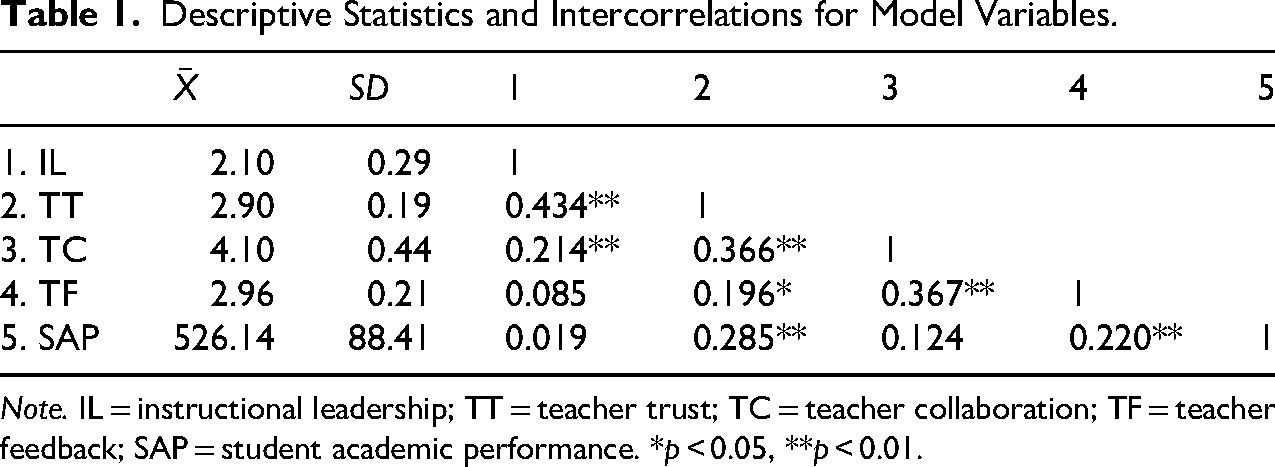
Note. IL = instructional leadership; TT = teacher trust; TC = teacher collaboration; TF = teacher feedback; SAP = student academic performance. *p < 0.05, **p < 0.01.
Hypotheses Tests
To evaluate the robustness of the proposed model, we compared it with two alternative specifications. The results indicate that the hypothesized model achieved the best fit (DIC = 14,304.219), compared to the full mediation model (DIC = 14,304.512) and the non-chained mediation model (DIC = 14,338.131). Therefore, we retained the hypothesized model for further interpretation.
The results from the trace plot (Appendix 1, Figure 1) demonstrate convergence, as the chains exhibit adequate mixing and appear to fluctuate randomly around a stable mean without discernible trends. Additionally, the autocorrelation plots (Appendix 2, Figure 2) indicate that dependencies between successive samples decrease rapidly, suggesting efficient sampling. These patterns confirm that the model parameters have reached a stable distribution. Furthermore, the data analysis reveals that at the 200th iteration, PSR = 1.021, meeting the typical convergence criterion, and the results stabilize at 1.000 after 17,100 iterations. These findings suggest that the model parameter estimation has achieved good convergence. Additionally, Figure 1 presents the posterior predictive scatterplot and histogram of the model. The plot indicates a posterior predictive p-value of 0.481, suggesting a satisfactory fit of the model and indicating that the model adequately replicates the observed data.
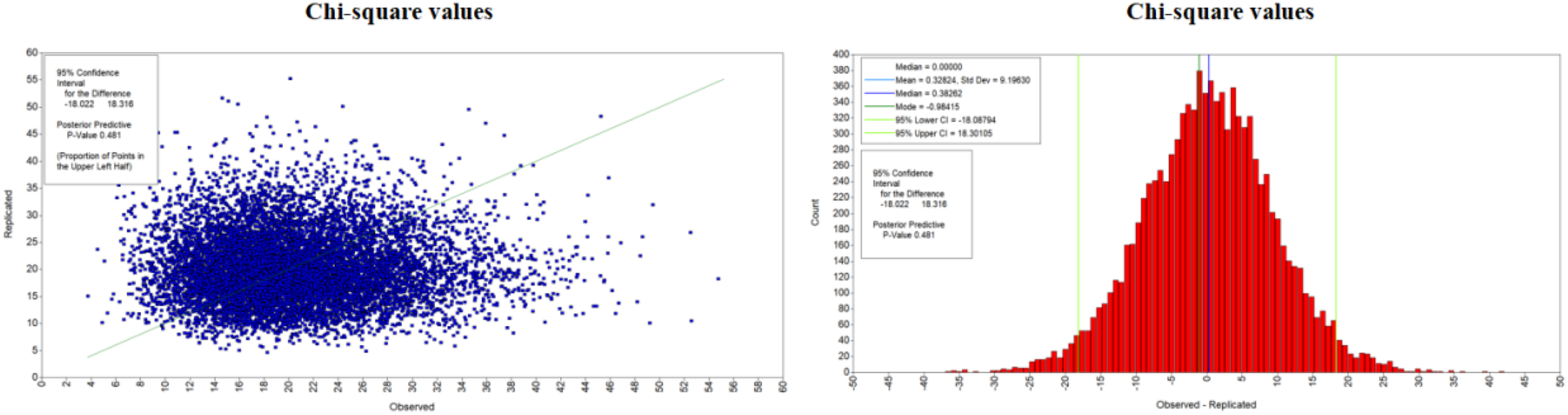
The plot of the posterior predictive checking results for the proposed model.
The parameter estimation results are depicted in Table 2, Figure 2, and Appendix 3 Figure 3. The results indicate that teacher trust has a positive effect on student academic performance (β = 0.196, 95% CrI [0.078, 0.313]), with a modest effect size. Teacher feedback also positively influences student academic performance (β = 0.111, 95% CrI [0.001, 0.219]), with a modest effect size. Teacher collaboration has a positive effect on teacher feedback (β = 0.339, 95% CrI [0.177, 0.503]), with a moderate effect size. Moreover, teacher trust positively affects teacher collaboration (β = 0.341, 95% CrI [0.174, 0.505]), with a moderate effect size. Furthermore, instructional leadership has a positive impact on teacher trust (β = 0.402, 95% CrI [0.254, 0.550]), with a moderate effect size.
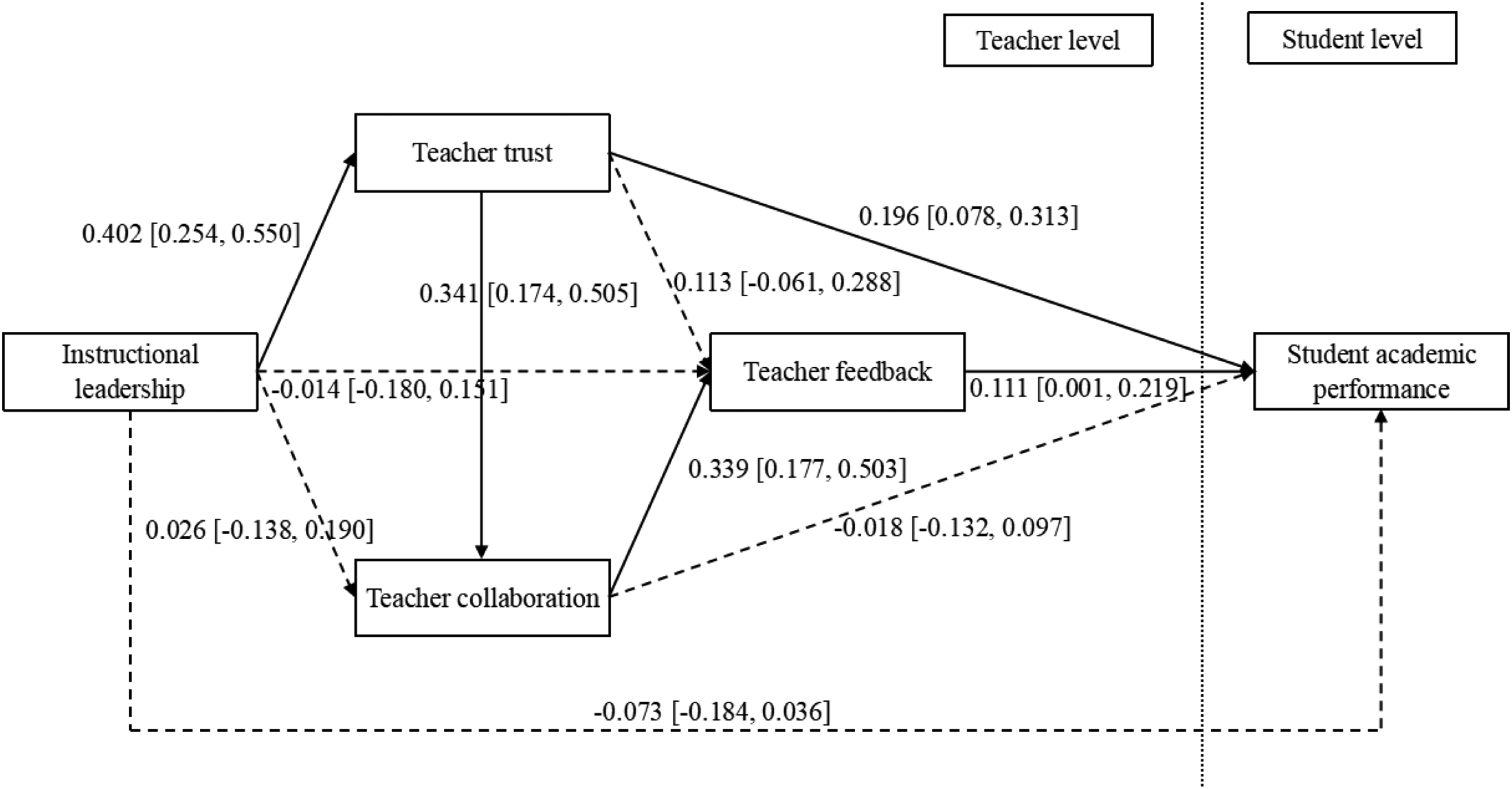
Parameter estimates (β) and 95% credibility intervals of the Bayesian multilevel mediation analysis.
Parameter Estimates (β) with 95% Credibility Intervals for the Direct and Indirect Effects from the Bayesian Multilevel Mediation Analysis of the Proposed Model.
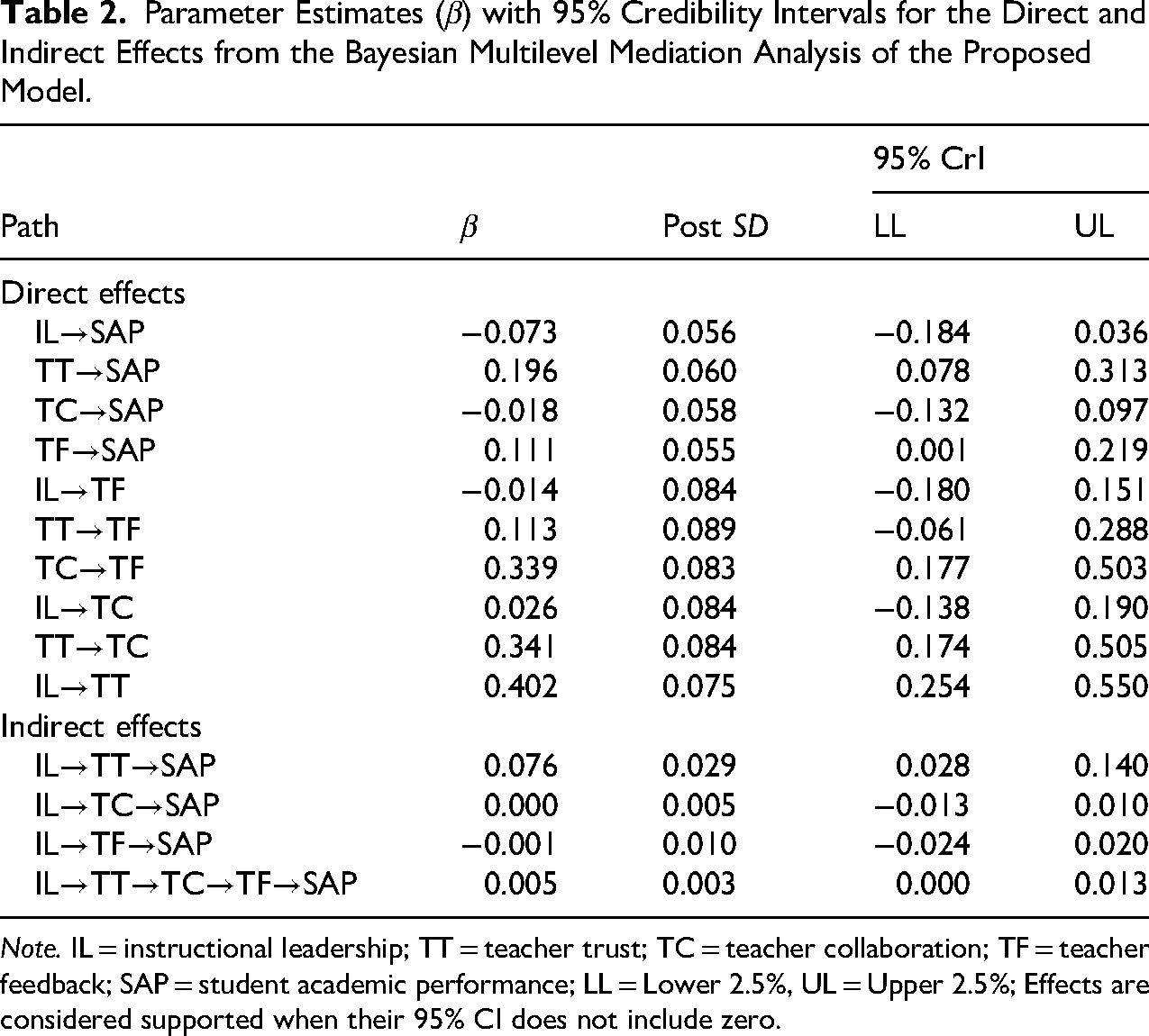
Note. IL = instructional leadership; TT = teacher trust; TC = teacher collaboration; TF = teacher feedback; SAP = student academic performance; LL = Lower 2.5%, UL = Upper 2.5%; Effects are considered supported when their 95% CI does not include zero.
However, the 95% credible intervals for the direct effects of instructional leadership on teacher collaboration, teacher feedback, and student academic performance included zero, suggesting weak or no evidence for these direct effects. Similarly, there was no strong evidence supporting an effect of teacher collaboration on student academic performance, or teacher trust on teacher feedback. The corresponding effect sizes for these paths were also relatively small.
Furthermore, this study found that instructional leadership influences student academic performance through its impact on teacher trust, with teacher trust acting as a mediator (β = 0.076, 95% CrI [0.028, 0.140]), although the effect size is small. Importantly, teacher trust, teacher collaboration, and teacher feedback collectively act as serial mediators in the relationship between instructional leadership and student academic performance (β = 0.005, 95% CrI [0.000, 0.013]), though this effect is small. However, the other two mediating pathways did not receive strong support based on the posterior credible intervals.
Thus, hypotheses H2 and H5 were well supported, while the remaining hypotheses were not supported.
Discussion
In this study, we investigated how instructional leadership influences student academic performance, focusing on the mediating roles of teacher trust, teacher collaboration, and teacher feedback. Utilizing data from PISA 2022, specifically from teachers and students in Hong Kong, we employed Bayesian estimation to analyze the multi-level mediation model. This approach allowed us to capture the complexity of these relationships and provide robust estimates that account for the hierarchical nature of the data. Our findings contribute to a deeper understanding of how instructional leadership practices impact student outcomes. Our findings align with the Ripple Effect of Principal Leadership theory, which posits that leadership influences extend beyond direct effects, shaping teacher collaboration, feedback, and ultimately student achievement. This perspective provides a theoretical basis for the observed chain mediation mechanism, highlighting the interconnected roles of instructional leadership, teacher trust, collaboration, and feedback in fostering student success.
To further interpret these relationships, Social Exchange Theory (Blau, 1964; Homans, 1958) offers a useful explanatory lens. From this perspective, teacher trust represents the foundation of reciprocal exchanges within professional communities. When teachers perceive their leaders and colleagues as trustworthy, they are more willing to invest effort, share expertise, and engage in collaborative practices that generate mutual benefits. These reciprocal exchanges foster collegial interdependence, which, in turn, encourages the exchange of constructive feedback and reflective dialogue about teaching and learning. Thus, the sequential pathway identified in this study—teacher trust leading to collaboration and subsequently to feedback—can be viewed as an expression of social exchange processes that translate leadership influence into classroom-level improvement.
While teacher collaboration and feedback did not independently mediate the effect of instructional leadership on students’ academic performance, we found that teacher trust did. This underscores the crucial role of trust as a conduit through which leadership practices influence student success. Furthermore, our analysis identifies a chain mediation mechanism in which instructional leadership influences student academic performance indirectly through teacher trust, collaboration, and feedback, albeit with a relatively small effect size. One possible explanation for this limited effect is that instructional leadership operates through multiple, complex pathways rather than a single mediation chain. Its influence is often dispersed across various organizational and instructional processes, making it difficult to observe a strong indirect effect through any single mechanism (Hallinger & Heck, 1998). Additionally, the cumulative impact of multiple mediators may weaken the overall indirect effect. Each mediating step introduces potential variability, measurement error, and unobserved confounding factors, all of which can attenuate the effect size (Preacher & Hayes, 2008). The complexity of multilevel mediation processes, particularly those spanning teacher and student levels, may further contribute to the observed small effect. Despite the relatively small effect size, the presence of this chain mediation pathway underscores the interconnected role of trust, collaboration, and feedback in linking leadership to student achievement. These findings highlight the importance of fostering supportive professional environments that enhance teacher collaboration and feedback quality, ultimately contributing to more effective instructional practices and improved student learning.
Building on existing literature, our study aligns with previous research emphasizing the pivotal role of instructional leadership in fostering positive educational outcomes (Gao et al., 2024; Liu & Hallinger, 2018; Liu et al., 2022; Ozdemir & Yalcin, 2019). For example, Liu et al. (2022) found that instructional leadership practices, such as setting clear goals and providing instructional support, were associated with improved student achievement. Similarly, Sun et al. (2023) highlighted the importance of teacher trust in facilitating effective collaboration and enhancing student learning outcomes. Additionally, research by Robinson et al. (2008) demonstrated that instructional leadership shapes teacher practices and the overall school climate, which in turn impacts student academic performance.
Our findings also contribute to the growing body of literature on the interconnectedness of leadership, trust, collaboration, and student performance. Previous studies have underscored the importance of trust and collaboration in educational settings (Carey et al., 2018; Goddard et al., 2001; Goddard et al., 2007; Hoy, 2002). Research by Ronfeldt et al. (2015) suggested that collaborative leadership approaches foster a sense of ownership among teachers, leading to enhanced student engagement and academic achievement. Furthermore, Câmpean et al. (2024) emphasized the role of instructional feedback in promoting teacher professional growth and student learning outcomes. By highlighting the complex interplay among instructional leadership, trust, collaboration, and feedback, our study provides insights into the mechanisms through which these factors collectively influence student academic performance. A key explanation for these findings lies in the social-cognitive processes underlying teacher interactions. Instructional leadership does not operate in isolation; rather, it cultivates a professional environment where trust, collaboration, and feedback function as mutually reinforcing mechanisms that enhance instructional quality. Leadership behaviors that prioritize instructional support, shared goals, and professional development create the psychological conditions necessary for teachers to establish trust, engage in meaningful collaboration, and exchange constructive feedback. This aligns with social capital theory, which posits that relationships within an organization serve as critical resources for knowledge sharing and cooperative problem-solving (Nahapiet & Ghoshal, 1998). Furthermore, our findings can be interpreted through the Ripple Effect of Principal Leadership (Clifford et al., 2012), which suggests that leadership influence extends beyond direct interactions with teachers, producing cascading effects that shape the broader school environment. Rather than functioning as a linear, top-down process, instructional leadership initiates systemic changes through multiple, interrelated pathways. In this study, the ripple effect manifests in how leadership shapes school culture to foster trust, collaboration, and feedback. When principals actively support instructional improvement—through goal-setting, professional development, and instructional monitoring—they create a climate of psychological safety and collegiality. In turn, this environment encourages teachers to engage in reciprocal trust-building, collaborative problem-solving, and continuous feedback cycles, all of which enhance instructional quality and, ultimately, student learning outcomes. Viewed through the lens of Social Exchange Theory, these reciprocal and collaborative processes reflect ongoing exchanges of trust and professional support that sustain a culture of mutual commitment within schools.
Additionally, our study provides valuable insights into the dynamics of teacher trust, collaboration, and feedback within educational contexts. The results reveal a significant relationship between teacher trust and collaboration, as well as between collaboration and feedback, highlighting the interconnectedness of these constructs in shaping instructional practices and fostering professional growth among educators. The finding that teacher trust positively influences teacher collaboration aligns with existing literature on the importance of trust in facilitating collaborative endeavors within educational institutions (Ghamrawi, 2011; Miesner et al., 2022; Ninkovic et al., 2022). This suggests that when teachers perceive a high level of trust among colleagues and school leadership, they are more likely to engage in open dialogue, share resources, and collectively address instructional challenges. From the perspective of social capital theory, the observed relationships between teacher trust, collaboration, and feedback can be attributed to the foundational role of trust in fostering professional interactions and instructional improvement. Trust reduces relational barriers, enhances teachers’ willingness to collaborate, and encourages open professional exchanges, ultimately facilitating shared instructional practices (Bryk & Schneider, 2002; Daly & Finnigan, 2011). In schools where trust is high, teachers are more likely to engage in collaboration not as a formal requirement but as a shared commitment to improving instructional quality. This environment fosters a professional learning community where teachers feel supported rather than scrutinized, making them more receptive to peer engagement and shared decision-making (Tschannen-Moran, 2004).
Moreover, this study highlights the influence of teacher collaboration on feedback mechanisms in educational settings. The positive relationship between collaboration and feedback aligns with prior research emphasizing how collaborative environments improve instructional practices and enhance student feedback (Jang et al., 2022; Sapkota et al., 2023; Yoo & Jang, 2023). In such environments, educators engage in meaningful discussions, exchange perspectives, and reflect on their teaching, ultimately strengthening feedback quality. These findings contribute to the literature by clarifying how teacher trust and collaboration shape effective feedback practices. Understanding these dynamics can help educational leaders and policymakers develop strategies to foster trust, collaboration, and improved feedback systems in schools.
Despite the well-documented role of instructional leadership in shaping school effectiveness, the present study found no significant direct effect of instructional leadership on student performance. This finding contrasts with traditional perspectives that emphasize the direct influence of leadership on academic outcomes (Shen et al., 2020; Wu & Shen, 2022). One possible explanation is that the effects of instructional leadership are primarily indirect, operating through mechanisms such as teacher trust, collaboration, and feedback rather than exerting an immediate impact on student achievement. Prior research suggests that leadership practices may take time to translate into measurable academic gains, particularly in large-scale educational systems like those assessed in PISA, where student learning outcomes are shaped by a multitude of school- and classroom-level factors (Ozdemir & Yalcin, 2019). This underscores the need for a more nuanced understanding of how leadership influences student performance over extended periods and through intermediary processes.
Furthermore, contrary to expectations, teacher collaboration did not mediate the relationship between instructional leadership and student achievement. While previous studies have linked instructional leadership to enhanced collaboration among educators (Bellibas et al., 2021; Liu et al., 2021), the extent to which such collaboration translates into improved student outcomes remains less clear. One possible explanation is that while instructional leadership fosters professional collaboration, the nature and depth of these collaborative interactions may vary. Superficial or compliance-driven collaboration, rather than deep, sustained professional learning communities, may fail to generate meaningful changes in teaching practices that ultimately affect student learning (Vangrieken et al., 2015).
Similarly, teacher feedback did not mediate the relationship between instructional leadership and student achievement, raising questions about the mechanisms through which leadership influences feedback practices. While instructional leadership can shape feedback cultures by promoting reflective teaching and professional dialogue (Tuytens & Devos, 2011), other contextual factors—such as teacher autonomy, workload constraints, and school climate—may play a more significant role in determining how feedback is utilized and whether it impacts student learning (Winstone & Carless, 2020). It is possible that leadership-driven initiatives to enhance feedback require sustained institutional support and alignment with broader instructional strategies before their effects on student performance become apparent. These findings suggest that strengthening feedback mechanisms in schools may require more than leadership support alone, emphasizing the need for systemic approaches that integrate leadership, teacher agency, and school-wide feedback practices.
This study makes several contributions to the literature on instructional leadership, teacher factors, and student academic performance. One of the key contributions of this study is its exploration of the mechanisms through which instructional leadership influences student academic performance. By examining the mediating role of teacher trust, collaboration, and feedback, our findings provide valuable insights into the complex pathways through which instructional leadership practices impact student outcomes. This nuanced understanding enhances the theoretical framework surrounding instructional leadership and sheds light on the specific processes that contribute to student success. Our study identifies a chain mediation process wherein instructional leadership influences student academic performance through its effects on teacher trust, collaboration, and feedback. This sequential mediation model offers a comprehensive perspective on the interrelatedness of leadership practices, teacher factors, and student outcomes. By delineating the sequential pathways through which instructional leadership operates, our findings contribute to a more nuanced understanding of the mechanisms underlying effective educational leadership. Furthermore, our findings contribute to the Ripple Effect of Principal Leadership theory by empirically demonstrating how instructional leadership generates cascading effects across teacher relationships and instructional practices. In addition to extending this macro-level framework, the study also draws on Social Exchange Theory to illuminate the micro-level mechanisms through which these cascading effects unfold. Unlike traditional models that emphasize direct leadership effects, our study underscores the systemic and indirect nature of leadership influence, reinforcing the notion that effective leadership fosters organizational conditions conducive to enhanced student learning. Methodologically, our study contributes to the field by employing Bayesian estimation methods to estimate multilevel mediation models. This methodological approach allows for a rigorous examination of complex mediation processes while accounting for the hierarchical structure of the data. By leveraging Bayesian estimation, we were able to obtain robust estimates of the indirect effects and provide more accurate insights into the relationships between instructional leadership, teacher factors, and student academic performance. Additionally, Bayesian methods offer more intuitive interpretations compared to traditional frequentist approaches. Rather than relying on null hypothesis significance testing, Bayesian credible intervals provide a direct probability-based measure of parameter uncertainty, allowing us to determine the probability that a parameter falls within a given range. Moreover, Bayesian probability values reflect the strength of evidence in favor of a particular hypothesis, rather than a binary rejection or acceptance based on a fixed threshold (e.g., p < 0.05). These features make Bayesian estimation particularly useful in educational research, where effect sizes and uncertainty are often of greater interest than dichotomous significance testing.
Implications
Our findings reinforce the importance of instructional leadership in shaping student academic performance, but they also reveal that its effects are largely indirect, operating through teacher trust, collaboration, and feedback. This underscores the need for educational leaders to move beyond traditional, top-down leadership models and adopt systemic approaches that foster interdependent professional relationships among educators. Rather than focusing solely on direct instructional oversight, principals should actively cultivate a school culture in which trust, collaborative problem-solving, and constructive feedback become embedded in daily teaching practices.
To achieve this, school leaders should implement structured opportunities for teacher collaboration, such as professional learning communities (PLCs) and peer observation programs. These initiatives should not only provide a platform for instructional dialogue but also be explicitly designed to build trust among teachers by ensuring psychological safety and shared ownership of student success. Additionally, administrators should establish transparent and bidirectional feedback mechanisms that encourage both teacher-to-teacher and teacher-to-leader communication, reinforcing a culture of continuous professional growth.
Policymakers must also recognize the cascading effects of instructional leadership and design leadership development programs that equip principals with the skills to nurture relational trust and foster collective teacher efficacy. Rather than focusing exclusively on instructional supervision, professional development for school leaders should incorporate training on fostering teacher agency, conflict resolution in collaborative settings, and creating feedback-rich school environments. Furthermore, policies should prioritize the allocation of time and resources for meaningful teacher collaboration, ensuring that school structures enable—not hinder—interdisciplinary teamwork and joint problem-solving efforts.
By embedding these principles within leadership training and policy frameworks, educational systems can leverage the Ripple Effect of Principal Leadership to create sustainable improvements in instructional quality and student learning outcomes. This systemic approach recognizes that leadership influence extends beyond direct instructional guidance and manifests in the everyday interactions, relationships, and professional culture of a school.
Limitations and Directions for Future Research
A key limitation of this study is its reliance on cross-sectional data from the PISA 2022 assessment, which prevents causal inferences about the relationships between instructional leadership, teacher factors, and student academic performance. As PISA is not an experimental design, it lacks temporal precedence, further constraining causal claims. While our findings offer valuable insights into these associations, future research should adopt longitudinal or experimental designs to better capture their dynamic nature and strengthen causal interpretations.
The findings of this study are based on data collected from schools in Hong Kong, which may limit their generalizability to other educational contexts. Cultural, organizational, and systemic differences across educational settings could influence the mechanisms through which instructional leadership operates. Future research should replicate this study in diverse cultural and contextual settings to assess the robustness of the findings and explore potential contextual moderators.
Another limitation relates to the measurement of key constructs such as instructional leadership, teacher trust, collaboration, and feedback. While efforts were made to use validated measures, the inherent subjectivity of self-report instruments and the potential for common method bias could influence the accuracy of the findings. Future research should employ multiple methods and sources of data (e.g., observations, administrative records) to enhance the validity and reliability of the measures used.
Additionally, this study may be subject to omitted variable bias, as not all factors influencing student academic performance were included in our models. While we accounted for key teacher-related mediators, other unobserved school-, family-, or student-level factors (e.g., socioeconomic status, parental involvement, school climate) could also play a role in shaping student outcomes. Future research should incorporate a broader range of covariates and consider using advanced statistical techniques such as instrumental variables or propensity score matching to address potential omitted variable bias.
The mediation models tested in this study involve multiple pathways and interactions between variables, which may oversimplify the complex reality of educational systems. Future research could explore alternative mediation models, including moderated mediation or mediated moderation, to account for potential moderators or boundary conditions that may influence the mediating mechanisms identified in this study.
Conclusions
This study advances our understanding of the mechanisms through which instructional leadership influences student academic performance. Our findings challenge the assumption of a direct link between instructional leadership and student achievement, instead revealing a complex, indirect process mediated by teacher trust, collaboration, and feedback. These results underscore the systemic nature of leadership influence, suggesting that principals shape instructional quality not through direct interventions alone, but by fostering the organizational conditions that enable effective teaching practices to emerge and sustain over time.
By integrating the Ripple Effect of Principal Leadership framework (Clifford et al., 2012), our study further refines theoretical perspectives on instructional leadership. Rather than conceptualizing leadership as a set of discrete actions exerted from the top down, our findings suggest that effective instructional leadership generates cascading effects that transform school climate, teacher relationships, and pedagogical practices in an interdependent manner. Specifically, leadership behaviors that cultivate trust among teachers initiate a ripple effect, strengthening collaboration and feedback loops that enhance instructional quality and, ultimately, student learning. Viewed through the lens of Social Exchange Theory, these cascading processes can be understood as reciprocal exchanges that sustain collaborative professionalism and relational trust within schools. This reconceptualization shifts the focus from leadership as a direct driver of student achievement to leadership as an orchestrator of systemic change within schools.
Beyond these theoretical contributions, our findings highlight important directions for future research. Given the potential influence of unobserved factors on student outcomes, future studies should explore additional school- and student-level variables that may moderate or mediate the effects of instructional leadership. Furthermore, integrating qualitative approaches, such as case studies or teacher interviews, could provide deeper insights into the mechanisms underlying these relationships. Finally, policymakers and practitioners should consider how different school contexts shape the effectiveness of instructional leadership strategies, emphasizing the need for context-specific interventions.
Footnotes
Acknowledgements
We would like to express our gratitude to Professor Qiong Li and Associate Professor Laura B. Liu for their invaluable guidance and support throughout the writing process of this article. Her insightful feedback and expertise have greatly contributed to the clarity and coherence of our work.

Author Contributions
Conceptualization: [Zhenyu Li], [Qiong Li]; Methodology: [Zhenyu Li]; Formal analysis and investigation: [Zhenyu Li]; Writing - original draft preparation: [Zhenyu Li]; Writing - review and editing: [Zhenyu Li], [Qiong Li], [Laura B. Liu]; Funding acquisition: [Qiong Li]; Supervision: [Qiong Li].
Funding
The authors disclosed receipt of the following financial support for the research, authorship, and/or publication of this article: This research was supported by the Major Project of the Philosophy and Social Science Foundation of China (Grant No. 24&ZD181).
Declaration of Conflicting Interests
The authors declared no potential conflicts of interest with respect to the research, authorship, and/or publication of this article.