





Abstract

The first in a three part series of reflections
It is such a well-known story and that’s the first problem. Familiarity breeds contempt: from the beginning, we assume that we know what it is all about. Furthermore, we may know the story, or think we do, but to get its meaning the context is all important. So here is the second problem: is the context peculiar to its historical setting or is it in fact timeless? The story is part of a conversation or dialogue between two parties. On the one hand there is the lawyer, the establishment figure representing authority, and on the other, there is the carpenter, or carpenter’s son, the agent provocateur, radical teacher and disturber of the status quo. The scenario, far from being set in the past, is one that has been replicated through the ages, and is as relevant in the present as it ever was. The questions are the key to gaining understanding, so here goes.
“Teacher, what must I do to inherit eternal life?” It seems such a silly question. We all know better. You don’t have
“What is written in the law? What do you read there?” It sounds an odd way to respond, but it was in the nature of this not so simple carpenter to answer one question by posing another. He threw the ball back into the lawyer’s court, which is curious if the lawyer was the same lawyer who had perhaps previously asked the carpenter “which commandment in the law is the greatest?” and got the reply that on the commandments to love God and to love your neighbour “hang all the law and the prophets” (Matthew 22:34-40). If so, the lawyer was only repeating the answer that the carpenter had once given him (or was it the other way around?). The foundation of the Torah that guided the workings of Hebrew society were the commandments to love God (the first 4) and to love one’s neighbour (the last 6). The lawyer knew full well that this was the very basis of what life was about, or should be about, piety on the one hand and justice on the other. Herein lay life’s abiding meaning and purpose. But the lawyer knew that loving with heart, soul, strength and mind and others as yourself was a tall order. If the welfare of society depended on people respecting a higher authority and serving one another, he knew that legislating to love was not so easy as it sounds. Love was something you fell into and also fell out of. Making it happen was highly problematic. And as some clarification was required, he asked another pertinent question. After all, surely there was a limit to loving.
“And who is my neighbour?” As was his wont, the carpenter told a story. A man is mugged on the Jerusalem to Jericho Road and is left for dead. Along comes a priest and then a Levite, presumably returning home from the Holy City: they were obviously more concerned with their piety than administering justice. And then a Samaritan turns up. What was he doing on that road, a long way from home and travelling away from it, a dubious foreigner ethnically and religiously, culturally alien and from another political domain? He picks up the mugged man, heals his wounds, leaves him with the innkeeper at the local pub, and promises to reimburse all expenses the innkeeper incurs. Here was someone divorced from all the orthodox piety but concerned to administer some kind of justice. The story concludes with the final question.
“Which of these three, do you think was a neighbour to the man who fell into the hands of robbers?” The answer was a no-brainer, or so it seems, for the lawyer – “the one who showed him mercy”. But was it ‘one’ or was it ‘two’? If the story is entitled ‘The Good Samaritan’, the innkeeper is forgotten because he was clearly good too. There are not three characters in the story, but four!
Let’s consider the Samaritan first. He took time out of his journey, so wherever he was going he was late for his appointment. He stopped to show compassion for a fellow human being, at possible risk to his own safety. Effectively, he took a wounded person to hospital. Yes, it was only a pub, but pubs offer hospitality, at a price of course. The Samaritan coughed up two days wages, and promised to reimburse the innkeeper more on his return. Showing mercy to a complete stranger on a dangerous road was personally costly.
So, what about the innkeeper? To coin a phrase, he was ‘left holding the baby’. (Who said there was no room at the inn?) He had to make room and care for a wounded man. The ‘booking’ was open-ended: he had no idea how long this commitment would last. Moreover, whilst he was paid in advance, in all probability it would not have been enough. He took the patient on trust that the Samaritan would return to pay him. Whilst this was likely as the Samaritan would be going back home, it was still an act of faith on his part. Taking the stranger in was not only a huge on-going responsibility but also a financial risk. For him, showing mercy (he could have said ‘no’) was costly too.
“Go and do likewise”. With these words, the dialogue between the carpenter and the lawyer ends, and importantly it takes us back to the original question, “what must I do to inherit eternal life?” The answer is that we must do whatever is necessary to fulfil the commandments to love. It’s a highly problematic answer because we may never be willing or able ‘to do enough’. The story shamed the lawyer who was wanting to justify himself because for all his knowledge of the law it was his social class (the priest and the Levite) who walked by on the other side. To the question “who is my neighbour?” the answer was clearly not those who ‘are in the know’ but those who are ‘willing to show compassion’ irrespective of what they know or believe, their race or their status.
We could leave the matter there; but we cannot. There is another important figure in the carpenter’s story that we must not forget and that is the man who was mugged. Without his need there would have been no story to tell!
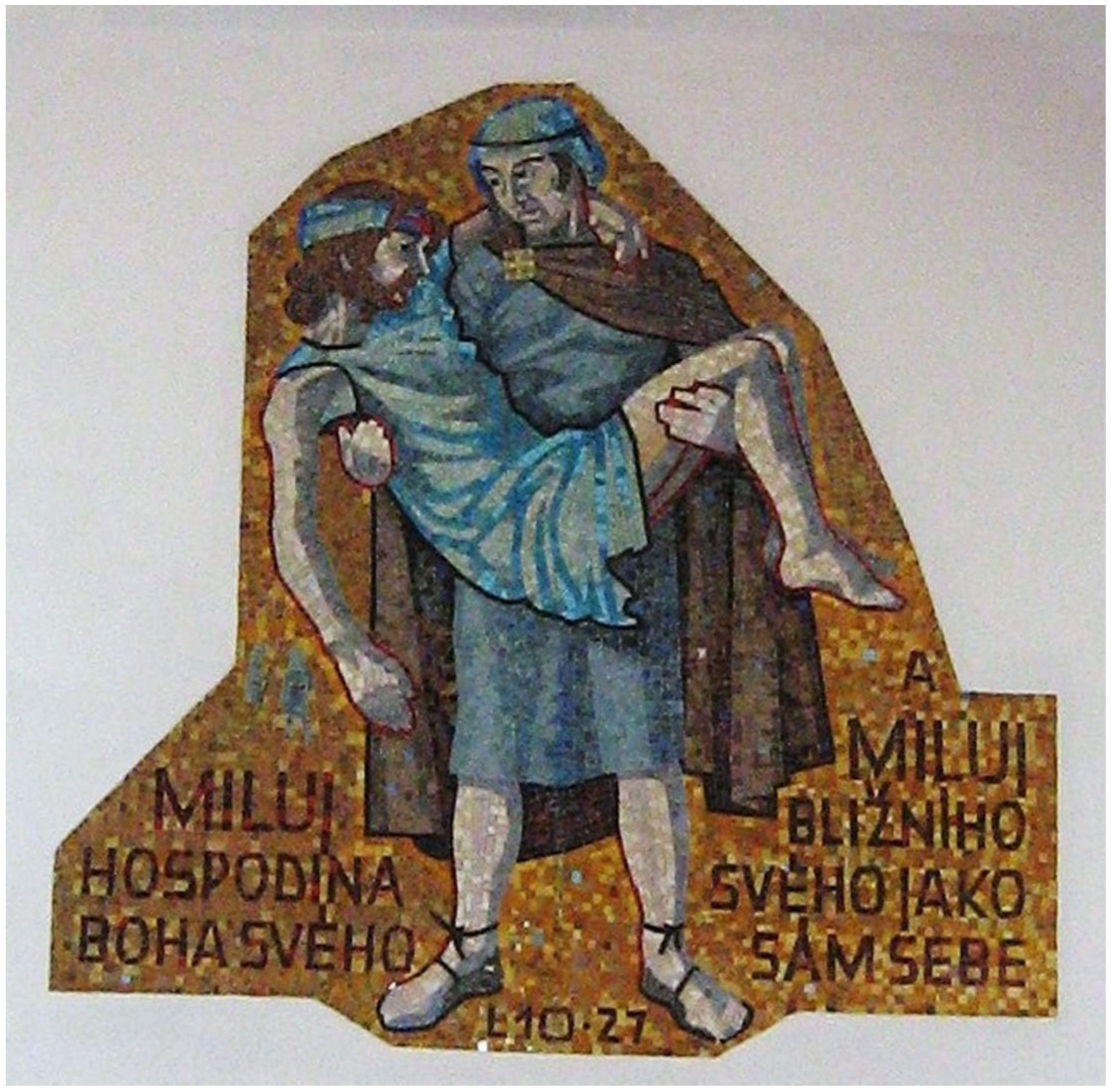
The above mural is at the front of the Evangelical Church of the Czech Brethren, Jindřichův Hradec. The text in Czech is the lawyer’s reply to the carpenter’s question “What is written in the Law?” Those sitting in the congregation cannot fail to get the point. They come to worship, i.e. to find worth and discover what is worthwhile, with the assurance that they are in safe hands and that they will find love, bringing healing and hope to counter all the misfortunes and insecurities of life. We discover the depths of the carpenter’s story when we identify not merely with the priest and the Levite (we all walk by on the other side from time to time), nor with the Samaritan and inn keeper (we all like to think we are better than we actually are), but with the down and out (we all have our hurts and sorrows and require the help and assistance of others). The carpenter knew a thing or two when he once said to a large crowd up a mountain: “in everything do to others as you would have them do to you; for this is the law and the prophets” (Matthew 7:12).
So, to return to the beginning of our conversation, eternal life is discovered through serving and being served; it grows when we acknowledge that we need to love and to be loved; it involves recognising the necessity for human solidarity.