







Abstract
This article describes a case study of a gifted high achiever in learning science. This learner was selected on the assumption that drawing attention to the characteristics of a successful learner may improve learning effectiveness of less successful learners. The first author taught the gifted learner and collected data through participant observation over a 3-year period when the learner was in Grades 8 to 10. The data corpus was composed of audio-recorded lesson observations and interviews, field notes, and written material. We operated in an interpretive paradigm, and data collection, analysis, and interpretation were done in an inductive, cyclic manner associated with the constant comparative method. We identified three general strategies and a number of associated tactics that characterized his successful learning. These strategies are interrogating information, thinking it through, and organizing and linking.
In this article, we focus on the learning strategies used by a gifted learner as he progressed through an accelerated and enriched learning program in school science. The participant, referred to here by the pseudonym André, lived on a large mission station in rural South Africa. The first author (henceforth referred to as I), also lived there and was a teacher in the mission school that served approximately 600 learners from the reception phase to Grade 12. Some students lived on the mission while others came from surrounding areas. Living and working in the same community as André, I came into contact with him over an extended period. This period started when I helped at the preschool and recognized that he was different from other students. There were many other opportunities to watch his learning progress and interact with him over the next few years, all of which confirmed my original idea that he was a gifted learner with high academic ability. As he entered Grade 8, I began implementing an accelerated individual learning program of science and mathematics for him. Simultaneously, I began formally documenting his learning in physical science (a combination of physics and chemistry topics) as part of my postgraduate research project. This formal study continued for 3 years. Extensive analysis and interpretation of these data led to the formulation of a number of assertions concerning the learning beliefs, strategies, and tactics used by this gifted high achiever when studying science. In this article, we focus on the assertions associated with André’s learning strategies. Other findings from the study associated with his learning, such as his learning beliefs, are reported elsewhere (Stott & Hobden, 2006, in press).
Rationale
In many countries, professional educators are concerned about raising the quality of teaching and learning in their school systems. For example, in South Africa, there is particular concern about the poor quality of mathematics and science education, which are considered gateway subjects to higher education and employment. The poor quality is evidenced by South African learners consistently being placed near the bottom of achievement tables in assessments such as Progress in International Reading Literacy Study and Trends in International Mathematics and Science Study. Many attempts have been made to improve the system, ranging from in-service teacher training to extra lessons outside of school hours for students. A particular intervention is that of selecting disadvantaged students who show evidence of being gifted learners, and placing them in highly successful schools. These are learners who achieve relatively well compared with their peers despite their economically disadvantaged socioeconomic backgrounds and attendance at schools with limited human and physical resource bases. Unfortunately, most do not improve significantly nor achieve at the high levels expected within their new environments. In fact, little improvement has been noted over the past 20 years since the demise of the apartheid education system, and there are suggestions that it is time to focus efforts elsewhere and try different types of interventions (Hobden, Hobden, Douglas, & Hardman, 2012). There is a pressing need to find ways of developing the talents and aptitudes of the many gifted students (Feldhusen, 1998) within the previously disadvantaged schools of South Africa.
Within this context, it makes sense to look at points of success within the system in order to determine whether we can learn something new that will supplement the design of the previously mentioned interventions. I was daily confronted by André, a gifted learner who achieved high scores in science and mathematics, while his peers struggled. This raised the question of what learning strategies he used to enable success. Consequently, he became the convenient target of a formal research study. As part of the study, we attempted to identify and describe the specific learning strategies used by this gifted learner, with the rationale that these could be taught to less effective students to improve their learning. Our own teaching and research interests in science education influenced us to choose physical science as the context for the research.
Teaching Strategies to Students
We approached the study with the understanding that observing a gifted learner in action (in this case learning physical science) might provide information that could be used to help underachievers. We have thus sought to identify the specific learning strategies that steer this gifted, high-achieving student’s learning of physical science toward scientifically appropriate understanding. In this article, we provide detailed descriptions of these strategies in action. We argue that educators and researchers should find these useful in informing their efforts to improve the learning of both underachieving gifted students as well as of less able students. Using strategies to improve learning is not a new idea. For example, similar sentiments were expressed by Shore and Kanevsky (1993) who surmised that it is an entirely reasonable goal “to enhance the thinking skills of a large number of people to any reasonable degree as a result of studying successful thinking in children and adults” (p. 142). Given the South African context of a high proportion of disadvantaged students together with our belief that their learning potentials are not “fixed, pre-determined, and beyond the salvation of any form of intervention” (Thomas, Anderson, & Nashon, 2008, p. 1702), this appears a reasonable goal.
Within the literature, there are many reports that give us confidence that the identification and study of learning strategies may be a key to improving teaching and learning, and consequently improving the success of students in physical science. Some authors (see, e.g., Baron, 1987; Sternberg & Grigorenko, 1997) indicated that there was sufficient evidence to believe that we can improve students’ achievement, that is, make them smarter, through instruction in beneficial learning strategies. For example, Baron suggested that the most effective way to raise intelligence in students may be to teach them beneficial intellectual personality traits (styles), and that these can be identified by studying experts in action. However, Baron acknowledged that it was very difficult to alter someone’s learning style, because this required alteration of their personality. Therefore, he suggested that it might be more feasible to try to improve the learning of less able students by teaching them specific strategies observed to be used by more able students.
Many studies reported success in raising expertise in a particular area following the teaching of specific strategies. For example, in a study of physics learning, Selçuk, Sahin, and Açikgöz (2011) showed that explicit learning strategy instruction was more effective than traditional instruction in improving the participating students’ achievement. Furthermore, recent findings from a meta-analysis of cognitive learning strategy studies in Korea (Kim et al., 2008) indicated that strategy intervention had significant effect sizes particularly for average and underperforming students across all grades except middle school.
Instruction in strategies is not confined to learning by nongifted learners, because limited use of learning strategies contributes to the underachievement of many gifted learners (Reis & McCoach, 2000). Instruction in the use of specific targeted strategies could be a key to helping gifted underachievers. There are many examples in the literature of specific strategies being the source of differentiation between achievers and underachievers. Examples include a study by Baum, Renzulli, and Hébert (1995), who found that among the common characteristics of gifted underachievers was poor use of self-regulation strategies, and a study by Redding (1990), who showed that achieving gifted adolescents outperformed their underachieving gifted counterparts in their use of detail- and precision-directing strategies. Adding to this, Reis and McCoach (2000) suggested that underachieving gifted students share more common characteristics with underachievers in general than they do with achieving gifted students. Therefore, it appears that they, too, would benefit from the identification of strategies that improve the effectiveness of their learning.
Although gifted learners in general display more spontaneous, frequent, and complex use of learning strategies than less gifted learners, even they can benefit from being taught new learning strategies. Scruggs, Mastropieri, Monson, and Jorgensen (1985) have shown that “externally imposed learning strategies including spatial organizers and transformational mnemonics have significantly increased the efficiency of learning of gifted students” (p. 183). In the specific case of teaching physics, Shore and Kanevsky (1993) found that training more able students in cognitive mapping enhanced their ability to develop interrelated knowledge structures. There was also convincing evidence found in studies such as Scruggs and Mastropieri (1988), where gifted learners used new strategies more effectively than other students, and were better able to transfer strategy usage to new situations. Risemberg and Zimmerman (1992) concluded their review of self-regulation strategies by suggesting that teaching new strategies to gifted learners could be a “particularly productive use of the school day” (p. 101). It is appreciated that this is not a simple matter. Shore and Kanevsky (1993) warned that much work still needs to be done to validate the goal of teaching cognitive skills to less able students, and Reis and McCoach (2000) cautioned that inadequate research had been carried out into how to intervene with gifted underachievers.
The above findings suggest that there is value for gifted achievers, gifted underachievers, and nongifted underachievers in the identification and subsequent teaching of effective learning strategies. The fact that most of the research was with students in lower grades in disciplines like language, provides additional motivation to investigate strategies in more problem-based disciplines such as science. For example, in Hobden’s (2005) case studies examining Grade 12 physical science classrooms in South Africa, virtually no identifiable cognitive strategies were explicitly taught to students or utilized by students during the yearlong observation of their classrooms. The explicit strategies taught in most cases were limited to drawing a diagram and writing down given information. A further motivation for our study was the limited amount of detailed qualitative research in the field. Coleman, Guo, and Dabbs (2007) argued that there was a need for case studies and for insider perspectives to deepen our understanding. This was supported by the review by Dai, Swanson, and Cheng (2011) who indicated that case study research was not very common within giftedness literature, and, in addition, only about 8% of qualitative studies dealt with cognitive processes. Dai et al. (2011) saw qualitative research as an opportunity to work close-up with individuals “rather than being purely based on remotely fashioned universal constructs” (p. 136). Overall, the current limited use of strategies despite the research that shows that they can have benefit when taught, together with the lack of case studies describing their use, point to the need for reporting a study such as this one.
Conceptual Framework
We constructed a conceptual framework (Ravitch & Riggan, 2012) from the existing literature on learning and learning strategies to guide the design of the case study and the initial data collection. We also used this framework to guide the initial stages of analysis as we connected data to propositions. In this way, a model of how André learns was constructed, guided by the literature and from our understandings emerging from the study. The resulting model is well grounded in both practice and theory, thus making a needed contribution to the literature (Dai et al., 2011) on research into giftedness and gifted education in the area of science education. We discuss the main constructs of our framework below.
Giftedness
The following question directed our study: What learning strategies and tactics does this gifted high achiever use while learning physical science? We were not concerned with variables that might have contributed to his external manifestations of giftedness. For example, we did not address the issue of whether André’s giftedness in science was latent or developed as a result of productive practice (Ericsson, Roring, & Nandagopal, 2007), nor did we debate the effects of cognitive, motivational, or sociocultural variables in the development of his giftedness or high achievement (Heller, 2007). Our focus was primarily on the detailed description of the empirically observable traits associated with the learning of this obviously gifted high achiever in the domain of school science. The assumption was that we had identified a gifted learner, and his use of learning strategies could provide useful information for informing our teaching and other students’ learning of science.
There are many different criteria used to identify giftedness, from IQ scores to the use of multiple criteria (Reis & McCoach, 2000). For the purposes of this study, we view giftedness (or high ability) as a developmental set of behaviors that can be applied to deep learning and to problem-solving situations (Renzulli, 2012). We hold similar views to Renzulli (2012) that “varying kinds and degrees of giftedness can be developed and displayed in certain people at certain times and under certain circumstances” (p. 153). Other authors emphasized different aspects. For example, Solomon (1979) emphasized transfer of knowledge to new contexts and a high capacity for information complexity, while Baron (1987) considered superior mental processing and the use of beneficial learning strategies and styles as diagnostic of high ability. In this article, the term gifted high achiever is used to refer to a student who shows advanced ability as well as advanced performance compared with his peers (Denton & Postlethwaite, 1984) in school science tasks, resulting in exceptional achievement.
Learning
Our perspective on learning is essentially constructivist in nature. The constructivist view presents human learning as an active process, that is, something done by, not on or to, the learner himself or herself (Taber, 2006). Driver, Asoko, Leach, Mortimer, and Scott (1994) suggested that “the core commitment of a constructivist position is that knowledge is not transmitted directly from one knower to another, but is actively built up by the learner” (p. 5).
Problem solving forms a significant part of learning physical science, so we used Schoenfeld’s (1985) framework for the analysis of problem solving as the overall framework for analyzing André’s problem-solving learning behavior. Schoenfeld argued that if we want to know why learners’ attempts to solve problems are successful or not, we need to examine their knowledge base or resources, problem-solving strategies (heuristics), monitoring and self-regulation, and belief systems. Using this framework, we see solving the many problems in science to involve the selection and use of resources and heuristics (learning strategies) through metacognitive control processes affected by the learner’s belief system (learning style).
Strategies
Learning strategies are situated in a more general framework of self-regulated learning. We have used a pragmatic modification of Garner’s definition of the term learning strategies (Garner, 1988). According to Garner, learning strategies are sequences of activities, largely under the deliberate, conscious control of the learner, which are selected from alternative activities in order to attain a learning goal. This corresponds to Schoenfeld’s (1985) term heuristics. Schoenfeld viewed these as separate from automated strategies, which he classified as a type of resource. However, given the difficulty in knowing whether observed learning activities are performed consciously or not, we use the term learning strategies to refer to observable patterns of behavior, controlled consciously or subconsciously by the student, which serve as tools for learning to occur.
Despite the many different kinds of learning strategy referred to in the literature, there appears to be agreement that at the most general level, they can be organized into three general classes: cognitive, metacognitive, and affective strategies (Schellings, 2011). Schellings (2011) explained the functions as “the executive part in acquiring knowledge and skills, the regulative part that directs the executive learning activities, and the affective strategies that are aimed at self-management” (p. 92). The focus in the study was on the more complex strategies within the cognitive category; in particular, with how three complex strategies (Duncan & McKeachie, 2005) of elaboration (linking and integrating knowledge), organization (summarizing and representing), and problem solving would manifest themselves in the learning of science by a gifted learner.
Learning With Understanding
An additional perspective on strategy use is to consider the depth of engagement. This was important, because we were interested in learning with understanding rather than reproductive or procedural learning. Baron (1987) indicated that there are various learning strategies and styles associated with various depths of learning engagement. This particular perspective was useful in directing observations. Moodley’s (1999) discussion of actual, representational, and notional levels of engagement was helpful in directing and understanding observations. According to Moodley, engagement with material on the actual level only involves using the original words of the information source. For students to be able to exert the freedom to express this information in their own form (i.e., to operate on the representational level), a degree of understanding needed to be reached. Even deeper engagement by the student, on the micro and hyper levels (i.e., on levels of greater specificity and generality, respectively), develops an understanding of details within the information and of the concepts, theories, or laws of which the information forms a part. The student is then said to be operating on the notional level of engagement. A deep learning style therefore involves using strategies in which students engage with information at the representational and notional levels. Such strategies include categorization, comparison and contrast, hierarchical organization of ideas in networks, and abstraction (Schmeck, 1988).
We used conceptual change theory to help us understand the value of operation on both the micro and hyper levels of engagement. Engagement on the micro level is important for clarification of meaning to enable establishment of clear conceptual boundaries. This is necessary to enable students to undergo the synthesis, analysis, evaluation, and subsumption required for conceptualization, which involves engagement on the hyper level. In other words, engagement on the micro- and hyper-notional levels involves some form of conceptual change. According to Hewson and Lemberger (2000), “Coming to a deep understanding of a conception means grappling with the conditions of intelligibility, plausibility and fruitfulness that define a conception’s status” (p. 123). The word grappling suggests an active, effortful process, and it was this process that was of central concern in this study.
Research Design
Given the context, we considered a detailed case study (Stake, 1994; Yin, 2014) an appropriate research approach and chose participant observation as the main method of collecting data. Operating in an interpretive paradigm, we considered a human instrument best able to sense and examine the complexities of the case and thus generate a rich, holistic description of his learning from which interpretations and generalizations could be made (Merriam, 2009). This study of a single “unusual case” (Yin, 2014, p. 52) over an extended period of time was in contrast to many reported survey-type studies in which the learning strategies were predetermined from theory, and learners were only given an opportunity to self-report agreement or disagreement. Stake (1994) identifies three types of case studies, classified according to the researcher’s purpose in performing the study. One of these, the instrumental case study, corresponds with our view of this case study. The purpose of researching this type of unique case study was that it potentially had instrumental value. We hoped that the study might “facilitate our understanding of something else” (Stake, 1994, p. 237), namely, what learning strategies to encourage among less successful physical science students.
The data corpus of field notes, critical incidents, audio recordings, journal entries, and interviews spanned 3 years, during which time I taught André physical science individually on most school days. Throughout this period, I recorded brief field notes of my interactions with the learner each day as well as more detailed reports on interesting events or conversations. In the first year, I also audio recorded complete lessons and used these recordings and field notes to construct reflective summaries of my observations. These initial data were reviewed, coded, and sorted in a primary analysis, resulting in the generation of an initial model of how it appeared André was learning. Guided by this model, we focused on critical incidents in the second year of the study. We analyzed these critical incidents for confirming or disconfirming evidence and refined the model in light of the evidence. The data collected in the final year consisted of interviews with André and were collected in a targeted manner to clarify understanding of incidents where the data analysis process had revealed the need for clarification. In this article, we report the findings of the analysis with a specific focus on the cognitive strategies used. Data collection, analysis, and interpretation were done in a reflective, inductive, cyclic manner, resulting in descriptive and interpretive analyses that were grounded in the data (Taber, 2000). The whole process of collection and interpretation of the data is best described as the constant comparative method (Taylor & Bogdan, 1984).
We ensured validity through long-term observation and triangulation relying on more than one data source (Merriam, 2009). By the end of the 3 years, the data corpus included 52 detailed lesson reports, 21 descriptions of critical incidents, 12 summaries of interviews, and 27 learning journal notes written by André. Richly detailed descriptions of selected observations have been given in Stott (2002), enabling readers to form interpretations and generalizations of their own, thus enhancing the validity of the study (Stake, 1994). Readers might consider it a limitation that the original study took place some years ago. I carried out the study while a practicing school teacher. At that time, my priority was to use the findings to reflect on my teaching practice and inform my PhD study in critical thinking. Recently, after I moved into an academic position at a university, we saw the current value of distributing the findings to a broader audience, given the need expressed for more detailed qualitative research in the field (Dai et al., 2011). We do not see any substantive reason why in this case the delay in publication would detract from the relevance of the findings.
André and his parents gave consent for the conduction of this research and the publication of its results, under the chosen pseudonym. We showed André relevant sections of the research findings at different times and made appropriate adjustments in response to his comments to ensure a true and valid representation of the events. In all cases, this only required minor changes to be made. We were guided throughout our research by the ethical principles imposed by our institution and others (Moon, 2011). We took great care to respect André’s autonomy, and to ensure both that we provided a true representation of events and that André was agreeable to the publication of the findings to a broader community.
The Case
André was purposely selected for study because of the interest we had in his learning. In this section, we provide some background information about him to offer context to the findings of the study. He lived with his own family in a large rural mission community of about 150 families, and all his schooling occurred at the mission school. I was employed to teach science in the mission high school. I also lived on the mission but was unrelated to his family. Until he reached high school, he attended regular classes with other learners from the mission and surrounding areas. André’s natural interest in science and his participation in science fairs while still in primary school caused him to gravitate toward me as I was responsible for science teaching in the high school, and I helped learners produce research projects for the local science fair. I then became more aware of André’s academic ability and the depth of his understanding of science when discussing his projects. This confirmed my view that he was academically gifted and needed individualized instruction, particularly in mathematics and science.
The school management was supportive of this and structured the school timetable so that I and other teachers could provide him with an individualized curriculum in parallel with that of the other learners in the school. Within the literature, this process is similar to curriculum compacting. According to Reis, Burns, and Renzulli (1992), curriculum compacting is a formally constructed individualized curriculum that eliminates those parts of the normal curriculum in which the learner is competent, making space for more challenging tasks and more productive use of the student’s time. Replacement strategies include activities for enrichment, acceleration, and others such as peer tutoring and assisting the teacher. Curriculum compacting has been shown to be effective in numerous studies in “serving high ability students in a variety of educational settings” (Reis & Renzulli, 2004, p. 126). In the case of André, he was not provided with a carefully planned alternative curriculum nor was his curriculum based on initial diagnostic tests or careful analysis of alternative curriculum goals. Rather, he pursued topics stipulated in the national curriculum, but at an accelerated pace and well beyond the depth and breadth required, and occasionally he joined the science class for formal practical work sessions and assessments.
When working with him on a one-on-one basis after becoming his science teacher at the start of Grade 8, I observed that his learning of science was charged with interest, enthusiasm, and cognitive activity which I did not experience with my other learners. André would often voluntarily share new thoughts, ask questions, rigorously debate logic, design challenging problem–solution variations, or bring his personalized lesson to a temporary halt by switching off to the world in intense thought. At this time, I started my postgraduate research studies and decided to undertake a systematic study to document his learning strategies in the belief that much could be learned and used with my other science learners.
The selection of the particular case in this study had many advantages for us in determining useful learning strategies. André was in a situation where he was encouraged to use his talents, allowed the freedom to learn at his own pace, and to follow his own interests under the guidance of a knowledgeable and experienced teacher. Consequently, he used whatever strategies he felt appropriate in the given situation. He was not limited to the pace of his peers nor was he restricted in his questioning by having to wait his turn in class. We know strategy use is dependent on goal emphasis (Ames & Archer, 1988). In this case, André’s emphasis was on understanding rather than the more common goal of focusing on what is in the examination (Hobden, 2005). Given that he was about 14 years old at the start of the study and already an advanced learner, he was not restricted from displaying all aspects of formal operational thinking and utilizing the full range of more complex strategies. The result for us was an opportunity to study unfettered strategy use in science by a gifted learner. This situation is relatively rare in studies of students in high school science where the emphasis is normally on problem solving and restricted to solving examination-type problems.
André’s Learning Strategies
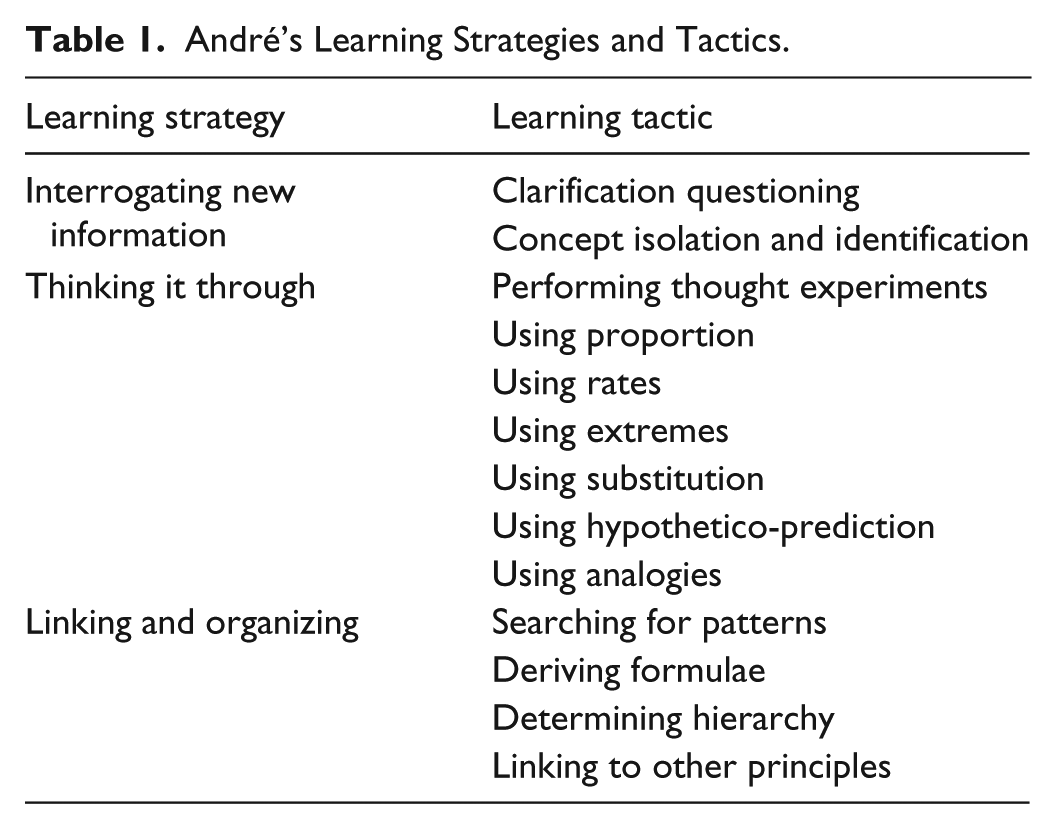
The term learning strategies is used here to refer to observable patterns of André’s behavior which were controlled consciously or subconsciously, and which served as tools for learning to occur. In addition, we identified more specific ways in which he behaved while employing each of these strategies and called these learning tactics in accordance with Schmeck’s (1988) use of this term. We have labelled the main learning strategies identified as interrogating new information, thinking it through, and linking and organizing. While the complexity of learning defies neat classification of learning strategies, we use the organizing structure given in Table 1 when discussing strategies André used. As is evident from the discussion that follows, many of the learning tactics could be classified in more than one category. We based our categorization decisions on the primary characteristics of the tactic. A selection of these are discussed below.
André’s Learning Strategies and Tactics.
Strategy: Interrogating Information
André probed and interrogated new information until its composition was clear to him, and he had determined if he had all he required for sense making. One tactic was to ask questions of clarification. He commonly used this tactic during lessons when I introduced new information. For example, in a lesson involving the application of a set of rules to name hydrocarbon compounds, he would not continue until he first understood the rules despite my plan to list the rules first and then for him to come to an understanding through application. As I listed the rules, he repeatedly questioned what “R” represented despite having been told R represented a hydrocarbon chain a few times. Then, he stopped the lesson and said “But I don’t know what the meaning of this is—so it doesn’t help me listening to this” (Field notes, April 12, 2002). In the following situation, he did not want to continue until he had clarity on the problem being discussed:
I showed André an Archimedes apparatus and made some remarks about it which I thought should be sufficient for him to understand the relevant concepts. I then asked André to comment regarding another learner’s remark that Archimedes’ principle does not apply to a brick. This question was designed to promote deeper thought about the relevant physics which I assumed he already knew. André looked confused and asked me to repeat what I had said. This suggested to me that my assumptions regarding his prior knowledge may have been incorrect so I set about explaining buoyancy more carefully. André could clearly not understand what I said, causing a lot of confusion and frustration between us. He repeatedly asked me just to tell him the aim of the apparatus. I tried to do this by explaining what the apparatus demonstrates. He looked confused and repeatedly asked that I just give him the aim of the Archimedes apparatus. Eventually he was satisfied and said that the aim was what he had wanted to know from the start. Then he restated some of my explanation and appeared to think about whether he agreed. Then he spoke about the meaning of the buoyant force and its relation to density. I commented that the buoyant force was caused by the difference in water pressure on the object’s lower and upper surfaces. He related this to the volume of water which would have been there had it not been displaced. Then he spoke of floating objects and the force required to keep such an object submerged. He was clearly pleased. He commented about the water volume and density, and density and force. Then, clearly satisfied he said, “Yes—it must be so.” (Field notes, May 30, 2001)
Besides interrogating me, he would often ask himself questions while thinking aloud about new information presented. He would then answer his own questions in a dialogue with himself, such as:
It’s exactly identical except if it’s taken . . . it’s symmetrical. . . . But how do you know, why must you take this one—um—this one—you know—and not rather that one? Because of the length of this chain. How would the naming be different if I added a C here—and H H H—then, um—I think I can see what the formula will be . . . is it 2x-2? (Lesson transcript, April 12, 2002)
Another tactic involved isolating and identifying concepts being discussed. For example, when asked how he was able to form scientifically sound conceptions from information that causes most people to form misconceptions, André answered that he thought this had to do with mutually exclusive categorization during concept formation, so that conceptual overlaps, which may cause inappropriate generalizations, are eliminated (Interview, November 1, 2002). He gave the following example to clarify this view. Motion is experienced in combination with friction, and so the everyday observation is that it is necessary to apply a force to keep a body moving. This can easily be extended to the misconception that motion requires application of a net force. However, he had realized at an early age that friction is not necessarily present during motion, and therefore conceptions of motion and friction should be separated from one another to prevent inappropriate generalization. In other words, he had extracted relevant aspects from experience in a manner that allowed for scientifically sound generalization. In this specific case, he had done this by identifying the concepts of friction and motion and isolating them from one another.
Strategy: Thinking It Through
By thinking it through, we mean activities in which the learner thinks through alterations of aspects of a situation to process the situation more deeply. The main processes André used were found to involve manipulating information and applying reasoning strategies to it as he compared it with preexisting knowledge. The purpose of this strategy appeared to be determining whether accommodation was necessary on exposure to new information or on reexamination of previously accepted information, to maintain internal cognitive consistency.
An example of a specific tactic was his use of thought experiments. On one occasion, André commented, “I don’t think you need to do an experiment, because you can do the experiment in your mind, and it will work just as well” (Interview, March 28, 2001). The reasoning he conducted about the influence of length on a pendulum’s frequency is an example of learning resulting from the performance of a thought experiment. I gave him a problem situation in which the lengths of two pendulums were different, and another in which the masses of the bobs were different:
He told me that while answering these questions he thought of the pendulums shown in Figure 1. Although the second pendulum’s length is significantly longer, he said, they would swing with the same frequency. Therefore, the factor determining frequency is not length but length to center of mass. (Field notes, January 31, 2001)
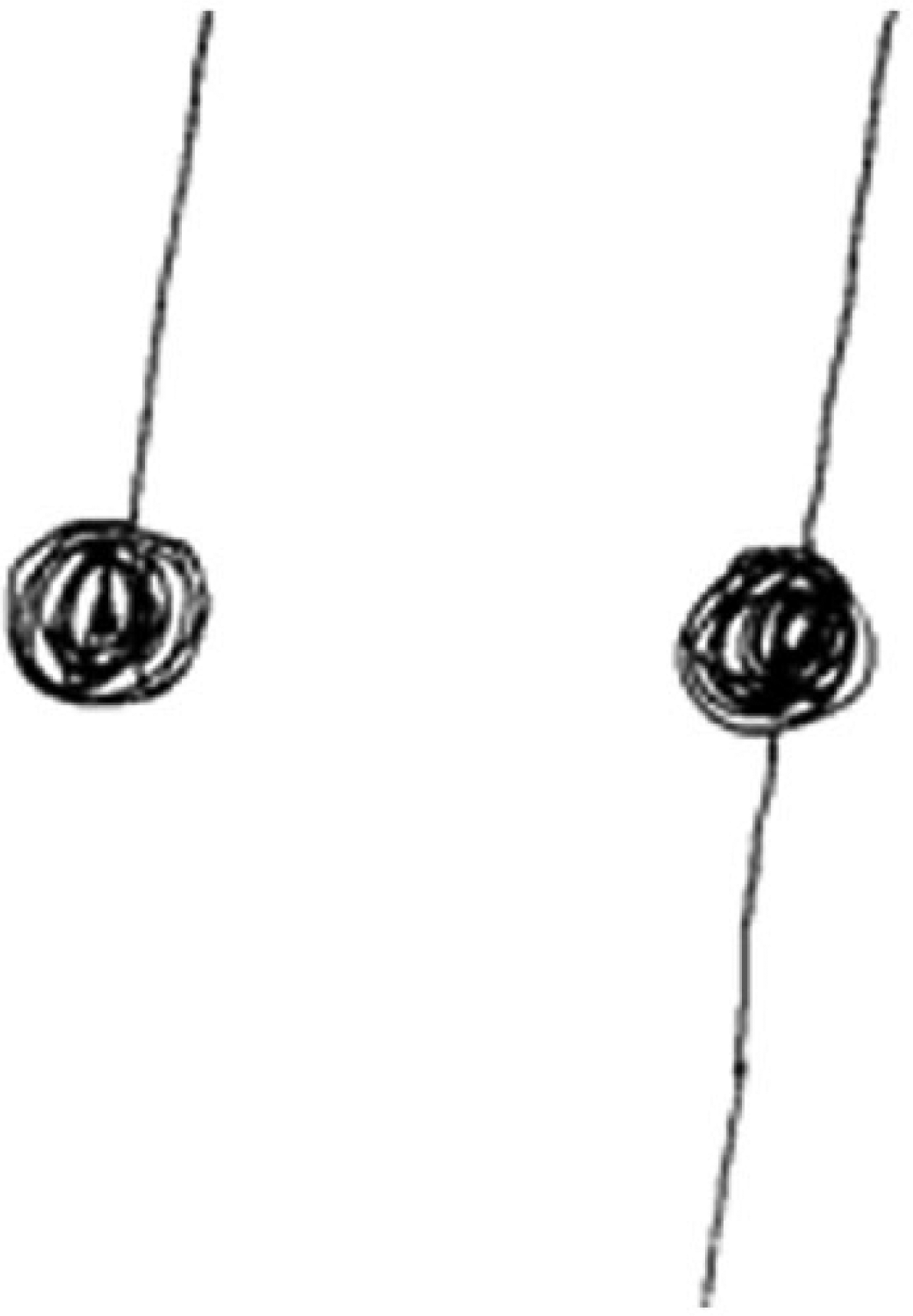
Pendulum variations André drew while exploring factors affecting pendulum frequency.
André also used various tactics of reasoning such as reasoning using proportion, rates, extremes, substitution, hypothetico-prediction, and analogies. By reasoning tactics, we mean activities which enable the learner to draw conclusions from facts and therefore, as Bruner (1971) put it, go beyond the information given. We understand the value of such activities to be that they enable the learner to make judgments about the implication of information, and therefore to determine whether accommodation is necessary. We illustrate this reasoning with two examples—reasoning with extremes and hypothetico-prediction.
André was frequently observed to reason with extremes. For example, after he had been taught about air buoyancy (Field notes, June 6, 2002), André reasoned that it could not be true that a pocket of air which is warmer than its surroundings should rise, regardless of the pocket’s size. He justified this by saying that a pocket of air so great that it comprised almost the entire atmosphere could never be buoyed up by the remaining air particles. Therefore, for such a statement to be valid, a pocket must be defined as having a volume ratio to its surroundings of one to infinity. Here André was considering extreme cases to draw conclusions about the acceptability of knowledge. In another example of this tactic, André approached a problem concerning torque applied to a door by thinking of the extreme case of no friction being present. He followed this by considering a case where an infinitesimally small amount of friction is present, before finally considering the problem at hand (Field notes, March 19, 2002). This appears to correspond to Howard’s (1987) statement that the categorization of borderline instances puts conceptual boundaries to the test, thus clarifying the rules of conceptualization.
André frequently used hypothetico-prediction. When undergoing hypothetico-predictive reasoning, learners make predictions based on their hypotheses, thus formulating ways to test the validity of their understanding (Lavoie, 1995). The excerpt given below illustrates André’s use of this type of thought. He was drawing on his knowledge of the general principles of combustion and convection to analyze the specific case of a flame being extinguished when covered. He did this by reasoning hypothetico-predictively between the general and the particular:
I said that a flame covered with a jar dies because of an increase in the amount of carbon dioxide rather than oxygen depletion. André suggested that we demonstrate this by covering one flame with a jar filled with oxygen, and one with a jar filled with air. He predicted that in the first case the flame would die more rapidly than in the second since the rate of combustion, and therefore carbon dioxide production, would be higher. However, when we did this practically, we found the flame covered with the jar filled with oxygen burnt for a longer time than that covered with a jar of air. André drew my attention to the motion of the smoke produced in the first case. He suggested that the greater heat produced by combustion in oxygen was causing stronger convection currents which caused oxygen from below the candle’s flame to rise, thus supporting combustion for a longer period than a simple collection of carbon dioxide from the top of the container downwards would have done. He proposed that this could be tested by comparing these results with those obtained when the effect of convection currents were reduced by using larger containers and longer candles. (Field notes, February 22, 2001)
Strategy: Linking and Organizing
At most stages in his learning, André used what appeared to be a highly linked and organized knowledge base. One of the main strategies he used was to link new ideas to his knowledge base. We interpret his linking strategies to be those activities that form, alter, or strengthen links between knowledge that has already been understood, and that he does this by organizing his learning and applying it to new situations. Generally, André organized information through the reduction of individual instances, which he did through some form of generalization. This was consistent with his high regard for information elegance (Stott & Hobden, in press). Some of the tactics he used to bring about this information reduction were a search for patterns, the determination of hierarchy, and linking to other principles.
When given a number of situations in which a phenomenon was operating, he attempted to produce a graph, algorithm, or generalizing statement to deal with all possible instances rather than just those asked for. André was prepared to spend much time and energy on this, because, he said, it led to an elegant outcome (Interview, October 9, 2002). For example, I gave him five situations dealing with different arrangements of lenses and asked about the relationship between the distance between an object, a convex lens, and the properties of the resultant image. Rather than provide answers for the five, he chose to produce a graph generalizing all possible setups. This indicated that his strategy was to look for the pattern rather than deal with isolated instances.
Another tactic André used when organizing ideas was to determine their hierarchy. Whenever he organized information in any form, he displayed meticulous attention to the hierarchy of information elements relative to one another. When interviewed about his strategies, this was the only one he identified himself (Interview, March 28, 2002). André also used a number of ways to extend classroom learning by applying knowledge to new contexts. In this way, he linked learning to other principles. He did this by creating his own designs and by considering situations from various perspectives. The excerpt below describes André’s consideration of situations of motion from the perspectives of energy and relativity:
He remarked that if one considers only the relativity of motion, a train hitting a stationary car at 20 kph and a stationary train being hit by a car moving at 20 kph should have the same results. However, the kinetic energies in the two situations are not the same, and therefore the results should be different. Similarly, since motion is relative one could view a person’s motion relative to the universe rather as the universe’s motion relative to the person. Since the whole universe has a huge mass, viewing the universe’s motion relative to the person would require a huge amount of energy to be converted to and from kinetic energy when a single person moves and then stops moving. He then tried to resolve these anomalies. (Field notes, October 25, 2002)
This illustrates André’s extension of learning through application of knowledge to contexts other than that in which it was originally learnt, in his efforts to produce a linked and organized knowledge base that would promote flexibility in his learning. André remarked that he believed understanding occurred when two or more isolated sections of one’s stored knowledge became linked, and that the further apart they were from one another, the greater was the revelation experienced on the formation of the link (Interview, September 10, 2002).
Discussion of André’s Strategies
Interrogating New Information
The interrogation of new information begins the process of exposing the characteristics of the new information, enabling the learner to make appropriate decisions about whether and how accommodation and/or assimilation should proceed as this information is learned. This process is then continued during the next strategy, identified as thinking it through. Clarifying questions between a learner and a teacher narrows the communication gap between them (Moodley, 1999). Internal dialogues, in which the learner poses and self-answers clarifying questions, can be seen as a form of metacognitive control (Risemberg & Zimmerman, 1992) which self-regulates examination of the surface and deeper features and implications of the new information. According to Risemberg and Zimmerman (1992), “gifted students as a whole, compared to non-gifted students, utilize more self-regulatory strategies, they utilize learning strategies that are more cognitively advanced, and they carry out these strategies more effectively” (p. 101).
The tactic of isolating and identifying concepts involves operating on the micro- and hyper-notional levels of engagement in learning (Moodley, 1999). During concept isolation, the student engages with the information on a micro level as they use specific instances to clarify the boundaries between concepts. Formation of clear conceptual boundaries (such as the separation of friction and motion) can be expected to reduce the likelihood of undergoing careless assimilation of incompatible information, and instead to promote deep conceptual learning. Concept formation encompasses abstraction and subsumption, both engaging the macro level of learning and resulting in chunking, which reduces cognitive load. Bruner (1971) explained that generalization, leading to theory formation, is vital for effective learning, because it avoids mental clutter, and “knowledge, to be useful, must be compact, accessible, and manipulative. Theory is the form that has these properties” (p. 106). Bruner (1971) labels mental clutter as lethal in learning, because very little knowledge can be dealt with at one time by the human mind. “A concept or the connected body of concepts that is a theory is man’s only means of getting a lot into the narrow compass of his attention all at one time. Without some such aid, there is clutter” (p. 123).
Thinking It Through
The use of thought experiments has been shown to be valuable in developing understanding (e.g., Gilbert & Reiner, 2000). The value of thought experiments to André’s learning can be understood in terms of conceptual change learning theory. According to conceptual change learning theory, learning is seen to involve an individual’s construction of knowledge from perceptions arrived at by personal interpretation of information, where decisions concerning conceptual change are guided by judgments about conceptual status, namely intelligibility, plausibility, and fruitfulness (Hewson & Lemberger, 2000). Thought experiments often led to some disequilibration, as was the case regarding the pendulum and its length. André resolved this disequilibration through accommodation of his understanding of pendulum frequency in a manner that raised the precision of his knowledge (i.e., not length but length to center of mass affects pendulum frequency). Consequently, the intelligibility and therefore status of his knowledge would have risen, resulting in conceptual change (Hewson & Lemberger, 2000).
Holland, Holyoak, Nisbett, and Thagard (cited in Lavoie, 1995), referring to the value of hypothetico-predictive reasoning in learning, argued that, “The need for more accurate prediction favours the addition of further specialized rules, whereas the need for efficient prediction favours the addition of general rules to replace a large number of specialized rules” (p. 23). In the candle example given, André used a specialized rule to explain the negative outcome to his prediction. This was that convection currents prevented his prediction from being fulfilled for the small containers and candles used. In this way, he could maintain his general concept of combustion without the need for accommodation. In other cases, André used hypothetico-predictive reasoning to test and refine generalized rules. For example, when learning organic chemistry, he drew and modified structural formulae to refine his developing understanding of the rules of nomenclature (Field notes, April 12, 2002). This is consistent with Lavoie’s (1995) observation that “this process of categorization and re-categorization of knowledge leads to an expansion of knowledge” (p. 14). Hypothetico-predictive reasoning can also be understood to contribute to effective learning through its continual interplay between the general and the particular. This corresponds to Moodley’s (1999) reference to engagement with information on the notional level, which includes hyper (general) and micro (specific) levels.
Linking and Organizing
Selection of relevant resources by the learner, to be brought to and utilized in the working memory during the formation of conceptual relationships, is a critical factor in learning. The value of each of the tactics observed within the linking and organizing strategy can be understood in relation to effective management of the limited space of working memory, facilitating learning (Niaz & Logie, 1993; Oberauer, 2001) and the activation of knowledge which would otherwise be inert (Schwartz, Varma, & Martin, 2008). A hierarchically organized, interlinked knowledge structure activates knowledge, thus making it more meaningful, accessible, flexible, and transferable between contexts (Lavoie, 1995), and allows for chunking of knowledge to reduce cognitive load (Kirschner, 2009). A highly linked and organized knowledge base accounts for the success of expert relative to novice problem solvers (Kirschner, 2009; Snyder, 2000). Viewing learning as a problem-solving process supports the observation that the organization of knowledge through pattern searching and the determination of hierarchy, together with the activation of knowledge through linking to other principles, enhances learning effectiveness.
Limitations
This case study was performed within the context of a single gifted student learning physical science in a one-on-one relationship with his teacher. André also possessed an extensive knowledge base, well-developed metacognitive control and learning strategies, and a belief system conducive to self-regulation of learning. As already discussed, these factors contributed to the strengths of the case for observing effective strategies for learning physical science; however, they also potentially decrease the applicability of the findings to helping students in more typical learning contexts. We acknowledge that for a student to undergo self-regulated learning a number of interacting internal and external factors are necessary such as those proposed in Schoenfeld’s (1985) framework for analyzing problem-solving behavior, namely learner knowledge, strategies, metacognitive control, and belief systems. In this article, we have focused only on the strategies André was observed to use during self-regulated learning. However, such strategies may have limited effectiveness for other students if divorced from the extensive and highly organized knowledge base, metacognitive control, and intrinsic factors André possesses (Stott, 2002).
The knowledge of and ability to use a strategy is insufficient to ensure that it will be applied where appropriate. Chi (1985) found that there was a complex interaction between the use of a strategy and the amount and structure of the content knowledge (resources) to which the strategy is to be applied. Reynolds and Shirey (1988) and Schoenfeld (2011) highlighted the importance of metacognitive strategies (control), while Palmer and Goetz (1988) pointed to the importance of motivation (belief system) in the selection and use of appropriate learning strategies. Consequently, while learning strategies are very important for effective learning, it must be remembered that they are insufficient on their own, given their interaction and dependence on other components of learning.
Additionally, André’s individualized learning environment, together with his giftedness, reduces the applicability of the findings of this study to other cases without additional studies. Research, such as that done by Risemberg and Zimmerman (1992), shows that gifted learners use self-regulatory learning strategies more frequently than nongifted learners. To the extent that this is as a result of such children’s superior mental processing ability, which is the nonteachable component of intelligence (Baron, 1985), one cannot expect learning behavior such as that described in this study to develop in children of more average ability, unless done as part of a targeted intervention. Nevertheless, we believe we have provided valuable insight into the learning process, and revealed powerful modes of thought that may be useful, when employed by other students, in raising the effectiveness of their learning of science. We believe that these strategies may be particularly useful for helping underachieving gifted students to improve their performance and to ignite a passion for learning which current classroom practice tends to stifle (Fredricks, Alfeld, & Eccles, 2010).
Conclusion
Given the poor achievement of learners in science in many countries, and the lack of obvious improvement, we argued that there is a need to look for points of success and identify new ideas for improving the situation. From the analysis of 3 years of observational data of a high-achieving learner who showed much evidence of learning effectively, we have identified three general strategies and a number of associated tactics that characterized his successful learning. These strategies are interrogating new information, thinking it through, and organizing and linking. In addition, we have provided insights into the manner in which these strategies and tactics are used, in this particular case in the domain of science. We believe that making learners aware of how a high achiever learns, and modeling these strategies during teaching, will result in some uptake and consequently prove to be effective in improving their physical science learning. However, we accept that further research into how these particular strategies and tactics could effectively be taught and adopted by less able or underachieving students is now needed.
Footnotes
Declaration of Conflicting Interests
The author(s) declared no potential conflicts of interest with respect to the research, authorship, and/or publication of this article.
Funding
The author(s) received no financial support for the research, authorship, and/or publication of this article.