







Abstract
Underachievement of gifted students has been a great concern for the field of gifted education. The current study reviewed 14 recent empirical studies concerning the effectiveness of underachievement interventions on gifted students’ achievement outcomes and psychosocial outcomes. Overall, there was no evidence that underachievement interventions significantly improved academic performance of gifted underachievers (g = .09, p = .387), especially in terms of course grades. Gifted underachievers receiving interventions significantly outscored their comparison peers on psychosocial outcomes (g = 0.22, p = .001), which consisted of a variety of measures on self-efficacy, goal valuation, environmental perceptions, self-regulation/motivation, and psychosocial functioning. Qualitative studies generally reported that gifted underachievers benefited from the interventions in terms of increased motivation for learning, improved self-regulation, and finding school more meaningful. Findings need to be viewed in light of the relatively low quality of the evidence from recent research on underachievement interventions.
Keywords
Introduction
Defining and Measuring Underachievement
The field of gifted education has long been concerned about loss of talent among academically gifted, talented, and high potential students due to underachievement. The prevalent and persistent issue of underachievement of the nation’s brightest students has recently invoked growing concerns in a national platform (The Washington Post, July 5, 2019). Gifted underachievement was recognized as the highest area of concern when the National Research Center on the Gifted and Talented surveyed thousands of educators, administrators, and researchers across the nation regarding research priorities for the field (Renzulli et al., 1991). This is a cause for great concern not only at the individual level in terms of unfulfilled potential but also at the societal level due to the need for creative products and innovative solutions to major problems (Ceci et al., 2009).
Multiple definitions of underachievement exist, but the one most commonly used is that of Reis and McCoach (2000), who framed underachievement as the discrepancy between expected achievement based on one’s intellectual potential/ability and observed academic performance. McCoach and Siegle (2014) stressed that the most useful way to identify gifted underachievers is to gather multiple measures and sources of evidence regarding characteristics of students, behaviors, and patterns of performance so that underachievement is measured in an authentic, valid, and reliable manner.
The concept of “discrepancy,” however, comes with several caveats, particularly in determining and quantifying the difference between expected achievement and actual achievement (McCoach & Siegle, 2014). Several studies have attempted to quantify discrepancy using different methods including nomination-based practices and three common statistical methods: the regression-based method, the arbitrary absolute split method, and the simple difference score method (McCoach & Siegle, 2014). With the regression-based method, underachievers are identified by determining the discrepancy between their actual and expected achievement, with expected achievement predicted by a regression equation utilizing ability measures (Plewis, 1991). With the arbitrary split method, underachievers are those students who scored above a certain level on an ability test (e.g., IQ of 130 or above) but earned a grade point average below a certain level (e.g., grade point average [GPA] of 2.5 or lower in two consecutive school years (McCall, 1994). With the simple difference score method, gifted underachievers are identified as those students for whom the difference between actual and expected achievement exceeded a predetermined threshold (Lau & Chan, 2001).
Lau and Chan (2001) found a high degree of congruence in identifying gifted underachievers using the three statistical methods described above but found that the level of congruence diminished when teachers, peers, and parents’ nominations were used for identification of underachievers. Overall, research on defining and measuring gifted underachievement is limited and the field could benefit from further studies comparing different methods.
Theoretical Frameworks for Studying Gifted Underachievement
Theories of Motivation for Learning
Motivation for learning is an important and complex topic. Most frameworks recognize the importance of multiple factors including personal characteristics of the individual, such as self-efficacy, interests, goals, beliefs, values, and environmental influences (e.g., school and family environments and cultural and societal attitudes; Dweck, 1999; Dweck & Leggett, 1988; Pintrich, 2000; Urdan, 2010; Wigfield & Cambria, 2010). Major theoretical frameworks recognize the complexity of motivation and typically include multiple, interacting components. There are several, however, that undergird much of the educational research on motivation (Linnenbrink-Garcia & Patall, 2015). A notable trend in research on gifted underachievers is the increasing integration of major motivational and self-regulated learning theories as a framework for these studies. These frameworks include intrinsic and extrinsic motivation, expectancy-value theory, self-determination theory, achievement goal theory, and self-regulation. Readers can find additional overviews of these theories and related key constructs in the works of Eccles and Wigfiled (2002) and Wigfield and Cambria (2010) and discussions of these as they relate to gifted students in Clinkenbeard (2012) and Patrick et al. (2015).
Intrinsic and Extrinsic Motivation
Most frameworks of motivation for learning include and contrast the constructs of intrinsic and extrinsic motivation. Intrinsic motivation is learning that is internally driven by interest, curiosity, and desire to know or improve—“learning for learning’s sake.” Extrinsic motivation is learning that is driven by external rewards such as good grades, high test scores, positive affirmation from adults, or prizes. Csikszentmihalyi (1991) emphasized intrinsic motivation in his concept of flow, and Deci and Ryan’s (1985) self-determination theory, which emphasizes a learner’s need for autonomy, relatedness, and competency, is built on the concept of intrinsic motivation.
Achievement Goal Theory
Of these major theoretical frameworks, achievement goal theory is the most prominent in research on gifted underachievement (Linnenbrink-Garcia & Patall, 2015; Siegle & McCoach, 2005). Five out of the 10 quantitative intervention studies included in the current meta-analysis were based on achievement goal theory. Central to this framework is goal orientation, which pertains to students’ purposeful engagement in learning-related tasks. A widely cited theoretical framework of goal orientation is that of Elliot and colleagues (Elliot, 2005; Elliot & Church, 1997). This model posits “mastery” and “performance goal” orientations. A mastery goal orientation manifests when a learner undertakes a task primarily to master content, increase competence, or enjoy a sense of learning something new. Evidence supports the positive link between mastery goal orientation and academic achievement (Hulleman et al., 2010). A performance orientation is evident when a learner’s engagement and effort on a task are primarily motivated by their intention to outperform their peers or show off their superior competence. Performance goal orientations have been classified as “performance-approach” (i.e., wanting to achieve higher than peers) and “performance-avoidance” (i.e., wanting to avoid failing or looking bad) orientations. Some research shows that a performance approach orientation can enhance motivation and achievement (Elliot & Harackiewicz, 1996).
Expectancy-value frameworks place a primary role on individual’s beliefs in effecting motivation for learning. Eccles et al. (1998) developed a comprehensive expectancy-value model and have conducted considerable research on its various components (see Eccles & Wigfield, 2002, and Wigfield & Cambria, 2010). In their model, individual’s beliefs about how well they might do in a future learning task or learning in a particular domain is related to their willingness to expend effort with higher expectations resulting in greater effort and engagement. Another critical component is the importance of the task or domain to some future goal of the individual, with higher value associated with greater motivation. These beliefs interact such that the value of a task may be diminished if the individual believes success will involve too much work, investment, or effort.
Self-Regulated Learning
Self-regulated learning is another motivational framework related to achievement goal theory. It is used as the underlying theory for at least two underachievement interventions reviewed in the current meta-analysis. Self-regulated learning “. . . is an active, constructive process whereby learners set goals for their learning and then attempt to monitor, regulate, and control their cognition, motivation, and behavior, guided and constrained by their goals and the contextual features in the environment” (Pintrich, 2000, p. 453). It involves the engagement and interplay of the learner, task, and/or context and consists of four different areas for regulation: cognition, motivation and affect, behavior, and context (Pintrich, 2000). Research shows that the processes of self-regulation involve the interplay of varied motivational factors, suggesting that motivational and cognitive processes are likely inseparable in self-regulated learning (Pintrich et al., 1993).
Self-regulated learning generally proceeds in four sequential phases involving (1) planning, goal setting, and activating perceptions and knowledge; (2) monitoring; (3) controlling or regulating; and (4) reacting and reflecting on various activities and processes. Ample research shows that self-regulatory activities are significantly related to academic achievement, often accounting for the mediational relationships between the learners’ characteristics and the learning contexts (Zimmerman, 1990). Some research supports that poor self-regulation skills are a significant factor for underachievement among gifted secondary students (Baum et al., 1995; McCoach & Siegle, 2003b).
The Achievement Orientation Model of Interventions
Scholars have developed several theoretical models in pursuit of interventions to address gifted underachievement. These include Rimm’s trifocal model, emphasizing the synergetic involvement of the student, the home, and the school (Rimm, 2008a, b) and Renzulli and Reis’s schoolwide enrichment model, which emphasizes individual interests and authentic enrichment (Reis & Renzulli, 2009). The most prominent one is the achievement orientation model (AOM), which focuses on how students’ beliefs and values can regulate their motivation to engage and achieve (Siegle & McCoach, 2005). The AOM was built upon an incorporation of multiple motivation theories including self-efficacy theory (Bandura, 1986), attribution theory (Weiner, 1986), expectancy-value theory (Eccles & Wigfield, 1995), theory of locus of control (Rotter, 1966), person–environment fit theory (French et al., 1974), and self-regulated learning (Pintrich, 2000).
The AOM hypothesizes that students’ self-perceptions in four key areas collectively effect an individual’s learning motivation. They are self-efficacy (e.g., belief that one can succeed), goal valuation (e.g., belief that learning is meaningful), perceptions about the environment (e.g., feeling supported by teachers, high expectations of others), and self-regulation. Furthermore, the AOM posits that positive self-perceptions and beliefs in these areas help improve learning behaviors, such as setting appropriate goals and utilizing self-regulation skills, which subsequently increase students’ learning motivation and engagement and improves their academic performances (Siegle, 2013). Findings from an empirical validation study of the AOM, based on a sample of 156 mathematically gifted sixth and seventh graders, confirmed the existence of most of the conceptual relationships that the AOM hypothesizes (Ritchotte et al., 2014). Key components in the AOM, as measured by five equivalent factors of the School Attitude Assessment Survey–Revised (academic self-perceptions, attitudes toward teachers and classes, attitudes toward school, goal valuation and motivation, and self-regulation; SAAS-R; McCoach & Siegle, 2003a), can be used to differentiate high and low achievers of differing developmental levels and cultural and socioeconomic backgrounds (Dedrick et al., 2015). The AOM has served as a framework for research on underachievement among gifted students and the design of interventions (e.g., Barbier et al., 2019; Brigandi et al., 2018; Rubenstein et al., 2012).
Research on Gifted Underachievement
Overall, research on gifted underachievement focuses on three key areas: understanding who gifted underachievers are, pathways and trajectories of underachievement, and developing and evaluating interventions to ameliorate underachievement. The sections below give a brief overview of research in these three areas.
Understanding Characteristics of Gifted Underachievers
This area of research focuses on understanding the characteristics of gifted underachievers, primarily through comparing them with high-achieving peers on factors such as motivation, self-efficacy, attitudes toward teacher and school, self-regulation, study skills, goal valuation, attributions, learning strategies, school environments, or family circumstances (Baker et al., 1998; Clemons, 2008; Figg et al., 2012; Landis & Reschly, 2013; McCoach & Siegle, 2003b; Mofield et al., 2016; Ruban & Reis, 2006; Siegle & McCoach, 2018; White et al., 2018).
For example, Zimmerman and Martinez-Pons (1990) found that high- and low-achieving students differed in their academic motivation and self-regulation, with the former demonstrating some advantages in actively creating, adjusting, and modifying strategies in concert with new circumstances. As another example, Peterson (2002) examined 14 gifted adolescents identified in high school as at-risk for poor educational outcomes through a longitudinal lens. Peterson found that, 4 years after their high school graduation, most of these youths had improved on some measures, such as believing that they were better able to resolve conflict with their parents, gaining autonomy, and maintaining good emotional health. However, the majority still lacked career direction and had difficulty developing mature relationships.
Pathways to Underachievement
A substantial body of research on underachieving gifted students focuses on uncovering factors, causes, and probable pathways or trajectories of underachievement. A few studies of the developmental path of underachievement are particularly notable. For instance, Snyder and Linnenbrink-Garcia (2013) examined the developmental path of underachievement from early childhood through young adulthood using a longitudinal, person-focused approach.
Building upon their previous work, Snyder et al. (Snyder, Carrig, et al., 2019) studied how teacher-reported underachievement developed in 932 elementary students from the first to sixth grade, with a focus on students’ self-reported changes on four motivational beliefs: reading self-concept, task importance for reading, psychological cost value for reading (e.g., worrying little or very much about doing badly in reading), and global self-worth. The results of latent class growth analyses revealed two patterns of underachievement between the first and sixth grade. One was “sustained underachievement,” featuring chronic or constant underachievement over time. The other pattern was “growing underachievement,” or underachievement that increased with higher levels of academic challenge. For the sustained underachievement pattern, there was a significant relationship between moderately lower levels of self-perceived psychological cost value, self-worth, and achievement in middle school. In contrast, the growing underachievement pattern was found to be significantly related to lower levels of student self-concept and student-perceived task importance in the early stage of elementary education which further declined over time. These findings raised concerns over the degree of heterogeneity in the developmental pathways of gifted underachievement.
Underachievement Interventions
The third key research area explores interventions aimed at stopping or reversing underachievement. Interventions studied generally involved instructional or counseling interventions or some combination of these (Dowdall & Colangelo, 1982; McCoach & Siegle, 2014). Instructional interventions included part-time or full-time special classes for gifted underachievers (Fehrenbach, 1993; Whitmore, 1980). Generally, these involved modifications to the learning environment (e.g., ability grouping) to provide greater academic support for students, curriculum modifications (e.g., curriculum compacting and choice-based differentiation), and activities designed to teach students learning strategies and improve their self-worth and self-concept (Dowdall & Colangelo, 1982; Siegle & McCoach, 2018).
Counseling interventions primarily focused on helping students understand and respond to a range of psychological and/or social–emotional challenges they may experience, such as low motivation, low self-efficacy, bullying by peers, anxiety, or poor relationship skills (Pfeiffer & Prado, 2018). Counseling interventions typically involved individual, group, and/or family therapy or cognitive behavioral training sessions. Some included providing psychological and social–emotional support through close interaction and connections with mentors or providing peer support groups.
Reviews of Underachievement Interventions
Studies of effects of interventions targeting gifted underachievers report mixed results. Some reviews concluded that underachievement interventions were largely ineffective in helping gifted underachievers improve academic performance. For example, Dowdall and Colangelo’s (1982) review of research between 1960 and 1982 found that neither instructional nor counseling interventions showed much success, citing nine studies of counseling interventions deemed ineffective in improving achievement and only one study showing limited positive impact. They concluded that “The programs we reviewed were rather consistent in reporting the ineffectiveness of interventions. . . . Whatever spurious improvements can be documented, there is no evidence that these changes are reliable or long-lasting” (Dowdall & Colangelo, 1982, p. 182).
Findings of some recent reviews are generally in line with the conclusion above (McCoach & Siegle, 2014; Siegle & McCoach, 2018). Other reviewers have seen promise in some recent interventions and/or theoretical models, such as Rimm’s trifocal model (Rimm, 2008a, 2008b), Morisano et al.’s (2010) goal-setting intervention, and Rubenstein et al.’s (2012) motivational and self-regulation interventions. Reviewers have also noted some earlier programs, such as Whitmore’s (1980) full-time and Supplee’s (1990) part-time programs for gifted elementary underachievers, also seemed to be successful (see McCoach & Siegle, 2014; Siegle & McCoach, 2018). McCoach and Siegle (2014) concluded that research on the effectiveness of underachievement interventions is challenged by methodological problems that also plague much of the research in gifted education including small sample sizes, weakness of research designs, and the lack of use of advanced statistical analysis techniques. White et al. (2018) echoed many of McCoach and Siegle’s concerns, stating that the research designs of studies lacked the capacity to effectively distinguish between gifted achievers and underachievers. McCoach and Siegle also stressed the necessity to do more research on the effectiveness of different kinds of interventions for different types of gifted underachievers, for example, those with low self-efficacy versus those who selectively underachieve in certain areas only.
Overall, empirical evidence regarding the effects of underachievement interventions on gifted underachievers still remains fragmentary, mixed, and inconclusive. Therefore, meta-analyses may be especially useful for clarifying the effects of underachievement intervention. Our literature survey revealed an ongoing meta-analysis involving 53 studies of underachievement intervention (i.e., Snyder, Fong, et al., 2019). This meta-analysis found that interventions were moderately effective in improving achievement and psychosocial outcomes. However, the vast majority of study samples were typical students. No prior meta-analysis has reviewed research on the effects of underachievement interventions exclusively focusing on samples of gifted underachievers as in our review.
The Current Meta-Analysis
The current meta-analysis reviewed recent empirical research into the impact of interventions on academic performance and psychosocial outcomes of gifted underachievers. It aimed to obtain a clearer view on whether and how interventions benefited gifted underachievers in the hope of informing the design of future interventions and research. Meta-analysis draws upon primary studies and is an advanced method of research synthesis providing more generalizable evidence of the effects of educational interventions (Cooper et al., 2009; Steenbergen-Hu & Olszewski-Kubilius, 2016; Vaughn et al., 1991). Moreover, the preliminary findings of this meta-analysis may contribute potentially useful data regarding how variables such as design model, participant characteristics, delivery format, length, and overall dosage of interventions may relate to effects (Lipsey & Wilson, 2001).
Research Questions
In the current study, we explore the range of intervention models designed for gifted underachievers, their underlying theoretical frameworks, activities, and implementation features. Our meta-analysis examines all key aspects of studies under review including research design, features of the study sample, setting, intervention implementation, outcome measures, and methods of statistical analysis, and applies consistent criteria to evaluate the quality of evidence presented in each study. Because a meta-analysis systematically and thoroughly evaluates all relevant studies on an issue on a same line of inquiry, it might help shed light on why some studies produce mixed or contradictory findings.
Typically, research studies involve generating predictions about possible relationships between variables (i.e., hypotheses). The focus of meta-analysis is to understand the strength and/or consistency of findings on a particular issue across a range of studies and the contribution of differences in methodology, theoretical frameworks, or other factors to the outcomes (Cooper, 2009). The researcher is open to discovering unforeseen relationships or findings based on moderator analyses to account for findings across studies. Thus, hypotheses or predictions about specific findings are not warranted or applicable.
The current meta-analysis addressed the following sets of questions:
What are the key design features of contemporary interventions for preventing or reversing underachievement in gifted students? Specifically, how do they define giftedness and underachievement, what theories of action inform their design, what activities do they involve, and what outcomes are they designed to affect?
How effective are these interventions in improving academic achievement and psychosocial factors associated with talent development?
Are there any features of the interventions (such as types of intervention or intervention dosage) that are significantly related to outcomes across studies?
What is the quality of the evidence overall on intervention research for gifted underachievers?
Method
Study Inclusion and Exclusion Criteria
To be included in the current meta-analysis, studies were screened according to the following criteria:
Each study implemented either an instructional or counseling intervention aiming to help underachieving gifted students. The intervention, either adapted or developed by the study authors, had to be guided with a theory or a combination of several theories on motivation, self-regulation, and academic achievement.
Studies reported information regarding how gifted students and gifted underachievers were defined and identified.
Studies employed subjects from general populations of gifted children, adolescents, or young adults. Studies focused primarily on interventions for specific twice-exceptional populations (such as students with ADHD [attention deficit/hyperactivity disorder] or learning disabilities) were excluded.
Interventions were implemented on a group or individual basis within school-based settings for a specified or estimable period of time. No study was excluded due to the duration of the interventions.
Quantitative studies had to report the interventions’ effectiveness on gifted underachievers’ academic achievement (e.g., course grades, GPA, retention rates) and/or psychosocial outcomes (e.g., achievement motivation, self-efficacy, goal valuation, self-regulation, use of cognitive strategies, attitudes toward teachers or school). Furthermore, adequate statistical information was either provided in the study report or obtainable otherwise so that effect sizes could be computed or estimated for related study outcomes.
Qualitative studies had to report narrative findings based on a variety of data collection methods such as interviews, writing reflections, and classroom observations.
Studies were conducted between January 2000 and February 2019 and had full texts available in English. There were two rationales for this timeframe. First, it was to focus the review on the most recent empirical studies. Second, studies of efficacy of underachievement interventions found in our search published prior to 2000 lacked certain features needed to meet the inclusion criteria of the current meta-analysis. For instance, Baum et al.’s (1995) study of the effects of creative productivity enrichment as a systematic intervention in reversing underachievement lacked a comparison group. Other earlier publications were case studies that provided little quantitative information useful in meta-analysis (e.g., Emerick, 1992; Fehrenbach, 1993). More information on earlier studies of underachievement interventions can be found in some narrative reviews (e.g., McCoach & Siegle, 2014).
Study Search and Identification
To find studies potentially eligible for inclusion in this meta-analysis, we first selected three sets of keywords. The first set included keywords and phrases such as giftedness, talented, high-achieving, high-ability, high-IQ, accelerated, academically able, superior learners, and advanced students. These keywords were used to restrict the literature to gifted populations. The second set of keywords consisted of terms and phrases such as underachievement, underperforming, low performance, excellence gap, at-risk, academically delayed, self-handicapping, selective producers/consumers, selective achievement, nonproducer, unproductive, underproducing, poor educational outcomes, lack of educational outcomes, “hidden gifted,” achievement gap, poor grades, academic survivability, invisible gifted students, involuntary underachievers, undeveloped talents, and underachievement syndrome. Considering that motivation and behavioral issues are often related to the underachievement of gifted students, we included the third set of keywords such as motivation, academic disinterest, antipathy, apathy, avoidance, maladaptive school behaviors, behavioral or conduct problems, defiance, disruptive behaviors, expulsion, and suspension. The study search used varied combinations of the three sets of keywords. Examples of varied combinations could be (1) gifted AND underachievement AND motivation, (2) talented AND at-risk AND academic disinterest, and (3) gifted AND at-risk AND motivation, and so on.
We conducted an extensive study search using six procedures as follows: (1) search of abstracts from electronic databases including Academic Search Premiere, APA PsychNet, EBSCOhost, ERIC, Science Direct, PsycINFO, and ProQuest; (2) search of relatively new studies using Google and Google Scholar search engines; (3) hand search of Gifted Child Quarterly; (4) examining the publication record of authors who published at least three articles on the underachievement of gifted students; (5) personal correspondence with researchers who extensively studied the gifted underachievement issue; and (6) constantly screening the references of all relevant primary studies and extant research reviews articles throughout the literature search and study coding processes.
The first four search procedures concluded at the beginning of February 2019, yielding 60 articles of empirical research on gifted underachievement. The first author and a research assistant double-reviewed full-texts of these 60 articles. A total of 10 quantitative and 4 qualitative studies were found to meet the inclusion criteria. These 14 studies appeared in 13 reports since one article (i.e., Rubenstein et al., 2012) contained both a quantitative (Study 1) and a qualitative study (Study 2).
Study Coding
A coding form was developed, piloted, and revised. The coding form covered major characteristics of eligible studies, such as (1) the identification criteria of gifted students and gifted underachievers; (2) age, grade level, or special features of participants, and the recruitment of the participants; (3) types of interventions, interventional activities, and theoretical frameworks of the interventions; (4) the implementation, duration, frequency, setting, and implementers of the interventions; (5) study outcomes and outcome assessments; and (6) statistical information for effect size calculation.
The first stage of coding primarily involved extracting the original contextual or quantitative data from each primary study. The first author coded each study and extracted data on approximately 40 variables reflecting major characteristics of the interventions and the studies. After completing coding of all studies, the extracted original data were recategorized, grouping data sharing similar features into one subcategory. For example, intervention type was grouped into two subcategories: “counseling” or “instructional interventions.” Likewise, intervention maturity also had two subcategories: “Replicating” denoted the cases where the intervention at study was utilized or adapted from those originally developed and studied by other researchers, while “piloting” referred to the situations that the intervention at study was original and exploratory, specifically designed for the study for the first time. More details about some other major variables are described in the context of testing for moderators later.
The amount of time used to code each study ranged from 120 to 600 minutes, totaling 3,860 minutes (64.3 hours) for coding all 14 studies. To ensure the quality of the coding, the first author rechecked the coding relevant to the intervention features and extracted study outcomes approximately 7 months after the completion of the initial coding. The coding and recoding agreement rate was near 100%. Additionally, a research assistant randomly rechecked four coded variables and found no errors.
Achievement Outcomes
Determining and categorizing outcomes of interest is a crucial process in study coding. The current meta-analysis focused on two types of outcomes. The first was achievement outcomes. Nine of the 10 quantitative studies assessed the effects of underachievement interventions on 16 specific outcomes under eight different names. These outcomes included grades in English, math, science, history, and social studies, course grades (in general) and overall grade point average. They also included one outcome named “retention rates” which was based on the number of college students in the intervention and comparison groups who maintained a “full-time” course load of nine credits or more in the postintervention semester (Morisano et al., 2010). These outcomes were then further grouped into three relatively broad categories: course grades (n = 13), GPA (n = 2), and retention rates (n = 1).
Psychosocial Outcomes
Regarding psychosocial outcomes, a total of 44 specific outcomes under 18 different names appeared in eight of the 10 quantitative studies. The 44 specific outcomes were further coded into five relatively broad categories: (1) academic self-efficacy, referring to students’ self-perceived confidence to tackle new learning tasks, improve skills, or grasp course materials (Bandura, 1997); (2) goal valuation, regarding whether students value a learning task and find it meaningful enough to do the work (Siegle, 2013); (3) environmental perceptions, concerning how students feel about the atmosphere of their environments, such as finding teachers to be supportive or feeling insecure around other classmates (Siegle et al., 2017); (4) self-regulation/motivation as a psychosocial outcome category encompassing activities, beliefs, or behaviors relevant to self-regulated learning or achievement motivation (McCoach & Siegle, 2003a); and (5) psychosocial functioning, referring to a variety of mental, social, or emotional states or experiences, such as anxiety, depression, self-consciousness, distress, loneliness, feeling of belonging, or learned helplessness (Puhr et al., 2019; Ziolkowski et al., 2019).
Below are examples of specific outcomes for each of the five psychosocial outcome categories as shown in the respective parentheses. A complete list of all 44 psychosocial outcomes is reported in a table later:
Self-efficacy (e.g., aspiration level for mathematics, academic self-perception, or theory of intelligence)
Goal valuation (e.g., goal setting, time perspective, future orientation, planning ahead, or anticipation of future consequences)
Environmental perceptions (e.g., attitudes toward teachers and/or school)
Self-regulation/motivation (e.g., cognitive strategies, self-reflection of own learning, persistence/willingness to exert effort, enthusiasm for the study, time management, and learning behaviors such as work habits, affective disposition, completing in-class assignment and homework, or managing not to lose course credit)
Psychosocial functioning (e.g., anxiety, negative affect, or learned helplessness)
The decision to assign each specific outcome to a category was based on careful considerations of several key aspects of the studies involved, especially regarding the types of interventions, the targeted outcomes of the intervention, how the outcomes were assessed, and references to specific theories of achievement motivation and self-regulated learning. For example, Niederdeppe’s (2009) study of a theatre-arts intervention reported an outcome called “affective disposition.” At face value, it seemed reasonable to place this outcome in the category of psychosocial functioning. However, it was found that “affective disposition” was used as an indicator of school engagement, measured by five additional questions added to the SAAS-R. Therefore, this outcome was ultimately included in the category of self-regulation/motivation. Another similar case was the outcome regarding the number of students who “Did not lose credit” in Johnson’s (2002) study, which was placed in the category of “Self-regulation/motivation.” This was because the outcome “Did not lose credit,” as well as “Completing in-class assignment” and “Completing homework”—two other psychosocial outcomes in the study—were all assessed to indicate students’ learning behaviors relevant to the constructs of self-regulation and motivation.
Also, the five-category outcome structure largely paralleled the AOM framework. Four of the five outcome categories (excepting psychosocial functioning) corresponded to the four key components of the AOM, that is, students’ beliefs in three key motivational areas including self-efficacy, goal valuation, environmental perceptions, as well as a self-regulation constituent. Moreover, the five outcome categories closely resembled the five factors of the SAAS-R, which is an instrumental presentation of the AOM. Relatedly, the SAAS-R was used to assess psychosocial outcomes in four of the 10 eligible quantitative studies reviewed.
Effect Sizes
Hedges’s g, a type of standardized mean difference effect size, was the primary effect size index for continuous outcomes in this meta-analysis. The preference for Hedges’s g over other standardized-difference indices, such as Cohen’s d and Glass’s Δ, is due to the fact that Hedges’s g can be corrected to reduce the bias that may arise when the sample size is small (e.g., n = 40; Glass et al., 1981). A Hedges’s g was calculated by dividing the difference in means by the pooled standard deviation of the intervention and comparison groups. A positive g indicates that gifted underachieving students receiving an intervention outperformed their comparison peers on a related outcome. Across the quantitative studies included in this meta-analysis, gifted underachievers were often compared with their peers in regular classroom instruction or to a no-treatment control condition. Effect sizes were computed for each specific outcome extracted from a study. For example, one Hedges’s g was computed for each of the outcomes of cognitive text-reduction strategies, self-efficacy, and anxiety, respectively in the Obergriesser and Stoeger’s (2015) study.
Meta-Analytic Analyses
Computing Mean Effect Sizes
Meta-analytic analyses were conducted for achievement and psychosocial outcomes separately. At the core of the analyses was computing mean effect sizes by integrating comparable outcomes across respective group of studies. The analysis was conducted with the Comprehensive Meta-Analysis (Borenstein et al., 2006) software, with effect size as the unit of analysis and a random-effects model (Cooper, 2017; Cooper et al., 2009). There were two reasons for using effect size instead of study as the unit of analysis. First, the total number of studies was rather small (n = 10), and the number was even smaller for studies with achievement outcomes (n = 9) and for those with psychosocial outcomes (n = 8). In contrast, the number of effect sizes for achievement and psychosocial outcomes was 16 and 44, respectively. Second, effect size independence was achieved first because meta-analysis was conducted separately on achievement and psychosocial outcomes; additionally, independence of effect sizes was made possible because of the wide variety of specific outcomes and the approach used to create relevant outcome categories (Lipsey & Wilson, 2001).
One may argue that a fixed-effects rather than a random-effects model might be a reasonable choice given that the current meta-analysis was based on only 10 quantitative studies. As it is advised that the choice of models should be primarily in line with the kind of inferences meta-analysts desire to make (Borenstein et al., 2009; Konstantopoulos & Hedges, 2009), a random-effects model was judged to be appropriate for the current meta-analysis, which aimed to make generalizations to a broad population regarding the effectiveness of underachievement interventions. Under a random-effects model, a mean effect size was calculated with each contributing study being weighted by the inverse of variance (i.e., dividing the value of one by the variance) with the Hedges-Vevea (Hegdes & Vevea, 1998) method. Therefore, a random-effects model has the additional advantage of balancing the weights of effect sizes between studies and thus reducing the risk that the mean effect size being overly influenced by any single study (Borenstein et al., 2010). We also conducted analyses with a fixed-effect model. The results appeared to be consistent under the two models. Therefore, we proceeded with only reporting the results from a random-effects model.
Heterogeneity Analysis and Testing for Moderators
Heterogeneity analysis was conducted to statistically assess whether there was significant variation in average effect sizes between those of relevant studies reviewed. In the current meta-analysis, for instance, there were nine studies and therefore nine average effect sizes for achievement outcomes. If average effect sizes varied significantly across studies, testing for moderator analysis (also called subgroup analysis) was then conducted with the method analogous to the analysis of variance (ANOVA). The goal of testing for moderator analysis was to explore possible sources of heterogeneity in the studies’ effect sizes (Borenstein et al., 2009; Hedges & Pigott, 2004). Unlike heterogeneity analysis, which evaluates the variations among average effect sizes of studies, testing for moderator analysis uncovers whether certain confounding variables moderated the effectiveness of an intervention on study outcomes.
The presence of such moderating influence of a confounding variable was indicated by whether the average effect sizes of subcategories of a variable varied significantly. For example, if the average effect size of counseling interventions and that of instructional interventions differed significantly as shown by the statistically significant heterogeneity between the two subcategories of interventions (e.g., the p value of the test for null hypotheses of Qb was less than .05, .01, or .001), then, by implication, intervention type would be a moderator of underachievement interventions’ effects on achievement outcomes.
From approximately 40 variables containing extracted data regarding major characteristics of the interventions and studies, seven were selected for testing for moderator analysis because they were most relevant to the questions that this meta-analysis intended to address (Littell et al., 2008). They included intervention type (i.e., a counseling or instructional intervention) and intervention maturity (i.e., replicating or piloting), both having two subcategories. The other five variables were intervention dosage (i.e., 90-150 minutes “low,” 300-900 minutes “moderate,” or 1,200-1,760 minutes “high”), development level (i.e., elementary, middle, or high school, or college), data source (i.e., self-reporting, teacher-reporting, or school record), report type (i.e., journal article or a dissertation), and country (i.e., in which country was the study conducted: United States, Germany, or Canada).
Assessing Publication Bias
Publication bias may arise when a meta-analysis was based on a disproportionally large number of small studies with significant or larger effect sizes. Presence of severe publication bias may lead to biased (usually overestimated) results that weaken the validity of a meta-analysis (Rothstein et al., 2005). To evaluate whether mean effect sizes varied due to possible publication bias, the effect sizes were first visually assessed for the symmetry or lack thereof of a funnel plot (Peters et al., 2008). The trim and fill procedures (Duval & Tweedie, 2000) were subsequently carried out, which involved iteratively removing or filling in effect sizes until publication bias no longer appeared to be an issue of concern, as shown by a symmetrical distribution of the funnel plot. Last, the recalculated (adjusted) mean effect sizes (including 95% confidence intervals and p values) through the trim and fill procedures were presented along with the original (observed) mean effect sizes and other relevant statistics.
Evaluating Quality of the Evidence
Problems with the design and implementation of intervention studies raise concerns about quality of the evidence and ultimately the validity of their findings. The current meta-analysis conducted basic evaluation of quality of the evidence of the 10 quantitative studies by assessing risk of bias often responsible for either overestimation or underestimation of the true intervention following a method as described in the Cochrane Handbook for Systematic Reviews of Interventions (see Higgins et al., 2017). The evaluation of quality of the evidence primarily focused on risk of selection bias and detection bias because these two sources of biases were especially relevant and important.
In the context of this meta-analysis, for example, the risk of selection bias might be high if the underachieving gifted students in the intervention condition happened to have better self-regulation skills at baseline than gifted underachievers in the comparison group because of the preintervention differences in self-regulation skills, the intervention itself, as well as a range of factors that may collectively affect students’ postintervention performance. Consequently, the quality of the research evidence would be questionable, and so would the validity of the study findings. Similarly, risk of detection bias may arise when study outcomes are affected when the persons who assess outcomes are not blind to whether students are in the intervention or comparison condition. The risk of detection bias might be high especially on psychosocial outcomes in this meta-analysis because the vast majority of such data were assessed through various student self-reported or teacher-reported rating scales. Furthermore, these intervention studies were also evaluated in light of whether they addressed issues of the fidelity and quality of implementation.
Results 1: Meta-Analysis of 10 Quantitative Studies
Descriptive Information
Key Features of Quantitative Studies
Table 1 presents the key features of 10 quantitative studies eligible to be included in the current meta-analysis. Four studies appeared in published journal articles and six studies in dissertations. Four studies were experimental studies that involved using random assignment of participants (i.e., Morisano et al., 2010; Sivaraman, 2012; Stoeger & Ziegler, 2005; Sullivan, 2016). All six dissertations employed a mixed-method research design, but they largely leaned on quantitative data and supplemented them with some limited narrative information. Mathematics, reading, and English language arts were the most frequently involved subject areas across the studies. The intervention maturity for seven studies fell in the category of replicating and the remaining three were cases of piloting. The number of sample sizes ranged from 28 to 85 across the 10 studies, with 398 (83.3%) of the total 478 gifted participants being underachievers.
Key Features of Quantitative Studies of Underachievement Interventions.
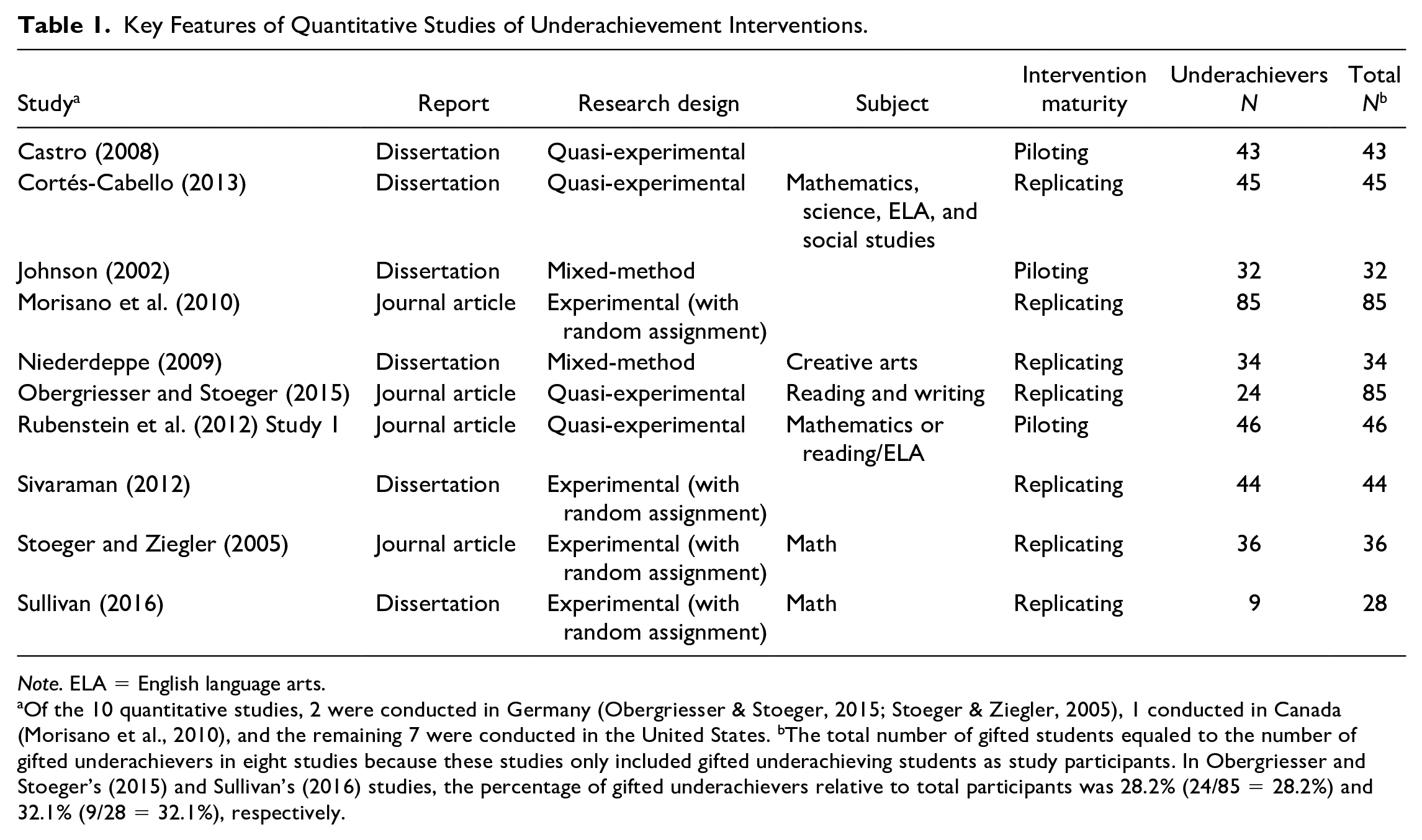
Note. ELA = English language arts.
Of the 10 quantitative studies, 2 were conducted in Germany (Obergriesser & Stoeger, 2015; Stoeger & Ziegler, 2005), 1 conducted in Canada (Morisano et al., 2010), and the remaining 7 were conducted in the United States. bThe total number of gifted students equaled to the number of gifted underachievers in eight studies because these studies only included gifted underachieving students as study participants. In Obergriesser and Stoeger’s (2015) and Sullivan’s (2016) studies, the percentage of gifted underachievers relative to total participants was 28.2% (24/85 = 28.2%) and 32.1% (9/28 = 32.1%), respectively.
Characteristics of Underachievement Interventions
As shown in Table 2, interventions investigated in these studies included self-regulated learning (Obergriesser & Stoeger, 2015; Stoeger & Ziegler, 2005), motivation and self-regulation (Rubenstein et al., 2012, Study 1), goal setting (Morisano et al., 2010; Sivaraman, 2012; Sullivan, 2016), theatre arts (Niederdeppe, 2009), strength-based academic (Cortés-Cabello, 2013) intervention, and support groups or networks involving peers, parents, teachers, and/or mentors (Castro, 2008; Johnson, 2002).
Key Characteristics of Underachievement Interventions: Quantitative Studies.
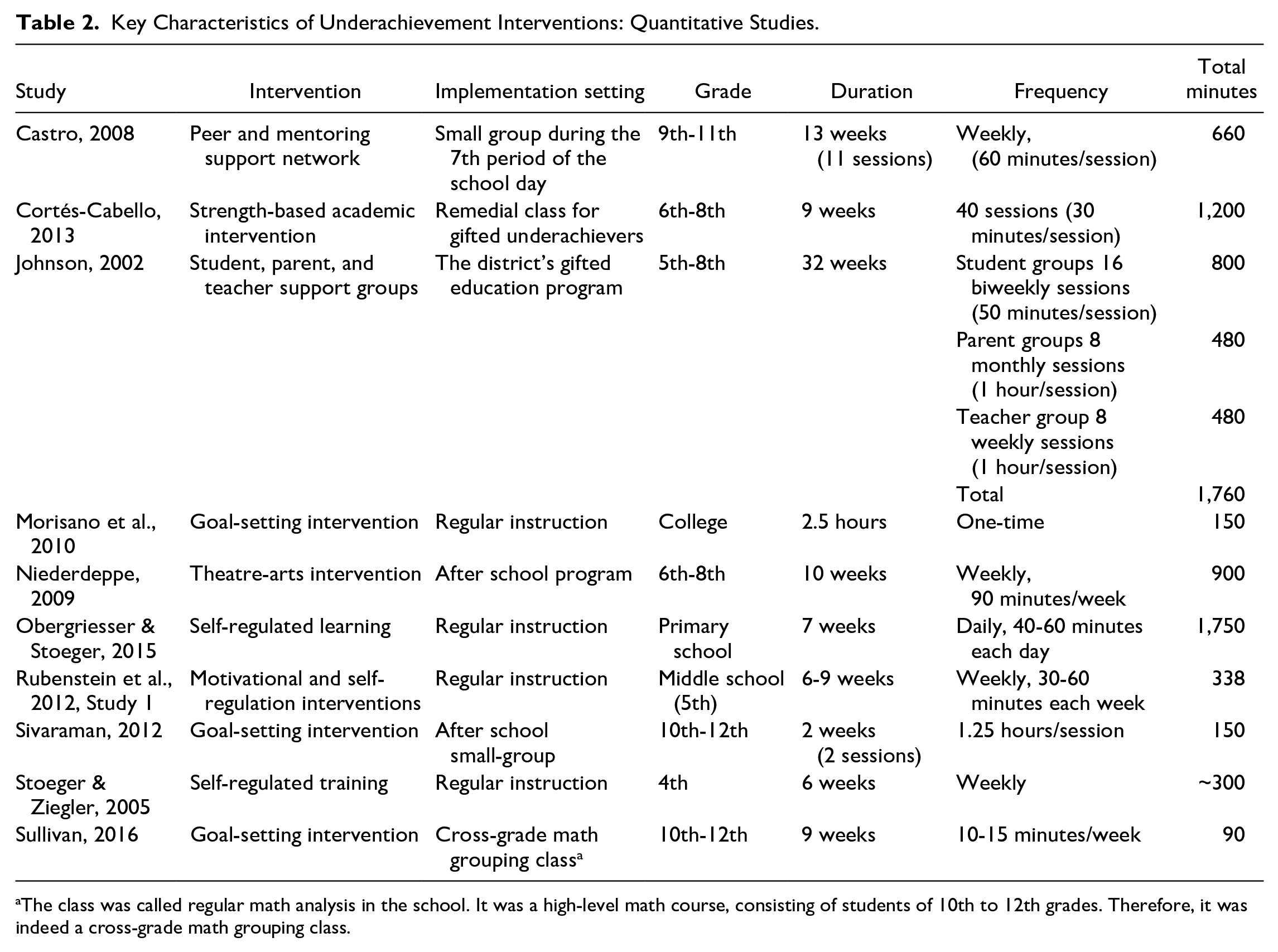
The class was called regular math analysis in the school. It was a high-level math course, consisting of students of 10th to 12th grades. Therefore, it was indeed a cross-grade math grouping class.
Four interventions were implemented in regular instruction classrooms, two in after-school time (Niederdeppe, 2009; Sivaraman, 2012), one in a cross-grade math ability-grouping class (Sullivan, 2016), and one in a remedial class for gifted underachievers (Cortés-Cabello, 2013). Two interventions were carried out with students in elementary school (Obergriesser & Stoeger, 2015; Stoeger & Ziegler, 2005), four in middle school (Cortés-Cabello, 2013; Johnson, 2002; Niederdeppe, 2009; Rubenstein et al., 2012, Study 1), three in high school (Castro, 2008; Sivaraman, 2012; Sullivan, 2016), and one intervention was with college students (Morisano et al., 2010). The interventions lasted as short as 90 minutes (Sullivan, 2016) and as long as approximately 30 hours (1,760 minutes) across dozens of sessions over a 32-week period (Johnson, 2002). Most of the intervention activities took place on a weekly basis.
Table 3 presents key activities and underlying theoretical frameworks of the interventions. For example, key interventional activities in the Sivaraman’s (2012) study involved teachers working with students to enhance time management skills, self-efficacy, and self-reflective learning behaviors. Although the names of the interventions varied across studies, the goals of the interventions and the kinds of activities involved suggest that they were either instructional (n = 7) or counseling interventions (n = 3) at their cores. The majority of interventions were designed on the basis of underlying frameworks of achievement motivation and/or self-regulated learning including theories pertaining to a variety of constructs such as self-efficacy, attribution, goal valuation, attitudes toward self, teachers and school, social support, and mentoring.
Underachievement Interventions, Activities, and Theoretical Frameworks: Quantitative Studies.
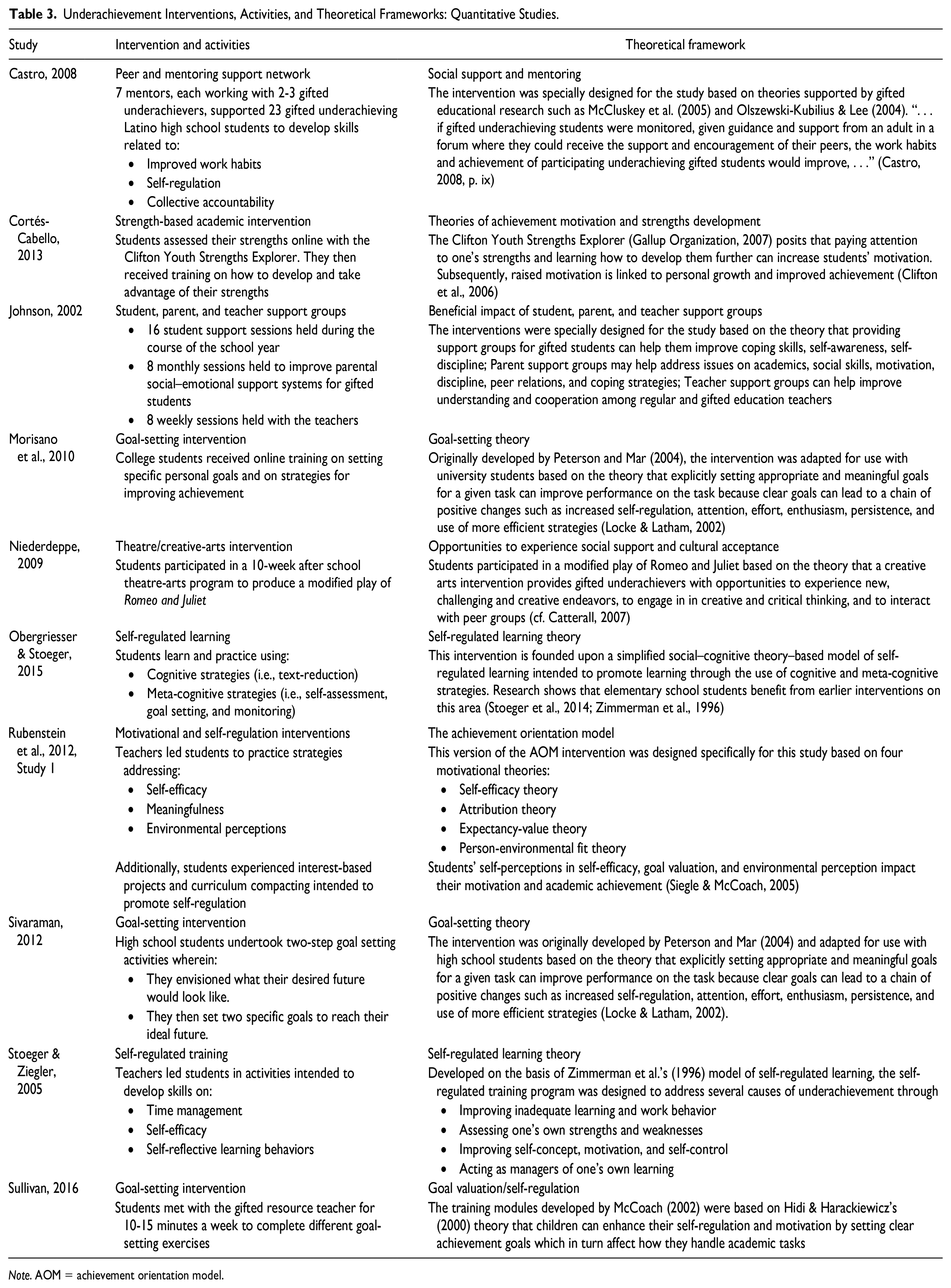
Note. AOM = achievement orientation model.
Identification of Gifted Underachievers
Table 4 provides summaries regarding how gifted achievers and underachievers were identified in each study. Three out of the 10 studies identified gifted students as those who scored the top percentiles (e.g., IQ = 120, 95%, or 96% percentiles or above) on some type of cognitive ability test and/or demonstrated superior performances on state or local standardized achievement tests (Johnson, 2002; Rubenstein et al., 2012, Study 1; Sivaraman, 2012). Three studies provided no detailed identification criteria other than mentioning that gifted students were identified by a local school or school district (Castro, 2008; Cortés-Cabello, 2013; Sullivan, 2016). Two studies considered students to be gifted if they scored in the top range on Raven’s Standard Progressive Matrices Test (German version; 90% percentile, Obergriesser & Stoeger, 2015; scored 130 or above, Stoeger & Ziegler, 2005). One study (Morisano et al., 2010) assumed that undergraduates attending a highly selective university were gifted or high achievers.
Identification of Gifted Achievers and Underachievers: Quantitative Studies.
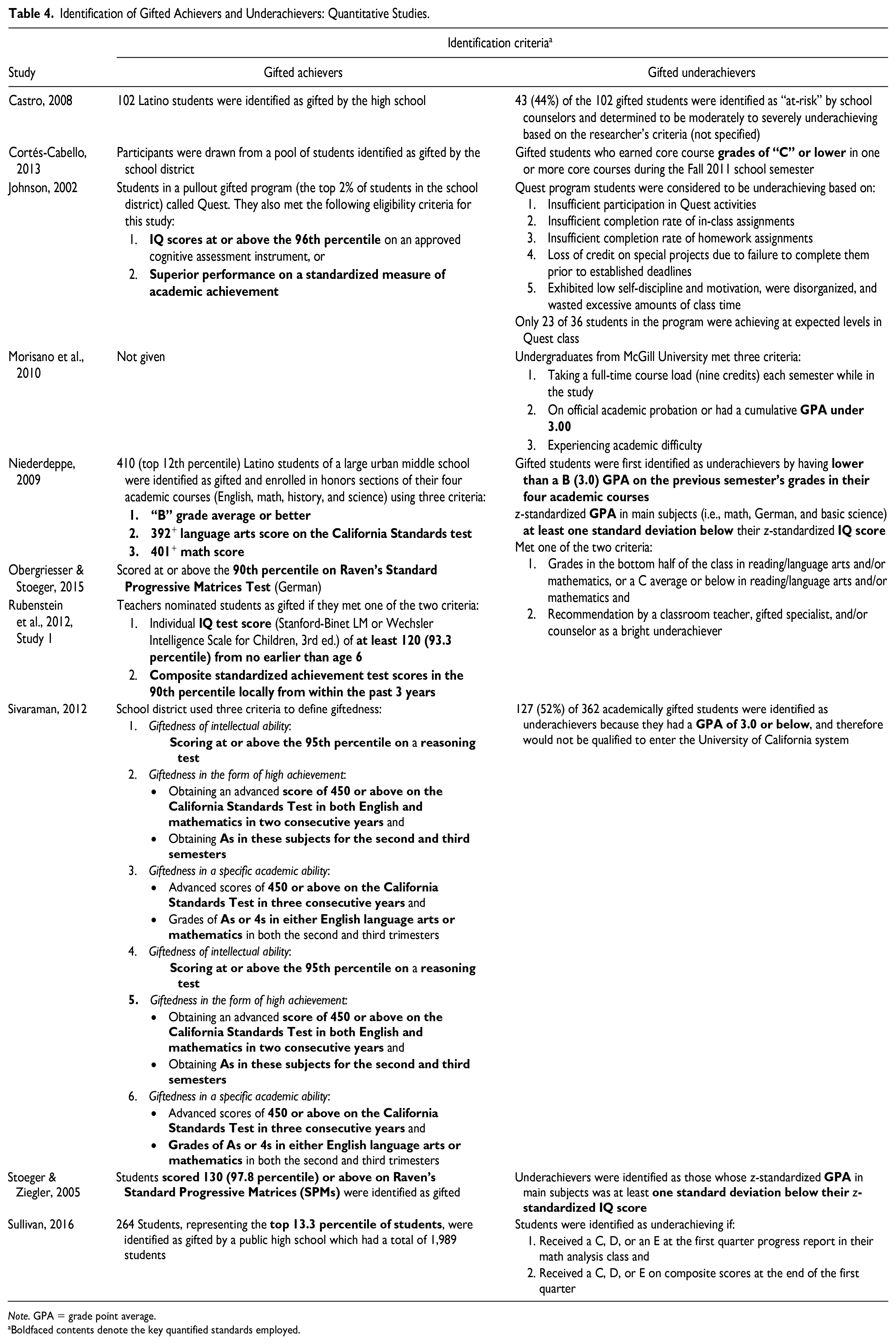
Note. GPA = grade point average.
Boldfaced contents denote the key quantified standards employed.
Only two studies (Obergriesser & Stoeger, 2015; Stoeger & Ziegler, 2005) quantified the discrepancy between students’ cognitive ability (potential) and actual achievement performance. They did so by identifying giftedness as scoring at the 90% percentile or above on the German version of Raven’s Standard Progressive Matrices Test, and determining underachievers as those who met the above criteria but whose z-standardized GPAs in math, German/native language, or basic science was at least one standard deviation below their z-standardized IQ scores. Three studies identified gifted underachievers as those with Grade C or lower either in a single or in multiple subject areas (Cortés-Cabello, 2013; Rubenstein et al., 2012, Study 1; Sullivan, 2016). Three studies identified gifted underachievers as those with a GPA of 3.0 or below (Morisano et al., 2010; Niederdeppe, 2009; Sivaraman, 2012). Castro (2008) provided no specific benchmarks but reported that 43 (44%) of the 102 gifted Latino students were determined to be moderately to severely underachieving by school counselors based on the researchers’ criteria.
In sum, gifted underachievers were identified with relatively clear criteria in most cases. Across the 10 studies, the highest IQ benchmark for qualifying as gifted was a score of 130 (top 2.2% percentile; Stoeger & Ziegler, 2005) and the lowest threshold was the top 13.3% percentile of 1,989 students in a public high school (Sullivan, 2016). Gifted underachievers were mostly identified following Reis and McCoach’s (2000) definition, which emphasizes discrepancies between expected achievement based on one’s intellectual potential and demonstrated performance. Among the samples of these 10 studies, as high as 52% of academically gifted students were identified as underachievers (Sivaraman, 2012).
Outcomes and Effect Sizes
Table 5 lists specific outcomes, outcome categories, outcome assessments, and effect sizes (Hedges’s gs) along with corresponding variances by each of the 10 studies. Nine of the 10 studies reported achievement outcomes while Obergriesser and Stoeger’s (2015) study only provided psychosocial outcomes. Eight of the 10 studies assessed psychosocial outcomes, and the remaining two only studied achievement outcomes (Cortés-Cabello, 2013; Rubenstein et al., 2012, Study 1). Six studies assessed both achievement and psychosocial outcomes.
Specific Outcomes, Outcome Categories, and Outcome Assessments, and 60 Effect Sizes Extracted.
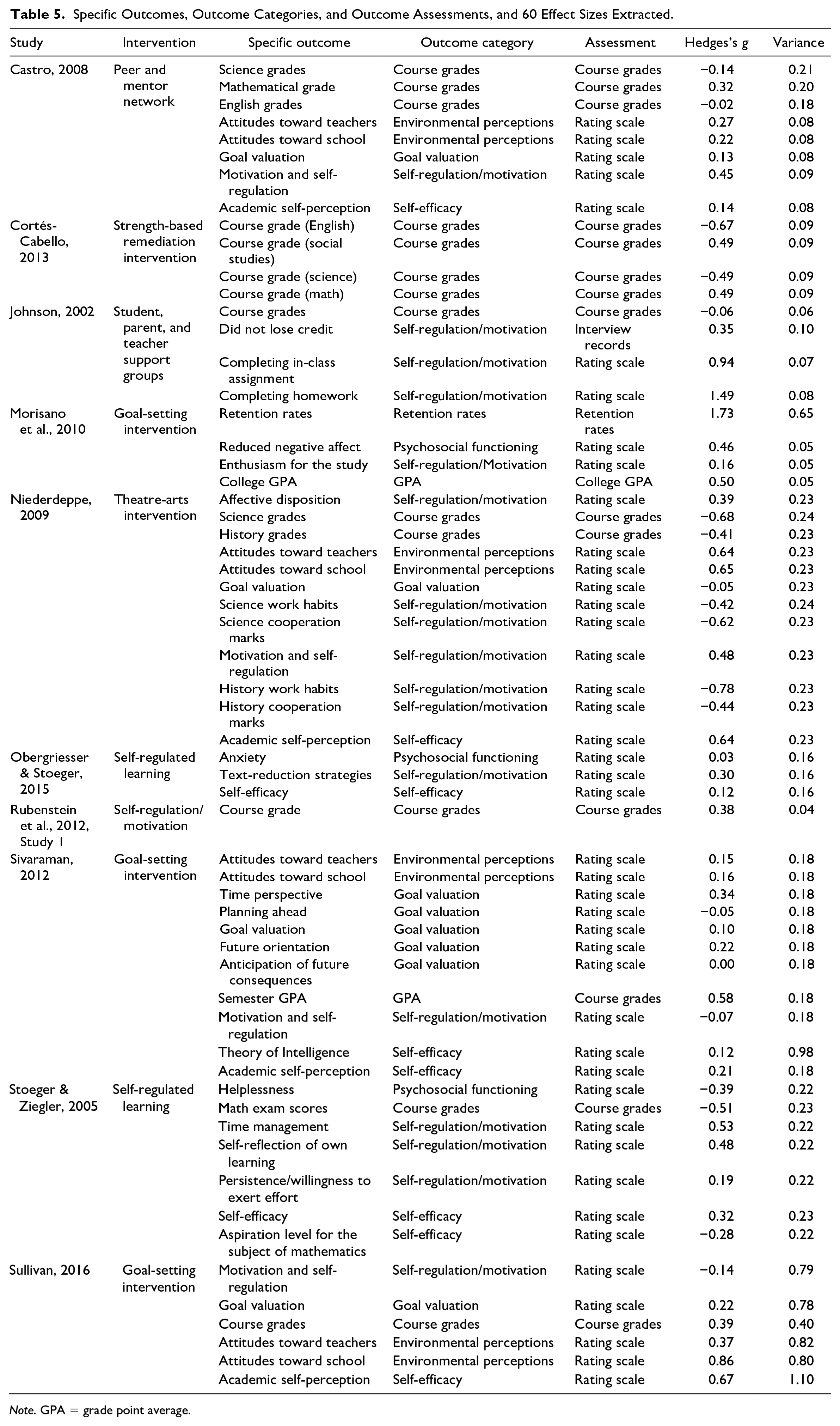
Note. GPA = grade point average.
A total of 60 specific outcomes of interest were extracted, including 58 continuous and two dichotomous outcomes (i.e., retention rates and the number of students who did not lose credits). Odds ratios were obtained for each of the two dichotomous outcomes and then converted to Hedges’s gs of 1.73 and 0.35, respectively. Of the 60 effect sizes corresponding to the total number of specific outcomes, 16 (26.7%) were associated with achievement outcomes, ranging from −0.68 to 1.73, eight of them being negative and eight being positive. Forty-four effect sizes (73.3%) were associated with psychosocial outcomes, ranging from −0.78 to 1.49, with 11 of them being negative and 33 being positive.
Nearly all (n = 43) of the psychosocial outcomes were measured with some type of rating scale or subscale. However, one outcome in Johnson’s (2002) study (“Did not lose credit”) used as an indicator of students’ self-regulation /motivation was based on teachers’ recollections during interviews. Four out of the 10 studies used SAAS-R (McCoach & Siegle, 2003a), a psychometrically validated instrument designed to measure adolescents’ perceptions on five factors (described in the “Introduction” section earlier) central to address the underachievement of gifted secondary students.
Meta-Analytic Results: Achievement Outcomes
Table 6 presents the results of meta-analytic analyses concerning the effectiveness of underachievement interventions on achievement outcomes. Key statistics include mean effect sizes (i.e., Hedges’s gs) and corresponding variances, 95% confidence intervals, and p values of null hypothesis testing. Heterogeneity statistics included between-group variance (Qb) indicating the total between-group variance associated with the subcategories of a given variable, degrees of freedom (df), p values showing whether there was statistically significant difference in the mean effect sizes corresponding to the subcategories of a given variable, and I2 showing the proportion of the between-group variance to the total variance. Higgins and Green (2011) provided a rough interpretation guide: an I2 of 0% to 40% suggests “Likely not important heterogeneity,” 30% to 60% “Possible moderate heterogeneity,” 50% to 90% “Possible substantial heterogeneity,” and 75% to 100% “Considerable heterogeneity.”
Effectiveness of Underachievement Interventions on Achievement Outcomes: Mean ES and ESs by Study and by Outcomes.
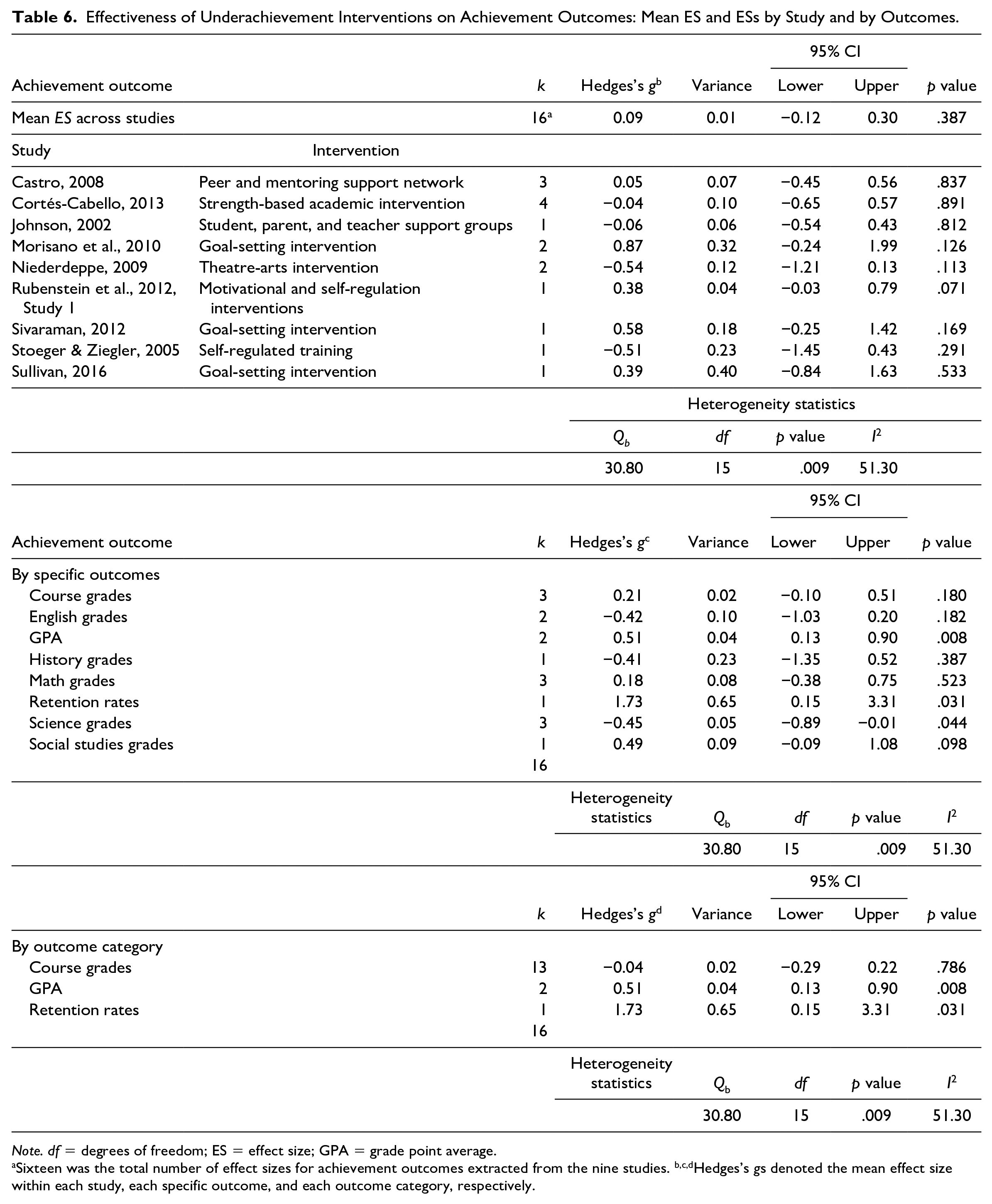
Note. df = degrees of freedom; ES = effect size; GPA = grade point average.
Sixteen was the total number of effect sizes for achievement outcomes extracted from the nine studies. b,c,dHedges’s gs denoted the mean effect size within each study, each specific outcome, and each outcome category, respectively.
Mean Effect Sizes
The mean effect sizes of the nine studies (and respective interventions) ranged from −0.54 to 0.87, four of them being negative (Cortés-Cabello, 2013; Johnson, 2002; Niederdeppe, 2009; Stoeger & Ziegler, 2005) and five being positive (Castro, 2008; Morisano et al., 2010; Rubenstein et al., 2012, Study 1; Sivaraman, 2012; Sullivan, 2016), but none of them was statistically and significantly different from zero, p values ranging from .071 to .891. Overall, there was no evidence that the interventions significantly affected the academic achievement of gifted underachievers, g = 0.09, k = 16 (effect sizes), 95% CI = [−0.12, 0.30], p = .387. Interventions’ effects on achievement outcomes varied significantly, Qb = 30.80, df = 15, p = .009, I2 = 51.30. Additionally, there was no evidence of publication bias affecting the effect sizes, suggesting that the observed overall mean effect size of 0.09 was neither an overestimation nor underestimation of the true effectiveness of the interventions.
Mean Effect Sizes by Specific Achievement Outcomes
The mean effect size for each of the eight specific achievement outcomes ranged from −0.45 to 1.73, three were negative (English, history, and science grades) and five were positive (course grades, GPA, math grades, retention rates, and social studies grades). On average, gifted underachievers receiving the interventions had significantly higher GPAs than their comparison peers, g = 0.51, k = 2 (effect sizes), 95% CI = [0.13, 0.90], p = .008. Gifted underachievers’ retention rates, an indicator of the number of college students whose course load remained at full-time status (nine credits or more) in the postintervention semester, was significantly higher than those of their nonintervention comparison peers, g = 1.73, k = 1 (effect size), 95% CI = [0.15, 3.31], p = .031. However, gifted underachievers receiving the interventions scored significantly lower in science grades than their comparison peers, g = −0.45, k = 3 (effect sizes), 95% CI = [−0.89, −0.01], p = .044. Interventions’ mean effects on academic performance varied significantly across the eight outcomes, Qb = 30.80, df = 15, p = .009, I2 = 51.30.
Mean Effect Sizes by Achievement Outcome Categories
The mean effect sizes for the outcome category of course grades, GPA, and retention rates were −0.04, 0.51, and 1.73, respectively. On average, gifted underachievers receiving the interventions performed no different on course grades from their comparison peers, g = −0.04, k = 13 (effect sizes), 95% CI = [−0.29, 0.22], p = .786. Not surprisingly, the interventions’ effectiveness on GPA and retention rates remained the same as above because the number of relevant effect sizes was the same regardless of whether they were treated as a specific outcome as above or as an outcome category here. Again, intervention mean effects on gifted underachievers’ academic performance varied significantly across the three outcome categories, Qb = 30.80, df = 15, p = .009, I2 = 51.30.
Testing for Moderators
Table 7 shows the results of analyses regarding whether underachievement interventions’ effectiveness on students’ academic achievement was moderated by any confounding factors. Intervention dosage appeared to be the only significant moderator out of the seven variables tested, Qb = 6.88, df = 2, p = .032. The three levels of intervention dosage were based on the total number of minutes that the interventions lasted (see Table 2). Counterintuitively, low intervention dosage (90-150 minutes; g = 0.57, p = .002) appeared to be much more effective in improving the academic performance of gifted underachievers than moderate (300-900 minutes; g = −0.02, p = .914) or high (1,200-1,760 minutes; g = −0.05, p = .843) levels of dosages.
Testing for Moderators of the Effectiveness of Underachievement Interventions on Achievement Outcomes.
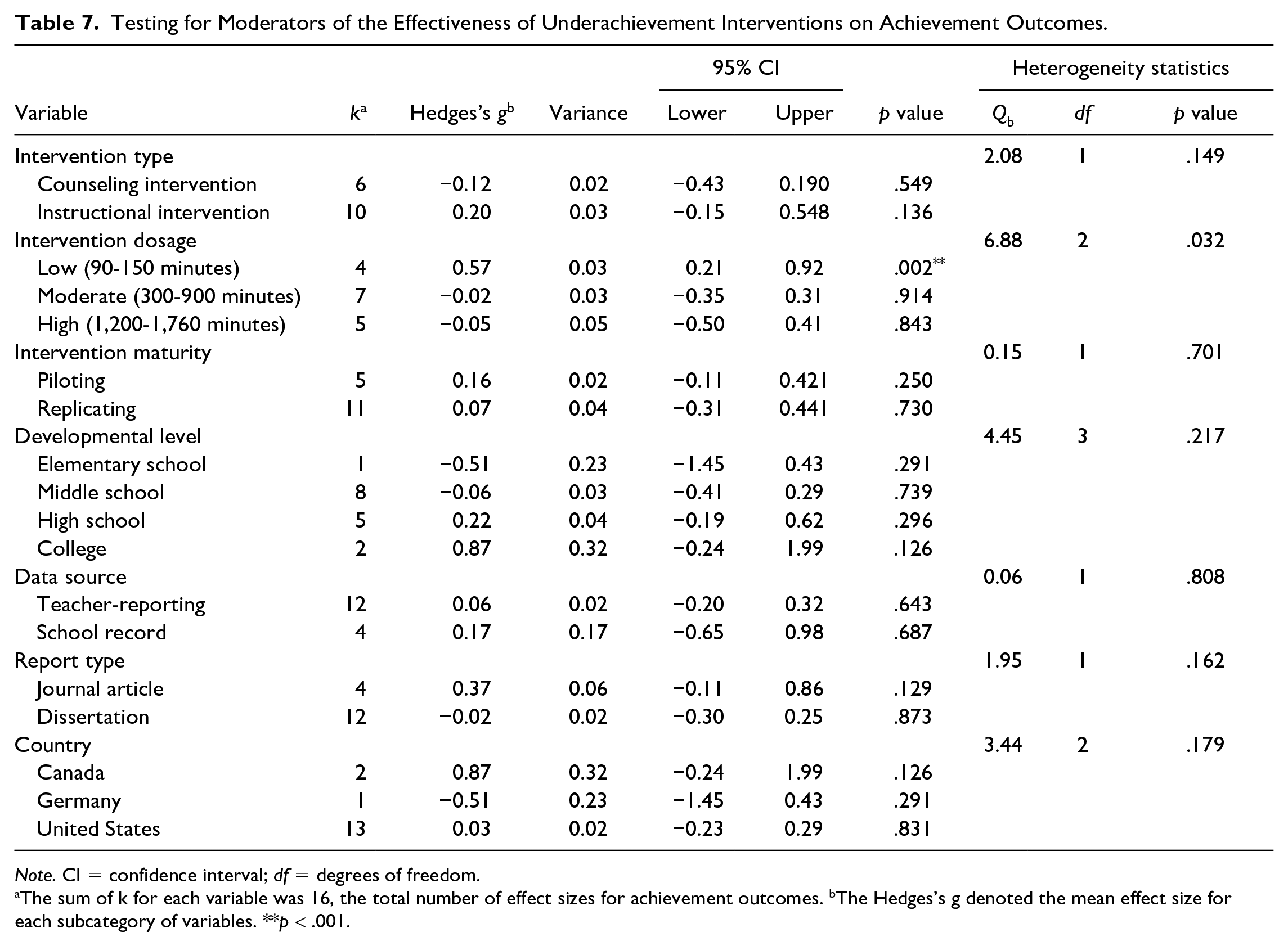
Note. CI = confidence interval; df = degrees of freedom.
The sum of k for each variable was 16, the total number of effect sizes for achievement outcomes. bThe Hedges’s g denoted the mean effect size for each subcategory of variables. **p < .001.
However, a further examination revealed that it is highly possible that this finding was merely a result of chance. This was because the two studies in which the dosages of the interventions were low (150 minutes in both Morisano et al., 2010, and Sivaraman, 2012) happened to have almost the largest effect sizes. Specifically, effect size was 1.73 for retention rates and 0.50 for college GPA in Morisano et al.’s (2010) study; similarly, the effect size was 0.58 for semester GPA in Sivaraman’s (2012) study. Also, the extremely small number of effect sizes in each category weakens confidence in the robustness of findings. Therefore, it seems reasonable to conclude that there was no evidence that interventions’ effects on academic achievement were significantly moderated by any confounding factors.
Meta-Analytic Results: Psychosocial Outcomes
Overall Mean Effect Sizes for Psychosocial Outcomes
Table 8 presents eight underachievement interventions’ effects on 44 psychosocial outcomes. Overall, gifted underachievers receiving interventions significantly outperformed their comparison peers on psychosocial outcomes, g = 0.22, k = 44 (effect sizes), 95% CI = [0.09, 0.34], p = .001. This observed mean effect size of .22 appeared to a reasonable estimate of the true effectiveness since there was no evidence of influence of publication bias. Interventions’ effects on psychosocial outcomes appeared to be relatively homogenous unlike the case in achievement ones, Qb = 49.74, df = 43, p = .223, I2 = 13.54. The average effect sizes by study ranged from 0.05 to 0.38.
Effectiveness of Underachievement Interventions on Nonachievement Outcomes: Mean ES, ESs by Study and Outcome Category.
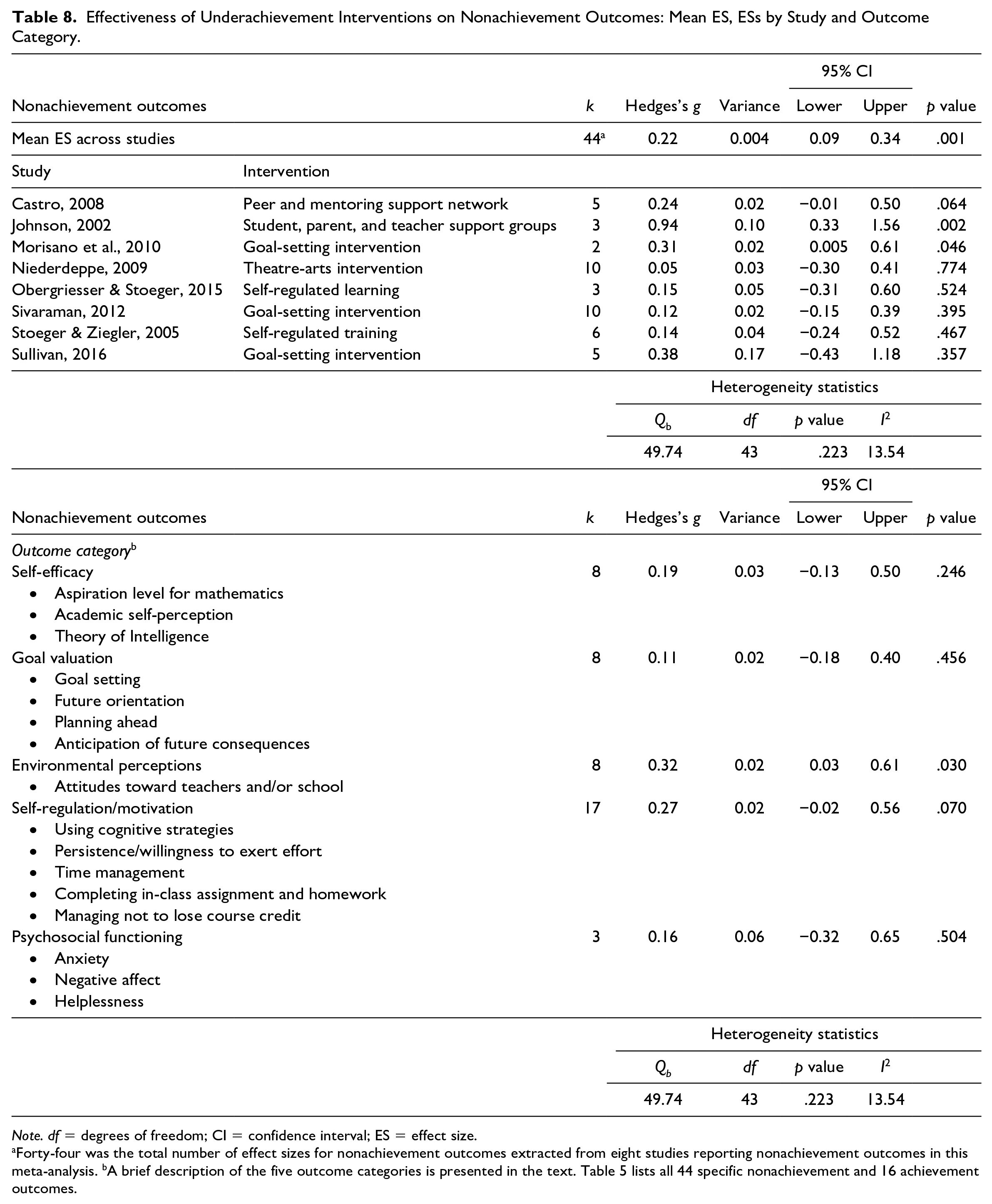
Note. df = degrees of freedom; CI = confidence interval; ES = effect size.
Forty-four was the total number of effect sizes for nonachievement outcomes extracted from eight studies reporting nonachievement outcomes in this meta-analysis. bA brief description of the five outcome categories is presented in the text. Table 5 lists all 44 specific nonachievement and 16 achievement outcomes.
Gifted underachievers receiving interventions scored significantly higher than their comparison peers in the studies of Johnson (2002): (g = 0.94, k = 3 effect sizes, 95% CI = [0.33, 1.56], p = .002) and Morisano et al. (2010): (g = 0.31, k = 2 effect sizes, 95% CI = [0.005, 0.61], p = .046). However, this finding seemed to be either overestimated or mostly spurious. All three psychosocial outcomes in the Johnson (2002) study were based on data reported by teachers who were also involved in implementing the intervention, thus, the risk of detection bias might have led to overestimations of the intervention’s effect. In fact, the respective effect sizes for the three psychosocial outcomes were 0.35, 0.94, and 1.49. Also, of the 44 psychosocial outcomes, only these 3 were teacher-reported, and the other 41 were self-reported by students. Last, when interpreting the effects of the goal-setting intervention in Morisano et al.’s (2010) study, it is necessary to bear in mind that this was the only study based on college students.
Mean Effect Sizes by Psychosocial Outcome Categories
Also shown in Table 8, the mean effect size was 0.19 for self-efficacy (k = 8 effect sizes, p = .246), 0.11 for goal valuation (k = 8 effect sizes, p = .456), 0.32 for environmental perceptions (k = 8 effect sizes, p = .030), 0.27 for self-regulation/motivation (k = 17 effect sizes, p = .070), and 0.16 for psychosocial functioning (k = 3 effect sizes, p = .504). On average, gifted underachievers receiving interventions outscored their comparison peers on self-reported environmental perceptions but not on the other four outcome categories, g = 0.32, k = 8 (effect sizes), 95% CI = [0.03, 0.61], p = .030. Underachievement interventions’ effects on students’ environmental perceptions appeared to relatively consistent and robust, considering that these effects were manifested across all four studies (Castro, 2008; Niederdeppe, 2009; Sivaraman, 2012; Sullivan, 2016) that assessed students’ attitudes toward teachers and school using the SAAR-S (McCoach & Siegle, 2003a). Again, interventions’ effects on psychosocial outcomes appeared to be relatively homogenous, Qb = 49.74, df = 43, p = .223, I2 = 13.54. Therefore, testing for moderators was not conducted. Table 9 provides interested readers an opportunity to view the distributions of the mean effect sizes for the subcategories of seven selected variables at face value.
Mean Effect Sizes for Subcategories of Key Variables: Nonachievement Outcomes.
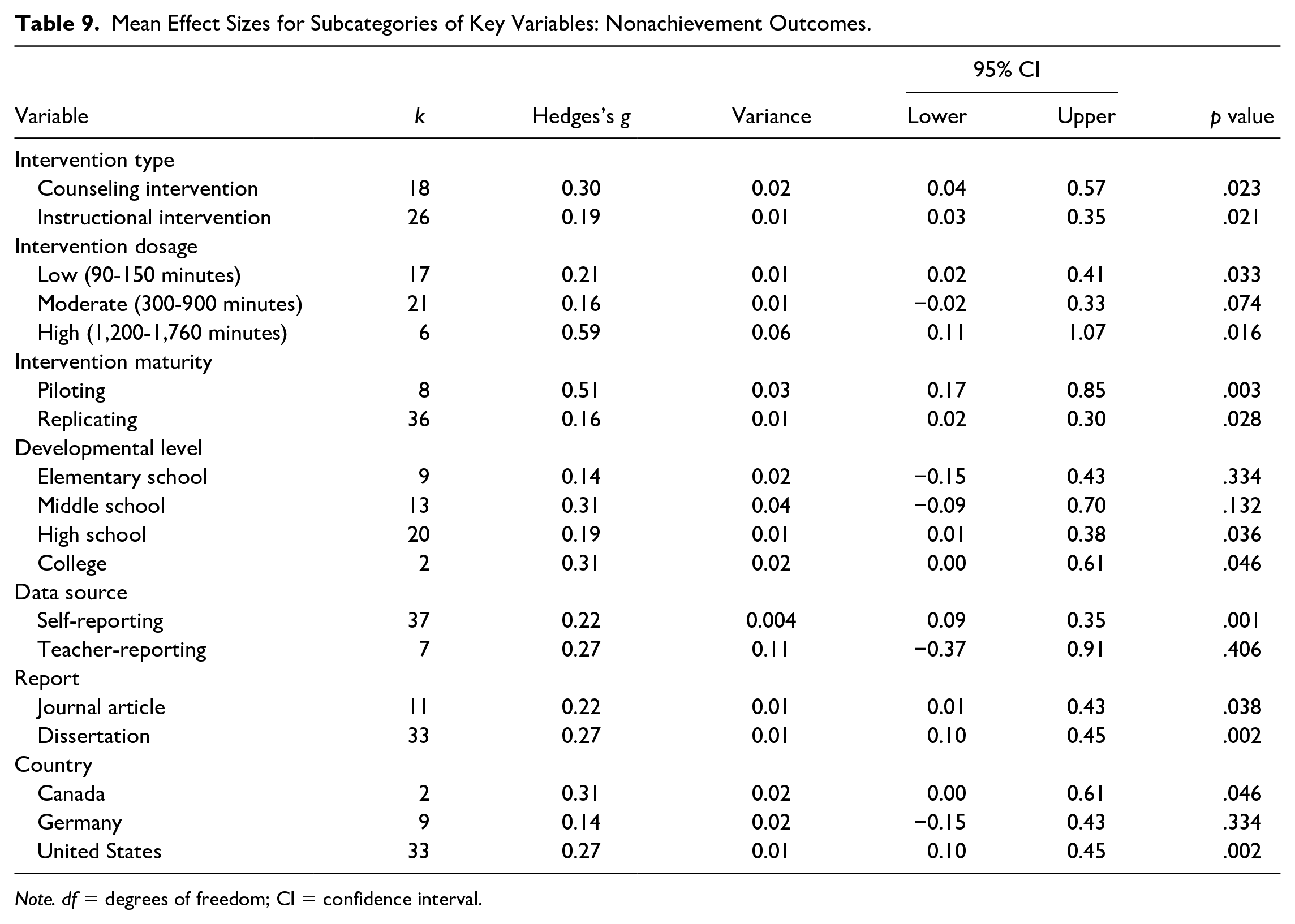
Note. df = degrees of freedom; CI = confidence interval.
Results 2: Systematic Review of Qualitative Studies
Characteristics of the Qualitative Studies
Table 10 presents characteristics of four qualitative studies reviewed. Three studies appeared in published journal articles (Bennett-Rappell & Northcote, 2016; Hébert & Olenchak, 2000; Rubenstein et al., 2012, Study 2) and one in a doctoral dissertation (Richer, 2012). Three were case studies (Bennett-Rappell & Northcote, 2016; Hébert & Olenchak, 2000; Richer, 2012), and Rubenstein et al.’s (2012) Study 2 employed a mixed-methods approach, including a multiple baseline single-subject design. However, effect sizes were not calculable from the multiple-baseline outcomes because the studies presented them visually with very limited quantitative information. Therefore, this study was treated as a qualitative work. Three studies investigated the efficacy of a piloting intervention (Bennett-Rappell & Northcote, 2016; Hébert & Olenchak, 2000; Rubenstein et al., 2012, Study 2), and one was a replication study of motivational interviewing (Richer, 2012), a counseling program initially developed by Miller and Rollnick (2002). The duration of interventions in studies ranged from 7 weeks (Bennett-Rappell & Northcote, 2016) to 1 school-year (Hébert & Olenchak, 2000), mostly on a weekly basis.
Characteristics of Underachievement Interventions and Related Qualitative Studies.
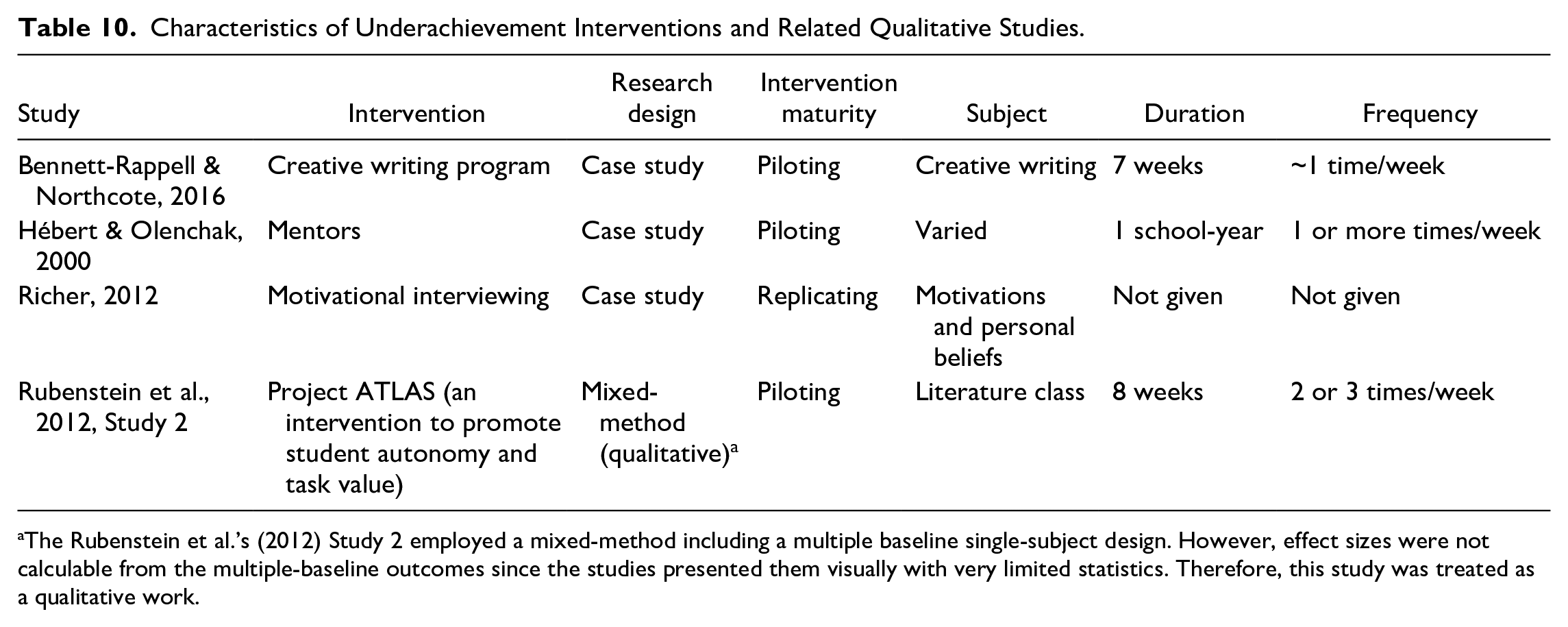
The Rubenstein et al.’s (2012) Study 2 employed a mixed-method including a multiple baseline single-subject design. However, effect sizes were not calculable from the multiple-baseline outcomes since the studies presented them visually with very limited statistics. Therefore, this study was treated as a qualitative work.
Features of the Interventions
Two studies investigated instructional interventions (the Creative Writing Program in Bennett-Rappell & Northcote, 2016, and the Project ATLAS in Rubenstein et al., 2012, Study 2; see Table 11). In the Creative Writing Program, two boys completed a guided series of narrative-based creative writing tasks and short stories over a course of 7 weeks. Project ATLAS (Autonomous Thinkers Learning as Scholars), an intervention to promote learner autonomy and task value was built upon self-determination theory (Ryan & Deci, 2000) and the achievement orientation model (Siegle & McCoach, 2005). In this intervention, two boys and one girl were coached on how to propose alternative assignments to teachers to make classes more meaningful and personally relevant. The other two focused on counseling interventions (Hébert & Olenchak, 2000; Richer, 2012).
Underachievement Interventions, Activities, and Theoretical Frameworks: Qualitative Studies.
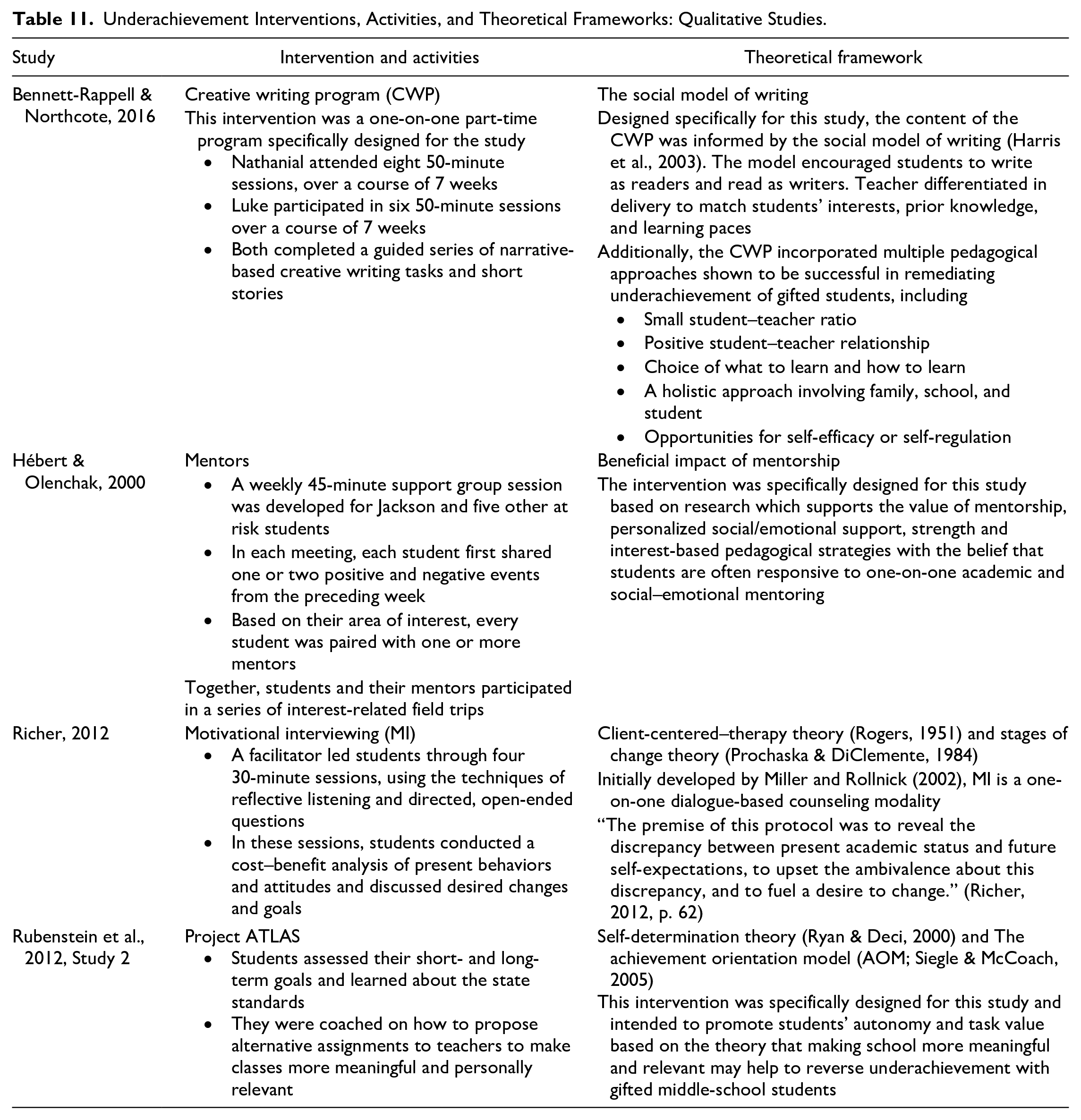
The counseling intervention in Hébert and Olenchak’s (2000) study involved assigning one or more mentors to be adults of significant influence for each of the three gifted underachieving boys. Another counseling intervention was motivational interviewing, a one-on-one dialogue-based counseling service in which a facilitator used the techniques of reflective listening and directed open-ended questions to lead students to discover the discrepancy between their present academic status and future self-expectations, and to fuel a desire to change (see, Richer, 2012).
Identification of Gifted Underachievers
Of the four qualitative studies, two described multiple criteria used to identify gifted students (Hébert & Olenchak, 2000; Richer, 2012; see Table 12). For example, in Hébert and Olenchak’s (2000) study, students were considered to be gifted if they were formally identified as gifted, participating in or being considered for gifted programs, or recognized or referred as gifted based on characteristics described by Davis and Rimm (1994). The Bennett-Rappell and Northcote (2016) study selected gifted students based on Betts and Neihart’s (1988) “Profiles of the gifted and talented.” In Rubenstein et al.’s (2012) Study 2, students were identified as academically gifted by teachers and administrators if they scored in the top 10% percentile locally on a standardized test in English or reading. Relative to the 10 quantitative studies reviewed, these qualitative studies more often included descriptive characteristics to identify gifted students. In identifying gifted underachievers, three studies cited the criterion of receiving a Grade C or lower, average to low, or failing grades in school (Hébert & Olenchak, 2000; Richer, 2012; Rubenstein et al., 2012, Study 2).
Identification of Gifted Achievers and Underachievers: Qualitative Studies.
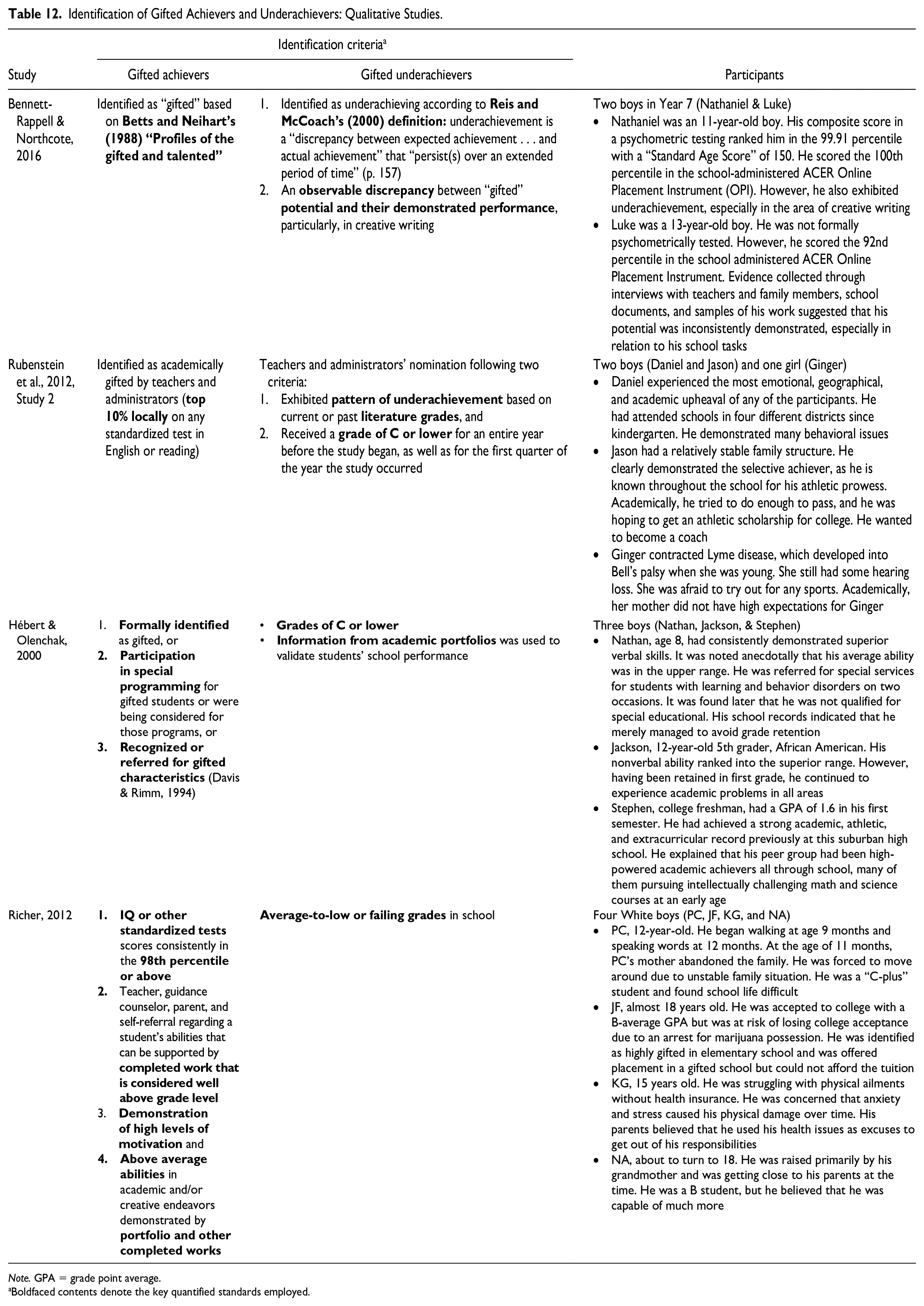
Note. GPA = grade point average.
Boldfaced contents denote the key quantified standards employed.
Description of participants revealed that the two boys in Bennett-Rappell and Northcote’s (2016) study scored at the 99th and 92nd percentiles in the school-administered Online Placement Instrument of the Australian Council for Educational Research, demonstrating the highest academic potential of the 10 gifted underachievers in the other three studies. Of the total 12 cases of underachievers, 3 grew up in dysfunctional families, 3 had many behavioral issues (for example, 1 of them was once arrested for marijuana possession), 2 had health issues, 2 excelled in some areas but were unsuccessful in other areas, 1 performed inconsistently on school tasks, one 12-year-old boy was retained in first grade and continued to struggle academically, and 1 college freshman received a GPA of 1.6 in his first semester in spite of strong records in high school.
Key Findings
Each of the four qualitative studies of underachievement interventions(Bennett-Rappell & Northcote, 2016; Hébert & Olenchak, 2000; Richer, 2012; Rubenstein et al., 2012, Study 2) focused on two to four gifted underachievers who differed in intellectual potential, developmental stages, family situations, physical conditions, school experiences, achievement motivation, and causes of underachievement. Interventions were mostly delivered one-on-one or in small groups. In general, participants reported positive experiences in the interventions. They benefited from the interventions on a variety of areas such as increased autonomy and task value, finding school more meaningful and relevant, building a close connection with peers and mentors, enjoying the positive influence of adult figures, improved work habits, self-regulation, and increased motivation to change.
Results of these studies suggest that positive teacher–student relationships, differentiation, and one-to-one teaching strategies are effective ways to address underachievement (Bennett-Rappell & Northcote, 2016). Gifted underachievers can benefit substantially from mentorship, especially from mentors who are open-minded, nonjudgmental, caring, and who can consistently provide personalized support for them (Hébert & Olenchak, 2000). Further, interventions that reinforce personal strengths and positive attributes of gifted underachievers are conducive to improve their motivation, self-regulation, and academic efforts (Richer, 2012; Rubenstein et al., 2012, Study 2).
Results 3: Quality of the Evidence
The quality of the evidence was considered to be low overall based on the 14 studies reviewed in the current meta-analysis. This judgment was made against a standard of large-scale randomized control trials typically seen in medical research, thus, a very high bar. Studies using large-scale randomized control trials are rare in the gifted education literature. At least four issues may attribute to the low quality of the evidence overall.
First, the high risk of selection in the studies reviewed may compromise the validity of findings. As mentioned earlier (see Table 1), four of the 10 quantitative studies were experimental studies that used random assignment of the participants (Morisano et al., 2010; Sivaraman, 2012; Stoeger & Ziegler, 2005; Sullivan, 2016). In theory, quality of the evidence from studies with strong research designs like these should be higher than that of other studies. However, all four studies were judged to have high risk of selection biases because none provided specific information on randomization methods and tools, such as whether the researchers used a computer random generator or throwing dice to determine the sequence of randomization.
Second, the validity of study findings might be threatened due to high risk of detection biases. For example, psychosocial outcomes in two of the four experimental studies were assessed with students’ (who, of course, typically were aware of their interventional or comparison conditions) self-reported rating scales, most of which lacked adequate credibility and validity. Specifically, reduced negative affect and enthusiasms for the study were assessed with a 15-item scale in the Morisano et al. (2010) study. Quality of assessments was no better in the Stoeger and Ziegler (2005) study, where scales or subscales constituting four to eight items were utilized to measure five psychosocial outcomes and one single question was used for gathering information regarding students’ aspiration level for mathematics.
Third, studies provided little or no information regarding the fidelity of implementation, such as classroom observations by trained independent evaluators, videotaping of intervention sessions, checklists for implementers to keep track of progresses, and calculating or estimating the percentage of intervention implementation actually accomplished.
Last, quality of the evidence also was compromised due to the limitations in the number of studies that met the qualification criteria and were available for inclusion. The sample sizes of quantitative studies were rather small, ranging from 28 (Sullivan, 2016) to 85 (Morisano et al., 2010; Obergriesser & Stoeger, 2015). Additionally, studies’ considerations of baseline group differences were very limited, consisting of only a few pretest outcomes, if any, taking into account a range of variables, such as gender, social–economic status, areas of underachieving, and features of schools.
Discussions
Summary of Findings
Results of this meta-analysis suggest that the time has yet to come to celebrate a large-scale success in boosting gifted underachievers’ academic performance and psychosocial outcomes as supported by consistent, robust, and high-quality research evidence. Results provided no evidence that underachievement interventions significantly improved academic performance of gifted underachievers especially in terms of course grades. However, gifted underachievers receiving interventions significantly and consistently outperformed their comparison peers on psychosocial outcomes. Qualitative studies reported that gifted underachievers benefited in terms of increased motivation for learning, improved self-regulation, finding school more meaningful, and enjoying the positive influence of adult figures.
A Silver Lining: Notable Progresses on Searching for Better Interventions
Although the field needs more research to guide successful interventions for underachievement, there has been noteworthy progress toward the goal. For example, the territory of research on factors contributing to underachievement has expanded to some relatively newer areas such as the connection between underachievement and perfectionism, achievement/affiliation conflicts, the need for cognitive challenge, and engagement in learning. There also has been growing interest in applying major theories of learning and achievement motivation (such as self-regulated learning and, especially, the achievement goal theory) to research on gifted underachievement (Linnenbrink-Garcia & Patall, 2015; Siegle, 2013). Research has been done to empirically validate the achievement orientation model, yielding a psychometrically sound instrument—the SAAR-S (McCoach & Siegle, 2003a) to evaluate psychosocial factors associated with underachievement. Research in this area also includes longitudinal and person-focused approaches to conceptualizing multiple, varied developmental pathways to gifted underachievement (Snyder, Carrig, et al., 2019; Snyder & Linnenbrink-Garcia, 2013).
Another sign of progress is increased efforts to evaluate the effects of interventions through replication studies. Of the 10 quantitative studies reviewed, seven replicated prior research to explore whether or how interventions work in a different setting and for more diverse underachieving students (Cortés-Cabello, 2013; Morisano et al., 2010; Niederdeppe, 2009; Obergriesser & Stoeger, 2015; Sivaraman, 2012; Stoeger & Ziegler, 2005; Sullivan, 2016). For example, Sullivan (2016) partially replicated a study by Rubenstein et al. (2012) that used a goal-setting intervention initially developed by Morisano et al. (2010) for college students. Sivaraman (2012) adapted the same intervention for high school students. Such efforts have the potential to yield valuable findings for interventions that are applicable in varied settings and to diverse groups of underachieving gifted students.
Last, researchers have designed individualized and personalized interventions based on the characteristics of students. For example, Rubenstein et al. (2012, Study 1) matched specific interventional components to gifted underachieving students based on preassessments of their needs and characteristics and then designed a follow-up based on the findings from the intervention.
Implications for Research and Practice
Findings from the current meta-analysis extend prior research on gifted underachievement interventions by providing a comprehensive, in-depth, and more nuanced view on the academic and psychosocial outcomes of underachievement interventions.
The Interventional System: Theories of Change and Beyond
The AOM is one of the most researched and utilized theoretical frameworks on interventions for underachieving gifted students. As elaborated in the “Introduction” section, the key premise of the AOM is that students’ academic self-efficacy (e.g., believing that they can succeed), goal valuation (e.g., believing that learning is important and meaningful), and perceptions about the environment (e.g., feeling that teachers are supportive) collectively effect their motivation (including self-regulated learning) to engage, learn, and perform in school. An AOM-based intervention aims to help gifted underachievers improve their academic performance by boosting their learning motivation and engagement, which serves as a bridge to the end goal of improving school performance.
Results of the current meta-analysis support that gifted underachievers seemed to benefit significantly from interventions in terms of targeted psychosocial outcomes, as noted above, in comparison with underachieving gifted peers not receiving interventions. However, they were not better off than their comparison peers in terms of traditional academic outcome measures, such as grades in the K-12 levels. There are many possible reasons for this, but a very likely one is that substantial change in academic performance requires sustained intervention to translate improved self-beliefs into actual academic performance. Students who have been underachieving may need time to “catch up” academically. Additionally, a successful intervention may need to include a concomitant focus on academic behaviors, such as learning strategies and organizational and study habits. Finally, it is possible that there is still a psychosocial “missing link” needed to move students to actualized improved academic performance.
The Role of Student Engagement
Interventions in nine out of the 10 quantitative studies (with the exception of the study by Cortés-Cabello in 2013) and in all four qualitative inquiries reviewed in the current meta-analysis, included some types of activities for boosting student engagement. This emphasis is in line with current empirical research on the importance of student engagement for school completion and dropout prevention (Reschly & Christenson, 2012). Student engagement is a broad, encompassing construct, covering active learning across the lifespan, including involvement in learning activities in the community, at home, as well as in school. Engagement is viewed not only as a process or mechanism through which external and internal factors work together to facilitate learning but also as an outcome of learning; furthermore, it acts as a protective factor that promotes resilience, coping behaviors, and social support (Wang et al., 2019). Christenson et al. (2012) defined it as including academic (e.g., time on-task, completion of assignments, accruing necessary credit hours), behavioral (e.g., attendance, compliance, discipline referrals), affective (e.g., a sense of belonging, believing that teachers are supportive), and cognitive components (e.g., valuing school, finding learning meaningful, feeling bored in class, embracing cognitive challenges).
The four dimensions of student engagement provide an array of potential levers for intervention because the dimensions may be influenced by a wide variety of activities and/or services that are facilitated by multiple parties, including parents, teachers, peers, and others and within diverse contexts such as home, school, and social networks. The dimensions of student engagement have important implications for both identifying gifted students at risk for underachievement as well as designing interventions and understanding their efficacy (Landis & Reschly, 2013). Future research may consider how each dimension of engagement influences achievement and the types of interventions that are most impactful on each dimension. By doing so, researchers may be able to provide practitioners with suggestions regarding how to provide more targeted and effective interventions for individual gifted underachievers.
Identifying Underachievement Among the Gifted
How to define and measure underachievement in a gifted population remains one of the fundamental and challenging issues facing researchers, no doubt rooted in the lack of consensus on the definition of giftedness. For instance, McBee and Makel (2019) found that the proportion of students categorized as gifted varied from less than 0.5% to approximately 90% depending on the definition of giftedness and measures used in the identification protocol. Many underachievers had been achievers at one time, and these children are relatively easy to identify by parents and teachers. More difficult to identify are children whose level of achievement relative to their academic potential is unknown. Universal screening in the early years may be useful in identifying some of these children. However, this may not be enough to identify underachievement among students with learning disabilities or children whose potential is unseen due to lack of opportunity. When students’ ability itself is underestimated, students attaining basic levels of achievement may not be recognized as gifted underachievers who may benefit from interventions. More extensive evaluation by school psychologists and/or early preparatory programs that expand opportunities for hidden potential to be revealed (for example, see Project SPARK, Little et al., 2018, and STEM Starters+, Robinson et al., 2018) may be required to find and support such students.
It is also worth noting the obstacles to studying underachievement among gifted students to support future research designs. First, to be identified as a gifted underachiever entails, as a prerequisite, being identified as gifted. In most schools, achievement is a significant factor in being identified as gifted. This is obviously true where giftedness is identified on the basis of achievement measures and/or grades. However, it is likely also true where access to the identification process depends on teacher referral or recommendation. This presents a high risk of subject selection issues in studies of gifted underachievement, as “underachievement” is disproportionately likely to be a temporary state for students in both treatment and control groups, given that today’s “gifted underachievers” in many schools must (by definition) have been high achievers at some point in the past. Regression toward the mean in achievement measures in both intervention and comparison groups of gifted students is potentially a significant barrier to detecting effects of interventions that may be overcome by increasing the number of observations and timeframe of studies.
Future researchers should also be cognizant of potential restriction of range issues when using many common achievement measures and take into consideration issues such as limited degrees of freedom in course grades or GPA, the influence of subjectivity on grading, and test ceiling effects that may limit the usefulness of grade-level achievement test scores to reliably measure real academic growth for gifted students and subsequently detect statistically significant group differences in achievement. Above-grade–level assessments (which raise test ceilings to better distribute scores of advanced learners) as measures of achievement change may be useful, especially when it is not feasible to create very large intervention and control groups.
Broaden the Definition of Intervention Success
Our findings on student engagement also highlight the need to look beyond the current ideology and practice concerning educational outcomes of underachievement interventions. Research on the efficacy of underachievement interventions for gifted students has largely been limited to a few traditional measures of school performance, such as course grades or GPA. For example, course grades emerged to be an overwhelmingly dominant indicator of achievement outcomes for students in the K-12 levels in the 10 quantitative studies reviewed in the current meta-analysis. To be sure, it is important to include such outcomes when examining the efficacy of underachievement interventions. However, evaluating the success of interventions solely on the basis of such outcomes may result in undervaluing interventions that yield other important benefits for student well-being and long-term talent development, such as confidence in one’s ability to excel in school, heightened motivation, increased participation in school-related activities, decreased anxiety, perceptions of greater social support, evidence of future educational goals, or even more independent learning at home. These effects may be an important prelude to changes in student achievement, which may begin with small steps before they are evident as substantial improvements.
Furthermore, it is worth noting the possibilities within the AOM framework for underachievement to be caused by factors extrinsic to the student that student-focused interventions cannot address. For example, with respect to the dimension of goal valuation, an intrinsically motivated student’s perception that there is little to be gained by exertion of effort when curriculum lacks opportunities for new learning may be accurate when viewed through the lens of “learning for learning’s sake.” Similarly, underachieving students’ perceptions that their current academic environments are not supportive may sometimes be accurate in settings where their abilities are not valued or where students experience issues such as frequent bullying or harassment. Thus, potential to change achievement outcomes by changing student perceptions may be limited when actual affordances for learning and development are not available in a student’s current setting. This study does not preclude the possibility that interventions that positively influenced student self-efficacy and motivation but did not appear to positively influence traditional achievement measures could yield academic benefits if combined with changes to academic curricula or modifications of the learning context.
Merits of Mixed Methods on Understanding Gifted Underachievement
The current study suggests that mixed methods would be especially useful in investigating gifted underachievement. Research has highlighted the heterogeneous and individualized nature of underachievement among gifted students (Siegle & McCoach, 2018; Snyder, Carrig, et al., 2019; Snyder & Linnenbrink-Garcia, 2013) and fluctuations in achievement levels from one setting to another (Baker et al., 1998; Matthews & McBee, 2007). Relatedly, successful interventions might require more individualized approaches as suggested by the four qualitative studies reviewed in the current meta-analysis (for a recent review on counseling gifted students particularly using a model of evidence-based practice, see Pfeiffer & Preado, 2018). Future research should focus on studying the match between student characteristics and environments and targeted interventions.
Implications for Practice
Although the present study does not point to a transformational one-intervention-fits-all approach to addressing gifted underachievement as measured by traditional academic measures, we see promise in interventions provided on a targeted basis. Practitioners should consider the likely reality that underachievement is a symptom with many potential causes. Therefore, effective approaches likely involve first diagnosing these underlying causes, as the diagnosis of “underachievement” itself may not be specific enough to be actionable. Further, practitioners evaluating potential intervention strategies for application should remember that an underlying assumption of interventions targeting learner self-efficacy, motivation, and engagement to influence academic outcomes is that learning opportunities that would be seized by a student with an optimal mind-set for academic achievement are actually available in the student’s learning environment. High levels of student effort and engagement invested in low-level curriculum may not yield achievement gains for gifted students. If interventions yield measurable improvements in self-efficacy and attitudes toward learning but do not ultimately move the needle on achievement, it may be worth considering the possibility that there are curriculum and/or setting issues to address. Future researchers exploring the issue of gifted underachievement are encouraged to capture and report data on curriculum content and academic setting so that potential interactions between student mind-set and learning context can be better understood to guide development of more precise diagnostic tools and the design of interventions that significantly impact underachievement among gifted students.
Limitations
The current meta-analysis needs to be viewed along with its limitations in several respects. The primary limitation has to do with the overall relatively low quality of the studies, as elaborated earlier. Given this, findings of this meta-analysis need to be interpreted with caution. To successfully address the issue of gifted underachievement in the future, increased efforts are needed by individual researchers to strengthen quality of the evidence regarding interventions’ effects—specifically addressing issues such as risk of selection and/or detection biases and fidelity of intervention implementations and by using psychometrically sound instruments to assess effects. Additionally, when sample sizes are small and randomization is not possible, which is often the case in school-based research within gifted education, researchers should collect data on as many potential confounding factors as possible to evaluate their effects on their findings. Researchers are advised to adopt quality indicators for strong education research design such as standards established by the Work Works Clearinghouse (WWC, 2017).
Conclusions
As Rubenstein et al. (2012) remarked, “Designing and researching interventions for underachieving gifted students are inherently difficult. . . . However, it is important for researchers to systematically investigate interventions and publish results, regardless of outcomes” (p. 690). The current meta-analysis presents a comprehensive, in-depth, and more nuanced view on the academic and psychosocial outcomes of interventions for gifted underachievers. It suggests that sustained intervention efforts might be required to transform increased motivation for learning into concrete academic achievement gains. Student engagement may hold the key to better identifying gifted underachievement, designing and implementing interventions, and understanding the efficacy of interventions.
Mixed methods that combine quantitative and qualitative data seem useful for advancing knowledge on gifted underachievement given the heterogeneous and individualized nature of underachievement among gifted students. Successful interventions might require individually customized approaches given the many causes and paths of underachievement among gifted students.
Footnotes
Declaration of Conflicting Interests
The author(s) declared no potential conflicts of interest with respect to the research, authorship, and/or publication of this article.
Funding
The author(s) received no financial support for the research, authorship, and/or publication of this article.