






Abstract
Objective:
The aim of this study was to evaluate the effectiveness of specialised personnel versus schoolteachers in delivering first aid teaching and trauma management to children aged 4–8 years in Greece.
Methods:
An experimental study with an educational intervention was conducted, involving three groups of children: a control group which received no special teaching, and two experimental groups which received teaching by either regular teachers or specialised personnel. The study comprised 180 students with an average age of 6 years. Four repeated measurements were taken in the experimental groups, while the control group underwent a single measurement. An assessment of the children’s first aid knowledge and skills was undertaken using scenario-based observations with checklists and questionnaires.
Results:
Statistical analysis showed no significant differences in children’s first aid knowledge and skills between the two experimental groups (p > .05). Participants in both teaching groups demonstrated significant improvements after teaching and maintained these skills at subsequent follow-ups (p < .05).
Conclusion:
The study findings suggest that teacher-led first aid teaching can be as effective as teaching by specialised personnel for young children aged 4–8 years. Integrating first aid education into schools, delivered by teachers, can be a cost-effective approach to imparting valuable life-saving skills. These findings contribute to efforts in enhancing community safety by ensuring broad-based preparedness to respond to emergencies.
Introduction
First aid teaching is a fundamental component of public health preparedness, aiming to empower individuals with life-saving skills in response to emergencies (Semeraro et al., 2018). Research has underscored the importance of broad-based teaching modules encompassing cardiopulmonary resuscitation (CPR), wound care, and head injury management (Tse et al., 2023a, 2023b). Several countries, such as Denmark and Italy, have introduced CPR education (Böttiger et al., 2017) in schools, and international agencies recommend integrating age-appropriate first aid and CPR into primary school curricula with annual updates (Wilks and Pendergast, 2017). With the right professional development and support, teachers in schools can effectively deliver first aid instruction to their students (Wilks and Pendergast, 2017).
Of particular interest currently are efforts to integrate first aid education into formal school curricula, with a focus on very young children aged 4–8 years (Bánfai et al., 2018; Tse et al., 2023a). Ongoing research focuses on the pedagogical approaches best suited to teaching first aid to children of this age (Ammirati et al., 2014; Plischewski et al., 2021). By systematically evaluating teaching methodologies and instructor effectiveness, researchers aim to refine the educational process and enhance the overall quality of the first aid teaching programmes provided. Bollig, Myklebust, and Østringen (2011) have shown that children aged 4–5 years can understand and apply basic first aid principles. Bollig, Wahl, and Svendsen (2009) found that a five-lesson first aid programme significantly enhanced the ability of 6- to 7-year-old children to perform basic first aid in emergency situations. Following intervention, children demonstrated significant improvements in consciousness assessment, breathing assessment, emergency call procedures, and airway management, with a strong retention of these skills after 6 months. These findings suggest that first aid teaching should be introduced in primary schools starting in first grade so as to lay the foundations for building life-saving skills.
In addition, Mohajervatan et al. (2020) have demonstrated that young children can learn essential emergency first aid skills such as calling an ambulance, managing an unconscious patient, and controlling severe bleeding. Against this background, the aim of this study was to evaluate the effectiveness of specialised personnel versus schoolteachers in delivering first aid teaching and trauma management to children aged 4–8 years. Specifically, we assessed how different instructors influenced students’ acquisition and application of first aid knowledge and skills.
Methods and materials
We conducted an experimental study with educational intervention to assess the effectiveness of different instructors in randomly selected schools in Thesprotia, Greece. In the study design, children were randomly allocated to three groups. One group, the control group, did not receive any special teaching, and was used as a comparison. The other two groups, the experimental groups, received teaching. One group (the Teaching by Teachers group) was instructed by a regular teacher, while the other (the Teaching by Specialised Personnel group) was taught by first aid staff. To ensure proficiency, all instructors had completed a comprehensive 2-hour first aid course. Here, the term ‘specialised staff’ refers to a nurse who was certified in first aid and qualified as a first aid instructor.
Sample size
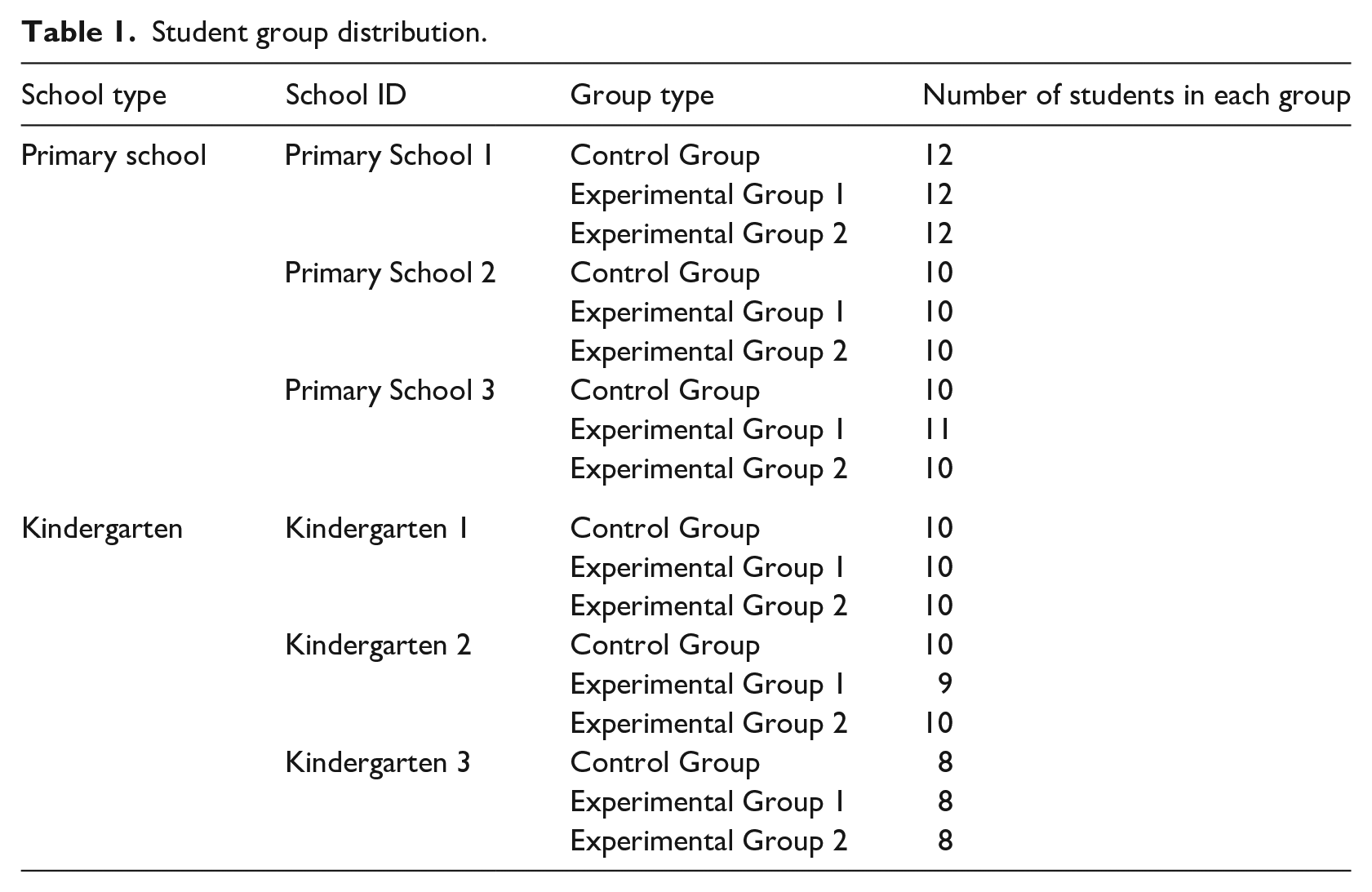
The sample size calculation was calculated using Gpower 3.1.9.7 software. With a power of 80%, an initial sample of 159 primary education students from three public elementary schools (ages 6–12) and three kindergartens (ages 4–5) in the region of Thesprotia was selected. To account for potential dropout during the study, the sample size was increased to 180 students participating, with each group consisting of 60 students. Participants in each school were randomly assigned to three groups: a control group and two experimental groups, one trained by teachers and the other by first aid experts (Table 1). The control group received no intervention.
Student group distribution.
Data collection
In each of the experimental groups, four repeated measurements were taken – at pre-test and post-test – with follow-ups at 2 and 7 months after the training, while the control group underwent only a single measurement. Data were collected by means of scenario-based observations using a 15-item checklist and questionnaires.
The checklist, administered by the researcher (E.T.), included 2 demographic items (sex and age) and 13 items assessing specific first aid skills such as the management of choking and calling for an ambulance, as used in previous research (Tse et al., 2024). Skills were evaluated based on children’s responses to particular scenarios, with a score of 1 being awarded for correct answers and 0 for incorrect ones.
Knowledge was assessed by means of a 12-question questionnaire, which included demographic information (sex and age), and 10 questions focused on typical first aid scenarios, covering topics like calling an ambulance, managing bleeding, treating nosebleeds, handling head injuries and responding to choking, as detailed in a pilot study (Tse et al., 2023a).
The study commenced in early November 2022 and ended in early June 2023.
The teaching programme
A 6-hour teaching programme for the children consisted of a series of 45-minute sessions blending together theory and practice. Theoretical content was taught through engaging presentations, while practical sessions included role-play, allowing participants to apply their knowledge in real-life scenarios.
Analysis
Data were analysed using SPSS software version 28.0, with a significance level set at .05 for all analyses. Descriptive statistics include percentages and means. Pairwise comparisons were made to examine differences between various measurement instances for each teaching group.
Ethical considerations
In October 2022, the study was been registered on clinicaltrials.gov under the identifier NCT05563129. The study was approved by the University of Ioannina Research Ethics Committee (56655/26-11-2021). Before the study began, participating children, their parents and the involved teachers were provided with both written and verbal explanations about the study. Written informed consent was obtained from parents for their child’s participation in the study. Parents were informed of their right to withdraw their child from the study at any point.
Results
The study included 180 students with mean age of 6 years. In the teaching by Teachers group, children aged between 4 and 8 years participated, with an average age of approximately 6.02 years and a standard deviation of 1.07 years. Similarly, the teaching by Specialised Personnel group also consisted of children aged 4–8 years, with an average age of 6.00 years and slightly lower variability (standard deviation of 0.99 years). The control group included children of the same age range, with an average age of 5.90 years and a standard deviation of 0.99 years.
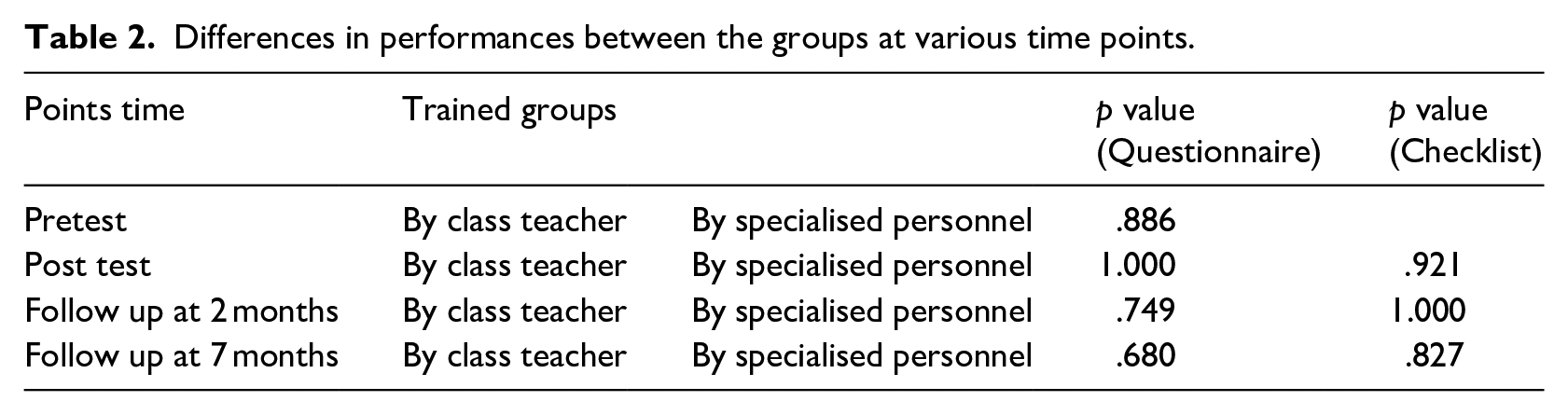
Statistical analysis revealed no significant differences in performance between the two experimental groups, suggesting that both the teacher-led and specialised personnel–led teaching were equally effective. Participants in both teaching groups showed substantial improvement during the intervention, and these enhanced skills were maintained during follow-up assessments (Table 2).
Differences in performances between the groups at various time points.
Discussion
These preliminary findings underscore the efficacy of first aid teaching led by teachers for young children, indicating that class teachers are equally effective at doing this as more specialised first aid personnel. This observation aligns with the findings of Ammirati et al. (2014), who similarly demonstrated that very young children can acquire first aid skills under the guidance and instruction of their own teachers. This suggests that integrating first aid education into schools, facilitated by teachers, can be a cost-effective approach of imparting valuable life-saving skills to members of the next generation (Tse et al., 2024). Teachers are often willing to teach first aid but require proper training and support due to a lack of confidence and knowledge. Integrating comprehensive first aid teaching into initial teacher education and training is essential (Bakke and Schwebs, 2017; Joseph et al., 2015), as is its inclusion at part of professional education and development for practising teaching staff.
Limitations
The study has some limitations. The first is the absence of ongoing assessment for performance of the control group. Given that participants came from the same school, it is possible that the control group may have gained some knowledge during this period. Another limitation is the absence of long-term follow-up to evaluate the retention of knowledge and skills among the students. Without this, it is difficult to determine how well students maintain their first aid competencies over time. Moreover, the study was not formally validated, nor was a similar approach implemented in other parts of Greece, which means that generalisation beyond this small-scale study is not possible. These limitations highlight the necessity for future research to address these gaps.
Conclusion
Our findings highlight the effectiveness of first aid teaching led by teachers for young children, suggesting that class teachers can be just as effective as specialised personnel in imparting understanding and key skills.
Footnotes
Declaration of conflicting interests
The author(s) declared no potential conflicts of interest with respect to the research, authorship, and/or publication of this article.
Funding
The author(s) received no financial support for the research, authorship, and/or publication of this article.
