







Abstract
Objective
To examine the effect of backpack hip strap use on walking energy expenditure while carrying a loaded backpack.
Background
Previous studies have demonstrated that energy cost increases as the mass of the load carried increases. However, few investigations have focused on backpack carriage design.
Methods
Fifteen young, healthy, male subjects walked at a self-selected pace for 10 minutes in two backpack loading conditions: with a hip strap (strapped) and without a hip strap (nonstrapped). Oxygen consumption (VO2), rating of perceived exertion (RPE), respiratory exchange ratio (RER), and heart rate (HR) were monitored throughout each 10-minute trial. Change scores from the 4th to 10th minute were calculated for each variable. A t test was used to evaluate the difference between conditions for each variable.
Results
The changes in VO2 (–0.62 ± 0.40 vs. 0.33 ± 0.23, p = .04) and RPE (1 ± 0.25 vs. 2 ± 0.21, p < .01) from the 4th to the 10th minute were different for the strapped versus nonstrapped condition. There was no difference in the change in RER (0.04 ± 0.01 vs. 0.03 ± 0.01, p > .05) or HR (3.53 ± 0.93 vs. 4.07 ± 1.39, p > .05) for the strapped versus unstrapped condition.
Conclusions
Wearing a hip strap reduced the energy expenditure and perceived exertion in as little as 10 minutes of walking compared to the nonstrapped condition. Future work should consider the effect of a hip strap on these variables while hiking for extended periods.
Application
Wearing a hip strap may increase the comfort and reduce the energy required of wearing a backpack. This is useful information for backpack designers, military personnel, and recreational hikers.
Introduction
The backpack was designed to carry loads for extended periods of time and is commonly used by military personnel, students, and recreational hikers (Holewijn, 1990; Knapik, Reynolds, & Harman, 2004). Backpack requirements vary depending on the duration of the trip, the size and shape of the equipment, and the individual’s anthropometrics (Harman, Obusek, Frykman, Palmer, & Kirk, 1997; Obusek, Harman, Frykman, Palmer, & Bills, 1997). Backpack designs are primarily focused on comfort, physiological demand, and carrying biomechanics.
The total mass of the backpack should be kept to a minimum whenever possible as increases in mass have been shown to increase the energy requirement of carriage associated with the increased mass (Huang & Kuo, 2014). However, the backpack must also contain all essential equipment. Haisman (1988) recommended that the loads in military personnel be limited to approximately 30% of the wearer’s body mass, whereas others have suggested civilian loads be limited to 15% to 20% of the wearer’s body mass (Al-Khabbaz, Shimada, & Hasegawa, 2008; Kistner, Fiebert, Roach, & Moore, 2013). Particularly with military personnel, however, the load that they have carried in combat has increased from the Vietnam War (approximately 35 kg) to Operation Desert Storm (approximately 55 kg). The increase in carriage load for military personnel was mainly due to an increase in the mass of protective body armor and amount of ammunition carried as well as the use of personal communications equipment (Dean, 2004; Knapik et al., 2004). Therefore, most U.S. soldiers carry a load that exceeds this 30% of body mass recommendation, with the potential to exceed 60% to 70% of the wearer’s body mass. With fixed masses for essential equipment, it is rarely possible to limit the load carried in a backpack proportional to body mass.
Most modern-day backpacks include a hip strap, which is designed to redistribute a portion of the vertical load from the shoulders to the hips. The use of a hip strap has been shown to decrease subjective discomfort by the wearer (Holewijn & Lotens, 1992) as well as the pressure on the shoulders and the likelihood of rucksack palsy (Holewijn, 1990). Individuals may choose not to use a hip strap, however, because of interference with other equipment or the belief that the hip strap makes no difference in load carriage or performance. Additional research is needed to further clarify the role of a hip strap on performance in civilian and military backpack wearers.
While comfort is one potential benefit of using a hip strap, the effect it can have on energy expenditure has not yet been clarified. Previous studies have demonstrated that energy cost increases as the weight of the load increases (Beekley, Alt, Buckley, Duffey, & Crowder, 2007; Borghols, Dresen, & Hollander, 1978; Goldman & Iampietro, 1962; Pandolf, Givoni, & Goldman, 1977; Patton, Kaszuba, Mello, & Reynolds, 1991; Soule, Pandolf, & Goldman, 1978), but few investigations have been conducted that focus on backpack carriage specifically. Examining the effect of duration of exercise on energy expenditure when carrying a backpack, Epstein, Rosenblum, Burstein, and Sawka (1988) and Patton et al. (1991) found that energy expenditure increased as duration of work went beyond two hours. In contrast, Sagiv, Ben-Sira, Sagiv, Werber, and Rotstein (1994) found that energy expenditure was no different at the beginning of exercise compared to the fourth hour of exercise. These conflicting results may be explained by the role of the hip strap. In both the Epstein et al. and Patton et al. studies, subjects did not use a hip strap. However, the subjects in the Sagiv et al. study used a hip strap. Therefore, the purpose of this study was to examine the effect of the use of a hip strap on energy expenditure when carrying a loaded backpack while walking. To examine this, oxygen consumption (VO2), carbon dioxide production, and respiratory exchange ratio (RER) were measured during treadmill walking. With these measurements, the body’s total energy requirement and relative intensity of the exercise can be measured.
Methods
Subjects
Fifteen healthy male participants (1.78 ± 0.08 m, 80.4 ± 10.3 kg, 22.6 ± 2 years) were recruited. Eligibility was dependent on having no known injuries to the feet, ankle, knee, hip, or spine within the last year; participation in regular exercise at least twice per week for at least 30 minutes per session; and must have walked or hiked while carrying a heavy backpack within the 30 days prior to beginning the study. All participants reported being free of any known cardiovascular disease, metabolic disease, or neurological disorder. Prior any data collection, the experimental procedures, risks, and discomforts associated with the study were explained to all subjects, and they provided signed informed consent, approved by the Institutional Review Board of Montclair State University and in accordance with the Declaration of Helsinki.
Experimental Design
Each subject was required to make two visits to the laboratory, a screening session and a testing session, with a minimum of two days between each visit. During the first screening visit, the subject was interviewed to determine injury and exercise history. Height and body mass were measured using a stadiometer (Detectco, Webb City, MO, USA). The subject’s resting heart rate (HR) was taken using a Polar E600/T31 heart rate monitor, which was also used to monitor HR throughout the treadmill test. Subjects performed a non–load carriage 10-minute treadmill test at a self-selected walking pace set at a 1% grade to simulate over-ground walking (Jones & Doust, 1996). The speed was recorded for use during the load carriage testing session. Heart rate was recorded every minute.
Testing Session
No more than seven days after the screening session, the subject reported to the laboratory to perform two backpack treadmill walking tests, one with use of a hip strap (strapped) and one without the use of the hip strap (nonstrapped). The order of the trials was randomized. Upon arrival to the laboratory, the subject was given time to familiarize himself with the backpack he would be carrying and then performed a nonload carriage 5-minute general warm-up. A 5-minute recovery period was assigned after the warm-up, then a resting heart rate was measured for 1 minute before starting the first randomly assigned treadmill test.
Two 10-minute treadmill tests were performed using the same protocol as the screening treadmill test described previously, using the self-selected walking speed determined during the screening test (mean = 1.13 ± 0.16 m/second; minimum = 0.85 m/second; maximum = 1.34 m/second) but while wearing a backpack, once for each condition (strapped and nonstrapped). A self-selected pace was used because walking at a speed outside of one’s self-selected pace can disrupt motion patterns, thus changing the metabolic cost of walking due to the biomechanical and kinematic strategy differences in addition to the speed (Bianchi, Angelini, & Lacquaniti, 1998). During each trial, the following variables were measured: rate of perceived exertion (RPE) using the Borg Scale (Borg, 1982), heart rate using a polar heartrate monitor, and oxygen consumption and respiratory exchange ratio both using the VMAX Encore metabolic cart (Yorba Linda, CA, USA). After each treadmill test, the backpack was removed, and a 5-minute walking recovery period was performed. Once the subject’s resting heart rate was within 5 beats per minute (bpm) of the pretesting resting heart for 5 consecutive minutes, the participant performed the second 10-minute walking treadmill test using the same protocol as the first test but using the opposite hip strap condition employed in the first test.
Backpack
During both treadmill tests, each participant carried the same loaded backpack with a mass of 24 kg. This mass is representative of loads typical for military personnel (Dean, 2004). Only one mass was used in the present investigation because the mass of essential equipment is fixed and not dependent on the wearer’s body mass. This mass represents between 26% and 35% of our subjects’ body weights. The backpack used in this investigation was a modernized large all-purpose lightweight individual carrying equipment (A.L.I.C.E) backpack with a padded external metal frame consisting of two vertical pads measuring 9.9 cm wide and 4.1 cm thick each, with shoulder straps measuring 7.4 cm wide and 2 cm thick, and a hip strap measuring 13.2 cm wide and 4.6 cm thick (Figure 1). Sand-filled sacks were inserted into the backpack, which resulted in a total backpack mass of 24 kg. The load was distributed inside the backpack such that the majority of the mass was at the mid-thoracic region of the wearer. During the strapped condition, the hip strap was worn just above the iliac crest. During the nonstrapped trials, the hip strap was secured to the back of the backpack. The shoulder straps were worn during both test trials, with a sternum strap connecting the shoulder straps. All straps were tightened to a self-selected level of tightness.
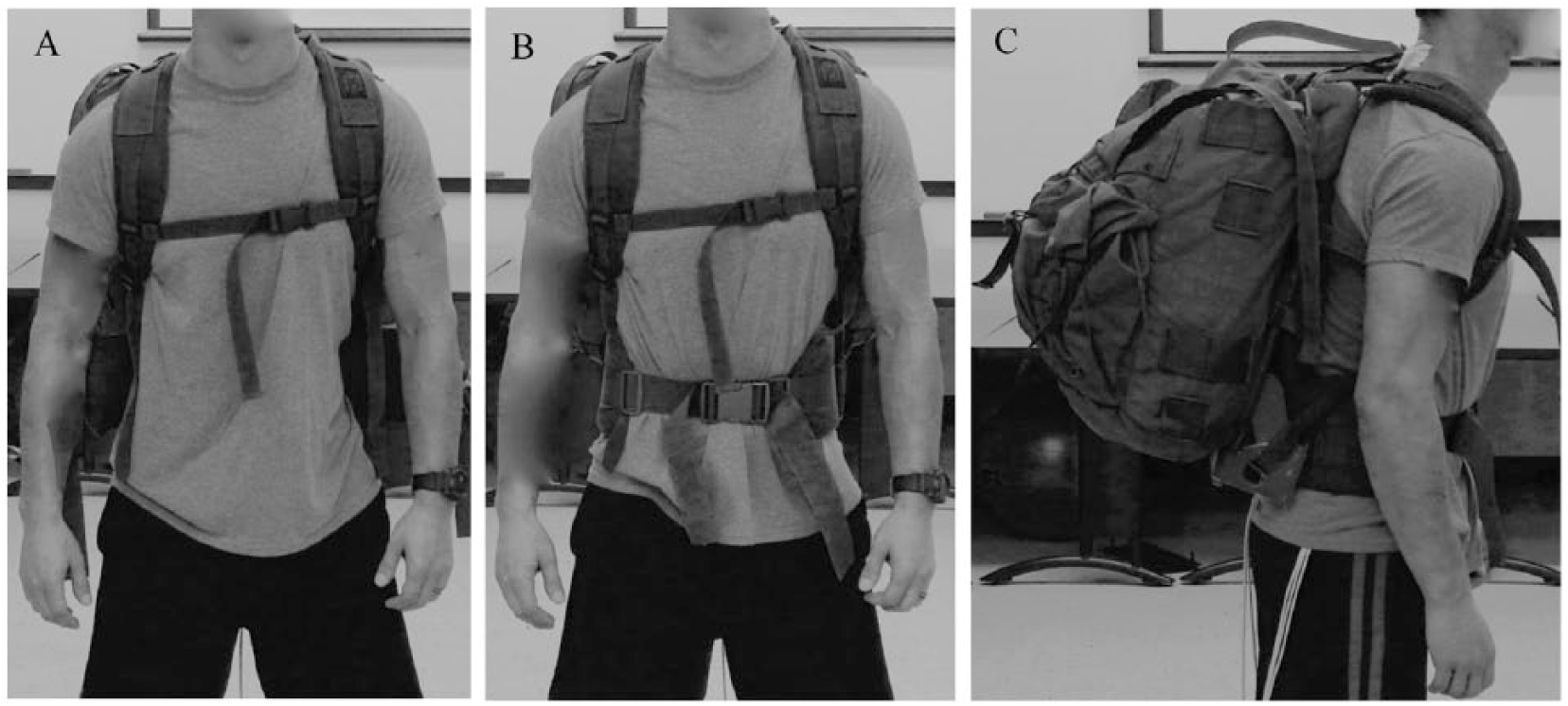
Pictures showing the backpack being worn in each condition. (A) Frontal plane view of the backpack in the nonstrapped condition. (B) Frontal plane view of the backpack in the strapped condition. (C) Sagittal plane view of the backpack in the strapped condition.
Data and Statistical Analysis
The VO2, RER, HR, and RPE values for each subject from minutes 4 and 10 were averaged for each trial. The 4th minute was selected because this is when all subjects were determined to be in a physiological steady state, namely, change in HR of less than 5 bpm for at least 2 consecutive minutes. The VO2 and RER values used in the statistical analysis were minute averages of the breath-by-breath measurements from the metabolic cart; these averages represent approximately 20 values collected during each minute of collection. Because each subject self-selected his own pace, not all subjects walked at the same absolute or relative VO2; therefore, change in VO2, RER, HR, and RPE values from the 4th to 10th minute were used for the statistical analysis. Paired t tests were used to evaluate the differences between the strapped condition versus the nonstrapped condition by comparing the change from the 4th to 10th minute for the following variables: VO2, RER, HR, and RPE. Statistical significance was established a priori at α = .05. Data are presented as mean ± standard deviation (SD) unless otherwise stated. All statistical analyses were computed using Statistical Package for the Social Sciences (SPSS) version 21.
Results
Mean data from the 4th, 6th, 8th, and 10th minutes for all physiological variables collected are reported in Table 1. Our results indicate that during the treadmill walk, the ∆VO2 from the 4th to 10th minute was greater (p = .046) in the nonstrapped condition (0.33 ± 0.88 mL.kg−1.min−1) than in the strapped condition (–0.62 ± 1.53 mL.kg−1.min−1) (Figure 2A). Further, Cohen’s effect size value (d = .76) suggests a high practical significance. In addition, the average ∆RPE from the 4th to 10th minute was greater (p = .007) in the nonstrapped condition (1.9 ± 0.8) than in the strapped condition (1.3 ± 1.0) (Figure 2B). Again, the Cohen’s effect size value (d = .75) for the ∆RPE suggests a high practical significance. No difference was found between the ∆RER (strapped 0.04 ± 0.05; nonstrapped 0.03 ± 0.01, p = .327, d = 0.28) (Figure 2C) or ∆HR (strapped 4 ± 4 bpm; nonstrapped 4 ± 5 bpm, p = .739, d = 0.12) (Figure 2D) between the two trials from the 4th to 10th minute of treadmill walking.
Physiological Measures (M ± SD) From the 4th, 6th, 8th, and 10th Minutes of Treadmill Walking at a Self-Selected Pace in the Strapped and Nonstrapped Conditions
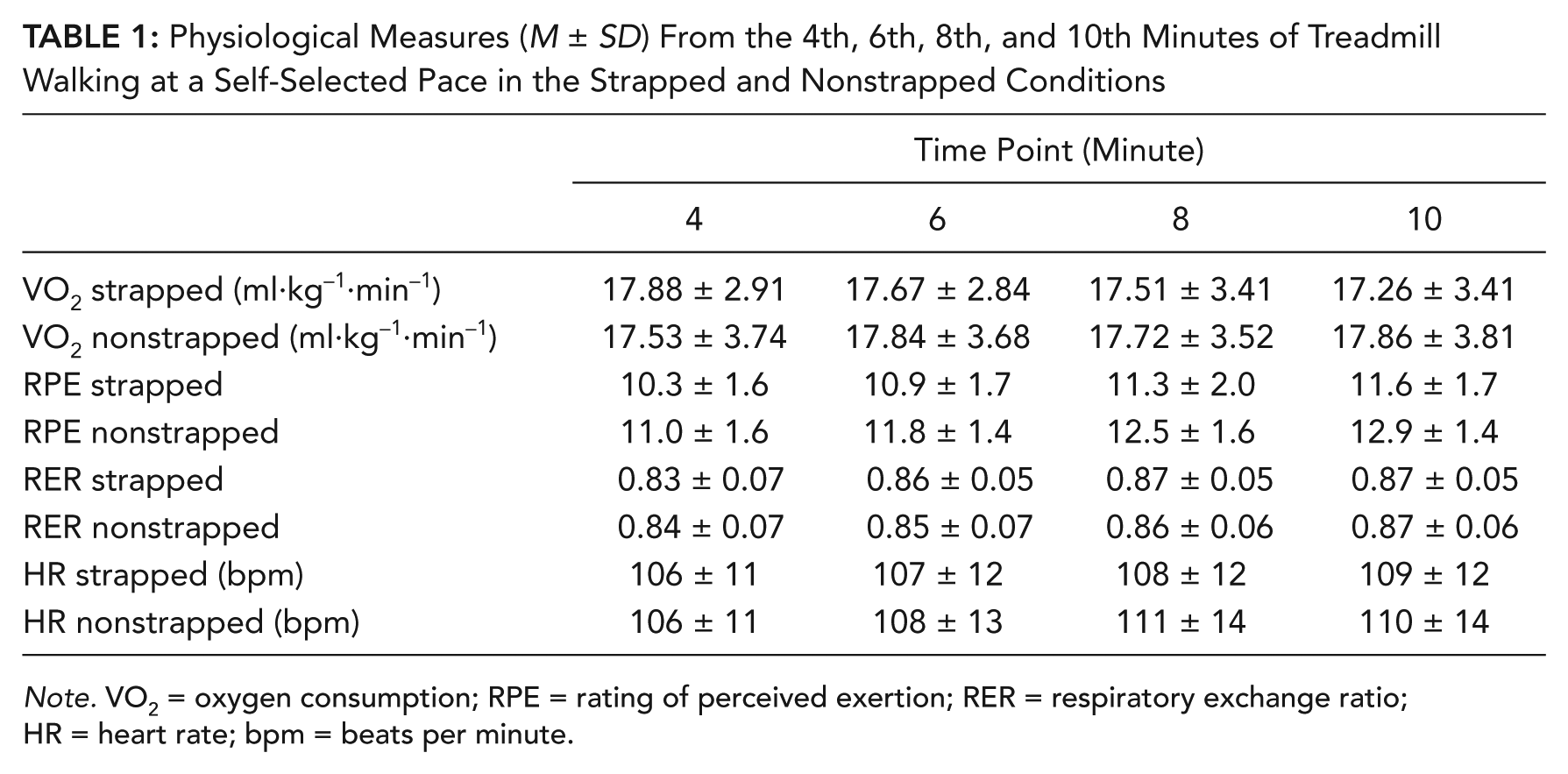
Note. VO2 = oxygen consumption; RPE = rating of perceived exertion; RER = respiratory exchange ratio; HR = heart rate; bpm = beats per minute.
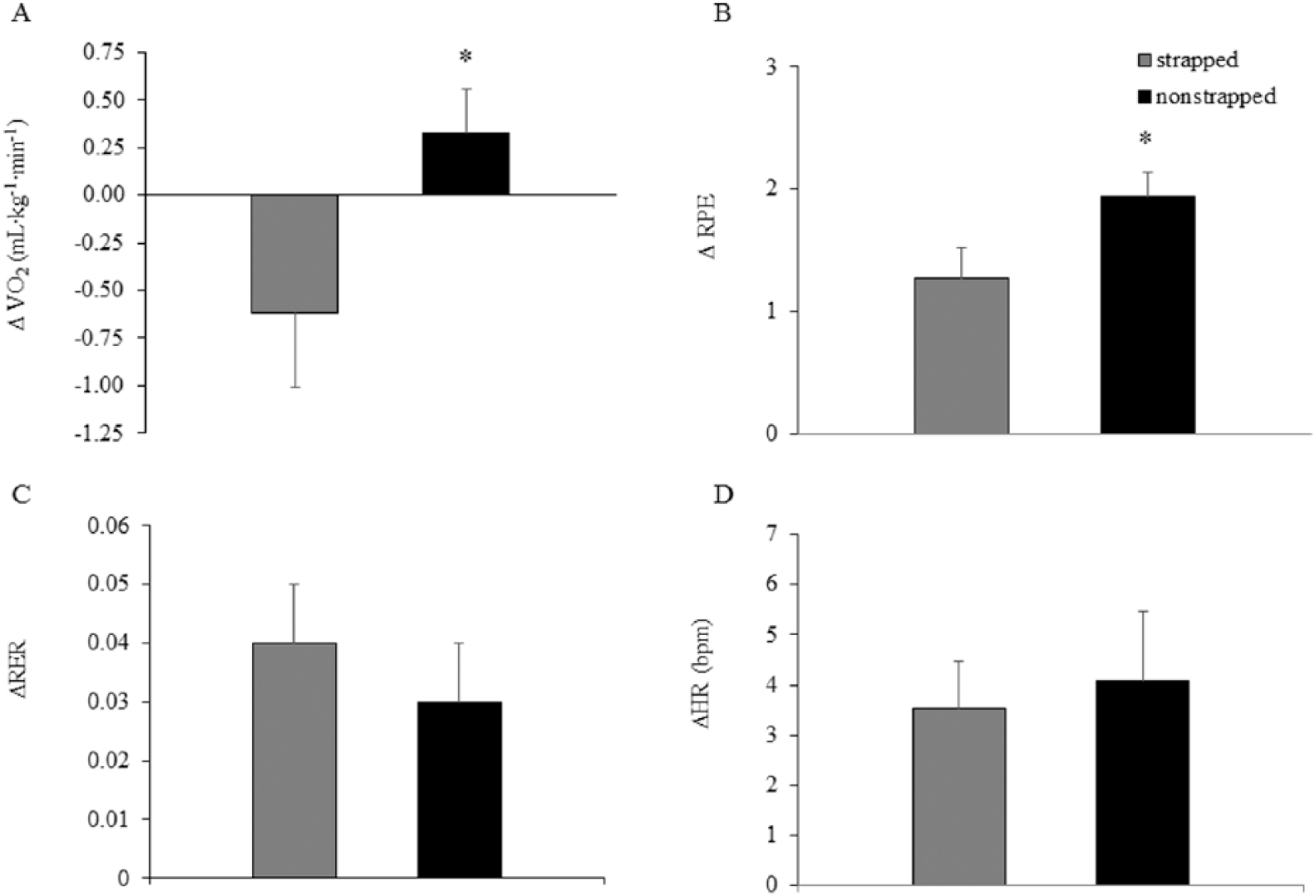
Results of the paired t test comparing the mean ∆ score between the 4th and 10th minute of treadmill walking for each condition. (A) Oxygen consumption (VO2). (B) Rating of perceived exertion (RPE). (C) Respiratory exchange ratio (RER). (D) Heart rate (HR).
Discussion
The overall objective of this study was to determine whether the use of a hip strap influences energy expenditure when carrying a loaded backpack while walking. The key findings are that the change in oxygen consumption and RPE were greater during nonstrapped backpack walking compared to strapped backpack walking after only 10 minutes of moderate pace walking. This suggests that using a hip strap may be of benefit, especially if these trends continue for longer times, and is worth considering when determining the energy cost of walking while wearing a backpack. A proposed mechanism for the hip strap benefit may be that it allows for better distribution of load across the hip and shoulder (Lafiandra & Harman, 2004). This redistribution of load to the hips may allow for more efficient movements, allowing for less ancillary movement, which is currently being investigated in our laboratory.
In the nonstrapped condition, oxygen consumption level increased slightly over the 10-minute trial. In the strapped condition, however, oxygen consumption level decreased slightly. This was found despite the fact that during both trials, subjects were confirmed to be in a steady state as evidenced by plateau in HR response for at least 2 consecutive minutes. This divergence of oxygen consumption between the conditions may have important implications for energy requirements during extended hiking periods. Epstein et al. (1988) found that the energy cost of hiking for 120 minutes on a treadmill was greater when wearing a 40 kg pack compared to a 25 kg pack. The authors suggested the difference was due to altered locomotor biomechanics due to the extra weight but did not assess the influence of a hip strap. Shoenfeld et al. (1978) found that despite a 5 kg difference in pack weight (30 kg vs. 35 kg), energy expenditure was not different in a 6 km hike but was greater for the heavier pack in a 12 km hike. Again the authors did not assess the effect of a hip strap on energy expenditure. In the present study, the change in VO2 was greater in the nonstrapped condition compared to the strapped condition in as little as 10 minutes of walking with an equal weight backpack. While the findings of the present study cannot be extended to demonstrate an influence in energy expenditure of longer trials, it is reasonable to believe that longer trials would result in a leveling off of the oxygen consumption, with the nonstrapped condition plateauing at a value above that in the strapped condition. Therefore, the use of a hip strap may have the ability to reduce the overall energy expenditure during long-distance hiking, and this is worthy of further examination.
The change in RPE from the 4th to 10th minute was less when the hip strap was used compared to without a hip strap. When performing physical activities, there are many factors that influence performance. One important component that may impact RPE specifically is biomechanical differences that result in increased muscular demand. It is possible that in the non–hip strap condition there is increased lateral or vertical movement of the pack leading to greater activation of the core muscles needed to minimize the impact of the sway while walking. This effect can affect oxygen consumption as well as have psychological effects. If a person thinks they are working harder than they objectively are, it may decrease their motivation, morale, and overall performance (Legg, Barr, & Hedderley, 2003; Vacheron, Poumarat, Chandezon, & Vanneuville, 1999). The RPE results in this study may have been due to the discomfort and subsequent psychological effects of only using the shoulder straps. The effect of the hip strap to reduce the load on the shoulder and distribute more of the load on the large musculature of the hips and lower extremities may explain this finding. However, further research into the precise mechanisms to explain the increase in RPE needs to be conducted.
We found no difference in change in HR or RER between the strapped versus nonstrapped conditions. This may be because the duration of the treadmill test was only 10 minutes and the relatively low level of work intensity. For instance, Shoenfled et al. (1978) demonstrated that as much as a 5 kg difference in pack weight (30 vs. 35 kg) was not able to elicit significant differences in HR or RER in a 6 km march but was elevated when the distance was increased to 12 km. Considering that both military personnel and recreational hikers routinely cover distances of 12 km and more, it is possible that if the duration of our tests were extended, the HR and RER may have increased in the nonstrapped compared to the strapped condition. Future research utilizing longer exercise periods and multiple intensity levels is warranted based on the present findings.
This study is not without limitations. The duration of the load carriage treadmill test when metabolic measurements were taken comparing the strapped to nonstrapped condition was only 10 minutes at a single intensity and load. Based on our results, had we used a 60-minute trial, several intensity levels, or multiple different loads, we would likely be able to extend our findings. However, this may have reduced the number of volunteers we were able to recruit. Also, our findings are limited to that of young, fit, male subjects. Therefore, it is difficult to generalize our results to females or other populations.
To better understand the effects of hip strap use on energy expenditure when carrying a heavy backpack, we suggest future research examine the interaction between duration, intensity, and weight of pack on energy expenditure under strapped versus nonstrapped conditions. In addition, the influence of backpack design should be examined; for example, customizable hip straps that allow the user to have a more personalized fit versus designs that have a universal fit for users with varying anthropometrics.
Conclusions
The present investigation indicates that the use of a hip strap allows for reduced oxygen consumption and perceived exertion of healthy male subjects in as little as 10 minutes of walking. These findings support the use of a hip strap to reduce energy expenditure and perceived exertion during hiking with a backpack, particularly if energy availability may be a limiting factor. Future studies should investigate the effects of hip strap use on oxygen consumption over longer periods of time, with lighter or heavier loads, and the biomechanical efficiency of movement.
Key Points
This research shows that employing a hip strap results in a lower change rate of perceived exertion in as little as 10 minutes of walking compared to walking without a hip strap.
When employing a hip strap, the energy expenditure was reduced in as little as 10 minutes of walking compared to walking without a hip strap.
Footnotes
Acknowledgements
Jamie Pigman is also with the University of Delaware, Newark, and Steven Leigh is also with Marshall University, Huntington, West Virginia.
Jamie Pigman is a PhD candidate at the University of Delaware in the Biomechanics and Movement Science Program. He received a MA from Montclair State University in exercise science in 2015.
William Sullivan is an associate professor at Montclair State University in the Exercise Science and Physical Education Department. He received an EdD in applied physiology from Columbia University in 1991.
Steven Leigh is an assistant professor of biomechanics at Marshall University in the School of Kinesiology. He received a PhD in human movement science from the University of North Carolina at Chapel Hill in 2010.
Peter A. Hosick is an assistant professor at Montclair State University in exercise science and physical education. He received a PhD in human movement science with a focus in exercise physiology from the University of North Carolina at Chapel Hill in 2011.