






Abstract
This article draws on insights from a variety of fields, including discursive psychology, ethnomethodology, dramatism, rhetoric, ante-narrative analysis and conversation analysis, to examine the discursive devices employed in the storytelling surrounding the recent financial crisis. Discursive devices refer to the linguistic styles, phrases, tropes and figures of speech that, we propose, are central to the development of a compelling story. We focus our analysis on the moral stories constructed during a public hearing involving senior banking executives in the UK. The analysis suggests that two competing storylines were used by the bankers and their questioners to emplot the events preceding the financial crisis. We propose that a discursive devices approach contributes to the understanding of storytelling by highlighting the power of micro-linguistic tools in laying out the moral landscape of the story. We argue that the stories surrounding the financial crisis are important because they shaped how the crisis was made sense of and acted upon.
It is a well-known feature of historical inquiries that an event can be reconstructed in countless ways. (Lynch and Bogen, 1996: 1) Men [sic] seek for vocabularies that will be faithful reflections of reality. To this end, they must develop vocabularies that are selections of reality. And any selection of reality must, in certain circumstances, function as a deflection of reality. (Burke, 1969: 59)
Introduction
The recent financial crisis, according to Colville and Pye (2010: 373), has led to ‘a collapse in collective sensemaking’. During major crises of this kind, taken for granted assumptions are suddenly open to question. Financial products and practices that were once assumed to be sustainable sources of economic growth and prosperity swiftly became de-legitimized, regarded instead as ‘questionable practices’ (Johnson and Kwak, 2010: 197) and ‘bogus’ sources of growth (McDonald and Robinson, 2009: 256). Highly respected individuals and institutions (bankers, regulators) suddenly became widely detested. ‘[T]he ideology of Wall Street – that unfettered innovation and unregulated financial markets were good for America and the world’ had been ‘the consensus position in Washington’ (Johnson and Kwak, 2010: 5) – but seemingly no longer. In such periods of grave uncertainty and highly disturbed sensemaking, the question of ‘what is going on?’ comes to the forefront: these are situations characterized more by ‘vu jade’ (never seen this before) rather than ‘déjà vu’ (Weick, 1993: 633–634).
In this article, we examine the role of storytelling in the process of making sense of the financial crisis. We follow Watson’s (2009: 429) definition of stories as ‘temporally sequenced accounts of events which unfold through plots involving the interplay of characters with interests, motives, emotions and moralities’. This article focuses specifically on the latter aspect: the way in which stories work to construct the morality of the characters involved. We examine the moral stories crafted during a public hearing in the UK that was designed to uncover ‘what (or who) went wrong’ during the recent financial crisis. We draw upon work in the fields of Discursive Psychology (DP) (e.g. Edwards and Potter, 1992), ethnomethodology (e.g. Lynch and Bogen, 1996), Conversational Analysis (CA) (e.g. Antaki and Horowitz, 2000), rhetoric (e.g. Billig, 1996), dramatism (e.g. Burke, 1969) and narrative (e.g. Boje, 2001) to examine the micro-linguistic tools – what we call ‘discursive devices’ (DDs) following Edwards and Potter (1992: 68) – used to build different emplotments of the ‘story’ of the financial crisis and paint a picture of the key characters, for example as ‘villains’ or ‘victims’.
Our approach is both inspired by, and builds upon, the ante-narrative perspective (Boje, 2001, 2008, 2010). Ante-narrative offers an alternative to the classical understanding of narrative as a ‘coherent, linear and ordered tale’ (Boje, 2001: 11) told by a single author(ity). Ante-narrative, in contrast, captures the ‘lived experience’ of storytelling in organizations where stories often have multiple authors (plurivocality), get built up in piecemeal fashion over time, often recounted only in fragments, never completely finalized and always open to new ‘twists’ as they are re-told. Ante-narrative is ‘ante’ in a double sense: both being ‘before’ a coherent and complete narrative – before the story is finalized, with a beginning, middle and end, complete with a morale and an agreed plot, and also being about ‘speculation’ – the ambiguity of trying to narrate ‘what is happening?’ in the flow of lived experience (Boje, 2001: 3–4).
Our approach to studying story-building through DDs contributes to the literature on ante-narrative by revealing the rhetorical processes through which stories are constructed in the face of counter-narratives. The lived experience of sensemaking within everyday interaction is often characterized by polyphony (Boje, 2001): many overlapping, interweaving (and perhaps even competing) narratives rather than a single coherent and authoritative storyline (see also Cunliffe and Coupland, 2012, this issue). Stories, we propose, ‘are shaped by and for their interactional contingencies’ (Stokoe and Edwards, 2006: 57) as they respond to the arguments and counter-arguments in which they are rhetorically located. Ochs (1997: 185) argues that narratives told in conversational situations often involve co-authorship, where others ‘ask questions, comment and otherwise overtly contribute to an evolving tale’. Such ‘conversational storytelling’, as Mandelbaum (1993: 247) calls it, is an interactive arena in which contrasting versions of reality can be proposed or inferred from ‘competing interpretations, or competing accounts’ (Gabriel, 2000: 49) of ‘what happened’. For example, Gabriel (2000: 47–49) describes two rival stories by management and staff about the suicide of a restaurant cook and Brown and Humphreys (2003) describe the competing stories told by management and staff about an organizational merger. Thus, narrators often have to deal with actual or potential counter-narratives that question or contradict their version of the story.
Telling a compelling story in conversational storytelling situations, we suggest, requires the ‘witcraft’ (Billig, 1996: 112) to ‘outwit’ actual or potential opposing stories. Alternative stories must be discredited or ‘disqualified’ (Antaki and Horowitz, 2000: 155) if the preferred story is to be credible. Stories can also ‘build in’ devices for handling the potential of being undermined. Stories of paranormal encounters, for instance, typically handle the potential of being discredited as wishful thinking or attention seeking through avowals of prior scepticism (Lamont, 2007). This form of ‘contrast structure’ device (Potter et al., 1984: 88) – ‘I used to think X but now I think Y’ – is a common discursive device used to present stories as credible by claiming they are counter-dispositional. Our ‘discursive devices analysis’ (DDA) approach (Mueller and Whittle, 2011) is valuable, we suggest, because it helps us to understand the linguistic methods through which storytellers deal with the contestation that occurs when ‘many different logics for plotting an ongoing event are still being investigated’ (Boje, 2001: 4). Our approach therefore brings ‘discursive struggle’ (Lynch and Bogen, 1996: 1) to the forefront of ante-narrative research and sheds light on the work involved in making stories plausible in the face of rival versions (Cunliffe and Coupland, 2012, this issue).
The article is structured as follows. The next section gives some background to the stories of the financial crisis. We substantiate our central theoretical perspective on moral storytelling and DDs in the two sections that follow. The article then moves on to illustrate our argument through analysis of the DDs extracted from a publicly available transcript 1 of the UK Treasury Select Committee hearing. We frame our analysis in terms of the two differently emplotted storylines narrated by the questioners (MPs) and witnesses (bankers). The final section discusses our conclusions and the wider implications of our analysis.
Moral orders and the story of the crisis
Moral plots dominate existing popular accounts of the financial crisis. ‘Insiders’ tell tales of immoral characters responsible for the ‘murder’ of respected institutions (Tibman, 2009), central characters (such as CEO and President of Lehman Brothers) were seen as having ‘essentially gone mad’ (McDonald and Robinson, 2009: 269), driving others ‘quietly nuts’ (2009: 248). The plot-lines of Greek mythology have been borrowed to analyse the ‘Sophoclean tragic hero’ involved in the collapse of Bear Stearns (Cowan, 2009: 277), the ‘Delphic’ quality of Greenspan (Sorkin, 2009: 62). Lehman Brothers was seen as ‘more a story of hybris than a tragedy’ (Ward, 2010: 227). Stories from Roman times were also borrowed by key actors at the time: the resignation of Pettit, then President of Lehman Brothers, was referred to as the ‘ides of March’ to refer to the day, ‘15th March, the day Julius Caesar was killed by his former friends in 44 B.C.’ (Ward, 2010: 5). The UK Treasury Select Committee hearings that we analyse here have been likened to the ‘catharsis’ that Aristotle described as an effect of tragic drama on its audience (CRESC, 2009: 19; see also Booker, 2004: 607).
Stories about failure are often constructed in very different ways to stories about success (see Maclean et al., 2012, this issue). As Bergmann (1998: 289) pointed out, an ‘unhappy event’ has to be reformulated as blameworthy or praiseworthy in order for it to become a topic for a moralizing discourse. Moral stories involve concerns about the social position of the self (and others), including issues of rights, duties, obligations, responsibility and potential blame (Harré and Van Langenhove, 1999; Van Langenhove and Harré, 1999: 23). By drawing on classical Greek notions of agency, responsibility and character, we can map the behaviour of characters onto a moral order (Harré and Gillett, 1994: 113). In this moral order, having done something, or having failed to do something – to call an alert or stop something happening – are actions that attract evaluation and, potentially, condemnation. We focus in particular on the moral character of key actors in the recent financial crisis. In Sorkin’s (2009) story of the financial crisis, for example, descriptions of the scene where Fuld sweeps his arm across (the more senior) Kaplan’s desk, knocking his paperwork to the floor (p. 22), invite certain assessments of Fuld’s moral character – painting a picture of an arrogant and intemperate man with little care for authority.
In this article, we build upon previous analyses of public texts, such as Brown (2000, 2004, 2005), by highlighting the moral positioning at work in such texts. A core assumption underlying our approach is that it is through ‘the self-identifying narratives and their embeddedness in communal life that the individual can be held morally responsible’ (Gergen, 1994: 103). For example, the report into the collapse of Barings Bank ‘paints a picture of Leeson as a clever and resourceful fraudster . . .’ (Brown, 2005: 1588). From the perspective suggested here, this report is a tale ‘rich in motivation and replete with assignments of responsibility’ (Edwards and Potter, 1992: 54). This also means that a different tale can be told that would allocate responsibility differently. Thus, a storytelling perspective based on DDA, views stories as vehicles for constructing, rather than reflecting, the relationships between elements in a particular plot and within a particular moral order (Potter and Wetherell, 2005: 18–19).
Storytelling, sensemaking and discourse
Stories are important because they are a key method through which people make sense of events. ‘Sensemaking’ is a broader term that refers to the process through which people interpret themselves and the world around them through the production of meaning (Weick, 1995). In a trouble-shooting context, for instance, stories will be told that attempt to make sense of the problem that now confronts the protagonists (Weick, 2001: 342). When trying to make sense of the origins of a crisis, authors will use ‘stories’ in order to colour the ‘background’ and make us understand the elements of the unfolding plot. Indeed, ‘organizational stories capture organizational life in a way that no compilation of facts ever can; this is because they are carriers of life itself, not just ‘reports’ on it’ (Czarniawska, 1997: 21).
Our aim in this article is to outline the contribution of DDA for the study of organizational sensemaking and storytelling. We use the term ‘discursive devices’ from the field of DP (Edwards and Potter, 1992: 68), although related terms such as ‘linguistic devices’, ‘rhetorical devices’ and ‘discursive strategies’ have also been used (e.g. Watson, 1995: 806, 810, 812). Existing work in storytelling has pointed to the importance of DDs (Gabriel, 2000: 115), but no systematic attempt has yet been made to map what these ‘devices’ are, or how they operate in the construction of stories. DP itself has a rich and varied intellectual heritage, drawing inspiration from the sociology of science, ethnomethodology, conversational analysis and socio-linguistics. We seek to advance this project of synthesis by bringing together these micro-linguistic disciplines with fields that consider broader issues such as dramatism, rhetoric, storytelling and narrative. One of the central aims of DDA is to study protagonists’ making sense of events as situated discursive practices. From a DDA perspective, discourse is studied not for what it reveals about mental processes, as in the correspondence model of language, but rather for how it acts as a flexible device for accounting for mental processes and, in so doing, achieving social actions (such as praising, blaming, excusing and so on). From a DDA perspective, sensemaking is viewed as a fundamentally social and situated activity, focusing on how ‘sense is built up sequentially [in interaction], turn-by-turn’ during interaction with others (Speer and Potter, 2002: 159). The value of DDA lies in its understanding of how these displays of sense perform social actions. For example, in Weider’s (1974) classic study of a correctional half-way house for newly released prisoners, rules such as ‘do not snitch’ performed the action of justifying a decision not to report the activities of fellow convicts. The rules were not cognitive structures that guided behaviour but rather were flexible resources for accounting for one’s actions.
Two psychological categories are of particular relevance to this study of the financial crisis: memory and personality. We examine how both accounts of memories of past events (‘what happened?’) and accounts of the personal dispositions of the self/other (‘what type of person am I/are you?’) perform ‘pragmatic and rhetorical work’ (Edwards and Potter, 1992: 54). For example, when ‘telling stories about past events . . . we do not (often) offer phenomenologies of merely conjuctive events, but provide tales rich in motivation and replete with assignments of responsibility’ (1992: 54). The bankers in our study, for example, used DDs to work up a version of events, through their ‘memories’ of what happened, that sought ‘to externalize responsibility, to blame circumstances and avoid unfavourable personal attributions’ (1992: 52). We use the term ‘character’ to refer to ‘different constructions of personhood, discursively available for placing in different kinds of narrative or to do different kinds of interpretive work’ (1992: 128).
The term DDA encompasses a variety of approaches that differ in the extent to which they seek to combine other perspectives, such as narrative analysis or post-structuralist ideas from Foucault, with the principles of Conversational Analysis (CA) and ethnomethodology (Speer and Potter, 2002: 156). For some scholars who seek to adopt a more ‘purist’ alignment with CA, DP should not be connected to narrative analysis. We instead follow the existing work in DP that draws connections between particular DDs with the development of certain narrative characters and plots. Wetherell and Potter (1992), for instance, have pointed to the role of discourse in positioning of characters in an emerging plot: ‘some of the actors in these dramas are no more than dupes, foils and ignorant scapegoats, others are sinister, Machiavellian figures with immense power . . .’ (p. 157). Others point to a long intellectual tradition of a ‘conversation-analytic approach to storytelling’ (Antaki and Horowitz, 2000: 156) that goes back to Sacks, such as his work on ‘second stories’ (Potter and te Molder, 2005: 24). Moreover, according to Czarniawska (1997: 13), ‘one criticism of ethnomethodological thinking is that it has difficulty in explaining the connections between various rules of accounting, which appear to be ascribed to specific situations.’ Hence, not all scholars using CA and ethnomethodology view storytelling as an antithetical approach: Lynch and Bogen (1996) focus on both the stories told in the Iran-Contra hearings and the stories of the hearings recounted in the popular press. We therefore follow Van Dijk’s (1997: 28) call for ‘further integration of various directions of discourse studies’ by forging productive links between the study of talk-in-interaction, rhetoric, storytelling and narrative.
Adopting this broader interpretation of DDA made us search for insights that could be gained from (ante-)narrative research as well as ethnomethodology approaches. Indeed, a major influence in this article is Lynch and Bogen’s (1996) ethnomethodological study of the storylines crafted by witnesses and defendants at the Iran-Contra hearings, based on testimonies from the 1987 investigation into the alleged sale of arms to Iran by senior US officials. The authors contrast the heroic storyline constructed by Lieutenant Colonel Oliver North during his testimony with the picture of a delusional, power-hungry and pathological liar painted by the questioners and other witnesses. For some, North succeeded in presenting himself as a patriotic American hero, who acted in the ‘national interest’. Lynch and Bogen (1996) follow Sacks (1992) in asserting that ‘people tell stories in such ways as to control inferences about the moral character of the teller-as-character’s actions in the story’ (Lynch and Bogen, 1996: 283). We also take up Brown’s (2005) argument that sensemaking is not a neutral, disinterested process but rather is a process ‘loaded’ with issues of power. Indeed, using an apt metaphor, just like telling a ‘good’ (i.e. convincing) story, for instance, enables actors to bolster their power and discount rival interpretations (Czarniawska, 1997). For us, the key question is: what DDs do people use to establish their version of the story as ‘what really happened’?
Method
The DDA approach we employ involves a particular approach to data collection and analysis. First, DDA’s commitment to studying talk-in-interaction means that we focus on naturally occurring data because they enable us to examine the stories constructed in situ by those involved in the sense-making following the financial crisis. These naturally occurring accounts are important precisely because they influenced the way in which the financial crisis was both understood and acted upon. Following Brown’s (2005) analysis of the reports following the collapse of Barings Bank, we view the Treasury Committee hearings as constituting an ‘important discursive contribution to people’s understanding of a significant episode in UK and global banking’ (p. 1584). One limitation of this publically available data source is that detailed Jeffersonian transcription, the established method of DP, was not possible. Only the official Treasury Committee transcription was available to us, meaning complex interactional features such as pauses and overlapping talk could not be transcribed. We acknowledge this methodological limitation, but remain convinced of the overall value of analysing public texts because they show how discourse is used in ‘creating, clarifying, sustaining and modifying’ a particular ‘version of “reality”’ (Brown, 2005: 1584).
Second, our DDA approach brings with it certain ontological commitments. Following DP, DDA views talk as a medium of social action, rather than a reflection of inner cognitive entities, such as thoughts, memories, emotions or attitudes. Hence, the job of the analyst is not to delineate the ‘true’ or ‘correct’ account among the competing versions produced by the questioners and witnesses in our study. ‘If people believe a story, if the story grips them, whether events actually happened or not is irrelevant’ (Gabriel, 2000: 4). Hence we focus on the ‘range of styles, linguistic resources and rhetorical devices’ (Edwards and Potter, 1992: 28) used to construct a ‘gripping’ story. For us, these ‘discursive devices’ are not stable cognitive entities; participants could well think and act in ways inconsistent with the particular story told in one encounter. This follows the principle outlined by Edwards and Potter (1992: 28) that ‘versions are likely to show variability according to the different interactional contexts they are constructed to serve’.
The transcript we analyse was part of a series of meetings and reports announced by the UK Treasury Committee on 25 November 2008 as part of its Banking Crisis inquiry. The inquiry involved a series of 17 oral evidence sessions, which we term ‘hearings’, involving banking executives, senior politicians, regulators and experts. This article focuses specifically on the hearing held on 10 February 2009 when four former bank executives were questioned by a range of MPs from across the political parties. The questions asked during the hearing were numbered in the publicly available transcript and are referenced accordingly (e.g. Q1570) in our discussion. A list of the participants in the hearing quoted in this article is given in Table 1 below.
Participants in Treasury Select Committee meeting 10 February 2009
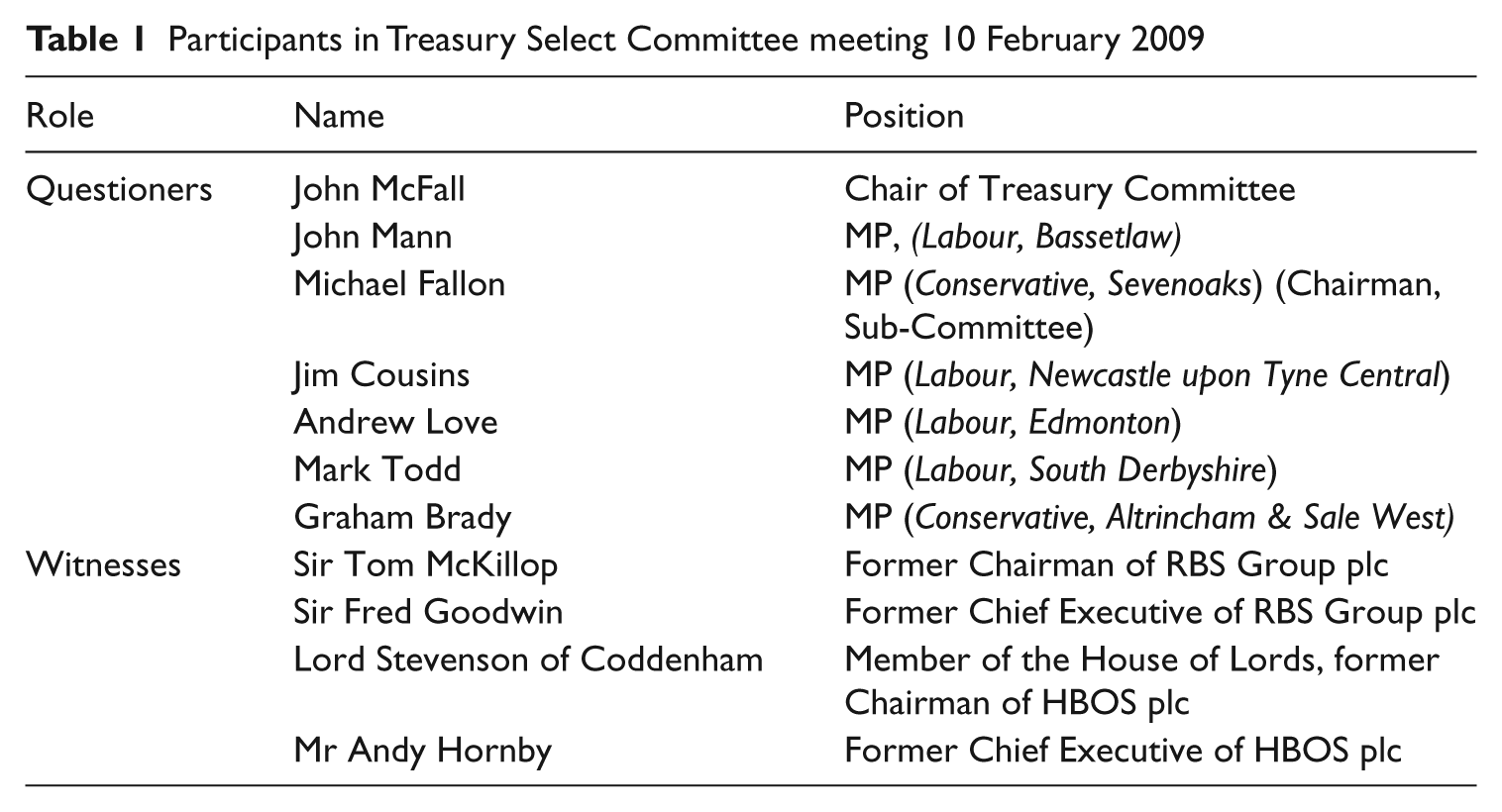
We focus on this single hearing for two reasons. First, an analysis of the entire range of 17 hearings would not be compatible with the detailed analysis of DDs we pursue in this article. The conversational analytic perspective adopted here has the advantage of demanding detailed analysis of specific conversational ‘episodes’; that is turn-taking exchanges within the ‘back and forth’ of a conversation. According to Antaki and Horowitz (2000: 157), it is important to study ‘the development of a piece of social action as it accumulates over the length of an episode; that is especially apt in the case of a storytelling, which can build over many turns’. Second, we chose this single hearing because moral issues of blame and responsibility would be likely to be fore-grounded here: the British media singled out bankers in particular, running regular stories about greed and excessive bonus payments.
The analysis was conducted through a process of coding the questions (by the MPs) and answers (by the bankers) within the transcript, to highlight the way that both events and actors were described. Taken in isolation, each question-answer sequence appeared somewhat separate, focused as they were on interrogating the bankers’ memories of their past actions and past events. Taken together, however, the two parties (MPs and bankers) appeared (to us) to build two competing plots about the events leading up to the financial crisis. It was through the process of analysis that we noticed that issues concerning the morality of the bankers appeared to be the central difference in the two competing storylines. While the categories used in Tables 2 and 3 are our categories, based on our reading of the data, some were employed by the participants (or observers) themselves: for example, ‘victim’ was used by a questioner while ‘villain’ was used in a US cross examination (of Fuld). Questions of morality, or indeed other sensitive issues such as ‘interests’, are typically dealt with implicitly rather than explicitly precisely because of their sensitivity (Potter, 1996: 148; Whittle and Mueller, 2011). Indeed, the value of DDA lies in its appreciation of how accusation, blame, responsibility and so on are performed implicitly through inferences, where listeners are invited to ‘hear’ a certain attribution in the description of events. For example, the accusation of ‘vested interests’ against the Islamic establishment by writer Salman Rushdie analysed by Potter (1996: 125) is done through inference. In our case, for instance, the question ‘Did any of that go to your head?’ is a more subtle, and probably more convincing, way of insinuating that the person is arrogant, egotistical and self-absorbed than an explicit accusation as such. In fact, Edwards and Potter (1992: 103) argue that criticisms of this kind ‘are very often precisely the occasion for extended sequences of competing descriptions as participants formulate the scene to display their moral status’. Hence, the term ‘villain’ was not used by the questioners themselves, it was instead ‘invited’ as an inference from the phrasing of their questions. Similarly, the term ‘victim’ was inferred in the discourse of the bankers, not used explicitly.
Competing storylines constructed during Treasury Select Committee hearing on 10 February 2009
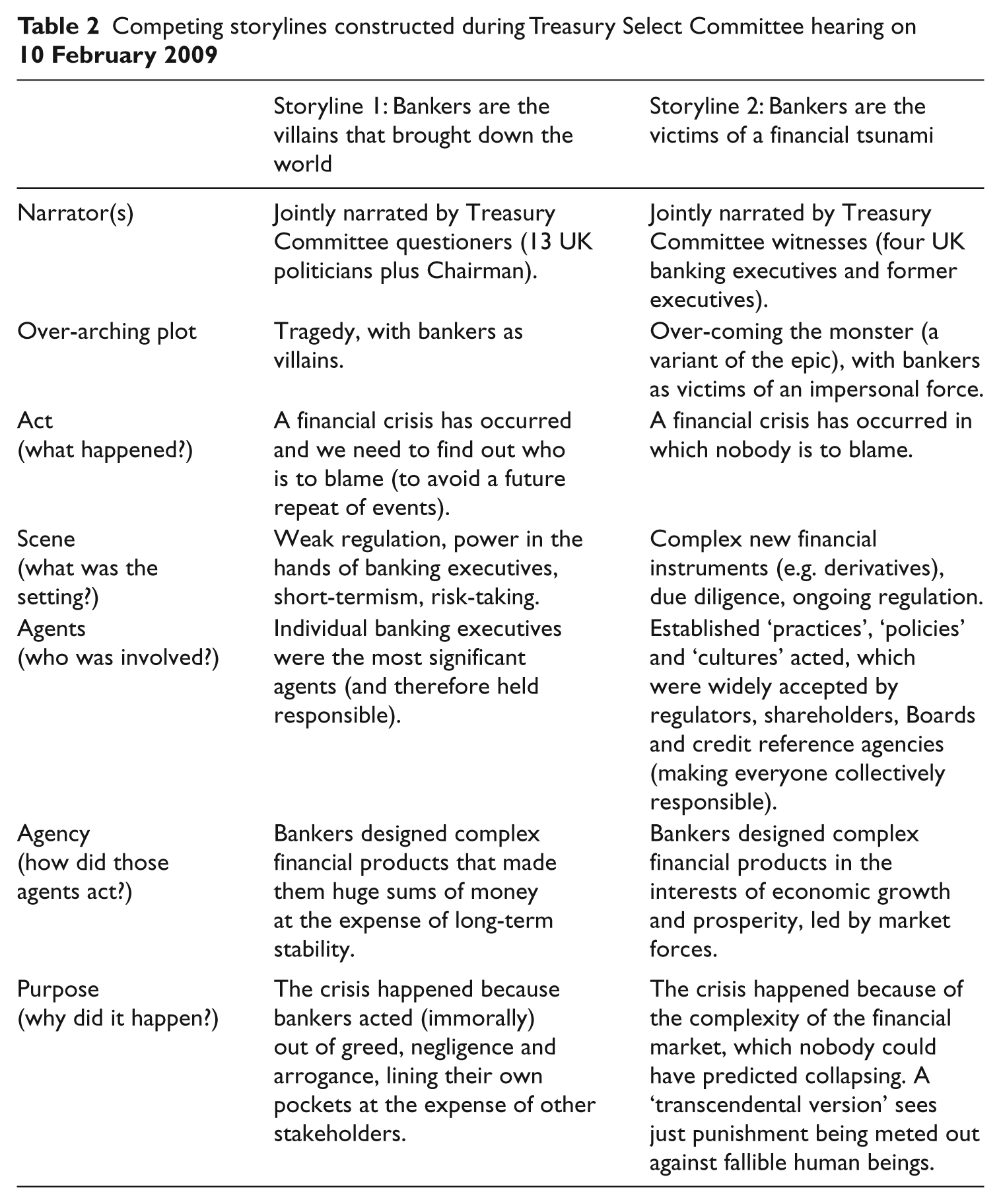
Two tales of the financial crisis
There are only so many ways to emplot (give a plot to) a narrative and it is likely that any new storytelling, whether consciously or not, draws on some of the archetypal structures of emplotment. Frye (1971 [1957]: 163–239), Czarniawska (2004: 21) and White (1978: 70) all distinguish between comedy, romance, tragedy and irony or satire. Booker (2004), however, argues that there are seven main types of plot-line used in classic stories: the Quest, Rags to Riches, Overcoming the Monster, Re-birth, Comedy, Tragedy, and Voyage and Return. Building on this typology, we make sense of the narratives constructed during the Treasury hearing in terms of two plot structures: tragedy and overcoming-the-monster.
Finer distinctions can be drawn within each category: Czarniawska (2004: 22) distinguished between two types of tragedy emplotment, namely a triumphant one and a fatalistic one. Gabriel (2000) also identifies ‘gripes’ as a sub-category of tragedies, which are ‘tragic stories without a villain, the victim usually attributing his or her misfortunes to error, negligence, or system failures’ (Gabriel, 2000: 72). According to Booker (2004: 156), the tragedy pattern typically unfolds by going through five distinct stages: in the Anticipation stage, the hero (or heroine) is in some way incomplete or unfulfilled. In the dream stage, he (or she) becomes in some way committed to a course of action (e.g. Faust signing his pact with the devil). In the Frustration stage, slowly things start to go wrong. In the Nightmare stage, things are comprehensively slipping out of the hero’s control accompanied by a mounting sense of threat and despair, with the forces of fate and opposition closing in. In the Destruction stage, either by hostile forces or his own act, the hero is destroyed. We argue that a form of the ‘tragedy’ emplotment is used by the questioners at the Treasury enquiry, which we label ‘Storyline 1’ (see Table 2). The main difference lies in the portrayal of the bankers in our case as ‘villain’ rather than ‘hero’. According to the MP’s storyline, the (in-)actions of the bankers are portrayed as the ultimate source of the financial crisis.
In the overcoming-the-monster plot, there is also a sub-plot in which there is a ‘relentless build-up towards some inevitable doom, followed in the nick of time by miraculous deliverance’ (Booker, 2004: 46). The term ‘monster’ does not necessarily refer to a huge ‘beast’ or ‘ogre’. In many stories using this plot, the monster is a huge and menacing impersonal event or force, such as a mysterious plague (Camus), or a threatening pendulum (EA Poe). We argue that this alternative emplotment of the financial crisis is put forward by the bankers, what we call ‘Storyline 2’ (see Table 2), where it is an overwhelming and impersonal force that threatened the global economic system – as opposed to their own (in-)actions. There are some elements that suggest a hero-in-an-epic narrative, albeit without the typical ‘happy ending’. The breakdown of the system in the weeks following the Lehman collapse is portrayed in Storyline 2 as a ‘temporary’ defeat followed by ‘ultimate’ victory: the bankers imply that a much worse crisis has been averted thanks to their swift actions. This would then still fall under the ‘epic’ category: ‘Defeats are important parts of epic plots, though their main purpose is to allow the hero to show his or her fortitude and sacrifice, helping to reinforce the poetic effect of the crowning triumph’ (Gabriel, 2000: 77).
For Burke (1969: xv), life is not just like a drama, life is a drama. When we interact, we employ all the features of a human drama to tell a compelling story: using the features of the act, scene, agent(s), agency and purpose to narrate a version of what happened and why it happened. We follow Czarniawska (1999: 64) in viewing Burke’s pentad as that which ‘permits creating a plot.’ According to Burke (1969: 56), the pentad provides a synoptic framework for mapping the way people narrate events. Table 2 uses Burke’s Pentad to summarize our view of the two competing storylines crafted by the questioners (MPs) and witnesses (banking executives). Mills (1940: 905), drawing on Burke, uses the term ‘vocabulary of motive’, which means that any action is not driven in real time by a determining motive, but can be described under different vocabularies of motive. For example, with regard to one and the same action, a soldier may be motivated to kill (nationally) and, simultaneously, ‘motivated by a horror of killing’ individually (Burke, 1969: 37). For Burke, the scene-act and scene-agent ‘emphases’ or ‘ratios’ are crucial. Where the scene dominates in the scene-agent ratio, this requires ‘that the “brutalizing” situation contain “brutalized” characters as its dialectical counterpart’ (Burke, 1969: 9). In effect, this replaces ‘acting’ with being ‘moved’ (1969: 10). Indeed, in a materialistic vocabulary, we assign ‘scenic terms to motives situated in the agent’ (1969: 49) for example, by emphasizing the overwhelming power of ‘objective circumstances’. Burke made the important point that when referring to our jobs/roles under ‘capitalist industrialism’, ‘often the element of action is reduced to a minimum and the element of sheer motion raised to a maximum’ (p. 14), such as in reference to ‘market forces’. Here, the agent/agency is sidelined and it is the scene that does the ‘work’ of the story.
Burke’s point about ratios is significant for our purposes because the stories told by the MPs and bankers differed significantly in the scene-agent ratios they used. The MPs emphasized the agent in their version of the story, seeking to place responsibility on the shoulders of the bankers being questioned. Emphasizing the agency of the agent is crucial for a tragedy plot: ‘The attribution of guilt to a malevolent agent or suitable scapegoat is a central theme of tragic stories’ (Gabriel, 2000: 49). The bankers, in contrast, emphasized aspects of the scene: the background setting of new financial products and practices, global interconnection of institutions, market forces and so on. The bankers downplayed or denied their own role as agents: either through reference to other agents (e.g. regulators, credit reference agencies, shareholders, etc.) or by reference to a wider collective force (e.g. the Board, markets, culture). These narrative structures are not unique to our case. According to Gabriel (2000: 40), denying (or downplaying) the role of the agent/agency is a common tactic for ‘cast[ing] a possible villain in the role of a victim’. Moreover, these different ratios are important, we suggest, because they produce different ways of making sense of what happened and why. As Table 2 shows, where the two storylines differ most is regarding the cause of the tragedy. In Storyline 1, crafted collectively by the 13 MPs and the Chairman of the Committee, the tale is one of greedy, unscrupulous and immoral ‘villain’ bankers who almost singlehandedly brought down the global economy. In Storyline 2, crafted collectively by the four banking executive witnesses, the tale is one of a global financial tsunami that they did not create, could not have predicted and to which they are themselves ‘victims’.
The moral status of the bankers (i.e. as ethical or unethical people) is a crucial theme of the plot of both storylines. In the two sections that follow, we analyse a series of extracts from these two storylines to illustrate the role of DDs in building these contrasting moral landscapes.
Storyline 1: The making of a villain
Formally, the Chairman stated the aims of the hearing as ‘a) to find out how we arrived at this situation; b) how we get ourselves through this present severe economic recession; and c) what the future of regulation in the financial services will look like’ (Q1644). Yet, as Lynch and Bogen (1996) argue in their analysis of the Iran-contra affair, ‘when the interrogator invites the witness to tell his story, he makes it clear that he already has in hand a version of the events and their circumstances against which he can compare that story’ (p. 162). The use of certain DDs in the construction of their questions, we argue, enabled the MPs in our case to narrate their own story about the causes of the crisis. We focus our attention here on how the questioners framed the moral responsibility of the bankers.
The first extract we have chosen to analyse concerns the moral positioning around the notion of injustice. At several points in the proceedings, the questioners make a pointed show of highlighting the salaries of the bankers. One such example is given below:
Q1656 Mr Brady: Sir Fred, I think in 2007 your remuneration was £4.1 million or thereabouts, of which about two-thirds was in the form of a bonus. Mr Hornby, I think the figure for you was about £1.9 million, about half of which was bonus.
A discussion of remuneration practices then followed these remarks. Later, however, the questioners employ a device known as rhetorical contrast (Edwards and Potter, 1992: 138, 146) to highlight the moral status of the bankers:
Q1705 John Mann: How much is JSA for an adult of, say, age 42? Mr Hornby: I beg your pardon? Q1706 John Mann: Job Seekers Allowance? Mr Hornby: I do not know the precise amount but it is a very low quantity of money. Q1707 John Mann: Because that would be the profile of the bank staff and I think it is your age as well. I do not know whether you are going to be relying on £60.50 of Job Seekers Allowance? Mr Hornby: I accept the fact I am a similar age to the average age.
The questioner (MP John Mann) asks Mr Hornby (former Chief Executive of HBOS plc) the amount of money given to the unemployed on Job Seekers Allowance in Britain. We classify this as a rhetorical question because Mann clearly knows the answer to the question already (see Q1707) and presumably asks the question to elicit a moral account rather than a factual response. Mann sets up a rhetorical contrast between the salary of those (he claims are) responsible for the crisis (banking executives like Hornby), and those who are ‘innocent victims’ of the crisis (bank staff who have lost their jobs). The story implied here is one of an evil villain enjoying the ‘spoils’ of his greedy actions while his victims suffer in poverty. In so doing, the MP appeals to the universal grammar of ‘monetary motive’ (Burke, 1969: 44) to explain the cause of the crisis. The monetary motive itself is not questioned here: it is rather the injustice of the distribution of riches that is the target of condemnation. Interestingly, Hornby refuses to ‘play along’ with this storyline and accepts the story only on a ‘technical’ rather than ‘moral’ level. He accepts that he is a ‘similar age to the average age’ but refuses to be drawn into reflection on the moral injustice of the contrast between his ‘riches’ and the poverty of his ‘victims’. In so doing, he contests the moral positioning of the ‘villain’ character being constructed by the questioner.
Our second extract concerns the moral standing of the bankers in terms of questions of their incompetence, lack of care and duty, self-interest and greed:
Q1695 John Mann: Mr Hornby, are you personally culpable, or is it essentially bad luck that leaves you to be facing the music for your industry today? In other words, are there bankers out there at the moment who are thinking, ‘There but for the grace of God go I’? Mr Hornby: I have already said on behalf of the Board we accept full responsibility and have apologised for the events that have taken place, so please do not in any way suggest that I am trying to avoid personal responsibility . . .
Mann sets up an invitation for Hornby to assess his own moral status as somebody who is either morally unethical by virtue of being responsible for the events (‘personally culpable’) or an innocent victim of outside events (‘bad luck’). We view this as the rhetorical use of attributional discourse (Edwards and Potter, 1992: Ch 5), in this case attribution of cause, where the issue of who (or what) we can attribute as the cause of events is accomplished. In attributional discourse, versions are constructed to ‘assign responsibility and negotiate moral issues of blame, duty and praise’ (Edwards and Potter, 1992: 127). Mann invites the listener to compare and contrast the two competing storylines being crafted by the questioners (Storyline 1) and bankers (Storyline 2). He also invites the bankers to declare their allegiance to one of these storylines: either ‘I was wrong and I am to blame’ (an issue of unscrupulous morals and bad character: Storyline 1) or ‘I was just unlucky and anybody else would have done the same’ (an issue of somebody just doing their job but being victim to external forces: Storyline 2).
Hornby deals with this attribution of cause in an interesting way. He actually concedes and accepts the questioner’s storyline by accepting ‘full responsibility’ for the events. Is this evidence, therefore, of the victory of Storyline 1? Our analysis of Hornby’s response suggests otherwise. Hornby uses the collective pronoun term ‘we’ rather than ‘I’ by accepting responsibility ‘on behalf of the Board’. This presents him as part of a Board of Directors who made decisions collectively, thereby distributing blame and responsibility. He presents himself as someone who was just ‘doing his job’ and following the decisions made by the Board: ‘He is innocent in the sense that what happens to him is far greater than anything he has done provokes, like the mountaineer whose shout brings down an avalanche’ (Frye, 1971 [1957]: 41).
The DDA approach offers a valuable lens on the moral work being done here by showing how descriptions of past events are not neutral recollections of memories but rather act to deal with issues of responsibility, blame and moral standing. In our case, Hornby’s subtle attribution of responsibility to ‘the Board’ (rather than himself) mitigates against the (actual or potential) accusation that he was personally culpable. In short, Hornby uses attributional discourse to appear to cooperate with the story being constructed by his questioners (Storyline 1), while also attempting to translate this into his preferred alternative version of events (Storyline 2).
The next extract is important because it shows how a similar translation of meaning occurs in the framing of agency:
Q1671 Mr Fallon: Why did you and your Board allow Sir Fred to go ahead with this huge deal without an escape clause when ABN had already pre-sold LaSalle, when the credit crunch had already begun, and when everybody else said you were paying too much? Sir Tom McKillop: The premise that we allowed Sir Fred to proceed implies that this was driven by Sir Fred, which is not the case. When the announcement of the ABN Amro merger with Barclays was made the Board received a presentation from our strategy group and the executive team, an analysis of the ABN Amro businesses; we looked at that in considerable detail. The Board had 18 meetings between March when we received that first analysis following the announcement by Barclays and ABN, in which ABN Amro was considered at every one of those. There was no proposition to buy ABN Amro at the first meeting; it was an analysis session. At every stage the whole Board considered this and were unanimous in the steps we took. It is wrong to characterize it as a proposition driven by Sir Fred that the Board were unable to stop.
The insights from Discourse Psychology enable us to understand how the attribution of agency works in this extract. According to Edwards and Potter (1992: 103), ‘attributional issues of blame and agency [are] dealt with precisely via the construction of alternative descriptions’. Attributing responsibility for wrongdoing may be done jointly with reporting of an ‘unhappy’ incident (Pomerantz, 1978). Here, the questioner (MP Michael Fallon) tells a story of a ‘plan’ (the decision to purchase ABN Amro) that was hatched by a central character, ‘Sir Fred’ (Sir Fred Goodwin, former Chief Executive of RBS Group plc). The others involved are implicitly cast as being ‘duped’ into following this central character in spite of the apparent ‘madness’ of the plan (‘the credit crunch had already begun’ and ‘everybody else said you were paying too much’). Sir Fred is thereby presented as the villain hatching a cunning plan, presumably to line his own pockets (although this is not explicitly stated), while his ‘accomplices’ were presumably too stupid, loyal or similarly motivated by greed to stop him.
McKillop, former Chairman of RBS Group plc, immediately rejects the ‘premise’ of this story. He constructs his own attribution of agency in which Sir Fred is not the evil villain who hatched the plot and controlled everyone else ‘under his spell’. The plot is re-cast as a carefully considered decision, based on detailed analysis, lengthy discussions and ‘unanimous’ agreement by everyone on the Board. A particular scene-act ratio (Burke, 1969: 13) is deployed to ‘substantiate this judgement’: ‘The scene-act ratio can be applied . . . deterministically in statements that a certain policy had to be adopted in a certain situation’. Descriptions of the scene where ‘18 meetings’ had led to a ‘unanimous’ decision of the ‘whole Board’ work to warrant the act of purchasing ABN Amro. The decision was portrayed not as a ‘cunning and greedy plan’ hatched by a single villain but part of the normal, rational process that not only this Board, but all Boards of Directors, routinely follow. McKillop implies that the hunt for the villain is futile: there is no villain, weakening the foundations of the MPs’ storyline.
In the final four extracts below, the questioners tackle the issue of moral responsibility head-on. We have excluded the responses for reasons of space, but needless to say that each ‘accusation’ is immediately and vigorously denied by the ‘accused’ (the reader is invited to check the publicly available document). These extracts employ what Antaki (1998: 71) calls identity ascription: explicitly ascribing a particular identity – a particular set of personality traits, attitudes and moral dispositions – to a person:
Q1863 Jim Cousins: Sir Tom, have you either asked for or been given any legal advice on the nature of criminal negligence?
Q1873 Mr Love: Okay, let me come back to that. Sir Fred, I read with interest the biography you gave to us which tells us that you were number one in Scotland on Sunday’s annual power list for several years in a row, European Banker of the Year in 2004, European Business Leader of the Future as well. Did any of that go to your head?
Q1874 Mr Love: Can I ask you, Mr Hornby, you were a Managing Director in Asda before you were 30 and you were the CEO of HBOS before you were 40. Did your reputation as a wunderkid affect you in any way?
Q1880 John Mann: Sir Fred, you made the extraordinary statement to Mr Cousins in response to a question in that you defended the strong financial position and good business position of the bank on 16 September and, three weeks later, the Government was having to stick in £20 billion of capital to keep the bank going. I put it to you that you do not like criticism, do you? You like people who bring you the good news and you do not like people who bring you the bad news.
A particular moral picture of the key characters is painted in these extracts. Extract 4 implies that McKillop is potentially guilty of criminal negligence, being so motivated by self-interest that he failed to protect the interests of the Bank. In Extracts 5 and 6, the implication is that both Goodwin and Hornby were driven by their arrogance, vanity, egotism and sense of self-importance. The main character in the story, according to the rhetoric of ‘attributions of motive’ employed by the questioners in Extract 7, is a negligent, arrogant, vain, self-serving agent. We propose that the moral status of the central character – the evil villain banker – is pieced together, turn by turn, in the way questions such as these are constructed. Moreover, a particular scene-agent ratio (Burke, 1969) is employed. In all these questions, aspects of the agent (what type of person the bankers are) are emphasized over and above aspects of the scene (the background setting in which the bankers acted).
The final extract we analyze is important precisely because the identity of the bankers as ‘victim’ or ‘villain’ is tackled head-on. This extract is relevant for our purposes because it deals explicitly with the participants’ own moral assessment of the character of the bankers:
Q1819 Mr Todd: You are presenting yourselves gently as victims in this process? Lord Stevenson of Coddenham: No. What can be quite plain, the denial, absolutely not . . .
MP Mark Todd uses a combination of two DDs: identity ascription (Antaki, 1998: 71) and reflexive conceptualization (Auburn, 2005: 701). Reflexive conceptualization refers to instances where speakers explicitly reflect on the meaning of their own (or others’) talk, to guide hearers towards a particular interpretation. This kind of ‘talk about talk’ is a pervasive feature of everyday interaction because it enables speakers to ‘cancel, substitute or renew’ prior segments of their talk (Auburn, 2005: 701). In Extract 8, Todd reflexively summarizes the bankers’ prior talk as guiding the hearer towards viewing them as ‘victims’. By using these two DDs, Todd invites the audience to assess the plausibility of the story of the bankers. Are you trying to make us think of you as victims? Should we believe you? Although Stevenson unequivocally rejects this idea, what these DDs do is serve to subtly undermine the bankers’ storyline, by ‘exposing’ their attempts to avoid taking responsibility by claiming to be a ‘victim’. The morality of the bankers is thereby questioned even further: not only are they to blame because of their greed and arrogance, they are also strategic manipulators, dishonourably trying to dodge blame and shirk responsibility.
Storyline 2: The making of a victim
It was not surprising that the bankers sought to resist, re-cast and re-frame the moral story crafted by the MPs above. In this section, we examine some of the key DDs used by the bankers to construct their own ‘moral story’.
While the questioners attempted to portray the bankers as arrogant, greedy and negligent, the bankers attempted to re-cast their characters in more moral, humane and sympathetic terms:
Q1641 Chairman: Thank you very much. May I start by saying this is an opportunity for you to provide your side of the story. Maybe my first question has been leaked if we look at the papers this morning; maybe all the questions have been leaked. However, is ‘sorry’, the hardest part, Lord Stevenson? Lord Stevenson of Coddenham: No, Chairman, and thank you for giving us the opportunity, right upfront, because there has been a lot of talk about the ‘s’ word. You have given me the opportunity to repeat what both Andy and I said to our shareholders when we met them at the EGM, that we are profoundly and, I think I would say, unreservedly sorry at the turn of events. Our shareholders, all of us, have lost a great deal of money, including of course a great number of our colleagues, and we are very sorry for that. There has been huge anxiety and uncertainty caused in particular for our colleagues but also for periods of time for our customers. I would also say, Chairman, we are sorry at the effect it has had on the communities we serve. There is nothing sudden, there is no turn of events; we said it publicly at the EGM and we have felt it throughout.
Edwards (1997) argues that empathy is a device that can be used to make a person (and their actions) appear more balanced, justified and sensitive. Stevenson, the former Chairman of HBOS plc, not only repeats his ‘profound and unreserved’ apology but elaborates in some detail on his sympathy and concern for the impact on a range of actors: shareholders, colleagues, customers, communities. He presents himself as someone who both understands and feels the position of others affected by the crisis. He also presents his feelings of sorrow and regret as sincere, not just ‘sudden’ and prompted by the question, but rather something he has felt ‘throughout’.
Why is the empathy device important for the storylines constructed during this hearing? Empathy is an important device for moral storytelling because it is more difficult to cast someone into the role of ‘villain’ if they display themselves as caring and compassionate persons. Villains are expected to be callous, ruthless and unconcerned by the misery and destruction brought about by their actions. While displaying empathy does not mean that the protagonist avoids blame for what happened, they are no longer cast as a wicked and malevolent villain. Stevenson presents himself as someone who may have made ‘bad decisions’ (technical dimension) but is not a ‘bad person’ (moral dimension). Many of the character traits of the typical ‘epic hero’ described by Gabriel (2000: 76) are inferred here: ‘loyal, impetuous, decisive, wise, controlled, dedicated, compassionate, approachable, loving and caring’.
Some other important devices are employed in Stevenson’s reply. First, notice how he specifically apologizes for the ‘turn of events’. Nominalization (Wetherell and Potter, 1992: 154) refers to the process of replacing nouns with verbs, adjectives or adverbs to avoid mentioning those who performed the action, particularly to avoid attribution of blame or responsibility. For example, ‘Police killed the rioters’ is transformed into ‘The killing of the rioters’. In this extract, Stevenson avoids mentioning his own role (i.e. ‘I am sorry for what I did’) by avoiding a personal pro-noun and instead saying he was sorry for ‘the turn of events’. Similarly, in the Iran-Contra hearings analysed by Lynch and Bogen (1996), Oliver North deviates from his typical self-presentation of himself as a man of action by making his agency peripheral to the event by saying ‘he became aware of what was really trying to be moved’ (sic), referring to the shipment of Hawk missiles (p. 165).
Second, the phrase ‘turn of events’ also relies on a device known as externalization or ‘out-there-ness’. Externalization refers to the process by which actions and events are presented as out of the control of the actor, simply part of the ‘world out there’ (Edwards and Potter, 1992: 105). Accounts are often carefully worked up to present what they describe as ‘out there’, lying outside the account itself (Potter, 1996: Ch 6). In Extract 9, Stevenson presents himself as simply ‘caught up’ in events beyond his control. In terms of Burke’s (1969) concept of ratios, aspects of the scene are emphasized over the actions of the agent. There was a ‘turn of events’ in which the bankers simply found themselves ‘caught up in’, unable to control.
Third and finally, notice how Stevenson emphasizes that the crisis has affected not only shareholders, but ‘all of us’. This can be seen as an example of membership categorization (Edwards and Potter, 1992: 51, 160), that is, the group categories used to describe yourself and others, including what responsibilities, expectations, rights and obligations are involved. Stevenson’s claim that ‘all of us’ have been affected constructs a common group with a common identity: ‘we are all in this together’. In fact, Goodwin later recounts the ‘considerable losses for me and my colleagues who have shares in the company’, and Hornby later states: ‘I have lost considerably more money in my shares than I have been paid’. What this membership categorization (‘I am just like you, I have been hurt too’) helps to achieve is an image of their character as an innocent victim rather than wicked villain by inviting this question: Surely we cannot be villains if we have suffered as well?
Our final extracts are instances where the bankers used the discursive device of concession by accepting certain elements of the MP’s storyline (Storyline 1). Rhetorically, conceding a counter-argument is not always a sign of defeat. On the contrary, a concession is an example of a ‘reflexive comment’ that presents the speaker as critical of themselves and their own ideas, and therefore to be trusted as a fair judge (Mulholland, 1994: 82). In fact, according to Antaki and Wetherell (1999), a ‘show’ concession makes ‘a show of conceding and, in making such a show, fortifies the speaker’s position against misunderstanding or attack’ (Antaki and Wetherell, 1999: 23). The two extracts that follow demonstrate the important rhetorical work performed by concession in our study: in a counter-intuitive way, concession acted to bolster the banker’s own storyline (Storyline 2) rather than affirm the MP’s opposing storyline (Storyline 1):
Lord Stevenson of Coddenham: . . . Looking back, with the wisdom of hindsight, we did not foresee the deterioration in asset values that took place, it is as simple as that. (Answer to Q1833)
Mr Hornby: I think if you look hard at the facts from 2006 and 2007 when I took over as CEO, we did try and preserve capital, we stopped the buyback programme, we reduced asset growth and we pulled back on mortgage market share. Of course, looking back, I would have liked to have done even more and I concur with the views that other people have said on the panel. We did not fully prophesize the complete closure of wholesale markets post-Lehman’s when wholesale markets were operating on an overnight basis. We did prophesize reductions in liquidity. I believe there are very few people in the world who foresaw the complete collapse and I regret that because clearly I would have tried to pull back even more. (Answer to Q1748)
These two concessions are interesting precisely for how they help to construct the moral standing of the protagonists. In Extract 10, Lord Stevenson concedes that he did not ‘foresee’ the crash in asset values. In Extract 11, Hornby similarly concedes that he did not ‘prophesize’ the collapse of the wholesale markets following the collapse of Lehman Brothers. We analyse these as ‘show’ concessions (Antaki and Wetherell, 1999: 23) because they make a show of conceding a point that does not actually question their moral integrity. Rather, they re-formulate the MP’s storyline by trivializing the accusation and acknowledging the obvious. How could anyone be expected to be a ‘fortune teller’ and predict the crash in the markets? Or single-handedly control how the markets reacted? The concessions act to undermine the storyline crafted by the questioners (Storyline 1) by highlighting the impossible moral and technical standards being expected of the characters. In terms of Burke’s (1969) concept of ratios, emphasizing the role of the scene (the setting in which the act took place) – such as ‘deterioration in asset values’, ‘closure of wholesale markets’ and ‘reductions in liquidity’ – served to minimize the role of the agent (bankers).
Discussion
During the testimony we have analysed, the bankers had to achieve a complex balancing act: they did not want to discredit the system as a whole; nor did they want to blame the leading actors (which included themselves). This task of ‘accounting for failure’ is often a tricky task. For vegans, for instance, DDs (such as presenting veganism as ‘easy’ and ‘normal’) enable advocates to put the blame for nutritional deficits on the agent ‘without degrading or undermining the ideal itself’ (Sneijder and te Molder, 2005: 677). Vegans have been found to use script formulations – such as ‘it’s almost impossible to lack anything [nutrients]’ (Sneijder and te Molder, 2005: 682) – to claim that the problem is not with veganism per se but the individual’s fault for failing to adopt a ‘correct’ vegan diet. What these devices achieve is to account for failure while maintaining faith in the system itself. Accounting for error in this way is crucial to the maintenance of an ideology: whether it is the ideology of veganism or the ideology of free market capitalism. An even more complex kind of attribution is made by the bankers in our case: they do not think that the system should be radically changed; nor did the main agents act recklessly. Neither the system nor the agent should be blamed or punished. Quite simply, system failures are very rare (‘once in a lifetime’), therefore we should retain our faith in the system. Thus, a rare nature-like disaster (like a plague or hurricane) was constructed to play the role of the villain in the story and ‘explain’ the financial crisis.
The pattern of storytelling we have analysed here has relevance beyond the UK: it is being repeated around the world. When Fuld, the CEO of Lehmann Brothers, sat down for a congressional hearing after the Lehman collapse, John Mica, a Republican congressman said to him, ‘If you haven’t discovered your role, you’re the villain today. You’ve got to act like a villain’ (Sorkin, 2009: 505). However, Fuld himself had lost extraordinary amounts of money due to the Lehman bankruptcy: shares that were once worth 1 billion dollars had declined in value to a paltry 65 thousand dollars. He, like our protagonists, tried to extract empathy from his listeners by suggesting he was a fellow victim: ‘As incredibly painful as this is for all those connected to or affected by Lehman Brothers, this financial tsunami is much bigger than any one firm or industry’ (p. 506). The metaphor of a tsunami is therefore centrally important here (used by Fuld but also the Chairman, in way of attribution, in Q1899 in our case): it presents the events as analogous to extreme weather conditions that are beyond the control of the individuals involved and which indiscriminately create victims. Indeed, the prototypical ‘cultural symbolism’ of the victim is built around a person ‘faced with forces over which he or she has no control’ (Gabriel, 2000: 48). Interestingly, the tsunami metaphor was also invoked in the recent testimonies to the US Financial Crisis Enquiry Commission – pointing to the potential for a global pattern of storytelling. Burke’s (1969) notion of scene-agent ratio is significant for understanding the power of the tsunami metaphor: emphasizing elements of the scene through reference to materialism, the ‘matter and motion’ (p. 131) of the physical world. Descriptions of the scene as a ‘tsunami’ invokes the idea of laws of cause-and-effect beyond the control of the individual’s ‘reason and mind’ (p. 171), downplaying the role of the agent.
The storyline crafted by the bankers themselves defends the morality of their character by presenting their actions as morally sound and widely accepted as legitimate. A potentially blameworthy action, such as a substantial change in the company’s leverage, becomes re-formulated as part of a sudden and unexpected nature-like disaster: the disaster is the result of a ‘global tsunami’ and the bankers themselves are victims. The moral vocabulary is one of joint suffering, cooperation (to get through this) and non-competitiveness (in an emergency we need to fight our competitive instincts). This is diametrically opposed to the moral vocabulary normally employed by senior executives, which is about ‘market value’, competition between firms and in labour markets, highly competitive compensation, and rampant individualism (McDonald, 2010).
The DDs we have analysed performed a particular social action for both the MPs and the bankers, namely the ‘casting’ and ‘re-casting’ of the moral status of their character. One set of devices worked to paint a picture of a greedy, arrogant, negligent villain (Storyline 1), while another set worked to re-cast the bankers in positive moral terms as caring, compassionate and competent types of people (Storyline 2). Table 3 summarizes the DDs we have identified in the two storylines.
Discursive devices used in the construction of the two storylines
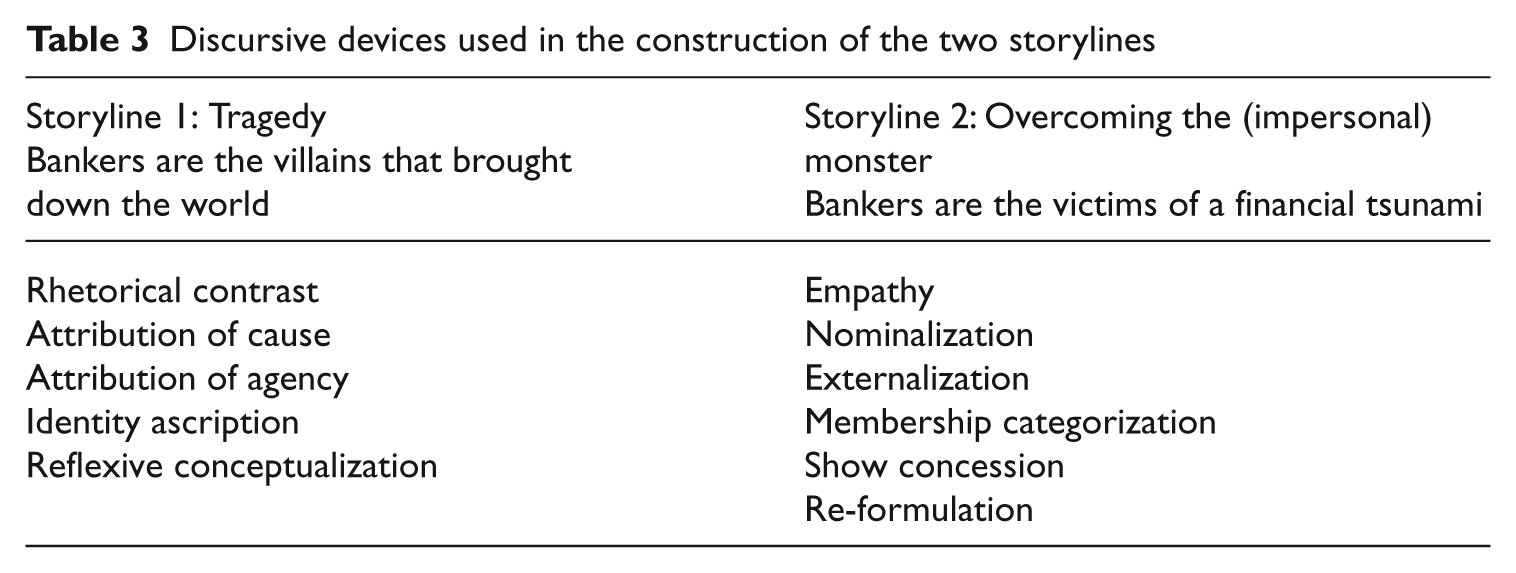
Storyline 1 is a variation of how a Tragedy can be emplotted. Let us briefly reflect on the typical structure of a tragedy: already in the beginning stage, something is, at least slightly, ‘wrong’. The seeds are sown early. In every instance of tragedy that Booker (2004) discusses, the hero’s obsession is drawing them into ‘something which violates and defies some prohibition or law or convention or duty or commitment or standard of normality. They are being tempted into stepping outside the bounds which circumscribe them’ (2004: 174). But within these commonalities, there are distinctions, indeed gradations exist ‘according to the extent to which the hero or heroine is primarily the malevolent author of other people’s sufferings, or is just a victim of his or her own folly’ (2004: 182). In Storyline 1 constructed by the MPs, ‘malevolence’ was a crucial element of their story: transgression of moral standards demanded some form of public humiliation and retribution. Storyline 2, constructed by the bankers, we interpreted as an example of an Overcoming the Monster plot, albeit with an impersonal monster: the plague (Camus) creates widespread devastation and salvation only comes in the last minute. There is no villain here, just victims trying to save themselves and salvage what they can from the devastation around them; plus an element of heroism from those (Paulson, Dimon, Brown) who made the system function again (Brown, 2010; McDonald, 2010; Paulson, 2010).
Our analysis shows that there are different ways to emplot the narrative of the financial crisis; there is clearly not one objective account. Moreover, even within a single plot structure, such as the tragedy emplotment, there may be different sub-types available to the narrator. Fuld and Lehman Brothers, for example, could be emplotted along the King Lear tragedy, with the central-character-as-monster plot structure (Booker, 2005: 184–185). In this ‘dark’ version of the financial crisis, ‘The forces of darkness unleashed by Lear’s initial act of heartless folly had proved too powerful’ (p. 185). Fuld’s increasingly desperate phone calls, especially to the private home of the Bank of America CEO during the fateful Saturday (Sorkin, 2009: 306–307) are highly reminiscent of King Lear in the ‘Nightmare stage’, ‘with the poor, weak old man wandering through a stormy night on the desolate heath’ until, eventually, he dies broken-hearted (Booker, 2004: 184). In the opposite emplotment, everyone was ravaged by a devastating plague/tsunami but the ‘senior executives stood as the delivering hero . . . performing heroic deeds in the epic mode’ (Gabriel, 2000: 118). The ‘surviving’ CEOs, such as Blankfein of Goldmann Sachs, or Dimon of JP MorganChase, are likely candidates for this kind of emplotment. In light of most banks being ‘saved’ in one form or another, some might even dare to give the tale a ‘happy ending’ (Brown, 2010; Paulson, 2010).
Conclusions and implications
Our theoretical point of departure was the issue of how people account for and justify their actions using storylines. We have sought to demonstrate the value of understanding the role of micro-linguistic practices, or ‘discursive devices’ (DDs) as we call them, used in the construction of stories. We have used discursive devices analysis (DDA) to examine the moral stories constructed in the cross-examination of four senior executives of banks that received state support (‘bail-outs’) from the UK Treasury. Public hearings such as these could be viewed as nothing more than a symbolic ritual, designed to act as a public façade and make the Government appear to be ‘acting’ and ‘mitigate public anxieties’ (Brown, 2005: 1579). We think that storytelling should not be read as simply ‘hot air’: the stories told by the bankers in our case had implications for who (or what) was assigned responsibility for the crisis and what should be done about it. These stories shaped both public opinion and policy responses. As Humphreys et al. (2012, this issue) also show, sensemaking is prospective as well as retrospective and therefore informs future actions (Lynch and Bogen, 1996: 23) – even if stories only offer a plausible narrative rather than strict causality (Polkinghorne, 1988: 21).
Our central contribution lies in showing how DDs are used as linguistic building blocks in the construction of moral stories. When a crisis of sensemaking occurs, and the dominant and well-established storyline (see Pemer and Näslund, 2012, this issue) is no longer plausible a new story must be crafted to make sense of what happened and why. The plot and characters of a story, we suggest, only start to form a meaningful story when these devices build up a moral landscape within which the events unfold. For example, stories often revolve around the creation of ‘villains’, ‘heroes’, ‘victims’, ‘bystanders’ (guilty and innocent) and so on. These characters are far from ‘fixed’ and ‘stable’ within the ongoing narration of conversations: protagonists may move from hero to villain to hero again, for instance (Whittle et al., 2009; see also Cunliffe and Coupland, 2012, this issue).
Our analysis also demonstrates the importance of an ‘ante-narrative’ (Boje, 2001, 2008, 2010) lens, which means studying the collective, piecemeal and fragmented process of jointly narrating events. Bruner (1990: 160) described the contextual shift in discursive psychology such that coming to know anything should be seen as a situated and distributed, and therefore typically collective, accomplishment. ‘Storytelling is fundamentally interactive. Recipients and tellers work together to bring a story to the floor, to sustain it, and to end it, working out together what the story is “about”’ (Mandelbaum, 1993: 253). We contribute to the study of ante-narrative by bringing insight into the DDs used when stories are contested, questioned or undermined by competing storylines. The ‘lived experience’ of storytelling, we suggest, can be ‘combative’ as well as ‘concertive’. Stories often have alternatives to contend with, some of which might be more coherent or convincing: ‘The crucial aspect, as always, is whose story will be accepted and become part of the general currency of explanation, whose version of events, whose account of the way things are?’ (Wetherell and Potter, 1992: 62).
We follow Edwards and Potter’s (1992: 54) argument that ‘accounts of past events need to be examined as pieces of discourse – as contextualized and variable productions that perform pragmatic and rhetorical work’, not as cognitive representations of memories or mental maps. Before the final ‘story’ of the financial crisis is established, multiple storylines circulate, some gathering momentum and getting adopted or adapted, others losing credibility and falling by the wayside. Our analysis shows that the rhetorical skills of the narrator are crucial for dealing with competing storylines. DDs can enable storytellers to do two things: (a) establish the credibility and validity of their own story, and (b) discredit alternative versions of the story. DDA also offers a unique contribution to the storytelling field by enabling us to understand how accounts are constructed to appear factual, not as a ‘mere story’ but rather ‘what really happened’ (Edwards and Potter, 2005). In addition, DDA helps us to understand how supposedly ‘factual’ accounts can be discredited by making them appear to be ‘just a story’, to be interpreted as self-serving, inaccurate or biased in certain ways (Edwards and Potter, 2005). For example, the act of accusing a banker of presenting himself as a ‘victim’ (see Extract 8) works to discredit the banker’s account by presenting it as ‘self-serving’ and ‘face-saving’. Thus, DDA departs from Gabriel’s (2000: 5) argument that ‘factual or descriptive accounts of events that aspire at objectivity rather than emotional effect must not be treated as stories’. In contrast, DDA is valuable precisely because it enables us to see how certain narratives are constructed to present themselves as an authentic, genuine, factual or objective version of events. People use DDs, we propose, ‘during the course of their talk to make their version of events appear “real” or “literal”’ (Abell and Stokoe, 1999: 298).
Periods of crisis, economic or otherwise, are of particular interest to studies of moral storytelling, because a crisis often intensifies processes of interpretation and sensemaking (i.e. ‘Why did the crisis happen? Who is to blame?’). A ‘classic case’ would be the multiple attempts to ‘make sense’ of the Mann Gulch disaster (see Maclean, 1992; Weick, 1993). When things do not work out quite as expected, we need to find some-thing or some-body to be held responsible (Mandelbaum, 1993: 253). Actors are called upon to justify or excuse their own role (or lack thereof) in the crisis and thereby defend their own moral standing and reputation. However, we propose that moral storytelling is not exclusive to crisis sensemaking. Acts of moral positioning are routine events within organizations. Hence, we propose that DDA has the potential to illuminate other types of storytelling situations, particularly where moral accounting is involved. For example, Clarke et al. (2009) examine the moral stories told by managers to justify their actions and decisions. They also notice a tendency to appeal to external economic factors in justifying their decisions (for instance to downsize the business), enabling them to deflect blame and avoid moral accusations. DDA enables us to see this as a classic type of ‘externalizing device’ and thus contributes to storytelling analysis by providing a systematic catalogue of the kinds of linguistic tools through which moral stories are told.
We view moral storytelling as an ongoing process rather than a one-off event, because stories are themselves accountable and may therefore be subject to a change in positioning (Harré, 1993 [1979]: 138). The storylines we identified are ‘fragile stories’ (Sacks, 1992: 504–511): this means that they take potentially controversial moral positions about the events, which can be subject to rival emplotments. Take, for example, the argument that the crisis was not foreseen because ‘. . . we’re not smart enough as people. We just cannot see events that far in advance’ (Greenspan cited in Ishikawa, 2009: 343). This account is susceptible to the counter-argument that both executives and policy-makers have themselves exhorted the need to generously pay for exceptional talent. Is the point of having exceptionally talented people at the helm not exactly that, namely to steer clear of deep crises? Our analysis shows how DDs are used by storytellers to resist or undermine opposing stories in this ongoing ‘discursive struggle’ (Lynch and Bogen, 1996: 1). As Czarniawska (2004: 9) observes, ‘there is no way of deciding between different stories except by negotiation’.
This does not mean that all stories are equal. Some accounts have more convincing plots than others. As Polkinghorne (1988: 19) puts it: ‘Not every plot can order a set of events. An appropriate configuration emerges only after a moving back and forth or tacking procedure compares proposed plot structures with the events and then revises the plot structure according to the principle of “best fit”’. Power is also at play in deciding which story is the story. In some cases, ‘other people or institutions sometimes concoct narratives for us, without including us in any conversation; this is what power is about’ (Czarniawska, 1997: 14). But, as Czarniawska points out, ‘even as puppets in a power game, we are still co-authors of history, that other enacted dramatic narrative in which we are also actors’ (Czarniawska, 1997: 14). Hence, there is an alternative to every ‘official’ story, including the official report into the Barings Bank collapse, for instance (Brown, 2005: 1588). Even in a single version of the story of the Enron collapse, the role of blame (and villain) was allotted to many parties: the US government, Enron executives, auditors, or sometimes all of them (Czarniawska, 2004: 9).
Our argument is that much can be gained for the study of sensemaking and storytelling from synthesizing insights from an extensive body of work in DP, (ante-)narrative analysis, dramatism, rhetoric, ethnomethodology and Conversational Analysis. In Lynch and Bogen’s (1996) ethnomethodological analysis of the (in)famous case of Ollie North, in the Iran-Contra hearings, it was moral storytelling that enabled him to be transformed from someone who entered the hearings as the ‘person suspected of being the main instigator’ into ‘the character who emerged [as] an American hero’ (p. 102). It is worth noting that these authors, while rooted in ethnomethodology and CA, go beyond the situational in order to make a point about narratives and their broader impact. Likewise, in the case of our analysis, the protagonists (bankers) crafted a story in which they attempted to re-position themselves as victims (in an overcoming-the-monster plot) rather than villains (in a tragedy plot). In so doing, the protagonists used DDs, including empathy, nominalization and externalization in order to construct a favourable character for themselves and reject the idea that they have behaved in morally questionable ways, such as being negligent, incompetent or arrogant. 2 The moral and dispositional qualities of the characters are therefore key to the unfolding of a plot: in the bankers’ telling of the story, they are strong but compassionate leaders, standing firm when faced by a once-in-a-lifetime event. They were also ‘innocent victims’ caught up in an event that was akin to a tsunami or a plague.
Our DDA perspective also enables scholars within the DP and CA traditions to gain a deeper engagement with the storytelling literature by viewing DDs not as isolated, but as embedded in broader narrative constructions, which tend to follow classical emplotments. We suggest that future research can be directed towards identifying and mapping the stock of DDs that are used in narratives that span different institutional contexts. However, combining a DDA storytelling focus with narrative analysis (e.g. Czarniawska, Polkinghorne, White) is not straightforward. Stokoe and Edwards (2006: 63) argue that for a DP-inspired analysis of stories,
We do not need a theory of narrative . . . It is not so much that, in ordinary talk, we find fragments of ‘narratives’. Rather, it is that narratives and their analysis build upon the everyday kinds of accountability that are the pervasive concern of ordinary talk.
Hopefully, we have shown that DDs, which centrally incorporate the idea of pervasive accountability, can be analysed with regard to their role for overarching narrative structures.
What difference does adopting a DDA approach to storytelling make? The contribution of DDA lies in its appreciation of discourse as social action. Viewing discourse as social action enables us to appreciate the performative aspects of storytelling: what the stories achieve or perform for those telling them. For the bankers, for instance, casting themselves as ‘victims’ enabled responsibility and blame to be (potentially) avoided. This is not simply about ‘saving face’, it is also about maintaining the legitimacy of the system that, to date, has also benefited them. For the politicians also, casting the bankers as ‘villains’ enables a convenient ‘scapegoat’ to be found, individualizing responsibility. The MPs were able to present themselves as ‘serving the public’ by locating and ‘punishing’ the perpetrators, while also avoiding any questions about the role of government in the crisis. DDs, then, are not simply trivial matters of semantics – ‘mere rhetoric’ – but serve important political and ideological functions. Stories can of course generate greater understanding or even ‘enlightenment’ but, at the other extreme, they are also ways for manipulating an audience: ‘this makes stories particularly dangerous devices in the hands of image-makers, hoaxers, spin doctors, and fantasists’ (Gabriel, 2004: 19). The ex US Treasury secretary, Paulson (2010: 348–349) argues that the ‘rhetoric to blame the U.S. government’, especially in the wake of Lehman’s collapse, was ‘a simple, easy-to-understand story’ which served the purposes of those who used it, such as Europe’s political leaders. The stories crafted by politicians, therefore, also served to legitimate particular actions (or inactions). For example, populist policies like the introduction of a ‘super-tax’ on bankers’ bonuses in the UK make sense in the context of the moral transgression-retribution plot constructed by the politicians: the bankers are the ‘wrong-doers’ and therefore must be ‘punished’.
Storylines that individualize responsibility and attribute blame to a few ‘rogue’ individuals take the focus away from national and international failures in regulation and oversight. Public anger gets directed towards the individual. By individualizing responsibility, the ideology of free-market capitalism remains largely unquestioned. The crisis is presented as a mere ‘blip’ in a normally smooth-running system, caused by a few ‘rogue’ individuals, and the ‘grand narrative’ (Lyotard, 1979) of neo-liberalism remains intact. As Stiglitz (2010: 6) observes, ‘bankers acted greedily because they had incentives and opportunities to do so, and that is what has to be changed’. Thus, while it may be natural to want to search for ‘culprits’, the problem with explanations based on the excessive greed of the bankers is that they fail to provide a basis for reform. To blame the ‘system’, on the other hand, diffuses and distributes moral responsibility away from individual bankers towards more general systemic failings, inviting the possibility of more widespread reform. A great deal certainly rests on which story, the politicians’ or the bankers’ emplotment, will eventually become embedded in our society’s ‘repertoire of legitimate stories’ (Czarniawska, 1997: 16).
Footnotes
Acknowledgements
We are very grateful to the three reviewers and the guest editors for guiding us along the stages of the review process and helping us to turn this into what we believe is a much improved paper. All remaining errors are solely our responsibility.
This research received no specific grant from any funding agency in the public, commercial, or not-for-profit sectors.