







Abstract
Because job crafting research proposes that individuals alter jobs on their own, there is an open debate on how others influence an individual’s job crafting. Whereas previous research has recognized that incumbents engage in job crafting depending on the characteristics of their own job, this study shows that job crafting depends on the job characteristics of the incumbents’ network contacts, meaning all employees in the organization with whom the incumbents frequently communicate about task-related issues. Applying role theory, the article theorizes that network contacts act as role senders who affect job crafting because they communicate role expectations that vary as a function of their own task activities. Key empirical findings show that contacts’ autonomy and contacts’ feedback from the job positively affect job crafting, whereas contacts’ task significance exercises a negative effect. The findings further show that the effect of job crafting on performance depends on the central position occupied by the incumbent in the network of relationships. When designing jobs, managers should therefore not only consider the tasks of each single incumbent but also the tasks of the people connected to him or her.
Keywords
Academics have long been interested in helping organizations improve job design (Hackman and Oldham, 1975). Job design research has witnessed a recent resurgence of attention to employees’ proactive construction of their own jobs (Grant and Ashford, 2008), and job crafting has emerged as a leading concept to revitalize job design research (Grant and Parker, 2009). Job crafting is the self-initiated behavior of proactively changing the boundaries of job tasks and altering the form, type and number of activities (Wrzesniewski and Dutton, 2001). The construct has attracted the attention of scholars proposing that people craft jobs on their own in response to personal preferences (Wrzesniewski and Dutton, 2001; Wrzesniewski et al., 2010).
The concept of job crafting raises an interesting question: if people have to craft jobs on their own, what is the effect of others on an individual’s job crafting? This question is germane because it invites us to reconsider our position on the role of the social context. In fact, previous research has shown that the social context could support an initiative to change tasks (Brass et al., 2004; Fleming et al., 2007; Perry-Smith, 2006). However, this argument may not apply in the case of job crafting. What makes job crafting different from all other task change initiatives is precisely that individuals must independently alter their job, and, if they alter tasks in response to social interactions with others, the resulting task change no longer qualifies as individual crafting but assumes the form of a collaborative task change initiative (Leana et al., 2009). The role of others may therefore vary depending on the kind of job change behavior we consider (Grant et al., 2009). Scholars have acknowledged the need to clarify the social context of job crafting (Berg et al., 2010a, 2010b; Grant and Parker, 2009), and the effect of others on an individual’s job crafting is a question still open to debate.
To answer the question, we need to understand, on one side, how others affect an individual’s job crafting and, on other side, who these others are. I claim that we can address these matters by merging the insights of role theory and social network research. Role theory is useful in understanding the social context of job crafting because it provides the appropriate theoretical underpinnings to explain how the task changes of an individual are influenced by the expectations of others, who are referred to as ‘role senders’ (Katz and Kahn, 1966). Social network research helps us understand and measure how people are connected to each other, allowing the conditions for social influence (Brass and Burkhardt, 1993). Role theory and social network research are complementary: role theory helps explain how others influence job crafting, and social network research helps identify who these others are.
The combination of role theory and social network perspectives allows the development of a fascinating argument. Appealing to network concepts such as communication ties (Cross and Cummings, 2004), instrumental task-related ties (Casciaro et al., 2014), and strong ties (Granovetter, 1973), this article identifies role senders as network contacts, conceived as any individuals in the organization with whom the job incumbent frequently communicates about task-related issues. According to role theory (Katz and Kahn, 1966), role senders communicate expectations to the incumbent regarding which tasks should or should not be executed on the job. These expectations may limit the opportunity for the incumbent to craft tasks on his or her own. Role senders transfer expectations because the type of task activities they perform creates a stake in what others do (Katz and Kahn, 1978). Jobs are not to be conceived in isolation (Kilduff and Brass, 2010), and job characteristics position the incumbent within a larger work context in which employees’ tasks interplay with one another (Morgeson and Humphrey, 2006). Because job characteristics reflect the position of a job within a work context in which jobs are intertwined, they regulate the stakes on others’ activities, which are the foundation for the need to raise role expectations (Katz and Kahn, 1966). Combining these logics, an interesting new argument emerges: the job crafting of an incumbent can not only be affected by the characteristics of his or her own job, as traditionally documented by previous research (Berg et al., 2010a, 2010b; Grant and Parker, 2009; Leana et al., 2009), but also by the characteristics of the jobs of all employees the incumbent is connected to—the network contacts.
This study offers several contributions. First, it advances research on job crafting. Although previous research shows that social contacts can support task change initiatives (Fleming et al., 2007; Perry-Smith, 2006), role theory offers an argument for the possible constraining effect of social contacts when it comes to the unique features of job crafting. Second, it contributes to research on job characteristics. Although Hackman and Oldham (1975) originally claimed that job characteristics have positive motivational effects on outcomes, studies revealed conflicting findings (Johns, 2010; Morgeson and Campion, 2002). For instance, both positive and negative effects can be found for job scope (Xie and Johns, 1995) and autonomy (Langfred and Moye, 2004). Given conflicting evidence, a way to contribute to research on job characteristics is to identify new effects on unexplored outcomes (Johns, 2010). This article addresses this issue by examining unexplored effects on job crafting and shifting the focus from the job characteristics of the incumbent to those of his or her contacts. Third, the study contributes to research on social networks. A social network is identified as an individual’s set of social contacts and the characteristics of these contacts (Borgatti and Foster, 2003). Scholars called for papers merging social networks and job design (Kilduff and Brass, 2010), and this article answers that call by suggesting that we should study job characteristics to understand the contacts’ need to exercise social influence. Fourth, the study offers recommendations regarding job design, proposing that managers should consider not only the tasks of each single incumbent but also those of employees connected to incumbents.
Job crafting and role theory: Network contacts as role senders
Job crafting theory is based on the same premise as the informal job design literature, according to which there is a difference between the tasks narrowly prescribed by job descriptions and the tasks actually executed by employees in an organization (Bell and Staw, 1989; Staw and Boettger, 1990). According to job crafting theory (Wrzesniewski and Dutton, 2001), this difference is explained by the fact that individuals respond to their own personal preferences to proactively construct their jobs, incorporating new tasks and simplifying, reducing or altering existing tasks. Although Wrzesniewski and Dutton (2001) focus not only on crafting tasks but also on the cognitive and relational dimensions of crafting, this work follows that of Leana et al. (2009) by focusing on actual task changes because this is at the core of job design research (Grant and Ashford, 2008; Grant and Parker, 2009; Oldham and Hackman, 2010).
In addition to job crafting, there is another theory that develops on the same premise that prescribed job activities differ from the actual activities executed: role theory (Katz and Kahn, 1966, 1978). Role theory tackles the same problem but offers an opposite explanation: people do not adjust their tasks in response to their personal preferences but in response to the preferences of others in the organization (Davis and Wacker, 1987). According to role theory (Katz and Kahn, 1966, 1978), some people in an organization, called role senders, have a stake in the tasks performed by the incumbent and develop role expectations, which are ‘preferences with respect to specific acts, things the person should do or avoid doing’ (Katz and Kahn, 1978: 190).
These expectations do not remain in the mind of role senders but are transmitted to the incumbent through specific communication acts regarding his or her tasks. Katz and Kahn (1978) state that these acts could be explicit instructions about what to avoid (e.g. ‘This is not your job’) or what to do (e.g. ‘Use the material developed by marketing when making presentations to clients’). Communication acts can also be more implicit and expressed through verbal or written reactions, judgments, rewards or punishments in response to the incumbent’s execution of tasks (e.g. ‘You will not get along here if you do like this’). In this case, there is no specific instruction about which tasks to change, but the incumbent infers an objectionable attitude about task behavior, which makes him or her perceive the need to change the way in which task activities are executed to respond to expectations (Katz and Kahn, 1978).
Embracing the social network perspective, we can think of role senders as the network contacts with whom the incumbent exchanges frequent task-related communication. Contacts have to be related through communication ties, as in Cross and Cummings (2004), because expectations are transferred via communication acts. The communication has to have task-related content, as in Brass (1981), because expectations refer to the execution of task activities. The communication has to have high frequency, as in Perry-Smith (2006), because strong ties with frequent exchanges are the ones through which people transfer expectations (Burt, 2005). Whereas a job transfers formal expectations as a result of contractual obligations, a strong tie with frequent interactions allows the development of informal expectations as a result of the social obligation contracted (Adler and Kwon, 2002; Burt, 2005; Granovetter, 1973).
Although job crafting and role theory provide different explanations for the same phenomenon, there is also a direct relationship between their arguments. More specifically, there is a tension between crafting jobs and responding to contacts’ expectations. The more incumbents have to respond to others’ expectations, the less opportunity they have to craft their job on their own (Wrzesniewski and Dutton, 2001). Role senders’ expectations limit individual crafting, for two reasons. First, if people have to respond to what others tell them to do, they have less time and fewer opportunities to carry out the task activities they want (Leana et al., 2009; Wrzesniewski and Dutton, 2001). Second, the more people have to respond to role senders’ expectations, the higher the likelihood of interference with what they want to do (Katz and Kahn, 1978). The tasks the employee wishes to do based on his or her preferences may be incompatible with the tasks others want the employee to do based on their preferences.
A possible counter-argument could be that social contacts can provide resources, support and encouragement for task change initiatives (Fleming et al., 2007; Perry-Smith, 2006). However, the core argument of job crafting is that people do not have to change tasks as a response to the input of others; otherwise, the job change initiative would be reactive (Grant and Parker, 2009). Job crafting must be rooted in inner personal callings, which relate to passions and depend on deep and stable personality dispositions (Berg et al., 2010a). As Wrzesniewski and Dutton (2001) note, job crafting often starts at the cognitive level when individuals realize on their own that they can alter the boundaries of their jobs. If others, through encouragement, suggestions or resources, are a cause for the alteration of the incumbent’s perceptions about the boundaries of the job, we can no longer assume the change initiative is independently conducted on one’s own, but it becomes the result of collaboration (Leana et al., 2009). Job crafting must be self-starting and not initiated by the input of others (Wrzesniewski and Dutton, 2001). Contacts therefore have a primarily constraining effect arising from their expectations.
However, not all contacts that frequently communicate with the incumbent will equally voice expectations. The network ties only give the opportunity to exercise influence, but whether people will use this opportunity or not depends on their interest (Brass and Burkhardt, 1993). In fact, role senders communicate expectations only if they have a stake, or active interests, in what others do, and this stake depends on the role senders’ task activities (Katz and Kahn, 1978). The extent to which contacts raise expectations may therefore be a function of the characteristics of their job. Hackman and Oldham (1975) identified five job characteristics that regulate the meaning the job acquires within the larger work context (Humphrey et al., 2007; Morgeson and Humphrey, 2006). Because job characteristics position a job within its work context, they have implications for others’ activities (Grant, 2007; Grant and Sonnentag, 2010; Humphrey et al., 2007; Langfred and Moye, 2004). For example, job autonomy makes people perceive that the results of their job depend on them and not on others (Hackman and Oldham, 1976); task significance makes people perceive their job has influence over others (Grant, 2008); and task identity makes people accept or pass work to others (Morgeson and Humphrey, 2006). Although job characteristics were initially thought to describe jobs in isolation, they are now seen as emerging from the interplay among tasks and as reflecting one’s interest in others’ tasks (Brass, 1981; Kilduff and Brass, 2010). As a result, there is justification for hypothesizing that contacts’ job characteristics affect job crafting because they determine the extent to which role senders transfer expectations to the incumbent.
Because most previous research focused on team members to explore aggregate job features (Campion et al., 1996; Humphrey et al., 2009; Mathieu et al., 2008), it is necessary to stress the importance of focusing on network contacts instead of on team members. Katz and Kahn (1978) argue that role senders come from all parts of the organization, being peers, superiors or subordinates. Examining the effect of contacts is different from examining the effect of team members. Informal relationships with contacts, which are regulated by social ties, may only partly overlap with formal relationships, which are regulated by affiliation with formal structures (McEvily et al., 2014; Soda and Zaheer, 2012). Only for highly mechanistic organizations should we expect informal and formal ties to significantly overlap (Tichy and Fombrun, 1979). Network scholars have shown that individuals form a significant number of strong ties outside their teams (Hansen et al., 2005; Tortoriello et al., 2012). Teams with strong inward interactions and no outward interactions are unusual these days (Ancona, 1990). Furthermore, team job characteristics are distinct from aggregate contacts’ characteristics because, different from the case of teams, every individual has a unique network.
Based on these premises, the present theory offers new insights into job design research, indicating the importance of contacts’ job characteristics in explaining job crafting. The job characteristics of contacts could be determinant factors that managers should consider when designing jobs. However, job design implications for managers can be better gauged if we identify performance implications. For this reason, after explaining how contacts’ job characteristics influence job crafting, the article concludes by observing how job crafting affects performance and transfers the effects of contacts’ job characteristics to individual performance.
Job characteristics and job crafting: The role of network contacts
The first job dimension in the job characteristics model is task autonomy, which is the amount of decision-making discretion in carrying out work assignments (Hackman and Oldham, 1975). The task autonomy of contacts is hypothesized to exercise a positive effect on job crafting. When contacts have low task autonomy, they raise more expectations, reducing the opportunity for job crafting. Contacts with high autonomy are likely to have a lower stake or interest in the activities of the incumbent. Hackman and Oldham (1980) explain that the critical psychological state activated by task autonomy is experienced responsibility for work outcomes. They state that when individuals have high task autonomy they perceive that the quality of their work depends on them, whereas if they have low task autonomy they perceive that the quality of their work depends on external factors, including the work of the coworkers they are tied to. Contacts with low autonomy may raise expectations because they have a stake in the incumbent’s activities, perceiving that his or her input is necessary for the quality of their own work.
Autonomy affects interpersonal relationships because people with autonomous jobs feel they do not need others to perform their job (Langfred, 2000). Autonomy gives alternative possibilities for executing tasks and makes people unconcerned with what others do (Juillerat, 2010). For example, a personal tax accountant who works alone will not feel the need to tell others what to do. A corporate tax accountant who does not work independently must tell others how to handle sensitive financial information, follow procedures and assist with internal auditing. Autonomous contacts can still raise some expectations for actions that potentially limit their autonomy. However, because those who have high autonomy believe the quality of their work does not depend on coworkers, they will raise fewer expectations than those who believe the quality of their work depends on coworkers. For these reasons:
Hypothesis 1: Network contacts’ task autonomy is positively associated with individual job crafting.
The second dimension of the job characteristics model is task variety, which is the degree to which a job requires employees to perform a diverse range of tasks (Morgeson and Humphrey, 2006). The task variety of contacts is hypothesized to have a positive effect on job crafting. When contacts have low task variety, they raise more role expectations because they have a stake in the activities of the incumbent. As Hackman and Oldham (1980) argue, when employees specialize in executing the same repetitive tasks with reduced scope, they become very efficient in performing that narrow activity but less adaptive to any change initiated by others. For this reason, they may not embrace a flexible work orientation to let people do what they want (Parker et al., 1997). If technicians are responsible for a very specialized type of quality assurance, they would want the incumbent to behave as they expect because any deviation could comprise the effectiveness of their work. Alternatively, when contacts perform many different activities, the quality of their work is less dependent on each of these activities. The contacts have more alternatives and flexibility, depend less on any incumbent, and will have less motivation to raise expectations. For these reasons:
Hypothesis 2: Network contacts’ task variety is positively associated with individual job crafting.
The third dimension of the job characteristics model is task significance, which reflects the extent to which a job has a substantial impact on the work or lives of colleagues and other people (Hackman and Oldham, 1975). Interestingly, the task significance of contacts is hypothesized to have a negative effect on job crafting. When contacts have high task significance, they raise role expectations because they have a greater stake in what the incumbent does. Task significance explicitly relates to influence on the work activities of colleagues (Hackman and Oldham, 1975). Influence over others is necessary for role expectations (Katz and Kahn, 1966). Individuals who can convince others in the organization that their tasks are significant make others do what they want and impose their expectations (Galang and Ferris, 1997). For example, a manager who controls the budget for employees has a significant impact on their work and can ask just about anything of them. Employees with a significant role in the organization can influence their colleagues’ work and raise more expectations on others (Graen and Scandura, 1987; Katz and Kahn, 1966).
Task significance also relates to the perception of the broader effect on the lives of other people, both inside and outside the organization (Hackman and Oldham, 1975). Whereas task autonomy makes people feel responsible for themselves (Langfred and Moye, 2004), task significance makes people feel responsible for others and makes them interested in what others do (Grant, 2008; Hackman and Oldham, 1976). We can see that autonomy and significance may have opposite effects on the stake in others’ activities. Reinforcing the perception of self-reliance and self-responsibility, autonomy decreases the stake in others’ activities, whereas significance, increasing felt responsibility for others, increases the stake in others. Contacts with high task-significant jobs will be more likely to influence people in terms of what to do or not do. Note that this does not mean an incumbent will not alter tasks. However, because the incumbent changes tasks because of the influence of the task-significant contacts, the task change does not qualify as job crafting. The greater role expectations raised by contacts with high task significance will thus reduce the independent and self-starting job crafting of the incumbent.
Hypothesis 3: Network contacts’ task significance is negatively associated with individual job crafting.
The fourth dimension of the job characteristics model is task identity, which is the degree to which a job requires the completion of a whole and identifiable piece of work, followed from beginning to end (Hackman and Oldham, 1976). The task identity of contacts is hypothesized to exercise a positive effect on job crafting. When contacts have low task identity, they raise more role expectations because they have a greater stake in what the incumbent does. According to Morgeson and Humphrey (2006), individuals with low task identity do not finish what they start and tend to pass their work on to others before it is completed. If individuals need to pass their work on to other people, they have a stake in those people following their expectations about what should or should not be done. High task identity makes it easy for individuals to show that the outcomes of their work depend on their own contribution, as they begin and finish their work without relying on others (Hackman and Oldham, 1976; Morgeson and Humphrey, 2006). If someone has to pass work on to another person, the final result of his or her work will more likely rely on the contribution of others, who will therefore receive requests to behave as expected. If employees work together on a common project and the contribution of each employee is indistinguishable, they will ensure that everyone does what is expected because a deviation may affect their evaluation. Contacts with high task identity are less likely to raise expectations, as they have less of a stake in what the incumbent does. Hence:
Hypothesis 4: Network contacts’ task identity is positively associated with individual job crafting.
The fifth dimension of the job characteristics model is feedback from the job, which is the extent to which a job provides direct and clear information about the effectiveness of performance (Hackman and Oldham, 1976). Feedback from the job of contacts exercises a positive effect on job crafting. When contacts have low feedback from the job, they raise more expectations because they have a greater stake in the activities of the incumbent. Hackman and Oldham (1976) specify that the key psychological mechanism triggered by feedback from the job is knowledge of results: individuals are capable of understanding and showing the results of what they do in a timely and continuous manner, having clear and objective information to assess their performance (Morgeson and Humphrey, 2006). For example, a salesperson knows clearly and on a weekly basis if he or she is achieving results based on the volume of customer sales.
Poor knowledge of results is a demotivating condition because if people cannot see and show their results they feel frustrated and uncertain about whether they are perceived to be doing well or not (Earley et al., 1990; Hackman and Oldham, 1980). When people cannot show objective results of their job, they need to establish standards for task behaviors and influence others to increase the salience of the task behaviors they want to establish as standards (Salancik and Pfeffer, 1978). According to Katz and Kahn (1978), role senders can transfer expectations to establish the appropriateness of their behaviors by telling others to do activities that are consistent with what they do to establish standards for good performance. When there is a low possibility of evaluating people on results, perceptions of their performance vary and the need to exercise social influence increases (Judge and Bretz, 1994; Judge and Ferris, 1993). For example, salespeople can show their sales volume and do not need to convince anyone about what is appropriate or not appropriate to do. Community service administrators experience challenges showing their performance. They may influence others, recommending attention to detail, collegiality, or the conscientious execution of tasks as standard practices in the organization, or discourage any attitude inconsistent with what they do so that their task behaviors are established as good. Hence:
Hypothesis 5: Network contacts’ feedback from the job is positively associated with individual job crafting.
Network contacts and job crafting: Implications for performance
The previous section helps us see that an incumbent’s job crafting is not only influenced by his or her own job but also by the jobs of his or her contacts. The theory emphasizes the idea that jobs are interconnected via networks and that managers should not only consider the incumbent but also the network contacts when designing jobs (Kilduff and Brass, 2010). As the theory aims to contribute to job design, should we then recommend that managers design jobs with high or low autonomy? The answer to this question depends on the desirability or undesirability of job crafting for organizations. The final recommendations for managers therefore depend on the extent to which job crafting affects performance.
Yet, the effect of job crafting on performance remains under debate. On one side, job crafting increases satisfaction (Tims et al., 2013) and engagement (Petrou et al., 2012). Bakker et al. (2012) found that job crafting affects work engagement and indirectly affects colleagues’ perceptions of in-role performance. However, on the other side, individuals often do not receive credit for their proactive task changes and can even be penalized (Grant et al., 2009). Job change behaviors are often misinterpreted or seen as threats (Frese and Fay, 2001; Grant and Ashford, 2008; Hornung et al., 2010). Wrzesniewski and Dutton (2001: 180) state that ‘whether job crafting is good or bad for the organization is an issue that is situationally dependent’.
The effectiveness of job crafting may depend on whether individuals have contextual information to understand the organizational consequences of their task changes. If individuals are unaware of the organizational consequences, job crafting may jeopardize effective execution or put the organization at risk (Wrzesniewski and Dutton, 2001). Although individuals independently make their own changes, the capacity to make effective changes requires broad knowledge of the organizational environment (Dutton et al., 2001). When individuals receive appropriate contextual information, they can gauge the consequences of their change, but when they do not have proper information, changes can be decontextualized and poorly integrated with other activities, potentially resulting in deleterious consequences (Donaldson, 2001; Sinha and Van de Ven, 2005; Tichy et al., 1979). Supervisors react negatively to job changes whenever they perceive them as decontextualized and purely self-serving, but react positively when changes are well integrated in the organization and contribute to its functioning (Grant et al., 2009).
Social context may play another important role in job crafting. When we look at the social context through the lens of social networks, we can either focus on the ‘neighborhood’ of contacts directly linked to an individual or on the position the individual occupies in the whole organizational network, which depends on how all employees are connected to one another (Borgatti and Foster, 2003). The former captures role senders who regulate job crafting, but whether crafting is beneficial to performance may depend on the latter. Network centrality measures the position in the structure of relationships in the whole organization and determines the possibility of being exposed to contextual information from multiple parts of the organization (Mehra et al., 2001). The social embeddedness in the organizational context captured by centrality is important to derive an understanding of the consequences of behaviors for an organization (Baldwin et al., 1997). Individuals in central positions in the network better understand the whole organizational environment and gain an accurate perception of the consequences of their actions (Krackhardt, 1990). When individuals are central in the network, the contextual information received allows them to assess the implications of job crafting for the organization, leading to beneficial consequences for performance. When individuals are peripheral in the network, their crafting is decontextualized and poorly integrated within the organization, leading to lower performance. We can therefore formulate a last hypothesis on the effect of job crafting on performance and observe the extent to which contacts’ job characteristics affect performance via job crafting. In this case, as job crafting is expected to affect performance as a function of centrality, there would be a moderated mediation path with conditional indirect effects (Preacher et al., 2007) linking contacts’ job characteristics and performance via job crafting:
Hypothesis 6a: When an individual’s position in the organizational network is central, job crafting is positively associated with performance.
Hypothesis 6b: When an individual’s position in the organizational network is not central, job crafting is negatively associated with performance.
Hypothesis 7a: Job crafting mediates the relationship between network contacts’ job characteristics and performance.
Hypothesis 7b: Centrality in the organizational network moderates mediation of the relationship between network contacts’ job characteristics and performance.
Method
Sample
I administered questionnaires to employees and supervisors of a North American company involved in the manufacturing and sales of pharmaceuticals. The sampled organization has 151 employees, and data were obtained from 138 of them (a response rate of 91%). The study achieved a high response rate, which is a necessary prerequisite for network studies (Wasserman and Faust, 1994). The sample consists of employees whose average age is quite high (46 years). The average employee has a high tenure in the organization (11 years), and most employees hold a Bachelor’s degree. Men and women are equally represented in the sample. Ten percent of the sample consists of individuals with managerial and supervisory roles; 90% of the sample consists of employees without managerial roles. The tasks performed include operations, engineering, quality control, sales, business development, marketing, HR, finance, accounting and IT.
Measures
Social networks
All employees were administered a network name generator survey in which I asked respondents to report their network contacts, identifying the first and last names of all people inside the organization with whom they have been ‘regularly exchanging information about work-related issues’. For each contact, the respondents were asked to indicate the frequency of the communication (several times a day; once a day; several times a week; once a week). Because the theory of this article focuses on strong ties with high communication frequency, only the contacts with whom the incumbent has been exchanging information several times a day were considered. In order to capture stable relationships, individuals were asked to report relationships that had been initiated at least six months before the administration of the survey. Discussions with management ensured that the window of six months was appropriate. Data on job crafting and performance were measured over the most recent six months, so the formation of the networks measured in the survey preceded the behaviors observed as outcomes. I constructed an adjacency matrix ‘individual by individual’. Network data were symmetrized, which is appropriate under the assumption that instrumental communication is generally undirected and flows in both directions. I calculated the network variables using the formulas and algorithms in UCINET VI.
Network contacts’ job characteristics
To measure job characteristics, I used the Work Design Questionnaire (Morgeson and Humphrey, 2006). Each individual reported the job characteristics of his or her own job. Reliabilities for each job characteristic variable were appropriate: decision-making autonomy (α = .88), task variety (α = .88), task significance (α = .83), task identity (α = .87) and feedback from the job (α = .89). I calculated the job characteristics for every employee. I constructed an asymmetric adjacency matrix, ‘individuals by contacts’, in which the tie linking each individual to each contact was expressed as the score for each job characteristic of the contact. I adopted an additive composition logic (Chan, 1998) to operationalize the job characteristics at the network level. I computed the arithmetic mean of each contact’s job characteristics, thus deriving an aggregated score for the job characteristics of the contacts. The contacts of each incumbent have different job characteristics. Their standard deviation varies from .41 for task variety to .72 for autonomy. Nonetheless, the distribution of job characteristics does not compromise the validity of the mean for predicting job crafting, as low dispersion is not necessary for the logic of the theory specified.
Network centrality
As in Mehra et al. (2001), I use betweenness centrality to capture the structural position in the whole organizational network. This variable measures the extent to which an individual serves as a ‘go-between’ for others, lying in the shortest path that connects any two other individuals (Freeman, 1979). When individuals lie between many others in an organization, different types of information from multiple parts of the organization pass through them (Mehra et al., 2001). The contacts of an employee with high betweenness centrality are less likely to have overlapping information, which increases the overall amount of contextual information available to the individual (Mehra et al., 2001). Betweenness centrality gives access to multiple perspectives from various sources in the organization (Perry-Smith, 2006). Betweenness centrality has been calculated using the betweenness algorithm in UCINET VI, which computes an estimate of the general extent to which a node passes through the shortest paths linking each pair of nodes in the network.
Job crafting
I employed an adapted scale of job crafting from Leana et al. (2009). I adapted this scale because Leana et al. (2009) use some generic items and some items specific to their empirical context (childcare classrooms). Taking items from Leana et al. (2009) and adding items that directly mirror the definition of job crafting proposed by Wrzesniewski and Dutton (2001), I developed a nine-item scale. The items measured behaviors over the most recent six months. Discussions with management were held to ensure that this time window was appropriate. A factor analysis with oblimin rotation loaded eight of the nine items under the same factor, excluding one item, which was removed. Rerunning the analysis without the ninth item resulted in a single factor with an eigenvalue of 4.41, which explains 55% of the variance. The eight-item variable reports high reliability (α = .89). 1
Following Leana et al. (2009), job crafting is self-rated. The reason for this builds on the idea that supervisors are often incapable of understanding how an individual alters his or her job tasks, whereas the individual can assess the degree of changes in his or her job (Grant et al., 2009). Self-rated job crafting is also appropriate because it does not create common-method variance with the independent variables, extracted from the ratings of contacts, and performance, which is supervisory rated. The job crafting scale measures job change initiatives developed ‘on one’s own’. Following other authors (Berg et al., 2010a, b; Leana et al., 2009; Wrzesniewski et al., 2010), the job crafting measure focuses on the behavioral aspect of crafting jobs whereby individuals take concrete actions to alter the structure of tasks.
Individual performance
Individual performance was assessed using supervisory ratings. Each supervisor rated immediate subordinates. I held preliminary meetings with the company management to identify the dimensions to accurately operationalize performance in the organization. I used the three-item performance indicators adopted by Brass (1981) in his network study, asking supervisors to rate (i) effort, (ii) quantity of work output and (iii) quality of work output. Each individual was rated on a five-point Likert scale compared with colleagues (1 = much below the average; 3 = average; 5 = much above the average). Performance was measured over the most recent six months (α = .85).
Controls
I included a series of controls to strengthen the empirical analyses. I controlled for gender (M = 1; F = 2), age, education (1 = high school; 2 = Bachelor’s degree; 3 = Master’s degree; 4 = PhD) and tenure in the organization (in years). I also controlled for percentage of managers in the network, which can be an important determinant of job crafting. I also controlled for individual job characteristics, such as decision-making autonomy, task variety, task identity, task significance and feedback, using Morgeson and Humphrey’s (2006) measures of job characteristics. These controls are fundamental because individuals can be related to contacts with similar job characteristics, so the analyses need to isolate the unique effects of contacts’ jobs while removing the effects of the individual’s job. Following the indications of Mehra et al. (2001) I also controlled for network size, which is necessary to isolate the unique effects of betweenness on performance. Last, to remove the possible confounding effect of task interdependence, I used Morgeson and Humphrey’s (2006) measure of received task interdependence as control. The construct captures the extent to which the incumbent’s job depends on the input provided by others.
Analysis and results
Table 1 reports means, standard deviations and zero-order correlations. The correlations among contacts’ job characteristics are lower than the correlations among individual job characteristics, showing how contacts’ job characteristics capture unique and distinct constructs. Each contact job characteristic and the corresponding individual job characteristic are almost completely orthogonal. This finding shows how the study of contacts’ job characteristics offers a completely different perspective when compared with the study of individual job characteristics, bringing new insight into the investigation of job design.
Descriptives and correlations.

N = 138. SD = standard deviation. *p < .05; **p < .01
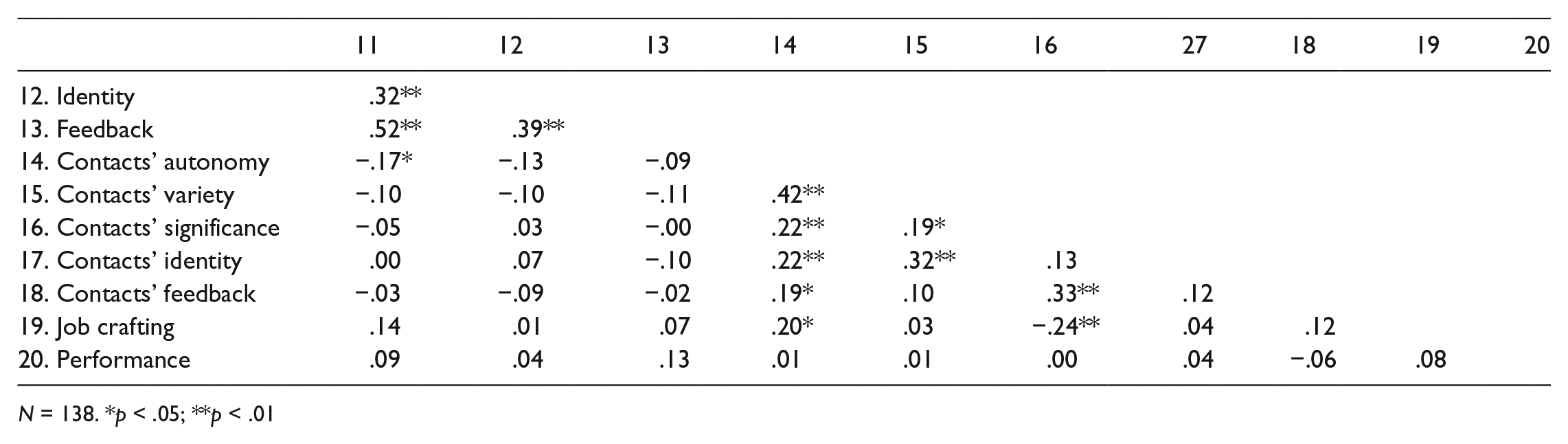
N = 138. *p < .05; **p < .01
Table 2 reports the coefficients for the prediction of job crafting. In order to account for the possible problem of lack of independence among data, I conducted hierarchical linear modeling (HLM) regressions with the mixed model procedure of SPSS 23. Each employee was affiliated with the formal work unit in which he or she worked, regardless of unit size. Predictor variables were grand mean-centered. Model 1 includes the set of controls and shows how autonomy has substantially high explanatory value in job crafting, a finding consistent with the insights of Wrzesniewski and Dutton (2001). It is interesting to observe that network size does not have any significant effect. Model 2 includes the job characteristics of contacts. The regression equation supports the positive value of contacts’ autonomy (β = .41; p < .001), the negative value of contacts’ significance (β = –.49; p < .001), and the positive value of contacts’ feedback from the job (β = .31; p < .05). Hypotheses 1, 3 and 5 are therefore supported, whereas there is no support for Hypotheses 2 and 4. The findings show the divergent predictive role of contacts’ job characteristics on job crafting. As I had collected data on different communication frequencies, I tried to run regressions considering contacts with whom the incumbent communicates less frequently. The reason for this was to confirm the theoretical argument for which we would expect a significant effect only for contacts with frequent communication exchanges because, as explained in the previous section, these are the ones more likely to raise expectations. The results were not replicated using ties involving infrequent exchanges, confirming that the theory is specific to contacts with whom the incumbent communicates more frequently.
HLM regression coefficients for the prediction of job crafting.
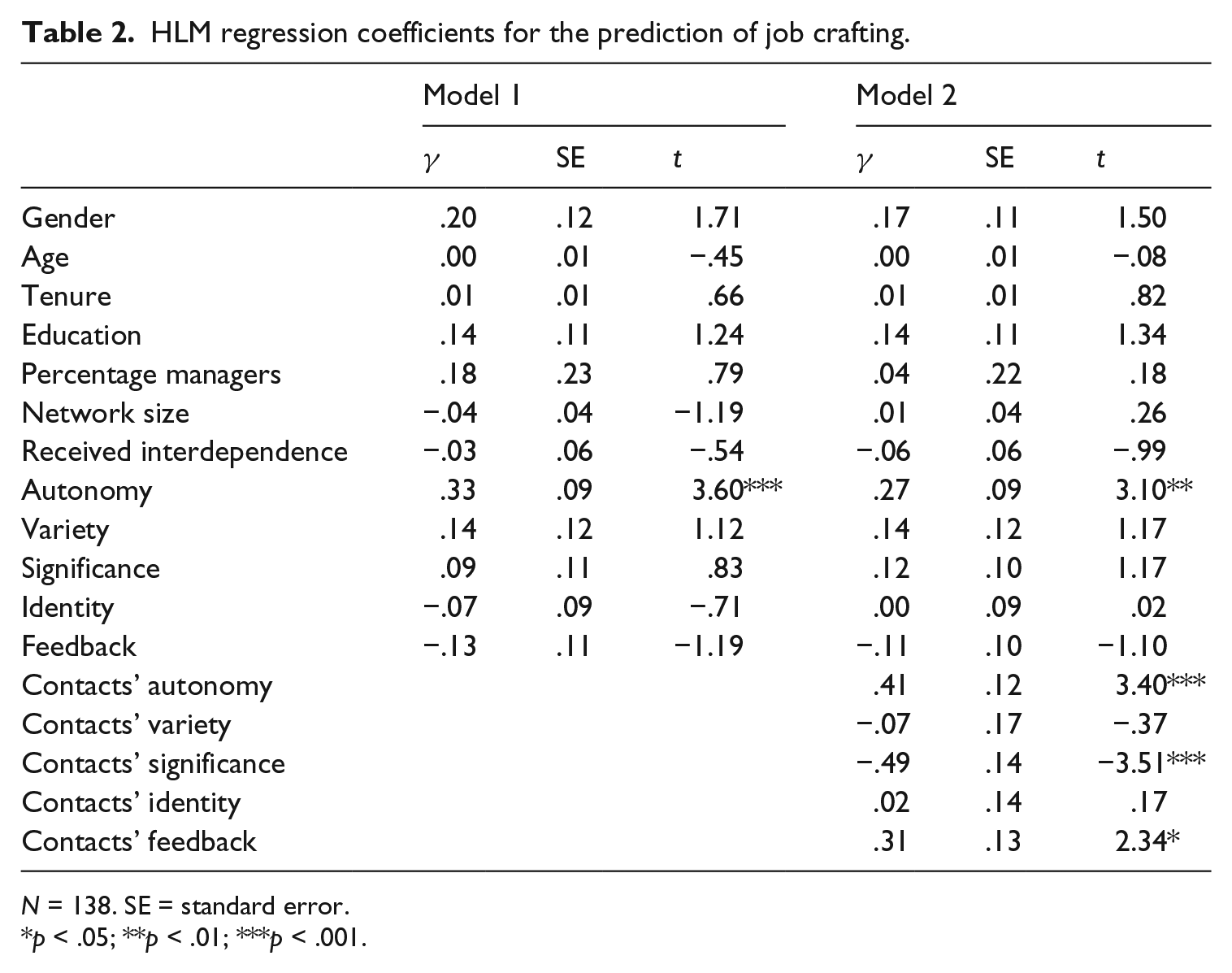
N = 138. SE = standard error.
p < .05; **p < .01; ***p < .001.
To highlight the unique role of contacts’ jobs, I ran a set of multilevel regressions aggregating team job characteristics and controlling for individual job characteristics. Team task significance is the only variable that exercises a significant and negative effect on crafting (p = .001). Nonetheless, even when controlling for team task significance, contacts’ task significance still exercises a significant effect on crafting (p = .010). The results suggest that contacts’ job characteristics have a unique effect on crafting. Contacts’ job characteristics correlate with team job characteristics, as some contacts are team members. Yet, correlations, although significant, show that the constructs are different (autonomy, r = .34; variety, r = .34; significance, r = .37; identify, r = .43; feedback, r = .37). In Table 2, team job characteristics are not used as controls. Some team members are contacts, and controlling for team members while assessing the effect of contacts could produce a distorted appraisal.
Table 3 reports the coefficients for the HLM regression analyses predicting individual performance. I included all controls used in the previous equation and the variables used as predictors of job crafting. Whereas Model 1 includes only the controls, Model 2 adds job crafting and network centrality to the equation. Job crafting alone does not predict individual performance. Following the indications of Mehra et al. (2001), Model 3 considers the interaction term of job crafting with betweenness and crafting with network size. The interaction terms are inserted as set because network size and betweenness centrality may be mathematically dependent, and it is important to consider them simultaneously to isolate the unique moderating effects of betweenness (Mehra et al., 2001). Without considering network size, the interactive term is not significant. However, accounting for the effect of network size, the multiplicative term between job crafting and betweenness centrality shows a significant value (β = .20; p = .035). There is support for a significant interaction.
Hierarchical linear modeling (HLM) regression coefficients for the prediction of performance.
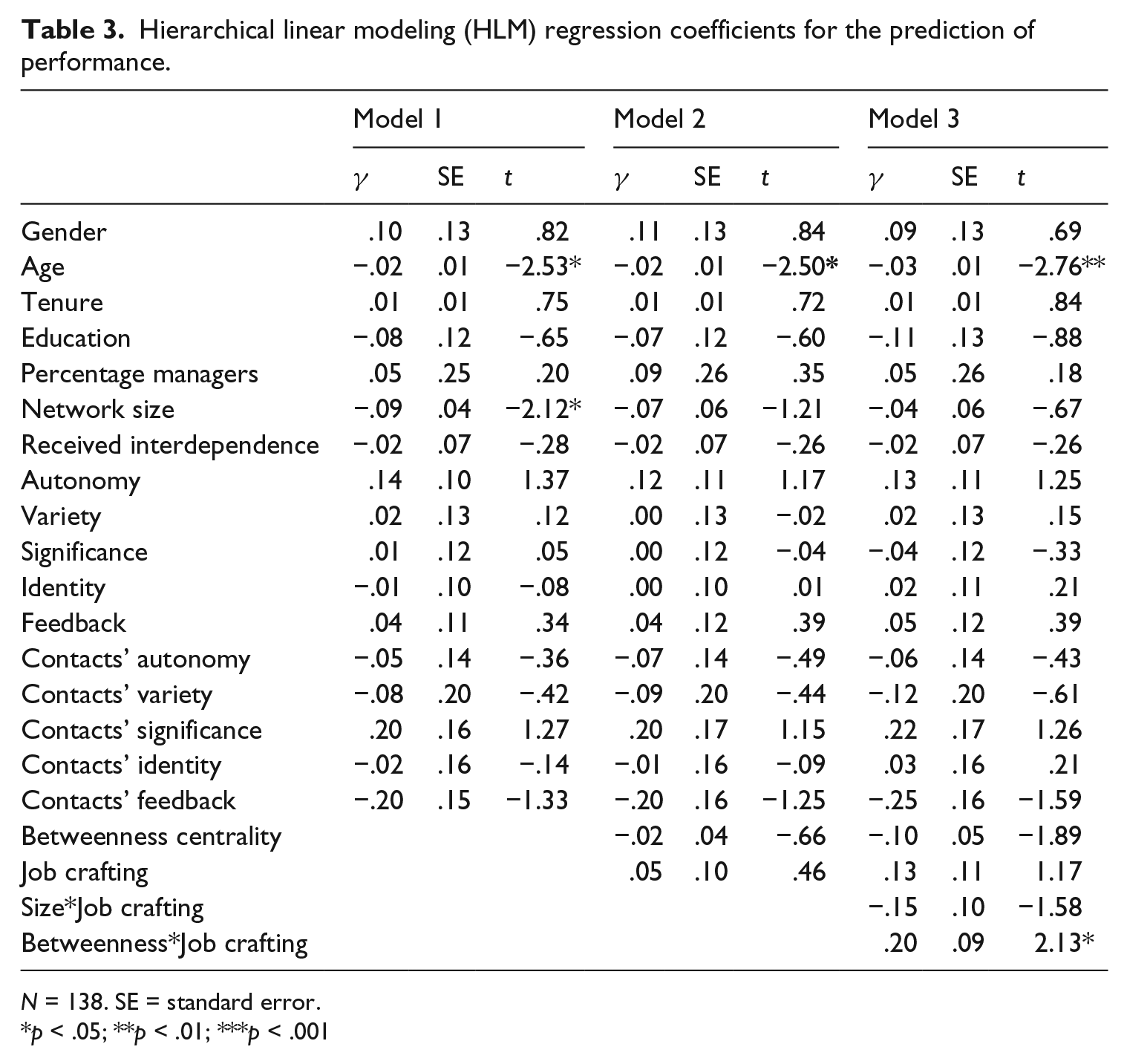
N = 138. SE = standard error.
p < .05; **p < .01; ***p < .001
To interpret the interaction of betweenness centrality and job crafting, I illustrated the slopes in Figure 1 graphically, following the procedure recommended in Aiken and West (1991). The figure shows the contingency effect and changes in slopes. To test the significance in slope changes, I conducted a simple slope analysis. Because I did not run OLS regressions but I ran HLM regressions, the traditional approaches to conduct simple slope analysis are prone to error. For this reason, I elaborated on the computational procedure for probing simple slopes in multilevel models developed by Preacher et al. (2006). When betweenness centrality is one standard deviation below the mean the slope is negative, although it does not reach a significant level (γ = – .23; SE = .14). The slope progressively turns from negative to positive and reaches a .05 significance level when the moderator is .5 standard deviations above the mean. When betweenness centrality is one standard deviation above the mean, the slope is positive and significant (γ = .40; SE = .19; t = 2.08; p < .05). Hypothesis 6a is therefore supported, whereas there is no support for the significant negative effect hypothesized in Hypothesis 6b.
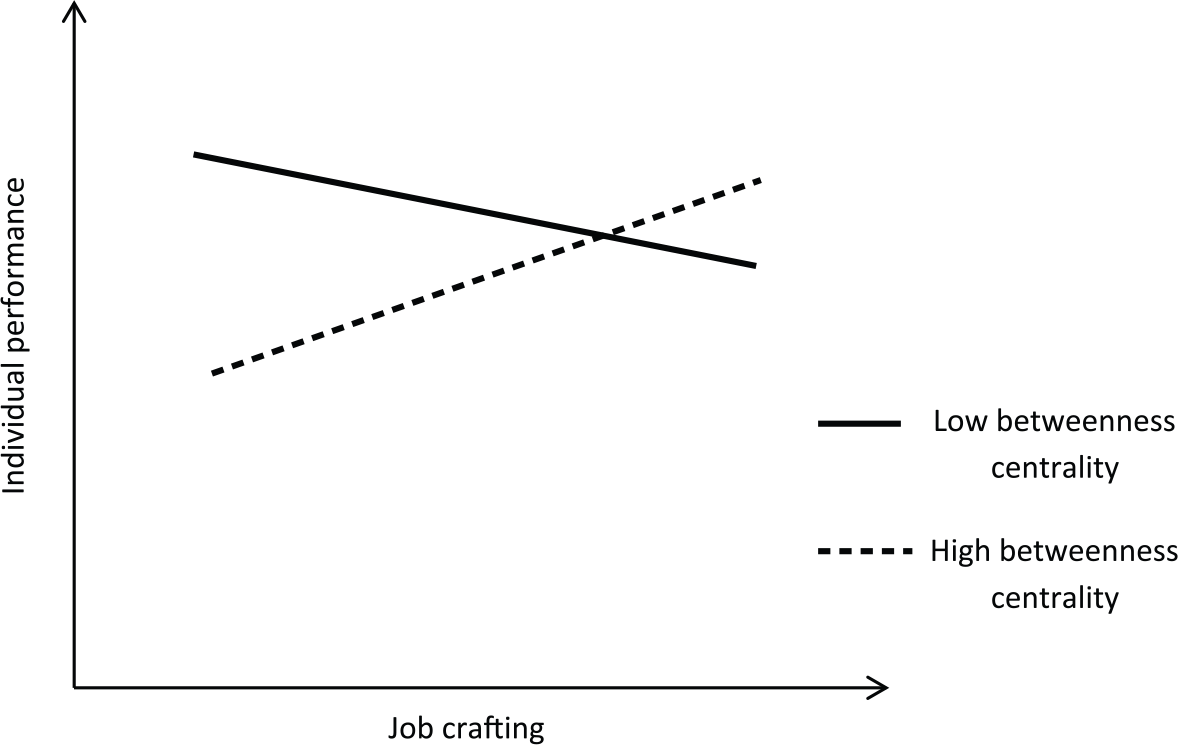
The contingent effect of job crafting on performance.
To test for the last hypothesis regarding moderated mediation, I elaborated on the procedure developed by Preacher et al. (2007) and implemented their SPSS macro MODMED. The procedure assesses conditional indirect effects where the sign and significance of the mediating relationship changes depending on the level of the moderating variable. More specifically, the procedure assesses the different indirect effects that result when the moderator variable—in our case, betweenness centrality—is one SD above and one SD below the mean. The procedure then assesses the significance of these indirect effects. The application of the MODMED procedure does not show any significant mediating effect conditional to the level of betweenness centrality. The effect of job crafting on performance, although significant, does not allow carrying the effect of contacts’ autonomy, significance and feedback from the job (which explain job crafting) to performance. Hypotheses 7a and 7b are therefore not supported.
Discussion
The article develops a theory to explain the effect of network contacts’ job characteristics on an incumbent’s job crafting and then illustrates the implications of job crafting for performance. As predicted, contacts’ task autonomy and contacts’ feedback from the job exercise a positive effect on individual crafting. The effect of contacts’ autonomy is significantly stronger than that of feedback from the job. The findings are consistent with the idea of Langfred (2000), according to whom people with low individual autonomy feel the need to influence others because they do not identify with their own job but with the group in which they are embedded. The evidence shows that the task significance of contacts has a negative effect. This finding is intriguing given the proven benefits of task significance (Grant, 2008). The findings do not negate these benefits but rather acknowledge that task significance can create significant advantages for those who have significant jobs. Nonetheless, by virtue of their social influence and interest in others, employees with significant jobs can raise more expectations in relation to those connected to them. The incumbent could still change task activities because of the input from the contacts with task-significant jobs, but the job change will not qualify as independent job crafting. Whereas Hypotheses 1, 3 and 5 are supported, Hypotheses 2 and 4 are not. One possibility for the lack of support of Hypothesis 2 is related to the potential non-linear implications of task variety. In fact, scholars have hypothesized that too much variety could create stress for individuals (Johns, 2010). The existence of conflicting mechanisms may hamper the possibility of detecting significance. The meta-analysis of Humphrey et al. (2007) shows that cumulative results on task identity tend to be unstable and weaker, which may offer a possible explanation why the results on task identity did not achieve significance.
The article shows that job crafting does not have a significant effect on performance, but the effect varies as a function of network centrality, as predicted by Hypotheses 6a and 6b. The findings do not provide evidence for a moderated mediation path in which network centrality influences the indirect effects in the relationship between contacts’ job characteristics and performance via job crafting. Therefore, Hypotheses 7a and 7b are not supported. Nonetheless, the evidence offers valid implications for job design and for managers. Job crafting can be positive or not depending on the position individuals occupy in the network, and therefore having contacts with high autonomy could be desirable or not depending on the position of the incumbent. The possible divergent effects of job crafting on performance seem to be at odds with recent theorizations on job crafting, which propose a beneficial role (Bakker et al., 2012; Petrou et al., 2012; Tims et al., 2013). However, previous studies provided no concrete evidence on performance. Leana et al. (2009) did not find a significant effect of individual crafting on performance. Bakker et al. (2012) only found that job crafting indirectly affects colleagues’ perceptions of in-role performance. Wrzesniewski and Dutton (2001) talked about dedication and satisfaction, but avoided mentioning performance because they recognized that crafting entails trade-offs.
The evidence indicates the necessity of considering contacts’ job characteristics. The findings show low correspondence between contacts’ and focal individuals’ job characteristics. Although this evidence confirms the relevance of studying contacts’ job characteristics because they differ from those of the individuals, it is also surprising. Research indicates that coworkers’ job characteristics affect the perception of individuals’ job characteristics (Salancik and Pfeffer, 1978). Nonetheless, the evidence relies on others’ job complexity (Morgeson and Campion, 2003), mostly studies effects on attitudes toward the job (Oldham et al., 1986), and is focused on ‘coworkers’ rather than contacts. Individuals select referents for social comparison (Oldham et al., 1982), but they need not be social contacts and could be any coworker with a similar job. Last, social cues affect job perceptions in experimental settings, but as familiarity with tasks increases, social cues become less determinant for task perceptions (Vance and Biddle, 1985).
The article contributes to research in job design. The social context of jobs is one of the most promising streams of investigation in job design research (Grant and Parker, 2009). Oldham and Hackman (2010) recently acknowledged that their original theory included aspects of social job design, but they removed them because they thought they were irrelevant at the time; however, they recognize that the time is now ripe to consider the social context in job design research. Scholars responded to this need by developing new job design characteristics that capture the social context (Humphrey et al., 2007; Morgeson and Humphrey, 2006). However, this article offers a new way to investigate the social context of jobs. Instead of identifying the social characteristics of the incumbent’s job, we could examine the job characteristics of the contacts of the incumbent. This new perspective offers great potential for enriching our insights. In fact, the theoretical insights from the extensive literature on job characteristics can now be expanded, shifting the focus from the incumbent to his or her contacts and thus promoting new ideas.
This article contributes new insights to the literature on proactive behaviors. There is a tension in the literature on proactive behaviors. Findings suggest that proactive behaviors are generally assumed to be beneficial to performance (Bateman and Crant, 1993; Grant and Ashford, 2008; Grant and Parker, 2009; Parker and Collins, 2010; Seibert et al., 2001). However, there are also deleterious effects (Grant et al., 2009; Searle, 2009). The article suggests that the effects of job crafting, as a particular form of proactive behavior, may be regulated by the social context. Future works could examine the role of social contexts on other proactive behaviors to see whether the conflict between their positive and negative effects is explained by social factors.
The article also contributes to role theory. Graen and Scandura (1987) claim that superiors are the main role senders. Social network research helps us to extend this argument and to consider that contacts strongly tied to the incumbent may also act as role senders. An interesting discussion point is the possibility that expectations from multiple actors—contacts, superiors, team members—conflict with one another. In Katz and Kahn (1978), different expectations from multiple actors generate role conflict that further constrains individuals because they perceive ambiguity about what they should do and are more concerned they could make mistakes. Although this article does not address the actual conflict among expectations, we can reasonably infer that conflict may exacerbate the constraining effect of expectations on individual crafting.
The findings of this work have considerable practical implications. Research on job design sprang from the practical imperative of providing indications to management on the way in which jobs should be designed to improve performance (Hackman and Oldham, 1976). The new role of management calls for collaborating with employees to create flexible work arrangements and a context that facilitates the construction of jobs (Hornung et al., 2008). Management can understand that the job of an individual is shaped by the characteristics of his or her social contacts, and therefore the work environment should not be designed based on considering each single individual separately but rather on a systemic logic.
This study has some limitations. It does not measure actual role expectations. However, social network theory developed a solid argument that strong ties create expectations (Burt, 2005; Granovetter, 1973). The argument developed is consistent with the assumptions of role theory, and the ties specifically measure work-related communication in which individuals discuss task activities. Furthermore, any measure of role expectations is difficult to capture reliably. There could be concern regarding reverse causation between the job characteristics of contacts and an individual’s job crafting. Yet, although there may be situations in which crafting influences contacts’ jobs, an individual’s job crafting may be more likely to affect contacts’ capacity to effectively comply with their job requirements than to change their task characteristics. Contacts could revise some of their tasks, but it may be unlikely that the individual’s crafting changes all contacts’ jobs to the extent that their job characteristics change compared with the jobs of others in the organization. Reverse causality could also affect job crafting and performance. Yet, the assumption adopted by other scholars is that proactive behaviors generally precede performance evaluations by supervisors (Grant et al., 2009).
To conclude, this study investigated the effects of contacts’ job characteristics on job crafting, thus contributing to the knowledge base in this research area. Whereas previous research mostly assumed that job characteristics have convergent and often overlapping effects on outcomes, this work showed how the job characteristics of contacts have divergent and unique effects on job crafting. Whereas previous research assumed that proactive behaviors are beneficial to performance, this article showed that the effect of job crafting varies as a function of network centrality. Overall, the findings provide rich insights that can inform new arguments relating to job design and social network research, hopefully driving the development of knowledge in the management field.
Footnotes
Acknowledgements
I wish to acknowledge the support and help received from Ann Langley, Danny Miller, Gary Johns, Christian Vandenberghe, Jia Lin Xie, Adam Grant, Amy Wrzesniewski, Andrew Van de Ven, Giuseppe Soda, David Obstfeld and Alice Labban. I thank associate editor Professor John Cordery for editorial guidance and the three anonymous reviewers for their valuable comments.
Funding
This research received no specific grant from any funding agency in the public, commercial, or not-for-profit sectors.