







Abstract
It is not yet clear whether work redesigns actually affect individual-, team- or organizational-level performance. In a synthesis of this literature, we conclude there is good overall evidence, with the most promising evidence at the individual level. Specifically, our systematic review assessed whether top-down work redesign interventions affect performance and, if so, why (mechanisms) and when (boundary conditions). We identified 55 heterogeneous work redesign intervention studies, of which 39 reported a positive effect on performance, two reported a negative effect, and 14 reported mixed effects. Of five types of work redesign, the evidence that work characteristics can explain the effect of redesign interventions on performance was most promising for relational interventions, and participative and non-participative job enrichment and enlargement. Autonomous work group and system-wide interventions showed initial evidence. As to ‘why’ work redesigns enhance performance, we identified change in work motivation, quick response and learning as three core mechanisms. As to ‘when’, we showed that intervention implementation, intervention context (including alignment of organizational systems, processes and the work redesign) and person factors are key boundary conditions. We synthesize our findings into an integrative multilevel model that can be used to design, implement and evaluate work redesigns aimed at improving performance.
Keywords
Introduction
Work design is typically described as ‘the content and organization of one’s work tasks, activities, relationships, and responsibilities’ (Parker, 2014: 662). Decades of research exists on the topic (Parker et al., 2017a), and it is widely accepted that the way work is designed has implications for many outcomes. Work designs that are high in positive job characteristics, such as autonomy, social support, job feedback and support, and contain moderate to low job demands, are theorized to be motivating, and lead to positive outcomes such as job satisfaction, increased well-being, work safety and individual job performance (Parker, 2014). High demands are argued to cause strain, and hence negative outcomes such as burnout, poor well-being and sickness absenteeism. Good work design is therefore assumed to be critical for optimal individual and organizationally oriented outcomes, including work performance.
Numerous reviews and meta-analyses of the literature mostly show positive associations between work design and performance (Fried and Ferris, 1987; Goodman et al., 1988; Humphrey et al., 2007; Semmer, 2006), with some noting mixed effects (Parker, 2014) or null effects (Kelly, 1992). However, many of the studies included in existing reviews and meta-analyses are cross-sectional, with few longitudinal studies and even fewer intervention studies. Intervention studies are important because they enhance confidence in causality, establish feasibility of work redesigns for improving outcomes, and identify important contextual and process factors that are needed for success. This means that, while there is evidence that work design positively relates to performance, the overall evidence base is limited by the mixed quality of the studies, with little clear causal evidence as to whether and when work redesign interventions do actually affect performance.
In this study, our primary aim is to assess, through a systematic review, whether, how, why and for whom top-down work design interventions enhance individual, team and organizational performance. Importantly, we assess the effects of top-down work redesign interventions (those led by managers) because theory consistently suggests that job design is a prime function of management (e.g. Fayol, 1949; Taylor, 1947). Managers thus play an important role in redesigning jobs (Guest, 1997; Parker et al., 2017b).
Our review has three goals. First, we conduct a narrative synthesis of the results of a systematic review of work redesign intervention studies that consider performance. Top-down work redesign interventions measuring performance are very heterogeneous (e.g. in terms of performance outcomes, design, method, other variables collected and quality), and measures are often collected at different levels of analysis (e.g. work design at the individual level, productivity at the organizational level). Our narrative review will synthesize the results from these different interventions and integrate the findings using theories from diverse perspectives. The results of this review thus address the question as to ‘whether’ work redesigns positively enhance performance, including which level performance outcomes are affected, as well as ‘why’ work redesign affects performance, or the key mechanisms.
Second, using a narrative approach, we thoroughly explore the impact of boundary conditions (e.g. intervention implementation, context/person factors) on the results. We thus integrate statistical results with qualitative information to understand ‘when’ work redesigns are effective.
Third, we use the review findings, as well as theory, to propose an integrative theoretical model of work redesign interventions, which helps to explain the multilevel relationships between interventions, work design and performance. We draw on individual and team work design theories as well as organizational systems approaches – in particular, human resource management (HRM) theory – to explain these relationships and illustrate how an intervention at one level (e.g. individual, team) can impact work design and performance at other levels. This model identifies mechanisms underlying work redesign interventions and summarizes moderators of effects, thereby guiding the design and implementation of work redesign interventions appropriate for particular targets and contexts. We thus contribute new knowledge to help move the field forward.
In what follows, after discussing how we conceptualize performance, we outline theory and evidence regarding how work design affects this outcome. We then describe our research questions.
Performance
Performance is conceptualized and operationalized differently across diverse theoretical perspectives (Waggoner et al., 1999). In our review, we consider performance at three different levels: the individual, the team and the organization.
At the individual level, we define job performance as individual behaviour that contributes to organizational goals and adds value to organizations (Campbell et al., 1993). We draw on the model of positive individual work behaviors (Griffin et al., 2007), which proposes a three by three matrix combining forms of positive performance that vary according to uncertainty (proficiency, adaptivity and proactivity), and level of performance contributions that vary according to interdependence (individual, team and organization). Carpini et al. (2017) recently showed that 40 performance constructs, covering most of those that exist in the literature, can be mapped onto this model. We also consider individual-level withdrawal behaviours (such as intention to leave and individual work absenteeism) as key performance constructs. Measures may be subjective (e.g. obtained using self-report surveys), or involve researcher observation (e.g. Welsh et al., 1993), other-ratings (e.g. supervisor ratings of employees’ performance) or company data (e.g. absenteeism, accidents).
At the team level, we consider team effectiveness as a key team performance outcome (McGrath, 1964). Team effectiveness outcomes are ‘results and by-products of team activity that are valued by one or more consitituencies’ (Mathieu et al., 2000: 273). 1 Team performance thus includes aspects such as the quality of team results and the quantity of team results. In the work design literature, team performance indicators include manager ratings of team effectiveness (Hall et al., 2008) and objective measures of team productivity (e.g. Pearson, 1992). In the production and operations literature, productivity may be indicated by the amount of product produced or work completed within a given time frame (e.g. Locke et al., 1976; Orpen, 1979). A further important team performance indicator is team safety, which has been particularly emphasized in human factor research (e.g. Guimaraes et al., 2015; Parenmark et al., 1993).
At the organization level, economists and management accountant theorists have tended to define performance in terms of positive financial outcomes, such as revenue, profit and sales volume (e.g. Welsh et al., 1993). More recently, other indicators have been considered. For example, the balanced scorecard (Kaplan and Norton, 2001) also includes customer outcomes such as customer satisfaction, internal business processes such as turnover and sickness absence, and learning and growth, important indicators of future success.
Work design theories and performance
Work design theories propose that, because of the effect of individual and group work characteristics on motivation, as well as on other mechanisms such as learning and quick response, work design can affect individual and team work performance (Andrei and Parker, 2017).
In terms of intrinsic motivation, job characteristics theory suggests that jobs high in characteristics such as autonomy, task variety and job feedback intrinsically motivate individuals to perform well (Hackman and Oldham, 1975). Such characteristics can also stimulate proactivity through building self-efficacy, promoting broader role orientations and enhancing activated positive affect, which Parker et al. (2010) referred to as ‘can do’, ‘reason to’ and ‘energized to’ forms of proactive motivation. Job characteristics theory has been expanded to incorporate social and relational factors that also drive performance through motivation. Social support can fulfil basic human needs by increasing individuals’ sense of belonging to a team or department, in accordance with self-determination theory (Deci and Ryan, 2000), or promoting psychological empowerment (e.g. Spreitzer, 1995). Need satisfaction and empowerment have both been linked to performance (e.g. Xanthopoulou et al., 2009; Yeatts and Cready, 2007). Broader relational perspectives have recently emphasized the importance of task significance and beneficiary contact for increasing individuals’ perceptions of the positive impact their work has on others, fostering prosocial motivation (Grant and Parker, 2009).
The job demands–resources model (JD-R; Bakker and Demerouti, 2007) builds on these earlier models as well as others, such as the job demands–control model (Karasek, 1979), to suggest that when resources (job characteristics) are high, individuals are able to cope with strain from high workload and cognitive and emotional demands, promoting well-being and subsequent performance.
Work design is also theorized to lead to performance through learning mechanisms. Leach et al. (2003) noted that timely feedback allowed individuals to learn, problem-solve and more efficiently complete tasks in the future, over and above the effect of empowerment alone on job knowledge and subsequent performance. Social interaction can also allow the transfer of knowledge between employees (e.g. Parker et al., 2017b).
The ‘quick-response’ mechanism (Wall et al., 1992) suggests that autonomy allows individuals to deal with problems when they arise rather than deferring them to higher levels, resulting in faster decision making. More directly, individual specialization may increase how fast work tasks are performed (Humphrey et al., 2007).
Most of the above theorized individual-level mechanisms have also been applied to the team level of analysis. For example, sociotechnical systems theory proposes that creating autonomous, self-managing, work groups or teams leads to team empowerment, where groups of individuals can take control and decide together how to carry out work tasks and meet work goals (Goodman et al., 1988). Such team work designs are also expected to improve individual and team performance through motivation, learning and quick responses.
Research suggests the above relationships are contingent on individual and contextual factors. Growth need strength is an important individual factor, and refers to the degree to which individuals desire to be satisfied at work through ‘growing’ (Hackman and Oldham, 1975). Individuals with higher growth need strength are predicted to respond more strongly and positively to more motivating jobs, leading to better outcomes, including performance. A key contextual contingency for performance is uncertainty: high uncertainty increases the need for individuals to take responsibility for work tasks and reactively adapt and problem-solve in response to the changing work environment (Wall et al., 2002). Wall et al. (2002) suggested that under uncertain conditions, quick response and effectiveness is more likely to be realized if timely feedback about performance is present, alongside autonomy. Timely feedback promotes faster learning, allowing individuals to reevaluate work methods, problem-solve and change their methods sooner rather than later, leading to optimal performance (see also Cherns, 1987).
Some evidence supports the above theories. For example, meta-analyses show positive relationships between several individual job characteristics (e.g. job autonomy) and performance (Fried and Ferris, 1987; Humphrey et al., 2007), and Wall et al. (2002) observed a positive link between empowerment, increased uncertainty and performance. Much evidence, however, focuses on correlational studies, with limited attention to intervention studies that help establish causality. Authors of reviews have acknowledged inconsistencies when this broader literature is considered (e.g. Oldham and Fried, 2016; Parker, 2014). In one of the only reviews that has focused exclusively on interventions, Kelly (1992) concluded that, though job redesign led to improved job satisfaction, it was not associated with improved performance. Kelly (1992) suggested a twin-track model in which the drivers of performance (extrinsic motivation, goal setting and more efficient work methods) are different from the drivers of job satisfaction.
A further challenge is that work design theories are concentrated at the individual and team levels, yet individual workers and teams are located within organizational systems. As such, wider factors may shape the effects of work design on performance, such as organizational policies. This highlights the need to take a broader perspective. Next, we discuss how human resource management theory (HRM) provides useful insights into how work design might shape performance.
Human resource management theory (HRM), work design and performance
Scholars have long been interested in the link between human resource work practices, or policies and procedures to develop employee skills, participation and motivation, and performance (Batt, 2002). The early focus of this research was on short-term productivity and efficiency, with a later, longer-term strategic view acknowledging employees as both a major source of human capital and an organizational cost (Beer et al., 2015). This longer-term strategic view stresses the importance of aligning high-performance work practices (HPWP) with each other (horizontal alignment), as well as with overall strategic business goals (vertical alignment), in order to drive performance (Christina et al., 2017; Guest, 1997). High-involvement management (HIM) practices are a type of HPWP that focus on direct employee partipation in decision-making, teamwork and consultation forums (Wood et al., 2012). As such, these practices have particular parallels with work redesigns that increase autonomy. Both HPWP and HIM primarily focus on organization-level outcomes, especially revenue, efficiency and productivity.
Horizontal alignment is particularly pertinent for organization-led work redesign, which can potentially have cross-level effects on team and individual performance (Christina et al., 2017). For example, employment practices such as reward structures and training systems can provide individual workers with work motivation and the necessary skills and abililities to carry out their work, but can also provide teams with the motivation and skills necessary to achieve team goals. If job design is aligned with these practices, such as by enabling participation in decision making and freedom over how to carry out work tasks, individual and team performance is more likely to improve. Despite this theorizing, we were unable to find any HRM intervention studies which have explicitly measured change in job design alongside other HRM changes and performance. For example, a recent randomized intervention in a multinational firm suggested that aligning HRM practices and job design influenced worker behaviour, as well as organizational and environmental outcomes, but job design was not actually measured in this study (Christina et al., 2017).
Summary
In sum, there is established theory to suggest that work design can enhance individual and team performance via various mechanisms, with some suggestion of stronger effects for particular individuals and contexts. There is also strong theory about the importance of aligning work design with other practices as well as overall business goals to achieve organizational performance. Figure 1 summarizes this theory, and indicates the key theoretical mechanisms and moderators that theory suggests are involved in the relationships between work design and individual, team and organizational performance. However, as we have discussed, the empirical evidence base is not clear. As we argue next, by systematically synthesizing findings from intervention studies, we can consolidate our knowledge of whether, why and when work design leads to performance.
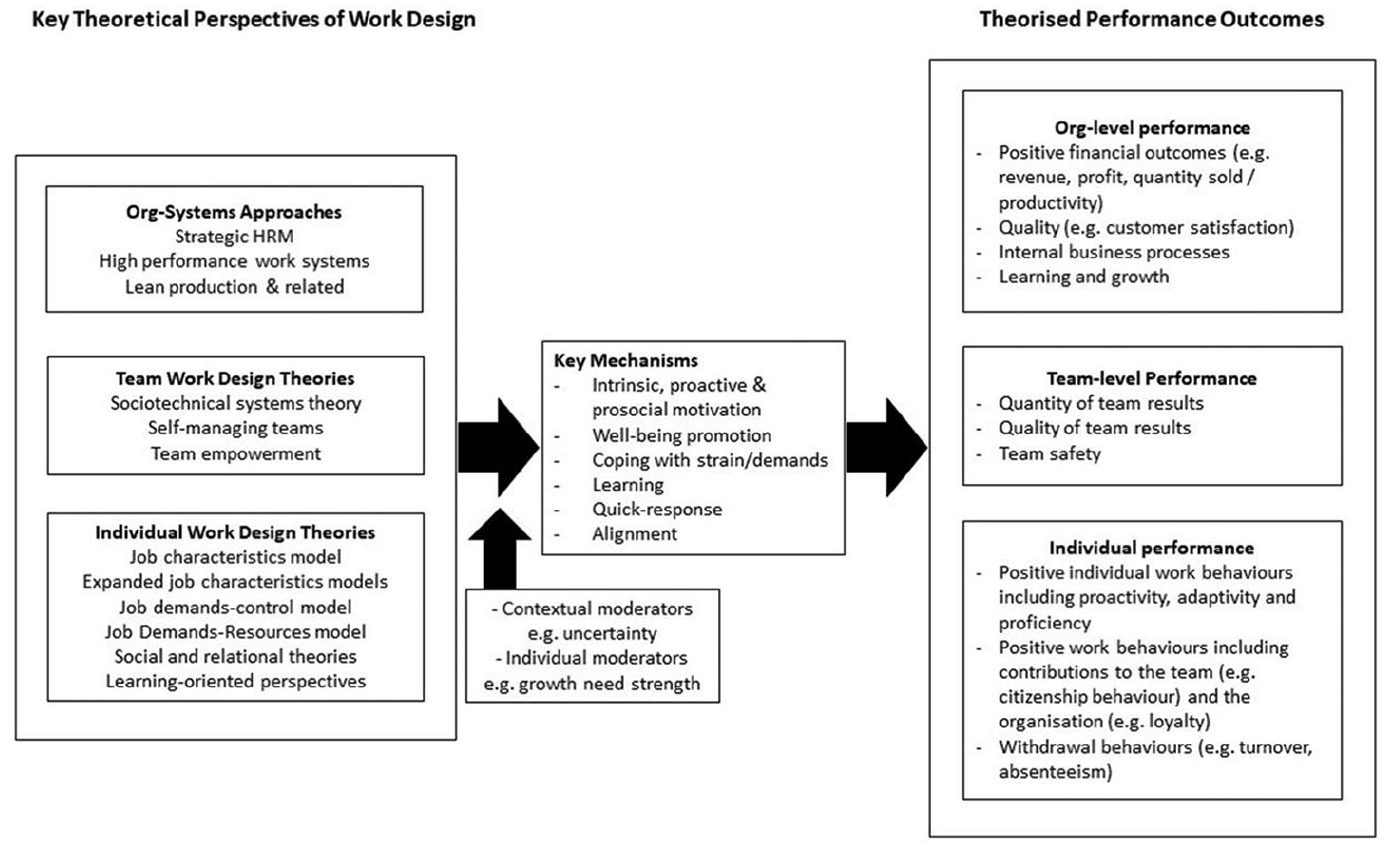
A diagram indicating the relationships between key theoretical perspectives of work design and theorized performance outcomes.
Research questions
We have seen that there is reasonable cross-sectional evidence linking work design with performance, with some suggestion from reviews that findings from intervention studies might be more mixed. Intervention designs offer greater ability to determine causal links, so it is important to consider evidence from such studies more systematically. Thus, investigating whether top-down work redesign interventions enhance performance, as theory suggests, is our first research question (RQ1). To do so, we assess the quality of studies, taking into account how research methods might affect the confidence we can place in the results (e.g. whether studies are randomized, whether a control or comparison group is present, what was measured, type of measures, number of measurement points, and sample size). Scholars regularly call for such considerations when evaluating the effectiveness of interventions (e.g. Briner and Walshe, 2015; Lamontagne et al., 2007; Nielsen and Randall, 2013; Pawson, 2013; Snape et al., 2016). As we discuss later, we assess a range of top work redesign interventions, including individual (e.g. job enrichment), team (e.g. autonomous work groups) and organizational (e.g. system changes) interventions.
We then seek to establish whether changes in work characteristics account for any relationship between top-down interventions and performance (RQ2). Work redesign interventions aim to change the nature and organization of work tasks, activities and responsibilities, which should be reflected in changes in employees’ perceptions of work charcteristics (Andrei and Parker, 2017), but to date it is unclear whether any effects of work redesign on performance can be explained by the theorized change in work characteristics. Showing the role of work characteristics clearly establishes the intervention as a ‘work redesign’ rather than reflecting some other process (e.g. Hawthorne effects).
Third, we identify the mechanisms that link changed work characteristics to performance (RQ3). Although many mechanisms have been theorized (e.g. motivation, learning, quick response), we seek to show which have been demonstrated empirically in intervention studies, as well as the quality of this evidence.
Fourth, beyond identifying whether and how work redesigns affect performance, boundary conditions, or when top-down work redesign interventions are effective, must also be considered (RQ4). We focus on three categories of boundary conditions: intervention implementation effectiveness, intervention context and person factors. Intervention implementation effectiveness includes, for example, whether interventions ran according to plan (e.g. whether all training sessions were conducted), degree of attrition, and resistance from managers and/or employees. Intervention context includes organizational factors such as setting, organizational design (e.g. alignment of pay, feedback, reward, information and communication systems) and organizational climate (e.g. economic and political instability such as redundancies, mergers, unrest over pay, policies or procedures). Person factors that can moderate work design effects include, for example, personality and work preferences. In sum, our research questions are as follows:
RQ1: Are top-down, organization-led work redesign interventions effective for increasing performance, and, if so, are positive effects found for all types of interventions?
RQ2: Do changes in perceptions of work characteristics account for the relationship between top-down work redesign interventions and performance, and, if so, are such mediation effects found for all types of intervention?
RQ3: What mechanisms underlie the relationships between changes in work characteristics and performance?
RQ4: What are the boundary conditions that affect whether and how top-down work redesign interventions lead to performance, including intervention implementation effectiveness, intervention context and person factors?
Method
We followed standard systematic review protocol and adopted the PICOS (population, intervention, comparators, outcomes, study design; Shamseer et al., 2015) approach to establish our inclusion criteria and search terms (supplementary material 2 ). We included longitudinal, top-down strategies that had changed some aspect of employees’ work design (‘work redesign’ interventions, or interventions that indirectly affected work design) and included pre- and post-intervention measures of performance. Measures of job characteristics were not necessary. All study designs were accepted, such as studies with or without comparison groups, experiments, quasi-experiments, and observational and field studies. We excluded studies that did not occur in a natural organizational setting (e.g. laboratory/simulation experiments) as these would have decreased the ecological validity of our findings. We restricted our search to English records and peer-reviewed, published articles. Our performance terms reflected our earlier definitions of performance, and included work performance terms (e.g. task, adaptive, contextual performance), financial indicators, organizational effectiveness, productivity and service quality (see also search terms, supplementatry material).
Subject-specific databases were searched until 24 August 2017 (Figure 2). Records were downloaded to Endnoteweb and duplicates removed. To supplement our search, we posted a call for papers through leading organizational psychology associations, and manually checked the references of recent work design reviews. All titles and abstracts were double screened by the first author and two research assistants. Full texts were retrieved for potential records and further scrutinized for inclusion. Study characteristics were double coded according to a specially developed coding guide (supplementary material). Extracted study information included author, year of publication, title of record, journal, country where the study took place, industry, participant population (e.g. nurses), study aim and design, intervention content and type, sample size and response rates, variables measured, implementation details, and work design and performance effects. Any discrepancies between coders were discussed until 100% consensus was reached.
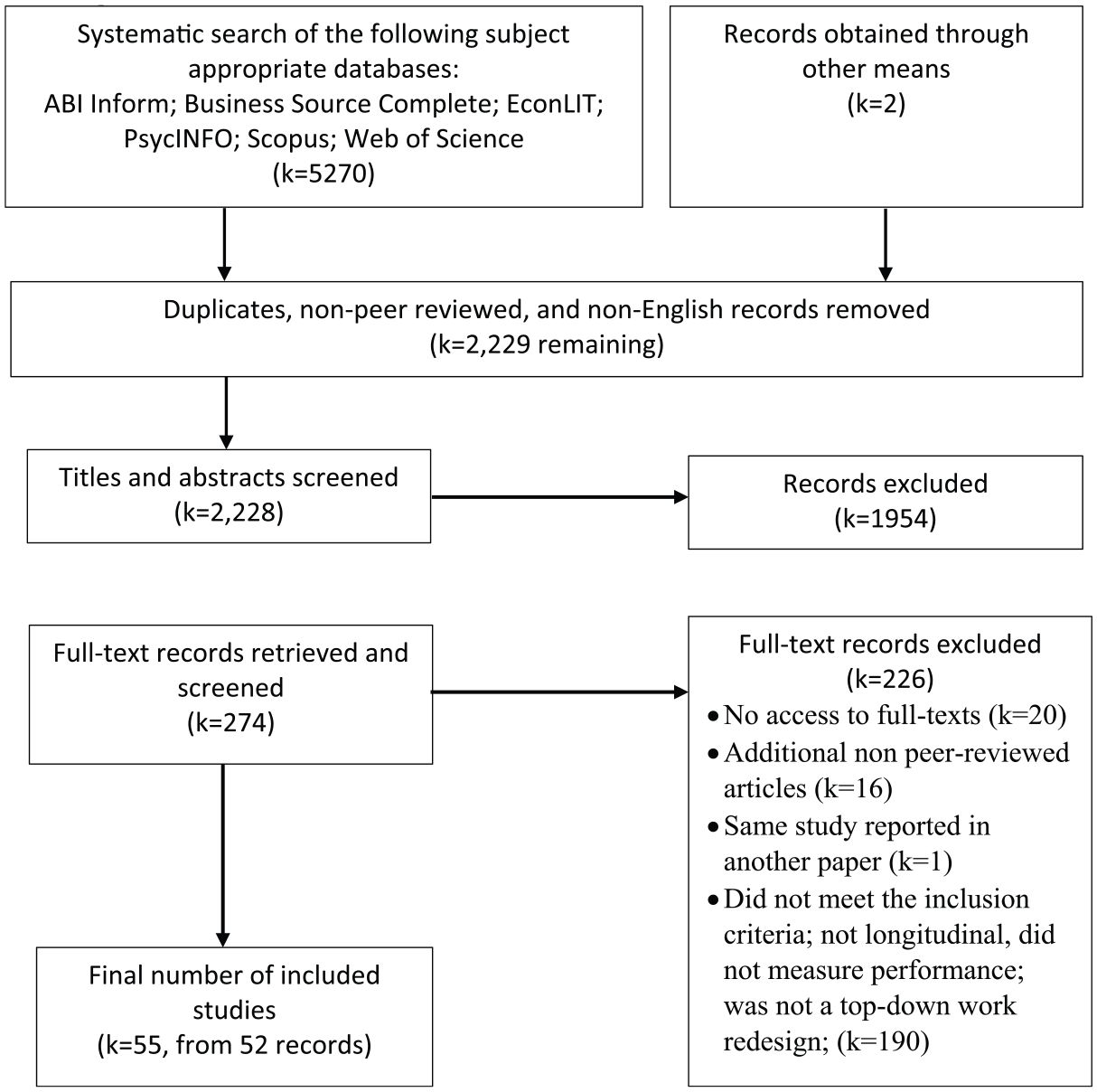
A PRISMA flow diagram (Shamseer et al., 2015) displaying the results of the systematic literature search and indicating why records were excluded at each stage of the process.
Extracted study data were presented in harvest plots adapted from previous systematic reviews (e.g. Crowther et al., 2011; Daniels et al., 2017; Ogilvie et al., 2008). These plots are not statistical in nature (unlike the forest plot associated with meta-analysis) but summarize the strength and quality of the evidence for the effectiveness of each type of intervention (Figures 3–8). Summary evidence statements were then developed based on the findings and harvest plots. The GRADE (Grading of Recommendations Assessment, Development and Evaluation; Balshem et al., 2011; Snape et al., 2016) approach was applied to rate each study and evidence statement according to the degree of confidence that can be placed in the results (see Results and Table 3, supplementary material). This approach is suitable for rating evidence from quantitative studies. Evidence for findings was assigned a quality rating according to one of four categories (Snape et al., 2016): (i) Strong, where further research is unlikely to change our confidence in the results (e.g. results provided by well-implemented, randomized controlled studies); (ii) Promising, where further research may impact our confidence in the results; (iii) Initial, where further research is very likely to impact our confidence in the results (e.g. results from observational studies); and (iv) Weak, evidence not strong enough to make conclusions, where there is little confidence in the results. The rating was based on study design, intervention implementation and context (see Balshem et al., 2011) as well as study limitations, inconsistent results, the precision of the results, and potential reporting bias (e.g. omission of study limitations). For example, evidence based on mostly randomized controlled studies was initially considered ‘strong’ and downgraded if evidence of any of the above was apparent, whereas evidence based largely on uncontrolled, observational studies was first rated ‘initial’. Quality ratings were double-coded by trained coders, and any discrepancies were discussed until 100% agreement was reached.
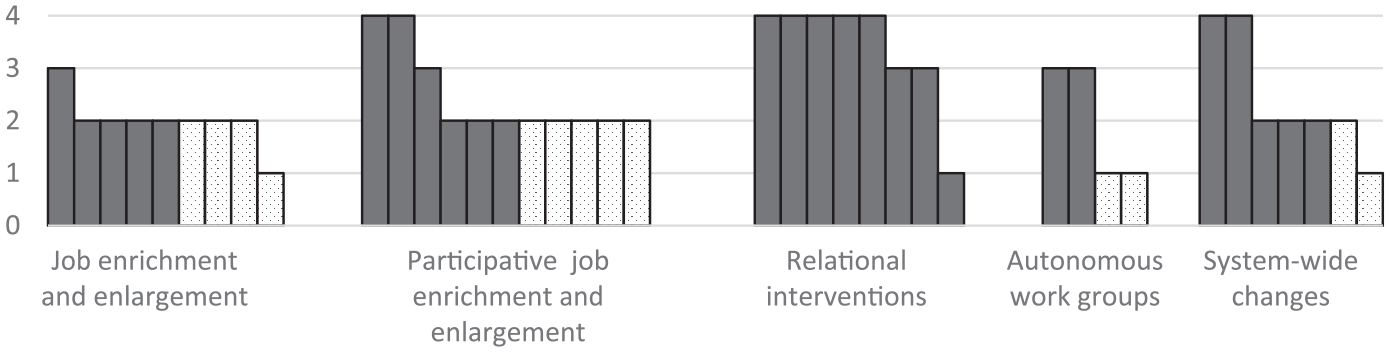
A harvest plot indicating the nature of the evidence for top-down work design intervention studies that demonstrated a positive effect on performance (k = 39).
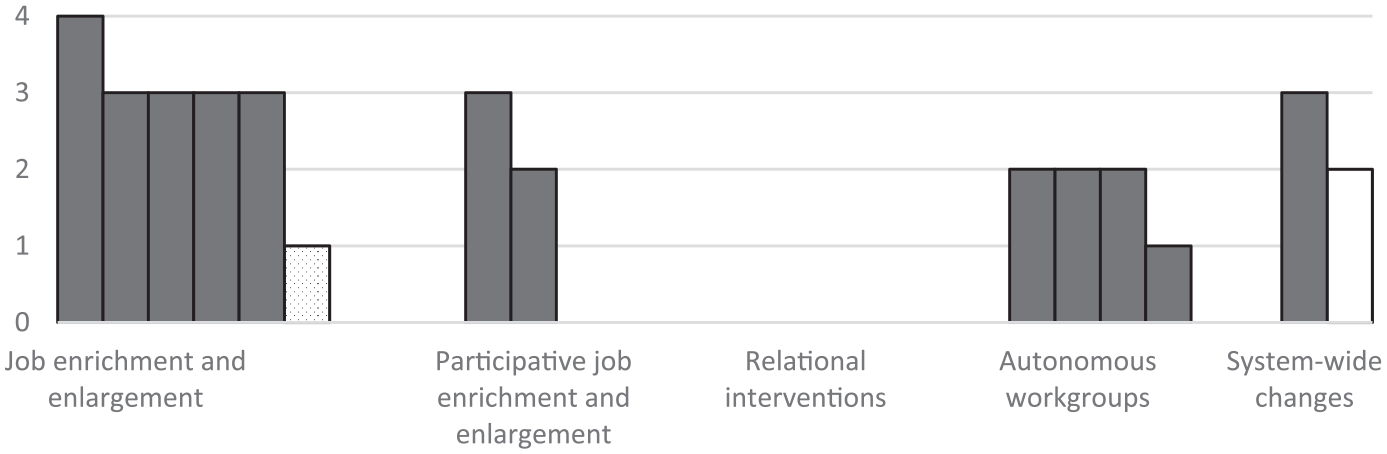
A harvest plot indicating the nature of the evidence for top-down work design intervention studies which demonstrated a mixed effect on performance (k = 14).
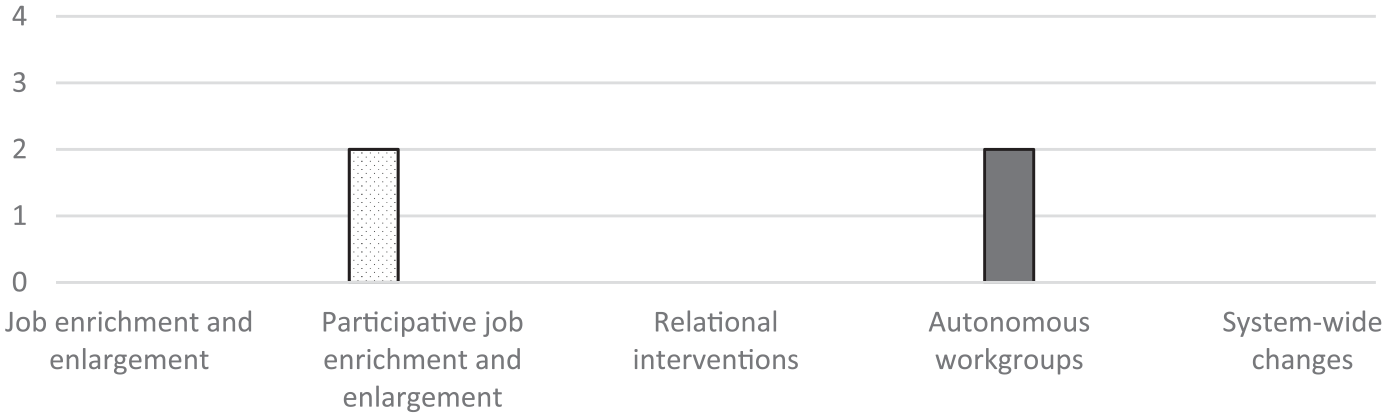
A harvest plot indicating the nature of the evidence for top-down work design intervention studies which demonstrated a negative effect on performance (k = 2).
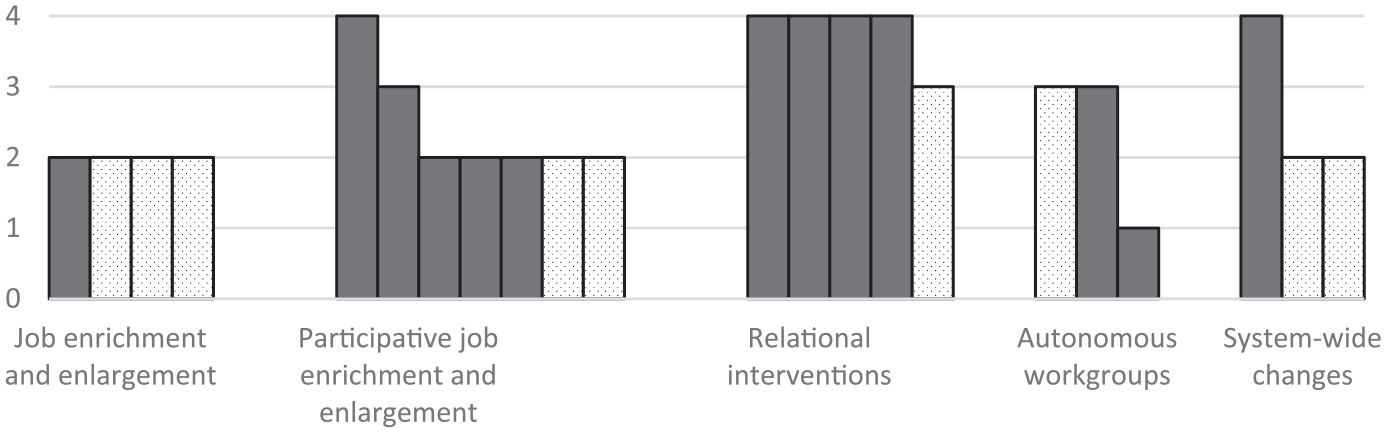
A harvest plot indicating the nature of the evidence for top-down work design intervention studies with positive effects on both work design and performance (k = 22).
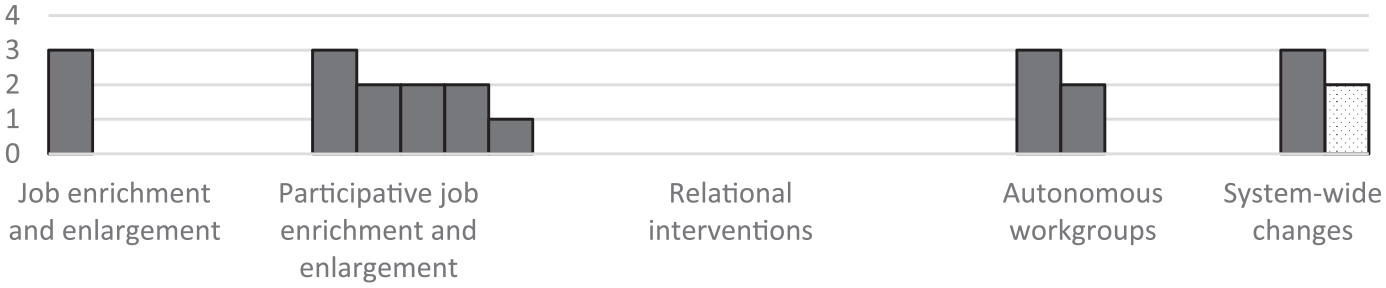
A harvest plot indicating the nature of the evidence for top-down work design intervention studies with positive effects on work design and mixed or negative effects on performance (k = 10).
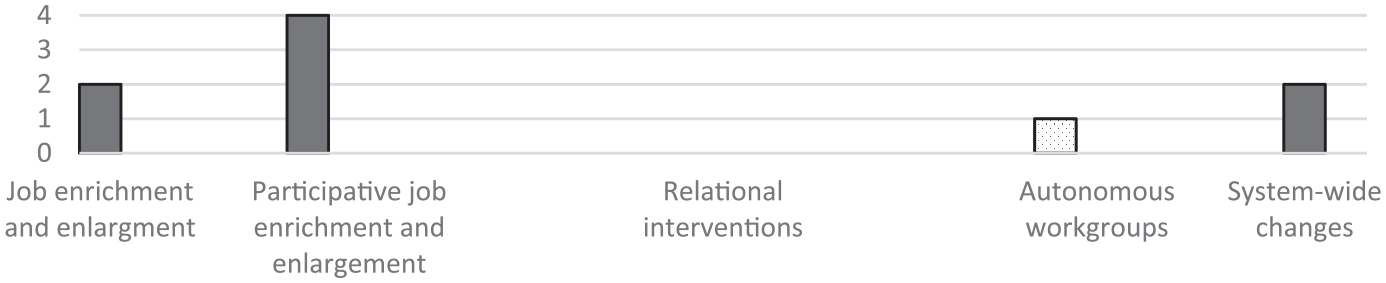
A harvest plot indicating the nature of the evidence for top-down work design intervention studies with mixed effects on work design and positive effects on performance (k = 4).
Results
From 2228 non-duplicate records, 46 records representing 48 independent samples were retained (Figure 2). Seven further records were included following the review process, resulting in 55 final studies. These studies occurred between 1956 and 2017, and reflect a steady interest in organization-led work redesign interventions to increase performance (see figure, supplementary material). Following key work design developments (Parker et al., 2017a), job enrichment interventions appeared earliest, interventions to create autonomous work groups were most common in the 1990s, and relational interventions appeared post 2000. Studies were conducted all around the world, including the US (k = 29), UK (k = 9) and Australia (k = 4). Thirty-eight studies involved methodologically rigorous designs (i.e. randomized or non-randomized but controlled). The focus of measures of performance varied enormously. Most studies employed objective measures or other-ratings of performance (k = 42), six employed subjective measures, and seven employed both objective and subjective measures.
We identified five categories of organization-led work design interventions to improve performance. These categories are not necessarily mutually exclusive. Multimodal studies, and studies with several intervention groups, were particularly difficult to classify (e.g. Workman and Bommer, 2004). Decisions were based on the primary focus of the intervention as determined by two independent coders. Any disagreements between coders were discussed, and a third expert (a review author) was consulted where necessary. Following further discussion, 100% agreement was reached.
Fifteen studies reported job enrichment and enlargement interventions, which aimed to change the work design of individual workers. Five studies focused on enlarging jobs, mostly via job rotation (e.g. Orpen, 1979) or increasing the variety of tasks (e.g. Campion and McClelland, 1993). Seven studies focused on job enrichment such as increasing autonomy, decision making and job complexity (e.g. Locke et al., 1976). Three interventions combined enlargement and enrichment strategies (e.g. Gard et al., 2002). We classified these studies together owing to the blurred distinctions between enlargement and enrichment (see Campion and McClelland, 1993).
Fourteen studies assessed participative job enrichment and enlargement interventions. These involved management-initiated means of enhancing employee participation, such as promoting employee involvement in problem solving and developing solutions to work design aspects (e.g. Cohen and Turney, 1978; Gomez and Mussio, 1975; Griffeth, 1985; Holman and Axtell, 2016). All of these redesigns utilized job enrichment strategies or a combination of enrichment and enlargement except one, which focused on enlarging jobs (Wall et al., 1990).
Eight individual-level relational interventions focused on developing individuals’ perceptions of the significance of their jobs (e.g. Bellé, 2014; Grant and Hofmann, 2011). Notably, one reduced job demands in junior doctors by offering structural support in the form of an advanced practice nurse (Parker et al., 2013).
Nine autonomous work group interventions involved work groups or teams that were able to manage their own responsibilities (e.g. Cordery et al., 1991; Morgeson et al., 2006; Pearson, 1992). These interventions, which largely arose out of sociotechnical systems theory (e.g. Goodman et al., 1988), are distinct from individual work redesigns because autonomy is devolved to teams. One team empowerment intervention fell within our inclusion criteria (Yeatts and Cready, 2007). Empowered work teams arose from a different heritage to autonomous work teams, but increased group autonomy is characteristic of both interventions, often also involving increases in other group-level work characteristics (e.g. task identity, job feedback). Although autonomous work group interventions are team-level, work design was often measured at the individual level, with only one study assessing effects at the team level (Cordery et al., 2010).
Finally, nine studies described system-wide changes (e.g. reward, information and communication systems) impacting work design and performance (e.g. Christina et al., 2017; Tregaskis et al., 2013; Workman and Bommer, 2004). These focused on the organization as a whole, but also affected the work design of individuals/teams. Multimodal strategies were used. For example, Workman and Bommer (2004) described aligning performance and reward structures as well as job rotation in one intervention, increasing interdependence and participation through the implementation of high-involvement work processes (HIWP) in another, and creating autonomous work teams in a third. We classified this study as a system-wide intervention owing to system-wide changes being predominant in two of the intervention groups. Smith et al. (2012) adopted large-scale Lean Quality Improvement techniques and work redesign in a pathology lab to decrease the number of errors, and Tregaskis et al. (2013) developed high-performance work practices (HPWPs) in a heavy engineering plant, such as safety training, specialization, and motivational performance, reward and communication systems. Further, both Christina et al. (2017) and Gallegos and Phelan (1977) found that aligning HRM practices with job design was beneficial for organizational outcomes. A larger literature on HPWP exists; however, no HPWP interventions were included, as they did not also explicitly focus on changing work design.
Three studies were less extensive, focusing on system-wide changes only. One introduced flexitime, and observed a decrease in absenteeism but no effect on manager ratings of work group productivity (Narayanan and Nath, 1982). Another offered a shorter shift whilst maintaining full pay (Welsh et al., 1993), observing an improvement in job feedback perceptions and sales volume but not in other work characteristics. Robertson et al. (2008) adopted an ergonomic redesign to make workspaces more flexible and conducive to ameliorating musculoskeletal disorders, with a positive impact on organizational efficiency.
Only a few intervention studies focused on job demands in relation to performance. Besides Parker et al.’s (2013) study (described below), two studies focused on participative job enrichment interventions: one found workload decreased following an ergonomics intervention (Guimaraes et al., 2015), and another found role conflict and task demands decreased following a participatory intervention to improve work conditions and care quality (Weigl et al., 2013). A further study noted decreased job demands following implementation of additional staff, a workload tool, and training and development (Rickard et al., 2012).
Findings for RQ1: Effectiveness of interventions on performance
Thirty-nine studies demonstrated a positive effect on performance, the majority of which used stronger research designs (e.g. randomized or quasi-experimental), with the overall quality of the evidence being considered ‘promising’ (Table 3, supplementary material). These results are consistent with theory and provide considerable evidence that organization-led work redesigns do positively influence performance (Figure 3), with the most promising results at the individual level.
Fourteen studies had mixed effects on performance (Figure 4), 11 of which involved randomized and/or controlled designs. Two studies demonstrated a negative effect. One non-randomized study observed higher turnover and absenteeism amongst employees in autonomous work groups than traditionally designed jobs, although work characteristics improved (Cordery et al., 1991) (Figure 5). The authors speculated that this was a result of factors external to the organization, such as the distance workers had to travel to the workplace, and differences between the intervention and control groups in terms of workload. Another study observed decreased productivity following increased employee responsibility for work scheduling (Powell and Schlacter, 1971), possibly owing to low autonomy needs amongst workers, change being undesired, or the change being insufficient to have the desired effects.
Our results suggest that work redesign interventions are worthy of investment for practitioners wishing to increase performance. We rated the evidence for this statement as promising, owing to the number of studies demonstrating a positive effect on performance, the number of studies with methodologically more rigorous research designs, and the decent sample sizes across most studies. We downgraded our rating from ‘strong evidence’ owing to some inconsistent results, with some studies observing positive effects on performance and others not (Figures 3–5). As we discuss later, it is likely there are boundary conditions that shape the performance effects of various work redesigns. In sum, we conclude:
Evidence statement 1: There is promising evidence that top-down work redesigns are effective for increasing performance. The evidence is most consistent for participative job enrichment and enlargement interventions, non-participative job enrichment and enlargement interventions, and relational interventions.
Findings for RQ2: Mediating role of work characteristics
The answer to the question about whether the effects of work redesign interventions on performance are accounted for by a change in work characteristics is ‘most likely’. The majority of the studies showing positive effects on performance also demonstrated a positive effect on perceptions of work characteristics (k = 22; Figure 6). Only three of these studies tested (and confirmed) a mediation relationship between the intervention, changes in work design, and performance (Bellé, 2014; Holman and Axtell, 2016; Grant, 2008a), preventing stronger causal conclusions.
Evidence statement 2: There is promising evidence that perceptions of changes in work characteristics mediate between top-down work redesigns and performance.
To unpack this evidence further, we examined the findings for each type of intervention in more detail. With respect to non-participative job enrichment and enlargement interventions, four studies reported a positive effect on work design and performance (Figure 6). Gard et al. (2002) measured individual perceptions of supervisory support and team autonomy, goal clarity, communication and collaboration, group work effectiveness and service quality. He et al. (2014) noted a positive effect on individual job characteristics (but did not clearly specify which) and organizational turnover. Michalos et al. (2013) noted an increase in individual task variety and a decrease in individual error probability, while Morse and Reimer (1956) reported increased individual autonomy alongside increased organizational productivity and decreased clerical costs.
One controlled job enrichment intervention had a mixed effect on work design yet an overall positive effect on manager-rated productivity and colleague-rated innovation (Keller and Holland, 1981). Following an individual’s role change or promotion to a higher job level, role ambiguity decreased and task variety, autonomy and performance at the individual level increased. Job feedback, contact with others, and supervision activities did not improve. The changes in work characteristics were sufficient, however, to improve performance.
One randomized study noted a mixed effect on work characteristics and a mixed effect on performance (Orpen, 1979). While individual perceptions of task variety, task identity and autonomy increased, perceptions of task significance and feedback did not; and while organizational turnover and absenteeism decreased, supervisor and group ratings of productivity did not change. This suggests that different aspects of work design may be differentially affected by a job enrichment intervention, and not all work redesigns should be expected to affect all work characteristics. Increases in autonomy and task variety were noted across most studies that measured these aspects, suggesting that these may be easier to increase via job enrichment than other work characteristics such as task significance or feedback, which might need a more focused intervention (such as a relational work redesign for task significance, or a feedback-oriented intervention for feedback). Although several job enrichment studies did seek to increase these aspects, it is not known how well the interventions were carried out, or whether enough was done to manipulate these specific attributes, and thus employees may not have perceived a change. Given the limitations to the studies, and the mixed effects, we conclude:
Evidence statement 2a: There is initial evidence that non-participative job enrichment and enlargement interventions can enhance performance by changing perceptions of work characteristics.
With respect to participative job enrichment studies, seven studies had positive effects on work design and performance (Figure 6). One intervention reported a mixed effect on individual perceptions of skill variety, task significance, job feedback and feedback from others, and a positive effect on organizational turnover (Griffeth, 1985; Figure 8). This study tested whether participation in job redesign was a contextual moderator that changed employee work design perceptions. A strong design with four groups was employed (participation and redesign; participation and no redesign; no participation and redesign; and no participation and no redesign). However, participation in brainstorming redesign ideas did not enhance the effects of enriched work, despite the fact that some of the ideas were used. The author suggests this was owing to the short nature of the participation (90 minutes), and the fact that actual job changes were limited.
In contrast, Holman and Axtell (2016) employed a more significant type of participation via scenario planning. Over two days, call centre employees participated in brainstorming and implementing ideas and solutions to problems with their current work design. Consistent with theory, statistical mediation ascertained that individually perceived job control and feedback mediated between the intervention and supervisor-rated job performance as well as individual outcomes such as employee well-being and psychological contract fulfilment. The success of this intervention demonstrates that participative job enrichment interventions have most positive effects when employees are able to significantly contribute throughout the redesign process, and when the ways in which the jobs are changed align with the aspects of work design targeted for change. This concurs with previous findings around participation (e.g. Daniels et al., 2017).
Evidence statement 2b: There is promising evidence that participative job enrichment interventions can enhance performance by changing perceived work characteristics.
We did not upgrade our rating of the strength of the evidence owing to implementation issues in many studies (k = 9). For example, in one study, one department continued to operate in an authoritarian manner as opposed to changing to meet the planned redesign. Several studies experienced management resistance impacting the extent of implementation (e.g. Guimaraes et al., 2012, 2015; Jayawardana and O’Donnell, 2009; Wall et al., 1990), and Pearson’s (1992) study was characterized by economic volatility, budget cuts and a decrease in the amount of work available. These issues make it difficult to determine cause and effect. However, Holman and Axtell’s (2016) study gained manager confirmation that the study had been fully implemented. Coupled with the results of their mediation analyses, this study suggests that well-designed and effectively implemented top-down work redesign interventions can improve performance.
For relational interventions, five studies demonstrated a positive impact on both work design and performance (Figure 6). Bellé (2014) reported that individual productivity was higher when employees were exposed to a transformational leader as well as beneficiaries of their work, or a self-persuasion condition (in which employees persuaded themselves why their work was worthwhile). This effect was mediated by pro-social impact, the ‘degree to which employees feel that their actions benefit other people’ (Grant, 2008a: 110). Whereas traditional work design models consider that increasing task significance increases the meaningfulness of individuals’ jobs and thereby impacts performance, contemporary theories suggest that pro-social impact is an alternative mechanism (Bellé, 2014; Grant, 2008a). Grant (2008a) conducted three experiments which demonstrated that increased individual task significance positively impacted performance in terms of amount of money raised (Grant, 2008a: studies 1 and 2) and helping behaviour (2008a: study 3). In one of these studies, Grant found hypothesized mediation relationships between perceived social impact and social worth (the ‘degree to which employees feel that their contributions are valued by other people’; Grant 2008a: 110). Despite small sample sizes, Grant demonstrated effects across several occupations.
Showing a very different type of relational intervention, Parker et al.’s (2013) study found that increasing structural support in the presence of individually perceived role clarity increased individual job performance (proactivity) and lowered perceptions of role overload. This was the only intervention study which manipulated changes in actual support (in this case, a new nursing support role), which is a stronger design than focusing on perceived support.
Taken together, these five studies indicate robust results in the context of ‘helping’ industries, and suggest the importance of considering the relational aspects of job design in these contexts. Studies show the more directly connected an individual is to the significance or impact of his or her work on other people, the more likely that positive effects on performance will be observed owing to increased awareness of prosocial impact and sense of social worth. Grant (2008a) found that those displaying low levels of the personality trait conscientiousness, and strong prosocial values, were most responsive to an intervention in which fundraisers read positive stories from beneficiaries of the money raised. Grant hypothesized that this type of person is more likely to be motivated by external cues rather than an internal drive to work hard, and have life values congruent with the importance of positively impacting others. For these people, fulfilling their values of benefiting others through their work is likely to be particularly important, and thus a positive effect on performance is more likely to be observed following an intervention to increase perceived social impact and worth. Bellé (2014) showed that these effects of relational work redesign are enhanced by a transformational leader who is motivating and inspiring, and also highlighted the importance of pro-social motivation for the success of work design interventions to increase performance in the public sector. Overall, though, the relatively small number of studies, conducted by a rather small set of researchers, shows the relative dominance of research related to task characteristics rather than social characteristics (Hackman and Oldham, 1975).
Evidence statement 2c: There is promising evidence that relational interventions can positively impact perceptions of work characteristics and performance.
With respect to the creation of autonomous work groups, three studies observed positive effects on both work design and performance (Figure 6). Cordery et al.’s (2010) study showed that team task uncertainty (in this case, the extent to which biological, chemical or mechanical methods formed part of water treatment) moderated the relationship between the intervention and team performance (Cordery et al., 2010). Allowing teams to make decisions to deal with this uncertainty buffered the impact of task uncertainty and increased performance. This highlights the importance of context for the success of interventions. The impact of context was also apparent in Pearson’s (1992) study, which found an increase in both work design (individually perceived decision making, job scope, role clarity) and performance (team productivity and safety) amongst autonomous teams compared to employees in traditionally organized jobs. This was in spite of economic volatility and organizational turbulence, including restructuring, budget restrictions, deregulation of the transport sector, increased competition, manager resistance and attrition.
Cordery et al. (1991) cited more favourable individual work attitudes yet increased turnover and absenteeism in autonomous work groups. Nevertheless, Cordery et al.’s (1991) results support Wall et al.’s (1986) findings, and also indicate the importance of factors beyond work design for the success of the intervention. For example, workers at one site had to travel further than workers at another site, had higher workloads (which may have contributed to absenteeism), and expressed dissatisfaction with progress in negotiating work design agreements with managers. Morgeson et al. (2006) also noted the influence of wider organizational factors. They reported increased autonomy in the intervention group but observed improvements in performance only when organizational reward, feedback and information systems were poor. They argued that creating autonomous work groups counteracted the effect of poor organizational systems on employees in traditionally designed jobs by improving work motivation. Other autonomous work group interventions also observed mixed results (e.g. Pasmore and King, 1978; Yeatts and Cready, 2007). Overall, the limited number of studies, mixed effects, and methodologically less rigorous research designs, led us to develop the following evidence statement:
Evidence statement 2d: There is insufficient evidence to make a conclusion about whether changing perceptions of work characteristics by creating autonomous work groups has a positive effect on performance.
With respect to system-wide changes, interventions that additionally involved strategies such as job enrichment and enlargement reported a positive effect on work characteristics (when measured), with three also reporting improved performance. Workman and Bommer’s (2004) randomized, controlled study found that high-involvement work processes (increasing employee perceived interdependence, knowledge sharing and participation via team-oriented structures and rewards, and structural alignment) had the biggest impact on performance (e.g customer service), compared with other intervention groups (an autonomous work group and a job design alignment).
Tregaskis et al. (2013) found that the implementation of high-performance work practices resulted in sustained increases in organizational productivity and safety performance, although they observed a mixed effect on individual work design. While individual perceptions of autonomy, skill development and reward increased, perceptions of workload and pressure also increased. Improvements in work characteristics may have mitigated the potential negative effects of increased demands, and contributed to improved outcomes. This interaction effect has been observed before in relation to well-being outcomes, with one study finding that worker well-being was maintained despite increased demands in a company undergoing downsizing owing to improved work characteristics (Parker et al., 1997). Smith et al. (2012) found that lean techniques, culture change and changes in work processes improved organizational pathology patient safety. Further, Rickard et al. (2012) noted positive effects on individually perceived work design, with improvements in adaptability and communication, and a reduction in job demands. Turnover decreased in only one of the two hospitals, despite reductions in stress in both hospitals, the reason for which is unclear but could be an artefact of the non-randomized and uncontrolled nature of the intervention. Gallegos and Phelan (1977) found that increasing employee responsibility alongside redesigning the feedback and reward system improved organizational productivity. Together, these five studies suggest that aligning system-wide changes with specific work design changes, such as enrichment and enlargement, is likely to be more effective than targeting system changes alone. This supports the findings of other studies that focused on work design changes rather than system-wide changes (e.g. Holman and Axtell, 2016).
In contrast, Narayanan and Nath’s (1982) randomized study described a positive effect of flexitime on individual autonomy and colleague/employee–manager relations, but no change in manager perceptions of work group productivity measured 3 months after the intervention, yet a decrease in absenteeism. It is possible that insufficient time was allowed for the effects of the intervention to be observed, or that individuals may have perceived increased performance, but this was not observed by managers. Welsh et al. (1993) observed increased individual job feedback, but no change in any other work design characteristics following the introduction of the shorter, full pay, voluntary street vending shift for bookstore employees. A positive effect on organizational sales volume and effectiveness was also observed. This could be owing to the Hawthorne Effect, the small sample size, or it may be that specific work design changes are needed alongside work practice change for perceived work characteristics to change.
Evidence statement 2e: There is initial evidence that system-wide changes can positively impact perceptions of work characteristics and hence performance, and these changes are likely to be more successful alongside specific work design changes.
Findings for RQ3: Mechanisms underlying interventions
Three key mechanisms emerged that explained why perceived changes in work characteristics might lead to changes in performance: (i) intrinsic work motivation; (ii) quick response; and (iii) employee learning. Studies did not always statistically test these mechanisms, and hence some evidence is circumstantial. Intrinsic work motivation was hypothesized to improve in accordance with classic job design theory (Hackman and Oldham, 1975), and this perspective was predominantly adopted by researchers carrying out participative and non-participative job enrichment and enlargement interventions. Relational interventions focused on prosocial work motivation. The social embeddedness of jobs, roles and tasks was taken into account, with an emphasis on influencing employees’ perceived social impact on beneficiaries and their social worth (e.g. Grant, 2008a). Quick-response and learning mechanisms through which work design impacts performance are both illustrated by Wall et al.’s (1992) study. These researchers described how, when operators on a production line were given the autonomy and responsibility to resolve faults on the operating line, there was a quicker response to issues that decreased downtime. Importantly, these operators worked under conditions of high technological uncertainty, lending support to the theory that the impact of increased autonomy on performance is contingent on the level of uncertainty. In addition, operators were also required to gain specialist knowledge which improved their understanding of how the faults arose and how to fix them, increasing their learning. Similarly, Griffin (1991) recounted the implementation of a computer system which automated error messages, providing faster responses from workers and enabling self-monitoring of sales performance. This study particularly highlights the benefit of timely feedback, which was supported by Leach et al.’s (2003) study. The opportunity to learn on the job commonly co-occurs with increased skill and task variety, job complexity, and social interactions which foster knowledge about interdependencies and promote technical knowledge. As well as improving quick response, this can improve motivation (Hackman and Oldham, 1975). Considering the evidence as a whole, we formulated the following statement:
Evidence statement 3: There is promising evidence that work motivation, quick response and learning mediate the relationship between changes in perceived work characteristics and performance.
Findings for RQ4: Boundary conditions impacting intervention effectiveness
Some types of intervention are most likely to be suited to certain contexts. For example, when operator autonomy was increased, Wall et al. (1990) reported increased performance, particularly for high-variance systems, with a smaller increase in performance for low-variance systems. This suggests a moderating effect of uncertainty, with a stronger effect on performance under high-uncertainty conditions. In high-uncertainty conditions, greater autonomy allowed operators to quickly respond to problems when they arose, decreasing the downtime that would have been inevitable if operators had to wait for specialists to respond. Similarly, Cordery et al. (2010) observed that task uncertainty (not knowing which operational problems will occur when) positively moderated the impact of increased autonomy on performance in the context of teams. This was proposed to be owing to non-routine decision-making abilities enabled in teams given greater autonomy, which allowed them to respond more quickly to unexpected events. Quick-response mechanisms were thus important in both Wall et al.’s (1990) and Cordery et al.’s (2010) studies.
Further, our results suggest that job enrichment and enlargement interventions have differential effects on performance under different conditions. Enrichment strategies to increase autonomy may be particularly effective when uncertainty is high owing to quick response and learning. However, enlargement strategies that increase the number or variety of tasks are unlikely to be moderated by uncertainty as they do not facilitate these mechanisms. These assertions are supported by the wider literature; Wall et al. (2002) theorized that empowering employees through job enrichment strategies which increase decision latitude and responsibilities promotes performance under conditions of high uncertainty, and that not empowering employees under conditions of high uncertainty causes performance losses. This study was not empirical, however, and while the first assertion has been borne out empirically, the second has not been shown: we found that increasing autonomy under conditions of uncertainty improves performance, but it was not clear whether a negative impact on performance occurs under high uncertainty if autonomy is not increased.
To conclude, Leach et al. (2013) stated that work redesign may fail to have desired effects on performance if uncertainty is not considered when strategies to increase control are introduced. Together, the evidence suggests that under high-uncertainty conditions, job-enrichment strategies which increase autonomy have differential effects on performance compared to job enlargement strategies. This is an important point, with practical implications. For example, organizations wishing to increase performance under conditions of high uncertainty would be better off increasing worker autonomy than adopting other strategies such as job enlargement. It is possible that increasing autonomy under conditions of low uncertainty is beneficial owing to motivational benefits (Hackman and Oldham, 1975), although the effects may be weaker. Further work is needed to test this assertion. Given our findings and the supporting literature, the following evidence statement was developed:
Evidence statement 4a: There is promising evidence to suggest that the benefits of job-enrichment strategies for performance will be greater under conditions of high uncertainty than low uncertainty.
In terms of other contexts, all of the relational interventions designed to increase task significance were conducted with employees who worked with people in the community (e.g. fundraisers). It is not known whether relational interventions would be equally as effective for increasing performance in settings where beneficiaries are distal, or where beneficiary contact is already high. With respect to the former, for example, in a car factory, the effect of a production employee’s job on the beneficiary (car owner) is distal, and it is not clear whether contact is important in such contexts. On the other hand, in settings where employees are frequently in contact with beneficiaries, such as in a hospital, it may not be advisable to attempt to increase performance by increasing beneficiary contact. Doctors and nurses, for example, typically report high emotional demands owing to regularly dealing with chronically ill patients and their carers. In these circumstances, increasing beneficiary contact may exacerbate negative outcomes such as burnout, particularly if workload is high and organizational systems are not aligned to offer support (Grant and Parker, 2009). Interventions are likely to be most successful if they are designed with context in mind, so that they are appropriate for the setting.
In addition, across contexts, we noted that alignment of organizational design elements (such as feedback, pay and reward systems, and information and communication systems) appears important for the success of top-down work design interventions, reinforcing the findings of previous work design research (e.g. Daniels et al., 2017; Goodman et al., 1988; Grant and Parker, 2009). Without such alignment, changes to work design are unlikely to be impactful and sustainable. For example, changing from a traditional work design to a highly interdependent, autonomous work group typically involves changes in goals, task allocation and problem-solving strategies. This necessitates aligned pay and information and communication systems that may not have been needed previously (Goodman et al., 1988), and resonates with the HRM literature around horizontal and vertical alignment (Beer et al., 2015; Christina et al., 2017). Consistent with Daniels et al.’s (2017) review, we have also seen how organizational employment practices such as flexitime (e.g. Narayanan and Nath, 1982) and performance mangagement systems (e.g. Workman and Bommer, 2004) might positively affect work design and performance. Currenting an anomaly to this evidence, Morgeson et al.’s (2006) results suggest a more nuanced relationship, given their findings that creating autonomous work groups improved performance when organizational systems were ineffective but not when they were effective.
Equally, organization-wide work design changes need strong manager support to be fully implemented and effective, further supporting the alignment of work practices with job design. For example, an empowerment intervention is likely to fail if managers do not actively devolve autonomy to employees, encourage employee voice and participation, and act on employee suggestions and opinions (Danford et al., 2004). This supports the use of high-involvement strategies promoted by HRM (Wood et al., 2012). Employees may develop mistrust in management if intended changes are not realized, or changes are perceived to be geared towards organizational goals (e.g. profit) at the expense of employee well-being (Danford et al., 2004). For example, organizations themselves may have motives for work redesign changes, such as downsizing, merging, or trying out new ways of working which may be perceived negatively by employees. Management therefore has a key role to play in gaining employee motivation and buy-in to interventions. This could include reassuring employees that managers are committed to the change as well as educating and involving managers in work redesign changes. Amongst our studies, Pearson (1992) reported management recalcitrance that limited success, Guimaraes et al. (2012) reported that some managers were inflexible towards worker opinions, and Guimaraes et al. (2015) reported resistance from immediate supervisors. Jayawardana and O’Donnell (2009) noted that one production line retained an authoritarian style as opposed to devolving responsibility. Based on our evidence, we developed the following evidence statement:
Evidence statement 4b: There is promising evidence that integrating and aligning organizational systems and processes, alongside strong manager support, will improve the effectiveness of top-down work redesign interventions on performance.
Individual-level boundary conditions were also identified in our studies. Grant (2008a) observed that those low in conscientiousness or with strong prosocial values were most responsive to a task significance intervention. Parker et al. (2013) observed that where employees had higher clarity about others’ work roles, structural support had a greater effect on performance. Furthermore, they found that where negative work affect was lower, structural support was associated with higher perceived skill utilization and proactivity, whereas where negative work affect was higher, structural support reduced perceptions of role overload. Workman and Bommer (2004) found that those with higher group work preferences achieved greater satisfaction following group-orientated interventions (e.g. the creation of autonomous work groups) than those with lower group work preferences. Although limited, this initial research strongly suggests that there are important individual-level boundary conditions that need to be considered by job redesign interventions. Implications could include aligning selection and recruitment systems with job design, so that person–job fit is improved, or allowing managers the autonomy to craft jobs to better fit individual traits and strengths. Alternatively, training and development opportunities could allow individuals to develop personal aspects such as self-efficacy, increasing person–job fit. Based on our evidence, we suggest:
Evidence statement 4c: There is initial evidence that individual-level boundary conditions moderate the effect of top-down work redesigns on performance, with potential implications for recruitment and selection systems, adapting jobs at a local level, or providing training and development opportunities, to increase person–job fit.
Discussion
There is already solid evidence that work can be redesigned to improve employees’ health and well-being (e.g. Daniels et al., 2017; Ruotsolainen et al., 2015; Semmer, 2006). Our analysis shows that there is also good evidence that work can be redesigned to enhance performance, albeit through different mechanisms (e.g. work motivation, learning, efficiency) and under different conditions (e.g. uncertainty, timely feedback, alignment of organizational systems and processes). Thirty-six studies, including many studies with strong research designs, show that work redesign interventions enhance performance (RQ1), and 21 studies showed that the interventions resulted in changes in perceived work characteristics (RQ2). Work redesign thus appears to be a vehicle for both enhancing well-being and performance, consistent with early theoretical predictions (e.g. Hackman and Oldham, 1975) and consistent with many decades of cross-sectional and other forms of non-intervention research (e.g. Humphrey et al., 2007; Parker et al., 2017a). Despite this evidence, poor work design persists, exercerbated by global increases in unemployment, underemployoment, automation and precarious work (Blustein et al., 2019). Organizations can counter this trend towards poor-quality work by redesigning work to improve both well-being and performance, moving the world towards a society in which decent work exists for all (Findlay et al., 2013; Grote and Guest, 2017).
Based on findings from the review, we propose an integrative theoretical framework (Figure 9) that depicts multilevel pathways linking the five different types of top-down work design interventions with individual and organizational performance. Solid lines depict parts of the model that are well evidenced by our studies, and dotted lines show less well established paths.
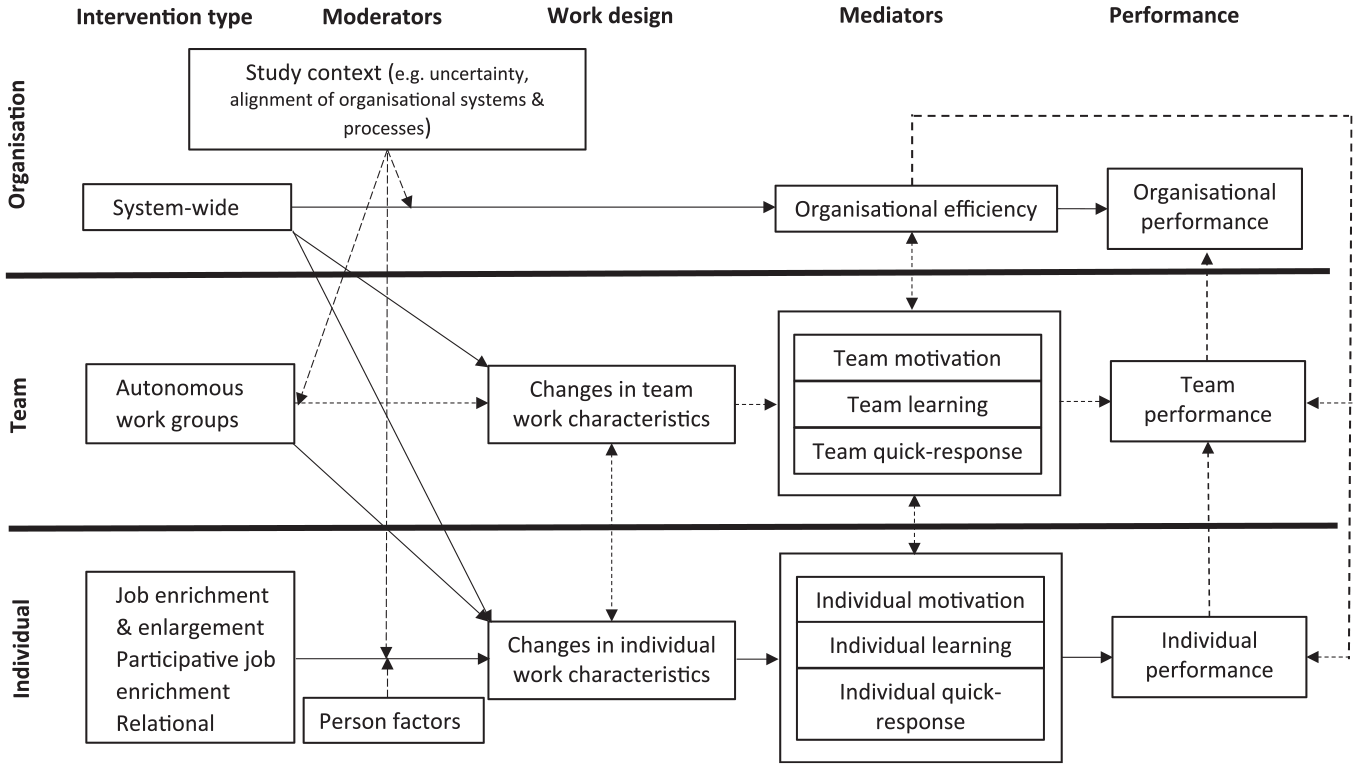
Multilevel model of top-down work redesign interventions and performance.
As depicted by the solid lines for these relationships, participative and non-participative job enrichment and enlargement, and relational interventions, can affect individuals’ work characteristics, which, in turn, shape individual performance. As to exactly how work characteristics affect performance, we propose this occurs through work content changing employees’ work motivation, job learning and quick response. The empirical evidence for these specific mechanisms (RQ3) is not strong in the included intervention studies, but theory and prior research suggest it is reasonable to conclude that changes in work characteristics promote work motivation by meeting individuals’ work-related needs for autonomy, competence and relatedness, as posited by self-determination theory (Deci and Ryan, 2000; Van den Broeck et al., 2010), and foster critical psychological states such as experienced meaning, as posited by the Job Characteristics Model (Hackman and Oldham, 1975). Interventions with a strong focus on employee participation, as seen in both participative job enrichment and enlargement and relational interventions, also increase social contact and can develop employees’ sense of belonging with an organization or group (Daniels et al., 2017; Nielsen, 2013), consistent with self-determination theory.
Other pathways between changes in work characteristics and performance include, for example, that opportunities for learning and mastering work tasks increase self-efficacy, leading to performance gains (Bandura, 1982; Parker, 1998). Work design can also increase exposure to other perspectives, knowledge and opportunities, encouraging cognitive and self-development, learning and proactivity (Parker, 2017). Given the rapid advance of increasingly complex and knowledge-orientated work in the context of automatization and artificial intelligence, we predict that cognition and learning mechanisms will become increasingly important for performance, and so we join others (e.g. Parker, 2014) in advocating more research attention to this pathway.
The model identifies the potential role of autonomous work group interventions, which are team-level work design interventions. Thus, drawing on Chen and Kanfer’s (2006) model, the model depicts that improved team work characteristics including social interactions can lead to increased team motivation, reflecting shared beliefs about team work goals and the individual roles, interdependencies and capabilities of team members. Improved quick response may emerge through team learning. If self-organizing teams can address interdependencies within and between teams, and adapt to the strengths and limitations of team members, tasks can be assigned to members with particularly appropriate skills or interests (Shuffler et al., 2018). However, it is important to note that these aspects of the model need more testing: most data evaluating team interventions has been collected at the individual level, reflecting the dominance of individual-level measures. As yet, we therefore have limited empirical evidence that changes in team work characteristics lead to changes in team performance, and we urge more such studies.
System-wide interventions are organizational-level interventions that can increase organizational performance by increasing organizational efficiency. Changing the physical design of work spaces, for example, may enable individuals to work more comfortably and efficiently owing to decreased musculoskeletal discomfort (Robertson et al., 2008). In addition, enabling individual workers to problem-solve ‘on-the-spot’ allows issues to be resolved more quickly than if an ‘expert’ has to be sought, increasing efficiency (Wall et al., 1990). System-wide interventions also likely affect perceptions of both individual and team work design. A flexible working policy, for example, can increase peceived individual autonomy over when work is completed, but is also likely to affect perceptions of group autonomy, as teams may have the freedom to decide who works from where and when. Team and individual performance may then be positively impacted by increased employee work motivation and increased individual and team efficiency.
Overall, it is intriguing that studies involving changes in HPWP and work design were not more plentiful, given that the benefits of simultaneously redesigning organizational systems as well as work design have been acknowledged as offering the best outcomes for interventions within both work design literature (e.g. Goodman et al., 1988) and HRM theory (Christina et al., 2017). It is possible that the difficult and complex nature of widescale work redesign in organizations often precludes the ability to change complex and entrenched organizational systems. However, without aligining system-wide changes with work design changes, interventions are unlikely to be effective.
As depicted in the model, the evidence from the review also strongly suggested the importance of moderators (RQ4) – especially context and intervention implementation – in these relationships. In particular, the impact of increased autonomy and responsibility (empowerment) on performance was contingent on the level of uncertainty and timely feedback (e.g. Griffin, 1983; Leach et al., 2003; Wall et al., 1992). In addition, where planned changes were not fully implemented, and/or management and employee resistance to change existed, perceived changes in work design and performance were difficult to ascertain and attribute to the intervention. In terms of outcomes, increased turnover and absenteeism appeared to be more connected with study contexts in which organizational design was not aligned with work design, the wider national climate was volatile (e.g. owing to increased unemployment and job insecurity, e.g. Pearson, 1992), and intervention implementation was poor, such as an intervention group failing to adopt a new work practice (e.g. Jayawardana and O’Donnell, 2009).
Individual-level person moderators were observed, such as conscientiousness and prosocial values (Grant, 2008a) and work affect (Parker et al., 2013). Non-intervention research suggests that other factors may be pertinent, such as self-efficacy, optimism, learning and proactive personality (e.g. Parker and Sprigg, 1999; Schaubroeck et al., 2000; Xanthopoulou et al., 2009). It is possible that performance could be increased by increasing person–job fit, either through recruitment and selection processes, or through individuals themselves crafting their own jobs to meet their own strengths, needs and desires (Wrzesniewski and Dutton, 2001). This also suggests that top-down redesign not only needs to be aligned with work design, but also individuals’ own bottom-up attempts to craft their own work. Other potential moderators include shared leadership, which Shuffler et al. (2018) found particularly effective for team performance, and the adaptability of leaders to the changing needs of the team over time.
Beyond the same-level relationships between work design and performance that are reasonably well established in the evidence, we propose cross-level relationships (Figure 9). These are depicted as dotted lines to convey there is limited evidence of such pathways in current work design intervention research. We draw on work design theory and HRM to explain these relationships. Shared perceptions of work design at the team level, for example, are likely to impact individual perceptions of work design, rather like the cross-level interactions between team and individual motivational states proposed by Chen and Kanfer (2006) and supported by later work (Chen et al., 2009). For instance, a shared perception of control over how work is organized amongst team members is likely to impact an individual’s sense of job autonomy (and subsequent individual individual performance). Motivational states can also have cross-level effects, being transferred between team members to affect individuals via a ‘contagion’ effect in the same way that work engagement can be contagious (Bakker and Demerouti, 2007).
Cross-level effects might also be explained through HRM theory, which suggests that horizontal alignment between employment practices and work design is necessary for performance (Christina et al., 2017). Changes to reward, training and development policies at the organizational level, for example, can support work design changes at the team or individual level, although the evidence base for this is as yet small. While work design may increase intrinsic motivation, increasing pay contingent on good performance taps extrinsic motivation. Aligning changes in work practices with work design changes could therefore be a powerful mechanism for effecting multilevel widespread changes.
From a practical perspective, this article suggests that work redesign interventions do work, although not for all people in all contexts. The multilevel model we have proposed can help practitioners to plan and implement work redesigns for particular targets (e.g. individual, team, organization) and performance outcome, with top-down participative and non-participative job enrichment and enlargement, and relational interventions, offering the strongest evidence for increasing performance. Our model identifies several factors that are likely to be crucial to the success of a work redesign intervention, including: assessing the need for interventions prior to designing them, so that interventions are targeted at those who are most likely to benefit; considering the appropriateness of an intervention in a particular context, including which work characteristics should be targeted and how organizational design may need to be changed; considering the level of uncertainty involved in targeting individuals’ work roles in order to gauge the relevance and potential impact of work redesign; including employee participation in the design of interventions; recording how well interventions are implemented, including the presence of manager and employee resistance; including appropriate control or comparison groups where possible; and considering the variables, measures used (e.g. subjective vs objective), measurement levels and number of timepoints. Our recommendations echo similar observations in the wider literature on intervention design (e.g. Briner and Walshe, 2015; Goodman et al., 1988; Nielsen and Randall, 2013; Stouten et al., 2018).
Limitations and future directions
The strength of our research lies in our systematic methods, including extensive searching and double-coding of a range of research, across varying research designs, variables and contexts. Despite our inclusiveness, we retained the quality of our review by focusing on longitudinal intervention studies conducted in the field, thereby promoting ecological validity and causal conclusions. We do, however, acknowledge a number of limitations. Some interventions could have been classified into several categories. Double-coding of our results ensured consistency. Furthermore, space constraints limited discussion of all observed relationships. We also noted that most of the included studies were conducted in western contexts, therefore the results of this review may not be applicable to other contexts. Finally, we acknowledge the limitations of two-dimensional diagrams for capturing the complexity of our findings.
We propose five key directions for future research. First, rather moderate evidence was found for the impact of work redesigns at the team and organizational level. Team- and organization-level research that statistically assesses the relationship between work design and performance, as well as mediation relationships, is needed. For example, investigating the impact of employment practices on work design and performance could contribute to developing evidence-based policy that protects workers whilst also maintaining high performance, enabling organizations to remain competitive.
Second, cross-level effects are not routinely investigated in work design intervention research. We recognize that it may be difficult to collect data at different levels in organizations, with some studies citing trust issues preventing data collection (e.g. MacDonald and Bodzak, 1999) and others being unable to match data to participants (Cordery et al., 1991; Morgeson et al., 2006). Nevertheless, exploring cross-level relationships would help researchers design interventions that evoke intended effects between, as well as within, individuals, teams and departments.
Third, few studies have explored boundary conditions beyond the role of uncertainty. Those which did (e.g. Grant, 2008a; Morgeson et al., 2006; Parker et al., 2013) suggested the importance of person factors, as well as intervention context and implementation. Even within a broad industry, different interventions appeared more appropriate in different contexts (e.g. relational interventions involving beneficiary contact in contexts where such contact is initially low). Research exploring boundary conditions could helping target interventions more appropriately.
Fourth, few interventions measured job demands; those which did focused on role overload (e.g. Parker et al., 2013), role ambiguity and role conflict (e.g. Weigl et al., 2013). Increasingly, jobs are characterized by a variety of different demands that employees must manage effectively in order to perform at a high level. These include job insecurity, technological demands such as interruptions from emails and downtime owing to technological failure (Braukmann et al., 2018). The job demands–resources model suggests that resources (job characteristcis) can buffer the impact of demands (Bakker and Demerouti, 2007). Future research could investigate the interaction between resources and a variety of contemporary job demands in intervention contexts. This echoes an earlier call to extend work characteristics in future work (Parker et al., 2017a).
Conclusion
The common assumption that good work design leads to superior performance has been largely based on correlational evidence. This systematic review found that top-down work redesign interventions can be effective for improving performance, providing causal evidence. Moreover, these heterogeneous interventions worked by improving worker motivation, developing knowledge and skills through learning mechanisms, and increasing quick response. Moderators included the degree of intervention implementation and study context. In particular, success was contingent upon the level of uncertainty, the integration and alignment of organizational systems, and strong manager support. Individual boundary conditions included personality (e.g. conscientiousness) and work-related affect. We contributed substantially to theory and practice by integrating our findings into a multi-level model that takes into account horizontal and cross-level relationships. We encourage researchers and practitioners to use this model to move the conversation forward around how and why top-down work design interventions are successful for improving performance.
Supplemental Material
Supplementary_material – Supplemental material for How work redesign interventions affect performance: An evidence-based model from a systematic review
Supplemental material, Supplementary_material for How work redesign interventions affect performance: An evidence-based model from a systematic review by Caroline Knight and Sharon K Parker in Human Relations
Footnotes
Acknowledgements
We would like to acknowledge the hard work of our research assistants, Lisa Jooste and Cindy Burton, who diligently helped us screen and double code our studies. We would also like to thank our reviewers for their time and effort in reviewing our work. The reviews we received greatly helped us develop our paper.
Funding
This work was supported by an Australian Research Council Laureate Fellowship (grant number FL160100033).

Supplemental material
Supplemental material for this article is available online.
Notes
References
Supplementary Material
Please find the following supplemental material available below.
For Open Access articles published under a Creative Commons License, all supplemental material carries the same license as the article it is associated with.
For non-Open Access articles published, all supplemental material carries a non-exclusive license, and permission requests for re-use of supplemental material or any part of supplemental material shall be sent directly to the copyright owner as specified in the copyright notice associated with the article.
