







Abstract
India’s accession to the WTO in 1995 brought a new set of challenges for its agriculture. Most of the policies supporting agriculture, especially price support and input subsidies, labelled by the agreement on agriculture (AoA) as domestic support measures, were under the scanner. The price support measure that India uses, namely, the minimum support price (MSP) provided to most of the major crops now faces a problem as the methodology of calculating the extent of subsidies on account of MSP is working against India. Further, the AoA prevents India from using export subsidies since it was not using this instrument in the past. But the agreement allows the advanced countries that were using export subsidies to continue using this instrument, albeit at a lower level. Equally problematic for India is the fact that AoA rules are constraining the implementation of the National Food Security Act, which provides subsidised foodgrains to the disadvantaged sections.
Introduction
During the past three decades, agricultural policies in major economies have been influenced by the Agreement on Agriculture (AoA), one of the most iniquitous agreements that the World Trade Organization (WTO) has been tasked to monitor. The Agreement was crafted essentially by the United States (US) and the European Union (EU), the two members of the WTO having signed a series of bilateral agreements in 1992 (the ‘Blair House Accords’), on certain specificities regarding agricultural subsidies that were eventually included in the AoA. According to the US General Accounting Office, ‘while the other major parties did not agree with some of these proposed changes, they accepted them for practical reasons—no agreement on agricultural reform would be possible without the support of the United States and the EU’ (GAO, 1994, p. 137).
With bilateral agreements between the US and the EU becoming integral parts of the multilateral trading system in the form of the AoA, it was hardly unsurprising that developing countries had begun to voice their concerns even before it was implemented. In the Ministerial Conference convened to formally endorse the formation of the WTO in 1994, the then Indian Commerce Minister, Pranab Mukherjee, voiced his concerns regarding the AoA. The Minister argued that the ‘agreement on agriculture will need to be refined in future so that greater liberalization can be achieved and trade-distorting practices disciplined without affecting in any way the developmental programmes and social objectives of developing countries’ (The Uruguay Round, 1994, p. 2). He underlined that the Government of India was ‘firmly committed to protecting the interests of our farmers who constitute the country’s life-line and to the objective of ensuring food security for our people’. Although India’s Commerce Minister had argued that the AoA needed to be refined to ensure that it did not adversely affect the development objectives of developing countries, the inequities embedded especially in the subsidies regime of the agreement have become progressively worse.
This article examines two aspects of the subsidies discipline of the AoA, which could not only undermine India’s subsidies regime but could also render ineffective the implementation of the National Food Security Act that promises subsidised food to nearly two-thirds of the country’s population. The first section of the article deals with India’s administered price mechanism in agriculture, which is being subjected to intense scrutiny in the Committee on Agriculture (CoA) that ‘oversees the implementation’ of the AoA and ‘provides a forum for members to raise and address related questions and concerns’ (World Trade Organization [WTO], 2022a). The second section of the article explains the controversies over India’s public stockholding (PSH) of food grains for food security purposes. Besides supporting the implementation of the NFSA, is also the backbone of the public procurement system that supports the farmers and is therefore critical to sustaining rural livelihoods. The importance of public procurement for the farming community was adequately demonstrated during the year-long farmers’ protests against the now-withdrawn farm legislation.
India’s Price Support Mechanism under Scrutiny
Over the past few years, India’s farm subsidies have consistently been scrutinised by WTO members. In May 2018, the US tabled a detailed paper questioning the veracity of India’s minimum support price (MSP) for rice and wheat, or market price support (MPS), according to the AoA. Subsequently, Australia asked similar questions regarding in respect of the fair and remunerative price (FRP), the minimum price that sugar mills must pay to the farmers, as well as the state advised price (SAP), which sugar mills located in the States must pay to their farmers for delivering sugarcane to the mills. In 2020, Australia, Brazil and Guatemala initiated disputes against India arguing that the FRP and the SAP were both WTO-incompatible. In order to understand the veracity of these claims, it is important to critically examine the basis of the so-called disciplines on MPS mechanisms in the AoA.
Basis for Estimating Market Price Support under AoA
For assessing the extent of the so-called market-distorting subsidies, the AoA estimates the ‘aggregate measure of support’ (AMS) for each member, which comprises the budgetary support provided to subsidise agriculture through input subsidies and subsidies resulting from MPS extended by the governments. During the Uruguay Round negotiations, MPS should be obtained by considering the differences between the administered prices and the ‘external reference price’ expressed in local currency using an average market rate of exchange (General Agreement on Tariffs and Trade [GATT], 1997, p. 3). Several members suggested that the external reference prices should be so selected to avoid the price volatility of agricultural commodities. In other words, external reference prices should be selected for only those years in which prices were relatively stable.
The then members of the European Community (EC), one of the leading protagonists of this approach for estimating subsidisation through MPS, argued in favour of an ‘external reference price’ … should remain unchanged for the initial five-year period’. The group suggested that a review should be conducted ‘during the fourth year, a different fixed external reference price could be envisaged’ (GATT, 1990, p. 58). The EC pointed out that several participants ‘argued that a fixed external reference price did not by itself eliminate the issue of exchange rates and world price movements’ and that while ‘choosing an external reference price, it was important not to lose sight of the economic realities negotiators were trying to capture in an aggregate measurement’. In an earlier phase of the negotiations, the EC had also alluded to the fact that participating countries had argued in favour of using ‘a moving average reference price instead of a fixed one, in order to take into account these economic realities’ (GATT, 1989a, pp. 1–2).
The Chairman of the Committee on Agriculture proposed in 1988 that
[P]ragmatic options for a recent base period would involve a moving average base starting with 1986-88 for 1989 and so on, or a crawling peg under which the support profile in 1988 would be the base for 1989, with 1989, in turn, becoming the base reference for 1990.
However, after the Mid-term Review of the Uruguay Round conducted between December 1988 and April 1989, the pendulum began to swing in favour of the adoption of a set of ‘fixed external reference prices’ with 1986–1988 being suggested as the preferred reference years. 1 The die was cast in favour of this methodology when the then Director General of the GATT, Arthur Dunkel presented the ‘final global package of the results of the Uruguay Round’. This so-called ‘Dunkel Draft’ became the basis for the outcome of the eighth Round of the GATT negotiations, although the AoA became a reality only after the US and the newly formed EU were able to find common ground through the Blair House accords, as mentioned above.
MPS provided by WTO members to different agricultural commodities are, therefore, calculated by comparing their administered prices for a given year and fixed external reference prices (FERP), namely, the international prices existing between 1986 and 1988. The assumption was that this period provided a set of unbiased and stable sets of commodity prices, which, when used as the numeraire, provided the best estimates of price support granted by the WTO members. For calculating the total value of subsidies given to each crop, the difference between the current administered prices and the FERP is multiplied by the volume of production enjoying price support (called ‘eligible production’). MPS below 10% of the value of production of a crop is considered the de minimis level for a developing country member and is excluded from the aggregate measurement of support (AMS) provided by a member. It may be mentioned that besides the non-de minimis MPS, AMS also includes the budgetary outlays on input subsidies, or non-product specific support, provided subsidies of individual inputs for a developing country are below 10% of the value of production.
The subsidy discipline of the AoA imposes an upper bound on the extent of AMS that a developing country may provide, which is 10% of its value of production. Although MPS for individual crops or budgetary outlays for specific inputs can exceed the 10% threshold, total AMS must always remain below the de minimis. However, if a developing country member did not report any AMS upon accession to the WTO, this member had to always limit its MPS for each crop to below10% of its value of production 2 . India is a case in point in this regard. India had reported that its product-specific support was ₹(–)244,422 million as the administered prices for 15 of the 17 crops receiving MPS during 1986–1988 were below the FERP, and therefore India did not report any AMS during these years. Therefore, India must keep its MPS for all individual crops below the de minimis in order to conform to Article 7.2(b) of the AoA.
AoA’s complex methodology for restricting the use of MPS is faulty on several counts, which we shall briefly discuss below.
Erroneous Methodology for Estimating Market Price Support
The methodology for estimating MPS has several limitations, a few of which are mentioned below.
The first and the most obvious fallacy in the methodology for estimating MPS is the assumption that the international prices with which the administered prices are compared represent competitive prices. It is a no-brainer that international prices during 1986–1988 were significantly influenced by the subsidies provided by the advanced countries, especially the US and the then EC, the major players in the markets for several important commodities. In 1988, the US and the EC members dominated the exports of several major commodities, accounting for nearly 60% of wheat and 80% of maize exports. 3 The US had long dominated the global markets for cotton and had continued to do so in the late-1980s.
Proponents of using FERP as the basis for estimating MPS had emphasised that the prices in the reference period should be stable. However, international commodity prices during 1986–1988 were generally volatile, and the same tendencies were witnessed in the prices of major commodities, including rice, wheat and maize.
De Gorter and Ingco (2002) alluded to the methodological flaws in the estimation of AMS. They argued that in ‘many cases, the AMS is overstated or understated, or meaningless because it is double counting support already provided by import barriers or export subsidies’. They argued that there are ‘difficulties in comparing the AMS across commodities and countries because it is conflated with import barriers and export subsidy measures, and if the actual market price is not equal to the support price, inaccuracies arise’. For instance, ‘if there are import barriers in place that keep domestic prices high, but there is no administered price, then no “market price support” is estimated for the AMS’.
The most significant criticism of the FERP is that it compares the international prices existing nearly four decades back with the current administered prices. By so doing, this methodology imposes a severe burden on WTO members, especially developing countries, which have been experiencing ‘excessive rates of inflation’ 4 since 1986–1988. India, for instance, has witnessed CPI inflation of close to 970% during this period, thus rendering its AMS calculations quite meaningless. This is, no doubt, a strong case for amending AoA’s methodology for calculating AMS so that it makes good economic sense.
Unfortunately, the agreement cannot be amended since it contains a weak provision that requires WTO members to give ‘due consideration to the influence of excessive rates of inflation on the ability of any Member to abide by its domestic support commitments’ (Article 18.4 of the AoA). This provision indicates that the drafters of the AoA were aware of the problems that inflation could cause while implementing the agreement (Matthews, 2014, p. 15), but they opted against including provisions that result in renegotiations involving areas of the AoA, not least the domestic support provisions that were carefully crafted by the US and the EU.
These limitations of AoA’s subsidies disciplines notwithstanding, India has been frequently questioned for providing MPS well beyond its entitlements. We will briefly discuss two instances when India’s AMS on rice, wheat and sugarcane, have been questioned in the WTO.
Unjustified Questioning of India’s Market Price Support to Rice and Wheat
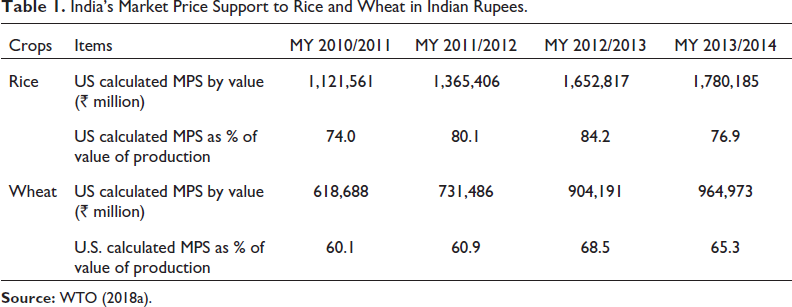
India’s Market Price Support to Rice and Wheat in Indian Rupees.
India’s Market Price Support to Rice and Wheat in Indian Rupees.
India’s Market Price Support to Rice and Wheat in US Dollars.
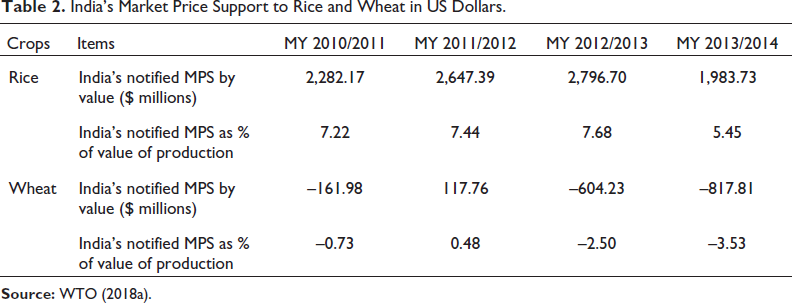
It is obvious that the discrepancies between the ‘US calculated’ figures and ‘India’s notified’ figures in Tables 1 and 2 respectively are because of the differences in the currencies that have been used to present the figures. The figures presented by India in its notifications show the effect of the devaluation of the Indian Rupee on the estimated MPS of rice and wheat. By factoring in the devaluation of the rupee in its domestic support notifications, India was able to show that the MPS for rice and wheat as a share of their value of production were well below the 10% threshold. But why is the US opposed to India’s practice of notifying its domestic support figures in rupees instead of the US dollars?
The US’ major criticism against India is that at the conclusion of the Uruguay Round negotiations, India had submitted its domestic support notification indicating its MPS during 1986–1988 in Indian Rupees. 5 However, in its notifications after the implementation of the AoA in 1995, India has been notifying its MPS in terms of US dollars. The US’ contented that India should have continued to notify its actual levels of domestic support in Indian Rupees as it had done in the first notification. This point may have some validity, but only from the point of view of consistency in reporting. However, this criticism lacks legal validity as the AoA does not advise/direct the WTO members about the currency in which they should be submitting their notifications.
From India’s point of view, the advantages of reporting its domestic support notifications in US dollars instead of Indian Rupees can clearly be understood from Tables 1 and 2. If India had continued to notify its MPS in Indian Rupees, it would have long breached de minimis threshold for developing countries. Consequently, India would have had to freeze its MPS, and it would have been prevented from increasing the MSPs every year.
By notifying its MPS in US dollars, India was in effect, getting partial compensation for the ‘excessive inflation’ it had experienced. Between 1986–1988 and 2010/2011 to 2013/2014, the period covered in the US submission, the Indian Rupee had depreciated by over 300%, while India’s CPI inflation was well over 600%. In other words, India’s MPS notifications in US dollars were under-compensating for the effects of ‘excessive inflation’ and are therefore leaving no scope for future increases in MPS for rice. In 2020–2021, MPS for rice had already exceeded 15% of its value of production and was well above the de minimis level (WTO, 2022b). Compensation for ‘excessive inflation’ while notifying MPS should, therefore, be India’s major demand in the WTO.
Threat to India’s Price Policy for Sugarcane
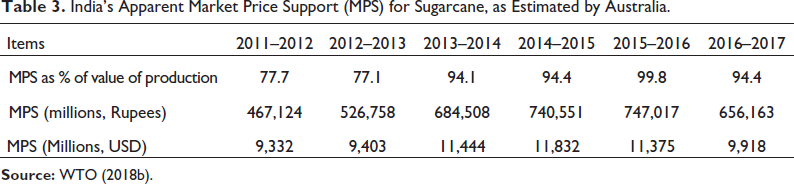
Like wheat and rice, India’s sugarcane policies also came under scrutiny in 2018. A formal submission by Australia the WTO-consistency of FRP, the minimum price that sugar mills must pay sugarcane farmers, as well as the SAP, which sugar mills in the States must pay to their farmers for supplying sugarcane (WTO, 2018b). In 2019, Brazil initiated a dispute against the FRP and SAP (WTO, 2019) and was joined by Guatemala and Brazil. They had also characterised India’s sugar export promotion measures as a violation of AoA.
India’s Apparent Market Price Support (MPS) for Sugarcane, as Estimated by Australia.
The dispute settlement panel concurred with the views of the complainants that FRP and SAP are forms of MPS (WTO, 2021). India contested the view of the Panel arguing that the AoA states that ‘subsidy can only exist where there is a budgetary outlay or revenue foregone by governments or their agents’, meaning thereby that governments must be involved in the payment of subsidies. India clarified that the Central and State Governments do not purchase sugarcane or pay FRP and SAPs to the farmers, these payments are made by the sugar mills, which are private entities.
However, the dispute settlement panel disagreed with India’s argument that FRP and SAPs cannot be treated as subsidies. The panel’s argued that the ‘market price’ of an agricultural product is the price of the product in the market, and ‘price support’ refers to the ‘assistance from a government or other official body in maintaining prices at a certain level regardless of supply or demand’. Therefore, a mandatory minimum price set by the government would seem to constitute ‘domestic support’ to agricultural producers, even if the payment was made by sugar mills.
This conclusion arrived at by the dispute settlement panel that FRP and SAPs are forms of subsidy raises at least two questions. The first is whether the panel had an adequate understanding of raison d’etre for fixing the statutory minimum prices that the farmers receive from the sugar mills. The real reason why the Central and State Governments direct the sugar mills to pay the farmers is to ensure that the latter receive fair prices from the former. Thus, the intention of the Central and State Governments is to improve the livelihoods of the farmers, who are already in considerable distress. In giving its ruling, the panel seemed to be ignorant of the reality that sugar farmers are in an adverse bargaining position vis-à-vis the sugar mills, and it is therefore imperative for the governments to step in to ensure that the farmers receive remunerative prices for sugarcane.
A second question against the panel’s ruling against India can be raised from the way it had concluded that FRP and SAPs are forms of price support measures, or subsidies even when the sugar mills were making payments to the farmers for supplying sugarcane. This interpretation by the panel seems to have turned the definition of a subsidy given in the WTO Agreement on Subsidies and Countervailing Measures (ASCM) on its head. The definition of subsidies given in ASCM has three basic elements: (a) a financial contribution (b) by a government or any public body within the territory of a WTO Member (c) which confers a benefit. 6 All three of these elements must be satisfied for a subsidy to exist. Therefore, when non-government entities like sugar mills pay FRP and SAPs to farmers, why did the panel stretch itself to categorise these payments as subsidies?
Indian agriculture faces the most formidable challenge from the implementation of AoA rules in respect of Public Stockholding for Food Security Purposes (PSH). The AoA imposes two sets of conditions on WTO members maintaining food stocks to provide subsidised food for addressing the problem of domestic food insecurity. One, governments must build public stockholding of food grains by purchasing the grains at current market prices and must sell from food security stocks at the current domestic market prices. Two, when stocks of foodstuffs for food security purposes are acquired and released at administered prices, the difference between the acquisition price and the FERP must be accounted for in the AMS. In other words, procurement of food grains for building publicly held stocks is done at the administered prices, and is subjected to a set of rules that are similar to those for providing MPS, as discussed earlier.
The provisions regarding PSH became important for India after the government began implementing the National Food Security Act (NFSA) in 2013. Having committed to provide subsidised food grains to almost two-thirds of the country’s population, India was staring at a situation where the possibility of breaching the subsidies’ threshold of 10% become imminent. If the government had continued to implement the NFSA despite breaching the subsidy limit, any other WTO member could have initiated a dispute against India. And, if India had lost the dispute, the distribution of subsidised food grains would have to be discontinued immediately.
However, in the run-up to the Bali Ministerial Conference in 2013 (WTO, 2013), India accepted the so-called ‘peace clause’, an interim mechanism that provided a temporary reprieve from facing disputes even if its total AMS had exceeded 10% of the value of production. However, the ‘peace clause’ proposed two binding conditions on the countries using ‘Public Stockholding’. First, India has to notify the WTO of the details regarding the PDS, including the quantity procured and distributed, and the quantities exported from the stockholding. The second condition was that food stocks procured under such programmes must not be used to distort trade or to adversely affect the food security of other members, in other words, India must refrain from exporting such subsidised stocks of food grains.
With this export restriction clause in place, it is hardly surprising that India’s increasing exports of food grains during the past few years and the government’s target to increase export volumes in the near term have attracted attention in the CoA discussions. WTO members have, in particular sought clarification, on whether the publicly held stocks with the Food Corporation of India are being used to trigger India’s cereal exports. Clearly, the export restriction condition in the ‘peace clause’ can adversely impact India’s ambitions to become a major exporter of cereals.
By Way of Conclusions
The Government of India’s MPS mechanism faces formidable challenges from the subsidies’ disciplines of the AoA. Over the past few years, India’s price support policies have consistently been challenged by several WTO members who have argued that India has breached the threshold specified by the agreement in respect of most major crops. The implications of these challenges are to prevent the government from providing price support to the farming communities, which are vitally important for protecting rural livelihoods.
This article argued that the methodology for estimating MPS, based on which India is being challenged, is deeply flawed. The AoA was established ‘… to establish a fair and market-oriented agricultural trading system …’, but its implementation has revealed that the agreement can only widen inequities among WTO members by increasing agrarian distress in the developing world. India is rapidly losing its flexibility to provide MPS and the government’s inability to provide price support to the farmers could significantly worsen the agrarian crisis.
Footnotes
Declaration of Conflicting Interests
The author declared no potential conflicts of interest with respect to the research, authorship and/or publication of this article.
Funding
The author received no financial support for the research, authorship and/or publication of this article.