







Abstract
India’s welfare trajectory has shifted from a constitutionally grounded, state-led model to a market-oriented approach, often overlooking rights-based social security policies. This article examines the governance of rights-based welfare policies (RBWPs) targeting economic security (work and food) and human development (health and education). Despite progressive mandates, implementation remains fragmented due to siloed ministries, administrative inefficiencies and uneven fiscal allocations, particularly at sub-national levels. The shift towards market-led welfare has failed to stabilise employment or secure the rights of informal workers. Gaps between policy intent (dharma) and execution (karma), compounded by low public investment and weak inter-departmental coordination, undermine constitutional entitlements. To address these challenges, this article proposes an integrated welfare provisioning model for economic and human development (IWP-EHD), a unified ministerial framework emphasising cross-sectoral coherence, participatory planning and digital governance. This model aims to transition from charity-based welfarism to a rights-based citizenship paradigm.
Keywords
Introduction
Several political philosophers have shaped the theoretical foundations of the welfare state. Classical liberal thought conceptualised the state as a guarantor of social order and individual liberty (Hobbes, 1651/1996; Locke, 1689/1988), while Rawls (1971) advanced justice as fairness through the difference principle to benefit the least advantaged. In contrast, Nozick (1974) defended minimal redistribution to protect individual freedom, and Marx and Engels (1848/1998) viewed welfare as a mechanism that stabilises capitalism without addressing structural inequality. Sen’s (1982) capabilities approach reframed welfare as the expansion of substantive freedoms rather than mere resource provision.
These perspectives collectively informed the evolution of the welfare state as a response to systemic, rather than individual, sources of poverty and inequality, prompting governments to pursue inclusive policies addressing health, education, housing and social security (Sinha, 2024). In India, the post-independence state adopted a welfarist orientation aimed at social equity and support for disadvantaged groups. While rights-based interventions such as employment guarantees and food security have enhanced capabilities and asset creation, they have not fundamentally altered underlying socio-economic structures (Haragopal & Balaramulu, 1989).
Against this theoretical and empirical backdrop, the article undertakes a structured analysis of India’s welfare trajectory. The first and second sections examine the transition from welfarism to new welfarism and the political context of rights-based welfare policies. The third section analyses budgetary trends and the operational dynamics of rights-based social security and human development programmes, with a focus on implementation. The fourth section advances the case for Integrated Welfare Provisioning for Economic and Human Development (IWP-EHD), followed by Conclusion.
The Changing Context of Welfarism to New Welfarism
In the context of the intensification of global economic pressures in post-industrial economies during the early 1990s, scholars challenged the traditional roles of the welfare state and advocated for a new welfarism. Unlike earlier models centred on state-led redistribution and structural interventions, new welfarism blends market mechanisms, technological governance and targeted subsidies to enhance individual capabilities and community engagement. It reflects the growing influence of corporate power and global economic policies on domestic welfare agendas (Farnsworth & Holden, 2006). This approach merges traditional welfare principles with adaptive strategies, calling for a holistic integration of social, economic and political considerations in policymaking (Sinha, 2024).
In the Indian context, the Constitution declares India a ‘Socialist’ state, advocating equitable wealth distribution and reduced economic disparities. The Directive Principles of State Policy (Part IV) reinforce this vision. Article 38(1) mandates the promotion of a just social order, while Article 38(2) urges the state to minimise inequalities in income, status and opportunity. Over time, however, the Indian welfare model has evolved, broadly transitioning from state-led welfarism to a more market-oriented new welfarism.
Welfarism: State-led Modernisation and Economic Growth
In pursuing modernisation, the state emphasised economic growth, while welfare initiatives were often designed to complement these broader objectives rather than serve as standalone goals. The same is argued by Jayal (1994) that the Indian state should be characterised as an interventionist and developmentalist state, with only a limited welfarist orientation, in contrast to the welfare states of the West. In the early post-independence period, growth was pursued through a ‘trickle-down’ model alongside efforts to address structural inequalities, such as land reforms, abolition of the zamindari system and tenancy regulation. However, these reforms were unevenly implemented and failed to dismantle entrenched inequities. Pellissery and Sasidhar (2018) argue that post-colonial welfare states, including India, prioritise developmental over social expenditure, and that social policy alone is inadequate to address deep-rooted issues in the Global South. Ram Reddy and Haragopal (1985) similarly critique welfare measures for focusing on symptoms rather than structural causes of poverty and inequality.
By the late 1960s, underdeveloped markets and unaddressed inequality led to growing unrest, exemplified by the Naxalbari uprising. In response, the 1970s saw a policy shift towards growth with social justice, marked by targeted programmes and autonomous agencies such as the Small Farmers’ Development Agency and the Integrated Tribal Development Agency. These initiatives aimed to improve the welfare of marginalised communities, including SCs, STs, OBCs, women and the unemployed (Balagopal, 1988; Balaramulu, 2025).
Challenging Welfarism
By the late 1980s, the Indian state’s welfarist orientation faced growing challenges, including international pressures for economic liberalisation and critiques of the effectiveness of state-led welfare schemes. Critics questioned their developmental impact and highlighted the administrative inefficiencies that hindered service delivery, such as excessive government control, bureaucratic delays, lack of transparency, political interference and institutional resistance to reform (GOI, 2008–2009). These governance shortcomings, combined with intensifying fiscal pressures and eroding confidence in state capacity, marked a turning point. The economic crisis of the early 1990s catalysed liberalisation reforms, reshaping the state’s role from a direct provider to a facilitator in welfare delivery, aligning with the principles of new welfarism.
Market Economy: A New Welfarism
The early 1990s marked a significant shift in India’s welfare paradigm. The Indian state moved away from direct involvement in production and social service delivery, embracing a market-oriented approach. Liberalisation reduced state control and encouraged private sector participation, privatisation promoted disinvestment in public enterprises and globalisation integrated the Indian economy with global markets through trade liberalisation and foreign investment. Despite this retreat from direct welfare provision, the state introduced targeted schemes for vulnerable groups, such as the elderly, widows and persons with disabilities, under the National Social Assistance Programme in 1995. The early 2000s saw a further expansion of social welfare through rights-based legislation, particularly in the domains of work and food security. This period also marked a shift towards delivering essential services such as food, health and education through public–private partnerships and digital governance mechanisms aimed at improving efficiency, targeting and transparency.
The Rights-based Welfarism Approach and Political Compulsions Context
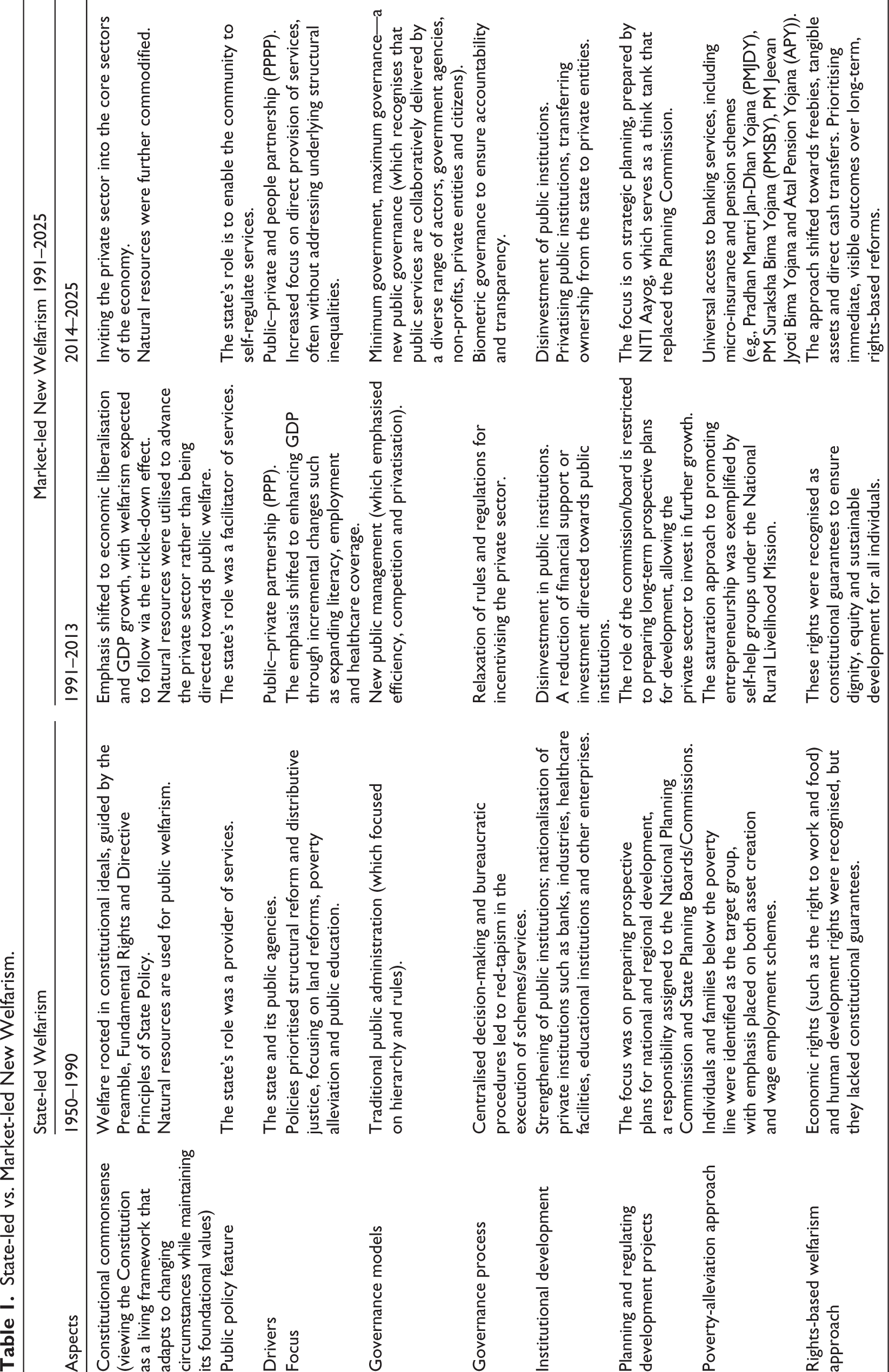
The welfarism approach reframes welfare as an entitlement rooted in social justice. However, this phenomenon is evolving under various regimes due to their political ideologies and global national compulsion. Table 1 provides insights into the changing concept of welfarism under different regimes and development models.
State-led vs. Market-led New Welfarism.
Rights-based Approach to Welfarism Under Different Regimes
Understanding the rights-based approach to welfarism and its political context is essential for analysing welfare policymaking in India. The National Democratic Alliance, led by the BJP in the 1990s, continued the liberalisation agenda initiated by the Congress in 1991. In the 2004 general elections, the BJP advanced in the polls, relying on Prime Minister Vajpayee’s popularity and the ‘India Shining’ campaign. However, this narrative failed to acknowledge widespread deprivation, creating a disconnect with the electorate. In contrast, the Congress party effectively mobilised a pro-poor ‘aam aadmi’ appeal, which resonated with voters and exposed the limitations of the BJP’s development model (The Hindu, 2004).
Reforms with a Human Face
The Congress-led United Progressive Alliance (UPA), which assumed office in 2004, explicitly acknowledged that market-oriented economic reforms alone were insufficient to address entrenched poverty and inequality. Through the National Common Minimum Programme (NCMP), the UPA advanced the idea of ‘reforms with a human face’, combining economic growth with targeted welfare interventions focused on rural development, agriculture, infrastructure and enhanced public investment in health and education (Bajpai & Sachs, 2004). The NCMP emphasised that poverty reduction required sustained growth alongside rights-based state intervention for marginalised populations.
This approach materialised in the enactment of a series of rights-based welfare programmes (RBWPs) between 2004 and 2014, broadly classified into two domains. The first, economic security, included the Mahatma Gandhi National Rural Employment Guarantee Act (MGNREGA), 2005, which provided statutory wage employment, and the National Food Security Act (NFSA), 2013, which ensured access to subsidised foodgrains. The second, human development, encompassed the National Rural Health Mission (NRHM), 2005, aimed at improving rural healthcare access, and the Right to Education (RTE) Act, 2009, which made free and compulsory education a legal entitlement for children aged 6–14 years.
Collectively, these programmes sought to operationalise constitutional commitments under Articles 21, 41, 45 and 47, translating social rights into enforceable entitlements. The UPA’s electoral victories in 2004 and 2009 were widely attributed to this inclusive growth strategy, which foregrounded redistribution, social protection and the extension of welfare rights to historically excluded groups.
Community-driven Strategies: The New Welfarism
Since 2014, the present regime has increasingly emphasised saturation-based self-targeting and community-driven welfare delivery, marking a shift towards asset-focused interventions. This approach prioritises universal provision of specific goods and services to households lacking them, including bank accounts, sanitation, electricity, cooking gas, drinking water and health insurance. Key initiatives include the Pradhan Mantri Jan-Dhan Yojana (PMJDY, 2014) for financial inclusion; Swachh Bharat Mission (SBM, 2014) to improve sanitation and reduce open defecation; Saubhagya (2017) for household electrification; Ayushman Bharat and PM Jan Arogya Yojana (PM-JAY, 2018) to advance universal health coverage; and the Jal Jeevan Mission (JJM, 2019), which aims to provide 55 litres of piped drinking water per person per day to every rural household. Government assessments frame these programmes as mechanisms to translate economic growth into tangible benefits and promote inclusion (NITI Aayog & UNDP, 2024; Sinha, 2024).
In contrast, RBWPs are legally universalised and inclusion-driven, targeting structurally vulnerable populations rather than asset deprivation alone (Khera & Asjad, 2024). Programmes such as MGNREGS, NFSA, Integrated Child Development Services (ICDS) and Mid-Day Meals address chronic conditions of income insecurity, food insecurity and malnutrition through periodic entitlements. These schemes function as shock absorbers during crises and as redistributive instruments during normal periods, contributing to long-term human capital formation and economic resilience (Balaramulu, 2016).
Crucially, RBWPs are grounded in law, with enforceable entitlements, accountability mechanisms and grievance redressal, distinguishing them from newer welfare models. Recent policy shifts towards asset-based and community-led strategies risk sidelining these programmes and overlooking the deeper economic and human development needs of informal workers, landless labourers, women and children (Rahman & Pingali, 2024; Sinha, 2024). Consequently, while asset-based initiatives address immediate deficits, inclusive welfare requires legally enforceable rights that confront structural deprivation, a role uniquely fulfilled by RBWPs.
Rights-based Welfare Programmes: An Assessment
The studies observe that schemes like MGNREGS and public distribution system (PDS), though rights-based in design, face chronic underfunding and bureaucratic hurdles and lack of coordination among the government agencies that dilute their impact (Balaramulu, 2024; Drèze, 2013; Drèze & Khera, 2017; Mooij Jos, 1999); the systemic gaps in health infrastructure and policy implementation disproportionately affected women, especially in informal sectors, during Covid-19 (Ghosh, 2021); health policy commitments have not translated into equitable access, particularly for rural and marginalised populations (Sreekumar, 2023); foundational learning goals in education policy are often compromised by weak institutional delivery and accountability mechanisms (Muralidharan & Singh, 2021). The studies also observed that despite progressive policy frameworks, the implementation gap remains evident in stagnant or declining budgetary allocations, poor coordination among public institutions and the growing inaccessibility of public goods and services, especially for the poor and vulnerable, due to increasing commodification. These patterns raise pressing concerns about the erosion of constitutional entitlements for marginalised communities. Crucial to this discussion is the analysis of budget allocations and operational dynamics of RBWPs, as it offers insights to inform the design and implementation of future policies aimed at achieving their intended objectives.
Trends in Union Budgetary Allocations
Union budgetary allocations reflect the state’s policy priorities and its commitment to addressing socio-economic challenges. An analysis of union budgets from 2005–2006 to 2025–2026 shows a sharp increase in total expenditure from ₹5.14 lakh crore to ₹50.65 lakh crore, implying an average annual growth rate of 12.31% (Ministry of Finance, 2025). However, when adjusted for inflation, real growth in allocations is considerably lower, raising concerns about the effective purchasing power and implementation capacity of public programmes, including RBWPs.
Since the early 1990s, fiscal policy has sought to balance welfare commitments with growth-oriented investment. Reforms such as the introduction of the Goods and Services Tax, inflation-targeting monetary policy and capital-intensive infrastructure expansion in sectors such as roads, railways and urban housing reflect this orientation. This reorientation, however, has entailed significant trade-offs. Defence expenditure more than doubled over the past decade, exceeding ₹6.8 lakh crore in 2025–2026, while allocations for education, healthcare and welfare have stagnated or declined in real terms (CNES, 2025). Rising unemployment, inflationary pressures and subsidy rationalisation have further intensified economic vulnerabilities, particularly among marginalised groups (Desai et al., 2025). These trends underscore the need for a more balanced expenditure framework that prioritises social equity, human development and inclusive growth.
Economic Security
Employment Access and MGNREGP
Public employment policy, particularly the Mahatma Gandhi National Rural Employment Guarantee Programme (MGNREGP), has been central to addressing rural poverty and underemployment. Such programmes remain essential in an economy characterised by surplus rural labour and chronic deficits in capital and social infrastructure that constrain growth (Nurke, 1957). Before MGNREGP, schemes such as the National Rural Employment Programme (NREP) and Jawahar Rozgar Yojana relied on labour-intensive public works to generate employment, build infrastructure and improve nutrition and livelihoods, but lacked legal enforceability (Hirway, 1985).
Enacted in 2005, MGNREGP institutionalised employment as a statutory entitlement by guaranteeing 100 days of wage employment per rural household annually. Despite this rights-based design, fiscal commitment has remained limited. Allocations rose from ₹11,000 crore in 2005–2006 to ₹86,000 crore in 2024–2025 and 2025–2026, yet the average annual allocation of ₹44,661 crore accounts for only 0.67 per cent of the union budget, with the programme’s share ranging between 0.41 per cent and 0.98 per cent (Ministry of Finance, 2025).
Inadequate funding has weakened the programme’s capacity to secure the right to work. Limited allocations have reduced employment generation, intensified rural poverty, encouraged distress migration and dampened local economic demand (IMPRI, 2024). On average, only 3.95 crore households accessed work annually, with households receiving 48.65 days of employment, well below the statutory guarantee (Ministry of Rural Development, 2023). Although unemployment allowances are mandated when work is not provided within fifteen days, demand is often underreported, as it is recorded only when employment is generated (Sobhana, 2025). The deletion of over 1.55 crore workers from programme rolls between 2022 and 2024 due to duplicate records, invalid job cards and migration has further narrowed access and raised concerns about accountability (The Economic Times, 2025a).
Against this backdrop, the Viksit Bharat Guarantee for Rozgar and Ajeevika Mission (Gramin) Act, 2025 (VB-G RAMG) marks a significant governance shift. While extending the employment guarantee to 125 days, the Act reconfigures the programme from a demand-driven entitlement to an allocation-based framework, with state-wise ceilings determined through centrally prescribed parameters. Employment generation is increasingly embedded within planning, infrastructure and productivity objectives, blurring the distinction between a legal right and a development programme. This convergence, while presented as livelihood enhancement, risks diluting the enforceability of the right to work by subordinating it to supply-side and administrative constraints.
Operational challenges have persisted throughout this transition. A substantial share of allocations is absorbed in clearing arrears, with West Bengal alone reporting pending dues of around ₹7,500 crore (The Economic Times, 2025b). Delayed wage payments, lagging revisions linked to the Consumer Price Index for Agricultural Labour (CPI-AL) and imbalances between employment demand and productivity-oriented initiatives remain widespread (Balaramulu, 2025; Ministry of Rural Development, 2022). Empirical studies document that inadequate funding, delayed payments, low wages and discontinuous employment constrain nutritional and labour market outcomes (Singh, 2018; Tabassum, 2020). These issues are compounded by gender and caste-based exclusion, weak infrastructure, limited awareness of entitlements and administrative inefficiencies (Hirway, 1985; Kumar, 2019; Mandal, 2018; Rath, 2018; Sharma, 2020).
Food Entitlement and the NFSA
Food security constitutes the second pillar of India’s rights-based welfare framework. While often equated with calorie sufficiency, food security also entails access through legally sanctioned means, including state entitlements (Sen, 1982; Vyas, 2000). India’s food policy evolved from limited rationing to a nationwide system encompassing the PDS, ICDS, Mid-Day Meal Scheme, Targeted PDS (TPDS) and Antyodaya Anna Yojana. The NFSA, enacted in 2013, marked a decisive shift by transforming food provisioning into a statutory entitlement, covering 75% of the rural and 50% of the urban population or approximately 80.72 crore individuals.
Budgetary allocations under NFSA increased from ₹10,000 crore in 2013–2014 to ₹50,000 crore in 2024–2025, with the programme’s share of the union budget rising from 0.45% to 1.00% and averaging 0.82% annually. However, persistent gaps between budgeted and actual expenditure indicate underutilisation. Coverage expanded from 2.36 crore households in 2013–2014 to 2.90 crore in 2024–2025, averaging 2.71 crore households annually (Ministry of Consumer Affairs, Food & Public Distribution, 2025). Also, state-level audits reveal significant deletions from NFSA rolls. In Punjab, for example, nearly 2.9 lakh beneficiaries (12% of flagged cases) were removed after field checks, while in Gujarat, 56.58 lakh ‘suspicious’ beneficiaries were flagged for verification, reflecting both leakages and attempts at clean-up. Operationally, food entitlement policies also suffer from limited stakeholder participation, poor inter-departmental coordination, culturally inappropriate food provisioning and weak integration with complementary rights such as health, education and information (Balaramulu, 2025; Chakraborty & Sarmah, 2019; Mooij, 1999).
Human Development: Health and Education
Investing in human development, particularly health and education, is central to securing dignity and well-being for vulnerable rural populations. In the health domain, the right to health, though not explicitly enumerated as a fundamental right, is implicitly protected under Article 21 of the Constitution, as affirmed by the Supreme Court and reinforced by the Directive Principles of State Policy under Articles 38, 42, 43 and 47.
Health
Launched in 2005, the NRHM sought to restructure India’s public health system through a comprehensive approach encompassing preventive, promotive, curative and rehabilitative care, with a focus on rural populations, women and children (Government of India, 2005). Key interventions included the deployment of Accredited Social Health Activists, strengthening rural health infrastructure, decentralised governance through Panchayati Raj Institutions and improved health information systems (Husain, 2011).
In the Union Budget 2025–2026, the health sector received ₹99,858.56 crore, of which NRHM accounted for ₹37,226.92 crore (37.3% of the health budget and 0.73% of the Union Budget). NRHM allocations increased from ₹6,700 crore in 2005–2006 to ₹37,227 crore in 2024–2025, with an average annual allocation of ₹21,774 crore and beneficiary coverage rising from 1.5 crore to 7.2 crore individuals (Ministry of Health and Family Welfare, 2025). Despite improvements in indicators such as immunisation and institutional deliveries, public health expenditure remains around 1% of the GDP, far below recommended levels (Raj et al., 2025). Evaluations highlight persistent gaps in service quality, regional equity and primary healthcare, shaped by sociocultural inequalities, weak local governance and inadequate attention to social determinants of health (Bhat et al., 2009; Duggal, 2009; Husain, 2011; Paul, 2020).
Education
Article 45 of the Indian Constitution mandates free and compulsory education for children aged 6–14 years, affirming the Right to Learning as a foundation for social inclusion and long-term development. The RTE Act, 2009, operationalised this mandate by making elementary education a legally enforceable right. Despite this constitutional and legal framework, substantial resource gaps persist across states, with poorer states facing a pronounced mismatch between normative expenditure requirements and actual allocations, highlighting the need for increased public investment and targeted fiscal support (Bose et al., 2020).
Union budget allocations for RTE increased from ₹15,000 crore in 2009–2010 to ₹48,000 crore in 2024–2025, with an average annual allocation of ₹35,193 crore and average actual expenditure of ₹31,543 crore. As a share of the union budget, RTE allocations rose from 0.48% to a peak of 1.35%, averaging 1.03% annually (Ministry of Education, 2025). However, access deficits remain significant. Approximately 15 million children are out-of-school nationwide, disproportionately from marginalised groups, with 40% belonging to SC and ST communities (NSS 2014–2015). Uttar Pradesh records the highest proportion of out-of-school children (13%), followed by Bihar and Rajasthan (around 10%), Gujarat and Madhya Pradesh (8%) and Jharkhand (7%) (Bose et al., 2020).
Implementation challenges stem from structural and budgetary constraints, bureaucratic dominance in educational administration, short-sighted policy decisions (Kainth, 2006; Manani & Goswami, 2025), rising private schooling costs leading to dropouts and discriminatory practices against economically weaker students admitted under the 25% quota (Sarasvati, 2020). Studies further note that unmeasured goals such as educational quality and freedom from mental harassment receive limited attention, resulting in compliance with the formal provisions of the RTE Act rather than its substantive intent (Chatterjee & Robitaille, 2023).
Thus, the cumulative effects of fragmented governance, implementation gaps and underinvestment across work, food, health and education point to the limitations of siloed welfare interventions and necessitate an integrated approach to welfare provisioning, articulated in the next section through the IWP-EHD framework.
The Case for Integrated Welfare Provisioning for Economic and Human Development (IWP-EHD)
India’s RBWPs are managed across diverse ministries (e.g., Rural Development, Consumer Affairs, Health and Education). This siloed structure results in overlapping efforts, administrative inefficiencies and uneven budget allocations, especially at district and sub-district levels. Further, the shift towards market-oriented welfare has not ensured economic stability for poor and marginalised populations. Employment opportunities remain precarious, and informal labour characterised by low wages and limited social protection persists. These concerns underscore the need for a governance model that integrates a provisioning framework that aligns economic security with human development; it is not merely desirable but imperative for the following reasons:
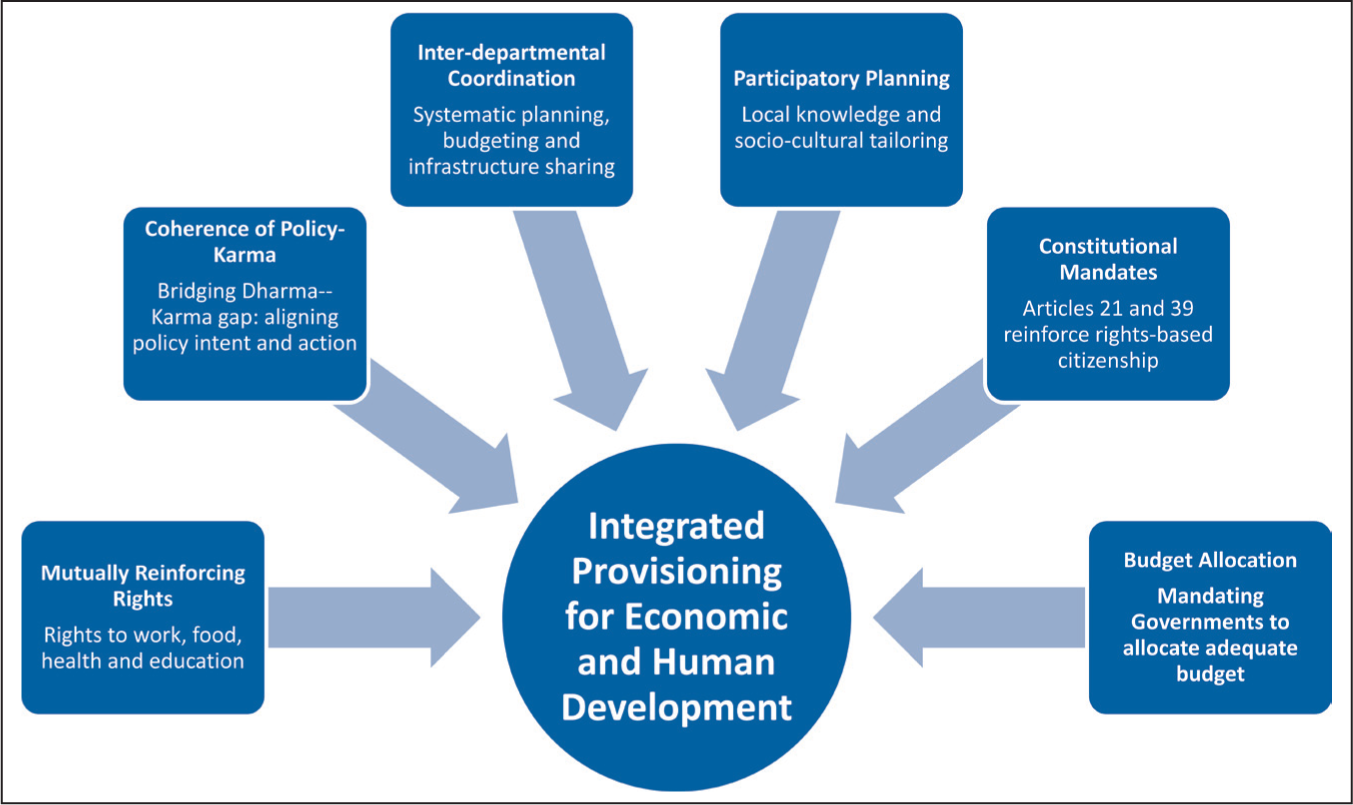
One, the rights to work, food, health and education are not discrete entitlements but mutually reinforcing pillars of human well-being and provide sustainable livelihoods and dignity, particularly for poor and marginalised communities. Two, the disjuncture between policy intent (dharma) and field-level implementation (karma) reflects not only poor state capacity but also the absence of a cohesive vision. Three, the inter-departmental coordination facilitates systemic planning and realistic budgeting, reduces redundancy and allows for shared digital infrastructure and grievance redressal mechanisms that enhance transparency and delivery efficiency. Four, participatory planning is based on lived realities and local knowledge systems, not only enhancing legitimacy but also tailoring services to diverse sociocultural needs, improving uptake and satisfaction. Five, it fulfils constitutional mandates under Articles 21 and 39, reinforcing the transition from charity-driven welfare to rights-based citizenship. The figures illustrate a unified policy and governance framework centred on rights, coordination and local participation (Figure 1), along with its operational model (Figures 2).
A Conceptual Chart Illustrating a Unified Policy and Governance Framework for Rights-based Welfarism.
Operational Governance Model for RBW.
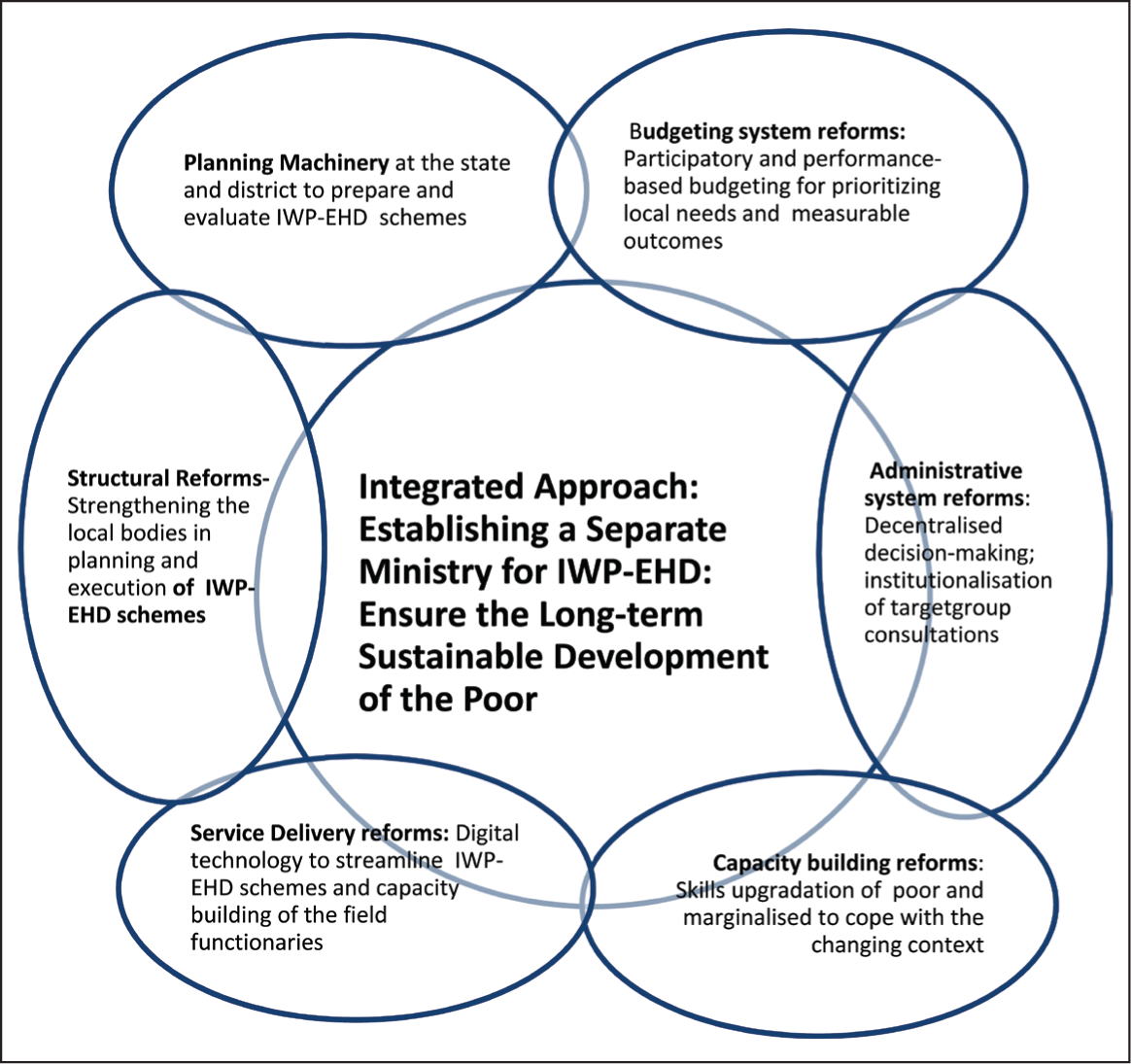
Operational Governance Model for IWP-EHD
Scholars like Cataldi (2024) highlight how hybrid models of governance, which blend traditional state mechanisms with collaborative networks, can effectively address complex policy challenges. Integrating multiple sectors under a unified institutional framework like the proposed IWP-EHD Ministry aligns with the new public governance approach that promotes cross-sectoral coordination, coproduction and improved service delivery. International experiences offer valuable insights into integrated welfare governance. For example, Brazil’s Bolsa Família programme consolidated welfare benefits under a single Ministry of Social Development, combining cash transfers with health and education entitlements. The use of a unified registry (Cadastro Único) and performance-based incentives (Decentralised Management Index) significantly improved targeting and service delivery (Sánchez-Ancochea & Mattei, 2011; Soares et al., 2007). Empirical studies show Bolsa Família reduced poverty and inequality, improved school attendance and enhanced nutritional outcomes (Bo Wu, 2025; Cavalcanti et al., 2025). Similarly, Denmark’s ‘flexicurity’ model integrates labour market flexibility with robust social security and active labour market policies. It balances flexible employment with generous unemployment benefits and mandatory activation programmes like job training or placement assistance. Randomised evaluations show that early activation policies increased job placement rates by over 30% (Andersen & Svarer, 2012; van Ours & Krogh Graversen, 2007).
Conclusion
Overall, the study examined the trajectory of rights-based welfare programmes in India against the backdrop of the transition from state-led welfarism to new welfarism. While India’s constitutional framework guarantees substantive social rights to work, food, health and education, the analysis reveals a persistent gap between normative commitments and implementation outcomes. Fragmented governance structures, fiscal under-prioritisation and the growing emphasis on asset-based and community-driven welfare have increasingly diluted the enforceability of rights-based entitlements, producing a recurring disjunction between policy intent (dharma) and delivery (karma).
Data from food security, health and education schemes demonstrate that RBWPs continue to function as critical stabilisers by mitigating economic shocks and supporting human capital formation. However, chronic underfunding, administrative delays, exclusion errors and weak inter-sectoral coordination limit their transformative capacity. Recent policy shifts, particularly the movement from demand-driven entitlements towards allocation-based welfare frameworks, further risk reconfiguring social rights into discretionary benefits.
In response, the article advances the IWP-EHD framework as an institutional corrective. By integrating economic security and human development within a unified governance architecture, IWP-EHD seeks to overcome silo-based administration, enhance fiscal coherence and strengthen accountability and participatory planning. Ultimately, the sustainability of India’s welfare regime depends not on proliferating fragmented schemes or symbolic asset delivery but on reaffirming rights-based citizenship through integrated governance. Embedding RBWPs within a coherent framework such as IWP-EHD is essential to uphold constitutional promises, reduce structural inequality and ensure that economic growth translates into durable human development outcomes.
Footnotes
Declaration of Conflicting Interests
The authors declared no potential conflicts of interest with respect to the research, authorship and/or publication of this article.
Funding
The authors received no financial support for the research, authorship and/or publication of this article.