






Abstract
Accurate and robust sensorless speed control of Permanent Magnet Synchronous Motor (PMSM) drives is essential for high-performance Electric Vehicle (EV) applications operating under rapid speed variations, load disturbances, and repeated start–stop conditions. This paper proposes a robust sensorless PMSM control framework based on Integral Sliding Mode Control (ISMC) combined with Extended Kalman Filter (EKF) and Model Reference Adaptive System (MRAS) observers. Unlike previous studies focusing separately on control or observer design, this work provides an integrated robustness and estimation accuracy evaluation under realistic EV driving conditions. The proposed ISMC scheme is designed to improve disturbance rejection capability and eliminate the conventional reaching phase of sliding mode control. EKF and MRAS observers are employed for sensorless rotor speed estimation, and their performances are comparatively analyzed under multiple EV operating scenarios, including step speed changes, dynamic driving profiles, and repeated start–stop operation. In addition, a weighted performance index is introduced to quantitatively compare the considered control configurations. Simulation results demonstrate that the proposed ISMC–EKF configuration achieves superior transient and steady-state performance compared with conventional PID-based control. The rise time is reduced from approximately 3.5 ms to 2.7 ms, while the settling time decreases from nearly 10 ms to about 5–6 ms. Furthermore, overshoot is reduced from 5% to 0.3%, and torque ripple is significantly minimized under dynamic EV conditions. Robustness analysis under parameter variations additionally confirms the disturbance rejection capability and stability of the proposed framework. The obtained results demonstrate that the proposed ISMC–EKF framework provides an efficient and reliable solution for high-performance sensorless PMSM drives in next-generation EV propulsion systems.
Keywords
Introduction
The growing electrification of transport worldwide has made Electric Vehicles (EVs) the leading option for sustainable mobility. The adoption of high-efficiency electric propulsion systems has been enhanced by growing environmental issues, strict emission regulations, and improvements in power electronics. Of the various traction motor technologies, the Permanent Magnet Synchronous Motors (PMSMs) have become a favorable choice for EV applications, attributable to their high-power density, better efficiency, small size, and good torque–speed profiles. 1 However, high-performance speed control for PMSM drive is essential to exploit the capabilities of the EV fully when subjected to load changes, such as rapid acceleration and so on. In addition, the system cost is increased, and the reliability is decreased by using mechanical speed sensors, especially in severe automotive environments. As a result, sensorless control methodologies are now considered to be essential tools for improving system robustness, simplifying hardware, and enhancing long-term reliability of operation.2,3 Linear controllers like Proportional–Integral–Derivative (PID) are widely used for conventional PMSM speed control because of their straightforwardness and simple implementation complexity. However, the PID-based methods have limited robustness to parameter uncertainties as well as nonlinear load disturbances in EV applications.3,4 To overcome these limitations, various advanced control methods, such as Field-Oriented Control (FOC), Sliding Mode Control (SMC), Active Disturbance Rejection Control (ADRC), and Model Predictive Control (MPC), have been proposed. Of these, the SMC-based methods are most attractive because of their strong robustness with respect to matched disturbance and model uncertainties. However, the classical SMC is vulnerable to instability problems during the reaching phase, and such phenomena are exaggerated in the case of fast torque transients. Integral Sliding Mode Control (ISMC) compensates these shortcomings by removing the reaching phase and projecting the system trajectory onto the sliding manifold from the initial moment, which leads to an improved transient response and greater potential for disturbance rejection. 5 Alongside powerful controls, estimation of system states without sensors is also an important area of research. Several observer-based methods were introduced for the PMSM drives, such as the Extended Kalman Filter (EKF), Model Reference Adaptive System (MRAS), Sliding Mode Observer (SMO), and Cubature Kalman Filter (CKF) methods. EKF is well known for its high estimation accuracy; nonlinear system dynamics can be handled by means of recursive prediction–correction procedures. MRAS complexity is lower, and its implementation is simpler, which is an important issue for embedded applications. 4 SMO-based methods are robust, but they may introduce estimation noise due to the switch behavior. On the other hand, higher-order Kalman filtering methods increase the precision but at the cost of computational burden. However, full-scale comparative studies on observer accuracy in real EV dynamic driving conditions are still scarce, especially when integrated with nonlinear robust control frameworks. While ISMC and EKF have been individually investigated in the literature for PMSM control, their combined effectiveness within EV-focused dynamic scenarios is yet to be thoroughly evaluated. Related research just focuses on controller robustness or observer accuracy, and no work shows a well-rounded evaluation with respect to rapid speed changes, start-stop driving conditions, and torque ripple evaluation. In addition, contributions based on quantitative superiority analyses via multi-criteria performance indices are scarcely available, so that the overall supremacy of integrated control–estimation schemes tends not to be well confirmed. Thus, the seamless integration and performance quantitative assessment of ISMC with EKF for sensorless PMSM-based EV drives is still an unresolved challenge in research.
The main contributions of this work can be summarized as follows:
A unified sensorless PMSM control framework combining ISMC, EKF, and MRAS is developed specifically for dynamic EV driving conditions, including rapid acceleration, repeated start–stop operation, and multi-step speed transitions. Unlike existing studies that focus either on controller robustness or observer accuracy individually, this work provides an integrated comparative evaluation of EKF- and MRAS-based sensorless estimation within the same nonlinear ISMC framework. A weighted multi-criteria performance index is introduced to quantitatively evaluate transient response, torque ripple, tracking accuracy, and robustness under identical EV operating scenarios. Robustness of the proposed framework is additionally investigated under parameter uncertainties, including stator resistance, rotor inertia, and flux linkage variations. Computational complexity and practical implementation feasibility of EKF and MRAS observers are comparatively discussed for embedded EV drive applications.
The main motivation of this work is the lack of integrated studies simultaneously addressing robustness, observer accuracy, torque ripple minimization, and dynamic EV driving validation within a unified PMSM sensorless control framework.
The novelty of this work does not rely on proposing a completely new observer or controller structure individually, but rather on the integrated EV-oriented control–estimation framework, robustness validation, and quantitative comparative analysis under realistic dynamic driving scenarios.
The remainder of the paper is organized as follows. Section 2 presents the mathematical modeling of the PMSM and the EV longitudinal dynamics. Section 3 describes the proposed ISMC design and observer-based estimation strategies. Section 4 provides simulation results and quantitative performance analysis. Section 5 discusses the findings in relation to robustness, estimation accuracy, and engineering implications. Finally, Section 6 concludes the paper and outlines future research directions.
Literature review
The industrial sector is interested in EVs because they offer numerous advantages, particularly environmental benefits. EVs rely on electric motors, which are their core component.6–8 PMSMs are chosen for EV powering due to several factors, including efficiency and robustness. PMSMs are controlled by advanced control technologies. These technologies include FOC, fuzzy logic controllers, SMC, ADRC, and others.9–11 Furthermore, monitoring technologies such as EKF, MRAS, and SMO are used to estimate speed instead of relying solely on motor speed.12–14 Fuzzy logic was used in controlling PMSM from the gel to handle various problems. 15 PMSM control was achieved using a Hybrid Adaptive Backstepping SMC system to improve speed response. 16 A practical project was conducted on a PMSM controlled by a Full-Order Terminal SMC. 17 Intelligent Fuzzy control was proposed for PMSM operation responsible for operating pumping applications. 18 An applied study was conducted using a Direct Torque Controller to control the PMSM, and the results demonstrated the motor's operation. 19 A comprehensive study and comparison were conducted to demonstrate the differences between various SMC control technologies used in PMSM operations. 20 ISMC was proposed for studying the speed and current loop in PMSM. 21 The Fast Terminal SMC was proposed for PMSM studies based on experimental work. 22 Speed estimation was proposed using an extended state observer in the PMSM with speed control by an Adaptive Super-Twisting SMC. 23 Speed was estimated by the EKF with the proposed backstepping in the PMSM speed control loop. 24 PMSM motor speed was estimated by EKF, using optimization algorithms to obtain optimal values for best performance. 25 Speed was estimated using MRAS in the PMSM, allowing the estimated speed to be used instead of the actual speed in case of an error. 26 To illustrate how speed can be estimated using EKF in the PMSM, an applied study was conducted using a PID speed loop. 27 In the PMSM study, an EKF Observer was used to estimate the speed and identify the Inter-Turn Short Circuit fault. 28 The speed was estimated using a sliding-mode observer for the PMSM motor with a PID loop for current and speed. 29 The CKF was proposed for fault diagnosis in PMSM in addition to fault tolerance. 30 PMSMs were controlled by SMC to operate an EV, and their performance was studied. 31 SMC was proposed in PMSM control for EV operation. 3 A brushless direct current (BLDC) motor and advanced SMC technology were proposed for operation in an EV. 32 A five-phase PMSM was proposed for operating EVs using Artificial Neural Networks (ANN) and MPC control techniques. 33 Recent ISMC developments have also been successfully applied to servo systems, 34 flexible joint robots, 35 and nonlinear electromechanical systems, 36 demonstrating improved finite-time convergence and robustness properties.37,38
Although numerous studies have investigated ISMC, EKF, MRAS, and advanced nonlinear PMSM control strategies independently, very limited research has provided a unified comparative framework integrating robust nonlinear control and multiple observer structures under realistic EV operating conditions.
Materials and methods
In this part, the modeling and control of a PMSM for sensorless operation in an EV application are introduced. The synchronous dq-reference frame-based PMSM dynamic model is integrated with the longitudinal vehicle dynamics to mimic actual road conditions. An ISMC scheme is proposed to achieve robust speed tracking against external load disturbance and parameter uncertainty. To remove the mechanical speed sensor, EKF and MRAS observers are used to estimate the rotor speed. The control robustness and estimation accuracy can be assessed with the developed drive system as a whole control concept.
Scenario 1: The PMSM magnetic circuit is considered unsaturated.
Scenario 2: The stator windings are assumed to be sinusoidally distributed.
Scenario 3: Parameter variations and external disturbances are bounded.
Scenario 4: The inverter switching dynamics are neglected compared with electrical dynamics.
Assumption 5: Measurement noise affecting current and voltage sensing is assumed to be bounded Gaussian noise.
PMSM model
The mathematical model of a PMSM is typically described using two key current components:
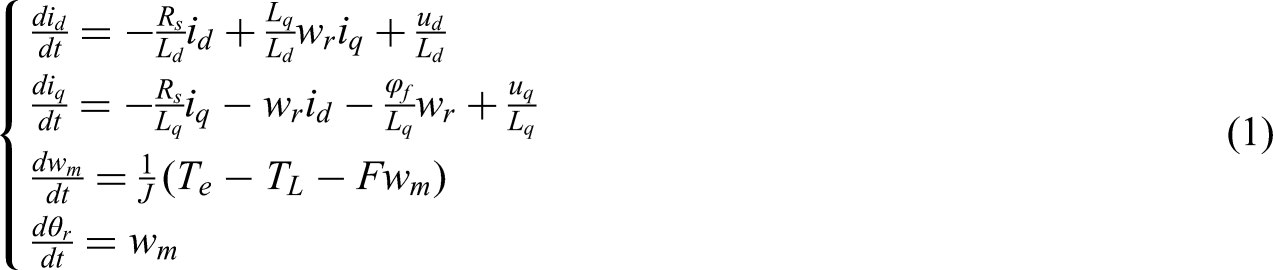
In the dq reference frame, stator voltages (ud, uq) and stator currents (id, iq) are denoted in volts and amperes, respectively. The stator resistance (Rs) is measured in ohms. The inductance of the direct and quadrature axes is represented by Ld and Lq, respectively, with both measured in [H]. wr is the rotor electrical speed in radians per second. Electromagnetic torque (Te) is measured in Newton meters [N · m]. Φ f permanent magnet flux linkage.
EV model
Various external and internal factors affect vehicle longitudinal behavior, such as aerodynamic drag, roll resistance, gravity from road grade, and inertial forces when accelerating or braking.
42
These forces must be modeled accurately to evaluate the electric drive system performance under real operation conditions.
43
In an EV, the traction motor must produce enough torque to balance out the total road load force acting on the vehicle.
44
The total resistive force



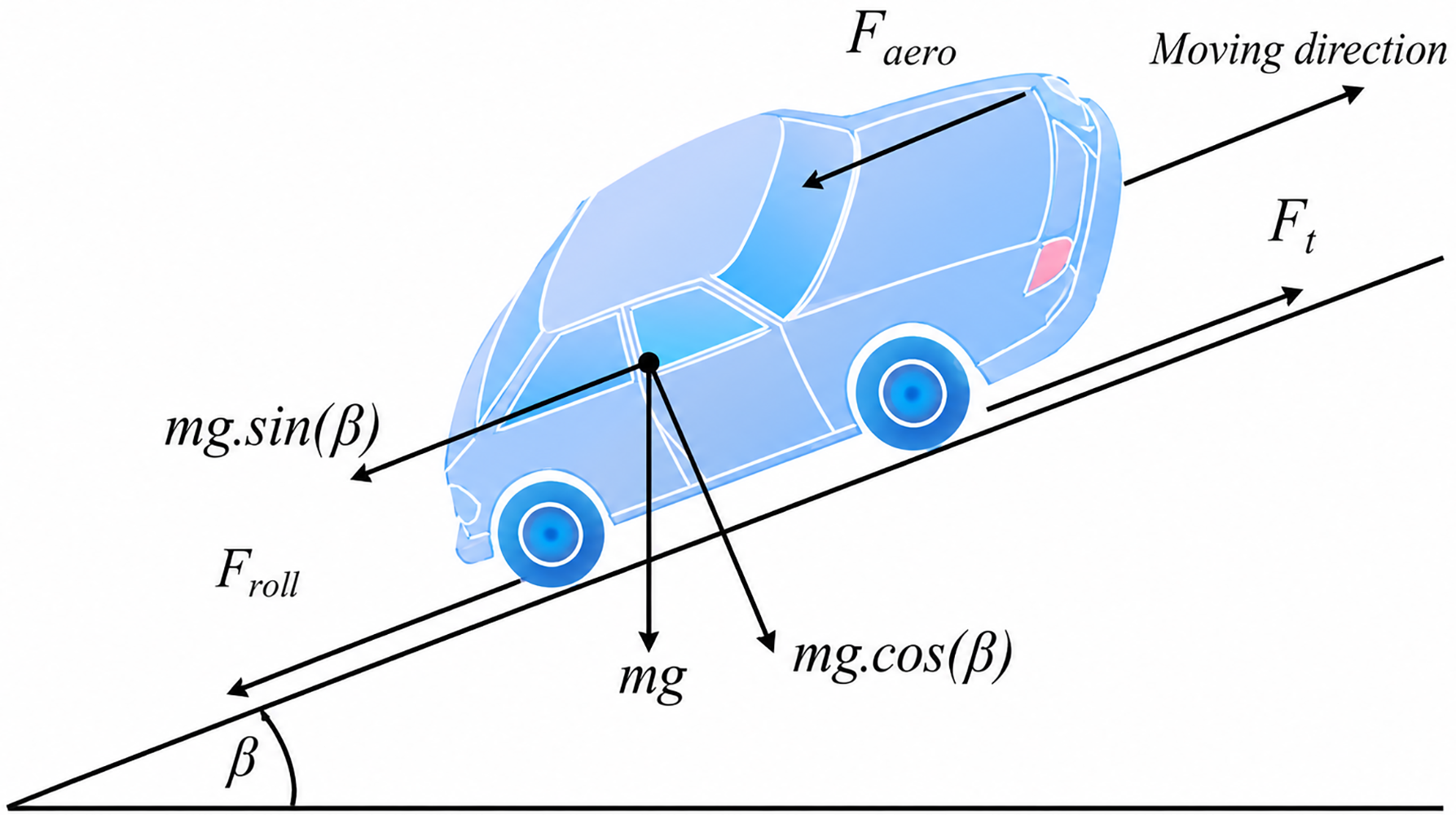
Modeling the forces acting on an EV.


In an EV, the transmission or gearbox is the mechanical component that links the electric motor to the wheels. Its primary role is to transfer and adjust torque and rotational speed between the motor and the tires according to driving requirements. By modifying the torque–speed relationship, the transmission ensures efficient power delivery, proper acceleration, and optimal vehicle performance, as described by the following equations:
47


The relationship between the motor and the wheels, in terms of rotational speed and torque, can be expressed by the following equation:


Control design
The control scheme is designed to rigorously guarantee speed tracking of the PMSM subject to load perturbations and parameter uncertainties, as those in EV applications. Taking into account the nonlinearities of the drive system, an ISMC speed controller is proposed to achieve better dynamic response and disturbance rejection as well as remove the steady-state error. For sensorless operation, EKF and MRAS observers are embedded within the control loop to provide real-time estimation of rotor speed. The integrated control–estimation scheme is shown to improve system stability, robustness, and tracking performance under time-varying operation conditions.
ISMC control
In this paper, an ISMC method is used together with a nonlinear observer to improve the robustness and the fast-paced tracking of the PMSM. The integral sliding surface is designed to eliminate the reaching phase; thus, the system trajectory moves on the sliding manifold from the beginning, different from the case of conventional SMC. This property contributes greatly towards enhancing the powerful disturbance-rejecting ability and reducing sensitivity with respect to parameter uncertainty. The sliding surface is designed as a function of the speed tracking error and its integral term, which guarantees asymptotic convergence and no error at the steady state. The control law has two parts: an equivalent control term (Let), which is deduced from the system dynamic equations to keep the system states moving on the sliding surface, and a discontinuous term (ud) that is designed to make the closed-loop system robust against the matched disturbances. A slip surface is defined as an equation or function in state space by which the behavior of a system can be controlled. This surface is often a function of the error between a reference value (Xx) and the actual value of the system (X), S = X–Xₓ.1,48 In ISMC, the sliding surface is defined in Equations. 49
Sliding surface definition
The integral sliding surface is initialized such that the system trajectory starts directly on the sliding manifold at t = 0, thereby eliminating the conventional reaching phase associated with standard first-order SMC. The speed tracking error is defined as:

The integral sliding surface is selected as:

Differentiating the sliding surface gives:


The PMSM mechanical dynamics can be expressed as:




Substituting (18) into (15) yields:


The equivalent control component is obtained by imposing the sliding condition:

Further, the discontinuous part is defined as

The final equation for the calculation Iqref is:

Stability analysis
To determine the stability analysis for ISMC, the Lyapunov function is used.

We derive and simplify the equation.





Thus, according to Lyapunov stability theory, the sliding surface asymptotically converges to zero, ensuring asymptotic stability, boundedness of all closed-loop signals, and robust speed tracking performance under parameter uncertainties and external disturbances.
MRAS model
The sensorless operation of the PMSM drive is made possible by estimating the rotor speed using an MRAS observer. It is a dual model comparison, where a reference model is compared with an adjustable model, and the estimation error feeds an adaptation law that modifies the observer parameters. The reference model is designed independently of the speed to be estimated, but the adjustable model depends on the estimated speed as a parameter. The difference between the two model outputs is fed into a PI-based adaptation law to regulate the speed estimation online. This configuration leads to a robust and less computationally complex estimation structure and, thus, makes MRAS in particular suitable for real-time EV applications where reliability and minimal sensor instrumentation are desired. This method works based on three basic components: the reference model, the tunable model, and the adaptive mechanism, shown in Figure 2. MRAS is used as an effective tool to estimate the speed and angle of the rotor 50 :
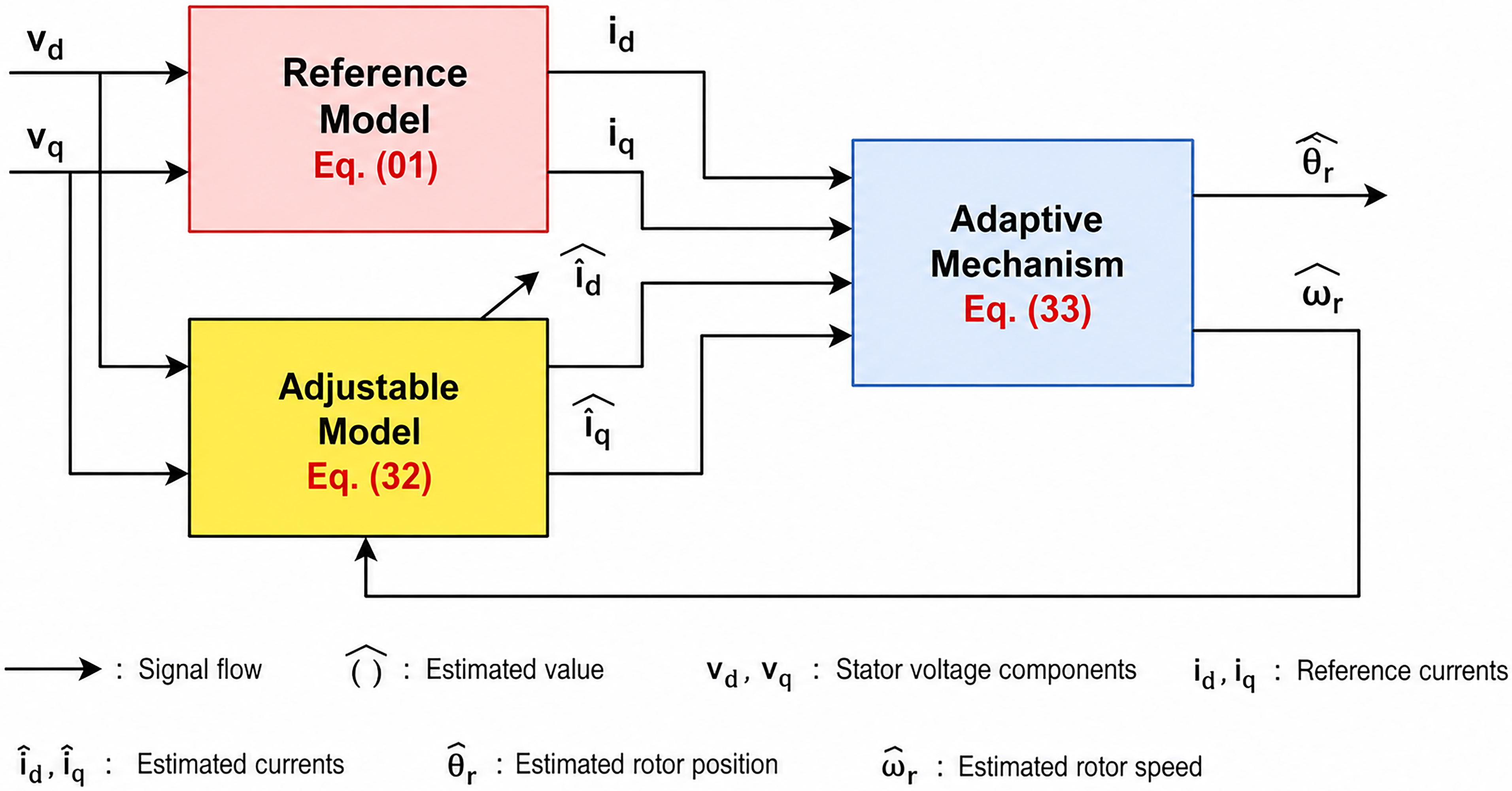
MRAS block diagram.


In the adjustable part, the currents

The formula for the estimated speed of the adaptive mechanism is as follows:

EKF estimation
For the nonlinear state estimation of the PMSM drive, the EKF is adopted. It recursively estimates the rotor speed and the internal states in real time by performing prediction and correction on the system state vector using the currents and input voltages measured. Taking into account the nonlinearities of the PMSM model, the EKF degenitalizes the system at the current operating point by using the Jacobian matrix. The algorithm has two basic steps: prediction, in which the state and covariance matrices are propagated forward in time, and correction, in which the estimation is updated using the measurement feedback. This recursive estimation process improves the accuracy in the presence of noise and model uncertainties, and EKF becomes a good observer for high-performance sensorless EV applications, so it is commonly used as an observer for sensorless EV. The PMSM's dynamic behavior is described by equations that reflect its operational conditions.
52

An initial estimate is created based on the variables in the initial state according to Equation (34).
53

Jacobian matrix F(k) is used in the calculation of filter gains k(k + 1) to improve the performance of the observer in Equation (37).
54


Finally, the covariance matrix and the expected state are updated based on filter gains k(k + 1).
55


The PMSM equations are modeled to conform to the EKF model in discrete space-state and the Jacobian matrix F(k).
24


Proposed control architecture
Figure 3 shows the high-level control structure of the PMSM drive system designed for EV applications. This framework encloses the speed control loop, observer block, predictive current control stage, and power conversion unit in a single entity. The reference speed
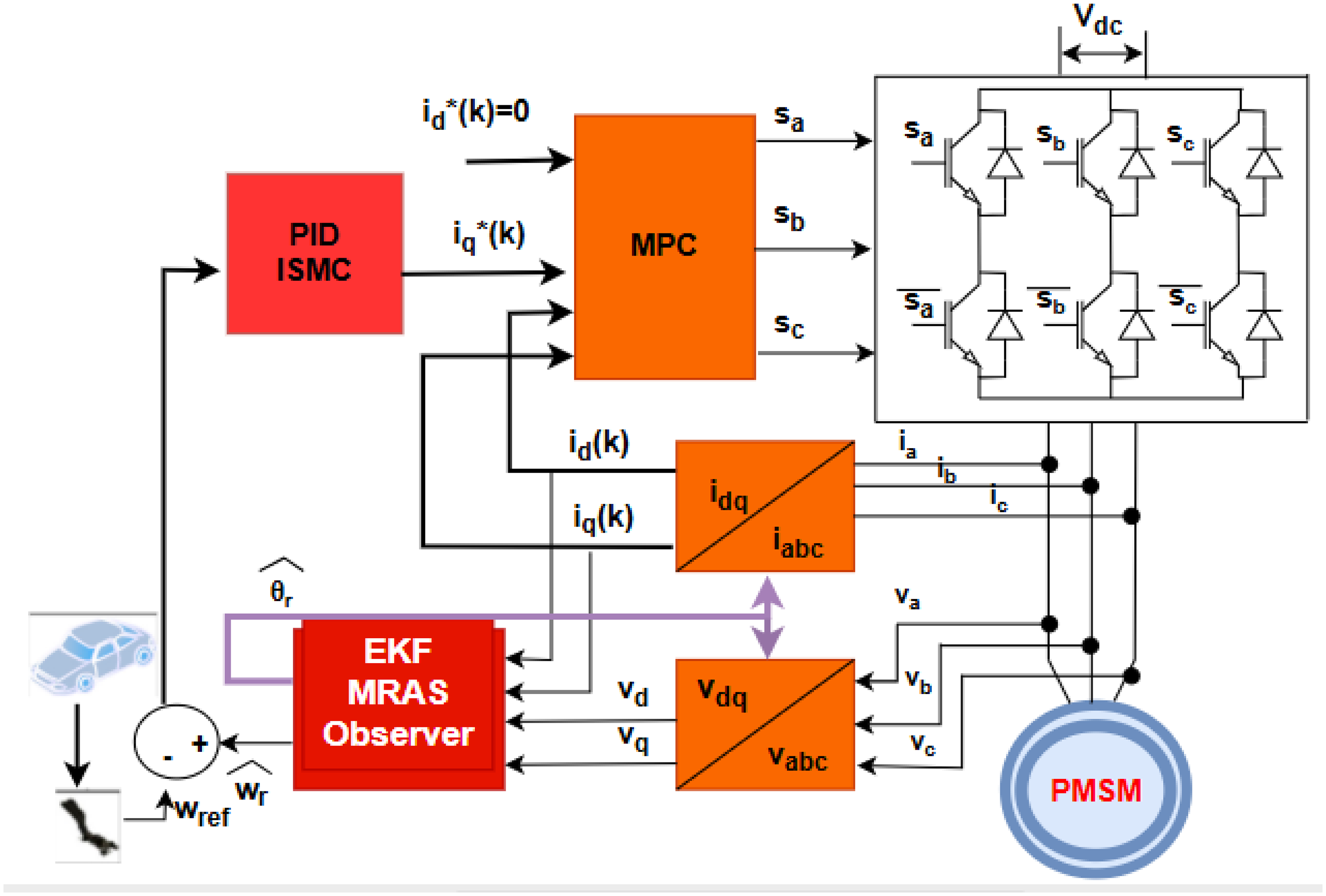
PMSM drive control architecture with ISMC-based speed loop and EKF–MRAS observer.
PMSM drive and control system parameters.
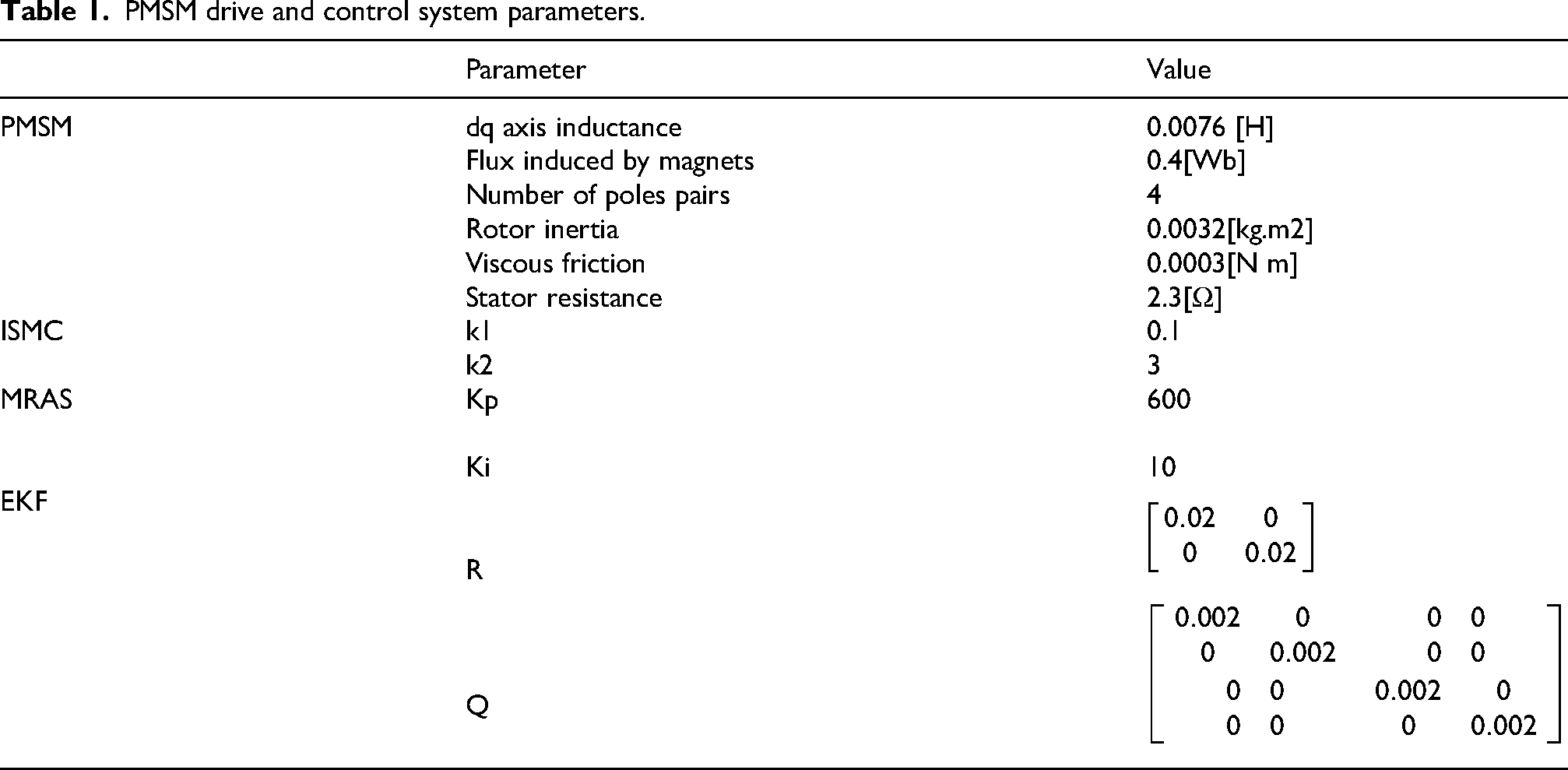
The ISMC gains were selected based on convergence speed and oscillation minimization criteria obtained through iterative simulation tuning.
EKF covariance matrices Q and R were selected experimentally to balance estimation smoothness and dynamic response. MRAS PI gains were tuned to minimize estimation error during transient operating conditions.
Results
This section presents the simulation results obtained for the proposed PMSM control framework under both steady-state and dynamic operating conditions. The performance of ISMC is first evaluated against conventional PID control in terms of transient response, stability, and current regulation. Subsequently, the effectiveness of the sensorless configurations based on MRAS and EKF is analyzed under constant and varying speed profiles.
Step response performance analysis
This part analyzes the transient and steady-state responses of the PMSM drive to a 600-rpm step reference. Dynamic response, stability, and current regulation performance are considered in the comparison in order to evaluate the performance of ISMC with that of the PID controller. Figure 4 shows the speed responses of the PMSM with the PID and ISMC controllers for a reference speed of 600 rpm. Both the controllers track reference, but there is a significant variation in their transient response. The PID Controller demonstrates considerable overshoot and an oscillatory nature during start-up, which is observed in the zoomed view. Contrarily, the ISMC response approach to the reference speed is faster, the overshoot is lower, and it has the minimum oscillation. The settling time is reduced, and the steady-state error is nearly zero with ISMC. These findings verify the better transient and improved robust performance of the ISMC as compared to PID for speed control applications. Figure 5 shows the response of the electromagnetic torque with the load torque and the ISMC control law and the PID controller. During the transient period, all the clearly evident oscillations −including overshoot and undershoot−of the torque executed by the PID controller, which is underdamped and highly sensitive to high-frequency speed error changes. Such oscillation may generate mechanical stress and cause a decrease in the reliability of the driving system in real applications of the EV. On the other hand, the torque of the ISMC-based controller has a much smoother curve and approaches the load torque value more rapidly. While only a short initial peak may be noticed from the need for a quick acceleration, the torque rapidly converges, closely following the load torque with very little ripple. The ISMC steady-state torque has better regulation and disturbance attenuation. The proposed results confirm that ISMC provides better dynamic stability, fewer torque oscillations, and a more robust EV system for high-performance and mechanically reliable EV drive systems.
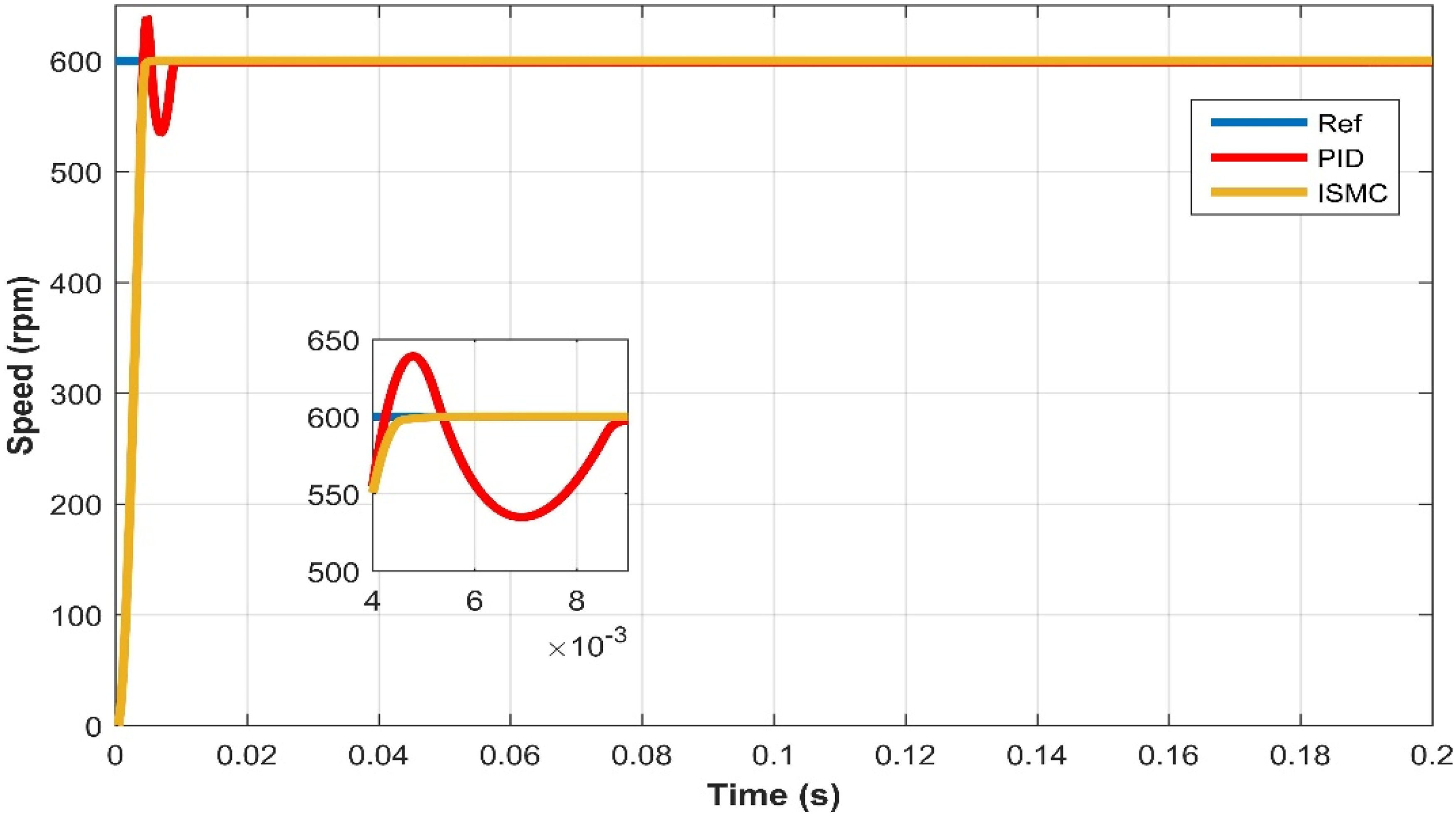
Speed response comparison of PID and ISMC controllers at 600 rpm.
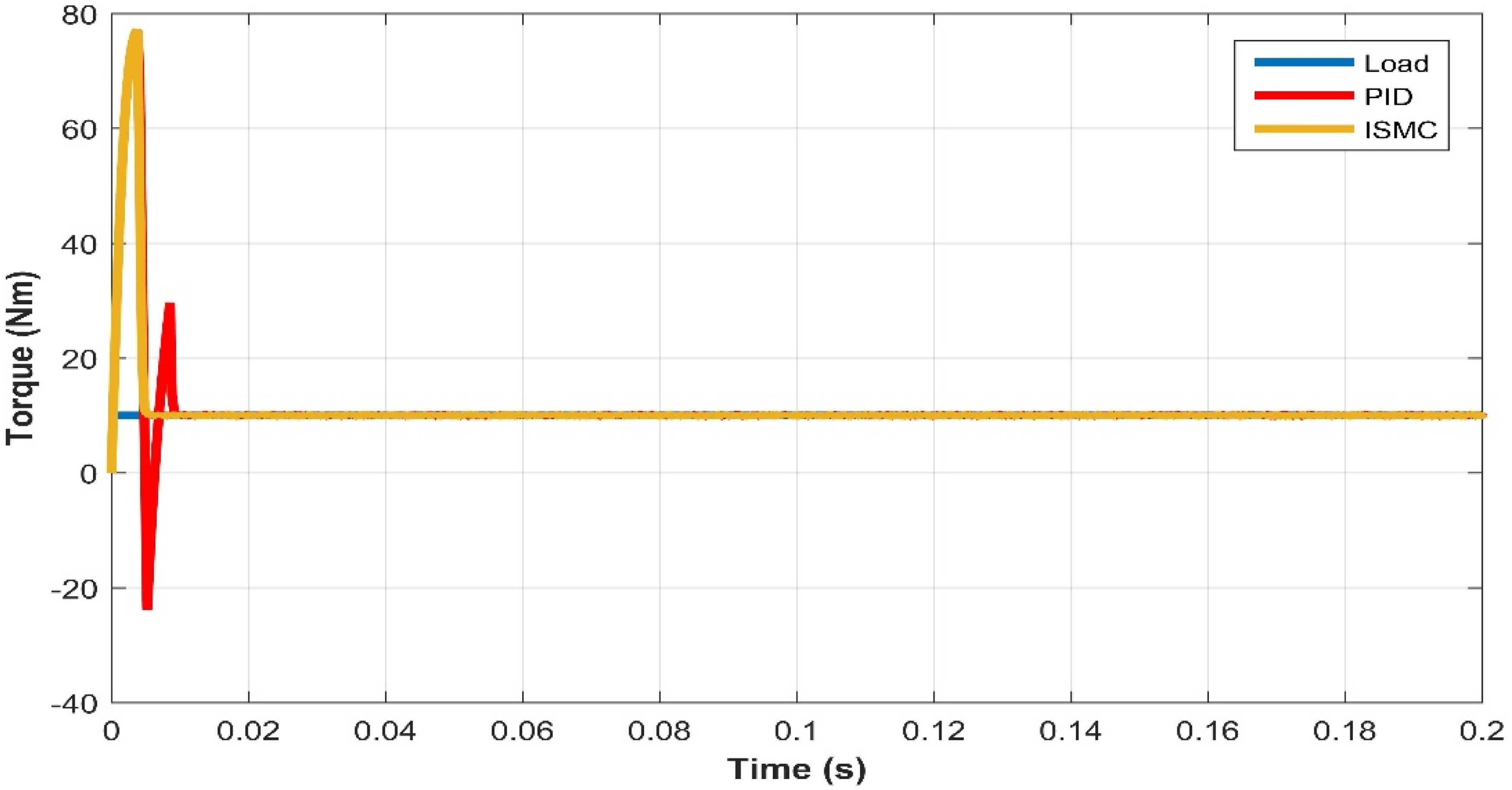
Electromagnetic torque response under PID and ISMC control.
Figure 6 shows the response of
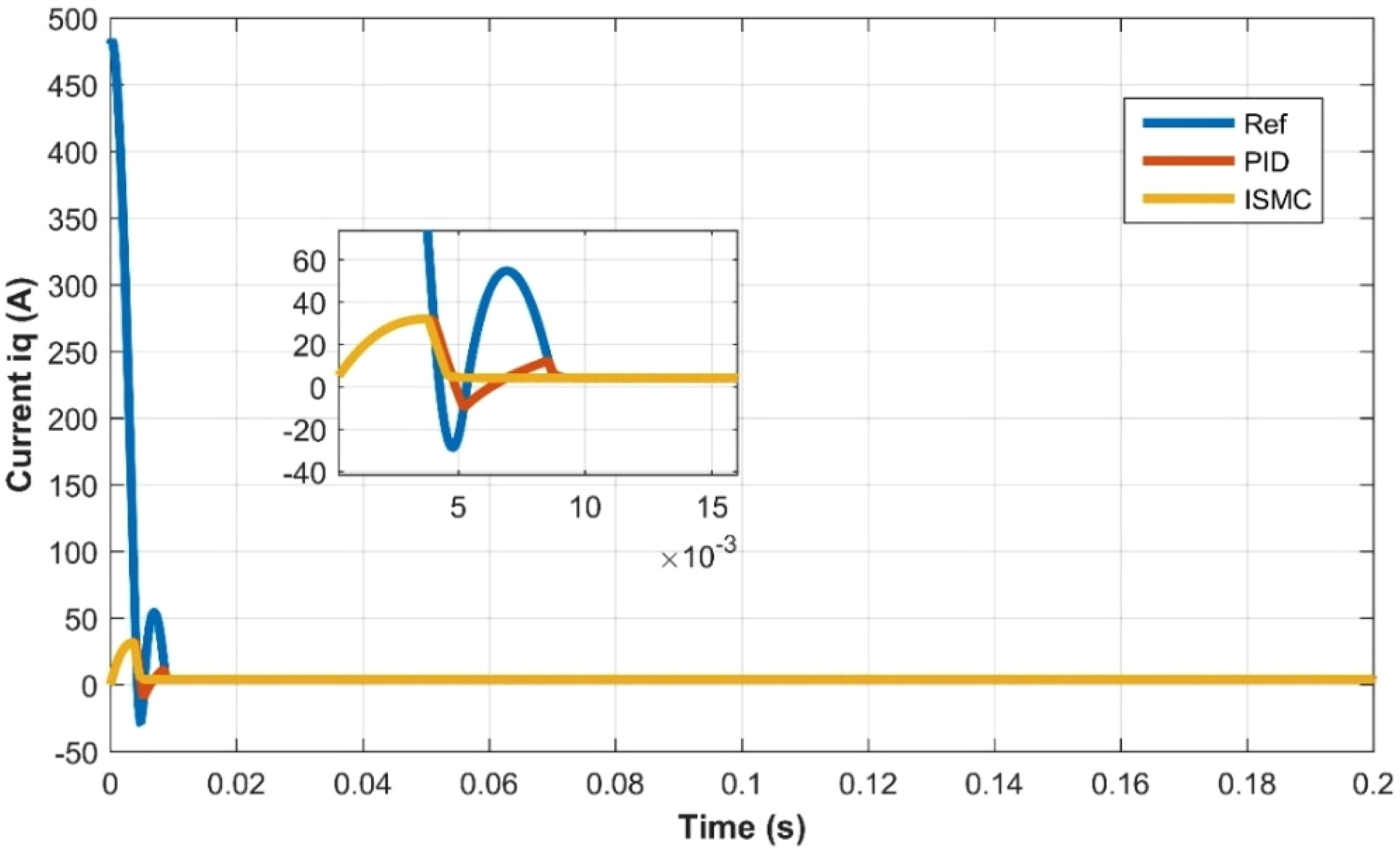
Quadrature-axis current response under PID and ISMC control.
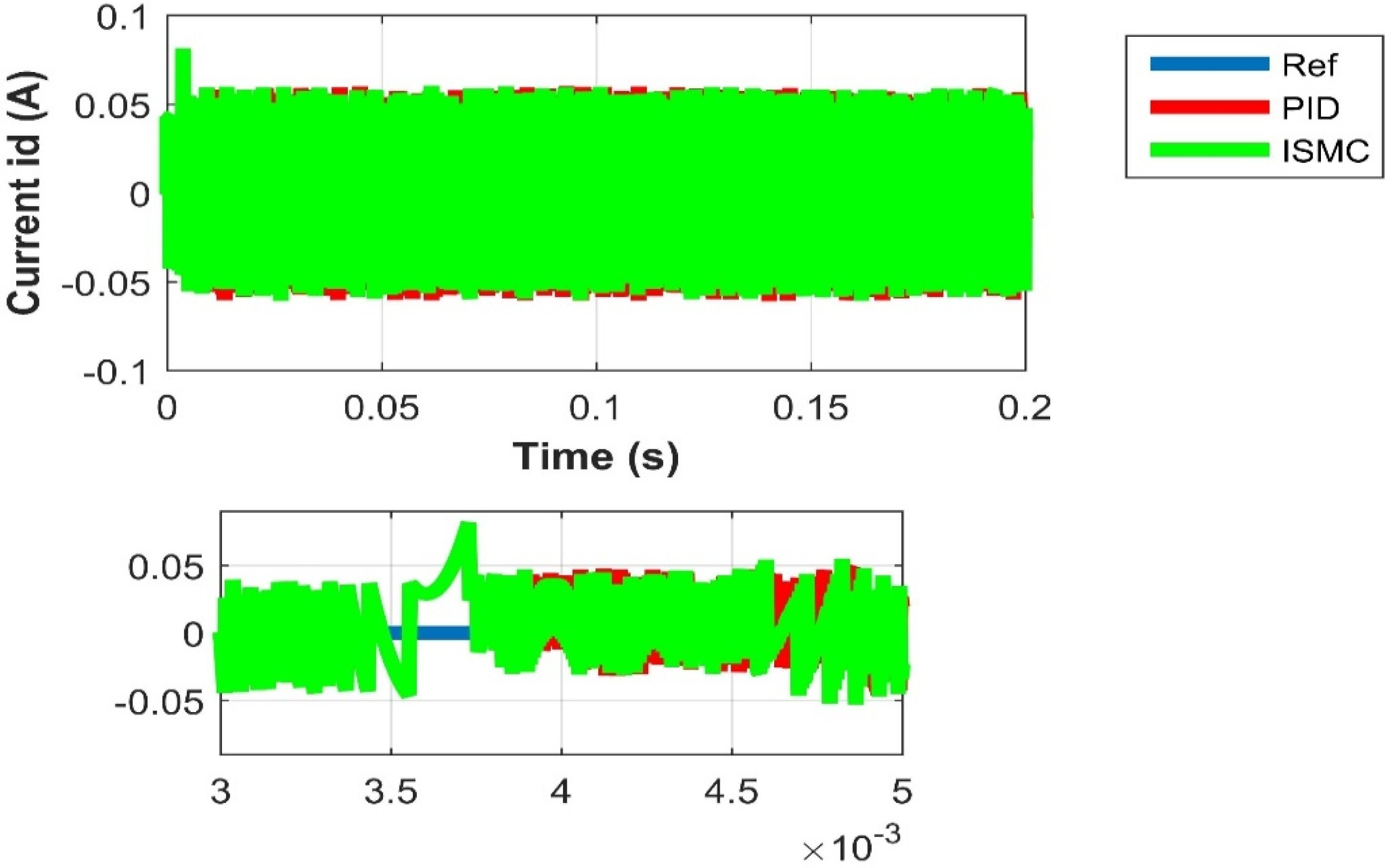
Direct-axis current response under PID and ISMC control.
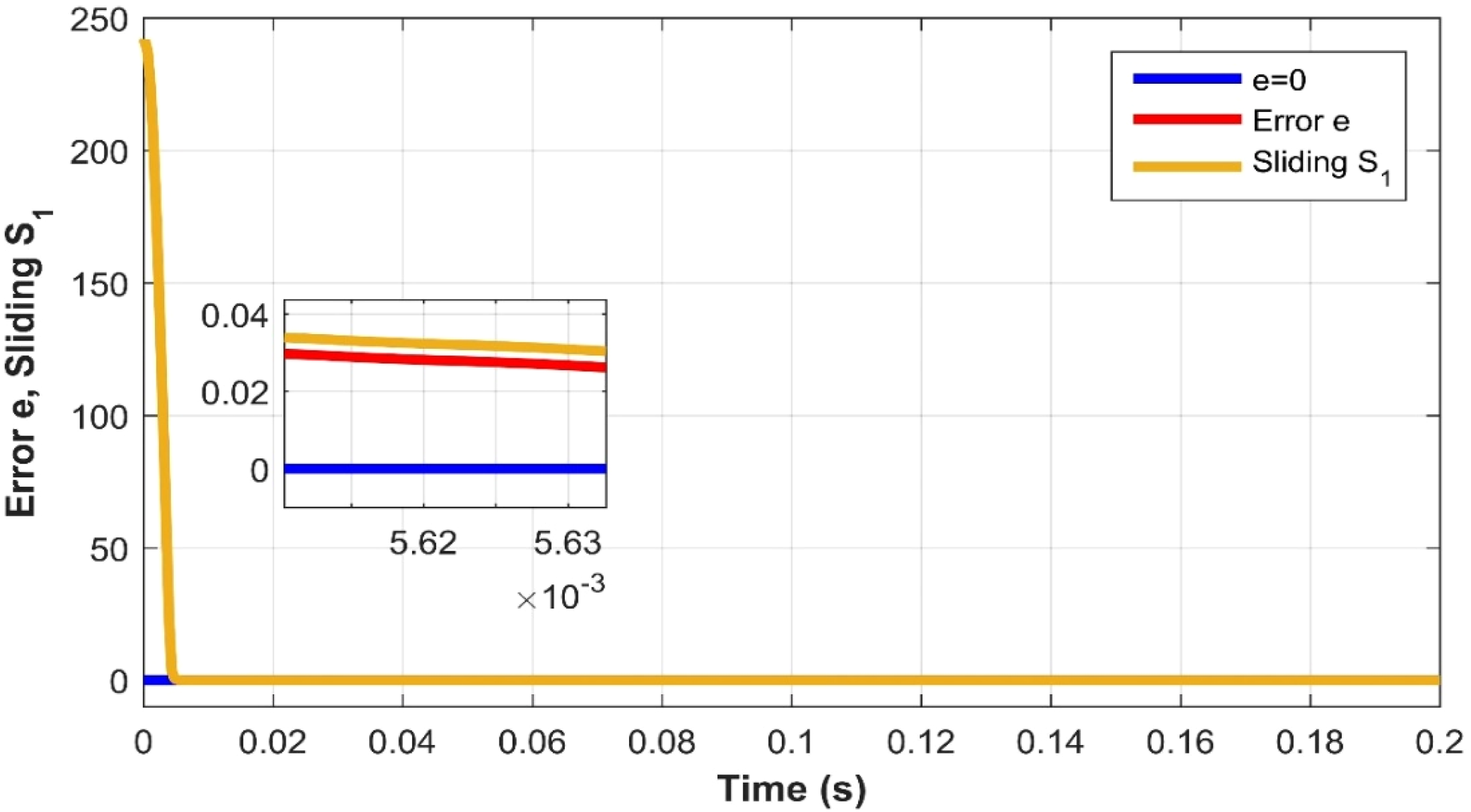
The difference (error) between the actual speed and the reference speed and the S1.
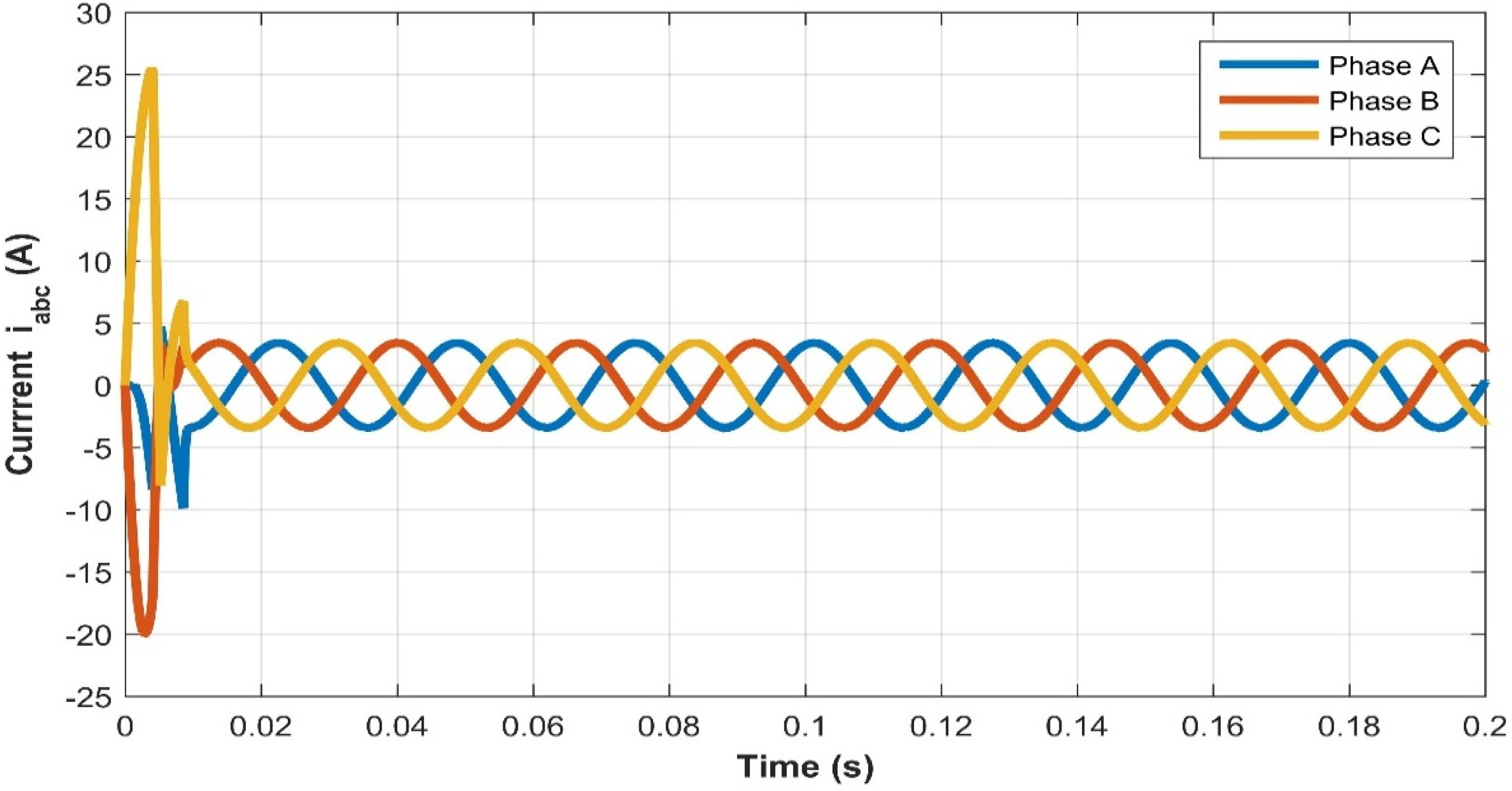
Three-phase stator currents of the PMSM drive.
Figure 10 captures the three-phase stator currents in operating condition under the proposed control. A short transient period, during which current peaks due to torque development and rotor acceleration have been superimposed on the whole system current. In comparison with the last one, the transient response oscillation is carefully attenuated faster, which means a better damping performance. After the transient period, the phase currents are balanced sinusoidal waves with equal amplitudes and 120° phase shifts. Both currents in the steady state are smooth and symmetric, which indicates that the current has been well-regulated and the inverter is operating properly. The improved harmonics and quicker convergence demonstrate the effectiveness of the proposed method and the ability to achieve an electrically balanced and dynamically stable PMSM drive in an EV environment.
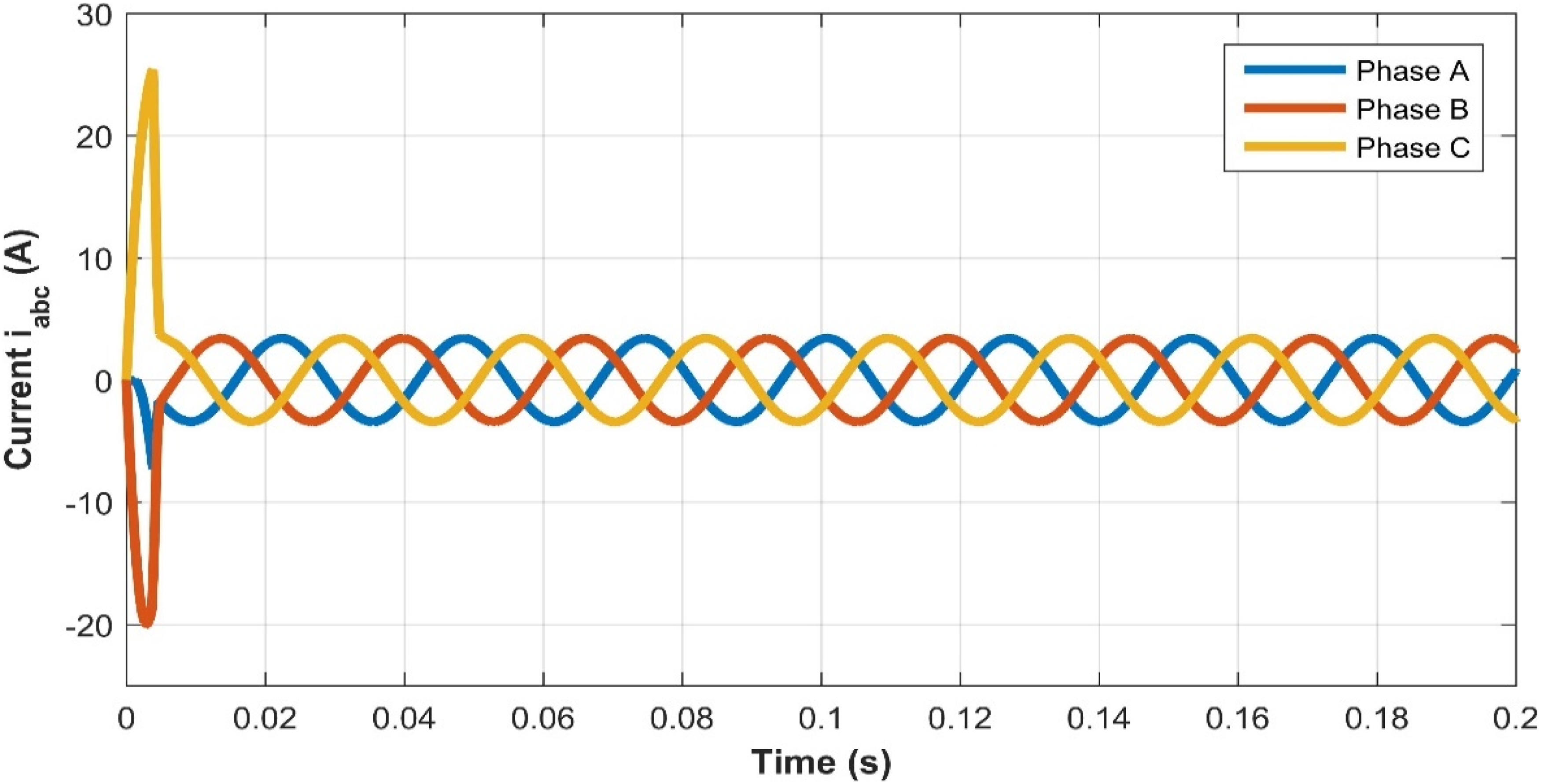
Three-phase stator currents under ISMC control.
Table 2 provides a numerical comparison of the transient responses and steady-state errors at a 600-rpm step reference. The dynamic response is greatly improved by ISMC relative to PID, with the overshoot and settling time being decreased. Among observer-based structures, the ISMC–EKF converges the fastest and results in minimum overshoot, which indicates the best estimation accuracy and disturbance rejection performance.
Quantitative performance comparison under 600 rpm step response.

Observer-based sensorless performance evaluation
This section evaluates the performances of sensorless MRAS and EKF based on MRAS and EKF. The assessment on relevance is on accuracy of estimation, time-domain/convergence behavior, and torque pulsation in re-f conditions. Figure 11 plots the speed responses using ISMC with actual speed, sensorless schemes based on MRAS, and EKF at a reference speed of 600 rpm. All methods closely follow the reference in steady state, revealing the proposed control observer architecture. During the transient time (see the blowup), a minor discrepancy can be seen in convergence. The convergence speed of the ISMC–EKF scheme is the fastest from zero initial estimate, with the best damping and smallest overshoot. The response of the ISMC–MRAS scheme appears to be a little bit slower with some small oscillations. However, they both perfectly estimate the rotor speed and track the reference trajectory. Both observer-based methods closely follow the reference trajectory. It is verified that the estimation based on the EKF outperforms in terms of dynamical accuracy, while the MRAS is computationally less complex, and it always gives acceptable results. The electromagnetic torque responses under the ISMC, ISMC–MRAS, and ISMC–EKF schemes with the load torque are depicted in Figure 12. During the startup period, a high transient torque peak can be seen because of the rapid acceleration. But the transient response is different for each of the estimates. ISMC–EKF has a faster damping and a smoother convergence to the load torque with less oscillation in the zoomed-in plot. The ISMC–MRAS response has even higher torque ripple, but the oscillations attenuate more slowly. However, with the exception of these transient dissimilarities, all the techniques accurately track the load torque in a steady state of around 10 Nm. The better damping and smaller ripple with EKF underline the best estimation accuracy and dynamics of EKF, which play L/R essential role for low mechanical stress and stable EV drive operation.
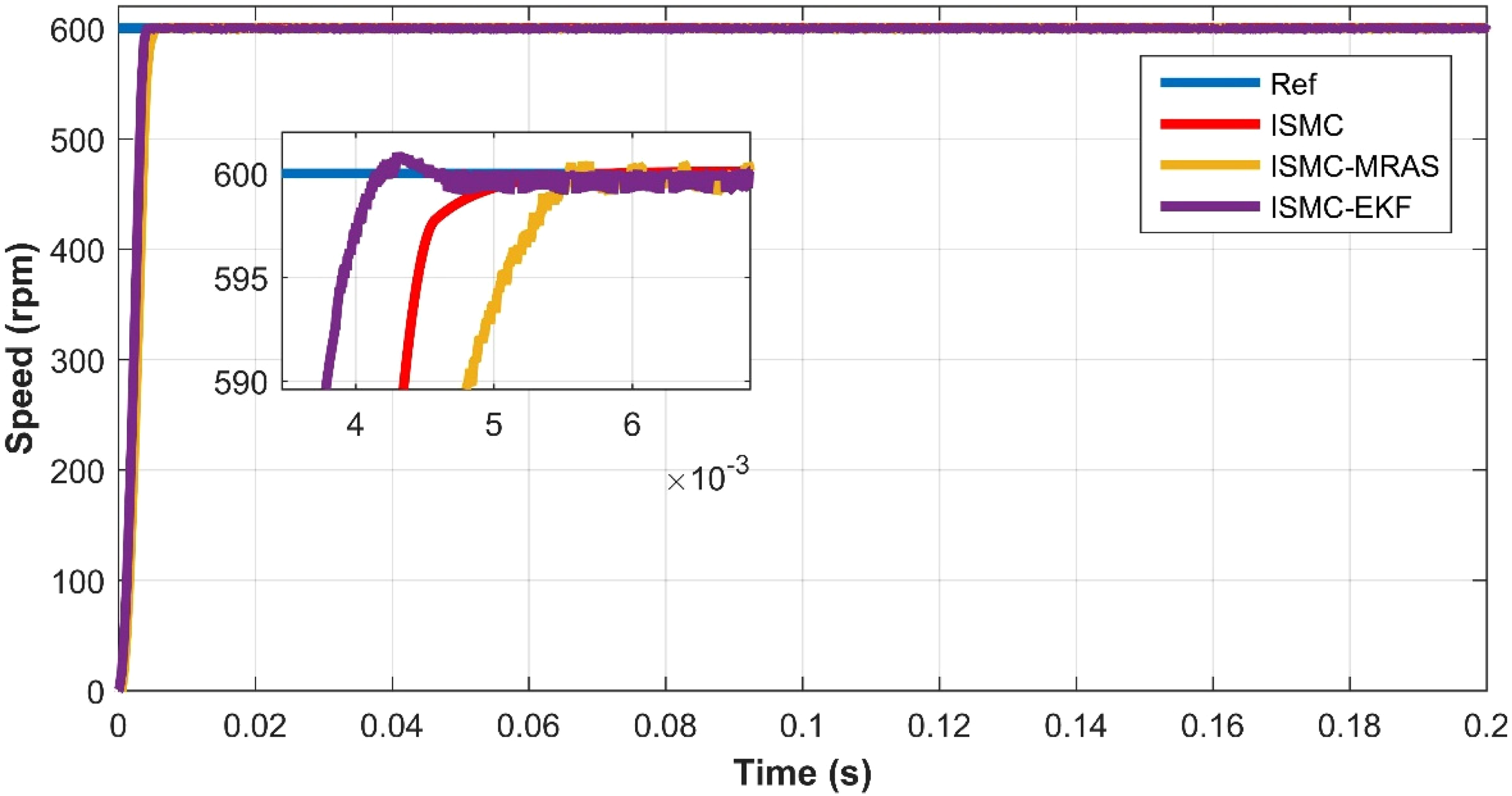
Speed response comparison of ISMC, ISMC–MRAS, and ISMC–EKF at 600 rpm.
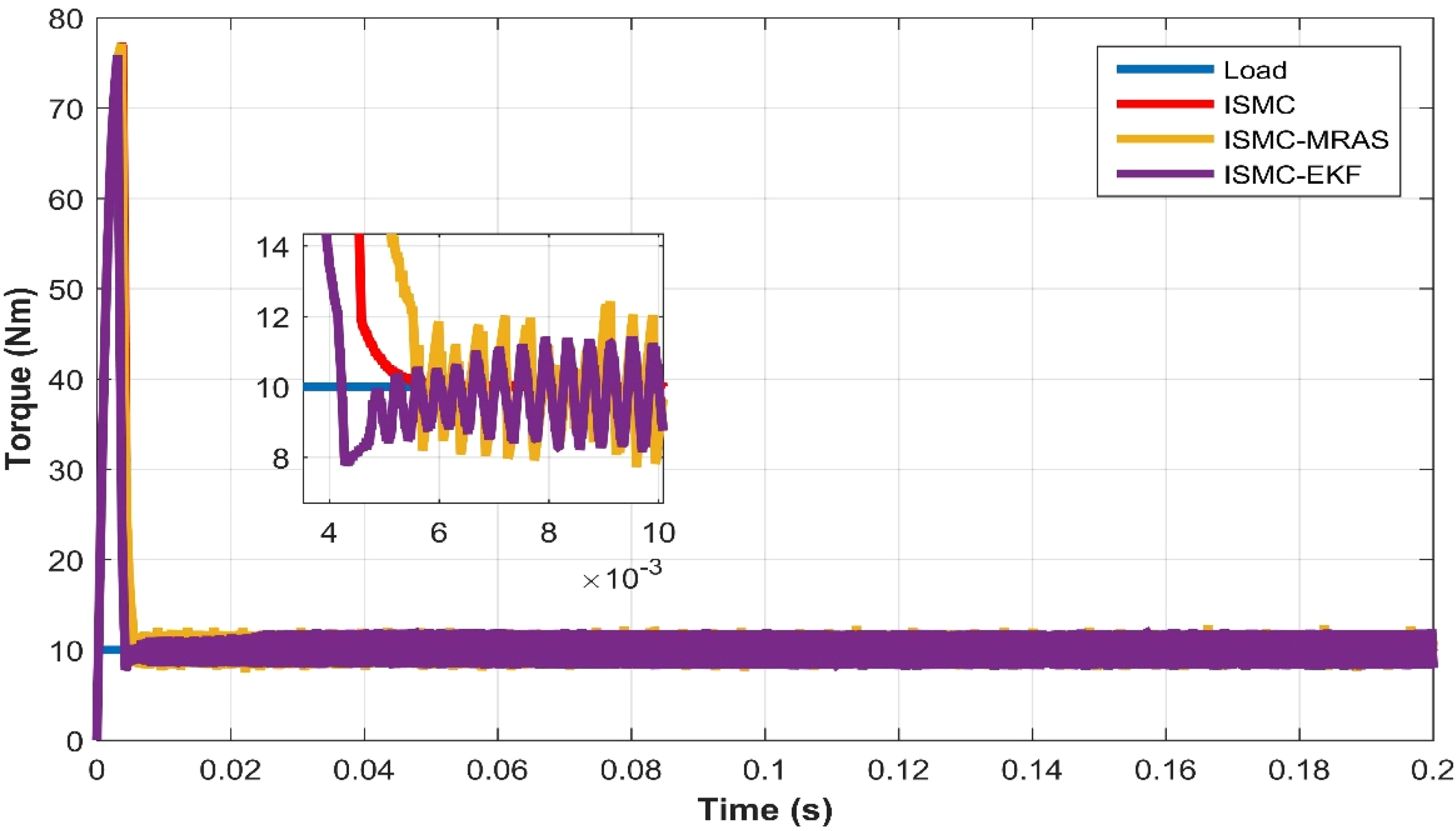
Torque response comparison of ISMC, ISMC–MRAS, and ISMC–EKF.
Robustness analysis under parameter variations
To further verify the robustness of the proposed control framework, parameter uncertainty tests were performed under simultaneous variations of stator resistance, rotor inertia, and permanent magnet flux linkage. Specifically, the stator resistance was increased by +30%, the rotor inertia by +25%, and the flux linkage was reduced by −20% relative to nominal values. Figures 13 and 14 demonstrate that the proposed ISMC–EKF framework preserves stable speed tracking and acceptable torque ripple despite significant parameter deviations. Compared with MRAS-based estimation, the EKF observer exhibits superior robustness due to its recursive covariance correction mechanism. These results confirm the disturbance rejection capability and parameter insensitivity of the proposed sensorless control framework.
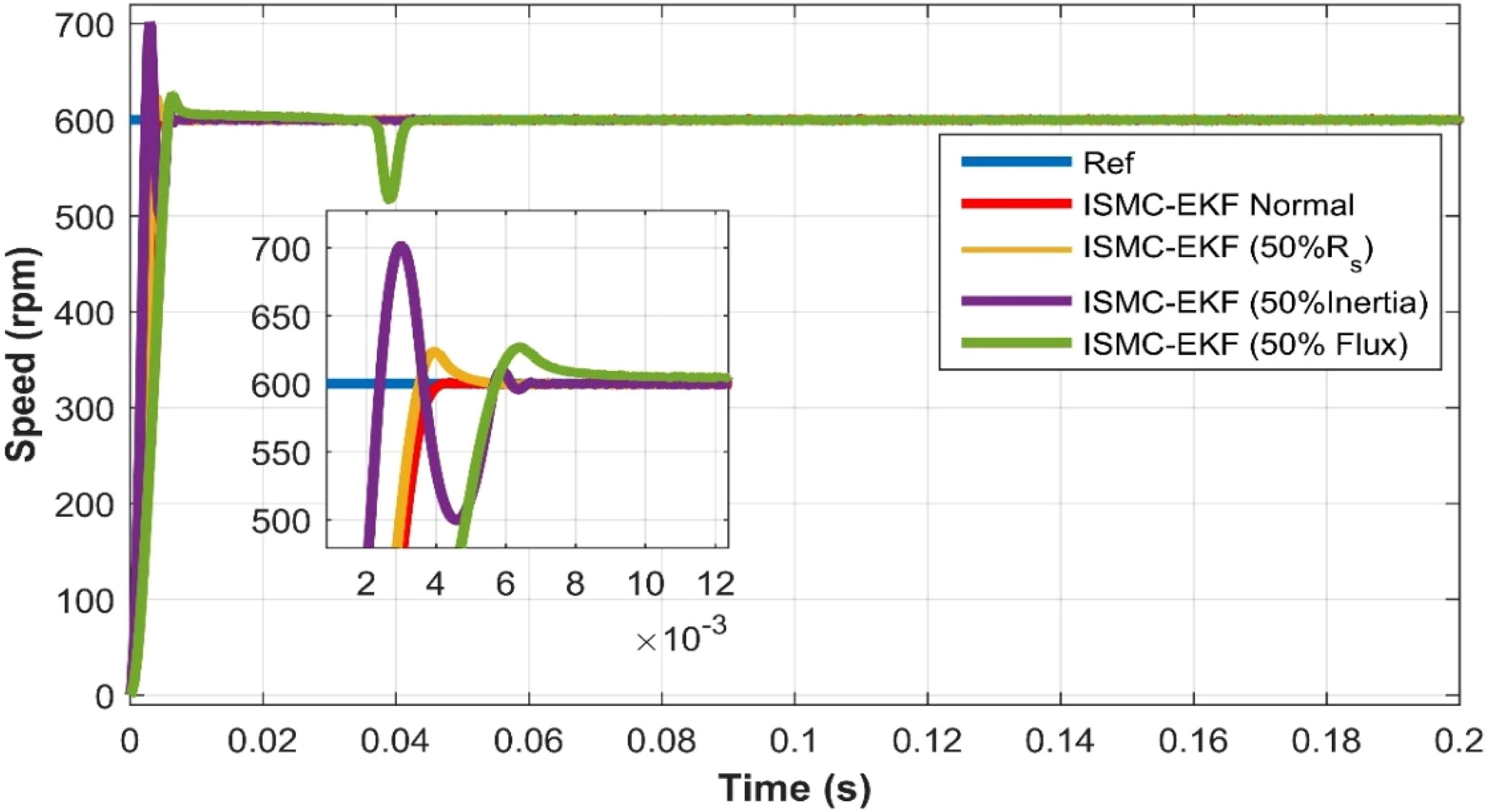
Speed in cases of changing parameters (resistance, flux, inertia).
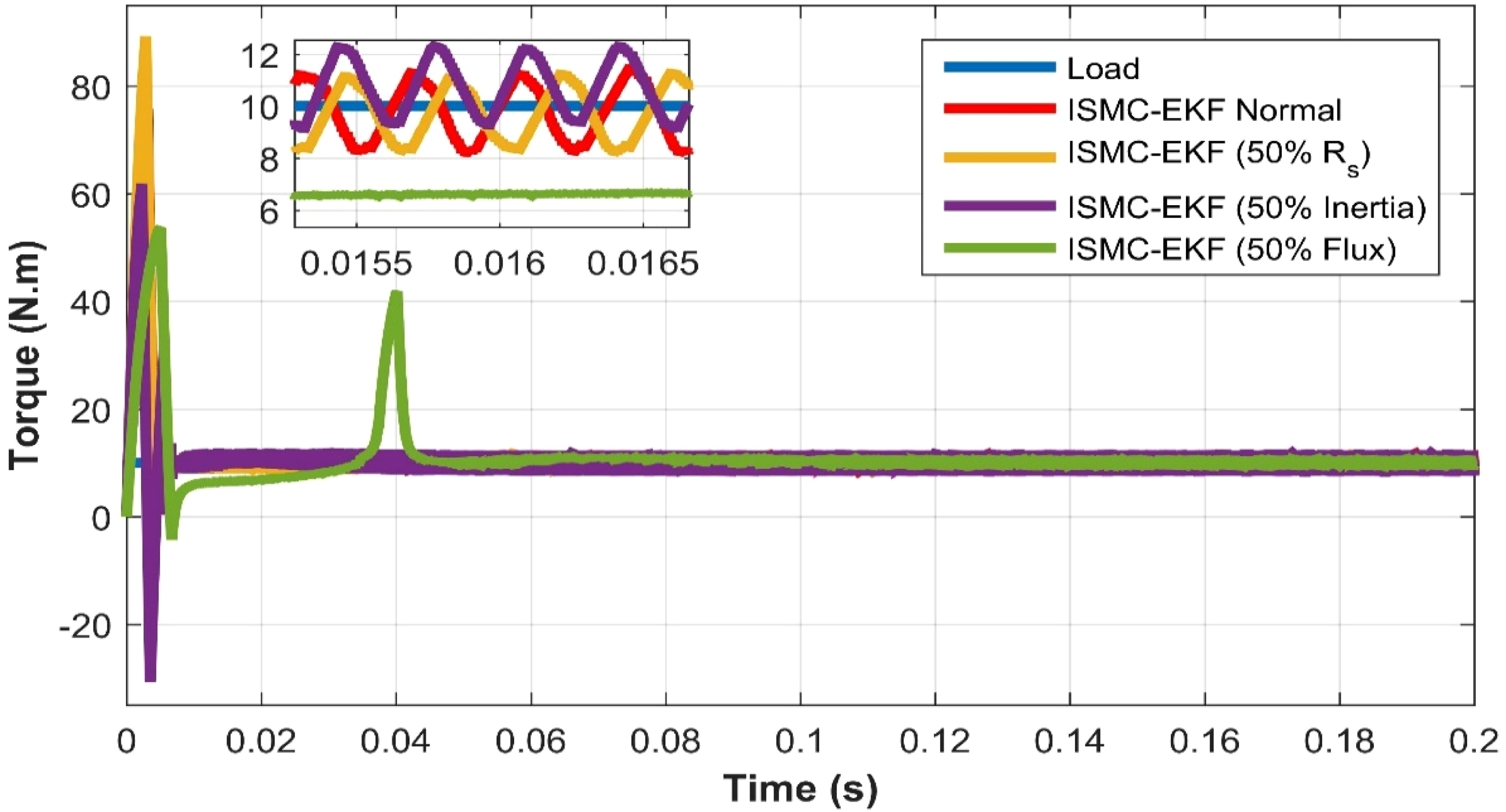
Torque in cases of changing parameters (resistance, flux, inertia).
Dynamic EV driving performance
In this subsection, the performance of the drive is examined under real EV operating scenarios, such as multi-step speed changes, dynamic driving profiles, and start-stop patterns. The analysis emphasizes tracking ability, torque smoothness, and robustness with quickly changing operating states. Figure 15 shows the speed response for several step changes in the reference signal representing real EV driving scenarios. The reference speed has a sequential nature, and the performance of ISMC, ISMC–MRAS, and ISMC–EKF is compared. The varying reference levels are tracked successfully by all the schemes, which indicates the stability of the overall control scheme. But transient now are shown when step transitions. The ISMC–EKF structure converges faster and has less overshoot, as can be seen in the enlarged region (zoomed in). The ISMC–MRAS response is slightly slower adapting and exhibits a small oscillation before convergence. Even with abrupt transitions in speed, the steady-state tracking errors are small in all cases. Taken together, the results suggest that EKF-based estimation can provide improved dynamic accuracy during sudden speed changes, a crucial aspect for EV applications where the vehicle can be expected to be accelerating and decelerating frequently. Figure 16 depicts the responses of the electromagnetic torque with successive speed change in (25), comparing the ISMC, ISMC-MRAS, and ISMC-EKF. At each velocity jump, torque spikes are very pronounced as a result of strong acceleration and braking. Such peaks show how the controller is trying to achieve dynamic tracking during sudden changes in operation. Among all the configurations, ISMC–EKF converges faster and has smaller oscillatory behaviors after each perturbation. ISMC–MRAS exhibits a slightly larger ripple on the magnitude during transient sections, especially in the zoomed window, which reveals slower adaptation kinetics. However, the three methods keep a good steady-state torque control around the load torque value. All the methods maintain precise steady-state torque control of the load torque. The results demonstrate that the EKF-based estimation improves transient robustness and torque smoothness during fast speed changes, leading to better mechanical reliability and drive stability in EV applications.
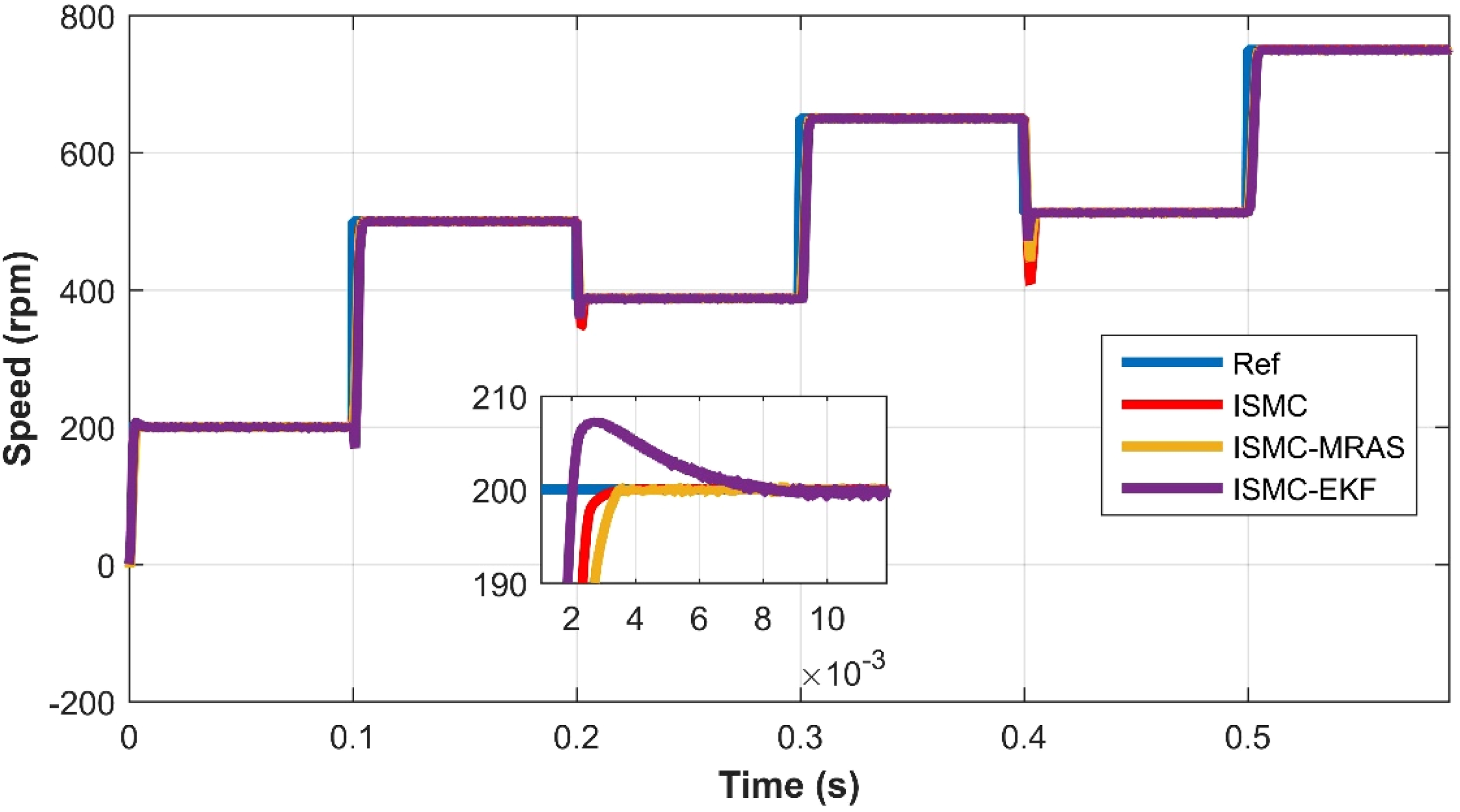
Speed response under multiple-step reference variations.
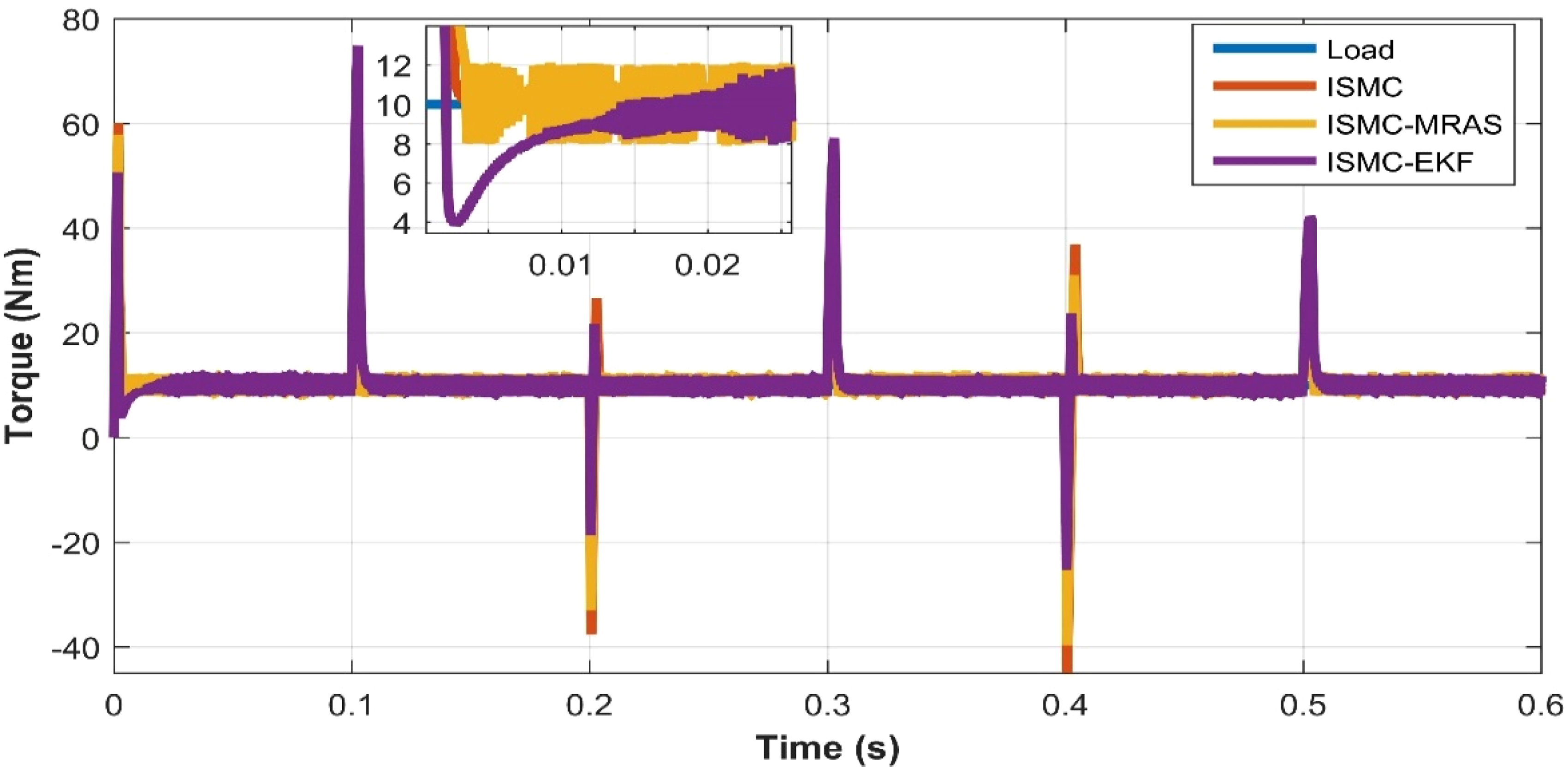
Torque response under multiple speed transitions.
Figure 17 shows the speed response for a more realistic reference profile to represent the EV dynamic driving condition. The reference trajectory has the presence of acceleration, deceleration, and intermediate operating points and gives a chance to review the tracking performance in the presence of non-step changes. All of the profiles are very close to the reference one, corroborating the stability of the nested control scheme. But in the zoomed area, there are differences in tracking accuracy. Tighter tracking and decreased fluctuation around the reference are observed for the ISMC–EKF approach. ISMC–MRAS indicates a marginally larger ripple amplitude, inferring that the estimation under fast variations is not as sensitive as in the other two estimates. The results also establish that EKF improves the smoothness of tracking and dynamic accuracy in complex driving situations to maintain a reliable speed regulation in a broad operating range. The EM torque response with the dynamic driving cycle is shown in Figure 18. The torque fluctuations are due to the speed demand changes, as the mechanical load intervals of acceleration and deceleration adapt. All the districting cases have torque control around the nominal load value in the steady state. But now, the transient responses are not the same in terms of the magnitude of the ripple and the decay. It can be seen that the ISMC–EKF structure has better stability and less oscillation, which is more clearly observed in the amplificatory window. ISMC–MRAS has somewhat bigger ripples during high-speed changes, which suggest that it has slightly slower adaptation dynamics. Although different in their design, all the approaches guarantee robust torque generation for the entire operating space. The smoother torque trajectory from EKF leads to higher mechanical reliability and better drive comfort in EV applications.
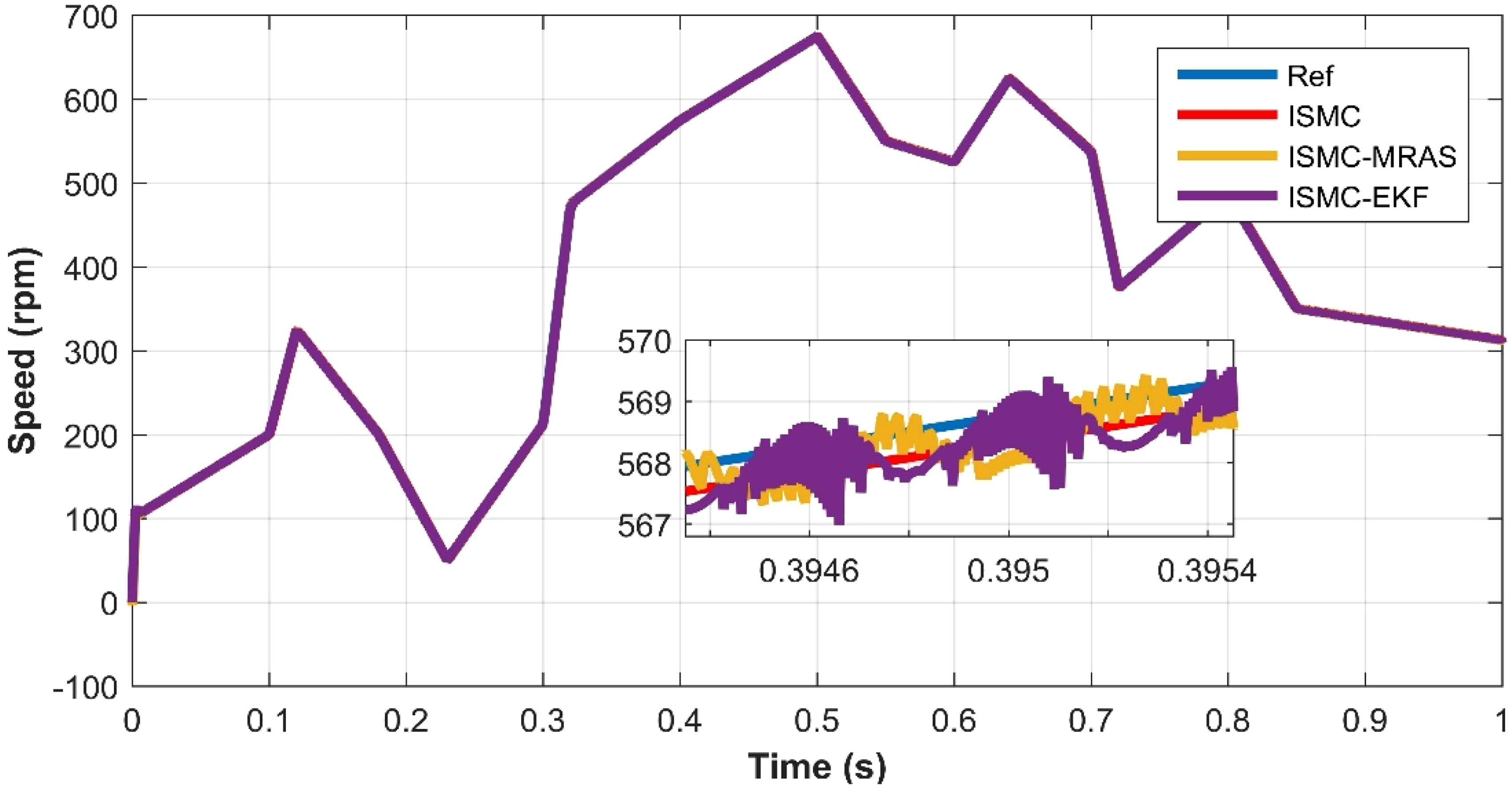
Speed tracking performance under a dynamic EV driving profile.
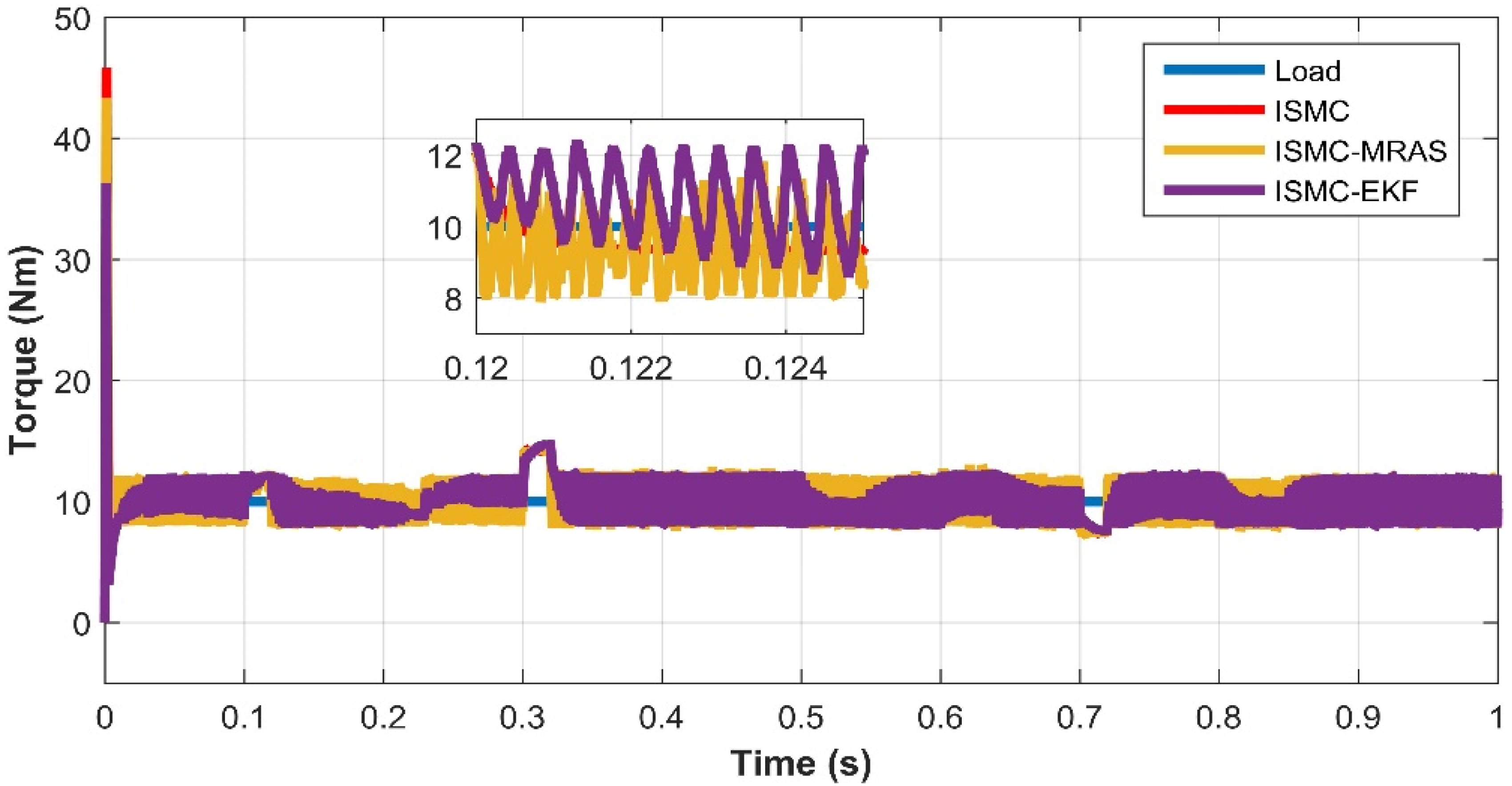
Torque response under dynamic EV driving conditions.
Figure 19 shows the speed response of the repeat acceleration and deceleration cycle, which contains a transition to zero speed. The profile tests controller stability and the estimation robustness at start–stop operation, which is very important for urban EV driving. All the arrangements track the reference trajectory (including intervals of zero speed) with no instability. In the inset figure, ISMC–EKF keeps a closer tracking with less oscillation around the reference value. ISMC–MRAS has a slightly more pronounced ripple during steady state, revealing that its estimation accuracy is relatively inferior when the system parameters vary rapidly. Good tracking at zero speed and during repeated switching validates the robustness of the integrated control framework. The EKF configuration achieves better stability and more accurate dynamics during repeated start-stops. The electromagnetic torque from dynamic operating conditions, such as load and speed change, is shown in Figure 20. The torque is just the mechanical requirement of the driving profile, and the controller tries to keep it regulated. All of the designs regulate roughly the nominal load torque in steady-state. However, they differ in the amplitude of the ripple and in the smoothness of the transients. The ISMC–EKF configuration yields a more robust torque with fewer ripples; this can be observed more clearly in the zoomed plot, where the steady state accuracy is evident. The ISMC–MRAS response has relatively more ripples in the two scenarios. The decrease in torque ripple and jitter achieved by EKF can lead to further enhanced mechanical stability and reduced vibration, as well as improved general drive reliability in EV applications.
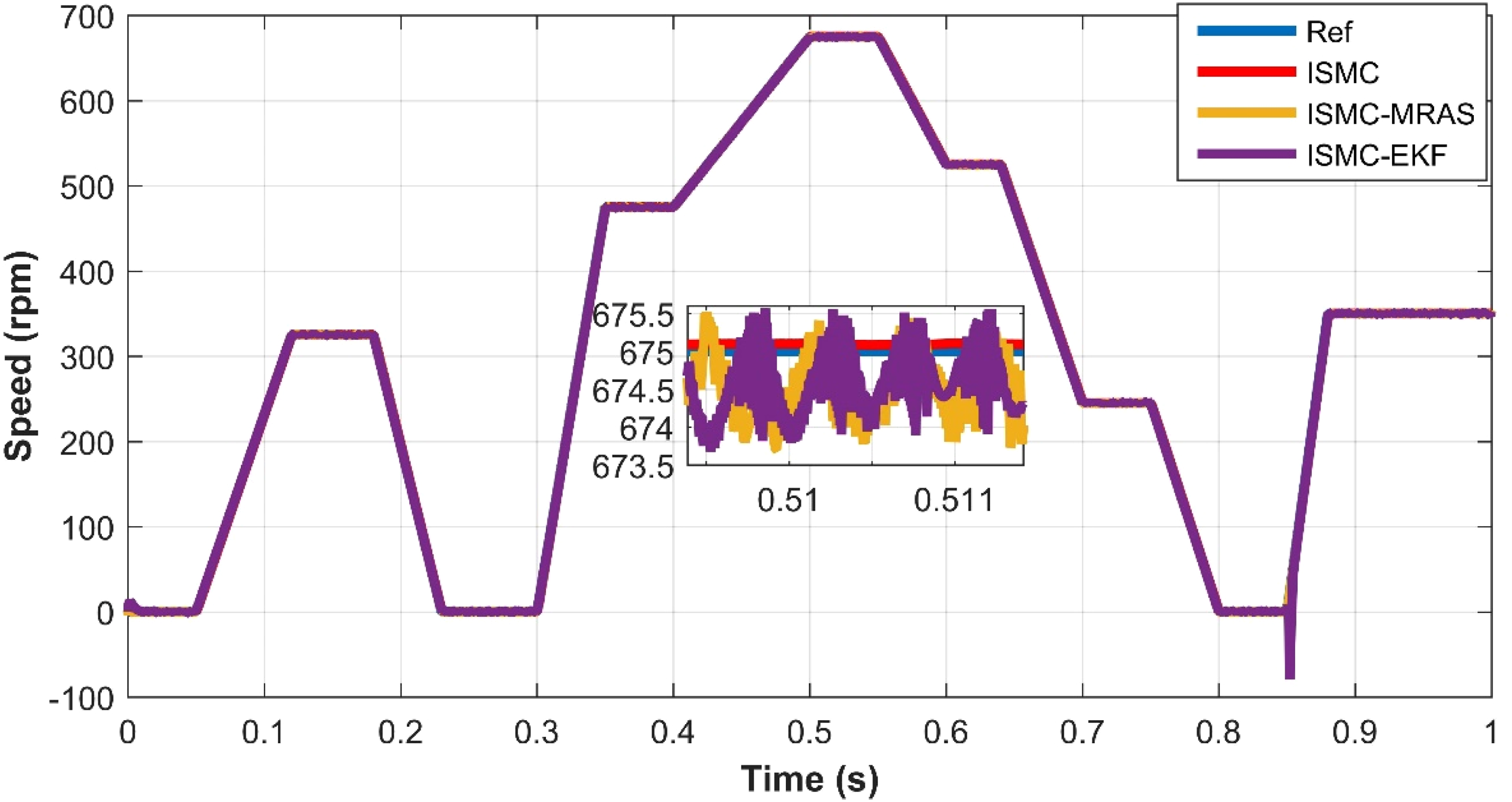
Speed response under repeated start–stop driving conditions.
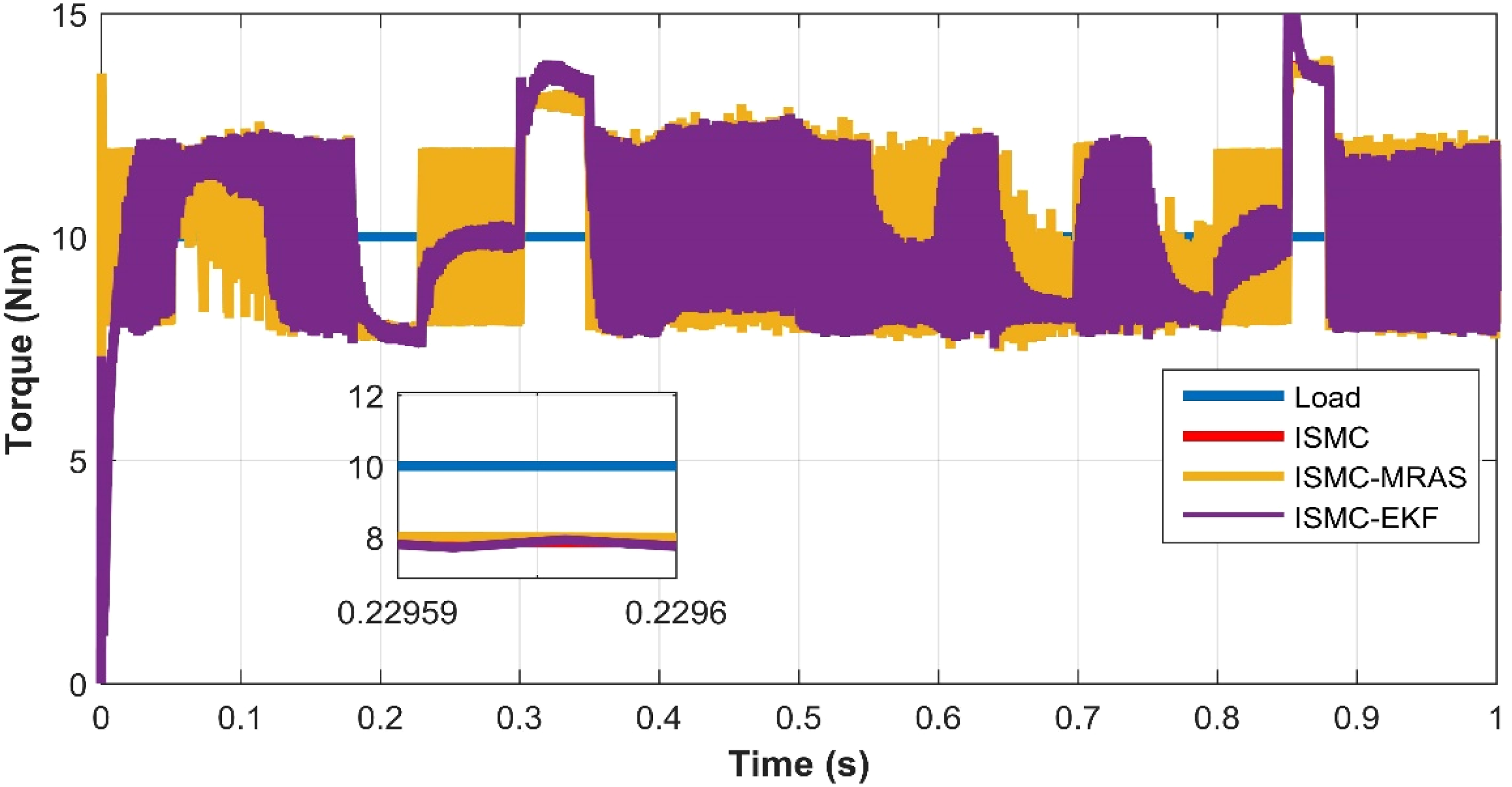
Torque response under dynamic EV operating conditions.
Multi-criteria quantitative dominance analysis
To provide an objective and quantitative comparison among the considered control configurations, a Weighted Performance Index (WPI) is introduced. The proposed index combines several normalized dynamic and steady-state performance metrics into a single evaluation criterion. The WPI is calculated as follows:
Weighting factors used in the weighted performance ındex (WPI).

Greater weights were assigned to transient-response-related metrics such as rise time and settling time because EV traction systems are highly sensitive to rapid acceleration and deceleration dynamics. Torque ripple was also assigned a relatively high weight due to its direct influence on mechanical vibration, passenger comfort, and drivetrain reliability. In contrast, the steady-state error was assigned a comparatively lower weight since all considered controllers exhibited nearly zero steady-state tracking error under nominal operating conditions. The normalized metrics were evaluated under identical EV operating scenarios to ensure a fair and consistent comparison among PID, ISMC, ISMC–MRAS, and ISMC–EKF control structures. The resulting WPI values provide an overall quantitative dominance ranking considering both dynamic and steady-state PMSM drive performance characteristics.
A performance metric with weighted cost is introduced in this subsection to allow an objective and quantitative comparison of the considered control approaches. The dominance ranking allows a full system evaluation under steady-state and dynamic simulations.
In order to get an unbiased multi-criteria assessment, a performance weighted index (WPI) is defined. The resulting relative performance ranking based on the normalized measures and the given weighting factors is summarized in Table 4. The ISMC–EKF scheme yields the maximum performance index (0.90), which implies that it is superior in dynamic response, tracking accuracy, and torque smoothness. Although ISMC by itself provides powerful robustness, the addition of EKF further improves transient stability and estimation accuracy, which results in the best solution for high-performance EV drive applications.
Performance index (WPI) and dominance ranking.

Discussion
In this section, an in-depth analysis of the results obtained is presented, and the developed control structure for the PMSM-based EV drive is related to the existing research works. In addition to the numerical results, the discussion also addresses the fundamental control principles that lead to improved dynamic stability, disturbance rejection, and estimation accuracy. The faster convergence achieved by ISMC originates from the integral sliding manifold that constrains the system trajectory directly onto the sliding surface from the initial instant. Reduced oscillatory behavior is attributed to the nonlinear switching action and disturbance rejection capability of the ISMC structure.
Interpretation of control performance
Firstly, the better quality of ISMC over PID is its fundamental robustness and the absence of the reaching phase. By adding an integral term in the sliding surface, the system trajectory is constrained to lie on the sliding manifold from the beginning, which significantly reduces the overshoot and increases the rate of convergence. This structural superiority accounts for the improved transient damping and steady state oscillation reduction in the results. In contrast to the linear PID control, which is sensitive to changes in parameters and perturbations, the ISMC remains robust even with time-varying loads. The diminished torque ripple and superior current regulation offer additional proof of the nonlinear control scheme's capability of dealing with matched disturbances and nonlinear dynamics of the PMSM. For these particular reasons, ISMC is commonly accepted as the best choice for fast EV drive applications.
Observer accuracy and robustness
Among the two observer-based structures, the EKF achieves better smoothing of the estimation and more rapid dynamic convergence than the MRAS. This improvement mainly stems from the recursive prediction–correction procedure of the EKF that considers system nonlinearities and measurement noise explicitly by means of covariance updating. Consequently, EKF achieves better state estimation during fast speed changes and start–stop situations. On the other hand, MRAS has an adaptation law based on an error system, which converges more slowly when the system dynamics are switched abruptly. While MRAS has a significantly lower computational complexity and more accurate steady state results, its transient accuracy of estimation is a bit too far. Therefore, EKF offers better robustness and dynamic reliability, especially under complex EV driving scenarios.
Engineering implications for EV drives
Torque ripple reduction is important, in particular from an engineering point of view. Lower torque pulsation results in less mechanical stress on the components of the powertrain, reduced vibration, and improved comfort for passengers. Moreover, better start–stop stability is essential in a city EV driving environment with repetitive acceleration/deceleration cycles. Better tracking also facilitates smoother power delivery and energy efficiency. The enhanced dynamic performance of the ISMC–EKF not only enhances the control accuracy but also ensures the durability of the long-term drivetrain, thereby increasing the practical significance. Two important aspects of this study are that it shows the applicability and usefulness of the suggested control–estimation framework to actual EVs.
Limitations and future work
Nevertheless, the EKF-based scheme is more complex than MRAS. This can restrict its application in cheap embedded systems/boards with limited processing power. Furthermore, this work is a simulation-based analysis. In future work, real-time experimental validation will be conducted based on hardware-in-the-loop or DSP-based implementation for validation of robustness in a practical environment. Further improvements on computational efficiency and adaptive tuning methods are also expected to enhance the practical usage of the proposed algorithms.
Computational complexity and real-time feasibility
The proposed ISMC–EKF framework introduces additional computational burden compared with conventional PID-based PMSM control due to recursive covariance updates and Jacobian matrix evaluations. However, the computational complexity remains suitable for modern DSP and FPGA-based EV drive controllers. The EKF algorithm mainly requires matrix multiplications and covariance updates at each sampling interval, whereas MRAS only requires algebraic adaptation laws and PI updating mechanisms. Therefore, MRAS has lower computational complexity but lower transient estimation accuracy. The proposed ISMC controller itself has low computational overhead because the control law mainly consists of algebraic operations and switching functions. For practical implementation, the proposed framework can be executed using real-time embedded processors such as TI TMS320F28379D or dSPACE DS1104 platforms with sampling frequencies commonly used in PMSM drive systems. Future work will include hardware-in-the-loop (HIL) and experimental validation to verify practical robustness under measurement noise, inverter nonlinearities, and communication delays.
Comparative analysis with state-of-the-art methods
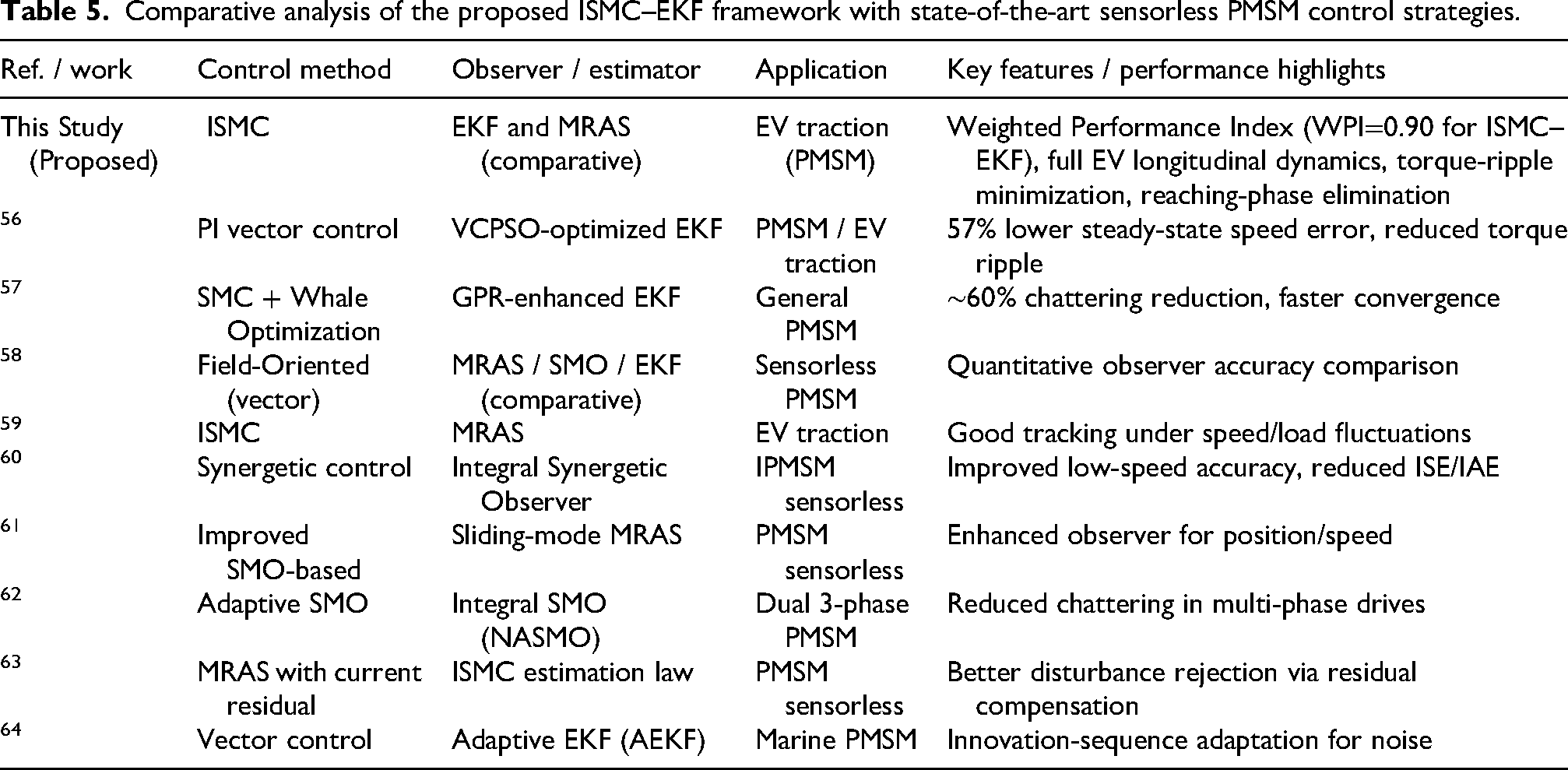
In order to locate the proposed framework in the context of the literature, a comparison with representative latest control and sensorless estimation methods for PMSM is presented in Table 5. The comparison comprises recent works based on SMC variants, predictive schemes, backstepping designs, and observer-based sensorless techniques, i.e., MRAS and EKF. Different from most existing works that consider separately advanced control design or observer design, the proposed approach seamlessly couples a nonlinear ISMC framework with a dual observer benchmarking demonstration under real EV operation conditions. And although a handful of research confirms performance under constant speed scenarios, this study builds on those two by adding dynamic driving patterns and start–stop dynamics, which are vital to real EV use. The comparison demonstrates that although the terminal SMC, predictive control, and MRAS-based approaches achieve a good tracking performance, their eccentricity is much in the sense that they do not have a complete EV- oriented validation or multi-criteria dominance analysis. On the contrary, the proposed ISMC–EKF structure has demonstrated better robustness performance, less torque ripple, and better dynamic stability, which is also illustrated by a quantitative performance index framework.
Comparative analysis of the proposed ISMC–EKF framework with state-of-the-art sensorless PMSM control strategies.
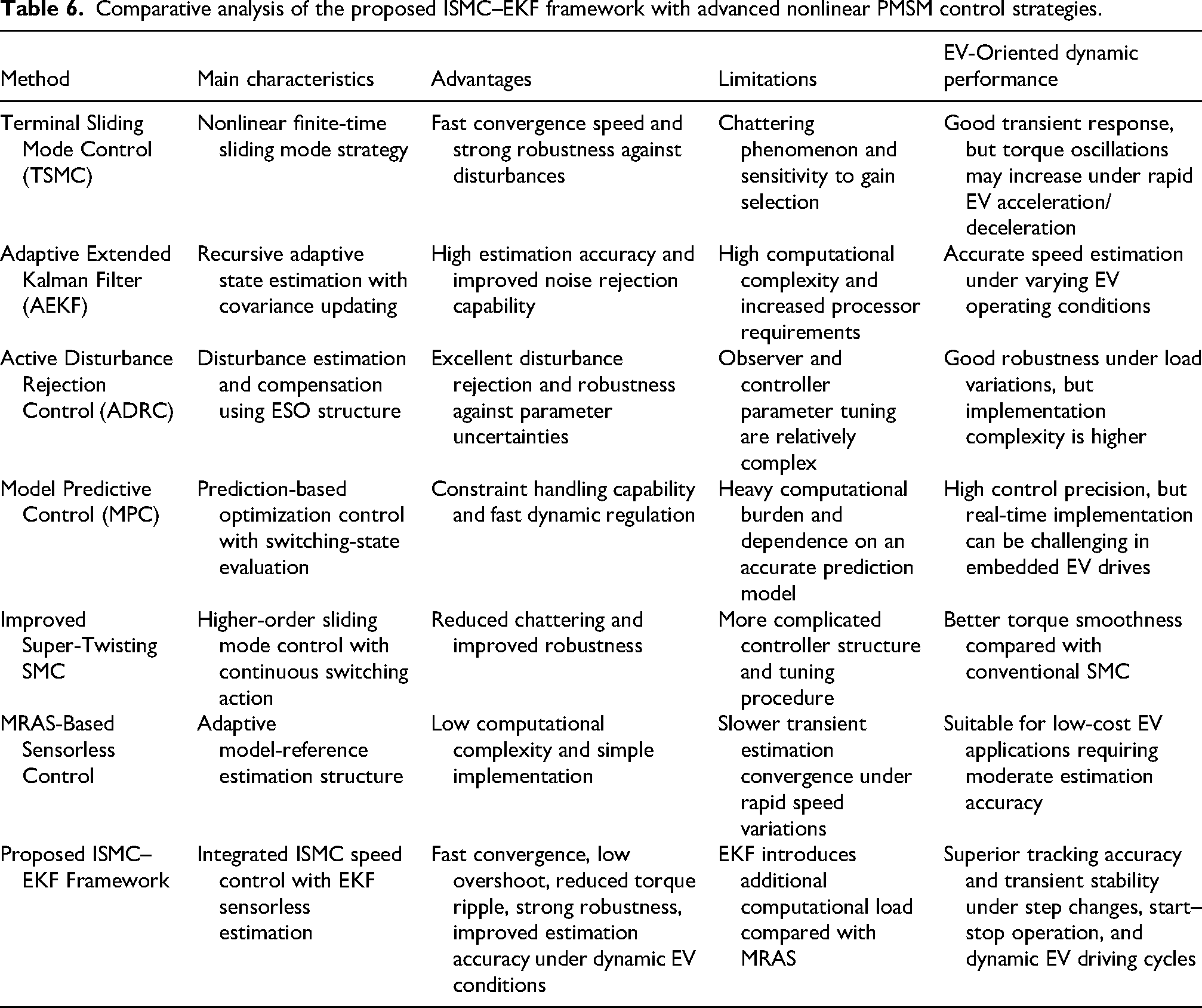
As summarized in Table 6, most existing PMSM sensorless control methods focus either on advanced nonlinear control design or observer enhancement individually. In contrast, the proposed ISMC–EKF framework combines robust integral sliding mode control with high-accuracy nonlinear state estimation and evaluates the overall performance under realistic EV driving conditions. Compared with conventional nonlinear methods, the proposed approach achieves improved transient response, lower torque ripple, and enhanced robustness during repeated acceleration–deceleration and start–stop operations. Although the EKF observer increases computational complexity, the resulting improvement in estimation accuracy and dynamic stability makes the proposed framework highly suitable for high-performance EV traction systems.
Comparative analysis of the proposed ISMC–EKF framework with advanced nonlinear PMSM control strategies.
Conclusion
A novel efficient sensorless control strategy of PMSM drives in EV traction systems is proposed in this paper using an ISMC in association with two robust observers, namely, EKF and model MRAS observers. The effectiveness of the proposed two-level control scheme was validated for various driving conditions, including step response and realistic dynamic EV driving cycles. Hence, it is possible to conduct a comprehensive analysis of the performance of PMSM drives. From the simulation results, it is confirmed that the ISMC controller is highly effective in improving the dynamic performance of PMSM drives compared with traditional PID control. By incorporating an integral sliding surface into the control scheme, it is possible to eliminate the reaching phase of the SMC. This enables faster convergence of the control system. As a result, faster response, less overshoot, shorter settling time, and stronger disturbance rejection are realized, which are all significant requirements in high-performance EV traction control. With regard to the observer design, MRAS and EKF methods have shown accurate rotor speed estimation, thus ensuring reliable sensorless control. Although both methods have shown promising results, it is observed that EKF has shown better transient response accuracy and smoother torque response, especially during rapid changes in speed and during start and stop conditions. Moreover, it is also observed that the quantitative evaluation has shown the superiority of the ISMC-EKF configuration in terms of tracking accuracy and robustness. The future work will be devoted to validating this strategy using real-time experiments and improving computational efficiency to make it more suitable for embedded control systems.
Footnotes
Abbreviations

Author contributions
Benkaihoul Said, Amar Regaz, Badreddine Naas: Conceptualization, Methodology, Software, Visualization, Investigation, Writing- Original draft preparation. Yıldırım Özüpak, Riyadh Bouddou, Farouk Ibrahim Bouguenna: Data curation, Validation, Supervision, Resources, Writing - Review & Editing. Mohit Bajaj, Ievgen Zaitsev: Project administration, Supervision, Resources, Writing - Review & Editing.
Funding
The authors received no financial support for the research, authorship, and/or publication of this article.
Declaration of conflicting interests
The authors declared no potential conflicts of interest with respect to the research, authorship, and/or publication of this article.
Availability of data and materials
All data generated or analyzed during this study are included in this published article.