






Abstract
Purpose:
Living in disadvantaged urban areas is associated with poor mental health. The purpose of this study was to assess which social characteristics were associated with psychological distress within a disadvantaged, multi-ethnic neighbourhood of Berlin.
Methods:
The study was conducted in an area of Berlin with the highest rates of unemployment and highest density of migrants. A total of 143 participants aged 18–57 years were included from a random sample. The social characteristics educational level, employment status, marital status, living alone, per-capita income and background of migration were collected. Psychological distress was assessed using the General Health Questionnaire GHQ-28; scores ≥ 5 indicated psychological distress corresponding to psychiatric caseness.
Results:
Psychological distress was found in 40.6% (n = 58) of the sample. Psychological distress was associated with younger age (OR = 0.95, 95% CI = 0.92–0.98, p = .004), female gender (OR = 3.51, 95% CI = 1.55–7.92, p = .003) and living alone (OR = 3.88, 95% CI = 1.58–9.52, p = .003), but not with background of migration, low educational level or with unemployment.
Conclusions:
Young age and female gender may predispose for psychological distress in disadvantaged areas. Living alone could be a social indicator of poor mental health within disadvantaged urban areas. The directionality of the association is unclear. Background of migration, low income and educational level do not seem to be associated with poor mental health within those areas.
Introduction
Social inequalities have been associated with health inequalities (Marmot, 2010; Reijneveld & Schene, 1998). Social inequalities in terms of employment, education and income are of concern in the EU (Fryers, Melzer, Jenkins & Brugha, 2005; Laaksonen et al., 2007). Poverty is associated with high unemployment rates and low levels of education (Pollitt, Rose & Kaufman, 2005), and an increased risk of morbidity (Lorant et al., 2003). Living in urban environments is particularly related to unequal life conditions and health inequalities (Almeida-Filho et al., 2004). Living in disadvantaged urban neighbourhoods is associated with lower total and disability-free life expectancy and poorer mental health (Barnes, Belsky, Frost & Melhuish, 2011; Stafford, Gimeno & Marmot, 2008; Stafford & Marmot, 2003). A relationship between unemployment and negative health outcomes has been reported (Clark & Oswald, 1994; McKee-Ryan, Song, Wanberg & Kinicki, 2005). Higher educational levels may also be associated with a decreased risk of mental disorders (Kessler et al., 1994). Single parents, persons living alone, or migrants and ethnic minorities may be at risk of having a low socio-economic status (SES) (European Council, 2003; Lelkes, 2007). Elevated rates of mental disorders in migrants have been reported in some countries (Levecque, Lodewyckx & Vranken, 2007; Lindert, Ehrenstein, Priebe, Mielck & Brähler, 2009; Selten, Cantor-Graae & Kahn, 2007; Williams et al., 2007). The factors mediating or moderating this relationship have not yet been revealed. SES may partly or fully explain this association (Gavin et al., 2010). Research on affective disorders is in line with this argument: depression has a stronger relation to SES than to ethnicity (Jackson-Triche et al., 2000; Somervell, Leaf, Weissman, Blazer & Bruce, 1989), or to migration (Tinghog, Al-Saffar, Carstensen & Nordenfelt, 2010). Mental health risks in migrant populations may be associated with the social hardships and inequalities they face (Massey & Eggers, 1990).
According to the German federal statistic agency DESTATIS (2011a), 14.6% of the German population lived at risk of poverty in 2009. By Organization for Security and Co-operation in Europe (OSCE) criteria, the risk of poverty has been defined as the rate of persons living below 60% of the median income of a population (OECD, 2008). Berlin, the largest metropolitan centre in Germany, has one of the highest poverty rates (19.0% in 2009) (DESTATIS, 2011a). In Berlin, non-German citizens have a higher risk of living in poverty than German citizens (25.7% vs 10.6%) (SenGesUmV, 2008a).
Publications on the interaction of SES and emotional distress in Germany are rare (Schwefel, 1986). Most of the literature in this area is based on data from the UK (Marmot, 2010; Stafford et al., 2008; Stafford & Marmot, 2003) and the USA (Mandal & Roe, 2008). There are limitations to generalize the results to Central European settings.
The purpose of this study was to determine the rate of psychological distress in the most disadvantaged area of Berlin and to explore which social characteristics that are usually associated with psychological distress in population-based studies were associated with psychological distress within this socially extremely disadvantaged multi-ethnic neighbourhood.
Methods
Population and setting
The study was approved by the Ethics Committee of Charité – Universitätsmedizin Berlin (EA1/132/08). The survey was conducted in two adjacent political sub-districts of Berlin, Germany –Gesundbrunnen and Wedding – in 2009. The two adjacent sub-districts constitute the most disadvantaged neighbourhood of Berlin with the lowest social indices (SenGesUmV, 2008b), the highest rate of residents living at the risk of poverty (23.0% in 2009), the highest unemployment rate (26.7% in 2008) and a high rate (11% in 2008) of persons without any educational degree (SenGesUmV, 2008a). The district has the highest density of migrant populations: 33% of the residents are foreign nationals; 53.5% of the population in the area have a migratory background. In our study, a random sample of 1,000 persons aged 18–57 years registered in the area was drawn from the population registry. The sample was stratified for gender and age. These age strata consisted of the age groups 18–27, 28–37, 38–47 and 48–57 years. The samples were then randomly subdivided into five waves for further recruitment. We chose a standard recruitment protocol for epidemiological research including two information and invitation letters, three telephone calls on three different days and times if a publicly listed phone number was available and three field visits at the listed address on three different days and times if the letters were not returned. One bilingual German and Turkish female interviewer refined the standard recruitment procedure. The postal services and the field teams were unable to find 203 persons listed. Only 797 were actually identified with a mailbox and doorbell as living in the area at the time of recruitment. There was a 63.0% non-response rate. Of the 295 (27.0%) who could be contacted, 152 (51.5%) refused participation. The sample consisted of 143 participants (Mundt, Aichberger, Kliewe, Ignatyev et al. 2012). Safety issues and distrust in the area, a high fluctuation of the population and many migrants only living part of the year in Germany were possible explanations for the low participation rate.
Measures
Socio-demographic measures
The variables gender, age and living alone were recorded. Living alone was inferred from the number of persons co-residing in the same household, categorized as living with others versus living alone.
Social status was assessed by employment status, level of education, net personal income and household income. Employment status was categorized as employed, unemployed and being retired or currently in training. For our analysis, employment status was further dichotomized into ‘employed’ and ‘unemployed’. Retirement was subsumed under unemployed, since it was assumed that persons who were retired were in early (disability-related) retirement, since the sample did not include persons of retirement age. Persons aged 30 years and above who were still in training were added to the unemployed group. The rationale for this was that persons living from social welfare are obliged to enter training programmes to continuously qualify for financial welfare support. Level of education was dichotomized into lower level of education (comprising levels 0–2 according to the International Standard Classification of Education (ISCED)) and higher level of education (comprising levels 3–6 of the ISCED) (UNESCO, 1997). Income level was calculated according to the categories of the OSCE for Germany. Household income was adjusted for persons per household with a weight of 1 in single households, 1.5 in two-person households, and an additional weight of 0.3 for every person above two living in the household (DESTATIS, 2011b). Income was dichotomized into ‘below poverty level’ (≤ €742 net household income per month) and ‘above poverty level’ (> €742) (DESTATIS, 2011b). Data were missing for 41 entries in per-capita net income per month and for 52 in net household income per month. Due to the high rate of missing information on these items, these variables and indicators derived from these were excluded from the majority of analyses to retain statistical power.
Psychological distress
Psychological distress was assessed using the German version of the General Health Questionnaire with 28 items (GHQ-28) developed by Goldberg (Goldberg & Hillier 1979; Goldberg et al., 1997), which contains four subscales for somatic symptoms, anxiety/insomnia, social dysfunction and severe depression. The GHQ-28 score ranges from 0 to 28, with a higher score indicating higher levels of psychological distress. It has widely been used to screen for mental disorders internationally (Goldberg et al., 1997). The instrument is used to screen for minor and sub-threshold mental disorders that present with significant symptoms and functional impairment (Sartorius, Üstün, Lecrubier & Wittchen, 1996). In our study, the answers were coded in a dichotomous format (0-0-1-1) and a sum score was calculated based on answers to individual items. We used 4/5 as a cut-off to estimate psychological distress possibly corresponding to psychiatric caseness. The cut-off on the GHQ-28 is the best trade-off between sensitivity and specificity for psychiatric caseness on a standardized diagnostic interview schedule in the same subjects. In a first review on cut-off points in different contexts, the authors came up with a recommendation to use 4/5 as the trans-culturally most adequate cut-off point if none was determined in the study (Goldberg & Williams, 2006). In an original validation study, the cut-off point 4/5 was only slightly better than 5/6 (Goldberg & Hillier 1979). In a later validation study using the Composite International Diagnostic Interview in several countries including Berlin, Germany as one test centre, 5/6 was the cut-off in Berlin and the most adequate trans-cultural cut-off (Goldberg et al., 1997) at least for European countries. In this study, 3/4 was determined as the best cut-off for the use of the Turkish version in Ankara (Goldberg et al., 1997). Another possibility is to use the median rather than the mean as a cut-off for settings in which the sensitivity and specificity for psychiatric caseness are not known (Ignatyev et al., 2012; Willmott, Boardman, Henshaw & Jones, 2004). This would have been 3/4 in our study. The Turkish version of the GHQ-28 was offered if participants’ mother tongue was Turkish; all other participants were assessed with the German version. Only Turkish participants were given this option since the Turkish community is the largest migrant community in this district and levels of German proficiency are commonly lower in Turkish immigrant women.
Migration
Non-German nationals, persons who were born abroad and had at least one non-German parent and persons whose parents were both non-Germans were considered to have a background of migration. For simplicity they are referred to as migrants in the further text. If applicable we administered an adapted version of the questionnaire presented by Schenk et al. (2006) to inquire about the country of origin, native language, German language proficiency, year of immigration and religion.
Analyses
We used descriptive, bivariate and logistic regression analyses. Exploratory, descriptive analyses regarding the rate of psychological distress were conducted for subgroups with different socio-economic characteristics. In order to test for significant associations in categorical data, χ 2 tests were used. The association of social characteristics and psychological distress was assessed using logistic regression analysis with the dichotomized GHQ score (cut-off at ≥ 5) as the dependent variable. In the basic model, age, gender and living alone were introduced as covariates; in a second model, unemployment, low educational level and background of migration were introduced. Ninety five per cent confidence intervals (CI 95%) are given. P values < .05 were considered statistically significant.
All analyses were conducted using STATA statistical software version 10.1.
Results
Background of migration in the sample
The rate of population with a background of migration (52.1%, N = 74) and the rate of foreign nationals (33.8%, N = 48) closely corresponded to the characteristics of the sub-districts (Table 1). Turkish migrants were over-represented in the sample (28.9%, N = 41); Polish migrants and migrants from former Yugoslavian countries were less frequent than in the total population. The ratio of unemployed to employed was higher among foreign nationals than for German nationals both in the sample and in the total.
Background of migration and employment in a random sample of a most disadvantaged inner-city area of Berlin.
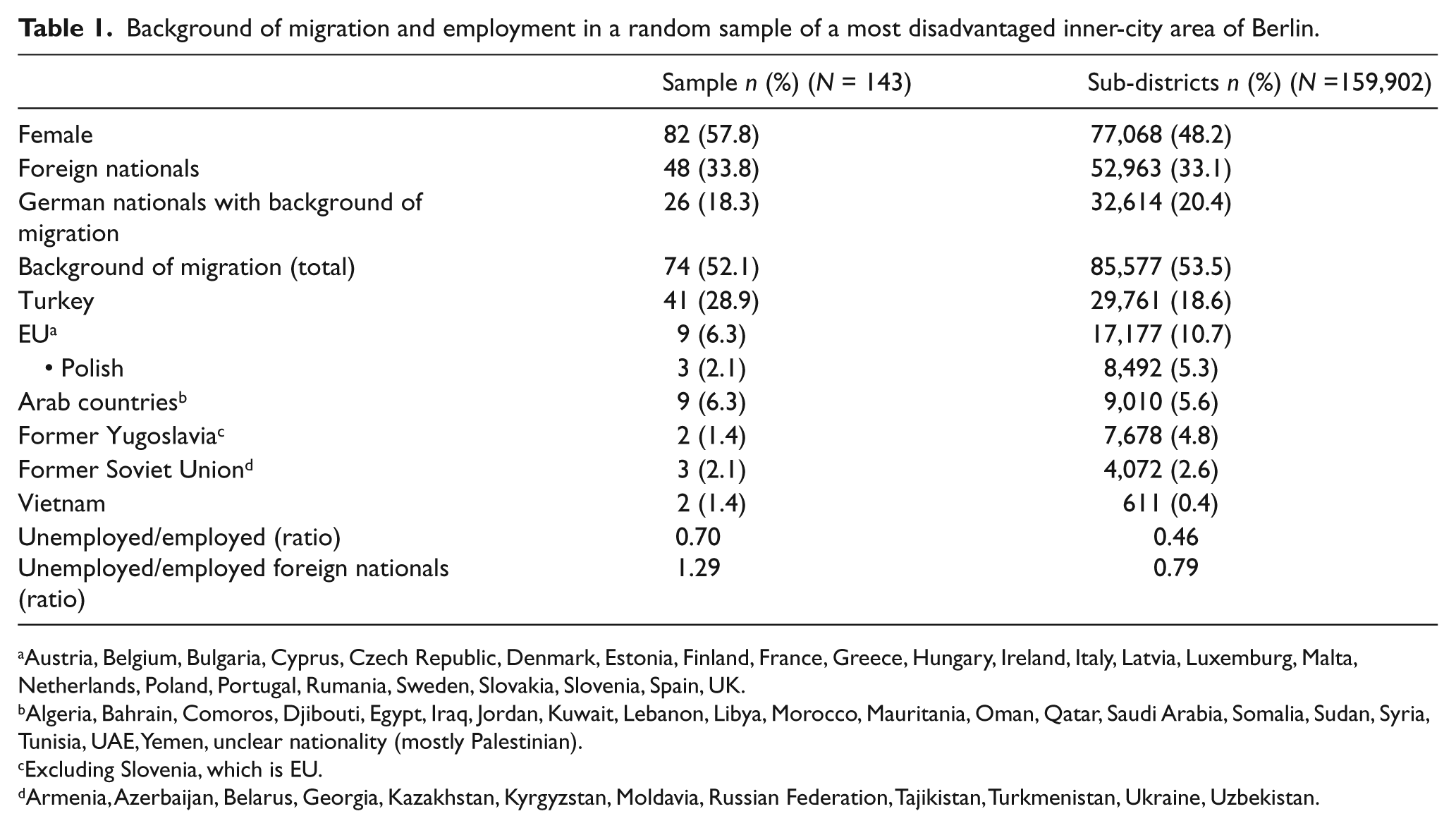
Austria, Belgium, Bulgaria, Cyprus, Czech Republic, Denmark, Estonia, Finland, France, Greece, Hungary, Ireland, Italy, Latvia, Luxemburg, Malta, Netherlands, Poland, Portugal, Rumania, Sweden, Slovakia, Slovenia, Spain, UK.
Algeria, Bahrain, Comoros, Djibouti, Egypt, Iraq, Jordan, Kuwait, Lebanon, Libya, Morocco, Mauritania, Oman, Qatar, Saudi Arabia, Somalia, Sudan, Syria, Tunisia, UAE, Yemen, unclear nationality (mostly Palestinian).
Excluding Slovenia, which is EU.
Armenia, Azerbaijan, Belarus, Georgia, Kazakhstan, Kyrgyzstan, Moldavia, Russian Federation, Tajikistan, Turkmenistan, Ukraine, Uzbekistan.
Social characteristics of the sample
Participants had a mean age of 37.6 (SD = 11.6) years, 58.0% (n = 83) were female, 27.9% (n = 40) were living alone, and 39.9% (n = 57) were married. Almost half of the sample (47.3%, N = 43) lived below the poverty level. An educational level below ISCED 3 was reported by 42.7% (N = 61). The rate of unemployed/early retirement was 37.8% (n = 84; Table 2). Almost half of the sample (40.6%, N = 58) reached the cut-off (≥ 5) for psychological distress on the GHQ-28.
Social characteristics of psychological distress corresponding to psychiatric caseness (GHQ-28 cut-off 4/5).
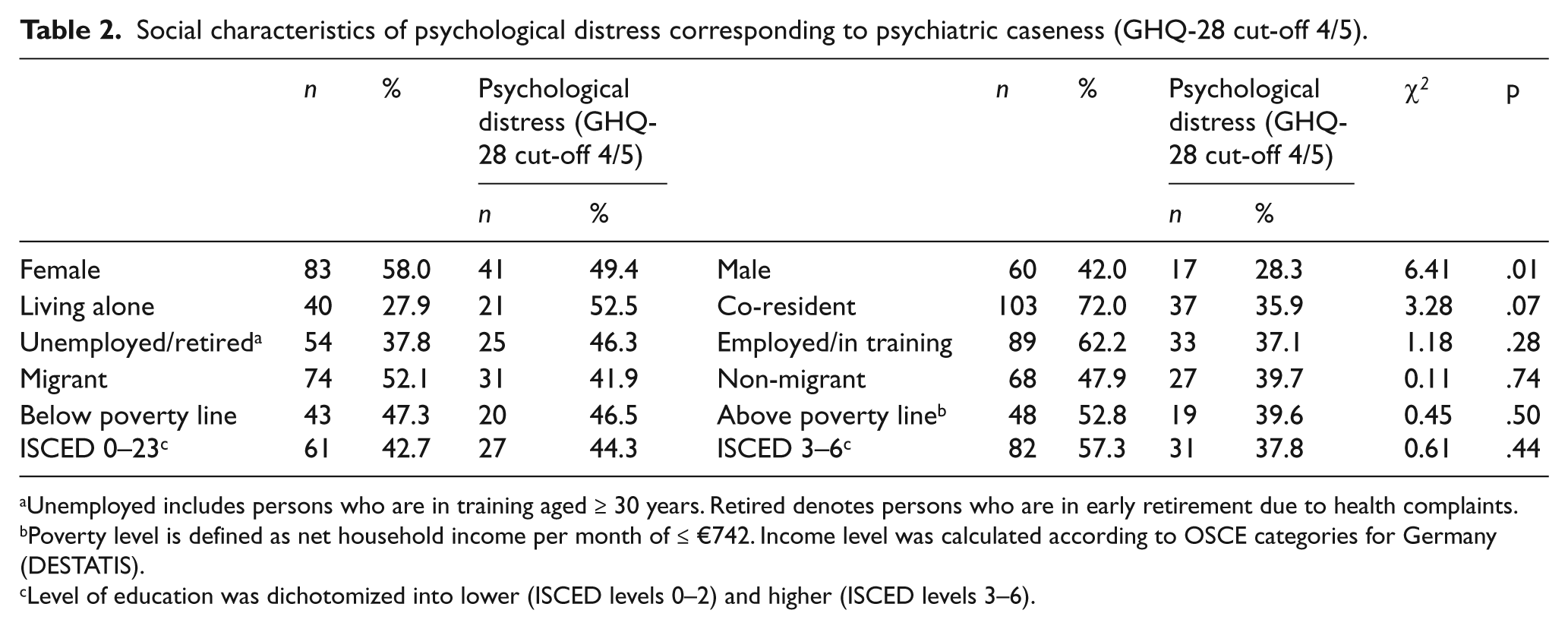
Unemployed includes persons who are in training aged ≥ 30 years. Retired denotes persons who are in early retirement due to health complaints.
Poverty level is defined as net household income per month of ≤ €742. Income level was calculated according to OSCE categories for Germany (DESTATIS).
Level of education was dichotomized into lower (ISCED levels 0–2) and higher (ISCED levels 3–6).
Social characteristics of psychological distress
Women had a higher rate of psychological distress than men (χ 2 = 6.41, p = .011, 49.4% vs 28.3%; Table 2). There was a trend for higher rates of psychological distress in subjects living alone (χ 2 = 3.28, p = .07, 52.5% living alone vs 35.9% co-residing).
The logistic regression analysis indicated that higher age was associated with lower rates of psychological distress (0.95, 95% CI = 0.92–0.98, p = .004). Female gender (3.51, 95% CI = 1.55–7.92, p = .003) and living alone (3.88, 95% CI = 1.58–9.52, p = .003) were associated with higher rates of psychological distress (Table 3). Introducing unemployment, lower educational levels and background of migration as additional covariates did not change the association of age, gender and living alone with psychological distress. Neither one of the additional covariates was significantly associated with psychological distress.
Logistic regression analyses with psychological distress as the dependent variable.
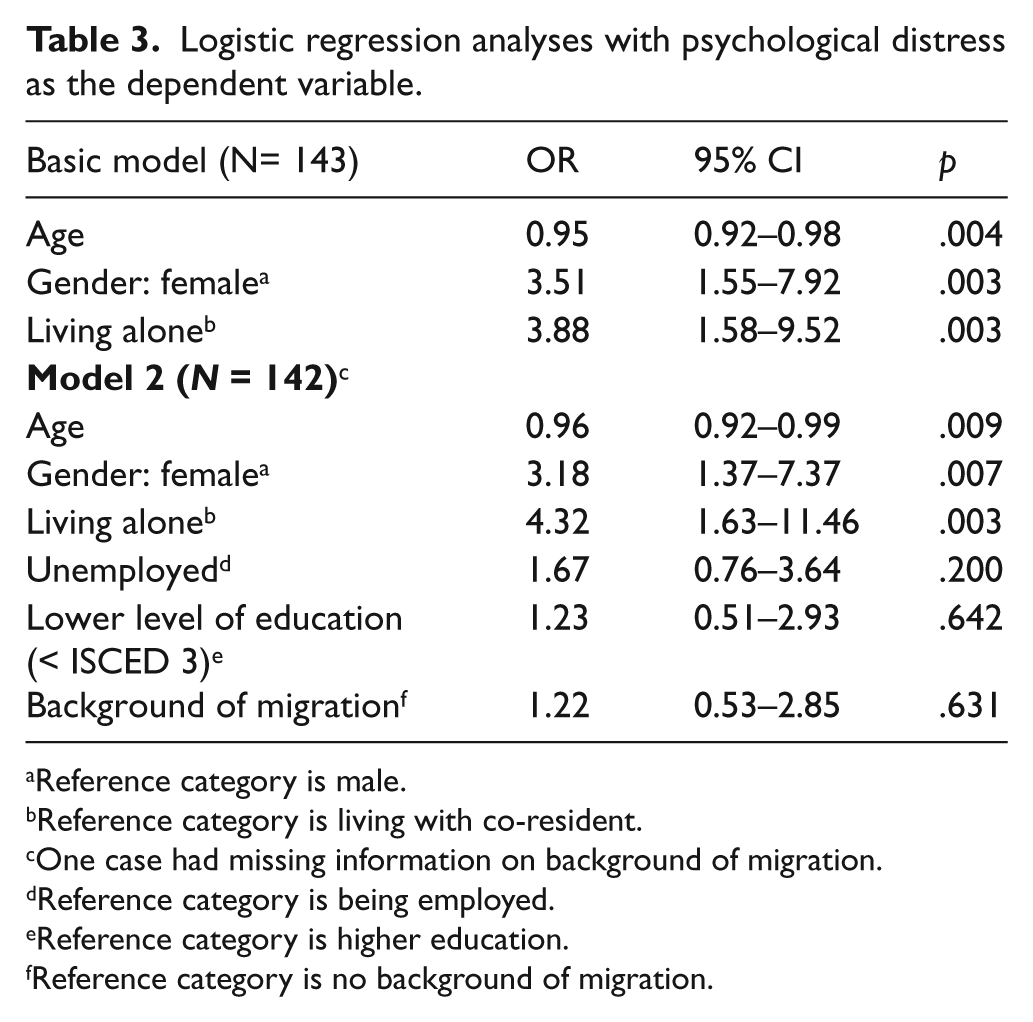
Reference category is male.
Reference category is living with co-resident.
One case had missing information on background of migration.
Reference category is being employed.
Reference category is higher education.
Reference category is no background of migration.
Discussion
We found high rates of psychological distress in this disadvantaged inner-city area of Berlin. The demographic parameters female gender and younger age were associated with psychological distress. Among several social indicators, living alone stood out to be associated with psychological distress within this socially disadvantaged urban area.
Limitations
The sample was taken from a socially very disadvantaged multi-ethnic neighbourhood, a hard-to-reach population that is usually not taken into account in surveys. Response rates are a problem for random sampling in those areas (Mundt, Aichberger, Kliewe, Ignatyev et al. 2012) and for targeting migrant populations (Aichberger et al., 2012), possibly due to a combination of little interest in surveys, fear, stigma regarding the topic, safety problems when responding to strangers, mistrust, language and cultural barriers, fluctuation and inaccuracy of population registries. In these extremely disadvantaged areas, random sampling with standard epidemiological contact procedures is at its limit to yield useful results with a tolerable bias. It can be argued that the loss due to inaccuracy of the population registry is fairly neutral. Many of the migrants spend only part of the year in Germany and can therefore not be recruited for surveys, which explains part of the non-contact rate. For more than half of those who could be contacted, it was unacceptable to participate. The formal and written informed consent procedure may have scared off a part of the population that feels insecure to engage in written contracts. A part of the population may have been scared off by the stigma surrounding the subject of mental health. Even more unacceptable than yielding information on mental health was revealing income, so this indicator had to be excluded the regression analysis. The alternative sampling strategies such as purposive sampling or snowball sampling introduce other problems. A combination of random and non-random sampling has been used for refugee mental health research (Bogic et al., 2012). Those techniques cannot depict multi-ethnicity and multinationality in one area, but they focus on a selection of persons from a common origin or a common social contact point. There may be limitations in generalizing the results because the composition of different backgrounds of migration (Table 1) in the sample is specific for the area. The cut-off on the GHQ-28 for possible psychiatric caseness may differ between cultures (Goldberg et al., 1997). The size of our sample was small. This has been reported as a methodological shortcoming of immigrant mental health research in Europe before (Claassen, Ascoli, Berhe & Priebe, 2005). It is difficult to interpret negative results in small samples. For missing values of the variable ‘income level’, it was not possible to exclude that the association of living alone and psychological distress was explained by poverty. Nevertheless, the reported positive associations stand out compared to the other indicators and should be followed up using different methodological approaches.
Conclusion
The levels of psychological distress in this sample were expected to be higher than those in the general population in Germany (Jacobi, Klose & Wittchen, 2004). High rates of psychological distress as indicated by the GHQ-28 in a socially disadvantaged urban neighbourhood is in accordance with earlier research findings in the UK (Marmot, 2010). In our sample, ‘living alone’ stands out as a possible social risk factor or as a possible social consequence of psychological distress within this disadvantaged population. Living alone could indicate the absence of informal social and family support in this area. A range of other social characteristics that have previously been identified as possible risk factors for depression in the general population (Kessler et al., 1994) did not show significant associations with psychological distress within this area. Migrants did not show different patterns of psychopathology within those disadvantaged areas of Berlin as compared to non-migrants (Mundt, Aichberger, Kliewe, Yayla et al. 2012). Subjects with different educational levels did not differ regarding their psychological distress. Social drift may force subjects with high educational levels and mental health problems to live in disadvantaged areas. High educational levels may only be associated with the absence of mental illness if they lead to economic participation (Chazelle et al., 2011). Neither does employment indicate the absence of psychological distress in this type of neighbourhood. A possible explanation for this is the high prevalence of precarious employment situations that do not increase economic participation for the subjects living in this area
It has been shown for the UK that area disadvantage is independently associated with poor self-rated mental health (Poortinga, Dunstan & Fone, 2007); possible mediating factors include poor housing conditions, safety problems, poor access to amenities and lack of social cohesion (Poortinga, Dunstan & Fone, 2008). Given prior research findings on mental distress and mental disorders in migrants (Fazel, Wheeler & Danesh, 2005; Levecque et al., 2007; Lindert et al., 2009; Williams et al., 2007), higher rates of psychological distress compared to non-migrants can be expected in general populations. This effect seems to disappear when studying socially disadvantaged neighbourhoods, where most of the migrants in Berlin live. A number of underlying pathways for the relationship of socio-economic challenges and ill health have been suggested (Mackenbach, van de Mheen & Stronks, 1994; Myer, Stein, Grimsrud, Seedat & Williams, 2008). ‘Selection’ and ‘causation’ have been proposed as possible mechanisms (Mackenbach et al., 1994): ‘selection’ refers to ill health impacting on social mobility and therefore SES; ‘causation’ relates to the influence of SES on health mediated or moderated through various risk factors (Mackenbach et al., 1994). According to the social drift theory, persons with mental disorders may be forced to move to disadvantaged urban areas with a lower social status (Berry, 2007). On the other hand, living in a disadvantaged neighbourhood and being exposed to social isolation (Heinz, Mann, Weinberger & Goldman, 2001) may lead to increased levels of mental distress regardless of the individuals’ social status (Barnes et al., 2011; Stafford et al., 2008; Stafford & Marmot, 2003).
Implications
For research: random sampling strategies for extremely disadvantaged areas should be refined to improve contact and response rates. They may have to be combined with non-random sampling methods. For practice: service providers in disadvantaged multi-ethnic urban settings should be aware that young adult females and persons living alone are at a very high risk of psychological distress. Further research is needed to explore the directionality of the association of living alone and psychological distress.
Footnotes
Funding
We would like to acknowledge the International Bureau of the Federal Ministry of Education and Research, grant number KAZ 09/002, for funding this study. Adrian P. Mundt is currently a European Union Marie Curie International Outgoing Fellow, grant number PIOF-GA-2011-302346-INCAS.