






Abstract
Background:
Multicultural adolescents in South Korea may face unique challenges related to acculturation that can affect their mental health over time.
Aims:
This study examined developmental trajectories of depression among multicultural adolescents in South Korea over a 9-year period and investigated how acculturation strategies and contextual factors influence these trajectories.
Methods:
Participants were 1,500 multicultural adolescents (50.7% female; Mage = 10.98 years at baseline) from the Multicultural Adolescents Panel Study (2012–2020). The sample included adolescents with mothers from various countries (Japan 33.4%, Philippines 25.1%, Chinese Korean 19.1%, China 7.3%, others 15.1%). Using latent class growth analysis, we examined depression trajectories and their associations with individual factors (acculturation strategies, self-esteem, acculturative stress), parental acculturative stress, and friend support.
Results:
We identified three distinct depression trajectories (low-level: 38.7%, mid-level: 44.9%, and high-level: 16.4%). Integration acculturation strategy showed advantages over assimilation in predicting more favorable depression trajectories. However, contrary to traditional expectations, results tentatively suggest that marginalization may not necessarily be associated with worse outcomes compared to separation strategies, although this finding should be interpreted with caution given the dichotomized measurement of acculturation strategies. Higher self-esteem, lower acculturative stress, and stronger friend support significantly predicted membership in more favorable trajectory groups.
Conclusions:
These findings challenge assumptions about uniform vulnerability to depression among multicultural adolescents and suggest more complex relationships between acculturation strategies and mental health than previously recognized.
Introduction
South Korea is transforming into a multicultural society with rising international marriages and foreign workers. According to the Korean Educational Development Institute’s Center for Education Statistics (2022), multicultural students grew from 55,780 in 2013 to 160,056 in 2021. The mental health of multicultural adolescents, particularly depression, has emerged as a critical concern. Many experience acculturative stress navigating both Korean and heritage cultures (Sohn, 2019), a challenge particularly salient in South Korea’s traditionally homogeneous society where cultural prejudices can be severe (Mo, 2018).
Previous research has been limited by cross-sectional designs. Sohn (2019) found that acculturative stress and social support predicted depression, while Oh (2016) identified family factor associations with depressive symptoms. Yu and Hwang (2016) demonstrated higher depression levels in multicultural adolescents compared to peers, with family income and social support as protective factors. More recently, several studies have utilized MAPS data to examine depression longitudinally. Song et al., (2020) applied LCGA to six waves of MAPS data (2012–2017) and identified three depression trajectory classes, but their analysis focused on demographic and socioeconomic predictors without examining acculturation strategies. S. Lee et al. (2024) similarly identified three trajectory classes using MAPS data from 2014 to 2019, yet also did not include acculturation strategies and employed conventional multinomial logistic regression rather than methods that account for classification uncertainty. Other MAPS-based studies have examined depression using cross-sectional (E. J. Lee & Jeong, 2021) or variable-centered longitudinal approaches (Joung & Chung, 2022; S. Lee et al., 2024), which estimate average trends without identifying qualitatively distinct subgroups. Critically, no prior MAPS-based study has examined how Berry’s acculturation strategies predict membership in distinct depression trajectory groups. Berry’s (1997) acculturation framework identifies four strategies: integration, assimilation, separation, and marginalization. While some suggest integration leads to better outcomes (Berry et al., 2006; Nguyen & Benet-Martinez, 2013), others challenge this view. Rudmin (2003) argued that strategy effectiveness varies by context, with some proposing single-dimension measurement (van de Vijver et al., 1999) or equal adaptiveness depending on circumstances (Escobar & Vega, 2000).
Existing studies have not examined how acculturation strategies relate to depression trajectories over time. Self-esteem has been identified as a protective factor against adolescent depression (Gu et al., 2024). Peer social support is especially critical for multicultural adolescents in Korea’s homogeneous society, where they may face isolation (Mo, 2018; Oh, 2016), though its influence on different depression trajectories remains unclear.
Depression in Multicultural Adolescents and its Significance
Depression during adolescence represents a critical public health concern due to its potential long-term consequences. Studies have shown that depressive symptoms that emerge during teenage years frequently continue into adult life, and individuals who experience depression early in life are more likely to develop more persistent and intense manifestations of the condition (Y. Kim, 2008). Adolescent depression shows several distinctive characteristics compared to adult depression, including longer symptom duration and higher recurrence rates (Kovacs et al., 1989).
Depression frequently co-occurs with other psychological and behavioral issues. Oh (2016) found that depressed adolescents often exhibit impulsivity, aggression, school maladjustment, and delinquency. These co-occurring problems can impair crucial developmental processes, affecting academic performance, peer relationships, and identity formation (Bandura, 1997). Depression is recognized as one of the most significant predictors of suicidal ideation among adolescents. Research has documented that youth from multicultural backgrounds typically report elevated rates of depressive symptoms when compared to adolescents from non-multicultural families (Jun, 2012; Milan & Keiley, 2000; Mo, 2018). Jun (2012) found that multicultural adolescents demonstrate higher levels of internalized problems and emotional-behavioral difficulties. This heightened vulnerability stems from challenges in identity development and acculturative stress as they navigate both Korean culture and their heritage culture (Sohn, 2019).
Theoretical Framework
This study is guided by two complementary theoretical frameworks. First, Berry’s (1997) acculturation theory provides the foundation for understanding how multicultural adolescents navigate between heritage and host cultures. Berry’s model posits four acculturation strategies—integration, assimilation, separation, and marginalization—each reflecting different orientations toward heritage culture maintenance and host culture adoption, with distinct implications for psychological adjustment. While Berry’s original framework suggests that integration is the most adaptive strategy, recent scholarship has questioned this hierarchy, arguing that strategy effectiveness is context-dependent (Rudmin, 2003; Safdar & van de Vijver, 2019). This theoretical perspective directly informs our examination of acculturation strategies as predictors of depression trajectory membership.
Second, Bronfenbrenner’s (1979) ecological systems theory provides the organizing framework for our multi-level predictor model. This theory posits that adolescent development is shaped by nested environmental systems. At the individual level (microsystem), factors such as self-esteem, acculturative stress, and acculturation strategies directly influence psychological adjustment. At the family level (mesosystem), parental acculturative stress and parental self-esteem reflect the intergenerational transmission of adaptation challenges that affect adolescents’ emotional well-being (Y. Lee, 2008; H. Park, 2014). At the school level (exosystem), friend support and teacher support represent broader social contexts that may buffer or exacerbate the effects of cultural adaptation on mental health (Bae, 2020; Hernández et al., 2025). By integrating these two frameworks, the present study moves beyond descriptive trajectory identification to theoretically grounded examination of how acculturation processes and ecological contexts jointly shape depression development among multicultural adolescents.
Factors Predicting Depression Trajectory Membership
Drawing on the ecological and acculturation frameworks outlined above, we examine predictors at individual, family, and school levels. At the individual level, it is important to distinguish between acculturation strategies and acculturative stress. While acculturation strategies refer to behavioral and attitudinal approaches toward maintaining heritage culture and adopting host culture, acculturative stress represents psychological strain during adaptation (Berry & Kim, 1988). Acculturative stress has been identified as a significant depression risk factor. According to the stress-vulnerability model, it can overwhelm coping resources, leading to psychological distress (Hovey & King, 1996). This stress manifests through language barriers, cultural conflicts, discrimination, and identity confusion, all contributing to depressive symptoms (Sohn, 2019).
Self-esteem represents a critical protective factor, with research demonstrating an inverse relationship with depressive symptoms (Gu et al., 2024). For multicultural adolescents, maintaining positive self-esteem is challenging due to identity conflicts, discrimination, or feelings of not fully belonging (Espinosa, 2021). Lower self-esteem amplifies acculturative stress impacts (Han & Kahng, 2019).
Berry’s (1997) framework identifies four acculturation strategies: integration, assimilation, separation, and marginalization. While early research suggested certain strategies might be more adaptive (Berry et al., 2006; Nguyen & Benet-Martinez, 2013), recent scholarship has challenged these assumptions. Rudmin (2003) questioned the hierarchical view, arguing different strategies may be equally adaptive depending on context. Strategy effectiveness varies based on receiving society’s attitudes and individual characteristics (Safdar & van de Vijver, 2019).
Parental factors play a crucial role, as parents’ adaptation experiences influence children’s psychological adjustment (Y. Lee, 2008; H. Park, 2014). Parents with higher self-esteem and better adaptation provide necessary emotional support for positive development (H. Park, 2014). Strong peer relationships serve as protective factors, particularly for those facing cultural adaptation challenges (Bae, 2020). Teacher support provides academic guidance and cultural understanding (Hernández et al., 2025; D. J. Park, 2019), with perceived support associated with better adjustment and lower depression among minority students (D. J. Park, 2019).
The Current Study
Given the increasing vulnerability of multicultural adolescents to depression, there is a pressing need for more comprehensive understanding of how depression develops in this population. While previous research has provided valuable insights, several important gaps remain. Most notably, existing studies have typically relied on cross-sectional data, limiting our understanding of how depression patterns change throughout adolescence.
The present study examines depression trajectories over a 9-year period, spanning early, middle, and late adolescence. This study extends prior MAPS-based research in several ways: (a) it covers the longest observation window (Waves 2–10, 2012–2020), encompassing elementary school through 1 year post-graduation; (b) it is the first to examine Berry’s acculturation strategies as predictors of depression trajectory group membership; (c) it employs the R3STEP approach to correct for classification error in predicting trajectory membership; and (d) it simultaneously incorporates individual, parental, and school-level factors in a multi-level predictor model. Guided by Berry’s acculturation theory and Bronfenbrenner’s ecological systems framework, this study addresses the following research questions: (1) What distinct trajectory patterns of depression emerge among multicultural adolescents over the 9-year period from 5th grade through 1 year post-graduation? (2) How do acculturation strategies (integration, assimilation, separation, and marginalization) predict membership in distinct depression trajectory groups? (3) To what extent do individual factors (self-esteem, acculturative stress), parental factors (parental acculturative stress), and school factors (friend support, teacher support) predict depression trajectory group membership? We hypothesize that integration will be associated with more favorable trajectories, that higher self-esteem and stronger social support will predict membership in lower depression groups, and that higher acculturative stress at both the individual and parental levels will predict membership in higher depression groups.
Methods
Participants
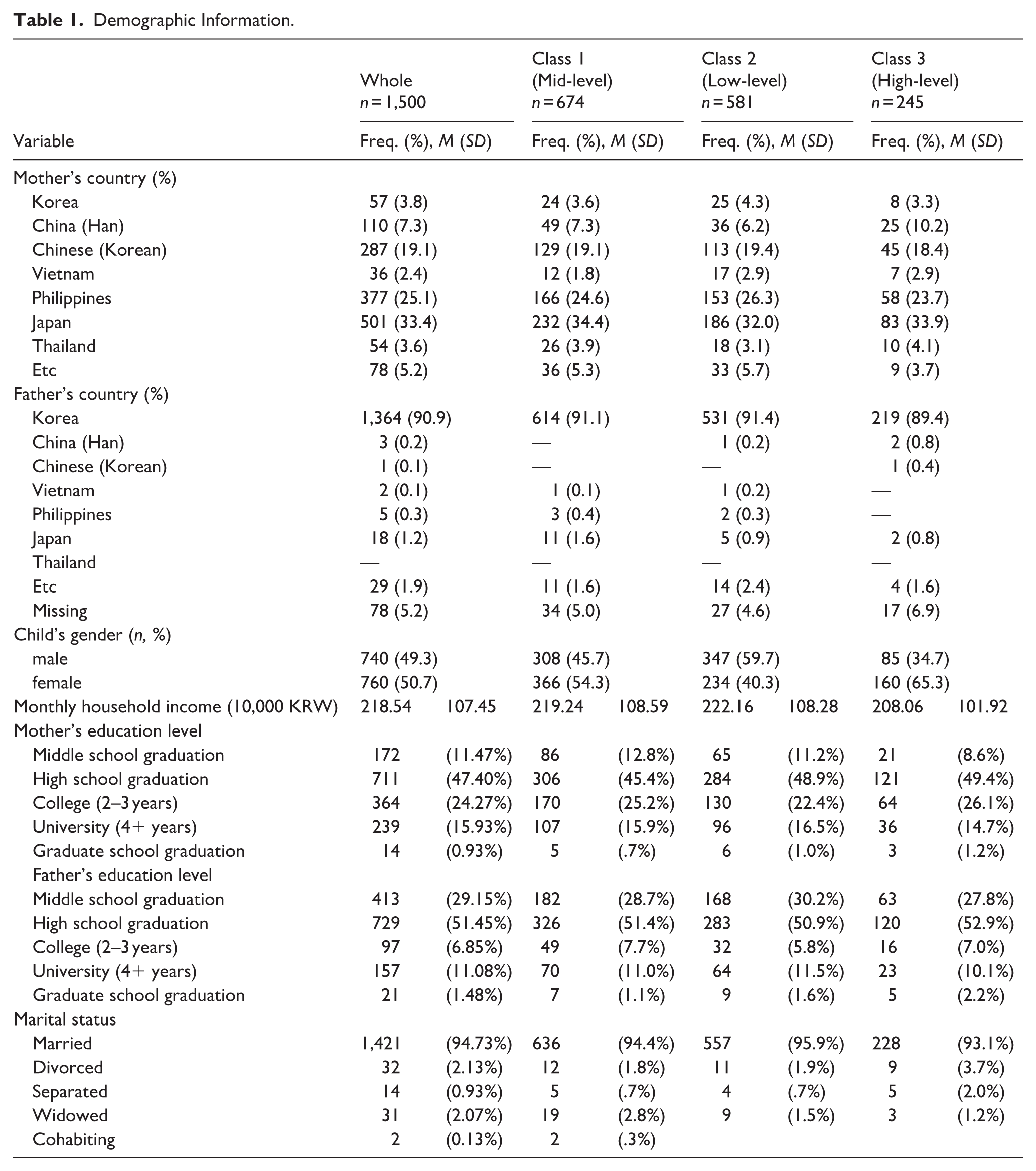
This study utilized longitudinal data spanning a period of 9 years, drawn from the Multicultural Adolescents Panel Study (MAPS), which was sourced from the National Youth Policy Institute (NYPI). The data cover the period from the second wave in 2012 to the 10th wave in 2020. The dataset includes a list of schools that admit multicultural adolescent students in 16 cities and provinces throughout the country. To choose the sample schools, a stratified random sampling method was utilized. Data for waves 1 (2011) to 8 (2018) were collected using the Computer Assisted Personal Interviewing (CAPI) method, while data for waves 9 (2019) to 10 (2020) were gathered through Tablet Assisted Personal Interviewing (TAPI). For parents, a questionnaire was translated into a total of 9 foreign languages in addition to Korean (both foreign language and Korean options were provided), allowing parents to select their preferred language for response. Informed consent was obtained from all participants. The first-year data from 2011 were excluded because depression (the dependent variable of this study) was not measured. MAPS surveyed the adolescents and parents of 1,625 multicultural households in 2011 for a total of 1,635 adolescents and 1,625 parents in this study. The study assigned unique household IDs and individual IDs to both parents and adolescents, allowing for proper identification of family relationships. Each adolescent participant was paired with one parent respondent (primarily mothers), with only 10 families (1.3% of sample) contributing two children. The 1,500 adolescents (50.7% female, mean age = 10.98 years at baseline) who responded to all the depression questionnaire items in the second-year survey were selected as the study subjects. The sample primarily consisted of adolescents born in South Korea from international marriage families, which represents the largest proportion of multicultural adolescents in Korea. Detailed demographic characteristics of the sample are presented in Table 1. The attrition rate (2012 ∼ 2020) from the original sample of the data was 8.3%, 11.8%, 15.7%, 17.7%, 18.8%, 23%, 26.9%, 30%, and 33.4%.
Demographic Information.
Measures
All predictor variables were measured at Wave 2 (2012) when participants were in 5th grade, serving as baseline predictors for the depression trajectories spanning from 5th grade through 1 year post-graduation.
Dependent Variable: Depression
Depression was measured using the adapted version of the Symptom Checklist-90-Revision, which was created by Derogatis et al. (1976) and standardized for Korean populations by K. I. Kim et al. (1984). The original SCL-90-R depression subscale contains 13 items; however, three items deemed unsuitable for children and adolescents were excluded, resulting in a 10-item version that has been consistently used in MAPS and other Korean youth panel studies (T. K. Lee et al., 2024; E. J. Lee & Jeong, 2021; Song et al., 2020). The questionnaire consists of 10 items such as “I have no energy,” which measures the respondent’s suicidal thoughts, motivation, and interest in life. Each item was rated on a 4-point Likert scale which ranged from “strongly disagree” (1 point) to “strongly agree” (4 points). The Cronbach’s alpha of this study ranged within 0.905–0.919. Depression was measured annually from Wave 2 (2012) through Wave 10 (2020), with adolescents responding to all items.
Individual Factors: Acculturation Strategies, Acculturative Stress, Self-Esteem
Each factor was completed by adolescents at Wave 2 (2012). Acculturation strategies refer to the adolescent’s attitude of acceptance regarding Korean culture and the culture of their foreign parent’s country of origin. In this study, they were measured with the scale used by Nho and Hong (2006). Specifically, the content of the questionnaire consists of 10 items such as “I tend to enjoy Korean culture (the culture of my foreign parent’s country of origin).” Each item was rated on a 4-point Likert scale with the following choices: “strongly disagree” (1 point), “disagree” (2 points), “agree” (3 points), and “strongly agree” (4 points). The Cronbach’s alpha of this study was .730. According to the suggestions of Berry (2003), this study classified acculturation strategies into the following: integration, assimilation, separation, and marginalization. This categorical approach follows Berry’s original conceptualization, which treats acculturation strategies as qualitatively distinct orientations rather than points along a continuum (Berry, 1997; Berry et al., 2006), and has been widely adopted in acculturation research with adolescent populations (Nho & Hong, 2006). The midpoint of the 4-point scale (between 2 “disagree” and 3 “agree”) served as the cutoff criterion: if the mean acculturation score was 1 point (strongly disagree) or 2 points (disagree), it was classified as a low score (interpreted to indicate disagreement), and if the score was 3 points (agree) or 4 points (strongly agree), it was classified as a high score (interpreted to indicate agreement). As a result, marginalization was characterized as having low scores in both Korean culture and foreign culture. Separation was delineated as having low scores in Korean culture and high scores in foreign culture. In addition, assimilation was described as having high scores in Korean culture and low scores in foreign culture. Lastly, when the scores were high for both types of culture, it was categorized as integration. At that point, acculturation strategies were coded as categorical variables as follows: integration = 3, assimilation = 2, separation = 1, and marginalization = 0.
Acculturative stress was measured using the modified version of the Social, Attitudinal, Familial, and Environmental Acculturative Stress Scale by Nho (2000), which was created by Hovey and King (1996). The scale includes 10 items such as “Living in Korea is stressful,” which measure social, familial, and environmental acculturative stress. This study excluded item 10 (“I can live better in Korea than in my foreign parent’s home country”) due to low reliability and used the remaining 9 items. Each item was rated on a 4-point Likert scale, which ranged from “strongly disagree” (1 point) to “strongly agree” (4 points). Therefore, higher scores indicate higher levels of acculturative stress. The Cronbach’s alpha of this study was .851.
Self-esteem was measured with the items used by N. Park and Oh (1992), which were developed by Coopersmith (1967). The scale includes four items such as “I am proud of myself.” Each item was rated on a 4-point Likert scale, which ranged from “strongly disagree” (1 point) to “strongly agree” (4 points). Therefore, higher scores indicate higher levels of self-esteem. The Cronbach’s alpha of this study was .793.
Parental Factors: Parental Acculturative Stress, Parental Self-Esteem
Each factor was completed by parent at Wave 2 (2012). Parental acculturative stress was measured using the modified version of the Acculturative Stress Scale for International Students by Lee (1997), which was developed by Sandhu and Asrabadi (1994). The questionnaire included eight items such as “I am treated differently from Koreans in the workplace.” A 5-point Likert scale was used for each item, with options ranging from “strongly disagree” (1 point) to “strongly agree” (5 points). Consequently, higher levels of parental acculturative stress were indicated by higher scores. The Cronbach’s alpha of this study was .842.
Parental self-esteem was measured using the scale proposed by Rosenberg (1965). The scale includes nine items such as “I feel that I am just as worthy as other people.” Each item was assessed using a 5-point Likert scale, which extended from “strongly disagree” (1 point) to “strongly agree” (5 points). Therefore, higher scores indicate higher levels of parental self-esteem. The Cronbach’s alpha of this study was .795.
School factors: friend support, teacher support: Each factor was completed by adolescents at Wave 2 (2012). The assessment of social support utilized established measures from Han’s (1996) scale, incorporating two distinct subscales. Friend support was evaluated through seven items (e.g., “I think my friends are very interested in me”), while teacher support was measured using six items (e.g., “I think my homeroom teacher is very interested in me”). Participants responded on a 5-point scale ranging from 1 (strongly disagree) to 5 (strongly agree), with higher scores reflecting greater perceived support from these respective sources. The Cronbach’s alpha of this study was .963 for friend support and .952 for teacher support.
Control factors: gender, income: Each factor was completed by adolescents at Wave 2 (2012). Males were represented as 0, while females were represented as 1. Regarding income, this study used logged average monthly household income data when performing the logistic regression analysis.
Data Analysis
This study used latent class growth analysis (LCGA) to determine trajectory types of depression change among multicultural adolescents from 5th grade through 1 year post-graduation. LCGA was selected over Growth Mixture Modeling for several reasons: it provides more parsimonious models with clearer interpretability (T. Jung & Wickrama, 2008), our goal was identifying qualitatively distinct trajectory groups rather than capturing within-group heterogeneity, and LCGA constrains within-class variance to zero, which, while restrictive, is consistent with this person-centered research objective (Nagin & Odgers, 2010). We also explored GMM as an alternative specification by allowing within-class variance to be freely estimated; however, these models produced convergence problems and improper solutions (e.g., negative variance estimates), a common issue in mixture modeling with similar sample sizes (Berlin et al., 2014). Furthermore, LCGA was adopted by prior MAPS-based depression trajectory studies (T. K. Lee et al., 2024; Song et al., 2020), facilitating direct comparison of our findings with existing research. Latent class groups were determined using information indices, classification quality, model comparison tests, and interpretability.
Information indices include the Akaike information criterion (AIC) and Bayesian information criterion (BIC), with lower values indicating better models (Muthén & Shedden, 1999). The entropy index ranges from 0 to 1, with values closer to 1 indicating better classification (Clark, 2010). Model comparison used the Lo-Mendell-Rubin adjusted likelihood ratio test (LMR-LRT) and parametric bootstrapped likelihood ratio test (BLRT). Non-significant p-values indicate the k-class model does not improve upon the k-1 class model. Research perspectives vary on minimum acceptable class size–some advocate 5% of total sample (T. Jung & Wickrama, 2008), while others consider 1% valid (Nooner et al., 2010).
Missing data were handled using full information maximum likelihood (FIML) estimation. We conducted logistic regression predicting missingness from baseline characteristics. FIML utilizes all available data without imputation, providing unbiased estimates under missing at random assumption (Schafer & Olsen, 1998), retaining all 1,500 participants despite varying response rates.
To examine predictor effects on latent class membership, we employed the R3STEP approach (Asparouhov & Muthén, 2014), which maintains latent class stability while accurately estimating relationships by determining classes without predictors, calculating classification errors, and estimating predictor effects while accounting for uncertainties.
Results
Classification of Latent Groups According to Changes in Depression
Initial variable relationships were examined through correlation analysis (Table 2).
Correlation Coefficient Analysis Among Variables at First Wave (n = 1,500).
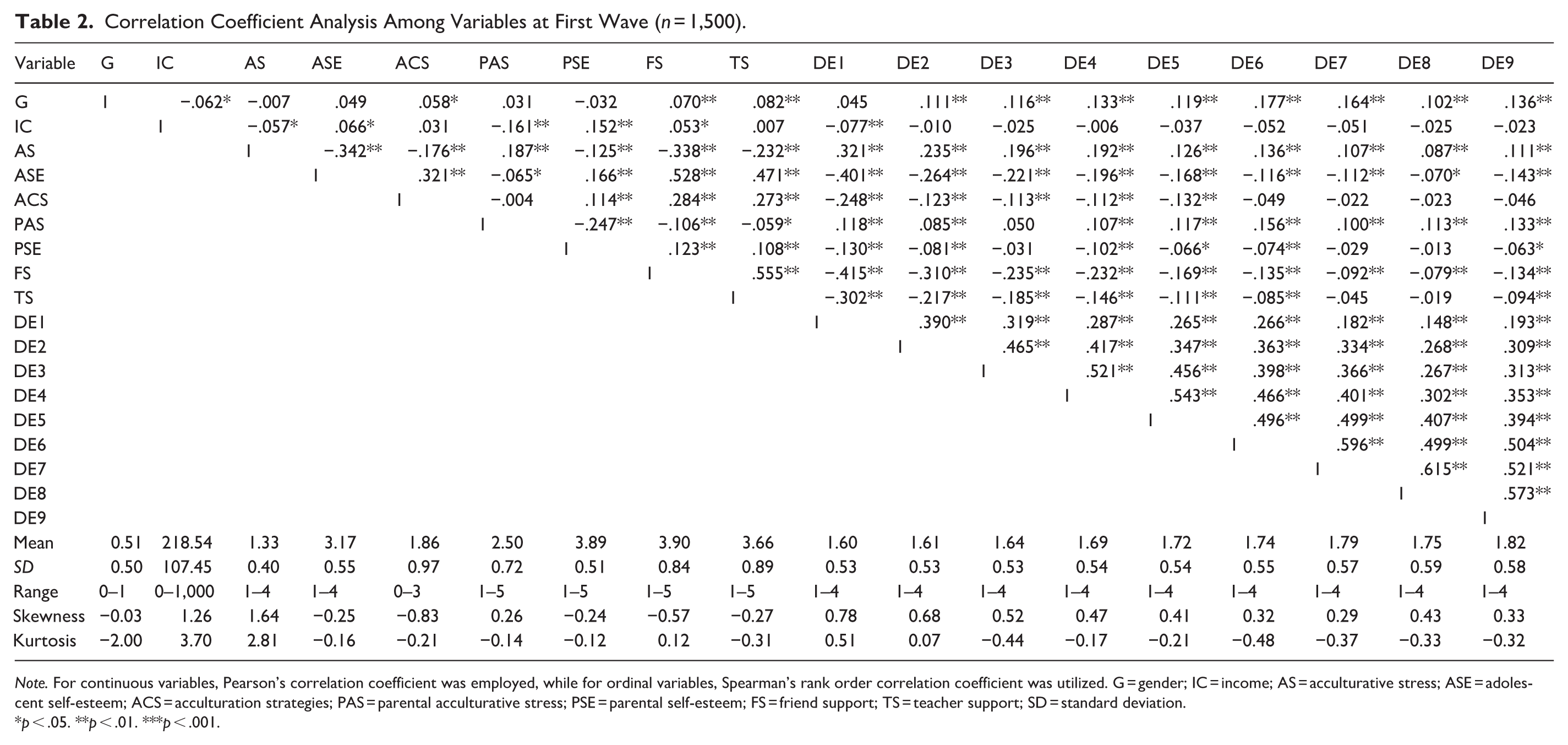
Note. For continuous variables, Pearson’s correlation coefficient was employed, while for ordinal variables, Spearman’s rank order correlation coefficient was utilized. G = gender; IC = income; AS = acculturative stress; ASE = adolescent self-esteem; ACS = acculturation strategies; PAS = parental acculturative stress; PSE = parental self-esteem; FS = friend support; TS = teacher support; SD = standard deviation.
p < .05. **p < .01. ***p < .001.
A chi-square difference test comparing linear and quadratic growth models rejected the null hypothesis (Δχ2 = 130.369, df = 4, p < .001), confirming the quadratic model’s superior fit. LCGA was then conducted using the quadratic model.
While increasing latent classes improved AIC and BIC values, the four-class solution showed a non-significant LMR-LRT (p = .5199). All groups in both three- and four-class solutions exceeded the 5% minimum threshold (T. Jung & Wickrama, 2008). The three-class model (AIC = 15,667.610, BIC = 15,773.874, Entropy = 0.740, LMRT p < .001, BLRT p < .001) was selected as optimal. Entropy exceeded the 0.70 threshold, and average posterior probabilities (0.89, 0.86, 0.92) all surpassed 0.80, indicating acceptable classification quality.
Trajectory parameters for each class are illustrated in Figure 1.
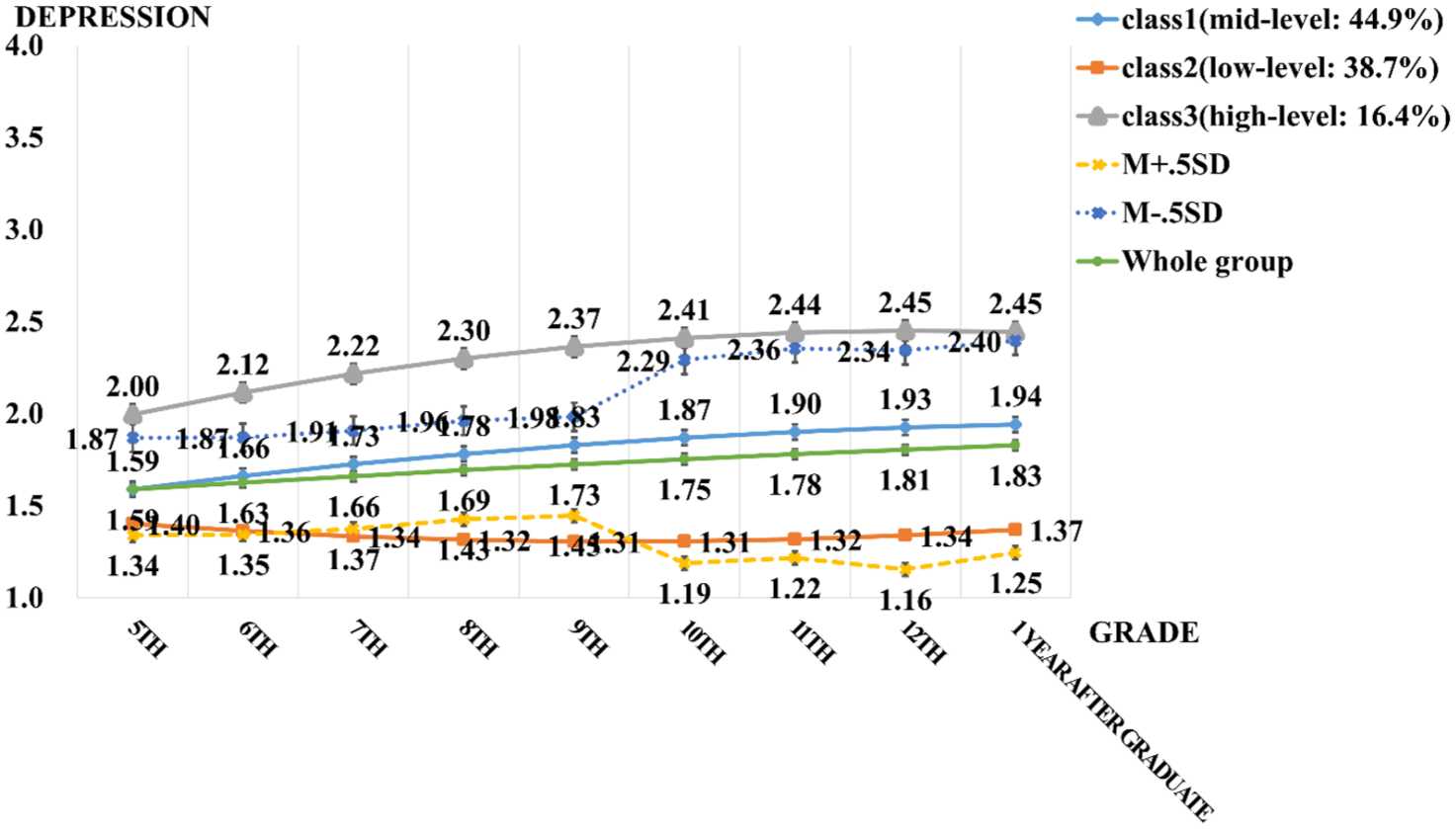
Whole group and class specific trajectories of depression.
Class 1 (mid-level group; n = 674, 44.9%) had an intercept of 1.590, linear slope of .076, and quadratic slope of −.004 (all significant). Depression was second-highest in 5th grade and increased over time, though remaining within ±0.5 SD of the overall mean. Class 2 (low-level group; n = 581, 38.7%) had an intercept of 1.403, linear slope of −.044, and quadratic slope of .005 (all significant). Depression was lowest in 5th grade, decreased until 10th grade, then increased from 11th grade. Class 3 (high-level group; n = 245, 16.4%) had an intercept of 1.997, linear slope of .128, and quadratic slope of −.009 (all significant). Depression was highest in 5th grade and continued increasing until the 1st year after graduation, remaining above +0.5 SD of the overall mean.
Descriptive Statistical Results of Key Variables
Table 3 presents descriptive statistics of key variables by latent class, using first-year (2012) data corresponding to 5th grade.
Descriptive Statistics of Depression by Latent Classes (N = 1,500).
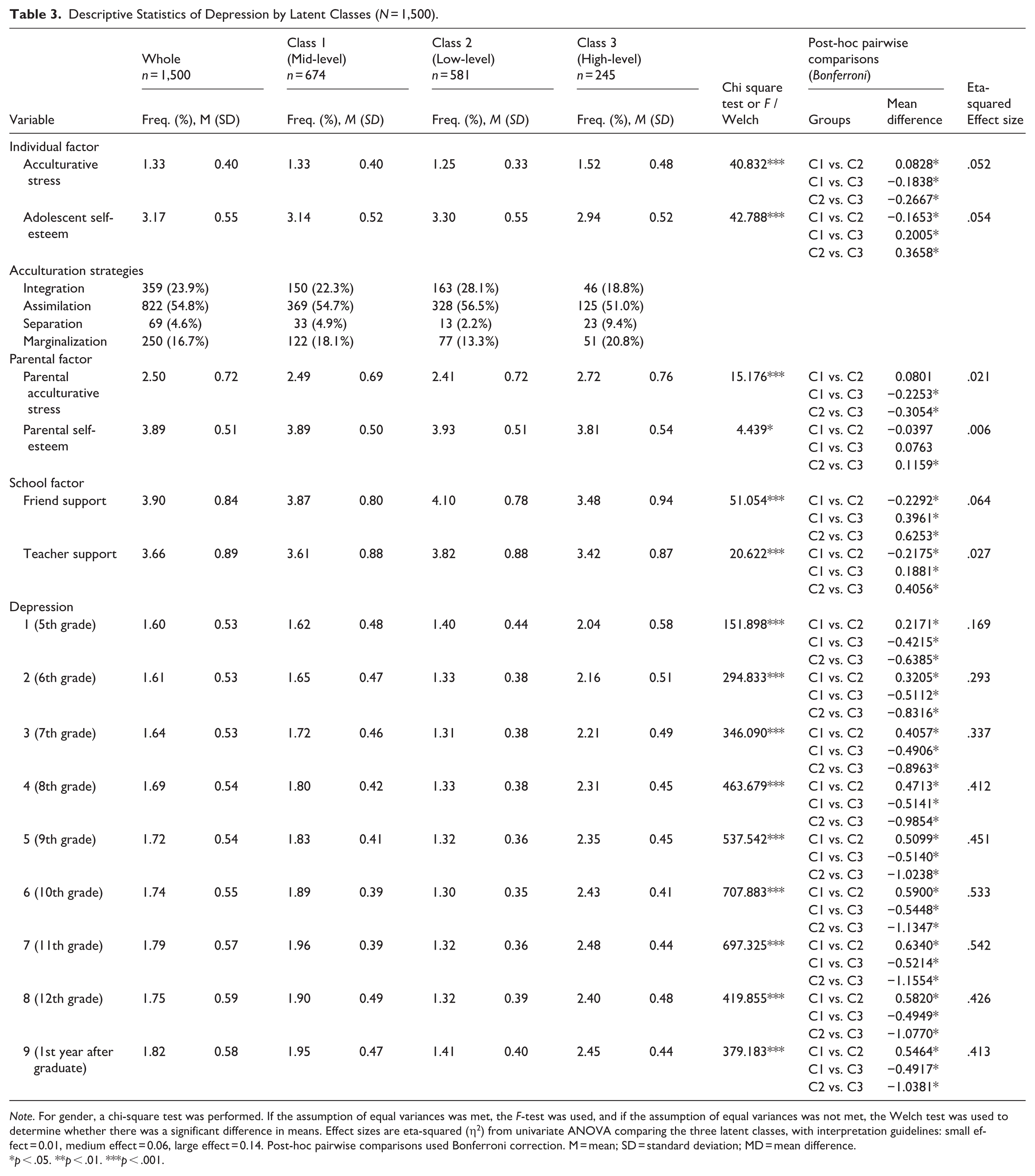
Note. For gender, a chi-square test was performed. If the assumption of equal variances was met, the F-test was used, and if the assumption of equal variances was not met, the Welch test was used to determine whether there was a significant difference in means. Effect sizes are eta-squared (η2) from univariate ANOVA comparing the three latent classes, with interpretation guidelines: small effect = 0.01, medium effect = 0.06, large effect = 0.14. Post-hoc pairwise comparisons used Bonferroni correction. M = mean; SD = standard deviation; MD = mean difference.
p < .05. **p < .01. ***p < .001.
Factors Affecting Latent Classes of Depression
Attrition analysis using logistic regression revealed no significant predictors of missingness (all p > .05), supporting the missing at random assumption. Nevertheless, the cumulative attrition reached 33.4% by Wave 10 (2020), which means that trajectory estimates for later time points, particularly during the post-high school period, are based on fewer observations and should be interpreted with appropriate caution. While FIML utilizes all available data and provides unbiased estimates under the MAR assumption, the possibility of missing not at random (MNAR) mechanisms cannot be entirely ruled out. Using the mid-level group (Class 1) as reference (Table 4): male gender and higher self-esteem predicted low-level group (Class 2) membership. Being male, lower personal and parental acculturative stress, and stronger friend support predicted mid-level over high-level group (Class 3) membership. For the low-level versus high-level comparison, low-level group membership was associated with being male, lower acculturative stress (personal and parental), higher self-esteem, marginalization over separation as acculturation strategy, and stronger friend support.
Multinomial Logistic Regression Predicting Group.
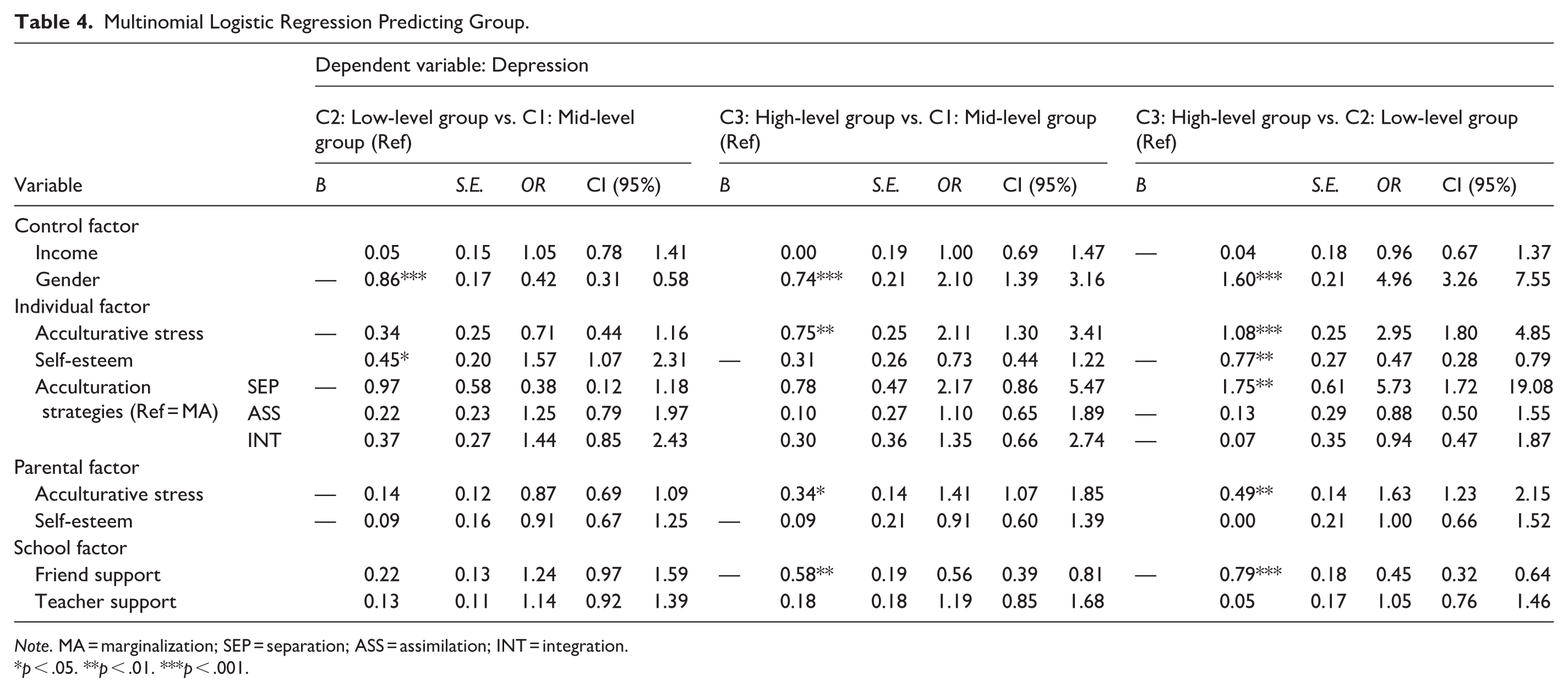
Note. MA = marginalization; SEP = separation; ASS = assimilation; INT = integration.
p < .05. **p < .01. ***p < .001.
Discussion
Distinct Patterns of Depression Trajectories
This study identified three distinct trajectory patterns of depression among multicultural adolescents over a 9-year period: low-level (38.7%), mid-level (44.9%), and high-level (16.4%) groups. This finding advances our understanding beyond previous cross-sectional studies (Oh, 2016; Sohn, 2019) by demonstrating the heterogeneous nature of depression development during adolescence. Notably, our three-class solution is consistent with prior MAPS-based trajectory studies. Song et al. (2020) identified three classes (high-increasing, moderate-increasing, and low-stable) using six waves of MAPS data, and S. Lee et al. (2024) similarly found three classes (high-increasing, moderate-increasing, and low-decreasing) over six waves covering middle and high school years. The convergence of three-class solutions across studies using different observation windows strengthens confidence in the robustness of these trajectory patterns. However, our extended 9-year observation period reveals trajectory features not captured in shorter windows, particularly the U-shaped pattern in the low-level group during the transition from high school to post-graduation.
The low-level group demonstrated resilience by maintaining consistently low depression levels, though showing a U-shaped pattern with an increase during final high school years. This timing coincides with intensive academic pressures in the Korean educational system, suggesting an interaction between cultural and academic stressors.
The mid-level group showed a gradual increase in depression while maintaining scores within ±0.5 standard deviation of the mean, aligning with previous findings about general trends in adolescent depression (Kovacs et al., 1989) while providing new insights into multicultural adolescents’ experiences.
The high-level group (16.4%) showed consistently elevated depression levels more than half a standard deviation above the mean. This finding extends previous research by demonstrating that a significant minority may experience persistent, rather than temporary, elevated depression levels, particularly concerning given the relationship between chronic depression and negative outcomes (Oh, 2016).
The identification of these distinct patterns has important implications for intervention timing and targeting, suggesting that support needs may vary not only across individuals but also across different developmental stages. From a clinical perspective, the high-level group (16.4%) is of particular concern, as their depression levels remained consistently above +0.5 SD of the overall mean throughout the entire observation period. This persistent elevation suggests chronic depressive symptomatology that may warrant clinical screening and sustained intervention rather than brief preventive programs. The mid-level group (44.9%), while not exhibiting clinically elevated levels, showed a gradual upward trend that, if left unaddressed, could place these adolescents at increasing risk over time. The low-level group’s U-shaped pattern, with increasing depression during the final high school years, highlights the need for renewed attention during the high school-to-adulthood transition, a period often overlooked in school-based prevention programs.
Acculturation Strategies and Depression
Our findings regarding acculturation strategies present a complex picture that both supports and challenges existing theoretical frameworks. When using integration as the reference group, our results showed that adolescents employing assimilation strategies were more likely to belong to groups with higher depression levels. This finding aligns with traditional acculturation theory (Berry et al., 2006) and supports previous research suggesting that integration strategies, which involve maintaining both heritage and host cultures, may serve as a protective factor against psychological distress. This advantage of integration over assimilation has been documented in various contexts (Nguyen & Benet-Martinez, 2013) and may reflect the psychological benefits of maintaining connections to both cultural worlds.
However, our analysis using marginalization as the reference group revealed complexities undocumented complexities in the relationship between acculturation strategies and depression. Contrary to traditional theoretical expectations and previous empirical findings (Berry & Kim, 1988), marginalization was not consistently associated with worse outcomes compared to separation strategies. This finding should be interpreted cautiously, as it may partly reflect the dichotomized classification of acculturation strategies, which could obscure meaningful within-group variation. Additionally, the relatively small number of adolescents classified as employing marginalization or separation strategies limits the statistical power of these comparisons. This unexpected finding may reflect the unique sociocultural context of South Korea, where strong pressures for cultural conformity and academic achievement create particular challenges for different acculturation approaches. Separation strategies, which involve maintaining only heritage culture while rejecting Korean culture, may create greater conflict with the demands of Korea’s highly competitive educational system and social expectations for integration. In contrast, marginalization during adolescence might serve as a temporary protective strategy, allowing youth to avoid the stress of actively navigating cultural conflicts while they focus on other developmental tasks (Rudmin, 2003). This finding provides empirical support for recent scholarly critiques (Escobar & Vega, 2000; Rudmin, 2003) questioning the universal superiority of particular acculturation strategies and suggests that the psychological implications of different strategies may be more context-dependent than previously recognized.
The simultaneous presence of these seemingly contradictory findings–the advantage of integration over assimilation alongside the potential benefits of marginalization over separation in some contexts—contributes to the literature. This supports more recent theoretical perspectives (Safdar & van de Vijver, 2019) arguing for a more flexible and context-sensitive understanding of cultural adaptation processes. Nevertheless, given the methodological caveats noted above, these findings regarding marginalization and separation should be considered preliminary and require replication using dimensional or latent profile approaches to acculturation measurement.
Contextual Factors Influencing Depression Trajectories
Consistent with Bronfenbrenner’s (1979) ecological systems framework, our findings demonstrate that depression trajectories are shaped by factors operating across multiple ecological levels. Several contextual factors emerged as significant predictors of trajectory membership. While male gender showed consistent protective effects, more central to our research focus were the findings regarding acculturation strategies and social support. Additionally, friend support emerged as a significant predictor while teacher support showed less consistent effects across trajectory comparisons. This gender difference aligns with previous research on adolescent depression but presents an interesting contrast to studies suggesting female students might be more adept at cultural adaptation (S. D. Jung, 2014; E. J. Lee & Kang, 2011).
Both adolescent and parental acculturative stress emerged as significant predictors, with lower stress levels associated with more favorable depression trajectories. The significance of parental acculturative stress particularly underscores the interconnected nature of cultural adaptation within families, supporting and extending previous findings about the impact of parental adjustment on children’s mental health (Y. Lee, 2008; H. Park, 2014).
Higher self-esteem was consistently associated with membership in lower depression groups, supporting previous research about its crucial role in psychological adjustment among multicultural adolescents (Han & Kahng, 2019). Similarly, the protective role of friend support extends previous findings by demonstrating its long-term influence on depression development. This is particularly significant given the challenges multicultural adolescents may face in forming social connections within Korea’s traditionally homogeneous society.
Practical and Policy Implications
Our findings carry several implications for practice and policy in the South Korean multicultural education and welfare context. First, the identification of distinct trajectory groups underscores the need for differentiated screening protocols in schools. School counselors should implement regular depression screening for multicultural adolescents, with particular attention to those exhibiting early signs of elevated depression, as membership in the high-level trajectory was identifiable from the initial assessment point. Second, the finding that both adolescent and parental acculturative stress predicted less favorable trajectories suggests that interventions should adopt a family-based approach. Multicultural family support centers, which currently serve over 200,000 families nationally, could integrate mental health screening and parent-child co-intervention programs alongside their existing language and cultural adaptation services. Third, the protective role of friend support highlights the importance of school-based peer relationship programs. Schools with high proportions of multicultural students could implement structured peer mentoring and intercultural exchange activities to facilitate social integration. Fourth, at the policy level, the current Multicultural Families Support Act primarily focuses on language education and cultural adaptation for immigrant parents. Our findings suggest that this policy framework should be expanded to explicitly address the mental health needs of multicultural adolescents, including funding for school-based counseling services and training for teachers on recognizing and responding to depressive symptoms in culturally diverse students.
Conclusions and Limitations
This study makes several significant contributions. First, by identifying three distinct depression trajectories over 9 years, we provide evidence that depression follows heterogeneous rather than uniform patterns, challenging the tendency to treat depression among multicultural adolescents homogeneously and suggesting need for targeted interventions. Second, our findings regarding acculturation strategies provide important theoretical insights. While we found evidence supporting integration strategies’ advantages, marginalization may not always be as maladaptive as traditionally assumed, contributing to debates about context-dependent cultural adaptation. Third, our identification of key factors–gender, acculturative stress, self-esteem, and social support–provides practical guidance. The significance of both personal and parental acculturative stress highlights the need for family-based interventions, while friend support’s protective role suggests the importance of fostering positive peer relationships.
However, several limitations should be noted. First, all predictor variables—including acculturation strategies, self-esteem, acculturative stress, and social support—were measured at a single time point (5th grade). While this allowed investigating how early adolescent characteristics influence long-term depression trajectories, these factors are likely to change throughout adolescence. Our findings reflect the predictive role of early developmental characteristics rather than time-varying associations, and future research should employ multi-wave measurement of predictors to capture dynamic relationships. Relatedly, although FIML estimation retained all 1,500 participants and our attrition analysis supported the MAR assumption, the cumulative attrition of 33.4% over the 9-year period means that later waves contributed fewer observations, potentially reducing the precision of trajectory estimates in the final years of the observation period. Second, while quadratic growth models captured overall patterns, Figure 1 suggests potential trajectory changes around 9th grade that might be better modeled using piecewise approaches. Future research should explore models identifying specific turning points during distinct developmental phases. Third, there are measurement limitations that should be acknowledged. Using observed scale scores rather than latent variable models may result in attenuated correlations, suggesting our effect sizes may be conservative estimates. Additionally, the acculturation strategy classification was based on dichotomizing continuous cultural orientation scores into high and low categories following Berry (2003), which may oversimplify the nuanced nature of adolescents’ cultural orientations. Future research should consider dimensional or latent profile approaches that preserve the continuous nature of cultural orientation scores. Fourth, the generalizability of our findings is subject to certain constraints. The study focused on adolescents from international marriage families where fathers were Korean and mothers were foreign-born, which represents the majority of multicultural families in Korea but limits applicability to other types of multicultural households. Moreover, our data collection period (2012–2020) coincides with the onset of the COVID-19 pandemic. The final wave of data (Wave 10) was collected in 2020, during which multicultural families in South Korea faced heightened xenophobia, racialized blame, and social exclusion. These pandemic-related contextual shifts may have meaningfully affected both depression outcomes and acculturation experiences, potentially limiting the generalizability of our findings to the post-pandemic period. Future studies should extend the observation window to include the pandemic and post-pandemic years to examine whether and how these societal changes altered depression trajectories in this population.
In conclusion, this study advances the literature by providing theoretically grounded, longitudinal evidence of heterogeneous depression trajectories among multicultural adolescents in South Korea. The integration of Berry’s acculturation framework with Bronfenbrenner’s ecological systems theory offers a comprehensive lens for understanding how cultural adaptation processes and multi-level contextual factors jointly shape depression development. Future research should employ multi-wave measurement of acculturation strategies and contextual factors, explore piecewise growth models to capture potential turning points during distinct developmental phases, and extend the observation window to include the post-pandemic period.
Footnotes
Acknowledgements
We would like to express our sincere gratitude to the anonymous reviewers for their thoughtful comments and valuable suggestions that helped improve the quality of this manuscript.

Ethical Considerations
Ethics approval was not required for this study as it involved secondary analysis of de-identified data from the Multicultural Adolescents Panel Study (MAPS), which is publicly available through the National Youth Policy Institute (NYPI).
Consent to Participate
Informed consent was obtained by NYPI from all participants and their legal guardians at the time of original data collection (IRB approval from the National Youth Policy Institute, No: NYPI-201904-HR-002-01).
Consent for Publication
All data used in this study are de-identified and publicly available through the National Youth Policy Institute. No individual participant data, identifiable information, or images are presented in this manuscript. Therefore, additional consent for publication was not required.
Author Contributions
Changmin Yoo designed the study, performed conceptualization, formal analysis and wrote the manuscript (original draft, review & editing).
Funding
The author disclosed receipt of the following financial support for the research, authorship, and/or publication of this article: This work was supported by INHA UNIVERSITY Research Grant.
Declaration of Conflicting Interests
The author declared no potential conflicts of interest with respect to the research, authorship, and/or publication of this article.