







Abstract
Innovations in participatory governance have been widely discussed but their introduction as such is rarely examined. This article seeks to understand why, in a context of established democracy, local authorities engage in participatory governance. Using a data set on the implementation of mini-publics in 1505 Swiss municipalities in the period 2000 to 2012, we test five hypotheses about the introduction of participatory governance. We find that mini-publics in Swiss municipalities are policy-oriented procedures that involve only a small proportion of the citizenry. Municipalities who implement mini-publics are those that do not have a municipal assembly tradition, whose public services are under growth pressure, who feature many different political groups as well as strong party and community ties, and who have a strongly professionalized public administration. We conclude that the expansion of participatory governance is driven by an agenda to increase governability in an adversarial context with strong and fragmented group interests.
Points for practitioners
This study explores the introduction of mini-publics in Swiss municipalities. Mini-publics are participatory designs in which small groups of citizens deliberate on a topic related to municipal policymaking. Most mini-public exercises found in this study were related to spatial planning, but sustainability and youth were recurrent fields as well. Mini-publics have become part of public administration practice and are set up in the hope that they will help find solutions to conflicts and foster the acceptance of policy decisions.
Introduction
New instances of citizen participation beyond electoral democracy have proliferated in the last three decades. Within the broad range of such ‘democratic innovations’ (Smith, 2009), instances of participatory governance have been a particular focus of scholarly attention. Participatory governance can be defined as processes and structures of public decision-making that involve actors who are not normally charged with decision-making (Newig et al., 2017: 273), and that complement – but do not replace – traditional institutions of democracy (Goodhart et al., 2012: 33). Participatory governance has gained increased attention as scholars and practitioners seek new avenues for engaging citizens in public policymaking, not only in established democracies, but also in fledgling democracies, and even in non-democracies. A prominent example is participatory budgeting, which, after its inception in the Brazilian city of Porto Alegre, has diffused widely across the globe (Porto de Oliveira, 2017; Sintomer et al., 2016; Wampler et al., 2018).
The scientific debate on participatory governance has focused on its functioning and effects (see Ansell and Gash, 2007; Emerson and Nabatchi, 2015), the criteria by which the democratic quality of various instances of participatory governance can be assessed (see Geissel and Newton, 2012), its potential to contribute to the development of democracy more generally (see Michels, 2011; Warren, 2009), and, more recently, its contribution to the quality of policy outcomes such as social equity and health (see Gonçalves, 2014; Touchton et al., 2017). However, what has been neglected until now is the introduction of participatory governance as such. Many studies simply assume that participatory governance is introduced in response to the inadequacies, limits or deficits of the existing institutions of democracy, especially in clientelistic or developing contexts (see Goodhart et al., 2012). However, participatory governance should also be seen as a strategic intervention used to achieve certain goals, and therefore as a ‘choice rather than as a necessity’ (Newig et al., 2017: 271). As Warren (2009: 3) has argued, the proliferation of participatory governance should be questioned rather than be taken for granted: ‘Who would have thought that policy and policy-making – the domain of technocrats and administrators – would move into the vanguard of democratization?’ Against this backdrop, this article seeks to understand the motivations underlying the introduction of participatory governance in an established democracy, based on a study at the local government level in Switzerland.
Why introduce participatory governance?
Regarding the rationale of participatory governance, the literature on the topic emphasizes two main points. First, mechanisms of participatory governance are considered democratic innovations (Geissel and Newton, 2012; Smith, 2009), meaning that they represent procedures or instruments that open up opportunities for citizen participation that did not previously exist in a particular context. Second, participatory governance is discussed in light of deliberative democratic theory focusing on a ‘talk-centric’ approach (Chambers, 2003), where the legitimacy of democratic decisions is rooted in discursive exchanges of arguments. Accordingly, the normative justification for mechanisms of participatory governance lies in their contribution to the strengthening of the deliberative dimension of political processes (Goodin, 2008), in that they enable a greater number of citizens to take part in the discussion of political decisions.
Reasons for the introduction of participatory governance: five hypotheses
While the causes for introducing participatory governance have not been a prominent scholarly focus, five general hypotheses about the reasons leading to participatory governance can nevertheless be derived from the literature.
A response to deficits of representative democracy
The most common line of argument is to view participatory governance as a remedy for the crisis of representative (local) democracy (Klijn and Koppenjan, 2002: 142). More particularly, it is argued that decreasing participation in traditional democratic institutions has led to legitimacy deficits that, in turn, increase the pressure for democratic renewal and ultimately foster the introduction of participatory governance (Fung, 2015). Goodhart et al. (2012: 50) additionally view participatory governance as a response to democratic deficits in contexts of strong social inequality, such as is found in developing countries and/or young democracies. Due to the low participation of marginalized groups in traditional institutions of electoral democracy, governments tend to be unresponsive to the demands of such groups. Participatory governance thus has the potential to restore social justice because it creates new opportunities for marginalized groups to voice their claims (Touchton and Wampler, 2014). The hypothesis that flows from this first line of argument is that mechanisms of participatory governance are more likely to be found in contexts characterized by low citizen participation in traditional democratic institutions and high social inequality.
A strategy to improve governance effectiveness
However, this first line of argument mainly operates at the system level, thereby neglecting the intentions of individual actors. This is unsatisfactory because, as a rule, mechanisms of participatory governance in concreto can only be introduced with the approval of existing authorities. To plausibly explain the introduction of participatory governance, we therefore have to look for reasons why authorities seek to relinquish some of their power to citizens. One such important reason, as Fung (2015) argues, is that authorities seek to achieve effective governance, and expect participatory mechanisms to contribute to governance effectiveness. Klijn and Koppenjan (2002) offer two expectations that governments formulate in this respect: the improvement of policy quality; and the increase of policy acceptability by the public.
Due to a lack of knowledge and understanding of local situations, administrative decisions often appear ‘aloof’ or ‘bureaucratic’ to stakeholders. By including local stakeholders in the decision-making process, participatory governance can counteract these problems: ‘[b]y reorganizing themselves to incorporate greater citizen participation, public agencies can increase their effectiveness by drawing on more information and the distinctive capabilities and resources of citizens’ (Fung, 2015: 517). Participatory governance is thereby seen to contribute to social learning and as facilitating public agencies’ adaptation to developments in their environment (Emerson and Nabatchi, 2015). A second hypothesis can thus be formulated: the greater the pressure to act on policy problems, or the more difficult these problems appear to a municipal government, the more likely it is that mechanisms of participatory governance will be introduced.
However, effective governance also depends on the acceptability of policies: compliance by the target groups is a major condition for effective policy implementation. Participatory governance thus appears as ‘an attempt to maximize support for policies and to minimize resistance by involving potential veto groups in the process of policy formation’ (Klijn and Koppenjan, 2002: 141). Creating public support for policies is particularly important given that modern societies are complex and characterized by a multitude of groups that pursue their own interests and often possess the legal and political means to bring those interests to bear. The consequences of such a fragmentation of power – also discussed as ‘hyper-pluralism’ (see Judge, 1995: 23) – are decision-making blockades and political standstills. Against this background, participatory governance helps governments to discern the array of interests held by different groups early on, to anticipate later resistance to policy decisions and reformulate these so as to reduce the resistance to a level that does not endanger overall policies. In as much as they enable decision-makers to discuss different policy options with the public, mechanisms of participatory governance provide a platform for governments to gauge ‘latent public opinion’ (Zaller, 2003) on potentially contentious governing issues. Participatory governance therefore appears as an instrument to improve governability by providing information to governments about the public acceptability of different policy options and strategies. Seen as an alternative to the adversarialism of interest group pluralism, participatory governance can also contribute to conflict resolution, and foster the acceptance of public decisions (Ansell and Gash, 2007; Newig et al., 2017). Drawing on this line of reasoning, a third hypothesis is that in municipalities with a large number of different political groups, the introduction of mechanisms of participatory governance is more likely.
The electoral benefits of participatory governance
Very few scholars, to date, have discussed mechanisms of participatory governance in terms of the electoral benefits that it could bring to politicians who introduce and practise them. In his studies on participatory budgeting in Brazil, Wampler (2015) argues that the introduction of and support for participatory budgeting in Brazilian cities is part of a strategy devised by mayors to increase their chances of re-election. In fact, participatory budgeting enables these mayors to reward party loyalists and to brand the party in government as democratic and participatory, as well as to reach out to interested constituents. Mutatis mutandis, we can build a more general argument about the electoral calculus behind the introduction of participatory governance. First, it is traditionally the Left and Green parties who campaign for the expansion of citizen participation (Goodfrank, 2011). For politicians in municipalities with a strong Left/Green voter base, the support for participatory processes provides an opportunity to score with their electorate. Second, mechanisms of participatory governance entail frequent direct interaction between citizens and government officials. For elected politicians, these mechanisms thus offer a stage to present themselves to the public, as well as opportunities to engage in personal contacts with citizens and reach out to the electorate. For politicians standing for election, good direct connections with their citizens are particularly important against the background of weakening party ties in most established democracies (Wampler, 2008). A fourth hypothesis can therefore be formulated: mechanisms of participatory governance are more likely to be introduced in municipalities with a strong Left/Green vote, but also in those with weak party ties.
Participatory governance as a public administration fad
Finally, several studies on participatory governance convey the notion that participatory procedures are part of professional administrative practice. Starting with Sherry Arnstein’s (1969) classic article on the possibilities and limits of participatory instruments in planning procedures, administrative theory nowadays emphasizes the importance of stakeholder inclusion and dialogue (Heinelt, 2010). The introduction of participatory governance is thus related to initiatives taken by public administrators, who promote them as part of state-of-the-art administrative practice, and seek to strengthen networked forms of governance that highlight the participation of citizens and service users in the management or monitoring of public services (Torfing et al., 2012). On this basis, a fifth hypothesis is that mechanisms of participatory governance spread in the wake of public administration professionalism and reforms.
The Swiss context and its relevance
In this article, we study the introduction of participatory governance in the municipalities of Switzerland’s German-speaking region. 1 The Swiss context is relevant to the study of participatory governance in two respects.
First, as in other established democracies, participation in traditional institutions of electoral democracy has declined in Switzerland since the mid-1970s (López Pintor and Gratschew, 2002). The decline of electoral turnout in Switzerland has been observed not only in national elections (Lutz and Selb, 2007), but also in those of the 26 cantons (Freitag, 2010), as well as in the roughly 2300 municipalities (Kübler, 2015). The situation in Switzerland is thus representative of the democratic shortcomings found in many other established democracies, for which participatory governance has been discussed as a remedy (Sørensen, 1997).
On the other hand, Switzerland has a long and very lively tradition of direct democracy. At all three levels of government (national, cantonal and municipal), direct democratic institutions encompass the possibility to submit parliamentary Acts to a binding popular vote (a referendum), and the possibility for citizens to formulate proposals that, if accepted in a popular vote, become law (the so-called ‘popular initiatives’). At the municipal level, Swiss direct democracy even goes beyond those two instruments as the legislative municipal institutions are often organized as citizen assemblies. This means that the legislative functions are performed directly by the citizens, allowing them to straightforwardly engage in deliberation and decision-making on municipal policies. Like the New England town meetings, Swiss municipal assemblies are thus good examples of ‘direct participatory authority’ (Fung, 2006: 69) epitomizing the model of ‘unitary democracy’ (Mansbridge, 1983), featuring a strong commonality of interests, a sense of friendship between citizens and consensus as the predominant mode of decision-making. Democracy, then, can be assumed to run quite deep in those municipalities featuring municipal assemblies, and we can expect that the introduction of additional mechanisms of participatory governance is unlikely in these settings. The municipal landscape in German-speaking Switzerland thus offers a unique opportunity to investigate the effect of a long-standing tradition of unitary democracy and direct participatory authorities on the further expansion of participatory governance.
Data, operationalization and method
Empirically, the research strategy consists of analysing the features of municipalities that have introduced mechanisms of participatory governance in a given period with the ones of municipalities that have not done so. So far, the introduction of mechanisms of participatory governance in Switzerland has primarily been studied in individual case studies (see Koch, 2013; Kübler, 1999) or in a limited number of regions or policy fields (see Gundelach et al., 2016; Van der Heiden and Krummenacher, 2011). This study, instead, provides a comprehensive overview by using data from all municipalities of the German-speaking cantons (N = 1505).
Dependent variable: mini-publics as a proxy for participatory governance
Mechanisms of participatory governance come in many different varieties. In this study, our empirical focus is on so-called mini-publics. Drawing on Grönlund et al. (2014), mini-publics can be described as designs in which small groups of people deliberate together on a topic related to contemporary political decision-making processes, and that have some claim to representativeness, meaning that they aim to involve lay citizens and non-partisans. While they are often established by governmental agencies, mini-publics usually have a merely advisory function and lack any decision- or lawmaking power of their own. Mini-publics are often implemented by specialized associations or businesses ‘devoted to cultivating the professional expertise – and providing the business services – required to implement successful public forums’ (Fung, 2015: 514). To hire an external provider for organizing one or several mini-publics not only reflects the desire to ensure a successful participatory process, but also shows a sign of a conscious choice and a substantial investment in participatory procedures. Indeed, the engagement of external providers entails financial resources that require an explicit decision by the municipal government.
Data collection took place via a survey of professional providers of mini-publics between July 2011 and August 2012. Similar to developments elsewhere, non-profit and for-profit organizations specializing in the provision of services for the organization and implementation of mini-publics have emerged in Switzerland since the millennium. In the absence of a centralized directory, desk research, followed by ‘snowballing’ (i.e. information provided by respondents about other providers), was undertaken to identify 112 professional mini-public providers in German-speaking Switzerland. All of these were invited to be interviewed through an online questionnaire, and followed up by telephone in case of non-response to the first invitation.
The interview protocol ascertained the number of mini-publics implemented by the company within the study period (2000 to mid-2012), as well as, for every single mini-public exercise, the year of implementation, the municipality in which it was implemented, the topic (policy area), the approximate number of participants and the applied procedures. Of the 112 providers contacted, 87 took part in the survey. Of these, 71 had, in fact, implemented mini-publics in German-speaking municipalities during the period under study. Most of these companies (57) were involved in a maximum of five mini-public exercises, while 12 companies had organized mini-publics between six and 20 times. Two companies had organized more than 20 mini-publics in German-speaking municipalities during the study period: Metron AG (26 times) and Frischer Wind AG (77 times). These two are the main professional providers of mini-publics in Switzerland. From the responses to our survey, it appears that the providers are well connected with one another. This suggests that with the 112 companies on our list, we have covered all the relevant providers of mini-publics in German-speaking Switzerland in the study period. Nevertheless, it cannot be completely excluded that some municipalities have used the services of small mini-public providers who have not answered our survey. This means that if there is a bias in our data, it is a bias towards an under- rather than over-reporting of mini-publics in municipalities. (Analyses with data from an alternative source presented in the supplemental material suggest, however, that the external validity of the data collected in our survey is high.)
Our main dependent variable – the implementation of mini-publics in a given municipality – is operationalized as a dichotomous variable. It takes the value of 1 if any of the providers surveyed declared having been involved, at least once, in the implementation of a mini-public exercise in the given municipality in the period from 2000 to mid-2012.
Hypotheses and independent variables
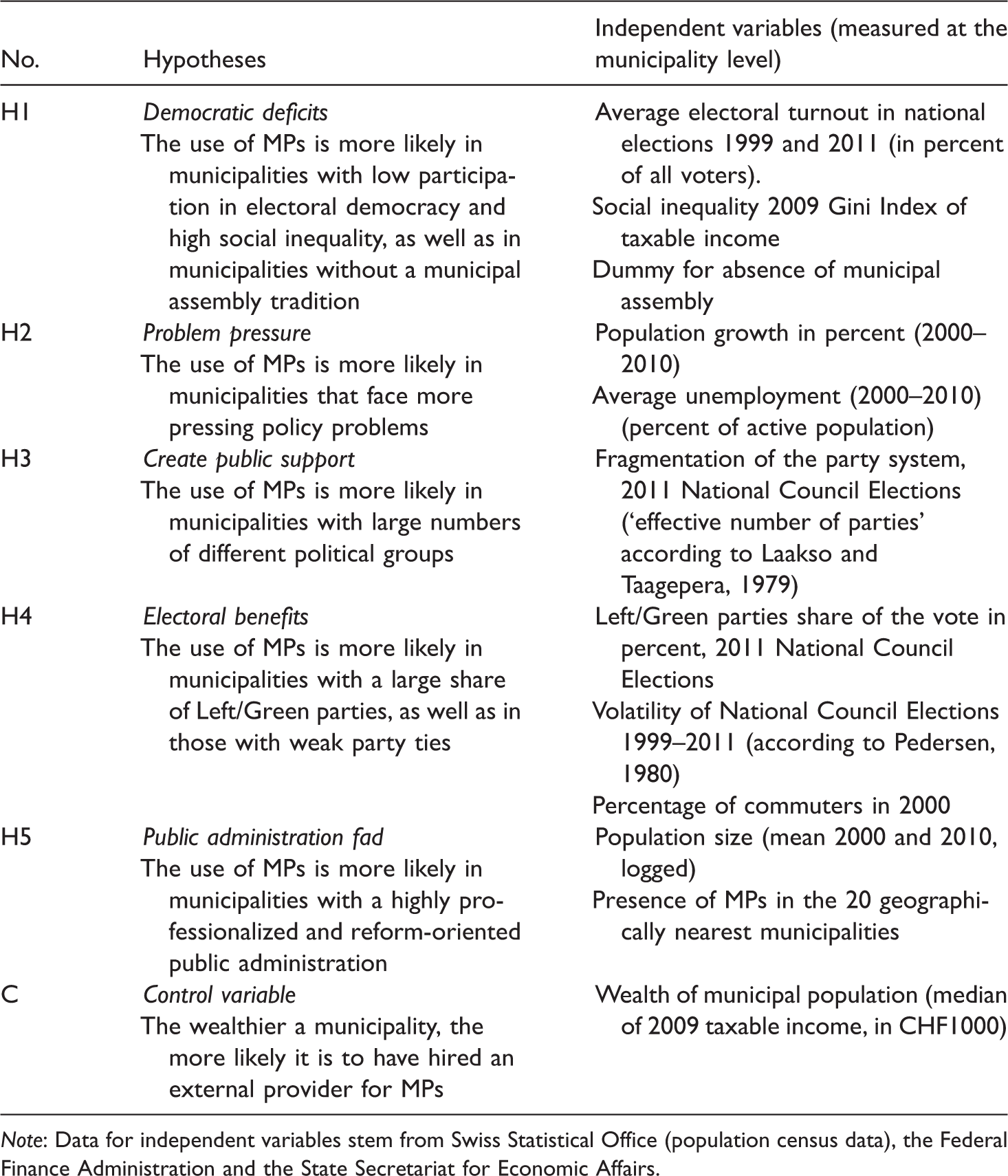
In the earlier theory section, we formulated five hypotheses about why mechanisms of participatory governance are introduced. These five hypotheses are operationalized with a total of 12 variables (see Table 1).
Implementation of mini-publics (MPs) in municipalities: Hypotheses and operationalization.
Note: Data for independent variables stem from Swiss Statistical Office (population census data), the Federal Finance Administration and the State Secretariat for Economic Affairs.
For most of these hypotheses, the operationalization is straightforward. With respect to the first hypothesis (H1): electoral participation is operationalized by the average turnout of the municipal electorate in national elections in the study period; 2 social inequality is measured by the Gini index of taxable income within the municipality; and the absence of the municipal assembly tradition is captured with a dummy variable. Policy problem pressure faced by municipal decision-makers (H2) is operationalized with population growth in the study period – used to capture the strain on municipal public services – as well as with the unemployment rate, seen as a proxy for the severity of social problems within a municipality. The presence of different political groups (H3) is operationalized with Laakso and Taagapera’s (1979) ‘effective number of parties’ on the basis of the municipal-level results of the national elections at the end of the study period. 3 Regarding H4, we measure the strength of Left and Green parties in a municipality via the cumulative share of votes obtained by the Social Democrats, the Greens and the Workers Party in the latest national elections. The strength of party ties is measured by the volatility of party votes in national elections (according to Pedersen, 1980), as well as by the share of out-commuters in a municipality. 4 Finally, drawing on previous studies on municipal administrative reforms in Switzerland (Ladner, 2001), we measure the professionalism and reform orientation of the municipal public administration (H5) via the size of a municipality (larger municipalities have a more professional administration), as well as via the implementation of mini-publics in the 20 geographically nearest neighbouring municipalities in order to take into account the ‘copycat effect’ of administrative reforms. Finally, the median taxable income in a municipality was used as a control variable to measure the financial resources available to municipal governments. Indeed, given our focus on mini-publics implemented or supported by external providers, poorer municipalities might be less likely to commission mini-publics simply because they lack the financial resources to pay professional providers.
Data on the independent variables were provided by the Swiss Statistical Office, the Federal Finance Administration and the State Secretariat for Economic Affairs, and could be collected for all municipalities in the German-speaking cantons of Switzerland (N = 1505). However, data were not available on all variables for all years of the study period. Data close to the end points of the study period were used, and means calculated, in these cases.
Results
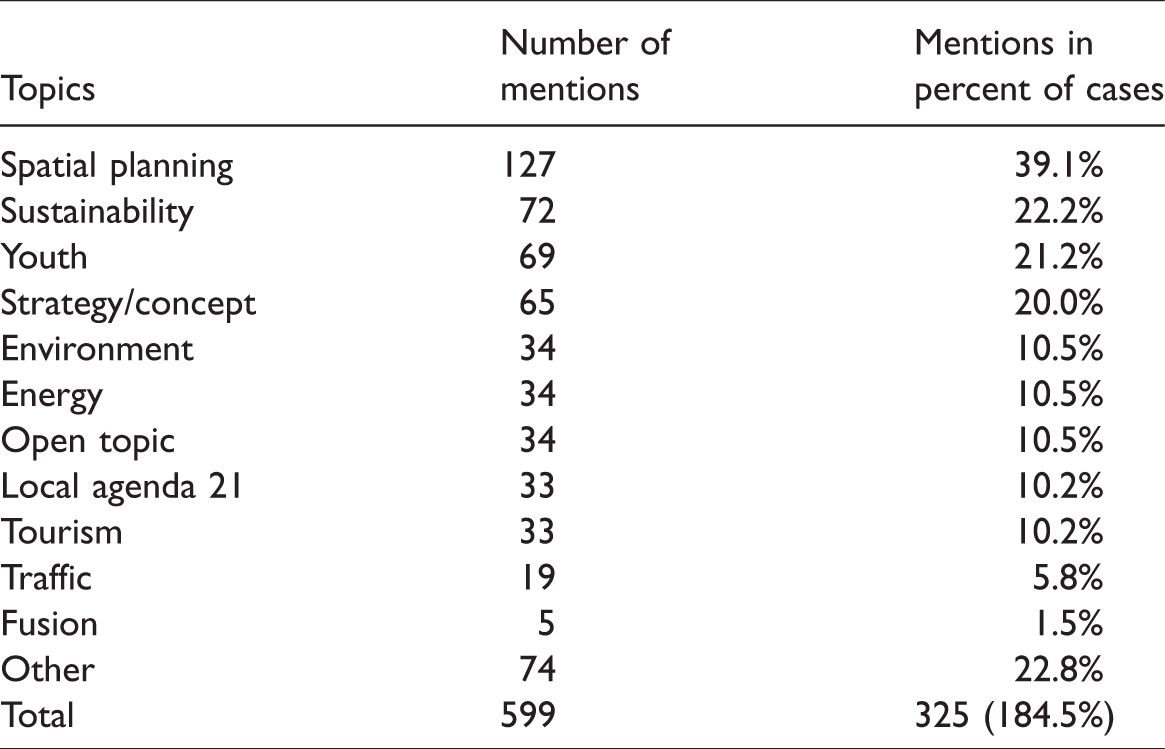
The providers covered in the survey indicated a total of 362 mini-publics that they had implemented in the municipalities of German-speaking Switzerland during the study period. A closer look at these mini-public exercises shows that they have covered a variety of topics, related to specific policy areas (see Table 2). By far the most important field is spatial planning, the subject of almost 40% of the mini-publics implemented by the survey respondents. Participatory governance at the municipal level therefore seems to be employed primarily in processes of local planning and development. Only around 10% of mini-publics were open and not policy-related.
Topics or policy areas of mini publics (multiple topics possible).
In terms of the numbers of participants, the survey responses show that only around a quarter of mini-publics had more than 100 participants. For almost half of all mini-publics in our sample (47.3%), the number of participants was between 25 and 75. Mini-publics are clearly events of a relatively manageable size. Interestingly, there is no significant correlation between the number of participants in mini-publics and the population size of the municipality in which they are implemented.
Features of municipalities with or without mini-publics
The 362 identified mini-public exercises took place in 233 municipalities within the Swiss-German cantons – 15.5% of all municipalities in these cantons. The distinction between those municipalities with mini-publics and those with no evidence of any mini-public during the study period shows that mini-publics were used primarily in (core) cities or suburban municipalities of metropolitan areas, while rural municipalities are under-represented (see Table 3).
Municipalities with or without mini-publics (MPs) in the study period, and number of mini-public exercises in municipalities with mini-publics according to municipality type.
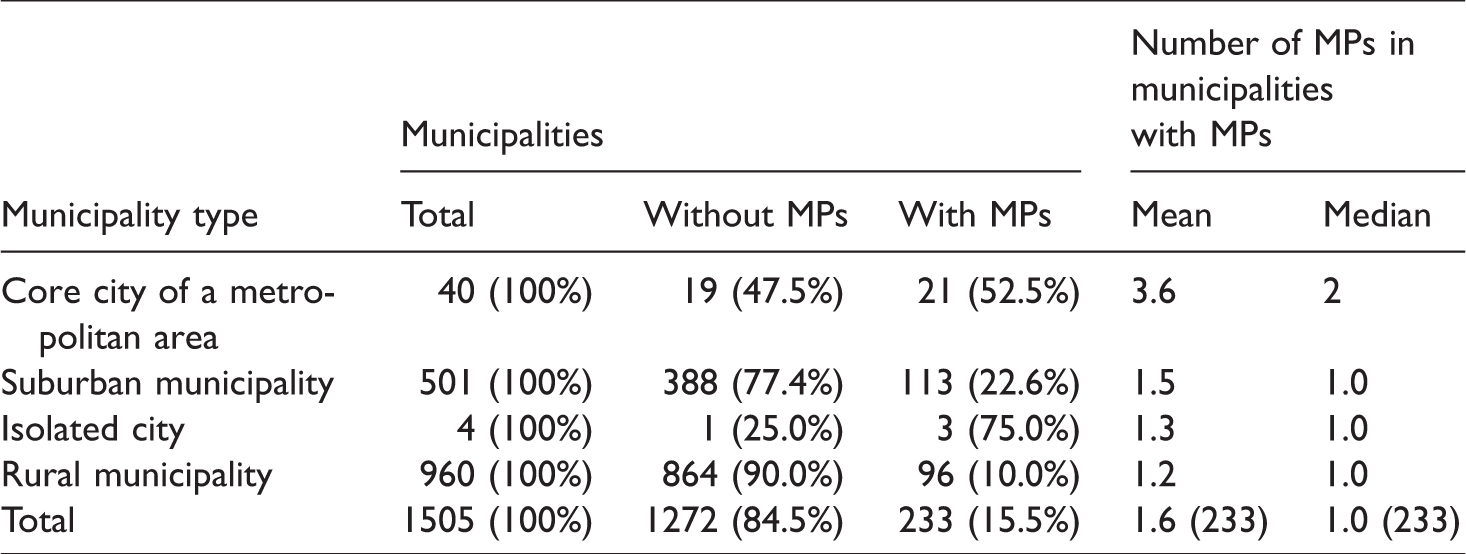
In most municipalities with mini-publics, only one exercise was held in the study period, but occasionally several mini-public exercises were mentioned for the same municipality during the study period. This was the case in larger cities in particular: 24 different mini-public exercises had taken place in the city of Zurich alone, while in the city of Basel, there were 11, and there were five in Lucerne.
Explanatory factors for the use of mini-publics at the municipal level
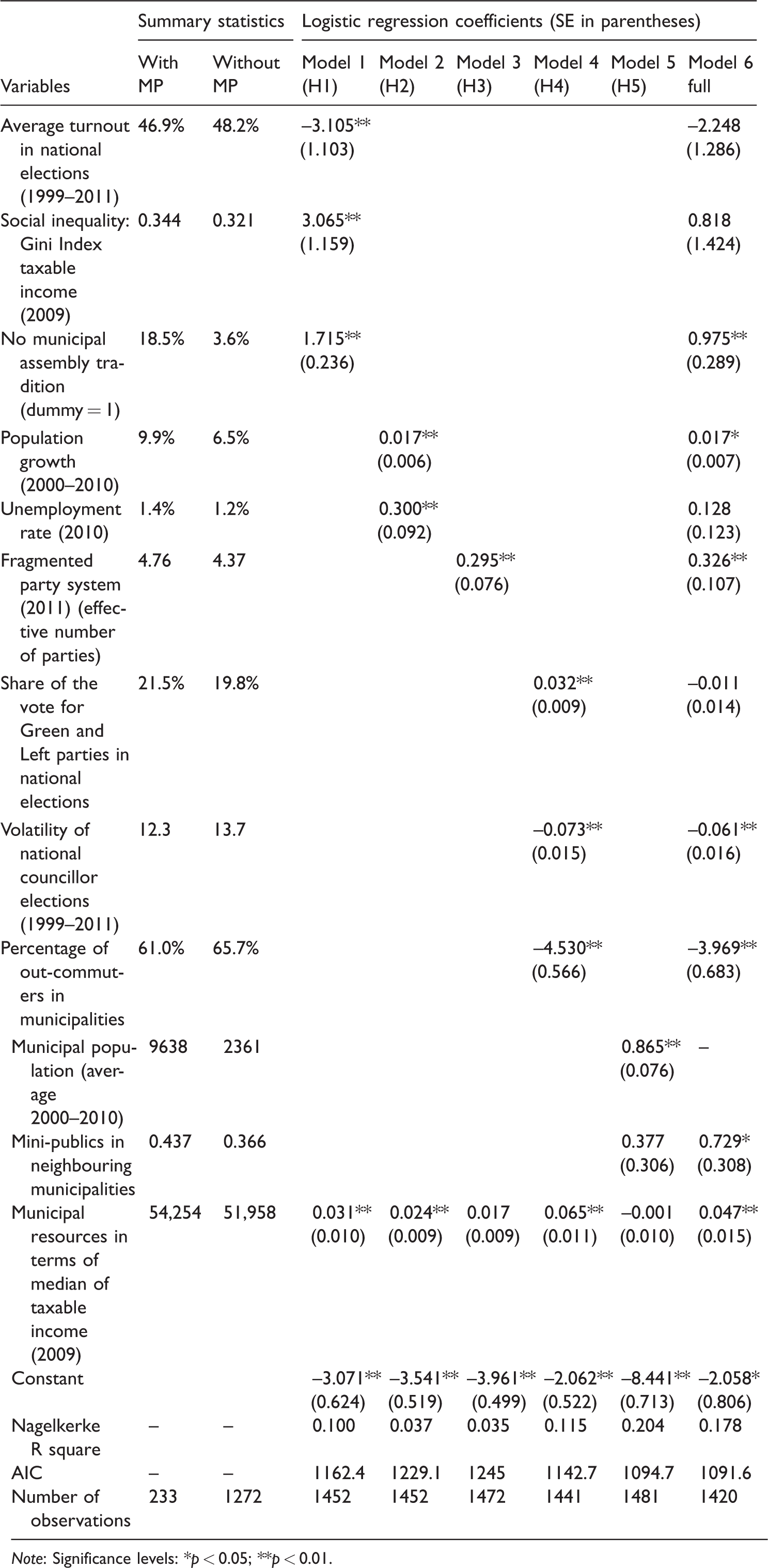
Using logistic regression analysis, we can identify the characteristics that differentiate municipalities with mini-publics from those without (see Table 4). Specifically, six different regressions models were estimated – one with those variables assigned to each hypothesis – and a combined model. 5 Model 1 estimates the influence of predictors for a democratic deficit (H1), and shows that low electoral turnout, high social inequality and the absence of a participatory tradition increase the likelihood for the implementation of mini-publics in municipalities. Model 2 shows that high population growth and unemployment – measures of policy pressure beyond the control of municipal governments – also make it more likely that municipalities have implemented mini-publics (H2). Model 3 shows that high party-system fragmentation in a municipality makes mini-publics more likely, supporting the hypothesis that mini-publics are introduced in contexts characterized by the presence of a larger number of different political groups, where the creation of public support for policies is more cumbersome (H3). The results of model 4, however, go partially against the underlying hypothesis: although the likelihood of mini-publics increases with the share of Left and Green parties and can thereby be assumed to be part of a Left/Green political agenda, the estimates for the variables measuring the strength of party ties (electoral volatility and proportions of out-commuters) go in the opposite direction from what was expected. The implementation of mini-publics in a given municipality is thus associated with strong, rather than weak, party and community ties. Finally, the fifth hypothesis is supported by the results of model 5: in larger municipalities that are associated with a higher level of professional administration, mini-publics are more likely to have been introduced. The ‘copycat effect’ of mini-publics in neighbouring municipalities is explained away, however, by municipal size.
Summary statistics and logistic regression of the implementation of mini-publics in Swiss municipalities.
Note: Significance levels: *p < 0.05; **p < 0.01.
The results of the combined model, which simultaneously considers all potential influencing factors (due to strong correlation with other variables, municipal population is excluded from the combined model 6 ), help to clarify the robustness of the effects considered previously. It shows that the effects of two democratic deficit indicators (low electoral turnout and high social inequality) are explained away by the other variables; the same is true for the effect of the unemployment rate, as well as for the strength of Left and Green parties. The factors that retain explanatory power for the occurrence of mini-publics in municipalities are: the absence of a municipal assembly tradition; high rates of population growth; high fragmentation of the party system; low electoral volatility and low proportions of out-commuters; and the presence of mini-publics in neighbouring municipalities. 7
Discussion and conclusion
The aim of this study was to provide an overview of the use of mini-publics by municipalities in German-speaking Switzerland, as well as to better understand the context in which local governments introduce mechanisms of participatory governance in established democracies. The results of the study suggest that mini-public exercises in Swiss municipalities are primarily policy-oriented participatory procedures, involving a rather small proportion of the citizenry, and employed in a variety of policy areas but particularly in the field of spatial planning and municipal development. Our analysis of the factors associated with the implementation of mini-publics shows that municipalities most likely to have used mini-publics are those that do not convey the participatory and deliberative tradition of unitary democracy (epitomized by the existence of the municipal assembly system), whose public services are under growth pressure, who feature a large number of different political groups and strong party and community ties, who have professional and reform-minded public administrators, and, finally, who are wealthy enough to hire professional providers to support the implementation of mini-publics.
The hypotheses found in the literature to explain the introduction of participatory governance by local governments hence need to be qualified. First and foremost, participatory governance is often presented as driven by the quest to solve legitimacy deficits that arise due to declining citizen participation in traditional electoral democracy (see Goodhart et al., 2012). The results of our analysis call this widely held thesis into question – at least in the context of established democracies. In the Swiss municipalities studied here, the introduction of mini-publics is not robustly related to (low) rates of citizen participation in elections, or to a context of social inequality in which representative deficits are most likely to appear. Rather, the analysis suggests that municipal authorities set up mini-publics in the hope that they will help find solutions to pressing policy problems in a context of an increasingly adversarial logic. This is especially pertinent in the face of fragmented group interests and in the context of strong party and interest group ties, in which public support for policy decisions – or, at least, the absence of resistance to these decisions – is a crucial source of effective governance. Furthermore, it is plausible to assume that mini-public exercises have become part of a professional practice driven by administrative actors.
The expansion of participatory governance in Swiss municipalities seems not so much motivated by a desire to redress the representation deficits of existing democratic institutions. Rather, participatory governance is expanded primarily in adversarial contexts characterized by problems of governability. In established democracies, mechanisms of participatory governance thereby appear ‘more like management and communication techniques … than effective instruments of democratization of the decision-making process’ (Papadopoulos and Warin, 2007: 596). Found essentially in contexts with fragmented but cohesive groups, participatory governance appears as a tool to discern latent public opinion on potentially conflictive policy choices in order to create support by adapting policies to what can be anticipated as acceptable to the main political groups present in a jurisdiction.
In conclusion, a pragmatic logic of governability appears as the major driving force for the expansion of participatory governance, which has been overlooked in many accounts of democratic innovations with often sweeping postulations about their origins. This study thus demonstrates the need to adopt a more nuanced look at the motivations for the introduction of participatory mechanisms. In particular, the Swiss case, with its varying models of democracy found at the municipal level – unitary versus adversary – has allowed us to identify the adversarial nature of local politics as one of the important conditions under which municipal governments turn towards participatory governance. Where unitary democracy prevails, the need for participatory governance does not seem to be felt very strongly.
The quest to increase governability in an adversarial local context might be the main driver for the adoption of participatory governance in the Swiss context, and, by extension, probably also in other established democracies with relatively few problems of representation. However, in clientelistic, developing contexts with serious democratic deficits, such as many parts of Latin America, Africa and South-east Asia, where participatory governance is also expanding rapidly, the story is likely very different.
Supplemental Material
Supplemental material for Strengthen governability rather than deepen democracy: why local governments introduce participatory governance
Supplemental Material for Strengthen governability rather than deepen democracy: why local governments introduce participatory governance by Daniel Kübler, Philippe E. Rochat, Su Yun Woo and Nico van der Heiden in International Review of Administrative Sciences
Footnotes
Declaration of conflicting interests
The author(s) declared no potential conflicts of interest with respect to the research, authorship, and/or publication of this article.
Funding
The author(s) received no financial support for the research, authorship, and/or publication of this article.

Notes
References
Supplementary Material
Please find the following supplemental material available below.
For Open Access articles published under a Creative Commons License, all supplemental material carries the same license as the article it is associated with.
For non-Open Access articles published, all supplemental material carries a non-exclusive license, and permission requests for re-use of supplemental material or any part of supplemental material shall be sent directly to the copyright owner as specified in the copyright notice associated with the article.
