







Abstract
This study reviews social work research on LGBTIQA+ issues in Turkey over the past decade, identifying 14 studies–9 quantitative and 5 qualitative – with a total sample of 2383 participants, including 1214 LGBTIQA+ individuals. The findings reveal both increased academic interest and a critical gap in intervention-focused research. In a context of political homophobia, social discrimination, and limited institutional support, LGBTIQA+ rights violations remain widespread. The study underscores the relevance of rights-based, inclusive, and context-sensitive approaches for social workers operating in restrictive environments, contributing to global dialogues on social justice, minority rights, and structural inequality in social work practice.
Introduction
The situation of LGBTIQA+ individuals in Turkey is shaped by various challenges, including social discrimination, LGBT+ phobia, and limited support resources. Research indicates that LGBTIQA+ individuals are frequently exposed to discrimination, which negatively affects their mental health and overall well-being. For instance, state that perceived discrimination weakens the identity needs of LGBTIQA+ individuals, leading to lower self-esteem and a reduced sense of belonging. Similarly, Eskici et al. (2020) emphasize that adherence to traditional gender roles increases homophobia and fosters a heteronormative society that excludes LGBTIQA+ identities.
The political climate in Turkey further exacerbates these issues. Public officials, including the Presidency, have made derogatory statements about LGBTIQA+ individuals, framing them as a societal threat (Şimşek, 2024). This state-sponsored homophobia not only legitimizes discrimination but also paves the way for an increase in hate crimes against LGBTIQA+ individuals (Şimşek, 2024). According to the Rainbow Index of the International Lesbian, Gay, Bisexual, Trans, and Intersex Association (ILGA-Europe), Turkey ranks 48th out of 49 European countries in terms of LGBTIQA+ rights, highlighting inadequate legal protections and a lack of societal acceptance (Barburoğlu et al., 2024). Furthermore, during the COVID-19 pandemic, LGBTIQA+ individuals were scapegoated and blamed for the spread of the virus, leading to further marginalization from society (Altay, 2022).
Access to healthcare remains a critical issue for LGBTIQA+ individuals. Apalı et al. (2020) report that LGBTIQA+ youth face significant barriers and discrimination in healthcare settings. Similarly, Duraku (2024) notes that the lack of cultural competence among professionals leads to inadequate care. Internalized homophobia further exacerbates health outcomes; Ummak et al. (2021) found that internalized heterosexism negatively impacts life satisfaction, particularly among women in sexual minority groups.
Intersectionality compounds discrimination. LGBTIQA+ individuals with additional marginalized identities, such as ethnic minority status or disabilities, often experience dual forms of exclusion, which can harm mental health and hinder integration (Cvetkovska et al., 2021). In Turkey, these issues are intensified by dominant social norms, political hostility, and institutional barriers.
Social work plays a vital role in addressing these challenges. The social ecological model emphasizes community support in building resilience (Asakura, 2016), while the minority empowerment model highlights the protective effect of social connection (Perrin et al., 2019). Education and advocacy are key: social workers must receive training on LGBTIQA+ issues (Dentato et al., 2013) and push for inclusive policies, including access to partner violence support (Paul, 2024; Turner and Hammersjö, 2023). Through inclusive practice, social work can foster equity and well-being.
As summarized above, Turkey has unfortunately begun to regress in terms of democratic rights and practices in recent years. As a result, socially disadvantaged groups have faced increasing disadvantages and human rights violations. One such group consists of LGBTIQA+ individuals. The rise of undemocratic practices, growing discrimination, hate speech, and the social exclusion of both these groups and those advocating for their rights have raised concerns about the extent to which social work academics and researchers are affected. This concern forms the basis of the present systematic review.
As is well known, social work is inherently rooted in advocacy, social justice, and human rights. Therefore, in a country like Turkey, where LGBTIQA+ individuals experience significant social exclusion, oppression, and human rights violations, it is crucial to examine the efforts of social work professionals and researchers in addressing these issues. In this context, the objectives of this study can be outlined as follows:
How many studies have been conducted by social work academics and researchers in the last 10 years?
What types of studies have been conducted by social work academics and researchers in the last 10 years?
What are the subject areas of the journals in which these studies have been published?
In which language(s) have these studies been published?
In journals from which country have these studies been published?
What are the main themes and content of these studies?
Who were the participants of these studies, and what research methods were used?
What are the general findings and conclusions of these studies?
Method
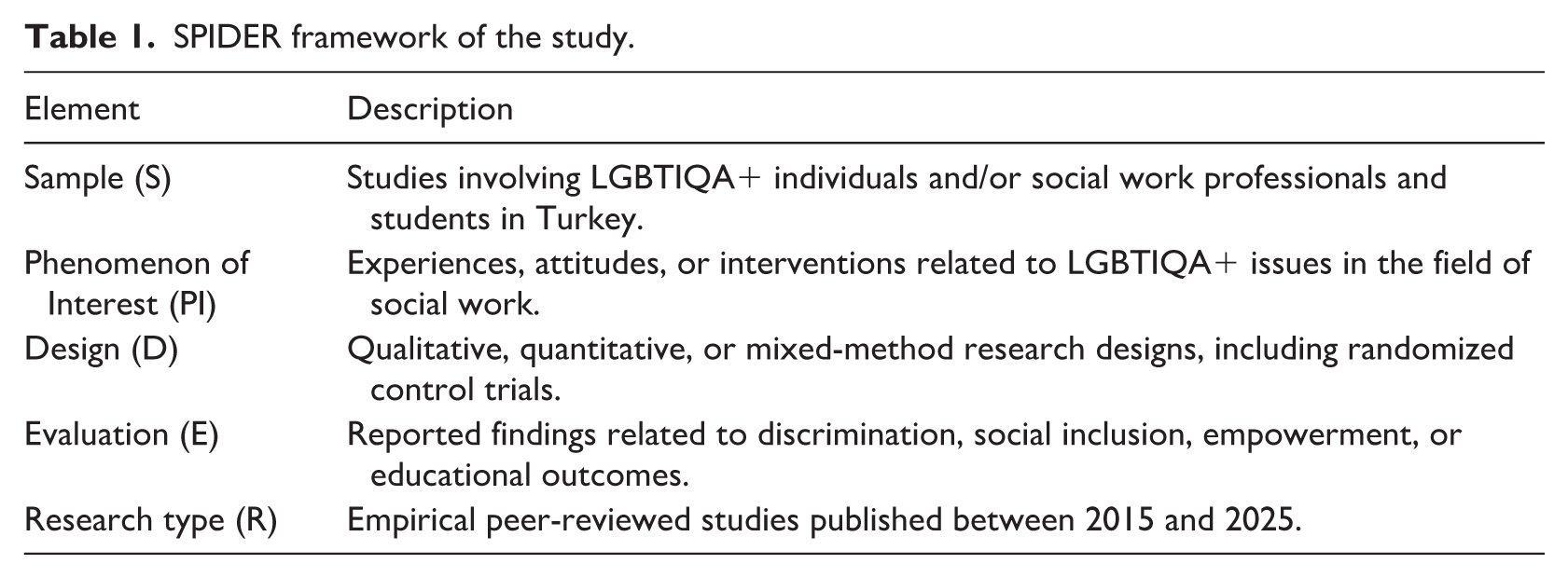
This systematic review adhered to the guidelines outlined in the Preferred Reporting Items for Systematic Reviews and Meta-Analyses (PRISMA) statement (Page et al., 2021), which includes a checklist and a flow diagram. PRISMA is widely utilized to promote clarity and comprehensiveness in the reporting of systematic reviews. Rather than solely serving as a quality assessment tool, it offers structured reporting recommendations and highlights key elements that should be included in each section of the manuscript (Page et al., 2021). In addition to PRISMA, the SPIDER framework (Sample, Phenomenon of Interest, Design, Evaluation, and Research Type) was applied to ensure a structured and conceptually coherent approach to data collection and synthesis (Cooke et al., 2012). This framework is particularly appropriate for social science and qualitative research contexts, as it allows the identification of studies exploring complex human experiences such as discrimination, social exclusion, and identity formation among LGBTIQA+ populations. Accordingly, this study was formulated as follows using the SPIDER framework (Table 1).
SPIDER framework of the study.
Search strategy
The review followed a two-step search strategy to ensure comprehensive coverage of the literature. Research articles authored by social work academics or researchers in Turkey between 2015 and 2025 were systematically searched across databases and national indexes. The main databases used were TR Dizin (Turkey Citation Index) and Google Scholar.
Searches were conducted on 24 December 2025, using the keyword sets ‘gay, lesbian, LGBT, “social work”, Turkey, Türkiye’ and ‘gey, lezbiyen, LGBT, “sosyal hizmet”’. These bilingual keywords were designed to capture both English and Turkish publications. No language restrictions other than Turkish and English were applied, and the publication type filter was limited to journal articles.
International databases (e.g. Scopus and Web of Science) were not included because the review aimed specifically to identify studies authored by Turkish social work academics and published in national or internationally accessible sources.
Eligibility criteria
Based on the defined topic and objectives, certain criteria based on the SPIDER framework were established for including studies in the analysis. The eligibility criteria are as follows:
The study was published between January 2015 and December 2025.
At least one author was affiliated with a social work department or held a degree in social work.
The study focused on LGBTIQA+ individuals or issues relevant to social work practice, education, or policy.
The study appeared in TR Dizin or Google Scholar and was published in Turkish or English.
The exclusion criteria for the studies are as follows:
Studies unrelated to social work or authored solely by non-social work professionals.
Studies published before 2015.
Review papers, conference abstracts, or non-peer-reviewed materials.
No automation tools were used; all decisions were made collaboratively. Disagreements were resolved through discussion, and data from eligible studies were entered into a structured extraction form including publication year, author(s), methodology, participant characteristics, and key findings. The detailed selection process is shown in Figure 1, which illustrates the number of studies identified (n = 249), excluded (n = 235), and included in the final review (n = 14). The flowchart and numbers were cross-checked for consistency with the narrative text.
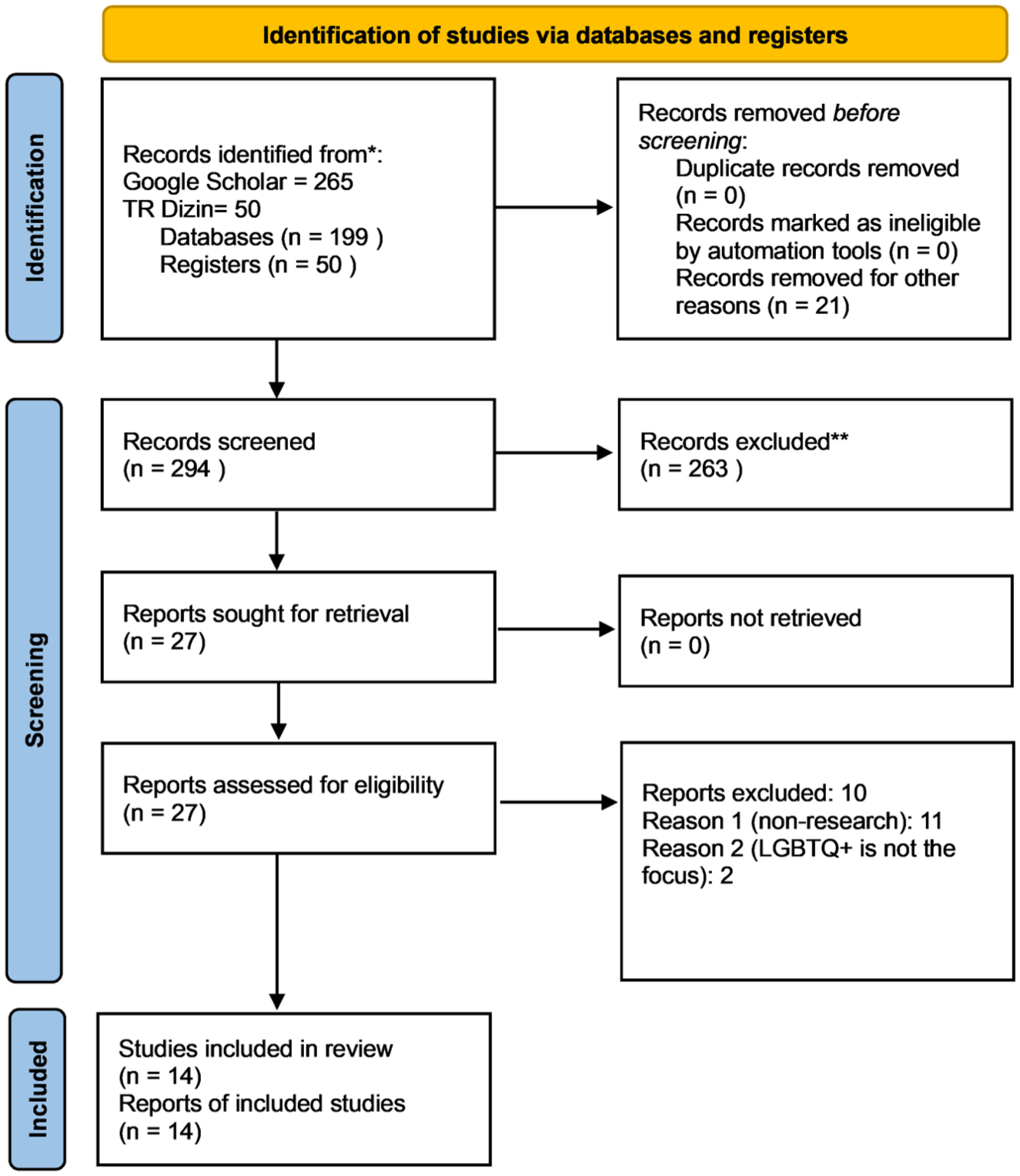
Illustration of the search results and the procedures for article selection.
Data extraction and study selection
The data extraction and study selection phases of the research were conducted between September and December 2025. The research process consisted of two stages. In the first stage, the results obtained from the database and index were reviewed according to the inclusion and exclusion criteria, and folders were created. In the second stage, the content, research subjects, and results of the included studies were analyzed.
The relevant databases and indexes were searched using the aforementioned keyword groups, with the year filter set to 2015–2025 and the language filter set to English and Turkish. All the results listed in the search results were individually opened by the researchers. On the first page of each result, the authors’ affiliation information was evaluated. If none of the authors was identified as social work academics or researchers, that result was closed without further examination. If at least one author was connected to social work, the abstract was read, and if the study was deemed relevant to the research topic, it was downloaded and placed in the folder for further analysis. Studies placed in the folder were later read in full, and those written as literature reviews (n = 13) were excluded from the sample. During this process, no automation tools were used, and the researchers conducted the process collaboratively. Information regarding this process can be found in Figure 1.
Data synthesis
Given the methodological diversity across studies, a narrative synthesis approach was used
Thematic categories were developed inductively and later aligned with the SPIDER framework’s evaluation dimension to ensure consistency between study aims and analytical themes. Quantitative results were summarized numerically, while qualitative data were analyzed for emergent themes related to discrimination, inclusion, and empowerment. All included studies were independently reviewed by a second researcher to minimize bias and confirm accuracy. The synthesis integrated both frequency-based (numerical) and meaning-based (interpretive) analyses.
Quality appraisal
All included studies were appraised for methodological quality and risk of bias. Randomized controlled trials (n = 3) were assessed using the RoB 2 Tool (Sterne et al., 2019). Qualitative studies (n = 5) were assessed using the CASP Checklist for Qualitative Research (Critical Appraisal Skills Programme, 2024). The overall risk of bias was judged as low. Because of the small number of experimental studies, no meta-analysis or effect size calculation was performed.
Ethical considerations
Although this review used only publicly available data, ethical sensitivity was maintained in the interpretation of studies concerning LGBTIQA+ individuals, acknowledging their vulnerability within the Turkish sociopolitical context.
Results
Search outcomes
In this systematic review, research and review studies conducted by social work academics and researchers on LGBTIQA+ individuals between 2015 and 2025 were examined through a database and a register. In the first phase, 249 publications were found. After excluding those not conducted by social work academics and researchers, 27 publications were identified. Among these 26 publications, those categorized as reviews (n = 11) and those not directly focusing on the target group of LGBTIQA+ (n = 2) were excluded from the sample, leaving 14 research studies included in the analysis. The following flowchart illustrates this process in detail.
Of the 14 studies included in the analysis, 10 were conducted using quantitative methods and 4 using qualitative methods. In total, 2383 participants, including 1214 LGBTIQA+ individuals, were the subjects of these studies. The participant numbers and characteristics from all studies, along with the key findings, are presented in Table 2.
Study summary.
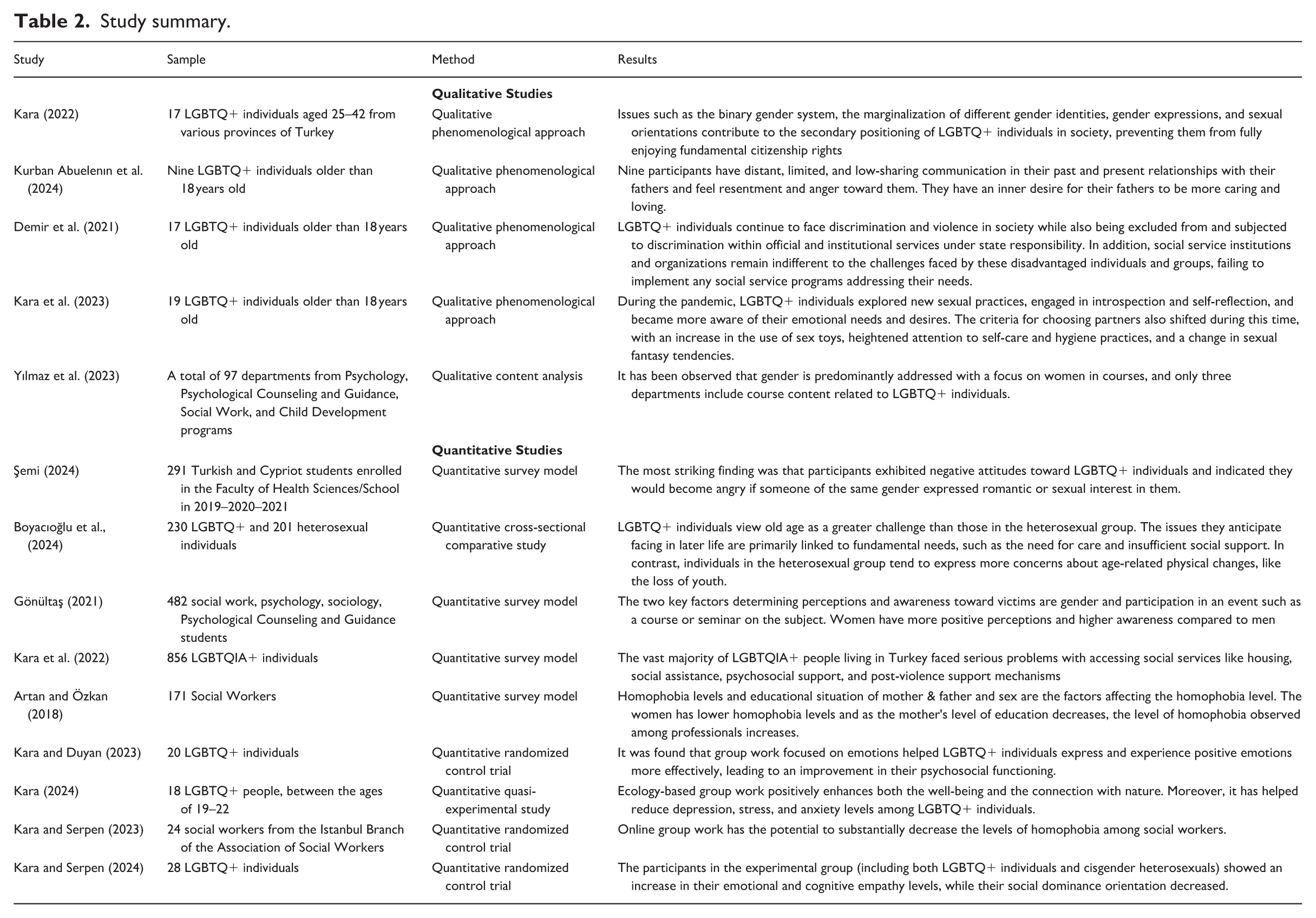
Among the quantitative studies conducted by social work academics and researchers in Turkey between 2015 and 2025, it was found that four included an intervention and measured the effectiveness of the intervention. Three of these four studies were conducted with LGBTIQA+ individuals, while one focused on changing social workers’ attitudes toward homophobia. The remaining quantitative studies used a survey model, and in two of these studies, university students from social work, psychology, and health sciences departments who were likely to work with LGBTIQA+ individuals were involved. As for the qualitative studies, except for one research analyzing university course contents, all of them were conducted through semi-structured qualitative interviews with LGBTIQA+ individuals.
When evaluating the studies, excluding intervention studies, the main research topics focus on the life experiences, challenges, pressures, and discrimination practices faced by LGBTIQA+ individuals. Studies conducted with other population groups primarily focus on attitudes, behaviors, prejudice, and homophobia toward LGBTIQA+ individuals. Upon detailed analysis of the intervention control trial studies, it was found that three of them were designed to improve the well-being of LGBTIQA+ individuals. In the remaining control trial, the goal was to reduce the prejudices held by social workers.
In the first screening phase of this research, 315 publications were found through academic search engines. As shown in Figure 1, only 14 of these publications were conducted by social work academics and researchers. In this context, social work academics and researchers in Turkey have conducted only 4.44% of the academic studies on LGBTIQA+ issues in the last 10 years.
In general, it has been found that the number of studies conducted by social work academics and researchers with LGBTIQA+ individuals in Turkey is quite low, and only a few studies have been conducted in this field after 2021. In the studies conducted after 2021, it can be said that there is little diversity among the researchers. In a total of 14 studies, seven have the same researchers. This indicates that this research area is not preferred by a wide variety of social work researchers. Regarding methodological diversity, it has been observed that nine out of the 14 studies used quantitative methods, while the remaining 5 used qualitative methods. Furthermore, intervention-focused studies were only conducted in 2023 and 2024, and all of them were carried out by the same researcher. Apart from a study conducted in 2018, no studies with LGBTIQA+ individuals were found in the research collected between 2015 and 2021, according to the inclusion criteria of this research.
Among the 14 studies evaluated in total, only 5 were published in Turkish and in journals based in Turkey. The remaining nine studies were all published in English and in journals based outside of Turkey. The academic fields of the journals in which these nine studies were published include group work in social work, homosexuality, social work research, social psychiatry, and social sciences. Except for one, all of these journals are indexed in SSCI and are classified in the Q1 and Q2 quartiles. It has been determined that these publications have been viewed a total of 3855 times and have been cited 21 times on the respective websites. No such statistical information could be accessed from the websites for the articles published in Turkey.
In journals based in Turkey, the fields are education and social sciences. There are 1748 academic journals publishing in Turkey (TR Dizin, 2025). However, none of these journals specifically publishes research related to LGBTIQA+ issues. Within TR Dizin, Turkey’s most widely recognized and accepted academic journal index, only 6 journals are focused on gender studies and women’s issues. However, according to the criteria of this study, no research was found in these 6 journals.
The references in these 14 studies generally consist of publications by authors outside Turkey and Turkish writers. In addition, the references used in the studies are not solely focused on the last 5 years but also include sources spanning a broader perspective.
When examining the sample, a total of 2383 individuals were involved, of which 1214 were LGBTIQA+ individuals. From this perspective, a balance might be noted. However, in studies where LGBTIQA+ individuals did not constitute the sample, only two groups were included: university students in the field of social sciences and social work professionals in the workforce. It can be observed that there is a limitation in terms of sample diversity in these studies.
The findings of studies conducted with LGBTQ+ individuals
The key findings from studies with LGBTIQA+ individuals reveal persistent social exclusion, emotional strain, and limited access to support services in Turkey. Kara (2022) and Demir et al. (2021) highlight how the binary gender system and institutional discrimination restrict LGBTIQA+ individuals’ citizenship rights and access to housing, social assistance, and post-violence care. Family-related research (Kurban Abuelenın et al., 2024) shows strained father–child relationships marked by emotional distance and unmet needs for affection. During the COVID-19 pandemic, individuals explored new sexual practices and self-care routines, reflecting shifts in intimacy and self-perception (Kara et al., 2023). Concerns about aging were also prominent; LGBTIQA+ participants anticipated greater challenges related to caregiving and social support compared to heterosexual peers (Boyacıoğlu et al., 2024). Intervention-based studies demonstrate positive outcomes: emotion-focused and ecology-based group work improved well-being and empathy while reducing stress, anxiety, and homophobia (Kara, 2024; Kara and Duyan, 2023; Kara and Serpen, 2024). Overall, these studies illustrate both the systemic barriers and the resilience of LGBTIQA+ individuals, underscoring the need for inclusive, rights-based social services and targeted psychosocial interventions.
The findings of studies conducted with other population groups
Recent research reveals persistent gaps in addressing LGBTIQA+ issues within education and professional practice. Yılmaz et al. (2023) analyzed 97 university departments and found that gender topics mainly focused on women, with only three programs including LGBTIQA+ content. Similarly, Erzeybek Şemi (2024) reported that health sciences students often expressed discomfort or anger toward same-gender romantic interest, indicating widespread bias. Gönültaş (2021) found that female students and those exposed to related training showed greater awareness and more positive attitudes. Finally, Kara and Serpen (2023) demonstrated that online group work with social workers significantly reduced homophobic attitudes. Together, these studies highlight the need for inclusive curricula and targeted interventions to promote awareness and acceptance of LGBTIQA+ individuals across both educational and professional domains.
Discussion
This systematic review study was conducted with the hypothesis of examining the extent to which the social and political climate in Turkey, characterized by discrimination and prejudice against LGBTIQA+ individuals, has impacted social work academics and researchers – one of the key professional groups in this field. The findings of this study provide significant insights, particularly for Turkey but also globally, regarding LGBTIQA+ individuals, who are among the primary groups experiencing discrimination and bias. One of the most notable findings is that the social work profession and academia have lagged behind in working with LGBTIQA+ individuals.
Another significant finding, closely related to the previous one, is the very limited number of studies conducted by the social work community in Turkey on LGBTIQA+ individuals. Specifically, between 2015 and 2025, only seven studies focused on the well-being and welfare of LGBTIQA+ individuals. Intervention-based studies aimed at creating direct change, such as randomized controlled trials, were even fewer in number (n = 3). In addition, studies exploring the lived experiences of LGBTIQA+ individuals were limited to just four.
For the past decade, this scarcity of research represents a major gap in the social work field. Notably, it is striking that social work academics and researchers accounted for only 4.44% of the total academic studies conducted on LGBTIQA+ issues. As of 2025, data from the Council of Higher Education (YÖK) and other research indicate that there are 528 social work academics in Turkey’s 276 universities with 4-year social work programs, regardless of their current activity status (Alptekin and Topuz 2022; Yökatlas, 2025). In terms of graduates, it is estimated that by the end of 2024, there were over 50,000 social workers in Turkey. However, there are no official statistics available regarding their employment status or continuation into higher education.
Excluding intervention-based studies, research conducted between 2015 and 2025 primarily focused on the lived experiences of LGBTIQA+ individuals, the challenges they face, and the various forms of oppression and discrimination they encounter. Studies involving other population groups, on the other hand, were mostly centered on attitudes, behaviors, prejudices and homophobia toward LGBTIQA+ individuals.
Over the past 5 years, there has been little change in the topics of research conducted within the field of social work, with studies continuing to focus on similar themes. A review of earlier studies beyond this period reveals similar findings (Acar and Altunok, 2013; Engin, 2015; Karakaya, 2010, 2014; Küçük, 2007; Özdemir, 2009; Öztürk, 2011; Yılmaz and Göçmen, 2016). The negative experiences of LGBTIQA+ individuals documented in these studies, as previously mentioned, are similarly or even more disadvantageous in neighboring Middle Eastern countries (Alessi et al., 2023; Alhajali, 2020; Crowe et al., 2021; Paceley et al., 2015). The situation of LGBTIQA+ individuals in Turkey reflects a broader, global pattern of marginalization, rights violations, and underrepresentation in academic and professional discourse. While legal and social frameworks differ across countries, many nations – especially those experiencing democratic backsliding or a rise in populist and authoritarian governance – share similar challenges, such as political homophobia, constrained civil liberties, and limited institutional support for LGBTIQA+ populations. In this context, the Turkish case offers valuable insights into how social workers operate within restrictive environments while striving to uphold human rights and professional ethical standards.
Another significant finding emerged from quantitative research. In their study analyzing the course content of 97 human services programs, Yılmaz et al. (2023) found that only three programs included content specifically related to LGBTIQA+ individuals. This highlights a major gap in undergraduate education for students who will be providing support and working to improve the well-being of LGBTIQA+ individuals. Supporting this finding, studies conducted with undergraduate students by Erzeybek Şemi (2024) and Gönültaş (2021) revealed that negative attitudes toward LGBTIQA+ individuals were predominant. However, prior contact with LGBTIQA+ individuals was found to reduce these negative attitudes and perceptions. Indeed, two studies included in this review demonstrated the effectiveness of interventions aimed at reducing negative attitudes, perceptions, and homophobia (Kara and Serpen, 2023, 2024); The need for increased intervention studies targeting undergraduate students, social workers, and related professional groups has become strikingly evident.
All research aimed at improving the well-being and welfare of LGBTIQA+ individuals has yielded positive results, demonstrating the effectiveness of the intervention programs implemented. This is one of the most crucial findings, as it shows that well-planned, inclusive, and widespread interventions can significantly enhance the well-being of LGBTIQA+ individuals. Numerous successful examples of such interventions exist worldwide (Aleshire et al., 2019; Fredriksen-Goldsen et al., 2014; Latu et al., 2024; Logie et al., 2016, 2018; Prasad et al., 2024). In addition, the research resonates with global concerns related to LGBTIQA+ health and well-being, particularly in terms of mental health, access to support services, and the role of social policy in addressing structural inequalities. From a comparative policy perspective, the Turkish case illustrates how countries differ in their approach to inclusive or exclusionary practices regarding sexual and gender diversity.
Addressing the gap in social work research and practice in Turkey appears to be of great importance. Therefore, this study contributes to the international literature by filling a gap in country-specific analyses of LGBTIQA+ issues within the field of social work. While international research increasingly emphasizes inclusive practice, intersectionality, and advocacy, much of the existing literature is centered on Global North contexts with relatively supportive legal and social frameworks. In contrast, the findings from Turkey illustrate how social work operates in a politically restrictive and socially conservative environment, offering a unique perspective on the limitations and possibilities of practice under pressure. This contrasts with the dominant narratives in the field and highlights the need for greater inclusion of voices and experiences from the Global South and politically constrained regions in the global knowledge base.
Beyond LGBTIQA+ individuals, the presence of social workers in only one intervention study is also a notable limitation. A profession dedicated to social integration and the prevention of discrimination should ideally engage with broader populations in this field (Acosta-Deprez et al., 2021; Bond and Miller, 2021; Heiden-Rootes et al., 2025; Wike et al., 2021). Social work, as one of the key professions capable of fostering interaction between LGBTIQA+ individuals and the broader society, carries even greater significance in countries like Turkey, where discrimination is on the rise. According to one study, personal acquaintance and daily social interactions with an LGBTIQA+ individual in Turkey can help break down prejudices (Listag, 2022). Also, the findings of this study can be situated within several global discussions and comparative frameworks. First, they contribute to the discourse on human rights and minority protections, particularly in regions where conservatism or nationalism is on the rise. Second, the study informs ongoing debates around social work ethics and advocacy, demonstrating how practitioners respond to politically sensitive issues within constrained institutional and policy settings.
According to the findings, the limited number of studies conducted on LGBTIQA+ issues in Turkey have not had a widespread impact within the country, as many are published in English abroad. This presents an additional challenge for an already neglected research area. However, this situation is likely influenced by Turkey’s sociopolitical climate. In fact, the number of journals within Turkey that would accept and publish research in this field is nearly limited to six.
It is also worth questioning whether journals hold a bias against studies related to LGBTIQA+ issues. According to the 2024 report by the Human Rights Association, during the process of Turkey’s withdrawal from the Istanbul Convention, political authorities and their allies claimed that the convention undermined traditional family structures and provided legal protection for same-sex marriages. These statements contributed to increased exclusion and state oppression of LGBTIQA+ individuals. Furthermore, during this period, with the participation of the highest levels of government, LGBTIQA+ individuals were collectively targeted by hate campaigns (Human Rights Association, 2024). In addition, those advocating for LGBTIQA+ rights have also been affected by this wave of hatred and discrimination (Sessizkalma.org, 2022; tihv.org, 2024; kaosgl.org, 2025).
The findings of this review have important implications for social work practice and research in both Turkey and international contexts. Nationally, the limited number of studies on LGBTIQA+ issues indicates that social work in Turkey has yet to institutionalize inclusive or anti-oppressive approaches to meet the needs of sexual and gender minorities. Although rooted in human rights and social justice, LGBTIQA+ individuals remain largely invisible in social service policies, education, and direct practice.
Operating within a politically conservative environment, Turkish social workers face significant risks in advocating for LGBTIQA+ rights. Nevertheless, the reviewed studies show that micro-level interventions – such as group work, psychoeducation, and emotion-focused programs – can enhance psychosocial well-being even under restrictive conditions. These findings highlight the transformative potential of empowerment-oriented and community-based approaches when systemic reform is limited. At the same time, there is a clear need for stronger engagement at meso and macro levels, including advocacy for inclusive legislation, academic freedom, and the integration of LGBTIQA+ content into curricula and field training. Collaboration with civil society organizations could further bridge academia and activism, reinforcing social work’s human rights mandate.
Internationally, these findings contribute to global debates on how social work operates under political constraint. While Global North contexts have developed institutionalized affirmative practices (Dentato et al., 2013; Fredriksen-Goldsen et al., 2014), the Turkish case aligns more closely with Global South and post-authoritarian contexts, where social workers face censorship and limited institutional support (Alhajali, 2020; Paceley et al., 2015).
The ‘silent resistance’ strategies identified – such as small-group work and informal professional networks – mirror similar forms of micro-resistance and advocacy observed in other conservative regions. Moreover, cross-national learning holds promise. The intervention models developed in Turkey, emphasizing emotional regulation, ecological connection, and solidarity, may inform practice in other politically sensitive settings. Conversely, established advocacy frameworks from Global North contexts can inspire local adaptation in Turkey. Together, these insights point to the emergence of a transnational model of inclusive social work that balances structural advocacy with context-sensitive micro practice. Ultimately, barriers to LGBTIQA+ inclusion in Turkish social work are both professional and political. Yet, the reviewed evidence shows that social work – through resilience, creativity, and ethical commitment – can act as a transformative force. By localizing global principles of empowerment, intersectionality, and social justice, Turkish social work contributes uniquely to the international dialogue on upholding human rights under pressure.
Conclusion and suggestions
The scarcity of research on LGBTIQA+ individuals in Turkey over the past 5 years cannot be explained solely by professional choices within social work. The increasingly restrictive political and social climate has also constrained academic freedom and research opportunities. Despite these barriers, the social work profession’s core emphasis on human rights and advocacy necessitates greater engagement in this field. The issues identified in Turkey – political hostility, service inaccessibility, and systemic discrimination – are not unique and can be observed in many countries with similar socio-political dynamics. Thus, the findings of this study hold relevance beyond national borders and offer insights into how social work can respond in politically sensitive environments. In addition, the methodological approach adopted here may guide similar reviews in other underrepresented or constrained regions, contributing to the development of inclusive and context-aware global social work research.
Beyond advocacy and lobbying efforts, there is a clear need for more intervention-focused studies in working with LGBTIQA+ individuals. Such efforts would contribute to empowering a population that faces significant disadvantages. Social workers, with their skills in lobbying and influencing policy, should serve as guides for the development of future human rights-aligned laws and practical applications. In Turkey, this guidance can only be realized through civil society. Therefore, it is crucial that social workers actively participate in organizations established by LGBTIQA+ individuals to foster solidarity and advocate for their rights.
This study highlights a significant gap in the social work literature concerning LGBTIQA+ issues in politically restrictive and socially conservative contexts. While international research tends to focus on inclusive practices and advocacy within the supportive frameworks of Global North countries, the Turkish case presents a contrasting scenario where social work must navigate substantial political and social barriers. These findings suggest that social workers in similar settings require context-specific tools, stronger advocacy strategies, and institutional support to uphold professional values. There is an urgent need for the international social work community to broaden its scope by incorporating more research and voices from the Global South and politically constrained regions. Future studies should focus not only on documenting challenges but also on developing and evaluating practical, intervention-based approaches that can be adapted across diverse sociopolitical environments.
Implications for practice and research
This review shows that social work research on LGBTIQA+ issues in Turkey remains scarce and limited in scope. Only 14 empirical studies were identified over the past decade – just 4.44% of all academic work on this topic – most of which were descriptive rather than intervention-based. This gap reflects broader political and academic constraints marked by state-led homophobia and limited freedom of inquiry. Nevertheless, the findings demonstrate that inclusive, well-designed interventions can enhance psychosocial well-being and reduce prejudice, confirming the transformative potential of social work grounded in human rights and social justice. To move forward, social work education must incorporate LGBTIQA+ issues into curricula, field practice, and supervision. Partnerships with LGBTIQA+ organizations can further strengthen advocacy and inclusive service delivery. Future research should adopt intervention-based, longitudinal, and intersectional designs, exploring how sexuality intersects with class, ethnicity, and disability. Comparative studies across the Global South could also challenge Global North-centric knowledge. Ultimately, international collaboration among social work scholars is vital to amplify marginalized voices and affirm LGBTIQA+ rights as a core ethical and professional responsibility within social work practice.
Footnotes

Ethical considerations
As this study did not involve human participants or the collection of personal data, ethical approval was not required in accordance with institutional and international guidelines.
Funding
The authors received no financial support for the research, authorship, and/or publication of this article.
Declaration of conflicting interests
The authors declared no potential conflicts of interest with respect to the research, authorship, and/or publication of this article.
Data availability statement
The data used in this study are publicly available via the academic search engine referenced in the methodology section of the manuscript.
Statement on AI
Artificial intelligence tools were utilized for the purpose of refining expressions and verifying translations.