






Abstract

“
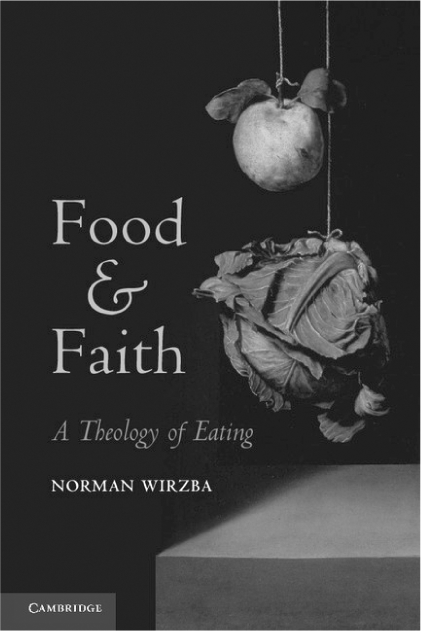
In Food & Faith, Wirzba strives to counter consumeristic perceptions and practices with a richer theological vision of this fundamental creaturely need. He maintains that eating is not some incidental aspect of created existence, but rather an integral facet of what it means to live in a world crafted by the Triune God. He argues that, contrary to the way we commonly eat, God never intended for us to consume food as a mere commodity for pleasure or fuel. Rather, food is rightly perceived and received as a divine gift meant for the general fellowship and flourishing of life throughout creation. Similarly, eating is the means by which God daily unites creation in a web of interdependent need and mutual self-offering that reflects the life of the Trinity. No living being in creation can flourish or even subsist in isolation from others. Any such detachment ends in swift starvation, and even though we humans routinely harbor delusions of self-reliant grandeur, Wirzba smartly notes that, “Whenever people come to the table they demonstrate with the unmistakable evidence of their stomachs that they are not self-subsisting gods” (p. 2).
Wirzba posits that even though we could imagine a world in which creatures did not need to eat to live, it would be a “tasteless and lonely world” far out of line with the care and hospitality that flows from God (p. 2). Consequently, Wirzba maintains that God intentionally made the world with living beings that are intimately interdependent upon one another for life. Humans not only rely on the rest of creation in order to stay alive, but the rest of creation also needs human nurture and cultivation so that it may thrive and replenish abundantly. To meet these mutual needs, Wirzba holds that humans and the rest of creation engage in forms of “self-offering”—i.e., “sacrifice” for the furtherance of one another’s lives—either in the giving of biological life itself (e.g., in being eaten) or in the offering of sweat and labor to cultivate other life forms. According to Wirzba, this system of eating and nurturing is fitting because it mirrors the mutual indwelling and self-offering that occurs between Father, Son, and Holy Spirit. It also demonstrates that life is at root a gift offered from one being to another and is not something that can be owned or merited. We cannot make ourselves “worthy” possessors of life; we can only receive it.
In some respects, this lofty theological, Trinitarian view of eating might seem oblivious to the suffering that regularly accompanies predation and death. On its face, being eaten does not appear to be something most life forms undertake willingly, as a self-offering, and many Christians have traditionally attributed both predation and death to the Fall as perversions of God’s intentions for creation. Yet, one of the most compelling aspects of Food & Faith is the deft manner in which Wirzba presents death as tightly interwoven with life: “Life as we know it depends on death, needs death, which means that death is not simply the cessation of life but its precondition” (p. 1). He contends that biological death is part of God’s good creation and is not itself an evil, even though sinful hearts can certainly perceive or twist it into an evil. As such, Wirzba argues that death, the “steadfast accomplice” of eating, should also be understood from a Trinitarian perspective, in which death is not an evil but a gift for the nourishment of another’s life. From this theological viewpoint, death is a creaturely expression of the self-offering love at play between Father, Son, and Holy Spirit.
On a grand scale, the circle of life in which all living things both eat and are ultimately eaten evidences this mutual self-giving. Among humans in particular, a unique kind of self-offering is expected. As creatures made in the image of a God whom Wirzba identifies as the consummate gardener and cultivator of life, people should not only be grateful for the deaths that make their lives possible, but also should live responsibly by consuming only what is needed to live and by diligently tending to creation’s flourishing and replenishment. (A related gem in this book worth exploring is Wirzba’s interpretation of the sacrifice of animals, plants, and resources as an act of self-offering and self-sacrifice by humans who have invested time, effort, and care into raising those sacrifices, and who risk the loss of sustenance their families may need in offering them.) Wirzba maintains that the current tendency to eat with little, if any, thought for responsible participation in the divinely ordained cycle of self-giving stems from the distance so many people have today from the production and preparation of food. Oblivious to the particularities from which their nourishment comes, many people are unappreciative of God’s intentions for food and similarly unaware of the responsibility that membership in creation enjoins upon them to consume in ways that nurture, rather than exhaust, life on earth.
Ultimately, Wirzba argues that God made creatures that must eat because eating, when not skewed by sin, unites creation in the mold of Triune love and thereby reflects God’s glory and delight. With themes of membership, communion, gratitude, and responsibility, this theological vision of eating beautifully threads together Scripture from the Garden of Eden to the eschatological banquet in the heavenly city. In his closing chapter, Wirzba considers whether heaven will still entail eating, and provocatively argues that heaven is constituted more by the “character of the memberships that are happening in it” than by its existence in some particular location or time. Consequently, Wirzba suggests that eating, as such an integral expression of divine hospitality, will continue in the eschaton even if altered in some capacity. In a nod to realized eschatology, he also holds that we can begin to live into these relationships of heavenly eating here and now. An interesting example of how people can live as God’s gardeners geared toward the heavenly city is arguably present in current efforts to turn abandoned city plots into urban farms for the health and fellowship of surrounding communities.
Food & Faith holds many other interesting insights about human identity, vocation, and formation as eaters, as well as about the crucial role of the Eucharist in making our eating practices more hospitable, grateful, and responsible. Although Wirzba describes Food & Faith primarily as a work of theology that lacks the in-depth practical research requisite for a more formal ethics of eating, his book has put down impressive roots from which a theological ethics of eating is waiting to spring. Some initial questions ripe for further ethical reflection include: 1) How could those who presently cannot afford to avoid the products of factory farms and fast food that are rampantly depleting life and exhausting resources strive to live more faithfully as eaters?; 2) What kind of value do different life forms (microbes, plants, insects, animals, and humans) harbor in relation to one another?; and 3) How should those values be weighed if and when they come into conflict with each other?
In sum, readers will walk away from Food & Faith with a compelling vision of eating as integral to our roles as God’s creatures and followers. Its chapters work nicely as separable units for shorter studies of eating in relation to gardening, sin, death, sacrifice, the Eucharist, grace, and heaven respectively, but as a whole, Faith & Food paints a persuasive picture of our call to learn God’s ways by being evermore grateful and responsible to the sources of our lives, both earthly and divine.