






Abstract

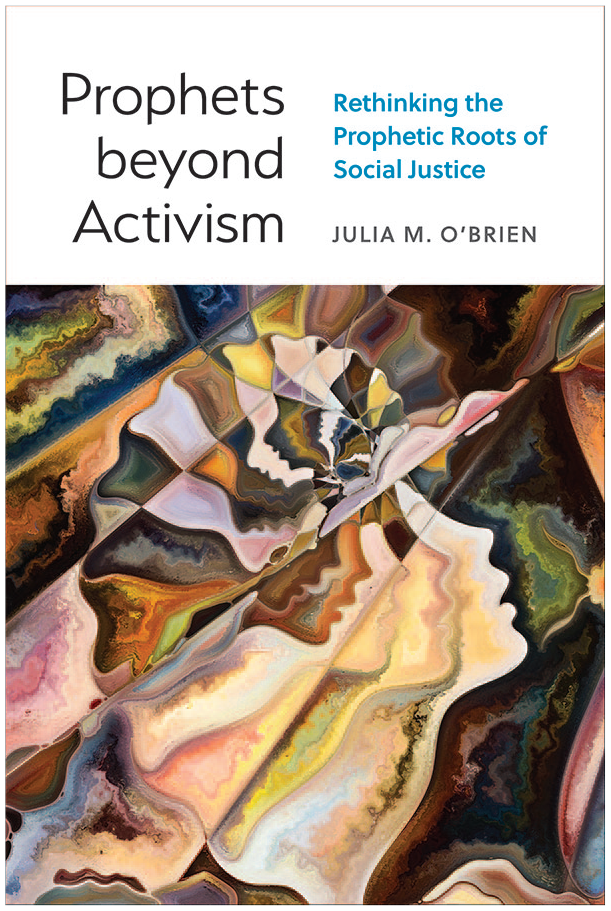
Prophets beyond Activism: Rethinking the Prophetic Roots of Social Justice
As a Jewish scholar of the prophetic literature who teaches in progressive Christian contexts, I have mixed feelings about this topic. On the one hand, I, too, find the prophets’ social critique compelling. It has shaped my understanding of the centrality of justice to Jewish understandings of God and God’s covenant. On the other hand, I am troubled by how often progressive Christian valorizations of the prophets replicate Christian anti-Judaism. If the prophets are the biblical representatives of justice and liberation, then the legal and ritual institutions that they challenge are the representatives of injustice and oppression. Given that Christians usually associate biblical law and ritual with Judaism, it does not take long for Judaism itself to become the quintessential unjust structure.
It turns out that I am not the only one with concerns. In Prophets beyond Activism, Julia M. O’Brien challenges what she calls the progressive Christian “orthodoxy” of prophetic social justice. An accomplished Christian scholar of the prophets who taught for many years at a progressive seminary affiliated with the United Church of Christ, O’Brien is well suited for the task. While she fully supports the progressive politics associated with this reading of the prophets, she contends that it is not inclusive of the experiences of many minoritized and marginalized groups. One of those is my own: “While on the surface, lionizing the prophets seems to honor the Jewish Bible,” O’Brien cautions, “this version of the prophets does something else: it lifts the prophets out of the Old Testament, making them an ethical core extractable from the ritual dross of the Jewish faith” (p. 58). For O’Brien, the anti-Judaism of the activist orthodoxy is indicative of the other problems with this approach. She challenges progressive Christians to recognize that biblical prophecy is more complicated than they often assume—and to let this shape their use of these texts for justice work.
In O’Brien’s view, the underlying problem is progressive Christians’ impulse to read the prophets in a historical and cultural vacuum. Accordingly, one of her central goals is to recontextualize them within the Bible, the ancient Near East, and Christian exegesis. When it comes to anti-Judaism, all three contexts intersect. O’Brien debunks the notion that the prophets were radically discontinuous with the Israelite legal and ritual structures that would later become the heart of rabbinic Judaism. Rather, they were products of these structures and frequently supported them. “Christians too often tout the social justice aspects of the Prophets without recognizing their deep embeddedness within the Jewish tradition,” O’Brien writes. “In the Prophets, the Gospels, and modern Judaism, ritual and ethics are deeply interwoven” (p. 99).
A second problem that O’Brien diagnoses is a failure of close reading: the activist orthodoxy prevents progressive Christians from seeing how often the prophets endorse ideas that are decidedly unprogressive—even while advocating for “justice.” As such, another major task she undertakes in the book is simply to walk readers through these texts. For instance, O’Brien shows that despite progressives’ use of the prophets for racial justice work, the prophetic conception of justice is decidedly ethnocentric. Amos, beloved among progressive Christians, insists that God “has an exclusive relationship with Israel (“You only have I known / of all the families of the earth” [Amos 3:2]). For him and, indeed, for all the prophets, justice is not “a universal ethical value but the obligations of Israel’s distinctive covenant with God” (p. 86).
As a biblical scholar, I share O’Brien’s view that the prophets must be contextualized, and that they often fall short of progressive ideals. However, as a Jew, I cannot help but feel that, in practice, these claims are at cross-purposes. What is the effect of urging progressive Christians not to detach the prophets from Judaism—and then to spend the rest of the book showing how xenophobic, misogynistic, homophobic, ableist, and elitist they all were? Given the prevalence of the anti-Judaism that O’Brien challenges, I worry that her readers might walk away thinking, “Wow, the prophets are less progressive than I thought—because of how Jewish they are!” This is obviously not O’Brien’s intention. Nevertheless, the fact that her book is vulnerable to this misreading suggests that she remains beholden to the very orthodoxy that she resists.
O’Brien’s discussion of prophetic ethnocentrism is illustrative. For her, this undermines the activist reading because ethnocentrism is self-evidently unjust—a classic progressive Christian stance. However, Jews typically understand ethnocentrism (better, Israel’s chosenness) differently: as the context that gives their obligation to justice its teeth. O’Brien cuts off Amos without letting him finish his thought: “You only have I known of all the families of the earth; therefore, I will punish you for all your iniquities” (Amos 3:2). The covenant is a structure of accountability to the oppressed, not a license to lord it over them. Yes, in context, those oppressed are also Israelites—a detail that should more frequently be acknowledged by activists who mobilize Amos for justice across groups. But once we do acknowledge this, is it so unreasonable to apply Amos’s message more broadly? While indeed the prophets do not articulate “a universal ethical value,” I fail to see why this makes them less relevant for contemporary justice work—particularly within a church that sees itself as part of the prophets’ audience. To my ears, this critique sounds disconcertingly close to the old Christian idea—alive and well in progressive circles—that the Jews are narrowly focused on themselves rather than on “all the families of the earth.”
This is not an isolated problem. A few pages later, O’Brien approvingly cites Walter Houston, whom she describes as, “a biblical scholar committed to justice, [who] claims that the most enduring legacy of the Bible as a whole is exactly this function: not its laws but its vision and ability to shape and reshape our moral imagination” (p. 89). In so doing, she echoes the classic anti-Jewish motif among progressive Christians: that the substance of biblical law is irrelevant for justice (and, perhaps, even prone to injustice). No consideration is given to a possibility that is obvious to most Jewish justice activists: that the specific rules of biblical (and rabbinic) law are the richest resources for justice work because they reflect the concrete action of which justice work actually consists. O’Brien might have benefitted from consulting Rabbi Jill Jacobs’s There Shall Be No Needy: Pursuing Social Justice through Jewish Law and Tradition (Jewish Lights, 2009), which offers a progressive activism program entirely rooted in the nitty-gritty of biblical and rabbinic law.
How is it possible that a book that takes such pains to resist anti-Judaism nevertheless falls into these traps? An indication may be found in a seemingly innocuous statement in the conclusion, where O’Brien emphasizes that she seeks “justice for the Jewish faith, justice for the colonized, and justice for the LGBTQIA community” (p. 126). Whereas “the colonized” and “the LGBTQIA community” are people, “the Jewish faith” is an idea. The incongruence is telling: actual Jews play virtually no role in this book, apart from occasional references to Abraham Joshua Heschel and some others. I certainly appreciate O’Brien’s objection to the unflattering and false idea of “Judaism” that the progressive orthodoxy has often fostered. However, the alternative idea of Judaism that she describes still looks little like the Judaism that I know. If anything, it looks rather like her own progressive Christianity. Because O’Brien does not engage the living Jewish practice of justice work, she deprives herself and her readers of the opportunity to discover other ways of mobilizing the Bible toward justice. By simply saying, “The Jewish use of [prophetic] terms and motifs is not mine to critique” (p. 8), she misses the most important point: prophecy is not the primary grammar of contemporary Jewish activism in the first place.
Despite my critiques, Prophets beyond Activism is an important corrective to well-meaning but potentially counterproductive ideas about the biblical prophets and justice. Progressive Christian clergy and laypeople should read it and take its challenge seriously. I only wish that, on questions of Jews and Judaism, O’Brien were not still so constrained by the very dynamics that she contests. The truth is that this reflects a much broader problem in progressive Christianity. Against that backdrop, Prophets beyond Activism therefore also deserves careful consideration from biblical scholars who are attentive to the biblical prophets’ role in the long, complicated, and often unhappy history of Christian-Jewish relations. Clearly, much work remains to be done.