






Abstract
This article examines the intertextual parallels between the books of Esther and Revelation through the primary lenses of humor and trauma, with additional attention to horror. As readers will see, both Esther and Revelation function as books of excess, employing comic hyperbole to lampoon imperial adversaries and culminate in excessive fantasies of revenge. They both also complicate tidy readings of resistance through their mirroring of the imperial structures they each seek to overthrow. As books that blend humor, trauma, and horror in excessive measures, Esther and Revelation illuminate how their ancient authors utilized comedic narrative to respond to imperial domination, how trauma’s effects simultaneously seep through their literary constructs.
The books of Esther and Revelation are books of excess. Esther begins with a 180-day display of wealth, followed by a seven-day drinking party, followed by King Ahasuerus issuing a decree that “men rule,” followed by the emasculinizations of those men, followed by the reversal of a death plot, followed by an Inglourious Basterds-like slaying of roughly 75,000 Persians over the span of a two-day sword fest. 1 Despite their differing details, Revelation proves similarly hyperbolic. It follows the implied author, John, as he imagines Jesus to be a gender-fluid proto-triune slain warrior: at once a Son of Man with breasts, a tiny trotting lamb, and hypermasculine super-warrior who reveals local and global adversaries to be incompetent beasts and drunken prostitutes. For John, it is only those from within his implied Jewish community who can enter his New Jerusalem unscathed. 2 Thus not only are implied enemies comically—and violently—lampooned throughout each narrative, but both Esther and Revelation culminate in excessive fantasies of revenge. In Esther, Persians are defeated; in Revelation, Romans (and Roman sympathizers) are overturned. In both texts, there is a drive to laugh and a drive to lord over.
While Revelation is often considered one of the most intertextual sources in the biblical canon—its author relies on and borrows from many other texts to craft his own—scholarly attention to its mirroring of Esther has remained surprisingly scarce. 3 Revelation’s and Esther’s textual parallels are what this article seeks to examine, utilizing lenses of humor, trauma, and horror to do so. Humor will serve as the foundation for this paper; as such, I will start by unpacking its theories, types, and techniques, which will then be followed by an examination of how the genres of trauma and horror interact with humor—and with Esther and Revelation. 4
Humor, Trauma, Esther
One of the most common axioms of humor studies is that humor is difficult if not impossible to define. Despite thinkers writing treatises on the comic for millennia, humor’s culturally specific tones and attitudes, not to mention its relentless subjectivity, make a singular definition of the comic difficult to maintain. As comic theorist Henri Bergson put it, humor “has a knack of baffling every effort, of slipping away and escaping only to bob up again.” 5 At the same time, it is important to keep in mind that “texts do not have humour any more than they have meaning.” 6 Meaning, in brief, is made by those who make it. Philip R. Davies thus sums this up well when he writes, “For all that the critic may try to establish that a text is funny or even that its author was trying to be funny, the sine qua non of such arguments is that the reader finds humor.” 7 Citing Freud, he adds, “Wit is made, while the comical is found.” 8 A reading practice of intertextuality assumes similarly that meaning is extrapolated and produced by interpreters. Texts gain meaning from “[t]he systems, codes, and traditions” from which they come and through which they are read. 9 For comic-attuned readers, humor becomes part of these systems, that is, part of a text’s network of textuality.
Investigating humor’s role in the Bible’s various networks of textuality remains complicated. A major reason for this has to do with not only humor’s personal and cultural relativity, but also the fact that many of the biblical sources, especially those within the Hebrew Bible, are difficult to date and therefore read alongside contemporaneous examples of the comic. Scholars do, however, regardless of dating (im)possibilities, focus on reading texts for various humor techniques and types (e.g., incongruity, absurdity, hyperbole, irony, wordplay, reversal, repetition, U-shaped plotlines, satire, slapstick, and more).
Humor also has a social function. As comic “relief” and “superiority” theories indicate, humor can not only help relieve one’s nerves—perhaps even provide space for play when such a space is otherwise limited or inaccessible—but it can also, in doing so, function as a coping tool. 10 Humor, including violent humor, “can give people a break from the real world. It can even offer counter narratives—narratives in which one’s adversaries are the ones who are mocked, ridiculed, and humiliated. Indeed, by humiliating the enemy [—and this is key—] one can resist and subvert the enemy.” 11 To quote Freud once more: “By making our enemy small, inferior, despicable or comic, we achieve in a roundabout way the enjoyment of overcoming him [sic].” 12
This use of humor occurs in many ancient Jewish texts. From the Assyrian onslaught in 722 BCE, to the Babylonian exile beginning in 597 BCE, to the Roman conquest of Judea in 63 BCE, to the ever-present Roman gaze—situated firmly on Jewish “Others”, culminating in the expulsion of Jews from Judea throughout the first and second centuries CE—ancient Israelites and later Jews fought repeatedly for cultural persistence, and often used narrative—including a narrative use of humor—as a means of doing so. As Melissa Jackson writes, comedy in the biblical sources “aids survival.” 13 That the Jews can survive in comedy and even take the upper hand, she explains, “keeps alive the promise that surviving real life is also possible.” 14
It is precisely this connection between humor and survival that brings the conversation to trauma and, with it, the book of Esther. By way of background, like humor, trauma is subjective, meaning that a shared event or events may not be experienced as trauma in all individuals and/or social collectives. Much in fact comes down to the effects of an experience: an event is rendered a trauma if an individual or collective respond to it in a way that signals it has been internalized as traumatic. 15 At a recent Society of Biblical Literature meeting, Sonia Kwok Wong even asserted that an event need not be “real” for one to experience posttraumatic effects in response to it. 16 An imagined event, in other words, may be traumatic if it elicits a posttraumatic response (e.g., avoidance, hypervigilance, anxiety, dissociation, a need to narrate and/or speak back to the event or events despite avoidance cues, etc.). This is an astute point, to be sure, one that I hope will nuance a current typical starting question with regard to trauma studies within the biblical field. This starting question is: Can a biblical source and its implied trauma response relate to the Bible’s social-historical contexts (i.e., can the narrations and/or ruptures within a text point to a “real” historical hardship)? 17
When it comes to Esther’s historical context, we do know some things: it is a post-exilic text, and its story world context, even if some argue it was written in the early Greek period, is Persian. 18 In many respects, the text does seem to be at home in the ancient Iranian world. Susa, where the story takes place, was located at the heart of the Persian empire and was the central dwelling place for the Persian royal court in winter months. Such a court would have projected an image of piety, suggesting their rule was sanctioned by the gods. This alone tells us something important about the Esther tale: Its lack of divine intervention is not a reflection of Persian influence but instead a purposeful move on behalf of the author, for reasons we will soon see.
It has also long been articulated that Esther’s king, Ahasuerus, is a representation of Xerxes I, who reigned in Persia from 486–465 BCE. The text, in fact, begins with Esther’s “Xerxes” in his third year of reign, although this may have less to do with specific dating and more to do with an easy setup to lampoon the king and his ostensible reign. A compound of “ruling” and “hero” or “man” in Old Persian, Xerxes means something like “ruling over heroes and/or men” or “hero among rulers.” 19 Esther’s new-to-the-throne “Xerxes” does neither, perhaps alluding to authorial dismay or distrust in the Persian imperial enterprise, or perhaps, in further evocation of its ancient context, to mirror ancient narrations that depict Xerxes as both brute and buffoon. 20
Of course, Ahasuerus is a literary construct. He’s not the real Xerxes, or the real anyone. Still, readers can question how Esther’s representations might still demonstrate how the writer felt about the state of Jewishness in post-exilic Persian Diaspora. It is important to note, for example, that, third year of reign or not, the story unfolds over a century since Cyrus expanded Persian dominance and brought nearly all Jewish-populated lands under his control.
21
Considering this intertextually with other post-exilic writings, Aaron Koller makes a compelling observation:
Despite all the differences between the visions of Ezekiel, Second Isaiah, and Zechariah…all the[se] voices from the past spoke as one in assuring the Jews in Persia that their exilic existence was temporary. Their lives, however, screamed the opposite was true…[While Jews] could remind themselves that the Assyrians had risen to great power, and then fallen hard; [that] the Babylonians, too, had controlled a great empire and then virtually disappeared as a political force…the Persians had already ruled for twice as long as the Assyrians, and three times as long as the Babylonians.
22
In Koller’s view, the writer of Esther knew this, and as such created a narrative in purposeful opposition to these other expositions. The god of Israel is missing for a reason, as is any allusion to a second exodus or evocation of Davidic sovereignty. 23 Being Jewish for Esther’s author, Koller insists, was a cultural identity of which to be proud, even a reason for choosing to write in Hebrew instead of Aramaic or Old Persian, but it was nevertheless an identity that could exist without the “Jerusalem-David-…-Exodus-God complex.” 24 The Jewish people were now an exilic people, and it was on them to survive—and thrive—under such circumstances.
More can be said, however, for how the text bears witness to the trauma and disruption faced by the Jewish people. When reading for trauma effects, biblical scholars often do so in two interrelated ways: (1) they read biblical literature as narrations of and/or counter-narrations to communal devastation and (2) they read the literature for signs of distress either in the author’s own reflections or in the portrayal of his characters. Although interconnected, Esther is more commonly read as a narration of and counter-narration to communal suffering. For example, as I have argued elsewhere, while the Megillah may not provide a literal historical account, it could be expressing “affective truths”—truths that, though presented through fictional narrative, still embody aspects of Jewish collective memory and consciousness. 25 Most scholars agree, for instance, that while Esther appears more fictional than factual, it still illuminates a contemporaneous Jewish political self-understanding. To use the words of Adele Berlin, the book of Esther “addresses the inherent problems of a [Jewish] minority people, their vulnerability to political forces and government edicts, their lack of autonomy, and their dependence on royal favor.” 26 While historical Jews in Persia may not have faced literal genocide as the story describes, the text’s depiction of Jewish life still reflects a cultural and psychological reality in which Jews existed as ethnic outsiders—a reality that, according to some trauma theorists, especially those trained to consider the impact of displacement and empire, can inherently rupture the integrity of a Jewish communal consciousness. 27 Esther addresses the need to respond to such rupture—and not just through Mordecai’s adornment of sackcloth and ashes, a sign of suffering and political demonstration against the Persian norm as it may be (Esth 4:1). A response is also demonstrated through the purposeful erasure of the gods. Of the missing God of Israel, for example, one may be reminded of the oft-cited Holocaust and post-Holocaust laments: “If there is a God, He will have to beg for my forgiveness.” 28 And “If there is Auschwitz, there is no God.” 29 If there is exile, maybe there is no god. Or at the very least, maybe there is no reason to rely on that god, but instead on the wit and grit of actual people. Esther, in other words, may be offering a fictive narrative that not only captures the real displacement and imperial Othering of Jews but also finds ways to respond and even talk back to such displacement and such Othering.
The text also narrates the intersectional features of Persian power, person, and gender—and for more than just Jews. The book of Esther, according to Ericka Shawndrinka Dunbar, is a book of horror, highlighting the violence and psychological terror of sex trafficking that underpinned the Persian empire. 30 That women’s and other minoritized bodies are made abject, existing only for elite male pleasure, is part of the text’s traumatizing legal social structure. This is evidenced in no small measure by the result of Vashti’s refusal to show herself to the intoxicated king and his intoxicated officers and ministers, followed by “beautiful young virgins” competing for the position of queen, a selection process that required a night of sex with the King (Esth 2:2–16). Framing the collection of virgins as state sponsored trafficking, Dunbar shows that Esther reveals the very real traumatizing features of colonial domination. Not only was the practice of acquiring women commonplace, whether as war booty or otherwise, but so were governors and scouts conscripting and sending to Persia “tribute” in the form of castrated boys and attractive and generative (fertile) girls. 31
In narrativizing this historical reality, Esther also, akin to other horror tales like The Silence of the Lambs, or The Shining, or Midsommar, narrates and even exploits fear of the unknown and the unexplained. We are never told, for example, what happens to the women who are used and abused by the King for just one night. While we are informed that Vashti’s dismissal is what ultimately leads Esther and others to be trafficked in the palace harems, the text is silent on their subsequent fate, including Vashti’s. 32 We don’t even know if she is kept alive. The audience of Esther is thus left to fill in the blanks with their own imagination, cultivating a sense of dread long after the story’s end. Through these unknowns, Ahasuerus is also presented as a proto-Hannibal Lecter, embodying the contradictions of human behavior—in this case, both brute and buffoon—in terrifying ways.
Esther is more than just horror, however, or a narrativization of imperial imposed trauma. As alluded to earlier, the Megillah encapsulates an array of comic types and techniques, from hyperbole to irony to slapstick to satire, as if to offer, in addition to Jewish wit and grit, a comic counter-narrative in the face of imperial domination. We see evidence of this use of comedy in the same scene as the one of Vashti (explored above). When Vashti refuses to wear a royal diadem for Ahasuerus at his seven-day drinking party, Ahasuerus and his court-of-bros throw a royal temper tantrum, culminating in the creation of an edict stating that all wives must treat their husbands with respect. The juxtaposition of powerful rulers, typically associated with strength and authority—or at least self-perceived strength and authority—exhibiting such childish behavior not only creates irony, but also showcases the extent to which these rulers fail to recognize the hypocrisy of their own actions. While they have no issue inflicting harm or hardship on others, they become emotional when faced with the smallest opposition or disappointment. Their lack of wherewithal is heightened by the fact that, as Celina Spiegel has shown, the King’s edict is simply a reiteration of the patriarchy already in place. 33 In other words, Ahasuerus can neither maintain nor retain his own orders.
Such focus on Persian incompetency continues throughout the narrative. Whereas traditional slapstick features a duo with one character being more level-headed and the other being the “fool” who drives the plot, it is difficult to decipher which character—that of Ahasuerus or Haman —is the text’s “Dumb and Dumber.” 34 Although not introduced until chapter 3, Haman is presented by Ahasuerus as a man of particular honor: He is given a seat above all the officials who were with him, which inflames Haman’s sense of self-importance (Esth 3:1). As is well noted, however, Haman’s exaggerated self-esteem is quickly lampooned as the additional honors he had coveted for himself are bestowed upon his arch-nemesis, Mordecai. Instead of being draped in robes and carried by the king’s royal horse, Haman is forced to lead the ceremony in ironic reversal. The bit is then repeated—and heightened, literally—when Haman is impaled on the pole he built for Mordecai. While Haman’s elevation to a position of power in 3:1 is indeed maintained, it is also savagely mocked, as he is ultimately “elevated” fifty cubits high. 35
When read in this way, we can see the text’s comic bits connecting to form comic butts. Esther functions as a grand political satire, one that paints enemy personages, most notably royal Persians, as royal pains in the ass. Even though Persian leaders may think they are elite, in Esther, they are nothing more than foil for plot, farce personified in the face of Jewish wit and survival. Rather than wallow in the repeated diminishment of his exiled minority group—a position perhaps captured in the text’s genocidal edict and power-plays of the King—the author of Esther combats royal functioning via parodic depictions of Persian rulers. In brief, the author creates a comic counter world—one in which Persian leaders are chumps, and he and his Jewish counterparts can survive and thrive. 36
Humor, Trauma, Revelation
I have suggested that this narrative use of humor is also in the book of Revelation. Although I unpack this at length in Humor, Resistance, and Jewish Cultural Persistence in the Book of Revelation: Roasting Rome, I summarize my findings below for the purpose of putting them in conversation with Esther. 37
Written in the latter half of the first century CE, much more can be said for Revelation’s context than Esther’s, in that, at the very least, interpreters know under which imperial system the text was constructed: Rome’s. Consensus remains that the author of Revelation creates a counter-narrative to contemporaneous Roman imperial conquest. While Rome and Roman sympathizers are depicted as looming large over and against John’s marginal Jewish group, John disarms them via a series of incongruous descriptions in an attempt to neutralize their power before Christ can destroy them for good.
Already in Revelation 2, John begins to construct an implied “us” of anti-Roman Jewish Christ-confessors, and does so by mocking “Jezebel,” the local false prophet and supporter of non-halakhic, Greco-Roman practices. We see such mockery at once in the Greek name: Iezabel. Beyond its reference to the infamous queen of 1 and 2 Kings, “Jezebel” carries parodic signification. When vocalized, the Greek Iezabel echoes Hebrew phrases such as “where is the prince?” (izebul) and “no nobility” (i-zebul), and an Arabic cognate for “dung” (zebel). Naming the false prophetess “Jezebel” thus becomes comedic wordplay that reveals an underlying incongruity: Jezebel is not who she or her followers think she is. “For all intents and purposes, she is a piece of shit—always already devoured, digested, and excreted by dogs [she is thrown out the window and eaten by dogs in 2 Kings 9:10]—and readers privy to Revelation’s humorous paronomasia are invited to see her as the ‘dung’ she really is.” 38 This humor, in turn, is what creates the boundary between implied jokers and the implied butts of their joking. Those like Jezebel are “out” (out the window?) and those like John are “in.”
Once Revelation constructs its implied community of laughers (i.e., Jewish anti-Roman Christ-confessors), it extends the humor onto larger adversaries—predominantly, Rome. In this way, Revelation’s satiric jabs operate on two levels: its mockery of local adversaries clarifies for readers the boundaries of the text’s “correct” Jewish cultural identity, while its comedic treatment of global powers challenges the prevailing discourse that has marginalized Jews as outsiders. Regarding the latter, for example, John roasts Rome: “And I saw a beast rising out of the sea, having ten horns and seven heads…The beast that I saw was like a leopard, its feet were like a bear’s, and its mouth was like a lion’s mouth” (Rev 13:1–2).
The comic here may not seem obvious. But luckily, because we know the imperial context under which Revelation was written, much more can be said about its relations to contemporaneous constructs of humor. Thus before unpacking the above description for humor, it might be helpful to note that, contrary to modern ethics, ancient humorists often found much humor in disfigured people and their gestures. 39 In ancient Roman graffiti, for example, we see persons mocked as having bald heads, abnormally shaped faces, animal-like features, and even phalluses penetrating their mouths or replacing their noses. 40 Women and women’s bodies, too, were lampooned regularly, often simply for the fact that they were not men or men’s bodies. 41 These types of characters, images, and statements were rendered humorous precisely because they did not comply with normative social values.
Roman piety existed upon a cosmic and oppressive, hierarchical scale, in which self-mastering deities and the male, Roman elite ranked toward the top, while women, slaves, and irrational beasts ranked toward the bottom. To mock the physique of one’s enemy served to cast that person as a “laughable physiognomy” and throw him down the power gradient. 42 To laugh at women served to maintain their subordinate position relative to men. To draw a penis penetrating a man’s mouth served to associate that man with the lesser, effeminate gender—the one that was penetrated rather than penetrator. Humor, put simply, often functioned as a “self versus other” dialectic that influenced societal norms and, in turn, lived experience. By depicting Rome as Beast, then, we can say comfortably that John is thrusting Rome down its own power gradient. Instead of its traditional military garb, the empire here is dressed in animal-skin, ready for public humiliation.
There are Jewish elements to this satirical construction, too. It is frequently noted, for example, that John is borrowing imagery from the book of Daniel—a text often referenced for its comedic subversions of enemy superpowers. In Daniel 4, for instance, the Babylonian King, Nebuchadnezzar, dreams of an “imperial” tree of life being felled to a stump, then transformed into an animal that must graze the earth for seven years (4:10–16). According to Daniel, who interprets the dream, this is an indication of the King’s collapse: “Oh King (he explains), it is you!...You will be driven away from humans to live with beasts. You will eat grass like cattle and will be made wet with the dew of heaven. And seven years will pass before you recognize that [it is my] God who is the God of all people” (4:19–25). Daniel’s interpretation turns out to be right. A few verses later, the King appears hunched like a cow, consuming mounds of grass. His hair has lengthened to resemble an eagle’s feathers, and his nails have grown as long as a bird’s claws. Despite the grotesque image of the king grazing on all fours, scholars have long recognized humor at play. As David Valeta summarizes:
The scandalous scene of a monarch munching vegetation on four appendages is one of the most ludicrous stories of Daniel …. These scenes are plainly designed to violate and denigrate royal etiquette. This is a tragic-comic portrait of a regent who claims absolute power but whose actions repeatedly reveal his impotence and beg for his further humiliation.
43
After all, even to the modern reader, there is surely something humorous in imagining “great leaders” refurbished as animals.
Daniel’s Nebuchadnezzar morphs into even further absurdity in the later apocalyptic visions of Daniel 7–12. 44 There, Daniel’s vision reduces the king to a tiny talking goat horn. This horn-king fumes with rage, hurling insults at the God of Israel and that God’s divine assembly (7:25). When read against constructions of contemporaneous masculinity—physical strength, mental fortitude—the text positions Nebuchadnezzar as deficient in manhood and therefore deficient in royal authority. He personifies “short man’s rage,” a comic convention deployed in both ancient and contemporary contexts to discredit through bodily inadequacy. As I write elsewhere, “The King’s emotions are simply too big for him.” 45 In fact, the transformation into a tiny talking horn involves not general bodily miniaturization but the reduction of a particular part of the body: the small horn is unmistakably phallic. Daniel 7, therefore, may preserve not only one of the first known apocalypses, but also potentially the first penile joke in traditional Jewish literature. Here is an interpretive image of the scene [Fig. 1]:

In Daniel’s apocalyptic vision, Nebuchadnezzar transforms into a tiny phallic horn. Illustration by Zoë Kushlefsky, 2025.
In the spirit of humor hyperbole, John of Revelation takes this image and heightens it: His Sea Beast has bejeweled horns sticking out of its heads paired with blasphemous names printed upon them. 46 Thus, while the names are certainly an indicator of Rome’s satanic associations, it is also tongue-in-cheek to humor. The empire, put simply, is absurd [Fig. 2].
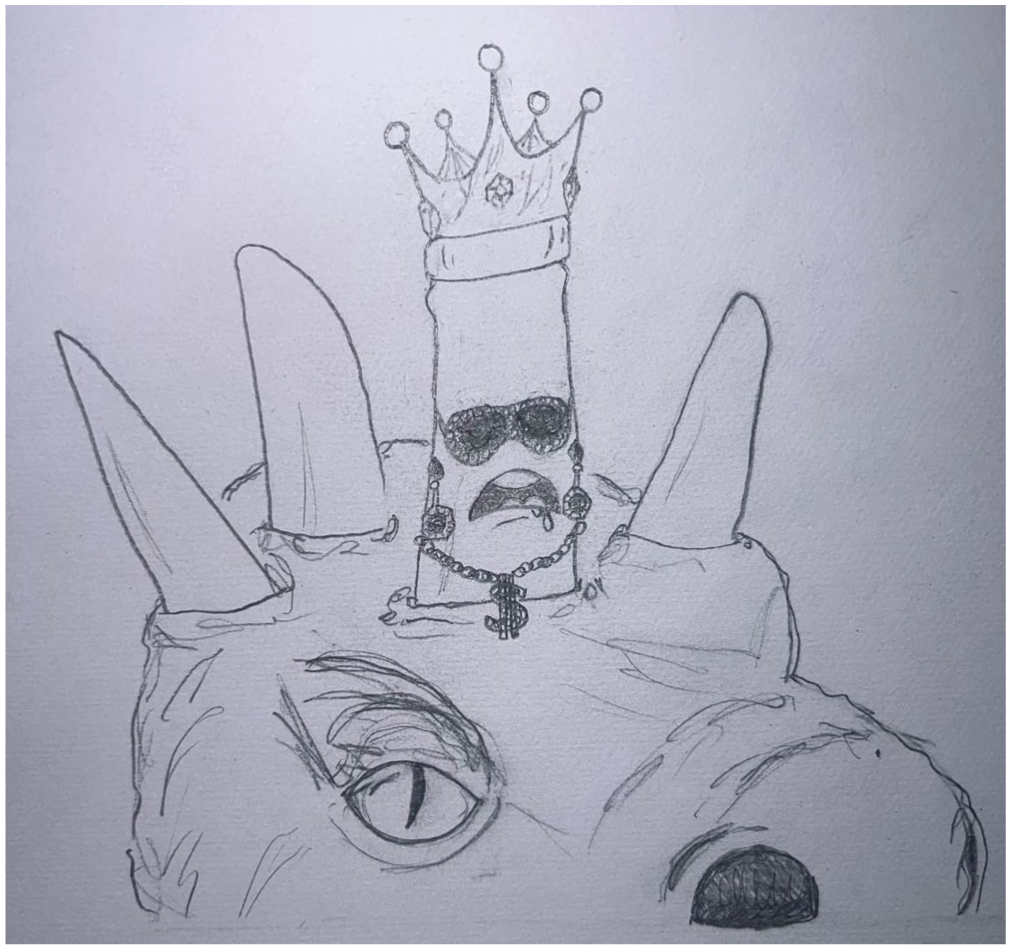
In Revelation’s humorous hyperbole of Daniel, the sea beast has become a bejeweled phallic horn. Illustration by Zoë Kushlefsky, 2025.
Bejeweled penises aside, the text also makes a satiric juxtaposition between the Beast’s blasphemies with proper tefillin practices. In the book of Deuteronomy (6:8), worshippers of the Israelite God are told that verses of the Shema prayer—a prayer listing YHWH as the God of Israel—should serve as a symbol between their eyes (or forehead). John’s implied audience would have certainly recognized the juxtaposition between the Beast’s blasphemous lists and the proper bodily dedication, as Jewish use of tefillin is well attested in the first century. More importantly, they would have recognized that this description of Rome not only highlights the empire’s exclusion from the coming world, but also functions as caustic parody. Like someone unaware of obscenities drawn on their forehead—or, say, like Haman parading Mordechai around in Esther, or Nebuchadnezzar turning into a small penis in Daniel—Rome here has become the unwitting fool. Because of the Empire’s inability to worship the correct God in the correct way (likely without even realizing it, no less), the empire is left out of the New Jerusalem as well as John’s own community of laughers.
Throughout Revelation, Rome is also—and perhaps more directly—depicted as the great Whore of Babylon. As the text reads:
Come, I will show you the punishment of the Great Whore who is sitting on many waters, with whom the kings of the earth have committed sexual impurity, and with the wine of her sexual impurity the dwellers of the earth have been made drunk, and who is holding in her hand a golden cup full of abominations and the impurities of her sexual immorality. (Rev 17:1–4)
When reading this passage, it is important to keep in mind that, while “Rome” depicted itself as female through the goddess, Roma was still “masculine on the level of ideology,” 47 largely because “Rome was epitomized by its ostensibly irresistible military.” 48 The description of Rome as a “Great Whore” (he porne he megale) thereby casts Rome as not a warrior—nor as a man—or even as a courtesan, but as a “nameless, faceless, streetwalking harlot.” 49 In terms of Rome’s own social hierarchy, He Porne lingers grotesquely at the bottom of the gendered gradient. John, in short, has turned Rome into spectacle, with her legs spread wide for all to see. And by describing the men of the earth as being “all-too-willing to kneel and guzzle” from what we can only imagine to be the Whore’s “own cup,” John, “like so many humorists who lampoon[ed] their opponents for what they chose to suck and swallow,” similarly satirizes Rome’s followers (Rev 17:4). 50
But John is not yet finished. Via scathing satire, he couples the Whore’s promiscuity with even more obscene character traits. He continues: “[I saw] on her forehead a name—a mystery: ‘Babylon the Great, mother of Whores and the abominations of the earth.’ And I saw that the woman was drunk with the blood of the saints and the blood of the witnesses of Jesus” (Rev 17:5–6). This is a grotesque reality indeed. Not only are the Whore’s genital fluids (her whorings) paralleled with the repulsive liquid she ingests (she’s drinking blood), but she also, in doing all of this, embodies an “utter inversion” of Jewish dietary practices. 51 Like the Beast, The Whore’s fornication is spelled out directly on her forehead (metowpon). But in addition to lacking John’s own tefillin mastery, the Whore also violates halakha (Jewish law) by consuming another’s lifeblood (Gen 9:4.). As stated, she drinks the blood of the saints and martyrs, becoming a “swollen spectacle”—an even bigger comic “butt” than her Beastly predecessor.
While Daniel is certainly another intertext of the hyperbolically intertextual Revelation, one here might also recall Esther, and perhaps not with regard to humor. At the 2020 Society of Biblical Literature review panel of Humor, Resistance, and Jewish Cultural Persistence in the Book of Revelation, Tina Pippin remarked that she kept reading the word “humor” as the word “horror.” 52 But if there is anything humor studies indicates, it is that horror need not exclude the humor—or, even, the fun. 53 Rome, in all her ugliness, is still the dupe. For as the Whore drinks from her utterly non-halakhic life-blood-cup, implied readers are invited to snicker with pride at the joke food he has placed in front of her—a food that prohibits the empire from entering John’s imagined world to come. John here has essentially whoopee-cushioned her (a Roman invention)—with a Jewish, halakhic twist—and only Rome is too stupid to hear the sound. Through repeated comic reversal, John has characterized the typically rendered “high and mighty” as just the opposite: a humiliating, gluttonous monster who is unaware of her own ineptitude, obscenity, and lack of self-control. Despite her imperial status, she, like Haman, is the epitome of human failure. She is a beast. A Whore. A dud.
Much like the humor in Esther, I have proposed that Revelation’s humor operates as a survival tactic in the face of imperial trauma. It attempts to create an “in group” of survivors and an “out group” of defeated opponents. 54 I have also suggested that Revelation’s intended readers are encouraged, through John’s comedic caricatures of Rome and Roman sympathizers, to ridicule and even laugh at the Empire for assuming it is stronger than it actually is, and for assuming that Roman imperialism will continue to rule over them. Like Esther, it is the contextual not-hero—that is, the sectarian Jew—who becomes the textual hero. And as the rich, elite, and all-powerful Rome, along with her followers, are defeated, John’s marginalized Jewish community, like Esther’s, comes to reign supreme.
Intertextual Books of Excess
The similarities by now should indeed be clear: both Revelation and Esther utilize hyperbole and incongruity to cast their enemies as idiots deserving of bodily suffering and public ridicule. Both also utilize the comic to an extreme; their drives to ridicule overflow into drives to lord over. This in fact gets us back to their intertextual evocations of trauma, and not just with regards to their own violent endings. While each text risks their own traumatization of implied Others, they also both showcase a range of trauma responses, ones that complicate tidy readings of resistance and survival.
On the lack of tidiness in Esther, Alexiana Fry urges readers to consider the aforementioned second approach in trauma hermeneutics: the cues of trauma and posttraumatic stress within the writing and/or character development. In engaging this approach, Fry shows that Esther’s Jews may indeed survive but not necessarily always thrive. She adds to Dunbar’s reading of Esther by showcasing how Esther herself enacts signs of posttraumatic stress. “[W]ith a trauma-informed lens,” she writes, “we are face-to-face with the literary survival mechanism of fawn.” 55 The fawn response, she adds, is one of hyper-awareness and dissociation combined: one is both “hyper-aware of what is happening [around them and also not at all aware…of [one’s] internal experience.” 56 In brief, fawners cater to others often over and against the needs of one’s own self. This is a common response to trauma, especially by “bodies made minoritized,” such as postexilic Jewish women living under a non-Jewish patriarchal system. 57 We see this enacted in the text. Esther, for example, as Fry shows, is consistently “tov” or “pleasing” to not only the King but also to Mordecai. “Her internal radar to her needs has been conditioned to completely shut off in order to become hypervigilant to others’ needs, [especially those] who are supposed to care for and meet her needs and have failed to.” 58 Even Esther’s request to add an additional day of slaughter in 9:13 might be to please the King’s own interests. In Fry’s words, Esther knows that the King “is not opposed to genocide or violence more generally as a way to govern [and thus may, come chapter 9, be thinking to herself]: “What would best please the King at this time, after one day of war? Perhaps more gratuitous death?” 59
Fry also makes clear, though, that we can’t really know the reasoning behind Esther’s request. The truth of the matter remains that, by the story’s end, we do not really know Esther at all. We see no development of her internal sense of self, just consistent hyper-awareness of those around her. She is, as the text reminds us: hidden.
Esther is also stuck. Never is she called Hadassah again. And never is she to leave the Persian court, at least not of her own volition. 60 This effectively encapsulates the broader Jewish situation within the narrative, as they, too, do not escape the Persian system. Even with Esther’s access to the royal crown, Jews, like Mordecai, are at the gate: they are actively loyal, yet always already liminal subjects of empire. Intentional or not, this is itself a call to how trauma operates: as much as trauma recovery involves integrating trauma and its effects into one’s conscious awareness, which may indeed mitigate posttraumatic suffering, there is no “cure” for trauma. Some thinkers even reject the term “healing” altogether, preferring “remaking” instead: trauma survivors continuously “remake” their identities in processes that are neither linear nor uniform, and that never restore them to what they were before. We see this lack of return highlighted at the end of the Esther narrative. While Esther’s ending is often presented as the upswing of a comedic U-shaped plotline in that there is a festival to commemorate Jewish redemption, the author makes clear that such festivities do not last forever. Imperial imposed taxes, he shows, will always resume. To get back to Koller’s point, it seems the author here knows that the effects of exile will never end, at least not fully. A return to Jerusalem is not really a return. A Jew in court is not really a return to Jewish monarchical order. A festival is not really the overturning of all social order. Like the effects of trauma, they can’t be.
Revelation functions similarly, so much so that its non-return-to-Jerusalem narrative becomes, at least in my reading, the key site of intertextual dialogue with Esther. At first blush, this may seem nonsensical; even more than the installation of a Jewish-centered festival (e.g., Purim), Revelation ends with God and Jesus ushering in an actual New Jerusalem: “And I saw the holy city, the New Jerusalem, coming down out of heaven” (Rev 21:2). But as empire-critical and postcolonial readings of Revelation have shown, there is much more to this new kingdom—and indeed this kingdom’s Christ—than meets the eye. 61 For in addition to parodying Rome as Beast and Whore, and in addition to mocking Roman sympathizers as various pieces of shit, John also transforms his own New Jerusalem hero. Indeed, as readers begin to focus their gaze, they start to notice, shall we say, a small peculiarity: “Not to put too fine a point on it, but Revelation’s Christ has boobs” (mastoi, in Greek, as opposed to stēthos, which means chest). 62 As the King James Bible translates the verse: “And I [John] turned to see the voice that spake with me. And being turned, I saw . . . one like a Son of man clothed with a garment down to the foot [insinuating a gown] and girt about the paps [breasts] with a golden girdle” (Rev 1:13). 63
Perhaps even more peculiar than Christ’s own breasts, however, is Christ’s eventual transformation into a tiny lamb: “And I saw in the midst of the throne and the four living creatures and in the midst of the elders a teeny-tiny Lamb” (to arnion, the diminutive of arēn (Rev. 5:6). According to John, this lamb is his Christ [Fig. 3].
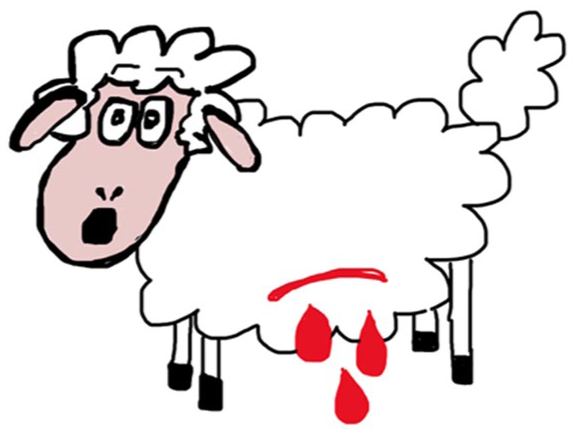
The tiny, wounded lamb that will conquer Rome. Illustration by Emma Adamcik, 2025.
Although Christ as lamb certainly highlights the text’s Jewish symbolism and sacrificial imagery, it is indeed striking that John’s messiah—that is, the one who is supposed to overturn the entire Roman order—is an itty-bitty, wounded sheep.
Of course, one may conclude that Christ’s effeminacy here functions as another subversive ploy; John elevates Christ-the-lamb—an animal that was regularly penetrated in antiquity—to the penetrator of Roman legions. As John writes: “They will make war with the Lamb, and the Lamb will overcome them, because he [the Lamb] is Lord of Lords, and King of Kings” (emphasis mine; Rev 17:14). Similar to the comic plots in which normative “others” outwit their patrons, perhaps John here is—again—illustrating that Rome is just too stupid to realize her own ineptitude. Even an itty-bitty lamb can subdue her.
There is, however, another slight issue here, as Christ-the-lamb nevertheless becomes quite the Roman by the apocalypse’s end. In fact, this should be apparent already from the quote just mentioned. The Lamb is Lord, the Lamb is King, the Lamb is . . . Emperor? [Fig. 4]
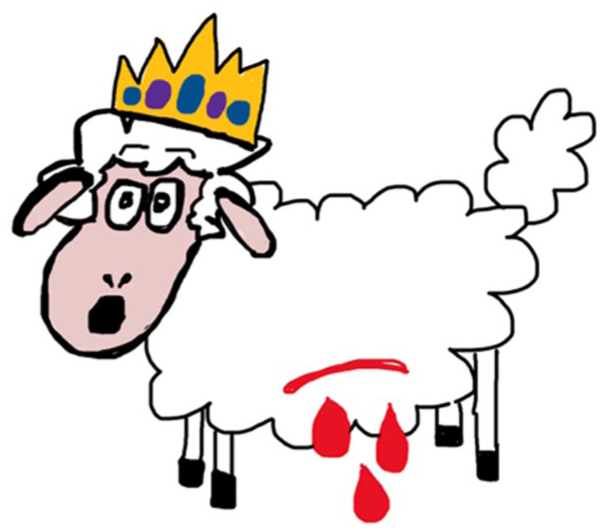
The Lamb as King of Kings becomes an imperial figure. Illustration by Emma Adamcik, 2025.
In all likelihood, John’s lamb is at least intended to be a masculine one. After all, he is King. According to New Testament scholar Colleen Conway, in fact, John actually highlights the Lamb’s masculinity to the point of creating a monstrous character. 64 Possessing seven eyes and seven horns, the Lamb not only comes to prove itself equally grandiose and grotesque to the Roman Beast from before, but also becomes the primary instrument through which readers witness the torture and demise of John’s adversaries. As John recounts: “If anyone worships the [Roman] Beast and its image and receives a mark on his forehead or on his hand . . . he will be tortured with fire and sulfur in the presence of the holy angels and in the presence of the Lamb” (Rev 14:9–10).
In other words, the Lamb undoes the ruling classes of Rome through its own embodiment of imperial forces. Because of this, in fact, we might even say that such monstrosity produces yet another ironic turnabout; the Lamb inevitably loses his manhood because his manic acts of violence override any sense of self-control—a masculine virtue John similarly strips from the Roman Empire. One here, in fact, might think of the Killer Rabbit from Monty Python and the Holy Grail, 65 captured in the interpretive image below [Fig. 5].
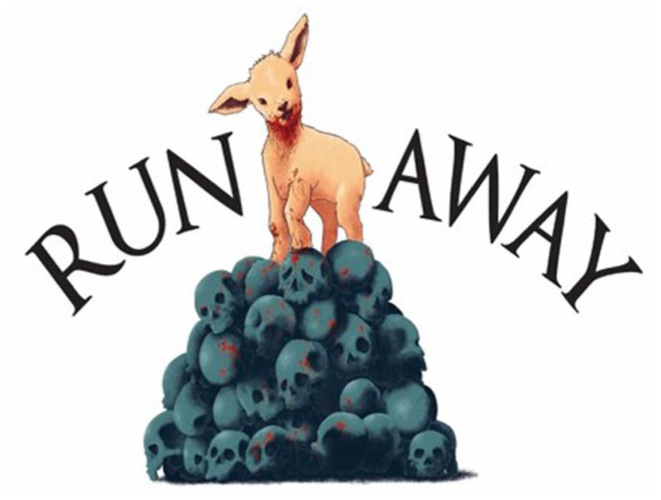
The Lamb’s manic violence and loss of self-control is reminiscent of the “killer rabbit” in the film Monty Python and the Holy Grail. Illustration by Alain Dimapilis, 2020.
In sum, John’s effeminate, then manly, then again effeminate lamb-man functions as an unintentional incongruity. John is so intent on diminishing Rome that he, in a fervent rage to construct the manliest of men, “plants the seeds of his own undoing.” 66 In the end, Jesus looks like the very thing John has been mocking all along. Through its overzealous need to obliterate the empire, the Lamb becomes the new Caesar. Despite the Apocalypse’s claims of ex-centricity—its “hold[ing] up for emulation a [Jewish] practice that is at once peripheral and pure” 67 —Revelation’s violent, satiric, and (let’s not forget) deeply misogynistic reimagining enacts its own imperial gaze. Thus, even the New Jerusalem is not really a “return” to anything, at least not without Rome. In the words of Robert Royalty, who compares the New Jerusalem to Roman empire, “Only names and labels are changed.” 68 This has led me to conclude that, in his pursuit to outwit Rome, John’s Jesus—and by proxy his entire apocalypse—risks becoming the unintended butt of John’s own joke. 69 Or as Spiegel writes of Haman and Haman’s edict, Revelation may indeed recoil on its own head. 70
Some readers have suggested that Esther’s ending, or at the very least its reversal of genocide, reveals something similar. Not everyone, in fact, has read the Jews of Esther as heroes, liminal or otherwise. Its Jewish wit and Jewish trickery foreshadows, for example, the perceived danger of twentieth-century European Jews hiding their race under the guise of their paler skin. Hitler even supported vengeance against the Jews for, in his view, their very much nonheroic actions in Esther. He asserted that “unless Germany is victorious…Jewry could celebrate the destruction of Europe by a second triumphant Purim festival.” 71 Later, Julius Streicher, seeing himself as carrying into effect the work of not only Hitler but also of Martin Luther, shouted “Purimfest!” as he made his way to the gallows. For these antisemites, Esther was a manifestation of horror, as were Jews themselves.
Yet even those who do not extend anti-Jewish sentiment don’t know what to do with the text’s excessive ending. Some even want to bifurcate it from the rest of the story; many scholars argue, for example, that while chs. 1–8 may be written in the Persian period, the violence of ch. 9 more rightly mirrors a later time period, perhaps that of the Maccabean era in which, some argue, Jewish violence and physicality were glorified. 72
While I am not suggesting that those who connect Esther to the Maccabean era are speaking from a place of anti-Judaism, I do question if the anti-Jewish interpretations of Esther continue to impact how readers relate to it and its characters. After all, even the hyperbolic deaths resulting from a hyperbolic edict can be read with the same absurdities as the rest of the narrative. With regard to Esther: When the Jews of Esther perform mass murder, their vengeance is interrupted repeatedly, not with descriptions of the fallen, but rather with the bizarre line, “But the Jews did not lay hands on the spoil” (Esth 9:10, 15, 16), as if to remind readers that this scene is, indeed, comedy. And as I consistently remind my students, there is no way the use of swords could kill 75,000+ people in a two-day sweep. We don’t even know how many Jews in the story were fighting. Is it an equal 75,000+? Or is it 5? In a move of imagination and critical fabulation, I can envision, in the spirit of the iconic Monty Python scene in which the Black Knight and King Arthur duel, a Persian saying, in actual reflection of his predicament, “Tis but a scratch!” And the Jew saying, in ludicrous response, “ A scratch? Your arm’s off!” 73 and then proceeding to count thousands of living Persians as triumphally deceased. Harry O. Maier, in fact, has contended similarly for Revelation, arguing that Revelation’s New Jerusalem is purposefully parodic. “Parody imitates,” he writes, “it does not merely quote.” 74 Jesus, in his view, needs to become a Caesar double; only then does the parody, and indeed mockery, of Rome withstand. Yes, even the Jewish characters in these tales can appear absurd, as evidenced by Revelation’s Jesus or the Jews’ skirting of loot in Esther. Maybe, in fact, the endings of Esther and Revelation aren’t unintentional unravelings at all, as hypothesized above, but instead like the offbeat and often playful humor of Monty Python cult classics. Or maybe they are both. 75 If the texts really are Persian and Roman, then the introjection of Persian and Roman violence cannot be out of the question. Trauma does not preclude assimilation.
What, then, does the fullness of this paper have to do with the point of this journal issue? Maybe nothing. Or maybe everything. Humor has a habit of losing linearity. Even the Romans classified satire as that which was purposefully “stuffed” (stuffed with content, invective, politics, and more). But trauma loses linearity, too. Its effects attach onto thing after thing after thing, often without clarity or cohesion. It is, if I had to ascribe a word to it, an experience of excess. Even in trauma narrations, there is no such thing as a “pure” narrative; when attempting to speak the unspeakable or to a create counter-claim to systems of oppression; evidence of stress, hypervigilance, and disconnect still seep through.
Similarly, in Esther and Revelation, there is no such thing as “pure horror,” just as there is no such thing as “pure comedy.” 76 While the texts may speak to the real terrors of being ruled by buffoons with power, it also offers moments of comedic transcendence from such reality. And while the text’s comedic elements underscore its social commentary and may indeed function as a method of survival in Persian diaspora, trauma and the effects of trauma still slip through. The texts bleed so much, in fact, that they can easily become unhinged from the very topic this journal issue has asked its writers to keep in focus. Like its own characters, the life of the Megillah exists within its own liminality; it not only responds to ancient Jewish circumstances but is also tugged by the uncanny resemblances to—and uses for—later Jewish suffering. The trauma repetition in its afterlife is, indeed, haunting—a haunting that, I suspect, would occur with Revelation had it too been canonized in the Hebrew Bible and upheld in later Jewish tradition.
Thus, rather than conclude with humor’s oft-assumed tidy ending, or, relatedly, an evocation of an unrealistic trauma “healing,” I end with this: Esther and Revelation are books that cannot be contained. Nor do they ask to be. They are stories of excess. As is humor. As is trauma. As is life.
Footnotes
1
Inglorious Basterds, dir. Quentin Tarantino (Universal, 2009).
2
This essay understands Revelation to be a Jewish apocalyptic text, written by a Jewish Christ-following author. For more on this, see Sarah Emanuel, Humor, Resistance, and Jewish Cultural Persistence in the Book of Revelation: Roasting Rome (Cambridge University Press, 2020); David Frankfurter, “Revelation,” in The Jewish Annotated New Testament, ed. Amy-Jill Levine and Marc Zvi Brettler (Oxford University Press, 2017); Elaine Pagels, Revelations: Visions, Prophecy, and Politics in the Book of Revelation (Penguin, 2012); John W. Marshall, “John’s Jewish (Christian?) Apocalypse,” in Jewish Christianity Reconsidered: Rethinking Ancient Groups and Texts, ed. Matt Jackson-McCabe (Augsburg Fortress, 2007).
3
This article too builds off of previous work; some of my arguments here are in fact retellings of my previous ones, albeit captured through a new Esther-Revelation intertextual set of relations. I am grateful for the opportunity to build upon my previous work in this way. While I cite my summaries and paraphrases as they arise throughout this article, I also include citations here for clearer and earnest reference: Sarah Emanuel, “Trauma and Counter-Trauma in the Book of Esther: Reading the Megillah in the Face of the Post-Shoah Sabra,” The Bible and Critical Theory 13.1 (2017): 23–42; Humor, Resistance, and Jewish Cultural Persistence in the Book of Revelation; “Letting Judges Breathe: Queer Survivance in the book of Judges and Gad Beck’s An Underground Life: Memoirs of a Gay Jew in Nazi Berlin,” JSOT 44.3 (2020): 394–419; “Down the Rabbit Hole…To the Humor of Apocalypse and the End of the World, LOL,” in Apocalypses in Context: Apocalyptic Currents Through History, ed. Kelly J. Murphy and Justin Jeffcoat Schedtler, 2nd ed. (Fortres, 2025), 439–66. Much of the newer work was workshopped at The Bible in its Ancient Iranian Context Conference at the University of Southern California, Los Angeles, March 13–15, 2025.
4
Due to page constraints, I focus on trauma here much more than horror, although the latter can certainly be unpacked in further detail for a longer project.
5
Henri Bergson, Laughter: An Essay on the Meaning of the Comic, trans. Cloudesely Brereton and Fred Rothwell (Arc Manor, 2008), 9.
6
Philip R. Davies, “Joking in Jeremiah 18,” in On Humour and the Comic in the Hebrew Bible, ed. Athalya Brenner and Yehuda T. Radday, Bible and Literature Series 23 (Almond, 1990), 191.
7
Davies, “Joking in Jeremiah 18,” 191.
8
Davies, “Joking in Jeremiah 18,” 191.
9
Graham Allen, Intertextuality (Routledge, 2000), 1.
10
For an introduction to these theories, see John Morreall, Comic Relief: A Comprehensive Philosophy of Humor (Wiley-Blackwell, 2009), ch. 1.
11
As also expressed in Emanuel, “Letting Judges Breathe,” 402.
12
See Sigmund Freud, Jokes and Their Relation to the Unconscious, ed. and trans. James Strachey (New York: Norto, 1960), 122–23. As also expressed in Emanuel, “Letting Judges Breathe,” 402.
13
Melissa Jackson, Comedy and Feminist Interpretation of the Hebrew Bible: A Subversive Collaboration (Oxford University Press, 2012), 27.
14
Jackson, Comedy and Feminist Interpretation of the Hebrew Bible, 28.
15
For more on this, see Sarah Emanuel, Trauma Theory, Trauma Story: A Narration of Biblical Studies and the World of Trauma, vol. 4, Brill Research Perspectives in Biblical Interpretation 4 (Brill, 2021), 4. For more on trauma theory in/and biblical studies, see Elizabeth Boase and Christopher G. Frechette, “Defining ‘Trauma’ as a Useful Lens,” in Bible through the Lens of Trauma, ed. Elizabeth Boase and Christopher G. Frechette (SBL, 2016); Elizabeth Boase, Trauma Theories: Refractions in the Book of Jeremiah (Sheffield Phoenix, 2024), 1–21.
16
Expressed at “The Histories and Potential Futures of Feminist and Trauma Studies in Biblical Studies,” Feminist Studies in Religion and Biblical Literature and the Hermeneutics of Trauma joint session, Society of Biblical Literature, 2025.
17
Boase and Frechette, “Defining ‘Trauma’ as a Useful Lens,” 11–13.
18
It remains unknown whether Esther was written under Persian or Greek dominance. This alone limits the kind of contemporaneous and thus contextual humor one might consider when reading Esther.
19
Lloyd Llewellyn-Jones, Ancient Persia and the Book of Esther: Achaemenid Court Culture in the Hebrew Bible (London: Tauris, 2023), 16.
20
See, for example, Aeschylus’s Persians and Herodotus’ Histories. See also Llewellyn-Jones, Ancient Persia and the Book of Esther, 21–22.
21
Aaron Koller, Esther in Ancient Jewish Thought (Cambridge University Press, 2014), 7.
22
Koller, Esther in Ancient Jewish Thought, 14–15.
23
E.g., Mordecai descends from a noble family that was exiled, but not from David’s line or even from the tribe of Judah; he is from the tribe of Saul.
24
Koller, Esther in Ancient Jewish Thought, 34.
25
These points are raised originally in Emanuel, “Trauma and Counter-Trauma in the Book of Esther,” 27.
26
Adele Berlin, “Esther: Introduction,” in The Jewish Study Bible: Jewish Publication Society Tanakh Translation, ed. Adele Berlin and Marc Zvi Brettler (Oxford University Press, 2004), 1625.
27
See especially the work of postcolonial trauma theorists, engaged in both Emanuel, “Trauma and Counter-Trauma in the Book of Esther” and Emanuel, Humor, Resistance, and Jewish Cultural Persistence in the Book of Revelation.
28
This is a translation from the original German. It was carved anonymously into a cell wall at Mauthausen, a Nazi concentration camp in Austria.
29
Primo Levi, in an interview, said “There is Auschwitz, and so there cannot be God.” See Ferdinando Camon, Conversations with Primo Levi, trans. John Shepley (Northwestern University Press, 1989), 68.
30
Ericka Shawndricka Dunbar, Trafficking Hadassah: Collective Trauma, Cultural Memory, and Identity in the Book of Esther and in the African Diaspora (Routledge, 2021).
31
This was not solely for sexual pleasure, but also for political purpose: whomever was trafficked would potentially produce an offspring for, and therefore successor to, the King.
32
Alexiana Fry, Esther Keeps the Score: Trauma, Body and Politics in the Hebrew Bible (London: SCM, 2026), 152.
33
Celina Spiegel, “The World Remade: The Book of Esther,” in Out of the Garden: Women Writers on the Bible, ed. Celina Spiegel and Christina Buchmann (New York: Ballantine, 1995), 195.
34
Dumb and Dumber, dir. Peter Farrelly (New Line Cinema, 1994).
35
Even these scenes reverse, and I think comically so, an earlier textual setup. Who would have thought that someone could out-fool the already foolish King?
36
See Emanuel, “Trauma and Counter-Trauma in the Book of Esther,” 24.
37
Thus, for fuller explications from which this work on Revelation is drawn, see Emanuel, Humor, Resistance, and Jewish Cultural Persistence in the Book of Revelation.
38
Emanuel, Humor, Resistance, and Jewish Cultural Persistence in the Book of Revelation, 111.
39
For examples and secondary source material, see Emanuel, Humor, Resistance, and Jewish Cultural Persistence in the Book of Revelation, 87–91.
40
Emanuel, Humor, Resistance, and Jewish Cultural Persistence in the Book of Revelation, 87–91.
41
Emanuel, Humor, Resistance, and Jewish Cultural Persistence in the Book of Revelation, 87–91.
42
On laughable physiognomies, see John R. Clarke, Looking at Laughter: Humor, Power, and Transgression in Roman Visual Culture, 100 B.C.–A.D. 250 (University of California Press, 2007), 45.
43
David M. Valeta, Lions and Ovens and Visions: A Satirical Reading of Daniel 1–6 (Sheffield Phoenix, 2008), 122.
44
The points in this paragraph are originally presented in and rephrased from Emanuel, “Down the Rabbit Hole,” 448–50.
45
Ibid., 449.
46
For another reading of Revelation’s horns as penile humor, see Lynn R. Huber and and Gail R. O’Day, Wisdom Commentary: Revelation (Liturgical Press, 2023), 186–87.
47
See Stephen D. Moore, Untold Tales from the Book of Revelation: Sex and Gender, Empire and Ecology (SBL, 2014), 140–41.
48
Emanuel, Humor, Resistance, and Jewish Cultural Persistence in the Book of Revelation, 150. See also Moore, Untold Tales from the Book of Revelation, 140–41.
49
Emanuel, Humor, Resistance, and Jewish Cultural Persistence in the Book of Revelation, 151.
50
Emanuel, Humor, Resistance, and Jewish Cultural Persistence in the Book of Revelation, 160. Food in first-century Greco-Roman literature also appears, in the words of Emily Gowers, “as a rule, in texts which are mixed and miscellaneous, and set themselves up as trivial or parodic; it tends to be absent, except in its most solemn, sacred, and undefined terms, from the higher genres.” Emily Gowers, The Loaded Table: Representations of Food in Roman Literature (Oxford University Press, 1993), 22.
51
David Frankfurter, “Revelation,” 565.
52
This was hosted by the Feminist Studies in Religion unit at the 2020 Society of Biblical Literature meeting.
53
Pippin also put into conversation humor and horror genres in her review.
54
My analysis here is a summary from Humor, Resistance, and Jewish Cultural Persistence in the Book of Revelation.
55
Fry, Esther Keeps the Score, 68.
56
Fry, Esther Keeps the Score, 69.
57
Fry, Esther Keeps the Score, 69.
58
Fry, Esther Keeps the Score, 68.
59
Fry, Esther Keeps the Score, 87.
60
This is in contrast to readings which see Esther as maintaining some sense of agency. In Charlyn Sharp’s view, for example, “In saving her people, Esther has simultaneously consolidated her political power.” See Carolyn J. Sharp, Irony and Meaning in the Hebrew Bible (Indiana University Press, 2009), 81.
61
See Emanuel, Humor, Resistance, and Jewish Cultural persistence in the book of Revelation, 50–51 and ch. 5.
62
Humor, Resistance, and Jewish Cultural Persistence in the Book of Revelation, 183.
63
Humor, Resistance, and Jewish Cultural Persistence in the Book of Revelation, 184. Referenced also by Moore, Untold Tales from the Book of Revelation, 150.
64
Colleen Conway, Behold the Man: Jesus and Greco-Roman Masculinity (Oxford University Press, 2008), 170–71.
65

66
Emanuel, in conversation with Conway, Humor, Resistance, and Jewish Cultural Persistence in the Book of Revelation, 188; Conway, Behold the Man, 170–71.
67
Moore, Untold Tales from the Book of Revelation, 32.
68
Robert M. Royalty, The Streets of Heaven: The Ideology of Wealth in the Apocalypse of John (Mercer University Press, 1998), 246.
69
See also Emanuel, Humor, Resistance, and Jewish Cultural Persistence in the Book of Revelation, 199, and Greg Carey, “‘Arrogant and Blasphemous Words’? Reading Revelation against and within Authoritarian Rhetoric,” Int 80.1 (2026): 6–20.
70
Spiegel, “The World Remade,” 199.
71
Cited by Jo Carruthers, “Esther and Hitler: A Second Triumphant Purim,” in The Oxford Handbook of the Reception History of the Bible, ed. Michael Lieb et al. (Oxford University Press, 2013), 523. Also in Emanuel, “Trauma and Counter-Trauma in the Book of Esther,” 33.
72
See Llewellyn-Jones’s work on “the troublesome Chapter 9” in his Introduction to Ancient Persia and the Book of Esther.
74
Harry O. Maier, Apocalypse Recalled: The Book of Revelation After Christendom (Fortress, 2002), 183.
75
I argued against this for Revelation in Humor, Resistance, and Jewish Cultural Persistence in the Book of Revelation. There, I concluded, opposite Maier, that Revelation’s ending is indeed an unintentional unraveling. See pp. 191–200.
76
For other evocations of Esther’s confluence of genres and literary features, including especially humor and violence, see Stephanie Day Powell, “Punching through the Line: Reading the Book of Esther with Hannah Gadsby’s ‘Nanette,’” The Bible and Critical Theory 18.2 (2022): 1–28; and Rosy Kandathil, “Trends in Recent Esther Scholarship (2000–2025),” forthcoming.