







Abstract
As the author of a manuscript defending the Copernican system in 1680, Jeanne Dumée is often cited among the few women who practised astronomy in early-modern France. However, her reputation is largely founded on a myth that was in place even before her work was available to the public. After her manuscript resurfaced at the Bibliothèque nationale de France, it took a long time for people to recognize that it hardly was original at all, a misunderstanding that is still leading some historians astray. In this paper, attempts are made to understand more about Dumée’s life and work, especially through a careful reading of her work and of her sources. It is argued that a careful rendering of Dumée’s voice may provide clues for a better understanding of astronomy’s place in early-modern women’s sociability.
Keywords
All dictionaries have talked about this book; but I have never been able to find it, and I suspect that it was never published. … This does not prevent us from ranking Jeanne Dumée among the women who have been successfully concerned with astronomy.
Since the middle of the eighteenth century, a myth has gained credence about Jeanne Dumée. Even though the only source known about her for nearly 200 years was a two-page review published in an issue of the Journal des savants dated 16 September 1680, she regularly featured among the earliest notable women to practise astronomy. 2 Throughout the centuries, as we shall see, the circumstances of Dumée’s astronomical work struck a chord in such varied contexts as astronomers’ bibliographies, feminists’ manifestos, and museum exhibits. 3 Myths of course serve different purposes in function of the circumstances in which they are produced and mobilized. Separating the wheat from the chaff, the historian is sometimes forced into an uncomfortable position when trying to locate the kernel of truth in popular beliefs. But, at least in Dumée’s case, this is a necessary procedure if one wants to hear her own voice among the chorus of her admirers.
Becoming a widow at barely 17, Dumée was known as the author of an Entretien sur l’opinion de Copernic touchant la mobilité de la terre (Conversation about Copernicus’ opinion regarding the mobility of the Earth) at a time when few dared to state bluntly their support of heliocentrism. Although some doubts remained about the actual publication of her book, Dumée was believed to have competently explained the three motions attributed to the Earth by Nicholas Copernicus. Her singular story earned her a place in Johann Friedrich Weidler’s comprehensive history of astronomy and, following that, a great deal of other accounts. 4 Not until 1856, when a manuscript resurfaced at the Bibliothèque impériale (now nationale) in Paris (Bibliothèque nationale de France (BNF)), did new biographical information emerge about Dumée. As contributor to Ferdinand Hoefer’s monumental Nouvelle bibliographie générale, the archivist Louis Lacour de la Pijardière (1832–1892) noted that a manuscript signed by her figured in the collections of the BNF. 5 Lacour’s reading of Dumée’s manuscript reinforced the fascination for the woman. Quoting the few instances where she spoke in the first person, he drew special attention to a remarkable statement she made regarding her intent in writing her book. Trying to diffuse in advance any criticism that a woman stepped out of bound when dealing with such matters, Dumée wrote that her goal was to prove to other women “that they are not incapable of study, if they wish to make the effort, because between the brain of a women and that of a man there is no difference.” 6 Echoing her contemporary François Poullain de la Barre’s anonymous feminist tracts, in which he had written in 1673 that a “woman’s brain is exactly the same as ours,” affirming the equality of the sexes in terms of their intellectual capabilities, and striving to increase the number of learned women, Dumée clearly spoke to the progressive mind. 7
No new information has emerged since concerning Dumée and her work. But this has not prevented embellishments to flourish. 8 Acknowledging that he was never able to see her writings, the astronomer Jérôme Lalande nonetheless wrote that she was “learned in astronomy [savante en astronomie]” in his addition to Montucla’s authoritative History of Mathematics. 9 A fictitious year of birth (1660) was computed on the unfounded assumption that the 17-year-old widow was still young when she showed her manuscript around. All evidence suggests that her date of death (1706) was invented out of thin air in the early nineteenth century. 10 Lately, some authors’ imagination has known no bounds: Dumée was supposed to have built an observatory in her attic and regularly visited professional astronomers in their place of work where she was shown the most recent developments, like Gian Domenico Cassini’s giant lunar map. 11 Her volume was considered an inspiration for Fontenelle’s Entretiens sur la pluralité des mondes, which transformed “a producer of knowledge, like Dumée, into a student.” 12 While more balanced and pointing out many interesting aspects, to which we shall have to come back, recent efforts at contextualizing her work have nevertheless fell prey to a hyperbolic evaluation of Dumée’s written words, without trying to ascertain their authenticity or their originality. 13
Dumée’s story seems indeed to be that of a deception. To start, the title of the manuscript was misleading since it reproduced not a conversation but a discourse that might have taken place in polite circles, while manipulating armillary spheres. More problematically, as pointed out by Maurice Thirion as early as 1975, the BNF manuscript so closely followed an earlier book that one would without any hesitation have talked of plagiarism, had this happened today. 14 In 1675, François Bernier (1620–1688), a medical doctor from Montpellier, published the second part of his Abrégé de la philosophie de Mr Gassendi, in which the 11 chapters of Book III were devoted to the Copernican system. 15 As Bernier acknowledged in his title, this book itself was the faithful translation into French of a treatise published in Latin by Pierre Gassendi (1592–1655), almost 30 years earlier. 16 Comparing Dumée’s manuscript with this portion of Bernier’s book, as we shall see, leaves absolutely no doubt about the close relationship between the texts. Dumée’s manuscript cannot be considered as anything else than a rough paraphrase of Bernier’s Abrégé from which extended parts were left out and to which very little was added. With one or two exceptions, as we shall see, in every sentence and every paragraph of her manuscript, Dumée rephrased the Abrégé, with often minimal stylistic alterations.
Was Dumée deliberately deceptive? Did she truly prepare her manuscript in view of publication, or was it intended to serve another purpose? Was she told in advance that the Journal des savants would review her work and did she agree with it? This has to be considered in the light of what was considered normal practices concerning borrowing and plagiarism in the seventeenth century. 17 Be that as it may, my claim here is that, even once Dumée’s manuscript is recognized for what it is – the mere copy of a book (Bernier’s) that itself summarized someone else’s philosophy (Gassendi’s) – it nevertheless has more to offer than meets the eye. One might argue that, like Jorge Luis Borgès’ Pierre Ménard who reproduced Don Quichote line by line in a different context, Dumée produced a manuscript that even if it was derivative acquired a new meaning because a woman had composed it. Drawing on recent insights from the historiography and a close reading of the sources, I aim at showing that Dumée’s own authorial voice can indeed be partially recovered. Considering ideas about the education of girls in the seventeenth century, even the naive copy of an extent publication should be seen as a fascinating first-hand account of the way astronomy was inserted in polite conversation and in women’s sociability in seventeenth-century France. To recover some of its meaning, however, we must use with caution the scant sources that have been handed down to us.
La Roque’s 1680 review
Let us start with the two-page review published in the Journal des savants, which was the only attested source on Dumée until the middle of the nineteenth century. This review was probably written by the abbé Jean-Paul de la Roque, about whom we unfortunately have little specific information. 18 We however know that, as the editor of the Journal between 1677 and 1684, he personally wrote most of its reviews. In 1682 and 1683, La Roque organized scientific meetings in his Parisian home in the presence of foreigners and members of the Academy of Sciences, but we have no information about Dumée’s presence there. It is safe to say that if a woman in Paris had authored an astronomical text, Le Roque was in a good position to hear about it.
A new document about Dumée
In the course of my research, I have found a third independent document where her name is mentioned. It comes from the Cartesian philosopher Pierre Bayle, who was both a correspondent of La Roque’s and, when he launched his Nouvelles de la République des Lettres in 1684, one of his direct competitors. In a “Note to the Reader,” Bayle confirmed a hunch that many of Dumée’s later biographers have had, namely that her book was never published.
19
La Roque’s review, Bayle wrote, was the cause for an infinite number of people to rush to all of the bookstores in Paris, asking for this book and whispering that a work that should have been public was nowhere to be found.
20
Immediately after the publication of La Roque’s review, a broad audience therefore took a real interest in finding out about a book of science written by a woman. Bayle then revealed that Dumée’s book was not published, because it was not cleared by royal censors. But less his reader thought that this circumstance had anything to do with her sex, Bayle drew attention to another female author, the historical romance writer Marie-Catherine de Villedieu, whose voluminous work had no problem going through royal censorship. To support his idea, Bayle might also have recalled Marie Meurdrac, whose chemical treatise was reprinted precisely in 1680:
21
Monsieur the abbé La Roque might have spared this trouble to the public, had he made known in his Journal that Mademoiselle Dumée lent him her manuscript, but that, due to the lack of a [royal] privilege – which would not have been refused to her [even] if she had spent her time as badly as Madame de Villedieu – her Entretiens did not come out from under the press.
22
This quote also shows, I believe, that Bayle had not himself seen a copy of Dumée’s work. Well known for his interest for astronomy and for his famous letter against astrology sparked by the appearance of a great comet in 1680, Bayle had moreover followed with attention the publication of the various editions of Bernier’s Abrégé. 23 Had Bayle seen Dumée’s manuscript kept at the BNF, one may surmise that he would have immediately recognized her blatant plagiarism and perhaps not implicitly approved its publication himself. Although he announced the publication of the first editions of Bernier’s book in the Journal des savants, La Roque, on the other hand, seemed to have overlook its significance in the 1670s, only acknowledging in 1684 that the book truly deserved to be reviewed. 24 It therefore seems entirely possible that contrary to Bayle, La Roque was not in position to spot Dumée’s extensive borrowings from Bernier when he published the review of her work in 1680.
The construction of a woman astronomer
Focusing on Dumée’s own text independently of her sources of inspiration, La Roque’s review provided just a few elements of context. To start, La Roque’s celebration of Dumée’s accomplishment mostly hinged on patriotic motives. A year earlier, he had saluted the doctorate in philosophy awarded to Elena Lucrezia Cornaro (1646–1684), a member of a distinguished Venitian family. 25 La Roque saw it as “his duty,” at a time when France was “victorious over all the Nations of the world due to the number and value of its brave [soldiers],” to publicize the accomplishment of his countrymen in the field of knowledge, too, “since it produces learned women in all sorts of matter.” 26
At a time when French writers such as Molière or Nicolas Boileau made learned women the objects of satires, La Roque argued that France should take pride in them. 27 In this perspective, he was siding with Poullain de la Barre – and, later, Fénélon (in his Traité de l’éducation des filles from 1687) – in arguing for the education and intellectual accomplishment of women. 28 From this perspective, however, Dumée’s work deserved to draw attention first and foremost because of its author’s sex, rather than anything it may have contained. La Roque added, “Perhaps will one not be angry to see here some of her reflections on a thing that seem so faraway from the concerns of [her] sex.” 29
At first, subsequent mentions of Dumée’s work placed much less emphasis on gender. Cornelis’ bibliographies listed her work like any other. In 1723, a French bibliographer likewise followed the alphabetical order and, reaching Dumée’s place, produced a short report focused solely on her astronomical work, merely noting she was “Parisienne & Astronome.” 30 In his history of astronomy, Weidler recalled some of the biographical elements supplied by La Roque but made no derogation to the chronological order that structured his book.
It was in a French review of Weidler’s book that Dumée was suddenly lumped together with other women astronomers, and put aside from the main stream of history. This article may have been written by Armand de la Chapelle, who has claimed authorship for most of the journal’s content in 1742. 31 Under the pretense of honouring the few women who practised astronomy in the seventeenth century, La Chapelle relegated his discussion of the work and life of four women mentioned by Weidler at the very end of his review. There, Dumée found a place in the company of Maria Cunitz, Maria Clara Muller née Eimmart, and Maria Kirch née Winkelmann, all of whom worked and published at a high level in astronomy. 32 Taken up by Jean Le Rond D’Alembert in the Encyclopédie, and then by Lalande in various publications, this way of referring to Dumée’s work together with that of other female scientists became standard and definitely contributed to the perpetuation of Dumée’s name among historians of astronomy. 33 On the official opening of the academic year at the Collège royal (now college de France), on 14 November 1786, Lalande amused his audience with a short talk on Caroline Herschel’s discoveries. While himself promoting the work of several women, like Louise Du Piéry, Marie-Reine Lepaute, and Amélie Le Français de Lalande, Lalande deplored the fact that they had not until then been directed towards the study of astronomy. Drawing attention to his Ladies’ Astronomy published earlier that year where he had sketched a history of female astronomers, Lalande expressed the hope that things were about to change. But the reaction of commenters like Moufle d’Angerville shows that he was climbing a steep hill: Lalande’s “effort to spread culture [esprit] and even gallantry,” he wrote, “were laughed at.” 34 This may help to understand the keen interest he showed for Dumée’s work even if he had little to draw on. 35
In the Enlightenment, Dumée was also picked up outside of astronomical contexts as a model of women’s emancipation. In a book aimed at a female audience and explicitly intended to foster a taste for science among women despite common sarcasm, Charles Devillers praised Dumée’s defence of the Copernican system at a time when many tried to fight off the idea. 36 A dictionary of famous women published in the same decade groundlessly deemed Dumée’s work in astronomy so successful that her book was printed. 37 And, of course, she was offered as an example in Riballier’s famous defence of women’s education, where her scientific production was said to have been in its time applauded by savants. 38
A military man’s widow
Besides sex, La Roque supplied other bits of biographical data about Dumée in a single sentence: Since she was made a widow, at age seventeen, her husband having been killed in Germany at the head of a Company he commanded, this [learned woman] devoted herself so strongly to the study of beautiful Philosophy that she penetrated its finest [parts].
39
By picturing a teenage girl chastely devoted to the study of philosophy, like Cornaro who according to La Roque had made the vow of remaining a virgin until her death, this single sentence has fired the imagination of countless biographers. By 1749, a standard form of the dictionary entry regarding Dumée had crystalized, in which the husband played a bad part. Said to have received a literary education as a child, Dumée “took advantage of the freedom of widowhood” to dedicate herself to her passion for astronomy. 40
So far, all attempts I have made at identifying Dumée’s husband have been unconvincing at best. If La Roque’s information is reliable, we know that he died before 1680 while commanding a company in Germany. In Louis XIV’s army, a company counted between 50 and a 100 men and was usually put under the authority of a Captain who may have had to buy his commission and pay for his men’s maintenance. 41 This office was therefore generally reserved to noblemen, so that we may question an assumption commonly made about Dumée’s status as a mere bourgeoise. 42 It is also doubtful that a noble officer’s wife would simply be a “Parisienne” (as she was often labelled for lack of anything better). If her manuscript is indeed signed with the words “Joanna Dumée Parisis fecit” (completed in Paris by Jeanne Dumée), we have no indication regarding Dumée’s whereabouts at any other time of her life (Figure 1). 43
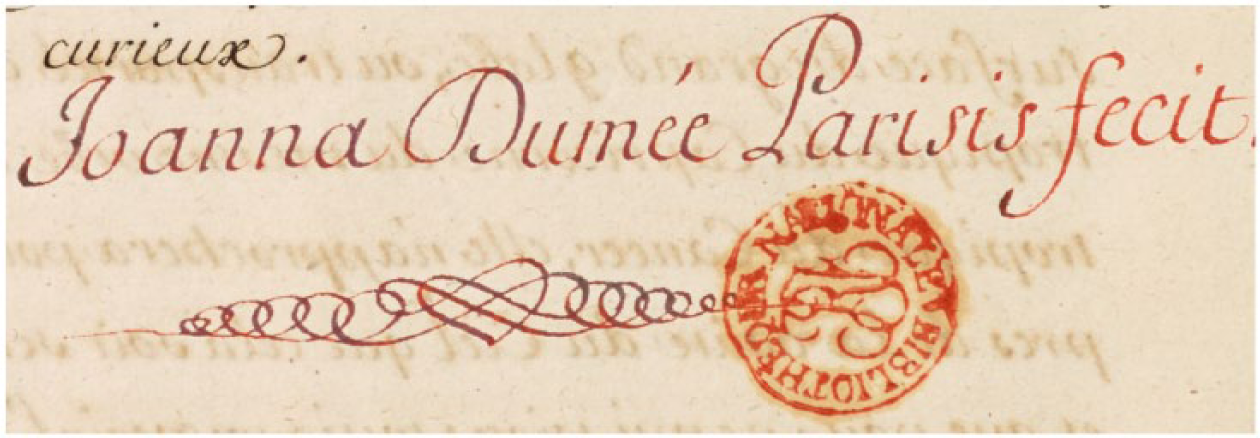
Jeanne Dumée’s colophon in Latin, to be found at the end of the BNF (Bibliothèque nationale de France) manuscript, p. 52. With permission of the BNF.
The only officer of that name known to have served in Louis XIV’s army is Pierre-Claude Berbier du Mets, whose name was often written “du Mée” or even “du May” (in one or two words). Born in 1638, he was enrolled at barely 16 and severely wounded in 1657. Although disfigured, Berbier du Mets went on to serve as an engineer in the artillery and eventually became Lieutenant General. He played an important part on Vauban’s side during the siege of Valencienne in 1673, before getting himself killed in the battle of Fleurus, Flanders, in 1690. 44 I have found no evidence that he ever was married and nothing seemed to link him with Jeanne Dumée.
If Berbier du Mets is an unlikely candidate, the chronicles of the many wars fought in the seventeenth century provide no further information regarding Dumée’s husband, especially since she might well have used her maiden name. However, if we take La Roque’s indication at face value and look for possible deaths in Germany, the range of plausible dates may be narrowed. Between the end of the Thirty Years War in 1648 and the operations conducted on both sides of the Rhine river from 1674 to 1678, there was almost no fighting involving the French Army in Germany proper. During both the Franco-Spanish War (1635–1659) and the War of Devolution (1667–1668), battles were fought in the Flanders and Franche-Comté, but it is improbable that La Roque referred to either region as Germany. But many men died in Germany in the 1670s: in July 1675, for example, 16 captains were lost to the enemy defending the bridge of Altenheim over the Rhine. 45 If we assume that Dumée became a widow at the age of 17 and that her husband was either killed in 1648 or before, or between 1674 and 1678, then her date of birth was either 1631 or before, or between 1657 and 1661. When she showed her manuscript to La Roque, Dumée would have been either a woman in or nearing her 50s, or a very young woman, still a teenager or nearly so.
When we take a closer look at the BNF manuscript, there might be some grounds to believe that Dumée was older than usually assumed. The document indeed contains an interesting dedication to Chancellor Louis de Boucherat where Dumée evoked 30 years of legal battles in which the Chancellor had been implicated, including some in which she herself was a party: One needs an enlightened mind to penetrate and untangle, as you do, the most embarrassed cases. I know this from experience, since you are the Hercules who smashed the last head of a Hydra that we have seen reborn over and over during the last thirty years in all of France’s tribunals. Yes, Milord, I have not forgotten the troubles you were kind enough to take to bring me justice.
46
Looking through legal history, a cause célèbre involving a certain “Mademoiselle Jeanne Péronne Dumay” pop up. 47 As we have seen for Berbier du Mets, orthographic differences were not rare at the time, even in legal documents. Pleaded in front of the Parliament of Paris (which was a court of law) on 21 June 1668, the case – which was to enter the international jurisprudence 48 – concerned Dumay’s son, Christophe of Conty, and his right to inherit his father’s properties, which was contested by his paternal uncle François du Quesnoy d’Hargicourt. Dumay had met her husband, Henry de Conty du Quesnoy, while he was garrisoning in her Flemish hometown of La Bassée. 49 Their son was born in France before they got married somewhat informally in England, where Henry then died on 5 May 1666. We note that it was rather odd that in his review La Roque likewise referred to her as “Miss [Mle] Dumée,” as if she was young or her marriage had somehow been contested. In a beautiful speech, the Master of Requests (maître des requêtes) Lamoignon de Basville, who was a friend of Boucherat’s, took Dumay’s defence and in the end, with the help of Advocate General (avocat général) Bignon, another friend of Boucherat’s, won the argument, no doubt to the great pleasure of the defendant. 50
If Jeanne Péronne Dumay was the same person as the Jeanne Dumée who showed her manuscript to La Roque, she might have been alluding to this famous case in her dedication to Boucherat. If she indeed was 17 when her husband died, this would put her date of birth around 1649, which is definitely out of the ranges discussed above. But, then, her husband would have died, not in Germany, but in England, which was then at war with the Netherlands. We, however, run into a more serious difficulty when we consider the period of the French occupation of La Bassée. Indeed, this town was occupied by the French following a terrible siege in 1647 and troops were stationed there until the Treaty of the Pyrenees of 1659, when La Bassée was returned to the Spaniards and only reintegrated to France in 1667. To sum up, in this hypothesis, Jeanne Dumay would have been barely 10 years old when Conty left La Bassée. How, then, could they have a child, elope to England, and get married, all this before she turned 17? Taking into consideration, moreover, that Conty’s death certificate stated that he had been “legally married to Dame Jeanne Dumay for several years before his death” (legaliter nuptus Ioanna Dame Dumay pro multis annis ante obitum), we conclude that the coincidence of names between the women probably was just that – a coincidence. 51
Jupiter’s sphere
Without certain additional documentation about Jeanne Dumée’s life, let us turn our attention back to the documents we have. In fact, the manuscript kept at the BNF cannot be the same as the one seen by La Roque. Indeed, Boucherat became Chancellor in 1685, 5 years after the publication of the review. Dumée’s manuscript is certainly posterior to this date, since her dedication clearly alluded to Boucherat’s nomination and included a nice engraving of the Chancellor. These elements already tipped off Lacour who had arrived at the same conclusion. 52 But were there other, more important differences between the versions of Dumée’s manuscript?
A close reading of both La Roque’s review and Dumée’s manuscript indicates that the 1680 manuscript contained matters that were absent from the later version. In his review, La Roque devoted three paragraphs to the description of its content. As we saw, he praised her for the clarity of her description of the three motions of the Earth. La Roque then went on, “All the reasons establishing or contradicting Copernicus’ system are brightly exposed. She explains all the appearances of Venus and performs the required computations [supputations] with great subtlety and a lot of exactitude.” 53 Now, this is not exactly true, at least if we compared this assertion to Dumée’s BNF manuscript. While she did discuss some of the reasons in favour of the Copernican theory, Dumée hardly paid attention to other hypotheses. 54 Moreover, if the word “supputation” is to be taken in its contemporary meaning of “computation,” then La Roque’s description is quite unfaithful, since Dumée nearly excluded all mentions of mathematics from her manuscript. 55 In fact, as we shall see, she systematically took geometrical developments out of Gassendi’s astronomy.
While these discrepancies may perhaps be explained away by supposing that La Roque had merely skimmed through Dumée’s manuscript, the last two paragraphs of his review focused on specific aspects of the Copernican system, which are definitely absent from the BNF manuscript. In his review, La Roque discussed several points of comparison between the Earth and Jupiter. The size of Jupiter’s diameter is, for example, said to be six times that of the Earth’s. Although there is no discussion of the relative size of planets and stars in the BNF manuscript, the topic is broached on several occasions in Gassendi’s astronomical treatise as well as in Bernier’s translation. 56
According to La Roque, Dumée also made an intriguing observation about Jupiter’s rotation on itself: “She says that new observations had established that Jupiter rotates around its center in ten days.” 57 In July 1664, the Parisian astronomer Adrian Auzout had unsuccessfully tried to observe Jupiter’s rotation. 58 The next year, Cassini established, from the observation of spots on the surface of Jupiter, that the planet’s period of rotation was close to 10 hours – but not 10 days as reported by La Roque, but this might be an oversight. 59 In the 1670s, several authors, like the Cartesians Jacques Rouhault and Nicolas Malebranche but not Bernier (whose main source was much older), discussed Cassini’s findings in books intended for a rather general audience. 60 Although we have no way to know whether it was La Roque or Dumée who made the mistake, this provides a strong argument tending to show that Dumée used other sources than Bernier when she wrote the 1680 manuscript. This is confirmed by her mention of Cartesian vortices around Jupiter (again only in La Roque’s review and not in the BNF manuscript) to explain the fact that the planet carried its four moon around it in its annual journey around the sun, an explanation not favoured by Gassendi. 61
The last point mentioned by La Roque, which is neither to be found in Dumée’s extent manuscript nor in Bernier’s Abrégé, concerned an attempt at explaining the ratio between Jupiter’s and the Earths’ daily and annual periods of rotation. Dumée was seemingly convinced that the fact that the terrestrial daily rotation was slower than Jupiter’s was not very surprising, as opposed to the quicker rotation of the Earth around the Sun. 62 Her argument, somewhat convoluted, involved the “need” the planets had for the Sun to mark time. Copernicians, like Gassendi and Marin Mersenne before him, argued that it was more natural for the Earth to orbit the Sun than the reverse, since the Earth had in some sense more need of the Sun than the Sun of the Earth, and this is the explanation Dumée repeated in the BNF manuscript. 63 In La Roque’s review, however, Dumée stated that the Earth needed the Sun more than Jupiter did, which explained why its daily rotation was slower. She was puzzled by the quick annual rotation of the Earth, “since we cannot doubt that it [that is, Jupiter] needs the Sun for distinguishing the seasons.” 64 I have been unable to identify other sources for such an opinion and we may want to attribute it to Dumée herself. In this case, we may conclude that Dumée indeed used several sources to draft the manuscript she showed to La Roque and went beyond the arguments she found in the sources to construct her own explanation for differences in the behaviour of the planets for which astronomers and philosophers gave no adequate reasons. This would surely be the sign of an original and inquisitive approach to questions raised by astronomy. These conclusions will be reinforced by a close study of the BNF manuscript.
The BNF manuscript
Provenance and description
The story of the leather-bound manuscript kept by the BNF can be reconstructed with precision. 65 The manuscript was deposited at the national library between December 1795 and February 1796, in an effort to save the precious library of the monks of Saint-Germain-des-Prés, badly damaged following the French Revolution. Later, the French manuscripts from Saint-Germain received call numbers ranging from 15,370 to 20,064, and Dumée’s manuscript among them number 19,941. A small annotation “Gèvres 50” (on f. 2r) indicates that it belonged to the collection bequeathed to the monks of Saint-Germain, on 7 November 1736, by Louis Potier, cardinal of Gesvres (1656–1744), on the condition that the collection would be available to the public once a week. The abbey took possession of Gesvres’ books and manuscripts on 9 December 1745. For his part, the Cardinal of Gesvres had bought about 50 manuscripts bearing the ex-libris “B.H. De Fourcy” (also to be found in Dumée’s manuscript), on 13 May 1737 when Balthazar-Henry de Fourcy de Chessy (1669–1745) sold his own collection. 66
Now, Fourcy was, through his mother Marie-Madeleine, the grandson of the Chancellor Louis de Boucharat. It is therefore very plausible that a manuscript personally addressed to Chancellor Boucherat, probably shortly after his nomination to that post in 1685 and in any case before his death in 1699, thus found its way to the collections of the BNF. This reinforces the confidence we may have in the authenticity of the document, even if, as we have seen, this was not the manuscript used by La Roque for his review.
The BNF manuscript is written in a neat hand. On the title page, only the title appear in large capital letters in a red ink, without any mention of the author:
ENTRETIEN
SVR L’OPINION DE
COPERNIC
TOVCHANT LA MOBILITÉ
DE LA TERRE
The manuscript has a few annotations, which are corrections to the text. Lacour believed them to be of the same hand. But we may question this assumption noting slight changes in the letter shapes (the letter l especially) and surprising mistakes: for example, the word l’horison, crossed out and replaced by l’auroit, would have made no sense in the sentence where it appears (Figure 2). 67 The copyist seemed to have had a poor understanding of the text he or she penned down. It is especially the case for words, names, and expressions, which would not have been familiar to a moderately literate person. We note, for instance, the strange transcription of atmosphere as “la Mosphere,” perhaps a sign that the text was dictated to the copyist. 68 Even more absurd is a mistake, which was not corrected in the manuscript, whereby the “celestial spaces [espaces célestes]” become the “injured spaces [espaces blessés].” 69 Lists of proper names often are nearly incomprehensible in the BNF manuscript, such as when Dumée writes that the idea of the earth’s rotation on itself was the sentiment “de Pautus, des Pitagorisciens, d’Heraclides, Ponticus, et Platon.” 70 The mention of “Aristarchus Samios” in Bernier’s book becomes “Aristarcus, Janicus” in the manuscript. 71 Mestlinus is spelled Melsinus, and the names of Schikard and Kepler are merged into some mysterious “Jeherard Lepler.” 72 Such mistakes are rather too basic and we cannot help but wonder whether the BNF manuscript was handwritten by someone other than Dumée herself.
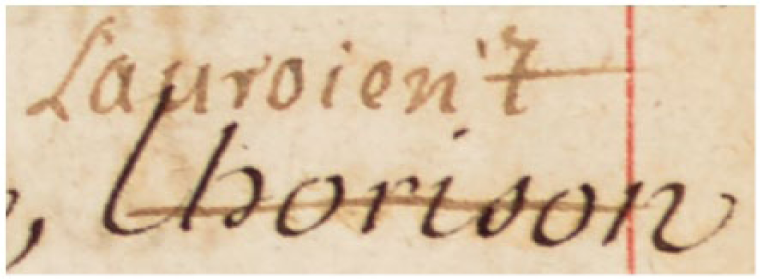
A correction made to the manuscript, p. 40. With permission of the Bibliothèque nationale de France.
Dumée’s paraphrase
As said above, the text of the manuscript generally lacks in originality and is no more than a rephrasing of some portion of Bernier’s Abrégé. In the Abrégé, astronomy is the topic of the second part, or Treatise IV, dealing with “celestial things.” Published for the first time in 1675, the treatise contained five chapters respectively devoted to the sphere, to planetary motion in the Ptolemaic system, to arguments in favour of the Copernican system, to Tycho Brahe’s geoheliocentric system, and to diverse other topics including a refutation of astrology. Leaving aside the most technical parts of the book, Dumée’s manuscript follows the arguments presented in the first seven chapters of Book III. It ends rather abruptly in the middle of chapter 8, gliding over the topic of chapters 9 and 10 in a single sentence. Interestingly, the final chapter of the Abrégé is devoted to the relative size of planets, a topic discussed in 1680 but absent from the BNF manuscript.
A closer reading of both the Entretien and the Abrégé is therefore necessary to recover Dumée’s own voice. For example, her statement of intent, which has often been quoted in the literature, mirrors quite closely Gassendi’s, which appeared more than 30 years before. She introduced her text by the following paragraph: What I claim to say here concerning Copernic’s opinion is not in the intent of establishing it, even less of wishing to support it, but only to exhibit the reasons with which Copernicians defend themselves, and also to give satisfaction to a few learned persons who having made me the honor of visiting me saw a sphere that I had put together according to this opinion and asked me to put them in writing, which has forced me to give to this small treatise the title of “Entretien.”
73
For his part, Bernier was following Gassendi when he stated, Although the System of Copernic has in our time become very famous, what we shall now say will however just be in order to exhibit it as it is, & to show in which way those who follow it have been used to defend it against objection made to it, without for that matter pretending absolutely to support it, nor to vouch for it.
74
From the direct confrontation of the texts, we can see that the neutral stance adopted by Dumée was the mere reflection of Gassendi’s, voiced not 15 years after Galileo’s condemnation, at a time when Copernican ideas were much more controversial. But we also see what was truly original about this passage, namely her claim to have built a Copernican model and showed it to other learned persons. 75
As emphasized above, the rest of Dumée’s manuscript is unfortunately devoid of much originality. Among the rare significant discrepancies between the texts, there are some metaphors used in Gassendi’s course that were apparently not pleasing to Dumée. Discussing the relationship between the Moon and the Earth, or between Jupiter and its satellites, Bernier used images of submission: the Moon was following her “mistress” the Earth; satellites were like Jupiter’s “slaves.” Dumée ignored such discussion. 76 Another apparently simple change she made on several occasions was the name of constellations used as examples by Bernier. By recognizing the arbitrariness of his choice and explaining phenomena that required a grasp of the relationship between signs, she showed that she had some knowledge of the Zodiac.
In shortening Bernier’s Abrégé and putting in a single continuous text the different chapters given by Gassendi, Dumée produced a text that was generally more opaque. Her style is clumsier and more tedious than Bernier’s, for example, repeating “it is claimed [on pretend]” six times in just two pages.
77
She moreover made a few blunders rendering her text at times unintelligible, or even downright false. Even her celebrated description of the three motions of the earth is mistaken. Speaking of the Copernican astronomers mentioned above, Dumée writes that they all agreed in placing the Sun in the center of the world and attributing to the Earth its daily motion and the two other motions, leaving to the planets their proper motion. They also gave to the firmament or to the sphere of fixed stars this slow revolution of twenty five thousand years.
78
Because of the way she shortened Bernier’s original explanation, Dumée wrongly attributed a motion to the sphere of fixed stars to account for the precession of equinoxes. But this was precisely the function of the earth’s third motion according to Copernicus. In his course, Gassendi had pointed out that some astronomers like David Origanus and Christian Logomontanus adopted a compromise position whereby the Earth was placed in the centre like in the Ptolemaic system but granted a diurnal rotation around its axis. 79 But Dumée’s cuts made this passage meaningless.
As a rule, Dumée omitted geometrical developments and all diagrams to be found in Bernier’s Abrégé from the version she produced. Most of the time, she did not even acknowledge them, merely skipping the whole passage and going on with her paraphrase afterwards. Even the simple representation of the planetary spheres was left out, as well as Bernier’s mention of it. 80 Sometimes, she dropped long passages that seemed too mathematical, especially when dealing with the third motion. 81 It is also revealing of her unease with mathematical explanations that when such subtleties were raised (e.g. the third motion or epicycles), Dumée usually stopped trying to paraphrase her source and reproduced Bernier’s sentences almost identically. 82
Similarly, Dumée’s text made clear that she was unfamiliar with astronomical observation. She showed no interest in the description of telescopic observation of Saturn’s rings and the corresponding diagrams, which she left out from her manuscript. 83 At one point, her rephrasing led her to state an absurdity in observational terms: “when the Earth is in Gemini,” she wrote, “we see the opposite sign, Sagittarius, through the Sun.” 84 Trying to explain why the Copernican system accounts in a more natural way for the fact that the inner planets, Mercury and Venus, never appear to be far from the Sun in the night sky, she misinterpreted Bernier’s argument and believed that the distance to the Sun here involved was the radius of their orbit. All this indicates that Dumée was familiar neither with telescopic nor naked-eye observation of the sky. 85
Recovering Dumée’s lost voice
With a strong basis neither in mathematics, nor in observational astronomy, Dumée relied on globes and spheres to approach the topic. Playing with spheres, it is indeed possible to see the sign behind the Sun. Discussing the Earth’s wobbling, Dumée once again stuck closely to Bernier’s text but neglected the physical analogy with the spinning top. To make this more vividly understandable, Gassendi suggested that one used a Ptolemaic armillary sphere (that is centred on the Earth), imagined that it was the Sun at the centre and introduced a small globe inside to visualize the motion of the Earth on the ecliptic around the Sun. Gassendi then supplied a geometric figure, which was reproduced by Bernier, but not by Dumée.
86
Instead, she added the following sentence, which reveals a first-hand knowledge of the market for spheres: I thought … that it would not be useless to employ a sphere and the small globe of the Earth that is in the middle to make the demonstrations taught above for a greater intelligence and ease, because sphere according to Copernicus’s system are not commonly to be found.
87
It was in her discussion of tides that Dumée was said to assert a position counter to eminent astronomers such as Copernicus and Galileo. In this part of her argument, however, Dumée again reproduced Bernier’s account rather faithfully. Strangely, she added the name of Copernicus where it was not expected.
88
It was Galileo alone who suggested that tides occurred as a result of the Earth’s three motions rather than the Moon’s influence.
89
More importantly, Dumée’s critique of tide theory cannot be attributed to her. Even though she used the first person, Dumée transcribed Bernier’s opinion, which for once differed from Gassendi’s.
90
Like Dumée is said to have done, Bernier criticized Galileo’s theory for its complexity: “I do not stop to make you see all this diverse mixing of motions, because it would not only be very long and difficult to understand … they [also] do not seem to be able to account for tides.”
91
The safer course simply was to accept the common opinion and attribute tides to the influence of the Moon: even though we do not know the way in which this influence acts, until someone is able to see, as we hope, that there is a unique cause for the motions [of tides] and shows us what is this cause.
92
The true significance of Dumée’s comment therefore lies not in her criticisms of Galileo and (wrongly) Copernicus, but in her claim regarding the unknown cause mentioned by Bernier. Dumée flatly asserted that Descartes had discovered this cause: “as for me,” she wrote, now speaking in her own name, I imagine that one has to stick to what has taught us the most illustrious philosopher of our time, Monsieur Descartes, who attributes tides to the influence of the Moon, because all the reasons found in Copernicus and Galileo seem too confused to me to describe them in detail here. It may be that I lack in intelligence [to be able] to penetrate the thought of these great men. I find comfort in the fact that I asked the great minds of this time for their feeling about this, that all answered me that they believed that both of these excellent philosophers had great thoughts but that their explanation for tides were especially bad, and that they were no inconvenience in supporting Monsieur Descartes’s thought.
93
Self-deprecation was often seen at the time as an almost obligatory remark for women to be accepted by their male intellectual partners. 94 But there is little in Dumée’s version of Gassendi’s astronomy to lead us to believe that she indeed understood the mathematical and physical foundations of the Galilean theory of tides – no more than Bernier did, for that matter. To me, it seems more interesting to see how she navigated around this difficulty and was able to express an original thought. In the above quote, Dumée was quite explicit about the way she formed her opinion on scientific matters. Like when she used ideas about the way the Earth needed the Sun and expanded it in new directions, Dumée seized Bernier’s invitation to look for a more satisfactory causal explanation of tides. Here again, Dumée thought that Cartesian philosophy would provide answers where Gassendi’s had failed. She had arrived at this conclusion on her own, she claimed. And because she belonged to high-level social circles where she met the “great minds of [her] times,” she could use their insights to comfort her conclusion.
Dumée’s manuscript ended rather abruptly. After having rather confusingly followed Bernier’s text on the meaning of perigee and apogee in Copernican astronomy, she dispensed from any discussion of elliptic orbits and expedited the last two chapters of Gassendi’s Copernican astronomy in two short sentences. Before moving on to a study of Tycho’s geoheliocentric model, Gassendi discussed objections to the Copernican system coming from physics and the Scriptures. In Dumée’s manuscript, the first were not mentioned, while the second were said to have been addressed by Campanella. Dumée concluded, “I leave these explanations to more skilful persons than I am.” 95
Conclusion
It now seems obvious that Jeanne Dumée’s fame in astronomy was due more to her sex than to her work. In fact, we might go as far as saying that she became famous because she was a woman, not despite of it. Like many women of her time, however, the traces she left in the written records are scarce and much about her remains in the shadows. Progress has nonetheless been made in circumscribing her identity and the significance of her work in astronomy. Dumée left many clues hinting at the fact that she was well read, familiar with current scientific progress, and inserted in learned circles. Let me further summarize the findings of this article as follows:
Dumée’s date of birth can most probably be situated either between 1657 and 1661 or around 1630. This means that when her manuscript was shown around, she was either in her late teens to early 20s or in her early 50s. While her manuscript provides indications that may lead one to believe that she was an older woman, no conclusive element has been found. We might be justified in believing that the naïveté with which a paraphrase is presented as a “book” betrays its author’s inexperience. The date of death sometimes given to her in the literature appears to be pure fiction.
Dumée’s social status probably was higher than the Parisian bourgeoisie. Although we have been unable to identify a likely candidate for her husband, the fact that he was a military man leading a company and therefore was likely a Captain indicates that he, and presumably she as well, was of low-ranking nobility. References to polite society in Dumée’s work reinforce this impression.
Contrary to what has often been claimed, Dumée was at best a beginner in astronomy. In particular, she seemed to have been mostly interested in philosophy, and showed close to no skill and little interest in observational and mathematical astronomy, geometry, and physics. She however was familiar with the workings of spheres and used them in polite conversation with other women.
The manuscript reviewed by La Roque in 1680 was different in some significant ways from the one that was copied and 5 years later dedicated to Boucherat. It has been shown that the latter manuscript, which eventually found its way to the BNF where it is kept, comes directly from the Boucherat family.
While the BNF manuscript is confirmed to be a direct rephrasing of Bernier’s translation of Gassendi’s astronomy, it contains a few indices confirming the use of globes and spheres as a focus of conversation and written developments in female high society and the prevalence of Cartesian philosophy in such circles.
Let us elaborate on this last point. Dumée’s fame was established before anyone except La Roque could look at her work. This may have inspired other women and certainly inspired astronomers like Lalande or César-François Cassini de Thury to take women’s interest in astronomy seriously.
96
People who subsequently were able to look at Dumée’s manuscript have usually assumed that she had prepared it for publication. Indeed, she described it as a “book” with a specific audience: women whose taste for education could be strengthened by her own example. Our close reading however cast doubt on this interpretation. Did she truly believe that the mere copy of the portion of a famous book, Bernier’s Abrégé de la philosophie de Gassendi, would be worth publishing? To try to answer this question, it is perhaps better to go back to Dumée’s own words: It will be said that this is too delicate a work for people of my sex. I agree that I let myself be touched by the ambition of working on topics to which the ladies of my times have not thought before. Yet, to make them know that they are not incapable of study, if they wish to make the effort, because between the brain of a women and that of a man there is no difference, I would like my book to give them ideas about emulating [this work].
97
This has a strong resonance with the words of another woman scientist, the chemist Meurdrac. In the first edition of her treatise published in 1656, Meurdrac shared her qualms about printing her work. She went on to justify her resolve as such: I objected to myself that teaching was not the profession of a woman; that she ought to remain in silence, to listen and to learn, without bearing witness that she knows: that it is above her to give a work to the public. … I prided myself that I am not the first woman to have placed something under the press, that mind has no sex, and if the minds of women were cultivated like those of men, and if we employed as much time and money in their instruction they could become their equal.
98
Whether or not she was aware of Meurdrac’s work, Dumée wrote a text that definitely shows that in seventeenth-century Paris a lady with a limited grasp on astronomical knowledge could nonetheless be compelled to tinker with spheres and globes and use them as the support for polite conversation with other women. She also felt a need to share her experience in writing. In the astronomical domain, Dumée thus updated Jacquette Guillaume’s project of giving an account of knowledge by and for women. 99 This is a rare insider’s view into the kind of sociability that is known to have existed around other learned women, such as most notably Madeleine de La Sablière who entertained Rouhault, Bernier, and Fontenelle, among others. 100 Future research may provide a deeper understanding of Dumée’s and other women’s participation to such networks of knowledge, provided, as I hope to have shown, that one reads their text rigorously.
Footnotes
Notes
Notes on Contributor
David Aubin is a Professor in the History of Sciences at Sorbonne Universités/Université Pierre et Marie Curie, in Paris. He is also a member of the Institut de mathématiques de Jussieu-Paris Rive Gauche (UMR 7586, Centre national de la recherche scientifique (CNRS), Univ Paris-Diderot, Sorbonne-Paris-Cité, Sorbonne Universités, Univ Paris 6 UPMC (Université Pierre et Marie Curie)). With Charlotte Bigg and H. Otto Sibum, he is the editor of The Heavens on Earth: Observatories and Astronomy in Nineteenth-Century Science and Culture (Duke University Press, 2010) and, with Catherine Goldstein, The War of Guns and Mathematics: Mathematical Practices and Communities Through World War I (American Mathematical Society, 2014).