







Abstract
Analysis of 111 Chinese timings of solar and lunar eclipses in the period AD 434–1280 and of 56 Middle-Eastern timings in AD 829–1020 reveals that their accuracy approached the limiting resolution of their clock systems. The Chinese accuracy improved progressively over the period of observation, with the standard deviation reducing from approximately 18 minutes round about AD 600 to 7 minutes circa AD 1200. The Middle-Eastern timings have a standard deviation of 5 minutes around AD 950.
Introduction
Prior to the introduction of the international atomic timescale (TAI) in 1961, long-term variations of the Earth’s rotation may be measured with respect to the celestial co-ordinate frame, which is realised from the dynamical equations of motion of Solar System bodies. Over much of the telescopic period dating from AD 1610, timings of occultations of stars by the Moon provide the most effective source of data. Throughout the pre-telescopic period, extending back to 720 BC, reports of solar and lunar eclipses offer the only viable option of measuring changes in the Earth’s rotation. There are two main categories of eclipse reports: untimed and timed.
Useful untimed observations are restricted to large solar eclipses. The near-coincidence of the apparent diameters of the Sun and Moon produces a relatively narrow shadow band on the Earth’s surface. Historically, a clear report from a specified place is sufficient to provide a viable resolution of the position of the Earth’s frame, without the need to record the time of the event. Fortunately, numerous reports of these events are preserved in ancient and medieval history. Many timings of various stages of both solar and lunar eclipses are also extant. However, a major problem in timing is the difficulty of determining the local time prior to the advent of accurate clocks.
Untimed records of total and annular solar eclipses have proved invaluable in studies of the Earth’s past rotation. In our paper Stephenson et al. 1 we used predominantly untimed eclipses to measure the variation of the Earth’s rotation in the period 720 BC–AD 1600. Since 2016 we have added more untimed reports of eclipses to our dataset. These originate principally from medieval Europe in the years AD 800–1600 (Morrison et al. 2 ). The analysis of these data has strengthened our measurement of the fluctuations in the Earth’s rotation determined from untimed observations. We are now in a position to investigate the accuracy of timed historical eclipses (both solar and lunar) using our solution for the Earth’s rotation derived from untimed data as the standard of comparison. There are sufficient numbers of extant timed observations of both solar and lunar eclipses from China and the Middle-East to permit significant statistical results to be obtained, particularly after AD 900.
Definition of the observational parameter, ∆T
The timed observations provide a measure of the parameter,
Chinese records of solar and lunar eclipse times
Before the 16th century, 111 separate timings of the phases of solar and lunar eclipses are recorded in Chinese history. These observations range in date from AD 434 to 1280. The observations are quite spasmodic between AD 434 and 800, followed by a lacuna (apart from two observations) until around AD 1050. Thereafter there are two groups, AD 1050–1100 and AD 1150–1280. In this paper, we focus on the comparatively precise timings in the period AD 1040–1280. Jiujin 3 compiled a list of 120 reports of timings of phases of solar eclipse in the period 134 BC to AD 1785. The imprecision of many of the early observations and the relative inaccuracy compared to other contemporary methods of the late observations, render them of little value in the determination of ∆T. Hence, they are outside the scope of this investigation.
For the period prior to AD 1050, the main sources of Chinese solar and lunar eclipse timings are the calendar treatises lizhi in the official histories of the appropriate dynasty. Nearly all of the eclipse records from this early period are to be found in only two works: the Songshu (chapter 12) and the Suishu (chapter 17). Between about AD 1150 and 1280, the principal sources of eclipse timings are the Wenxian Tongkao (chapter 285) and the Yuanshi (chapter 53). The Wenxian Tongkao (Comprehensive History of Civilisation), which was compiled by Ma Danlin over several years and completed in AD 1307, cites many eclipse timings from the Song dynasty AD 960–1279. Most of these are not contained in other surviving Song works. Although the Yuanshi is the official history of the Yuan dynasty (AD 1260–1368), the calendar treatise also contains many eclipse records from the previous Song dynasty.
The eclipse timings which we have analysed are from the dynasties displayed in Table 1.
Chinese dynasties during which eclipse timings were recorded.
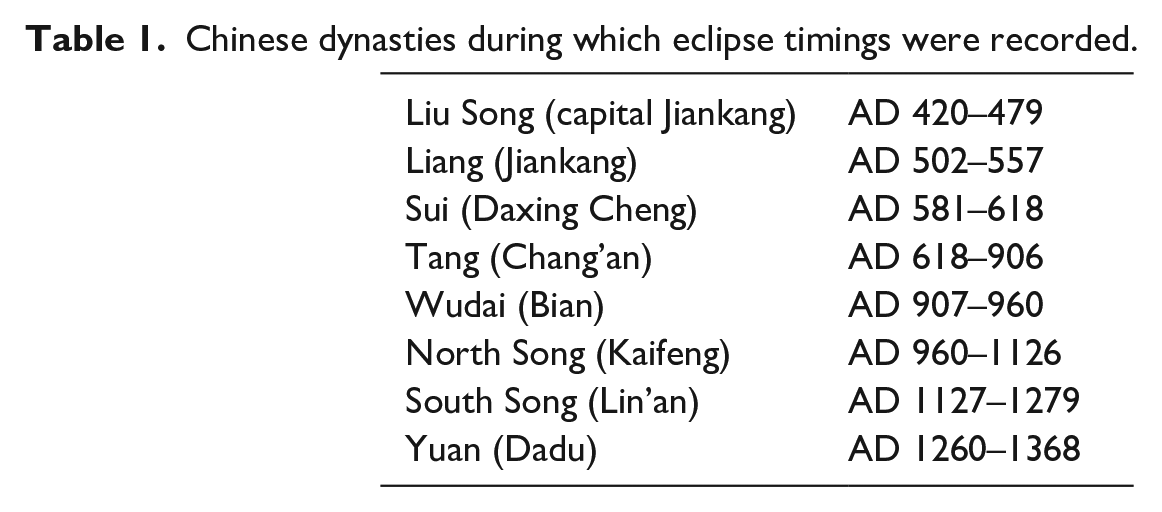
It is noteworthy that the Song dynasty (AD 960–1279) had two separate capitals. In the first half of the dynasty (known as the Northern Song), the imperial residence was at Bian in central China. In AD 1127 much of the northern half of China was annexed by invaders. As a result, Lin’an in south China became the capital of the Song empire, which became known as the Southern Song. Lin’an remained the Song imperial residence, and the site of the official observatory, until the dynasty came to an end in AD 1279. In that year the city was captured by the Mongols, who had established the Yuan dynasty a few years previously (in AD 1271). The last surviving eclipse observations in our lists were made by the Yuan astronomers between AD 1277 and 1280. Thereafter, no further timed eclipse records survive until AD 1572.
Only a few solar eclipse timings are preserved between AD 586 and 761. During the next three centuries (down to AD 1040) just a single solar timing is extant (AD 937). However, in AD 1040–1277 the list of solar observations is impressive. In the case of lunar eclipses there is a reasonably substantial number of timings in the years AD 434–596. Over the next five centuries only one lunar timing is on record (AD 948). Fortunately, numerous observations are reported between AD 1062 and 1280.
We are cognizant of the possibility that some of the reported times may in fact be predictions rather than observations. This possibility is addressed later in the section on the analysis of the solar eclipses.
Chinese methods of timing eclipse contacts
Throughout the pre-telescopic period, measurements of eclipse timings in China were made using water clocks (clepsydra). Our authoritative source for the development and use of clepsydras is Heavenly Clockwork by Needham et al 4 . Until about AD 1000, Chinese astronomers did not systematically follow the same methods for timing solar and lunar eclipses. Hence it is necessary to consider the time systems which they used in this earlier period separately.
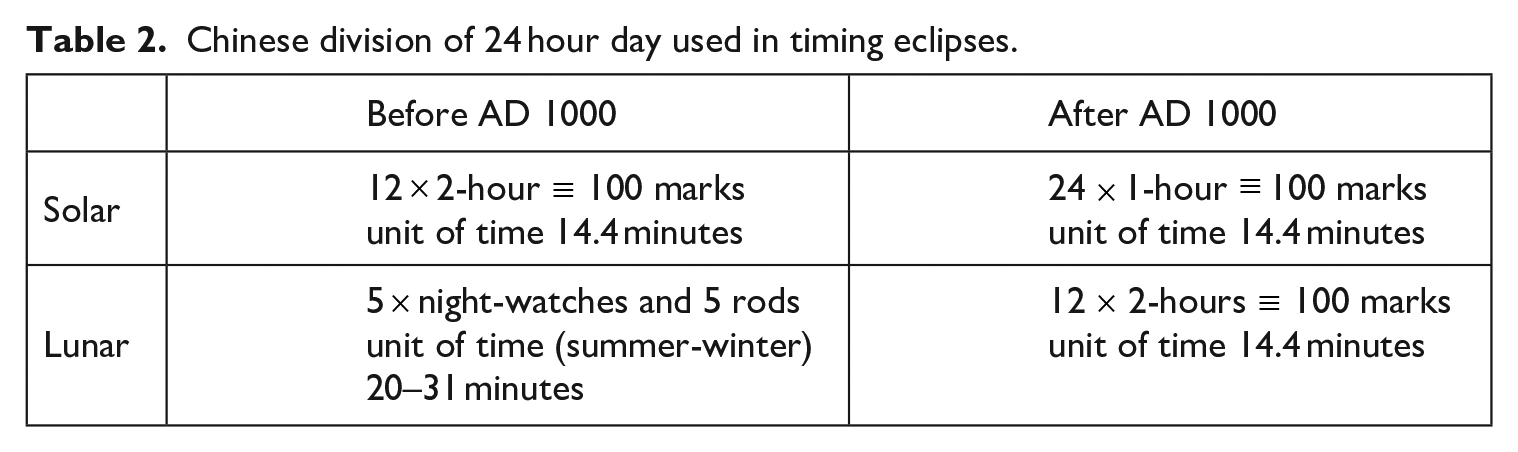
Prior to about AD 1000 the standard scheme employed for timing solar eclipses was based on dividing the whole day – from midnight to midnight – into 12 equal 2-hour intervals (‘double-hours’, shi). The first 2-hour period began at 23 hours local time, and was centred on midnight. After about AD 1000, each of these 2-hour periods were usually divided equally into an ‘initial’ and ‘central’ half, producing twenty-four 1-hour periods, with the first period starting at 23 hours and ending at midnight.
A separate division of the whole day into 100 equal marks (ke, a mark cut in the indicator-rod of the clepsydra) of 0.24 hours was also used in parallel with the 2-hour and 1-hour system. Marks were enumerated from the start of each 2-hour and 1-hour period. Thus, a 2-hour interval contained
We presuppose that the observed time of the phase of an eclipse lies anywhere within the designated mark interval, unless it was specified otherwise. So, we have generally adopted the centre time of the mark in our reduction of the observations. For example, the solar eclipse of AD 586 was reported as beginning at 2 marks in the 2-hour period of chen (
By these procedures, the value of ∆T derived from a timing of a solar eclipse should lie within half a mark (±7 minutes) of the value in our standard of comparison.
Before AD 1050 lunar eclipses were consistently expressed in terms of night-watches (geng). The interval of time between the end of evening twilight (2
Unlike the later shi system, the length of a watch and rod differed with the seasonal length of darkness. A rod varied from about 20 minutes in summer to 31 minutes in winter. Assuming the centre time of the rod in our reductions, the value of ∆T derived from a timing of a lunar eclipse should lie within half a rod of the value in our standard of comparison. This ranges from ±10 minutes in the summer to ±16 minutes in the winter.
After about AD 1050, Chinese astronomers generally adopted the method used in timing solar eclipses, by almost exclusively subdividing the day into 2-hour (rather than 1-hour) intervals and marks. The various divisions of the 24-hour day are collected in Table 2.
Chinese division of 24 hour day used in timing eclipses.
Analysis of Chinese timed solar eclipses
We are in possession of 42 usable timings of solar eclipses in the period AD 586–1277. The provenance of the observations is discussed by Stephenson 7 and the observational parameter, ∆T, derived from the timings are listed in Table 9.4 of that monograph. These in turn, with a few updated values of ∆T, are listed in Table S6 to the Supplement of Stephenson et al. 8 We reproduce that table here (Table 3), with the addition of the phase of the observed phenomenon taken from Stephenson. 9
Value of
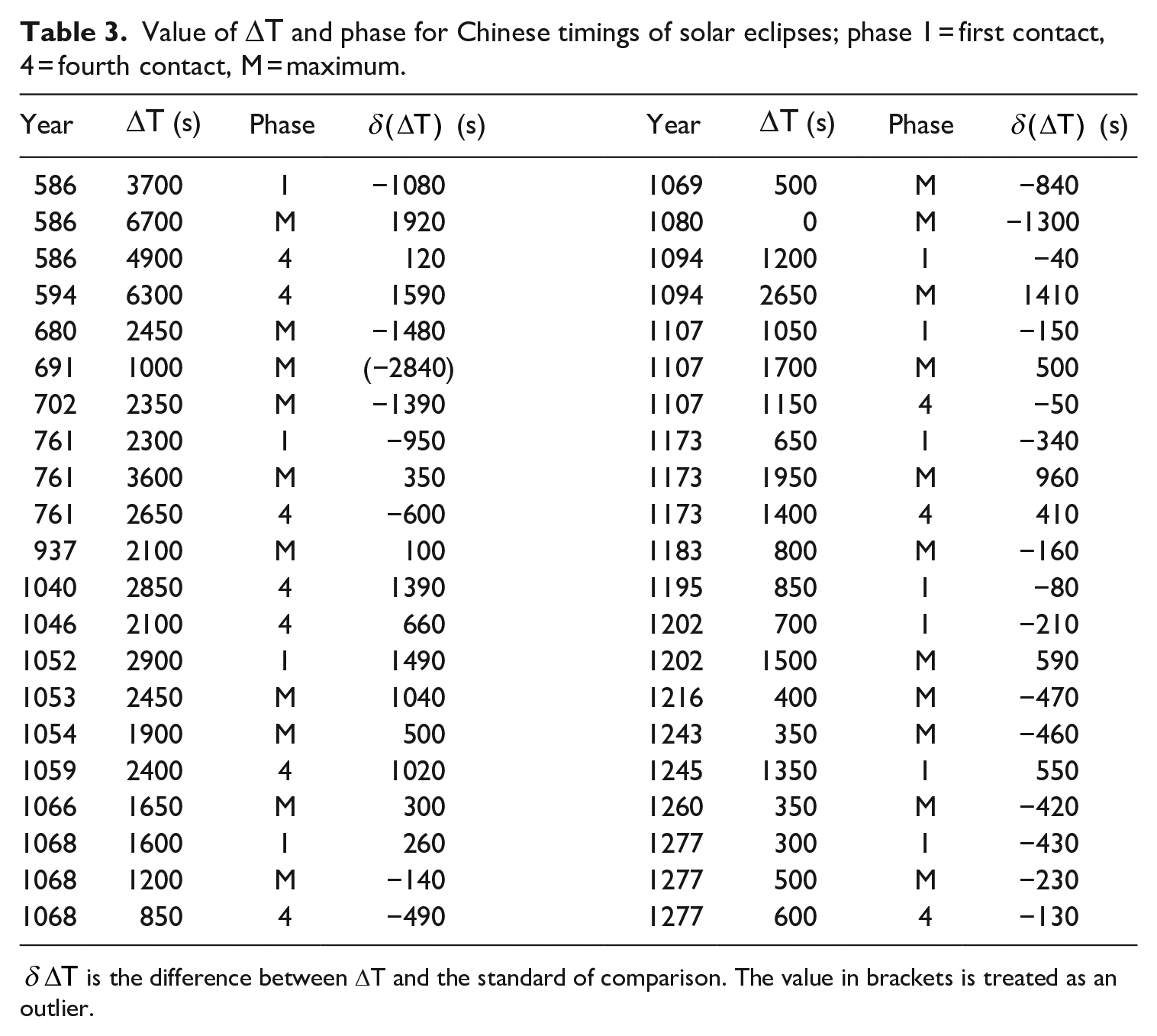
The values of ΔT in Table 3 are plotted in Figure 1a, together with the curve from our untimed solution in Morrison et al. 10 This shows that, collectively, the timed solar results are in good agreement with the untimed solution. It is noted that the accuracy improves progressively between the three clusters: AD 500–800, AD 1050–1100 and AD 1150–1300. The standard deviations of the ∆T values in these periods are 20, 13 and 7 minutes, respectively. In the last period, the day was subdivided into 1-hour intervals, as distinct from 2-hour intervals in the preceding years. Nevertheless, the two procedures had ostensibly the same effective resolution dictated by the length of the mark. But the accuracy in the last period is distinctly better, which implies that the later procedure was intrinsically more accurate.
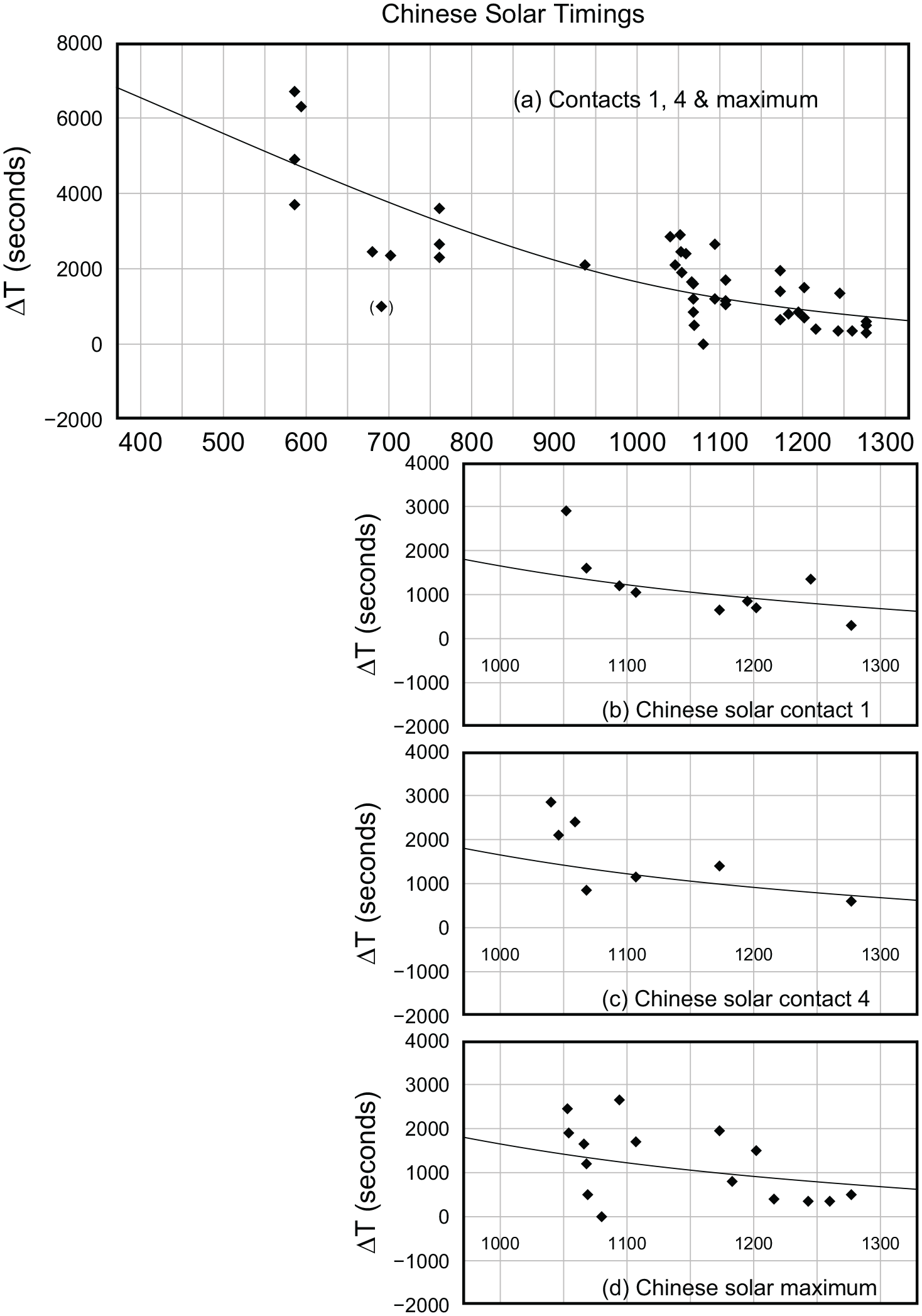
(a) Plot of ∆T values in Table 3; (b–d) values as a function of phase. The solid curve is the spline fit to independent untimed data, and is the standard of comparison.
It is interesting to investigate whether the accuracy of the timed observations is a function of the eclipse phase observed. There are sufficient numbers of observations after AD 1000 to make this viable. Figure 1b to d shows plots of the values of ∆T for contacts 1, 4 and the maximum of the eclipse. The observations in 937 and 1053 designated M in Table 3 are in fact timings of intermediate phases. Total solar eclipses are rare at any one place, and there are no timings of the beginning and end of totality (contacts 2 and 3).
The scatter in the ∆T values reduces with time for all phases, which suggests an improvement in the accuracy in time-keeping, rather than better resolution of the phenomena themselves, since all the observations were made with the unaided eye throughout the period. The good agreement of contact 1 with the standard curve, implies that the Chinese predictions of solar eclipses were tolerably reliable and astronomers were primed for observation of the beginning of the eclipse.
The good accuracy of the timings precludes the possibility that they are predictions rather than observations. Although it is possible that one or more of the outliers in Figures 1 and 2 are in fact predictions. We have analysed contemporary Japanese reports of solar eclipses, which were timed using similar equipment to the Chinese. These give values of ΔT with offsets of more than an hour from our comparison curve shown in Figure 1. From this level of inaccuracy, we conclude that these must be predictions. Conversely, the bulk of the Chinese observations cannot be predictions.
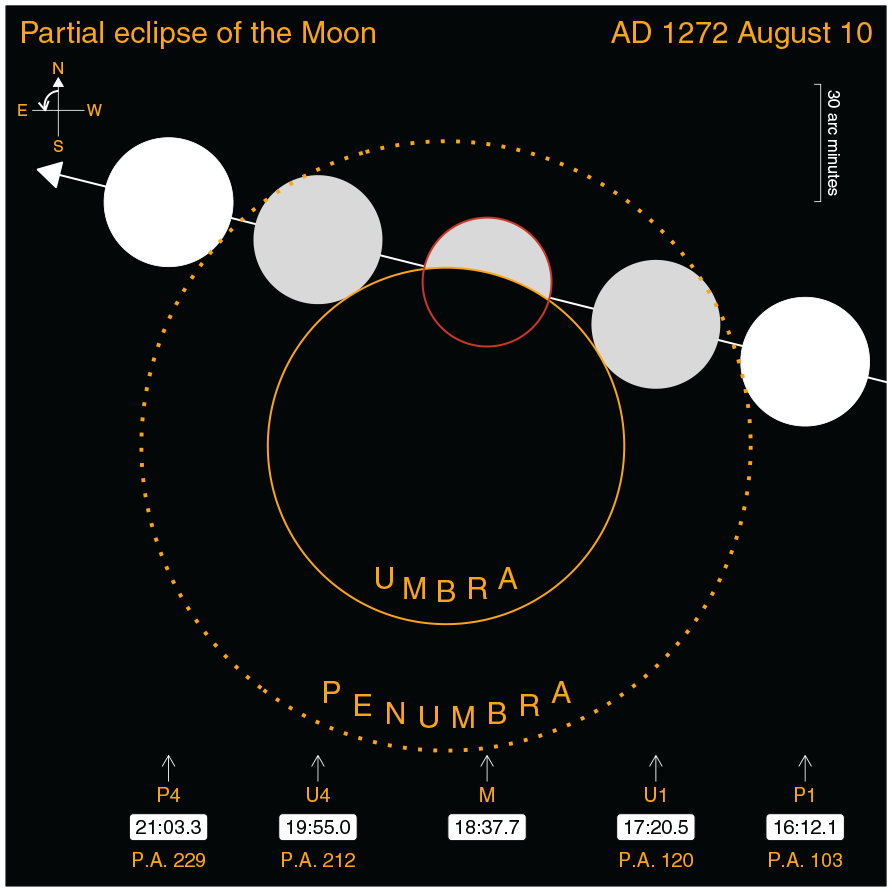
Partial lunar eclipse of AD 1272 August 10, showing the calculated times in Terrestrial Time of the various contacts. Chinese astronomers usually timed the beginning, maximum and end (U1, M, U4) of the partial umbral phase.
The question arises as to how the clepsydras were regulated during daylight hours. Chinese astronomers had established records of the seasonal variation of the apparent local times of sunrise and sunset, and these would have acted as fiducial points for the clepsydras. Measurements of the altitude of the Sun would also have provided running checks.
Analysis of Chinese timed lunar eclipses
In the period AD 434–1280 there are almost 70 usable timings of lunar eclipse umbral contacts 1, 2, 3, 4 and estimates of maximum eclipse. Total lunar eclipses are not as frequent as partial eclipses at any one location, and there are only eight timings of the total umbral phases–contacts 2 and 3. As an example of a partial lunar eclipse, Figure 2 shows the calculated TT of the phases of the eclipse of AD 1272 August 10, which was observed by Chinese astronomers. The penumbral phase is not detectable by the unaided eye until about half of the lunar disk is within the penumbra. 11 Therefore, the first timing was usually of the first contact with the umbra (contact 1 = U1), which is resolvable by eye to within a minute of time. Similar conditions apply to the last phase (contact 4 = U4).
The values of ∆T are plotted in Figure 3a to d, together with the curve from our untimed solution in Morrison et al. 12
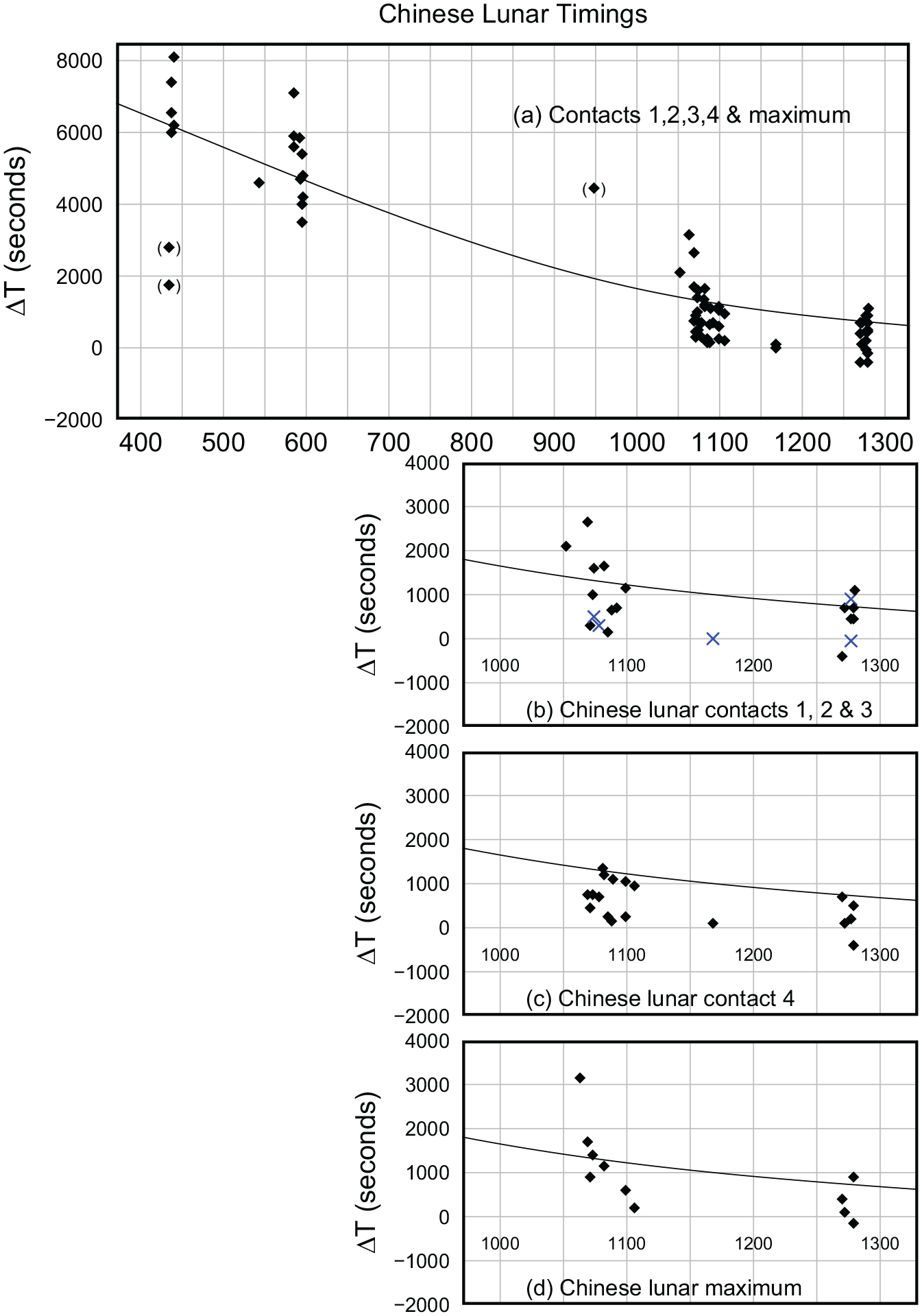
(a) Plot of the ∆T values in Table 4; (b–d), values as a function of phase, where in plot (b) diamonds are contact 1 and crosses are contacts 2 and 3. The solid curve is the spline fit to independent untimed data, and is the standard of comparison.
Value of ∆T and phase for Chinese timings of lunar eclipses; phases 1, 2, 3, 4 = first, second, third, fourth contacts, respectively, M = maximum.
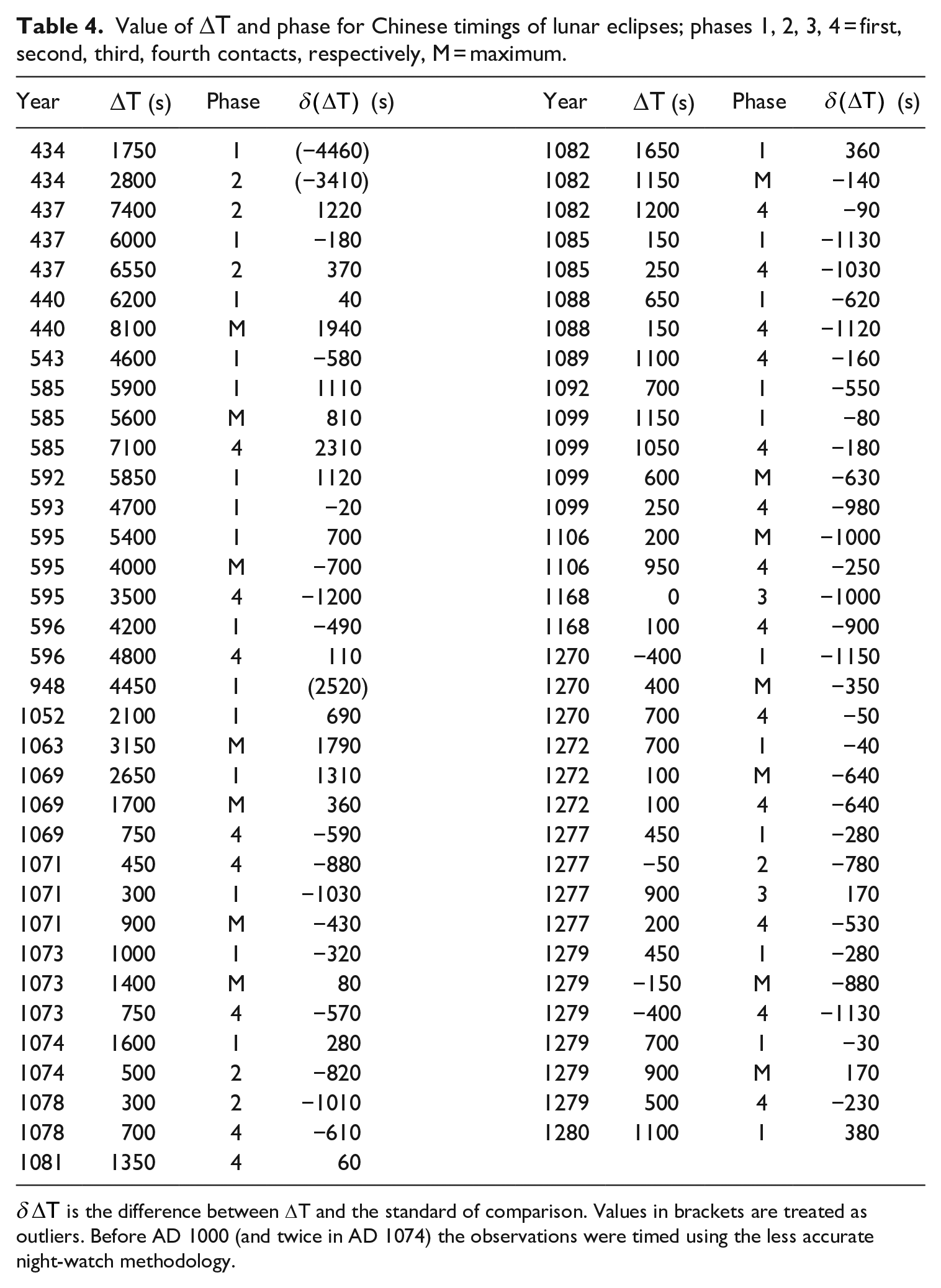
As with the solar observations, the timing accuracy improves progressively between the three periods: AD 500–800, AD 1050–1100 and AD 1150-1300. The standard deviations of the ∆T values in these periods are 16, 11 and 8 minutes, respectively. The values for contact 4 (Figure 3c) are particularly self-consistent, having a standard deviation of 7 minutes. Contact 4 would have been anticipated as astronomers followed the progress of the eclipse, and we might expect these to be more self-consistent than contact 1. This is the case, but it is surprising that in the period AD 1000–1300 the values of ∆T for contact 4 lie about 8 minutes systematically below the comparison curve, which implies that the recorded times were 8 minutes late on the average. There is some tendency for lateness in contacts 2, 3 and the maximum. The partial umbral phases 1 and 4 are resolvable to better than 1 minute by the unaided eye, so why were the lunar observations of contact 4 consistently timed late?
A possible explanation is that the recorded mark did not designate an interval of time, but rather the nearest graduation on the clepsydra. In that case, our assumption of the mean between two graduations will be systematically late by 7 minutes, which could resolve the issue. But the same system of division of the 24-hour day was used in timing both the solar and lunar observations, and yet the solar observations do not show this bias. For this reason, we reject this hypothesis.
We have also considered the possibility that our model for the division of the clepsydra into hours and marks is incorrect. As in Stephenson,
13
we have assumed that the first mark in each 2-hour period was always of full length (14.4 minutes), and that the last mark was a third in length, thus fitting
A further possible explanation for the distinct bias in contact 4 could be that the astronomers waited until they were certain that the eclipse had ended. The reports usually use the expression ‘fully restored’ (fu-man) when describing the end of the eclipse, which we have interpreted as the moment of contact 4. However, the astronomers may not have been trying to time the exact moment of contact 4, but rather the time when the whole disk of the Moon was again clearly visible. In the absence of any other plausible explanation, we are inclined to accept this one.
Middle-Eastern timed solar and lunar eclipses
Reports of 56 separate timings of the phases of solar and lunar eclipses by medieval Middle-Eastern astronomers are extant for the period AD 829–1019. These observations were first discussed by Said and Stephenson, 14 and they were further analysed by Stephenson. 15 It appears that virtually no useful Middle-Eastern reports of eclipse timings are preserved prior to AD 829.
Most of the eclipse timings in AD 829–933, and also in AD 977–1004 are contained in a treatise by the great Cairo astronomer Ibn Yunus (d.AD 1009). The observations in the earlier of these two sets were made in Baghdad, while those in the later group were made in Cairo, some by Yunus himself. Further timings in AD 883–901 are cited by al-Battani, while al-Biruni reported additional observations in AD 1003–1019. These observations were made at a variety of named/specified cities in western Asia. The main objective in assembling the observations was to test and improve existing lunar and planetary tables.
Middle-Eastern timing techniques
Middle-Eastern astronomers determined the times of eclipse phases by measuring altitudes of celestial bodies using astrolabes, and reducing these to local times. For solar eclipses, timings were based on the determination of the altitude of the Sun, and for lunar eclipses, altitudes of both the Moon and selected bright stars were used. The altitude measurements were usually made to the nearest degree, which corresponds to approximately 5 minutes in time at the latitude of Cairo/Baghdad. However, near culmination the resolution in time is poorer than this. Occasionally, altitude measurements were made to the nearest half-degree. The various altitude measurements were independently reduced to local time by Said and Stephenson, 16 and revised by Stephenson. 17 Some of these results were further modified in Stephenson et al. 18
Analysis of Middle-Eastern timed solar eclipses
Middle-Eastern astronomers timed contacts 1 and 4, and the maximum phase of partial solar eclipses. Most of the 23 values of ∆T derived from timings in Table 5 are taken from Stephenson. 19 However, a few of these values have been updated and are listed in the Supplement to Stephenson et al. 20 That table is reproduced here, with the addition of the observed phase taken from Stephenson. 21
Value of ∆T and phase for Middle-Eastern timings of solar eclipses.
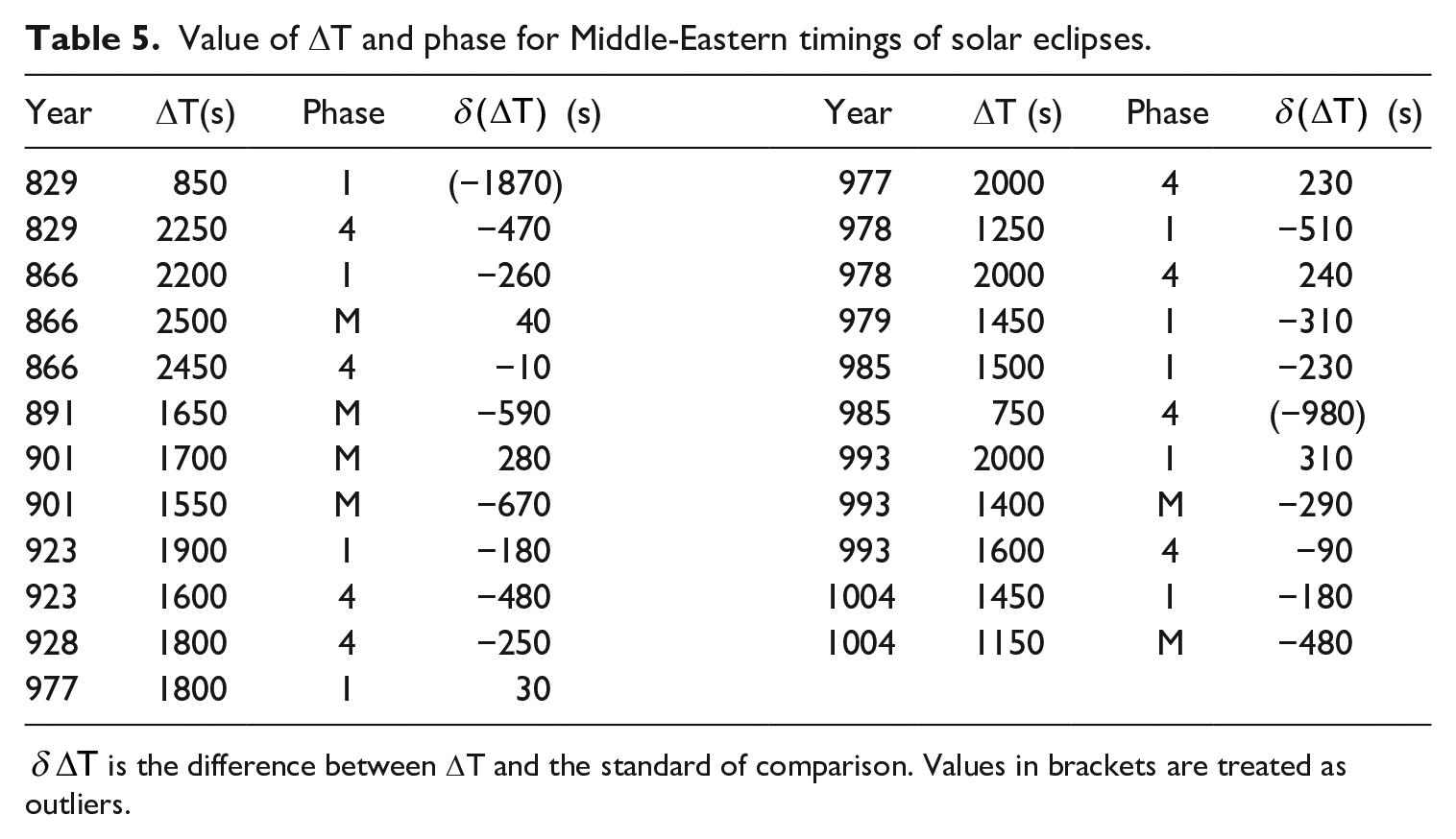
The results for ∆T are plotted in Figure 3a to d. The timed solar results are in fairly good agreement with the ∆T curve derived from the untimed data. The standard deviation for all the solar observations (excluding outliers) is 5 minutes, which is equal to the approximate limiting resolution in time using astrolabes.
Analysis of Middle-Eastern timings of lunar eclipses
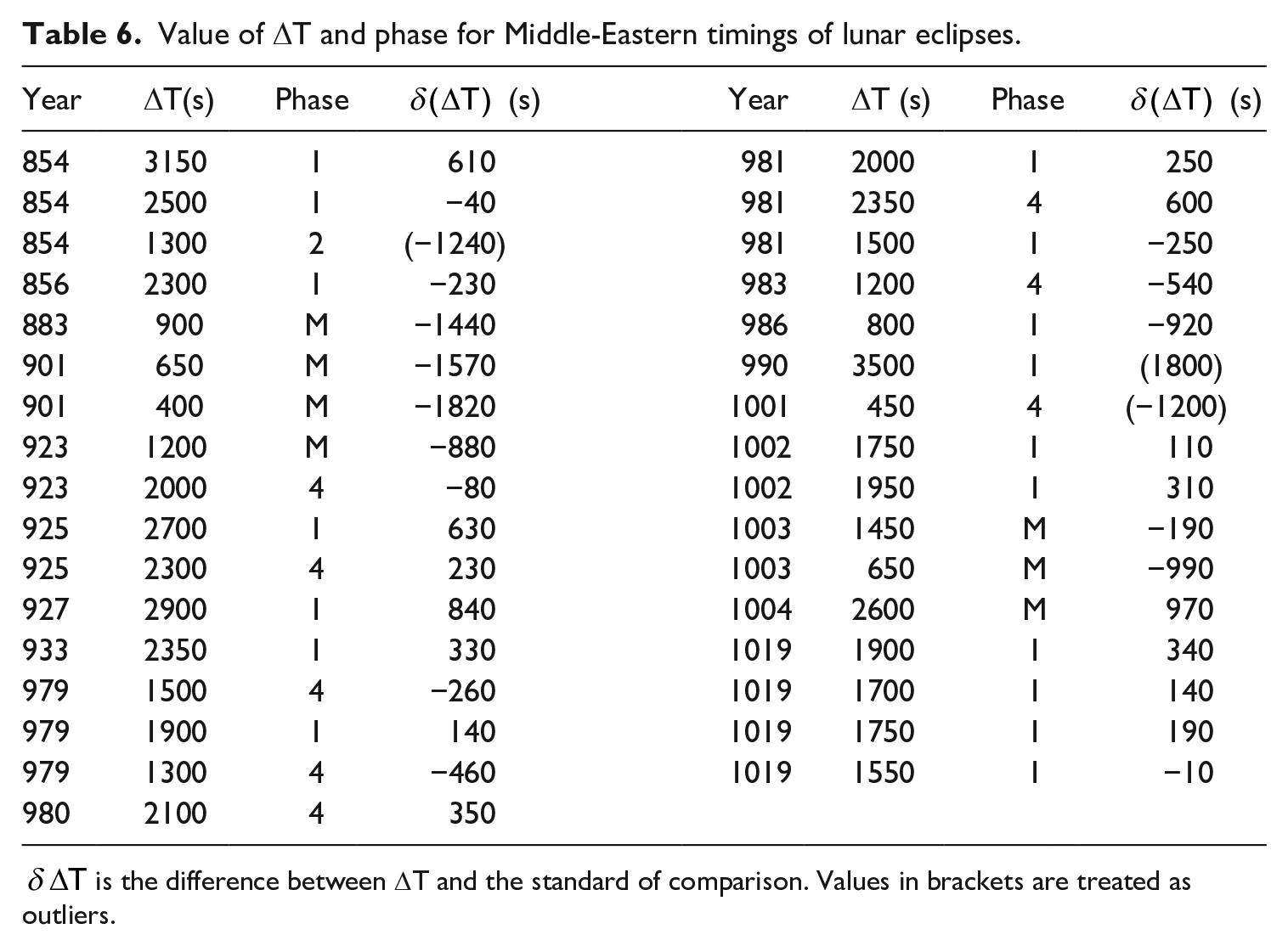
Middle-Eastern astronomers timed umbral contacts 1 and 4, and the maximum phase of partial lunar eclipses. Contact 2 was recorded in one total lunar eclipse. The calculated values of ∆T derived from 33 timings of lunar eclipses are taken from Stephenson. 22 A few of these values have been updated and are listed in the Supplement to Stephenson et al. 23 That table is reproduced here, with the addition of the observed phase taken from Stephenson. 24
The results for ∆T are plotted in Figure 4e to h. The lunar results are more disparate than the solar results in all phases, particularly the maximum. The difficulty in lunar eclipses lies in resolving the indefinite outline of Earth’s shadow, which is not sharp as depicted in Figure 2. The standard deviation for the lunar eclipses, excluding the maxima (Figure 4h), is 7 minutes, as compared with the solar value of 5 minutes. It is noteworthy that the timing of lunar contact 4 (Figure 4g) does not show the marked bias of the Chinese observations (Figure 3c).
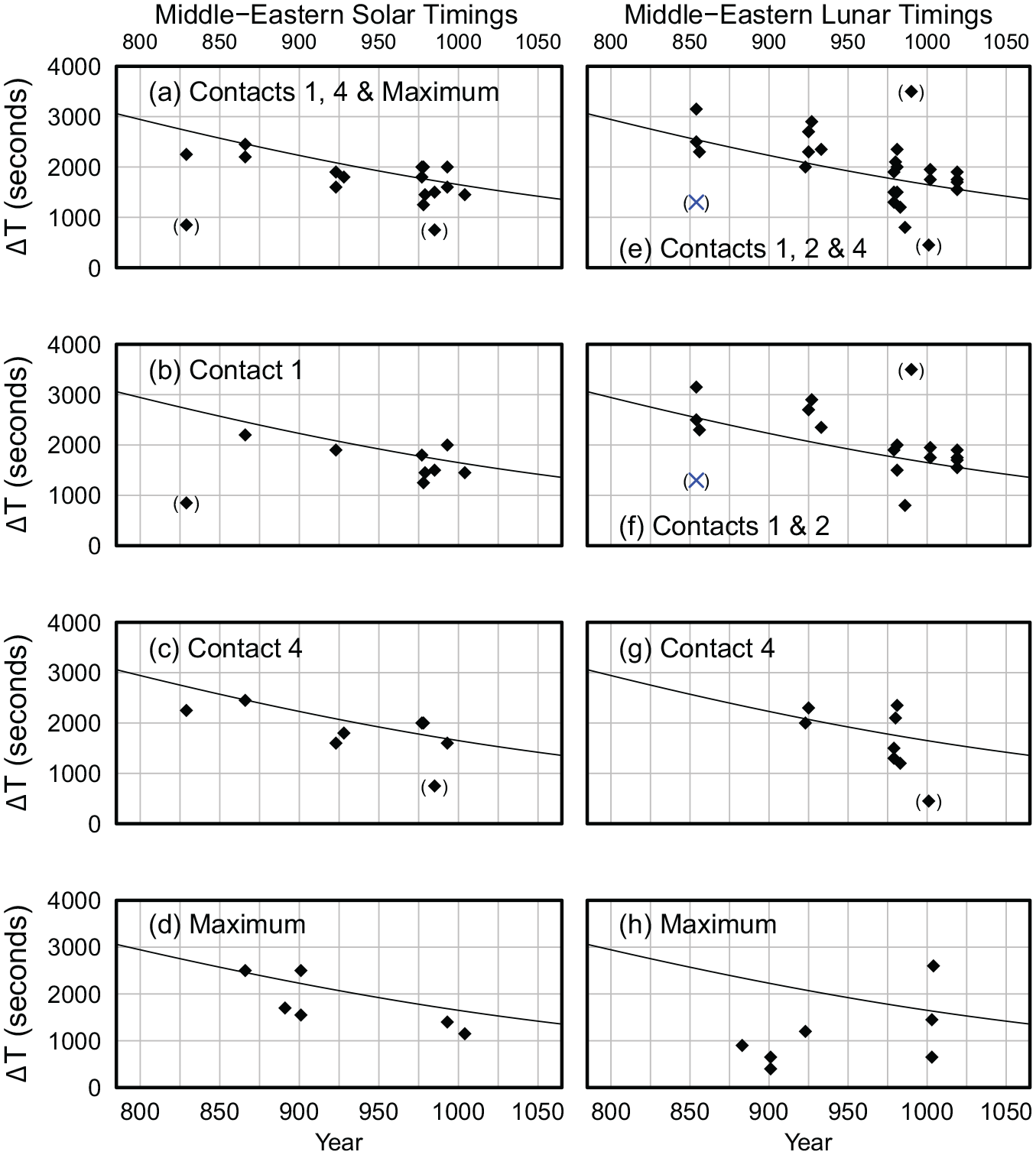
Plot of ∆T (seconds) from Middle-Eastern eclipse timings for years 800 to 1050. The left column; solar timings (Table 5) for; (a) all the data, (b) contact 1, (c) contact 4 and (d) maximum. The right column; lunar timings (Table 6) for; (e) contacts 1, 2 (=X) and 4, (f) contacts 1 and 2 (=X), (g) contact 4 and (h) maximum. The bracketed points are outliers. The solid curve is the spline fit to independent untimed data, and is the standard of comparison.
Value of ∆T and phase for Middle-Eastern timings of lunar eclipses.
From an analysis of the timings of three lunar eclipses in the years 1262, 1270 and 1274 observed at the Maragha observatory in Iran, Mozaffari 25 estimated a timing accuracy of about 5 minutes. Three later lunar eclipse timings made at Istanbul in the years 1567 and 1577, analysed by Mozaffari and Steele, 26 are too inaccurate to contribute to the determination of ∆T at that epoch.
Conclusion
The accuracy of the Chinese and Middle-Eastern timings of eclipse phenomena is summarised in Figure 5.
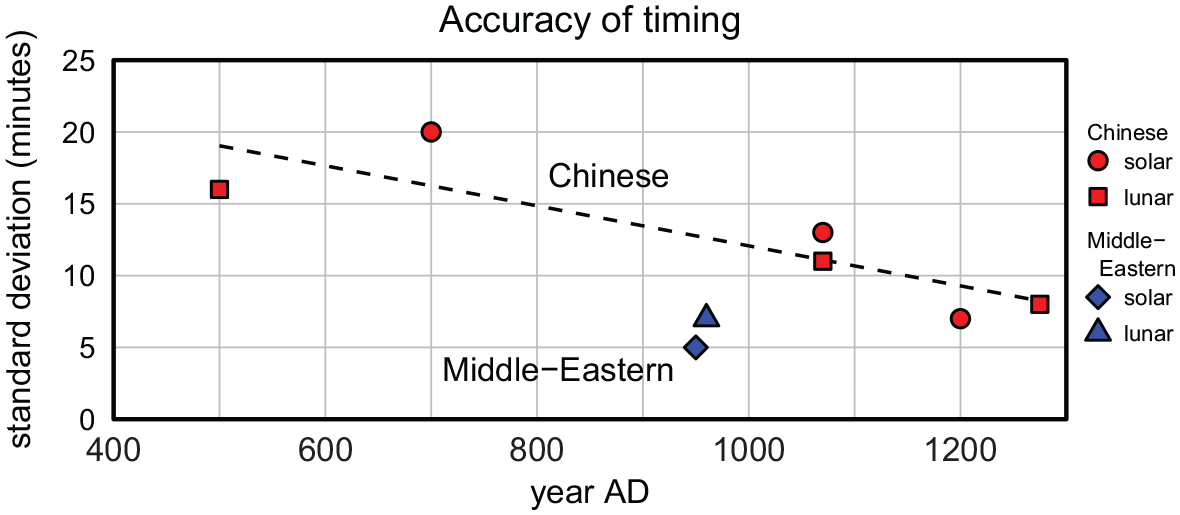
Standard deviations for the Chinese and Middle-Eastern timings of solar and lunar eclipse phenomena. The dashed line indicates the improvement over time of the accuracy of the Chinese observations.
The Chinese observations naturally group into three historical periods. There is a clear improvement in accuracy over time, with the standard deviation reducing to about 7 minutes for the solar observations in the last period around AD 1200. This reflects the improvement in the construction and use of clepsydras in the period AD 400–1300. 27
The Middle-Eastern data cover a narrower range in date, and there is insufficient data to discern a trend. When the unreliable timings of the maximum of solar eclipses are rejected, the best accuracy has a standard deviation of 5 minutes, which is equal to the resolution in the measurement of time using astrolabes.
Thus, the accuracy of both the later Chinese timings (after about AD 1000) and Middle-Eastern timings approached the resolution in time of their clock systems: 7 and 5 minutes, respectively.
Collectively, the timed observations support the solution for the Earth’s variable rotation obtained independently from untimed eclipses, except for the Chinese timing of contact 4 in lunar eclipses. We surmise that it may not have been their intention to time the fourth contact, but rather to note the time when the whole disk of the Moon appeared to be completely restored.
Footnotes
Acknowledgements
The authors acknowledge HM Nautical Almanac Office and the International Astronomical Union’s Standards Of Fundamental Astronomy.