






Abstract
In this article, I explore sensemaking processes associated with the overview effect—a cognitive shift experienced by astronauts who see Earth from space. Analysis of publicly available interviews (n = 51) with astronauts revealed a common sequence of sensemaking: First, astronauts reported experiencing speechlessness triggered by beauty and awe (a phenomenon I label, awe-mute). Second, during and after missions, most reported attempting to make sense of the experience with others, often resulting in a deepening of their previously-existing worldviews, a process I term sensedeepening. Third, sensedeepening often resulted in astronauts’ (a) admissions of inadequacy to give sense to their experience for others, and despite this, (b) development of messages to communicate their experiences, and (c) engagement in social activism. These patterns were corroborated by additional interviews with astronauts (n = 5) and an interview with a prolific interviewer of astronauts. Implications for sensemaking theory and organizational change conclude the article.
The reality and aftermath of a global pandemic, environmental issues, and catastrophic international unrest are just several of many worldwide difficulties where prosocial group collaboration is necessary, but elusive. Getting groups to work together and navigate conflict constructively is a pressing challenge of our day. These global challenges demand bold and unconventional investigations into the conditions that can foster a fresh openness to efforts to work together fruitfully. As such, this article uses and extends sensemaking theory (Weick, 1995; Weick et al., 2005) because it explains how groups’ receptiveness to change tend to be closed, but also hints at the conditions under which change receptiveness may be cultivated.
Sensemaking theory explains that people tend to interpret negative triggering events (NTEs) by ignoring disconfirming information, prioritizing plausibility over accuracy, and seeking identity-affirming storylines (Maitless & Christianson, 2014; Weick, 1995; Weick et al., 2005). Groups often adopt self-enhancing meaning attributions to cope with the ambiguity associated with challenges; however, in doing so, intergroup collaboration and change receptiveness become less likely. NTEs foster anxiety and the psychosocial coping process of sensemaking, which, in turn, typically shuts down further inquiry, critical self-questioning, and investigation of future possibilities that are crucial to successful (inter)group cooperation. Sensemaking is related to many organizational change processes (Corley & Gioia, 2004; Gioia & Chittipeddi, 1991; Sharma & Good, 2013), and as such is important to consider in collaborative groups.
To date, scholars have considered sensemaking processes related to negative triggering events (NTEs) across many crises (e.g., James, 2007; Kent, 2019; Maitlis & Christianson, 2014); yet, what is less understood is whether and how positive triggering events (PTEs) shift the ordinary sequences of sensemaking. In other words, the association between PTEs and constructive social change remains an underexplored aspect of sensemaking theory. On the one hand, anxiety and ambiguity brought on by NTEs slow down sensemaking and tend to provoke psychosocial coping processes (Weick, 1995; Weick et al., 2005). However, what happens when the ambiguity experienced is enmeshed in positive—not negative—emotions and experiences, such as the awe felt when in the presence of large geographical features or even space? On the other hand, PTEs may stir desirable emotions that people want to prolong (as opposed to minimizing), opening up sensemaking in ways that foster openness, inquiry, and creativity (Gottlieb et al., 2018; Keltner & Haidt, 2003). Additionally, PTEs may create enriched worldviews that accommodate new interpretations, which function as springboards to productive individual and collective action. Though organizational scholars have considered emotions involved in making sense of organizational change (Bartunek et al., 2006), little scholarship has explored how sensemaking may be triggered by emotions that open up receptivity to change, including organizational change. In sum, sensemaking theory is a key for understanding how PTEs might induce change accommodation processes engendered by the adoption of alternative, enriching, and meaningful storylines that influence subsequent action.
In this article, I investigate elite professionals who undergo an extraordinary PTE in their work: astronauts who experience the overview effect (OE). First, I discuss the OE in depth. Second, I provide a thorough discussion of sensemaking theory and posit the theory's explanatory power related to the OE. Finally, I elaborate on the positive emotion of awe as characteristic of the OE as a PTE. As such, this article contributes to the literature in four ways related to awe and organizational theory by (a) proposing that the OE is a positive triggering event, (b) labeling a communication phenomenon central to the OE that I call awe-mute, (c) identifying a meaning-making process I call sensedeepening, and (d) proposing that PTEs such as awe can short-circuit the common consequences of sensemaking and stimulate members toward greater curiosity and an openness to work together on large challenges.
The Overview Effect
Over the past several decades, philosophers and psychologists paid increasing attention to astronauts’ experiences of what has been termed “The overview effect” (OE; White, 1987, 2021). The OE describes the cognitive shift experienced by many astronauts when they view Earth from outer space—a vantage point that affords an “overview” perspective that humans on Earth cannot experience (Voski, 2020; Weibel, 2020; White, 1987, 2021). Intrinsic to the OE are positive emotions, as astronauts report their awe, amazement, and joy when they see Earth from space (White, 1987, 2021). For example, astronauts report feeling unexpected, immense emotion, an increased sense of connectedness with others, and a deep appreciation of the beauty of Earth (Yaden et al., 2016). This awe-striking and emotionally overwhelming experience is often transformative and can leave astronauts feeling a deeper connection with others, perceiving the world as a more unified system, and engaging in initiatives that promote social change, environmental advocacy, and human wellbeing (Stepanova et al., 2019; Voski, 2020; White, 1987, 2021).
Significant insights have been identified regarding what astronauts see and feel when they observe Earth from space. For example, astronauts describe the beauty and fragility of Earth and express their own sense of smallness and insignificance in comparison to the vastness of space (White, 1987, 2021). They also report that because they cannot see Earth's national borders when looking down on the world, they perceive the planet as one global system, inhabited by one people who share far more in common than they perceive (White, 1987, 2021). Despite their attempts to describe their experiences, astronauts express that the OE is so extraordinary that it is nearly impossible to describe or process (White, 1987, 2021).
Research on the OE escalated in recent years (e.g., Launius, 2013; Malina, 1992; Suedfeld et al., 2012; Voski, 2020; Weibel, 2020; Yaden et al., 2016), and the transformative nature of the OE is well-established empirically (e.g., Ihle et al., 2006; Suedfeld et al., 2012; Voski, 2020; White, 1987, 2021). Current scholarship focuses on the philosophical, psychological, spiritual, and ecological implications for astronauts and the general public (e.g., Nezami, 2017; Voski, 2020; Weibel, 2020), rather than on implications from a management or organizational point of view.
However, it is important for organizational scholars to know more about the overview effect for several reasons. First, the positive consequences of this phenomenon may be transferrable to more traditional organizational contexts. Though earth-bound managers and employees cannot experience the overview effect themselves, they can experience the awe and other broadening emotions in the workplace, as well as experience perspective changes that motivate new action. As the scholarship on the overview effect to date suggests, positive emotions such as awe may support cooperation, teamwork, and unity between diverse peoples. Second, the overview effect suggests that perspective change is powerful in accomplishing the organizational changes management scholars work toward. As Fairhurst (2011) argues, organizational members and leaders hold mental models, or “frames,” about how the world should or does work, that significantly shape organizational life and leadership. Certain emotions and experiences may be able to shape these frames in ways that lead to behaviors like cooperation and collaboration. In an organizational world often driven by deadlines, bottom lines, division, and self-interest, the overview effect holds promise for providing insights about the power of perspective change in supporting organizational change efforts.
Third, the overview effect speaks to the way that people cooperate in team settings. While experiencing the overview effect, diverse teams of astronauts successfully carry out high-risk, mission-critical work. Additionally, after experiencing the overview effect, astronauts consistently engage in team-based initiatives and seek to promote cooperation and unity across diverse peoples. Evidently, their experience in space is quite transformative, and the overview effect provokes them to make sense of the world in new ways. Scholars of organizational theory and change should take great interest in this phenomenon. This article uses a sensemaking perspective to consider the overview effect from an organizational point of view.
Sensemaking Theory
Sensemaking theory explains how people attribute meaning to their world (Maitlis & Christianson, 2014; Weick, 1995; Weick et al., 2005). The sensemaking process is usually very rapid, effortless, and beneath conscious awareness, rendering it difficult to observe. Weick and colleagues explain sensemaking by using the interrelated questions of: “What's the story?” and “What therefore should I do next?” (Weick et al., 2005). As storylines are adopted in response to these questions, those stories become springboards for future action. Repetition of these actions shaped by accepted meaning attributions, in turn, create and routinize taken-for-grantedness (Weick et al., 2005).
As an organization loses fitness with its environment because of ongoing change, the system shifts from rapid, subconscious, “autopilot” sensemaking to slowed, clunky, difficult, and conscious sensemaking (Weick, 1995; Weick et al., 2015). In other words, sensemaking never begins or ends, but the system's awareness of sensemaking does change as existing meaning systems are confirmed or threatened. Key to sensemaking theory is the presence of a triggering event that disrupts rapid, easy sensemaking and heightens anxiety and ambiguity. Triggering events raise sensemaking to the level of conscious awareness as existing interpretations are questioned, thus making sensemaking processes more easily observable. Systems are motivated to reduce anxiety, so they communicate in ways that account for identity threats. Through this labeling process, they interpret events by constructing and adapting plausible storylines (Maitlis & Lawrence, 2014; Weick, 1995; Weick et al., 2005). When a system perceives a gap in sensemaking processes, the system likely relies on sensegiving processes (Maitlis & Lawrence, 2007). Sensegiving occurs when people communicatively attempt to shape others’ sensemaking processes (Maitlis & Lawrence, 2007).
Negative Triggering Events
Scholars examined a plethora of sensemaking cases, usually within the context of organizations (e.g., Bartunek et al., 2006; Christianson et al., 2009; Monin et al., 2013; Rerup & Feldman, 2011); the vast majority involve negative triggering events (NTEs; e.g., Baber & McMaster, 2016; Maitlis & Sonenshein, 2010). NTEs are events that disrupt rapid sensemaking and are morally or emotionally harmful, bad, unpleasant, or destructive in nature (e.g., sexual harassment, see Dougherty & Smythe, 2004). Sensemaking theory has primarily considered NTEs, positing that most events are experienced negatively because they heighten unwanted, uncomfortable anxiety (Weick, 1995). Negative experiences tend to result in a search for meaning attributions that offer sensemakers psychosocial coping, often prolonging maladaptive actions (e.g., Brown & Starkey, 2000). These meaning attributions serve as springboards to action and can scale from the organizational level up to institutions and larger systems, in some cases, in extraordinary ways (e.g., Bisel et al., 2017).
Positive Triggering Events
PTEs are events that disrupt rapid sensemaking, but are morally or emotionally exemplary, good, beneficial, or positive in nature. Consider learning about a case of a community who extended forgiveness toward a shooter who had tragically killed several children in their local school (Aquino et al., 2011) or about middle managers who create virtuous social change in their organizations (Sharma & Good, 2013). Such incredible stories leave the audience with a sense of awe, delight, and even a need to search for a deeper meaning—a sensation that suggests sensemaking has slowed down and become somewhat disrupted. Natural or moral beauty (e.g., acts of extreme generosity or kindness) can trigger a host of positive emotions, such as gratitude, happiness, joy, awe, gratitude, satisfaction, or connection (Algoe, 2012; Algoe & Haidt, 2009; Cameron & Dutton, 2003; Pohling & Diessner, 2016; Shiota et al., 2007; Shiota et al., 2017). Presumably, such emotions can slow the sensemaking process and drive individuals to search for meaning. We do not yet know the impact of PTEs, but these events and their related emotions may trigger sensemaking that results in new processes and outcomes. PTEs may enable both the broadening of sensemaking processes and the building of resources for thriving. In the case of the overview effect, the emotion of awe as characteristic of certain PTEs is salient to consider.
Awe
Awe describes the sense of wonder, joy, and fear in response to an impressive or admirable stimulus (Gottlieb et al., 2018; Keltner & Haidt, 2003; Shiota et al., 2007; Shiota et al., 2017). Awe is highly associated with experiences, and is primarily conceptualized as a positive, elevated emotional phenomenon that shifts focus outside of the self and results in a sense of smallness or insignificance (Keltner & Haidt, 2003; Shiota et al., 2007; Shiota et al., 2017). Awe is an emotional experience that (a) blends fear and amazement, (b) requires the perception of something symbolically or literally vast or great, and (c) calls for new mental structures to accommodate the stimuli (Keltner & Haidt, 2003).
Given its definition, people typically experience awe when they perceive significant beauty, ability, threat, virtue, or the supernatural (Keltner & Haidt, 2003). Scholars have connected awe specifically to scientific inquiry (Gottlieb et al., 2018), but the simultaneous fear and joy involved in awe can occur in a multitude of environments. People report experiences of awe as stimulating contentment, love, humility, rapture, connection with the world, and unawareness of mundane concerns (Shiota et al., 2017). Individuals who experience awe often also have an increased ability to endure uncertainty (Gottlieb et al., 2018; Shiota et al., 2006).
The emotional experience of awe is particularly relevant to an investigation of positive-triggering events for sensemaking, as this positive emotion is positively associated with accommodation processes (i.e., the development of new cognitive meaning structures) in a way that may shape the sensemaking process in the wake of awestruck moments (Keltner & Haidt, 2003). Additionally, awe is salient to positive organizational scholarship and inquiry on productive action because this emotional experience is associated with adaptive outcomes, such as altruism, prosocial behavior, and well-being (Gottlieb et al., 2018; Yaden et al., 2016). Though scholars have refined conceptualizations of awe as an emotional or psychological state, little is known about the communication and organizational processes associated with awe. However, both emotion and communication are defining aspects of workplace life and sensemaking (e.g., Miller et al., 2007; Scarduzio & Tracy, 2015). As such, further theorizing about positive emotion and communication in organizational settings, particularly those that trigger sensemaking, is needed.
A sensemaking perspective positions the OE as PTEs that positively disrupts astronauts’ existing mental models and obliges them to talk about their experiences to interpret to them. These communicatively-constructed meaning attributions may foster accommodation and openness to enriching, meaningful storylines that serve as springboards for important future action such as intergroup collaboration. Grounded in sensemaking theory (Weick, 1995; Weick et al., 2005), this study explores the OE as PTEs, as well as the communicative and behavioral consequences of this phenomenon. I posit the following research questions: RQ1 How do astronauts make sense of the overview effect?
Method
Participants and Procedures
The dataset consisted of two main sources: publicly available interview transcripts published by Frank White and original interviews conducted by the authors (see details below and in Appendix C of Table 1A). As is common with astronauts, participants in both data sources represented a range of academic (e.g., engineering, medicine) and professional (e.g., test pilot, scientist) backgrounds.
Frank White worked for 35 years on the concept of the OE. His popular book is now in its fourth edition. The book is supported by interviews with National Aeronautics and Space Administration (NASA) and European Space Agency (ESA) astronauts and engineers who have experienced space travel. His book concludes with 300 single-spaced pages of lightly-edited interview transcripts with these professionals. Those publicly available interview transcripts served as the first source of data for analysis. The collection of transcripts represents 53 interviewees and 57 interviews, spanning 99 missions across 58 years of space flight.
Additionally, the researcher recruited astronauts through a professional contact associated with NASA, who, in turn, asked potential participants if they were willing to be contacted by the researcher. Then, the researcher employed a snowball sampling strategy and asked interviewees to help recruit other astronaut participants. After obtaining informed consent from participants under the oversight of the Institutional Review Board, the researcher conducted in-depth, semi-structured interviews with five astronauts who have participated in space missions. Interviews were conducted via video conferencing (i.e., Zoom). Interview questions asked participants to describe their roles as astronauts, their experience of the OE, and their attempts to communicate their experiences to others after space flight (see Appendix B). Each interview was recorded, and recordings were transcribed by a compensated individual in a professional transcription service. Backchannel affirmations and ordinary disfluencies were excluded. I compared these transcripts to the Zoom-recorded interview transcripts to recapture in any muffled sentences where necessary and possible. Interviews ranged from approximately 40 to 80 min in length, resulting in approximately 77 pages of single-spaced transcriptions.
Analysis
Transcripts from both data sources were analyzed using a modified version of constant comparative analysis, which is common of contemporary communication and organizational research (Charmaz, 2006; Glaser & Strauss, 1967; Lindlof & Taylor, 2017). I used NVivo, a software for qualitative data management, which facilitated the analysis. Analysis proceeded in four stages: First, I conducted data reduction on all publicly-available interview transcripts from Frank White's book, The Overview Effect, resulting in approximately 25 pages of single-spaced data pertinent to my research questions. Segments were retained for further analysis if participants described the view, the OE, or the sensemaking and transformation processes they experienced as a result of space flight. Second, I utilized open coding on the cumulative interview transcripts. Specifically, I assigned summative labels to portions of the data that expressed a single idea. Summative labels were created to retain detail but also allow my mind to recognize patterns across those details. Example summative labels included absorption in view, appreciation, awe, can’t look away, consuming, danger, enjoyment, Grand Canyon, and humility. The open coding process was exploratory and iterative, such that I checked constantly for new codes against existing codes until all similarities and differences were accounted for. Third, I conducted focused coding, where I organized open codes by category (e.g., positive emotions, negative emotions, metaphors, descriptions of view). Fourth, axial coding was used to theorize interrelationships among the data. Late in the analysis, it was discovered through constant comparison that the main categories were primarily related to one another in terms of their unfolding over time. Along the axis of time, I identified and proposed two concepts to capture this temporal interrelationship: awe-mute and sensedeepening.
Creswell (2007) recommends validating qualitative findings with at least two strategies (Creswell & Poth, 2016). I utilized a form of peer review, in which the analysis was checked by a senior scholar and qualitative methodologist who has experience researching the topic of sensemaking and positive deviance. Throughout the analysis, this senior scholar provided feedback, offered critique, and played devil's advocate, which strengthened the rigor of analysis and theorizing. Additionally, more than one base of evidence was collected (i.e., in-depth interviews and publicly available transcripts). The two bases of evidence were helpful in that in-depth interviews could corroborate publicly available transcripts and vice versa.
Findings
Astronauts engaged in a common sensemaking process to interpret their experiences in space. This process unfolded in three stages: experiencing the PTE (OE), communicatively processing the event with others, and engaging in behavioral and communicative activities as a result (Appendix A of Figure A1). Ironically, respondents expressed frustration about their inadequacy to describe the experience, yet felt compelled to still communicate with others. Looking deeply into these experiences is important for the organizational world because positive events and emotions may trigger sensemaking in ways that are transformative to change receptiveness and intergroup collaboration in large social systems.
Positive Triggering Event
Astronauts’ sensemaking processes were triggered by a PTE: experiencing the OE. Sensemaking theory posits that triggering events disrupt rapid, easy sensemaking and provoke effortful, retrospective interpretations of such events that then become springboards to future action (Weick, 1995; Weick et al., 2005). However, scholars have theorized that slowed sensemaking is primarily induced by negative emotional events (e.g., trauma, see van de Ven, 2020) and focused on the anxiety and ambiguity fostered when an accepted “storyline” is threatened. In contrast, astronauts described the triggering event (OE) of their sensemaking processes as positive, enriching, gratifying, and transformative, despite some elements of fear and uncertainty.
Central to astronauts’ PTE for sensemaking was the visual impression of Earth. Astronauts offered rich descriptions of their view of Earth from space, attempting to articulate the perspective of Earth from their otherworldly vantage. Astronauts described the exquisite splendor of the scene with poetic language. For example, Astronaut Valentin Lebedev said, “Space is very beautiful: the dark velvet of the sky, the blue halo of Earth.” Other astronauts focused on the enormity of space (e.g., “It's simply vast and infinite.”). These descriptions emphasized the exquisite beauty of the view and a captivated absorption that demonstrated the positive, enriching nature of the PTE.
Astronauts also expressed that they experienced profound emotions when they looked back on Earth from space, such as awe (e.g., “It is really awe-inspiring to be in that environment”), admiration (e.g., “[It's] just sort of a shared admiration of whatever it is that you’re flying over”), satisfaction (e.g., Astronaut Joseph P. Allen: “It is endlessly fulfilling”), joy (e.g., “It's just an overpowering and overwhelming joy that you have”), and bliss (e.g., “The feeling is absolutely euphoric”). Most felt a profound sense of being overwhelmed; astronaut Charles Bolden Jr. stated, “I was so overwhelmed that I literally cried. All of a sudden, tears came to my eyes and I cried for a couple of reasons … it was emotionally overwhelming.” Others, such as astronaut John B. Herrington, expressed a sense of humility: “What was significant about it to me was that it made me feel really insignificant, really small in relation to what I was looking at.” Astronaut Jean-Francois Clervoy elaborated, “You feel the opposite of a superiority complex. You feel an inferiority complex before the Earth. We are nothing …”
In addition to these euphoric and humbling emotions, astronauts also reported feeling fearful (e.g., “You’d better be a little bit scared. You’ve got to be, because it's a dangerous place”) and even terrified (e.g., Astronaut Michael E. Fossum: “And that view … that was a moment of sheer, stark terror.”). Astronauts even described the view as eerie (e.g., Astronaut Tracy Caldwell Dyson: “It's really eerie because you just see this dark shadow coming …”) and disturbing (e.g., Astronaut Michael E. Fossum: “That's a very disturbing view, looking down …”). This complexity of emotion resonates with the nature of awe, which is comprised of both joy and fear (Shiota et al., 2017). Awe-striking experiences often leave individuals feeling small, insignificant, and humble in relation to the enormity or impressiveness of the stimulus (Perez & Lench, 2018; Silva Luna & Bering, 2021).
Astronauts also expressed the significance of the OE as an immersive, “whole body experience,” emphasizing that one must personally experience the OE to understand its consequences. Others reported the OE as “something that you can experience only by being in space.” Astronaut Byron Lichtenberg explained that presence in space was “like the difference between seeing a good PBS special on the Grand Canyon and being there.” Repeatedly, astronauts emphasized the irreplaceability of experiential knowing: “You know intellectually what seeing Earth from space is like because we’ve all seen the pictures. The pictures are the next best thing to being there. But it's not being there.” Evidently, this PTE involves a physical and emotional presence that is impossible to replicate.
In addition to the physical and emotional aspects of the PTE, astronauts referenced the profundity of spirituality. Astronaut Jake Garn described the immense depth of presence as spiritual in nature: “It is a spiritual feeling that you know, not just because somebody told you … but you have personally seen that it really is like what you learned in school.” Astronaut Bill Nelson referenced the importance of the Bible to his experience of the OE: “I frequently recalled what King David had written thousands of years ago in Psalm 19: ‘The heavens declare the glory of God, and the firmament showeth His handiwork’. That order, that creation, was very apparent to me.” As astronauts attempted to describe the richness of the OE, they appealed beyond emotionality to spirituality.
Finally, when experiencing the OE, astronauts reported experiencing speechlessness, a communication consequence I label awe-mute. Awe-muteness is the speechlessness experienced by individuals overcome with the emotion of awe. Awe-muteness is often detected indirectly by reports of the experience of an inability and lack of desire to speak triggered by the perceived profundity of a moment. This “in between” state captures astronauts’ newly disrupted and newly forming mental schemas. When staring out the window and absorbing the view, astronauts were often completely silent. Astronaut Tracy Caldwell Dyson explained: “Whether folks had teary eyed responses or not I couldn’t tell, but what I did know was that we all had a sense of awe that didn’t require confirmation from the other person. No, it was a moment of silence for all of us.” Additionally, when trying to convey those awe-striking moments to others, astronauts reported inadequacy in communicating. Astronaut Sultan Bin Salman al-Saud expressed: “It really is the most incredible thing. I was asked … to come up with one word to describe what I have seen, and I said, ‘The word I come up with is that there are no words to describe it; it is beyond description’.’’ This speechlessness provides insight into the nature of awe, suggesting that, unlike some emotional experiences, awe initially quiets, impedes, or befuddles communication. This phenomenon echoes Nonaka and Takeuchi's (1995) work on knowledge creation, which argues that “tacit knowledge” is ineffable. Similarly, as astronauts internalized new knowledge during the overview effect, they were suspended in their capability of articulating their experience. During this PTE, astronauts were captivated by beauty, joy, and awe that words failed to express.
Astronaut Michael Collins believed that this powerful experience would be transformative for anyone: “I am less optimistic about getting humankind together than I was 10 years ago. Still, I think if you could send enough people up, that would have a salutary effect.” Astronaut Eugene A. Cernan echoed the transformative potential of translating the experience to earth-bound contexts: You try to share and relate your feelings to others, but you can’t take a billion people back with you. It's almost as if you have come back from the future. You wonder, if only everyone could relate to the beauty and purposefulness of it, the reality of the infinity of time and space, how our star moves through time and space with such logic and purpose. It wouldn’t bring a utopia to this planet for people to understand it all, but it might make a difference.
Though earth-bound organizational members do not experience exactly what astronauts do, astronauts consistently expressed an earnest desire for others to somehow experience a fraction of what they did, suggesting that the role of awe is still important to consider in organizational systems. Arguably, this perplexing experience of joy and fear is common in the workplace, yet perhaps underrecognized. For example, medical professionals and scientists encounter the wonders of nature and the human body on a daily basis. Human service workers are often privileged to witness awe-inspiring resilience in their clients and sacrificial love in their volunteers and donors. Even corporate teams can experience awe in response to stimuli such as exemplary leaders in their workplace or a lofty goal achieved. Organizational theorists should pay attention to the ways awe shapes communication and action in team-based settings, as this emotion may make more of a difference than we think.
Sensemaking and Sensedeepening
The OE exceeded many astronauts’ expectations and, in turn, triggered sensemaking. One astronaut explained, “Looking back has been the most dramatic part of it. I think we have been as surprised about how much it has meant to look back at Earth, as it has to look out into space.” Additionally, the OE altered many astronauts’ personal meaning systems (e.g., “Being a quarter million miles out in space has to give you a different perspective. Anyone who denies it has missed something.”). As astronauts experienced the PTE, awe disrupted astronauts’ existing mental models and slowed their “autopilot” of rapid sensemaking (Weick, 1995). Astronauts voiced their own limits to process the immensity of the triggering event (e.g., Astronaut Scott E. Parazinski “I think my aperture for being able to absorb the whole experience as perhaps a little bit limited. But, with each subsequent flight … I broadened … my aperture, and I was able to absorb more.”). This finding resembles Shiota et al.'s (2017) theorizing, which posits that awe reduces reliance on current knowledge structures and exposes the need for new schemas that better account for the object of awe.
When astronauts felt awe and realized that their present apertures were too small to account for the extraordinary stimulus, they experienced awe-muteness, but then began to talk to make sense of disrupted sensemaking. One astronaut summarized the process of making sense of the OE, explaining: “So you … experience spaceflight, and then process it verbally. Each time I was able to study more of the view in detail because of its familiarity. The immediate and superficial impressions that flooded me lessened. I could study them more carefully.” As astronauts reflected on the PTE, they crystallized accepted storylines and began to attempt to communicate them with others. Thus, after astronauts experienced the PTE, they engaged in sensemaking processes with one another, and in turn, attempted to communicate newly-formed meaning with others.
Though the OE challenged existing mental models, it also reinforced existing worldviews, a process I call sensedeepening. Sensedeepening is a sensemaking process whereby preexisting meaning structures are reinforced and strengthened, such that those meaning structures become more articulated and articulable. Rather than only altering meaning attributions, the PTE intensified already-held beliefs, views, and interpretations. For example, one astronaut stated: “Seeing Earth from that perspective did reinforce my concept of a small fragile planet and a species needing to come to terms with itself.” Another astronaut explained how the OE made [him] more sure of what he already believed: “It was a reaffirmation of what a beautiful and special place Earth is … It makes you more certain that there is a reason for it, too.” This comment demonstrates how sensemaking processes can deepen preexisting values and beliefs, fortifying these meaning structures. Astronauts’ sensedeepening processes demonstrate that sensemaking may result not in new labels, but in a deeper attachment to existing labels. These findings suggest that positive triggering events may provoke sensemaking in organizational teams that is different than traditional sensemaking. The positive emotions that characterize these experiences may stir transformative meaning-making processes in the workplace that are necessary for growth, change, and cooperation. These meaning attributions may reinforce meaningful organizational narratives that shape larger systems of thought, communication, and cooperation.
Behavioral and Communicative Consequences
Astronauts’ sensemaking and sensedeepening resulted in both communicative and behavioral outcomes. Specifically, astronauts emphasized their inadequacy to communicate the experience, yet, ironically, they crafted messages to attempt to convey what they had seen. In addition, astronauts participated in social activism, engaging in environmental, cultural, and other strategic efforts to improve the human condition.
Astronauts articulated an ardent desire and even conviction to share their experience with others (e.g., Astronaut Jeffrey A. Hoffman: “The main thing is to talk to other people about it, which is one of the reasons I agree to have my diary made public.”). Astronaut Charles D. Walker implied that the experience was so magnificent that [he] could talk about it endlessly: “When I talk to audiences, I always get the question, ‘What was it like?’ My first response is, ‘I’m sorry. How many days would you like to take to hear the answer to that?’’ However, though astronauts felt compelled to talk about the view (e.g., “I could not help exclaiming over the radio about what I saw.”), they also felt frustration over their inability to sufficiently give sense to others (e.g., Astronaut Jake Garn: “First let me say that it is virtually impossible to describe the beauty of Earth, I don’t have the vocabulary, and I have felt very frustrated in trying to describe it.”). I termed this experience the conscious inability to sensegive (CISG). Astronaut Tracy Caldwell Dyson articulated the simultaneous resolve and inability to communicate the OE to others: “The experience is in some ways ineffable, but I learned that we must keep doing it.” Astronauts repeatedly admitted that their descriptions were insufficient, yet still attempted to share as much as possible.
Despite CISG, astronauts utilized framing devices to relate their experiences to non-astronauts, primarily through similes, metaphors, and vivid language. Astronauts compared space flight to Earth-bound explorations, such as climbing “Mount Everest,” visiting the “Grand Canyon,” “pioneering,” “hot air ballooning,” and “scuba diving.” They also framed the inherent goodness of the experience metaphorically, comparing it to a “dream,” “magic,” and a “vacation.” One astronaut even said, “I could no more look at Earth and see anything bad than I could look at a smiling little girl or boy and see a bank robber. It's impossible to see anything but goodness.” Astronauts also used metaphorical language to give sense about what Earth looked like, offering comparisons such as a “blue marble,” a “fragile oasis,” and a “pale blue dot.”
Astronauts returned motived to talk about their experiences (e.g., Astronaut Bob Thirsk: “I think I’m a better writer today. I think I’m a better orator, because I really want to communicate the message of, you know, why we’re investing in space flight.”). To do so, they used artistic and other metaphors continually to paint a linguistic image for others to imagine. These poetic attempts to describe the OE suggest the emotive role of language in sensemaking. As astronauts attributed meaning to their experience and then were motivated to convey its meaningfulness to others, they could not adequately do so with technical, precise language. Though successful management and organizing are often associated with a need for clear and even technical language, astronauts’ communication devices suggest that other linguistic strategies may be needed to convey the significance of some PTEs, as well as to express the depth of resulting transformed worldviews. Thus, where organizational sensemaking and change are particularly meaningful and provoke profound emotions, organizational leaders and members may need to rely on more emotive language to adequately engage in sensemaking and sensegiving. This idea reflects Fairhurst and Sarr's (1996) recommendation that organizational leaders utilize linguistic, poetic framing devices to most effectively shape members’ mental models. Perhaps organizational leaders should intentionally incorporate emotive language to express certain realities, rather than over-emphasizing clear, technical communication. Furthermore, findings demonstrated that sensegiving communication about profound experiences is an ongoing work-in-progress. “After experiencing the OE, astronauts progressively worked on their communication about the OE, publishing updated editions of books and refining descriptions in their plentiful speaking engagements.” Thus, astronauts’ sensemaking and sensedeepening processes motivated them toward a consciously-inadequate sensegiving, as they attempted to communicate in new ways because of space flight.
Sensemaking processes also changed astronauts’ perceptions of the world, such that they felt a deeper sense of unity across racial and geographical differences (e.g., “These international and cross-cultural issues are more important to me now.”). Numerous astronauts articulated that because international boundaries are invisible from space, they were able to see Earth as a single planet where “earthlings” lived. Astronauts explained, “Each of us has seen Earth as a single place with our own eyes” and, “It's just all one being, one thing, and it's all interconnected.” Astronaut Bob Thirsk explained: “We should be learning about the plight of people elsewhere in the world, on the opposite side of the planet, and we don’t—and I wish the news maybe would do a better job of fostering this notion that we are one humanity.”
Finally, astronauts engaged, both personally and publicly, in social activism and launched initiatives for the public good upon return from space flight. One volunteered in a hospital to paint spacesuits with pediatric patients, and as a result founded the Space for Art Foundation, which engages children in space-themed art therapy. Many astronauts return with a heightened sense of responsibility and stewardship regarding the planet's resources; Astronaut Bob Thirsk stated, “I think everyone comes back from a space flight an environmentalist to some degree.” These findings echo research that states that viewing images of beauty is a better motivator for climate change activism than fear appeals (O’neill & Nicholson-Cole, 2009). Just as astronauts’ sensemaking and sensedeepening provoked their investment in social and environmental activism for the common good, workplace sensemaking and sensedeepening may foster productive action. Though we do not yet know how positive events may trigger sensemaking and subsequent action in traditional workplace settings, organizational scholars should examine these processes more deeply. Awe-inducing PTEs may disrupt old knowledge structures and provoke organizational members to create new schemas (Shiota et al., 2017) that could facilitate cooperative, others-focused efforts in teams.
Discussion
The purpose of this article was to provide an account of the OE from an organizational and communication theory perspective. This article contributes to the literature by (a) proposing the OE is a PTE that disrupts astronauts’ sensemaking, (b) labeling the speechlessness astronauts experience during the OE with the term awe-mute, (c) identifying a meaning-making process I call sensedeepening, and (d) demonstrating the communication consequences and social actions that result from astronauts’ sensemaking processes. The following paragraphs explain each point in more detail.
First, a sensemaking perspective of findings positions the OE as a positive triggering event (PTE). Astronauts described the positive emotions they felt while looking at Earth from space: delightful, exhilarating, fearful, humbling, mesmerizing, and extraordinary. Furthermore, they expressed a desire to prolong the experience of the OE. Additionally, astronauts communicated how the OE disrupted their existing worldviews and exposed a need for new mental schemas to accommodate the profundity of the experience. Each of these findings demonstrates the OE as a PTE.
Sensemaking processes to date have been primary understood as triggered by negative events, such as crises (Maitlis & Lawrence, 2014), tragedies (Williams & Ishak, 2018), and disasters (Larson, 2003). Negative events slow down the sensemaking process and render it observable and open to the investigation; however, the present study adds to that point that positive triggering events can also slow down rapid sensemaking and make it available for observation. Sensemaking theory posits that people are motivated to cope with these NTEs quickly by seeking identity affirmation, prioritizing plausibility rather than accuracy, and explaining uncomfortable realities away (Maitlis & Lawrence, 2014; Weick, 1995; Weick et al., 2005). These psychosocial coping tendencies likely account for some of the difficulty of intergroup environmental collaboration, as people tend to prefer self-enhancing interpretations of events rather than sacrificing for the collective good and to excuse difficult realities rather than embracing the challenge of problem-solving with other groups.
This study contributes to sensemaking literature with the idea that PTEs may be a key to mitigating some of the known tendencies of sensemaking, such as identity defense that resists needed changes, and supporting new processes, such as expanding the definition of the self, opening people up to change possibilities, and collaborating together. Awe stimulated in the OE challenged astronauts’ expectations about reality and future possibilities, and drew attention away from the self and toward something worth appreciation and respect [the view] (Shiota et al., 2017). According to Shiota et al. (2017), the cognitive shift stimulated by awe should lower reliance on existing knowledge schemas, increase curiosity, and facilitate the development of new ways of thinking. According to sensemaking theory, the meaning attributions adopted during this period of slowed sensemaking will serve as springboards to chains of action (Weick et al., 2005). Specifically, because awe likely fosters openness, accommodation (Keltner & Haidt, 2003), curiosity, and innovation, awestruck people may be open to considering alternative possibilities, working together, and focusing less on the self and identity affirmation.
Research on sensemaking and intuition sheds light on how people might also make sense of awe-striking experiences and act accordingly. Like awe, intuition consists of both affective and cognitive elements which influence subsequent judgment and decision-making (Meziani & Cabantous, 2020). People intuit in ways that feel “tacit, intimate, and complex,” but make sense of intuition in ways that are “publicly displayed, simpler, and ordered” (Meziani & Cabantous, 2020, pp. 1384–1385). Similarly, astronauts engaged in sensemaking to assign meaning to complex, awe-striking experiences that are difficult to describe. However, these emotional experiences were powerful enough to provoke sensemaking and motivate astronauts to talk and act in ways that demonstrated a concern for unity, the common good, and cooperation across diverse groups. These findings demonstrate that awe-inducing experiences may be an answer to getting people to work together on difficult projects.
It is important to note that existing scholarship demonstrates that NTEs can also provide a context for collective relational coordination (e.g., organizational failure, see Bartunek, 2020). For example, the Covid-19 pandemic threatened many organizations, but also provided an opportunity for creative, cooperative growth and engagement (De Clercq & Pereira, 2021). In this case, adversity actually strengthened solidarity and collective synergy. If NTEs can position organizations to engage in positive organizational collaboration and change, it stands to reason that PTEs can do so as well. Future research should continue to examine the sensemaking processes and impact of PTEs, as well as how awe may facilitate successful collaboration.
Second, this study is the first to document and label a communication phenomenon reported by astronauts when they view Earth from space: namely, they become awe-mute. As astronauts felt both joy and fear, amazed by the view out the window, they reported not initially talking. Astronauts expressed that the view they saw fostered such immense reverence and awe that words would detract from their presence or fall short of capturing the profundity of the experience. Awe-muteness, therefore, suggests that some emotions, in this case, a positive one, are too profound to adequately capture with language. From a sensemaking perspective, astronauts’ speechlessness points to a triggering event, where they realized that existing mental models and apertures were inadequate to account for the experience, and that new knowledge structures were needed (Weick et al., 2005). Future research should consider the presence and impact of awe-muteness in other contexts. Certainly, there are many cases in which the profundity of an experience leaves individuals speechless, particularly in scientific contexts (e.g., the birth of a baby). Furthermore, the presence of awe-muteness may signal the presence of a triggering event that makes sensemaking processes more observable.
Third, this study is the first to document and label a phenomenon reported by astronauts after seeing Earth from space: specifically, astronauts tended to experience sensedeepening, a unique meaning-making process through which existing worldviews were reinforced and strengthened. After experiencing awe-muteness, astronauts attempted to talk about the OE to make sense of it (Weick, 1995; Weick et al., 2005). Though few astronauts adopted new worldviews after viewing Earth from space, most reported a series of events in which their previously-held ways of thinking were deepened. This finding contributes to sensemaking theorizing by labeling a meaning-making process that likely occurs in many contexts of sensemaking. After PTEs, the ensuing labeling process that occurs through talk (Weick, 1995) may result in people's clinging more deeply to existing labels and beliefs, rather than creating new labels. Sensedeepening questions the assumption that people always develop new labels for storylines in the sensemaking process. In future inquiry, organizational scholars should consider the ways that groups and organizations, and systems may foster the sensedeepening of desired ideals and mental models, or prevent the sensedeepening of unproductive worldviews.
Fourth, astronauts’ sensemaking and sensedeepening resulted in important communication and behavioral consequences for organizing. Astronauts emphasized awareness and frustration over their inability to engage in sensegiving adequately, a phenomenon I called a conscious inability to sensegive. Despite their CISG, astronauts remained highly motivated to participate in sensegiving about their experiences (Maitlis & Lawrence, 2007). This motivation has resulted in innumerable communicative actions: writing books, speaking at conferences, participating in interviews, and testifying to the experience of the OE in podcasts, movies, and other forms of media. When sensegiving even amidst their perceived inadequacy to accurately convey the OE, astronauts used poetic framing devices rather than highly technical, precise communication. These linguistic choices demonstrate the importance of highly poetic and artistic forms of language to give sense to others about profound experiences.
Sensemaking of the OE also resulted in important, productive chains of action demonstrated in the social and environmental activism astronauts engaged in upon their return. Astronauts reported engagement in a variety of good works, including involvement in space art therapy during child cancer rehabilitation, participation in environmental efforts, greater care for Earth, and authoring numerous books to share their experience. Astronauts also returned with a great sense of the unity of Earth and determination to promote world peace despite cross-cultural issues. These behaviors are evidence of productive action that resulted from meaningful storylines, which were developed through sensemaking provoked by a PTE, the OE. These findings have significant implications not only for astronauts, but for the general public. Research has already demonstrated that interactive experiences with images from space increased people's intention to support and advocate for space project funding (Weber et al., 2016) and that viewing images of beauty in space fosters positive involvement in climate change activism (O’neill & Nicholson-Cole, 2009). Additionally, Smith et al. (2011) explain that non-experts actually look at images from space with an eye for beauty and with more emotion than experts looking at these images. This research suggests that, while not everyone can experience the OE, aspects of the effect may be translatable to the general public (e.g., images) in ways that still promote beneficial action and engagement. These findings also hold promise for organizational contexts where PTEs could trigger sensemaking that disrupts or reinforces existing worldviews that are meaningful for positive organizational outcomes or change. Future research should examine the kinds of productive action and flourishing that may be provoked by such PTEs. Researchers in positive organizational scholarship (Cameron et al., 2003) and practitioners alike will benefit greatly from a sensemaking perspective of positive deviance (Bisel et al., 2020 ).
Limitations and Future Research
As with all studies, this study has limitations. The data consisted of self-reported interview responses; however, because it is nearly impossible to directly observe astronauts’ spontaneous sensemaking conversations of the OE in space, interviews were fitting because they enable the researcher to gain insight when observation is difficult (Tracy, 2019). Additionally, though significant portions of the archival interviews directly answered my research question, I was limited in my ability to guide the direction of these responses.
Future research should examine positive disruptions to sensemaking that may provoke adaptive sensemaking and sensedeepening processes that facilitate flourishing behaviors such as teamwork, environmental collaboration, unification, and cooperation. Making sense of awe-striking experiences may foster openness and humility that enable needed organizational changes to happen. Additionally, sensedeepening may be a key to understanding when and how organizations and larger systems reinforce existing beliefs which, in turn, shape small- and large-scale outcomes.
This study offers an analysis of the OE from a sensemaking perspective. I propose the significant of PTEs, some of which may be so profound that they leave individuals awe-mute. I also identify and define sensedeepening as a sensemaking process in which existing worldviews are reinforced, and propose that sensedeepening is an integral aspect of astronauts’ sensemaking sequence and an extension of sensemaking theory. The positive communicative and behavioral consequences resulting from astronauts’ sensemaking of the OE suggest the potential of PTEs to trigger a host of behaviors that promote human flourishing and positive organizational change.
Footnotes
Acknowledgments
I would like to acknowledge Dr. Ryan S. Bisel for his feedback on this manuscript.
Ethical Statement
The IRB at the University of Oklahoma (Vice Chair: Kendra Williams-Diehm) granted ethical approval for this study in May 2021, ensuring that the research meets all national and international guidelines for research on humans (IRB#13147). After initial submission, the study was exempted from further review because the research posed no more than minimal risk to participants and ensured participant anonymity.
Declaration of Conflicting Interests
The authors declared no potential conflicts of interest with respect to the research, authorship, and/or publication of this article.
Funding
The authors received no financial support for the research, authorship, and/or publication of this article.

Appendix A
Comparison of ordinary sensemaking and PTE awe-struck sensemaking/sensedeepening.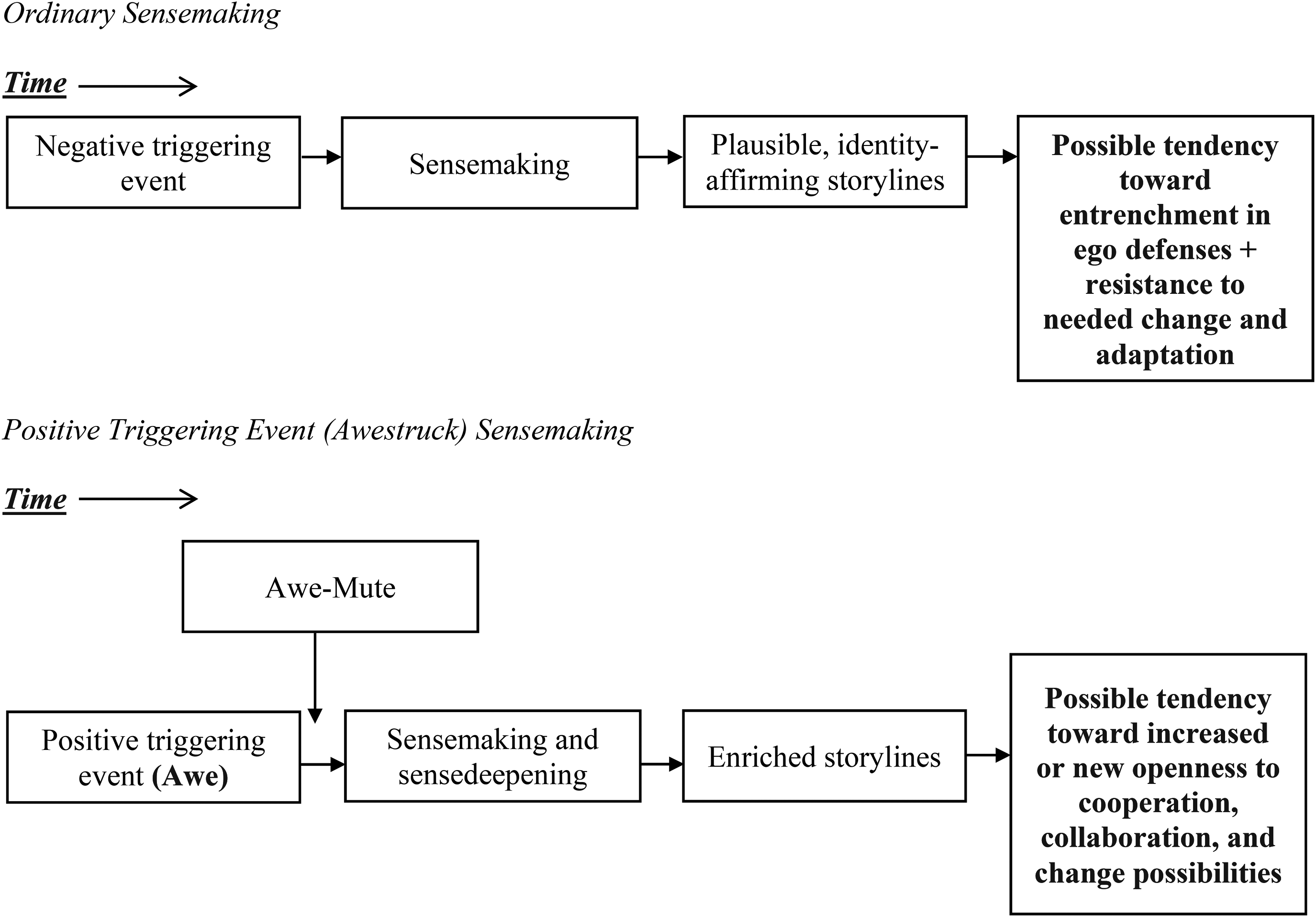
Appendix B
Appendix C
Astronaut Demographics.

| Name | Sex | Missions | Year interviewed | Dataset |
|---|---|---|---|---|
| Yuri Alexeyevich Gagarin | Male | Vostok 1 | N/A (*Quoted by Frank White from Survival in Space, published 1969) |
White |
| Alan B. Shepard Jr. | Male | Freedom 7, Apollo 14 | N/A (*Quoted by Frank White from We Seven, published 1962) |
White |
| John H. Glenn Jr. | Male | Friendship 7 | N/A (*Quoted by Frank White from We Seven, published 1962) |
White |
| Malcolm Scott Carpenter | Male | Aurora 7 | N/A (*Quoted by Frank White from We Seven, published 1962) |
White |
| Eugene A. Cernan | Male | Gemini 9, Apollo 10, Apollo 17 | 1985 | White |
| Michael Collins | Male | Gemini 10, Apollo 10 | 1986 | White |
| Russell L. “Rusty” Schweickart | Male | Apollo 9 | 1985 | White |
| Alan L. Bean | Male | Apollo 12, Skylab 3 | 1986 | White |
| Edgar D. Mitchell | Male | Apollo 14 | 1986 | White |
| Edward G. Gibson | Male | Skylab 4 | 1985 | White |
| Gerald P. Carr | Male | Skylab 4 | 1986 | White |
| Valentin Lebedev | Male | Soyuz 13, Soyuz T-5 | 1983 | White |
| Anatoly N. Berezovoy | Male | Soyuz T-5 | N/A (*Quoted by Frank White from diaries reprinted in 1983 in Aviatsiya I Kosmonavtika. |
White |
| Joseph P. Allen | Male | STS-5, STS-51-A | 1985 | White |
| Byron K. Lichtenberg | Male | STS9, STS45 | 1986 | White |
| Ronald E. McNair | Male | STS-41-B | 1986 (*Quoted by Frank White from a letter he wrote and from the report of the memorial service of the Challenger accident in 1986) |
White |
| Charles D. Walker | Male | STS-41-D, STS-51-D, STS-61-B | 1985, 1986, 2019 2021 |
White Author |
| Marc Garneau | Male | STS-41-G, STS-77 | 1986 | White |
| Jeffrey A. Hoffman | Male | STS-51-D, STS-35, STS-46, STS-61, STS-75 | 1985, 1985 (*Quoted by White from one of Hoffman's presentations at the Smithsonian Center for Astrophysics in 1985, and then interviewed by White in 1986) |
White |
| Edwin “Jake” Garn | Male | STS-51-D | 1986 | White |
| Don L. Lind | Male | STS-51-B | 1985 | White |
| Sultan Bin Salman al-Saud | Male | STS-51-G | 1985 (*Quoted by White from Sultan's interview with Bob MacDonald of Christian Science Monitor Broadcasting) |
White |
| Loren W. Acton | Male | STS-51-F | 1986 | White |
| Bonnie J. Dunbar | Female | STS-61-A, STS-32, STS-50, STS-71, STS-89 | 1997 | White |
| Charles Bolden Jr. | Male | STS-31, STS-61-C, STS-60, STS-45 | 2020 | White |
| Bill Nelson | Male | STS-61-C | 1986 | White |
| Helen P. Sharman | Female | TM 11, TM 12 | 2013 | White |
| Tamara E. “Tammy” Jernigan | Female | STS-40, STS-52, STS-67, STS-80, STS-96 | 1997 | White |
| Janice E. Voss | Female | STS-57, STS-63, STS-83, STS-94, STS-99 | 1997 | White |
| William S. McArthur | Male | STS-58, STS-74, STS-92, Expedition 12 | 2019 | White |
| Scott Parazynski | Male | STS-66, STS-86, STS-95, STS-100, STS-120 | 2016 2021 |
White Author |
| Jean-Francois Clervoy | Male | STS-66, STS-84, STS-103 | 2020 2021 |
White Author |
| Mary Ellen Weber | Female | STS-70, STS-101 | 1997 | White |
| Michael Lopez-Alegria | Male | STS-73, STS-92, STS-113, ISS Expedition 14 | N/A | White |
| Al Sacco, Jr. | Male | STS-73 | 1997 | White |
| Robert Thirsk | Male | STS-78, Expedition 20/21 | 2022 | Author |
| Susan L. Kilrain-Still | Female | STS-83, STS-94 | 1997 | White |
| Sandra H. “Sandy” Magnus | Female | STS-112, ISS Expedition 18, STS-135 | 2013 | White |
| John B. Herrington | Male | STS-113 | 2013 | White |
| Donald R. Pettit | Male | Expedition 6, STS-126, Expedition 30/31 | N/A | White |
| Michael E. Fossum | Male | STS-121, STS-124, Expedition 28/29 | 2019 | White |
| Tracy Caldwell Dyson | Female | STS-118, Expedition 23/24 | 2019 | White |
| Ronald J. Garan, Jr. | Male | STS-124, ISS Expeditions 27/28 | 2012 | White |
| Michael J. Foreman | Male | STS-123, STS-120 | 2019 | White |
| Akihiko “Aki” Hoshide | Male | STS-124, ISS Expedition 32/33 | 2013 | White |
| Karen Nyberg | Female | STS-124, Expedition 36/37 | 2019 | White |
| Richard Garriott de Cayeux | Male | Soyuz TMA-13 | 2015 | White |
| Nicole P. Stott | Female | ISS Expeditions 20/21, STS-133 | 2011 2021 |
White Author |
| Reid Wiseman | Male | Expedition 41 | 2019 | White |
| Anne C. McClain | Female | Expeditions 58, 59/60, 61 | 2019 | White |
| Christina H. Koch | Female | Expeditions 58, 59/60, 61 | 2019 | White |
| Tyler N “Nick” Hague | Male | Expeditions 58, 59/60, 61 | 2019 | White |
| Frank White | Male | None | 2021 | Author |