







Abstract
We examine the role of emotions in the sensemaking and related processes engaged during a period of change in a worldwide network of organizations—the Anglican Communion (global religion of nearly 75 million members of the Anglican faith). We studied and qualitatively analyzed text from blogs of members in multiple countries as they commented on issues and actions by the Anglican Communion following a controversial decision. Our findings revealed how manifesting discrete emotions can affect the sense processes by catalyzing them or providing motivation for them. Emotions were also found to be a product of such sense processes.
1. Introduction
I confess to narcissistic impulses that compel me to blog. Cogito sum vox, ergo blogito. (I think I am right, therefore I blog.) What would bring joy to our Lord’s heart? Unity? Truth? Love? Compassion? Deep sigh. Not division, strife, hate, exclusion … I think. As always, I pray and try to walk with mercy and peace. Great post—they all are.
How do people make sense of profound changes in their organizations? Although sensemaking involves cognition, strong feelings and emotions are also likely to be engaged, particularly in the kaleidoscopic changes that characterize an organization in transition. Past research has shown that organizational change involves sensemaking—the process of constructing interpretations of ambiguous environmental stimuli (Weick, 1995)—yet there is a relative paucity of empirical work that has examined the possible role that emotions might play in this process (for exceptions, see, for example, Maitlis and Sonenshein, 2010; Mills, 2009). Organizational change is a context in which sensemaking and emotions are particularly pronounced because change disrupts existing roles, responsibilities, routines, and affiliations, and individual identities may be threatened (Bullis and Bach, 1989; Hill, 1992; Labianca et al., 2000). Organizational changes, therefore, provide occasions for organizational members to reexamine through sensemaking who they are in light of the changes (Ashforth et al., 2008).
In this article, we examine the role that emotions play in sense processes during organizational change. Sense processes include sensemaking or ongoing retrospective meaning making (Weick, 1995); sensegiving, the imparting of sense where actors influence each other through persuasion (Gioia and Chittipeddi, 1991); and sensebreaking, attempts to break and replace existing notions of reality (Pratt, 2000). Comparatively little research has focused on the role that emotion plays in either sensemaking or sensebreaking activities, yet, given the preponderance of rapidly changing organizations in today’s dynamic environment, we would be well served to consider the role of emotion in sensemaking more explicitly.
One of the ways that organizations have experienced rapid change is through the exponential increase in use and effect of technology. The virtual workplace and the use of virtual communication media are increasingly affecting organizations today. There has been a growing trend toward “blogging,” or the creation of web pages with time-stamped sections of text, ordered chronologically from newest to oldest (Bausch et al., 2002). Blogging is increasingly encouraged by organizations, as blogs can add significant value to organizational learning (Ojala, 2005) about company image, customer preferences, consumer trends, and other phenomena. Indeed, Mills (2009) notes that communication is at the very heart of sensemaking. Hence, blogs naturally lend themselves to studying sensemaking and related processes.
2. Sense processes in organizations
2.1. Sensemaking
Sensemaking involves meaning making—a critical function of individuals and organizations (e.g. Hernes and Maitlis, 2010). According to Weick (1995), sensemaking is concerned with “placement of items into frameworks, comprehending, redressing surprise, constructing meaning, interacting in pursuit of mutual understanding, and patterning” (p. 6) and happens especially “when an expectation is disconfirmed” (p. 5). Thus, a trigger for sensemaking can be a novel or an unanticipated event that interrupts the routine. To engage in sensemaking is to construct, filter, frame, create, facilitate (Turner, 1987), and “render the subjective into something more tangible” (Weick, 1995: 14).
Weick (1995) espoused that “sense may be in the eye of the beholder, but beholders vote and the majority rules” (p. 6). Thus, it often has collective outcomes. Although sensemaking has been associated mainly with retrospection, it is also associated with anticipation and future orientation (Weick, 1995, 2005), and acts of sensemaking include, among others, observing, reasoning, analyzing, contemplating, anticipating, and imagining. According to Weick (1995), uncertainty and ambiguity (as is experienced during organizational change) are key factors that stimulate sensemaking. Thus, periods of change are ideal times to study sensemaking (Mills, 2009).
2.2. Sensegiving and sensebreaking
Whereas sensemaking involves interpretation and meaning making of novel situations, sensegiving involves the deliberate attempt to shape the interpretations and sensemaking of others toward a preferred redefinition of organizational reality (Gioia and Chittipeddi, 1991; Maitlis, 2005; Weick, 1995). Sensegiving may include offering descriptions and explanations, providing signals (Lin et al., 2005); constructing credible, consistent narratives; and projecting images through stories, slogans, metaphors, and artifacts (Ravasi and Schultz, 2006). Thus, sensegiving can be through words as well as through symbols and symbolic actions (Frost and Morgan, 1983; Gioia and Chittipeddi, 1991; Gioia and Thomas, 1996; Pfeffer, 1981).
Conceptually related to sensemaking is sensebreaking, which Pratt (2000) defines as “the destruction or breaking down of meaning [and] involves a fundamental questioning of who one is when one’s sense of self is challenged” (p. 464). Individuals use sensebreaking to question others’ existing understandings of themselves (Maitlis and Lawrence, 2007; Vlaar et al., 2008). New (or even previously ignored) aspects of the other’s self are strategically made salient to them when sense is being broken (Hargadon and Bechky, 2006).
Hence, the main purpose of sensebreaking is to disrupt another individual’s sense of self or to cause the other individual to devalue self (Maitlis and Lawrence, 2007). This disruption or devaluation creates a meaning void that is then followed by introducing the individual to new ideal selves (Pratt, 2000). Thus, sensebreaking involves sensegiving because not only is the current self disrupted, but also a potential self is introduced to supply new meaning.
3. The role of emotions in the sense processes
Organizational researchers are becoming increasingly aware that cognition and emotions or affect are intertwining, inseparable threads (see Barsade et al., 2003 for a review). For example, commenting on the process of change, Weick (1995) noted that both cognition and affect are engaged. However, calls for research on sensemaking and the role of affect are largely unmet (Gioia and Mehra, 1996; Maitlis and Sonenshein, 2010). An exception to this (Myers, 2007) provides initial evidence that emotions complement sensemaking, yet is limited to studying only one portion of the online communication process. Affect infusion is the process whereby “affectively loaded information exerts an influence on and becomes incorporated into the judgmental process, entering into the judge’s deliberations and eventually coloring the judgmental outcome” (Forgas, 1995: 39). It still remains to be seen how affect-infused sense processes affect all communication parties—sender, recipient, and observers. Mills’ (2009) proposed model also demonstrates that affective engagement (defined as “the depth or intensity of affect a worker expresses towards the workplace communication”: Mills (2000: 412)) is the driving force for workers when making sense of workplace communication, particularly during times of change and uncertainty. We seek to continue this line of inquiry with our broad research question being What roles do emotions play in the “sense” processes (e.g., sensemaking, sensegiving and sensebreaking)?
3.1. The virtual context
Today’s workplace is increasingly characterized by virtual communication. Within this larger virtual context, blogs afford a rich vehicle for the study of emotion during sensemaking and sensebreaking. One reason is that blogs allow individuals to maintain anonymity and express authentic feelings without fear of social stigma. As a result, blogs might provide an unobtrusive way to detect signs of value incongruence that are precursors to undesired outcomes such as turnover and disengagement.
However, in order to gain the benefits that might accrue from the use of blogs (such as organizational learning or detecting signs of value incongruence), organization-related blogs need to be seen as non-threatening (Ojala, 2005). In the corporate context, there are two types of blogs: internal (sanctioned by the employer) and external (personal blogs of employees; Ojala, 2005). Blogs that are not imposed by management (e.g. either external/personal blogs or internal blogs that are employee initiated) are more likely to be seen as non-threatening. Grassroots blogs of this sort can provide a gentle but powerful way to tap the pulse of an organization. Studying blogs of a changing organization then would allow researchers to understand how sensemaking occurs in organizations in situ. In addition, it would help unearth any ways emotions are expressed and used in the virtual context. With this in mind, we conducted a qualitative analysis of blogsites from a network of organizations in flux.
4. Methodology
4.1. Research setting
We used a grounded theory methodology (Charmaz, 2006; Glaser and Strauss, 1967; Suddaby, 2006) to address our research question. This entailed analyzing blog comments from a specific time period in the history of the Anglican Communion—the 3 months surrounding two historic conferences. In the following section, we provide a detailed description of the research site and the conferences and then describe how the data were collected and analyzed.
4.1.1. The Organization: Anglican Communion
The setting for our study is the worldwide Anglican Communion, a global network in 164 countries representing nearly 75 million members of the Anglican faith. This body was at a crossroads in the aftermath of a controversial event—the election of Rev. Gene Robinson, an openly gay priest, as a bishop of the Episcopal Church, the US arm of the Anglican Communion. Although the Church had ordained gay priests for years, the election of a gay person to bishop (a key leadership position in the Church and the Anglican network as a whole) was unprecedented. This event sparked debate between conservatives and liberals, about Anglican values, beliefs, and boundaries.
In this study, we focus on how the controversy that began in the United States has become the basis for the larger question worldwide of what it means to be Anglican. Specifically, we concentrate on Anglican Communion members’ sensemaking with respect to a decennial event called the “Lambeth Conference,” an invitation-only gathering of virtually all bishops within the worldwide Anglican network.
Since Bishop Robinson’s election in 2003, several publically accessible blogs emerged as ways for Anglicans across the world to sensemake and sensegive—sites on which information and opinions about ongoing events are exchanged. The 2008 Lambeth Conference (held the first 2 weeks of August) became a highly blogged-about event. Blog participants speculated about which bishops might not be invited and what would or would not be decided at the meeting and opined what the decisions would mean for the Anglican Communion.
A few weeks before the Lambeth Conference, many lay and clergy conservatives of the Anglican Communion held a conference of their own called GAFCON (Global Anglican Future Conference), and its stated agenda was to unify conservatives and mobilize toward the change they sought—rejection of gay clergy and leadership. GAFCON was heralded in blogs as a means to boycott and undermine the upcoming Lambeth Conference, although many bishops attended both meetings.
Given their significance, we based our study around events pertaining to the two 2008 conferences—Lambeth and GAFCON—as both acted as platforms for simmering issues in the Anglican Communion to come to full boil. We studied blogs written in English from various countries with a significant Anglican Communion presence, including North America, the United Kingdom, Australia, New Zealand, and South Africa.
4.1.2. Why blogs?
The use of blogs as a source of research data is especially appropriate for studying sensemaking since blogs are a place where people express themselves with a specific type of audience/reader in mind (Nardi et al., 2004). Fineman et al. (2007) expanded the study of emotions to include the virtual world—a context that includes “sites where people bond, trust, love, get angry, frustrated, make friends, create enemies, shape their identities, confront loneliness, feel oppressed or liberated” (p. 555). This is especially likely to be the case with online internal blogs. Indeed, literature has found that individuals spend a great deal of time managing aspects of their online identity (Ellison, 2007; Harrison and Thomas, 2009), making blogs appropriate ground for study of identity-related sense processes and emotion.
Fineman et al. (2007) also observed that researchers entering the virtual work territory face a heavy legacy of emotion research in “non-virtual” organizations. While many organizations are likely to be a mix of virtual and non-virtual settings, virtual settings are best regarded as different and analyzable in their own right—a new social production (Fineman, 2003; Handy, 1995). In other words, in virtual settings, individuals can express feeling and negotiate novel emotion protocols, which may become institutionalized for the medium (e.g. emoticons—symbols to depict a facial and/or emotional expression).
Nardi et al. (2004) identified five major motivations for blogging, each of which connects to sensemaking, sensegiving, and/or emotions: documenting one’s life; providing commentary and opinions; articulating ideas; forming and maintaining community forums; and expressing deeply felt emotions. They contended that blogs helped individuals explore issues about which they felt “obsessive” or “passionate” and, in fact, gave people a place to “shout” or express themselves to a diverse audience that could include friends, colleagues, family, or even total strangers.
We believe blogs are an ideal setting to address our research question for several important reasons. First, blogs enable unobtrusive data gathering; unlike surveys or interviews, no extra step or time is required on the part of the respondent, and the data are not generated for researcher-influenced purposes. Also, participants in blog “conversations” can post comments using pseudonyms, providing a veil of anonymity. As Fineman et al. (2007) note, virtual settings offer creative opportunities for individuals to experiment with the construction and expression of feeling. Thus, one of the ways we ascribed emotionality to blog text was when specific expression of emotion occurred (described in detail in the findings section). Also, the sample of bloggers we studied included many clergy members, who, as writers of sermons, often use stories and metaphors to express themselves. We attended particularly to numerous metaphors and Biblical references in the blog text that painted a vivid, emotionally charged picture. In addition, we noted passages in which emotion “language” unique to virtual written communication (such as using emoticons or abbreviations such as LOL) as well as emotion words (happy, sad, scared, disgusted, etc.) were used. The claims being made in this study pertain to the expression of emotion via the written medium. While this could be representative of actual felt emotion, this is not always necessarily the case (Sutton, 1991). Thus, we limit our findings to how the expression of emotions in a virtual context plays a role during sense processes.
4.2. Data collection and analysis
We began identifying which blogs to study using the blog list available on the Episcopal Church’s official website. Thereafter, we used a snowball sampling method to find other blogs. Moreover, we searched for blogs related to the Anglican Communion using the google.com search engine and using search strings that combined the words “Lambeth” and/or “GAFCON” and “blog.” We obtained permission from blog owners to read and use their blog data and then familiarized ourselves with blogs written in late May, June, July, and early August 2008, which was the period just before, during, and just after the conferences.
We followed grounded theory’s logic of theoretical sampling, which encourages new sources of data throughout the project to be driven by what would be most meaningful to further develop emerging theory. Although we began by reading close to 100 blogsites, we narrowed that down and formally analyzed data from 26 (see Appendix 1) using the following criteria: they (1) were in English, (2) had sufficient site traffic, and (3) had not disabled the comments option.
Our data included blog posts, as well as related comments, as we were particularly interested in the back-and-forth interaction between the community of bloggers and visitors to their sites. By studying this interaction, we were able to observe how a virtual community used language to make, give, receive, and seek sense about events. Thus, one of our criteria for selecting a specific blog post for inclusion was that it had at least one comment from a visitor to the blogsite. Given our particular interest in the role of emotion, we further purposively sampled the blogs and comments for posts or sections of posts that had specific references to emotions or a strongly emotional tone to the writing.
We engaged in “open coding,” in which we assigned broad open codes to sections of blog text and used a “constant comparative” process to analyze the data line-by-line and compare new data with old (Corbin and Strauss, 2008; Glaser and Strauss, 1967). Corbin and Strauss (2008) acknowledge that researchers have certain theoretical lenses and encourage use of these lenses while coding, but they also encourage allowing for the possibility for other codes to emerge. Accordingly, we allowed our data to dictate the initial codes. The data inspired our codes, resulting in several categories of codes, some of which emerged from our theoretical lenses (such as emotions, sensemaking, sensegiving, sensebreaking, legitimacy, culture, behavioral outcomes, and events) and others that were in vivo codes (such as “we are family,” “muddling through,” and “character assassination”). Since the same blog text could have elements of more than one open code, we allowed the text to be coded for multiple open codes.
To determine the relationship between our in vivo codes and the major codes, we followed Corbin and Strauss (2008) and performed axial coding throughout the coding process. While open coding parses data, axial coding attempts to bring it together and helps relate subcategories to categories (Charmaz, 2006). This analytic process simultaneously blends first-order analysis (reflective of the subjects’ views) and second-order analysis (reflective of researchers’ interpretations) and is consistent with relatively recent grounded theory research in management (e.g. Ashforth et al., 2007; Kreiner et al., 2006; Suddaby, 2006). The process allowed us to derive a categorization scheme outlining how emotion was used in the sense processes.
Throughout coding, we took notes about the new codes/changes; wrote theoretical memos (Charmaz, 2006) to document potential theoretical relationships between the categories; and updated our coding dictionary accordingly. Our open coding led to 18 major categories with over 90 in vivo codes as subcategories. We then moved to what Charmaz (2006) refers to as “focused coding”—we focused on coding specifically to explain large segments of the data, using the most significant and frequently used codes (such as codes to do with emotions or sense processes) to sift through large amounts of data and generate our grounded theory. Following the labor-intensive and detailed process we used, as well as the data-driven findings we present, we followed the guidelines laid out by Lincoln and Guba (1985) and Suddaby (2006) on conducting trustworthy and credible qualitative research.
5. Findings
5.1. Emotion as a tool in sense processes
Recall that we focus our research question on the role of emotions in the sense processes. We found that the bloggers and their followers used emotions as catalysts in the sensemaking, sensebreaking, and sensegiving processes. Deliberately or otherwise, emotions were employed to accelerate or decelerate sense processes during virtual communication through blogs.
Furthermore, we distinguish between the expression of discrete emotions (e.g. anger, grief) in the sense processes and the tactics (such as sarcasm) that are meant to trigger emotions. We also find that the context of the virtual medium of blogs contributes to the catalytic role of emotions in sense processes. We find evidence of this in both the structural elements of the blogosphere, such as the usage of written words and symbols to convey emotion (all capitals, italics, punctuation marks, and emoticons), as well as in the anonymity this medium provides to disagreeing parties to express their views without fear of real-world social backlash.
We introduce Figure 1, through which we illustrate the process that links various sense processes and the inherent catalytic role of emotions—both within as well as between the sense processes. In the sections below, we walk the reader through the details of Figure 1. As a quick preview of Figure 1, we offer an example of the interplay of sense processes between two members “conversing” on a blog—person A and person B. Figure 1 begins with person A seeking sense/understanding from person B (process 1). Person B in turn either sensegives and/or sensebreaks to person A (process 2). This leads to sensemaking in person A (Process 3). This sensemaking may then be followed by person A continuing the exchange with person B (Process 4a) or Person A’s own sensegiving/sensebreaking to others (Process 4b). Our findings show how each facet of the process is triggered or enhanced by emotions. We now further illustrate the model.
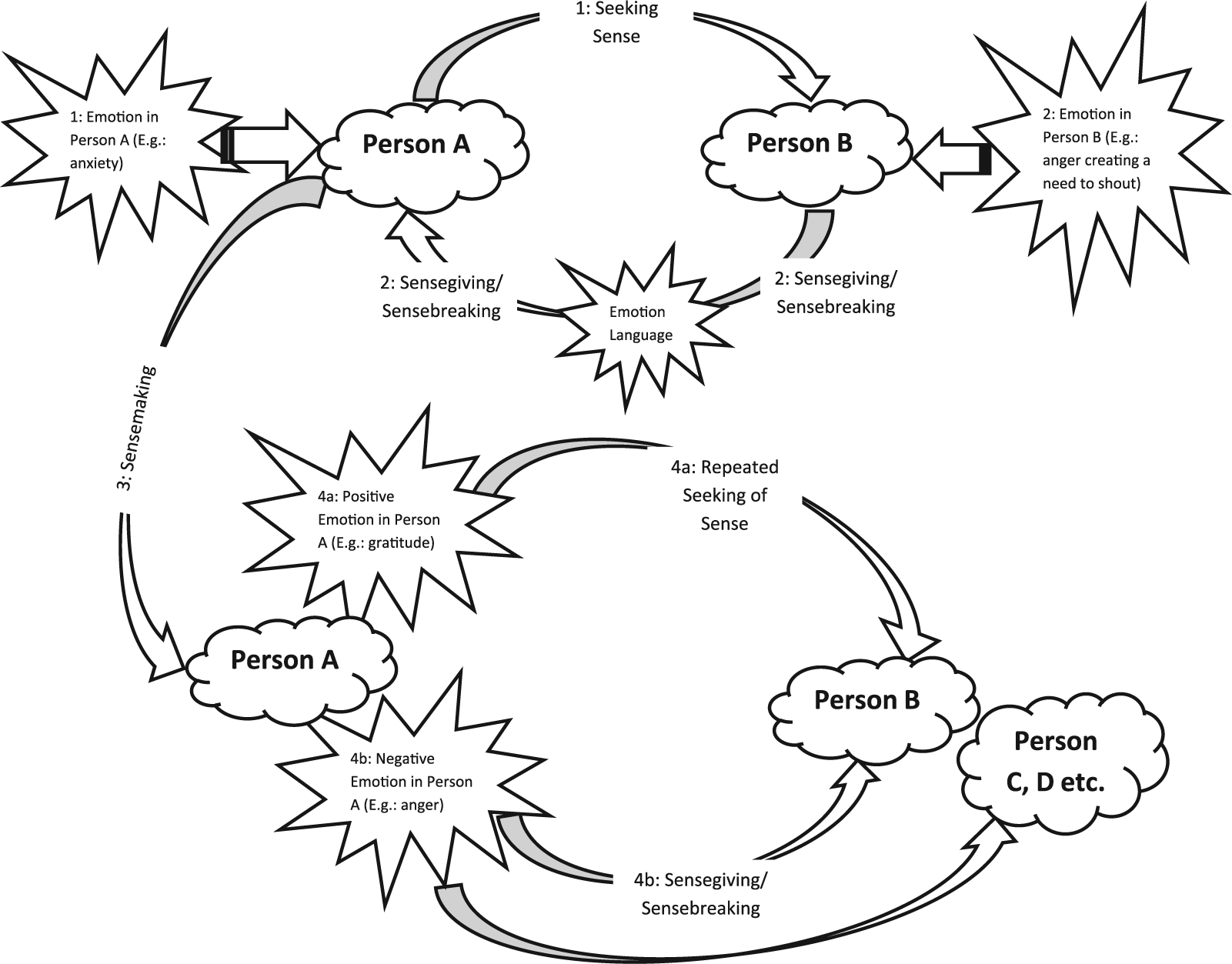
Sense processes and role of emotions.
5.1.1. Process 1—seeking sense and the emotions that drive it
We found that in online bogs, individuals sought others’ opinions (or sought sense from another) by either specifically asking questions (explicit) or by being cognitively connected/open to a particular source (implicit) (i.e. we observed that blog posters had an audience of readers and commentators who sought out certain other people’s opinions on a subject.)
A code in our data that we labeled “because of you I now understand” occurred often and was used to capture this idea that bloggers had an audience that was tuning into them expressly to help them sensemake. We read many comments on blogsites where readers thanked the blogger/writer for helping them understand some problem, challenge, or threat with which they were grappling. In some cases, these commenters specifically asked questions and thus explicitly sought meaning or sense from others. In other cases, this was more implicit—for example, regular readers who kept up with a blogger’s posts to clarify issues not necessarily articulated in the form of a question. We found evidence of this implicit process when commenters, without having previously asked a specific question, thanked the blogger for a post and said it helped them understand something.
For instance, on the blogsite of (liberal-leaning) Fr. Terry Martin, a commentator says, Thanks to Mark and all who participate here for your thoughts, feelings, and observations … During the final eventful days, I was away at a business conference and had very limited internet access, so when I could get online, it was great to have a place to go to not only get good information but also the thoughts and feelings of those whom I’ve come to know and respect a great deal.
This quote demonstrates how participants on blogsites sought input from others to fuel their own sensemaking processes. They used the online debates and discussion to understand the issues with which they were struggling.
Here is another example from a commentator on David Virtue’s (a conservative blogger) site: These are perilous times. As we peruse the blogs, we now see many, even in the conservative camp(s), declaring the [Archbishop of Canterbury], a Saint who has with conviction moved swiftly to disable [the Church’s] tyranny, even as his visionary dreams for men lying with men are being published everywhere. Oh the shame of this understanding … It’s now all about raw, nasty politics, with the moderates playing ball with godless ones and praying that, through the [Archbishop of Canterbury] they’ll receive a tiny table scrap or two … Do you offer an emoticon that openly weeps?
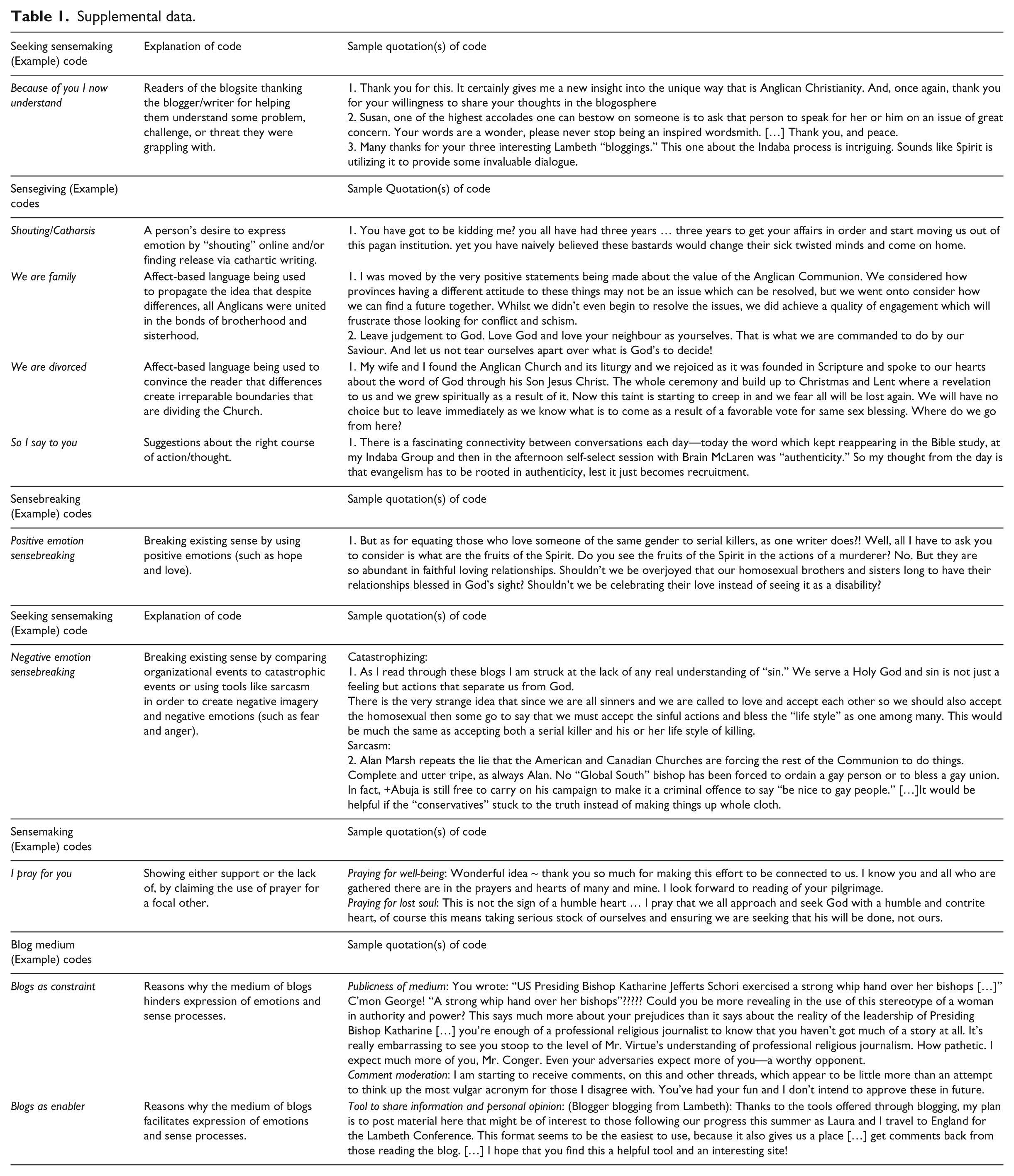
Here the commenter declares the times as “perilous,” indicating an existing presence of negative emotional drivers such as fear and anxiety. He/she goes on to express how perusing these blogs led to a sensemaking of shame (the leadership is all about politics) and an expression of grief (emoticon that weeps). Thus, we see how emotion acts as both a trigger to seek meaning/sense and is also an outcome of sensemaking (also discussed in further detail later). As with other constructs, we found multiple corroborating examples of this process. (Table 1 provides further examples of each code.)
Supplemental data.
5.1.2. Process 2—sensegiving and/or sensebreaking and the role(s) emotion plays as triggers and tools
At the outset, it is important to note that we equate original blog posts with the phenomenon of sensegiving. Just as emotions can trigger a desire to seek sense from others (i.e. in Figure 1, person A reading the blogs of person B), emotions can also trigger a need to sensegive (for example, to “shout” and release oneself by cathartic writing). Thus, the need to express emotion (like anger or frustration) becomes a trigger to sensegive (i.e. Person B being motivated to sensegive to Person A or anyone who will listen). For example, note the following illustrative quote from the blog post of Bishop Wahlon’s blog: Lambeth days pass by … Today I awoke very early, unable to sleep. The weight of the past days pressed upon me. Could we never get beyond the binaries of “social justice vs. personal holiness,” as one bishop had put it the night before at a Windsor Continuation hearing? Don’t “they” see that it cannot be either/or, but both/and? So I bemoaned the failure of the Conference to God.
This is an example of negative emotions (such as regret and a feeling of helplessness) fueling sensegiving (in the form of “can we not do …”). It is also an example of writing blogs for cathartic reasons (Nardi et al., 2004).
We found that a key ingredient in the sensegiving process was the expression of emotion through language. Emotion played a role in sensegiving by utilizing emotion-laden language as a tool to influence sensemaking in another (i.e. Person B sensegives to Person A using emotion-laden language). Both bloggers and the commentators on blogsites used affect-laden words to either include or exclude other Anglicans from a so-called Anglican family. While some participants on blogsites used a language of inclusion (e.g. “we are family”), others used metaphors for exclusion (e.g. “we are divorced”). Such language served the purpose of giving sense about what attitude to hold toward those on the other side of the debate. These arguments often employed emotion-laden words liberally to trigger the appropriate emotional–cognitive response in the reader.
We are family. We used the in vivo (data-driven) code “we are family” to capture instances in which affect-based language was used to propagate the idea that despite differences, all Anglicans were united. For example (liberal-leaning), blogger Susan Russell was giving sense to blogsite visitors about who is part of the Anglican family despite philosophical differences. She said: “I remain convinced that differences need not inevitably lead to divisions and that the bonds of mutual affection that have knit the global Anglican Communion together are strong enough to include all God’s beloved at the banquet table.” This post was then commented on by a number of followers of her blogsite who thanked her for her words and opined about Church issues, illustrating the role that Susan Russell’s words played in sensegiving leading to sensemaking for other readers of the blog.
We are divorced. We used the in vivo code “we are divorced” to capture instances in which affect-based language was used to convince the reader that differences create boundaries that are dividing the Church. For example, a commentator on the blog Thinking Anglicans said,
The thing about a schism, like a divorce, which it so much resembles, is that the problems don’t go away just because you have done it … It’s quite easy to know what a divorce means: “We’re not married any more. We don’t any longer have special obligations to each other, and we don’t any longer have special hopes of each other.”
In this example, the sensegiver is attempting to trigger a sense of finality in the reader by suggesting that there are no positive emotions (like hope) that can be associated with a schism in the Church and likens it to a divorce in a marriage. In another example, two analogies—the Anglican Communion being like a human body and the condemned city of Sodom—were used in saying, Considering what occurred at Lambeth, who, in their right mind would really want to remain connected to that dead corpse? It is nothing more than a communion of death. Those who participated in GAFCON need to leave Sodom and not look back.
Here, the sensegiver is utilizing negative imagery to incite negative emotions (such as fear or loathing of death) with the suggestion that the answer is to leave the Communion.
Recall that sensebreaking is a particular type of sensegiving and tends to involve an implicit assumption that notions held by others are wrong and need to be broken and replaced with notions of a desired reality instead (Maitlis and Lawrence, 2007; Pratt, 2000; Vlaar et al., 2008). We found that emotion played a central catalytic role in sensebreaking because it was often by targeting emotions that sensebreakers attempted to impose their view of reality. We found two major types of sensebreaking: positive- and negative-emotion-based sensebreaking.
Positive-emotion-based sensebreaking. We found instances of positive emotions being used to break existing ideas and replace them with a more positive, hopeful sense. For example, the quote below targets the emotions of hope and love. This comment was in response to a blog post about getting dissenting voices to speak to each other and continue building bridges. The blog post ended with the words “The question is, do we have the will to engage the work … and the time left to complete it.” In response, the commentator below challenges the blogger’s anxiety and pessimism by countering with sensebreaking that targets the hope for unity and love in face of differences by saying,
And you raise the question, will there be enough time? A challenge to you: What is time, and who are we to think that our little second here must save the world! Remember that Christ has completed the work, we are merely living into. Let not time worry you, for God holds all time, and all our works, in His loving hands, stretched out once on the hard wood of the cross for all. (Comment on blogsite “That we may all be one”)
Negative-emotion-based sensebreaking. We found that sensebreakers used negative emotions (e.g. anger and fear) to break a person’s existing sense of reality using techniques such as catastrophizing, which is the term we adopted to capture instances of affect-laden language being used to induce negative emotions to break existing mindsets. We found this occurring when bloggers/commentators tried to break sense of another using affect-laden language to paint a worldview that positioned issues as catastrophic. Catastrophizing has been used in the psychology literature to describe the state of negative emotional cognition when patients are expecting the worst to happen (Schroevers et al., 2008). In our use of the term, we focus on its use as a language tool that targets the emotion of fear in others.
Catastrophizing involved equating issues the Church faced with phenomena such as earthquakes and ships sinking. Sensebreakers wrapping Church events in such calamity-steeped jargon was both an expression and invocation of fear, which would then be a possible motivation for attitudinal or behavioral change in another. For example, one blogger opined that the problems in the Communion were “a world-wide epidemic, with the potential to be as devastating as the reputed outbreak of the Bird flu.” Another reacted to Bishop Robinson (the controversial openly gay Episcopal bishop) being invited to Lambeth by the Archbishop of Canterbury by invoking the metaphor that “the band played as the Titanic went to the bottom of the north Atlantic,” equating the invitation of the controversial Bishop to the sinking of a ship.
Furthermore, we found that sensebreaking comments were often followed with suggestions about what needed to be done to bring back normalcy (sensegiving). This pattern of sensegiving following sensebreaking was illustrated in the sensegiving code “so I say to you” in which sensebreakers, following an instance of sensebreaking, now donned the hat of a sensegiver to help the (supposedly) anxious/confused individual make sense of the world again. For example, Confronted by the big problems of the real world, let alone the arena of Church politics, it is easy to reach sticking points where people simply dig in. In 1914 the fusion of spades, agricultural barbed wire and machine guns gave the world Trench warfare. The men who dug in thought it would all be over by Christmas, but they were wrong. Accidentally they had invented an all but unwinnable form of warfare … The sober fact for all sides to contemplate is that, to quote Saint Albert himself, You cannot solve a problem on the level it was created … It’s time for fresh thinking, not trench warfare! So the question of the day becomes, reversing a slogan of 1914, Do you know a man digging trenches, when he should be digging your garden? (from a blog post by Bishop Alan)
In the above example, Bishop Alan’s attempt to equate the Church events with “trench warfare” is an attempt at breaking existing sense of individuals who did not perceive these events as that catastrophic. Fear is being targeted when the metaphor an “unwinnable form of warfare” is employed to break notions that either side (liberal or conservative) may have had about coming out on top in this situation. Instead, Bishop Alan implores his readers they “cannot solve a problem on the level it was created” and further that it is “time for fresh thinking” that would involve coming together and working things out (as implied in the quote: “Do you know a man digging trenches, when he should be digging your garden?”). Note how the emotional tools fuel the sensebreaking and sensemaking processes by heightening arousal of the problem as well as a proposed solution.
5.1.3. Processes 3, 4a, and 4b—subsequent sensemaking and the role of emotions
As depicted in Figure 1, we found the process of sensemaking to be the result of sense shared from giver (person B) to receiver (person A) being processed and this in turn created emotions in the receiver who is now the sensemaker (Process 3). We found that emotion played a role in sensemaking in two ways. First, it influenced the sense being made. For example, positive affect was experienced when the sensemaker (Person A) agreed with the sensegiver (Person B), thus catalyzing repeated seeking of meaning/sense from the same source (i.e. Person A repeatedly sought sense from Person B; Process 4a). Also, emotions influenced the outcomes of sensemaking. So, for example, when the seeker of sense who eventually became a sensemaker (Person A) did not agree with the sensegiver, he or she was tuning into (Person B), he or she (Person A) in turn might attempt to influence the sensegiver (Person B) and/or other people (Person C, D, etc.) by becoming a sensegiver/sensebreaker (Process 4b). Below we explore a few examples of how this plays out.
I pray for you. Data we coded for sensemaking included categorizing individuals as belonging to either an in-group or an out-group. Using affect-influenced sensemaking verbiage, participants on blogsites showed trust and care for similar others and suspicion (even hatred) for dissimilar others. Interestingly, we found that the use of language such as “we pray for you” could be used toward either an in-group or an out-group, but the reason for praying would change; namely, one would invoke prayer on behalf of like others, whereas one would invoke prayer for the lost souls of dissimilar others. We created the code I pray for your well-being to capture instances in which blog participants told similar others that they were cared about. For example, conservative blogger David Virtue had been featured on a BBC debate about gay rights. A follower of his blog wrote on his blogsite: “Dr. Virtue, I can only imagine your intense frustration with having to try to cogently interact with covert insanity. God bless you, sir.” By showing emotional support through words, the in-group members are supporting and reinforcing each other’s thoughts and feelings thereby reinforcing in-group identity sensemaking. Furthermore, when sensemakers agreed with and felt positive affect toward sensegivers, they repeated tuned into these sensegivers (Process 4a). Thus, positive emotions can catalyze cognitive openness. Specifically, the emotion of gratitude often was linked with which sensegiver people tuned into, such that prior positive sensemaking experience with a sensegiver led to tuning more into the blogs of that sensegiver. In other words, gratitude catalyzed repeated attention to a sensegiver. Commentators often wrote thank you notes to the blogger (the sensegiver) for helping them understand something with which they were struggling. An example of gratitude catalyzing repeated attention to a sensegiver is captured in these comments left on (liberal-leaning) Bishop Smith’s blog:
I need to take more time to ponder what you wrote. But for now, let me just say I am grateful that you are blogging. I never would have thought you would do this! You are blogging?!?! Who would’ve thought?? I am happy.
Another vivid example of how positively valenced emotions like happiness and gratitude experienced by someone led to tuning into a particular sensegiver is captured in the following comment left on Bishop Greg’s blog: Keep it coming Bishop Greg. For me … you know the really excitable layperson—who generally doesn’t give a hoot about all this stuff going on in the rest of the world—I will continue to read with interest as you tell the story through your eyes. You … I know. You … I get. You … I understand (where you are coming from on some of these things) … And finally, you … the one who will continue to challenge ME to be better!!! All is good, the world is still spinning, therefore, more yet to do!!! LOL
The preceding example demonstrates the emotional bond apparently felt by the individual toward the sensegiver. These positive emotions arose from sensemaking and caused people to repeatedly come back for more ideas to tune into. Indeed, positive emotions can catalyze sensemaking even in an otherwise passive audience to turn them into individuals now actively looking for meaning; for example, even the “the lay person who generally does not give a hoot for all this stuff going on in the world” is excited to “read this story with interest” because it is being told by a sensegiver toward whom positive emotions are felt. From the above discussion, we can see how expressions of discrete emotions, such as happiness and gratitude, play a catalytic role in seeking out certain sensegivers to help with sensemaking.
Conversely, the I pray for your soul code was used to capture instances in which one group specifically expressed intolerance of the other group’s point of view and launched an affective attack using such terms as “sinners whose souls needed to be prayed for.” For example, in reaction to a statement by the Episcopal Church’s Presiding Bishop (Katharine Jefferts Schori), a commentator on (conservative) Kendell Harmon’s blog said, What a petulant and childish response! … There is no grace, no tact, no substance. Her mischaracterizations are maddening, her misreading of history is crazy-making, and her attempt to coopt Christian mission is disgusting … I will keep her in prayer, because she has such an admirable heart for the poor, if only she wouldn’t misapply her gifts so.
This quote illustrates how affect is stirred by creating a perception of superiority over another individual. After creating this superiority, the writer then reaches down to the other to offer prayer on their behalf—an invocation of compassion and warmth, yet with a subtext of superiority. The combination of manifest emotions and triggers for emotions accelerates the reader through the logical argument. This equivalent of an affective roller coaster lubricates the logic and serves as a catalyst for meaning making. The quote also illustrates how emotional reactions occur as a result of reading about identity-laden events and issues, as well as how emotions serve as a catalyst in the construction of meaning for self and others.
We also found that sensemaking was often followed by sensegiving and/or sensebreaking (Process 4b). In other words, the sensemaker in turn often attempted to influence others by offering his or her own interpretation of events and suggestions of action. In the example below, the commentator (sensebreaker) was originally a person seeking meaning to sensemake, but after reading a blog post with which he disagrees, he undertakes sensebreaking by targeting the sense of both the original sensegiver as well as other individuals tuning in for sensemaking: I would define Bishop Rodgers’ groups a bit differently. There are those who seek to conquer, to impose a new “prophetic” and unsubstantiated position on others … There are those who are unable to see evil for what it is and who are afraid or unable … to take a firm stand. There are those who subscribe to the historic faith and affirm the principles defined and honed over the millennia. The first group is perfectly welcome to decide they no longer believe in Jesus as Savior … They are not welcome to … impose ungodly and heretic beliefs on others. The fence sitting undecided must decide whom they serve. The latter group, those of the historic faith … must figure out exactly what it is that does define their historic faith, state what membership in the historic faith requires, decide how accountability will occur, and then actively and aggressively go forth to all nations and peoples and proclaim the Good News of Christ. (Comment left on the blog of David Virtue.)
In this quote, the commentator attempts to break sense by targeting the emotions of fear and anger by associating a certain group with evil. He categorizes people of the Communion into three groups and then makes strong suggestions about what each group should do (e.g. leave the Communion/figure out what they really believe and take action on it). This demonstrates that a sensemaker can receive sense and then choose to become a sensebreaker and/or sensegiver.
6. Discussion
We conducted a qualitative study of blog text from several blogsites about the Anglican Communion, which had been facing several pressing sensemaking issues due to dramatic events in its history. In tracking blog conversations, we found that emotion played a catalytic role both within and between the sense processes (sensemaking, sensegiving, and sensebreaking). We were able to draw several lessons about the catalytic role of emotions from the data. Specifically, we found that emotions act as a catalyst by triggering individuals to try to sensemake in the first place (e.g. to reduce ambiguity surrounding puzzling phenomena, to reduce anxiety surrounding uncertainty). Likewise, the need for emotional expression (via online “shouting” or expressing frustration, for example) was found to trigger sensegiving by providing motivation for the same (i.e. as a catharsis to exorcise negative emotions). Beyond emotions playing the catalytic role of triggering people to read and write blogs, we also observed that the tool of emotion-laden language could be used to catalyze the sense processes. For example, emotions facilitated the sensegiving process when they were (1) evoked by sensegivers during the sensegiving process and (2) when they were triggered in individuals during their sensemaking (because it led to these sensemakers becoming sensegivers). Furthermore, we also found that sensebreakers sometimes expressed emotional language specifically to trigger certain discrete emotions (such as hope, excitement, fear or anger) in individuals who were seeking to sensemake. Sensebreakers did so in order to create or destroy a preferred definition of organizational reality in the other via subsequent sensegiving. We also found that emotions played a role in how a person responded after having read the sensegiving/sensebreaking blog post. Positive emotions such as gratitude and happiness toward certain sensegivers catalyzed repeated tuning into such individuals for sensemaking. Conversely, negative emotions led to the recipient themselves attempting to sensegive/sensebreak to others.
By specifically acknowledging and studying the role of emotions in sense processes, we have contributed a key missing link to the sensemaking, sensegiving, and sensebreaking literatures which have otherwise been studied through a predominantly cognitive and rational lens. We show how emotions are used in tandem with cognition to create (both for oneself and for others) a lived reality that includes a community with in-groups and out-groups. By doing so, we demonstrate at least three of Ashkanasy’s (2002) five levels of emotions in an organization, namely, within-person, individual, and dyadic levels. We show how emotions are targeted through language with the attempt to influence the thoughts of others. Emotions act as the trigger that helps spark sense processes. In many of the blogs we studied, blog owners moderated comments on their site and removed any communication posted by members who used offensive language. As a result, we believe that our study represents an even more conservative interpretation of the use of emotions in sensemaking; in spite of deletions by the blog moderators, we still found ample and highly emotionally charged posts.
Blogs provide a transparent medium where participants are unfettered by the rules of social norms imposed during face-to-face interaction. Online comments can be left under pseudonyms or even anonymously, allowing individuals to contest and construct identity without the fear of social backlash. Any emotions expressed online can thus be taken as a marker of their true feelings or alternatively as (implicit or explicit) manipulations meant to sway others. Furthermore, we add to Harrison and Thomas’s (2009) findings which showed that social networking sites (SNSs) can be used by language learners to explore new relationships (rather than merely maintain existing ones). We find this is more nuanced in an environment that is contentious with individuals both seeking and rejecting sense (and implicitly identity-influencing relationships) with those they seek to communicate with online.
The emotions literature benefits from examining emotion contagion in virtual contexts, as this study has done, since so far it has been studied primarily in laboratory or other face-to-face settings. Fisher (2002) noted that most research on affect in organizations has utilized one-time retrospective measures of mood at work, which is less desirable since there is evidence of bias in reporting affective phenomena after the fact. The field data we have presented come from an existing (rather than a lab) context, with issues about which participants can and do feel strongly. These individuals are not being asked to report their feelings but are doing so of their own volition. Given the preponderance of readily available blog data, this opens up a highly promising area of future research, as blogs of different kinds could be studied.
6.1. Limitations and future research
Studying emotions through the use of data based purely on virtual communication necessarily omits some of the richness of physiologically felt and expressed emotion. For example, we were unable to say unequivocally, based on the reading of a blog text, whether the emotion that motivated a post was anger and not fear expressed as anger. We were unable to use a person’s physiological reaction or facial expression to triangulate the emotion that motivated his/her words online. However, given the context in which we studied emotion—that is, how it is used in sensegiving, sensemaking and sensebreaking—this does not become a stumbling block, as the unit of analysis is not the felt emotions of the communicator, but rather the emotion projected onto the text.
Expressed emotions may have other associated but distinct underlying emotions that act as catalysts, and particular emotions might play different catalytic roles in different parts of the sense processes. For example, fear often manifests as anger or sadness as humor. Future research could delve into such multi-layered emotion-based triggers for sense processes and outcomes.
In sum, our work has laid a foundation for studying the role of emotion in the sense processes. Our focus has been on the virtual context of blogs, but we believe there is potential in building on this foundation by studying emotion and sensemaking in other contexts and media.
Footnotes
Appendix 1
Acknowledgements
The authors express their gratitude to Barbara Gray and Linda Trevino for their insights on earlier versions of this manuscript. The authors appreciate the feedback received from their audience members as portions of this work were presented at the Penn State University and the Annual Meetings of the Academy of Management.
Final transcript accepted 19 August 2017 by Peter Jordan (AE Organisational Behaviour).
Funding
The author(s) received no financial support for the research, authorship, and/or publication of this article.