







Abstract
This article investigates the proliferation of informal mobile phone markets and contributes to the understanding of the changing urban economic geographies in Africa. It enriches comparative research by modestly bringing new theoretical ideas to bear, and explores how the spatial geography of mobile phone markets mediates urban governance. We argue that regardless of where in Accra mobile phone markets emerge, the same kind of processes and activities develop, and this recognition contrasts other works, which either focus on the city as a whole or on specific sites. Using key informant interviews, augmented with cognitive mapping, we observe the geography of mobile phone repairs and sales, intersecting socio-economic factors, and a collaborative culture among participants. Ultimately, our article touches upon the issues of power and agency by elucidating the relational dynamics between the informal operators and city authorities.
Introduction
Ghana has one of the most vibrant mobile phone market (MPM) clusters 1 in Africa. Recent studies indicate every two Ghanaians own three mobile phones (Gyeke-Dako et al., 2015; Oteng-Ababio and Grant, 2019). Before the government liberalized the telephony industry (in the mid 1990s), the sector was publicly driven, producing a homogenized (voice call) product (Killick, 2010). Statistically, the number of telephony companies has increased dramatically from two in the 1990s to six by 2020, including the regional heavyweights MTN Ghana, Vodafone Ghana, and AirtelTigo, formed from a merger of Airtel Ghana and Tigo Ghana in 2018 (Oteng-Ababio and Grant, 2019). Further, the industry has recorded a penetration rate of 10.8% and contributes to at least 2% of the country’s Gross Domestic Product (GDP) (Gyeke-Dako et al., 2015). Ghanaians who had limited access to modern telecommunication have leapfrogged the technology deficit. Mobile telephony provides the urban poor 2 with better, different, and less costly services (Oteng-Ababio and Grant, 2019). Grant (2015) recounts situations now where the ubiquitous brands of multi-national conglomerates are competing for space with alternative products from China, Brazil, and India within the Ghanaian market.
In the national capital (Accra), the industry is not only maintaining its pre-revolutionised symbiotic relationships. It is creating innovative responses to how city authorities with smaller economies and less local government capacity, which crave for a mega-city without poverty, would want Accra to be managed, organized, and governed (Gillespie, 2018). This contrasts with the fact that the responsibility for critical urban governance issues is often fragmented amongst large numbers of government stakeholders with limited capacities and conflicting interests (Smit, 2018). The Accra Metropolitan Assembly (AMA) has over the years adopted and implemented a policy of decongestion with the explicit aim of reducing informal activities and their operators in the central business districts (CBDs) and other critical areas of the city (Crentsil and Owusu, 2018), with little attention devoted to the impact of such activities on the city’s economic geography.
Our article aims to bring new perspectives to bear by investigating the emerging MPM clusters and how their spatial geography enriches our understandings of the changing economic geography and urban governance. We look at the production of similar clusters in different neighborhoods, and almost regardless of where in Accra we are, we encounter the development of the same kind of processes. This recognition contrasts with other works, which either focus on the city as a whole or specific sites. The article advances an interpretation of entrepreneurial analysis that aims to generate new insights into the drivers of diverse transformation and governance occurring across urban Africa. The paper sees the emerging informal MPMs as sites of innovation and crucial for reproducing the city. However, the authorities are focused on transforming Accra into a formalized and ordered one. They seek to create an entrepreneurial city, thus making Accra a product to be sold, promoted, and marketed (Gillespie, 2016; Oteng-Ababio and van der Velden, 2019). Herein resides the task of our article: We seek reasons behind the phenomenal growth of MPM economies and how participants navigate the city authorities' sometimes high-handedness and exclusionary tendencies.
Typically, earlier studies on electronic waste, in general, have explored the human and environmental health challenges (Agyei-Mensah and Oteng-Ababio, 2012), labour market conditions (Afenah, 2010; Morrison, 2017; Oteng-Ababio and Grant, 2019), cluster and local embeddedness (Gillespie, 2016; Morrison, 2017), and socio-cultural policies (Farouk and Owusu, 2012; Stacey, 2016). These studies, using mainly sociological or business research lenses, uncovered interesting issues, yet their geo-spatial patterning and dynamics remained invisible, hence the catalyst for this paper. We see the congruence of informal MPMs and the governance of urban spaces as evincing complex contestation at different levels, scales, and scope, that defies simple binaries between city authorities and civil society or what Flack (1997: 38) terms “cultural counter-current." Instead, it shows how state institutions and ‘informal entrepreneurs’ battle exclusion and struggles in everyday life. We interrogate the geographies of the emerging clusters, which support the whole urban economic structure. It provides an excellent case study for understanding how the informal MPM operators, who remain mostly unrecognised and sometimes prosecuted, navigate the city and tap into public institutions and help shape public policies.
The paper proceeds as follows: In the next section, we elaborate on the nature of Accra’s local governance, followed by a brief background and overview of the study area and methodology used for the study. In the following section—Geographies and characteristics of used phone clusters—we explore the location and geographical patterns of MPM clusters in Accra and discuss the potential causalities. In the final section, we provide a conclusion to our study and put forward some policy implications.
Entrepreneurialism and placemaking 3 in public spaces
Broadly, entrepreneurship is essential to a city’s economic dynamism. It has become a phenomenon of paramount importance, that has received increasing attention in recent years (Fuentelsaz et al., 2018). Given the entrepreneurship relationship to economic growth and wealth, scholars and policymakers alike have shown much interest in understanding the factors encouraging the city’s growth and those that generate higher externalities for society. The existing evidence shows that entrepreneurship varies across places. In our view, attempts to explain this differentiation must pay attention not only to the level, but also the type of entrepreneurship that characterizes a specific locale (Fuentelsaz et al., 2018). This makes the role of ‘institution’ imperative as a factor that either enables or hinders entrepreneurship.
Frequently, in most African economies, public spaces—streets, sidewalks, parks—are owned and governed by local governments. Such areas (the obvious analogy to “the commons metaphor” (Foster, 2009: 267)) have brought to fruition increased [informal] entrepreneurship, and their occupation by one type of entrepreneur detracts others from using them, sometimes leading to rivalries, over-use, and congestion (Garnett, 2012). This makes some level of official institutional restriction inevitable, which unfortunately tends to exclude some individuals or groups completely. This contradicts studies from developed economies showing public spaces as a springboard for revitalizing communities, whatever and wherever they are (Mean and Tims, 2005; Morrison, 2017). In the development discourse, public spaces are seen as attractive, active, well-functioning areas capable of jumpstarting economic development in cities (Gillespie, 2018) or as a vital ingredient of prosperous cities (Grant, 2015). The challenge yet to be critically examined, however, is the extent to which such well-researched theories and concepts from developed economies provide an appropriate interpretative framework in a country like Ghana (Myers, 2011; Robinson, 2016).
Conceptually, Morrison (2017) cautions against any model under transition conditions, failing to capture its distinctive features, contexts, and processes. Graham and Thrift (2007: 11) put it aptly: “In most of the mega-cities of the global South, for example, the fact that urban life is the result of continuous efforts of infrastructural improvisation and repair is too overwhelming and visible to be ignored.” In Ghana, studies on e-waste activities have affirmed how informal work 4 and placemaking businesses diversify local economies, create local jobs, and serve as the primary source of livelihood for the urban poor (Gillespie, 2016; Morrison, 2017). In Accra, the MPMs act as incubators with strong roots that keep them within particular locales, sharing urban spaces with low-cost amenities and, often, provide coaching, mentoring, and other supports (Graham and Thrift, 2007; Stacey, 2018). They inspire people to reimagine and reinvent public areas collectively and strengthen how such spaces are shaped to maximize shared values.
On the contrary, city officials seek to promote “better urban designs” by pitting formal work against informal entrepreneurs. Consequently, they employ a policy of decongestion (Crentsil and Owusu, 2018) which works against “homegrown” creativity and impedes building inclusive, healthy, functional, and productive cities (Robinson, 2016). The precise control of the commons is vague (Garnett, 2012) and worsens when it leads to patchworks of ideal trajectories (Stacey, 2018: 4). Thus, the binary categorization of the mainly state-led institutions as positive with traits including rationality and formality, while community-led developments are described as ineffective and disorganized, is empirically inappropriate (Grant, 2015: 135). Many recent studies have incontrovertibly affirmed public spaces as crucial for innovation and creativity (Gillespie, 2016; Morrison, 2017; Oteng-Ababio and Van der Velden, 2019), though it took over 40 years since Keith Hart “first discovered” this in 1973 for researchers “to see the light” (Oteng-Ababio, 2018: 11).
This emerging scholarship, particularly that related to MPMs, raises lots of conceptual and theoretical issues regarding urban economic geographies (Morrison, 2017; Myers, 2011). Despite AMA's decongestion policy, the massive uptake of information technology and its MPM clusters appears to have caught the government by surprise, signifying a dramatic transformation of economic, social, and political activities (Atiemo et al., 2016). The situation demonstrates that “governance is not produced by the government alone, but through competition, contest, and negotiation between heterogeneous statutory and non-statutory institutions with agency assigned to actors at the grassroots level” (Stacey, 2018: 1). Grant (2015) opines that in African countries, where unemployment rates are skyrocketing and the infrastructure base is thin, such innovative clusters are unprecedented, strategic, and lucrative, and too overwhelming and visible to be ignored (see Graham and Thrift (2007: 11).
Empirically, Baldé et al. (2017) confirm that the e-waste trade forms part of a US$52 billion global recycling, processing, and re-exporting industry focused on retrievable metals. Further, Le Moigne (2017) also sees the repair, refurbishment, and reuse market as quite a significant segment of a US$4 billion mobile phone industry. The impact of the mobile telephony trade on the growth rate of open businesses in South Africa is higher than that of the world's top-performing national economy (Neuwirth, 2011). Globally, the informal economy is seen as enlarging and will encompass two-thirds of the world's workforce by 2020 (ILO, 2018). These realizations re-echo the need to reimagine, re-theorize, and re-conceptualize urban public spaces in their own right (Robinson, 2016), focusing on “what is going on” in these spaces as opposed to “what should be going on” and “what is missing” (Myers, 2011; Simone, 2000). We concur that attempts to create an entrepreneurial city, which privileges speculative, high-risk yield-gaining projects over homegrown creativity, only perpetuates market-led partnerships. It ostensibly seeks the welfare of the poor, yet it excludes hawkers from footbridges or underpasses using laws such as: “the commercialization of public spaces is contrary to AMA Street Hawking bye-laws 2011 and the Road Traffic (Amendment) Act, 2008 (Act 761) Section 29(2)” (Agyapong and Ojo, 2018). Such attempts create a divided city with affluent areas just a block away from the poverty and despair of the slum (Arguello et al., 2013). Such machinations defeat the immanent meaning of public spaces, which “should belong to everyone, and everyone in the city should have a right to access and use them as they please” (Mitchell, 2003: 73).
Mapping and interrogating the geographies of MPMs in Accra, this paper enriches our understanding of how both formal institutions and informal negotiations can shape public spaces. The paper questions the city authority’s governance of public spaces. In particular, it challenges the various characterizations of informality: as disorganized and deprived of agency (Davis, 2006); as sites prone to violence and social tensions (Lombard and Rakodi, 2016); and as arenas of economic homogeneity, or occupied by those marginalized from globalization processes (Mohanty, 2006; Shabane et al., 2011). Though these objectionable features are observable, we do not believe they accurately define the MPM clusters in Accra. Our point of departure in this article, which goes beyond the virtues of informality (Baldé et al., 2017; Le Moigne, 2017), is understanding how the emerging MPM in Accra is changing its economic geography and its implications for urban governance. Pointedly, the production of similar MPM clusters in different parts of the city offering the same kind of processes, is symbolic rather than typical. It contains elements that many clusters in the city will recognise in their own stories. Not all MPM clusters follow this same path, but many encroach upon it along the way, which contrasts with other works that focus on the city as a whole or a specific site. By subsisting, resourcefulness, improvisation, and the use of social networks to substitute for capital and other deficiencies, the MPM continues to proliferate despite the sustained efforts by city authorities “to sanitize” or decongest the city (Crentsil and Owusu, 2018; Stacey, 2018).
The study areas and methodology
We conducted the study in the Greater Accra Metropolitan Area, 5 home of Ghana’s capital city (Accra). The area (hereafter Accra) is not only the preferred destination for migrants but home to about 4.6 million people, more than 16% of Ghana’s 2016 total population. Accra remains the country's administrative and economic hub. Its economy accounts for about 25% of the country’s GDP, dominates formal (32%) and informal (68%) urban employment (GSS, 2016), and is the least impoverished region, with the incidence of poverty at 5.6% lower than the national average (24%) (GSS, 2014). While street trading is not uncommon in Accra, we concentrated on the geography of the sedentary MPM economy, clustered at specific commons which are in perpetual conflict with city laws (Farouk and Owusu, 2012). A total of four MPM clusters were selected. The unifying features among these clusters were that they all concentrated on mobile phone repairs and sales, offered apprenticeship opportunities, and sold new phones and accessories in ‘unauthorized’ spaces, rather than in places dedicated to working. These clusters are Kwame Nkrumah Circle (hereafter Circle), Osu Oxford Street (Oxford Street), Madina Market (Madina), and the Abeka-Lapaz Section of the N1 Motorway (Abeka-Lapaz). The study maps these locations and examines their socio-economic and built environment characteristics and any ‘offshoot' activities they have catalyzed.
Research methodology
To achieve the set objectives, we adopted a social constructivism perspective 6 to help understand the world in which the “entrepreneurs” live and work (Creswell, 2014). We employed some research instruments: a geographic information system mapping of formal and informal mobile phone and related business operators, participant observation, and in-depth interviews with key stakeholders. The approach allows for a deeper understanding of the many angles of the MPM clusters. Further, it focuses on the complexity of views rather than narrowing meanings into a few categories or ideas (Yin, 2014). The stories and observed images help us to make better sense of the numbers. The fieldwork took place between September and December 2017, and the face-to-face interviews were conducted on-site using a semi-structured interview guide, to fit in with the operators’ busy schedule. The questions posed were guided by the preliminary observations made during earlier reconnaissance surveys.
Admittedly, there were distractions at the interview sites from noise and the activities of hawkers. As noted by Elwood (2002), such contexts are crucial for knowledge formation between a researcher and interviewee. In this instance, the distractions provided an opportunity for participant observation and to experience at first hand some of the challenges and coping strategies adopted by the operators in their day-to-day activities.
In total, 36 key informant interviews were conducted. At each research location, we interviewed two mobile phone repairers, two vendors, and two dealers in phone accessories. The Circle and Oxford Street clusters uniquely served as friendly training sites for potential repairers and as a result, an additional two apprentices were interviewed at each of these sites, while two informal discussions were also held with those trading in phone spare-parts at Circle. Apart from those directly involved in MPM activities, six public and other officials, whose duties generally border on the electronic waste trade, were interviewed. The questions sought information about respondents’ socio-economic characteristics, local business characteristics, economic outcomes, conflicts experienced, and coping strategies. At Circle, we delved into participants’ relationship with city authorities and their motivation to return to the site days after they have been violently forced out. All interviews were audiotaped and later transcribed.
With a hand-held Global Positioning System, we also mapped selected activity spots (clusters) and represented them graphically. The analysis (details in subsequent sections) shows that the motivation and circumstances in which the MPM operators use the urban commons and enter these “transitive spaces” (Parati, 2017) are not dissimilar from those contouring any other entrée to any market in the city: they step into markets because of the proximity of these spaces to their clientele base. However, in the case of the MPM clusters, other vital elements include space availability and what has been termed “economies of cooperation” (Dennett and Page, 2017: 450). The camaraderie among the informal operators means that equipment, ideas, knowledge, and customers are shared to the benefit of all. In our case study, Circle played a central role in the MPM's cooperative economy, but other examples abound across the other clusters.
Geographies and characteristics of used phone clusters
We examine the geographies of emerging MPM clusters in defiance of the city authorities’ quest for a “sanitized city” through incessant “decongestion exercises.” We discuss how informal MPM operators have created a free entry and exit enterprise based on economies of cooperation. The operators use improvisation, ingenuity, and innovation through sharing expertise among colleagues, the master-apprentice system, the WhatsApp group for repairers, the invention of new tools or new approaches to repair, etc., while at the same time navigating official barriers and the changing character of public spaces. Since this is an exploratory study, we adopted a simple mapping approach, which, as the analysis depicts, identified cluster patterns of both formal and informal clusters along with transport nodes and intersections, as discussed below. Table 1 presents an overview of the various groups mapped in the study area.
Characteristics of mobile phone market clusters within Greater Accra Metropolitan Area.
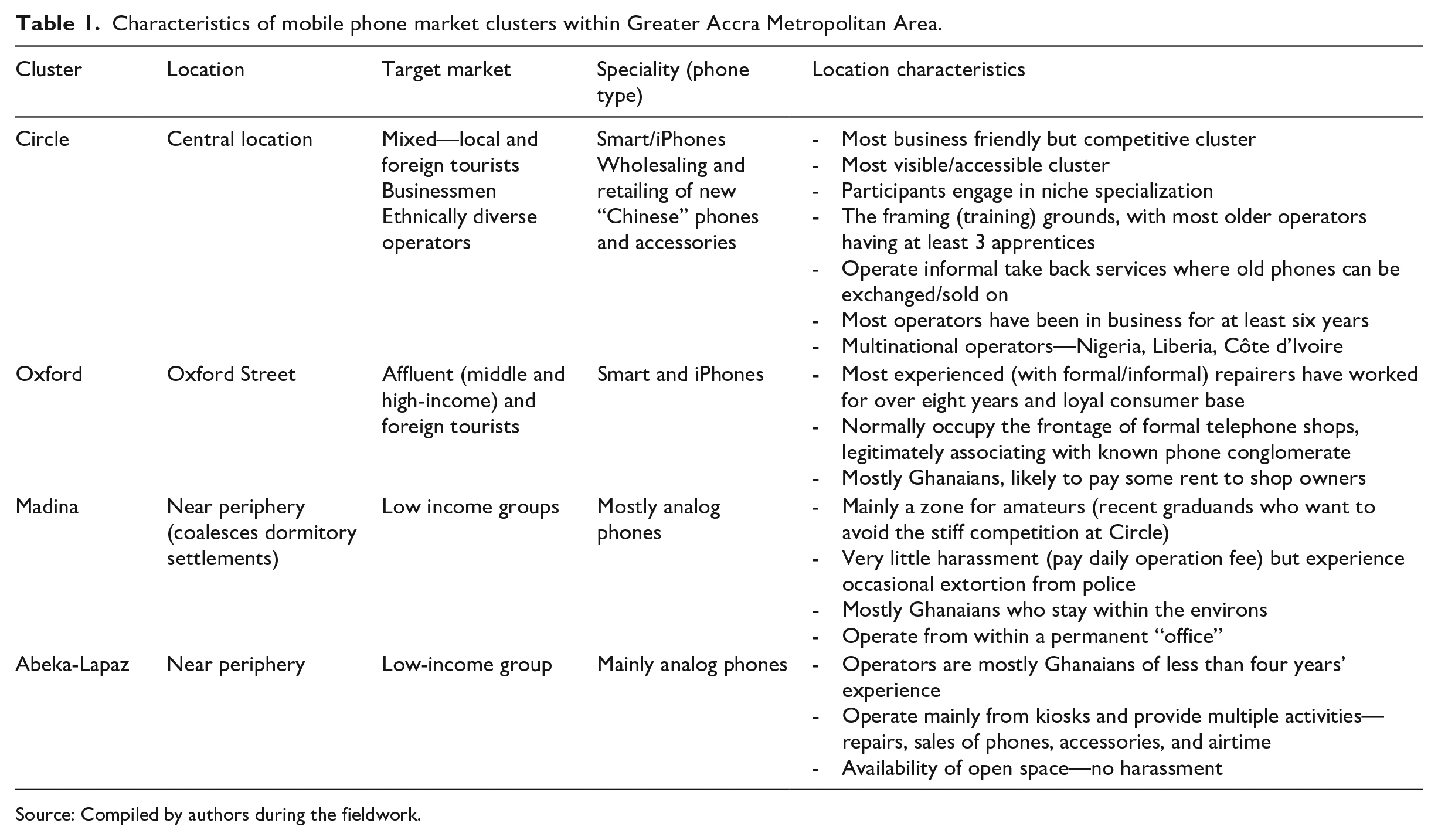
Source: Compiled by authors during the fieldwork.
The Circle cluster
The Circle cluster, graphically depicted in Figure 1, occupies a prominent location in Accra. It is an excellent transport hub serving inter- and intra-city commuters and is located adjacent to the city’s most significant transport interchange, a kilometer away from the CBD. This intersection connects four major road corridors, CBD-Kumasi-Paga, CBD-Takoradi-Alubo, CBD-Ho-Aflao; and CBD-Sunyani-Dormaa, which collectively dispatch and receive 1500 buses, or about a million passengers daily (Quayson, 2014). The interchange, named after Ghana’s first President, has historically been a place where commuters enjoy comfortable chaos (multiple activities), revelling in different sounds, smells, and rhythms, while walking, gazing, listening, smelling, and eating the vast array of products (Quayson, 2014). The Circle is also an iconographic space embedded in notions of national identity, and a central point where trade unions, political parties, and civil society groups converge to organize and participate in protests, rallies, and demonstrations.
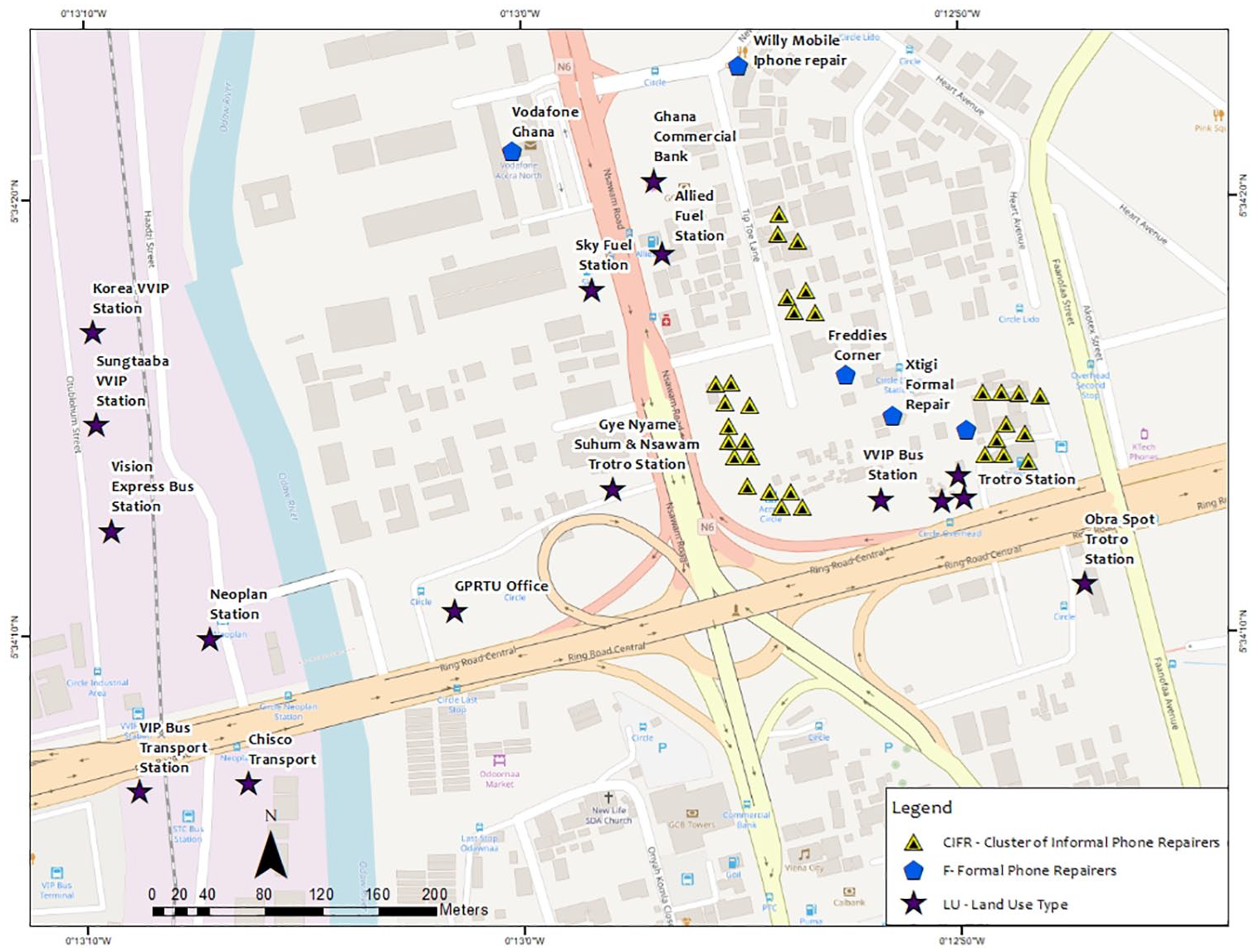
The geography of MPM clusters in Circle, 2017.
The intersection of diverse mobility has made Circle the epicenter of the MPM; it is a place for the repair and sale of used phones, the training of apprentices, and is often linked with improvisation and ingenuity. We counted 127 repair centres, 47 vendors of new and used mobile phones and phone accessories “shops,” as well as more than 200 itinerant vendors who rely on Circle’s large open pavement spaces for their businesses. Geographically, Circle houses the headquarters of all the phone companies—MTN, Vodafone, Airtel/Tigo. The reconstruction of Circle in 2016 into a towering three-tier inter-change has provided additional open spaces for MPM participants, many of whom operate tactically on trestle tables. The Circle stands out as the “home of wholesaling and retailing” of smartphones from China, Brazil, India, etc., in addition to expert re-purposing, repairs, and sales of phones. Circle uniquely exhibits “super-diversity,” inclusive and egalitarian space, where, as noted by Stacey (2018), no ethnic group holds an intimidating majority but clusters men and women from different nationalities and social backgrounds
The Oxford cluster
The second cluster, Oxford Street (Figure 2), is located in Osu, an indigenous coastal settlement housing the Christianborg Castle, which, until 2014, was the seat of government. Located three kilometers from the CBD, Osu used to be primarily a residential neighborhood. However, the economic reforms in the 1980s led to its conversion into a high-intensity commercial district, an archetype of Oxford Street in London’s West End. The area connects prestigious neighborhoods like Ridge, Kanda, Labone, and Cantonments, which are among the most prized zones that have been favoured by the ruling elites since the colonial era and provide a steady stream of well-heeled shoppers (Quayson, 2014). Its proximity to foreign embassies and the headquarters of government departments (the Ministries) fosters the vitality of Oxford Street (Quayson, 2014). The presence of formal mobile phone companies has made Oxford Street a 24-hour commercial and leisure hub. These concentrations have also catalyzed informal phone activities, though they are less intense compared to the Circle cluster.
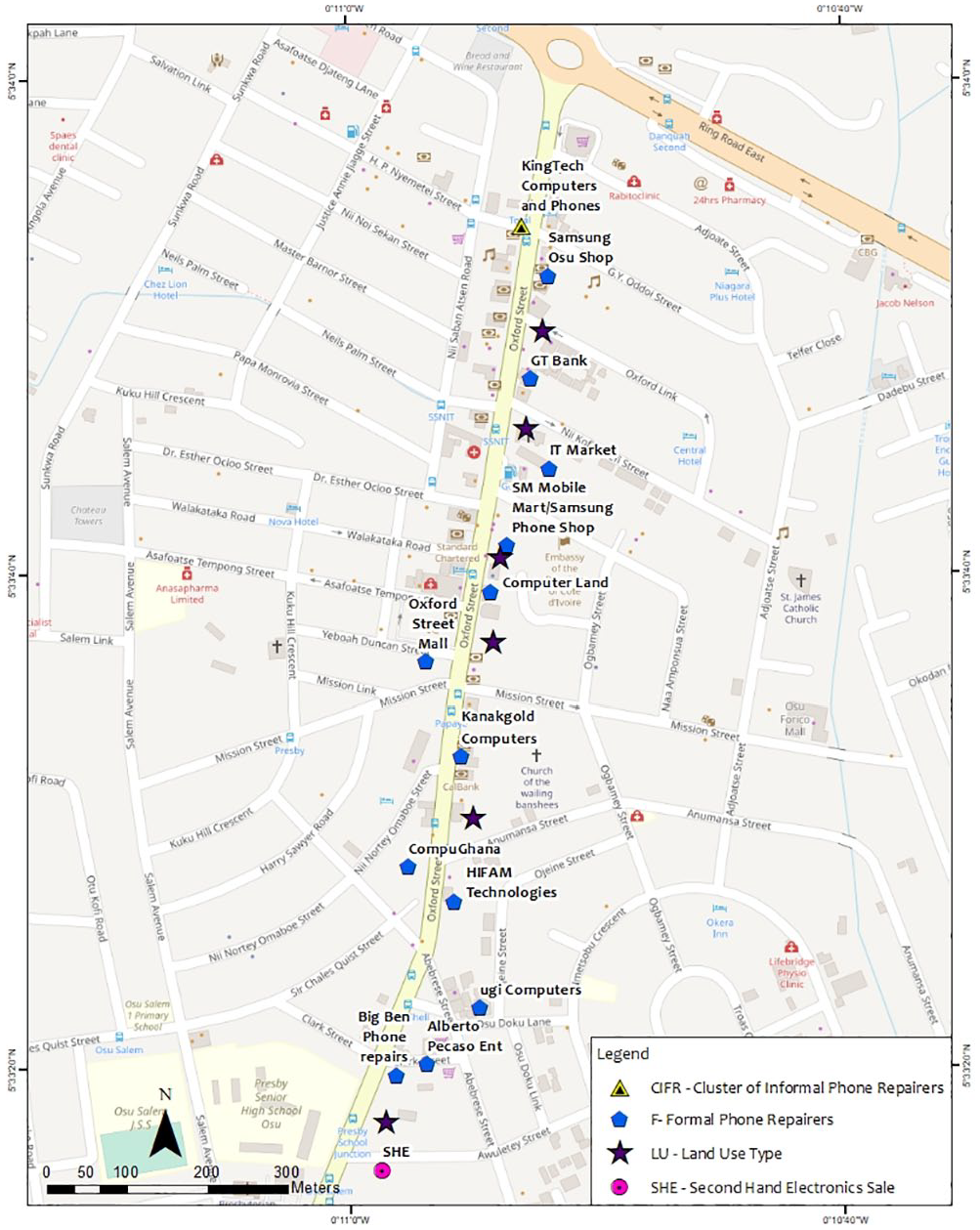
The geography of the mobile phone market in Oxford Street, 2017.
The Madina cluster
The third cluster—Madina—is a suburb located 16 km from the CBD (Figure 3), and an emerging commercial center, with an extensive continuous area, coalescing many dormitory settlements and providing a direct connection to the south-eastern part of Ghana via the N1 Highway. The Madina Market is a mini-CBD tempered by socio-cultural activities. For example, young men selling fresh coconuts whose skills for discerning the tenderness or hardness of the fruit inside before deftly splitting off the crown with cutlass seems purely esoteric. We observed female hawkers calmly walking along with their wares balanced on their heads but without the prop of hands and selling things as varied as ice-cold water, or roasted peanuts. Some women may even have a child strapped to their backs (Quayson, 2014). These features reflect the mix of businesses much closer to the emerging settlements, full of commercial activities, but each with its distinctive characteristics. Unlike Circle cluster, most participants in Madina operate from kiosks and engage in multiple activities including phone repairs and the sale of new (cheap) mobile phones, phone accessories, and airtime.
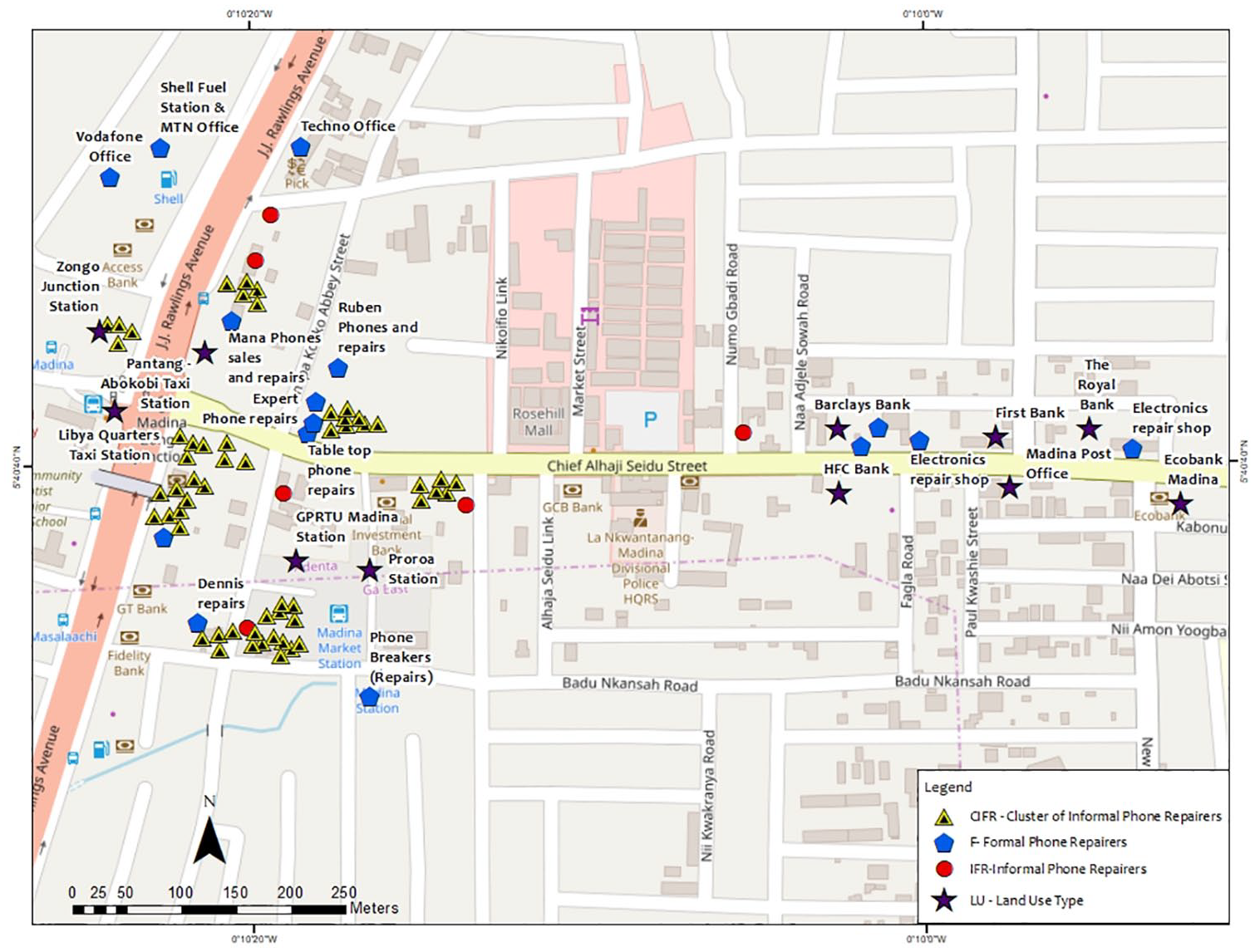
The geography of the mobile phone market in Madina, 2017.
The Abeka Lapaz cluster
The Abeka-Lapaz cluster, which stretches along the NI Highway (Figure 4), has become an essential used-goods market corridor. The area’s greatest asset is the vast open space, created after the highway construction in 2006. The neighborhood has fostered the growth of both formal and informal activities, ranging from used foot wares to electrical and electronic appliances, with different space requirements. The free spaces are so large that the authorities have virtually endorsed open markets. No trader suffers decongestion harassment except occasional extortion from the police. Characteristically, the Abeka-Lapas neighborhood is a fast-growing dormitory area and attracts lots of opportunities, including the MPM (Grant, 2015). Although there are no large transport terminals as in Circle or Madina, the area boasts several taxi and tro-tro 7 terminals, which have increased its accessibility.
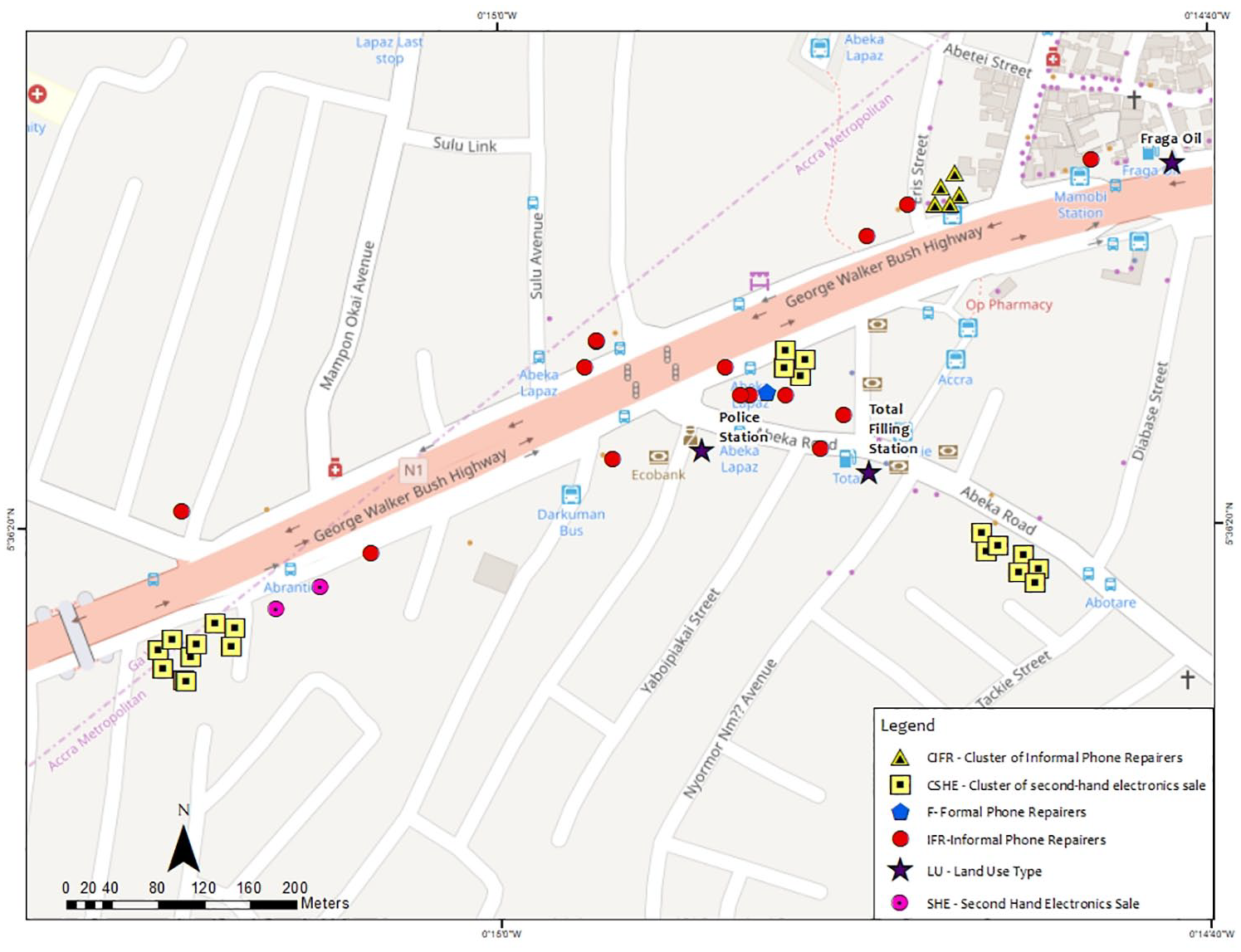
The geography of the mobile phone market in Abeka-Lapaz, 2017.
City governance and mobile phone trade corridors
This study, like previous ones (Gillespie, 2018; Morrison, 2017; Oteng-Ababio and Grant, 2019), makes a compelling case as to how, due to persistent poverty and inequality, city governance must strive to engage informal workers relationally and effectively. It questions the management approaches of public places: governance—or centralized control—by the authorities; and exclusion—through privatization (Garnett, 2012; Stacey, 2018). The study highlights the need for democratic and social justice principles in dealing with informality. Our discussions have shown how the MPM, an informal arrangement initiated by grassroots participants, interacts with formal processes. The results show how city authorities are virtually forced to grapple with evolving realities and power relations that shape the structures and processes in shared and contested urban spaces. Some tentative conclusions can be drawn as discussed below.
First, the findings confirm earlier e-waste studies (Agyapong and Ojo, 2018; Arguello et al., 2013; Farouk and Owusu, 2012) which show electrical and electronic trade as a youth niche activity, with participants aged between 15 and 35 (or a mean of 28 years), operating in specific urban spaces. Further, most MPM actors have some formal education, with more men engaged as repairers and sellers, while women dominate the phone accessories and airtime sales segment. The sale of new phones attracts both sexes, but wholesaling has risen slightly for women as more of them join the cross-border trade. Further, both men and women have the potential to succeed in this trade, and this contrasts with other employment where women remain disproportionately disadvantaged. Being a youthful occupational niche comes as no surprise since the “current generation of young people has never lived without tech” (Sidibe, 2015: i). The study shows Circle as a “globalized habitus” (Bourdieu, 1984); its defining features include repairs, wholesaling, and retailing of used and new phones, and the ability to expertly train and export large numbers of repairers over its borders, thus increasing its regional significance. However, due to AMA’s occasional unpredicted harassment, traders operate as collegiate (not as competitors) and mainly on trestle tables. This allows them to outwit unexpected (decongestion) raids from AMA and resist their repressive acts.
Second, the findings show that the entry into the MPM is not exclusive to those with formal technical competences. We observed a mix of “experts”: (semi)-trained technicians and autodidacts who repair and sell at different markets. Further, access to space is not predicated on the dictates of a gate-keeper or broker with the “authorities”; one’s ability to shore up financial resources to purchase the needed tools may suffice. Ultimately, one’s ability to secure a strategic location that will open up new circuits and transactive spaces depends on its ability to accommodate local hazards. For example, in Circle and Osu, one should be prepared to tolerate the occasional decongestion harassment from AMA, or in Madina and Abeka-Lapaz, the extortions from the police are equally imperative as the promise of profit. The results thus show that a cluster will not just emerge in an urban milieu, no matter how large, without some factors being in place. Therefore, while the experience of re-purposed phones is not universal, it unearths the influencing factors at play on how clusters perpetuate, and how participants build their resilience in the use of public spaces.
Third, the results confirm a higher preference for open spaces such as pavements, lorry terminals, and frontages of shops, though operators at each cluster have different motivations. At Circle, “where life never stops” and an estimated 84,000 vehicles pass through daily, the MPM thrives on its economies of cooperation and diverse traders and customers (Quayson, 2014). Over 80 percent of interviewees alluded to the unique connection between them and their customers. A common mantra was: “at the Circle, you can work for 24 hours, 7 days in a week”. Participants lauded their economies of cooperation and not competition, which encourage the sharing of repair knowledge, spare parts, and equipment. This manifests in the formation of a WhatsApp group
8
through which market conditions are disseminated, and the occasional unannounced raids by AMA are monitored. Explaining economies of cooperation, Koo,
9
a 32-year-old former junior secondary school maths teacher, wittily remarked: Circle is the only place with the capacity to test for phone functionality, and where one can procure extensive inventories of accumulated parts to service the reuse cluster [. . .] Other refurbishers travel into the area to source parts. (Personal interview)
Contributing, Thomas, a 25-year-old repairer, remarked: Here, [the Circle] I believe our business success depends on our members' experiences and swift delivery of services as it does with our collaborative knowledge and equipment sharing. There are no bylaws, no officers or bureaucracy that might get in the way of progress. (Personal interview)
A 41-year-old Nigerian corroborated Thomas’s comments: Yes, many people work here, yet each one can make some reasonable daily income. The jobs are varied, including playing a middleman's role. No transportation fee; you just walk across to procure replaceable parts, cheap. (Personal interview)
We observed that the ability to solidarize and create economies of cooperation among micro-traders operating from trestle tables is the antithesis of multi-national companies. Their hands-on nature is a powerful antidote to the so-called formal service providers, whose services are time-consuming and prohibitively expensive. A cluster is a reaction against market capitalism, albeit with some challenges. As Poki, an importer and retailer of Chinese phones, summarised: A significant challenge we face here is noise, with other traders shouting to attract clients; there are also a new set of religious preachers who mount extensive blaring public address systems. Pickpockets have also taken advantage of the congestion to rob people. Our temporary structures admittedly also blight the environment and degrade the aesthetic quality of the city, and this has been used by city authorities to harass us occasionally. (Personal interview)
We further observed that repairers operating at Oxford Street are highly acclaimed, skilful individuals with competences in smartphones. Their preference for that cluster, housing most formal mobile conglomerates’ repair outlets, is strategic, targeting tourists and business people who need a quick fix. They combine their competencies and creativity and take advantage of the waning enthusiasm of clients of formal conglomerate repair outlets due to their excessive charges and long service delivery time. A commentary by Alfred, a 31-year-old repairer and graduate from Ho Technical University, is remarkable: In this business, time is of the essence. A tourist cannot keep the phone at a shop for a week or more. A government official will better buy a new phone than losing it for two days. These have been their experiences with the [formal] companies. Still, aesthetically, since most repairs deal with the cosmetics of the devices, i.e. broken screens or with the casing, these can be repaired in an hour or less depending on the make of the smartphone device, i.e. Android, iPhone, Galaxy, Blackberry. (Personal Interview)
Kombat repairs phones on a trestle table in front of a shop in Oxford Street. He explains why the MPM operates briskly day and night, with patronage from governmental and residential customers from the city: There are other monetary considerations: the truth is that despite the allure of new phones, realistically, most people will not spend over $500 on the latest device. Most cell phone repairs fall under 50 dollars. We hear about people’s horrible experiences with just random software updates on machines costing hundreds of dollars. It makes economic sense to allow us [the informal professionals] to fix such situations. (Personal interview)
The findings revealed that those working in front of shops do so with the consent of shop owners and, most probably, at a fee, with some formal phone outlets offering free space to some “experienced repairers” to tap into their expertise and competencies.
The Madina and Abeka-Lapaz clusters came out as low-cost clusters, yet they enjoyed an abundance of open spaces and less (decongestion) harassment, though participants have to contend with extortion from the police. Such a selective governance approach serves as an important motivating factor for the mushrooming trade. Red, a 27-year-old repairer, revealed in an informal conversation: Unlike other popular places [Circle and Oxford Clusters], everybody has a permanent workshop due to space availability. We operate from kiosks and engage in multiple activities. (Personal interview)
Another comment akin to Red’s was from Tao: the authorities in Circle have lost focus: instead of focusing on eradicating poverty as one would expect, their strategy of choice focuses on eliminating the poor. There is little harassment here [Madina] except occasional extortions from some police officers. (Personal interview)
Technically, Madina and Abeka-Lapaz are sites for amateurs, 10 who are tactfully avoiding competition, though our participants inconclusively debated this argument. There was, however, a consensus that operators in the two outlier areas restrict their operations to mostly servicing analog phones. A common feature of the amateurs is the adoption of flexibility in their client relations and peddling an illusion of self-accomplishment through a visible display of financial success by dressing in expensive clothes, with fancy accessories like gold jewellery. The aggressive fostering of elegance and polish enables the inexperienced operators to accentuate their cosmopolitanism and create the impression of their expert prowess. The impersonation of business success, or what MacGaffey and Bazenguissa-Ganga (2000: 3–4) describe as “cult of appearance,” produces a useful tactical ambiguity in their business negotiations, where the clients are never quite sure who they are dealing with, and the true extent of their technical capabilities.
The empirical material presented above enables us to construct a checklist of conditions accounting for the perpetuation of the emerging MPM clusters, which to all intents and purposes, are not random in space. These insights are particularly valuable to policymakers and development specialists. The Circle cluster is unique in terms of the sheer number of operators and visitors it brings to the city daily. The Oxford Street cluster targets customers who place value on the embedded notions of quality, authenticity, and legitimacy, and who cherish quick service and would want to connect with the repairers directly. We can also attribute the raison d'être of the Madina and Abeka-Lapaz clusters to the abundance of open spaces and providing services to low-income residential corridors of Accra. Though they seem straightforward, the conditions for success are complex, and fulfilling each of them can be a substantial policy exercise. Ultimately, a functioning cluster might not arise, and it seldom emerges due to how the public spaces are re-envisioned.
Concluding remarks
We set out to examine the interactive (physical, social, economic) factors mediating the emerging geographies of MPM clusters in Accra and how that can enrich our understanding of the changing urban economic geographies and governance in the sub-region. Our analysis reveals MPM as a city-center activity, clustering in public spaces, which conflict with how city authorities would want the city to be managed, organized, and governed (Gillespie, 2018). We explored the strategies participants adopt to navigate potential impediments and sometimes shape public policies. Our findings make a modest case for a more intimate reading of macro policy shifts that may hold the potential to advance transformative policies on the national and the urban scale (Pieterse, 2018). The findings caution against focusing only on the visible cultural surfaces of everyday life in a city, which may yield some insights into the rhythms, patterns, and practices that characterize people's livelihood choices but cannot on its own convincingly capture the survivalist ethos and the underlying (and out-of-sight) mechanisms that govern the decisions people make in selecting the operational turf for their economic activity (Myers, 2011).
Ultimately, participants in the MPM clusters rely, to a significant extent, on the systems of patronage, economies of cooperation, and the inconsistent application of rules by city authorities to circumvent the “governing regimes” for survival. Thus, at Circle and Oxford Street, city authorities maintain “order” by occasionally undertaking decongestion exercises, which vary significantly from the extortion traders at the Madina and Abeka-Lapas clusters suffer from the police. The inconsistent application of rules is also reflected in the infrastructure investments of participants. At Circle and Oxford street, where traders occasionally suffer unannounced (decongestion) harassments, the use of trestle tables is the preferred investment. At the same time, their counterparts in the Madina and Abeka-Lapas clusters operate from constructed kiosks. Understanding such intra-urban variations enrich comparative urban research and its implications for urban governance. The results show that a more focused study based on an analysis of the nature and terms of infrastructure investments can advance considerations on whether city authorities’ policy frameworks are developing a more inclusive, labour-intensive, and sustainable development pattern in cities and towns.
Additionally, our results reveal to some extent how urban governance policy discourses are now connecting urban investments and regulation with macroeconomic imperatives, which could lead to a greater awareness of urban governance (Pieterse, 2018). Clearly, the results show the overwhelming dependence of the urban economy on informal institutions, and this contradicts some traditional literature, which frequently treats informality as a euphemism for marginality or a desperate, dysfunctional socio-economic action (Baldwin, 2005; Myers, 2011). Our study does not equate the MPM as an expression of “failed” modernity or truncated development but as a central feature in the economic geography of contemporary Accra (Stacey, 2016). It demonstrates how MPMs create socially intensive labour networks that facilitate their mobilization or what Dennett and Page (2017: 452) describe as economies of cooperation, and the extent to which camaraderie ensures that participants share equipment, ideas, knowledge, spare parts, and customers to the benefit of all.
In unearthing and presenting this model, the hope is to spur further intra-urban research. Mapping the MPM clusters has demonstrated that regardless of where economies of cooperation emerge, the same kind of production paradigm is observed. This contrasts with other works, which either focus on the city as a whole or a specific site. Such economies of cooperation explain the raison d'être of traders to cluster geographically and typically locate close to the action spot, to observe the ebb and flow of daily transactions, and to position themselves favourably in a nexus of information (Oteng-Ababio, 2018; Stacey, 2018). Traders at Circle use the magic of trestle tables to outwit city authorities’ decongestion exercises. At Oxford Street, we see successful traders using their expertise to cultivate patronage to command client loyalty. In Madina, the amateurs’ “cult of appearance” strategy produces a useful tactical ambiguity that conceals their newness in the trade. In this way, the dramaturgical presentation of self—through clothing, mannerisms, style of speech—sometimes becomes a kind of theatrical production or an elaborate masquerade (Simone, 2000).
We believe that facilitating such entrepreneurship in sub-Saharan Africa is an essential aspect of any urban governance and economic development policy framework, and can be empowering. And this, like other urban governance and economic policies, must be contextually grounded and diagnostically sophisticated. We must avoid conflating our urban governance and economic development trajectories with a neoliberal discourse as it erodes our social protections, neither should we aspire to be part of any urban governance and economic policy prescriptions that fail to address social justice and a fair and inclusive labor market for all participants, citizens, and migrants alike.
Footnotes
Funding
The authors disclosed receipt of the following financial support for the research, authorship, and/or publication of this article: This work was supported by Sustainable Market Actors for Responsible Trade (SMART), a HORIZON2020-financed research project (grant agreement No. 693642).
