







Abstract
This manuscript presents a computational investigation of the compression-after-impact (CAI) response of polymer matrix composites subjected to seawater-induced environmental degradation. A multiscale computational model that accounts for seawater-induced property degradation in composite constituents is proposed to predict the CAI response of E-glass reinforced vinyl-ester composites. Predictions of the CAI response as a function of specimen saturation are validated against experimental observations. The investigations revealed that partially-saturated vinyl-ester matrix composites undergo a significant reduction in the CAI strength, part of which is recovered upon full matrix saturation. The proposed computational model captures the response characteristics of partially- and fully-saturated specimens.
Keywords
Introduction
Fiber-reinforced polymer composites provide tremendous potential as structural components in naval and marine structures due to their high specific stiffness, strength, and durability properties. For instance, polymer composites with glass reinforcements (GFRP) are increasingly used in marine structures including radomes, submarine casings, sonar casings, propellers, masts, and shafts 1 as well as light-weight advanced defense platform structures due to high mobility and low-fuel cost replacements. 2 Vinyl-ester and polyesters are preferred over epoxy as matrix materials due to their low cost and ease of processing. 2 E-glass fibers are typically preferred compared to carbon fibers due to the low cost and higher achievable ultimate strain levels, despite their reduced tolerance to aqueous environments in comparison to carbon fibers. 2
Environmental degradation of the mechanical properties including strength, stiffness, compression-after-impact (CAI), and immersed fatigue strength of fiber-reinforced polymer composites subjected to seawater environment is of significant concern. Prior experimental investigations 3 , 4 focused on characterization of composite specimens fully immersed in seawater. Liao et al. 5 show a reduction in strength and moduli of pultruded GFRP composites with environmental aging in salt solutions, and suggest several mechanisms for flexural strength degradation including significant degradation in the fiber-matrix interphase region and in situ fiber strength degradation. Karbhari and Zhang 2 demonstrate reduction in tensile strength of E-glass vinyl-ester (EVE) composites. They suggest that the changes in strength are not only due to plasticization and hydrolysis of the matrix, but also due to degradation at the fiber-matrix interface and at the individual fiber itself. Roy et al. 6 report a decrease in flexural strength of glass fiber-reinforced vinyl-ester composites of approximately 17% when subjected to boiling water.
CAI strength of composite structures exposed to seawater was shown to be lower than dry structures. Imielinska and Guillaumat 3 show that the CAI strength of woven aramid-glass fiber epoxy composites reduced by a maximum of 42% under low velocity impact. In view of the sensitivity of the CAI response to damage distribution within composite specimens, Xu et al. 7 experimentally investigated the CAI response of composite specimens exposed to seawater from one side only, in contrast to full immersion of specimens in seawater. One side only exposure was argued to describe the seawater exposure more accurately for marine structures.
In this manuscript, the effect of seawater exposure on the CAI strength of polymer composites is numerically investigated. A multiscale computational model that accounts for seawater-induced degradation of composite constituents is devised to numerically study the evolution of CAI strength as a function of seawater ingress into the composite. The proposed model is employed to predict the CAI of a suite of vinyl-ester specimens subjected to seawater for up to 30 months in an experimental study. The investigations reveal that partially-saturated composites undergo a significant reduction of CAI strength, part of which is recovered upon saturation. The proposed seawater degradation model captures the response characteristics of partially- and fully-saturated composites.
The remainder of this manuscript is organized as follows. A summary of experiments employed to validate the proposed computational environmental degradation model is described in Section 2. Section 3 describes the computational multiscale approach to model the response of composites including seawater ingress-induced degradation of material properties. Moisture absorption model and degradation of constituent material properties as a function of saturation are described. In Section 4, numerical investigations of the CAI response of partially- and fully-saturated EVE composite specimens are presented. Conclusions and future research directions are described in Section 5.
Experimental investigations
A suite of experiments were conducted to characterize the effect of seawater exposure on the CAI strength of EVE composites.
7
,
8
Composite specimens were manufactured using vaccum assisted resin transfer molding process.
9
Eight plain weave fabric layers were stitched to produce rectangular composite panels with dimensions of 101.6 ± 0.1 × 152.4 ± 0.1 mm2 (4” × 6” ± 0.004). The thickness of each panel is 4.96 ± 0.22 mm2 which is required by ASTM D 7137. The samples were exposed to seawater on one side only, (Figure 1(a)) to mimic realistic exposure conditions observed in naval structures. This is in contrast with previous approaches, where the experimental samples are fully immersed in water. Artificial seawater with a salinity content of approximately 2.9% (ASTM D1141) is used as the moisture environment. Composite specimens with varying degrees of exposure (i.e, approximately 3 month intervals of up to 30 months) were prepared for CAI testing. A total of 72 composite specimens were tested over a time period of 30 months.
(a) Realistic exposure of CAI specimens to seawater, (b) drop tower impact testing of EVE composite, (c) CAI testing of EVE composite, (d) damage profile after impact testing, (e) damage profile after CAI testing, and (f) shear crack along the side of the specimen after CAI testing.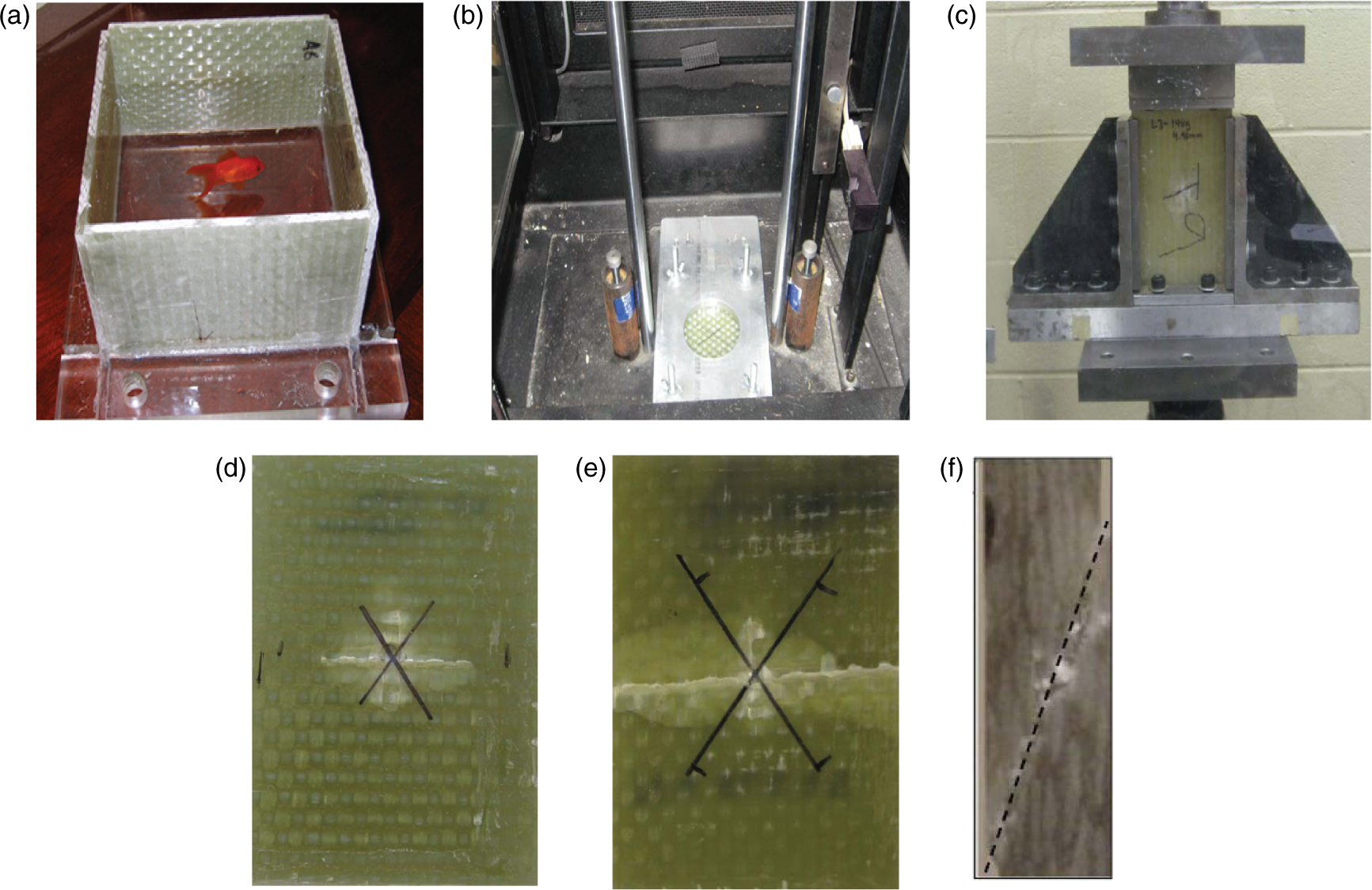
CAI testing consists of subjecting the moisture-exposed composite specimens to impact damage followed by compression testing as illustrated in Figure 1(b) and (c). In the impact testing, a 16-mm (5/8”) diameter hemispherical impactor impinges on the composite specimen with 60 J of energy using a drop tower apparatus as prescribed by ASTM D 7137. The impact damage causes a horizontal and a vertical matrix crack on the front-impact surface (Figure 1(d)), while delamination zones along with fiber breakage was observed on the back surface. Delamination zones are approximate circles with increasing radii toward the back face with maximum radius of about 17.6 ± 1 mm observed between the last two plies. No significant change in the delamination zone is observed in the specimens as a function of moisture exposure duration. Fiber breakage also occurred at the drop weight impact site.
Variation of CAI strength with seawater exposure duration
Moisture absorption model
Moisture absorption process in EVE and other polymer matrix composites is typically idealized using Fick's second law of diffusion:
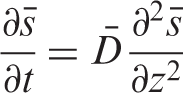
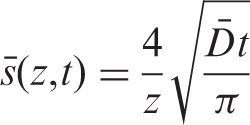
Moisture absorption process in vinyl-ester and epoxy matrix composites exhibit deviations from the Fickian model. Glass fiber reinforced polymer composites (GFRP) 10 and carbon fiber-reinforced polymer composites with different types of matrices have shown deviations from classical Fickian response which points to additional moisture absorption mechanisms (e.g., reaction processes). For instance, Karbhari and Zhang 2 report a two-stage diffusion process in EVE composite. They present a moisture absorption curve which shows an initial increase followed by a plateau, and another increase in mass of absorbed water as a function of moisture exposure duration. Tsotsis and Weitsman 11 present a simple graphical solution to calculate the diffusion parameters from a non-Fickian moisture absorption response for composites. Despite such deviations, the Fickian model remains to represent the process of moisture ingress in various types of composite systems including woven aramid-glass fiber/epoxy, 3 glass/vinyl-ester, carbon/vinyl-ester, carbon/epoxy, glass/epoxy composites. 6 , 12 In addition to composite systems, the response of neat vinyl-ester resin has also been assumed to be Fickian in nature by Sagi-Mana et al. 13
Murthy et al.
12
provides the coefficient of diffusion at room temperature,
Saturation profiles in the composite specimens subjected to seawater exposure.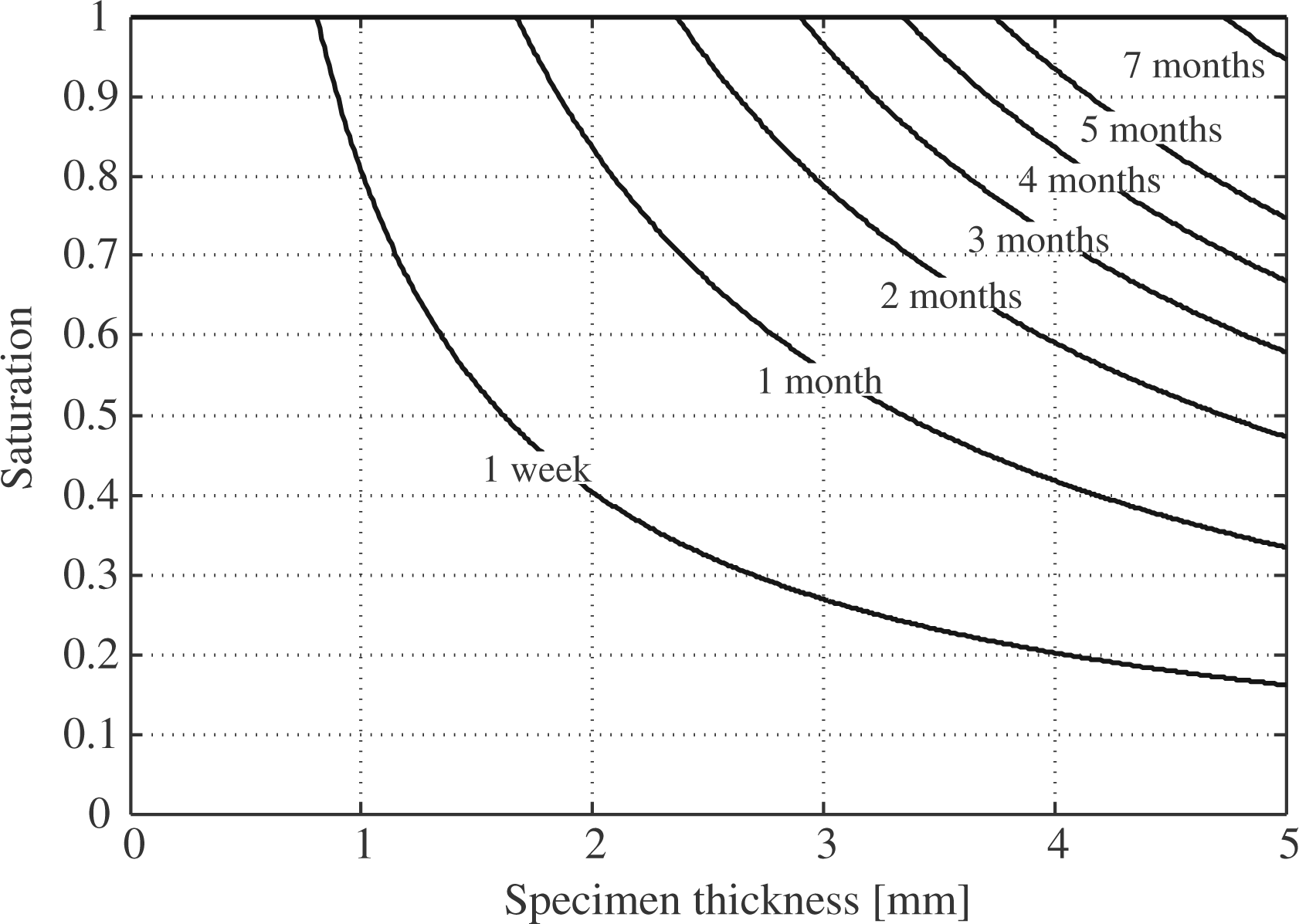
Modeling CAI failure of seawater-exposed composites
The geometry and discretization employed to idealize the CAI specimens are illustrated in Figure 3. The specimens are modeled as a 101.6 × 152.4 mm2 rectangular plates with a thickness of 5 mm. The displacement in the thickness direction is constrained (u3 = 0) along the edges of the front and back side of the plate. The bottom edge is constrained (u2 = 0) and vertical displacement is prescribed at the top surface. CAI response of the composite specimen is modeled by considering the following failure mechanisms: (1) the effect of seawater on constituent stiffness; (2) the effect of seawater on constituent strength; (3) impact-induced damage; (4) progressive damage in seawater-exposed composite plies; and, (5) progressive delamination along ply interfaces.
(a) Composite specimens exposed to seawater on one side only, (b) geometry and boundary conditions, and (c) RVE with matrix (transparent), fill-fibers (lateral) and warp-fibers (vertical).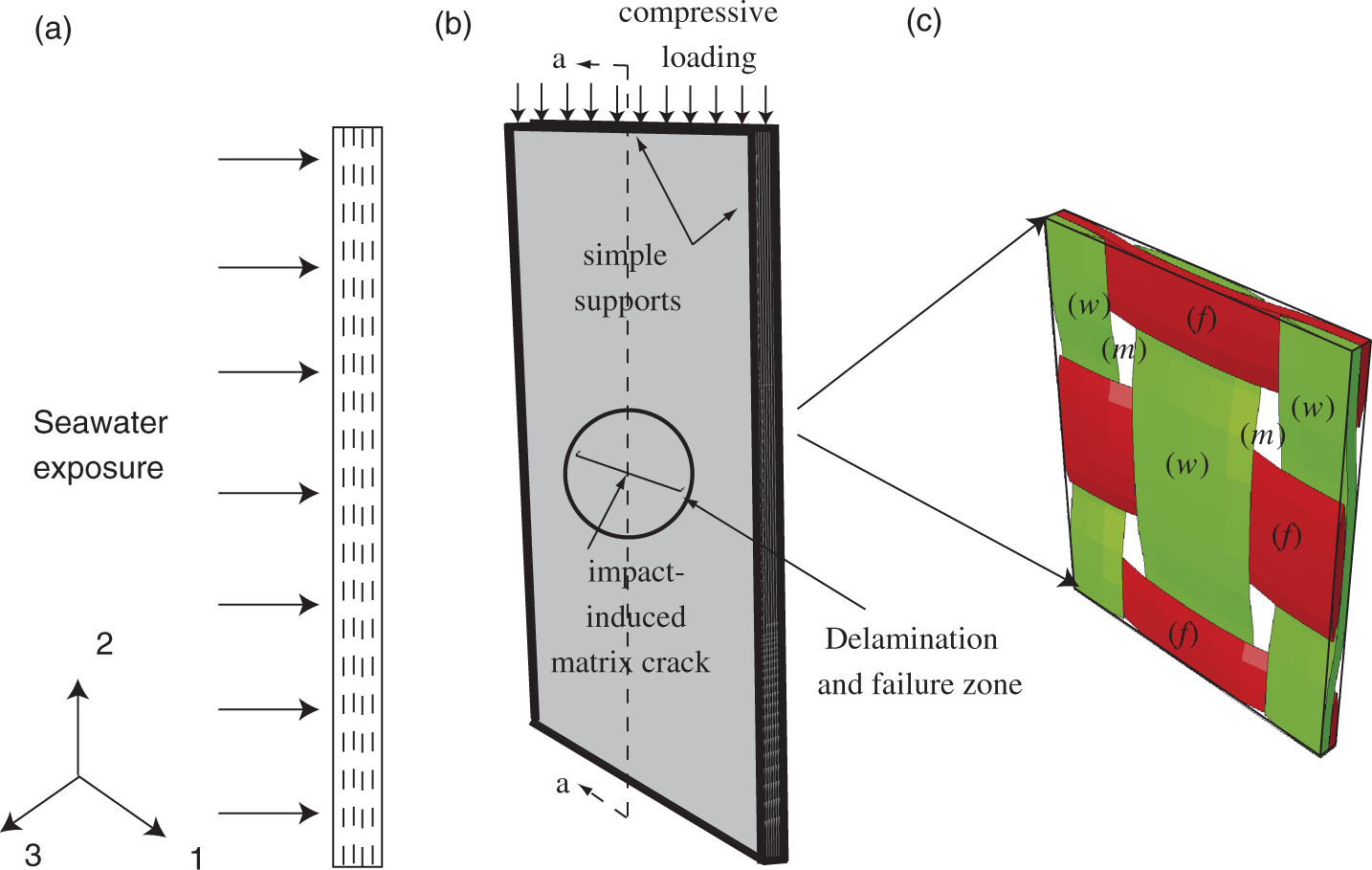
Effect of seawater on constituent stiffness
Moisture ingress affects the stiffness of the vinyl-ester matrix through two competing mechanisms:
14
plasticization due to water sorption that tends to decrease the stiffness accompanied by embrittlement of the matrix material, and leaching of the low molecular weight substances during the hydrolysis process
15
that tends to increase the stiffness of the matrix material. Apicella and Nicolais
16
reported a 10% increase in the elastic modulus of vinyl-ester at a water saturation level of 45%, which indicates that the leaching process overcomes the plasticization effect up to the reported saturation levels. Experimental reports on vinyl-ester stiffness for higher saturation values is not available in the literature to the best of the authors' knowledge. In this study, the variation of elastic modulus of the vinyl-ester matrix with saturation percentage is assumed to be according to the following expression:

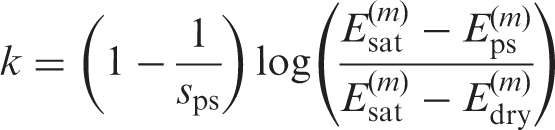
The variation of the elastic modulus of the matrix as a function of saturation provided by the proposed model (using
Variation of elastic modulus with saturation percentage as predicted by the model.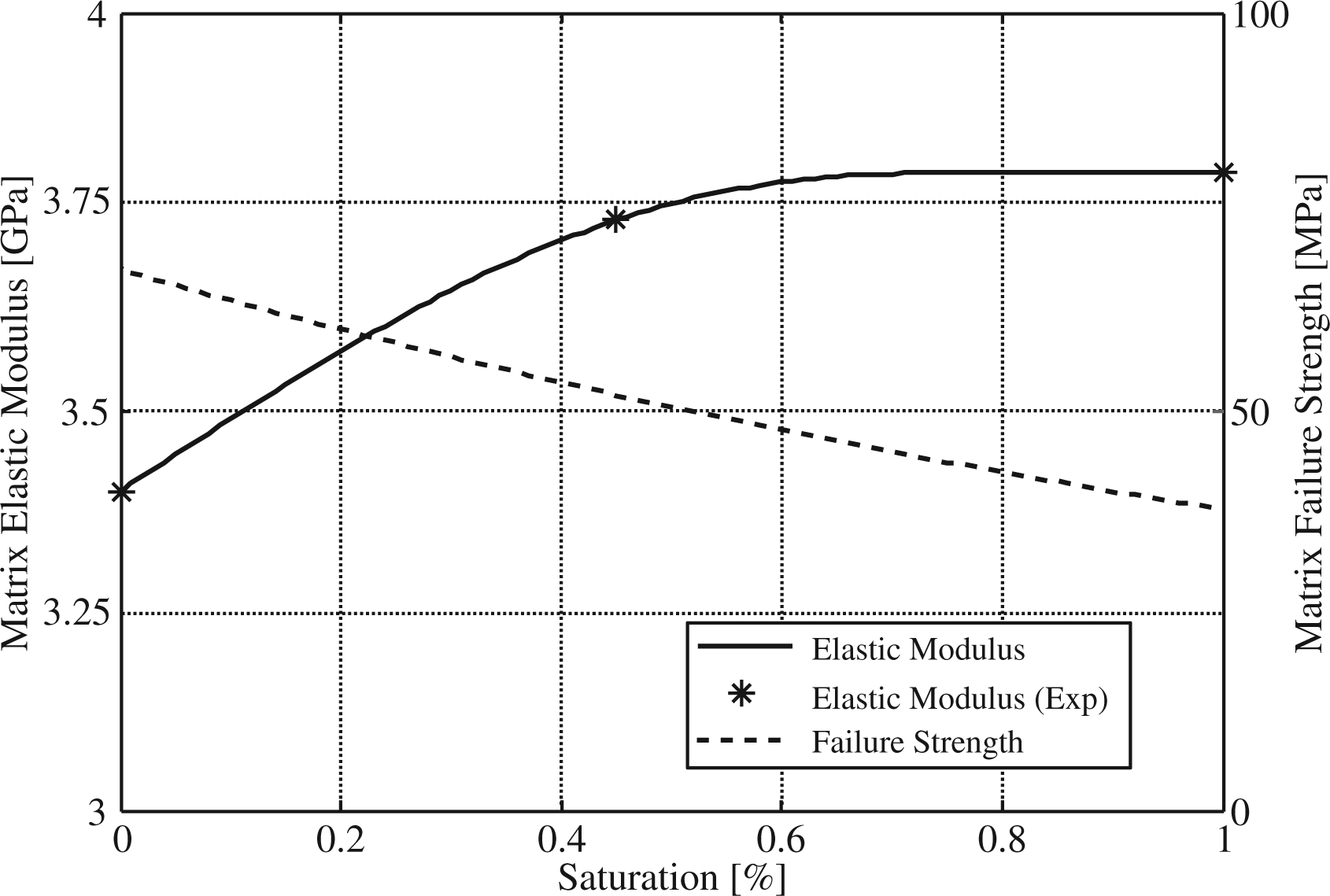
In the experimental investigations, the compressive moduli of moisture-exposed CAI composite specimens do not show significant reductions as a function of moisture exposure durations. This points to the observation that the fiber stiffness is not significantly altered by the moisture exposure.
Effect of seawater on constituent strength
Moisture ingress significantly reduces the strength of the vinyl-ester matrix. The degradation of matrix strength is attributed to the formation of voids and cracks within the material during leaching of the low molecular weight substances.
15
Moisture-induced voids and cracks are randomly dispersed across the wet region and act as fracture initiation sites when subjected to mechanical loading. Apicella and Nicolais
16
reported 57% reduction in the failure strain of partially-saturated (
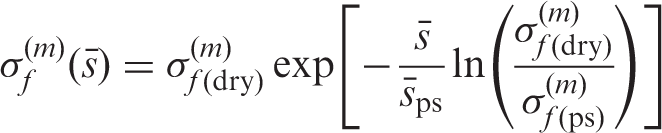
The existing experimental investigations focus on deterioration of tensile strength of vinyl-ester matrix when exposed to moisture. In contrast, no experimental data are available on compressive strength deterioration of moisture-exposed vinyl-ester. Considering leaching-induced randomly distributed crack and void formation during the moisture ingress process, tensile and compressive loading conditions lead to similar stress concentrations within the moisture-exposed regions. In this study, the degradation of the compressive strength of vinyl-ester is taken to be identical to degradation under tensile loading.
The strength of E-glass fibers are known to deteriorate in moisture environments. 5 , 17 , 18 The deterioration has been attributed to generation of surface flaws due to dissolution. 18 Ramirez et al. 19 provided an experimentally calibrated empirical tensile strength degradation model for E-glass fibers exposed to seawater. The extent of strength degradation in fibers were up to 45% of dry fiber strength near full saturation. Our numerical investigations reveal that at the state of sublaminate buckling in CAI specimens, the stresses within fibers remain below the degraded failure strength. Therefore, reduction in the fiber strength does not significantly affect the CAI strength in E-glass fiber-reinforced vinyl-ester composites.
Impact-induced damage
Experiments indicate three distinct damage mechanisms when the specimens are subjected to impact: (1) horizontal and vertical matrix cracks at the impact site of the specimens; (2) delamination within a near-conical zone (with apex at the center of the impact surface and base at the back face along the thickness direction of the specimens); and, (3) matrix and fiber cracking within the delamination zone. In this study, a 35.2-mm long horizontal crack with 0.625 mm depth is introduced in the numerical specimens. Experiments suggest that the vertical matrix crack does not grow upon compressive loading, and is not modeled in our simulations. Within the conical impact-damage zone, the composite plies are taken to be completely debonded and a negligible residual strength is assigned to the plies within the impact-damage zone. The base of the conical zone has a diameter of 35 mm based on the experimental observations. The experiments show no significant change in the initial impact damage zone as a function of seawater exposure duration. The full details on modeling of the initial impact-induced damage in composite specimens is explained in Yan et al. 8
Multiscale ply failure model
A moisture-dependent continuum damage mechanics model is proposed to idealize the failure processes within the moisture-exposed composite constituents. The proposed model is implemented within the context of the eigendeformation-based reduced order homogenization method (EHM) recently proposed by Oskay and coworkers. 20 , 21 In the EHM approach, failure response of the composite constituents (i.e., matrix and fiber) is numerically evaluated at the scale of the representative volume element (RVE) and the overall composite response is computed based on the computational homogenization method by appropriate averaging across the RVE domain. The details of the EHM methodology is described in Refs. 20 , 21 and the moisture-dependent failure model for constituent materials is described herein.
The RVE of the woven E-glass fiber-reinforced vinyl-ester composite is shown in Figure 3(c). The RVE consists of the vinyl-ester matrix, as well as the fibers in the warp- and fill-directions. We consider a damage potential function, f, taken to be piecewise constant within the RVE:

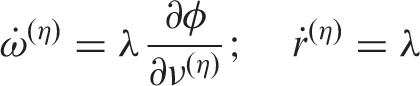

Phase damage equivalent strain, ν(γ), is defined as:



The moisture-dependent phase damage evolution function, θ, is expressed based on an arctangent law of the form:
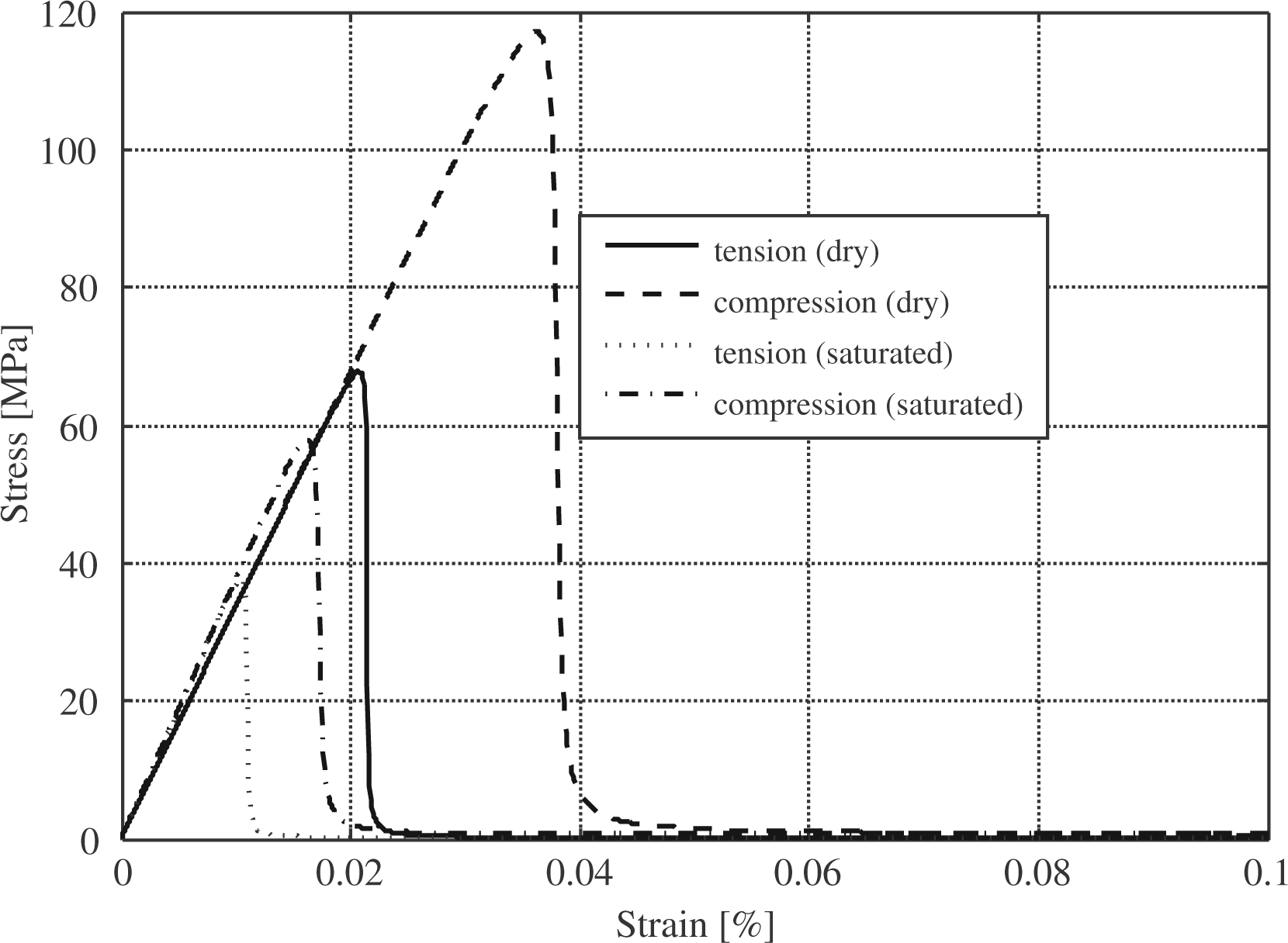
Stress–strain curves of dry and saturated vinyl-ester matrix subjected to uniaxial compressive and tensile loadings.

Calibrated failure parameters of composite constituents
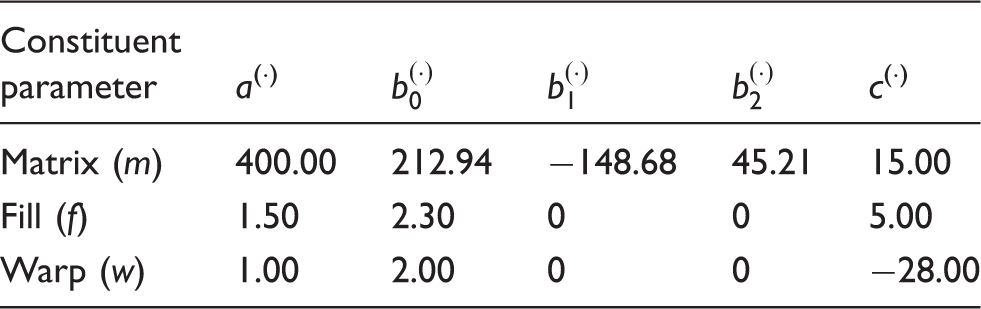
In this study,
Stress–strain diagram showing tension and compression properties of dry and saturated (inset) glass fiber-reinforced vinyl-ester composite.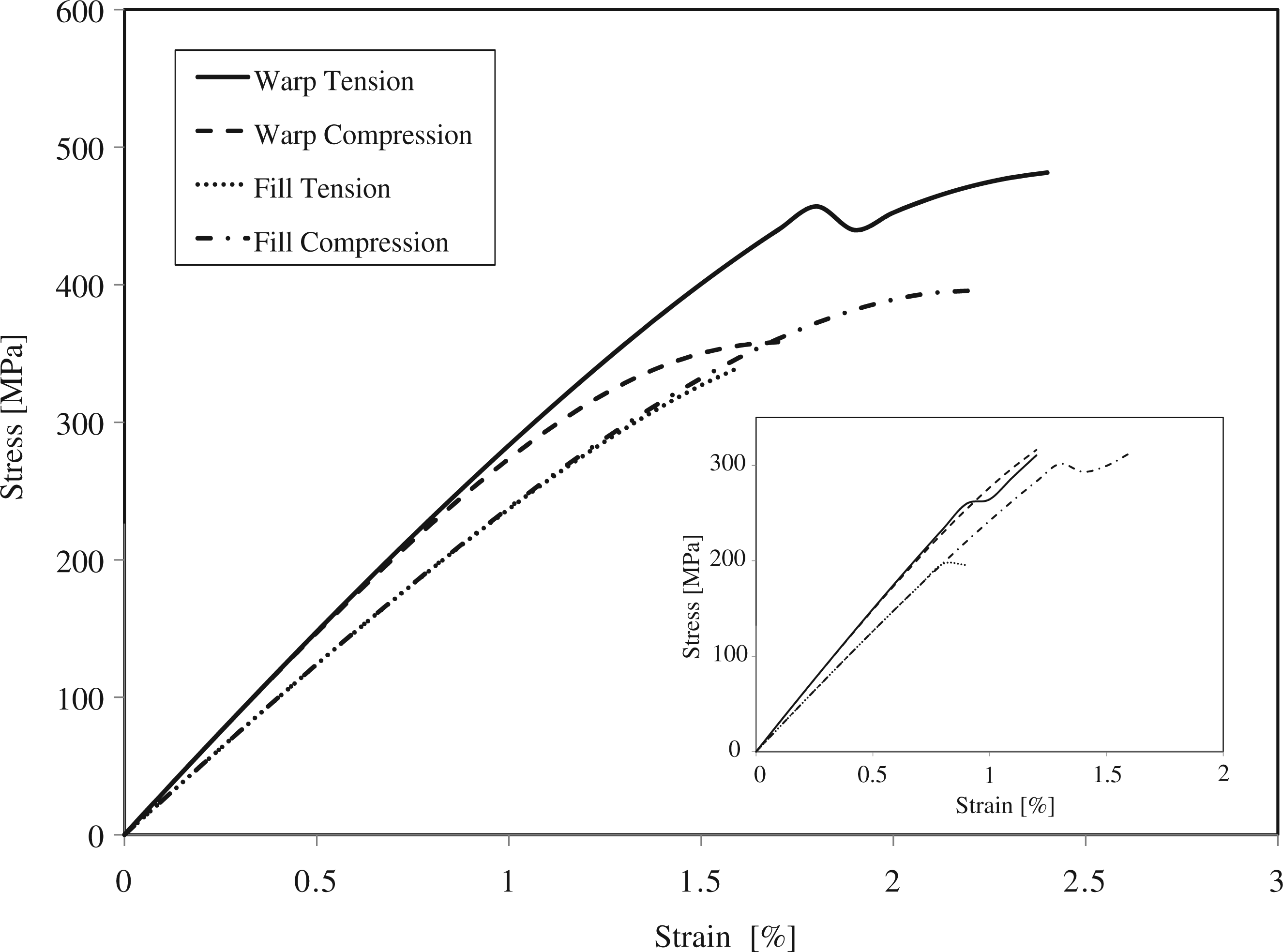
Interlaminar failure model
Progressive delamination of the plies upon compressive loading is idealized using a saturation-dependent cohesive surface model, which provides the traction-displacement relationship along the interlaminar boundaries as illustrated in Figure 7:
Interface damage evolution model for dry (solid lines) and saturated (dashed lines) composites.
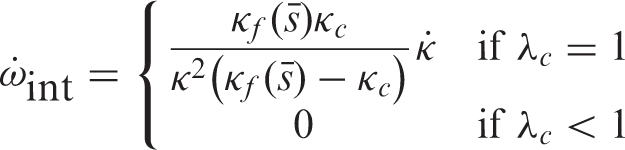
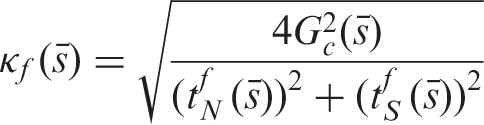
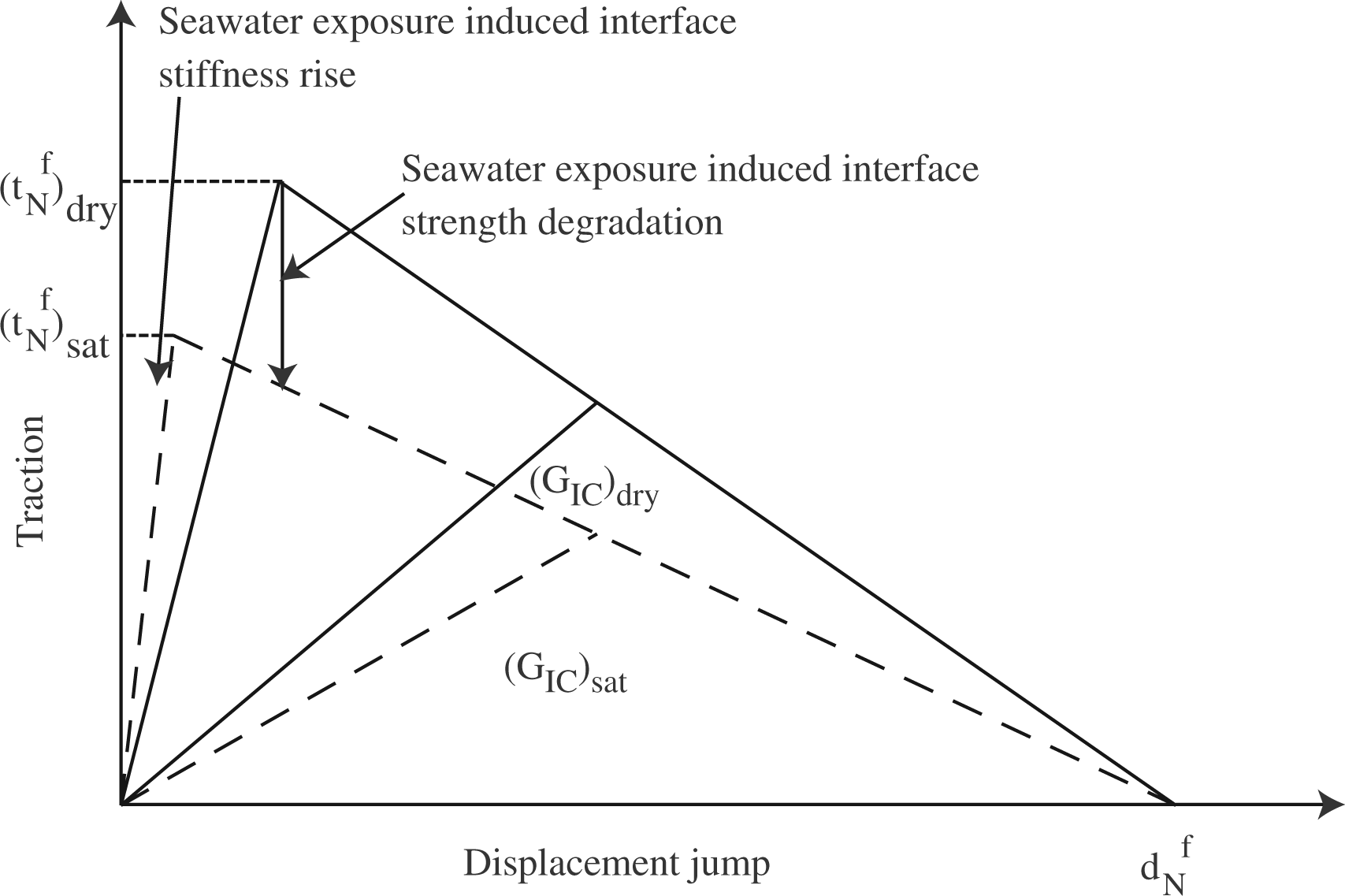
The calibration of the ply interface parameters for dry CAI specimens are described in Ref. 8. In this manuscript, we concentrate on the effect of moisture on the interface delamination response characteristics. The interface stiffness coefficients in the normal and tangential directions, K
N
and K
S
, respectively, are taken to be based on the homogenized moduli of the composite material along the thickness direction (Figure 3): K
N
= Ē33/h and
Numerical simulation of compression failure in seawater-exposed CAI specimens
Variation of average ply saturation with time employed in the numerical simulations
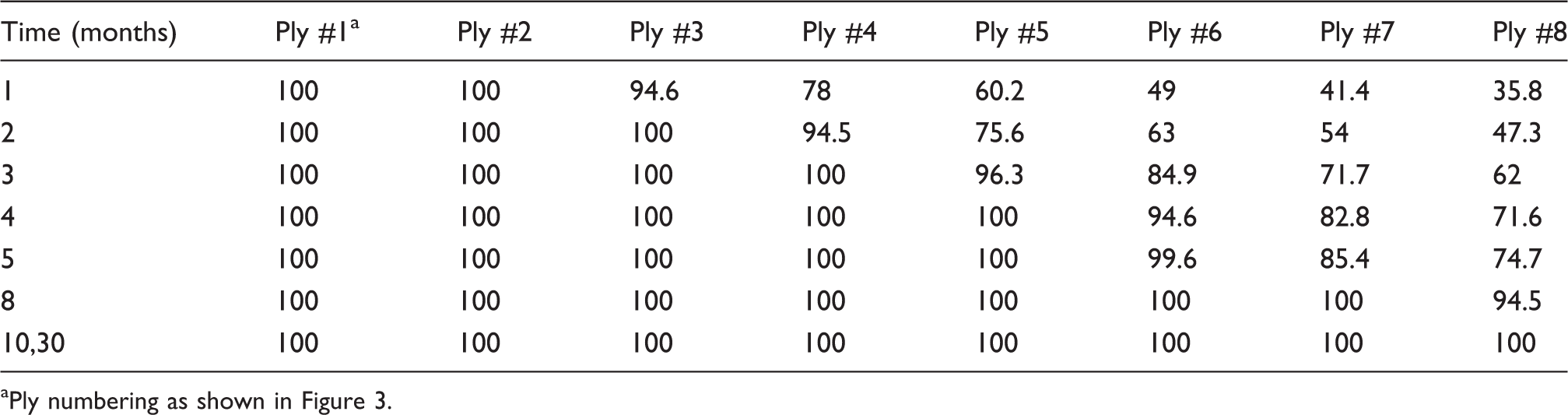
aPly numbering as shown in Figure 3.
The compression simulations consider the failure mechanisms of impact-induced damage, progressive failure within the composite constituents, as well as progressive delamination along the ply interfaces. Experiments indicate that the impact-induced damage profiles for partially- and fully-saturated specimens do not significantly differ from the damage profile for the dry specimen. 7 Identical impact-induced damage profiles are considered for the dry and all moisture-exposed specimens.
Normalized CAI strength
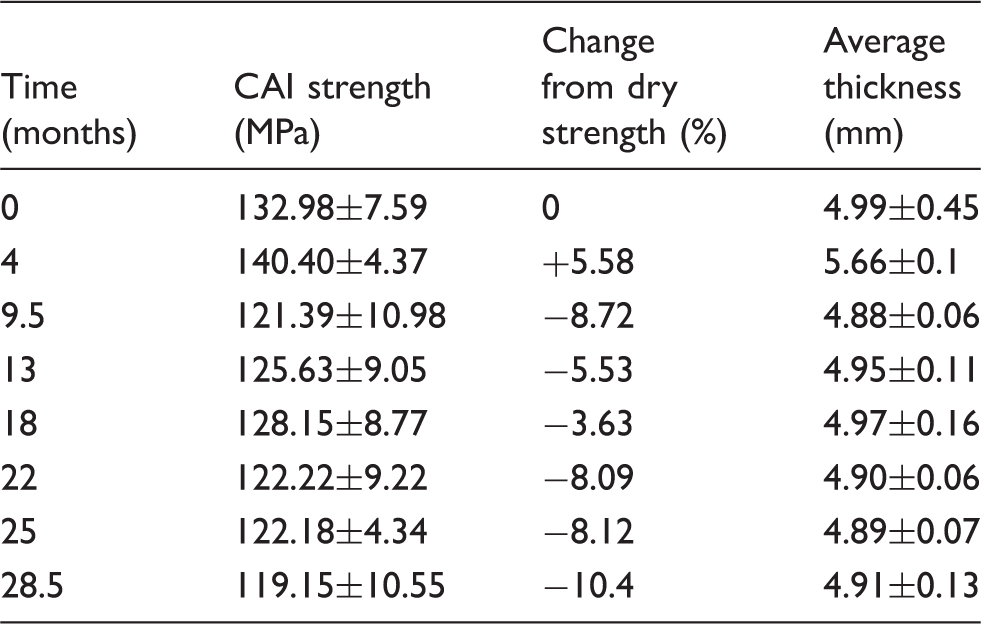
The experimentally observed CAI strength of composite specimens as a function of seawater-exposure is shown in Figure 8(a). The measured CAI strength of the composite specimens subjected to 4 months of seawater exposure is 5.6% higher compared to the dry CAI strength, whereas the CAI strength of saturated specimens (i.e., seawater exposure duration of 9 months and more) is smaller compared to dry CAI strength. The relative increase in the CAI strength in unsaturated composite specimens is attributed to the higher specimen thicknesses (Table 1).
(a) Variation of CAI strength as a function of seawater exposure duration for experimental dry and wet specimens and (b) variation of normalized CAI strength as a function of seawater exposure duration for experimental and simulated specimens.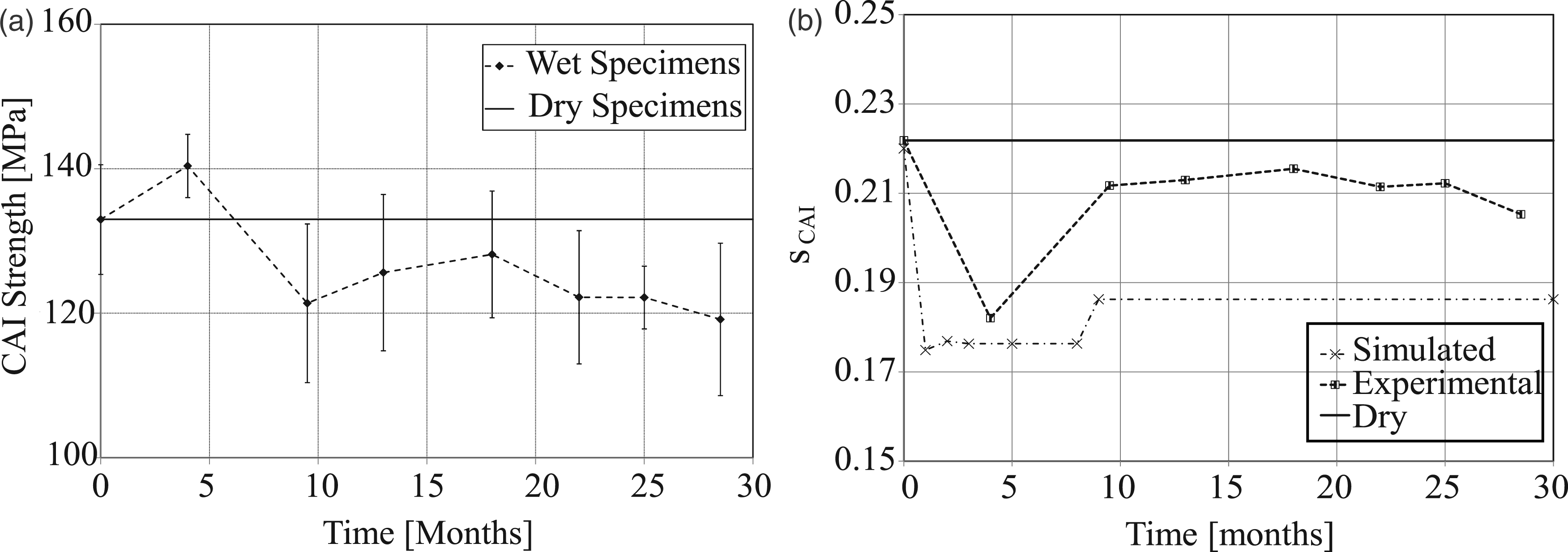
The CAI strength of composites is defined by sublaminate buckling, which is a function of the specimen thickness. Considering a classical Euler buckling formula for a pin-supported column, The buckling stress, σcr is expressed as:
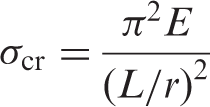
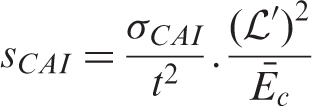
Figure 8 illustrates the variation of s
CAI
as a function of duration of moisture exposure observed in the experiments, as well as those predicted by the numerical simulations. For all specimens,
The variation of s CAI with moisture exposure duration predicted by the numerical simulations captures the trend that moisture exposure leads to a reduction in the normalized CAI strength of moisture-exposed specimens compared to dry composites. The simulations reveal that there is a significant reduction in s CAI upon a slight exposure to moisture, which is partially recovered upon full saturation. The overall reduction of the normalized CAI strength (from dry conditions) for the saturated composites predicted by the numerical simulations are 15.5% compared to 23% reduction in unsaturated specimens. We attribute higher reduction in s CAI in unsaturated specimens compared to saturated composites to the uneven material properties in the unsaturated specimens with more degradation along the moisture exposure face, which promotes buckling. While the current experiments seem to agree with this trend, further independent CAI experimentation on unsaturated specimens is needed to validate the numerical predictions and the underlying reason for the observed behavior. While, the overall trend of the CAI strength is successfully modeled by the proposed multiscale CAI failure model, the simulations predict a somewhat lower CAI strength of dry and moisture-exposed specimens compared to the experimental observations. The discrepancy between simulated and experimentally observed CAI strength is due to the uncertainties in the impact-induced damage within the composite constituents and ply interfaces, as well as in the characterization of the moisture-induced material property changes due to moisture ingress. Additional experimental and numerical investigations to more accurately identify damage processes at the micro- and specimen scale are currently on-going.
Conclusions
In this manuscript, we presented a numerical investigation of the effect of moisture ingress on the CAI response of EVE composite materials. A moisture-dependent multiscale composite damage model is proposed and employed to predict the variation of CAI strength as a function of moisture exposure durations. One key observation is that partially-saturated specimens display lower CAI strength compared to fully-saturated specimens. This observation is in agreement with experiments. The proposed multiscale damage model was shown to be effective in capturing moisture exposure-induced degradation of material as well as CAI parameters. Additional difficulties related to modeling the effect of seawater exposure on CAI remains to be investigated. First, more experimental investigation is needed in the partially-saturated range to further validate the prediction of the model. Second, incorporation of the effects of seawater exposure on matrix-fiber debonding as well as on delamination characteristics are likely to provide a more accurate model for prediction of CAI response. These issues will be addressed in future studies.
Footnotes
Funding
This research received no specific grant from any funding agency in the public, commercial, or not-for-profit sectors.
Acknowledgments
The authors acknowledge the financial support from the Office of Naval Research and Vanderbilt University. The authors also thank Professor Roy Xu at University of Texas, El Paso for his fruitful discussions and experimental collaboration.
Conflict of Interest
None declared.