






Abstract
The incorporation of nanoparticles into a polymer can lead to a considerable improvement of mechanical properties. Especially, the toughness and stiffness of the nanocomposite can be enhanced at the same time. Therefore, a homogeneous distribution of fillers within the matrix is required. In this research study, the feasibility of improving polymer composites was investigated using 21 nm titanium dioxide nanoparticles in a vinyl ester resin. The nanocomposites were processed by shear mixing and ultrasonication at different filler concentrations (1, 2.5, and 5 wt%). Also, a polymeric coupling agent was employed to strengthen the interface between filler and resin by forming strong chemical bonds. Changes in mechanical properties were examined through a variety of tests. Results indicate an enhancement in the vinyl ester composite mechanical properties due to the addition of small fraction of titanium dioxide particles. It was concluded that the highest mechanical properties could be achieved at an optimal titanium dioxide fraction.
Introduction
The use of particulate materials (fillers) for enhancement of polymer properties dates back to the earliest years of the polymer industry. 1 Over the years, there has been considerable interest in particulate polymer composites (generally consist of micro- or nano-fillers) since the dispersed fillers can be used to easily control the overall stiffness, strength, wear resistance, fracture toughness, and impact energy absorption of the resulting composite.2,3 In almost all of these cases, the size of the particles is an important factor affecting the performance of the materials. 4 The incorporation of nanoparticles into a polymer matrix can lead to a simultaneous improvement of different material properties. Especially, the toughness and stiffness of the nanocomposite can be enhanced at the same time, which is not possible for conventional composites with micro- or even macro-scale fillers to the same degree and for the same low filler contents. 5
The basic challenges in order to gain the desired nanocomposite properties are to disperse the nanoparticles as individual particles in the polymer matrix and to introduce strong chemical bonding between the nanoparticles and the polymer matrix.6–8 In other words, the mechanical and physical properties of polymeric composites are related closely with the dispersion state of the filler particles in the matrix, especially for nanometer fillers because of the particle surface effect. 9 Physical forces like ‘van der Waals’ lead to an agglomeration of commercially available nanoparticles.5,6 Several methods can be applied to produce a commercial polymeric nanocomposite. 10 Mixing technique plays a critical role in the degree of exfoliation, and many mixing techniques have been explored in recent studies. Generally, direct mixing of the polymer and the inorganic fillers, sol–gel process, and in situ polymerization of monomers are three preparative methods to synthesize polymer/inorganic filler nanocomposites. 11 The particles can either be dispersed purely mechanically, for instance with a dissolver or with a bead mill, or by means of ultrasound. 5 The objective of using such techniques is to create eddy currents in the dispersing medium that provide dispersing energy or shear forces on the appropriate length scale of the particle agglomerate to break up agglomerates and to distribute the individual fillers homogeneously in the polymer.6,12–14
The efficiency of these methods may be further increased by the application of ultrasound. 6 Ultrasound can create acoustic cavitation (formation, growth, and implosion of bubbles) in a mixture. When cavitation bubbles collapse, small areas of high-pressure differences are generated, resulting in micro turbulence and liquid jets. This creates strong forces that act on the agglomerates resulting in their disruption.15,16 On other words, ultrasound techniques are able to combine the breakage of particle agglomerates with an effective mixing of the material components on a molecular level. 6 Introducing good linkages between the fillers and the polymer matrix is still a challenge for specific composite fabrication. The interfacial interactions between fillers and polymer matrix play a decisive role in determining the quality and properties of particulate-filled polymers.8,17 Therefore, surface functionalization of nanoparticles with a surfactant or a coupling agent is important not only to stabilize the nanoparticles 18 during processing but also to render them compatible with polymer matrix. 8
Vinyl ester resins (VERs) are one of the most significant classes of thermosetting polymers that combine the chemical, mechanical, and thermal properties of epoxy resins with the rapid cure of unsaturated polyester resins. This property optimization makes them especially suitable as the matrix for large, high-performance reinforced composites.19–22 The potential of nanoparticle-reinforced vinyl ester composites has been largely unexplored. Gryshchuk et al. 23 investigated vinyl ester nanocomposites through the use of mechanical stirring and ultrasonic mixing. Poor nanotube dispersion was noted in the vinyl ester system due to nanoscale entanglement. Minor increases in the elastic properties and fracture toughness at varying nanotube concentrations as well as an increase in electrical conductivity were reported. Recently, Thostenson et al. 24 examined the influence of processing on the electrical properties of carbon nanotube/vinyl ester nanocomposites. They reported that the formation of percolating carbon nanotube networks at low concentration holds promise for the utilization of carbon nanotube as in situ sensors for detecting deformation and damage in advanced naval composites. Ji and Li 25 investigated the influence of nanoclay morphology on the mechanical, thermal, and fire-retardant properties of vinyl ester-based nanocomposites. They noted that tactoids and intercalated nanoclay morphology reduced all properties of nanocomposite; partially exfoliated or nearly fully exfoliated nanoclay morphology increased all properties of nanocomposite as compared with pure resin. As well as, vinyl ester has been successfully used to fabricate high-quality particulate nanocomposites filled with alumina 26 and with copper oxide nanoparticles. 27
Titanium dioxide (TiO2), with high reflective index, 2.7, in the crystal form of rutile, is one of the most important inorganic pigments. 28 It has been the most widely studied and used in the development of nanocomposites. This is based on positively perceived characteristics of these nanocomposites that include mechanical performance, (di)electric behavior, thermal properties, biodegradability, optical properties, bactericidal effects, magnetic characteristics and transport, permeation, and separation properties. 29 TiO2 polymer nanocomposites have been shown to display considerable antibacterial activity, mechanical, and flame retardant properties.30,31 TiO2 nanoparticles have been recognized as promising materials in photocatalytic devices,32,33 gas sensors,34,35 and electrochromic display devices. 36 Also, polymer/TiO2 composites have been successfully synthesized in different polymer matrixes such as epoxy,5,37–39 polystyrene,40,41 polyimide,42,43 polyamide, 44 and unsaturated polyester, 45 whereas investigations on the vinyl ester/TiO2 nanoparticles properties are relatively rare. Therefore, the purpose of the present study was to investigate the effect of filler content on the mechanical properties of the cured VER. In order to understand the reinforcing mechanisms of nanoparticles, scanning electron microscope (SEM) pictures of the fracture surfaces of the samples were carried out.
Experimental procedure
Materials
The polymeric matrix used was a VER, Crystic VE671 (AD)-F (manufactured by the Scott Bader Company), which is a mixture of 55 wt% vinyl ester with an average molecular weight of 970 g/mole and 45 wt% styrene monomers. Styrene with only one unsaturated carbon–carbon double bond provides linear chain extension. Vinyl ester monomers with two reactive vinyl end groups (as shown in Figure 1) enable the cross-linking for network formation. This liquid resin has a density of 1.045 g/cm3 and a viscosity of 350 cps at room temperature. TiO2 (P25, Degussa, Germany), with an average diameter of 21 nm and a specific surface area of 50 m2/g was selected as nanofillers for the nanocomposite fabrication. Methyl ethyl ketone peroxide (curing catalyst or initiator, liquid) was purchased from Akzo Nobel Chemicals. Cobalt naphthenate (1.8 wt%, CoNap, OM Group, Inc.) and dimethylamine (0.35 wt%, DMA, Aldrich Chemical) were used as catalyst promoter (accelerator) to decompose the catalyst at room temperature. A polymeric coupling agent with the commercial name of BYK-C 8000 supplied by BYK-Chemie GmbH (Germany) in the form of low viscosity liquid was employed as additive to strengthen the interface between filler and resin by forming strong chemical bonds. All the chemicals were used as-received without further treatment.
Chemical structure of (a) styrene and (b) vinyl ester (VE) monomer.
26

Preparation of specimens
The as-received TiO2 nanoparticles were mixed into resin on a specific weight percentage basis and stirred for 25 min at 3800 r/min, using the high shear mixer, by which the air was completely excluded. Then, the dispersion was carried out with a high-intensity ultrasonic horn with an amplitude of 100% (23 kHz, MSE (UK) Ltd), that was immersed into the 400 ml of liquid particle-resin-mixture for about 10 min. The sonication time should be long enough to break up most of the nanoparticle agglomerates, but at the same time, it should be kept as short as possible to avoid degradation of the resin material. 5 The vessel of the mixture was cooled in an ice water bath. During the sonication, the mixture was stirred every 2 min using a small spoon to make sure the sonication energy was applied uniformly to the entire material. Subsequently, this mixture was evacuated by a high vacuum pump (Edwards E2M2, USA) to remove the air entrapped during the dispersion process. Afterwards, according to the BYK C-8000 technical data sheet, 46 a coupling agent was added to the resin prior to the curing process. Then, 1.2 wt% catalyst (initiator) was added into the nanoparticle/resin solution, which was stirred and degassed for 2 min. Next, promoters were added and mixed quickly. The specimens were cured for a week at room temperature followed by a post-curing for 2 h at 80℃ and 1 h at 105℃, respectively.
Barcol hardness
The hardness of the specimens was evaluated by Colman Barcol hardness tester GYZJ934-1, which provides the measure of the surface hardness of the specimen against indentation up to penetration depth. The measurements were made as per ASTM D-2583 47 on 10 different locations each separated by a circular area of at least 3 mm diameter in the case of each sample, and the average of all the 10 readings was taken.
Tensile test
Tensile testing was carried out on dog-bone shaped samples (ASTM D-638, Type I) 48 using a universal testing machine “YL05” (YLE GmbH, Germany). The specimen surfaces were smoothed with an abrasive sand paper (1000 grit) and the sanding strokes were made in the direction parallel to the long axis of the test specimen. The measurements were carried out at 24 ± 1℃ using a crosshead speed of 2 mm/min. The tensile stress–strain curve is a tool to provide data on toughness (area under the curve), ultimate tensile strength, ultimate elongation at break, and Young's modulus.
Flexural test
Flexural properties of the nanocomposites were performed according to ASTM D-790 49 at room temperature (24 ± 1℃) in YLE05 (YLE GmbH, Germany) machine at a crosshead rate of 2 mm/min. Flexural strengths were measured in three-point bending using specimen dimensions equal to 60.0 mm × 13.0 mm × 3.0 mm (L × W × T). The length between supports span was equal to 50 mm as recommended by the standard. Ten samples were used for each test.
Impact test
To determine the impact energy, a Zwick Charpy impact tester (Zwick GmbH, Germany) with 40 kpcm impact load was used. The unnotched nanocomposite specimens were produced according to the ASTM D-256 standard. 50 The impact energy was calculated as a mean value of 10 test samples.
Scanning electron microscopy
Fracture surfaces of samples with and without filler content were coated with gold and then analyzed using “Cambridge S-360” SEM, operated at 20 kV.
Results and discussions
Barcol hardness
Barcol hardness is a simple method used to measure the hardness of both reinforced and non-reinforced plastics. The specimen is placed under the Barcol impressor and a uniform pressure is applied until the dial reaches the maximum deflection. Barcol hardness was measured in Barcol hardness units (BHU). Many other properties of materials are related to hardness; therefore, it gives an overall idea of related properties. The results obtained from Barcol hardness measurement are illustrated in Figure 2. An enhancement of hardness is observed by addition of TiO2 nanoparticles in vinyl ester matrix. The hardness increases almost linearly with increasing the TiO2 weight percent up to 5%. When the 5 wt% of particles are reinforced, the hardness of TiO2/vinyl ester nanocomposites is 49 BHU, which is about 13% higher than pure resin. Relatively, uniform distribution of TiO2 particles and decrease in interparticle distance with increasing particle loading in the matrix result in increase of resistance to indentation of VER matrix. According to Goyal et al.,
51
for a given volume fraction, nanoparticles are much closer to each other compared to microparticles in the matrix, and hence, nanoparticles will resist more strongly the penetration of the indentation in the matrix.
Variation of Barcol hardness of the nanocomposites as a function of the TiO2 content.
Tensile test
It is well known that the addition of nanosized materials into the polymer alters the mechanical properties of the polymer.
52
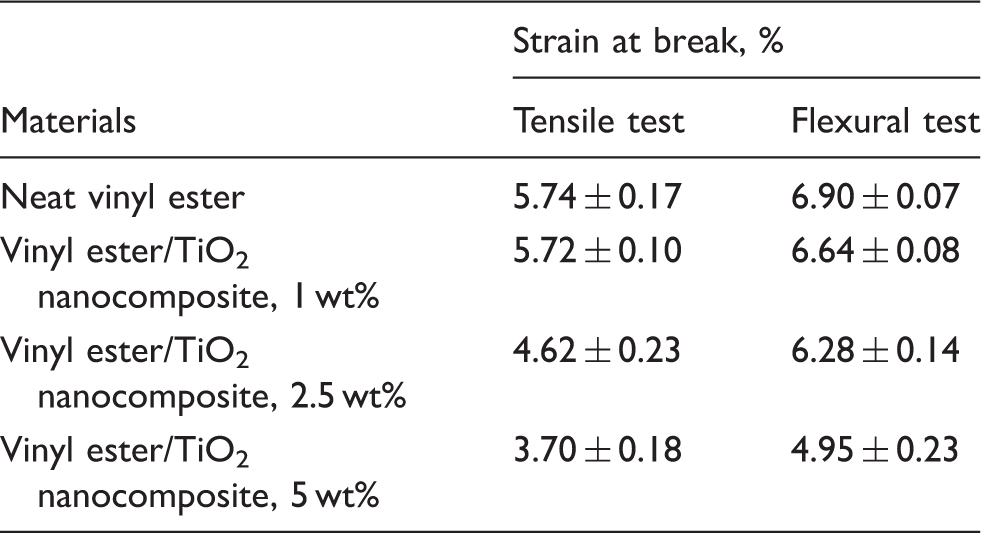
At first, the influence of TiO2 nanoparticles on the mechanical properties of vinyl ester was investigated by elastic modulus, tensile strength, and strain at break of the nanocomposite. Tensile properties of the neat vinyl ester and the nanocomposites are shown in Figure 3 and Table 1. A linear increase in tensile modulus with respect to TiO2 content is evident. This result is typical of polymeric systems in which nanoscale TiO2 dispersion is prevalent.28,37,39 This was as expected since the TiO2 particles inherently possess high moduli and would strengthen the polymeric matrix when dispersed at the nanoscale level. In the range of 0–2.5 wt% of nanoparticles, the tensile strength exhibits the same increasing tendency, while loading more than 2.5 wt% leads to its decline. This can be interpreted by the particle agglomeration, the bubbles trapped during the sample preparation, and the weak interaction between particle and polymer matrix, consistent with the result reported for iron oxide, alumina, and copper oxide nanoparticles reinforced vinyl ester nanocomposites.8,26,27 The number of these flaws may increase with the volume fraction of the filler. The values of strain at break of pure resin and nanocomposite in the range of 0–5 wt% of TiO2 are presented in Table 1. Decrease of strain at break can be attributed to ductile to brittle transition of nanocomposites when the weight fraction of TiO2 increases. This is because a higher number of nanoparticles can reduce the mobility of polymer chains, which leads to more brittle behavior.
Variation of (a) Young’s modulus and (b) tensile strength of the nanocomposites as a function of the TiO2 content. Strain at break of neat vinyl ester and nanocomposites.
Generally, there are two interrelated factors that affected the mechanical properties of nanocomposites: interfacial adhesion and nanoparticles dispersion in the matrix. The load transfer properties are the main issue that ensures the composite system functions properly. 53 Since the reinforcement role of TiO2 nanoparticles depends on the load transfer from matrix to TiO2, the interfacial strength between these two is of crucial importance. Stronger interface leads to better load transfer, which causes improved mechanical properties.53,54 Characteristics of the small nanoparticles such as, higher rigidity than vinyl ester, high specific surface area, and sufficient particle-matrix adhesion should be credited for the interfacial interaction improvement. 39
Flexural test
Flexural mechanical test was performed to evaluate the stiffness of the material.
39
The flexural strength is considered to be a demonstrative parameter for brittle materials, such as polymers and ceramics.
55
It is seen that incorporation of fillers in the polymer matrix has a considerable effect in the flexural properties. The variation in flexural strength and modulus of the vinyl ester-based nanocomposites as a function of filler content is displayed in Figure 4 and Table 1. Flexural strength of the nanocomposite increased slightly with the addition of up to 1 wt% TiO2. Further increasing the filler loading (up to 5 wt%) resulted in a decrease of about 4% in flexural strength compared with the unmodified VER. On the other hand, a gradual decrease in the flexural strength of vinyl ester/TiO2 with increasing filler loading was observed. The increase in flexural strength with small amounts of TiO2 is attributed to its high aspect ratio, which increased the contact surface between TiO2 and the vinyl ester matrix, thus improving the load transfer. The possible reason for the reduction in flexural strength is due to the poor dispersion of nanofiller in the polymer matrix, high stress concentration that paved the way for less load transfer from the matrix to the filler. In general, hard particles affect the strength in two ways. One is the weakening effect due to the stress concentration they cause, and another is the reinforcing effect since they may serve as barriers to crack growth.
56
At high filler loading, agglomerates act as stress concentrators and thus the weakening effect is predominant, causing the premature failure and the decrease in nanocomposite flexural strength.
57
A similar finding has been reported by Mohan et al.
58
for the epoxy polymer containing silicate clay particles.
Variation of (a) flexural strength and (b) flexural modulus of the nanocomposites as a function of the TiO2 content.
The flexural modulus of nanocomposites exhibited an increase as the filler loading increased up to 2.5 wt%. The maximum gain in the flexural modulus of TiO2/vinyl ester is about 22%. This improvement upon addition of filler is attributed to the higher stiffness value of the rigid TiO2 compared to the polymer matrix. However, there was a slight decrease in flexural modulus upon further addition of filler loading until 5 wt%. This is probably caused by the agglomeration of nanofillers in the vinyl ester matrix. This observation is in agreement with the previous study conducted by Chou et al. 57 on the PLLA/PBSL/TiO2 nanocomposites.
Table 1 shows the strain at break for the vinyl ester filled with TiO2 under different mass fraction of filler. It is well known that the filler content reduces the strain at break, due to the hard and rigid nature of the fillers. The deformation of the pure polymer is drastically affected by the presence of these fillers. 58 It is seen that the failure strain continuously decreases as the TiO2 content increases irrespective of the process condition. Here the particles dominate and they reduce the matrix deformation considerably.
Impact test
The impact resistance of a polymer nanocomposite is probably one of the most important and least understood mechanical properties of polymers. In contrast to the other mechanical properties, it is not possible to predict the impact strength of a polymer composite. Charpy impact tests are high-speed fracture tests measuring the energy to break of specimen under bending conditions. The specimens are deformed within a short time and therefore exposed to high strain rates. 6 Unnotched testing is best for detecting agglomerates and flaws because the crack initiates at such imperfections. 59 Since untoughened VER matrices can be classified as brittle materials, they are very sensitive to notches and local inhomogeneities. In general, it was found that the impact properties of polymers are more enhanced by small particles with low aspect ratio, while large particles can act as flaws, and high aspect ratio particles are able to induce large stress concentrations near their edges. 6
The unnotched Charpy impact energy of the vinyl ester-based composites filled with rigid TiO2 nanoparticles is shown in Figure 5. The impact energy of nanocomposites is enhanced as more nanoparticles are added to the system until 2.5 wt% and then the impact strength drops with further addition of filler. This decline is generally attributed to the presence of too many agglomerations in the polymer matrix, which act as a point of crack initiation within the system leading to the composite failure. In order to explain the trends observed for the impact energy, the effective mechanisms that contribute to this property should be studied. The load transfer properties are the main issue that ensures the composite system functions properly. Since the reinforcement role of TiO2 nanoparticles depends on the load transfer from matrix to TiO2, the interfacial strength between these two is of crucial importance. Stronger interface leads to a better load transfer, which causes improved mechanical properties. In addition, a well-known mechanism, which participates in improving the mechanical properties of nanocomposites, is bridging.
53
Clearly, for a constant size of nanoparticles, as the particle weight fraction increases, the number of nanoparticles bridging the crack interface shows an increase.
Charpy impact energy of vinyl ester/TiO2 nanocomposites as a function of the filler content.
The special relationship between the flexural modulus and the impact energy can easily visualize the reinforcing effect of nanoparticles.
6
According to Figure 6, the simultaneous improvement of both impact energy and flexural modulus can result in specimens up to 2.5 wt% TiO2. It turned out that nanoparticles are able to push these properties to a higher level, leading to the generation of polymer composites with superior mechanical properties.6,60 Similar results for other particulate-polymer composite systems have also been obtained.58,60,61
Relationship between stiffness and impact energy of the nanocomposites as a function of the filler content.
Fractography
The fracture surfaces of nanocomposites give initial information about the fracture mechanisms and the influence of nanoparticles on fracture behavior. The SEM fracture surface of nanocomposites (after impact test) that is shown in Figure 7, gives some idea of improved impact properties. Figure 7(a) is the photograph of pure VER, showing the small crazes and the clear river lines with smooth surface on the fracture pattern. It is similar to that resulting from the cleavage fracture of a metal. This indicates that the resistance of the material under crack propagation is less and leads to brittle failure. The surface of the nanocomposite on the addition of 2.5 wt% of TiO2 (Figure 7(b)) reveals some minor agglomerates, but between these agglomerates the particles are separated well and distributed homogeneously within the polymer matrix, leading to a rough surface acting as obstacles for the crack propagation; subsequently, crack deflection occurs.
5
Indeed, when the crack front reaches the rigid TiO2 particles, it has to change its direction and to dodge between them. This fact leads to a higher fracture surface, which correlates with higher energy absorption during fracture. The fracture mechanisms responsible for this behavior are, i.e. breaking of agglomerates and shear lips, as can be observed in Figure 7(b). The former is an indication of a quite good adhesion between fillers and resin, since in case of a poor bonding agglomerate pull-out would occur.
Impact fracture surface of (a) pure vinyl ester and (b) VE + 2.5% TiO2 nanoparticles.
Conclusions
In this study, vinyl ester-based nanocomposites reinforced with TiO2 nanoparticles were prepared and characterized. In particular, the mechanical properties have been investigated. A polymeric coupling agent with the commercial name of BYK-C 8000 was found to increase the adhesion of the nanofiller into the matrix. Impact strength, hardness, tensile, and flexural modulus of the composite improved remarkably when 2.5 wt% of nano-TiO2 was added. The observed improved mechanical properties in the composites reinforced with nanoparticles are closely attributed to the good nanoparticle dispersion in the polymer matrix and to the introduced chemical bonding. The chemical bonding is similar to a silane-coupling agent, like methacrylate silane. Decrease of strain at break can be attributed to ductile to brittle transition of nanocomposites when the weight fraction of TiO2 increases. This is because a higher number of nanoparticles can reduce the mobility of polymer chains, which leads to more brittle behavior. However, additional amount of TiO2 particles causes decline in the mechanical properties. It was concluded that the highest mechanical properties can be achieved at an optimal TiO2 fraction.
Footnotes
Conflict of interest
None declared.
Funding
The authors would like to thank the Company of Faratec Novin Parseh (CFNP) for supporting this work.