





Abstract
Tourmaline/graphene oxide (TGOx, x = 5, 10, 15, and 20) compound with high thermal conductivity and high far infrared emissivity was prepared by a refluxing method. Transmission electron microscopy results confirmed that graphene oxide with a few layers was fabricated, and tourmaline nanoparticles were supported by graphene oxide layers. Thermal interface materials were prepared by adding tourmaline/graphene oxidex compound into epoxy resin. Far infrared emissivity of TGOx and thermal conductivity of thermal interface materials were increased with the weight ratio of graphene oxide in compound, but the corresponding electrical conductivity was slightly decreased. In particular, the tourmaline/graphene oxide15 (tourmaline/graphene oxide ratio of 85:15) showed an enhancement of 4% in far infrared emission than that of tourmaline. The thermal conductivity of thermal interface materials with 5 wt% tourmaline/graphene oxide15 was improved by 380% compared with that of pure epoxy resin, and the electrical conductivity of tourmaline/graphene oxide/epoxy was decreased slightly compared to that of graphene oxide/epoxy.
Introduction
Semiconductor industry has been moving towards higher integrated level, down-scaling size, and increasing clock rate, which led to increasing power density and escalating hot-shot temperatures.1,2 Efficient heat removal becomes a crucial issue for the development of the next generations of integrated circuits (ICs), three-dimensional integration, and ultrafast high-power density communication devices. 3 The interfacial thermal resistance existing between the heat sink base and heat source cannot be removed even by employing advanced cooling techniques on the side of the heat sink. 4 However, thermal interface materials (TIMs), applied between heat sources and heat sinks to enhance heat conduction to the heat spreader, have been proven to be effective in thermal management. 5
Conventional TIMs achieve high thermal conductivity by filling thermally conductive metal particles into polymers or greases matrix. 6 However, large loading volume fractions of fillers and weak thermal coupling restrict its further application.7–9 The requirements of limited size and mechanical property of the heat sink devices make nanometer inorganic filling materials, such as BN, SiC, and Al2O3, a research focus in the field of TIMs with the advantages of small loading volume, low cost, and excellent thermal radiation ability.10–12 Tourmaline, which attracts much attention due to its possession of spontaneous and permanent poles, pyroelectric and piezoelectric properties,12,13 and high infrared emission, has been widely used in radiating coating. Despite its unique thermal dissipating model, there are no literature on its application in TIMs. However, the relatively low thermal conductivity of tourmaline restricts its application in TIMs.
Carbon nanomaterials, such as diamonds, carbon nanotubes, and graphene nanosheets, have been exploited as fillers of TIMs because of their high thermal conductivity and low loading volume fraction.14–16 Among all the carbon nanomaterials, graphene nanosheets have shown the most potentiality for developing thermally conductive polymer compound. 17 Graphene nanoplatelets are an alternative to carbon nanotubes due to the combination of low cost and conductivity properties. 18 As the precursor of graphene, graphene oxide (GO) is much more available and inexpensive, and based on our experiment results, it has been found that it is easier to prepare tourmaline/GO compound (TGOx, x = 5, 10, 15, and 20) through a simple reflux method. Balandin et al. 19 first measured the thermal conductivity of monolayer graphene and found that the suspended graphene has a thermal conductivity of up to 5300 W/mK at room temperature, exceeding that of carbon nanotubes.20–22 It is expected that the combination of high far infrared emissivity of tourmaline nanoparticles and high thermal conductivity and electrical conductivity of GO sheets could provide excellent thermal removal properties.
In this paper, tourmaline/GO was prepared by a refluxing method and was used as the fillers of TIMs to increase the far infrared emission, thermal conductivity and electrical conductivity, thus improving the thermal radiation. TGOx compound was collected after co-ultrasonic and co-refluxing of tourmaline and GO suspension. The formation of effective interfacial bonding between tourmaline nanoparticles and GO sheets was characterized by Raman, X-ray photoelectron spectroscopy (XPS), Fourier Transform infrared spectroscopy (FTIR), and field emission transmission electron microscopy (FETEM). TIMs were fabricated by adding thermal conductive fillers (5 wt%) into epoxy resin. Far infrared emissivity of TGOx and thermal conductivity and electrical conductivity of as-prepared TIMs were measured to determine the effects of different compound addition on TIMs.
Experimental
Materials
Flake graphite powder was spectroscopically pure and purchased from Tianjin Guangfu Fine Chemical Research Institute. Tourmaline was obtained from western China, and tourmaline nanoparticles were prepared by hydrothermal treatment referring to literature. 23 Phosphorus pentoxide (P2O5), potassium permanganate (K2MnO4), potassium persulfate (K2S2O8), sulfuric acid (H2SO4, 98.0%), hydrochloric acid (HCl, 35.0–37.0%), hydrogen peroxide (H2O2, 30.0%), and acetone were purchased from Tianjin Jiangtian Chemicals and all were of analytical grade. Deionized (DI) water from ULUPURE Water Purification System (Chengdu, China) was used to prepare all solutions. Epoxy resin used in this work was E51 (epoxy equivalent weight (E.E.W.) = 185–195 g/eq), purchased from Jiangsu Sanmu Resin Co. Ltd, which is, basically, diglycidyl ether of bisphenol-A. Curing agent utilized was phenol formaldehyde amine (PFA) supplied by Shanghai Resin Co.
Preparation
The graphite oxide was prepared according to the modified Hummers method. 24 In a typical process, flake graphite powders (12 g), K2S2O8 (10 g), and P2O5 (10 g) were gradually added into a flask (5 L) with concentrated H2SO4 (50 mL) under mechanical agitation. The mixture was incubated in water bath at 80℃ for 4.5 h. After that, DI water (2 L) was slowly added to the suspension. The mixture was left overnight and then filtered through a Teflon Millipore membrane. Then, the filter cake was dried in air overnight and slowly dispersed into concentrated H2SO4 (0.5 L) in an ice bath with stirring. The reaction system was kept at 35℃ for 2 h and then diluted with 3.7 L of DI water. Immediately after dilution, 50 mL of 30% H2O2 was slowly added to the suspension, leading to an obvious color change from brown to bright yellow. The mixture was left in air for at least 2 days and then filtered through a Teflon membrane, and washed with 10% HCl and DI water for several times until the pH value reached neutral. The final filter cake was collected and dried in air. GO can be easily obtained by dispersing the obtained graphite oxide in DI water by ultrasonication.
TGOx compound with different weight ratios of tourmaline and GO was fabricated to investigate its thermal conductivity effects on TIMs. In a typical process, the amount of tourmaline was put into a round-bottomed flask containing 0.1 wt% of GO/DI water dispersion prepared by ultrasonication of graphite oxide suspension for 1 h. The mixture was heated up to 100℃ under continuous stirring in a refluxing system for 5 h. Then, the product was collected through 0.45 µm filter and washed with distilled water. TGOx was obtained after drying and grinding as-collected compound. The as-prepared samples were labeled as TGO5, TGO10, TGO15, and TGO20 according to different weight ratios of GO in TGOx compound, that is, 5 wt%, 10 wt%, 15 wt%, and 20 wt%, respectively.
Fabrication of TIMs
TGOx powders were dispersed in acetone and stirred mechanically for 2 h. Epoxy resin was added to the TGOx suspension and heated to 50℃ with mechanical agitation for 1 day to give a homogenization system. The acetone was evaporated by heating the mixture in a convection oven at 80℃ for 12 h. The curing agent (PFA) was added into epoxy resin mixture with agitation for 5 min at 60℃. The mixture was poured into PTFE molds, which have a cavity size of 40 × 10 × 2 mm for the test of thermal conductivity. The molds were put in a vacuum oven and cured using the following cycle, 25 80℃ for 2 h, 120℃ for 6 h, and 160℃ for 6 h.
Characterization
The pristine graphite and GO were determined by laser micro Raman spectrometer (Renishaw Invia Reflex), with the excitation wavelength of 532 nm, data collected from 100 cm−1 to 3200 cm−1. XPS measurements were performed on a K-Alpha spectrometer equipped with Al Kα radiation to obtain the information on chemical binding energy of GO. The functional group of the tourmaline and TGOx compound was detected using a Fourier transform infrared spectrometer (Bruker, VERTEX-80v, America) over a frequency range of 600–4500 cm−1. FETEM (Tecnai F30) and its energy dispersive X-ray (EDX) spectrum operating at an accelerating voltage of 200 kV were examined to investigate the morphology and chemical composition of compound.
Far infrared emissivity of compound
The far infrared emission of tourmaline and TGOx compound is expressed by normal total far infrared emissivity ɛλ, which is the ratio of normal radiation quantity of the samples to that of the blackbody. Far infrared emissivity of tourmaline and compound was determined by a 5DX Fourier transform infrared spectrometer with a wavenumber precision of 0.01 cm−1 and a resolution ratio of 4 cm−1. The effective emissivity of blackbody is over 0.99.
Thermal conductivity of TIMs
The thermal conductivity measurements for TIMs were taken using a Thermal Conductivity Tester (TA instruments, DLF1600) by laser flash method at room temperature. The samples were cut into Φ12.7 mm circle plates with a thickness of 2 mm. In this test, there were 10 samples per formulation.
Electrical conductivity of TIMs
Electrical conductivity of epoxy is characteristic of an electrical insulator. The resistance R of the as-prepared TIMs was measured by an avometer. Similarly, 10 samples per formulation were used to measure the electrical conductivity. Resistivities of TIMs were calculated according to formula of resistivity
Results and discussion
Raman spectroscopy is a powerful tool for characterization of carbon nanostructures because of their high Raman intensities. As shown in Figure 1, the compositional and structural information on pristine graphite and GO were characterized by Raman scattering spectra. Pristine graphite shows two major peaks. The G band at 1580 cm−1 corresponds to in-plane vibration of sp2 carbon atoms involving first-order scattering of the E2g mode.
26
The band at 2700 cm−1 is related to 2D band.
Raman scattering spectra of pristine graphite and as-prepared graphene oxide.
Compared with graphite, there is a strong D band at 1343 cm−1 in the spectra of GO, which is related to breathing mode of A1g symmetry involving phonons near the K zone boundary, representing defects and the presence of amorphous carbon in the structure of single or few layer graphene sheets. The D band here is assigned to the sp3 carbons generated during oxidation of graphite in GO sheets.27,28 Raman spectroscopy indicates the successful synthesis of GO, which can be confirmed in the following XPS test.
The XPS spectra for C 1 s of the GO were measured in order to investigate the carbon states in the sample. As shown in Figure 2, the black curve is the original data for the XPS test, and the red smooth curve is obtained by the peak fitting. The C 1 s peaks of GO appear at 284.6, 286.5, and 288.5 eV, respectively. Concretely, the binding energy of 284.6 eV is attributed to the C–C bonds, and those of 286.5 and 288.5 eV are typically assigned to the C–O and C = O functional groups, respectively.29,30 It is generally accepted that the presence of oxygen in GO is mostly in the form of hydroxyl and epoxy groups on the basal plane, whereas a small amount of carboxyl, carbonyl, phenol, lactone, and quinone is present primarily at the sheet edges.
31
The presence of the C–O and C = O structures reveals that the oxidation of the graphite has been successfully completed.
32
XPS spectra for C 1s of as-prepared GO.
The chemical structures of tourmaline and TGOx compound were characterized by FTIR (shown in Figure 3). It reveals that pure tourmaline shows the typical peaks of Si–O–Si (νSi–O–Si, 710 cm−1), Si–O (νSi–O, 980 cm−1), B–O (νB–O, 1273 cm−1), and the peak at the range of 3450–3600 cm−1 is attributed to the O–H stretching vibrations of the absorbed water.
33
There is no significant change in TGOx compound compared with pure tourmaline, all of these major peaks mentioned above remained in the spectra of TGOx compound. However, the widened absorption mode of O–H group of TGOx compound may be due to the absorbed water of GO. Besides, compared with pure tourmaline, there exists an absorption peak around 1636 cm−1 corresponding to the C = O aromatic bonding of GO,
34
which confirms the existence of GO in TGOx compound. This suggests that tourmaline/ GO (TGOx, x = 5, 10, 15, and 20) compound has been successfully prepared.
Fourier transform infrared spectra of TGOx.
Figure 4 shows the TEM images of TGOx compound. Figure 4(a) displays overlapping regions of tourmaline and GO, which could improve thermal coupling between tourmaline and GO.
1
HRTEM observation reveals that the tourmaline nanoparticles are anchored on the paper-like wrinkles of GO sheets consisting of less than five layers with a platelet thickness of 0.34 nm, as shown in Figure 4(c) and (d). Furthermore, the graphene-based compound was examined by EDX (see Figure 4(b)), which confirms the co-existence of tourmaline and GO. As expected, the spectra reveals the presence of C and O originating from GO, and Si, Al, O, Fe, Ti, etc. originating from tourmaline. The results demonstrate that the designed mechanism has been successfully performed after refluxing process without any surfactant.
FETEM images of graphene supported tourmaline granules, (b) EDX scanning corresponding to the circled area in the imagine (a), (c) HRTEM image of layered GO sheet, (d) HRTEM image of boundary of tourmaline and GO sheet.
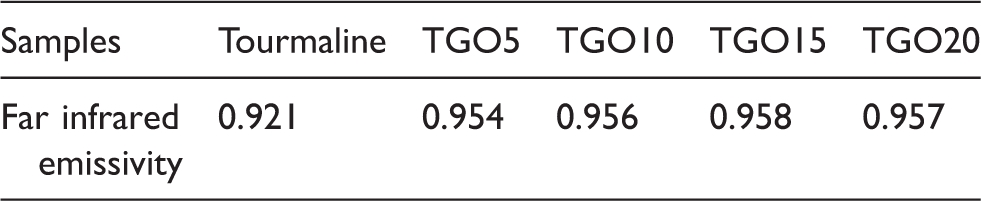
As shown in Table 1, the far infrared emissivity of tourmaline and TGOx compound was measured at 120℃. The far infrared emissivity of TGOx compound is much higher than that of pure tourmaline (ɛλ = 0.921), and is increased with the proportion of GO in compound. TGO15 has the highest far infrared emissivity, which is 4% higher than that of pure tourmaline. The far infrared emission spectra of tourmaline and TGO15 are shown in Figure 5. It can be observed that there is an obvious decline in far infrared emissivity of tourmaline at 5–6.67 µm (corresponding to 1500–2000 cm−1). However, TGO15 showed excellent infrared emission at the same wave range, proven to be important in many fields including agriculture, energy saving, catalysis, medical treatment, and wastewater treatment.
35
TGOx compound behaves more like a grey body with constant emissivity.
36
Its high constant far infrared emissivity at full far infrared wave range can make up for the deficiency of tourmaline at 5–6.67 µm, which can also explain why the TGOx compound has higher far infrared emissivity than tourmaline.
Far infrared emission spectra of tourmaline and TGO15. Far infrared emissivity of tourmaline, TGO5, TGO10, TGO15, and TGO20.
In this test, the thermal conductivity was calculated by averaging those of 10 samples per formulation. Figure 6 shows the thermal conductivity of pure epoxy and epoxy-based compounds with 5 wt% different fillers (different proportions of GO in TGOx compounds). The thermal conductivity of pure epoxy is approximately 0.15 W/mK, which is in agreement with vendor’s specification. As shown in Figure 6, the thermal conductivity of TIMs filled with TGO5, TGO10, TGO15, TGO20 is 0.63, 0.67, 0.72, and 0.70 W/mK, respectively. It can be concluded that the thermal conductivity of TIMs is increased by the addition of fillers and the increasing proportion of GO in TGOx compound. In particular, TIMs filled with TGO15 has the highest thermal conductivity, nearly four times higher than that of pure epoxy resin, which may be partly due to the highest far infrared emission of TGO15. The changes of thermal conductivity of TIMs with proportion of GO in TGOx correspond in a way to the variations of that of far infrared emission of TGOx. In theory, the thermal conductivity of TIMs is increased with the increasing content of GO. However, thermal conductivity of TIMs is similar to far infrared emission of TGOx compound, showing a tendency of first increasing and then decreasing, with a maximum value at the GO content of 15%. The results show that the far infrared emission of TGOx compound has a certain effect on the thermal conductivity of TIMs.
Comparison of thermal conductivity of pure epoxy and epoxy filled with 5 wt% TGO5, TGO10, TGO15, and TGO20.
Figure 7 shows the electrical conductivity of the epoxy-based compound with 5 wt% different fillers (different proportions of GO in TGOx compounds). Ten samples per formulation were used to measure the electrical conductivity, and then the average was calculated. Pure epoxy resin is essentially insulative, with a resistivity of 6.33 E-7 S/m.
37
As shown in Figure 7, the electrical conductivity of TIMs filled with TGO5, TGO10, TGO15, TGO20, and GO is 1.02E-4, 1.02E-4, 1.03E-4, 1.24E-4, and 1.39E-4 S/m, respectively. It can be concluded that the electrical conductivity of pure epoxy resin is increased compared to that of TIMs with different compounds. However, the electrical conductivity of the epoxy-based compound with 5 wt% different fillers is decreased slightly compared to that of GO/epoxy. The electrical resistivity of GO with very strong electrical conductivity is very low (∼10−6 Ω·cm). Therefore, when the content of GO is 20% in TGOx compound, the electrical conductivity of TIMs is more than that of TIMs filled with TGO5, TGO10, and TGO15.
Comparison of electrical conductivity of epoxy filled with 5 wt% TGO5, TGO10, TGO15, and TGO20 and GO.
Conclusion
The effects of TGOx compound on the thermal removal properties of TIMs have been investigated in this study. TGOx compound has been successfully prepared using a refluxing method. Raman, XPS, FTIR, and FETEM results confirm that tourmaline particles are anchored firmly on the surface of wrinkled GO sheets with a few layers. Far infrared emissivity and thermal conductivity increase with the increasing proportion of GO in TGOx compound, and electrical conductivity exhibits a slight increase with the increasing proportion of GO in compound. In particular, the TGO15 shows an enhancement of 4% in far infrared emission than tourmaline, and thermal conductivity of TIMs with 5 wt% TGO15 is improved by 380% compared with that of pure epoxy resin. Electrical conductivity of TGOx/epoxy is decreased slightly compared to that of GO/epoxy.
Footnotes
Declaration of Conflicting Interests
The author(s) declared no potential conflicts of interest with respect to the research, authorship, and/or publication of this article.
Funding
The author(s) disclosed receipt of the following financial support for the research, authorship, and/or publication of this article: This research was financially supported by the Natural Science Foundation of Hebei Province of China (No. E2014202194) and Science and Technology Correspondent Project of Tianjin (No.14JCTPJC00485).